ARTICLE · 996543
高考英语非谓语的最新命题思路
近年来,高考英语语法填空的命题思路呈现出从单纯考查语法规则向语境化、语篇化转变的趋势。题目不再孤立地测试某一语法点,而是将考点融入完整的语篇中,强调在真实语境中理解和运用语言的能力。命题者更注重考查考生对上下文逻辑关系的把握,以及词汇在具体语境中的灵活运用。死背规则往往会跳入命题人的陷阱。
经典的非谓语题目
1.Nanxiang aside, the best Xiao long bao have a fine skin, allowing them ______(61)(lift) out of the steamer basket without tearing or spilling any of their contents. (2023年新课标1卷)
2.It is also common for them _________(56)(hold) during traditional Chinese holidays such as the SpringFestival and the Mid-Autumn Festival, as well as other local festivals. (2026年新课标1卷)
3.I remember ______(61)(push) in a supermarket trolley (手推车) over theuneven car park ground like riding a rollercoaster. (2026年1月浙江卷)
错误分析如下
第一题,allow sb to do sth,故填to lift。
第二题,it is common for sb to do sth,故填to hold。
第三题,remember doing sth表示“记得做过某事”,故填pushing。
正确答案如下
第一题to be lifted,
第二题to be held,
第三题being pushed。
错误分析
这三道题的错误答案与正确答案的差异,恰恰揭示了非谓语动词解题中两个最容易被忽视的维度:“语态”与“逻辑主语”。
第一题中,虽然“allow sb to do sth”结构正确,但主语“them”与“lift”之间是被动关系,故用被动语态to be lifted。
第二题中,“them”与“hold”之间是被动关系——被举行、被使用的,因此必须用to be held。
第三题中,“I”与“push”之间也是被动关系——我是被手推车载着颠簸的,而非自己在推车,故用being pushed。
这三道题共同说明,非谓语动词的选择不能仅凭固定搭配机械套用,而必须回到句子本身,先判断逻辑主语与动词之间的主被动关系,再结合时态要求确定最终形式。考生在平时练习中,应养成“三步走”的解题习惯:先找逻辑主语,再判主被动,最后定时态。这种“三步走”策略看似简单,却是规避非谓语动词失分的核心路径。许多考生在考场上急于套用“remember to do”或“allow sb to do”等固定搭配,却忽略了搭配内部的主被动关系,导致在语态判断上失分。
因此,建议在复习非谓语动词时,将固定搭配与语境分析结合训练,每做完一题都主动追问“谁发出这个动作”“动作承受者是谁”,以此强化语态敏感度。同时,可整理常见易错搭配清单,如“remember doing/to do”“allow sb to do/to be done”等,在清单中标注出主被动差异的典型例题,反复对比记忆。
非谓语的解题技巧
如果括号内为及物动词,后面有宾语用主动,无宾语则优先考虑被动;若括号内为不及物动词,则不存在被动语态,直接考虑主动。这一判断标准在实战中极为有效,能帮助考生快速锁定方向。
例如,看到“The problem requires ______ (solve)”时,先判断solve为及物动词,其后无宾语,故需用被动形式to be solved或being solved;而“We need ______ (solve) the problem.”中solve后有宾语the problem,故用主动形式to solve。
此外,还需警惕“主动形式表被动意义”的特殊结构,如need/want/require后接doing形式,如“The car needs washing.”虽形式主动,但意义被动,相当于“The car needs to be washed.”。这类特殊结构在考试中反复出现,考生应将其作为独立考点记忆,而非依赖常规主被动判断。
在实战演练中,建议将上述判断标准与特殊结构分开处理:先按“及物动词看宾语、不及物动词用主动”的常规流程快速定位,再单独核对是否存在特殊结构。若题目中出现need/want/require/be worth等词,则优先考虑doing形式表被动含义。
综合练习
Childhood‑time community activities leave deep marks on us.
I still remember ①________ (lead) by my grandma to join neighborhood cultural events when I was seven. I remember ②________ (perform) simple folk dances together with other kids on the square. Sometimes I forget ③________ (arrive) early for preparations, so I would miss part of the opening show.
It is common for local residents ④________ (take) an active part in these activities. It is also common for such events ⑤________ (organize) during traditional festivals. The open‑air stage allows volunteers ⑥________ (put) on various performances. It also allows wonderful folk arts ⑦________ (show) to more young people.
It is necessary for teenagers ⑧________ (gain) exposure to our local culture. And it is vital for these valuable traditions ⑨________ (pass) down generation after generation. I will never forget ⑩________ (encourage) by the old artists to learn folk art in those years.
参考答案
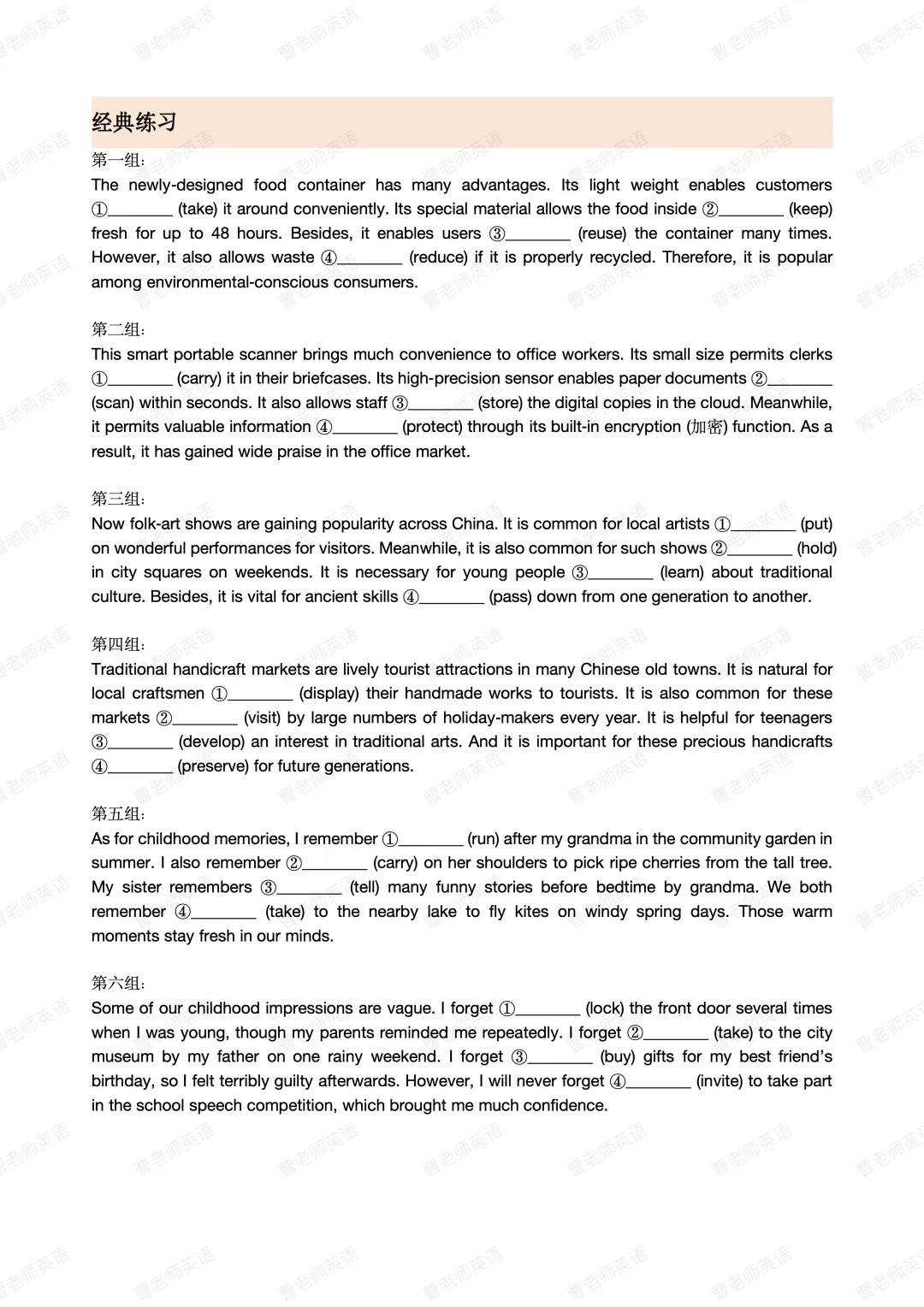
第一组答案:
①to take②to be kept ③to reuse ④to be reduced。此题考查enable/allow后接“宾语+不定式”结构,其中②④因宾语与动作间存在被动关系,需用不定式的被动式to be done。
第二组答案
①to carry②to be scanned ③to store ④to be protected。此题同样考查“动词+宾语+不定式”结构,其中②④因宾语与动作之间为被动关系,需用不定式的被动式to be done。整体来看,这两组练习的核心考点一致。
第三组答案
①to put②to be held ③to learn ④to be passed。此题考查“It is + adj. + for sb./sth. + to do”结构,其中②④因主语与动作之间为被动关系,需用不定式的被动式to be held和to be passed。整体来看,此题的核心考点在于“It is + adj. + for + 名词/代词 + 不定式”结构中,不定式主动式与被动式的选择取决于主语与动词之间的逻辑关系:若主语是动作的执行者,用主动式to do;若主语是动作的承受者,则用被动式to be done。
第四组答案
①to display②to be visited ③to develop ④to be preserved。此题同样考查“It is + adj. + for + 名词 + 不定式”结构,其中①③因主语与动作之间为主动关系,用不定式主动式;②④因主语是动作的承受者,用不定式被动式。
第五组答案:
①running②being carried ③being told ④being taken。此题考查“remember doing sth.”结构,表示“记得做过某事”。其中①因主语与动作之间为主动关系,用动名词主动式;②③④因主语是动作的承受者,用动名词被动式。
第六组答案:
①to lock②being taken ③to buy ④being invited。此题考查“forget to do sth.”与“forget doing sth.”的区别。①③因动作未发生,用不定式表示“忘记去做”;②④因动作已发生且主语是承受者,用动名词被动式表示“忘记曾被做”。注意区分:forget to do 强调“忘记去做某事”,动作未发生;forget doing 强调“忘记做过某事”,动作已发生。
综合练习答案:① being led② performing ③ to arrive ④ to take ⑤ to be organized ⑥ to put ⑦ to be shown ⑧ to gain ⑨ to be passed ⑩ being encouraged