2 0 2 3 下 粉 笔 教 资
全 真 模 拟 初 中 2
▹
讲师:原 原
更多干货关注 粉笔教师教育 粉笔教师一 、单 项 选 择 题
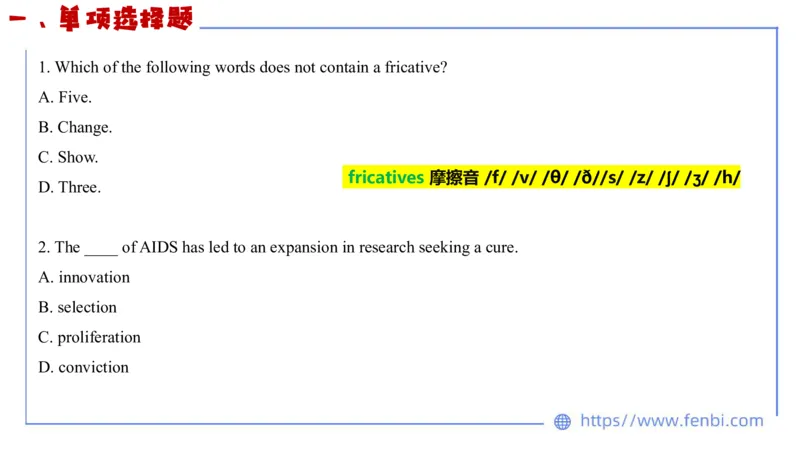
1. Which of the following words does not contain a fricative?
A. Five.
B. Change.
C. Show.
fricatives 摩擦音 /f/ /v/ /θ/ /ð//s/ /z/ /ʃ/ /ʒ/ /h/
D. Three.
2. The ____ of AIDS has led to an expansion in research seeking a cure.
A. innovation
B. selection
C. proliferation
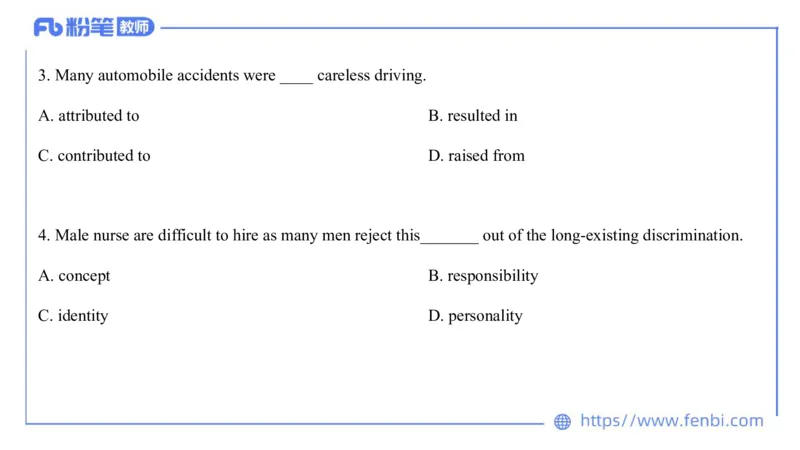
D. conviction3. Many automobile accidents were ____ careless driving.
A. attributed to B. resulted in
C. contributed to D. raised from
4. Male nurse are difficult to hire as many men reject this_______ out of the long-existing discrimination.
A. concept B. responsibility
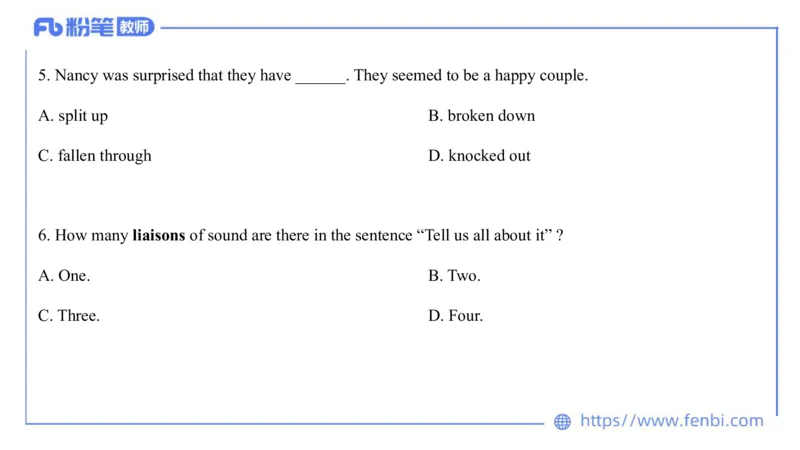
C. identity D. personality5. Nancy was surprised that they have ______. They seemed to be a happy couple.
A. split up B. broken down
C. fallen through D. knocked out
6. How many liaisons of sound are there in the sentence “Tell us all about it” ?
A. One. B. Two.
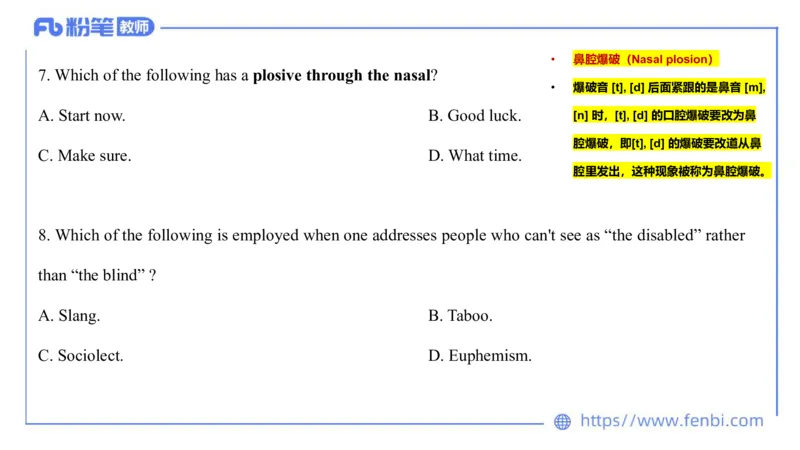
C. Three. D. Four.• 鼻腔爆破(Nasal plosion)
7. Which of the following has a plosive through the nasal?
• 爆破音 [t], [d] 后面紧跟的是鼻音 [m],
A. Start now. B. Good luck. [n] 时,[t], [d] 的口腔爆破要改为鼻
腔爆破,即[t], [d] 的爆破要改道从鼻
C. Make sure. D. What time.
腔里发出,这种现象被称为鼻腔爆破。
8. Which of the following is employed when one addresses people who can't see as “the disabled” rather
than “the blind” ?
A. Slang. B. Taboo.
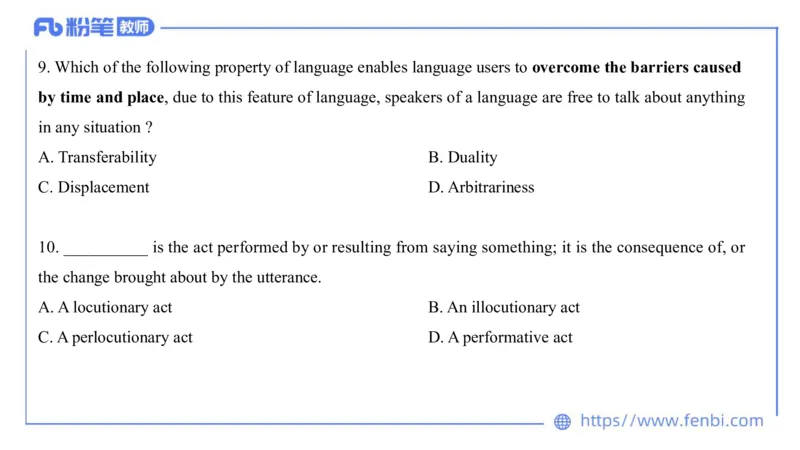
C. Sociolect. D. Euphemism.9. Which of the following property of language enables language users to overcome the barriers caused
by time and place, due to this feature of language, speakers of a language are free to talk about anything
in any situation ?
A. Transferability B. Duality
C. Displacement D. Arbitrariness
10. __________ is the act performed by or resulting from saying something; it is the consequence of, or
the change brought about by the utterance.
A. A locutionary act B. An illocutionary act
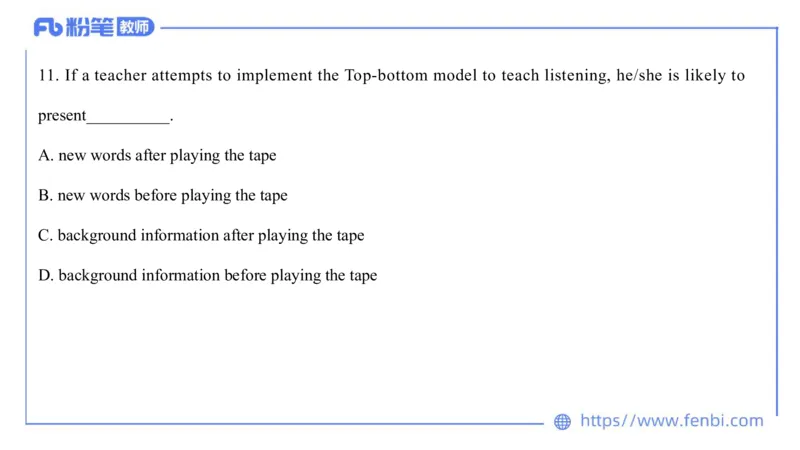
C. A perlocutionary act D. A performative act11. If a teacher attempts to implement the Top-bottom model to teach listening, he/she is likely to
present__________.
A. new words after playing the tape
B. new words before playing the tape
C. background information after playing the tape
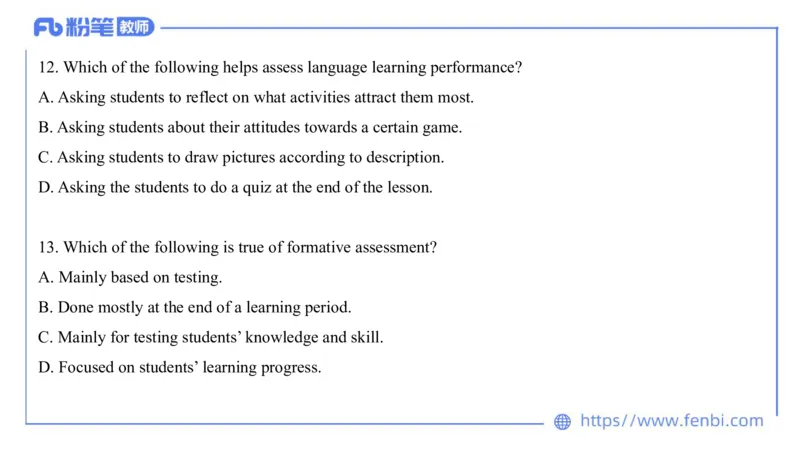
D. background information before playing the tape12. Which of the following helps assess language learning performance?
A. Asking students to reflect on what activities attract them most.
B. Asking students about their attitudes towards a certain game.
C. Asking students to draw pictures according to description.
D. Asking the students to do a quiz at the end of the lesson.
13. Which of the following is true of formative assessment?
A. Mainly based on testing.
B. Done mostly at the end of a learning period.
C. Mainly for testing students’ knowledge and skill.
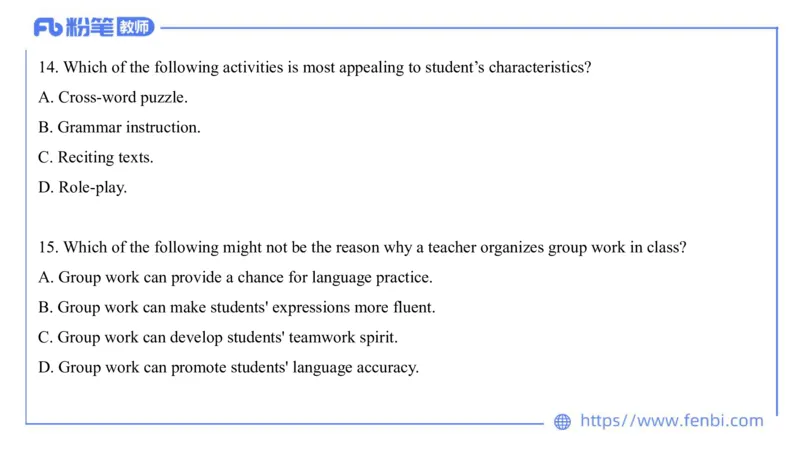
D. Focused on students’ learning progress.14. Which of the following activities is most appealing to student’s characteristics?
A. Cross-word puzzle.
B. Grammar instruction.
C. Reciting texts.
D. Role-play.
15. Which of the following might not be the reason why a teacher organizes group work in class?
A. Group work can provide a chance for language practice.
B. Group work can make students' expressions more fluent.
C. Group work can develop students' teamwork spirit.
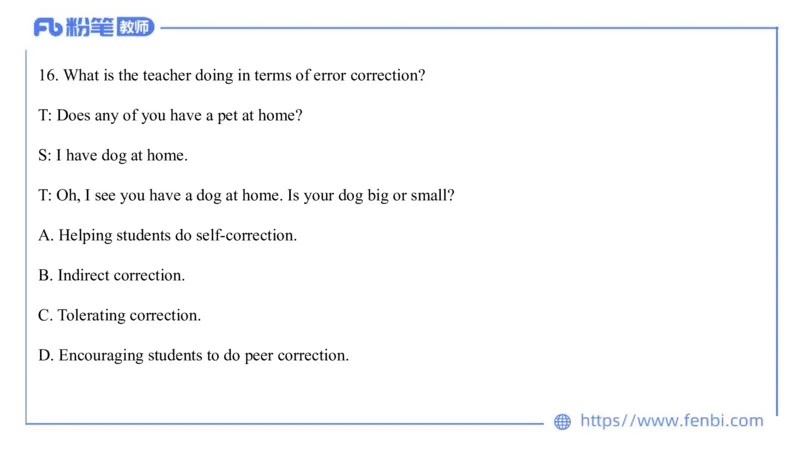
D. Group work can promote students' language accuracy.16. What is the teacher doing in terms of error correction?
T: Does any of you have a pet at home?
S: I have dog at home.
T: Oh, I see you have a dog at home. Is your dog big or small?
A. Helping students do self-correction.
B. Indirect correction.
C. Tolerating correction.
D. Encouraging students to do peer correction.17. If the teacher wants to know whether the students can use the comparative degree of adjectives,
which of the following activities should the teacher choose?
A. Asking the students to do multiple-choice questions concerning the comparative degree of adjectives.
B. Asking the students to compare the life today with the life ten years ago.
C. Asking the students to complete sentences with the right forms of the adjectives given.
D. Asking the students to talk about the rules about the comparative degree of adjectives.
18. In speaking activities,a speaker often tries to avoid using a difficult word or structure but use a
simpler one instead. What learning strategy does the speaker use?
A. Simplification. B. Generalization.
C. Paraphrase. D. Avoidance.19. What is the teacher doing in terms of error correction?
S: I go to the theater last night.
T: You GO to the theater last night?
A. Correcting the student's mistake directly. B. Hinting that there is a mistake.
C. Encouraging peer correction. D. Asking the student whether he really went to the theater.
20. Students can do _____ activities, such as, silent reading, doing written exercises, writing something
down individually after brainstorming in a group, or individual speech preparations, etc.
A. pair work B. whole-class work
C. individual D. group workPassage 1
21. What are teachers complaining about?
A. There are too many students requiring special attention.
B. They are under too much stress counselling needy students.
C. Schools are inadequately equipped to implement any intervention.
D. They lack the necessary resources to address pupils’ mental problems.
【第二段】Schools and teachers have consistently reported the scale of the problem since 2009. Last
year, over half of teachers reported that more of their pupils experience mental health problems than in
the past. But teachers also consistently report how ill-equipped they feel to meet pupils’ mental health
needs, and often cite a lack of training, expertise and support from the National Health Service.22. What do we learn from the passage about community health services in Britain?
A. They have deteriorated due to budget cuts.
B. They facilitate local residents’ everyday lives.
C. They prove ineffective in helping mental patients.
D. They cover preventative care for the local residents.
【第三段】Part of the reason for the increased pressure on schools is that there are now fewer “early
intervention” and low-level mental health services based in the community. Cuts to local authority
budgets since 2010 have resulted in a significant decline of these services, despite strong evidence of
their effectiveness in preventing crises further down the line.23. Where does the author suggest mental health services be placed?
A. At home.
B. At school.
C. In hospitals.
D. In communities.
【第五段】There are strong arguments for why schools are best placed to provide mental health
services....Recent studies have shown that children and young people largely prefer to see a counsellor in
school rather than in an outside environment. Young people have reported that for low-level conditions
such as stress and anxiety, a clinical setting can sometimes be daunting.24. What do we learn from the recent studies?
A. Students prefer to rely on peers to relieve stress and anxiety.
B. Young people are keen on building meaningful relationships.
C. Students are more comfortable seeking counselling in school.
D. Young people benefit from various kinds of outdoor activities.
【第五段】Recent studies have shown that children and young people largely prefer to see a counsellor
in school rather than in an outside environment. Young people have reported that for low-level conditions
such as stress and anxiety, a clinical setting can sometimes be daunting.25. What does the author mean by “a cultural shift” (Line 2 and 3, Para. 6)?
A. Simplification of schools’ academic curriculums.
B. Parents’ involvement in schools’ policy-making.
C. A change in teachers’ attitudes to mental health.
D. A change in the conception of what schools are.
【第六段】There are already examples of innovative schools which combine mental health and
wellbeing provision with a strong academic curriculum. This will, though, require a huge cultural shift.
Politicians, policymakers, commissioners and school leaders must be brave enough to make the leap
towards reimagining schools as providers of health as well as education services.Passage 2
26. Why are some researchers irritated at the USDA’s 2016–2020 Dietary Guidelines?
A. It ignores the harmful effect of red meat and processed food on health.
B. Too much emphasis is given to eating less meat and buying local food.
C. The dietary recommendations are not based on medical science.
D. It takes no notice of the potential impact on the environment.
【第一段】But the best available science also has a lot to say about what those food choices do to the
environment, and some researchers are annoyed that new dietary recommendations of the USDA (United
States Department of Agriculture) released yesterday seem to utterly ignore that fact.27. Why does the author say the USDA could have contributed a lot to lowering the climate cost
through its dietary guidelines?
A. It has the capacity and the financial resources to do so.
B. Its researchers have already submitted relevant proposals.
C. Its agencies in charge of drafting the guidelines have the expertise.
D. It can raise students’ environmental awareness through its programs.
【第三段】The government’s dietary guidelines could have done a lot to lower that climate cost.
Not just because of their position of authority: The guidelines drive billions of dollars of food
production through federal programs like school lunches and nutrition assistance for the needy.28. What do we learn from the Dietary Guidelines Advisory Committee’s scientific report?
A. Food is easily contaminated from farm to belly.
B. Greenhouse effect is an issue still under debate.
C. Modern agriculture has increased food diversity.
D. Farming consumes most of our natural resources.
【第四段】Food production is the largest user of fresh water, largest contributor to the loss of
biodiversity, and a major contributor to using up natural resources.29. What may account for the neglect of sustainability in the USDA’s Dietary Guidelines according to the
author?
A. Its exclusive concern with Americans’ food safety.
B. Its sole responsibility for providing dietary advice.
C. Its close ties with the agriculture companies.
D. Its alleged failure to regulate the industries.
【第六段】The official response is that sustainability falls too far outside the guidelines’ official scope,
which is to provide “nutritional and dietary information.”
【第七段】Possibly the agencies in charge of drafting the decisions are too close to the industries they
are supposed to regulate. On the one hand, the USDA is compiling dietary advice. On the other, their
clients are US agriculture companies.30. What should the USDA do to achieve food security according to David Wallinga?
A. Give top priority to things like nutrition and food security.
B. Endeavor to ensure the sustainable development of agriculture.
C. Fulfill its mission by closely cooperating with the industries.
D. Study the long-term impact of climate change on food production.
【最后一段】David Wallinga, for example, says, “In previous guidelines, they’ve always been
concerned with things like food security—which is presumably the mission of the USDA. You absolutely
need to be worried about climate impacts and future sustainability if you want secure food in the future.”二 、简 答 题
请简述英语学习中四种重要的课堂活动组织形式(12分),并说明其用途(8分)。【参考答案】
(1)全班活动(Whole class work)。班级活动就是需要全班同学共同参与的学习活动。当教师
呈现新知识、给出解释、检查答案、进行准确性的练习活动或总结知识时,经常采用全班活动。
在整个活动过程中,教师提出问题,学生按照老师指示一起回答或逐个回答。课堂效率高,对学
生的整体包容性强。
(2)小组活动(Group work)。小组活动就是将学生分成若干小组,通过小组内成员的相互配合
来完成学习任务的活动。单词游戏、小品表演、访谈等活动都可以采用小组活动的组织形式。计
划要周密,给出清晰的指令,学生要了解小组活动的目的、具体做法、最终得到的结果及展示方
式。教师可以作为参与者加入小组活动。有助于提升学生的团队合作意识,提升他们的口语表达
能力。(3)配对活动(Pair work)。配对活动是指将团体成员两两分组或三人分组,围绕某一团体主
题所展开的活动。在活动过程中,教师可以采取巡场的方式检查学生讨论进度,必要时可以提供
帮助。该活动类型赋予了教学内容情景化和趣味化,有助于培养学生的自主性和创造性。
(4)个人活动(Individual study)。个人活动是学生独立完成学习任务的活动,主要用于锻炼学
生自主学习能力。单项操练性活动如填空、选择、默读等一般采用个人活动的组织形式。三 、教学 情 境分 析题
根据题目要求完成下列任务,用中文作答。
某重点初中的王老师在讲授有关地震这一课中,在阅读正文前设计了如下环节:
(1)与学生问好,邀请学生在教室前面做 daily report。
(2)教师利用多媒体展示一些唐山地震前与地震后的照片,让学生观察后,找学生用英语谈谈
前后变化。
(3)教师利用多媒体播放唐山或者印度大地震电影片段,观看后直接找学生谈谈自己的感受。结合材料回答以下问题:
(1)案例中教师主要采用了什么教学方法?(2分)这种方法有哪些优点?(8分)【参考答案】
(1)该案例中王老师在教学中多次运用多媒体展示图片以及视频,为学生创设了真实的英语情
境,主要采用了情境教学法进行教学。该方法的优点有以下几点:
①情境教学以其直观性、趣味性、生动性激发了学生的参与积极性和学习欲望。
②情境在教学中的应用,改变了以往单纯的条款记忆式的学习方式,把枯燥的学习放在了逼真的
环境中。
③针对性强。这种方式更有利于教师发现教学中存在的问题,及时掌握教学效果,并对教学内容
做出相应的调整,提高效率。
④时效性强。这种教学法需要不断更新教学内容,克服了传统教学模式下内容陈旧的问题,教师
必须对学生学习过程中发生的新问题进行解答,使教师所教内容的时效性更强。结合材料回答以下问题:
(2)案例中的教学值得借鉴的地方以及主要存在的问题有哪些?(10分)某重点初中的王老师在讲授有关地震这一课中,在阅读正文前设计了如下环节:
(1)与学生问好,邀请学生在教室前面做 daily report。
(2)教师利用多媒体展示一些唐山地震前与地震后的照片,让学生观察后,找学生用英语谈谈
前后变化。
(3)教师利用多媒体播放唐山或者印度大地震电影片段,观看后直接找学生谈谈自己的感受。【参考答案】
(2)该案例中王老师始终以学生为主体,有很多值得借鉴的地方。
首先,王老师让学生坚持做 daily report 可以培养学生学英语的兴趣,无形中也提高了学生应用英
语的能力,也锻炼了学生在公共场合表达自己的能力。
其次,在学习文章内容前为学生展示有关地震的相关材料,可以让学生对所学内容更熟悉,针对
性比较强,为后续学习奠定了基础。另外,利用多媒体创设情境可以帮助学生身临其境地学习目
标语言,以情激趣,充分调动学生学习的积极性。【参考答案】
案例中也有不足之处,首先,王老师利用多媒体展示一些唐山地震前与地震后的照片,让学生观
察后,找学生用英语谈谈前后变化。由于是阅读前,那么跟话题有关的词汇和表达还未系统学习
过,那么此时的表达对于学生是有一定难度的,容易降低学生的积极性。
其次,王老师让学生看完图片以及视频后直接让学生谈论感受,没有给学生足够的思考时间,学
生自己完成也可能有局限性,效果大打折扣。(3)针对案例中的问题提出建设性的修改意见。(10分)(3)建议一:当课上教师安排与话题有关的讨论时,应该结合学生的程度以及材料的内容进行
新知识的讲解,比如词汇和句型等,有助于为学生扫清阅读障碍,同时也能够让学生在讨论中得
心应手,真正体现学生的自主性和创造性,达到老师预期的教学效果。
建议二:不管是观看图片还是视频,结束后可以分成两人或者多人小组,给学生大约5分钟的时
间思考并讨论,交换意见可以让学生提高合作意识,开阔思路,学生的思维也能够得到充分的启
发。与此同时,学生也可以提升交流能力以及英语实践能力,提高学生学习英语的兴趣。四 、教学 设 计 题
根据提供的信息和语言素材设计教学方案,用英文作答。
设计任务:请阅读下面的学生信息和语言素材,设计一份时长 分钟的听说教学方案。
15
教案没有固定格式,但须包含下列要点:
①
Teaching objectives
②
Teaching contents
③
Key and difficult points
④
Major steps and time allocation
⑤
Activities and justifications
教学时间: 分钟
15
学生概况:某城镇普通中学八年级(初中二年级)学生,班级人数 人,多数学生已经达到
40
《义务教育英语课程标准( 年版)》三级水平。学生课堂参与积极性一般。
2022语言素材:
Reporter: Hi, I'm doing a survey for the Green City Daily News.What's the best clothing store in town?
Boy: I think Jason's is the best.
Reporter: Why?
Boy: Jeans Comer and Trendy Teens are good stores, but Jason's has good quality clothes. It's also cheaper than the
other stores.
Reporter: What do you like about the other stores?
Boy: Well,let me see. Trendy Teens is in a fun part of town,but it's expensive. Don't go to Funky Fashions. It has the
worst clothes in town.
Reporter: OK.What about the radio stations in Green City? What's the best radio station?语言素材:
Boy: I guess Jazz 107.9 FM is the best.
Reporter: Why?
Boy: Because it has the most interesting music. It's much better than the other stations in town.
Reporter: What about the other radio stations?
Boy: Well, I think Oldies 102.1 FM is pretty bad. It has the worst music.
Reporter: I heard that Easy Listening 97.9 FM is the most popular.
Boy: Not for me.
Reporter: Why not?
Boy: Just listen to their commercials. They're worse than commercials of All Talk 970 FM!【参考设计】
1. Teaching contents
This is listening lesson. It mainly talks about a dialogue between a reporter and a boy.The reporter is doing a survey
about the best clothing store and the best radio station in Green City.2. Teaching objectives
Language competence: Students will understand the basic meaning of the new words, such as quality, expensive,
commercial and so on.
Through listening, students will understand the main idea of the listening materials and be able to use the target
language to express their opinions about their own city.
Cultural awareness: Students can have self-confidence and self-improvement of good character.
Thinking quality: Students can correctly understand and judge the thematic meaning and viewpoint of the passage.
Learning ability: Students will be willing to take part in the class activities and cooperate with other group members.3. Teaching key and difficult points
Key point:
How to learn the useful expressions, the story and its topic.
Difficult point:
How to help students accurately use the new words and sentence structure and then apply them into their daily life.4. Teaching procedures
Step 1 Pre-listening (4 mins)
(1) New knowledge teaching
With the help of some pictures, the teacher will guide students to understand the meaning and usage of the new words,
including quality, expensive, commercial and so on.
(2)Prediction
Before listening, the teacher will organize students to make a prediction. Some hints will be provided to help them.
Hint 1: Words and sentence just referred to.
Hint 2: A video in which students can see a boy is talking about his city life with a reporter.
【Justification】The above activities can help students recognize the new words, remove the barriers, and lay the
foundation for the next step of “listening”.Step 2 While-listening(8 mins)
(1)Extensive listening
Students will listen to the passage for the first time to check their predictions and conclude the main idea of the
passage.
(2)Intensive listening
Students should listen to the passage for the second time and do the following task:
True or False:
1. Trendy Teens is in a fun part of town, and it's not expensive. (T/F)
2. The boy is doing a survey for the Green City Daily News. (T/F)
3. The reporter thinks that Oldies 102.1 FM is pretty good. (T/F)(3) Listening and repeating
Students will listen to the passage for the third time and read after it. They should pay attention to the pronunciation
and intonation.
【Justification】In the process of completing the listening tasks at different levels, students can not only understand
the content and certain details of the passage, but also improve their listening skills.Step 3 Post-listening(3 mins)
Doing a survey
Ask students to work in pairs. One student acts as the interviewer and the other acts as the interviewee.Then the
interviewer makes a survey about the interviewee's preferences in big cities. Several minutes will be given. When
time's up, several students will be invited to share their results. Then the teacher will comment on students'
performance.
【Justification】Pair work will provide students with the opportunity to apply what they have learned to the situation,
improve their comprehensive language skills, and boost their confidence in learning English and strengthen their
sense of teamwork.