2 0 2 3 下 粉 笔 教 资
全 真 模 拟 高 中 2
▹
讲师:原 原
更多干货关注 粉笔教师教育 粉笔教师一 、单 项 选 择 题
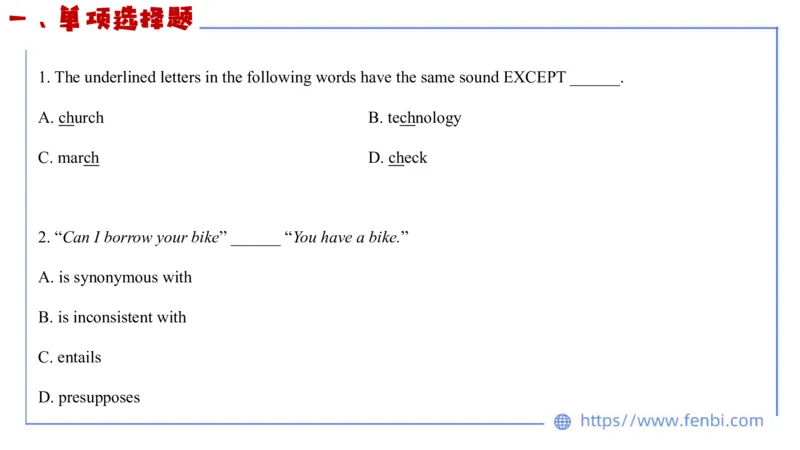
1. The underlined letters in the following words have the same sound EXCEPT ______.
A. church B. technology
C. march D. check
2. “Can I borrow your bike” ______ “You have a bike.”
A. is synonymous with
B. is inconsistent with
C. entails
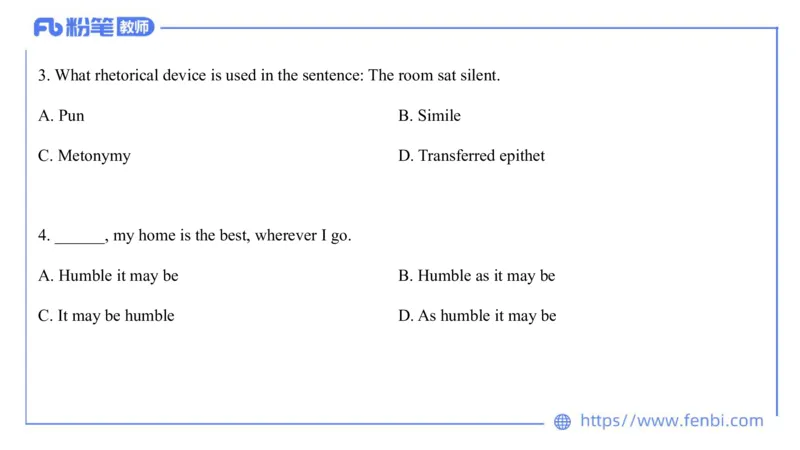
D. presupposes3. What rhetorical device is used in the sentence: The room sat silent.
A. Pun B. Simile
C. Metonymy D. Transferred epithet
4. ______, my home is the best, wherever I go.
A. Humble it may be B. Humble as it may be
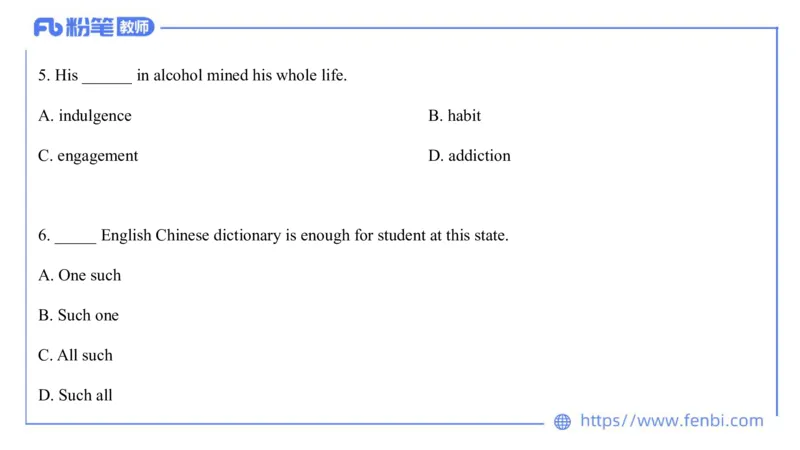
C. It may be humble D. As humble it may be5. His ______ in alcohol mined his whole life.
A. indulgence B. habit
C. engagement D. addiction
6. _____ English Chinese dictionary is enough for student at this state.
A. One such
B. Such one
C. All such
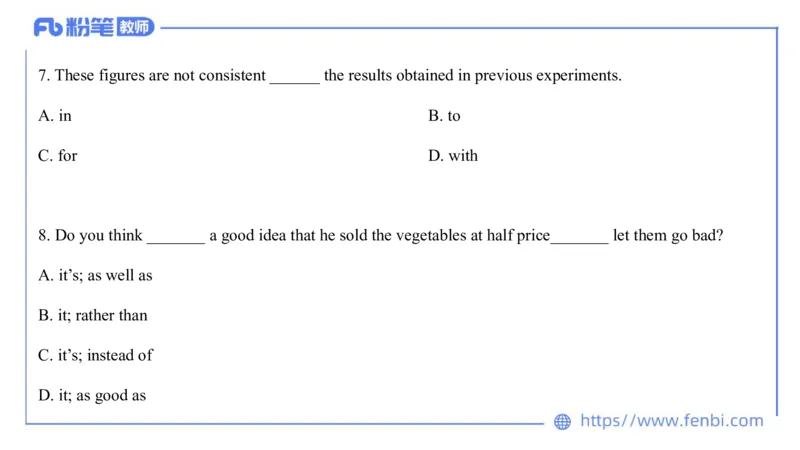
D. Such all7. These figures are not consistent ______ the results obtained in previous experiments.
A. in B. to
C. for D. with
8. Do you think _______ a good idea that he sold the vegetables at half price_______ let them go bad?
A. it’s; as well as
B. it; rather than
C. it’s; instead of
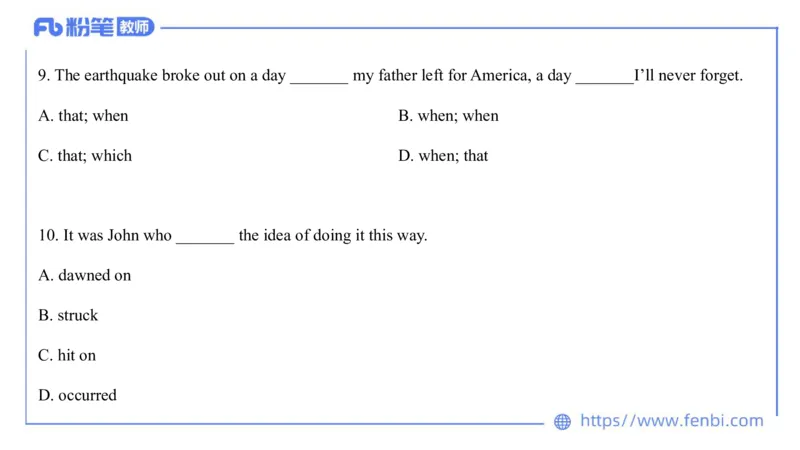
D. it; as good as9. The earthquake broke out on a day _______ my father left for America, a day _______I’ll never forget.
A. that; when B. when; when
C. that; which D. when; that
10. It was John who _______ the idea of doing it this way.
A. dawned on
B. struck
C. hit on
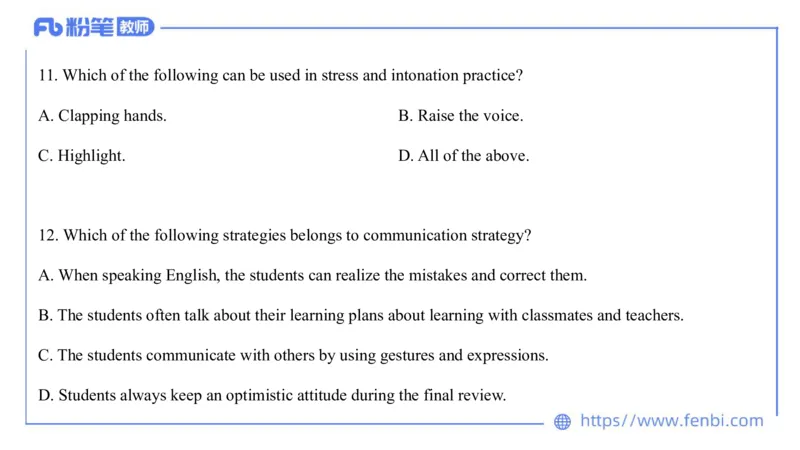
D. occurred11. Which of the following can be used in stress and intonation practice?
A. Clapping hands. B. Raise the voice.
C. Highlight. D. All of the above.
12. Which of the following strategies belongs to communication strategy?
A. When speaking English, the students can realize the mistakes and correct them.
B. The students often talk about their learning plans about learning with classmates and teachers.
C. The students communicate with others by using gestures and expressions.
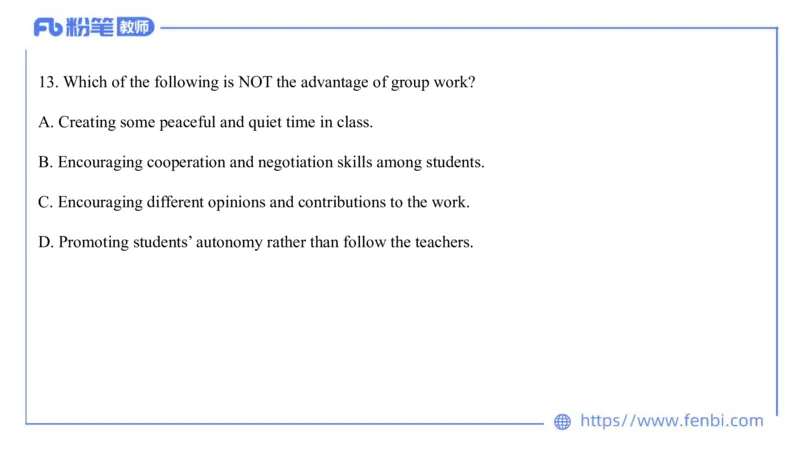
D. Students always keep an optimistic attitude during the final review.13. Which of the following is NOT the advantage of group work?
A. Creating some peaceful and quiet time in class.
B. Encouraging cooperation and negotiation skills among students.
C. Encouraging different opinions and contributions to the work.
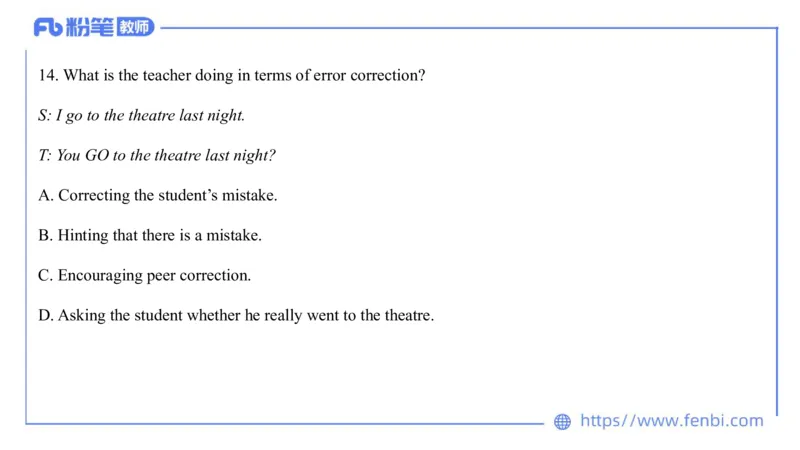
D. Promoting students’ autonomy rather than follow the teachers.14. What is the teacher doing in terms of error correction?
S: I go to the theatre last night.
T: You GO to the theatre last night?
A. Correcting the student’s mistake.
B. Hinting that there is a mistake.
C. Encouraging peer correction.
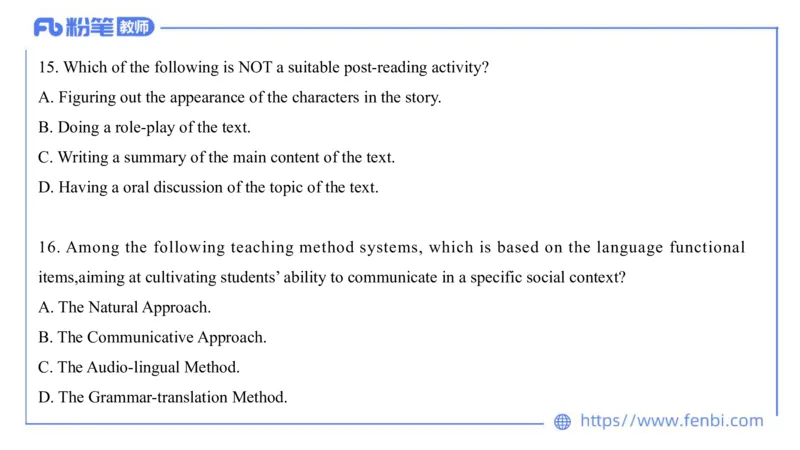
D. Asking the student whether he really went to the theatre.15. Which of the following is NOT a suitable post-reading activity?
A. Figuring out the appearance of the characters in the story.
B. Doing a role-play of the text.
C. Writing a summary of the main content of the text.
D. Having a oral discussion of the topic of the text.
16. Among the following teaching method systems, which is based on the language functional
items,aiming at cultivating students’ ability to communicate in a specific social context?
A. The Natural Approach.
B. The Communicative Approach.
C. The Audio-lingual Method.
D. The Grammar-translation Method.17. The situational approach is a grammar-based language teaching method which focuses on ______.
A. grammar and vocabularies
B. oral language and sentence patterns
C. speaking and listening
D. pronunciation and speaking
18. As far as teaching grammar is concerned, in the inductive method, the teacher induces the learners to
realize grammar rules ______.
A. without any explicit explanation
B. by explaining in an explicit way
C. with explicit explanation
D. by telling them the rules19. Questioning plays an important role for the classroom teaching. Which of the following questions
does not belong to comprehension questions?
A. What is the main idea of this paragraph?
B. Can you tell the difference between the two terms?
C. Can you retell the text we have learned last week?
D. Can you paraphrase the sentence in your own words?
20. If a teacher intends to maintain discipline of the class, what instruction would he/she give to the
students?
A. Close your books.B. Listen to the tape.
C. Raise your hands.D. Be quiet, please.Passage 1
21.What is the passage mainly about?
A.Mixed emotions
B. Great poets
C. Lyric poems
D. Musical forms
【通读全文】22.What does the underlined word “articulate” in Para. 2 probably mean?
A.clear
B. safe
C. straight
D. difficult
【第二段】But poetry is more than a great pleasure. It should also be an outlet for our own unspoken thoughts
and our varied moods. It makes articulate our choked-up passageways of speech, giving adequate expression to
our pent-up loves and joys and glories, and furnishes release and relief to our fears, grieves and sorrows.23. According to the author, a great poet is one who ______.
A. gives meaning to readers’ life
B. makes readers blessed with wisdom
C. puts readers in a peaceful state of mind
D. enables readers to have a sense of belonging
【第二段】A great poet takes our half-formed thoughts, or suppressed moods, our crushed desires, and
needs, and leads them out into the open, endowing them with a harmony, and completeness...24. It can be inferred from Tennyson’s poem that ______.
A. it’s vital to treasure what we have
B. it’s hard to live life to the fullest
C. it’s great to appreciate the beauty of nature
D. it’s impossible to understand what God and man is
【最后一段】Great verse can help to vitalize our thinking about the commonplace and element in life, and
can idealize and give meaning to the simplest things in creation. Listen to Tennyson:25.Which of the following is TRUE according to the passage?
A. The lyric is beautiful poetry of action and story.
B. The most important feature of the lyric is its musical form.
C. Poetry gains its meaning when read silently and carefully.
D. Poet defined all poetry as pure music with chiming syllables.
【第一段】A lyric is a subjective poem of intense personal emotion whose principal quality is its musical
form. Poet, master of the lyric, was led to explain all poetry as the rhythmical creation of beauty in words.
Because great poetry is often pure music, haunting melody, and chiming syllables...Poetry being music,
like all other forms of music, it gains its meaning when interpreted by the human voice.Passage 2
26. From the evolutionary point of view, ______.
A. forgetting for lack of practice tends to be obviously inadaptive .
B. if a person gets very forgetful all of a sudden he must be very adaptive
C. the gradual process of forgetting is an indication of an individual' s adaptability
D. sudden forgetting may bring about adaptive consequences
【第二段】Practice (or review) tends to build and maintain memory for a task or for any learned material.
Over a period of no practice what has been learned tends to be forgotten; and the adaptive consequences
may not seem obvious. Yet, dramatic instances of sudden forgetting can be seen to be adaptive.In this
sense, the ability to forget can be interpreted to have survived through a process of natural selection in
animals.27. According to the passage, if a person never forgot, ______.
A. he would survive best
B. he would have a lot of trouble
C. the evolution of memory would stop
D. his ability to learn would be enhanced
【第三段】Without forgetting, adaptive ability would suffer, for example, learned behavior that might
have been corrected a decade ago may no longer be. Cases are recorded of people who (by ordinary
standards) forgot so little that their everyday activities were full of confusion. This forgetting seems to
serve that survival of the individual and the species.28. From the last paragraph we know that ______.
A. memory is a compensation for forgetting
B. the memory storage system is an exactly balanced input-output system
C. the capacity of a memory storage system is limited
D. forgetfulness is a response to learning
【最后一段】Another line of thought assumes a memory storage system of limited capacity that provides
adaptive flexibility specifically through forgetting. In this view, continual adjustments are made between
learning or memory storage (input) and forgetting (output). Indeed, there is evidence that the rate at which
individuals forget is directly related to how much they have learned. Such data offers gross support of
contemporary models of memory that assume an input-output balance.29. The tone of the passage can best be described as ______.
A. humorous
B. theoretical
C. exaggerative
D. philosophical
【通读全文】30. The main purpose of this passage is to ______.
A. interpret the function of forgetting
B. illustrate the process of adapting
C. explain the performance of memory
D. emphasize the importance of learning
【通读全文】二 、简 答 题
根据题目要求完成下列任务,用中文作答。
31. 课堂提问有哪些功能?(6分)简述展示性问题和参考性问题的内涵,并各写出一个英语例子
加以说明。(14分)【参考答案】
1. 增进师生交流:教师提问,学生讨论并回答,这是一种交流。课堂提问不仅可以提高学生的表
达能力,培养他们的团队精神,还可以促进师生感情,从而更好地推动教学。
2. 集中学生注意力:教师在学生注意力不集中时进行提问,往往可以唤回学生的注意力,让学生
重新回归课堂。
3. 引起学生兴趣:提问内容贴近学生生活,学生有分享展示的欲望。
4. 促进思维发展:课堂提问可以鼓励学生积极思考,促进其思维的发展,回答问题的过程其实就
是锻炼逻辑思维的过程。【参考答案】
5. 锻炼表达能力:学生回答问题,可以锻炼其表达能力和组织语言的能力。
6. 检验学习效果:通过学生在回答问题时反映出的思维受阻、歧义、谬误、遗漏等现象,教师可
以及时清晰地了解学生学习的效果,并通过提示、点拨、反问等方式,合理引导学生的思维。二 、简 答 题
简述展示性问题和参考性问题的内涵,并各写出一个英语例子加以说明。(14分)【参考答案】
(2)展示性问题:教师已经知道答案或者答案能在相关工具中找到,用于检查学生对课文内容
的字面理解。学生作答时只需凭借表层理解、短时记忆,或是快速查找课文,便能找到答案。过
多的展示性问题会限制学生自由思考,不利于发展学生的创造性思维和综合语言运用能力。如:
What did Mandela do to help Elias solve the problems?
参考性问题:也是真实性问题,教师不知道答案或者教师所提的问题没有预设的答案。目的是让
学生发散思维,获取更多信息。学生作答时需在一定程度上参阅课文内容,同时结合个人的认知
和经历.对课文信息进行综合分析。参考性问题可以促使课堂对话更具有交互性.促进学生对所
学内容进行深层理解,有利于学生用所学知识进行真实的、具有独创性的语言输出,从而促进语
言习得。如:What do you think of the value of money?三 、教学 情 境分 析题
根据题目要求完成下列任务,用中文作答。
32. 下面是某高中课堂实录的教学片段。
T: Thank you. Look at the picture. We have learned Wang Hui′s experiences in England. Today let′s talk
about how Wang Hui wrote the passage. Open your book and look at the passage. How many paragraphs?
Ss: Five.
T: Yes. Let′s find out the key words of each paragraph.
Ss: Way of life; something interesting...
T: Good. Look at the picture. What′s the structure of the passage? A or B?
Ss: (学生思考讨论) A.
T: Well, Next. Let′s talk about how Wang Hui wrote his life in England. The first paragraph: Wang Hui
talked about...Ss: Way of life.
T: Look at the picture. What did Wang Hui say?
S1: When you meet someone for the first time, you must use Mr or Mrs.
S2: When you get to know better, you use their first names.
根据上面所给的信息,从下列三个方面作答:
(1)该片段反映了教学中哪两个环节?(5分)
(2)分析这两个教学环节的目的。(10分)
(3)请分析该教学片段的三个缺点。(15分)【参考答案】
(1)该片段属于教学环节的课堂导入和新课讲授阶段。导入是指开始上课时,教师运用一定的
方法有效地引导学生把注意力和思维指向上课的内容,从而导入新课的一种教学活动方式;新授
环节是新课教学中最重要的一环,是指教师指导学生理解和掌握知识、传递教学信息的行为。
(2)课堂导入的目的有:吸引学生的注意力,并明确本节课的目的和任务;激发学生的求知欲,
使学生对本节课的内容产生兴趣:联系旧知识,自然而然地引出本节课的内容。
新课讲授的目的在于呈现本堂课的教学内容,包括语言结构和语言功能,让学生掌握基本语言知
识,同时锻炼学生的语言能力,即听说读写能力。通过教学活动的设置,完成教学任务,达到教
学目标。(3)请分析该教学片段的三个缺点。(15分)
T: Thank you. Look at the picture. We have learned Wang Hui′s experiences in England. Today let′s talk
about how Wang Hui wrote the passage. Open your book and look at the passage. How many paragraphs?
Ss: Five.
T: Yes. Let′s find out the key words of each paragraph.
Ss: Way of life; something interesting...
T: Good. Look at the picture. What′s the structure of the passage? A or B?
Ss: (学生思考讨论) A.
T: Well, Next. Let′s talk about how Wang Hui wrote his life in England. The first paragraph: Wang Hui
talked about...Ss: Way of life.
T: Look at the picture. What did Wang Hui say?
S1: When you meet someone for the first time, you must use Mr or Mrs.
S2: When you get to know better, you use their first names.(3)三个缺点:
①该教学片段中,教师首先通过图片展示表明之前已经学习过王辉在英国的经历,随即变引出本
节课的目的,也就是文章的谋篇布局。这样通过回顾旧知识的方式引入新课,但是没有进一步让
学生展开讨论,没有充分激活学生的关联知识。导入内容趣味性不高,不利于激发学生的学习兴
趣。
②在新授环节中,教师本节课的目的是谈谈王辉如何写这篇文章的,提问的内容从段落数量,到
段落关键词,再到段落结构和内容,整个授课流程都相对死板且过于零散,应注意让学生整体感
知文章,而不是机械地分析每一部分的大意,这样不利于学生阅读能力的培养。③教学反馈较单一,材料当中老师对于学生的评价基本都是“ yes, good, well ”等,应多用一些启
发性的反馈语,引导学生积极探索新知,培养学生的自主探究能力,提高教学效率。四 、教学 设 计 题
根据提供的信息和语言素材设计教学方案,用英文作答。
设计任务:请阅读下面的学生信息和语言素材,设计一份时长20分钟的写作教学方案。
教案没有固定格式,但须包含下列要点:
① Teaching objectives
② Teaching contents
③ Key and difficult points
④ Major steps and time allocation
⑤ Activities and justifications
教学时间:20 分钟
学生概况:某城镇普通中学高二年级学生,班级人数40人多数学生已达到《普通高中课程标准(2017
年版)》水平一。学生课堂参与积极性一般。语言素材:有范文:
Pre-writing 无范文:
(结合教学内容选择)
Learning about the Outlining
Conceiving Structure learning
material
writing
material
(brainstorming)【参考设计】
1. Teaching contents
This is a writing passage about four students’ ideas of future in ten years.2. Teaching objectives
①Students can learn more about some professions.
②Students’ writing ability can be improved and they can write a short but well-organized passage to talk about their
future.
③Students can have the awareness of future planning and make a feasible plan to achieve their goals.
④Students can correctly understand and judge the thematic meaning and viewpoint of the material.
⑤Students will be more confident and willing to share their own ideas with others in public.3. Teaching key and difficult points
Key point
How to enable students to write a short passage about their future with correct words and expressions.
Difficult point
How to make students set goals for their future and work out a plan to help their dreams come true.4. Teaching procedures
Step l Pre-writing (8 minutes)
(1) Learning about the material
The teacher will guide students to read the material to summarize the topic of it. Then students will
answer some questions about the material.
Who is going to celebrate his birthday with his friends?
Who wants to get married sometime in the next ten years?
To be a doctor, what will Ken do after he finishes school?(2) Conceiving writing material
Students will work in groups of four to talk about their future plan based on the form and write down some ideas.
Representatives from each group will share their discussion results, including some useful phrases, sentences and so
on.(3) Structure learning
The teacher will guide students to summarize the basic structure of the passage, and remind them that they should
pay attention to the topic sentences, transitional words and logical relations.
(4) Outlining
Students will write an outline based on above activities.
【Justification】Through the above activities, students will be prepared to write their own compositions. They will
know what to write and how to write it.Step 2 While-writing (7 mins)
Drafting
Students will write their own compositions, and the teacher will walk around to offer help and remind students to pay
attention to the spelling, grammar, punctuation and so on.
(Justification: Through the activity, students will finish their writing and their writing ability will be improved.)Step 3Post-writing (5 mins)
(1) Editing
① Self-editing
The teacher will give students a short time to go through their compositions to correct the mistakes in
spelling and grammar.
② Peer-editing
Students will exchange their compositions with each other and correct the mistakes in spelling and
grammar. They can also make suggestions about polishing their writings.
(2) Displaying and evaluating
The teacher will invite some students to share their compositions with the whole class and guide other
students to evaluate these compositions, and then the teacher will make a conclusion.
【Justification】Through these activities, students will regulate their language and work out better ideas or
expressions, and they will improve their writing skills. Besides, they will be more willing to share their ideas
in public and learn from each other.