注意事项
1. 本试卷分第卷和第II卷两部分;第I卷1~5页,为选择题,第II卷6~ 8页,为非选择题,共120分。考
试时间为120分钟。答卷前,在试卷第一页上 方空白处写上姓名和准考证号。考试结束,将试卷和答题卡
一并交回。
2. 回答第I卷所有题目时,都要在答题卡第I卷上把对应题目的答案标号(ABCD)涂黑;回答第II卷所有题
目时,都要在答题卡第II卷对应的题目横线上答题。
第I卷 (选择题 三部分共55分)
第一部分:听力(听力选择题,共3节小题,每小题1分,满分I5分;听力填空题 共1节,41~45小题,
每小题2分,满分10分)[来源:Z,xx,k.Com]
第一节 听下面五段对话。每段对话后有一个题,从题中所给的A、A、C三个选项中 选出最佳答案,
并标在试卷的相应位置。听完每段对话后,你将有5秒钟的时间来回答有关 小题和阅读下一小题。每段对
话读两遍。
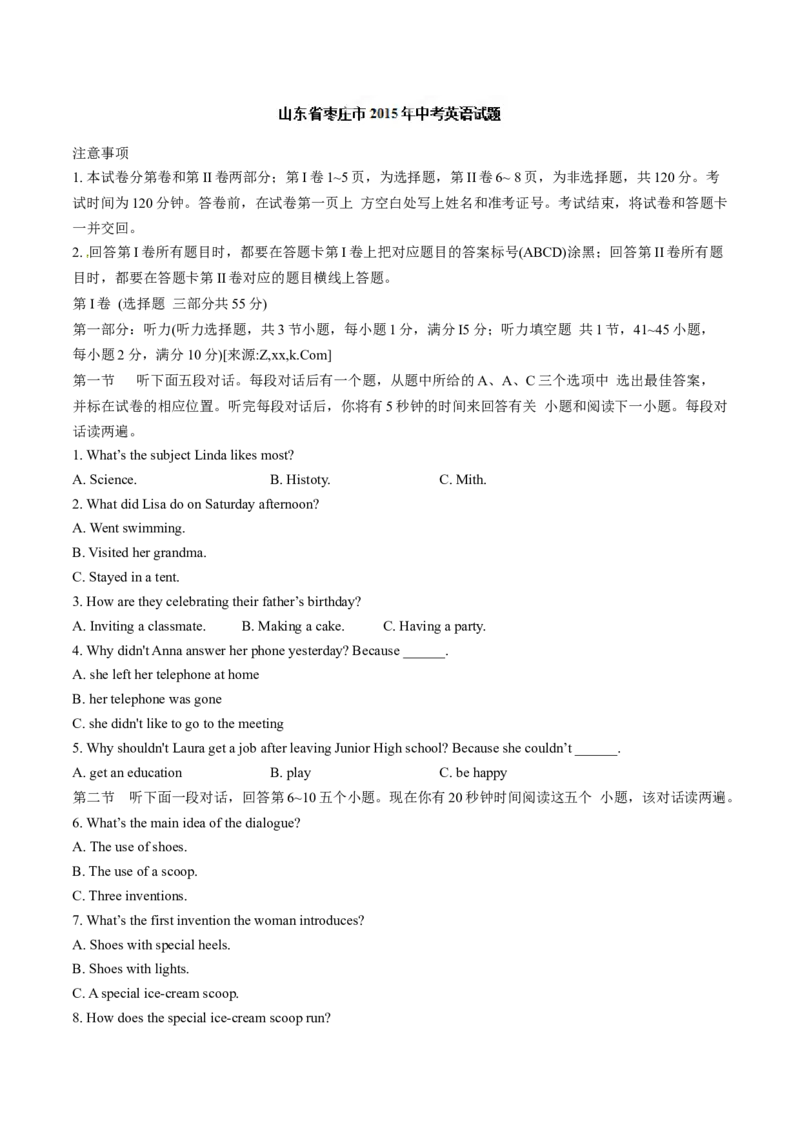
1. What’s the subject Linda likes most?
A. Science. B. Histoty. C. Mith.
2. What did Lisa do on Saturday afternoon?
A. Went swimming.
B. Visited her grandma.
C. Stayed in a tent.
3. How are they celebrating their father’s birthday?
A. Inviting a classmate. B. Making a cake. C. Having a party.
4. Why didn't Anna answer her phone yesterday? Because ______.
A. she left her telephone at home
B. her telephone was gone
C. she didn't like to go to the meeting
5. Why shouldn't Laura get a job after leaving Junior High school? Because she couldn’t ______.
A. get an education B. play C. be happy
第二节 听下面一段对话,回答第6~10五个小题。现在你有20秒钟时间阅读这五个 小题,该对话读两遍。
6. What’s the main idea of the dialogue?
A. The use of shoes.
B. The use of a scoop.
C. Three inventions.
7. What’s the first invention the woman introduces?
A. Shoes with special heels.
B. Shoes with lights.
C. A special ice-cream scoop.
8. How does the special ice-cream scoop run?A. In an ice-cream. B. On electricity. C. In the water.
9. Are shoes with lights useful for walking at night?
A. No. B. Yes. C. Don’t know.
10. Why are shoes with special heels useful? Because the heels can ______ when necessary.
A. be raised or lowered
B. go up
C. go down
第三节 听下面一段短文,回答第11~15五个小题。现在你有20秒钟时间阅读这五 个小题,该短文读
两遍。
11. What’s the main idea of the passage?
A. Evening At Home. B. Night At Home. C. Afternoon At Home.
12. What’s the weather like in the passage?
A. Cold. B. Hot. C. Warm.
13. What kind of students do you think Harry and Kate are?
A. Impolite. B. Hard-working. C. Shy.
14. What do you think of their mother? She is ______.
A. not lazy and wastes things
B. lazy and saves things
C. not lazy and doesn’t waste things
15. What kind of home do you think the Browns have?
A. Painful. B. Sad. C. Happy.
(请同学们翻到第II卷第四部分第一节,继续做听力填空題)
第二部分:英语知识运用(共两节,第一节16~25小题,每小题1分,满分10分;第二节语法填空,
46~55小题,每小题1分,满分10分,共20分)
第一节 完型填空 阅读下面短文,掌握其大意,然后从16~25各题所给的四个选项(ABCD)中,选出最
佳选项。
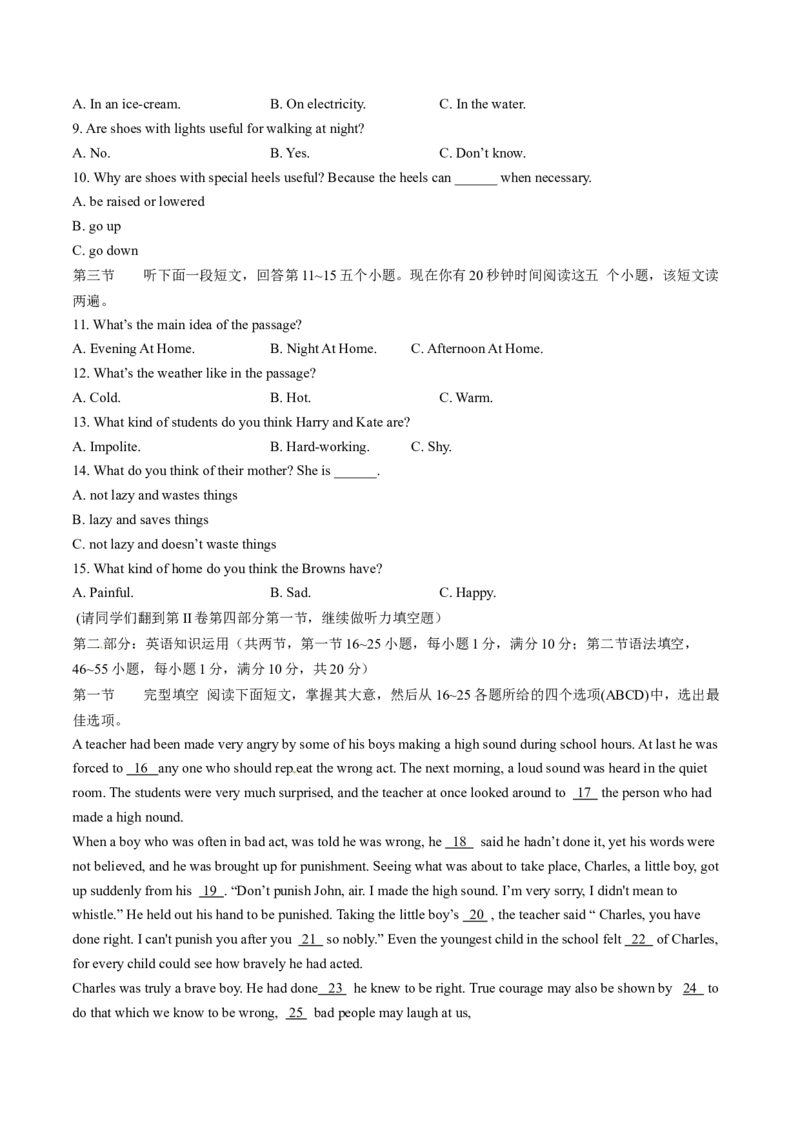
A teacher had been made very angry by some of his boys making a high sound during school hours. At last he was
forced to 16 any one who should repeat the wrong act. The next morning, a loud sound was heard in the quiet
room. The students were very much surprised, and the teacher at once looked around to 17 the person who had
made a high nound.
When a boy who was often in bad act, was told he was wrong, he 18 said he hadn’t done it, yet his words were
not believed, and he was brought up for punishment. Seeing what was about to take place, Charles, a little boy, got
up suddenly from his 19 . “Don’t punish John, air. I made the high sound. I’m very sorry, I didn't mean to
whistle.” He held out his hand to be punished. Taking the little boy’s 20 , the teacher said “ Charles, you have
done right. I can't punish you after you 21 so nobly.” Even the youngest child in the school felt 22 of Charles,
for every child could see how bravely he had acted.
Charles was truly a brave boy. He had done 23 he knew to be right. True courage may also be shown by 24 to
do that which we know to be wrong, 25 bad people may laugh at us,16. A. punish B. praise C. fix D. hurt
17. A. hide B. discover C. pay D. wake
18. A. actively B. aloud C. strongly D. softly
19. A. bag B. board C. desk D. seat
20. A. hair B. arm C. finger D. hand
21. A. have given B. have run C. have acted D. have fallen
22. A. afraid B. proud C. sure D. careful
23. A. what B. which C. who D. when
24. A. refusing B. continuing C. dreaming D. wanting
25. A. but B. though C. after D. until
第三部分 阅读理解(共15小题,每小题2分,满分30分)
阅读下列短文,从26~40各题所给的四个选项(A B C D)中,选出最佳选项。
A
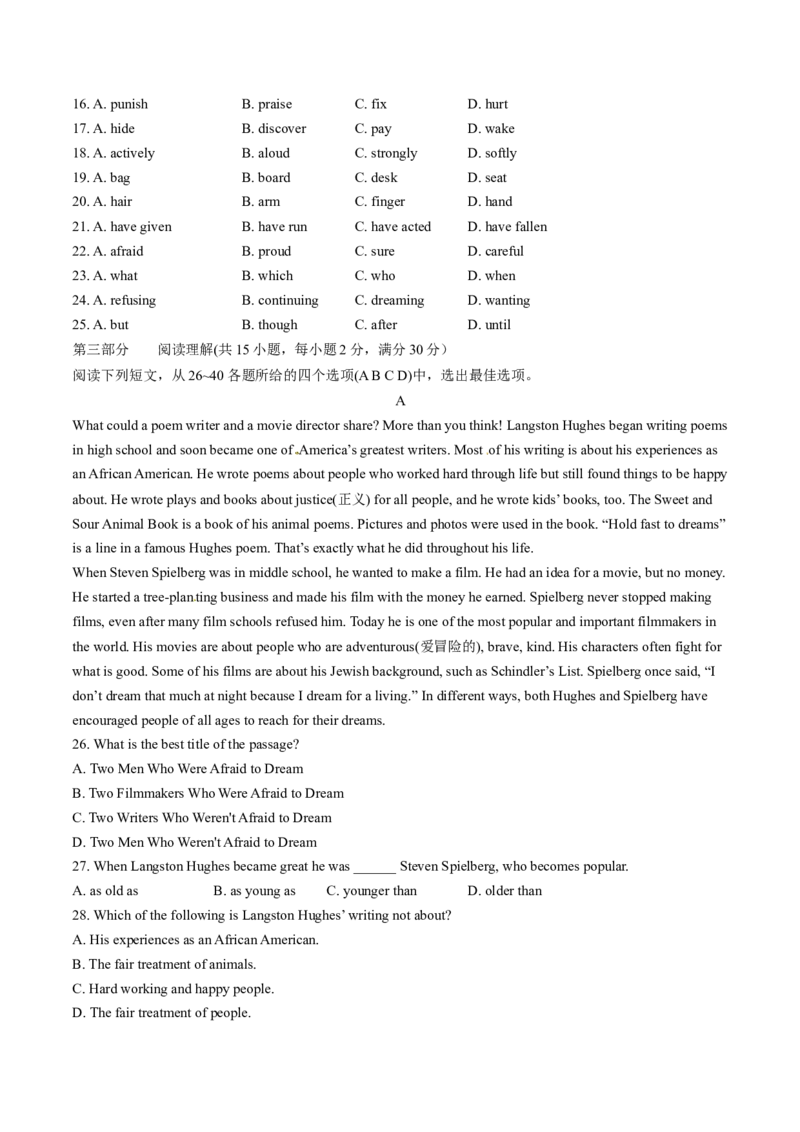
What could a poem writer and a movie director share? More than you think! Langston Hughes began writing poems
in high school and soon became one of America’s greatest writers. Most of his writing is about his experiences as
an African American. He wrote poems about people who worked hard through life but still found things to be happy
about. He wrote plays and books about justice(正义) for all people, and he wrote kids’ books, too. The Sweet and
Sour Animal Book is a book of his animal poems. Pictures and photos were used in the book. “Hold fast to dreams”
is a line in a famous Hughes poem. That’s exactly what he did throughout his life.
When Steven Spielberg was in middle school, he wanted to make a film. He had an idea for a movie, but no money.
He started a tree-planting business and made his film with the money he earned. Spielberg never stopped making
films, even after many film schools refused him. Today he is one of the most popular and important filmmakers in
the world. His movies are about people who are adventurous(爱冒险的), brave, kind. His characters often fight for
what is good. Some of his films are about his Jewish background, such as Schindler’s List. Spielberg once said, “I
don’t dream that much at night because I dream for a living.” In different ways, both Hughes and Spielberg have
encouraged people of all ages to reach for their dreams.
26. What is the best title of the passage?
A. Two Men Who Were Afraid to Dream
B. Two Filmmakers Who Were Afraid to Dream
C. Two Writers Who Weren't Afraid to Dream
D. Two Men Who Weren't Afraid to Dream
27. When Langston Hughes became great he was ______ Steven Spielberg, who becomes popular.
A. as old as B. as young as C. younger than D. older than
28. Which of the following is Langston Hughes’ writing not about?
A. His experiences as an African American.
B. The fair treatment of animals.
C. Hard working and happy people.
D. The fair treatment of people.29. What did Langston Hughes do in his whole life?
A. He never gave up his wish.
B. He sometimes had a wish to achieve.
C. He always had no wish to achieve.
D. He always wrote poems for movies.
30. Steven Spielberg’s movies are about the following except ______.
A. important people B. courageous people
C. friendly people D. his Jewish background
B
The long trunk of an elephant is a wonderful example of skill. The neck of four-footed animals is usually long, to
have them reach their food without difficulty, but the elephant has a short neck, to make him more easily support
the weight of his huge head and heavy teeth. His long trunk lets him get his food easily.
The trunk of an elephant is to him what the neck is to other animals. It is also a nose to him, for at the end of it there
is a empty place like a cup, and in the bottom of the cup are two holes, and the animal smells and breathes through
them. It is an arm and a hand too, so that it has been said that the elephant carries his nose in his hand, and it might
also have been said that he breathes by his hand.
At the end of the trunk, there is a strange part, about five inches long, which forms a finger. With this finger the
animal can pick up the smallest piece of money from the ground, and he has been taught to make marks like letters
with a pen.
The trunk of a full-grown elephant is about eight feet long. The elephant has such great strength that he can knock
down a man with it.
31. The elephant has a short neck to support ______.
[来源:Zxxk.Com]
A. his leg B. his body C. his arm D. his head and teeth
32. The trunk of the elephant helps him get his ______ easily.
A. side B. tail C. food D. ear
33. The trunk of the elephant takes the place of the following except ______.
A. a neck B. a nose and a fingsr C. an arm and a hand D. a leg
34. How does the elephont smell? Through two holes ______.
A. in the bottom of the cup B. at the beginning of the trunk
C. in his head D. in his face
35. The elephant can knock down a man with his trunk. This shows that he is ______.
A. weak B. strong C. quiet D. angry
C
When he was small, Hill was a famous bad boy.
At the age of 9, his father married his stepmother. At that time they lived poor in the countryside while his
stepmother was from a wealthy family.
His father introduced Hill to his stepmother as he said, “Dear, I hope you notice in the entire shire this is the worst
boy, who has made me have no other way. Maybe before tomorrow morning he will throw a stone at you, or do abad thing you will never imagine.”
To Hill's surprise, his stepmother went up to him with a smile, held up his head and looked at him carefully. She
then turned around to tell her husband, “You’re wrong. He is not the worst boy in the entire shire, but the cleverest
and creative boy. Only he doesn’t find a place to show himself. ”
His stepmother’s words warmed his heart, his eyes full of tears. With this, he started building friendship with his
stepmother. And this became the drive of his life, making him create 28 successful golden rules, which helped tens
of thousands of ordinary people walk on the road to success.
Before his stepmother came, no one praised him smart, and his father and neighbors considered him as a bad boy.
However, his stepmother’s words changed his life.
When Hill was 14 years old, his stepmother bought him a used typewriter and said to him, “I believe you will
become a writer.” Hill accepted his stepmother’s gift and expectation, and started writing things to a local
newspaper. He understood his stepmother’s strong feeling of interest in his family while he saw with his own eyes
she had changed his family. Therefore, he would do as well as she expected him to.
The strength from his stepmother made him a rich man and famous writer in the United States and one of the most
important persons in the 20th century.
Praise will never be unnecessary, especially for children. A sincere (真诚的〉praise may be better than 10, 000 bad
words.
36. What did people think of Hill before the age of nine?
A. Clever. B. Creative. C. Unfriendly. D. Foolish.
37. Hill started making friends with his stepmother after she ______.
A. smiled at him B. looked at him carefully
C. said good words about him D. said bad words about him
38. Which of the following is wrong about Hill?
A. He accepted his stepmother's typewriter.
B. He failed to do as he was expected.
C. He started writing to a local newspaper.
D. He understood his stepmother.
39. The writer is most probably an expert of______.
A. house building B. diet C. news writing D. education
40. The passage was written mainly to tell us that ______.
A. children should be praised B. Hill’s father married again
第II卷(非选择题 一部分 共65分)
第四部分:写作(共七节,满分65分)
第一节 听力填空题 (共5小题,每小题2分,满分l0分)
听下面一段短文,根据所听内容完成下面的表格(每空填—词)。现在你有20秒钟时间阅读这五个小题。把
答案写在答题卡第II卷第一节41~45小题的横线上。
…junior high school is the 41 of a new life …
You’ll make 42 along the way, ……many exciting things 43 for you…
…you have the 44 to make your…
…go your 45 ways now…
第二节语法填空(共10小题,每小题1分,满分10分)
阅读下面材料,把答案写在答题卡第II卷46~55小题横线上。有的答案要填入适当的内容,有的答案要用
括号内单词的正确形式,但每个答案不多于3个单词。
Some people still live in their hometown. However, others may only visit 46 once or twice a year. Millions of
Chinese leave the countryside 47 (search) for work in the cities. Among these is Hua Xing. He 48 (live) in
Wenzhou for the last 13 years. With a hard job 49 a factory, he seldom visits his hometown. “I haven’t been back
for three years. It’s 50 (shame),” he says.
51 (develop) have been good in Hua Xing’s hometown since 2002, for example, new roads 52 (appear). A new
school 53 (build). However, some things will never change in his hometown. The big old tree is still beside the
playground. Children in his time 54 (usual) liked to play together under it. It was 55 happy childhood.
第三节 阅读理解七选五(共5小题,毎小题2分,满分10分)
根据短文内容,从短文后的选项中选出能填入答题卡56~60小题最佳选项.
选项中有两项为多余选项。
“Have you finished your lesson, George?” Said Mr. Prentice to his son, who had laid aside his book and was busy
making a large paper kite.
“No, father,” replied George, hanging down his Head.
“ 56 ”
“Because it is so difficult, father, I’m not sure that I shall never learn it. 57 . My memory is so bad.”
“If I were to promise you a holiday on the thirtieth of the month after next, do you think you would forget the
date?”
“ 58 ”
“You are good at skating, and flying your kite, and playing footballs, are you not?” “Yes, father.”
“And you cannot learn your lesson! My dear boy, you are lying to yourself. 59 ” “But have I not tried, father?”
again asked George.
“ 60 . Come, for this afternoon lay aside that kite you are making, and give another effort to get your lesson ready.
Be serious, and you will soon learn it.”
A. No, I’m pretty sure that I should not.
B. You can learn as well as any one, if you will try.
C. It is easy.
D. Well, try again.
E. Besides(而且), I could not remember it after I had learned it.
F. If you don’t pay more attention to your lessons you will never be fit for anything.
[来源:学|科|网]
G. Why not, my son?
第四节 单词拼写(共5小题,每小题1分,满分5分)
根据下列句中的汉语提示,写出所缺单词的正确形式,毎空一词。把答案写在答题卡 61~65小题的横线上。61. —Let’s play music. —That sounds __________(轻松).
62. My mother is making ____________(味美的) soup.
63. My pet dog, three years old now, ___________(不喜欢) to stay alone.
64. After you argue with your parents you must ___________(交流)with them and explain why you did that.
65. Don’t put your __________(胳膊肘)on the table.
[来源:Zxxk.Com]
第五节 汉译英(共5小题,每小题2分, 满分10分)
把答案写在答题卡66~70小题的横线上,必须用上所提供的单词或短语。
66. Jim的姐姐正在打电话。(talk…phone).
67. 我喜欢熊猫,因为它们有点趣。(kind of)
68. 你多长时间去看一次电影?(how often )
69. 你能带我出去散散步吗?(could…please )
70. 他过去常戴眼镜吗?(used to)
第六节 短文改错 (共10小题,每小题1分,满分10分)
假定英语课上老师要求间桌之间交换修改作文,请你修改你同桌写的以下作文。文中共有10处语言错误。
每句中最多有两处。错误仅涉及一个单词的增加、删除或修改。增加:在缺词处加一个漏字符号^,并在
其下面写出该增加的词。删除:把多余的词用(/)划掉。修改:在错的词下画一横线,并在该词下面写出修
改后的词。
注意:1. 每处错误及其修改均仅限一词,
2. 在答题卡的第六节的题上答题.
3. 只允许修改10处,多者(从第11处起)不计分.
Students these days often have a lot of worry. Sometimes they have problems with
their schoolwork, and sometimes with their friends. How can they deal these problems?
Laura Mills, the teenager from London, says,
“I think talking to someone help a lot. If we talk to someone, we’ll certainly feel
[来源:学_科_网]
[来源:学科网ZXXK]
better than we don't.”
Laura once loses her wallet, and worried for days. She was afraid to tell her parents
about it for several days. In the end, she talked to her parents and we were really
understanding. They got her a new wallet and asked her to be most more careful.
“I will always remember share my problems in the future!” Laura says.Robert Hunt advises students about common problems. He thinks the first step is to
find someone you trust to talk to. In English, we say that sharing a problem is like cut it
in half. So you’re halfway to solve a problem just by talking to someone about it.
第七节 书面表达(共1题,满分10分)
把书面表达答案写在答题卡第七节的横线上。
Suppose(假设) You’re are Li Qianghua. Summer is coming. You are going to take part in the activities of an
international summer camp. Every member of the camp will introduce himself/herself to other members on the first
day. Write an introduction of yourself in no more than 120 words according to the following points.
Where are you from?
Which grade are you in?
What kind of English textbook is used in your school?
What do you think of the textbook and why?
Why are you in the summer camp?
What do you like and why?
What is your dream?
How can you achieve it?
The beginning is ready. I’m Li Qianghua.学科网高考一轮复习微课视频手机观看地址:
http://xkw.so/wksp