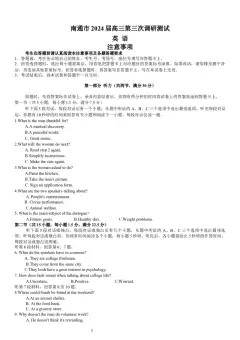
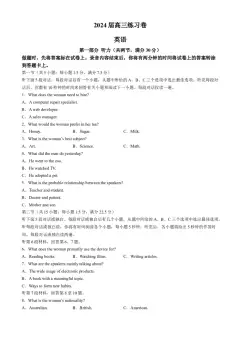
南通市 2024 届高三第一次调研测试
英语
注意事项
考生在答题前请认真阅读本注意事项及各题答题要求
1. 答题前,考生务必将自己的姓名、考生号、考场号、座位号填写在答题卡上。
2. 回答选择题时,选出每小题答案后,用铅笔把答题卡上对应题目的答案标号涂黑。如
需改动,请用橡皮擦干净后,再选涂其他答案标号。回答非选择题时,将答案写在答题卡上,
写在本试卷上无效。
3. 考试结束后,将本试卷和答题卡一并交回。
第一部分听力(共两节,满分30分)
做题时,先将答案标在试卷上。录音内容结束后,你将有两分钟的时间将试卷上的答案
转涂到答题卡上。
第一节(共5小题;每小题1. 5分,满分7. 5分)
听下面5段对话。每段对话后有一个小题,从题中所给的 A、B、C三个选项中选出最
佳选项。听完每段对话后,你都有 10秒钟的时间来回答有关小题和阅读下一小题。每段对
话仅读一遍。
1. Why did the woman buy the dress?
A. It’s her favorite style. B. It’s needed for work. C. It’s inexpensive.
2. What has the man started doing recently?
A. Taking exercise. B. Keeping a diary. C. Learning to
cook.
3. Which kind of house do the speakers work in now?
A. A one-room studio. B. A two-room apartment. C. A two-story town
house.
4. What is the man doing for the woman?
A. Explaining her work duties.
1 / 13
学科网(北京)股份有限公司B. Checking her blood pressure.
C. Scheduling her next doctor's visit.
5. What are the speakers mainly talking about?
A. Ways to make a living.
B. Lessons from their jobs.
C. Feelings of working in a city.
第二节(共15小题;每小题1. 5分,满分22. 5分)
听下面5段对话或独白。每段对话或独白后有几个小题,从题中所给的 A、B、C三个
选项中选出最佳选项。听每段对话或独白前,你将有时间阅读各个小题,每小题 5秒钟;听
完后,各小题将给出5秒钟的作答时间。每段对话或独白读两遍。
听第6段材料,回答第6、7题。
6. What does the woman think of the exam?
A. It's easy. B. It's surprising. C. It's unimportant.
7. What is the relationship between the speakers?
A. Cousins. B. Classmates. C. Teacher and student.
听第7段材料,回答第8至10题。
8. Where did the woman probably learn about the book?
A. From a friend. B. From the man. C. From TV.
9. What does the woman offer to do for the man?
A. Lend him a book. B. Check his writing. C. Teach him social skills.
10. Where are the speakers?
A. In a bookstore. B. In a library. C. On a beach.
英语试卷第2页(共12页)听第8段材料,回答第11至13题。
11. What activity will the man mainly do during his vacation?
A. Clothing shopping. B. Outdoor sports. C. City touring.
12. Who is the woman going on her trip with?
A. Her sister. B. Her parent. C. Her friend.
13. When will the woman return from South Korea?
A. On March 19th. B. On March 21st. C. On March 23rd.
听第9段材料,回答第14至17题。
14. How does the man feel now?
2 / 13
学科网(北京)股份有限公司A. Stressed. B. Excited. C. Bored.
15. Why didn't the man come back home as planned?
A. He had to take exams.
B. His flight was delayed.
C. He went to a Christmas party.
16. Where will the speakers go next?
A. The man's house. B. An airport. C. A supermarket.
17. How is the woman probably related to the man?
A. His friend. B. His teacher. C. His mother.
听第10段材料,回答第18至20题。
18. Who put forward the proposal?
A. A government official. B. A senior student. C. A food expert.
19. When will the new plan be carried out?
A. Today. B. Next week. C. In one year.
20. What is the judgment on the policy based on?
A. The health condition of the listeners.
B. The profits made by the dining hall.
C. The level of student satisfaction with the food.
第二部分阅读(共两节,满分50分)
第一节(共15小题;每小题2. 5分,满分37. 5分)
阅读下列短文,从每题所给的A、B、C、D四个选项中选出最佳选项。
A
Where to Eat in Kuala Lumpur
Great restaurants in Kuala Lumpur offer a genuine global dining experience. Whether
you are looking to enjoy hearty comfort food or some local delicacies, the city's dining
scene satisfies all comers.
Mum's Place
Nothing brings more comfort than mom's cooking. With recipes inspired by the owners'
mother, this restaurant brings you Nyonya dishes that are truly Malaysian. Located in the
district of Damansara Perdana, Mum's Place is a neighbourhood restaurant with its main
3 / 13
学科网(北京)股份有限公司customers from residents nearby. Some of the best dishes include cencaru fish, devil curry
chicken and beef rendang.
Cantaloupe
Located about 20 minutes from downtown Malacca, it is a home-based eatery with
about 10 tables manned by four operators. Unlike most restaurants, food is self-service here,
with dishes placed on catering pans for customers to choose from. It serves traditional
Malaysian dishes with distinct Chinese influences. You will find rice dumplings and chicken
rendang among the offerings. It has two branches in the city. Their dishes sell out fast, so
it'd be best to head there before lunch time.
YumYum Restaurant
Situated in the beautiful Shangri-La Hotel, Yum Yum Restaurant is among the locals'
many favourite spots to dine at. It offers an interesting Nyonya and Thai food with Chi-
nese influences that make them stand out. The classic dishes include sambal petai prawns,
assam fish head and Yum Yum egg. It can get crowded here, so it'd be best to head there
early or call ahead for reservations.
Troika Sky Dining
Offering fine dining, the impressive Troika Sky Dining undoubtedly stands out from
the pack. Set on the 23rd floor of Tower B of The Troika, it goes without saying that the
cloud-skimming views here are something else entirely. The food is what helped it stand
out. It serves award-winning French, Italian, Greek, and Spanish food and adventurous
menu of high-end pizzas and pasta.
21. What do Mum's Place and Yum Yum Restaurant have in common?
A. They are based in hotels. B. They serve Nyonya dishes.
C. They need prior reservations. D. They offer breathtaking views.
22. Which restaurant serves western food?
A. Mum's Place. B. Cantaloupe.
C. Yum Yum Restaurant. D. Troika Sky Dining.
23. What's special about Cantaloupe?
A. It is a buffet restaurant. B. It serves hard-to-find dishes.
C. It has branches throughout Asia. D. It opens for lunch earlier than others.
4 / 13
学科网(北京)股份有限公司B
The motivation for his invention came to Aarrav Anil last year when he saw his uncle
Arjun, who has Parkinson's disease, struggle to eat. Some food spilled (溢出) out of his
mouth, the rest splattered (溅) on his clothes. Arjun attempted to keep his dignity but
the frustration forced him to give up and call his helper to feed him.
The sight of his uncle's shaking the spoon so violently inspired Aarrav, 17, from Ben-
galuru, south India, to turn to robotics. He locked himself in his room with microcon-
trollers, sensors, motors, and a 3D printer. What emerged was a prototype (原型) of a smart
spoon that is now undergoing trials at the RV College of Physiotherapy in Bengaluru.
The sensors in the battery-operated spoon detect shaking on one side and activate
movement on the other, effectively cancelling out shaking to keep the spoon stable.
"I've been fine tuning the design based on the college's feedback-that it needs to be
waterproof so that it can be washed without damaging all the electronics inside; that it
must be removable so it can be cleaned and replaced by a fork, "Aarrav says.
For Aarrav it is the peak of a 10-year interest in mechanics that began when his
mother bought him a Lego set. He has now represented India at more than 20 robotics
competitions across the world.
When the blueprint for the smart spoon won first prize in the future innovators cate-
gory at last year's World Robot Olympiad in Germany, Aarrav felt encouraged to make the
prototype.
More than 7 million people in India are estimated to have Parkinson's disease, a con-
dition in which parts of the brain become progressively damaged and which mainly affects
people over the age of 50. Symptoms (症状) include involuntary shaking and stiff mus-
cles. As the disease progresses, eating can become more difficult, forcing people to rely on
help from others.
Aarrav's ambition is that every family that has someone with Parkinson's will have the
smart spoon. He says his uncle Arjun's words keep echoing (回响) in his mind: "Who
would have thought such a small thing could mean the difference between dignity and in-
dignity?"
5 / 13
学科网(北京)股份有限公司24. What can Aarrav's invention help people with Parkinson's do?
A. Control their physical balance. B. Boost their mood and relieve stress.
C. Maintain a good range of movement. D. Feed themselves more independently.
25. What does the underlined part "fine tuning" in paragraph 4 mean?
A. Overturning. B. Reconsidering.
C. Conducting a study of. D. Making minor changes to.
26. What is the author's purpose in mentioning Parkinson's in India?
A. To show prospects of Aarrav's invention.
B. To reveal the nation's poor health situation.
C. To popularize general knowledge of the disease.
D. To convince people to volunteer for social causes.
27. What can be learned about Aarrav from the text?
A. He enjoys being alone. B. He has an innovative mind.
C. He used to be a health worker. D. He longed to be a businessman.
C
Saving Us: A Climate Scientist's Case for Hope and Healing in a Divided World is
one of the more important books about climate change to have been written. Hayhoe is a
gifted public speaker and Saving Us is a follow-up to her awesome TED talk in 2018,
"The most important thing you can do to fight climate change: talk about it".
One of the many refreshing aspects of this book is that Hayhoe recounts both her suc-
cesses and her failures to communicate, through which she has gathered evidence about
what works and what does not. Much of the book's advice is common sense, all backed up
not just by Hayhoe's experience but also with convincing research by psychologists and so-
cial scientists.
Hayhoe advises against trying to engage with a small minority, the "Dismissives", who
"angrily reject the idea that human-caused climate change is a threat; they are most recep-
tive to misinformation and conspiracy theories (阴谋论)". There is a warning that offer-
ing up more facts about climate change can actually increase polarisation among them.
The book includes amusing examples of her encounters with the "Dismissives", almost
entirely older men-including an engineer who was unconvinced about the evidence but with
6 / 13
学科网(北京)股份有限公司whom she was able to establish mutual (相互的) respect through a shared passion for
knitting (打毛线衣)—and is packed with inspiring accounts of how she has won over
even the most suspicious of crowds. Her motto is "bond, connect and inspire", which repre-
sents her approach of always looking for points of commonality.
She also tells of a man who approached her after an event in London in 2019. He
had been so inspired by her TED talk that he had started to speak to everybody he could
in his neighborhood of Wandsworth. He showed her details of 12, 000 conversations that
had taken place as a result, claiming that they had helped to convince the council to de-
clare a climate emergency and to switch investments from fossil fuels to renewable energy.
And so, while it may feel difficult to influence the outcome of the COP26, Hayhoe's
uplifting book makes a persuasive case that we can all do our bit to bring about success
just by talking about the issue.
28. What does the book mainly focus on?
A. Sharing climate communication tips.
B. Teaching presentation skills with TED talks.
C. Exploring critical thinking through literature.
D. Promoting people's insight into climate change.
29. Which of the following best describes the advice in the book?
A. Humorous but one-sided. B. Novel but contradictory.
C. Serious and hard to follow. D. Well-based and workable.
30. How did Hayhoe win over the "Dismissives"?
A. By changing their political identity.
B. By challenging their fundamental beliefs.
C. By offering more facts about climate change.
D. By seeking common ground built on a shared love.
31. What does the author want to say by telling the story in paragraph 5?
A. World shift to clean energy is unstoppable.
B. We should help people prepare for the climate crisis.
C. Policymakers are less responsive to market changes.
D. Conversations can influence climate decision-making.
7 / 13
学科网(北京)股份有限公司D
Ramirez Castañeda, a Colombian biologist, spends her time in the Amazon studying
how snakes eat poisonous frogs without getting ill. Although her findings come in many
shapes and sizes, she and her colleagues have struggled to get their biological discoveries
out to the wider scientific community. With Spanish as her mother tongue, her research had
to be translated into English to be published. That wasn't always possible because of bud-
get or time-and it means that some of her findings were never published.
"It's not that I'm a bad scientist, " she says. "It's just because of the language. "
Castañeda is not alone. There is plenty of research in non-English-language papers that
gets lost in translation, or is never translated. A research looked through more than 400,
000 peer-reviewed papers in 16 different languages and found 1, 234 studies providing evi-
dence on biodiversity conservation which, because they weren't in English, may have been
overlooked. These included Japanese-language findings on the effectiveness of relocating the
endangered Blakiston's fish owl, the largest owl species.
Some experts argue that for the sake of the bigger picture, scientific knowledge should
converge (转换) into one common language. Science is very globalised and becoming
more so, so the use of a global language is enormous for that.
Of course, scientists can work with an English partner, or use a translator-but this ulti-
mately strengthens the cycle of dependency on the global north, leading to inequality in
international influence. The specific meanings of words can also pose a problem in transla-
tion. For example, it is difficult to find in English one single word to describe forest snakes
and frogs in the work Castafieda does with indigenous (土著的) communities in the
Amazon.
"So we're losing observations for science, too, " says Castañeda. "For me, it's not pos-
sible to just have everything translated into English. We need multilingual (多语种的)
science, and we need people that feel comfortable doing science in their own languages. It
could be possible to switch to a world where, say, Chinese, English and Spanish are the
three languages of science, just as English, French and German were the languages of sci-
ence in the 19th century. "
32. What prevented Castañeda's discoveries from being more widely known?
8 / 13
学科网(北京)股份有限公司A. Poor management. B. Opposition from her colleagues.
C. Her bad reputation. D. The language barrier.
33. What's the consequence of the dominant focus on English in scientific research?
A. Inefficient wildlife conservation.
B. A knowledge gap in the scientific world.
C. A growing interest in non-English papers.
D. Inadequate job opportunities for translators.
34. What does the author want to illustrate by mentioning forest snakes and frogs?
A. The urgency to protect rare species.
B. The need to adopt one global language.
C. The challenges in translating scientific texts.
D. The biodiversity on the South American continent.
35. What is presented in the last paragraph of the text?
A. A potential solution. B. A theoretical model.
C. A popular belief. D. A global trend.
第二节(共5小题;每小题2. 5分,满分12. 5分)
阅读下面短文,从短文后的选项中选出可以填入空白处的最佳选项。选项中有两项为多
余选项。
Learning how to apologize is similar to learning any new behavior. It may feel awk-
ward and may not be polished at first. 3 6 There are several tips that will help you as
you learn how to apologize.
First of all, wait until the right time and you are in the right place. Although public
apology is often appropriate, discretion (谨慎) should be used. 3 7 Remember, you
will be raising a topic that may recall a bad experience or bad feelings. Be respectful as
you approach this task.
Be direct and brief in your approach. Acknowledge the fact that injury has occurred
and then take responsibility for what happened. Be sincere in expressing your regret and
demonstrate your willingness to take ownership of the situation. 3 8
9 / 13
学科网(北京)股份有限公司Even if you follow these steps, be prepared for rejection. Sometimes, the person apolo-
gizing has an expectation that the apology will lead to immediate forgiveness and accep-
tance. 3 9 If you think of the offense (冒犯) as an emotional bruise (瘀伤), think
of the healing process as the color changes we see as a bruise heals.
40 Knowing when to keep one's mouth shut is a virtue. Keeping quiet may be
very difficult, as post-apology listening is not easy. We may hear unpleasant observations
from another about our own shortcomings. We may hear the expression of anger. One of
the ways we let others know we are truly responsible and accountable for our mistakes is
by listening to the other party pour out the feelings associated with our actions.
A. Forgiveness and acceptance may take time.
B. To give or receive a good apology is an art.
C. But with practice, everyone can learn to do it.
D. Listening to the response to our apologies is important.
E. Most apologies can and should happen in a private setting.
F. In other words, avoid excuses and offer to repair the damage.
G. Taking responsibility doesn't mean accepting blame for everything.
第三部分语言运用(共两节,满分30分)
第一节(共15小题;每小题1分,满分15分)
阅读下面短文,从每题所给的 A、B、C、D四个选项中选出可以填入空白处的最佳选
项。
Last Christmas, I volunteered for WNWNB, a charity which takes surplus (剩余的)
produce from New Covent Garden Market and 4 1 it to the local community.
The food was already in containers. So we set up the stand and got ready to distribute
some Christmas 42 . At first, it was 43 . People seemed a bit suspicious of tak-
ing food for free. But they gradually 44 us and we had a fun afternoon singing car-
ols and trying to 4 5 passersby to take our food.
It was then time to deliver meals to those who weren't able to come. This is 4 6
things changed for me. The first door I knocked on was 4 7 by a woman in her 30s.
She had children and looked absolutely worn out. I told her I was from WNWNB and
10 / 13
学科网(北京)股份有限公司gave her the 48 meals. It was probably only about two days' worth of food but, the
way she 4 9 , I felt as if I was handing her gold.
I had similar responses to my next 50 . In some cases, when people were elderly
or alone, I'd go into their homes and have a brief 51 before heading off. Many felt
52 , but I saw how happy they were to have another adult human to 5 3 .
As a local politician I knock on doors and talk to people a lot, but there was some-
thing deeper about those 5 4 on Christmas Day. I finished my day at WNWNB a slightly
different person from the one who 5 5 .
41. A. distributes B. introduces C. sells D. exhibits
42. A. forgiveness B. images C. recipes D. cheer
43. A. easy B. nice C. slow D. safe
44. A. broke away from B. put up with
C. cut in on D. warmed up to
45. A. threaten B. encourage C. allow D. command
46. A. why B. how C. where D. when
47. A. opened B. repaired C. cleaned D. guarded
48. A. costly B. unfinished C. deserted D. ready
49. A. declined B. reacted C. argued D. traded
50. A. purchases B. interviews C. deliveries D. schedules
51. A. meal B. chat C. report D. silence
52. A. proud B. free C. lonely D. content
53. A. connect with B. look after C. turn to D. rely on
54. A. conversations B. budgets C. explanations D. deals
55. A. hesitated B. started C. ignored D. struggled
第二节(共10小题;每小题1. 5分,满分15分)
阅读下面短文,在空白处填入一个适当的单词或括号内单词的正确形式。
Tanghulu (also known as bingtang hulu) is a traditional Chinese snack consisting of
hardened sugar coated fruits on a stick. 56 (classic), tanghulu is made of
hawthorns that are rich 57 vitamin C. In recent times, tanghulu makers 58
11 / 13
学科网(北京)股份有限公司(add)variety to this traditional snack by using other fruits such as cherries, strawberries,
pineapples or grapes.
Tanghulu can taste sweet or sour, depending on your fruit. Traditional tanghulu using
hawthorn berries is said to taste like a 59 (combine)of both. You can, of course,
make your own Tanghulu using any fruit you desire.
Tanghulu is easier 60 (make)at home than you might think. The trick is to
use the correct water to sugar ratio (比例) and boil the sugar water mixture 61
its temperature reaches 150 ℃. Then quickly dip your fruit skewer (扦) into the sugar
mixture. This will result in fruit that's coated in a thin layer of hard candy that cracks
when 6 2 (bite)into.
Tanghulu is commonly eaten in the winter. You can find 63 (travel)traders
roaming (游荡) in the streets, selling this unique snack. If you want to try the sticky
treat 64 (you), you can find Tanghulu stands near most of the popular tourist
attractions in China. Tanghulu isn't expensive, as a skewer costs only $1. So, what could
possibly stop you from giving one 6 5 try?
第四部分写作(共两节;满分40分)
第一节(满分15分)
假定你是李华,2024年元旦你校举行了登高迎新年活动。请你为校英文报写一篇报道,
内容包括:
1. 活动过程;
2. 活动感想。
注意:
1. 写作词数应为80左右;
2. 请按如下格式在答题卡的相应位置作答。
A climbing event to celebrate the New Year
第二节(满分25分)
阅读下面材料,根据其内容和所给段落开头语续写两段,使之构成一篇完整的短文。
12 / 13
学科网(北京)股份有限公司I've always known that I'm very quick with my hands. If someone throws something, I
catch it almost before I'm aware it has been thrown. When I was young, I had no idea
how useful this skill would become.
Last week, I was going to visit a friend with her newborn and was on my way to a
toy store to buy a gift. I'd once lived in the neighbourhood and I decided to head back to
my old cupcake shop for a coffee. Sitting alone at a table outside with my drink, I was
approached by an older man, who in a calm and very matter-of-fact way told me to call
911, because there was a baby on a fire escape.
I jumped up to see where the baby was. I was so surprised to see it, wearing a little
onesie (连体衣) and lying on the fire escape railings (栏杆) between the second and
third storeys. I was nervous, so the baby boy became my only priority.
As I was on the phone to the emergency services, I made eye contact with the child,
keeping him calm, telling him to stay there. Some people were going up the stairs to find
the parents, who were apparently sleeping through the whole drama.
I just wanted the child to feel safe. I hoped he'd stay there until somebody could res-
cue him. Apparently he had slipped through pieces of cardboard placed next to an air-con-
ditioning unit in the window, and without bars to protect him he'd crawled (爬) out and
up the fire escape towards the next storey. He was only 16 months old. For him to even
climb up and balance in that position was incredible.
Then he slipped. Instinctively (本能), he grabbed on the railing as he fell, hang-
ing by his arms. I knew he couldn't hold on, 25 feet above the street, for long. I sensed
people had gathered behind, but my attention was purely focused on my intention to catch
the baby.
注意:
1. 续写词数应为150左右;
2. 请按如下格式在答题卡的相应位置作答。
I made sure I was positioned to catch him.
The moments after he was saved were exciting:
13 / 13
学科网(北京)股份有限公司