

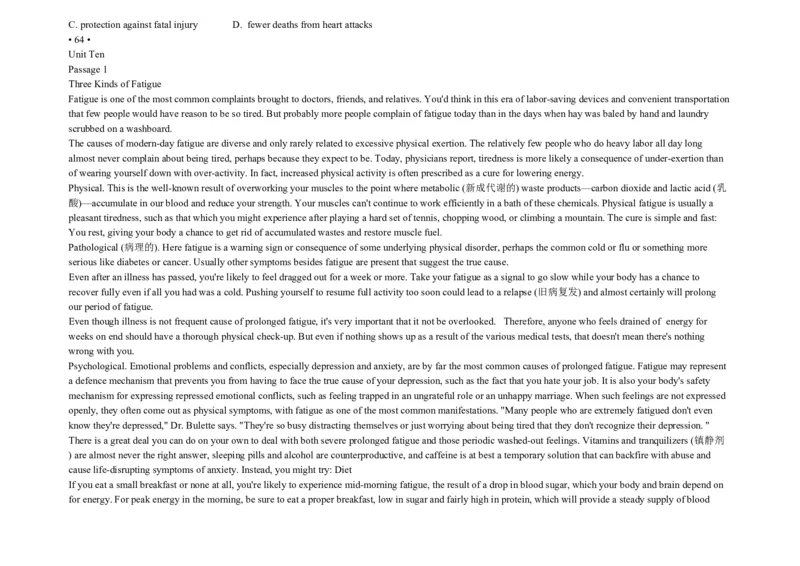
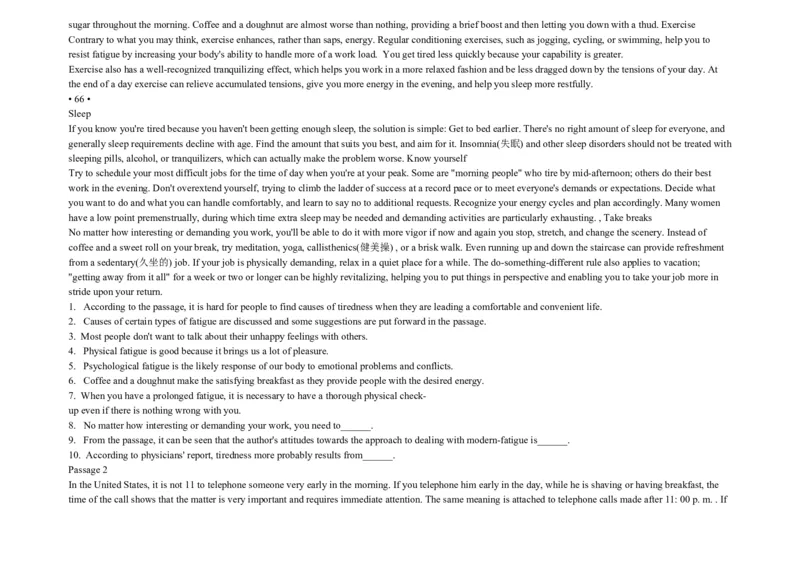
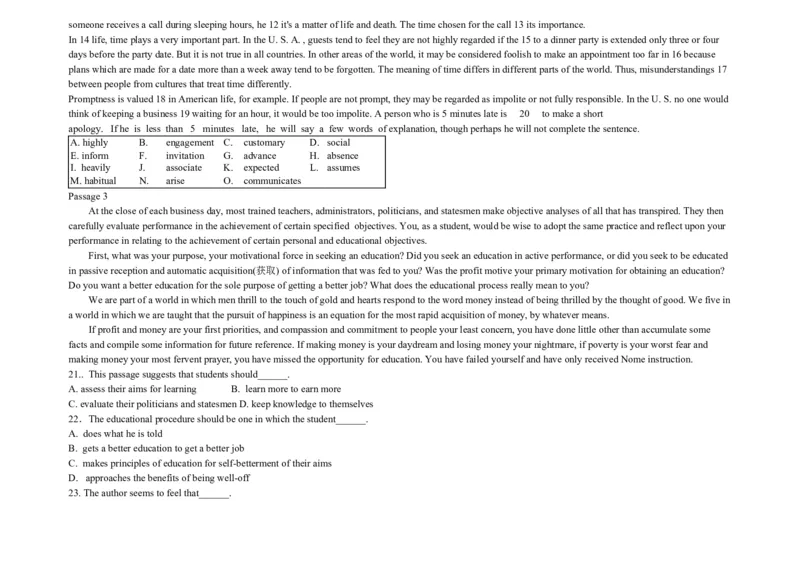
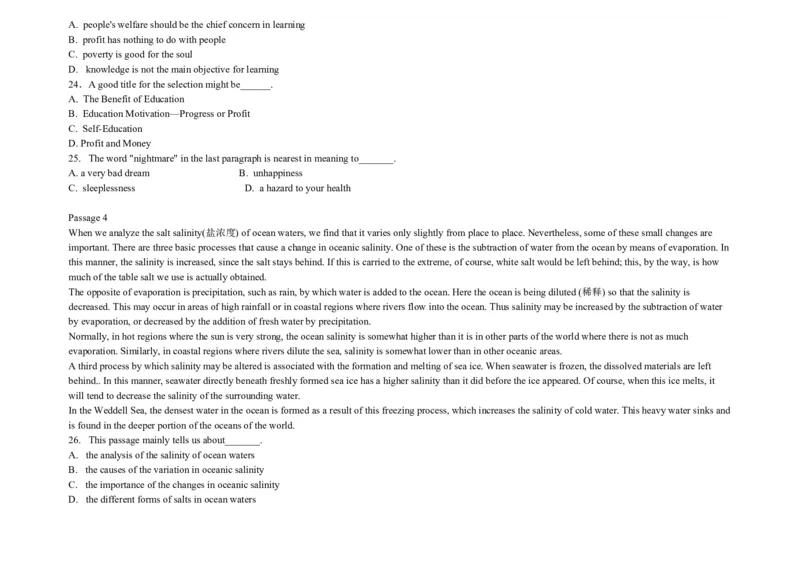
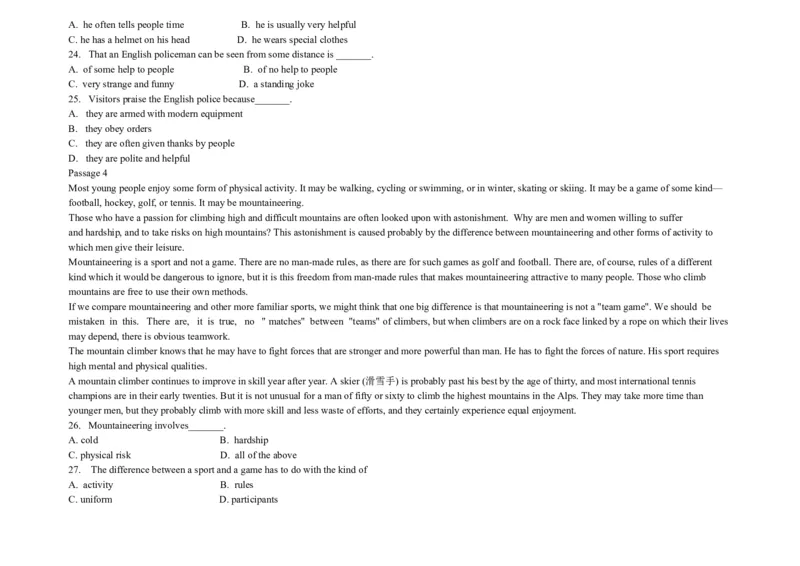
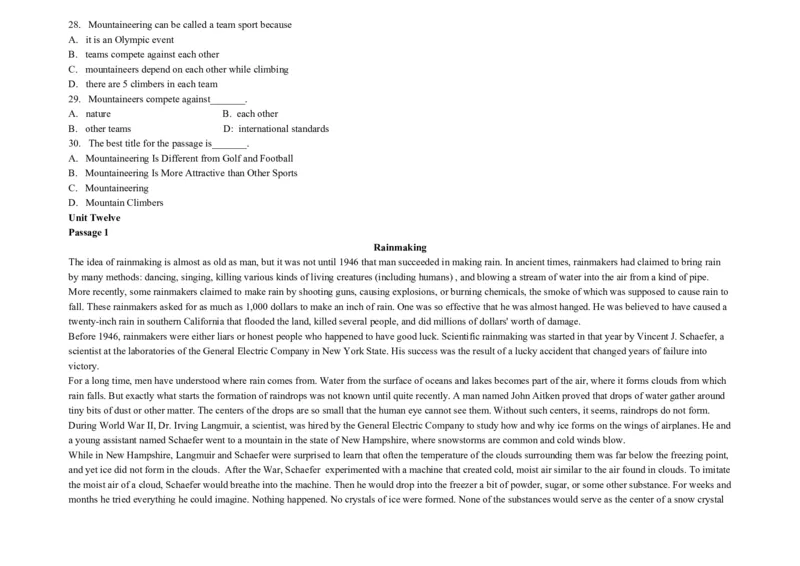
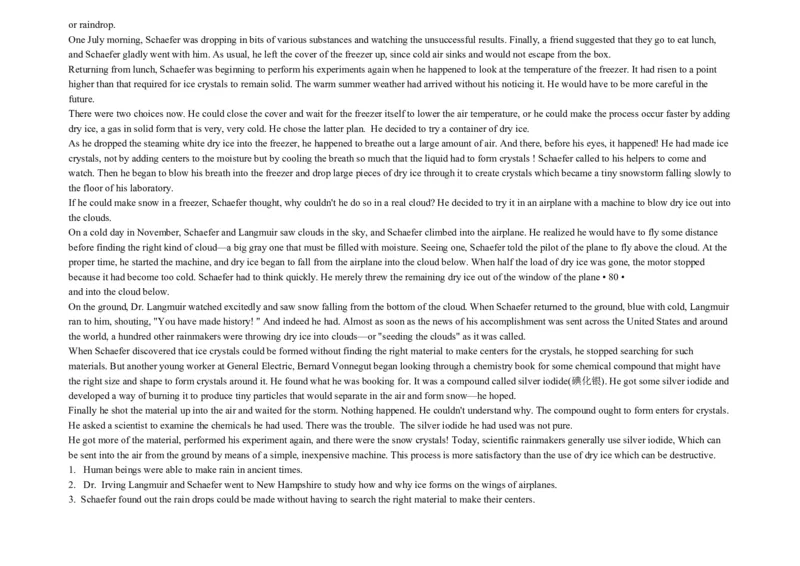
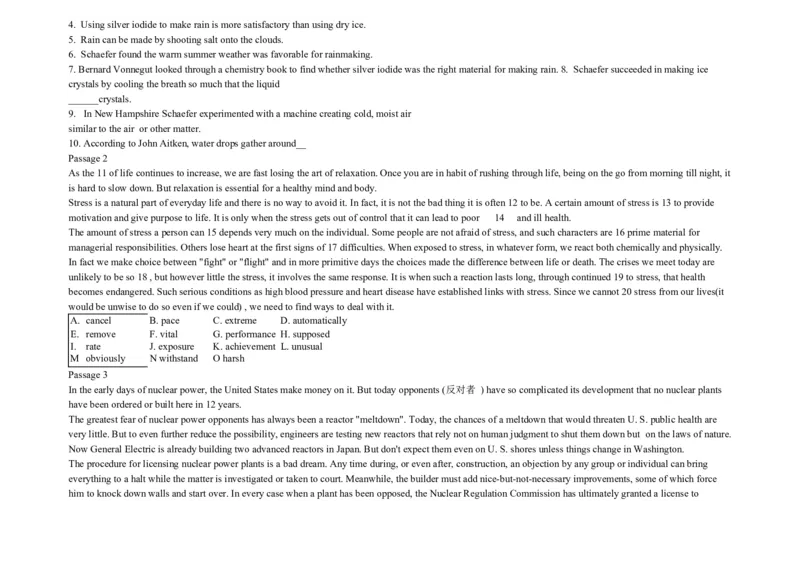
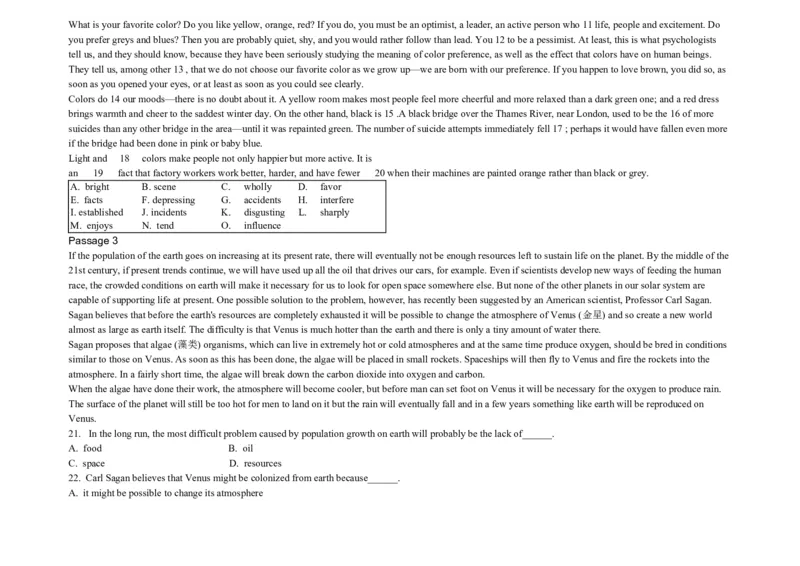
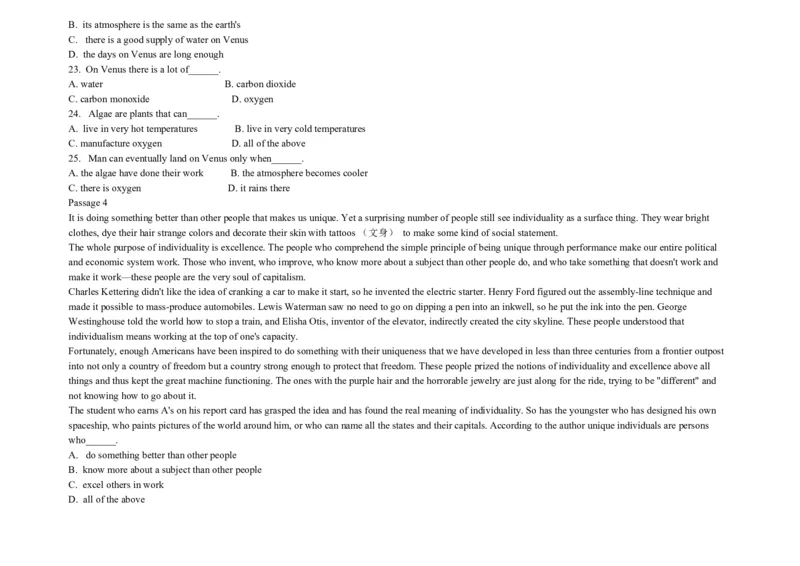
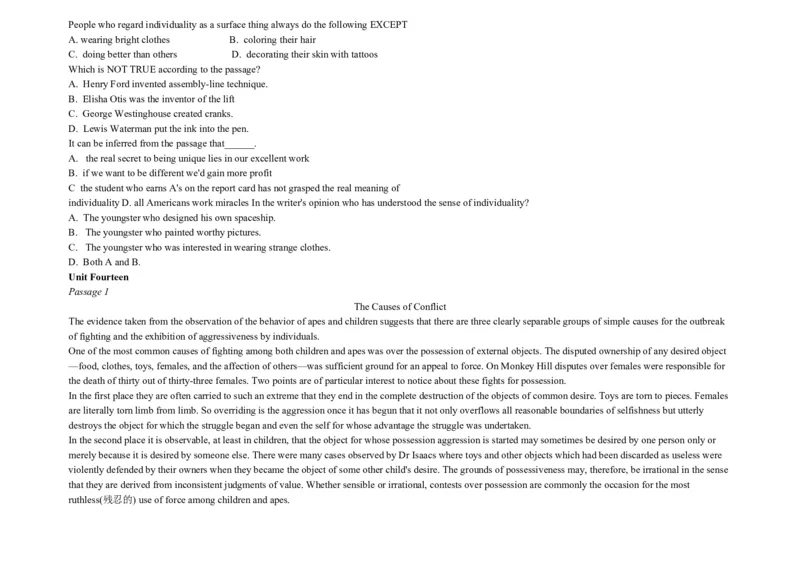
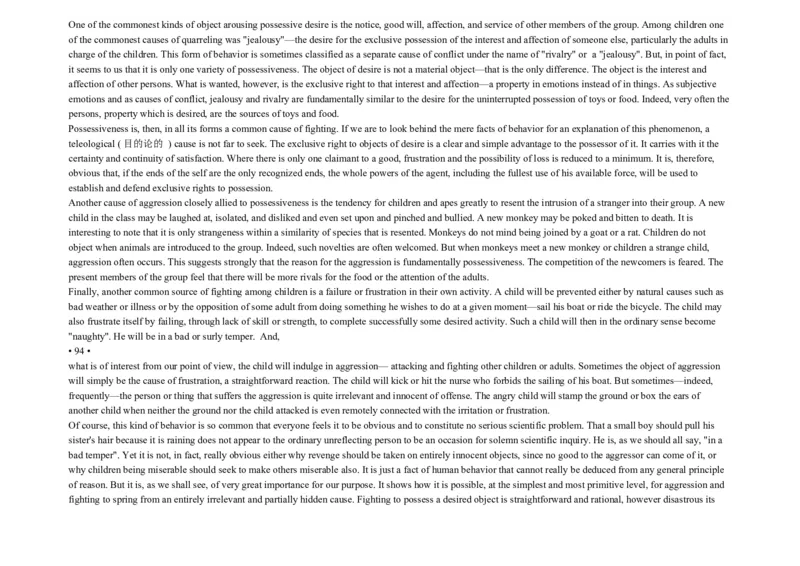
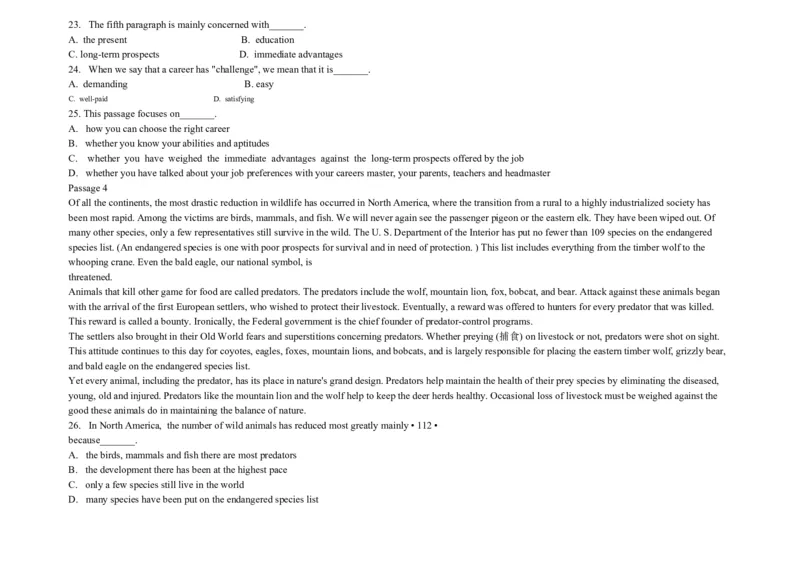
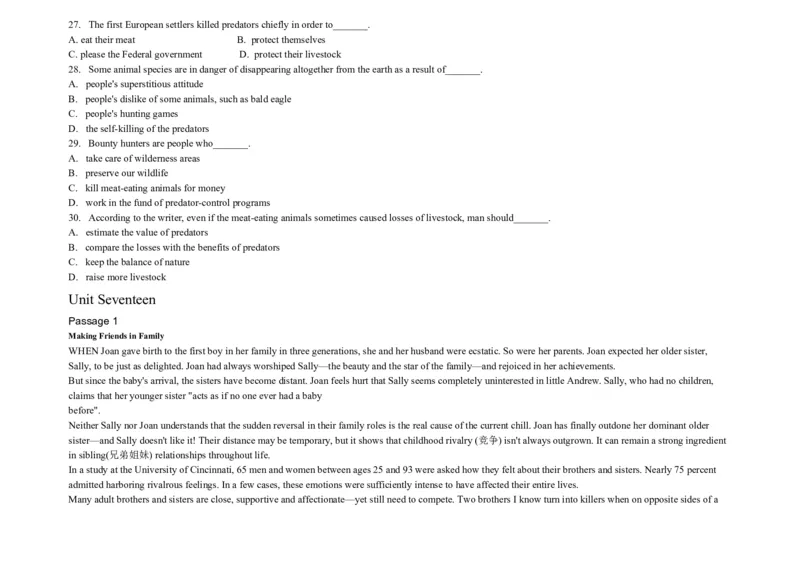
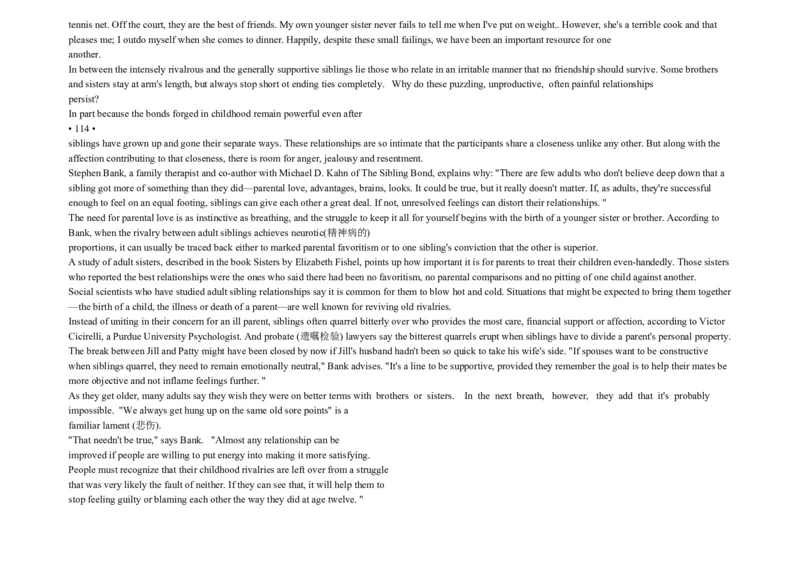
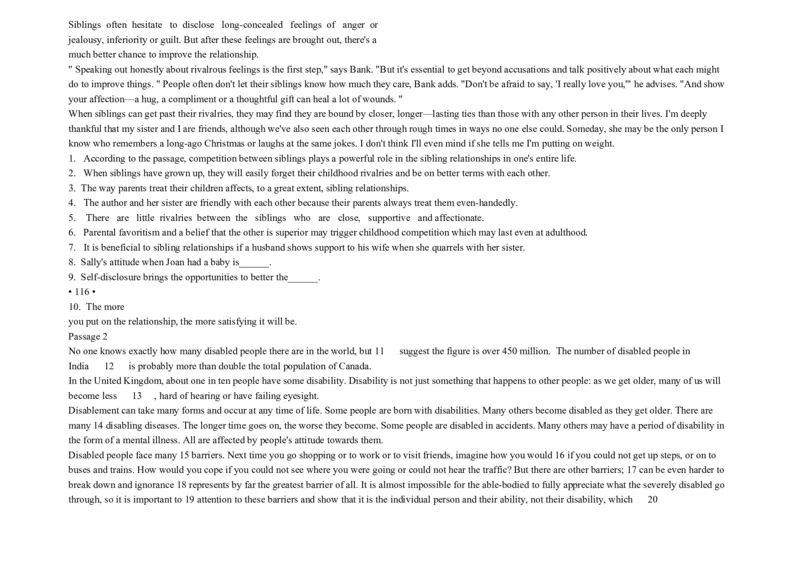
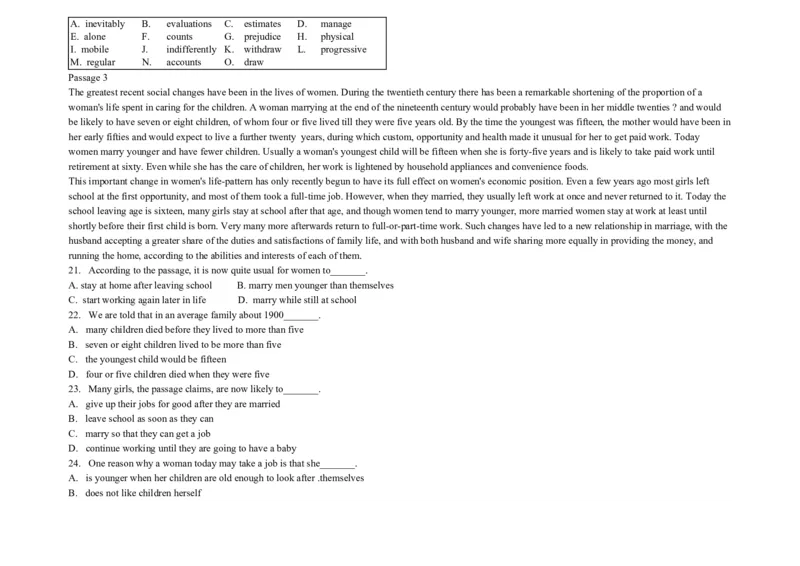
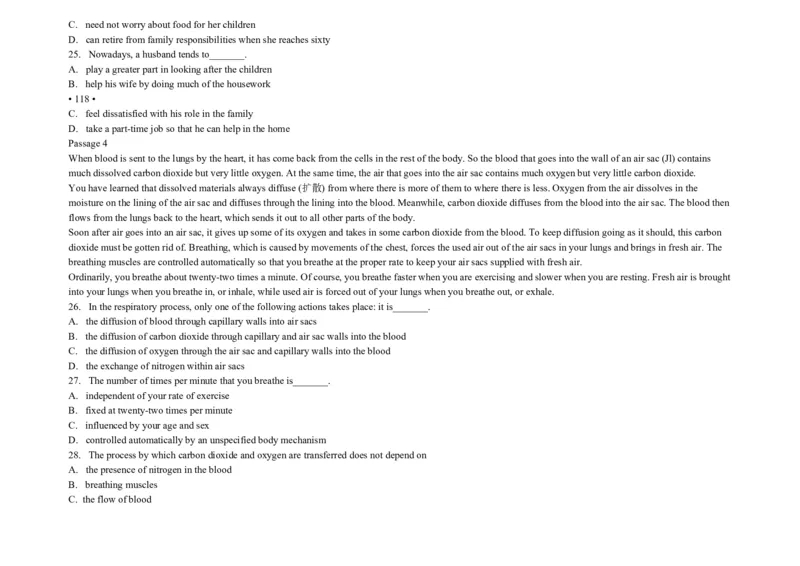
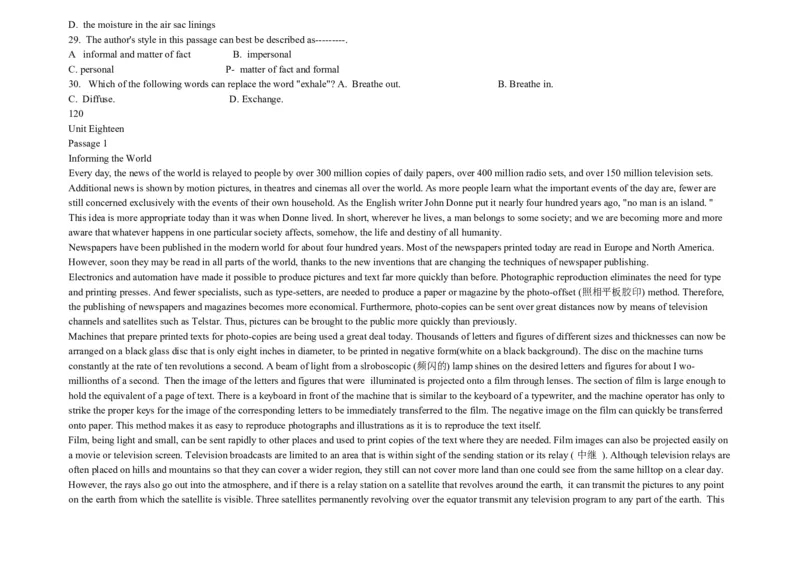
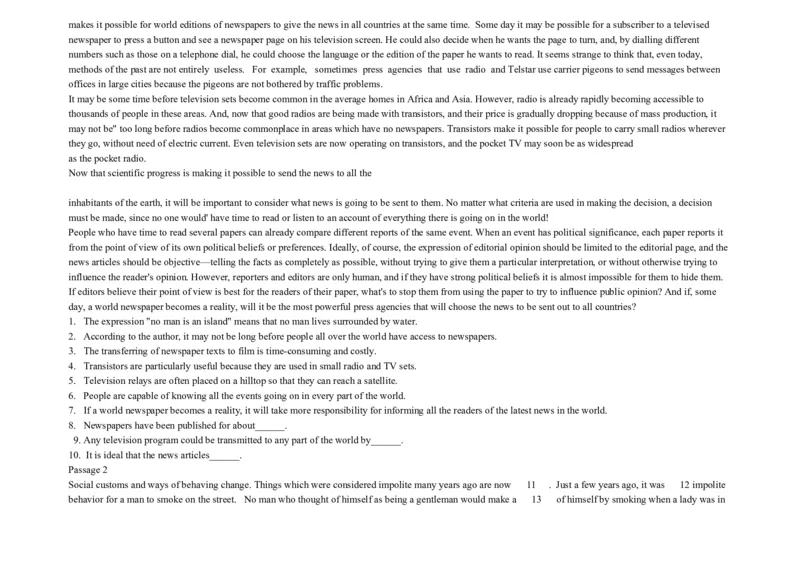
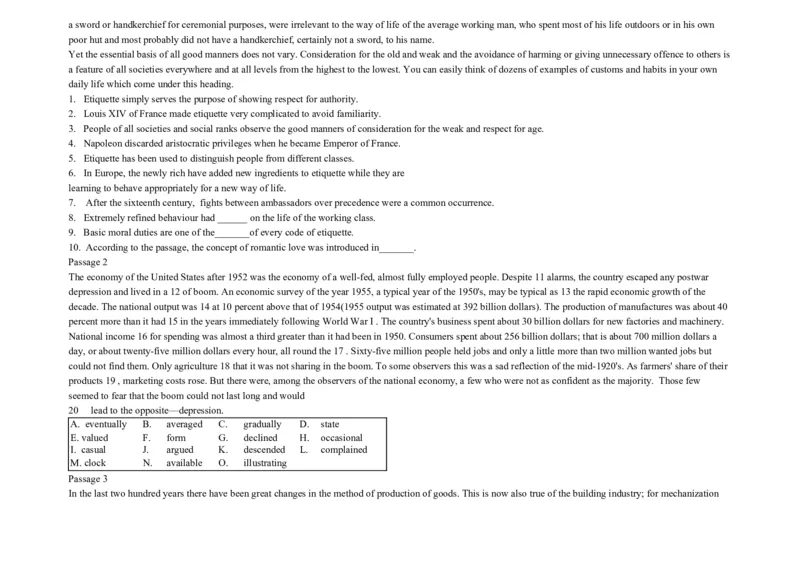
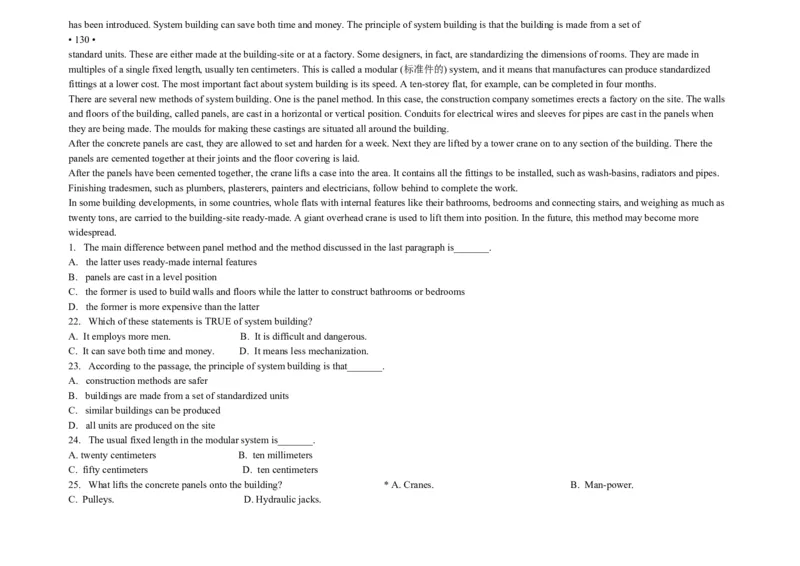
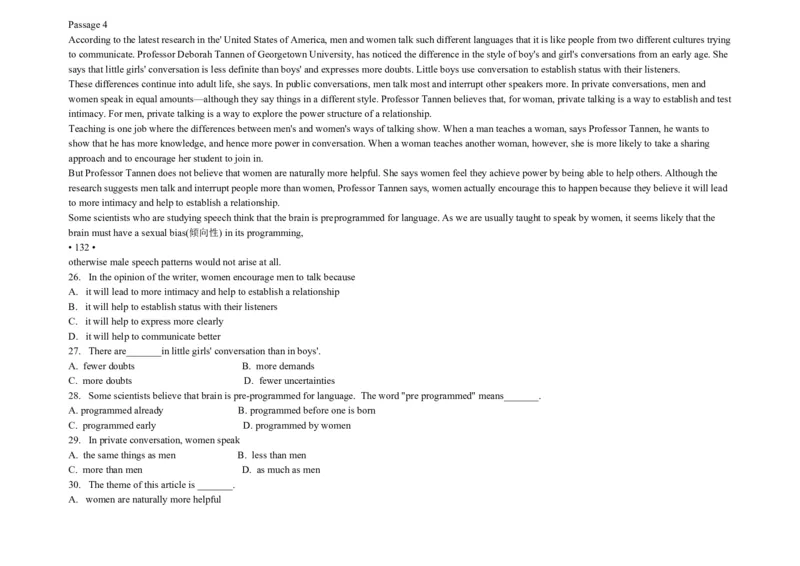
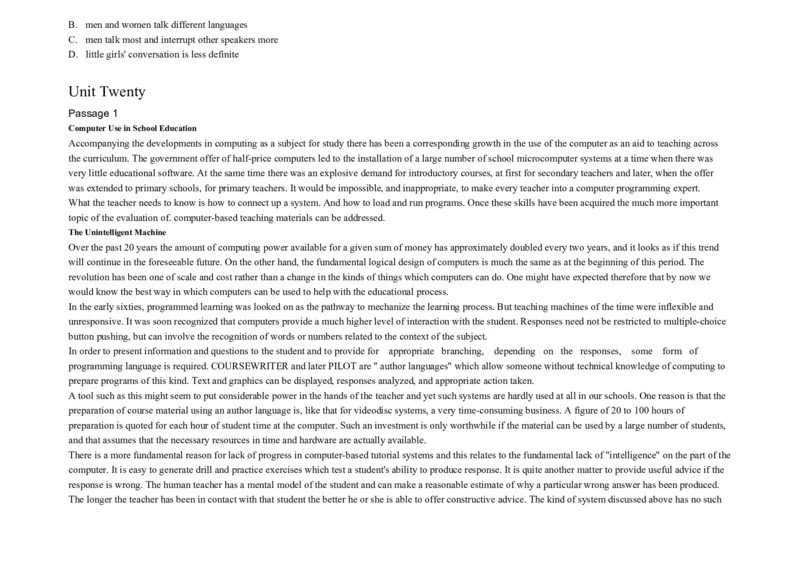
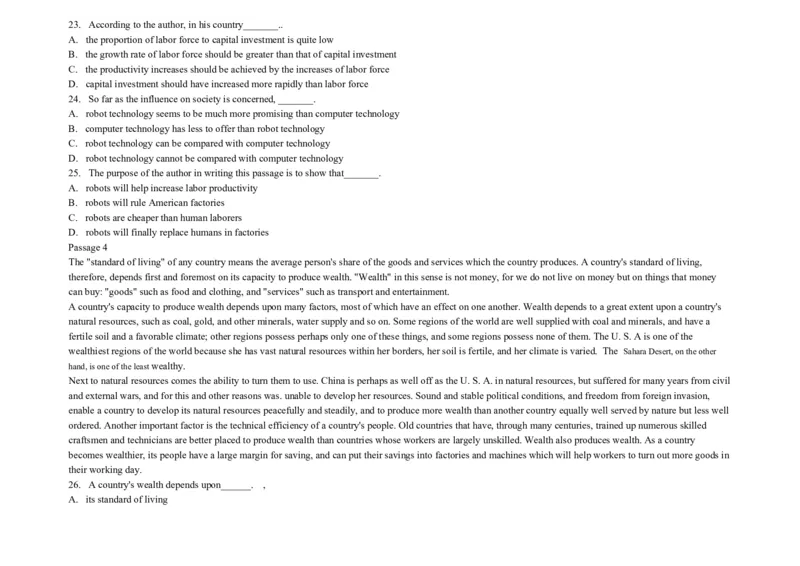
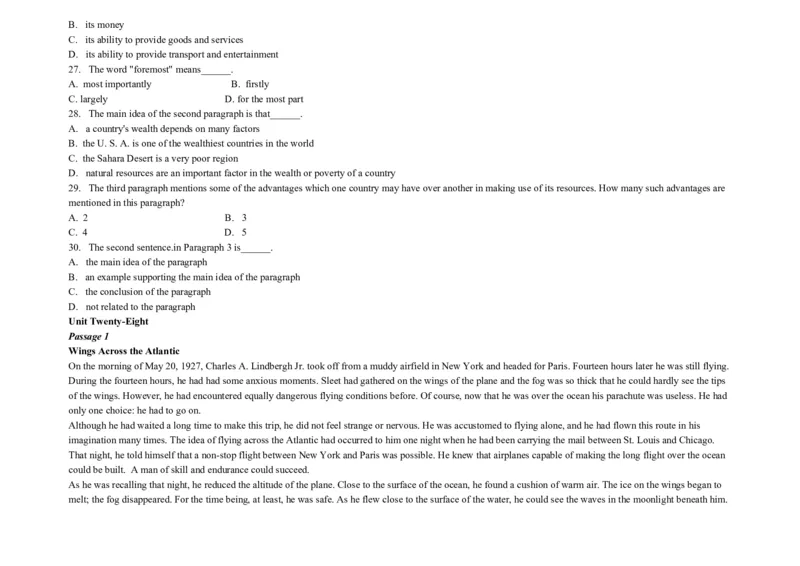
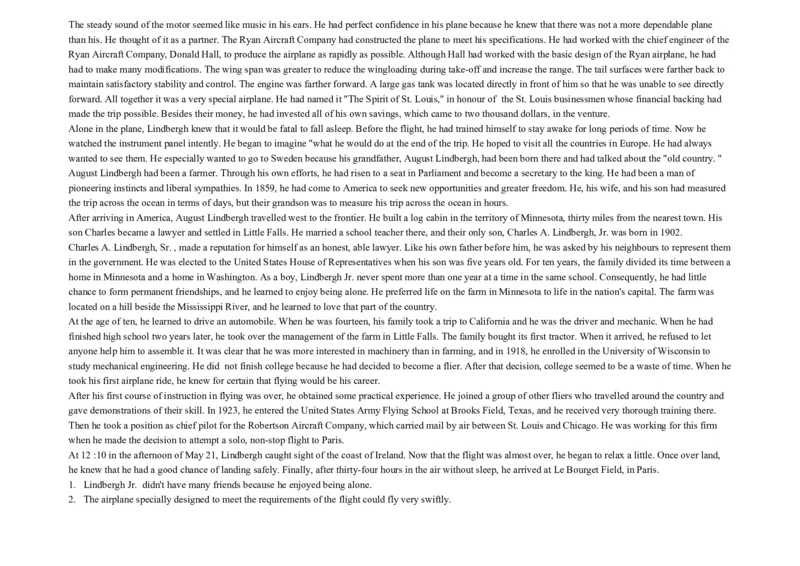
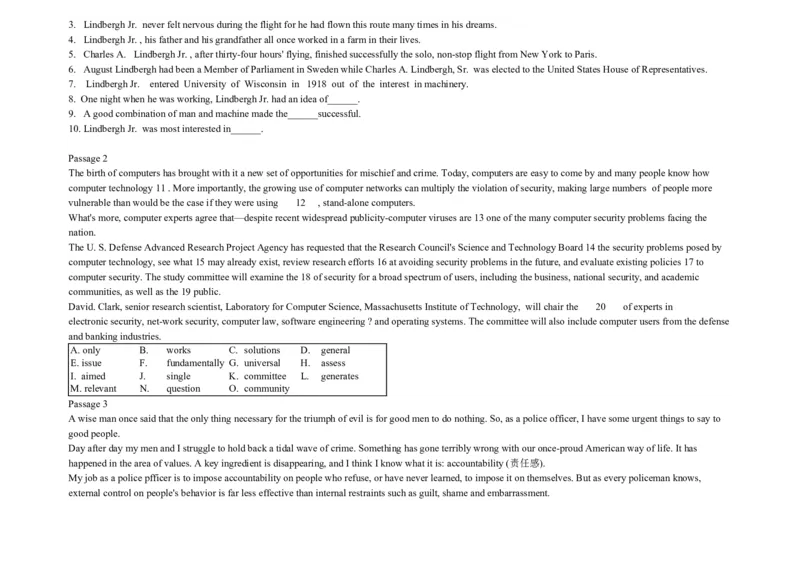
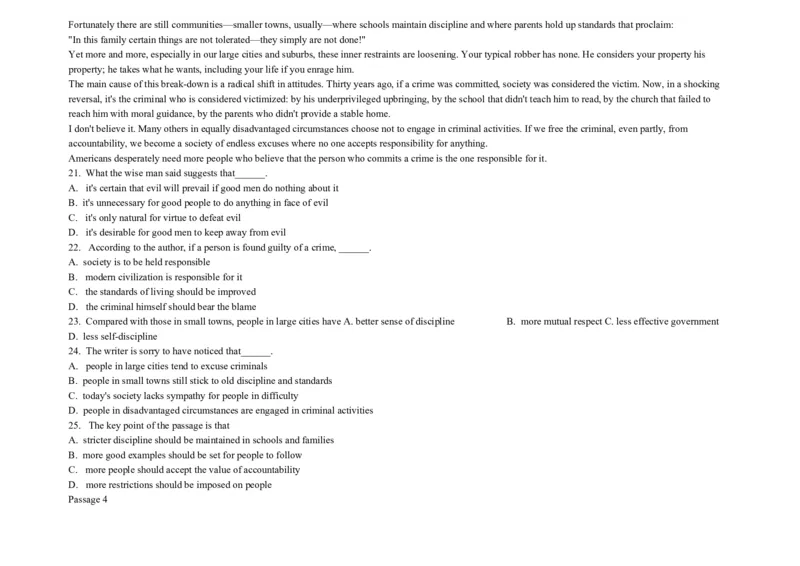
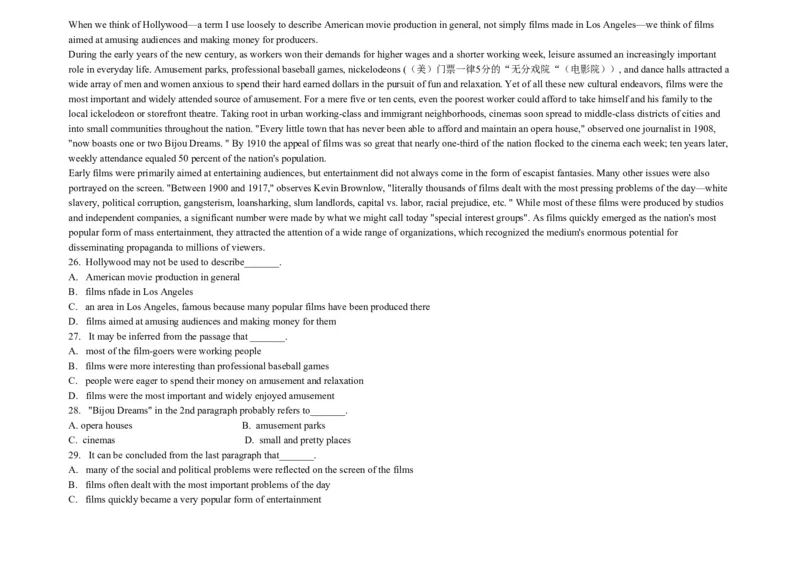
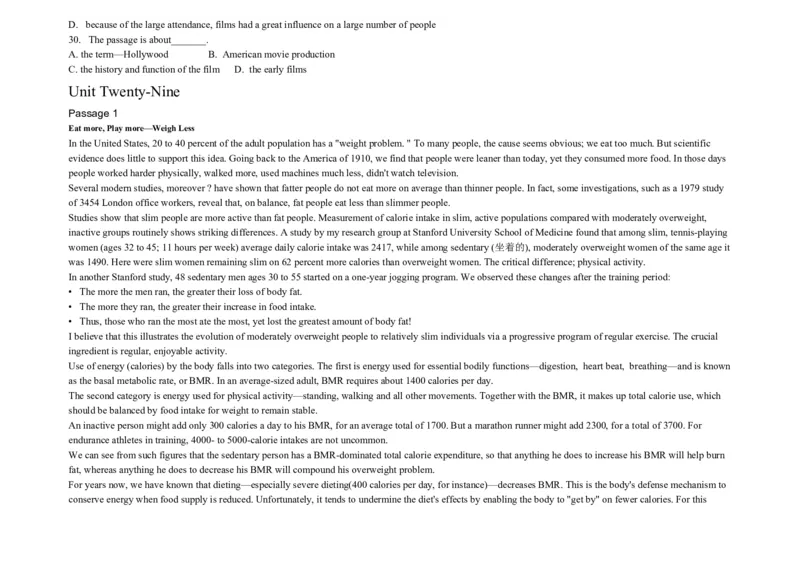
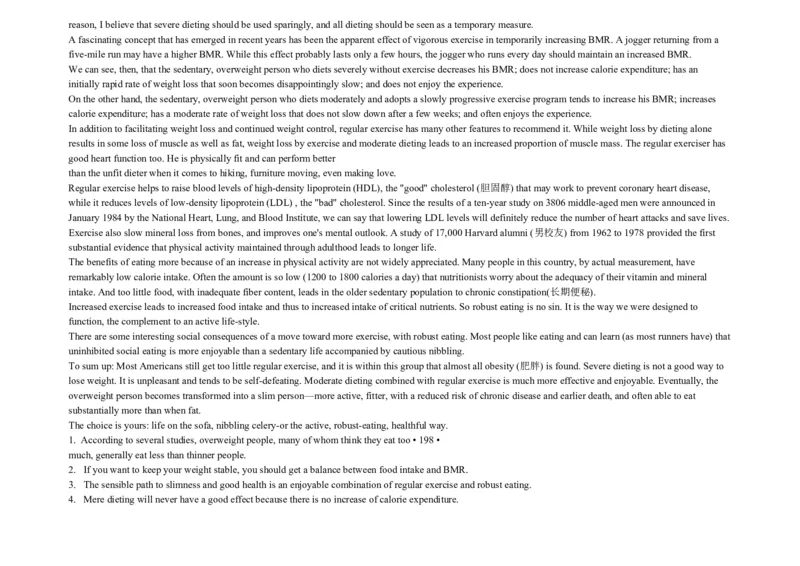
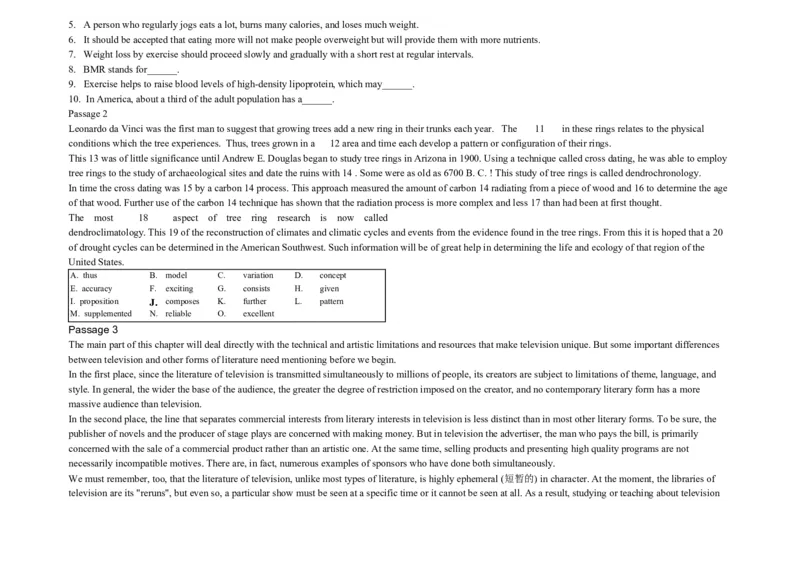
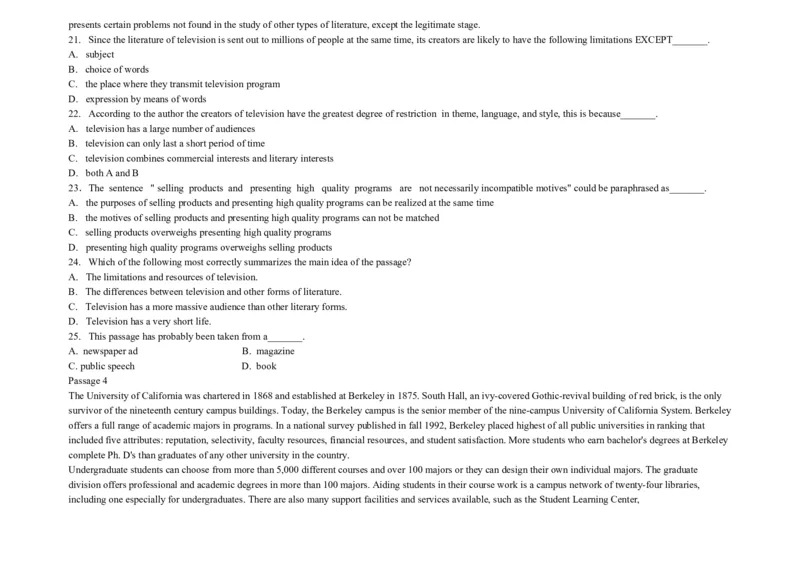
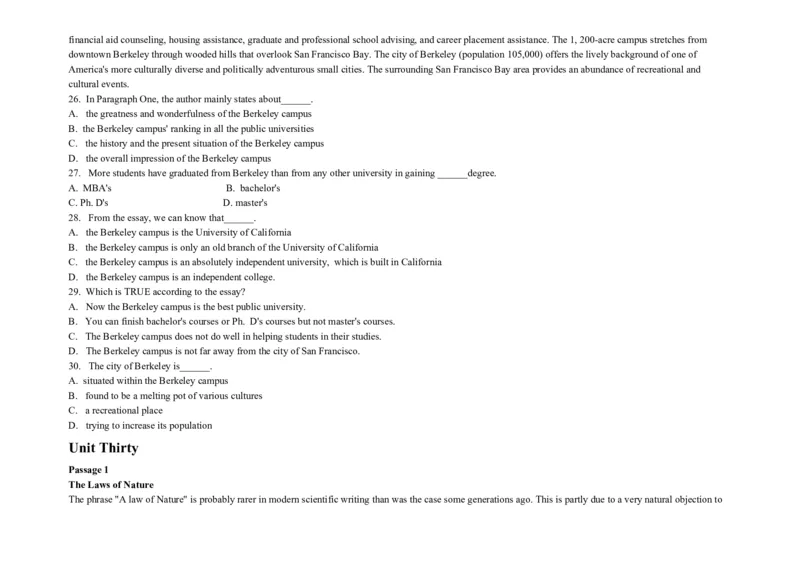
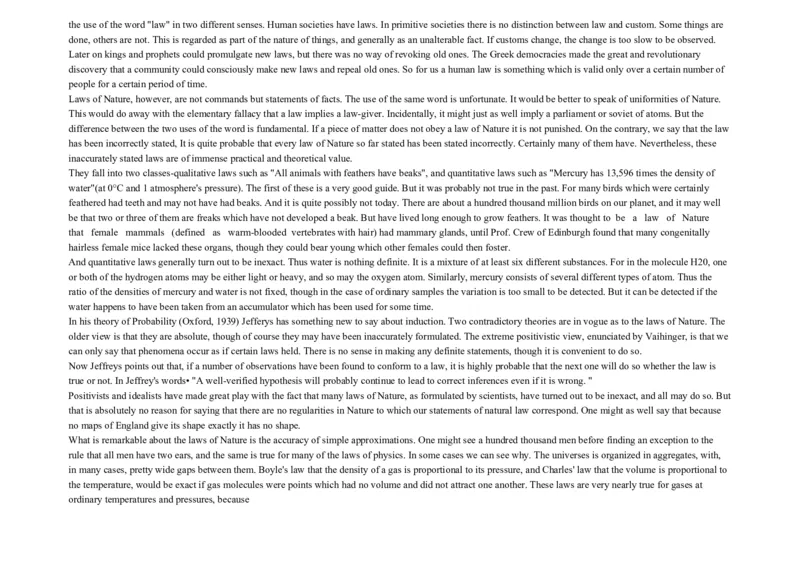
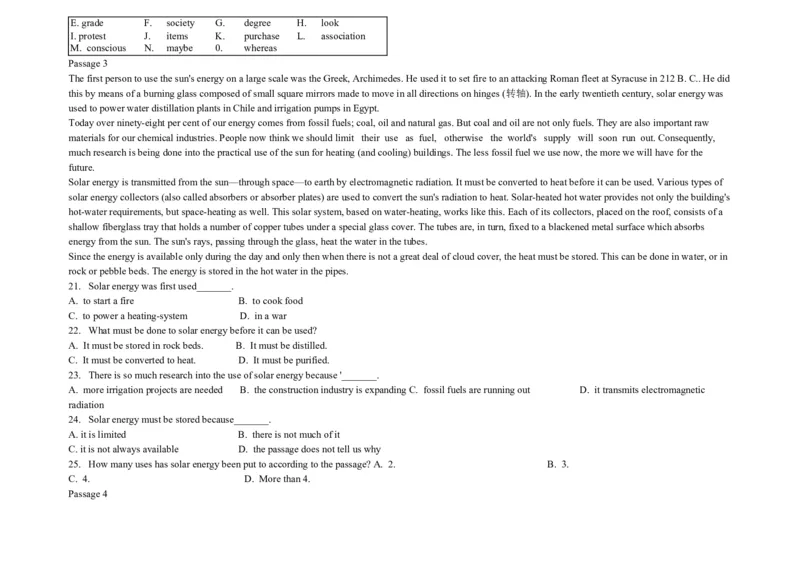
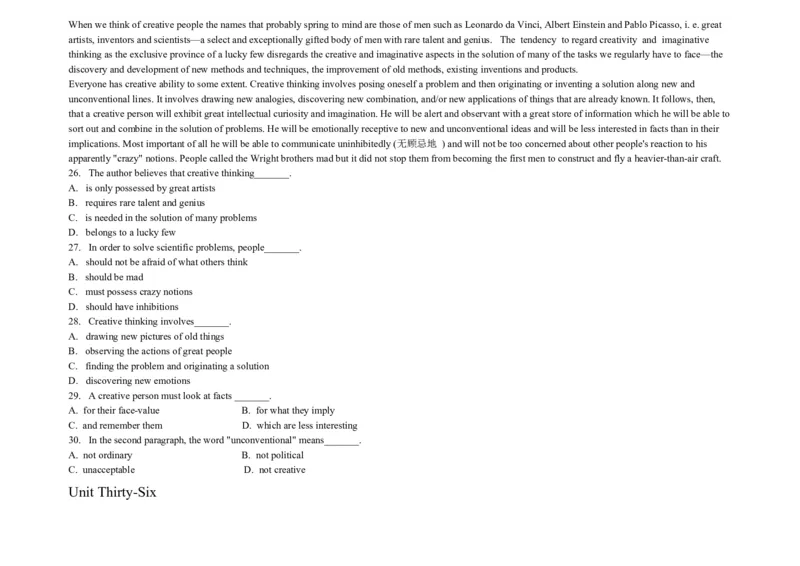
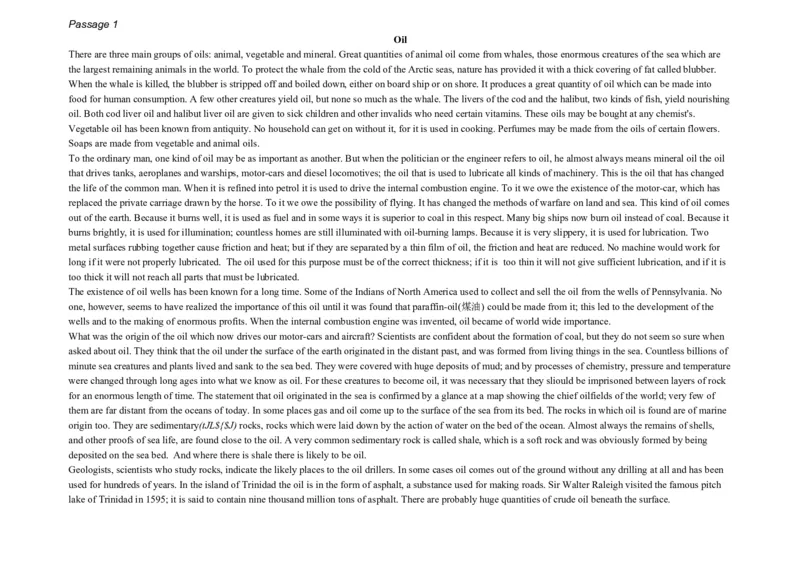
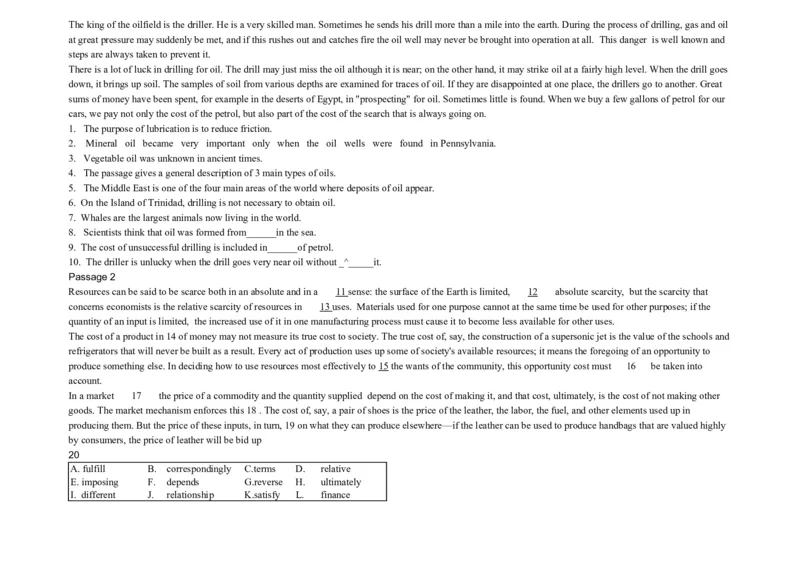

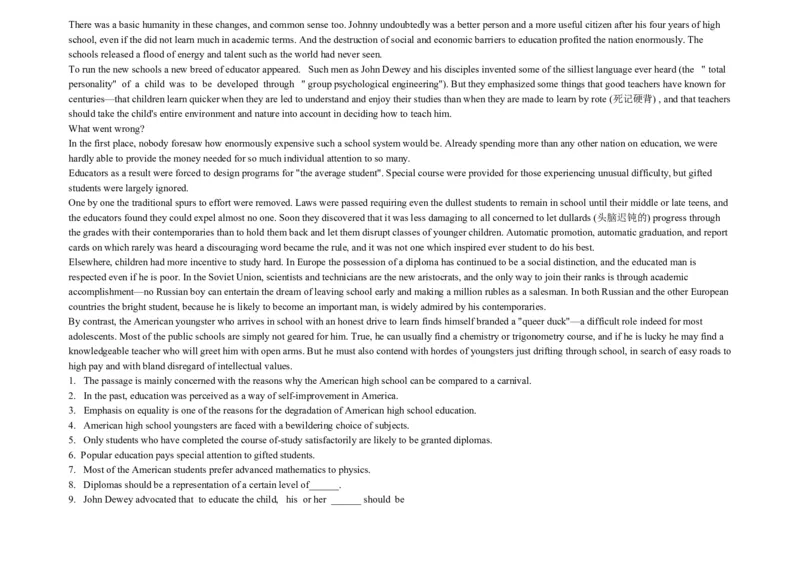
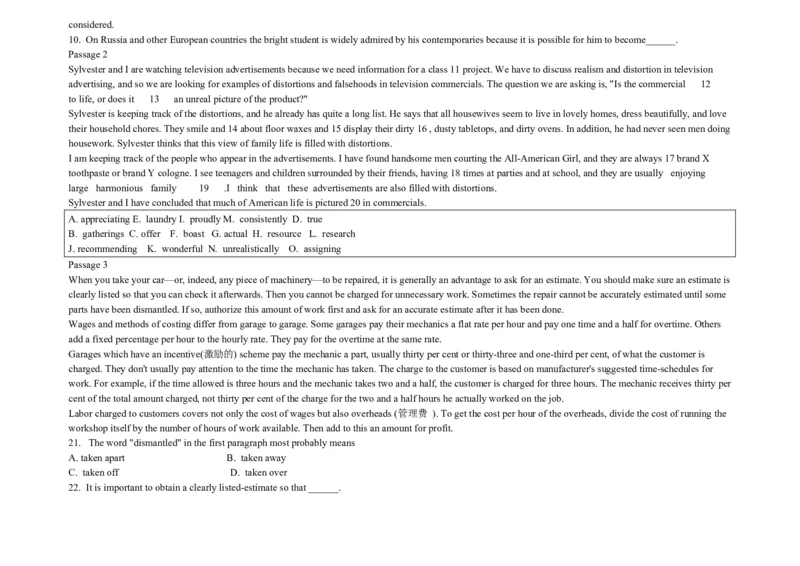
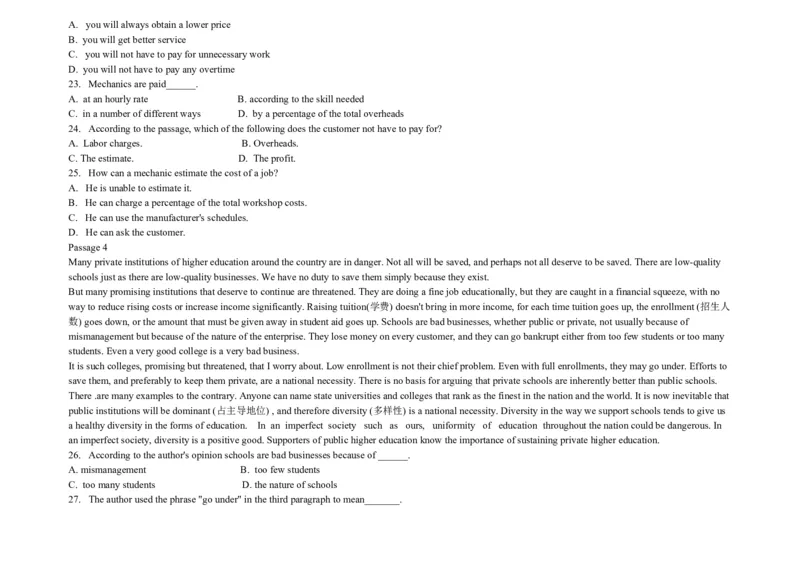
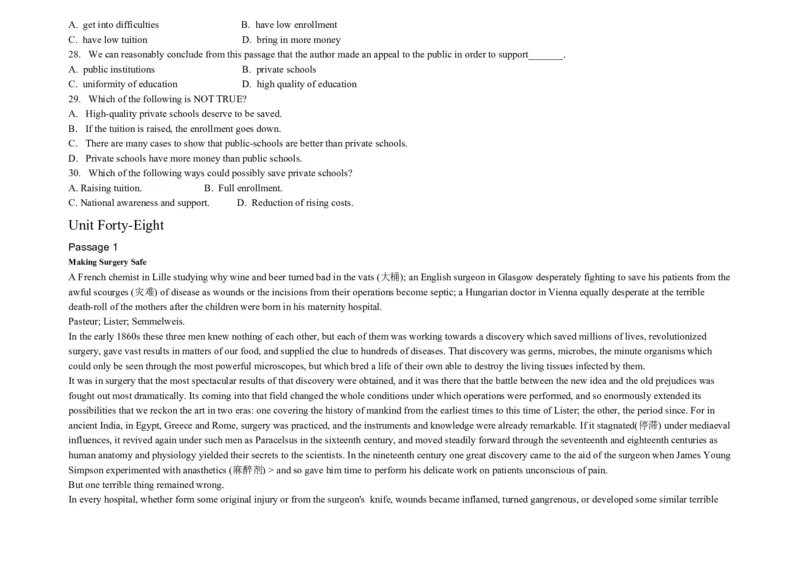
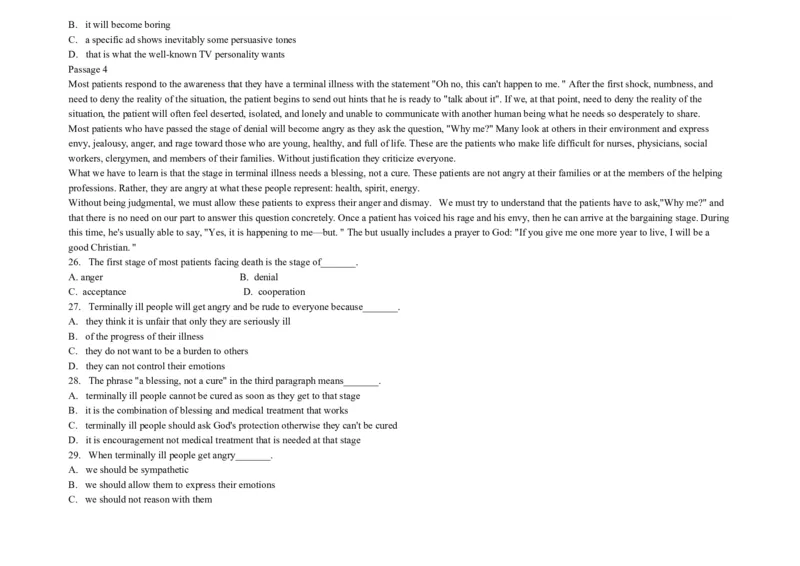






文档内容
Unit One
Passage 1
Reading Comprehension (Skimming and Scanning) (15 minutes)
Directions: In this passage, you will have 15 minutes to go over the passage
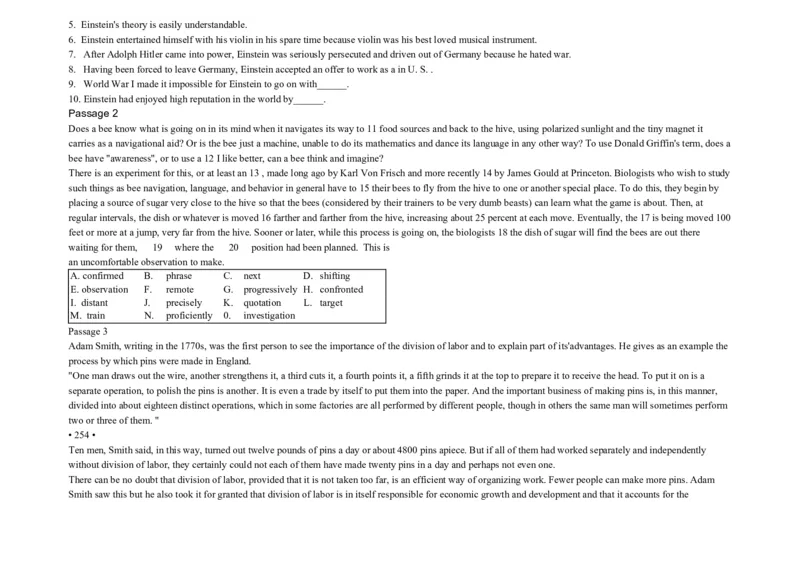
quickly and answer the questions on Answer Sheet 1.
For questions 1-7, mark
Y (for YES) if the statement agrees with the information given
in the passage; N ({for NO) if the statement contradicts the information given in
the passage; NG (for NOT GIVEN) if the information is not given in the passage. For questions 8-10, complete the sentences with the information given in the
passage.
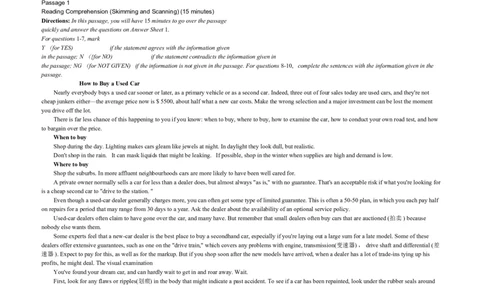
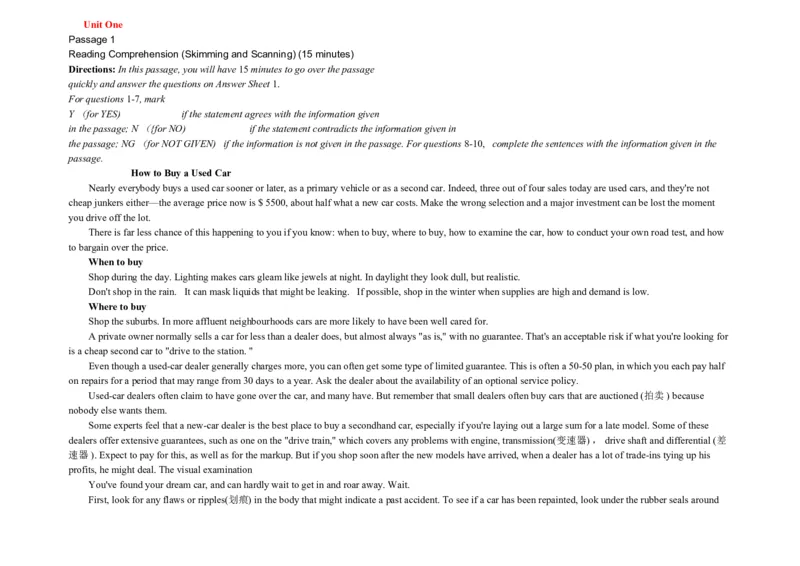
How to Buy a Used Car
Nearly everybody buys a used car sooner or later, as a primary vehicle or as a second car. Indeed, three out of four sales today are used cars, and they're not
cheap junkers either—the average price now is $ 5500, about half what a new car costs. Make the wrong selection and a major investment can be lost the moment
you drive off the lot.
There is far less chance of this happening to you if you know: when to buy, where to buy, how to examine the car, how to conduct your own road test, and how
to bargain over the price.
When to buy
Shop during the day. Lighting makes cars gleam like jewels at night. In daylight they look dull, but realistic.
Don't shop in the rain. It can mask liquids that might be leaking. If possible, shop in the winter when supplies are high and demand is low.
Where to buy
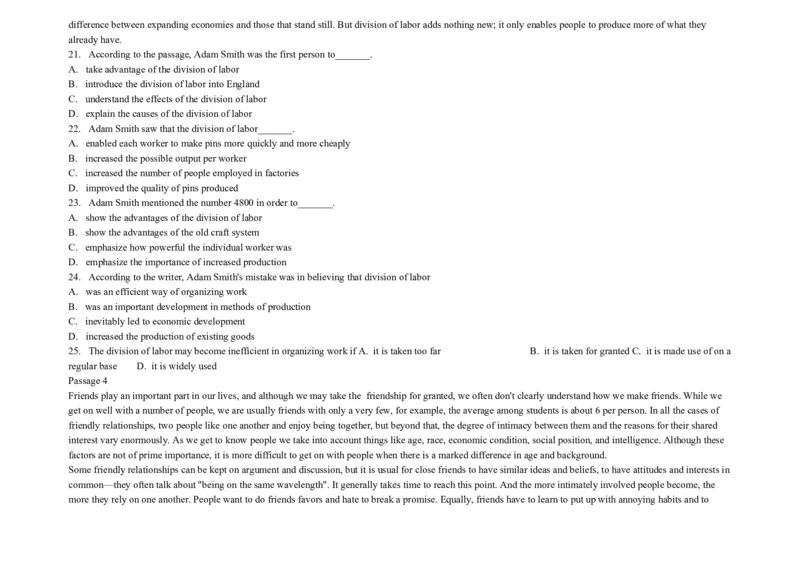
Shop the suburbs. In more affluent neighbourhoods cars are more likely to have been well cared for.
A private owner normally sells a car for less than a dealer does, but almost always "as is," with no guarantee. That's an acceptable risk if what you're looking for
is a cheap second car to "drive to the station. "
Even though a used-car dealer generally charges more, you can often get some type of limited guarantee. This is often a 50-50 plan, in which you each pay half
on repairs for a period that may range from 30 days to a year. Ask the dealer about the availability of an optional service policy.
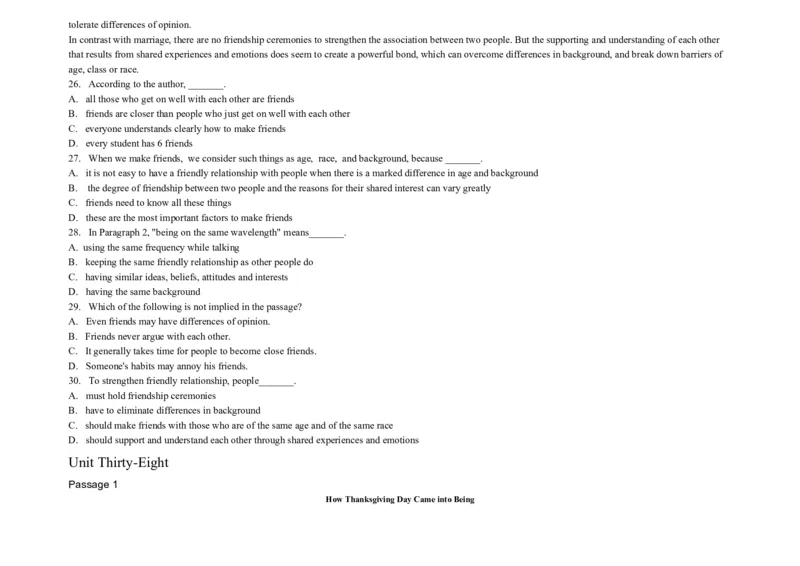
Used-car dealers often claim to have gone over the car, and many have. But remember that small dealers often buy cars that are auctioned (拍卖 ) because
nobody else wants them.
Some experts feel that a new-car dealer is the best place to buy a secondhand car, especially if you're laying out a large sum for a late model. Some of these
dealers offer extensive guarantees, such as one on the "drive train," which covers any problems with engine, transmission(变速器) , drive shaft and differential (差
速器 ). Expect to pay for this, as well as for the markup. But if you shop soon after the new models have arrived, when a dealer has a lot of trade-ins tying up his
profits, he might deal. The visual examination
You've found your dream car, and can hardly wait to get in and roar away. Wait.
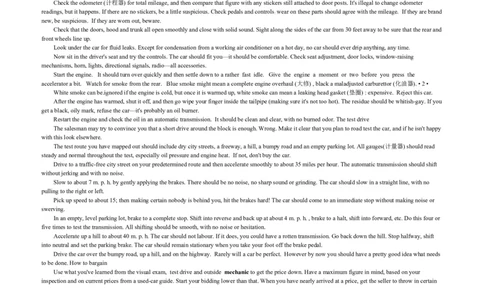
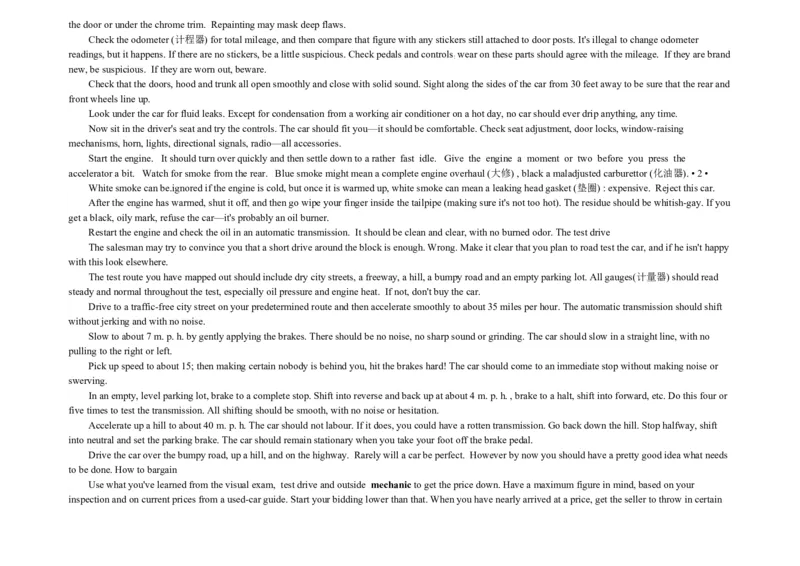
First, look for any flaws or ripples(划痕) in the body that might indicate a past accident. To see if a car has been repainted, look under the rubber seals aroundthe door or under the chrome trim. Repainting may mask deep flaws.
Check the odometer (计程器) for total mileage, and then compare that figure with any stickers still attached to door posts. It's illegal to change odometer
readings, but it happens. If there are no stickers, be a little suspicious. Check pedals and controls wear on these parts should agree with the mileage. If they are brand
:
new, be suspicious. If they are worn out, beware.
Check that the doors, hood and trunk all open smoothly and close with solid sound. Sight along the sides of the car from 30 feet away to be sure that the rear and
front wheels line up.
Look under the car for fluid leaks. Except for condensation from a working air conditioner on a hot day, no car should ever drip anything, any time.
Now sit in the driver's seat and try the controls. The car should fit you—it should be comfortable. Check seat adjustment, door locks, window-raising
mechanisms, horn, lights, directional signals, radio—all accessories.
Start the engine. It should turn over quickly and then settle down to a rather fast idle. Give the engine a moment or two before you press the
accelerator a bit. Watch for smoke from the rear. Blue smoke might mean a complete engine overhaul (大修) , black a maladjusted carburettor (化油器). • 2 •
White smoke can be.ignored if the engine is cold, but once it is warmed up, white smoke can mean a leaking head gasket (垫圈) : expensive. Reject this car.
After the engine has warmed, shut it off, and then go wipe your finger inside the tailpipe (making sure it's not too hot). The residue should be whitish-gay. If you
get a black, oily mark, refuse the car—it's probably an oil burner.
Restart the engine and check the oil in an automatic transmission. It should be clean and clear, with no burned odor. The test drive
The salesman may try to convince you that a short drive around the block is enough. Wrong. Make it clear that you plan to road test the car, and if he isn't happy
with this look elsewhere.
The test route you have mapped out should include dry city streets, a freeway, a hill, a bumpy road and an empty parking lot. All gauges(计量器) should read
steady and normal throughout the test, especially oil pressure and engine heat. If not, don't buy the car.
Drive to a traffic-free city street on your predetermined route and then accelerate smoothly to about 35 miles per hour. The automatic transmission should shift
without jerking and with no noise.
Slow to about 7 m. p. h. by gently applying the brakes. There should be no noise, no sharp sound or grinding. The car should slow in a straight line, with no
pulling to the right or left.
Pick up speed to about 15; then making certain nobody is behind you, hit the brakes hard! The car should come to an immediate stop without making noise or
swerving.
In an empty, level parking lot, brake to a complete stop. Shift into reverse and back up at about 4 m. p. h. , brake to a halt, shift into forward, etc. Do this four or
five times to test the transmission. All shifting should be smooth, with no noise or hesitation.
Accelerate up a hill to about 40 m. p. h. The car should not labour. If it does, you could have a rotten transmission. Go back down the hill. Stop halfway, shift
into neutral and set the parking brake. The car should remain stationary when you take your foot off the brake pedal.
Drive the car over the bumpy road, up a hill, and on the highway. Rarely will a car be perfect. However by now you should have a pretty good idea what needs
to be done. How to bargain
Use what you've learned from the visual exam, test drive and outside mechanic to get the price down. Have a maximum figure in mind, based on your
inspection and on current prices from a used-car guide. Start your bidding lower than that. When you have nearly arrived at a price, get the seller to throw in certainrepairs. It may be cheaper for him than further price cuts.
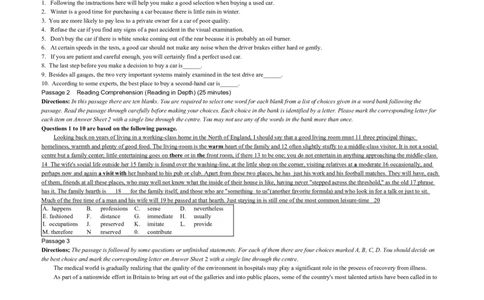
1. Following the instructions here will help you make a good selection when buying a used car.
2. Winter is a good time for purchasing a car because there is little rain in winter.
3. You are more likely to pay less to a private owner for a car of poor quality.
4. Refuse the car if you find any signs of a past accident in the visual examination.
5. Don't buy the car if there is white smoke coming out of the rear because it is probably an oil burner.
6. At certain speeds in the tests, a good car should not make any noise when the driver brakes either hard or gently.
7. If you are patient and careful enough, you will certainly find a perfect used car.
8. The last step before you make a decision to buy a car is______.
9. Besides all gauges, the two very important systems mainly examined in the test drive are______.
10. According to some experts, the best place to buy a second-hand car is______.
Passage 2 Reading Comprehension (Reading in Depth) (25 minutes)
Directions: In this passage there are ten blanks. You are required to select one word for each blank from a list of choices given in a word bank following the
passage. Read the passage through carefully before making your choices. Each choice in the bank is identified by a letter. Please mark the corresponding letter for
each item on Answer Sheet 2 with a single line through the centre. You may not use any of the words in the bank more than once.
Questions 1 to 10 are based on the following passage.
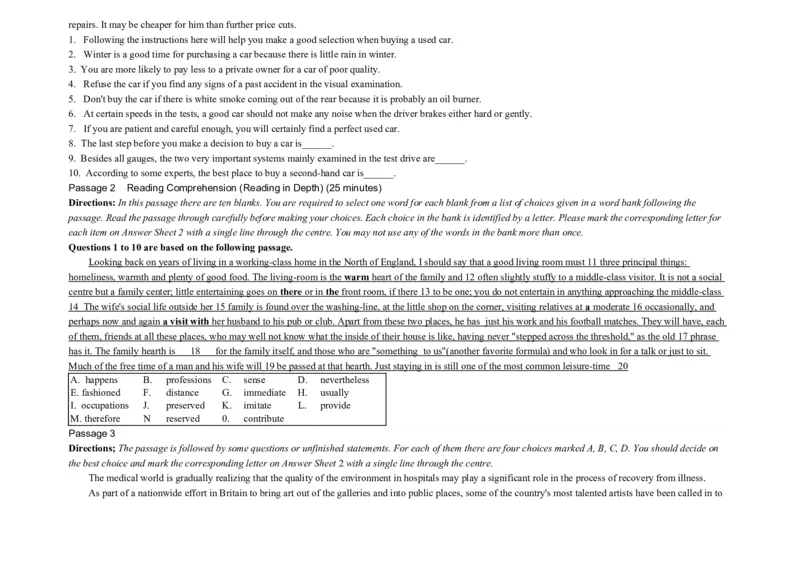
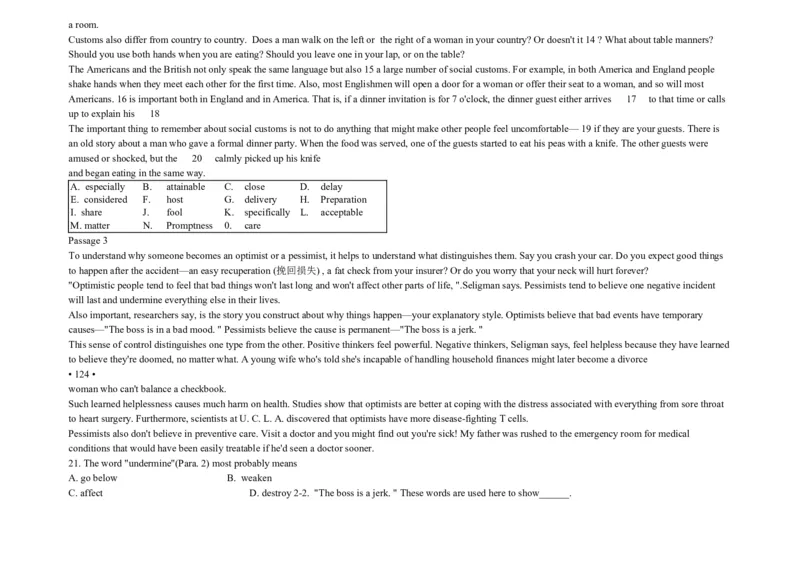
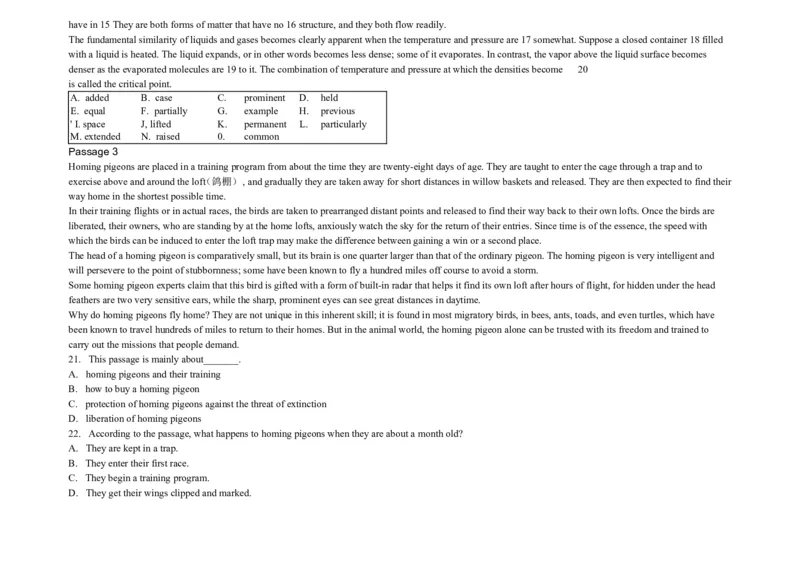
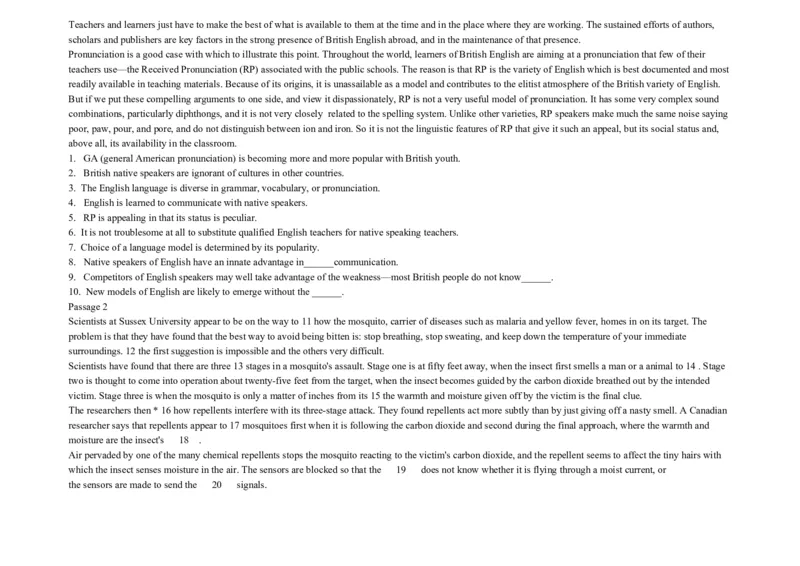
Looking back on years of living in a working-class home in the North of England, I should say that a good living room must 11 three principal things:
homeliness, warmth and plenty of good food. The living-room is the warm heart of the family and 12 often slightly stuffy to a middle-class visitor. It is not a social
centre but a family center; little entertaining goes on there or in the front room, if there 13 to be one; you do not entertain in anything approaching the middle-class
14 The wife's social life outside her 15 family is found over the washing-line, at the little shop on the corner, visiting relatives at a moderate 16 occasionally, and
perhaps now and again a visit with her husband to his pub or club. Apart from these two places, he has just his work and his football matches. They will have, each
of them, friends at all these places, who may well not know what the inside of their house is like, having never "stepped across the threshold," as the old 17 phrase
has it. The family hearth is 18 for the family itself, and those who are "something to us"(another favorite formula) and who look in for a talk or just to sit.
Much of the free time of a man and his wife will 19 be passed at that hearth. Just staying in is still one of the most common leisure-time 20
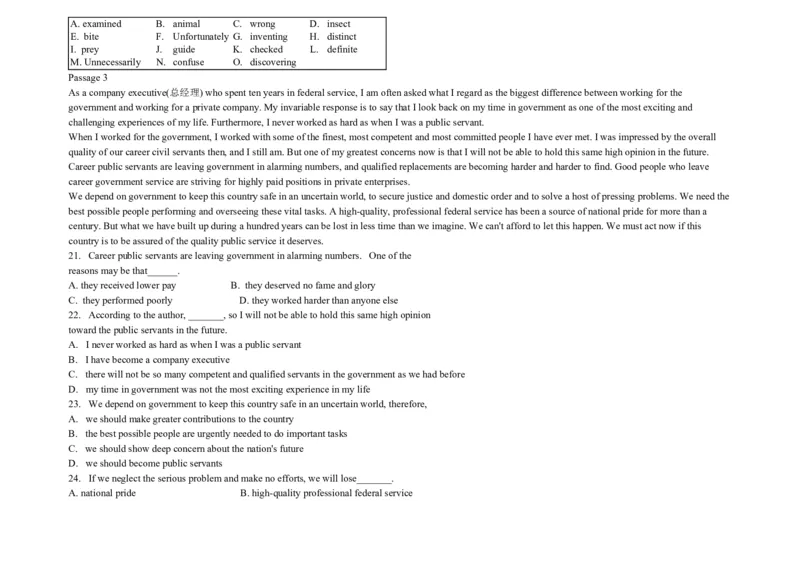
A. happens B. professions C. sense D. nevertheless
E. fashioned F. distance G. immediate H. usually
I. occupations J. preserved K. imitate L. provide
M. therefore N reserved 0. contribute
Passage 3
Directions; The passage is followed by some questions or unfinished statements. For each of them there are four choices marked A, B, C, D. You should decide on
the best choice and mark the corresponding letter on Answer Sheet 2 with a single line through the centre.
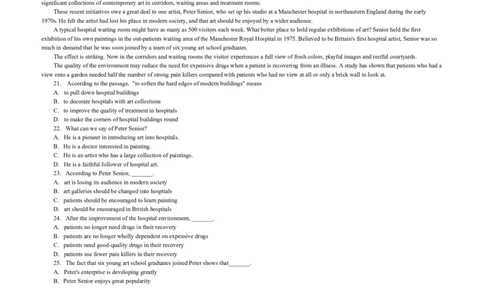
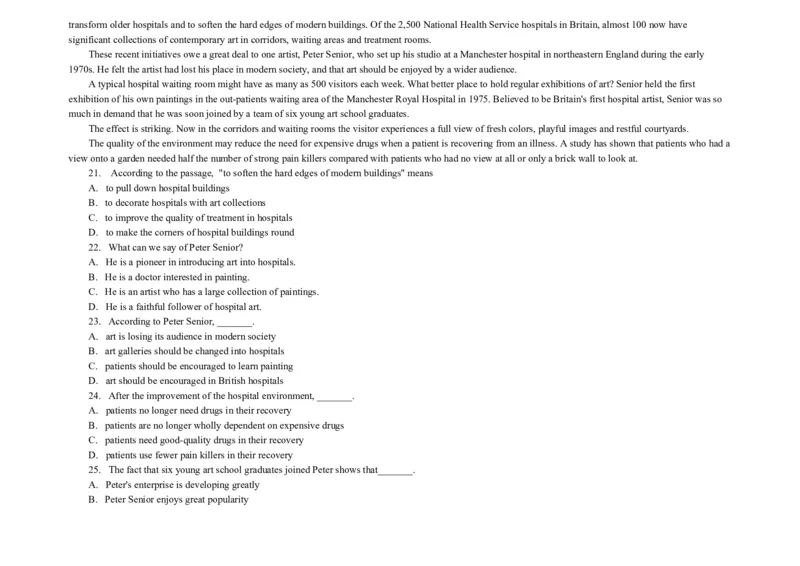
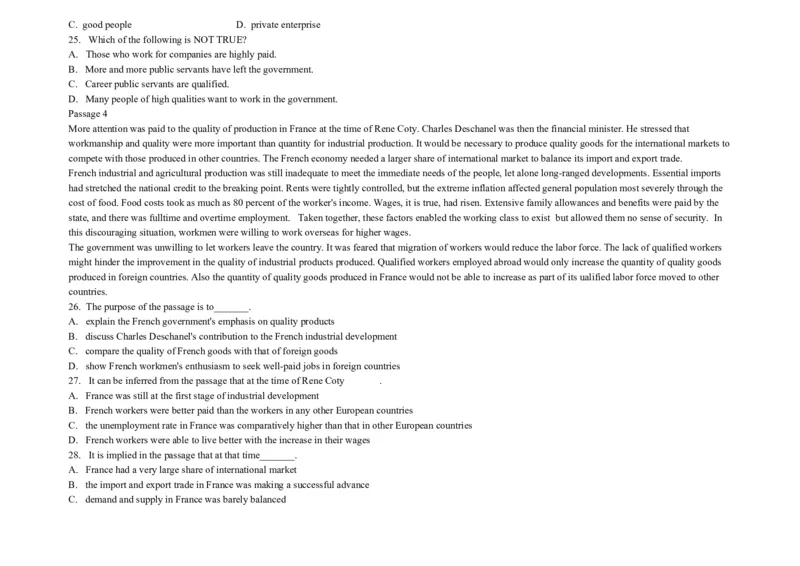
The medical world is gradually realizing that the quality of the environment in hospitals may play a significant role in the process of recovery from illness.
As part of a nationwide effort in Britain to bring art out of the galleries and into public places, some of the country's most talented artists have been called in totransform older hospitals and to soften the hard edges of modern buildings. Of the 2,500 National Health Service hospitals in Britain, almost 100 now have
significant collections of contemporary art in corridors, waiting areas and treatment rooms.
These recent initiatives owe a great deal to one artist, Peter Senior, who set up his studio at a Manchester hospital in northeastern England during the early
1970s. He felt the artist had lost his place in modern society, and that art should be enjoyed by a wider audience.
A typical hospital waiting room might have as many as 500 visitors each week. What better place to hold regular exhibitions of art? Senior held the first
exhibition of his own paintings in the out-patients waiting area of the Manchester Royal Hospital in 1975. Believed to be Britain's first hospital artist, Senior was so
much in demand that he was soon joined by a team of six young art school graduates.
The effect is striking. Now in the corridors and waiting rooms the visitor experiences a full view of fresh colors, playful images and restful courtyards.
The quality of the environment may reduce the need for expensive drugs when a patient is recovering from an illness. A study has shown that patients who had a
view onto a garden needed half the number of strong pain killers compared with patients who had no view at all or only a brick wall to look at.
21. According to the passage, "to soften the hard edges of modern buildings" means
A. to pull down hospital buildings
B. to decorate hospitals with art collections
C. to improve the quality of treatment in hospitals
D. to make the corners of hospital buildings round
22. What can we say of Peter Senior?
A. He is a pioneer in introducing art into hospitals.
B. He is a doctor interested in painting.
C. He is an artist who has a large collection of paintings.
D. He is a faithful follower of hospital art.
23. According to Peter Senior, _______.
A. art is losing its audience in modern society
B. art galleries should be changed into hospitals
C. patients should be encouraged to learn painting
D. art should be encouraged in British hospitals
24. After the improvement of the hospital environment, _______.
A. patients no longer need drugs in their recovery
B. patients are no longer wholly dependent on expensive drugs
C. patients need good-quality drugs in their recovery
D. patients use fewer pain killers in their recovery
25. The fact that six young art school graduates joined Peter shows that_______.
A. Peter's enterprise is developing greatly
B. Peter Senior enjoys great popularityC. they are talented hospital artists
D. the role of hospital environment is being recognized
Passage 4
Directions: The passage is followed by some questions or unfinished statements. For each of them there are four choices marked A, B, C, D. You should decide
on the best choice and mark the corresponding letter on Answer Sheet 2 with a single line through the centre.
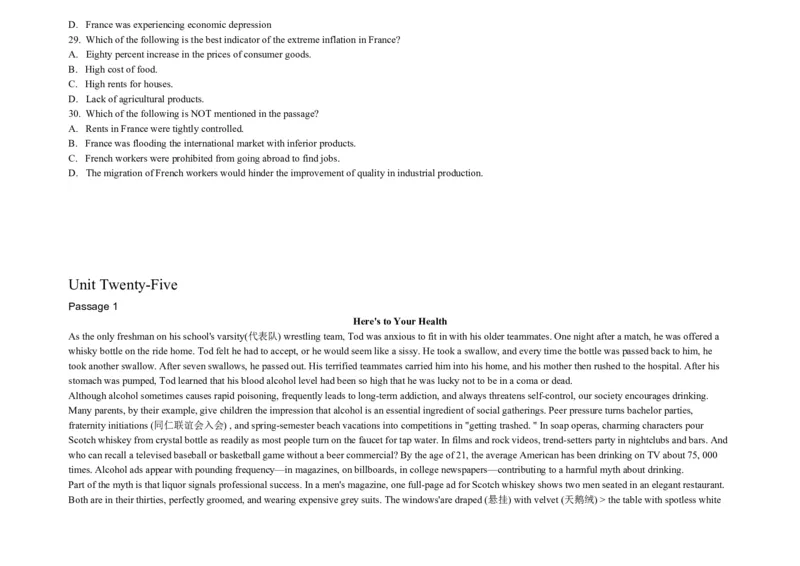
Polyester (聚酯 ) is now being used for bottles. ICI, the chemicals and plastics company, believes that it is now beginning to break the grip of glass on
the bottle business and thus take advantage of this huge market.
All the plastics manufacturers have been experiencing hard times as their traditional products have been doing badly world-wide for the last few years. Between
1982 and 1984 the Plastics Division of ICI had lost a hundred and twenty million dollars, and they felt that the. most hopeful new market was in packaging, bottles
and cans.
Since 1982 it has opened three new factories producing "Melinar", the raw material from which high quality polyester bottles are made.
The polyester bottle was born in the 1970s, when soft drinks companies like Coca Cola started selling their drinks in giant two-liter containers. Because of the
build-up of the pressure of gas in these large containers, glass was unsuitable. Nor was PVC, the plastic which had been used for bottles since the 1960s, suitable for
drinks with gas in them. A new plastic had to be made.
Glass is still cheaper for the smaller bottles, and will continue to be so unless oil and plastic become much cheaper, but plastic does well for the larger sizes.
Polyester bottles are virtually unbreakable. The manufacturers claim they are also lighter, less noisy when being handled, and can be reused. Shopkeepers and
other business people are unlikely to object to a change from glass to polyester, since these bottles mean few breakages, which are costly and time-consuming. The
public, though, have been more difficult to persuade. ICI's commercial department is developing different bottles with interesting shapes, to try and make them
visually more attractive to the public.
The next step could be to develop a plastic which could replace tins for food. The problem here is the high temperatures necessary for cooking the food in the
container.
26. Plastics of various kinds have been used for making bottles__________.
A. since 1982
B. since the 1970s but only for large bottles
C. since the 1960s but not for liquids with gas in them
D. since companies like Coca Cola first tried them
27. Why is ICI's Plastics Division interested in polyester for bottles?
A. The other things they make are not selling well.
B. Glass manufacturers cannot make enough new bottles.
C. They have factories which could be adapted to make it.
D. The price of oil keeps changing.
28. Why aren't all bottles now made of polyester?
A. The price of oil and plastic has risen.B. It is not suitable for containing gassy drinks.
C. The public like traditional glass bottles.
D. Shop-keepers dislike reusable bottles.
29. Manufacturers think polyester bottles are better than glass bottles because they
A. are cheaper B. are more suited to small sizes
C. are more exciting to look at D. do not break easily
30. Plastic containers for holding food in the same way as cans______.
A. have been used for many years
B. are an idea that interests the plastics companies
C. are possible, but only for hot food
D. are the first things being made in the new factories
Unit Two
Passage 1
World's Nonsmokers Take up Fight for Cleaner Air
In country after country, talk of nonsmokers' rights is in the air. This fresh voice is heard from Australia to Sweden. Its force is freeing clean air for nonsmokers
—and tightening the situation for smokers.
In west Germany, for instance, taxi drivers—known for their independence—post signs saying "Nicht Raucher"(nonsmoker) and may refuse passengers who
insist on smoking. . . Bans in Poland prevent smoking in factories, offices, snack bars, and other public places. . . And Venezuelans can be fined $ 230 to $ 1,000 for
smoking in supermarkets, buses, and numerous other places. Many countries also are moving in step to limit tobacco promotion (despite a 7 percent jump in world
tobacco production last year) and eliminate the "false claims of the glorification(美化) of smoking as a habit.. . " says Jean de Moerloose of the United Nations World
Health Organization.
While a majority of countries have taken little or no action yet, some 30 nations have introduced legislative steps to control smoking abuse. Many laws have
been introduced in other countries to help clear the air for nonsmokers, or to cut cigarette consumption.
In many developing nations, however, cigarette smoking is seen as a sign of economic progress—and is even encouraged.
"While it appears that in developed countries the consumption of cigarettes has become stabilized, there are some indications that it is still rising at a steady pace
in Latin America," says Dr. Daniel J. Joly, an adviser to the Pan American Health Organization.
Despite progress in segregating (隔离) nonsmokers and smokers, most countries see little change in the number of smokers. In fact, there is a jump in the
number of girls and young women starting to smoke.
As more tobacco companies go international, new markets are sought to gain new smokers in developing countries. For example, great efforts are made by the
American tobacco industry to sell cigarettes in the Middle East and North Africa—where U. S. tobacco exports increased by more than 27 percent last year,
according the U. S. Foreign Agriculture Service. So far, any cooperation between tobacco interests and governments' campaigns against smoking has been in the
area of tobacco advertising.
Restrictions on cigarette ads, plus health warnings on packages and bans on public smoking in certain places, are the most popular tools used by nations insupport of nonsmokers or in curbing ( 限制) smoking.
But world attention also is focusing on other steps which will:
—make the smoker increasingly self-conscious and uncomfortable about his habit by publicizing public awareness of the decline of social acceptability of
smoking.
(This method is receiving strong support in the U. S. and other countries. )
—prevent pro-smoking scenes on television and films.
—remove cigarette vending machines.
—provide support for those who want to kick the habit of smoking.
—make it illegal to sell or hand over tobacco products to minors and prohibit smoking in meeting places for young people.
—boost cigarette prices with higher tobacco taxes—and use the money for antismoking campaigns.
At a June UN conference on smoking, a goal set by Sir George E. Godber, chairman of the expert committee on smoking and health for the World Health
Organization, stated " We may not have eliminated cigarette smoking completely by the end of this century, but we ought to have reached a position where relatively
:
few addicts still use cigarettes, but only in private at most in the company of consenting adults. " NATIONS ATTEMPT SOLUTIONS
Here are brief sketches of major or unique attempts around the world to insure nonsmokers' right to smoke-free air and to help smokers quit. SWEDEN
An ambitious, concerted plan to raise a nation of nonsmokers is being implemented by the Swedish National Board of Health and Welfare.
Swedish children born after 1975 will grow up in environments that will be nonsmoking and antismoking as much as possible. General cigarette consumption
will cut from 1,700 cigarettes a year per person to 1920 level of under 300 cigarettes a year, according to the 25-year plan.
A campaign to restrict tobacco advertising, raise cigarette prices to over $ 2
a pack, remove cigarette vending machines by 1979, ban pro-smoking content in
films and television programs, restrict public smoking, and give intensive
antismoking education in schools and the military, will promote the goal of a
society which "should be so unfavourable toward smoking that smoking could not arise once again as a major factor harmful to public health. "
By Swedish law, life-insurance premiums (保险费 ) are lowered for nonsmokers. WEST GERMANY
An image-reversing advertising campaign began a few years ago in West Germany whereby it is the nonsmoker who is shown to be living the swinging life
previously claimed by the cigarette addict.
A government-sponsored program to warn the public about the dangers of smoking includes an attempt to encourage consideration of the nonsmoker at work
and in public places. Tobacco television ads were stopped in 1973.
But there are no firm plans at the federal level to ban smoking in public places, although it is being considered as a legislative proposal. Health experts say that
the legally required warning on cigarette packages in the United States has not helped. Hence there are strong doubts about strict laws in the whole area of smoking.
The governing idea here is to encourage consideration of others. But this angle of attack (moral persuasion) does not rule out legislation. In two of Germany's 11
states there are laws to protect public employees who do not smoke from their smoking fellow workers. "Smoke breaks" are used to separate the smokers and
nonsmokers.
"The nonsmoker today is just as much or more respected than the smoker. " Says one health official, "and this is a success in itself. " GREAT BRITAINA television advertising ban in 1965, a health warning on tobacco packages begun in 1971, a 20 percent price rise on cigarettes in 1974, and a constant
campaign to isolate pubic smoking in airlines, trains, and other public places have fuelled a forceful antismoking and nonsmokers' program in Britain.
In Ireland, an advertising code bans ads emphasizing the pleasure of smoking, featuring conventional heroes of the young as smokers, or implying
that it is less harmful to smoke one brand than another. UNITED STATES
U. S. airlines are subject to $ 1,000 fines for failing to provide a smoke free seat for any passenger who wants one. The Interstate Commerce Commission has
made "no smoking" the rule, rather than the exception, on all interstate passenger trains and buses. The Military segregates smokers and no longer distributes
cigarette in C rations.
A growing number of restaurants now offer separate areas for nonsmokers. A ban on television and radio cigarette ads, health warnings and restrictions on public
smoking in many states and cities make the United States a participant in world nonsmoking and antismoking efforts. The number of U. S. nonsmokers is rising as
well.
1. With the world's efforts, more and more smokers have realized the harmful effect of smoking on environment.
2. 30 countries have introduced legislation to restrict smoking, though little has been done in most other countries.
3. The total number of smokers decreases while the number of female smokers increases in most countries.
4. Smokers in Latin America consume more cigarettes than in developed countries.
5. The improved economic situation in developing countries is the explanation of the rising number of smokers there.
6. Both Sweden and Great Britain raised cigarette prices to control the tobacco consumption.
7. The increasing number of nonsmokers in U. S. is the evidence to show that the U. S. antismoking campaign has been successful.
8. Tobacco companies are now getting more profit in______than before.
9. People aboard any flight in U. S. can get a
10. In West Germany, consideration of nonsmokers is ______ in the campaign against smoking.
Passage 2
Flying over a desert area in an airplane, two scientists looked down with trained eyes at trees and bushes. After an hour's 11 one of the scientists wrote in his book,
"Look here for 12 metal. " Scientists in another airplane, flying over a mountain region, sent a 13 to other scientists on the ground, "Gold possible. " Walking across
hilly ground, four scientists reported, "This ground should be searched for metals. " From an airplane over a hilly wasteland a scientist sent back by radio one word,
"Uranium. "
None of the scientists had X-ray eyes they had no 14 powers for looking down below the earth's surface. They were 15 putting to use one of the newest methods of
:
16 minerals in the ground—using trees and plants as 17 that certain minerals may lie beneath the ground on which the trees and
plants are growing.
This newest method of searching for minerals is 18 on the fact that minerals deep in the earth may 19 the kind of bushes and trees that grow on the
surface.
At Watson Bar Creek, a brook six thousand feet high in the mountains of British Columbia, Canada, a mineral search group gathered bags of tree seeds. Boxes were
filled with small branches from the trees. Roots were dug and put into boxes. Each bag and box was 20 marked. In a scientific laboratory the parts of the forest trees
were burned to ashes and tested. Each small part was examined to learn whether there were minerals in it.A. signs B. sufficientl C. locating D. affect
y
E. merely F. magic G. hints H. carefully
I. finding J. message K. flight L. probable
M. revealing N. based O. information
Passage 3
There are two factors which determine an individual's intelligence. The first is the sort of brain he is born with. Human brains differ considerably , some being
more capable than others. But no matter how good a brain he has to begin with, an individual will have a low order of intelligence unless he has opportunities to
learn. So the second factor is what happens to the individual— the sort of environment in which he is brought up. If an individual is handicapped(不利)
environmentally, it is likely that his brain will fail to develop and he will never attain the level of intelligence of which he is capable.
The importance of environment in determining an individual's intelligence can be demonstrated by the case history of the identical twins, Peter and Mark. Being
identical, the twins had identical brains at birth, and their growth processes were the same. When the twins were three months old, their parents died, and they were
placed in separate foster(抚养) homes. Peter was raised by parents of low intelligence in an isolated community with poor educational opportunities. Mark was reared
in the home of well-to-do parents who had been to college. He was read to as a child, sent to good schools, and given every opportunity to be stimulated
intellectually. This environmental difference continued until the twins were in their late teens, when they were given tests to measure their intelligence. Mark's I. Q.
was 125, twenty-five points higher than the average and fully forty points higher than his identical brother. Given equal opportunities, the twins, having identical
brains, would have tested at roughly the same level.
21. This selection can best be titled____________.
A. Measuring Your Intelligence B. Intelligence and Environment
C. The Case of Peter and Mark D. How the Brain Influences Intelligence
22. The best statement of the main idea of this passage is that _______.
A. human brains differ considerably
B. the brain a person is born with is important in determining his intelligence
C. environment is crucial in determining a person's intelligence
D. persons having identical brains will have roughly the same intelligence
23. According to the passage, the average I. Q. is_______.
A. 85 . B. 100
C. 110 D. 125
24. The case history of the twins appears to support the conclusion that_______.
A. individuals with identical brains seldom test at the same level
B. an individual's intelligence is determined only by his environment
C. lack of opportunity blocks the growth of intelligence
D. changes of environment produce changes in the structure of the brain25. This passage suggests that an individual's I. Q. _______.
A. can be predicted at birth B. stays the same throughout his life
C. can be increased by education D. is determined by his childhood
Passage 4
As a reliable travel agency, we really do try to describe our centers and accommodation as realistically as possible. All our Super Centers and Main Centers have
been extensively investigated during the winter season 1975-1976. As a result we have first-hand information on the way in which hotels, life networks and ski
schools, etc. operate during the season. We have not been able to investigate, at first hand, all our Independent Centers during the last season but all have been visited
during the past three seasons. Should you need any more information about these centers we will try to get it for you. Our American centers have been investigated
on our behalf by United Airlines Tours Department and by the U. S. tour operators who are assisting United and ourselves to offer you this novel program to the
United States.
Where possible we have eliminated the use of superlatives from the text (possibly making our brochure(小册子) less attractive to read than it might be) and have
concentrated on as accurate a description as possible. Nevertheless you should bear in mind that your opinion and the opinion of our investigator might differ and
there may be changes between the time of a visit by our investigator and the visit of one of our customers.
We trust that it is evident to you that we have done all in our power to eliminate misdescription and that there really is no question of misrepresenta-tion on our
part—either careless or otherwise. We welcome your constructive criticism—it is the best way we know of improving our brochures and our service. Although
complaints are very expensive to handle, your complaint or criticism will be thoroughly investigated and a refund (退赔 ) made if it is justified—none will be made if
it isn't.
26. The firm claims that all its winter sports centers have been the recent target of
A. a program of personal visits
B. intensive enquiries about facilities
C. attempts to increase hotel accommodation
D. an improved information service
27. The "Independent Centers" were personally inspected_______.
A. the year before last B. three years ago
C. between 1975 and 1976 D. within the last three seasons
28. The program of tours to the United States appears to be_______.
A. a new collaboration with U. S. travel firms
B. newly taken over by U. S. tour operations
C. a new independent venture
D. organized by United Airlines
29. Their brochure would be more attractive to read, they say, if_______.
A. it were less truthful B. it used fewer superlatives
C. it eliminated description D. it were more encouraged30. The firm's claim is that their program is improved by_______.
A. helpful fault-finding by customers
B. attractive description of the centers in every brochure
C. a standard policy of prompt repayment
D. careful control of the hotels
Unit Three
Passage 1
The Louisiana Purchase
On April 30, 1803, the area of the United States approximately doubled. Until that time, United States territory had extended from the Atlantic Ocean to the
banks of the Mississippi and from the Great Lakes and the St. Lawrence River to the thirty-first parallel. The national land now was expanded westward to include
practically all of the area between the Mississippi River and the Rocky Mountains and between the Gulf of Mexico and the Canadian border. On that day, for fifteen
million dollars, the United States purchased from France 875,000 square miles of territory. After Robert R. Livingston, an American who represented President
Jefferson in France, signed his name to the treaty, he rose, shook hands with James Monroe and Marbois, the Frenchman representing Napoleon and remarked, "We
have lived long, but this is the noblest work of our lives. " As we glance backward upon this important event in history, we must agree that the signing of the treaty
for the purchase of Louisiana was probably the most important event in Thomas Jefferson's administration. Without the acquisition of this territory, the United States
would most probably have not developed into the powerful nation which it is today.
What Causes Led to Purchase of the Louisiana Territory
Until 1763, Louisiana had been a possession of France, but in that year it was given to Spain to repay an old debt. Twenty years later in Paris, the treaty ending
the American Revolution was signed between the United States and Great Britain. One of the terms of this treaty was that the western border of the United States was
to stretch to the Mississippi River. Immediately settlers and pioneers crossed westward over the Allegheny Mountains to clear the territory and establish farms. Since
roads were scarce and difficult to travel, the products of these farmers had to be shipped on the waterways leading to the Mississippi River and then down this great
stream to New Orleans. At this port city, the produce was transferred to larger ocean-going vessels and transported to markets on the Eastern Seaboard or to Europe.
However, Spain's ownership of both shores of the river for at least two hundred miles north of New Orleans permitted this foreign nation to control the trade moving
on the Mississippi. As a monarchy (君主政体) ,the Spanish government distrusted the rising spirit of democracy in the United States, especially the much freer
expression of democracy that existed among the western farmers. This distrust of democracy resulted in the desire of the Spanish to deny the use of the great river to
any Americans. The reaction was instantaneous (瞬间的 ) and furious, western farmers raised their voices to protest and the United states sent John Jay to Madrid to
discuss this matter. In 1795 this conflict was settled. Spain consented to allow citizens of the United States the right to use the lower Mississippi River and also the
"right of deposit" at New Orleans, the right of deposit permitted American farmers, without a duty charge, to remove their products from smaller boats at New
Orleans after having navigated down the Mississippi, and then to transfer the agricultural commodities to larger ocean-going vessels.
For the succeeding five years this agreement was observed and little conflict existed. On October 1, 1800, however, Spain signed a treaty giving the ownership
of the Louisiana territory back to France. The news of this treaty did not reach Jefferson until May of the following year. As soon as he became aware of the change
in ownership of the territory, Jefferson realized that this was part of a plan by which Napoleon hoped to establish France as a great power in the New World.
Although Napoleon still permitted Spain to remain in control of the port of New Orleans, the future threat to the navigation rights of the western farmers stillremained. At any moment, Napoleon might send troops to the "Gateway" and forbid Americans to use it for navigation. This would affect almost forty per cent of the
total export trade of the United States. By April 1802 Jefferson's concerns in this matter became even more intense. Napoleon had shipped armed forces to Santo
Domingo to suppress the uprising. Once this had been accomplished, the troops were under orders to take possession of Louisiana with its key port city of New
Orleans. On the eighteenth of that month the President wrote his now-famous letter to the American Minister to France, Robert R. Livingston.
There is one place on the globe, one single spot, the possessor of which is our natural and habitual enemy. It is New Orleans through which the produce of three
eighths of our territory must pass to market. . . it seals the union of two nations who in conjunction can maintain exclusive possession of the ocean. From that
moment we must marry ourselves to the British fleet and nation.
Seven months later Jefferson learned that the Spanish officials at New Orleans had suspended(暂不实行) the right of deposit. Immediately western
farmers protested. Many demanded immediate action. Others pressed for a declaration of war. The Federalists in the East who opposed Jefferson sided with those
who wished to declare war, in order to split the ranks of his followers. In January 1803, Congress appropriated two million dollars "to defray (支付) expenses to
help improve relations between the United States and foreign nations. " Jefferson asked James Monroe to sail for France to resolve the difficulty. Monroe
was instructed to negotiate for the purchase of New Orleans and Florida. He was permitted to offer 50,000,000 francs for this concession of territory. If this offer
were refused, then an alternative offer of 37,500,000 francs was to be made for New Orleans alone. A third alternative to be used in the negotiation was to insist
upon the permanent right of deposit at New Orleans and navigation along the lower Mississippi. If all three offers were rejected by Napoleon, Monroe and
Livingston were instructed to negotiate an alliance with the British Government "not to make any peace with France. "
Why Napoleon Sold Louisiana
Events favored the United States. Napoleon had transported 35,000 troops to wipe out the rebellion in Santo Domingo, but yellow fever and the rebels did away
with most of the French troops. With this disaster Napoleon's visions of expanding in the mainland at New Orleans vanished. He also recognized he inevitability
of a conflict with Great Britain. How could he hope to keep Louisiana, thousands of miles away across the Atlantic, as long as Britain was "Empress of the
Seas"? The revenue that the sale of Louisiana would bring to
France was a temptation to Napoleon, whose treasury was almost depleted (消耗). Confronted with so many problems Napoleon quickly arrived at a decision.On
April 11, 1803, even before the arrival of Monroe in Paris, Talleyrand proposed that the United States purchase all of the Louisiana
territory.Livingston's first offer for this "bargain" was 20, 000, 000 francs, but Talleyrand countered with a demand for 125,000,000. In a brief negotiation
both finally compromised on 80,000,000 francs, equivalent to $ 15,000,000 in
American money. On April 30, 1803, Louisiana became the possession of the United States. Three-fourths of the sum went to France, the balance was reserved
to pay the claims of American citizens against France.
1. The passage gives a general description of the reasons for and the effect of the Louisiana purchase.
2. The purchase of Louisiana helped the U. S. to grow into the powerful nation which it is today.
3. The Louisiana purchase only expanded the territory of the U. S. .
4. The rising spirit of democracy in the U. S. was introduced to Spain and France instantaneously.
5. The purchase of Louisiana was accomplished at a much lower price than originally intended.
6. Spain was the original possessor of the Louisiana territory.
7. Livingston's eloquence persuaded Marbois to accept an unreasonably low price for the Louisiana territory.8. Louisiana was sold to the U. S, for______francs.
9. The Federalists in the East of U. S. were in favor of declaring war on Spain because they wished to______of President Jefferson's followers.
10. When Louisiana was purchased, the export trade moving on the Mississippi accounted for___of the total export trade of the U. S. .
Passage 2
America's most famous woman is the Goddess of Liberty, i. e. the Statue of Liberty. It was first thought of in 1865 by Edouard de Laboulaye and designed
by another Frenchman, Frederic Bartoldi. They wanted to 11 liberty and friendship.
It was hoped that the monument would be completed by 1876 when America 12 its centennial. Fund raising and the 13 of the statue in France went slowly. It was
1885 when the 214 crates containing the statue reached New York.
Americans were initially 14 for they had not raised the money to pay for the erection of the base. Fund raising by popular subscription was behind 15 . One
fund raising method used was to have popular Americans write letters which were then sold in public.
The base and statue, 16 272 feet tall, were completed in 1886. From a 17 standpoint, the statue is a marvel. The inner structure was designed by the French
engineer, Alexandre Eiffel. His design for the stressed copper skin of the statue anticipated many of the 18 utilized in modern aircraft.
After a century, the monument began to show signs of getting worse in 19 . Just as Frenchmen had created the Statue, so it was with restoration.
A Frenchman noted the decay and French and American craftsmen and contributions brought about the renewal of the Statue in
time for its centennial.Liberty is still 2 0 in France and the United States.
A. completely B. measures C. popular D. together
E. honor F. manufacture G. schedule H. reward
I. celebrated J. principles K. embarrassed L. technical
M. voluntary N conditions 0. discouraged
Passage 3
A new scheme for getting children to and from school is being started by the education authorities in part of Eastern England. This could end the worries of many
parents fearful for their children's safety on the roads.
Until now the Country Council has only been prepared to provide bus services for children living more than three miles from their school, or sometimes less if
special reasons existed. Now it has been decided that if a group of parents ask for help in organizing transport they will be prepared to go ahead, provided the
arrangement will not lose money and that children taking part will be attending their nearest school.
The new scheme is to be tried out this term for children living at Milton who attend Impington school. The children live just within the three-mile limit and the
Council has said in the past it will not undertake to provide free transport to the school. But now they have agreed to organize a bus service from Milton to Impington
and back, a plan which has the support of the school's headmaster.
Between 50 and 60 parents have said they would like their children to take part. Final calculations have still to be carried out, but a council official has said the cost
to parents should be less than £6. 50 a term.
They have been able to arrange the service at a low cost because there is already an agreement with the, bus company for a bus to take children who live further away
to Impington. The same bus would now just make an extra journey to pick up the Milton children. The official said they would get in touch with other groups ofparents who in the past had asked if transport could be provided for their children, to see if they would like to take part in the new scheme.
21. The children the Council ran buses for in the past were those______.
A. whose parents were worried about them
B. who would have had to walk otherwise
C. who could not walk
D. who had to travel a long way
22. Taking part in the Council's trial scheme are children who______.
A. live in Milton and go to Impington school
B. live in Impington and go to Milton school
C. live in Milton and go to Milton school
D. live in Impington and go to Impington school
23. The new bus service will run______.
A. on morning journeys to school only
B. in connection with an existing service
C. only for children living more than three miles away
D. only in wet weather
24. Agreement to pay for the new bus service has been obtained from______.
A. the school's headmaster B. the education department
C. the bus company D. the parents
25. The parents the Council is now going to contact are those______.
A. who had not yet answered letters B. who didn't want to pay
C. whose children stayed away from school D. who had asked about transport before
Passage 4
The most interesting architectural phenomenon of the 1970's was the enthusiasm for refurnishing older building. Obviously, this was not an entirely new
phenomenon. What is new is the whole scale in reusing the past, in recycling, in adaptive rehabilitation (更新 ). A few trial efforts, such as Ghirardelli Square in San
Francisco, proved their financial feasibility in the 1960's, but it was in the 1970's, with strong government support through tax incentives and rapid depreciation (贬
值) , as well as growing interest in ecology (生态) issues, that recycling became a major factor on the urban scene. One of the most comprehensive ventures was the
restoration and transformation of Boston's eighteenth century Faneuil Hall and the Quincy Market, designed in 1824. This section had fallen on hard times, but
beginning with the construction of a new city hall immediately nearby, it has returned to life with the intelligent reuse of these fine old buildings under the design
leadership of Benjamin Thompson. He has provided a marvelous setting for dining, shopping, professional office, and simply walking.
Butler Square, in Minneapolis, serves as an example of major changes in its complex of offices, commercial space, and public amenities carved out of a massive pile
designed in 1906 as a hardware warehouse. The exciting interior timber structure of the building was highlighted by cutting light courts through the interior and
adding large skylights.San Antonio, Texas, offers a big object lesson for numerous other cities combating urban decay. Rather than bringing in the bulldozers ( 推土机) , San Antonio's
leaders rehabilitated existing structures, while simultaneously cleaning up the San Antonio River, which runs through the business district.
26. The main idea of the passage is_______.
A. during the 1970's, old building in many cities were recycled for modern use
B. recent interest in ecology issues has led to the cleaning up of many rivers
C. the San Antonio example shows that bulldozers are not the right way to fight urban decay
. D. strong government support has made adaptive rehabilitation a reality in Boston
27. According to the passage, Benjamin Thompson was the designer for a project in
A. Boston B. San Francisco
C. Minneapolis D. San Antonio
28. The space at Quincy Market is now used as_______.
A. Boston's new city hall B. sports and recreational facilities
C. commercial and industrial warehouses D. restaurants, offices, and stores
29. What is the author's opinion of the San Antonio's project?
A. It is clearly the best of the projects discussed.
B. It is a good project that could be copied by other cities.
C. The extensive use of bulldozers made the project unnecessarily costly.
D. The work done on the river was more important than work done on the buildings.
30. The passage states that the San Antonio project differed from those in Boston and Minneapolis in that_______.
A. it consisted primarily of new buildings
B. it occurred in the business district
C. it involved the environment as well as buildings
D. it was designed to combat urban decay
Unit Four
Passage 1
Immigrants All
A visitor to Liberty Island in New York Harbor would see one of the most important national monuments in the United States. Rising three hundred five feet above
the island stands the Statue of Liberty, which since its formal unveiling (揭幕) on October 28, 1886, has served constantly to remind Americans of the long-lasting
friendship that has existed between the United States and France. As immigrants to the United States pass the statue with its enormous torch pointing skyward, they
may notice the broken chain at the statue's feet, symbolizing the people of a nation bursting the bonds in their mighty struggle for a free form of government and the
ensuing liberties.
To the forty-one million immigrants who have arrived upon our shores during the past one hundred forty years, these lines indicated that the poor, hungry, and
persecuted could find freedom and opportunity in the New World. They arrived in such large numbers that by the end of the nineteenth century some Americans haddoubts concerning the policy of admitting unlimited numbers of immigrants. By 1921, this viewpoint was widely accepted. During the 1930's we discovered that
emigration from this nation was at times larger than immigration to this nation. The history of these significant developments divides itself into the three clearly
defined periods. Period of Early Immigration
The period from 1790 to 1861 is considered as the period of early immigration. In 1790, one year after the new government was organized, the population of the
United States was approximately 4,000,000. Of that number more than seventy-five per cent were descendants of immigrants who had sailed westward from England
and northern Ireland. By 1810 there were probably 5,000 to 6,000 immigrants per year. At about 1820 the rate began to increase. By 1840 the new arrivals numbered
more than 80,000 yearly. The number continued to increase until, in 1854, it reached a total of 428,000. Although many of these continued to come from Great
Britain, the largest numbers were of German and Irish origin. A trickle was now apparent from Italy, Austria-Hungary , and the nations of Scandinavia.
The Period of the Later Immigration
The years intervening between 1861 and 1917 marked the period of later immigration. During the early part of this period there was need for more manpower to do
work and to provide troops for the armed forces during the War Between the States. The need for workers for industry and laborers for railroad construction
encouraged President Lincoln to ask Congress to pass favorable legislation for immigrants. Employers of unskilled laborers rushed to support the recommendation.
The American Emigrant Company was organized to secure immigrants by advancing their transportation expenses and recovering the loan from the wages earned
during the first year of employment. The government capitalized on the influx of immigrants by building stands in the fields next to the harbor of New York City and
offering sums of money to the newcomers if they would join the army. In the post-war period immigrants eagerly sailed for America as the "golden land of
opportunity" where "the streets were paved with bricks of gold". The rapid growth of industry and reports of our prosperity continued to call thousands of immigrants
to our land long after the war needs were over. These inducements and descriptions of America motivated immigrants to sail for the United States in large numbers
during this entire period. So many came that the American people became concerned about the open-door policy. In 1882 the first restrictive law was passed. This
law forbade acceptance of people who were lunatics, idiots, immoral persons, paupers, and persons likely to become public charges. In 1885 the Alien Contract
Labor Law was passed, prohibiting American employers from importing laborers from Europe under contract.
Period of Severe Restrictions
During the period of 1917 to the present time immigration has.been severely restricted. As immigrants continued to flow into the country, more and more concern
was felt about admitting such large numbers. As a result more laws were passed restricting the number of immigrants who might come to our shores. In 1917 an act
was passed requiring a literacy test for all immigrants over 16 years of age. In 1918 an act was passed which excluded anarchists and others who advocated the
overthrow of the government by violence. These acts and the ones previously passed excluded only about 1. 4 per cent of the total number of immigrants who wanted
to come to the United States, so the number of immigrants arriving here was not greatly reduced.
The first drastic measure taken to reduce immigration was the quota law passed in 1921. This law limited the number of immigrants from any one country to
3 per cent of the nationality of that country which was in the United States in 1910. The law of 1924 reduced the quotas to 2 per cent based on the 1890 census. As a
result, in 1925 only 294,000 immigrants were admitted. Later amendments were made to the law of 1924 in 1929. These amendments stated that the total annual
quota could not exceed 150,000.
The 150,000 to be admitted from all nations under the 1929 amendment were to be apportioned in terms of the number of people of a given nation's origin living in
the United States in 1920 and the total population in the same year. This meant that a national origin which represented 10 per cent of the total population in 1920
would have a quota of 15,000 from the foreign country which sent the respective immigrants. This law, in addition to still further restricting immigration, assigned 83per cent of the total to nations of western and northern Europe and the remainder to southern and eastern European nations. During the following ten years(1931-
1940) only 528,431 people sought a new home in our United States. This was fewer than arrived in the decade of the 1830's, a century earlier. This effect may be
attributed to the restrictive legislation combined with the consequences of the economic depression of the 1930's. It is important to note that during this ten-year span
of 1931 to 1940, 459,738 emigrated from our country back to the countries of their origin, in most instances. The war years of the 1940's and the continuation of the
1929 legislation kept immigration at an average of 100,000 per year in the decade of 1941-1950.
On June 27, 1952, the Immigration and Nationality Act became the law of the land. It discontinued racial bars ( RI fjj '|4 M At! ) on immigration but did not give up
the quota system based on national origins. Asiatic nations were permitted an annual quota based upon a formula like the one given to European nations. Under this
act, immigration was restricted to a maximum of 154,657 with most of the migrants to come from northern and western Europe. One year later, in 1953, permission
was granted to allow 214,000 refugees to enter the United States during the following three years. This was in addition to the numbers permitted under the law of
1952. Since then, the immigration law has been further liberalized.
If a public opinion poll were taken in the United States today, it would most probably show that a majority of Americans favor restricting immigration. The
overwhelming majority, however, favor legislation to permit the admission of immigrants who can contribute to the development and progress of the nation.
1. In 1780, 3,000,000 Americans were descended from immigrants of England and northern Ireland.
2. The new government of the United States was founded in 1789.
3. The 1929 amendment merely served to restrict immigration to the U. S. .
4. The years from 1861 to 1917 witnessed a need for immigrants as workers in industry and laborers from railroad construction.
5. The restriction of immigration to the U. S. was one of the factors leading to the economic depression of the 1930s.
6. The depression of the 1930s was dealt with by permitting immigrants who could contribute to the development and progress of the nation.
7. In 1929, only a little more than 150,000 foreigners migrated to the U. S. .
8. Between 1931 and 1940 only______people emigrated to the U. S. .
9. Since 1953 the immigration law has become increasingly
10. In the 1880s Americans were concerned that immigrants were likely to become
Passage 2
Sophy Brent came to visit me nearly every day. She made me feel uneasy most of the time. She smoked 11 and never used an ashtray. She followed me into the
kitchen while I made tea or coffee or supper and 12 herself to the children's orange juice. She made a great hit with my two-year-old daughter Flora, who would 13
about her for hours and refer to her lovingly as "sofa", and she was always talking about my husband and asking me where he was.
I could not decide why she chose my 14 , although I realized that nobody else paid her very much attention. Her situation was very difficult in that she was 15 out of
drama school and only nineteen, but being 16 to play a leading part in a company of fairly 17 and experienced actors. They would not have liked her much even if
she had been good, and as, from all accounts, she was not good so they took every 18 to run her down. I think she thought that I was the only person around who was
both unconnected with the theatre and tolerably 19 . To associate with me was not, at any rate, to step down the scale. And for my part, although I felt troubled by her
I did not dislike her. There was something genuinely outstanding in her personality, and she had such physical 20 that with me she could get away with anything. She
was nice to have around, like flowers or a bowl of fruit.
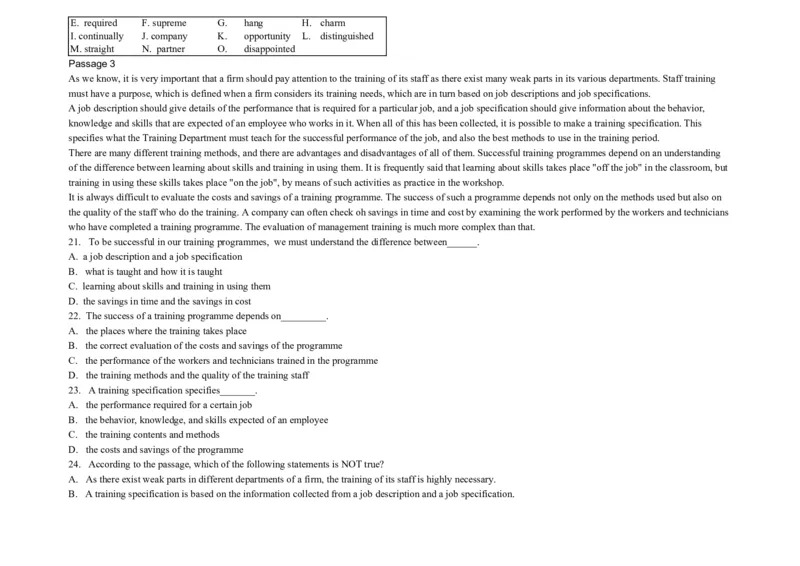
A. helped B. smart B. constantly D. treatedE. required F. supreme G. hang H. charm
I. continually J. company K. opportunity L. distinguished
M. straight N. partner O. disappointed
Passage 3
As we know, it is very important that a firm should pay attention to the training of its staff as there exist many weak parts in its various departments. Staff training
must have a purpose, which is defined when a firm considers its training needs, which are in turn based on job descriptions and job specifications.
A job description should give details of the performance that is required for a particular job, and a job specification should give information about the behavior,
knowledge and skills that are expected of an employee who works in it. When all of this has been collected, it is possible to make a training specification. This
specifies what the Training Department must teach for the successful performance of the job, and also the best methods to use in the training period.
There are many different training methods, and there are advantages and disadvantages of all of them. Successful training programmes depend on an understanding
of the difference between learning about skills and training in using them. It is frequently said that learning about skills takes place "off the job" in the classroom, but
training in using these skills takes place "on the job", by means of such activities as practice in the workshop.
It is always difficult to evaluate the costs and savings of a training programme. The success of such a programme depends not only on the methods used but also on
the quality of the staff who do the training. A company can often check oh savings in time and cost by examining the work performed by the workers and technicians
who have completed a training programme. The evaluation of management training is much more complex than that.
21. To be successful in our training programmes, we must understand the difference between______.
A. a job description and a job specification
B. what is taught and how it is taught
C. learning about skills and training in using them
D. the savings in time and the savings in cost
22. The success of a training programme depends on_________.
A. the places where the training takes place
B. the correct evaluation of the costs and savings of the programme
C. the performance of the workers and technicians trained in the programme
D. the training methods and the quality of the training staff
23. A training specification specifies_______.
A. the performance required for a certain job
B. the behavior, knowledge, and skills expected of an employee
C. the training contents and methods
D. the costs and savings of the programme
24. According to the passage, which of the following statements is NOT true?
A. As there exist weak parts in different departments of a firm, the training of its staff is highly necessary.
B. A training specification is based on the information collected from a job description and a job specification.C. Training in using skills and learning about skills usually do not happen at the same place.
D. It is easier to evaluate management training than to evaluate the training of workers and technicians.
25. The best title for this passage might be_______.
A. A Successful Training Programme
B. How to Describe and Specify a Job
C. Staff Training
D. The Importance of Training Workers and Technicians
Passage 4
Without most people realizing it, there has been a revolution in office work over the last ten years. Before that time, large computers were only used by large, rich
companies that could afford the investment. With the advancement of technology, small computers have come onto the market which are capable of doing the work
which used to be done by much larger and more expensive computers, so now most smaller companies can use them.
The main development in small computers has been in the field of word processors, or WP's as they are often called. 40% of British offices are now estimated to have
a word processor for both secretary and manager. The secretary is freed from a lot of routine work, such as re-typing letters and storing papers. He or she can use this
time to do other more interesting work for the boss. From a manager's point of view, secretarial time is being made better use of and money can be saved by doing
routine jobs automatically outside office hours.
But is it all good? If a lot of routine secretarial work can be done automatically , surely this will mean that fewer secretaries will be needed. Another worry is the
increasing medical problems related to work with visual display units. The case of a slow loss of sight among people using word processors seems to have risen
greatly. It is also feared that if a woman works at a VDU for long hours, the unborn child in her body might be killed. Safety screens to put over a VDU have been
invented but few companies in England bother to buy them.
Whatever the arguments for or against word processors, they are a key feature of this revolution in office practice.
26. Ten years ago, smaller companies did not use large computers because_______.
A. these companies had not enough money to buy such expensive computers
B. these computers could not do the work that small computers can do today
C. these computers did not come onto the market
D. these companies did not need to use this new technology
27. According to the writer, the main feature of the revolution in office work over the last ten years is_______.
A. the saving of time and money B. the use of computers in small companies
C. the wide use of word processors D. the decreasing number of secretaries
28. It is implied but NOT directly stated in the passage that with the use of word processors _______.
A. some secretaries will lose their jobs
B. routine jobs can be done automatically outside office hours
C. medical problems related to work with a VDU have increased
D. using word processors, secretaries can get more time to do more interesting work for their bosses29. Which of the following statements is NOT true?
A. There are both advantages and disadvantages in using a word processor.
B. The British companies care much for the health of the people using word processors.
C. The technology in the field of computers has been greatly advanced over the last ten years.
D. Using world processors, secretaries can get more time to do more interesting work for their bosses.
30. It can concluded from the passage that_______.
A. safety screens are of poor quality
B. working at a VDU for a long time is good for one's health
C. more and more British offices will use word processors
D. British companies will need fewer and fewer managers
Unit Five
Passage 1
The Look Younger Diet
Is the Fountain of Youth a myth? Not entirely, many experts in nutrition now believe, "Age fast, or age slow—it's up to you. " declares Dr. Kenneth Cooper,
president and founder of the Aerobics Center in Dallas. Jeffrey Blumberg, associate director of the U. S. Department of Agriculture's Human Nutrition Research
Center on Aging at Tufts University in Boston, agrees, " Research shows that many so-called age-related declines in physiological function seem to have less to do
with aging than with environmental factors like diet and exercise. "
Obesity (过度肥胖 ) is one of the leading causes of accelerated aging, according to Cooper, "If you lose weight, stop smoking, and exercise," he says, "you can slow
the aging process—and make dramatic changes in your looks in a relatively short period of time. "
A 37-year-old sales director for a Boston computer-distribution company is a prime example. Over six feet tall, he had been considerably overweight most of his like.
Then he began to worry that his appearance could be hurting his career. "I got tired of people thinking I was the same age as my brother, who's nearly nine years
older," he says, "When you're fat, people in the business world assume you're out of control. "
Determined to change, the sales director entered a hospital-based diet program and dropped over 70 pounds. "I feel—and look—ten years younger. " he says.
At 82, Clarice R. Mc Williams, a retired business owner in Dallas, has the appearance, skin tone (肤色) and mental agility of someone many years younger. "Most
people think I'm in my 60s. " she boasts.
Mc Williams admits genes play some role in the way she looks, but believes diet is an important factor. "It doesn't matter how good the genes are if you don't eat
properly and take care of yourself," she says. "If you want to look good, get plenty of rest, exercise every day, eat mostly raw fruits and vegetables—and quit
worrying. "
Says Blumberg, "There's certainly a link between good nutrition, a positive • 30 •
attitude and improved quality of life. People can have a say in what's going on with their bodies by selecting a healthful diet. "
Skin. Nowhere do the signs of aging manifest themselves more clearly than in the condition of the skin. When your weight fluctuates, the skin stretches with each up
cycle, but it may not completely shrink back to its original size in the down cycle. As a result, the skin may sag(松弛下垂).
A severely deficient diet can lead to skin disorders, dramatically affecting one's appearance. By the same token, a well-balanced diet with ample supplies of nutrientsis thought by many experts to produce a glowing, younger look.
Zinc and vitamin A are important for normal, healthy skin. Zinc helps the skin repair itself, and vitamin A aids in keeping skin supple, preventing dryness and
helping shed dead cells. Good sources of zinc are beef, eggs and seafood, while many dark-green leafy vegetables are rich in beta carotene, which the body converts
to vitamin A. Other foods containing ample amounts of beta carotene include carrots, cantaloupe, winter squash, sweet potatoes, sweet red peppers, apricots and
mangoes.
Vitamin C helps improve the blood supply to the skin and aids in forming collagen(胶原) , the fibrous protein that lies beneath the skin's surface and gives it a
smooth appearance. Good sources of vitamin C include citrus fruits and juices, Brussels sprouts, cauliflower, snow peas, red and green peppers, broccoli, white and
sweet potatoes, tomatoes, watermelon, honeydew melon and cantaloupe.
Greens are excellent sources of skin-preserving nutrients and, generally, the darker the leaves, the more nutritious. Romaine lettuce, for example has about six times
as much vitamin C and eight times as much beta carotene as iceberg
lettuce.
How food is prepared matters too. The longer vegetables cook, the greater the loss of vitamins and texture. Don't soak vegetables when washing them, since water-
soluble vitamins such as C will be lost.
Blumberg also recommends drinking six to eight glasses of water or other fluids each day to help keep skin and other tissues hydrated. "That's especially important
for older people," he says, "who are at risk for dehydration because their thirst drive becomes blunted with age. " Coffee, colas and tea aren't the best sources, since
they contain caffeine, a diuretic that induces water loss.
Hair. Healthy, shining hair is second only to vibrant skin for making one look younger. Yet many people unwittingly mistreat their hair by eating an unbalanced diet.
When a 33-year-old employee at a Texas corporation decided to lose weight quickly, she went on a fad diet, high in fiber and bulk, but low in protein. Over three
months, she lost a lot of weight. She also lost a good deal of her hair.
Dermatologist (皮肤病学家) David Alkek, a clinical professor at the University of Texas Southwest Medical Center at Dallas, sees too many cases like this woman's.
When diets don't contain enough amino acids, the building blocks of protein, there's dramatic increase in hair loss as the body breaks down its own protein.
Hair and skin cells are constantly reproducing and are, therefore, very sensitive to nutritional deficiencies, explains Dr. Alkek. Foods high in amino acids include
meats, eggs, milk, grains and legumes. Just remember that the body cannot store protein. So foods high in protein must be ingested daily. Under Alkek's care, the
woman began eating nutritionally balanced meals, and her hair was restored in about eight months.
Immune system. Vitamins E and C and beta carotene, known as antioxidants (抗氧化剂 ) , are considered powerful disease-fighters, capable of slowing down or
preventing a number of ailments typically associated with aging.
A growing body of evidence suggests that aging and decline in immune function may result in part from accumulated damage to cells caused by certain toxic
compounds called free radicals (自由基). Antioxidants seem to counteract or impair the ability of these substances to attack healthy cells, thus avoiding at least some
of the damage. Foods containing these nutrients are being linked—by science rather than myth—to the control and prevention of heart disease and cancer, stroke,
cataracts and to the body's ability to ward off infectious diseases.
Good general nutrition is essential to maintaining a healthy, youthful appearance. And the key to good general nutrition is balance. Proteins should make up roughly
ten percent of your daily calorie intake; no more than 30 percent should come from fats; and the remaining calories should come mostly from complex carbohydrates.
1. The passage primarily tells us how to lose weight so as to improve one's appearance.2. Dark-green leafy vegetables are good sources of beta carotene.
3. When one gains weight, the skin becomes loose.
4. It is particularly important for the old to drink 6 to 8 glasses of water to help keep skin and other tissues hydrated.
5. Food low in protein is harmful to hair.
6. Free radicals play an important role in immune function.
7. In order to look younger, one should cut back on fats.
8. Amino acids are the building blocks of______.
9. Genes are______than diet in determining one's looks.
10. The body changes______into vitamin A.
Passage 2
Many people often enjoy eating out either before or after a visit to the theatre. However, most of us would rather keep the two 11 separate. One man who thinks that
they can be successfully combined has not only expressed his ideas in a recent book, but also set up an establishment where the theory is put very 12 into practice.
The man is Paul Thornton, and the place is the Hollics, an old farmhouse.
Whenever I visit a new restaurant, I feel the same excitement that keen theatre-goers must experience on opening night. I had this feeling last Friday evening at dusk,
as my wife and I were taking a walk in the beautiful gardens of the restaurant 13 after we had arrived. Dinner was as excellent as we had been 14 . There is no menu,
for Mr. Thornton creates his meals rather as a director produces a play. Nevertheless, the various combinations of 15 at each course are always 16 as if they were
done by magic. He and his team of highly skilled helpers serve, cut and cook the food, moving about the "stage" as confidently as 17 actors. The meal is as different
from what one finds in ordinary restaurants as a 18 performance of A Midsummer Night's Dream would be from a second-rate television production.
May I offer a few words of advice in case you are thinking of paying him a visit. Try not to arrive just after noon, as Mr. Thornton does not serve a normal lunch.
His "brunch" which 19 the best 20 of a traditional English breakfast, is served around eleven o'clock and is so plentiful that lunch is unnecessary.
A. features B. shortly C. potential D. definitely
E. perfect F. promoted G. live H. professional I. characters
J. promised K. choices L. includes M. pleasures N. vigorously O. substitutions
Passage 3
40 years ago the idea of disabled people doing sport was never heard of. But when the annual games for the disabled were started at Stoke Mandeville, England in
1948 by Sir Ludwig Guttmann, the situation began to change.
Sir Ludwig Guttmann, who had been driven to England in 1939 from Nazi Germany, had been asked by the British government to set up an injuries center at Stoke
Mandeville Hospital near London. His ideas about treating injuries included sport for the disabled.
In the first games just two teams of injured soldiers took part. The next year, 1949, five teams took part. From those beginnings, things have developed fast. Teams
now come from abroad to Stoke Mandeville every year. In 1960 the first Olympics for the Disabled were held in Rome, in the same place as the normal Olympic
Games. Now, every four years the Olympic Games for the Disabled are held, if possible, in the same place as the normal Olympic Games, although they are
organized separately. In other years Games for the Disabled are still held at Stoke Mandeville. In the 1984 wheelchair Olympic Games, 1064 wheelchair athletes
from about 40 countries took part. Unfortunately, they were held at Stoke Mandeville and not in Los Angeles, along with the other Olympics.The Games have been a great success in promoting international friendship and understanding, and in proving that being disabled does not mean you can't enjoy
sport. One small source of disappointment for those who organize and take part in the games, however, has been the unwillingness of the International Olympic
Committee to include disabled events at Olympic Games for the able-bodied. Perhaps a few more years are still needed to convince those fortunate enough not to be
disabled that their disabled fellow athletes should not be excluded.
21. The first games for the disabled were held______after Sir Ludwig Guttmann arrived
in England.
A. 40 years B. 21 years
C. 10 years D. 9 years
22. Besides Stoke Mandeville, surely the games for the disabled were once held in______.
A. New York B. London
C. Rome D. Los Angeles
23. In Paragraph 3, the word "athletes" means______.
A. people who support the games B. people who watch the games
C. people who organize the games D. people who compete in the games
24. Which of the following statements is NOT true?
A. Sir Ludwig Guttmann is an early organizer of the games for the disabled.
B. Sir Ludwig Guttmann is an injured soldier.
C. Sir Ludwig Guttmann is from Germany.
D. Sir Ludwig Guttmann is welcomed by the British government.
25. From the passage, we may conclude that the writer is ______.
A. one of the organizers of the game for the disabled
B. a disabled person who once took part in the games
C. against holding the games for the disabled
D. in favor of holding the games for the disabled
Passage 4
It is well known that when an individual joins a group he tends to accept the group's standards of behavior and thinking. Many illustrations (例证) could be given of
this from everyday life, but what is of particular interest to psychologists is the extent to which people's judgments and opinions can be changed as a result of group
pressure. Asch and others noticed that people in a group will agree to statements that are contrary to the evidence of their senses. It would be a mistake to think that
only particular changeable people are chosen to take part in experiments of this type. Usually highly intelligent and independent people are used.
In a typical experiment, this is what may happen. The experimenter asks for volunteers to join a group which is investigating visual perception. The victims are not,
therefore, aware of the real purpose of the experiment. Each volunteer is taken to a room where he finds a group of about seven people who are collaborating(合作)
with the experimenter. The group is shown a standard card which contains a single line. They are then asked to look at a second card. This has three lines on it. One
is obviously longer than the line on the first card, one is shorter and one the same length. They have to say which line on the second card is the same length as the lineon the standard card. The other members of the group answer first but what the volunteer does not know is that they have been told to pick one of the wrong lines.
When his turn comes he is faced with the unanimous (一致的 ) opinion of the rest of the group—all the others have chosen line A but he quite clearly sees line B as
correct. What will he do? According to Asch, more than half of the victims chosen will change their opinion. What is equally surprising is that, when interviewed
about their answers, most explained that they know the group choice was incorrect but that they yield to the pressure of the group because they thought they must be
suffering from an optical illusion, or because they were afraid of being different.
26. The psychologists are particularly interested in_______.
A. the changes in the attitudes of the people
B. the degree of changes of people's opinions
C. the result of the experiment
D. the difference in people's characters
27. People who are usually chosen to take part in the experiments are_______.
A. stubborn and independent B. intelligent
C. ignorant and docile D. capable of reasoning
28. Which of the following statements is TRUE?
A. The experimenter and all the members of the group except the victim know the purpose of the experiment.
B. All of them know the purpose of the experiment.
C. Only the experimenter knows the purpose of the experiment.
D. Only the victim knows the purpose of the experiment.
29. More than half of the victims changed their opinion because_______.
A. someone in the group changed their opinion
B. they thought their eyes must be deceived
C. they thought the group choice was correct.
D. they had been told about the answer
30. The purpose of the author in writing this passage is to_______.
A. illustrate the influence of the group's pressure on individual's behavior
B. invite more volunteers to join in Asch's experiment
C. tell the audience how to perform psychological experiment
D. encourage people to act against the group's opinion
Unit Six
Passage 1
The Man on the Street and the Men on the Moon
Does walking on the moon make life better for people on earth? Considering all the problems of our own world, why should we be spending huge sums on trips to
outer space? Such questions as these are often asked, especially by those whose tax money is paying for space exploration. The answers to these questions are manyand varied.
Up to now, the practical benefits resulting from space research have included the development of new methods and skills, new processes, new services, new products,
and even new companies created to make use of what has been learned through space travel. Also among the benefits are better education (especially in scientific
subjects), more efficient management, higher quality of industrial products, and rapid economic growth. People all over the world are now served by improved
weather predictions, better communication systems, and better understanding of the earth and its environment. Everyone will benefit as observations from space
make it possible to measure the earth's resources and to observe whether or not they are being used properly. Increasingly, the space program will help our world deal
with the problems of the environment. It has already brought a new appreciation of the complex system of which man is only a part.
One of the first areas of daily life to feel the effects of space travel was education. Americans felt challenged by the news of Sputnik I in 1957. Immediately their
government responded by providing greatly increased financial support for U. S. education. Emphasis was placed on teaching more science and leaching it better,
from the elementary grades through post-graduate school. Because education emphasized science and engineering, thousands of scientists and engineers were
produced. These specialists participated more widely in government and industry than ever before..
In discussing how space travel has contributed to life on earth, some writers also emphasize the management methods which were developed in the effort to land men
on the moon. That complex operation required new methods for directing the combined endeavours of thousands and thousands of minds, some in
government, some in universities, some in private industry—all working together for a common purpose. Of the set of management techniques that made the walk on
the moon possible, one writer, Tom Alexander, has written in Fortune magazine " This is potentially the most powerful tool in man's history. . . The question now is
:
whether such techniques can be refashioned and turned to other tasks as well. "
Another result of the space travel has concerned the quality of industrial products. Early in the Space Age, some of the equipment used by astronauts failed to
perform properly. Space program managers were convinced by these events that space travel would require greater assurance of quality and dependability than had
previously been demanded in industry.
To deal with the problem of quality and dependability, those in charge of the space program emphasized the need for testing industrial products. Many companies
that had to develop tests for the space program also manufactured products for use on earth, such as cars and planes. Since some parts are used both in space systems
and in products for ordinary life, the emphasis on quality had spread through American industry. Many products are now more reliable than they might have been if
men had not been sent to the moon.
In addition to improving the quality of existing products, the space program has been responsible for the development and improvement of new ones. The most
important is the computer. To bring the endangered Apollo 13 home safely in 1970, a new flight plan had to be made taking account of an unbelievably complex
combination of elements. The computer accomplished this task in seventy-two minutes, whereas a man or a woman working with pencil and paper would have taken
more than a million years! If there had been no space program, it is doubtful that computers would now be so widely used in industry and government. More than
800, 000 people in the United States are now employed in jobs related to computers it is a field in which some of the highest salaries are paid.
:
Thousands of other new products and processes are now found in industry as the result of space research. Among them are metal alloys, long-wearing paints, plastics,
and new types of glue and other adhesives(粘合剂) , as well as new industrial tools. The National Aeronautics and Space Administration (NASA) has a special
program called Technology Utilization to speed the transfer of new ideas from the space program to commerce and industry. The U. S. Department of Commerce
makes reports on this information available to organizations abroad.
New products and techniques for medicine have developed from the need to measure astronauts' response to space flights. Many of these products and techniques areuseful to patients in hospitals. To take just one example, there is a unit as small as a cigarette package which can be strapped to a patient's arm to report on blood
pressure, temperature, breathing, and other important information. Such devices allow a single nurse to observe changes in the condition of as many as sixty-four
patients in an intensive-care unit.
Besides contributing to education, industry, and medicine, the space program has benefited communication. As a matter of fact, space satellites have revolutionized
world communication. By 1960, the demand for overseas telephone and telegraph message for the United States was growing even faster. Industry could see no way
to lay undersea cable. Transoceanic television was considered impractical. Satellites have changed all this. From thousands of kilometres above our earth, a
communications satellite receives a signal from one side of the world and relays it directly to the other.
The first experiments with communications satellites were conducted in the early 1960s. Today about half the world's long-distance telephone, telegraph, and
television traffic is relayed by satellite. Through international agreements, the cost of transoceanic communication has cut almost in half.
An example of other ways in which satellites can benefit mankind was provided in 1970 by an international congress on post-graduate medical instruction. The
American participants were in Texas; participating Europeans were in Switzerland, Germany, and Austria. For three hours by satellite, 30,000 doctors saw and heard
their colleagues across the sea.
Satellites are being used not only for medical purposes and for education but also for predicting the weather in a more reliable way. Many lives have been saved by
advance warnings of hurricanes and other dangerous storms. Before satellites, weather forecasters had information only from locations with observation stations. The
information was generally available only from land areas. There were few reports about conditions in areas covered by oceans— about three-fourths of the world's
surface. The significance of this lack becomes apparent with the realization that most bad weather originates at sea.
1. Even without space program, computers would have become very popular in every walk of life.
2. The passage gives an account of the practical benefits resulting from space research.
3. American education was the first area affected by space travel because science and engineering were placed much emphasis on after Sputnik I was launched in
1957.
4. The quality control methods resulted in more reliable products for space travel than for ordinary life.
5. To meet the increasing need for world communication, Americans could do nothing but lay more undersea cables.
6. Before satellites, people got little information about the weather conditions in the sea areas, where most bad weather originates.
7. American youngsters were particularly interested in science and engineering.
8. The need for better quality control of industrial products was realized due to the fact that some of the equipment used in space program_______.
9. It is said in the passage that some of the people working in the field of computers earn
10. People began the experiments with the communications satellites in_______.
Passage 2
Student expeditions do a great deal of good work on the Arctic islands but from time to time cause trouble in the huts, probably because students are not familiar with
the 11 of the little wooden huts dotted all over the islands of the Spizbergen group.
Each hut 12 has an inner and an outer door, shutters over the windows, a store of wood 13 up outside, dry chopped wood inside, utensils and cutlery, and above all, a
small store of food. All these things must be completely in 14 whenever the hut is left.
It makes no 15 if it is only the middle of July. That 16 hut may not be visited again before the winter. A door left open can lead either to snow filling up the hut to theceiling, or 17 still, wind blowing the roof off. Unfastened shutters leave the windows an easy prey for polar bears 18 for food and the result is again snow in the hut.
The ready-chopped wood is also very important.
A traveler visiting the hut in the middle of the dark time and perhaps in bad weather, his feet, hands and face bitten by the frost, will have his difficulties doubled if
the wood he left has been used up by others and he had nothing with which to 19 a fire.
Ten or more years ago there were enough hunters to look after most of the huts, but now many buildings have become useless because there is no one to repair them
and because of 20
A. worse B. peculiar C. laid D. light
E. generally F. order G. particular H. conventions
I. carelessness J. difference K. built L. fashions
M. searching N. ordinarily O. result
Passage 3
I have had just about enough of being treated like a second-class citizen, simply because I happen to be that put-upon member of society—a customer. The more I go
into shops and hotels, banks and post offices, railway stations, airports and the like, the more I'm convinced that things are being run solely to suit the firm, the
system, or the union. There seems to be a harmful new motto (格言) for so-called "service" organizations—Staff Before Service.
How often, for example, have you queued for what seems like hours at the Post Office or the supermarket because there weren't enough staff on duty to man all the
service grilles (栅门) of checkout counters? Surely in these days of high unemployment it must be possible to recruit cashiers and counter staff. Yet supermarkets,
hinting darkly at higher prices, claim that enshrouding all their cash registers at any one time would increase overheads. And the Post Office says we cannot expect
all their service grilles to be occupied "at times when demand is low. "
It's the same with hotels. Because waiters and kitchen staff must finish when it suits them, dining rooms close earlier or menu choice is curtailed. As for us guests, we
just have to put up with it. There's also the nonsense of so many so friendly hotel night porters having been dismissed in the interests of "efficiency" (i. e. profits) and
replaced by coin guzzling machines. Not to mention the coldness of the tea-making kit in your room: a kettle with an assortment of teabags, plastic milk cartons and
lump sugar. Who wants to wake up to a raw teabag? I don't, especially when I am paying for "service".
21. The writer feels that nowadays a customer is_______.
A. one who is well served B. unworthy of proper consideration
C. classified by society as inferior D. the victim of modern service
22. In the writer's opinion, the quality of service is changing because_______.
A. the customer's demands have changed
B. the organizations receive more consideration than the customers
C. the customers' needs have increased
D. the staff are less considerate than their employers
23. According to the writer, long queues at counters are caused by ____.
A. difficulties in recruiting staff B. inadequate staffing arrangements
C. staff being made lazy D. lack of co-operation between the staff24. Service organizations claim that keeping the checkout counters manned would result in
A. a rise in the price for providing services
B. demands by cashiers for more money
C. insignificant benefits for the customers
D. the need to purchase expensive equipment
25. The disappearance of old-style hotel porters can be attributed to the fact that______.
A. few people are willing to do this type of work
B. machines are more reliable than human beings
C. the personal touch is less appreciated nowadays
D. automation has provided cheaper alternatives
Passage 4
Back in the old days, when I was a child, we sat around the family roundtable at dinnertime and exchanged our daily experiences. It wasn't very organized, but
everyone was recognized and all the news that had to be told was told by each family member.
We listened to each other and the interest was not put-on; it was real. Our family was a unit and we supported each other, and nurtured each other, and liked each
other, and—we were even willing to admit—we loved each other.
Today, the family roundtable has moved to the local fast-food restaurant and talk is not easy, much less encouraged.
• Grandma, who used to live upstairs, is now. the voice on long distance, and the working parent is far too beaten down each day to spend evening relaxation time
listening to the sandbox experience of an eager four-year-old.
So family conversation is as extinct as my old toys and parental questions such as "What have you been doing, Bobby?" have been replaced by "I'm busy, go watch
television. "
And watch TV they do; count them by the millions.
But it's usually not children's television that children watch. Saturday morning, the children's hour, amounts to only about 8 percent of their weekly viewing.
Where are they to be found? Watching adult television, of course, from the Match Game in the morning, to the afternoon at General Hospital, from the muggings and
battles on the evening news right through the family hour and past
• 42 •
into Starsky and Hutch. That's where you find our kids, over five million of them, at 10 p. m. , not fewer than a million until after midnight! All of this is done with
parental permission.
Television, used well, can provide enriching experiences for our young people, but we must use it with some sense. When the carpet is clean, we turn off the vacuum
cleaner. When the dishes are clean, the dishwasher turns itself
off.
Not so the television, which is on from the sun in the morning to the moon
at night and beyond!
Parents must exercise some control and show some concern about the cultural influence on the child when a program not intended for that child is viewed. Parentsneed to intervene (干涉). Nonintervention may be a wise policy in international affairs, but the results of parental nonintervention will not be wise at all.
26. From the first two paragraphs one may infer that the writer's a attitude towards "the old days" is______.
A. preferring B. hating
C. being tired of D. disappointing
27. The working parent is not willing to listen to her (his) four-year-old child talking about his sandbox games because she (he) is______.
A. boring B. very tired
C. busy D. angry
28. According to the writer, the responsibility for the kid's watching adult television and watching it for a long time should be undertaken by______.
A. the television stations B. the society
C. TV programs D. their parents
29. If we use television with some ______television can provide our young people with
much knowledge.
A. instruction of experts B. judgment of our own
C. direction of engineers D. indication of teachers
30. What is the main idea of the last paragraph?
A. Parental nonintervention will not be praised.
B. Nonintervention may be a good policy in international affairs.
C. Parents must exercise some control and show some concern about the cultural influence on the children.
D. Parents need to intervene.
Unit Seven
Passage 1
Who Knows
Since no one knows what scientific discoveries will be made between now and the year A. D. 2000, each of us can make his own predictions.
Our prophecies (预言) need not be completely wild guesses. We know science has moved forward rapidly in the past 50 years and will continue to do so. If we allow
our imaginations to be guided by known research, our prophecies need not be sheer fantasy. We don't have to go so far as to predict that there will be invasion by
men from Mars, or that all food and nourishment will be taken in capsule form, or that mechanical men will roam the world.
With the scientific information that we have available now, let's make an estimate of progress in air travel. It is likely that within 50 years we shall travel through the
air at a speed of 10,000 miles per hour. Too fast? Not at all. Jet-propelled planes can now travel at least 1,000 miles an hour, and jet planes will be outmoded(过时的)
shortly by guided missiles. The X-15 rocket's speed in 1961 was 3,690 miles per hour, and scientists are hoping to double and even triple this speed. They will
accomplish this speed-up, because there is no apparent scientific obstacle to prevent it.
Some day, certain aerodynamic(空气动力学的) problems will be overcome and missiles will be enlarged to carry at least 25 passengers. When scientists have solved
all the problems of constructing and increasing the speed of apparatus-carrying missiles, their skill will lead them to the next step—missiles for interplanetary flight.
This prediction is a scientific possibility in the near future.Flights into outer space began when Sputnik I was launched in 1957, and man first went into space in 1961. During the late 1950's and early 1960's many satellites—
man-made astral bodies—orbited the earth and moon. Satellites, which will be controlled by men on earth, may have many beneficial uses. Perhaps scientists will
discover a source of energy 100 miles above the earth. This energy could be transmitted to us as a source of power for manufacturing plants or even for our cook
stoves. Or one of these missiles might serve as the medium for transmitting communications across the globe. Telephonic
communications might be carried on by beaming waves at the missile, which would in turn beam waves at a telephone halfway across the world. The missile might
be the telephonic connection, for example, between you in New York, and a friend in Bangkok.
Such a satellite might also be used as the transmitting medium for international television broadcasts. Programs being telecast from a Paris studio could then be seen
simultaneously in every other country. This immediate international transmission will surely be a development before the turn of a new century.
We may expect to order our clothing, groceries,and other household goods
by television-phone. We prophesy that within twenty five years, our telephones will be equipped with television screens so that we can see the person at the other end
of the line.
Other fields of science have also made gigantic (巨大的 ) strides in progress. Medicine had operated so efficiently in the past half-century that many diseases have
been nearly wiped out. And more will join this disappearing group of diseases. Diabetes and polio are under control. We can hope and expect that cancer will be
conquered. Certain skin diseases, like psoriasis and eczema, which are exceedingly common though not fatal, will be eradicated(消灭). The victims of annoying
diseases will lead pleasanter lives.
Even the healthy will benefit from the advances in medicine. Life expectancy already had been lengthened and scientists know that the time is coining rapidly when
the person one hundred years old will not be a phenomenon.
Even if the birth rate should remain at its present level, the population will be larger as people stay alive longer. Realizing that the increase of population will Strain
natural resources, scientists of all kinds are experimenting with methods for extending these resources.
One matter of immediate urgency will be our source of food. The larger the population, the greater will be the demand for food. Our arable适合工作的) land is
already taxed to capacity. Scientists will have to find a way to mass-produce food by hydroponics—the science of growing vegetables, or other plants, in water—or
by irrigating desert wasteland.
This increased demand for food will create an increased demand for water. Certain parts of the United States—Nevada, New Mexico, and Arizona, for example—
have been in desperate need of water for a long time. Periodically, the citizens of New York have been water-rationed because droughts have seriously threatened
the water supply in the reservoirs which provide the millions of gallons a day needed in the largest city in the world.
Scientists will solve the water problems of the desert and metropolitan areas. Rain-makers will have perfected a simple method, now in the elementary stages of
experimentation, for making clouds release their moisture so that the right amount of rain is produced to keep reservoirs at the correct level at all times of the year.
Another method of water production will be the purification of salt water taken from oceans. When a simple, cheap method has been worked out for converting
seawater into pure water suitable for use in the household and the manufacturing plant, other scientist-engineers will contribute practical mechanical equipment for
piping the water from seashore to desert areas.
Other improvements of the future will touch our lives more closely. It is possible, for example, to imagine that cities of the future will have underground networks of
conveyor belts which would supplement subways and make it possible for people to hop on a rapid conveyor system, sit in a little booth, and shuttle a couple of
blocks in safety.Of even more immediate interest than transportation is the clothing of the future. The clothes you will wear at the end of this century may not be of silk, cotton, wool,
or even nylon. Clothing will be made of new synthetics and so will the upholstery(家具装饰材料) materials you order by television-phone. To get these synthetic
materials, scientists will have devised some electrically controlled apparatus which will allow men to dig twenty miles below the surface of the ground. At that level
inside the earth, they may discover many types of rock, now unknown, which will give us these new synthetic materials. Cloth made from these materials will be fire-
proof because they come from rock.
While these synthetics for cloth are being developed, others will be discovered to take the place of wood and steel. We already have plastic furniture, plastic boats,
and plastic dishes. As our wood and steel supplies dwindle (减少 ), synthetic materials will be developed for building homes and giant skyscrapers.
1. According to the reading selection, the world in the year 2000 will achieve great progress in many fields.
2. According to the writer, our predictions about the future should be based on our free imaginations.
3. Synthetics in place of silk, cotton and wool will be made from rocks.
4. Based on available scientific information, it is predicted in this passage that the speed of air travel 50 years from now will reach 10,000 kilometres an hour.
5. Paragraph 8 mainly tells us that many diseases will be cured or under control in the future thanks to the advances in medicine.
6. To meet the increasing demand for food, scientists have found a way to mass-produce food by irrigating desert wasteland.
7. Underground networks of conveyor belts will be more convenient and more widely used than subways.
8. The way to grow vegetables, or other plants, in water is called______.
9. The water problems can be solved by producing rain and______.
10. One of satellites' beneficial uses is to work as the medium for______.
Passage 2
Most of us trade money for entertainment. Movies, concerts and shows are enjoyable but 11 .If you think that you can't have a good time without spending a lot of
money, read on. A little resourcefulness and a few minutes of newspaper-scanning should give you some pleasant surprises.
People may be the most interesting show in a large city. 12 through busy streets and see what everybody else is doing. You will probably see people from all over the
world; you will 13 see people of every age, size, and shape, and you'll get a free fashion show, too. Window-shopping is also a 14 sport if the stores are closed.
Check the listings in your neighborhood paper. Local colleges or schools often 15 the public to hear an interesting speaker or a good 16 . The film or concert series at
the local public library probably won't cost you a penny. Be sure to check commercial advertisements too. A flea market can provide hours of pleasant looking round.
Perhaps you can find a free cooking or crafts 17 in a department store.
Plan ahead for some activities. It is always more pleasant not to have people in front of you in a museum or at a zoo. You may save some money, too, since these
places often 18 aside one or two free 19 days at slow times during the week. Make sure that you are including the indispensable 20 that people travel miles to
see. If you feel like taking an interesting walk, find a free walking tour, or plan one yourself.
A. expensive B. Wonder C.debate D. admission
E. set F. Wander G.safe H. addition
I. valuable J. dispute K.welcome L. confidently
M. sights N. demonstration O.certainlyPassage 3
Despite these alarming statistics, the scale of the threat that smoking causes to women's health has received surprisingly little attention. Smoking is still seen by many
as a mainly male problem, perhaps because men were the first to take up the habit and therefore the first to suffer the ill-effects. This is no longer the case. Women
who smoke like men will die like men. WHO estimates that, in industrialized countries, smoking rates amongst men and women are very similar, at around 30 per
cent; in a large number of developed countries, smoking is now more common among teenage girls than boys.
As women took up smoking later than men, the full impact of smoking on their health has yet to be seen. But it is clear from countries where women have smoked
longest, such as the United Kingdom and the United States, that smoking causes the same diseases in women as in men and the gap between their death rates is
narrowing. On current trends, some 20 to 25 per cent of women who smoke will die from their habit. One in three of these deaths will be among women under 65
year of age. The US Surgeon General has estimated that, amongst these women, smoking is responsible for around 40 per cent heart disease deaths, 55 per cent of
lethal strokes and, among women of all ages, 80 per cent of lung cancer deaths and 30 per cent of all cancer deaths. Over the last 20 years, death rates in women from
lung cancer have more than doubled in Japan, Norway, Poland, Sweden and the United Kingdom; have increased by more than 200 per cent in Australia, Denmark
and New Zealand; and have increased by more than 300 per cent in Canada and the United States.
21. The effect of smoking on women has not been paid enough attention because______.
A. men suffer more from smoking
B. men would like women to smoke
C. men are considered the main sufferers of smoking
D. there are alarming statistics of death caused by smoking
22. "This is no longer the case. " The word "this" refers to______.
A. that men used to suffer the ill-effects
B. that there were alarming statistics
C. that the scale of threat become larger
D. that women suffered from smoking as greatly as men
23. From the fact that in some developed countries smoking is now more common among teenage girls than boys, we can predict that in the days to come, ______.
A. women will have the same diseases as men
B. more women may suffer from smoking than men
C. the smoking rates among men and women will drop
D. the teenage girls today may give up smoking when they are grown-ups
24. All of the following statements are the effects of smoking on women EXCEPT that
A. the death rates of the women and men who are smoking are in similar proportion
B. smoking causes the same diseases in women as in men
C. in the past 20 years, death rates in women from lung cancer have more than doubled
D. smoking is responsible for 30 percent of all cancer deaths among women
25. In the phrase "lethal stroke", the word "lethal" most probably means______.A. causing death B. causing discomfort
C. causing poor health D. causing anxiety
Passage 4
The men who race the cars are generally small, with a tight, nervous look. They range from the early 20s to the middle 40s, and it is usually their nerves that go first.
Fear is the driver's constant companion, and tragedy can be just a step behind. Scarcely a man in the 500 does not carry the scars of ancient crashes. The mark of the
plastic surgeon is everywhere, and burned skin is common. Sometimes a driver's scars are invisible, part of his heritage. Two young drivers, Billy Vukovich and Gary
Bettenhausen, raced in their first 500 in 1968. Less than 20 years before, their fathers also competed against one another on the Indy track—and died there.
All this the drivers accept. Over the years, they have learned to trust their own techniques, reflexes, and courage. They depend, too, on a trusted servant—scientific
engineering. Though they may not have had a great deal of schooling (an exception is New Zealand's Bruce McLaren, who has an engineering degree), many drivers
are gifted mechanics, with a feeling for their engines that amount to kinship.
A few top drivers have become extremely wealthy, with six-figure incomes from prize money, endorsements, and jobs with auto-product manufacturers. Some have
businesses of their own. McLaren designs racing chassis (底盘). Dan Gurney's California factory manufactured the chassis of three of the first four ears in the 1968
Indy 500, including his own second place car.
Yet money is not the only reason why men race cars. Perhaps it isn't even the major reason. Three-time Indy winner(1961, 1964, 1967) A. J. Foyt, for example, can
frequently be found competing on dirty tracks in minor-league races, where money, crowds and safety features are limited, and only the danger is not. Why does he
do it? Sometimes Foyt answers, "It's in my blood. " Other times he says, "It's good practice. " Now and then he replies, "Don't ask dumb questions. "
26. The statement "it is usually their nerves that go first" means_______.
A. at first they all have a nervous look
B. they often find they can't bear the tension even if they are in good condition
C. someday they find they can't make responses to any risk
D. they can continue their career at most until the middle 40s
27. It can be inferred that a car accident is often coupled with_______.
A. a plastic surgeon B. a companion
C. a risk D. a fire
28. The invisible scars of the drivers mentioned in the second paragraph refers to_______.
A. the regrets left by their fathers B. the fears left by their fathers
C. the cars left by their fathers D. the heritage left by their fathers
29. Bruce McLaren is different from most of the drivers in that_______.
A. he himself designs chassis B. he has an engineering degree
C. he manufactures chassis D. he is a gifted mechanic
30. A. J. Foyt often takes part in minor-league races for_______.
A. prize money B. blood test
C. cheers from the crowd D. enjoymentUnit Eight
Passage 1
The School Years
Soon after the United States was founded, Thomas Jefferson, who was President from 1801 to 1809 wrote, "If a nation expects to be ignorant and free in a state of
civilization, it expects what never was and never will be. " Jefferson believed that the new republic would be served best by literate, well-informed citizens and that
everyone should have a guarantee of some education with further education for those who wanted it and were qualified. The American system of public education
has been built on this philosophy. Public education in this country is expected to offer equal educational opportunities to everyone enrolled in secular schools, which
are publicly controlled and publicly financed, with free tuition, free books, and compulsory attendance.
There is no mention of education in the Constitution, and each state is responsible for its own educational system. Public schools are financed primarily by local and
state taxes, and the amount of money spent on public school students varies from state to state. Alabama, for example, spent an average of $716 for each pupil in
1974, the lowest rate of any state. New York, by contrast, had the highest rate, $ 1809 per pupil. The majority of states spent more than $ 800 per pupil.
There are great differences in expenditures (花费 ) by communities within each state, depending on the amount of local funds available for public education. Often,
well-to-do communities spend several hundred dollars more for each child than poorer towns nearby do. These figures reflect differences in expenditures . for such
items as teachers' salaries, the purchase of books, and school construction and maintenance.
Despite these differences, there is general uniformity in the organization and curricula of public schools throughout the country. Each state is divided into local
school districts. Usually a state department of education sets the general requirements that local communities or school districts must meet. Local school boards,
usually elected by members of their communities, are responsible for the detailed organization and operation of their schools. This-responsibility includes hiring
teachers and administration and setting their salaries.
The twelve years of public school education usually begin when a child is six years old. Some school systems are divided into eight years of primary school and four
years of secondary school. Primary schools are often called elementary schools, and secondary schools are called high schools. Many systems combine the last two
years of elementary school and the first year of high school in what is known as junior high school. This is followed by three years of senior high school. A large
number of school systems also have a kindergarten program that provides one year of preschool training for five-year-old children before they begin the formal
school years. The academic year lasts nine months, from September to June, with winter and spring vacations. Classes are held five days a week, from Monday
through Friday.
Elementary schools are usually organized on a neighbourhood basis. Children living in the same area attend a school that is close to their homes. High schools, on the
other hand, serve children from many different elementary schools, and a single high school often has several thousand students from various parts of the community.
Many towns have just one high school. In rural areas one elementary school frequently serves the children from several communities. When schools are located
beyond convenient walking distance, children are transported free of charge in bright yellow school buses. Today more than 40 percent of all American school
children are bused to and from school daily.It took many years for Jefferson's dream of education for everyone to approach reality. In 1870 only slightly more than half of all children of school age attended
school. It was not until 1918 that every state had a compulsory school-attendance law. Today most states require the attendance of all children between the ages of six
and sixteen. Approximately 99 percent of all American children of elementary school age (six through thirteen) and 94 percent of high school age (fourteen through
seventeen) go to school.
The quality of education has changed as the record of school attendance. For example, in a typical mid-nineteenth century elementary school class children sat in one
place in one position for hours on end, with periodic arm swinging for exercise and perhaps occasional permission to go to the bathroom. The method of instruction
was catechism (questions by the teacher with memorized responses by the students).. . The teacher fed the stuff out one day, and wanted it back the next, in her own
words.
Emphasis was on good behavior and learning what were called "the three Rs"—reading, 'riting and 'rithmetic. Most of the teachers had no more than elementary
school education themselves.
In the modern elementary school, in addition to the study of reading, writing, arithmetic, and language arts (including spelling), children are taught social studies
(history, geography, and civics or government) science, art, and music. They are. often also taught cooking and manual skills such as carpentry and sewing. Outdoor
playgrounds and indoor gymnasiums offer opportunities for lots of physical exercise.
Modern teaching theories and methods vary greatly, but they frequently reflect the influence of John Dewey, an important twentieth-century educator and
philosopher. Dewey believed that education should be more concerned with the interests and needs of each child than with the particular subjects that the child is
taught. Today many teachers try to give considerable attention to the personal development of each individual student, especially at the elementary school level.
Entrance to high school is automatic when a student completes elementary school. No examinations are required. High schools usually offer courses in English
literature and composition, the social sciences, mathematics, laboratory sciences, and foreign languages as well as art, music, and physical education. After
completing certain basic requirements, students are often permitted to choose the subjects that best suit their plans for college or for work after graduation.
Extracurricular activities including clubs, school newspapers and magazines, and sports are important features of high-school life. In addition, student
representatives, elected by their fellow students, often work with school officials in planning school policies. This arrangement is an effort to encourage students'
interest in self-government and in their responsibilities as citizens.
Most high schools are organized on what is called a comprehensive basis, which means that programs in academic (college preparatory), vocational, and general
education are offered in the same school. In some large cities specialized high schools concentrate on just one type of program. In addition, many communities
provide programs for handicapped children (children who are deaf, blind, crippled, emotionally disturbed, or mentally retarded) and children who are specially gifted,
intellectually or artistically.
1. In American system of public education, everyone is expected to have equal educational opportunities, which is defined in the U. S. Constitution.
2. The amount of money spent on public school students depends mainly on local and state taxes.
3. The organization and curricula of public schools have much in common throughout the country.
4. All students can take yellow school buses to school in some states.
5.Both school attendance and the quality of education have been greatly improved today.
6.All children between the ages of five and eighteen are required to attend school in most states.7.There are much higher requirements for public school teachers today than in the past.
8.Students can get well prepared for college study in_______________
9.Modern teaching theories and methods are generally influenced by_________________
10. Children may have one year of___before they start elementary school years.
Passage 2
When a person feels low, blue, or down in the clumps, it usually means he has been hurt, disappointed, or saddened by something that causes a confused and
listless feeling. There is 11 a type of music called "the blue", a low, mournful, sad sound to 12 these universal human feelings.
Depression is another name for this mood. Feeling depressed is a normal and natural 13 to experiences of loss, failure, and undeserved bad luck. Indeed, it has
been pointed out that without depression, we would 14 much of the world's great tragic literature, music, and art.
In some cases, however, depression becomes something more than just 15 feelings of blues or letdown. A large number of people suffer from what psychiatrists
call "depressive illness. " Depressive illness is more 16 and lasts longer than common listless feelings. Sometimes a serious 17 of depression can begin with the loss
of a loved one or a change of job. Many times, in very
18 cases, there doesn't seem to be any circumstance serious enough to have caused the depression.
Some psychiatrists suggest that the key feature in depression is change. The person becomes different from the way before the onset of his depression. He may
even become the opposite of his usual self. There are many examples: the businessman who becomes a wanderer, the mother who wants to 19 her children and
herself. Instead of seeking satisfaction and pleasure, the depressed person 20 it.
A. ever B. escape C. intense D. response
E. avoids F. even G. express H. realization
I. severe J. lessen K. dense L. period
M. harm N. lack O. normal
Passage 3
Social change is more likely to occur in societies where there is a mixture of different kinds of people than in societies where people are similar in many ways.
The simple reason for this is that there are more different ways of looking at things present in the first kind of society. There are more ideas, more
disagreements in interest, and more groups and organizations with different beliefs. In addition, there is usually a greater worldly interest and greater tolerance in
mixed societies. All these factors tend to promote social change by opening more areas of life to decision. In a society where people are quite similar in many ways,
there are fewer occasions for people to see the need or the opportunity for change because everything seems to be the same. And although conditions may not be
satisfactory, they are at least customary and undisputed.
Within a society, social changes is also likely to occur more frequently and more readily in the material aspects of the culture than in the non-material, for
example, in technology rather than in values; in what has been learned later in life rather than what was learned early; in the less basic and less emotional aspects of
society than in their opposites; in the simple elements rather than in the complex ones; in form rather than in substance; and in elements that are acceptable to the
culture rather than in strange elements.
Furthermore, social change is easier if it is gradual. For example, it comes more readily in human relations on a continuous scale rather than one with sharp
difference. This is one reason why change has not come more quickly to Black Americans as compared to other American minorities, because of the sharp difference
in appearance between them and their white counterparts.
21. The passage is mainly discussing ______.
A. the necessity of social changeB. certain factors that determine the ease with which social changes occur
C. two different societies
D. certain factors that promote social change
22.One of the factors that tend to promote social change is ___.
A. joint interest B. different points of view
C. less emotional people D. advanced technology
23.According to the passage, which of the following is NOT true? A. Social change tends to meet with more difficulty in basic and emotional aspects of society.
B. Disagreement with and argument about conditions tend to slow down social change.
C. Social change is more likely to occur in the material aspect of society.
D. Social change is less likely to occur in what people learned when they were young.
24. The expression "greater tolerance "(Para. 1) refers to_______.
A. greater willingness to accept social change
B. quicker adaptation to changing circumstances
C. more respect for different beliefs and behavior
D. greater readiness to agree to different opinions and ideas
25. Social change is less likely to occur in a society where people are quite similar in many ways because_______. v
A. people there have got so accustomed to their conditions that they seldom think it necessary to change
B. people there have identical needs that can be satisfied without much difficulty
C. people there are easy to please
D. people there are less disputed
Passage 4
Anne Whitney, a sophomore (大学二年级学生) at Colorado State University, first had a problem taking tests when she began college. "I was always well prepared
for my tests. Sometimes I studied for weeks before a test. Yet I would go in to take the test, only to find I could not answer the questions correctly. I would blank out
because of nervousness and fear. I couldn't think of the answer. My low grades on the tests did not show what I knew to the teacher. " Another student in biology had
similar experiences. He said, "My first chemistry test was very difficult. Then, on the second test, I sat down to take it, and I was so nervous that I was shaking. My
hands were moving up and down so quickly that it was hard to hold my pencil. I knew the material and I knew the answers. Yet I couldn't even write them down!"
These two young students were experiencing something called test anxiety. Because a student worries and is uneasy about a test, his or her mind does not work as
well as it usually does. The student cannot write or think clearly because of the extreme tension and nervousness. Although poor grades are often a result of poor
study habits, sometimes test anxiety causes the low grades. Recently, test anxiety has been recognized as a real problem, not just an excuse or a false explanation of
lazy students.
Special university advising courses try to help students. In these courses, advisors try to help students by teaching them how to manage test anxiety. At some
universities, students take tests to measure their anxiety. If the tests show (heir anxiety is high, the students can take short courses to help them deal with (heir
tensions. These courses teach students how to relax their bodies. Students are trained to become calm in very tense situations. By controlling their nervousness, they
can let their minds work at ease. Learned information then comes out without difficulty on a test.An expert • at the University of California explains, " With almost all students, relaxation and less stress are felt after taking our program. Most of them experience
better control during their tests. Almost all have some improvement. With some, the improvement is very great. "
26. To "blank out" is probably______.
A. to be like a blanket B. to be sure of an answer
C. to be unable to think clearly D. to show knowledge to the teacher
27. Poor grades are usually the result of______.
A. poor sleeping habit B. laziness
C. lack of sleep D. inability to form good study habits
28. Test anxiety has been recognized as______.
A. an excuse for laziness B. the result of poor study habits
C. a real problem D. something that cannot be changed
29. To deal with this problem, students say they want to______.
A. take a short course on anxiety
B. read about anxiety
C. be able to manage or understand their anxiety
D. take tests to prove they are not anxious
30. A University of California advisor said______.
A. all students could overcome the anxiety after taking a special test anxiety program
B. almost all students felt less stress after taking a University of California advising course
C. students found it difficult to improve even though they had taken a special test anxiety course
D. students found it easy to relax as soon as they entered a University of California advising course
Unit Nine
Passage 1
How to Deal With Difficult People
In New York City one day, a businesswoman got into a taxi. Because it was rush hour and she was hurrying for a train, she suggested a route. "I've been a cabby(车
夫) for 15 years!" the driver yelled. "You think I don't know the best way to go?"
The woman tried to explain that she hadn't meant to offend him, but the driver kept yelling. She finally realized he was too upset to be reasonable. So she did the
unexpected. "You know, you're right," she told him. "It must seem dumb for me to assume you don't know the best way through the city. "
Taken aback, the driver flashed his rider a confused look in the rear-view mirror, turned down the street she wanted and got her to the train on time. "He didn't say
another word the rest of the ride," she said, "until I got out and paid him. Then he thanked me. "
When you encounter people like this cab driver, there's an irresistible urge to dig in your heels. This can lead to prolonged arguments, soured friendships, lost career
opportunities and broken marriages. As a clinical psychiatrist, I've discovered one simple but extremely unlikely principle that can prevent virtually any conflict or
other difficult situation from becoming a recipe for disaster.The key is to put yourself in the other person's shoes and look for the truth in what that person is saying. Find a way to agree. The result may surprise you.
Sulkers Steve's 14-year-old son, Adam, had been irritable for several days. When Steve asked why, Adam snapped, "Nothing's wrong! Leave me alone!" and stalked
off to his room.
We all know people like this. When there's problem, they may sulk(生闷气) or act angry and refuse to talk.
So what's the solution? First, Steve needs to ask himself why Adam won't talk. Maybe the boy is worried about something that happened at school. Or he might be
angry at his dad but afraid to bring it up because Steve gets defensive whenever he is criticized. Steve can pursue these possibilities the next time they talk by saying,
"I noticed you're upset, and I think it would help to get the problem out in the open. It may be hard because I haven't always listened very • 58 •
well. If so, I feel bad because I love you and don't want to let you down. "
If Adam still refuses to talk, Steve can take a different tack: "I'm concerned about what's going on with you, but we can talk things over later, when you're more in the
mood. "
This strategy allows both sides to win: Steve doesn't have to compromise on the principle that ultimately the problem needs to be talked out and resolved. Adam
saves face by being allowed to withdraw for a while.
Noisy critics. Recently, I was counselling a businessman named Frank who lends to be overbearing(专横的) when he's upset. Frank told me that I was too absent-
minded with money and that he shouldn't have to pay at each of our sessions. He wanted to be billed monthly.
I felt annoyed because it seemed Frank always had to have things his way. I explained that I had tried monthly billing, but it hadn't worked because some patients
didn't pay. Frank argued that he had impeccable (无可挑剔的 ) credit and knew much more about credit and billing than I did.
Suddenly I realized I was missing Frank's point. "You are right," I said. " I'm being defensive. We should focus on the problems in your life and not worry so much
about money. "
Frank immediately softened and began talking about what was really bothering him, which were some personal problems. The next time we met, he handed me a
check for 20 sessions in advance!
There are times, of course, when people are unreasonably abusive and you may need to just walk away from the situation. But if the problem is one that you want
solved, it's important to allow the other person to keep some self-esteem. There's nearly always a grain of truth in the other person's point of view. If you
acknowledge this, he or she will be less defensive and more likely to listen to you.
Complainers. Brad is a 32-year-old Detroit chiropractor (按摩师) who recently described his frustration with a patient of his: "I ask Mr. Barry, 'How are you doing?'
and he dumps out his whole life story-his family problems and his financial difficulties. I give him advice, but he ignores everything I tell him. "
Brad needs to recognize that habitual complainers usually don't want advice. They just want someone to listen and understand. So Brad might simply say : "sounds
like a rough week, It's no fun to have unpaid bills, people nagging you, and this pain besides. " The complainer will usually run out of gas and stop complaining. The
secret is not to give advice. Just agreeing and validating a person's point of view will make that person feel better.
Demanding friends. Difficult people aren't always -, angry or just complaining. Sometimes they are difficult because of the demands they place upon us. Maybe a
friend puts you on the spot with a request to run an errand for him while he's out of town. If you have a crowded schedule, you may agree but end up angry and
resentful. Or if you say no in the wrong way, your friend may feel hurt and unhappy. The problem is that, caught off guard, you don't know how to deal with the
situation in a way that avoids bad feelings.
One method I've found helpful is "punting". You're punting when you tell the person you need to think about the request and that you'll get back about it. Say acolleague calls and pressures me to give a lecture at his university. I've learned to say, "I'm flattered that you thought of me. Let me check my schedule, and I'll
call you back. "
This gives me time to deal with any feelings of guilt if I have to say no. Suppose I decide it is better to decline; punting allow me to plan what I will say when I call
back, "I appreciate being asked," I might indicate, "but I find I'm over-committed right now. However, I hope you'll think of me in the future. "
Responding to difficult people with patience and empathy can be tough, especially when you feel upset. But the moment you give up your need to control or be right,
the other person will begin relaxing and start listening to you. The Greek philosopher Epictetus understood this when he said nearly 2, 000 years ago, "If someone
criticizes you, agree at once. Mention that if only the other person knew you well, there would be more to criticize than that !"
Real communication results from a spirit of respect for yourself and for the other person. The benefits can be amazing.
1. The principle the writer has discovered to stop any conflict from going worse is to find a way to agree.
2. The taxi driver thanked the businesswoman because she was very polite to him.
3. Difficult people mentioned in the passage include those who give occasional complaints.
4. One way to deal with the person who is unreasonably abusive is to walk away from the situation.
5. If Mr. Barry had followed Brad's advice, he would have solved all his personal problems.
6. What habitual complainers need is a good listener.
7. It will end up in unhappiness whether you have satisfied your friend's request or not.
8. You will be rewarded with a real communication if you______for others.
9. A difficult person can become a relaxing and good conversational partner if you______
your control.
• 60 •
10. According to the author, one effective way to deal with a demanding friend is______.
Passage 2
A growing world population and the discoveries of science may 11 this pattern of distribution in the future. As men slowly learn to master diseases, control floods,
prevent famines, and stop wars, fewer people die every year; and in 12 the population of the world is 13 increasing. In 1925 there were about 2,000 million people in
the world; by the end of the century there may well be over 4,000 million.
When numbers rise the 14 mouths must be fed. New lands must be I bought under cultivation, or land already farmed made to 15 larger crops. In some areas the
accessible land is largely so intensively 16 that it will be difficult to make it provide more food. In some areas the population is so dense that the land is parceled out
in units too 17 to allow for much improvement in farming methods. Were a larger part of this farming population drawn off into industrial occupations, the land
might be farmed much more productively by modern methods.
There is now a race for science, technology, and industry to keep the 18 of food rising faster than the number of people to be fed. New strains of crops are being
developed which will thrive in 19 climates; irrigation and dry-farming methods bring poor lands under the plough, dams hold back the waters of great rivers to
20 water for the fields in all seasons and to provide electric power for new industries; industrial chemistry provides fertilizers to suit particular soils;
aero planes spray crops to destroy insects and many plant diseases.
A. ensure B. violently C. alter D. harmful E. cultivated F. unique G. transplanted H. yieldI. consequence J. output K. extra L. steadily M. tiny N. unfavorable O. produce
Passage 3
The process of perceiving others is rarely translated (to ourselves or others) into cold, objective terms. "She was 5 feet 8 inches tall, had fair hair, and wore a colored
skirt. " More often, we try to get inside the other person to pinpoint (强调 ) his or her attitudes, emotions, motivations, abilities, ideas, and characters. Furthermore,
we sometimes behave as if we can accomplish this difficult job very quickly—perhaps with a two-second glance.
We try to obtain information about others in many ways. Berger suggests several methods for reducing uncertainties about others; who are known to you so you can
compare the observed person's behavior with the known others' behavior, observing a person in a situation where social behavior is relatively unrestrained or where a
wide variety of behavioral responses are called for, deliberately structuring the physical or social environment so as to observe the person's responses to specific
stimuli (刺激因素) , asking people who have had or have frequent contact with the person about him or her, and using various strategies in face-to-face interaction to
uncover information about another person—question, self-disclosures, and so on.
Getting to know someone is a never-ending task, largely because people are constantly changing and the methods we use to obtain information are often imprecise.
You may have known someone for ten years and still know very little about him. If we accept the idea that we won't ever fully know another person, it enables us to
deal more easily with those things that get in the way of accurate knowledge such as secrets and deceptions. It will also keep us from being too surprised or shocked
by seemingly inconsistent behavior. Ironically, those things that keep us from knowing another person too well(e. g. secrets and deceptions) may be just as important
to the development of a satisfying relationship as those things that enable us to obtain accurate knowledge about a person (e. g. disclosures and truthful statement).
21. According to the passage, if we perceive a person, we are likely to be interested in
A. what he wears B. how tall he is
C. how happy he is D. what color he dyes his hair
22. Some people are often surprised by what other people do. According to Berger, that is mainly because_______.
A. some people are more emotional than others
B. some people are not aware of the fact that we will never completely know another person
C. some people are sensitive enough to sense the change of other people's attitudes
D. some people choose to keep to themselves
23. We may have known someone for ten years and still know very little about him because_______.
A. we don't accept the idea that we might never fully know another person
B. we often get information in a casual and inexact way
C. we pay more attention to other people's motivations and emotions • 62 •
D. we often have face-to-face conversation with him
24. There are things that we find preventing us from knowing others. These things are
A. disclosures B. deceptions
C. stimuli D. interactions
25. This passage mainly concerns_______.
A. the relationship between people B. the perception of other peopleC. secrets and deceptions of people D. people's attitudes and characters
Passage 4
Modern scientists divide the process of dying into two stages—clinical or (emporary death and biological death. Clinical death occurs when the vital organs, such as
the heart or lungs, have ceased to function, but have not suffered permanent damage. The organism can still be revived (复活). Biological death occurs when changes
in the organism lead to the disintegration(解体) of vital cells and tissues. Death is then irreversible and final.
Scientists have been seeking a way to prolong the period of clinical death so (hat the organism can be revived before biological death occurs. The best method
developed so far involves cooling of the organism, combined with narcotic(麻醉的) sleep. By slowing down the body's metabolism(新成代谢) , cooling delays the
processes leading to biological death.
To illustrate how this works, scientists performed an experiment on a six-year-old female monkey called Keta. The scientists put Keta to sleep with a narcotic. Then
they surrounded her body with ice-bags and began checking her body temperature. When it had dropped to 28 degrees the scientists began draining blood from an its
body. The monkey's blood pressure decreased and an hour later both the heart and breathing stopped; clinical death set in. For twenty minutes Keta remained in this
state. Her temperature dropped to 22 degrees. At this point the scientists pumped blood into its body in the direction of the heart and started artificial breathing. After
two minutes the monkey's heart became active once more. After fifteen minutes, spontaneous breathing began, and after four hours Keta opened her eyes and lifted
her head. After six hours, when the scientists tried to give her a penicillin injection, Keta seized the syringe and ran with it around the room. Her behavior differed
little from that of a healthy animal.
26. This passage focuses on_______.
A. the difference between biological and clinical death.
B. the process of dying
C. prolonging the period of clinical death
D. the nature of clinical death
27. The best statement of the main idea of this passage is that
A. modem scientists divide the process of dying into clinical and biological death
B. biological death occurs when vital organs have suffered permanent damage
C. scientists have found a way to prolong the period of clinical death
D. cooling delays the processes leading to biological death
28. One characteristic of clinical death is______.
A. lasting damage to the lungs B. destruction of the tissues
C. temporary non-functioning of the heartD. that the organism cannot be revived
29. According to the passage, cooling an organism
A. speeds up the body's metabolism B. slows disintegration of body tissues
C. prevents damage to organs D. revives damaged organs
30. One possible benefit of the experiment discussed in the passage is______.
A. less crowded cities B. victory over deathC. protection against fatal injury D. fewer deaths from heart attacks
• 64 •
Unit Ten
Passage 1
Three Kinds of Fatigue
Fatigue is one of the most common complaints brought to doctors, friends, and relatives. You'd think in this era of labor-saving devices and convenient transportation
that few people would have reason to be so tired. But probably more people complain of fatigue today than in the days when hay was baled by hand and laundry
scrubbed on a washboard.
The causes of modern-day fatigue are diverse and only rarely related to excessive physical exertion. The relatively few people who do heavy labor all day long
almost never complain about being tired, perhaps because they expect to be. Today, physicians report, tiredness is more likely a consequence of under-exertion than
of wearing yourself down with over-activity. In fact, increased physical activity is often prescribed as a cure for lowering energy.
Physical. This is the well-known result of overworking your muscles to the point where metabolic (新成代谢的) waste products—carbon dioxide and lactic acid (乳
酸)—accumulate in our blood and reduce your strength. Your muscles can't continue to work efficiently in a bath of these chemicals. Physical fatigue is usually a
pleasant tiredness, such as that which you might experience after playing a hard set of tennis, chopping wood, or climbing a mountain. The cure is simple and fast:
You rest, giving your body a chance to get rid of accumulated wastes and restore muscle fuel.
Pathological (病理的). Here fatigue is a warning sign or consequence of some underlying physical disorder, perhaps the common cold or flu or something more
serious like diabetes or cancer. Usually other symptoms besides fatigue are present that suggest the true cause.
Even after an illness has passed, you're likely to feel dragged out for a week or more. Take your fatigue as a signal to go slow while your body has a chance to
recover fully even if all you had was a cold. Pushing yourself to resume full activity too soon could lead to a relapse (旧病复发) and almost certainly will prolong
our period of fatigue.
Even though illness is not frequent cause of prolonged fatigue, it's very important that it not be overlooked. Therefore, anyone who feels drained of energy for
weeks on end should have a thorough physical check-up. But even if nothing shows up as a result of the various medical tests, that doesn't mean there's nothing
wrong with you.
Psychological. Emotional problems and conflicts, especially depression and anxiety, are by far the most common causes of prolonged fatigue. Fatigue may represent
a defence mechanism that prevents you from having to face the true cause of your depression, such as the fact that you hate your job. It is also your body's safety
mechanism for expressing repressed emotional conflicts, such as feeling trapped in an ungrateful role or an unhappy marriage. When such feelings are not expressed
openly, they often come out as physical symptoms, with fatigue as one of the most common manifestations. "Many people who are extremely fatigued don't even
know they're depressed," Dr. Bulette says. "They're so busy distracting themselves or just worrying about being tired that they don't recognize their depression. "
There is a great deal you can do on your own to deal with both severe prolonged fatigue and those periodic washed-out feelings. Vitamins and tranquilizers (镇静剂
) are almost never the right answer, sleeping pills and alcohol are counterproductive, and caffeine is at best a temporary solution that can backfire with abuse and
cause life-disrupting symptoms of anxiety. Instead, you might try: Diet
If you eat a small breakfast or none at all, you're likely to experience mid-morning fatigue, the result of a drop in blood sugar, which your body and brain depend on
for energy. For peak energy in the morning, be sure to eat a proper breakfast, low in sugar and fairly high in protein, which will provide a steady supply of bloodsugar throughout the morning. Coffee and a doughnut are almost worse than nothing, providing a brief boost and then letting you down with a thud. Exercise
Contrary to what you may think, exercise enhances, rather than saps, energy. Regular conditioning exercises, such as jogging, cycling, or swimming, help you to
resist fatigue by increasing your body's ability to handle more of a work load. You get tired less quickly because your capability is greater.
Exercise also has a well-recognized tranquilizing effect, which helps you work in a more relaxed fashion and be less dragged down by the tensions of your day. At
the end of a day exercise can relieve accumulated tensions, give you more energy in the evening, and help you sleep more restfully.
• 66 •
Sleep
If you know you're tired because you haven't been getting enough sleep, the solution is simple: Get to bed earlier. There's no right amount of sleep for everyone, and
generally sleep requirements decline with age. Find the amount that suits you best, and aim for it. Insomnia(失眠) and other sleep disorders should not be treated with
sleeping pills, alcohol, or tranquilizers, which can actually make the problem worse. Know yourself
Try to schedule your most difficult jobs for the time of day when you're at your peak. Some are "morning people" who tire by mid-afternoon; others do their best
work in the evening. Don't overextend yourself, trying to climb the ladder of success at a record pace or to meet everyone's demands or expectations. Decide what
you want to do and what you can handle comfortably, and learn to say no to additional requests. Recognize your energy cycles and plan accordingly. Many women
have a low point premenstrually, during which time extra sleep may be needed and demanding activities are particularly exhausting. , Take breaks
No matter how interesting or demanding you work, you'll be able to do it with more vigor if now and again you stop, stretch, and change the scenery. Instead of
coffee and a sweet roll on your break, try meditation, yoga, callisthenics(健美操) , or a brisk walk. Even running up and down the staircase can provide refreshment
from a sedentary(久坐的) job. If your job is physically demanding, relax in a quiet place for a while. The do-something-different rule also applies to vacation;
"getting away from it all" for a week or two or longer can be highly revitalizing, helping you to put things in perspective and enabling you to take your job more in
stride upon your return.
1. According to the passage, it is hard for people to find causes of tiredness when they are leading a comfortable and convenient life.
2. Causes of certain types of fatigue are discussed and some suggestions are put forward in the passage.
3. Most people don't want to talk about their unhappy feelings with others.
4. Physical fatigue is good because it brings us a lot of pleasure.
5. Psychological fatigue is the likely response of our body to emotional problems and conflicts.
6. Coffee and a doughnut make the satisfying breakfast as they provide people with the desired energy.
7. When you have a prolonged fatigue, it is necessary to have a thorough physical check-
up even if there is nothing wrong with you.
8. No matter how interesting or demanding your work, you need to______.
9. From the passage, it can be seen that the author's attitudes towards the approach to dealing with modern-fatigue is______.
10. According to physicians' report, tiredness more probably results from______.
Passage 2
In the United States, it is not 11 to telephone someone very early in the morning. If you telephone him early in the day, while he is shaving or having breakfast, the
time of the call shows that the matter is very important and requires immediate attention. The same meaning is attached to telephone calls made after 11: 00 p. m. . Ifsomeone receives a call during sleeping hours, he 12 it's a matter of life and death. The time chosen for the call 13 its importance.
In 14 life, time plays a very important part. In the U. S. A. , guests tend to feel they are not highly regarded if the 15 to a dinner party is extended only three or four
days before the party date. But it is not true in all countries. In other areas of the world, it may be considered foolish to make an appointment too far in 16 because
plans which are made for a date more than a week away tend to be forgotten. The meaning of time differs in different parts of the world. Thus, misunderstandings 17
between people from cultures that treat time differently.
Promptness is valued 18 in American life, for example. If people are not prompt, they may be regarded as impolite or not fully responsible. In the U. S. no one would
think of keeping a business 19 waiting for an hour, it would be too impolite. A person who is 5 minutes late is 20 to make a short
apology. If he is less than 5 minutes late, he will say a few words of explanation, though perhaps he will not complete the sentence.
A. highly B. engagement C. customary D. social
E. inform F. invitation G. advance H. absence
I. heavily J. associate K. expected L. assumes
M. habitual N. arise O. communicates
Passage 3
At the close of each business day, most trained teachers, administrators, politicians, and statesmen make objective analyses of all that has transpired. They then
carefully evaluate performance in the achievement of certain specified objectives. You, as a student, would be wise to adopt the same practice and reflect upon your
performance in relating to the achievement of certain personal and educational objectives.
First, what was your purpose, your motivational force in seeking an education? Did you seek an education in active performance, or did you seek to be educated
in passive reception and automatic acquisition(获取) of information that was fed to you? Was the profit motive your primary motivation for obtaining an education?
Do you want a better education for the sole purpose of getting a better job? What does the educational process really mean to you?
We are part of a world in which men thrill to the touch of gold and hearts respond to the word money instead of being thrilled by the thought of good. We five in
a world in which we are taught that the pursuit of happiness is an equation for the most rapid acquisition of money, by whatever means.
If profit and money are your first priorities, and compassion and commitment to people your least concern, you have done little other than accumulate some
facts and compile some information for future reference. If making money is your daydream and losing money your nightmare, if poverty is your worst fear and
making money your most fervent prayer, you have missed the opportunity for education. You have failed yourself and have only received Nome instruction.
21.. This passage suggests that students should______.
A. assess their aims for learning B. learn more to earn more
C. evaluate their politicians and statesmen D. keep knowledge to themselves
22.The educational procedure should be one in which the student______.
A. does what he is told
B. gets a better education to get a better job
C. makes principles of education for self-betterment of their aims
D. approaches the benefits of being well-off
23. The author seems to feel that______.A. people's welfare should be the chief concern in learning
B. profit has nothing to do with people
C. poverty is good for the soul
D. knowledge is not the main objective for learning
24.A good title for the selection might be______.
A. The Benefit of Education
B. Education Motivation—Progress or Profit
C. Self-Education
D. Profit and Money
25. The word "nightmare" in the last paragraph is nearest in meaning to_______.
A. a very bad dream B. unhappiness
C. sleeplessness D. a hazard to your health
Passage 4
When we analyze the salt salinity(盐浓度) of ocean waters, we find that it varies only slightly from place to place. Nevertheless, some of these small changes are
important. There are three basic processes that cause a change in oceanic salinity. One of these is the subtraction of water from the ocean by means of evaporation. In
this manner, the salinity is increased, since the salt stays behind. If this is carried to the extreme, of course, white salt would be left behind; this, by the way, is how
much of the table salt we use is actually obtained.
The opposite of evaporation is precipitation, such as rain, by which water is added to the ocean. Here the ocean is being diluted (稀释) so that the salinity is
decreased. This may occur in areas of high rainfall or in coastal regions where rivers flow into the ocean. Thus salinity may be increased by the subtraction of water
by evaporation, or decreased by the addition of fresh water by precipitation.
Normally, in hot regions where the sun is very strong, the ocean salinity is somewhat higher than it is in other parts of the world where there is not as much
evaporation. Similarly, in coastal regions where rivers dilute the sea, salinity is somewhat lower than in other oceanic areas.
A third process by which salinity may be altered is associated with the formation and melting of sea ice. When seawater is frozen, the dissolved materials are left
behind.. In this manner, seawater directly beneath freshly formed sea ice has a higher salinity than it did before the ice appeared. Of course, when this ice melts, it
will tend to decrease the salinity of the surrounding water.
In the Weddell Sea, the densest water in the ocean is formed as a result of this freezing process, which increases the salinity of cold water. This heavy water sinks and
is found in the deeper portion of the oceans of the world.
26. This passage mainly tells us about_______.
A. the analysis of the salinity of ocean waters
B. the causes of the variation in oceanic salinity
C. the importance of the changes in oceanic salinity
D. the different forms of salts in ocean waters27.It can be known from the passage that increase in the salinity of ocean water is caused
by______.
A. melting of sea ice B. precipitation
C. evaporation D. supplement of salt
28.Which of the following is not the cause of the decrease in the oceanic salinity?
A. Precipitation. B. Rain and snow.
C. Formation of ice. D. Addition of water by rivers.
29.Which of the following statements is TRUE according to the passage?
A. Oceanic salinity has great effect on sea life.
B. Many factors combine to cause changes in oceanic salinity.
C. The movement of the water is related to the amount of salt.
D. The temperature of the water has much to do with the oceanic salinity.
30.The purpose of mentioning the Weddell Sea is_______.
A. to give an example of cold-water salinity
B. to point out the location of deep waters
C. to make a comparison between hot-water salinity and cold-water salinity
D. to show that the water in the Weddell Sea varies in salinity from place to place
Unit Eleven
Passage 1
Learn How to Listen
The people in the room were tense. Five young engineers were sitting with their boss. They were trying to settle details of an important new plant site for a
major client.
Suddenly one of the young engineers gave what he thought was a good solution to the problem. What he had to say was greeted by an uncomfortable silence.
The boss then laughingly pointed out that the same proposal had been made and turned down some minutes before.
The incident seemed funny at the time. But several months later it didn't. After the project had been successfully finished, most of the engineers who had worked
on it were promoted. But the young man who had made a fool of himself at the meeting was passed over.
What had happened? The young engineer swore that he had never heard the proposal made and rejected. He was right. He was a victim of a bad listening habit
that he didn't know he had.
Bad listening habits can hurt you a lot in your daily living. Much of your success, both in your work and social life, is related to how you listen. A number of
major industries and more than twenty leading colleges have become very concerned about our bad listening habits. They have set up "listening clinics" and courses
to find out what is wrong. And what to do about it! Why You Must Hear CorrectlyMy own experience as a teacher in one of these clinics has taught me that many people who seem to be listening miss important points. Therefore, they draw
wrong conclusions from what is said. That is a serious problem when you consider our attitudes toward other people and success on the job. These attitudes are
shaped more by the persuasive spoken word than by any other means of communication.
What are the faulty hearing habits that hurt us in so many ways? Here are some of the more common ones I've observed in a close study of my many clinic
students.
Our minds won't wait. Our thoughts can race along from four to ten times • 72 •
faster than most people speak. So, while we are waiting for the words to come in, our thoughts tend to go off on a tangent(突然改变想法) And sometimes they
remain away too long.
Your boss, perhaps, is discussing a situation with you. You want to hear it all. But what happens? Your mind tunes out. It comes back and tunes out again. Why
doesn't someone kill that fly? I wonder who just came into the other room? Suddenly a few words come through. "Since you agree with my suggestion," your boss
says. . . What did he suggest? Such tuning-out gaps are common—and sometimes costly.
We think we know already. We're so sure we know what the speaker is going to say that we listen with just "half an ear. "
A newspaper publisher once told me how this listening habit cost him a big gum of money.
A regular client telephoned an order for a new series of ads. The person taking the order simply wrote out a standard order form. Not until too late did the
publisher learn that the client had wanted the new ads to be four times as large as the old. But the smaller ads had already been set in type by then. So the client
decided to run them.
One clerk's job around that newspaper office was pretty shaky for a time.
We're looking not listening. How often in introductions has a name failed to stick because your mind was in the way its owner looked or acted? For the same
reason, and far more often than you may think, other information fails to come through.
We are busy listeners. We try to listen while giving part of our attention to a newspaper, or a radio or TV program. Outside noises also bid for a share of our
attention. No wonder we don't really "hear. "
We miss the big idea. Once I gave my students a list of vocabulary words from a recording of a newscast. The students were to listen for these words and decide
how they were used in context.
Then I questioned them about the general content. They replied, "Oh, we weren't listening for that; we were just listening for the words. "
The poor listener "just hears words. " Have you ever had the feeling that a upeaker said a lot but that you didn't quite "get" it all? This may have been the
speaker's fault. Or perhaps you haven't learned to look for the main ideas and the important supporting details.
Our emotions make us deaf. Do you recall a speech or conversation that got you riled up(激怒)? How well did you listen once your blood started to boil?
When someone offers opposing ideas on a subject like religion or politics , we often feel it is risky to listen. Most of us have strong opinions on these subjects. We
are afraid* we might hear something that could make us question our own views. We mentally stop listening while we plan our verbal counter-attack.
These are some of the common listening faults. Fortunately, with so little effort, you can correct any of them. I suggest these six ways to make yourself a better
listener;
(1) Learn to concentrate. It's an important part of listening. Practice such games as "Take 2, plus 3, minus 5, plus 4 times 2, minus 6—what's the answer?" Similar
exercises are used in listening-training courses.(2) Run a TV test. With a friend or relative listen to a radio or television talk. See how many of the ideas presented you can recall. You may find yourself lost. "Well,
he sort of talked about. . . And then he said. . . and then. . . " If so, you may have missed the main point. With the other listener, try to agree on a pretty specific
statement of the main ideas.
(3) Cut out distractions. Resolve to put aside the newspaper and stop half-listening to a radio or TV program when someone is trying to talk to you.
(4) Accept controversy. When someone brings up a controversial subject, don't automatically go "deaf". Check all-too-natural wish to stop listening while thinking
up sharp remarks to deliver in the next silence.
Instead, plan a question based on his remarks. Don't plan the kind that will cut the opposition down to size. But plan one that will make sure you are getting what is
being said.
(5) Repeat instructions. Practice repeating instructions and directions correctly. Unless you can do so, you obviously will not be able to carry them out properly.
( 6) Help others listen. I suspect we encourage bad listening habits in our children by repeating our demands several times before they obey. As much as possible, we
should give them a command once. If they do not "hear" it, we should give them some penalty. This way they will learn to listen the first time. And we might set
them a good example by listening to them the first time.
Good listening isn't easy. Hearing, understanding, and remembering take a great deal of energy. It is hard to listen properly and do anything else at the same time.
But it pays off.
By recognizing and correcting any listening faults that may be hurting you, good things may happen. You may listen your way to closer friendships and better
relations with your family. You may also get larger pay checks and ♦ 74 •
general success in life.
1. One of the major clients had just cancelled his order and so the people in the room were tense.
2. Poor listening habits may cause one to fail in examinations.
3. The newspaper publisher suffered a big loss of money because the ads were not to the requirements in size by the client.
4. Poor memory is responsible for failure to remember a person's name being introduced.
5. In learning to listen you should be strict with your child as well as with yourself.
6. Good listening habit is of great value in many ways.
7. When you are talked to, it is advisable for you to run a TV test.
8. Our attitudes toward other people and success on the job are largely shaped by the
9. Noise from radio or TV programs tends to______our attention away from listening.
10. Sometimes we pay so much attention to a person's looks or actions that his name
Passage 2
Personality is, to a large extent, inherent—A-type parents, usually bring about A-type children. But the environment must also have a 11 effect, wince if competition
is important to the parents it is likely to become a major 12 in the lives of their children.
One place where children soak up A characteristics is school, which is, by its very nature, a highly competitive institution. Too many schools 13 the " win at all
costs" moral standard and measure their success by sporting achievements. The current 14 for making children compete against their classmates or against the clock
produces a two-layer system, in which competitive A types seem in some way better than their B-type fellows. Being 15 keen to win can have dangerousconsequences: remember that Pheidippides, the first marathon runner, dropped dead seconds after saying; "cheers, we conquer!"
By far the worst form of competition in schools is the extreme 16 on examinations. It is a rare school that allows pupils to 17 on those things they do well. The merits
of competition by examination are somewhat 18 , but competition in the certain knowledge of failure is positively harmful.
Obviously, it is neither 19 nor desirable that all A youngsters change into B's. The world needs types, and schools have an important duty to try to 20 a
child's personality to his possible future employment. It is top management.
A. enough B. fit C. emphasis D. practical
E. innumerable F. concentrate G. adopt H. questionable
I. profound J. factor K. too L. substance
M. passion N. emotion O. fix
Passage 3
The English policeman has several nicknames ( 绰号 ) but the most frequently used are "copper" and "bobby". The first name comes from the verb "to cop " (which
is also slang ) , meaning " to take " or " to capture ", and the second comes from the first name of Sir Robert Peel, the nineteenth-century politician, who was the
founder of the police force as we know it today. An early nickname for the policeman was "peeler", but this one has died out.
Whatever we may call them, the general opinion of the police seems to be a favorable one; except, of course, among the criminal part of the community where the
police are given more derogatory nicknames which originated in America, such as "fuzz" or "pig". Visitors to England seem nearly always to be very impressed by
the English police. It has, in fact, become a standing joke that the visitor to Britain, when asked for his views of the country, will always say, at some point or other,
"I think your policemen are wonderful. "
Well, the British bobby may not always be wonderful but he is usually a very friendly and helpful sort of character. A music-hall song of some years ago was called
"If You Want To Know The Time, Ask A Policeman". Nowadays, most people own watches but they still seem to find plenty of other questions to ask the
policeman. In London, the policemen spend so much of their time directing visitors about the city that one wonders how they ever find time to do anything else!
Two things are immediately noticeable to the stranger when he sees an English policeman for the first time. The first is that he does not carry a pistol (手枪) and the
second is that he wears a very distinctive type of headgear, the policeman's helmet. His helmet, together with his height, enable an English policeman to be seen from
a considerable distance, a fact that is not without its usefulness. From time to time it is suggested that the policeman should be given a pistol and that his helmet
should be taken from him, but both these suggestions are resisted by the majority of the public and the police themselves.
21. Nowadays British people call the policeman_______.
A. pig B. peeler
C. fuzz D. bobby
22. Which of the following statements is TRUE?
A. There are fewer criminals in America than in Britain.
B. The English police usually leave a deep impression on visitors.
C. The British bobby is friendly but not helpful.
D. The English police enjoy having pistols.
23. If you see an English policeman for the first time, you will probably notice at once thatA. he often tells people time B. he is usually very helpful
C. he has a helmet on his head D. he wears special clothes
24. That an English policeman can be seen from some distance is _______.
A. of some help to people B. of no help to people
C. very strange and funny D. a standing joke
25. Visitors praise the English police because_______.
A. they are armed with modern equipment
B. they obey orders
C. they are often given thanks by people
D. they are polite and helpful
Passage 4
Most young people enjoy some form of physical activity. It may be walking, cycling or swimming, or in winter, skating or skiing. It may be a game of some kind—
football, hockey, golf, or tennis. It may be mountaineering.
Those who have a passion for climbing high and difficult mountains are often looked upon with astonishment. Why are men and women willing to suffer
and hardship, and to take risks on high mountains? This astonishment is caused probably by the difference between mountaineering and other forms of activity to
which men give their leisure.
Mountaineering is a sport and not a game. There are no man-made rules, as there are for such games as golf and football. There are, of course, rules of a different
kind which it would be dangerous to ignore, but it is this freedom from man-made rules that makes mountaineering attractive to many people. Those who climb
mountains are free to use their own methods.
If we compare mountaineering and other more familiar sports, we might think that one big difference is that mountaineering is not a "team game". We should be
mistaken in this. There are, it is true, no " matches" between "teams" of climbers, but when climbers are on a rock face linked by a rope on which their lives
may depend, there is obvious teamwork.
The mountain climber knows that he may have to fight forces that are stronger and more powerful than man. He has to fight the forces of nature. His sport requires
high mental and physical qualities.
A mountain climber continues to improve in skill year after year. A skier (滑雪手) is probably past his best by the age of thirty, and most international tennis
champions are in their early twenties. But it is not unusual for a man of fifty or sixty to climb the highest mountains in the Alps. They may take more time than
younger men, but they probably climb with more skill and less waste of efforts, and they certainly experience equal enjoyment.
26. Mountaineering involves_______.
A. cold B. hardship
C. physical risk D. all of the above
27. The difference between a sport and a game has to do with the kind of
A. activity B. rules
C. uniform D. participants28. Mountaineering can be called a team sport because
A. it is an Olympic event
B. teams compete against each other
C. mountaineers depend on each other while climbing
D. there are 5 climbers in each team
29. Mountaineers compete against_______.
A. nature B. each other
B. other teams D: international standards
30. The best title for the passage is_______.
A. Mountaineering Is Different from Golf and Football
B. Mountaineering Is More Attractive than Other Sports
C. Mountaineering
D. Mountain Climbers
Unit Twelve
Passage 1
Rainmaking
The idea of rainmaking is almost as old as man, but it was not until 1946 that man succeeded in making rain. In ancient times, rainmakers had claimed to bring rain
by many methods: dancing, singing, killing various kinds of living creatures (including humans) , and blowing a stream of water into the air from a kind of pipe.
More recently, some rainmakers claimed to make rain by shooting guns, causing explosions, or burning chemicals, the smoke of which was supposed to cause rain to
fall. These rainmakers asked for as much as 1,000 dollars to make an inch of rain. One was so effective that he was almost hanged. He was believed to have caused a
twenty-inch rain in southern California that flooded the land, killed several people, and did millions of dollars' worth of damage.
Before 1946, rainmakers were either liars or honest people who happened to have good luck. Scientific rainmaking was started in that year by Vincent J. Schaefer, a
scientist at the laboratories of the General Electric Company in New York State. His success was the result of a lucky accident that changed years of failure into
victory.
For a long time, men have understood where rain comes from. Water from the surface of oceans and lakes becomes part of the air, where it forms clouds from which
rain falls. But exactly what starts the formation of raindrops was not known until quite recently. A man named John Aitken proved that drops of water gather around
tiny bits of dust or other matter. The centers of the drops are so small that the human eye cannot see them. Without such centers, it seems, raindrops do not form.
During World War II, Dr. Irving Langmuir, a scientist, was hired by the General Electric Company to study how and why ice forms on the wings of airplanes. He and
a young assistant named Schaefer went to a mountain in the state of New Hampshire, where snowstorms are common and cold winds blow.
While in New Hampshire, Langmuir and Schaefer were surprised to learn that often the temperature of the clouds surrounding them was far below the freezing point,
and yet ice did not form in the clouds. After the War, Schaefer experimented with a machine that created cold, moist air similar to the air found in clouds. To imitate
the moist air of a cloud, Schaefer would breathe into the machine. Then he would drop into the freezer a bit of powder, sugar, or some other substance. For weeks and
months he tried everything he could imagine. Nothing happened. No crystals of ice were formed. None of the substances would serve as the center of a snow crystalor raindrop.
One July morning, Schaefer was dropping in bits of various substances and watching the unsuccessful results. Finally, a friend suggested that they go to eat lunch,
and Schaefer gladly went with him. As usual, he left the cover of the freezer up, since cold air sinks and would not escape from the box.
Returning from lunch, Schaefer was beginning to perform his experiments again when he happened to look at the temperature of the freezer. It had risen to a point
higher than that required for ice crystals to remain solid. The warm summer weather had arrived without his noticing it. He would have to be more careful in the
future.
There were two choices now. He could close the cover and wait for the freezer itself to lower the air temperature, or he could make the process occur faster by adding
dry ice, a gas in solid form that is very, very cold. He chose the latter plan. He decided to try a container of dry ice.
As he dropped the steaming white dry ice into the freezer, he happened to breathe out a large amount of air. And there, before his eyes, it happened! He had made ice
crystals, not by adding centers to the moisture but by cooling the breath so much that the liquid had to form crystals ! Schaefer called to his helpers to come and
watch. Then he began to blow his breath into the freezer and drop large pieces of dry ice through it to create crystals which became a tiny snowstorm falling slowly to
the floor of his laboratory.
If he could make snow in a freezer, Schaefer thought, why couldn't he do so in a real cloud? He decided to try it in an airplane with a machine to blow dry ice out into
the clouds.
On a cold day in November, Schaefer and Langmuir saw clouds in the sky, and Schaefer climbed into the airplane. He realized he would have to fly some distance
before finding the right kind of cloud—a big gray one that must be filled with moisture. Seeing one, Schaefer told the pilot of the plane to fly above the cloud. At the
proper time, he started the machine, and dry ice began to fall from the airplane into the cloud below. When half the load of dry ice was gone, the motor stopped
because it had become too cold. Schaefer had to think quickly. He merely threw the remaining dry ice out of the window of the plane • 80 •
and into the cloud below.
On the ground, Dr. Langmuir watched excitedly and saw snow falling from the bottom of the cloud. When Schaefer returned to the ground, blue with cold, Langmuir
ran to him, shouting, "You have made history! " And indeed he had. Almost as soon as the news of his accomplishment was sent across the United States and around
the world, a hundred other rainmakers were throwing dry ice into clouds—or "seeding the clouds" as it was called.
When Schaefer discovered that ice crystals could be formed without finding the right material to make centers for the crystals, he stopped searching for such
materials. But another young worker at General Electric, Bernard Vonnegut began looking through a chemistry book for some chemical compound that might have
the right size and shape to form crystals around it. He found what he was booking for. It was a compound called silver iodide(碘化银). He got some silver iodide and
developed a way of burning it to produce tiny particles that would separate in the air and form snow—he hoped.
Finally he shot the material up into the air and waited for the storm. Nothing happened. He couldn't understand why. The compound ought to form enters for crystals.
He asked a scientist to examine the chemicals he had used. There was the trouble. The silver iodide he had used was not pure.
He got more of the material, performed his experiment again, and there were the snow crystals! Today, scientific rainmakers generally use silver iodide, Which can
be sent into the air from the ground by means of a simple, inexpensive machine. This process is more satisfactory than the use of dry ice which can be destructive.
1. Human beings were able to make rain in ancient times.
2. Dr. Irving Langmuir and Schaefer went to New Hampshire to study how and why ice forms on the wings of airplanes.
3. Schaefer found out the rain drops could be made without having to search the right material to make their centers.4. Using silver iodide to make rain is more satisfactory than using dry ice.
5. Rain can be made by shooting salt onto the clouds.
6. Schaefer found the warm summer weather was favorable for rainmaking.
7. Bernard Vonnegut looked through a chemistry book to find whether silver iodide was the right material for making rain. 8. Schaefer succeeded in making ice
crystals by cooling the breath so much that the liquid
______crystals.
9. In New Hampshire Schaefer experimented with a machine creating cold, moist air
similar to the air or other matter.
10. According to John Aitken, water drops gather around__
Passage 2
As the 11 of life continues to increase, we are fast losing the art of relaxation. Once you are in habit of rushing through life, being on the go from morning till night, it
is hard to slow down. But relaxation is essential for a healthy mind and body.
Stress is a natural part of everyday life and there is no way to avoid it. In fact, it is not the bad thing it is often 12 to be. A certain amount of stress is 13 to provide
motivation and give purpose to life. It is only when the stress gets out of control that it can lead to poor 14 and ill health.
The amount of stress a person can 15 depends very much on the individual. Some people are not afraid of stress, and such characters are 16 prime material for
managerial responsibilities. Others lose heart at the first signs of 17 difficulties. When exposed to stress, in whatever form, we react both chemically and physically.
In fact we make choice between "fight" or "flight" and in more primitive days the choices made the difference between life or death. The crises we meet today are
unlikely to be so 18 , but however little the stress, it involves the same response. It is when such a reaction lasts long, through continued 19 to stress, that health
becomes endangered. Such serious conditions as high blood pressure and heart disease have established links with stress. Since we cannot 20 stress from our lives(it
would be unwise to do so even if we could) , we need to find ways to deal with it.
A. cancel B. pace C. extreme D. automatically
E. remove F. vital G. performance H. supposed
I. rate J. exposure K. achievement L. unusual
M obviously N withstand O harsh
Passage 3
In the early days of nuclear power, the United States make money on it. But today opponents (反对者 ) have so complicated its development that no nuclear plants
have been ordered or built here in 12 years.
The greatest fear of nuclear power opponents has always been a reactor "meltdown". Today, the chances of a meltdown that would threaten U. S. public health are
very little. But to even further reduce the possibility, engineers are testing new reactors that rely not on human judgment to shut them down but on the laws of nature.
Now General Electric is already building two advanced reactors in Japan. But don't expect them even on U. S. shores unless things change in Washington.
The procedure for licensing nuclear power plants is a bad dream. Any time during, or even after, construction, an objection by any group or individual can bring
everything to a halt while the matter is investigated or taken to court. Meanwhile, the builder must add nice-but-not-necessary improvements, some of which force
him to knock down walls and start over. In every case when a plant has been opposed, the Nuclear Regulation Commission has ultimately granted a license toconstruct or operate. But the victory often costs so much that the utility ends up abandoning the plant anyway.
A case in point is the Shoreham plant on New York's Long Island. Shoreham was a virtual twin to the Millstone plant in Connecticut, both ordered in the mid-60's.
Millstone, completed for $ 101 million, has been generating electricity for two decades. Shoreham, however, was singled out by antinuclear activists who, by sending
in endless protests, drove the cost over $ 5 billion and delayed its use for many years.
Shoreham finally won its operation license. But the plant has never produced a watt power. Governor Mario Cuomo, an opponent of a Shoreham start up, used his
power to force New York's public-utilities commission to accept the following settlement: the power company could pass the cost of Shoreham along to its
consumers only if it agreed not to operate the plant. I'oday, a perfectly good facility, capable of servicing hundreds of thousands of homes, sits rusting.
21.The author's attitude toward the development of nuclear power is______.
A. negative B. neutral
C. positive D. questioning
22.What has made the procedure for licensing nuclear power plants a bad dream?
A. The inefficiency of the Nuclear Regulation Commission. B. The enormous cost of construction and operation.
C. The length of time it takes to make investigations.
D. The objection of the opponents of nuclear power.
23.It can be inferred from Paragraph 2 that______.
A. there are not enough safety measures in the U. S. for running new nuclear power plants
B. it is not technical difficulties that prevent the building of nuclear power plants in the U. S.
C. there are already more nuclear power plants than necessary in the U. S.
D. the American government will not allow Japanese nuclear reactors to be installed in the U. S.
24. Governor Mario Cuomo's chief intention in proposing the settlement was to_______.
A. stop the Shoreham plant from going into operation
B. urge the power company to further increase its power supply
C. permit the Shoreham plant to operate under certain conditions
D. help the power company to solve its financial problems
25. The phrase "single out" is closest in meaning to_______.
A. delay B. end up
C. complete D. separate
Passage 4
Water problems in the future will become more intense and more complex. Our increasing population will tremendously increase urban wastes, primarily sewage. On
the other hand, increasing demands for water will decrease substantially the amount of water available for diluting wastes. Rapidly expanding industries which
involve more and more complex chemical processes will produce large volumes of liquid wastes, and many of these will contain chemicals which are poisonous. To
feed our rapidly expanding population, agriculture will have to be intensified. This will involve ever-increasing quantities of agriculture chemicals. From this, it is
apparent that drastic steps must be taken immediately to develop corrective measures for the pollution problem.There are two ways by which this pollution problem can be lessened. The first relates to the treatment of wastes to decrease their pollution hazard. This involves the
processing of solid wastes "prior to" disposal and the treatment of liquid wastes, or effluents (废料) , to permit the reuse of the water or best reduce pollution upon
final disposal.
A second approach is to develop an economic use for all or a part of the wastes. Farm manure is spread in fields as a nutrient (养料 ) or organic supplement.
Effluents from sewage disposal plants are used in some areas both for irrigation and for the nutrients contained. Effluents from other processing plants may also be
used as a supplemental source of water. Many industries, such as meat and poultry processing plants, are currently converting former waste production into
marketable byproducts. Other industries have potential economic uses for their waste products.
26. The purpose of this passage is_______.
A. to warn the reader of the dwindling water supply
B. to explain industrial uses of water
C. to acquaint the reader with water pollution problems
D. to demonstrate various measures to solve the pollution problem Which of the following points is not included in the passage?
A. Industrial development includes the simplification of complex chemical processes.
B. Diluting wastes needs certain amount of water.
C. Demands for water will go up along with the expanding population.
D. Intensive cultivation of land requires more and more chemicals. The reader can conclude that_______.
A. countries of the world will work together on pollution problems
B. byproducts from wastes lead to a more prosperous marketplace
C. science is making great progress on increasing water supplies
D. some industries are now making economic use of wastes
The author gives substance to the passage through the use of_______.
A. interviews with authorities in the field of water controls
B. opinion and personal observations
C. definitions which clarify important terms
D. strong argument and persuasions
The words "prior to" (Para. 2) probably mean_______.
A. after B. during
C. before D. beyond
Unit Thirteen
Passage 1
Protecting Against Poverty
Conditions in the Late Nineteenth Century.In the great cities of the nineteenth century slum dwellers crowded into foul-smelling tenements(公寓) , worked in sweatshop industries, and were victims of such
working and living conditions as seemed beyond any power to remedy or change. The tenements, four to six stories high, crowded along alleys, which served as air-
shafts. Only a few of the rooms faced the alley; the majority of the rooms had access to neither light nor air. There was little or no inside plumbing, and frequently
there was but a single sink with running water for an entire tenement. There were no playgrounds, no parks, and few schoolhouses in such areas. There were
saloons(公共大厅) ; there was plenty of vice and crime; and
there was disease.
On New York's East Side, the death rate for children in 1888 was 140 per 1000. Today it is about 7 per 1000. Contagious diseases such as typhoid fever, smallpox,
diphtheria, scarlet fever, and tuberculosis took a frightful toll every year. In the 1890's, Jacob Riis, a Danish immigrant, began writing stories about the conditions
among the poor who lived in Murderers' Alley, Hell's Kitchen, Poverty Gap, the Lung Blocks, and the Bowery. His book, How the Other Half Lives, stirred the
conscience of the nation. People on other parts of the country began to see that the conditions in New York which he so vividly described might also exist in the cities
where they lived.
In rural districts the poor found life equally hard. Hamlin Garland, novelist of the late nineteenth and early twentieth centuries, wrote graphically(生动地) of the
hardships of life on the Middle Border. He described the hard work on the farm. There was no romance in getting up at five o'clock in the morning with the
temperature thirty degrees below zero. "It required military discipline to get us out of bed in a chamber warmed only by the stovepipe, to draw on icy socks and
frosty boots and go to milking cows. "
The Salvation(拯救) Army.
In times of distress poor people were chiefly dependent upon private charities, political clubs, and religious organizations for charity.
The Salvation Army, which had its beginning in England, was also organized in America in 1879. It was more than a religious organization concerned with the
spreading of Christian faith among the poor and the outcasts of society. Its workers went into the slums and worked among the poor and destitute. Long before the
twentieth century this organization had set up employment agencies, lodging houses for the homeless, soup kitchens for the hungry, and was carrying on a whole
program of social service for those in need. Its little chapels and houses of refuge were to be found in every city.
The YMCA and Other Religious Agencies.
In the same spirit the Young Men's Christian Association expanded its program to more than social and religious work among the young men of the great cities. It
began to branch out into educational programs and practical service to the needy. To many of the poor immigrants coming from the Catholic countries of southern
Europe, the only refuge was the Church; and the Catholic Church during the period of the 1890's and the early 1900's carried on a great and worthy program of real
service to many who were in great need. The Jewish synagogue(会堂) and leaders of their faith took an equally active part in the program of social service among
their people. Settlement Houses.
Social settlements were established in many cities during the latter part of the nineteenth century. Among the most famous were Jane Addams' Hull House founded
by Lillian D. Wald in New York City. Hull House and the Henry Street Settlement were not just refuges for the down and out. In these places, men and women first
learned to attack in a realistic way the causes of poverty. Here the lust Americanization classes were formed. English was taught to adults, and practical programs
were worked out to help foreigners to adjust themselves to the new ways of living in a new land.
Public Efforts Against Poverty.
The New York Commission of 1900 completed an investigation that disclosed the seriousness of the problem of poverty in cities. This commission hadbeen appointed by Theodore Roosevelt while he was governor of New York State. The result of the investigation was the passage of the first tenement law. Under
this law tenements must meet certain standards of sanitation, lighting, and ventilation.
Local Organization.
By the twentieth century State Boards of Charity and Correction had been established in most of our states. In an industrial civilization such as ours, the amount of
poverty varies from time to time depending upon conditions in industry. The development of the charitable societies in the 1870's and 1880's and the settlement
houses during the same period was not proof that the problem was being solved, only that the public was aware of it. The magnitude of the problem also became
apparent. Through such organizations as the Family Welfare Organization or Associated Charities, private charitable groups in an area were merged into a single
organization so that adequate aid could be provided after careful investigation, for those who were in greatest need. In normal times, this plan worked fairly well, but
in times of prolonged depression it was inadequate.
Federal Aid for Unemployment.
The depression which began in 1929 threw millions out of work and caused economic distress throughout the country. By 1931, there were 10,000,000 unemployed.
In 1935, 18,000,000 were on relief. That meant one out of every seven in the whole population. Congress set up a Public Works Administration with funds to build
dams, power plants, highways, schools, hospitals, post offices, and other public projects, to help absorb the unemployed. Emergency relief had been established by
the Civil Works Administration to provide temporary relief by putting people to work on hastily devised jobs of digging ditches, widening streets, and repairing
public buildings.
Social Security.
The first old-age pension law was passed in Germany in the days of Bismarck, in 1889. Similar laws were passed in France and Great Britain before the close of the
nineteenth century. The first state to pass an old-age pension law was Arizona in 1914, only to find the law rendered unconstitutional by the state supreme court. In
1915, the Alaska territory enacted such a law, and legislation to that effect was passed in Montana, Nevada, and Pennsylvania in 1923. By 1940 every state had some
kind of old-age pension system in force, but these laws provided for a maximum of about $ 25 to $ 30 a month, hardly sufficient to buy food and shelter.
In 1935 was enacted the Federal Social Security Act. By this law the Federal government promised to match dollar for dollar the money spent by states in the
assistance of old-age pensions.
1. The passage gives a general description of a variety of organizations in history to help the poor and needy.
2. The first Federal Security Act was enacted in the U. S. in 1923.
3. How the Other Half Lives awakened people to the awful conditions of the poor in American great cities.
4. When the depression was extended, local organizations proved to be inadequate.
5. The sole purpose of settlement house was to teach English to adults.
6. Theodore Roosevelt got America out of poverty.
7. The Salvation Army was organized first in America.
8. The first U. S. tenement law required that tenements must come up to standards of ______and ventilation.
9. The first U. S. old-age pension laws provided for______at most a month.
10. ______depicted the hard work on the farm.
Passage 2What is your favorite color? Do you like yellow, orange, red? If you do, you must be an optimist, a leader, an active person who 11 life, people and excitement. Do
you prefer greys and blues? Then you are probably quiet, shy, and you would rather follow than lead. You 12 to be a pessimist. At least, this is what psychologists
tell us, and they should know, because they have been seriously studying the meaning of color preference, as well as the effect that colors have on human beings.
They tell us, among other 13 , that we do not choose our favorite color as we grow up—we are born with our preference. If you happen to love brown, you did so, as
soon as you opened your eyes, or at least as soon as you could see clearly.
Colors do 14 our moods—there is no doubt about it. A yellow room makes most people feel more cheerful and more relaxed than a dark green one; and a red dress
brings warmth and cheer to the saddest winter day. On the other hand, black is 15 .A black bridge over the Thames River, near London, used to be the 16 of more
suicides than any other bridge in the area—until it was repainted green. The number of suicide attempts immediately fell 17 ; perhaps it would have fallen even more
if the bridge had been done in pink or baby blue.
Light and 18 colors make people not only happier but more active. It is
an 19 fact that factory workers work better, harder, and have fewer 20 when their machines are painted orange rather than black or grey.
A. bright B. scene C. wholly D. favor
E. facts F. depressing G. accidents H. interfere
I. established J. incidents K. disgusting L. sharply
M. enjoys N. tend O. influence
Passage 3
If the population of the earth goes on increasing at its present rate, there will eventually not be enough resources left to sustain life on the planet. By the middle of the
21st century, if present trends continue, we will have used up all the oil that drives our cars, for example. Even if scientists develop new ways of feeding the human
race, the crowded conditions on earth will make it necessary for us to look for open space somewhere else. But none of the other planets in our solar system are
capable of supporting life at present. One possible solution to the problem, however, has recently been suggested by an American scientist, Professor Carl Sagan.
Sagan believes that before the earth's resources are completely exhausted it will be possible to change the atmosphere of Venus (金星) and so create a new world
almost as large as earth itself. The difficulty is that Venus is much hotter than the earth and there is only a tiny amount of water there.
Sagan proposes that algae (藻类) organisms, which can live in extremely hot or cold atmospheres and at the same time produce oxygen, should be bred in conditions
similar to those on Venus. As soon as this has been done, the algae will be placed in small rockets. Spaceships will then fly to Venus and fire the rockets into the
atmosphere. In a fairly short time, the algae will break down the carbon dioxide into oxygen and carbon.
When the algae have done their work, the atmosphere will become cooler, but before man can set foot on Venus it will be necessary for the oxygen to produce rain.
The surface of the planet will still be too hot for men to land on it but the rain will eventually fall and in a few years something like earth will be reproduced on
Venus.
21. In the long run, the most difficult problem caused by population growth on earth will probably be the lack of______.
A. food B. oil
C. space D. resources
22. Carl Sagan believes that Venus might be colonized from earth because______.
A. it might be possible to change its atmosphereB. its atmosphere is the same as the earth's
C. there is a good supply of water on Venus
D. the days on Venus are long enough
23. On Venus there is a lot of______.
A. water B. carbon dioxide
C. carbon monoxide D. oxygen
24. Algae are plants that can______.
A. live in very hot temperatures B. live in very cold temperatures
C. manufacture oxygen D. all of the above
25. Man can eventually land on Venus only when______.
A. the algae have done their work B. the atmosphere becomes cooler
C. there is oxygen D. it rains there
Passage 4
It is doing something better than other people that makes us unique. Yet a surprising number of people still see individuality as a surface thing. They wear bright
clothes, dye their hair strange colors and decorate their skin with tattoos (文身) to make some kind of social statement.
The whole purpose of individuality is excellence. The people who comprehend the simple principle of being unique through performance make our entire political
and economic system work. Those who invent, who improve, who know more about a subject than other people do, and who take something that doesn't work and
make it work—these people are the very soul of capitalism.
Charles Kettering didn't like the idea of cranking a car to make it start, so he invented the electric starter. Henry Ford figured out the assembly-line technique and
made it possible to mass-produce automobiles. Lewis Waterman saw no need to go on dipping a pen into an inkwell, so he put the ink into the pen. George
Westinghouse told the world how to stop a train, and Elisha Otis, inventor of the elevator, indirectly created the city skyline. These people understood that
individualism means working at the top of one's capacity.
Fortunately, enough Americans have been inspired to do something with their uniqueness that we have developed in less than three centuries from a frontier outpost
into not only a country of freedom but a country strong enough to protect that freedom. These people prized the notions of individuality and excellence above all
things and thus kept the great machine functioning. The ones with the purple hair and the horrorable jewelry are just along for the ride, trying to be "different" and
not knowing how to go about it.
The student who earns A's on his report card has grasped the idea and has found the real meaning of individuality. So has the youngster who has designed his own
spaceship, who paints pictures of the world around him, or who can name all the states and their capitals. According to the author unique individuals are persons
who______.
A. do something better than other people
B. know more about a subject than other people
C. excel others in work
D. all of the abovePeople who regard individuality as a surface thing always do the following EXCEPT
A. wearing bright clothes B. coloring their hair
C. doing better than others D. decorating their skin with tattoos
Which is NOT TRUE according to the passage?
A. Henry Ford invented assembly-line technique.
B. Elisha Otis was the inventor of the lift
C. George Westinghouse created cranks.
D. Lewis Waterman put the ink into the pen.
It can be inferred from the passage that______.
A. the real secret to being unique lies in our excellent work
B. if we want to be different we'd gain more profit
C the student who earns A's on the report card has not grasped the real meaning of
individuality D. all Americans work miracles In the writer's opinion who has understood the sense of individuality?
A. The youngster who designed his own spaceship.
B. The youngster who painted worthy pictures.
C. The youngster who was interested in wearing strange clothes.
D. Both A and B.
Unit Fourteen
Passage 1
The Causes of Conflict
The evidence taken from the observation of the behavior of apes and children suggests that there are three clearly separable groups of simple causes for the outbreak
of fighting and the exhibition of aggressiveness by individuals.
One of the most common causes of fighting among both children and apes was over the possession of external objects. The disputed ownership of any desired object
—food, clothes, toys, females, and the affection of others—was sufficient ground for an appeal to force. On Monkey Hill disputes over females were responsible for
the death of thirty out of thirty-three females. Two points are of particular interest to notice about these fights for possession.
In the first place they are often carried to such an extreme that they end in the complete destruction of the objects of common desire. Toys are torn to pieces. Females
are literally torn limb from limb. So overriding is the aggression once it has begun that it not only overflows all reasonable boundaries of selfishness but utterly
destroys the object for which the struggle began and even the self for whose advantage the struggle was undertaken.
In the second place it is observable, at least in children, that the object for whose possession aggression is started may sometimes be desired by one person only or
merely because it is desired by someone else. There were many cases observed by Dr Isaacs where toys and other objects which had been discarded as useless were
violently defended by their owners when they became the object of some other child's desire. The grounds of possessiveness may, therefore, be irrational in the sense
that they are derived from inconsistent judgments of value. Whether sensible or irrational, contests over possession are commonly the occasion for the most
ruthless(残忍的) use of force among children and apes.One of the commonest kinds of object arousing possessive desire is the notice, good will, affection, and service of other members of the group. Among children one
of the commonest causes of quarreling was "jealousy"—the desire for the exclusive possession of the interest and affection of someone else, particularly the adults in
charge of the children. This form of behavior is sometimes classified as a separate cause of conflict under the name of "rivalry" or a "jealousy". But, in point of fact,
it seems to us that it is only one variety of possessiveness. The object of desire is not a material object—that is the only difference. The object is the interest and
affection of other persons. What is wanted, however, is the exclusive right to that interest and affection—a property in emotions instead of in things. As subjective
emotions and as causes of conflict, jealousy and rivalry are fundamentally similar to the desire for the uninterrupted possession of toys or food. Indeed, very often the
persons, property which is desired, are the sources of toys and food.
Possessiveness is, then, in all its forms a common cause of fighting. If we are to look behind the mere facts of behavior for an explanation of this phenomenon, a
teleological ( 目的论的 ) cause is not far to seek. The exclusive right to objects of desire is a clear and simple advantage to the possessor of it. It carries with it the
certainty and continuity of satisfaction. Where there is only one claimant to a good, frustration and the possibility of loss is reduced to a minimum. It is, therefore,
obvious that, if the ends of the self are the only recognized ends, the whole powers of the agent, including the fullest use of his available force, will be used to
establish and defend exclusive rights to possession.
Another cause of aggression closely allied to possessiveness is the tendency for children and apes greatly to resent the intrusion of a stranger into their group. A new
child in the class may be laughed at, isolated, and disliked and even set upon and pinched and bullied. A new monkey may be poked and bitten to death. It is
interesting to note that it is only strangeness within a similarity of species that is resented. Monkeys do not mind being joined by a goat or a rat. Children do not
object when animals are introduced to the group. Indeed, such novelties are often welcomed. But when monkeys meet a new monkey or children a strange child,
aggression often occurs. This suggests strongly that the reason for the aggression is fundamentally possessiveness. The competition of the newcomers is feared. The
present members of the group feel that there will be more rivals for the food or the attention of the adults.
Finally, another common source of fighting among children is a failure or frustration in their own activity. A child will be prevented either by natural causes such as
bad weather or illness or by the opposition of some adult from doing something he wishes to do at a given moment—sail his boat or ride the bicycle. The child may
also frustrate itself by failing, through lack of skill or strength, to complete successfully some desired activity. Such a child will then in the ordinary sense become
"naughty". He will be in a bad or surly temper. And,
• 94 •
what is of interest from our point of view, the child will indulge in aggression— attacking and fighting other children or adults. Sometimes the object of aggression
will simply be the cause of frustration, a straightforward reaction. The child will kick or hit the nurse who forbids the sailing of his boat. But sometimes—indeed,
frequently—the person or thing that suffers the aggression is quite irrelevant and innocent of offense. The angry child will stamp the ground or box the ears of
another child when neither the ground nor the child attacked is even remotely connected with the irritation or frustration.
Of course, this kind of behavior is so common that everyone feels it to be obvious and to constitute no serious scientific problem. That a small boy should pull his
sister's hair because it is raining does not appear to the ordinary unreflecting person to be an occasion for solemn scientific inquiry. He is, as we should all say, "in a
bad temper". Yet it is not, in fact, really obvious either why revenge should be taken on entirely innocent objects, since no good to the aggressor can come of it, or
why children being miserable should seek to make others miserable also. It is just a fact of human behavior that cannot really be deduced from any general principle
of reason. But it is, as we shall see, of very great importance for our purpose. It shows how it is possible, at the simplest and most primitive level, for aggression and
fighting to spring from an entirely irrelevant and partially hidden cause. Fighting to possess a desired object is straightforward and rational, however disastrous itsconsequences, compared with fighting that occurs because, in a different and unrelated activity, some frustration has barred the road to pleasure. The importance of
this possibility for an understanding of group conflict must already be obvious.
1. The observation of apes leads to aggressive activities in the group.
2. The passage mainly describes 3 separable groups of causes of conflict.
3. Intrusion by a strange animal is certain to result in a fighting among children for survival.
4. In order to win parents' affection, children may fight with each other.
5. Children are likely to fight for the possession of a certain object.
6. It is possible that one gets addicted to aggression to punish the sources of frustration.
7. People take aggressive actions so as to climb up the social ladder.
8. Fighting occurs because frustration has______to pleasure.
9. It seems that jealousy is only one variety of______.
1.0. The exclusive right to objects of desire is accompanied by the______of satisfaction.
Passage 2
Women are also underrepresented in the administration and this is because there are so few women 11 professors. In 1985, Regent Beryl Milburn produced a report
blasting the University of Texas System administration for not 12 women. The University was rated among the lowest for the system. In a 1587 update, Milburn 13
and praised the progress that was made and called for even more 14
One of the positive results from her study was a system-wide program to inform women of available administrative jobs.
College of Communication Associate Dean, Patricia Witherspoon, said it is important that woman be 15 when it comes to relocating if they want to 16 in the
ranks.
Although a woman may face a chilly 17 on campus, many times in order for her to succeed, she must rise above the problems around her and concentrate on her
work.
Until women make up a greater 18 of the senior positions in the University and all academia, inequalities will exist.
"Women need to spend their energies and time doing scholarly activities that are important here at the University. " Spirduso said. "If they do that they will be 19 in
this system. If they spend their time in little groups mourning the sexual discrimination that they think exists here, they are 20 wasting valuable study time. "
A. full B. recalled C. improvement D. rise
E. encouraging F. flexible G. recognized H. idly
I. ratio J. persuading K. movable L. possibly
M. successful N. climate O. percentage
Passage 3
Very old people do raise moral problems for almost everyone who comes in contact with them. Their values—this can't be repeated too often—are not necessarily
our values. Physical comfort, cleanness and order are not necessarily the most important things. The social services from time to time find themselves faced with a
flat with decaying food covered by small worms, and an old person lying alone in bed, taking no notice of the worms. But is it interfering with personal freedom to
insist that they go to live with some of their relatives so that they might be taken better care of? Some social workers, the ones who clear up the worms, think we arein danger of carrying this concept of personal freedom to the point where serious risks are being taken with the health and safety of the old.
Indeed, the old can be easily hurt or harmed. The body is like a car, it needs more mechanical maintenance as it gets older. You can carry this comparison right
through to the provision of spare parts. But never forget that such operations are painful experiences, however good the results. And at what point should you cease to
treat the old body? Is it morally right to try to push off death by pursuing the development of drugs to excite the forgetful old mind and to activate(激活) the old
body, knowing that it is designed to die? You cannot ask doctors or scientists to decide, because so long as they can see the technical opportunities, they will feel
bound to give them a try, on the principle that while there's life, there's hope.
When you talk to the old people, however, you are forced to the conclusion that whether age is happy or unpleasant depends less on money or on health than it does
on your ability to have fun.
21. It is implied in Paragraph 1 that______.
A. very old people enjoy living with their relatives
B. social services have nothing to do with very old people
C. very old people would like to live alone so that they can have more personal freedom
D. very old people are able to keep their rooms very clean
22. Some social workers think that______.
A. health and safety are more important than personal freedom
B. personal freedom is more important than health and safety
C. old people should keep their rooms clean
D. one should not take the risk of dealing with old people
23. In the author's opinion, ______.
A. the human body can't be compared to a car
B. the older a person, the more care he needs
C. too much emphasis has been put on old people's values
D. it is easy to provide spare parts for old people
24. The word "it" in the last paragraph refers to______.
A. the conclusion you have come to B. your talk to the old people
C. whether age is happy or unpleasant D. one's money or one's health
25. The author thinks that______.
A. medical decisions for old people should be left to the doctors
B. old people can enjoy a happy life only if they are very rich
C. the opinion that we should try every means possible to save old people is doubtful
D. it is always morally right to treat old people and push off death
Passage 4
At some time in your life you may have a strong desire to do something strange or terrible. However, chances are that you don't act on your impulse, but let it passinstead. You know that to commit the action is wrong in some way and that other people will not accept your behavior.
Perhaps the most interesting thing about the phenomenon of taboo(禁忌的) behavior is how it can change over the years within the same society, how certain
behavior and attitudes once considered taboo can become perfectly acceptable and natural at another point in time. Topics such as death, for example, were once
considered so upsetting and unpleasant that it was a taboo to even talk about them. Now with the publication of important books such as On Death and Dying and
Learning to Say Goodbye, people have become more aware of the importance of expressing feelings about death and, as a result, are more willing to talk about this
taboo subject.
One of the newest taboos in American society is the topic of fat. Unlike many other taboos, fat is a topic that Americans talk about constantly. It's not taboo to talk
about fat; it's taboo to be fat. The "in" look is thin, not fat. In the work world, most companies prefer youthful-looking, trim executives to sell their image as well as
their products to the public. The thin look is associated with youth, vigor, and success. The fat person, on the other hand, is thought of as lazy and lacking in energy,
self-discipline, and self-respect. In an image-conscious society like the U. S. , thin is "in", fat is "out".
It's not surprising, then, that millions of Americans have become obsessed (着迷) with staying slim and "in shape". The pursuit of a youthful physical appearance is
not, however, the sole reason for America's obsession with diet and exercise. Recent research has shown the critical importance of diet and exercise for personal
health. As in most technologically developed nations, the life-style of North Americans has changed dramatically during the course of the last century. Modern
machines do all the physical labor that people were once forced to do by hand. Cars and buses transport us quickly from point to point. As a result of inactivity and
disuse, people's bodies can easily become weak and vulnerable to disease. In an effort to avoid such a fate, millions of Americans are spending more of their time
exercising every day.
26. From the passage we can infer taboo is .
A. a strong desire to do something strange or terrible
• 98 •
B. a crime committed on impulse
C. behavior considered unacceptable in society's eyes
D. an unfavorable impression left on other people
Based on the ideas presented in the passage we can conclude "being fat"_______.
A. will always remain a taboo B. is not considered a taboo by most people
C. has long been a taboo D. may no longer be a taboo some day
The topic of fat is_______many other taboo subjects.
A. the same as B. different from
C. more popular than D. less often talked about than
In the U. S. , thin is "in", fat is "out", this means_______.
A. thin is "inside", fat is "outside"
B. thin is "diligent", fat is "lazy"
C. thin is "youthful", fat is "spiritless"
D. thin is "fashionable", fat is "unfashionable"The main reason the passage gives for why so many Americans are exercising regularly is_______.
A. their changed life-style
B. their eagerness to stay thin and youthful
C. their appreciation of the importance of exercise
D. the encouragement they have received from their companies
Unit Fifteen
Passage 1
Using Land Wisely
A very important world problem, —in fact I am inclined to say it is the most important of all the great world problems which face us at the present time—is the
rapidly increasing pressure of population on land and on land resources.
It is not so much the actual population of the world but its rate of increase which is important. It works out to be about 1. 6 per cent per annum net increase. In terms
of numbers this means something like forty to fifty-five million additional people every year. Canada has a population of twenty million— rather less than six
months' climb in the world population. Take Australia. There are ten million people in Australia. So, it, takes the world less than three months to add to itself a
population which peoples that vast country. Let us take our own crowded country—England and Wales: forty-five to fifty million people—just about a year's supply.
By this time tomorrow, and every day, there will be added to the earth about 120,000 extra people—just about the population of the city of York.
I am not talking about birth rate. This is net increase. To give you some idea of birth rate, look at the seconds hand of your watch. Every second three babies are born
somewhere in the world. Another baby! Another baby! Another baby! You cannot speak quickly enough to keep pace with the birth rate.
This enormous increase of population will create immense problems. By A. D. 2000, unless something desperate happens, there will be as many as 7,000,000,000
people on the surface of this earth! So this is a problem which you are going to see in your lifetime.
Why is this enormous increase in population taking place? It is really due to the spread of the knowledge and the practice of what is coming to be called Death
Control. You have heard of Birth Control? Death Control is something rather different. Death Control recognizes the work of the doctors and the nurses and the
hospitals and the health services in keeping alive people who, a few years ago, would have died of some of the incredibly serious killing diseases, as they used to be.
Squalid conditions, which we can remedy by an improved standard of living, caused a lot of disease and dirt. Medical examinations at school catch
diseases early and ensure healthier school children. Scientists are at work stamping out malaria and other more deadly diseases. If you are seriously ill there is an
ambulance to take you to a modern hospital. Medical care helps to keep people alive longer. We used to think seventy was a good age; now eighty, ninety, it may be,
are coming to be recognized as a normal age for human beings. People are living longer because of the Death Control, and fewer children are dying, so the population
of the world is shooting up.
Imagine the position if you and I and everyone else living on earth shared the surface between us. How much should we have each? It would be just over twelve acres
—the sort of size of a small holding. But not all that is useful land which is going to produce food. We can cut out one-fifth of it, for example, as being too cold. That
is land which is covered with ice and snow—Antarctica and Greenland and the great frozen areas of northern Canada. Then we can cut out another fifth as being too
dry—the great deserts of the world like the Sahara and the heart of Australia and other areas where there is no known water supply to feed crops and so to produce
food. Then we can cut out another fifth as being too mountainous or with too great an elevation above sea level. Then we can cut out another tenth as land which hasinsufficient soil, probably just rock at the surface. Now, out of the twelve acres only about four are left as suitable for producing food. But not all that is used. It
includes land with enough soil and enough rainfall or water, and enough heat which, at present, we are not using, such as, for example, the great Amazon forests and
the Congo forest and the grasslands of Africa. How much are we actually using? Only a little over one acre is what is required to support one human being on an
average at the present time.
Now we come to the next point, and that is, the haves and the have-nots amongst the countries of the world. The standard share per person for the world is a little
over twelve acres per head; potentially usable, about four acres; and actually used about 1. 1 acre. We are very often told in Britain to take the United States as an
example of what is done or what might be done. Every little American is born into this world with a heritage of the home country, the continental United States, of
just about the world average—about twelve acres. We can estimate that probably some six acres of the total of twelve of the American homeland is cultivable in the
sense I have just given you. But the amount actually used—what the Americans call "improved land" in crops and pasture on farms—is three and a half acres. So the
Americans have over three times the world average of land on which to produce food for themselves. On that land they produce more food than they actually
require, so they have a surplus for export.
Now suppose we take the United States great neighbour to the north, Canada. Every Canadian has 140 acres to roam around in. A lot of it is away in the frozen north,
but there is still an enormous area of land in Canada waiting to be settled and developed. The official figure is twenty-two acres. The Canadians use at the moment
four acres, and they too have a large food surplus available for export.
Now turn to our own country. Including land of all sorts, there is just over one acre per head in the United Kingdom of Great Britain and Northern Ireland. That is
why we have to be so very careful with it. How much do we actually use? Just over half an acre to produce food—that is as farm land. The story is much the same if
you separate off Northern Ireland and Scotland and just take England and Wales. In this very crowded country, we have only 0. 8 acres per head of land of all sorts to
do everything with which we need. That is why we have to think so very carefully of this problem.
1. The United States is extravagant in the use of land because Americans produce things that require a lot of land.
2. Death control means control of the world's population.
3. Medical care combined with the spread of knowledge has kept he world's population roaring.
4. The United States is a good example of what might be done with cultivable land because the land Americans have is roughly the world average and they are
producing more food than they need for themselves.
5. The UK boasts of less cultivable land than the U. S. .
6. Australia is more populous than Canada.
7. The passage gives a general description of the shortage of food supply in comparison with the world's rapidly increasing population.
8. The land suitable for agriculture in the whole world is on little over______per head.
9. The populations of America, Australia and England and Wales are examples to show the high______of the world population.
10. Antarctica and the Greenland accounts for approximately______of the surface of the
earth.
Passage 2
In October 1987, the National Board for Professional Teaching Standards began its work to set new standards of accomplishment for the teaching profession
and to improve the 11 of education available to all children in the United States.Teachers are 12 to students and their learning. They must act on the belief that all students can learn. They must recognize 13 differences in their students and adjust
their practice 14 . They must know that their mission extends beyond developing the cognitive capacity of their students. They must be 15 with their students' self-
concept, with their motivation, and with the development of character.
Teachers must know the subjects they teach and how to teach them. They must 16 specialized knowledge of how to convey a subject to students. Teachers are
responsible for managing and monitoring student learning. They must call on 17 methods to meet their goals, knowing and being able to 18 a variety of instructional
skills. Teachers must think systematically about their practice and learn from experience, seeking the 19 of others and drawing on education research and scholarship
to improve their practice.
As members of learning communities, teachers contribute to school effectiveness by collaborating with other professionals. They take ___20 of
community resources, cultivating knowledge of their school's community as a powerful resource for learning.
A. employ B. advice C. quantity D. committed
E. command F. consulted G. manual H. approximately
I. concerned J. advantage K. multiple L. accordingly
M. individual N. embrace O. quality
Passage 3
For some time past it has been widely accepted that babies and other creatures learn to do things because certain acts lead to "rewards"; and there is no reason to
doubt that this is true. But it used also to be widely believed that effective rewards, at least in the early stages, had to be directly related to such basic physiological(生
理的) "drives" as thirst or hunger. In other words, a baby would learn if he got food or drink or some sort of physical comfort, not otherwise.
It is now clear that this is not so. Babies will learn to behave in ways that produce results with no reward except the successful outcome.
Papousek began his studies by using milk in the normal way to "reward" the babies and so teach them to carry out some simple movements, such as turning the head
to one side or the other. Then he noticed that a baby who had had
• 103 •that land they produce more food than they actually require, so they have a surplus for export.
Now suppose we take the United States great neighbour to the north, Canada. Every Canadian has 140 acres to roam around in. A lot of it is away in the frozen north,
but there is still an enormous area of land in Canada waiting to be settled and developed. The official figure is twenty-two acres. The Canadians use at the moment
four acres, and they too have a large food surplus available for export.
Now turn to our own country. Including land of all sorts, there is just over one acre per head in the United Kingdom of Great Britain and Northern Ireland. That is
why we have to be so very careful with it. How much do we actually use? Just over half an acre to produce food—that is as farm land. The story is much the same if
you separate off Northern Ireland and Scotland and just take England and Wales. In this very crowded country, we have only 0. 8 acres per head of land of all sorts to
do everything with which we need. That is why we have to think so very carefully of this problem.
1. The United States is extravagant in the use of land because Americans produce things that require a lot of land.
2. Death control means control of the world's population.
3. Medical care combined with the spread of knowledge has kept he world's population roaring.
4. The United States is a good example of what might be done with cultivable land because the land Americans have is roughly the world average and they areproducing more food than they need for themselves.
5. The UK boasts of less cultivable land than the U. S. .
6. Australia is more populous than Canada.
7. The passage gives a general description of the shortage of food supply in comparison with the world's rapidly increasing population.
8. The land suitable for agriculture in the whole world is on little over______per head.
9. The populations of America, Australia and England and Wales are examples to show the high______of the world population.
10. Antarctica and the Greenland accounts for approximately______of the surface of the
earth.
Passage 2
In October 1987, the National Board for Professional Teaching Standards began its work to set new standards of accomplishment for the teaching
•102 •
profession and to improve the 11 of education available to all children in the United States.
Teachers are 12 to students and their learning. They must act on the belief that all students can learn. They must recognize 13 differences in their students and adjust
their practice 14 . They must know that their mission extends beyond developing the cognitive capacity of their students. They must be 15 with their students' self-
concept, with their motivation, and with the development of character.
Teachers must know the subjects they teach and how to teach them. They must 16 specialized knowledge of how to convey a subject to students. Teachers are
responsible for managing and monitoring student learning. They must call on 17 methods to meet their goals, knowing and being able to 18 a variety of instructional
skills. Teachers must think systematically about their practice and learn from experience, seeking the 19 of others and drawing on education research and scholarship
to improve their practice.
As members of learning communities, teachers contribute to school effectiveness by collaborating with other professionals. They take ___20 of
community resources, cultivating knowledge of their school's community as a powerful resource for learning.
A. employ B. advice C. quantity D. committed
E. command F. consulted G. manual H. approximately
I. concerned J. advantage K. multiple L. accordingly
M. individual N. embrace O. quality
Passage 3
For some time past it has been widely accepted that babies and other creatures learn to do things because certain acts lead to "rewards"; and there is no reason to
doubt that this is true. But it used also to be widely believed that effective rewards, at least in the early stages, had to be directly related to such basic physiological(生
理的) "drives" as thirst or hunger. In other words, a baby would learn if he got food or drink or some sort of physical comfort, not otherwise.
It is now clear that this is not so. Babies will learn to behave in ways that produce results with no reward except the successful outcome.
Papousek began his studies by using milk in the normal way to "reward" the babies and so teach them to carry out some simple movements, such as turning the head
to one side or the other. Then he noticed that a baby who had had enough to drink would refuse the milk but would still go on making the learned response with
clear signs of pleasure. So he began to study the children's responses in situations where no milk was provided. He quickly found that children as young as fourmonths would learn to turn their heads to right or left if the movement "switched on" a display of lights—and indeed that they were capable of learning quite complex
turns to bring about this result, for instance, two left or two right, or even to make as many.as three turns to one side.
Papousek's light display was placed directly in front of the babies and he made the interesting observation that sometimes they would not turn back to watch the
lights closely although they would " smile and bubble" when the display came on. Papousek concluded that it was not primarily the sight of the lights which pleased
them, it was the success they were achieving in solving the problem, in mastering the skill, and that there exists a fundamental human urge to make sense of the
world and bring it under intentional control.
21. According to the author, babies learn to do things which______.
A. are directly related to pleasure B. will meet their physical needs
C. will bring them a feeling of success D. will satisfy their curiosity
22. Papousek noticed in his studies that a baby______.
A. would make learned responses when it saw the milk
B. would carry out learned movements when it had enough to drink
C. would continue the simple movements without being given milk
D. would turn its head to right or left when it had enough to drink
23. In Papousek's experiment babies make learned movements of the head in order to
A. have the lights turned on B. be rewarded with milk
C. please their parents D. be praised
24. The babies would "smile and bubble" at the lights because______.
A. the lights were directly related to some basic "drives"
B. the sight of the lights was interesting
C. they need not turn back to watch the lights
D. they succeeded in "switching on" the lights
25. According to Papousek, the pleasure babies get in achieving something is a reflection of______.
A. a basic human desire to understand and control the world
B. the satisfaction of certain physiological needs
C. their strong desire to solve complex problems
D. a fundamental human urge to display their learned skills
• 104 •
Passage 4
There are various ways in which individual economic units can interact with one another. These basic ways may be described as the market system, the administered
system, and the traditional system.
In a market system individual economic units are free to interact among each other in the marketplace. It is possible to buy goods from other economic units or sell
goods to them. In a market, transactions may take place through barter or money exchange. In a barter economy, real goods such as automobiles, shoes, and rice aretraded against each other. Obviously, finding somebody who wants to trade my old car in exchange for a sail-boat may not always be an easy task. Hence, the
introduction of money as a medium of exchange eases transactions considerably. In the modern market economy ? goods and services are bought or sold for money.
An alternative to the market system is administrative control by some agency over all transactions. This agency will issue commands as to how much of each goods
and service should be produced, and consumed by each economic unit. Central planning may be one way of running such an economy. The central plan, drawn up by
the government, shows the amounts of each goods produced by the various firms and shared among different households for consumption. This is an example of
complete planning of production, consumption, and exchange for the whole economy.
In a traditional society, production and consumption patterns are governed by tradition; every person's place within the economic system is fixed by fatherhood or
motherhood, religion, and custom. Transactions take place on the basis of tradition, too.
26. The main purpose of the passage is______.
A. to outline different types of economic systems
B. to explain the science of economics
C. to argue that one economic system is better than the others
D. to compare barter and money-exchange markets
27. In the second paragraph, the word "real" could best be replaced by______.
A. high quality B. special
C. actual • D. exact
28. Which of the following statements is TRUE according to the passage?
A. The author prefers the market system to either the administered system or the traditional system.
B. In an administered system only the government makes decision.
C. In a market economy services can be sold or bought.
D. The traditional system is good for a society which asks for little progress.
29. According to the passage, a barter economy can lead to______.
A. rapid speed of transaction B. misunderstanding
C. inflation D. difficulties for traders
30. According to the passage, who has the greatest degree of control in an administered system?
A. Individual household. B. Major corporations.
C. Small businesses. D. The government.
Unit Sixteen
Passage 1
What Will Space People Look Like?
Once we are in space, the question arises—will we be the only ones? Will we find other intelligent beings plying (往返于) the space ways, and if so, what will they
be like? We cannot predict everything, of course, but we do have a good idea of what space people might look like.
Suppose that this evening a spaceship from somewhere outside the solar system landed unnoticed in your neighborhood. Suppose you saw three beings from that shipwalk down the road in front of your house at dusk. Would you run screaming to the telephone to call the police? No, the chances are that you wouldn't even give
them a second look.
We can be almost certain that our visitors from space will not have three eyes, webbed (有蹼的) feet, or television antennae growing out of their foreheads. Instead,
scientists theorize, they will probably bear a strong resemblance to the man next door.
The reason we can make this assumption is that science has shown that the shape of a living body is not accidental.
There are rules of "biological construction" that help us picture presumed visitors before they actually step out of their spaceship.
In applying the rules, we have to make just two assumptions. The first is that the bodies of spacemen consist of protoplasm (原生质) like ours. The second is that
they are intelligent, which is an inescapable fact once we accept the idea that they are capable of building a spaceship.
With those assumptions in mind, we can paint this portrait of the man from Planet X. :
He breathes air. Water breathers might develop some intelligence, but they could not smelt (熔炼) metals under water. This means that any development above the
level of our own Stone Age is the accomplishment of air breathers.
He eats both plants and meat. A strict plant-eater spends too much time stuffing himself with food to build the kind of civilization which is necessary to produce a
spaceship. Animals which can digest meat only would not be likely to survive the occasional adverse periods which very likely occur on all planets and wipe out the
less adaptable forms of life.
He's probably not much larger than the largest human being. The limiting factor here is something called the spare-cube law. If you double the height of a, person
without changing his proportions, you have a being with weight times the weight. This means that a person 12 feet tall, for example, must be clumsy and cannot
perform precision work. And precision work will be essential, of course, in building the spaceship.
He weighs at least 40 pounds, and probably more. A brain of a certain size and complexity would be required for the building of a spaceship. The brain of our
spacemen would weigh at least 2 pounds. And from our studies of animals on earth, we know that a body weighing at least 40 pounds is required to support a
2-pound brain.
He has a skull of some kind. The most valuable organ of an intelligent being is his brain, and his brain must be protected in some manner against injury.
He has two eyes and ears. The "three-eyed man from space" is not a very likely creation. Two eyes are better than one for the purpose of judging distance and shape,
but three would not be better than two. The same goes for ears. More eyes and ears would be useful as spares in case of accidents but earth organisms, at least, do not
run to spares. We do not know the reason for this but it is logical to assume that life on other planets would not have developed
along different lines.
The eyes and ears are near the brain. Information gathered by eyes and ears must reach the brain quickly in order to be useful. This transmission by the nerves is
slow. Therefore the sense organs must be close to the brain to shorten the time lag between information and reaction.
He has "hands" and "feet". We know that our spacemen will walk erect. In order to survive, any being must be able to move around. But in order to build he would
need something resembling our hands. Somewhere along the line of his development he would have had to free one pair of legs to allow them to become hands. The
only way to do this is to learn to stand.
Also, it is almost certain that once on his back legs he would develop bending fingers and a thumb. To produce a high state of development he would need to pick up
things, to be able to grasp, hold, push and pull. Why not tentacles (触须) , such as on an octopus? Because tentacles can pull but cannot
push effectively.Now that we've drawn a rough portrait of the Man from Planet X, is there
anything we can guess about Planet X itself? • 108 •
Here again the answer is a familiar one; his planet is probably very much like ours. We would probably be able to live on it.
First of all, Planet X can't be much larger or much smaller than the earth. If it were much bigger, the gravity would be so crushingly great that life would never even
get started. If it were too small, it would not have sufficient gravitational pull to hang on to its gases and there would be no "air" to breathe.
The planet's atmosphere would be much like ours. There are only two chemical combinations that are complex enough to support life: the carbon-oxygen-hydrogen
cycle we live on, and the chlorine-fluoride (氟化氯) , methane cycle. The latter is a highly explosive mixture and though it is conceivable that somewhere there could
be a life-form living on it, it is not likely. This cycle is so complex that the chances are heavily in favor of oxygen-based life developing long before the chlorine-
based form of got a chance.
Planet X would have land and sea masses and a climate with drastic changes like ours. If the climate were static there would be no incentive for our visitor's race to
build anything. Variable hot and cold, wet and dry seasons are needed to push him around. And, of course, there would have to be land for our spaceman to live on
and water for him to drink.
All this tells that our visitor is from outside our solar system, since none of our sun's planets, besides the earth, is capable of supporting intelligent life. It also tells us
something else: our space visitor is a good bit more advanced than we are.
Whether it is because his race is more intelligent, or just because Planet X is older than the earth and he has had more time to develop, we cannot tell. But the fact is
that he has come from outer space. The nearest star system to us is Alpha Centauri, four light-years away. So our visitor has come a minimum of four light-years. Our
science, just on the edge of interplanetary flight, couldn't even begin to tackle such an interstellar voyage. We would have a lot to learn from such a visitor.
1. Intelligent life is certain to be found on other planets of the solar system than the earth.
2. Spacemen would have to fly a distance of 4 light years to visit us.
3. The bodies of spacemen are made up of protoplasm.
4. In the near future, space light will be an almost everyday occurrence.
5. The occasional adverse periods on all planets require intelligent beings to eat meat for survival.
6. The judgment of distances increases with the number of eyes.
7. The passage mainly tells us about spacemen's resemblance to human beings and requirements of life-supporting planets.
8. The only way for legs to become hands is to_______.
9. In order to support life, a planet must have a size_______the earth.
10. The atmosphere of life-supporting planets contain only_______chemical combinations.
Passage 2
If you are looking for information, library shelves are a good place to start. But if you need up-to-the-minute data or have specialized needs, you may find a
computerized database more useful, less expensive, and less time 11 .A database, a file of information on one subject or family of subjects, can be stored and 12 in a
computer's memory. The speed of the computer then 13 you to recall any item in this file almost 14
The three main types of databases are statistical, bibliographic, and full text. Statistical databases store 15 amounts of numerical data, such as wage and price indexes,
census information, foreign 16 rates and bond prices. Bibliographic databases store references to and summaries of articles in periodicals and newspapers. Full-textdatabases offer the complex texts of such 17 as newspaper, magazine, and journal articles.
Thousands of databases exist today, and their numbers are growing. Many companies have their in-house database, which is 18 to employees through computer
terminals or microcomputers. In addition, several hundred commercial databases are now available to the 19 , with literally millions of items of information readily
obtainable. These databases 20 specific fields, such as law and financial forecasting, or general information, such as sports and weather data.
A. exchange B. public C. instantly D. cover
E. enables F. consuming G. remained H. materials
I. hide J. intensively K. vast L. communication
s
M. exhausting N. accessible 0. maintained
Passage 3
In order to give you as much help as possible, I have drawn up a list of questions that you ought to ask yourself.
v "Have I given thought to what I would like to be doing in 15 to 20 years from now?" Bear in mind that the career you choose will affect the future course
• 110 •
of your life. It will partially determine your range of friends, your choice of husband or wife, where you live, your recreational activities, and other important aspects
of your life.
"Have I a clear knowledge of my abilities and aptitudes, as well as my interests and aims?" Be honest about your weak points as well as your strong ones. Take a
really good look at yourself and give real thought to the kind of person you are, what you are good at, and what kind of person you want to be.
"Do I know the kind of occupation in which people like myself tend to find success and satisfaction?" Once you have examined and found out about yourself, your
next question is what you can really do with yourself. You can gain some idea of what other people, with similar abilities and interests, consider to be important and
challenging in the careers that interest you. Watch these people at work.
"Have I weighed carefully the immediate advantages against the long-term prospects offered by the jobs I am considering?" Will the occupation you select give you
satisfaction, not just when you start, but in the years to come? Realize now the importance of education in all fields, technical and professional. Remember that when
promotion occurs, preference is usually given to educated persons—other things being equal.
"Have I talked about my job preference with my careers master, my parents, teachers and my headmaster?" Remember they have a tremendous fund of experience
from which you should benefit. They can stimulate you to give careful thought to what you really want to do, and offer useful suggestions as to how you might take
full advantage of your personal qualities and qualifications.
21. The main idea of Paragraph 2 is that a person choosing a career should_______.
A. choose his career very carefully
B. make up his mind but be prepared to change it later
C. choose a career that fits the kind of life he leads
D. try to foresee how a career will affect his life
22. Which of these words is nearest in meaning to "aptitudes"? A. Talents. B. Preferences. C. Standards.
D. Attitudes.23. The fifth paragraph is mainly concerned with_______.
A. the present B. education
C. long-term prospects D. immediate advantages
24. When we say that a career has "challenge", we mean that it is_______.
A. demanding B. easy
C. well-paid D. satisfying
25. This passage focuses on_______.
A. how you can choose the right career
B. whether you know your abilities and aptitudes
C. whether you have weighed the immediate advantages against the long-term prospects offered by the job
D. whether you have talked about your job preferences with your careers master, your parents, teachers and headmaster
Passage 4
Of all the continents, the most drastic reduction in wildlife has occurred in North America, where the transition from a rural to a highly industrialized society has
been most rapid. Among the victims are birds, mammals, and fish. We will never again see the passenger pigeon or the eastern elk. They have been wiped out. Of
many other species, only a few representatives still survive in the wild. The U. S. Department of the Interior has put no fewer than 109 species on the endangered
species list. (An endangered species is one with poor prospects for survival and in need of protection. ) This list includes everything from the timber wolf to the
whooping crane. Even the bald eagle, our national symbol, is
threatened.
Animals that kill other game for food are called predators. The predators include the wolf, mountain lion, fox, bobcat, and bear. Attack against these animals began
with the arrival of the first European settlers, who wished to protect their livestock. Eventually, a reward was offered to hunters for every predator that was killed.
This reward is called a bounty. Ironically, the Federal government is the chief founder of predator-control programs.
The settlers also brought in their Old World fears and superstitions concerning predators. Whether preying (捕食) on livestock or not, predators were shot on sight.
This attitude continues to this day for coyotes, eagles, foxes, mountain lions, and bobcats, and is largely responsible for placing the eastern timber wolf, grizzly bear,
and bald eagle on the endangered species list.
Yet every animal, including the predator, has its place in nature's grand design. Predators help maintain the health of their prey species by eliminating the diseased,
young, old and injured. Predators like the mountain lion and the wolf help to keep the deer herds healthy. Occasional loss of livestock must be weighed against the
good these animals do in maintaining the balance of nature.
26. In North America, the number of wild animals has reduced most greatly mainly • 112 •
because_______.
A. the birds, mammals and fish there are most predators
B. the development there has been at the highest pace
C. only a few species still live in the world
D. many species have been put on the endangered species list27. The first European settlers killed predators chiefly in order to_______.
A. eat their meat B. protect themselves
C. please the Federal government D. protect their livestock
28. Some animal species are in danger of disappearing altogether from the earth as a result of_______.
A. people's superstitious attitude
B. people's dislike of some animals, such as bald eagle
C. people's hunting games
D. the self-killing of the predators
29. Bounty hunters are people who_______.
A. take care of wilderness areas
B. preserve our wildlife
C. kill meat-eating animals for money
D. work in the fund of predator-control programs
30. According to the writer, even if the meat-eating animals sometimes caused losses of livestock, man should_______.
A. estimate the value of predators
B. compare the losses with the benefits of predators
C. keep the balance of nature
D. raise more livestock
Unit Seventeen
Passage 1
Making Friends in Family
WHEN Joan gave birth to the first boy in her family in three generations, she and her husband were ecstatic. So were her parents. Joan expected her older sister,
Sally, to be just as delighted. Joan had always worshiped Sally—the beauty and the star of the family—and rejoiced in her achievements.
But since the baby's arrival, the sisters have become distant. Joan feels hurt that Sally seems completely uninterested in little Andrew. Sally, who had no children,
claims that her younger sister "acts as if no one ever had a baby
before".
Neither Sally nor Joan understands that the sudden reversal in their family roles is the real cause of the current chill. Joan has finally outdone her dominant older
sister—and Sally doesn't like it! Their distance may be temporary, but it shows that childhood rivalry (竞争) isn't always outgrown. It can remain a strong ingredient
in sibling(兄弟姐妹) relationships throughout life.
In a study at the University of Cincinnati, 65 men and women between ages 25 and 93 were asked how they felt about their brothers and sisters. Nearly 75 percent
admitted harboring rivalrous feelings. In a few cases, these emotions were sufficiently intense to have affected their entire lives.
Many adult brothers and sisters are close, supportive and affectionate—yet still need to compete. Two brothers I know turn into killers when on opposite sides of atennis net. Off the court, they are the best of friends. My own younger sister never fails to tell me when I've put on weight.. However, she's a terrible cook and that
pleases me; I outdo myself when she comes to dinner. Happily, despite these small failings, we have been an important resource for one
another.
In between the intensely rivalrous and the generally supportive siblings lie those who relate in an irritable manner that no friendship should survive. Some brothers
and sisters stay at arm's length, but always stop short ot ending ties completely. Why do these puzzling, unproductive, often painful relationships
persist?
In part because the bonds forged in childhood remain powerful even after
• 114 •
siblings have grown up and gone their separate ways. These relationships are so intimate that the participants share a closeness unlike any other. But along with the
affection contributing to that closeness, there is room for anger, jealousy and resentment.
Stephen Bank, a family therapist and co-author with Michael D. Kahn of The Sibling Bond, explains why: "There are few adults who don't believe deep down that a
sibling got more of something than they did—parental love, advantages, brains, looks. It could be true, but it really doesn't matter. If, as adults, they're successful
enough to feel on an equal footing, siblings can give each other a great deal. If not, unresolved feelings can distort their relationships. "
The need for parental love is as instinctive as breathing, and the struggle to keep it all for yourself begins with the birth of a younger sister or brother. According to
Bank, when the rivalry between adult siblings achieves neurotic(精神病的)
proportions, it can usually be traced back either to marked parental favoritism or to one sibling's conviction that the other is superior.
A study of adult sisters, described in the book Sisters by Elizabeth Fishel, points up how important it is for parents to treat their children even-handedly. Those sisters
who reported the best relationships were the ones who said there had been no favoritism, no parental comparisons and no pitting of one child against another.
Social scientists who have studied adult sibling relationships say it is common for them to blow hot and cold. Situations that might be expected to bring them together
—the birth of a child, the illness or death of a parent—are well known for reviving old rivalries.
Instead of uniting in their concern for an ill parent, siblings often quarrel bitterly over who provides the most care, financial support or affection, according to Victor
Cicirelli, a Purdue University Psychologist. And probate (遗嘱检验) lawyers say the bitterest quarrels erupt when siblings have to divide a parent's personal property.
The break between Jill and Patty might have been closed by now if Jill's husband hadn't been so quick to take his wife's side. "If spouses want to be constructive
when siblings quarrel, they need to remain emotionally neutral," Bank advises. "It's a line to be supportive, provided they remember the goal is to help their mates be
more objective and not inflame feelings further. "
As they get older, many adults say they wish they were on better terms with brothers or sisters. In the next breath, however, they add that it's probably
impossible. "We always get hung up on the same old sore points" is a
familiar lament (悲伤).
"That needn't be true," says Bank. "Almost any relationship can be
improved if people are willing to put energy into making it more satisfying.
People must recognize that their childhood rivalries are left over from a struggle
that was very likely the fault of neither. If they can see that, it will help them to
stop feeling guilty or blaming each other the way they did at age twelve. "Siblings often hesitate to disclose long-concealed feelings of anger or
jealousy, inferiority or guilt. But after these feelings are brought out, there's a
much better chance to improve the relationship.
" Speaking out honestly about rivalrous feelings is the first step," says Bank. "But it's essential to get beyond accusations and talk positively about what each might
do to improve things. " People often don't let their siblings know how much they care, Bank adds. "Don't be afraid to say, 'I really love you,'" he advises. "And show
your affection—a hug, a compliment or a thoughtful gift can heal a lot of wounds. "
When siblings can get past their rivalries, they may find they are bound by closer, longer—lasting ties than those with any other person in their lives. I'm deeply
thankful that my sister and I are friends, although we've also seen each other through rough times in ways no one else could. Someday, she may be the only person I
know who remembers a long-ago Christmas or laughs at the same jokes. I don't think I'll even mind if she tells me I'm putting on weight.
1. According to the passage, competition between siblings plays a powerful role in the sibling relationships in one's entire life.
2. When siblings have grown up, they will easily forget their childhood rivalries and be on better terms with each other.
3. The way parents treat their children affects, to a great extent, sibling relationships.
4. The author and her sister are friendly with each other because their parents always treat them even-handedly.
5. There are little rivalries between the siblings who are close, supportive and affectionate.
6. Parental favoritism and a belief that the other is superior may trigger childhood competition which may last even at adulthood.
7. It is beneficial to sibling relationships if a husband shows support to his wife when she quarrels with her sister.
8. Sally's attitude when Joan had a baby is______.
9. Self-disclosure brings the opportunities to better the______.
• 116 •
10. The more
you put on the relationship, the more satisfying it will be.
Passage 2
No one knows exactly how many disabled people there are in the world, but 11 suggest the figure is over 450 million. The number of disabled people in
India 12 is probably more than double the total population of Canada.
In the United Kingdom, about one in ten people have some disability. Disability is not just something that happens to other people: as we get older, many of us will
become less 13 , hard of hearing or have failing eyesight.
Disablement can take many forms and occur at any time of life. Some people are born with disabilities. Many others become disabled as they get older. There are
many 14 disabling diseases. The longer time goes on, the worse they become. Some people are disabled in accidents. Many others may have a period of disability in
the form of a mental illness. All are affected by people's attitude towards them.
Disabled people face many 15 barriers. Next time you go shopping or to work or to visit friends, imagine how you would 16 if you could not get up steps, or on to
buses and trains. How would you cope if you could not see where you were going or could not hear the traffic? But there are other barriers; 17 can be even harder to
break down and ignorance 18 represents by far the greatest barrier of all. It is almost impossible for the able-bodied to fully appreciate what the severely disabled go
through, so it is important to 19 attention to these barriers and show that it is the individual person and their ability, not their disability, which 20A. inevitably B. evaluations C. estimates D. manage
E. alone F. counts G. prejudice H. physical
I. mobile J. indifferently K. withdraw L. progressive
M. regular N. accounts O. draw
Passage 3
The greatest recent social changes have been in the lives of women. During the twentieth century there has been a remarkable shortening of the proportion of a
woman's life spent in caring for the children. A woman marrying at the end of the nineteenth century would probably have been in her middle twenties ? and would
be likely to have seven or eight children, of whom four or five lived till they were five years old. By the time the youngest was fifteen, the mother would have been in
her early fifties and would expect to live a further twenty years, during which custom, opportunity and health made it unusual for her to get paid work. Today
women marry younger and have fewer children. Usually a woman's youngest child will be fifteen when she is forty-five years and is likely to take paid work until
retirement at sixty. Even while she has the care of children, her work is lightened by household appliances and convenience foods.
This important change in women's life-pattern has only recently begun to have its full effect on women's economic position. Even a few years ago most girls left
school at the first opportunity, and most of them took a full-time job. However, when they married, they usually left work at once and never returned to it. Today the
school leaving age is sixteen, many girls stay at school after that age, and though women tend to marry younger, more married women stay at work at least until
shortly before their first child is born. Very many more afterwards return to full-or-part-time work. Such changes have led to a new relationship in marriage, with the
husband accepting a greater share of the duties and satisfactions of family life, and with both husband and wife sharing more equally in providing the money, and
running the home, according to the abilities and interests of each of them.
21. According to the passage, it is now quite usual for women to_______.
A. stay at home after leaving school B. marry men younger than themselves
C. start working again later in life D. marry while still at school
22. We are told that in an average family about 1900_______.
A. many children died before they lived to more than five
B. seven or eight children lived to be more than five
C. the youngest child would be fifteen
D. four or five children died when they were five
23. Many girls, the passage claims, are now likely to_______.
A. give up their jobs for good after they are married
B. leave school as soon as they can
C. marry so that they can get a job
D. continue working until they are going to have a baby
24. One reason why a woman today may take a job is that she_______.
A. is younger when her children are old enough to look after .themselves
B. does not like children herselfC. need not worry about food for her children
D. can retire from family responsibilities when she reaches sixty
25. Nowadays, a husband tends to_______.
A. play a greater part in looking after the children
B. help his wife by doing much of the housework
• 118 •
C. feel dissatisfied with his role in the family
D. take a part-time job so that he can help in the home
Passage 4
When blood is sent to the lungs by the heart, it has come back from the cells in the rest of the body. So the blood that goes into the wall of an air sac (Jl) contains
much dissolved carbon dioxide but very little oxygen. At the same time, the air that goes into the air sac contains much oxygen but very little carbon dioxide.
You have learned that dissolved materials always diffuse (扩散) from where there is more of them to where there is less. Oxygen from the air dissolves in the
moisture on the lining of the air sac and diffuses through the lining into the blood. Meanwhile, carbon dioxide diffuses from the blood into the air sac. The blood then
flows from the lungs back to the heart, which sends it out to all other parts of the body.
Soon after air goes into an air sac, it gives up some of its oxygen and takes in some carbon dioxide from the blood. To keep diffusion going as it should, this carbon
dioxide must be gotten rid of. Breathing, which is caused by movements of the chest, forces the used air out of the air sacs in your lungs and brings in fresh air. The
breathing muscles are controlled automatically so that you breathe at the proper rate to keep your air sacs supplied with fresh air.
Ordinarily, you breathe about twenty-two times a minute. Of course, you breathe faster when you are exercising and slower when you are resting. Fresh air is brought
into your lungs when you breathe in, or inhale, while used air is forced out of your lungs when you breathe out, or exhale.
26. In the respiratory process, only one of the following actions takes place: it is_______.
A. the diffusion of blood through capillary walls into air sacs
B. the diffusion of carbon dioxide through capillary and air sac walls into the blood
C. the diffusion of oxygen through the air sac and capillary walls into the blood
D. the exchange of nitrogen within air sacs
27. The number of times per minute that you breathe is_______.
A. independent of your rate of exercise
B. fixed at twenty-two times per minute
C. influenced by your age and sex
D. controlled automatically by an unspecified body mechanism
28. The process by which carbon dioxide and oxygen are transferred does not depend on
A. the presence of nitrogen in the blood
B. breathing muscles
C. the flow of bloodD. the moisture in the air sac linings
29. The author's style in this passage can best be described as---------.
A informal and matter of fact B. impersonal
C. personal P- matter of fact and formal
30. Which of the following words can replace the word "exhale"? A. Breathe out. B. Breathe in.
C. Diffuse. D. Exchange.
120
Unit Eighteen
Passage 1
Informing the World
Every day, the news of the world is relayed to people by over 300 million copies of daily papers, over 400 million radio sets, and over 150 million television sets.
Additional news is shown by motion pictures, in theatres and cinemas all over the world. As more people learn what the important events of the day are, fewer are
still concerned exclusively with the events of their own household. As the English writer John Donne put it nearly four hundred years ago, "no man is an island. "
This idea is more appropriate today than it was when Donne lived. In short, wherever he lives, a man belongs to some society; and we are becoming more and more
aware that whatever happens in one particular society affects, somehow, the life and destiny of all humanity.
Newspapers have been published in the modern world for about four hundred years. Most of the newspapers printed today are read in Europe and North America.
However, soon they may be read in all parts of the world, thanks to the new inventions that are changing the techniques of newspaper publishing.
Electronics and automation have made it possible to produce pictures and text far more quickly than before. Photographic reproduction eliminates the need for type
and printing presses. And fewer specialists, such as type-setters, are needed to produce a paper or magazine by the photo-offset (照相平板胶印) method. Therefore,
the publishing of newspapers and magazines becomes more economical. Furthermore, photo-copies can be sent over great distances now by means of television
channels and satellites such as Telstar. Thus, pictures can be brought to the public more quickly than previously.
Machines that prepare printed texts for photo-copies are being used a great deal today. Thousands of letters and figures of different sizes and thicknesses can now be
arranged on a black glass disc that is only eight inches in diameter, to be printed in negative form(white on a black background). The disc on the machine turns
constantly at the rate of ten revolutions a second. A beam of light from a slroboscopic (频闪的) lamp shines on the desired letters and figures for about I wo-
millionths of a second. Then the image of the letters and figures that were illuminated is projected onto a film through lenses. The section of film is large enough to
hold the equivalent of a page of text. There is a keyboard in front of the machine that is similar to the keyboard of a typewriter, and the machine operator has only to
strike the proper keys for the image of the corresponding letters to be immediately transferred to the film. The negative image on the film can quickly be transferred
onto paper. This method makes it as easy to reproduce photographs and illustrations as it is to reproduce the text itself.
Film, being light and small, can be sent rapidly to other places and used to print copies of the text where they are needed. Film images can also be projected easily on
a movie or television screen. Television broadcasts are limited to an area that is within sight of the sending station or its relay ( 中继 ). Although television relays are
often placed on hills and mountains so that they can cover a wider region, they still can not cover more land than one could see from the same hilltop on a clear day.
However, the rays also go out into the atmosphere, and if there is a relay station on a satellite that revolves around the earth, it can transmit the pictures to any point
on the earth from which the satellite is visible. Three satellites permanently revolving over the equator transmit any television program to any part of the earth. Thismakes it possible for world editions of newspapers to give the news in all countries at the same time. Some day it may be possible for a subscriber to a televised
newspaper to press a button and see a newspaper page on his television screen. He could also decide when he wants the page to turn, and, by dialling different
numbers such as those on a telephone dial, he could choose the language or the edition of the paper he wants to read. It seems strange to think that, even today,
methods of the past are not entirely useless. For example, sometimes press agencies that use radio and Telstar use carrier pigeons to send messages between
offices in large cities because the pigeons are not bothered by traffic problems.
It may be some time before television sets become common in the average homes in Africa and Asia. However, radio is already rapidly becoming accessible to
thousands of people in these areas. And, now that good radios are being made with transistors, and their price is gradually dropping because of mass production, it
may not be" too long before radios become commonplace in areas which have no newspapers. Transistors make it possible for people to carry small radios wherever
they go, without need of electric current. Even television sets are now operating on transistors, and the pocket TV may soon be as widespread
as the pocket radio.
Now that scientific progress is making it possible to send the news to all the
inhabitants of the earth, it will be important to consider what news is going to be sent to them. No matter what criteria are used in making the decision, a decision
must be made, since no one would' have time to read or listen to an account of everything there is going on in the world!
People who have time to read several papers can already compare different reports of the same event. When an event has political significance, each paper reports it
from the point of view of its own political beliefs or preferences. Ideally, of course, the expression of editorial opinion should be limited to the editorial page, and the
news articles should be objective—telling the facts as completely as possible, without trying to give them a particular interpretation, or without otherwise trying to
influence the reader's opinion. However, reporters and editors are only human, and if they have strong political beliefs it is almost impossible for them to hide them.
If editors believe their point of view is best for the readers of their paper, what's to stop them from using the paper to try to influence public opinion? And if, some
day, a world newspaper becomes a reality, will it be the most powerful press agencies that will choose the news to be sent out to all countries?
1. The expression "no man is an island" means that no man lives surrounded by water.
2. According to the author, it may not be long before people all over the world have access to newspapers.
3. The transferring of newspaper texts to film is time-consuming and costly.
4. Transistors are particularly useful because they are used in small radio and TV sets.
5. Television relays are often placed on a hilltop so that they can reach a satellite.
6. People are capable of knowing all the events going on in every part of the world.
7. If a world newspaper becomes a reality, it will take more responsibility for informing all the readers of the latest news in the world.
8. Newspapers have been published for about______.
9. Any television program could be transmitted to any part of the world by______.
10. It is ideal that the news articles______.
Passage 2
Social customs and ways of behaving change. Things which were considered impolite many years ago are now 11 . Just a few years ago, it was 12 impolite
behavior for a man to smoke on the street. No man who thought of himself as being a gentleman would make a 13 of himself by smoking when a lady was ina room.
Customs also differ from country to country. Does a man walk on the left or the right of a woman in your country? Or doesn't it 14 ? What about table manners?
Should you use both hands when you are eating? Should you leave one in your lap, or on the table?
The Americans and the British not only speak the same language but also 15 a large number of social customs. For example, in both America and England people
shake hands when they meet each other for the first time. Also, most Englishmen will open a door for a woman or offer their seat to a woman, and so will most
Americans. 16 is important both in England and in America. That is, if a dinner invitation is for 7 o'clock, the dinner guest either arrives 17 to that time or calls
up to explain his 18
The important thing to remember about social customs is not to do anything that might make other people feel uncomfortable— 19 if they are your guests. There is
an old story about a man who gave a formal dinner party. When the food was served, one of the guests started to eat his peas with a knife. The other guests were
amused or shocked, but the 20 calmly picked up his knife
and began eating in the same way.
A. especially B. attainable C. close D. delay
E. considered F. host G. delivery H. Preparation
I. share J. fool K. specifically L. acceptable
M. matter N. Promptness 0. care
Passage 3
To understand why someone becomes an optimist or a pessimist, it helps to understand what distinguishes them. Say you crash your car. Do you expect good things
to happen after the accident—an easy recuperation (挽回损失) , a fat check from your insurer? Or do you worry that your neck will hurt forever?
"Optimistic people tend to feel that bad things won't last long and won't affect other parts of life, ".Seligman says. Pessimists tend to believe one negative incident
will last and undermine everything else in their lives.
Also important, researchers say, is the story you construct about why things happen—your explanatory style. Optimists believe that bad events have temporary
causes—"The boss is in a bad mood. " Pessimists believe the cause is permanent—"The boss is a jerk. "
This sense of control distinguishes one type from the other. Positive thinkers feel powerful. Negative thinkers, Seligman says, feel helpless because they have learned
to believe they're doomed, no matter what. A young wife who's told she's incapable of handling household finances might later become a divorce
• 124 •
woman who can't balance a checkbook.
Such learned helplessness causes much harm on health. Studies show that optimists are better at coping with the distress associated with everything from sore throat
to heart surgery. Furthermore, scientists at U. C. L. A. discovered that optimists have more disease-fighting T cells.
Pessimists also don't believe in preventive care. Visit a doctor and you might find out you're sick! My father was rushed to the emergency room for medical
conditions that would have been easily treatable if he'd seen a doctor sooner.
21. The word "undermine"(Para. 2) most probably means
A. go below B. weaken
C. affect D. destroy 2-2. "The boss is a jerk. " These words are used here to show______.A. how some bosses act displeasingly
B. how optimists explain some bad events
C. how pessimists think about the unhappy things around them
D. how the writer suggests people should do when facing something unpleasant
23. The example given about a young wife shows that______.
A. the dividing line between optimists and pessimists
B. young women today suffer a lot in doing housework
C. most of young wives are pessimists
D. the pessimists are used to thinking of everything negatively
24. Which of the following statements is TRUE of "my father"?
A. My father was an optimist.
B. My father didn't like to take any preventive measures.
C. My father often visited doctors.
D. My father was wise enough to mind his own health.
25. It can be inferred from the passage that Seliman should be______.
A. an optimist B. a pessimist
C. a psychologist D. the writer of this passage
Passage 4
Nearly everyone agrees that money doesn't buy as much as it used to, no matter where you want to spend it. This is certainly true of the paper money that passes so
quickly through one's hands. Inflation(通货膨胀) eats away at its buying power just as the steady appetite of waves chews at sand cliffs. But what about coins that
seem to do very little except wear out your purses and pockets? Unlike notes, metal money becomes more valuable the longer it is held, especially if it is put
away where it won't get scratched or worn. Why is this? One reason is that coins, being more durable, fall more readily into a category for collectors. Naturally, the
rarer gold pieces must become more valuable as the price of this metal goes up.
But, curiously, one of the rarest coins in the world is not made of gold, but of the relatively cheaper silver. In 1804, the United States mint(造币厂) struck 19,570
silver dollars. That is what its records show. Today only six of this original number remain and these are unlikely ever to reach the auction market. So what happened
to some 19,564 large silver coins, not the easiest sort of things to lose? One of the more romantic theories is that they were part of the payment to Napoleon for the
American territory then known as Louisiana. But they never reached France. Somewhere in the Gulf of Mexico, the ship transporting them was sunk, either by a
storm or by pirates (#£&). The probable answer to the mystery is that they were melted down—since the silver value was greater than the actual value of the coin.
What really happened to the rest will probably always remain a mystery. What is known is that whoever can come up with one will find himself instantly rich.
26. It can be inferred from passage that_______.
A. money buys as much as it did before
B. money does not buy as much as it did before
C. paper money buys more than metal moneyD. metal money buys more than paper money
27. Which of the following is TRUE of a coin?
A. The longer it is held, the less valuable it becomes.
B. The more it wears out, the more valuable it becomes.
C. The less it gets scratched, the less it values.
D. The longer it lasts, the more it values.
28. According to this passage, one of the rarest coins in the world is made of A. silver B. gold
C. copper D. paper
29. Coins become more valuable because_______.
A. they wear out your purses and pockets
B. the price of metal goes up
C. they fall more readily into a category for collectors due to their duration
D. both B and C
30. What really happened to some 19,564 large silver coins?
A. They were melted down. B. They were sunk in the Gulf of Mexico.
C. It is still a mystery. D. They were stolen by pirates.
Unit Nineteen
Passage 1
Etiquette (礼仪)
The origins of etiquette—the conventional rules of behavior and ceremonies observed in polite society—are complex. One of them is respect for authority. From the
most primitive times, subjects(臣民) showed respect for their ruler by bowing, prostrating themselves on the ground, not speaking until spoken to, and never turning
their backs to the throne. Some rulers developed rules to stress even further the respect due to them. The emperors of Byzantium expected their subjects to kiss their
feet. When an ambassador from abroad was introduced, he had to touch the ground before the throne with his forehead. Meanwhile the throne itself was raised in the
air so that, on looking up, the ambassador saw the ruler far above him, haughty and remote.
Absolute rulers have, as a rule, made etiquette more complicated rather than simpler. The purpose is not only to make the ruler seem almost godlike, but also to
protect him from familiarity, for without some such protection his life, lived inevitably in the public eye, would be intolerable. The court of Louis XIV of France
provided an excellent example of a very highly developed system of etiquette. Because the king and his family were considered to belong to France, they were almost
continually on show among their courtiers (朝臣). They woke, prayed, washed and dressed before crowds of courtiers. Even large crowds watched them eat their
meals, and access to their palace was free to all their subjects.
Yet this public life was organized so carefully, with such a refinement of ceremonial, that the authority of the King and the respect in which he was held grew
steadily throughout his lifetime. A crowd watched him dress, but only the Duke who was his first valet de chamber (贴身男仆) was allowed to hold out the right
sleeve of his shirt, only the Prince who was his Grand Chamberlain could relieve him of his dressing gown, and only the Master of the Wardrobe might help him pullup his trousers. These were not familiarities, nor merely duties, but highly desired privileges. Napoleon recognized the value of ceremony to a ruler. When he became
Emperor, he discarded the revolutionary custom of calling everyone "citizen", restored much of the Court ceremonial that the Revolution had destroyed, and
recalled members of the nobility to instruct his new court in the old formal manners.
Rules of etiquette may prevent embarrassment and even serious disputes. The general rule of social precedence is that people of greater importance precede those of
lesser importance. Before the rules of diplomatic precedence were worked out in the early sixteenth century, rival ambassadors often fought for the most honourable
seating position at a ceremony. Before the principle was established that ambassadors of various countries should sign treaties in order of seniority, disputes arose as
to who should sign first. The establishment of rules for such matters prevented uncertainty and disagreement, as to rules for less important occasions. For example, at
an English wedding, the mother of the bridegroom should sit in the first pew or bench on the right-hand side of the church. The result is dignity and order.
Outside palace circles, the main concern of etiquette has been to make harmonious the behaviour of equals, but sometimes social classes have used etiquette as a
weapon against intruders, refining their manners in order to mark themselves off from the lower classes.
In sixteenth-century Italy and eighteenth-century France, decreasing prosperity and increasing social unrest led the ruling families to try to preserve their superiority
by withdrawing from the lower and middle classes behind barriers of etiquette. In a prosperous community, on the other hand, polite society soon absorbs the newly
rich, and in England there has never been any shortage of books on etiquette for teaching them the manners appropriate to their new way of life.
Every code of etiquette has contained three elements: basic moral duties; practical rules which promote efficiency; and artificial, optional graces such as formal
compliments to, say, women on their beauty or superiors on their generosity and importance.
In the first category are consideration for the weak and respect for age. Among the ancient Egyptians the young always stood in the presence of older people. Among
the Mponguwe of Tanzania, the young men bow as they pass the huts of the elders. In England, until about a century ago, young children did not sit in their parents'
presence without asking permission.
Practical rules are helpful in such ordinary occurrences of social life as
making proper introductions at parties or other functions so that people can be
brought to know each other. Before the invention of the fork, etiquette directed
that the fingers should be kept as clean as possible; before the handkerchief came
• 128 •
into common use, etiquette suggested that, after spitting, a person should rub the spit inconspicuously (难以察觉的) underfoot.
Extremely refined behavior, however, cultivated as an art of gracious living, has been characteristic only of societies with wealth and leisure, which admitted women
as the social equals of men. After the fall of Rome, the first European society to regulate behavior in private life in accordance with a complicated code of etiquette
was twelfth-century Provence, in France.
Provence had become wealthy. The lords had returned to their castles from the crusades (十字军东征) , and there the ideals of chivalry (武士制度) grew up, which
emphasized the virtue and gentleness of women and demanded that a knight (骑士) should profess a pure and dedicated love to a lady who would be his inspiration,
and to whom he would dedicate his brave deeds, though he would never come physically close to her. This was the introduction of the concept of romantic love,
which was to influence literature for many hundreds of years and which still lives on in a belittled form in simple popular songs and cheap novels today.
In Renaissance Italy too, in the fourteenth and fifteenth centuries, a wealthy and leisured society developed an extremely complex code of manners, but the rules of
behavior of fashionable society had little influence on the daily life of the lower classes. Indeed many of the rules, such as how to enter a banquet room, or how to usea sword or handkerchief for ceremonial purposes, were irrelevant to the way of life of the average working man, who spent most of his life outdoors or in his own
poor hut and most probably did not have a handkerchief, certainly not a sword, to his name.
Yet the essential basis of all good manners does not vary. Consideration for the old and weak and the avoidance of harming or giving unnecessary offence to others is
a feature of all societies everywhere and at all levels from the highest to the lowest. You can easily think of dozens of examples of customs and habits in your own
daily life which come under this heading.
1. Etiquette simply serves the purpose of showing respect for authority.
2. Louis XIV of France made etiquette very complicated to avoid familiarity.
3. People of all societies and social ranks observe the good manners of consideration for the weak and respect for age.
4. Napoleon discarded aristocratic privileges when he became Emperor of France.
5. Etiquette has been used to distinguish people from different classes.
6. In Europe, the newly rich have added new ingredients to etiquette while they are
learning to behave appropriately for a new way of life.
7. After the sixteenth century, fights between ambassadors over precedence were a common occurrence.
8. Extremely refined behaviour had ______ on the life of the working class.
9. Basic moral duties are one of the_______of every code of etiquette.
10. According to the passage, the concept of romantic love was introduced in_______.
Passage 2
The economy of the United States after 1952 was the economy of a well-fed, almost fully employed people. Despite 11 alarms, the country escaped any postwar
depression and lived in a 12 of boom. An economic survey of the year 1955, a typical year of the 1950's, may be typical as 13 the rapid economic growth of the
decade. The national output was 14 at 10 percent above that of 1954(1955 output was estimated at 392 billion dollars). The production of manufactures was about 40
percent more than it had 15 in the years immediately following World War I . The country's business spent about 30 billion dollars for new factories and machinery.
National income 16 for spending was almost a third greater than it had been in 1950. Consumers spent about 256 billion dollars; that is about 700 million dollars a
day, or about twenty-five million dollars every hour, all round the 17 . Sixty-five million people held jobs and only a little more than two million wanted jobs but
could not find them. Only agriculture 18 that it was not sharing in the boom. To some observers this was a sad reflection of the mid-1920's. As farmers' share of their
products 19 , marketing costs rose. But there were, among the observers of the national economy, a few who were not as confident as the majority. Those few
seemed to fear that the boom could not last long and would
20 lead to the opposite—depression.
A. eventually B. averaged C. gradually D. state
E. valued F. form G. declined H. occasional
I. casual J. argued K. descended L. complained
M. clock N. available O. illustrating
Passage 3
In the last two hundred years there have been great changes in the method of production of goods. This is now also true of the building industry; for mechanizationhas been introduced. System building can save both time and money. The principle of system building is that the building is made from a set of
• 130 •
standard units. These are either made at the building-site or at a factory. Some designers, in fact, are standardizing the dimensions of rooms. They are made in
multiples of a single fixed length, usually ten centimeters. This is called a modular (标准件的) system, and it means that manufactures can produce standardized
fittings at a lower cost. The most important fact about system building is its speed. A ten-storey flat, for example, can be completed in four months.
There are several new methods of system building. One is the panel method. In this case, the construction company sometimes erects a factory on the site. The walls
and floors of the building, called panels, are cast in a horizontal or vertical position. Conduits for electrical wires and sleeves for pipes are cast in the panels when
they are being made. The moulds for making these castings are situated all around the building.
After the concrete panels are cast, they are allowed to set and harden for a week. Next they are lifted by a tower crane on to any section of the building. There the
panels are cemented together at their joints and the floor covering is laid.
After the panels have been cemented together, the crane lifts a case into the area. It contains all the fittings to be installed, such as wash-basins, radiators and pipes.
Finishing tradesmen, such as plumbers, plasterers, painters and electricians, follow behind to complete the work.
In some building developments, in some countries, whole flats with internal features like their bathrooms, bedrooms and connecting stairs, and weighing as much as
twenty tons, are carried to the building-site ready-made. A giant overhead crane is used to lift them into position. In the future, this method may become more
widespread.
1. The main difference between panel method and the method discussed in the last paragraph is_______.
A. the latter uses ready-made internal features
B. panels are cast in a level position
C. the former is used to build walls and floors while the latter to construct bathrooms or bedrooms
D. the former is more expensive than the latter
22. Which of these statements is TRUE of system building?
A. It employs more men. B. It is difficult and dangerous.
C. It can save both time and money. D. It means less mechanization.
23. According to the passage, the principle of system building is that_______.
A. construction methods are safer
B. buildings are made from a set of standardized units
C. similar buildings can be produced
D. all units are produced on the site
24. The usual fixed length in the modular system is_______.
A. twenty centimeters B. ten millimeters
C. fifty centimeters D. ten centimeters
25. What lifts the concrete panels onto the building? * A. Cranes. B. Man-power.
C. Pulleys. D. Hydraulic jacks.Passage 4
According to the latest research in the' United States of America, men and women talk such different languages that it is like people from two different cultures trying
to communicate. Professor Deborah Tannen of Georgetown University, has noticed the difference in the style of boy's and girl's conversations from an early age. She
says that little girls' conversation is less definite than boys' and expresses more doubts. Little boys use conversation to establish status with their listeners.
These differences continue into adult life, she says. In public conversations, men talk most and interrupt other speakers more. In private conversations, men and
women speak in equal amounts—although they say things in a different style. Professor Tannen believes that, for woman, private talking is a way to establish and test
intimacy. For men, private talking is a way to explore the power structure of a relationship.
Teaching is one job where the differences between men's and women's ways of talking show. When a man teaches a woman, says Professor Tannen, he wants to
show that he has more knowledge, and hence more power in conversation. When a woman teaches another woman, however, she is more likely to take a sharing
approach and to encourage her student to join in.
But Professor Tannen does not believe that women are naturally more helpful. She says women feel they achieve power by being able to help others. Although the
research suggests men talk and interrupt people more than women, Professor Tannen says, women actually encourage this to happen because they believe it will lead
to more intimacy and help to establish a relationship.
Some scientists who are studying speech think that the brain is preprogrammed for language. As we are usually taught to speak by women, it seems likely that the
brain must have a sexual bias(倾向性) in its programming,
• 132 •
otherwise male speech patterns would not arise at all.
26. In the opinion of the writer, women encourage men to talk because
A. it will lead to more intimacy and help to establish a relationship
B. it will help to establish status with their listeners
C. it will help to express more clearly
D. it will help to communicate better
27. There are_______in little girls' conversation than in boys'.
A. fewer doubts B. more demands
C. more doubts D. fewer uncertainties
28. Some scientists believe that brain is pre-programmed for language. The word "pre programmed" means_______.
A. programmed already B. programmed before one is born
C. programmed early D. programmed by women
29. In private conversation, women speak
A. the same things as men B. less than men
C. more than men D. as much as men
30. The theme of this article is _______.
A. women are naturally more helpfulB. men and women talk different languages
C. men talk most and interrupt other speakers more
D. little girls' conversation is less definite
Unit Twenty
Passage 1
Computer Use in School Education
Accompanying the developments in computing as a subject for study there has been a corresponding growth in the use of the computer as an aid to teaching across
the curriculum. The government offer of half-price computers led to the installation of a large number of school microcomputer systems at a time when there was
very little educational software. At the same time there was an explosive demand for introductory courses, at first for secondary teachers and later, when the offer
was extended to primary schools, for primary teachers. It would be impossible, and inappropriate, to make every teacher into a computer programming expert.
What the teacher needs to know is how to connect up a system. And how to load and run programs. Once these skills have been acquired the much more important
topic of the evaluation of. computer-based teaching materials can be addressed.
The Unintelligent Machine
Over the past 20 years the amount of computing power available for a given sum of money has approximately doubled every two years, and it looks as if this trend
will continue in the foreseeable future. On the other hand, the fundamental logical design of computers is much the same as at the beginning of this period. The
revolution has been one of scale and cost rather than a change in the kinds of things which computers can do. One might have expected therefore that by now we
would know the best way in which computers can be used to help with the educational process.
In the early sixties, programmed learning was looked on as the pathway to mechanize the learning process. But teaching machines of the time were inflexible and
unresponsive. It was soon recognized that computers provide a much higher level of interaction with the student. Responses need not be restricted to multiple-choice
button pushing, but can involve the recognition of words or numbers related to the context of the subject.
In order to present information and questions to the student and to provide for appropriate branching, depending on the responses, some form of
programming language is required. COURSEWRITER and later PILOT are " author languages" which allow someone without technical knowledge of computing to
prepare programs of this kind. Text and graphics can be displayed, responses analyzed, and appropriate action taken.
A tool such as this might seem to put considerable power in the hands of the teacher and yet such systems are hardly used at all in our schools. One reason is that the
preparation of course material using an author language is, like that for videodisc systems, a very time-consuming business. A figure of 20 to 100 hours of
preparation is quoted for each hour of student time at the computer. Such an investment is only worthwhile if the material can be used by a large number of students,
and that assumes that the necessary resources in time and hardware are actually available.
There is a more fundamental reason for lack of progress in computer-based tutorial systems and this relates to the fundamental lack of "intelligence" on the part of the
computer. It is easy to generate drill and practice exercises which test a student's ability to produce response. It is quite another matter to provide useful advice if the
response is wrong. The human teacher has a mental model of the student and can make a reasonable estimate of why a particular wrong answer has been produced.
The longer the teacher has been in contact with that student the better he or she is able to offer constructive advice. The kind of system discussed above has no suchmodel of the student on which to make decisions, nor does it have access to the large body of subject knowledge which is held by the human teacher. Its responses
therefore must be stereotyped and unintelligent.
Further evidence of the lack of machine intelligence is the failure to make computer " understand" natural language. We talk about " programming languages" for
computers, but these are not languages in the ordinary sense. They are just systems of coding which provide a highly stylized way of writing down the solutions to
particular sorts of problems. The tact that programs in these languages, although made up largely of English words and some well-known mathematical symbols, are
unintelligible to the layC^f-ff W) reader indicates the gulf which still exists between the kind of verbal instructions which can be given to another human, and the
coded instructions required by the computer. One expert has argued that the construction of an intelligent machine is a logical impossibility. Many researchers in this
area would dispute such a claim, but so far they cannot provide the essential demonstration to the contrary.
The development of " expert systems", which can provide advice and information on the basis of human experience which is fed into them, is one step in the
direction of machine intelligence. However, such systems are limited to knowledge in a tightly defined domain, and cannot operate outside this area. Nevertheless,
there may well be something here for education. The Computer in the Classroom
Where does this leave the computer as a tool for the teacher? Clearly teachers must exploit its strengths rather than complain about its weakness. However dull much
drill and practice material may seem, children will often work at it for a considerable time without losing concentration. Rote learning (硬记硬背) is rightly out of
favor in most educational contexts, but there are certain things which it is convenient to be able to recall instantly, and the computer can help us to remember them.
The school pupil soon learns that the computer never gets tired, never loses its temper, will always respond almost instantaneously to any input, and does not display
the pupil's ignorance to other people, and these factors help to provide a micro-environment within which the pupil is stable and secure.
The introduction of computers into primary schools has concentrated the minds of educators on the use of the machine as an aid to the teacher, without the distraction
of computer studies as a subject in its own right. The computer is very good at storing and rearranging information, and the introduction of simple database
manipulation packages has allowed teachers to present pupils with the opportunity to collect information which is of interest to them, to structure it appropriately, and
to store it on the computer. From the files thus produced various reports can be generated. These packages can be used in a variety of areas of study, from history to
science, and an introduction to them is now an important part of teacher education in the use of computers. Computers can also simulate (|模拟) various dynamic
situations, and a number of packages exploit this ability. Even the adventure games, which are sold for amusement to home computer users, can be turned to
advantage if the problem-solving aspects are emphasized and the pupils' activity is appropriately structured.
1. A computer has its limitations in the use as an aid to teaching.
2. It is likely that computers will take the place of human teachers in the future.
3. With the use of many computers in schools, the computer courses were in great demand.
4. Computers are more reliable than human teachers in many respects.
5. If focusing on problem-solving, pupils can get more amusement from the computer games.
6. There is an argument over the possibility of making computers as intelligent as human teachers.
7. The more fundamental factor that affects computer aided teaching is that it is time-consuming to prepare course materials.
8. Coursewriter and Pilot are______.
9. For constructive advice, students will have to rely on______.
10. The advantage of computer's capability of storing information has been displayed by the use of______.Passage 2
Growth of trade will depend greatly on availability of energy sources. There may still be a trillion barrels of recoverable oil in the Middle East. But the oil crisis of
1974 has 11 to renewed interest in coal and to a search for 12 sources of energy. Solar, geothermal, and nuclear energy will play a large role in the years to
come.
Solar energy is available in 13 forms. Buildings can be heated and cooled by direct use of solar radiation, crops and trees, which are the most efficient converters of
sunlight into energy, can be grown for their energy potential, wastes can be burned as 14 , sunlight can be converted into DC (direct current) electricity, electric
power can be 15 from the sun-warmed surface waters of the ocean, and lastly, solar radiation can be converted into heat that will drive electric power generators.
Serious problems still remain as to 16 and storage of solar energy.
Geothermal energy is the energy contained within the earth. Heat is abundantly available deep in the earth's core and is constantly being produced. However,
this heat is usually located at too deep a level for 17 exploitation. In short, very little is known on the use of geothermal energy, and it has 18 been exploited.
Nuclear energy is produced in nuclear power plants. At these plants atoms of uranium are split, thus 19 masses of energy. Another source of energy
under development is the nuclear fusion of certain atoms of hydrogen. This could eventually 20 natural gas as a source of energy.
A. rarely B. transformation C. fuel D. replace
E. led F. alternative G. commercial H. briefly
I. derived J. various K. relieving L. releasing
M. transportation N. financial O. described
Passage 3
For as long as humans have raised crops as a source of food and other products, insects have damaged them. Between 1870 and 1880, locusts ate millions of dollars'
worth of crops in the Mississippi Valley. Today in the United States the cotton boll weevil damages about 300 million dollars' worth of crops each year. Additional
millions are lost each year to the appetites of other plant-eating insects. Some of these are corn borers, gypsy moths, potato beetles, and Japanese beetles.
In modern times, many powerful insecticides(杀虫剂) have been used in an attempt to destroy insects that damage crops and trees. Some kinds of insecticides, when
carefully used, have worked well. Yet the same insecticides have caused some unexpected problems. In one large area, an insecticide was used against Japanese
beetles, which eat almost any kind of flower or leaf. Shortly afterward, the number of corn borers almost doubled. As intended, the insecticide had killed many
Japanese beetles. But it had killed many of the insect enemies of the corn borer as well.
In another case, an insecticide was used in Louisiana to kill the troublesome fire ant. The insecticide did not kill many fire ants. It did kill several small animals. It
also killed some insect enemies of the sugarcane borer, a much more destructive pest than the fire ants. As a result, the number of sugarcane borers increased and
severely damaged the sugarcane crop.
To be sure that one insect pest will not be traded for another when an insecticide is used, scientists must perform careful experiments and do wide research. The
experiments and research provide knowledge of the possible hazards an insecticide may bring to plant and animal communities. Without such knowledge, we have
found that nature sometimes responds to insecticides in unexpected ways.
21. An insecticide was used in Louisiana to kill the troublesome______.
A. corn borer B. Japanese beetle
B. gypsy moth D. fire ant22. While it is not directly stated, the article suggests that______.
A. insecticides are not dangerous to any small animals
B. insecticides do not always accomplish their purposes
C. insecticides are no longer being used to kill insects
D. insecticides do no harm to people
23. On the whole, the article tells about______.
• 138 •
A. the appetites of plant-eating insects B. the best way to kill boll weevils C. the dangers in using insecticides D. the best way to grow crops
24. Which statement does this article lead you to believe?
A. All changes are predictable. B. Nothing ever changes in nature.
C. Nature is not always predictable. D. Nature always serves man well.
25. Scientists perform careful experiments and do wide research because______.
A. they must learn to destroy all the insects that we need
B. they must be sure one insect pest is not traded for another
C. research keeps them from inventing new insecticide for the crops
D. research helps them find a way to kill all insects
Passage 4
Every day 25 million U. S. children ride school buses. The safety record for these buses is much better than for passenger cars; but nevertheless, about 10 children are
killed each year riding on large school buses, and nearly four times that number are killed outside buses in the loading zones. By and large, however, the nation's
school children are transported to and from school safely.
Even though the number of school bus casualties(死亡人数) is not large, the safety of children is always of intense public concern. While everyone wants to see
children transported safely, people are divided about what needs to be done—particularly whether seat belts should be mandatory (J强制性的)•
Supporters of seat belts on school buses argue that seat belts are necessary not only to reduce death and injury, but also to teach children lessons about the importance
of using them routinely in any moving vehicle. A side benefit, they point out, is that seat belts help keep children in their seats, away from the bus driver.
Opponents of seat belt installation suggest that children are already well protected by the school buses that follow the National Highway Traffic Safety
Administration's (NHTSA) safety requirement set in 1977. They also believe that many children won't wear seat belts anyway, and that they may damage the belts or
use them as weapons to hurt other children.
A new Research Council report on school bus safety suggests that there are alternate safety devices and procedures that may be more effective and less expensive.
For example, the study committee suggested that raising seat backs four inches may have the same safety effectiveness as seat belts.
The report sponsored by the Department of Transportation at the request of Congress, reviews seat belts extensively while taking a broader look at safety in and
around school buses.
• 139 •Passage 3
For as long as humans have raised crops as a source of food and other products, insects have damaged them. Between 1870 and 1880, locusts ate millions of dollars'worth of crops in the Mississippi Valley. Today in the United States the cotton boll weevil damages about 300 million dollars' worth of crops each year. Additional
millions are lost each year to the appetites of other plant-eating insects. Some of these are corn borers, gypsy moths, potato beetles, and Japanese beetles.
In modern times, many powerful insecticides(杀虫剂) have been used in an attempt to destroy insects that damage crops and trees. Some kinds of insecticides, when
carefully used, have worked well. Yet the same insecticides have caused some unexpected problems. In one large area, an insecticide was used against Japanese
beetles, which eat almost any kind of flower or leaf. Shortly afterward, the number of corn borers almost doubled. As intended, the insecticide had killed many
Japanese beetles. But it had killed many of the insect enemies of the corn borer as well.
In another case, an insecticide was used in Louisiana to kill the troublesome fire ant. The insecticide did not kill many fire ants. It did kill several small animals. It
also killed some insect enemies of the sugarcane borer, a much more destructive pest than the fire ants. As a result, the number of sugarcane borers increased and
severely damaged the sugarcane crop.
To be sure that one insect pest will not be traded for another when an insecticide is used, scientists must perform careful experiments and do wide research. The
experiments and research provide knowledge of the possible hazards an insecticide may bring to plant and animal communities. Without such knowledge, we have
found that nature sometimes responds to insecticides in unexpected ways.
21. An insecticide was used in Louisiana to kill the troublesome______.
A. corn borer B. Japanese beetle
B. gypsy moth D. fire ant
22. While it is not directly stated, the article suggests that______.
A. insecticides are not dangerous to any small animals
B. insecticides do not always accomplish their purposes
C. insecticides are no longer being used to kill insects
D. insecticides do no harm to people
23. On the whole, the article tells about______.
• 138 •
A. the appetites of plant-eating insects B. the best way to kill boll weevils C. the dangers in using insecticides D. the best way to grow crops
24. Which statement does this article lead you to believe?
A. All changes are predictable. B. Nothing ever changes in nature.
C. Nature is not always predictable. D. Nature always serves man well.
25. Scientists perform careful experiments and do wide research because______.
A. they must learn to destroy all the insects that we need
B. they must be sure one insect pest is not traded for another
C. research keeps them from inventing new insecticide for the crops
D. research helps them find a way to kill all insects
Passage 4
Every day 25 million U. S. children ride school buses. The safety record for these buses is much better than for passenger cars; but nevertheless, about 10 children arekilled each year riding on large school buses, and nearly four times that number are killed outside buses in the loading zones. By and large, however, the nation's
school children are transported to and from school safely.
Even though the number of school bus casualties(死亡人数) is not large, the safety of children is always of intense public concern. While everyone wants to see
children transported safely, people are divided about what needs to be done—particularly whether seat belts should be mandatory (强制性的)•
Supporters of seat belts on school buses argue that seat belts are necessary not only to reduce death and injury, but also to teach children lessons about the importance
of using them routinely in any moving vehicle. A side benefit, they point out, is that seat belts help keep children in their seats, away from the bus driver.
Opponents of seat belt installation suggest that children are already well protected by the school buses that follow the National Highway Traffic Safety
Administration's (NHTSA) safety requirement set in 1977. They also believe that many children won't wear seat belts anyway, and that they may damage the belts or
use them as weapons to hurt other children.
A new Research Council report on school bus safety suggests that there are alternate safety devices and procedures that may be more effective and less expensive.
For example, the study committee suggested that raising seat backs four inches may have the same safety effectiveness as seat belts.
The report sponsored by the Department of Transportation at the request of Congress, reviews seat belts extensively while taking a broader look at safety in and
around school buses.
26. Each year, children killed outside buses in the loading zones are about_______.
A. 10 B. 40
C. 30 D. 50
27. Which of these words is nearest in meaning to the words "are divided" in Paragraph
2?
A. disagree B. separate
C. arrange D. concern
28. According to the passage, who has the greatest degree of control of the school buses' "safety"?
A. A New Research Council.
B. The Department of Transportation.
C. The Medical Organizations.
D. National Highway Traffic Safety Administration.
29. It may be inferred from this passage that_______.
A. many of the opponents of seat belt installation are parents and officials of the Department of Transportation
B. proposal of seat belts on school buses would be seriously considered
C. an alternate safety device (raising seat backs four inches) may be taken into
consideration
D. The Department of Transportation may either take the idea of seat belts or other measures when it reviews the whole situation
30. The best title which expresses the idea of the passage is_______.
A. Making School Buses Even Safer for ChildrenB. Seat Belts Needed on School Buses
C. Alternate Safety Devices and Procedures
D. Safety in and around School Buses
Unit Twenty-One
Passage 1
Hope is Healthy
You are about to go to the hospital for a routine surgical procedure. Which attitude is healthier?
A. "I'd better find out everything I can about this operation—you can never know too much. "
B. "Don't tell me the details. It's going to be fine. "
Answer B is supposed to be the wrong one. It's an example of what psychologists call "denial," a defence mechanism that minimizes uncomfortable information.
Denial, they have argued, is stupid, self-defeating and ultimately dangerous.
But research is showing that answer B is a faster route to recovery. Denial—of a certain sort and at certain times—can be healthy. Of course, you do need to pay
attention to some unpleasant facts. The trick is to know when it's helpful to worry and when it's counterproductive.
Out-and-out denial may be the best approach to surgery, according to Richard S. Lazarus, professor of psychology at the University of California at Berkeley. With
Frances Cohen, Lazarus studied 61 patients about to undergo operations (all relatively common operations). In general, patients followed one of two mental
strategies; "avoidance" or "vigilance. "
Typically, avoiders had not discussed their surgery in detail with anyone, didn't want to know about it and didn't dwell upon its risks.
In contrast, vigilant types were alert to every detail. Many sought out articles about their disorders. They wanted to know the risks of surgery, the risks if surgery was
not performed, the surgical procedures, the potential complications and the likelihood of recurrence.
When Lazarus and Cohen compared the two groups after surgery, they found that avoiders got on much better. They had a lower incidence of postoperative
complications such as nausea (恶心), headache, fever and infection. The net result: they were discharged sooner.
One reason may be that their denial make room for hope, or at least for a positive outlook, even under the grimmest of conditions. "Never deny the
diagnosis, but do deny the negative opinion that may go with it," advises Norman Cousins, author of Anatomy of an Illness and The Healing Heart. Why? Because
grim warnings about diseases come from statistics on the average case. Cousins believes that most patients, given hope and determination, have a good chance to
transcend the averages.
Adds Dr. Hackett: "Deniers see the machines they're hooked up to as helping them to get well, not as a sign of a badly functioning heart. Those who feel most
positive about their ability to get well tend to do better than those who fear and worry more. "
Of course, none of these researchers would conclude that denial is the best approach to all medical matters. A diabetic must monitor blood sugar; a kidney patient
must keep track of dialysis (透析) ; a woman who finds a lump in her breast must not delay in having it diagnosed.
The question to ask yourself, Dr. Lazarus explains, is whether the information you gather will help you solve a problem, or whether there is little you can do to
change things. In the first case, pay attention and act. In the second case, don't become preoccupied with the risks; anxiety can worsen your health.
Dr. Herbert Benson, associate professor of medicine at Harvard Medical School, points out that the overly vigilant patient's central nervous system becomes arousedinto the fight-or-flight response. But since all the patient can do is lie there, his body suffers the classic damages of stress.
While studying people's reactions to medical stress, Temple University psychologist Suzanne Miller and University of Pennsylvania gynecologic oncologist (妇科肿
瘤学 ) Charles E. Mangan placed 40 women about to undergo colposcopy (阴道镜检查) in two different groups, according to their coping style.
Miller's main interest was to see whether any of these women would cope better if they had extra information. She gave half of each group voluminous details about
what would happen and how they would feel; she gave the rest only the basic facts. Overall, the results reinforced the benefits of avoidance. The women given
minimal information felt more relaxed throughout the procedure than the women who knew more. (Oddly enough, the group desiring information complained that
they would have liked even more. The very act of gathering details seemed to make them less anxious. )
Miller's research shows that different people react to news about their situations in very different ways. That means, she suggests, that people should seek as much
or as little information as their individual coping style dictates.
Does the research on denial mean we should regress (倒退) to the days when physicians used to say, "Don't tell patients anything, because they don't really want to
know?" Hardly. People have a right to know what is going to happen to them, and to take part in decisions about their treatment. But patients can get necessary
information without learning a lot of nerve-racking details they don't need.
For example, a physician can say: "You have a suspicious Pap test. The next procedure is called colposcopy; it will take fifteen minutes. " The doctor doesn't need to
describe everything a colposcope does, feels like or might find. Similarly, a woman should seek all the options if she has a suspicious Pap test, but once she makes a
decision, she should not be obsessed about it.
You could summarize the research in a set of guidelines:
• In general, it is best to block out medical threats and worries when there is nothing you can do about them—say, after you've decided to undergo surgery. Don't
dwell on all that could go wrong or visualize every fearful detail; concentrate instead on what is likely to go right.
• Be vigilant about matters that you can control, such as paying attention to signs of illness.
• Find out your personal disposition to avoid details or to acquire all information possible, and let your own inclination be your guide—but only up to a point.
"Many of those who gather any and all facts are putting themselves through more stress than they need to," Miller says. She advises them to learn when their
approach will only increase their anxiety. In those cases, they'd do better to turn off their radar. On the other hand, avoiders should recognize when it is valuable to
gather more facts than they might like to.
The basic advice is clear: don't feel guilty if you decide to take the rosy view. Concentrating on the positive turns out to be medically sound.
1. It is suggested in the passage that if you were a vigilant patient, you should learn to adopt a new strategy of avoidance because it brings you less stress.
2. The doctors are discovering that the best medicine is often simply to deny the worst and expect the best.
3. Miller divided the women patients into two groups at will and provided each group with either detailed or basic information in order to find out who would get on
better.
4. Based on the findings of the researches, doctors find it hard to decide whether they should tell patients anything about their illness.
5. Psychologists have changed their opinion that it is stupid and dangerous for people to deny uncomfortable information.
6. A tip for both deniers and vigilant patients is: avoid details or acquire much information following your own coping style, but only to a certain point.
7. It is unnecessary for patients to get information about their disorders because there is nothing they can do about their illness.
8. Patients generally fall into two groups: _______and_______.9. "A diabetic must monitor blood sugar;" helps explain that_______to all cases.
10. All patients should pay attention to_______.
Passage 2
Like most parents, geologist Brain Atwater worries about his daughter's safety. But these days, he has an unusual concern; The public school she 11 in Seattle has
unreinforced brick walls, a 12 being easy to collapse during earthquakes. The same 13 of walls crushed hundreds of thousands of people during the 1976
Tangshan quake in China.
A decade ago, Atwater would have paid little notice to schoolroom walls. But over the last several years, he and other scientists have found 14 signs that the Pacific
Northwest has experienced giant quakes in the distant past and that the area may be headed for a destructive shock in the near future.
At a meeting of the American Geophysical Union in December, researchers discussed the 15 uncovered evidence of quake potential in the Pacific Northwest. While
some remain unconvinced that huge earthquakes—with magnitudes of 8 or higher—do indeed 16 this region, a growing number consider such shocks a serious
possibility.
What's worrisome, they say, is that northwestern cities such as Portland, Seattle and Vancouver have not prepared for earthquakes of this magnitude, which could
shake the region's 17 centers with enough force to make the recent San Francisco area damage seem 18 in comparison.
"I think it's quite true to say that nothing has really been designed with one of these earthquakes in mind," says seismologist Paul Somerville of Woodward. At the
meeting, Somerville and his colleagues 19 estimates of the degree of shaking. Portland and Seattle would suffer during such a 20 earthquake.
A. massive B. recently C. construction D. displayed
E. relatively F. attends G. type H. strike
I. structure J. participates K. excessive L. mild
M. disturbing N. population 0. presented
Passage 3
What do we think with? Only the brain? Hardly. The brain is like a telephone exchange. It is the switchboard, but not the whole system. Its function is to receive
incoming signals, make proper connection, and send the messages through to their destination. For efficient service, the body must function as a whole.
But where is the "mind"? Is it in the brain? Or perhaps in the nervous system? After all, can we say that the mind is in any particular place? It is not a thing, like a leg,
or even the brain. It is a function, an activity. Aristotle, twenty-three hundred years ago, observed that the mind was to the body what cutting was to the ax. When the
ax is not in use, there is no cutting. So with the mind. "Mind," said Charles H. Woolbert, "is what the body is doing. "
If this activity is necessary for thinking, it is also necessary for carrying thought from one person to another. Observe how people go about the business of ordinary
conversation. If you have never done this painstakingly, you have a surprise in store, for good conversationalists are almost constantly in motion. Their heads are
continually nodding and shaking sometimes so vigorously that you wonder how their necks can stand the strain.
Even the legs and feet are active. As for the hands and arms, they are seldom still for more than a few seconds at a time.
These people, remember, are not making speeches. They are merely common folk trying to make others understand what they have in mind. They are not conscious
of movement. Their speech is not studied. They are just human creatures in a human environment, trying to adapt themselves to a social situation. Yet they converse,
not only with oral language, but with visible actions that involve practically every muscle in the body.
In short, because people really think all over, a speaker must talk all over if he succeeds in making people think.21. The best title for the passage would be_______.
A. Bodily Communication B. Spoken Language
C. Bodily Actions D. Conversation
22. Which of the following statements would the author agree with?
A. Thinking is a social phenomenon.
B. Thinking is solely a brain function.
C. Thinking is a function of the nervous system.
D. Thinking is the sum total of bodily activity.
23. In communication, it is essential not only to employ speech, but also_______.
A. to speak directly to the other person
B. to employ a variety of bodily movements
C. to be certain that the other person is listening
D. to pay great attention to the other person's behavior
24. It can be inferred from the passage that the basic function of bodily activity in speech is to_______.
A. make the listener feel emotional
B. strengthen the speaker's understanding
C. strengthen or intensify the speaker's implied meaning to the listener
D. convey the speaker's implied meaning to the listener
25. Which of the following is TRUE?
A. The brain is compared to a telephone exchange.
B. The mind is an activity of the nervous system.
C. Some people remain still while talking to others.
D. Many people move their bodies on purpose while talking.
Passage 4
Laziness is a sin(罪), everyone knows that. We have probably all had lectures pointing out that laziness is immoral, that it is wasteful, and that lazy people will never
amount to anything in life. But laziness can be more harmful than that, and it is often caused by more complex reasons rather than simple wish to avoid work. Some
people who appear to be lazy are suffering from much more serious problems. They may be so distrustful of their fellow workers that they are unable to join in any
group task for fear of ridicule or of having their idea stolen. These people who seem lazy may be ruined by a fear of failure that prevents fruitful work. Or other sorts
of fantasies (幻想) may prevent work; some people are so busy planning, sometimes planning great deals of fantastic achievements that they are unable to deal with
whatever "lesser" work is on hand. Still other people are not avoiding work; strictly speaking, they are merely procrastinating rescheduling their day.
Laziness can actually be helpful. Like procrastinators, some people may look lazy when they are really thinking, planning, researching. We should all remember that
great scientific discoveries occurred by chance. Newton wasn't working in the orchard when the apple hit him and he devised the theory of gravity. All of us would
like to have someone "lazy" build the car or stove we buy, particularly if that "laziness" were caused by the worker's taking time to• 146 •
check each step of his work and to do his job right. And sometimes, being "lazy"—that is,, taking time off for a rest—is good for the overworked students or
executives. Taking a rest can be particularly helpful to the athlete who is trying too hard or the doctor who's simply working himself overtime too many evenings at
the clinic. So be careful when you're tempted to call someone lazy. That person may be thinking, resting, or planning his or her next work.
26. The main idea of this passage is that_______.
A. laziness is a moral sin
B. there are advantages and disadvantages in being lazy
C. laziness is the sign of deep-seated emotion problems
D. lazy people do more careful work
27. The passage states that_______.
A. laziness is a disease
B. laziness is more beneficial than harmful
C. a good definition of laziness is emotional illness
D. some people appear lazy because they are insecure
28. Which of the following conclusions does the passage support?
A. Most of the time laziness is a virtue.
B. Most assembly workers are lazy.
C. The word laziness is sometimes applied incorrectly.
D. Most insecure people are lazy.
29. As used in this passage, the word "devised"(Para. 2) means_______.
A. understood B. wrote
C. made D. proved
30. Being lazy may be good for_______.
A. doctors B. athletes
C. executives D. those who overwork themselves
Unit Twenty-Two
Passage 1
Fire
A gift of the gods. According to an old Greek myth, Prometheus and his brother, Epimetheus, heroes of a race of giants called the Titans, were given the task of
creating man. Epimetheus was also to provide all the animals with means of defense or flight. To some he gave courage, strength, and claws with which to fight, and
to others long legs, nimble feet, or wings with which to escape. So lavish (慷慨的) was he with these gifts to the lower animals that he had nothing left to give toman. Prometheus, however, was determined that man should not be neglected and so, according to the myth, he gained access to heaven and lighted his torch at the
chariot of the sun. Returning to earth, he presented fire to man, and with this gift came man's dominion over all the earth.
The first cook. It took a long time, however, to learn how to use this gift. For centuries men lived like wild animals. Their food consisted of nuts, herbs, fruit, and the
flesh of animals. Cooking was unknown, and when a wild animal was captured, the savage tore it apart and ate the raw flesh. According to one legend, a hunter, after
a long tramp, succeeded in catching a rabbit. On his way home he found a smoldering (缓慢燃烧的) fire which had been started by lightning. Throwing his rabbit on
a log, he lay down and went to sleep. When he awoke, he found that his rabbit had fallen into the fire. In attempting to rescue it, the savage got some of the juice of
the roasted rabbit on his fingers. By instinct, he put his burnt fingers to his mouth, and the taste was so pleasing that he immediately finished the rabbit, and this is
how man learned to cook.
Reduction of metals. Ages later, man began to use fire to make metals and to form them into spears and hatchets for hunting and fighting. The alchemists, as we
know, used fire in their attempts to change the base metals into gold, and today fires are burning in many furnaces producing, if not gold, metals of far greater value
to the progress of civilization. Copper, bronze, iron, and steel, produced by fire, have been the stepping stones of man's progress through the ages. The chemistry
involved in the extraction, purification, and alloying of metals is so interesting and of such great importance that volumes have been written on this subject.
Heating homes. We are so accustomed to living in heated homes that it is only when something goes wrong with the furnace that we give any thought to the blessed
fire. To the savage shivering in his cave, however, a fire was a real blessing, even if it did fill his eyes with smoke. Keeping the home fires burning
was a difficult task for the American Indian, who delegated this to his wife. Woe be to the squaw(印第安女子或妻子) who let the fire go out. In the wintertime, the
fire was built on the ground in the center of the tent, which had a small hole in the top to act as a smokestack. Even the palaces of the wealthy in the Middle Ages
were cold and damp, the fireplaces being so inefficient that only a portion of one room could be heated at a time. Not until a comparatively recent date (1742) were
stoves invented, and furnaces were unknown even when your grandfather was a boy.
How fires are started and stopped. You have learned that burning is rapid oxidation which gives off light and heat. In order to start a fire, three conditions are
necessary: (1) something to burn; (2) something to support the combustion; and (3) a means of lighting the fuel (raising it to its kindling temperature). Having lived
all his life in a home where the furnace is kept burning all winter, the average person seldom thinks of the difficulty of starting a fire.
To get some idea of the difficulty of starting fires, imagine yourself shipwrecked like Robinson Crusoe upon an uninhabited island. To build a fire, the first condition
would be met by collecting some wood. The second condition would be no problem as air is always present to support combustion. The third condition, raising the
fuel to its kindling temperature, would offer a real difficulty. Two methods have been used. The first is to employ the heat of friction caused by rubbing two dry
sticks together. This sounds simple, but much skill and practice are essential to the success of this operation. The second method is to make sparks by striking two
pieces of flint (极硬的东西, 燧石) together. This may work if the operator is persistent and if his fuel is sufficiently fine and dry. But before he succeeds in getting a
fire started by either method, our Robinson Crusoe will do some thinking about the usefulness of the common match.
Poison matches. There are two kinds of phosphorus used in making matches, white and red. White phosphorus has an advantage and a disadvantage. White
phosphorus is cheaper and, at one time, its use was quite common. White phosphorus is poisonous, however, and for this reason its use in making matches is
prohibited by law in nearly all civilized countries. Men working in match factories which used white phosphorus were subject to a disease which caused the jaw
bones to decay. The danger of small children being
poisoned by these matches is also evident.
Fortunately, chemists have discovered a method of making a form of phosphorus which is not poisonous. When white phosphorus is gently heated for several hoursin a closed vessel from which air is excluded, it slowly changes in color and the no-poisonous red phosphorus is formed. In addition to the fact that it is not
poisonous, red phosphorus has other advantages. Its kindling temperature is much higher than that of the white variety, and this makes red phosphorus less dangerous
to ship and to store. Another method of making phosphorus safe for use in matches is to combine it with sulphur. To do this, the two elements are mixed and heated
in the absence of air. The phosphorus sulphide, which is formed, is not poisonous.
1. With the help of his brother, Prometheus succeeded in presenting fire to man.
2. Fire gave man an advantage over other animals.
3. Man learned to cook by accident.
4. In the Middle Ages even the palaces of the wealthy were cold because wood was much too expensive.
5. In striking a match, friction raises the phosphorus compound in the tip to the kindling temperature.
6. Red phosphorus is the only means of making phosphorus safe.
7. Fire has played an important role in the progress of civilization.
8. The small hole in the top of the American Indian tent was used as a______.
9. Employees in match factories used to suffer from a disease______the jaw bones.
10. Air is needed to start a fire because it______.
Passage 2
During the nineteenth and twentieth centuries, migrations have taken place within 11 countries; the cities with their industries have attracted people away from the
country. The possibility of earning a fixed 12 in a factory or office was more attractive than the possibility of staying on the farm and having one's work 13
by frost, storms, or droughts. Furthermore, the
development of agricultural machinery made it possible for fewer people to do the same 14 of work.
Thus, at the same time when the industrial revolution made it possible to produce goods more 15 and more quickly in factories, agricultural revolution also took
place. Instead of leaving fields empty every third year, farmers began to plant clover or some other crop that would 16 the soil. Instead of using only animal fertilizer,
farmers began to use chemical fertilizers to keep the soil
• 150 •
rich. These methods have enabled French farmers, for example, to get five times as much wheat as was 17 from the same land two centuries ago.
In many countries farmers find it more 18 to raise only one crop or one kind of animal. They choose the kind that gives the best results. Then they sell all that they
produce, instead of trying to grow a little of everything and consume what they grow. This is a more feasible type of 19 because modern methods and machinery are
adapted to specific animals and specific crops. Therefore, it would be too expensive to do all the work by hand, or to buy the 20 needed for several different kinds
of farming.
A. salary E. deserted I. equivalent M. destroyed
B. freely F. operation J. enrich N. certain
C. profitable G.amount K. fruitful O. cheaply
D. obtained H. payment L. equipmentPassage 3
Plastics are materials which are softened by heat and set into lasting form when shaped in a mold. Some are natural; some are semi-synthetic(半合成的) , the result
of chemical action on natural substance; some are synthetic, built up from the constituents of oil or coal. All are based on the chemistry of carbon, with its capacity
for forming chains. The molecules that compose them (monomers) link together in the setting or curing(硫化) process to form chains (polymers) , which give
plastics their flexible strength. Some plastics retain their ability to be softened and reshaped; like wax, they are thermoplastic. Others set permanently in the shapes
they are given by heat and pressure; like eggs, they are thermosetting.
From industrial beginnings in the nineteenth century, plastics have struggled through a hundred and twenty years of glory, failure, disrepute and suspicion on the
slow road to public acceptance. Now, at last, one can positively say that plastics are appreciated and enjoyed for what they are; that they make modern life richer,
more comfortable and convenient, and also more fun. Plastics are warm materials, sympathetic to the human touch, and their transformation into things that come
into contact with human beings is entirely appropriate.
The fact that there are plastic antiques comes as a shock to most people. How can a material that seems so essentially twentieth century, and one that is so much
associated with cheap, disposable products, has a history at all? It is a young technology, and a great part of the fun of collecting plastics is that beautiful pieces
of historical interest can still be found very cheaply.
21. The word "sympathetic" in Paragraph 2 most probably means_______.
A. harmful B. agreeable
C. pitiful D. sorry
22. It can be concluded from this passage that_______.
A. plastics are synthetic materials
B. plastics won public acceptance 120 years ago
C. plastics are very harmful in modern life
D. plastics are cheap as antiques
23. Which of the following is essential to create any type of plastics? A. Carbon. B. Eggs.
C. Oil. D. Coal.
24. Plastics that harden into permanent shapes are called_______.
A. chained B. thermoplastic
C. synthetic D. thermosetting
25. Which of the following is the best title for the passage?
A. The Importance of Plastics in the Nineteenth Century.
B. Why People Are Suspicious of Plastics.
C. The Development of Plastics as a Modern Material.
D. How Plastics Are Manufactured.
Passage 4
In today's world, insurance plays a vital role in the economic and social welfare of the entire population. The wish to guard against dangers to life and property isbasic to human nature. By using various kinds of insurance, society has been able to reduce the effects of such hazards.
Nowhere is insurance more important than in the management of a business. In many instances, losses in a small firm can mean the difference between growth and
failure, vitality and stagnation (停滞).Very few small businesses have even a portion of the financial resources available to larger enterprises. Frequently, they must
operate on a very slight margin if they hope to stay in business. And thus, they are particularly sensitive to unexpected losses.
Without enough insurance, what happens to such a firm when the owner dies or is suddenly disabled? When a fire breaks out and destroys the firm's building or
stock? When an employee is found to have stolen company funds? When a customer is awarded a liability judgment for an accident? Too often, the business is
forced to the wall, its future operations drastically curbed; sometimes, it is damaged beyond repair, its ability to continue completely crushed.
Almost always, a small businessman would find it impossible to handle the full burden of his potential risk. The amount of money he would have to set aside to cover
possible losses would leave him nothing, or almost nothing, to run his business with. If loss were to occur which he could repair by using his reserve fund, what
assurance would he have that another loss—the same kind or different—might not occur next week, next month? But then he would have no reserve fund and little
likelihood of staying in business at all.
26. This selection deals mainly with_______.
A. the relation between insurance and society
B. accidents and losses
C. business failures
D. the importance of insurance to business
27. In Paragraph 3, "forced to the wall" means "_______".
A. driven to despair B. staying in a strong position
C. doing well D. climbing up
28. The author thinks that_______.
A. accidents always happen
B. a businessman should take risks
C. businesses should have adequate insurance
D. insurance is a social welfare project
29. Adequate insurance will do all of the following EXCEPT that it will_______.
A. free some business funds B. add to benefits for employees
C. relieve some management problems D. provide for unexpected incidents
30. The word "curbed" in Paragraph 3 is nearest in meaning to_______.
A. checked B. advanced
C. expanded D. disturbed
Unit Twenty-Three
Passage 1The Story of Progress and Discovery
You have probably heard it said that if you put a horsehair in a container of rainwater and place it in the sunshine, a snake will develop. It is hard to convince people
even today that this is not true, yet it is not difficult to get a horsehair and some rainwater to try the experiment. Since very early times men have believed that living
things could come from non-living things. Some people thought that frogs and toads developed from the mud of ponds, rats from the river Nile, and insects from dew
or from rotting waste. Vergil wrote that slime begat(产生) frogs. Centuries later, other men wrote that water produced fishes and that mice came from old rags. This
notion that living things can come from lifeless matter is known as the theory of "spontaneous generation. " Today we know that living things can come only from
living things. Redi, in the seventeenth century, was the first to experiment to prove that insects do not originate from rotting matter. From his experiment, Redi
concluded that maggots appear in decaying meat simply because the eggs of flies hatch there, and not from "spontaneous generation".
At the time of Leeuwenhoek the microscope was not well developed, but with it he discovered bacteria. The study of these tiny forms of life which looked like
specks(小污点) to him was not practical until more than 150 years later, when microscopes were much improved. However, the discovery led some medical men at
the time to think that contagious diseases were due to germs passed from the sick to the well.
Dr. Edward Jenner, a young English physician, overheard a milkmaid say that she was not afraid of smallpox because she had just recovered from an attack of
cowpox. This gave Jenner the clue, and in 1796 he proved that a person vaccinated with cowpox germs is quite certain to escape from getting smallpox. At this time
smallpox was so common that about only one person in a hundred escaped.
In Aristotle's days, it was the common belief that air caused foods to spoil. People believed that this was true until the seventeenth century. In 180'0, Napoleon
offered a prize for the successful invention of a container which would keep foods from spoiling in war times. The prize was won by Francois Appert, who had
worked all his life on this problem. He packed foods in glass or china jars, poured in enough water to cover the food, corked and sealed them, then placed the jars in a
container of water which was gradually heated to the boiling point. He thought, however, that it was air that caused the foods to spoil. It was not until fifty years later
that Louis Pasteur proved that it was not air that spoiled foods, but tiny living organisms that float about in the air. The first tin-can container was made in 1807 by
Peter Durand. The canning industry in the United States began in 1819 when salmon, lobster, and oysters were first canned.
The idea that germs cause disease did not have many followers when it was first suggested. Interest began to be shown again when Bassi, in 1837, showed that a
silkworm disease was transmitted to healthy worms by the passing of tiny "glittering particles. " Later, Henle said that "catching" diseases were caused by germs.
About 1850, Louis Pasteur began experimenting with tiny living organisms and was able to discover many important things. He proved that yeast plants cause
substances to ferment, that bacteria cause milk to sour, and that floating particles in the air contain living germs which cause spoiling and decay.
Soon after Pasteur had announced these discoveries, Joseph Lister proved that wounds were poisoned by germs from the air or from the surgeon's instruments used
during operations. He proved that if the instruments were perfectly clean or sterile and if antiseptic (防腐剂) dressings were used on wounds to prevent the entrance
of germs, wounds would heal without decay or blood poisoning. The first antiseptic Lister used was carbolic acid(石炭酸). The wards in the Glasgow infirmary of
which Lister had charge were especially affected by gangrene (坏蛆). In a short time they became the healthiest of any known, because he applied his knowledge of
antiseptics to the healing of wounds. With some improvements, Lister's methods are used today.
Major Laveran was the first to discover that a certain germ was always present in the blood of patients who had malaria. Eight years later, in 1888, Major Ross
proved that he found a similar germ in the body of the Anopheles mosquito. Then, by other experiments, it was shown that the germs that cause malaria can be
transmitted only by the bite of the mosquito. To prove this, two physicians in London permitted themselves to be bitten by mosquitoes which had previously bitten
malarial patients in Italy and ten were shipped in a box to London. In eighteen days after being bitten by these mosquitoes, both physicians developed malarial fever.Soon it was proved that the germs of yellow fever were carried by the Aedes mosquito.
About this time there were many dogs with rabies in Paris, and Pasteur set about to show how to inoculate for hydrophobia, the disease which is caused by the bite of
a mad dog. He had done many experiments but had not yet tried his success with a human being, when a boy who had been bitten by a mad dog was brought to
Pasteur's laboratory by his parents. Pasteur's work was still being criticized by many, and he hesitated to inoculate the boy. The parents pleaded, and Pasteur agreed,
if the boy would be left under his care. The inoculation on the boy with hydrophobia germs was successful, and Pasteur's fame spread rapidly. Three years later, the
first Pasteur Institute for the treatment of rabies was established in Paris. Thousands of cases were successfully treated here, and here also Roux discovered the
antitoxin for diphtheria.
The modern scientific method of dealing with diseases was developed by Pasteur. Many people still doubted things which he had proved, but which were contrary to
what they had always believed and to what they wanted to believe. He decided to put on a public demonstration. He would try to prove that he could successfully
vaccinate sheep against anthrax, a disease which was causing great losses of flocks in France. Even at that time, people said a farmer was being punished by God if
his sheep died. The experiment was begun on May 5,1882, near Melun, France. Pasteur's reputation depended on the result. A large crowd of farmers, doctors, and
curious onlookers gathered for the event. Most of them did not believe he would succeed. Of the fifty sheep used in experiment, Pasteur inoculated twenty-five with
his protective vaccine, while the other twenty-five were not vaccinated. On May 31, he gave all fifty sheep a strong inoculation of anthrax poison and predicted that
by June fifth all the unprotected sheep would be dead and all the protected ones alive. On June second, he went to the farm where the experiment had been performed
and found that twenty-two of the unprotected sheep were already dead and the other three were dying. All the animals which had been vaccinated were in perfect
health. Those who had doubted him were now convinced, and he was praised all over France. From this time on, his methods were adopted everywhere.
1. The passage gives a general description of progress made in discovery of the cause and prevention of certain diseases.
2. Centuries ago, it was believed that non-living things could develop into living things.
3. Dr Jenner experimented to show that milkmaids were immune to smallpox.
4. Francois Appert heated the water in a container to the boiling point to stop the food from spoiling.
5. Louis Pasteur was the first to prove that diseases were transmitted by germs.
6. Joseph Lister set up the first wards in Glasgow where antiseptic dressings were employed.
7. Two physicians in London agreed to be bitten by the Aedes mosquito to demonstrate how the germs of yellow fever were carried.
8. In Pasteur's experiment, _______sheep died because they were not inoculated.
9. In_______, Louis Pasteur proved that it was living organisms floating about in the air
that spoiled foods.
10. Cases of rabies can be successfully treated only by_______.
Passage 2
The difference between a liquid and a gas is obvious under the conditions of temperature and pressure commonly found at the surface of the Earth. A liquid can be
kept in an open container and fill it to the level of a free surface. A gas forms no free surface but tends to diffuse throughout the 11 available; it must therefore be
kept in a closed container or held by a gravitational field, as in the 12 of a planet's atmosphere. The distinction was a 13 feature of early theories describing the phases
of matter. In the nineteenth century, for example, one theory maintained that a liquid could be "dissolved" in a vapor without losing its identity, and another theory 14
that the two phases are made up of different kinds of molecules. The theories now prevailing take a quite different approach by emphasizing what liquids and gaseshave in 15 They are both forms of matter that have no 16 structure, and they both flow readily.
The fundamental similarity of liquids and gases becomes clearly apparent when the temperature and pressure are 17 somewhat. Suppose a closed container 18 filled
with a liquid is heated. The liquid expands, or in other words becomes less dense; some of it evaporates. In contrast, the vapor above the liquid surface becomes
denser as the evaporated molecules are 19 to it. The combination of temperature and pressure at which the densities become 20
is called the critical point.
A. added B. case C. prominent D. held
E. equal F. partially G. example H. previous
' I. space J, lifted K. permanent L. particularly
M. extended N. raised 0. common
Passage 3
Homing pigeons are placed in a training program from about the time they are twenty-eight days of age. They are taught to enter the cage through a trap and to
exercise above and around the lof(t 鸽棚) , and gradually they are taken away for short distances in willow baskets and released. They are then expected to find their
way home in the shortest possible time.
In their training flights or in actual races, the birds are taken to prearranged distant points and released to find their way back to their own lofts. Once the birds are
liberated, their owners, who are standing by at the home lofts, anxiously watch the sky for the return of their entries. Since time is of the essence, the speed with
which the birds can be induced to enter the loft trap may make the difference between gaining a win or a second place.
The head of a homing pigeon is comparatively small, but its brain is one quarter larger than that of the ordinary pigeon. The homing pigeon is very intelligent and
will persevere to the point of stubbornness; some have been known to fly a hundred miles off course to avoid a storm.
Some homing pigeon experts claim that this bird is gifted with a form of built-in radar that helps it find its own loft after hours of flight, for hidden under the head
feathers are two very sensitive ears, while the sharp, prominent eyes can see great distances in daytime.
Why do homing pigeons fly home? They are not unique in this inherent skill; it is found in most migratory birds, in bees, ants, toads, and even turtles, which have
been known to travel hundreds of miles to return to their homes. But in the animal world, the homing pigeon alone can be trusted with its freedom and trained to
carry out the missions that people demand.
21. This passage is mainly about_______.
A. homing pigeons and their training
B. how to buy a homing pigeon
C. protection of homing pigeons against the threat of extinction
D. liberation of homing pigeons
22. According to the passage, what happens to homing pigeons when they are about a month old?
A. They are kept in a trap.
B. They enter their first race.
C. They begin a training program.
D. They get their wings clipped and marked.23. According to the passage, the difference between a homing pigeon and an ordinary one is_______.
A. the span of the wings B. the shape of the eyes
C. the texture of the feathers D. the size of the brain
24. The author mentions all of the following attributes that enable a homing pigeon to
return home EXCEPT_______.
A. instinct B. air sacs
C. sensitive ears D. good eyes
25. Why does the author mention bees, ants, toads, and turtles in the last paragraph?
A. To describe some unusual kinds of pets.
B. To measure distances traveled by various animals.
C. To compare their home-finding abilities with those of homing pigeons.
D. To interest the reader in learning about other animals.
Passage 4
Are some people born clever, and others born stupid? Or is intelligence developed by our environment and our experiences? Strangely enough, the answer to both
these questions is yes. To some extent our intelligence is given us at birth, and no amount of special education can make a genius out of a child born with low
intelligence. On the other hand, a child who lives in a boring environment will develop his intelligence less than one who lives in rich and varied surroundings. Thus
the limits of a person's intelligence are fixed at birth, but whether or not he reaches those limits will depend on his environment. This view, now held by most experts,
can be supported in a number of ways.
It is easy to show that intelligence is to some extent something we are born with. The closer the blood relationship between two people, the closer they are likely to
be in intelligence. Thus if we take two unrelated people at random(任意的) from the population,
it is likely that their degrees of intelligence will be completely different. If on the other hand we take two identical (完全相同的) twins they will very likely be as
intelligent as each other. Relations like brothers and sisters, parents and children, usually have similar intelligence, and this clearly suggests that intelligence depends
on birth.
Imagine now that we take two identical twins and put them in different environments. We might send one, for example, to a university and the other to a factory
where the work is boring. We would soon find differences in intelligence developing, and this indicates that environment as well as birth plays
a part. This conclusion is also suggested by the fact that people who live in close contact with each other, but who are not related at all, are likely to have similar
degrees of intelligence.
26. Which of these sentences best describes the writer's point in Paragraph 1?
A. To some extent, intelligence is given at birth.
B. Intelligence is developed by the environment.
C. Some people are born clever and others born stupid.D. Intelligence is fixed at birth, but is developed by the environment.
27. It is suggested in this passage that_______.
A. unrelated people are not likely to have different intelligence
B. close relations usually have similar intelligence
C. the closer the blood relationship between people, the more different they are likely to be in intelligence
D. people who live in close contact with each other are not likely to have similar degrees of intelligence
28. Brothers and sisters are likely to_______.
A. have similar intelligence B. have different intelligence
C. go to the same university D. go to the same factory
29. In Paragraph 1, the word "surroundings" means_______.
A. intelligence B. life
C. environments D. housing
30. The best title for this article would be_______.
A. On Intelligence
B. What Intelligence Means
C. We Are Born with Intelligence
D. Environment Plays a Part in Developing Intelligence
Unit Twenty-Four
Passage 1
Models and Monuments
It is fashionable nowadays to talk about "Englishes"—surely one of the least attractive of recent coinages. But it is an indication that the great community of users of
English are now conscious of the fact that they do not all have exactly the same accent, or habit of grammar and idiom, or vocabulary. They have a choice, and they
intend to use it. How does Britain stand in this comparison? What is the role of the British Council, and other British educational interests? How does a major
initiative like the Cobuild project further the image of Britain abroad? Born with English
In Britain on the whole we do not have much of a choice. We can take steps to modify our language a little, and there are some famous recent examples of the perils
attending that policy. But by and large we just use the language that somehow emerges in early development and usually seems adequate for our daily
communication needs.
We should never forget what an asset it is to us all that this language is English. Everyone who has English as a birthright has an inbuilt (固有的) advantage in
international communication. Not only are we spared the trouble and expense of mastering the language later on, we also have access to a mastery of it which is of
such high quality that few foreigners ever reach the same level.
Such an asset beats North Sea Oil hands down. It must be worth billions of pounds a year and it is renewed solely by the operation of normal social
processes. Only EnglishThere are some disadvantages which must at least be mentioned. We in Britain are in danger of turning this asset into arrogance, insularity and complacency. Since
there is no commercial pressure on us to learn any particular foreign language, we tend as a nation to be very bad learners of other languages.. This cuts us off from
the ability to appreciate fully the culture of others, and denies us the ability to make the wonderful outward gesture of using someone else's own language. Both
personally and commercially, most British people do not know what they are missing, and our competitors are well able to take advantage of this weakness.
Busy and important people nowadays travel a lot and find themselves frequently attending meetings and giving talks, which have to be in English although everyone
else shares a common language. It would improve the situation if on each occasion the unfortunate monolingual were to give a simple and sincere apology. The old
adage (格言) » that if you just speak English loudly enough everyone will understand, is truer than ever before, but is getting less and less effective.
In practical terms, of course, the person restricted to English could not be expected to speak all sorts of other languages, and this is an inhibiting factor— anyone else
knows exactly which language is best worth investing in. But we native speakers of English should always be kept conscious of the fact that we frequently force our
friends, customers and colleagues into a disadvantageous position. Which English?
The English language has been so successfully exported round the world that the native speakers no longer have control over it. They are now in a snow minority, for
a start, and today's learners of English are not learning it particularly to talk to Englishmen, but also to talk to each other. The very features that distinguish native
speakers disqualify them from key discussions like "Which is the best English?"
There are a lot of good models of English available. As well as British English there is American English, the other world-wide model,. with Canadian, Australian,
New Zealand and South African English also available as prominent models.
And what about the English which is established as a second language in many Commonwealth countries? Indian English, West African English, West Indian
English, Singaporean English and others have adapted to local circumstances over many years and are in the process of being re-exported. Because they are used in
the everyday lives of millions of non-native speakers, they have features which could make them very attractive as practical alternatives to a native speaker variety.
When native speaking teachers are not welcome politically in a country, for example, there will be found plenty of well-qualified and experienced colleagues from
such countries.
Further, we are witness at the present time to the development of English as an additional language in a number of communities which have a common language
already and which are under no political pressure to adopt English. People from Scandinavia, West Germany and Holland, for instance, have English available as a
matter of course. Their way of teaching it is moving from the concerns of access to a foreign culture—the great literature etc. —to the priorities of a working
language in a community—how to get things done. Gradually, for international matters, it will be more sensible to use English rather than translate. English language
films will not be dubbed (配音) or subtitled any more. English language journalism will be edited and read by foreign communities, and gradually written by them
also.
Very soon there will be powerful new models of English offered to the world—models which can claim to have arisen without the attentions of native speakers, to
have none of the mystique, and yet to be usable as the principal language of external and public affairs. These models will derive authority from an impressive group
of scholars and administrators who must never be overlooked—the thousands of experts on English and the teaching of it who are not themselves native speakers. In
Practice
Practicality is a key feature of anyone's choice of a language model. Quite apart from the various reasons advanced above, the learner may in an actual situation have
a very restricted choice of language models, in the available teachers and in access to materials. Recorded material and radio and television transmissions offer
alternatives, but they may confuse as much as extend the choice available to the learner.Teachers and learners just have to make the best of what is available to them at the time and in the place where they are working. The sustained efforts of authors,
scholars and publishers are key factors in the strong presence of British English abroad, and in the maintenance of that presence.
Pronunciation is a good case with which to illustrate this point. Throughout the world, learners of British English are aiming at a pronunciation that few of their
teachers use—the Received Pronunciation (RP) associated with the public schools. The reason is that RP is the variety of English which is best documented and most
readily available in teaching materials. Because of its origins, it is unassailable as a model and contributes to the elitist atmosphere of the British variety of English.
But if we put these compelling arguments to one side, and view it dispassionately, RP is not a very useful model of pronunciation. It has some very complex sound
combinations, particularly diphthongs, and it is not very closely related to the spelling system. Unlike other varieties, RP speakers make much the same noise saying
poor, paw, pour, and pore, and do not distinguish between ion and iron. So it is not the linguistic features of RP that give it such an appeal, but its social status and,
above all, its availability in the classroom.
1. GA (general American pronunciation) is becoming more and more popular with British youth.
2. British native speakers are ignorant of cultures in other countries.
3. The English language is diverse in grammar, vocabulary, or pronunciation.
4. English is learned to communicate with native speakers.
5. RP is appealing in that its status is peculiar.
6. It is not troublesome at all to substitute qualified English teachers for native speaking teachers.
7. Choice of a language model is determined by its popularity.
8. Native speakers of English have an innate advantage in______communication.
9. Competitors of English speakers may well take advantage of the weakness—most British people do not know______.
10. New models of English are likely to emerge without the ______.
Passage 2
Scientists at Sussex University appear to be on the way to 11 how the mosquito, carrier of diseases such as malaria and yellow fever, homes in on its target. The
problem is that they have found that the best way to avoid being bitten is: stop breathing, stop sweating, and keep down the temperature of your immediate
surroundings. 12 the first suggestion is impossible and the others very difficult.
Scientists have found that there are three 13 stages in a mosquito's assault. Stage one is at fifty feet away, when the insect first smells a man or a animal to 14 . Stage
two is thought to come into operation about twenty-five feet from the target, when the insect becomes guided by the carbon dioxide breathed out by the intended
victim. Stage three is when the mosquito is only a matter of inches from its 15 the warmth and moisture given off by the victim is the final clue.
The researchers then * 16 how repellents interfere with its three-stage attack. They found repellents act more subtly than by just giving off a nasty smell. A Canadian
researcher says that repellents appear to 17 mosquitoes first when it is following the carbon dioxide and second during the final approach, where the warmth and
moisture are the insect's 18 .
Air pervaded by one of the many chemical repellents stops the mosquito reacting to the victim's carbon dioxide, and the repellent seems to affect the tiny hairs with
which the insect senses moisture in the air. The sensors are blocked so that the 19 does not know whether it is flying through a moist current, or
the sensors are made to send the 20 signals.A. examined B. animal C. wrong D. insect
E. bite F. Unfortunately G. inventing H. distinct
I. prey J. guide K. checked L. definite
M. Unnecessarily N. confuse O. discovering
Passage 3
As a company executive(总经理) who spent ten years in federal service, I am often asked what I regard as the biggest difference between working for the
government and working for a private company. My invariable response is to say that I look back on my time in government as one of the most exciting and
challenging experiences of my life. Furthermore, I never worked as hard as when I was a public servant.
When I worked for the government, I worked with some of the finest, most competent and most committed people I have ever met. I was impressed by the overall
quality of our career civil servants then, and I still am. But one of my greatest concerns now is that I will not be able to hold this same high opinion in the future.
Career public servants are leaving government in alarming numbers, and qualified replacements are becoming harder and harder to find. Good people who leave
career government service are striving for highly paid positions in private enterprises.
We depend on government to keep this country safe in an uncertain world, to secure justice and domestic order and to solve a host of pressing problems. We need the
best possible people performing and overseeing these vital tasks. A high-quality, professional federal service has been a source of national pride for more than a
century. But what we have built up during a hundred years can be lost in less time than we imagine. We can't afford to let this happen. We must act now if this
country is to be assured of the quality public service it deserves.
21. Career public servants are leaving government in alarming numbers. One of the
reasons may be that______.
A. they received lower pay B. they deserved no fame and glory
C. they performed poorly D. they worked harder than anyone else
22. According to the author, _______, so I will not be able to hold this same high opinion
toward the public servants in the future.
A. I never worked as hard as when I was a public servant
B. I have become a company executive
C. there will not be so many competent and qualified servants in the government as we had before
D. my time in government was not the most exciting experience in my life
23. We depend on government to keep this country safe in an uncertain world, therefore,
A. we should make greater contributions to the country
B. the best possible people are urgently needed to do important tasks
C. we should show deep concern about the nation's future
D. we should become public servants
24. If we neglect the serious problem and make no efforts, we will lose_______.
A. national pride B. high-quality professional federal serviceC. good people D. private enterprise
25. Which of the following is NOT TRUE?
A. Those who work for companies are highly paid.
B. More and more public servants have left the government.
C. Career public servants are qualified.
D. Many people of high qualities want to work in the government.
Passage 4
More attention was paid to the quality of production in France at the time of Rene Coty. Charles Deschanel was then the financial minister. He stressed that
workmanship and quality were more important than quantity for industrial production. It would be necessary to produce quality goods for the international markets to
compete with those produced in other countries. The French economy needed a larger share of international market to balance its import and export trade.
French industrial and agricultural production was still inadequate to meet the immediate needs of the people, let alone long-ranged developments. Essential imports
had stretched the national credit to the breaking point. Rents were tightly controlled, but the extreme inflation affected general population most severely through the
cost of food. Food costs took as much as 80 percent of the worker's income. Wages, it is true, had risen. Extensive family allowances and benefits were paid by the
state, and there was fulltime and overtime employment. Taken together, these factors enabled the working class to exist but allowed them no sense of security. In
this discouraging situation, workmen were willing to work overseas for higher wages.
The government was unwilling to let workers leave the country. It was feared that migration of workers would reduce the labor force. The lack of qualified workers
might hinder the improvement in the quality of industrial products produced. Qualified workers employed abroad would only increase the quantity of quality goods
produced in foreign countries. Also the quantity of quality goods produced in France would not be able to increase as part of its ualified labor force moved to other
countries.
26. The purpose of the passage is to_______.
A. explain the French government's emphasis on quality products
B. discuss Charles Deschanel's contribution to the French industrial development
C. compare the quality of French goods with that of foreign goods
D. show French workmen's enthusiasm to seek well-paid jobs in foreign countries
27. It can be inferred from the passage that at the time of Rene Coty .
A. France was still at the first stage of industrial development
B. French workers were better paid than the workers in any other European countries
C. the unemployment rate in France was comparatively higher than that in other European countries
D. French workers were able to live better with the increase in their wages
28. It is implied in the passage that at that time_______.
A. France had a very large share of international market
B. the import and export trade in France was making a successful advance
C. demand and supply in France was barely balancedD. France was experiencing economic depression
29. Which of the following is the best indicator of the extreme inflation in France?
A. Eighty percent increase in the prices of consumer goods.
B. High cost of food.
C. High rents for houses.
D. Lack of agricultural products.
30. Which of the following is NOT mentioned in the passage?
A. Rents in France were tightly controlled.
B. France was flooding the international market with inferior products.
C. French workers were prohibited from going abroad to find jobs.
D. The migration of French workers would hinder the improvement of quality in industrial production.
Unit Twenty-Five
Passage 1
Here's to Your Health
As the only freshman on his school's varsity(代表队) wrestling team, Tod was anxious to fit in with his older teammates. One night after a match, he was offered a
whisky bottle on the ride home. Tod felt he had to accept, or he would seem like a sissy. He took a swallow, and every time the bottle was passed back to him, he
took another swallow. After seven swallows, he passed out. His terrified teammates carried him into his home, and his mother then rushed to the hospital. After his
stomach was pumped, Tod learned that his blood alcohol level had been so high that he was lucky not to be in a coma or dead.
Although alcohol sometimes causes rapid poisoning, frequently leads to long-term addiction, and always threatens self-control, our society encourages drinking.
Many parents, by their example, give children the impression that alcohol is an essential ingredient of social gatherings. Peer pressure turns bachelor parties,
fraternity initiations (同仁联谊会入会) , and spring-semester beach vacations into competitions in "getting trashed. " In soap operas, charming characters pour
Scotch whiskey from crystal bottle as readily as most people turn on the faucet for tap water. In films and rock videos, trend-setters party in nightclubs and bars. And
who can recall a televised baseball or basketball game without a beer commercial? By the age of 21, the average American has been drinking on TV about 75, 000
times. Alcohol ads appear with pounding frequency—in magazines, on billboards, in college newspapers—contributing to a harmful myth about drinking.
Part of the myth is that liquor signals professional success. In a men's magazine, one full-page ad for Scotch whiskey shows two men seated in an elegant restaurant.
Both are in their thirties, perfectly groomed, and wearing expensive grey suits. The windows'are draped (悬挂) with velvet (天鹅绒) > the table with spotless whitelinen. Each place-setting consists of a long-stemmed water goblet, silver utensils and thick silver plates. On each plate is half-empty cocktail glass. The two men are
grinning and shaking hands, as if they've just concluded a business deal. The caption reads, "The taste of success. "
Contrary to what the liquor company would have us believe, drinking is more closely related to lack of success than to achievement. Among students, the heaviest
drinkers have the lowest grades. In the work force, alcoholics are frequently late or absent, tend to perform poorly, and often get fired. Although, alcohol abuse
occurs in all economic classes, it remains most severe among the poor.
Another part of the alcohol myth is that drinking makes you more attractive to the opposite sex. "Hot, hot, hot," one commercial's soundtrack(电影配乐) begins, as
the camera scans a crowd of college-age beachgoers. Next it follows the curve of a woman's leg up to her bare hip and lingers there. She is young, beautiful, wearing
a bikini. A young guy, carrying an ice chest (箱子), positions himself near to where she sits. He is tan, muscular. She doesn't show much interest—until he opens the
chest and takes out a beer. Now she smiles over at him. He raises his eyebrows and, invitingly, holds up another can. She joins him. This beer, the song concludes,
"attracts like no other. "
Beer doesn't make anyone sexier. Like all alcohol, it lowers the levels of male hormones in men and of female hormones in women—even when taken in small
amounts. In substantial amounts, alcohol can cause infertility(不生育) in women and impotence (阳萎|) in men. Some alcoholic men develop enlarged breasts, from
their increased female hormones.
The alcohol myth also creates the illusion that beer and athletics are a perfect combination. One billboard features three high-action images: a baseball player running
at top speed, a surfer riding a wave, and a basketball player leaping to make a dunk shot. A particular light beer, the billboard promises, "won't slow you down. "
"Slow you down" is exactly what alcohol does. Drinking plays a role in over six million injuries each year—not counting automobile accidents. Even in small
amounts, alcohol dulls the brain, reducing muscle coordination and slowing reaction time. It also interferes with the ability to focus the eyes and adjust to a sudden
change in brightness—such as the flash of a car's headlights. Drinking and driving, responsible for over half of all automobile deaths, is the leading cause of death
among teenagers. Continued alcohol abuse can physically alter the brain, permanently damaging learning and memory. Long-term drinking is related to malnutrition,
weakening of the bones, and ulcers. It increases the risk of liver failure, heart disease, and stomach cancer.
Finally, according to the myth fostered by the media in our culture, alcohol generates a warm glow of happiness that unifies the family. In one popular film, the only
food visible at a wedding reception is an untouched wedding cake, but beer, whiskey, and vodka flow freely. Most of the guests are drunk. After shouting into the
microphone to get everyone's attention, the band leader asks the bride and groom to come forward. They are presented with two wine-filled silver drinking cups. "If
you can drink your cups without spilling any wine," the band leader tells them, "you will have good luck for the rest of your lives. " The couple drain their cups
without taking a breath, and the crowd cheers.
A marriage, however, is unlikely to be "lucky" if alcohol plays a major role in it. Nearly two-thirds of domestic violence involves drinking. Alcohol abuse by parents
is strongly tied to child neglect and juvenile delinquency. Drinking during pregnancy can lead to miscarriage and is a major cause of such birth defects as deformed
limbs and mental retardation. Those who depend on alcohol are far from happy: over a fourth of the patients in state and county mental institutions have alcohol
problems; more than half of all violent crimes are alcohol-related; the rate of suicide among alcoholics is fifteen times higher than among the general population.
Alcohol, some would have us believe, is part of being successful, sexy, healthy, and happy. But those who have suffered from it—directly or indirectly—know
otherwise. For alcohol's victims, "Here's to your health" rings with a terrible irony when it is accompanied by the clink of liquor glasses.
1. The author provides lots of evidence to refute the harmful myth about drinking.
2. We can conclude from the passage that the media and the culture of American society promote false beliefs about alcohol.3. Paragraph four tells us that alcoholics will never succeed if they don't quit drinking.
4. Instead of making people more attractive, alcohol makes man womanlike.
5. Drinking is one of the main causes of death among teenagers.
6. The sentence ". . . our society encourages drinking. " is simply based on the fact that there are so many ads for alcohol in magazines and on TV.
7. Something must be done to restrain alcohol abuse before it is too late.
8. Over six million injuries each year are related to______.
9. The life of those who are addicted to drinking is______.
10. Besides a major cause of birth defects, drinking during pregnancy can lead to______.
Passage 2
Climate, more than any other single factor, 11 the distribution of life on Earth. Climatic boundaries establish the limits within which organisms can survive. Plants,
even more than animals, must be 12 adapted to climate in order to survive. They cannot move about or take shelter but must be equipped to 13 whatever weather
conditions are likely to occur. In the harsh conditions of the far north of the earth, for example, low growing mosses, lichens, and a few flowering plants all hold to
the ground for shelter from icy winds.
Animals, despite their 14 to move about and find shelter, are just as much influenced by climate as plants are. Creatures such as the camel and the penguin are so
highly specialized that they have an 15 limited distribution. Others, such as bears, are flexible enough to adapt to a 16 range of climates.. Ocean-dwelling organisms
are just as sensitive to climatic changes—in this case temperature and salinity—as land animals. Reef corals can survive only in clear warm seawater. Certain
foraminaters are so sensitive to changes in their 17 that their presence can be taken as an 18 of sea temperature. Human beings are among the 19 specialized of all
animals and can live almost anywhere. Their clothes and their homes 20 as a sort of "miniature climate" that can be taken with them everywhere.
A. least B. determines c. ability D. urgently
E. broad F. behave G. worst H. index
I. endure J. extremely K. entertain L. well
M. neighborhood N. act O. environment
Passage 3
Once you're prepared for a situation, you're 50 percent of the way toward overcoming nervousness. The other 50 percent is the physical and mental control of
nervousness; adjusting your attitude so you have confidence, and control of yourself and your audience.
I was in the theater for many years and always went to work with terrible stage fright—until I was in "The King and I". While waiting offstage one night, I saw Yul
Brynner, the show's star, pushing in a lunging position against a wall. It looked as though he wanted to knock it down. "This helps me control my nervousness," he
explained.
I tried it and, sure enough, freed myself from stage fright. Not only that, but pushing the wall seemed to give me a whole new kind of physical energy. Later I
discovered that when you push against a wall you contract the muscles that lie just below where your ribs begin to splay (展开). I call this area the "vital triangle".
To understand how these muscles work, try this: sit in a straight-backed chair and lean slightly forward. Put your palms together in front of you, your elbows
pointing out the sides, your fingertips pointing upward, and push so that you feel pressure in the heels of your palms and under your arms.
Say ssssssss, like a hiss. As you're exhaling the s, contract those muscles in the vital triangle as though you were rowing a boat, pulling the oars back and up. Thevital triangle should tighten. Relax the muscles at the end of your exhalation, then inhale gently.
You can also adjust your attitude to prevent nervousness. What you say to yourself sends a message to your audience. If you tell yourself you're afraid, that's the
message your listener receives. So select the attitude you want to communicate. Attitude adjusting is your mental suit of armor against nervousness. If you entertain
only positive thoughts, you will be giving out these words: joy and ease, enthusiasm, sincerity and concern, and authority.
21. To overcome nervousness, one should_______.
A. adjust his attitude as well as make preparation for a gathering
B. ask the audience to give him confidence
C. try not to be knocked down by stage fright
D. wait offstage
22. "The King and I" should be_______.
A. a film B. a novel
C. a play D. a song
23. The writer cites examples in Paragraphs 4 and 5 to support his statement that_______.
A. you will have a positive effect by putting energy into your voice
B. you're 50 percent of the way towards overcoming nervousness once you are prepared for a situation
C. you will have a whole new kind of physical energy by pushing against a wall
D. if you master the techniques informed by the author your will never be nervous again
24. Yul Brynner pushed the wall in order to_______.
A. show the writer how to overcome nervousness
B. pull down the wall
C. get physical energy
D. overcome his own nervousness
25. If you have active thoughts, your audience will detect ______.
A. that you are full of fear and depression
B. that you are tightening your vital triangle
C. that you are joyful and easy-going
D. that you are relaxing your muscles
• 172 •
Passage 4
Although credit cards are becoming a more acceptable part of the financial scene, they are still regarded with suspicion by many as being a major part of the "live
now pay later" syndrome(^Jttt). Along with hire-purchase, rental and leasing schemes, they provide encouragement to spend more money. Of course, it is only the
foolhardy who yield to the temptation to live, temporarily at least, beyond their means, and such people would no doubt manage to do so even without credit cards.
Advertising campaigns have, however, promoted a growing realization of the advantages of these small pieces of plastic. They obviate (避免) need to carry largeamounts of cash and are always useful in emergencies.
All the credit card organizations charge interest on a monthly basis which may work out as high as 25 per cent a year, yet judicious purchasing using a card can mean
that you obtain up to seven weeks, interest-free credit. Using the card abroad, where items frequently take a long time to be included on your account, can extend this
period even further.
It is worthwhile shopping around before deciding on a particular credit card. It is necessary to consider the amount of credit granted; interest rates, which may vary
slightly; the number and range of outlets, though most cards cover major garages, hotels, restaurants and department stores; and of course, what happens if your card
is lost or stolen. A credit card thief may be sitting on a potential goldmine particularly if there is a delay in reporting the loss of the card.
However, if used wisely, a credit card can cost nothing, or at least help to tide you over a period of financial difficulty.
26. Which of the following can not make you spend more money?
A. Credit cards. B. Hire-purchase.
C. Rental and leasing schemes. D. None of the above is right.
27. The foolhardy are people who_______.
A. spend more money than they have B. spend less money than other people C. save money D. make money
28. The disadvantage of credit cards is_______.
A. to enable you to buy things without carrying large amount of cash
B. to encourage people to spend more money
C. to be always useful in emergencies
D. to help people tide over a period of financial difficulty
29. According to the passage, credit cards are made of_______.
A. paper B. gold
C. plastic D. tin
30. Deciding on a particular credit, you do not have to consider______.
A. the amount of credit granted
B. the number and range of outlets
C. the possibility of loss of money
D. the department stores where you are going to use your credit cards
Unit Twenty-Six
Passage 1
Putting the Sun to Work
It's a hot summer day, and you, your family, and friends decide to drive to the beach for a cookout.
When you get to the beach, the sand and the rocks are so hot that they hurt your bare feet. You put on sneakers in a hurry. The water is so bright and shining in the
sun that you can hardly look at it. While the charcoal( 木炭) fire is starting to burn in the cookout stove, every one goes for a swim. The water feels good—warm atthe top, but cooler down around your toes.
A little wind is blowing when you come out. The fire isn't quite ready for cooking yet, so you play tag (儿童捉人游戏) or read.
For lunch there are hot dog, corn, salad and rolls, sodas, fruit, and coffee for the adults. By the time the coffee water boils and the corn and hot dogs are cooked, all
the bathing suits are dry. So are the towels spread out on the rocks, in the sun.
Lunch is good. Just as you are finishing, it starts to rain so you pack up and run. But nobody minds the rain. It will cool things off.
At the same time you were having fun at the beach, work was being done. Energy from the sun was doing work. Energy, in one form or another, does all the work in
the world.
Heat energy from the sun dried the towels. It heated the sand and the rocks, the water and the air. It even made the rain and the wind. Heat from the sun does small
work and big work, all over the earth.
Light energy from the sun was working on the beach too. It supplied the daylight.
It lit the earth and made the sand bright and the water sparkling.
The sun also supplied the energy that grew the food you ate.
Plants use light energy from the sun to make food for themselves. The food is a kind of sugar. It is also a kind of energy called chemical energy. Green plants change
light energy from the sun into chemical energy.
Plants use some of that energy for everyday living and growing. They store the rest in their leaves and seeds, in fruit, roots, stems, and berries.
The salad and the corn, the rolls, fruit, and coffee all came from plants. You and all animals depend on plants for food.
The charcoal you used for cooking began as a plant too. Once, that charcoal was a living tree that used sunlight to make food and then stored part of the food it made.
The energy in this stored food remained, even after the tree died. You used that energy when you burned the charcoal.
The gasoline you used for driving to the beach began with energy from the sun, too. It was made from oil.
Oil was formed from the remains of plants and animals that lived on earth millions of years ago. The remains of ancient living things are called fossils. This is why
oil is called a fossil fuel. Coal and natural gas are fossil fuels, too.
Now fossil fuels are beginning to be used up.
That's why people worry about running out of energy.
But as long as the sun shines, the earth will not run out of energy. The sun pours more energy on earth than we can ever use. Most of that energy comes to us as heat
and light. Energy from the sun is called solar energy.
Solar energy is a safe kind of energy. It doesn't make pollution or have dangerous leftovers. That is why scientists and inventors are experimenting with ways of
harnessing the sun to do some of the jobs fossil fuels have been doing.
But to make the sun do work like that, they have to solve some problems.
They have to collect the sun's energy. Collecting sunshine isn't easy, unless
you are a plant.
Sunshine isn't easy to store, either. You can't fill a tank with it or put it in the wood box. You can't move it through a pipe or a wire. You can't turn it on.
Still, people have been using solar energy to help do their work for a long time. There are old ways and new ways of catching sunshine and putting it to work.
Suppose you were living in a cold place and going to spend the winter in a cave. Would you choose a cave that faced the winter sun or a cave that faced away fromit?
You might make the same choice if you were building a house in a cold place. You would probably build the house, so the winter sun would pour in the windows to
warm it. People have been building houses that way for a long time.
Is it possible to catch still more of the sun's heat in a house? Yes, Some houses also collect heat on the roof, move it indoors, store some, use some to make hot water
and the rest for heating. A house like that is called a solar
house.
People who build solar houses have learned how to do those things by observing how the earth itself uses solar energy.
Remember the beach?
Remember the hot sand and the hot rocks?
Some materials take in heat energy from the sun and hold it. They absorb the heat. Sand and rocks do this. So do some other solid materials, such as metals. Water
absorbs the sun's heat too.
Color can also be important. Dark, dull colors absorb heat. Light-colored, shiny surfaces reflect heat. They bounce it back. That's why dark clothes are warmer in the
winter and light colored clothes are cooler in the summer.
The longer it takes something to heat up, the longer that thing holds the heat. Materials that heat up fast cool off fast.
If you go back to the beach in the evening after sunset, the sand and the rocks, which heated up fast, will be cool. But the water, which heated up slowly, will still be
warm.
It takes a long time for the sun to heat the water in a big lake or ocean. But by the end of summer, a large body of water will have caught and stored enough heat from
the sun to last for a good part of the winter. Water stores heat very well.
That's why land near a large body of water never gets quite as cold in the winter as land far away from the water. The stored heat in the water keeps the land around it
warm.
Slowly, all winter long, heat from the water moves out into the cold air. Heat always moves that way—from a warmer place or thing to a cooler one. Once you know
which way heat moves, you understand how things get hot and how they lose heat.
1. All the work in the world is done by energy coming from the sun in one form or another.
2. As we humans depend on plants for food, plants live on chemical energy converted from light energy.
3. Unless the sun dies, it will supply endless energy on earth.
4. It has been a long time since people began to use solar energy because sunshine can be stored in houses.
5. The advantage of the solar house is that it has hot water and heating.
6. A solar house doesn't have to use electricity when it makes a good use of solar energy.
7. The passage gives a brief account of how solar energy is employed.
8. We can understand how things get hot or lose heat as long as we know______.
9. Most of the energy the sun supplies to us is in the forms of______.
10. People like to use fossil fuels to get almost all kinds of energy because they are______.
Passage 2I have never attended a large company's board meeting in my life, but I feel certain that the discussion often takes the following lines. The 11 of producing a new—
for example—toothpaste would make 8 Op the decent price for it, so we will market it at £l. 20. It is not a bad toothpaste (not specially good either, but not bad) , and
as people like to try new things it will sell well to start with; but the 12 of novelty soon fades, so sales will 13 . When that starts to happen we will reduce the price to
£l. 15. And we will turn it into a bargain by printing 5p OFF all over it, whereupon people will rush to buy it even though it still costs about forty-three percent more
than its 14 price.
Sometimes it is not 5p OFF but lp OFF. What a shame to advertise lp OFF your soap or washing powder or dog food or whatever. Even the poorest old-age pensioner
ought to regard this as an insult, but he doesn't. A bargain must not be 15 To be offered a "gift" of one penny is like being invited to dinner and offered one single pea
(tastily cooked), and nothing else. Even if it represented a 16 reduction it would be an insult. Still, people say, one has to have washing powder (or whatever) and one
might as well buy it a penny cheaper. When I was a boy in Hungary a man was 17 of murdering someone for the sake of one pengo, the equivalent of a shilling, and
pleaded 18 The judge shouted 19 : "To kill a man for a shilling! What can you say in your 20 ?" The murderer replied: "A shilling here. . . a shilling there. . . " And
that's what today's shopper says, too: "A penny here... a penny there. . . "
A. missed B. defense C. real D. cost
E. anxiously F. attraction G. fair H. expense
I. fall J. angrily K. dismissed L. accused
M. guilty N. faulty O. security
Passage 3
An industrial society, especially one as centralized and concentrated as that of Britain, is heavily dependant on certain essential services: for instance, electricity
supply, water, rail and road transport, the harbors. The area of dependency has widened to include removing rubbish, hospital and ambulance services, and, as the
economy develops, central computer and information services as well. If any of these services ceases to operate, the whole economic system is in danger.
It is this interdependency of the economic system that makes the power of trade unions such an important issue. Single trade unions have the ability to cut off many
economic blood supplies. This can happen more easily in Britain than in some other countries, in part because the labor force is highly organized. About 55 per cent
of British workers belong to unions, compared to under a quarter in the United States. For historical reasons, Britain's unions have tended to develop along trade and
occupational lines, rather than on an industry-by-industry basis, which makes wage policy, democracy in industry and the improvement of procedures for fixing wage
levels difficult to achieve.
There are considerable strains and tensions in the trade union movement, some of them arising from their outdated and inefficient structure. Some unions have lost
many members because of industrial changes. Others are involved in arguments about who should represent workers in new trades. Unions for skilled trades are
separate from general unions, which means that different levels of wages for certain jobs are often a source of bad feeling between unions. In traditional trades which
are being pushed out of existence by advancing technologies, unions can fight for their members' disappearing jobs to the point where the jobs of other union's
members are threatened or destroyed. The printing of newspapers both in the United States and in Britain has frequently been halted by the efforts of printers to hold
on to their traditional highly-paid jobs.
21. Why is the question of trade union power important in Britain?
A. The economy is very much interdependent.
B. Unions have been established a long time.C. There are more unions in Britain than elsewhere.
D. There are many essential services.
22. Because of their out-of-date organization some unions find it difficult to______.
A. change as industries change B. get new members to join them
C. learn new technologies D. bargain for high enough wages
23. Disagreements arise between unions because some of them
A. try to win over members of other unions
B. ignore agreements
C. protect their own members at the expense of others
D. take over other union's jobs
24. It is difficult to improve the procedures for fixing wage levels because______.
A. some industries have no unions
B. unions are not organized according to industries
C. only 55 per cent of workers belong to unions
D. some unions are too powerful
25. Which of the following is NOT TRUE?
A. There are strains and tensions in the trade union movement.
B. Some unions have lost many members.
C. Some unions exist in the outdated structure.
D. A higher percentage of American workers belong to unions than that of British workers.
Passage 4
Pronouncing a language is a skill. Every normal person is expert in the skill of pronouncing his own language; but few people are even moderately proficient at
pronouncing foreign languages. Now there are many reasons for this, some obvious, some perhaps not so obvious. But I suggest that the fundamental reason why
people in general do not speak foreign languages very much better than they do is that they fail to grasp the true nature of the problem of learning to pronounce, and
consequently never set about tackling it in the right way. Far too many people fail to realize that pronouncing a foreign language is a skill—one that needs careful
training of a special kind, and one that cannot be acquired by just leaving it to take care of itself. I think even teachers of language, while recognizing the importance
of a good accent, tend to neglect, in their practical teaching, the branch of study concerned with speaking the language. So the first point I want to make is that
English pronunciation must be taught; the teacher should be prepared to devote some of the lesson time to this, and should get the student to feel that here is a matter
worthy of receiving his close attention. So, there should be occasions when other aspects of English, such as grammar or spelling, are allowed for the moment to take
second place.
Apart from this question of the time given to pronunciation, there are two other requirements for the teacher: the first, knowledge; the second, technique.
It is important that the teacher should be in possession of the necessary information. This can generally be obtained from books. It is possible to get from books some
idea of the mechanics of speech, and of what we call general phonetic theory. It is also possible in this way to get a clear mental picture of the relationship betweenthe sounds of different languages, between the speech habits of English people and those, say, of your students. Unless the teacher has such a picture, any comments
he may make on his students' pronunciation are unlikely to be of much use, and lesson time spent on pronunciation may well be time wasted.
26. What does the writer actually say about pronouncing foreign languages?
A. Only a few people are really proficient.
B. No one is really an expert in the skill.
C. There aren't many people who are even fairly good.
D. There are even some people who are moderately proficient.
27. The writer argues that going about the problem of pronunciation in the wrong way is
A. an obvious cause of not grasping the problem correctly
B. a fundamental consequence of not speaking well
C. a consequence of not grasping the problem correctly
D. not an obvious cause of speaking poorly
28. The best way of learning to speak a foreign language, he suggests, is by_______.
A. picking it up naturally as a child
B. learning from a native speaker
C. not concentrating on pronunciation as such
D. undertaking systematic work
29. The value the student puts on correct speech habits depends upon_______.
A. how closely he attends to the matter
B. whether it is English that is being taught
C. his teacher's approach to pronunciation
D. the importance normally given to grammar and spelling
30. How might the teacher find himself wasting lesson time?
A. By spending lesson time on pronunciation.
B. By making ill-informed comments upon pronunciation.
C. By not using books on phonetics in the classroom.
D. By not giving students a clear mental picture of the difference between sounds.
Unit Twenty-Seven
Passage 1
Colleges and Universities
More than 60 percent of all high school graduates continue their formal education after graduation. Many attend colleges that offer four-year programs leading to a
bachelor's degree. College students are called undergraduates, and their four years of study are divided into the freshman, sophomore, junior, and senior years. Inmost colleges the first two years are designed to provide a broad general education, and during this time the college student is usually required to take courses in
general areas of study, such as English, science, foreign languages, and social science. By the junior year the student begins to major in one particular field of study,
or discipline.
Some institutions of higher learning offer only the four-year college program. A university offers graduate or post-college programs, as well. Graduate degrees in
fields such as English literature, chemistry, and history are granted by graduate schools of arts and sciences. These schools may offer one- or two-year programs
leading to a master's degree (M. A. ), and programs lasting three years or more that lead to the degree of doctor of Philosophy (Ph. D. ). A candidate for a Ph. D. must
meet certain course requirements in his field, pass written and oral examinations, and present a written thesis based on original research. Some universities offer
postdoctoral programs that extend study and research beyond the Ph. D.
Many universities also have what are called professional schools for study in such fields as law, medicine, engineering, architecture, social work, business, library
science, and education. Professional schools differ widely in their requirements for admission and the lengths of their programs. Medical students, for example, must
complete at least three years of premedical studies at an undergraduate school before they can enter the three- or four-year program at a medical school. Engineering
and architecture students, on the other hand, can enter a four- or five-year professional school immediately upon completion of secondary school.
The various disciplines, or fields of study, are organized by department. These departments are staffed by faculty members ranging from full professors to
instructors. A full professor has tenure, which is permanent appointment with guaranteed employment at the institution until his retirement. Ranking below the full
professors are the associate professors, who may or may not have tenure, depending on the policy of the particular college or university. Next are the assistant
professors, who do not have tenure. At the bottom of this academic ladder are the instructors. They are usually young teachers who have just received their doctorates
or will receive them shortly. Sometimes graduate students are employed as part-time teaching assistants while they are completing their graduate work.
Today almost 5 million men and more than 3 million women attend more than 2500 colleges and universities. Approximately 85 percent of these schools are
coeducational, which means that both men and women are enrolled in the same institutions. Colleges range in size from a few hundred students to many thousands.
Several universities have more than 20, 000 undergraduate and graduate students on one campus. A number of large state institutions maintain branches on several
different campuses throughout the state. Classes vary from seminars, or small discussion groups, of fewer than twenty to large lecture courses for hundreds of
students.
Approximately one-fourth of all college and university students attend private institutions. The rest study at state or municipal, publicly financed colleges and
universities. Every state has at least one public university, and in addition there are several hundred state and locally supported colleges. The academic programs of
these private and public institutions are very similar. Indeed, there are only a few important differences between public and private colleges. Private colleges are
privately organized and privately run; public institutions are operated under the control of state or local officials. The other differences involve admissions policies
and the methods by which public and private institutions are financed.
Admission to a state university is usually open to all men and women who have graduated from high schools of the state and who have satisfactory high school
records. Many state universities require students to earn high scores on achievement and aptitude examinations, but the underlying philosophy is that all students who
want an education and are qualified should have the opportunity to continue their education at public institutions. Tuition rates are low, compared to private-college
costs, and scholarship aid and loans are frequently available. A few nonresidents are admitted to state schools, but they must pay much higher tuition fees than
residents of the state.
Admission to some private colleges is more selective and rigid than admission to some public institutions, and frequently the student body is smaller. High schoolapplicants to some private colleges must submit detailed application forms, and they must take scholastic aptitude and achievement examinations. College admissions
committees decide which students to accept, basing their judgment on these applications, the results of the examinations, high school records, and other factors such
as personal interviews with the applicants and letters of recommendation from high school teachers. For certain colleges, such as Harvard, Yale, Princeton, Stanford,
and Columbia, applications usually far exceed the number of students who are accepted. In 1975 , for example, Harvard received 7620 applications for 1500
available places.
The average private college tuition in the early 1970s was $ 2161 a year. This figure was approximately four times greater than the average public-college tuition. At
Harvard, tuition cost $3200 in 1973-1974. The University of Massachusetts, a publicly supported institution in the same state, charged $ 300 for a state resident.
These tuition figures do not include the costs of room, food, and other everyday living expenses. Some students receive scholarship assistance and loans to help pay
for the cost of their education. Many students at private and public colleges work while they are attending school, in order to pay their expenses.
Almost 1500 American colleges and universities are privately organized and financed. More than half the income of these institutions comes from student tuition
payments. The rest comes from private gifts, endowment earnings, and some federal research grants, Because of steadily rising costs, many private institutions have
had to raise tuition rates, reduce scholarship aid, and limit some academic programs. The poor financial condition of most private institutions is a very serious
problem in the world of higher education today.
Student fees account for only 15 percent of the income of public colleges and universities. The rest comes from municipal or state and some federal government
sources. Although public institutions have also experienced the problem of rising costs, they have often been able to depend on state legislators for financial support.
In large part this support may be explained by the legislators' response *o the wishes of the people who elected them and to general acceptance of the American
tradition that everyone who is qualified should have the opportunity to continue his climb up the educational ladder at publicly financed institutions.
1. It can be inferred from the passage that all high school graduates who want an education and are qualified will have the opportunity for further education in either
public or private universities.
2. According to the passage, about three fourths of college and university students are studying in the public institutions.
3. Private institutions. enjoy higher reputation of good teaching quality, although they have similar academic programs with public institutions.
4. Students can study for a master's degree or the degree of Doctor of Philosophy in any institutions as long as they can meet all the requirements.
5. The assistant professors are right next to the full professors in the academic ladder.
6. The average tuition of private colleges was about four times more than that of public colleges in the early 1970s, which accounted for half of the total income.
7. The majority of the students who graduate from high schools go on with their education in the institutions of higher learning.
8. A college senior is supposed to focus his study on______.
9. That the operation of the colleges and universities rests with state or local government is the characteristic of______.
10. The admissions committees of private colleges are responsible for______.
Passage 2
Sugar is so much a part of our modern life that we only really think about it when, for some 11 , we cannot obtain it. It has been known to man for at least 3,000
years, but has 12 into common use only in 13 times. Until quite recently it was considered as a medicine and as a luxury for the very rich only.
Sugar is, then, 14 to our civilization. But what 15 is it? Of course, most of us recognize sugar immediately as the sweet material which we put in coffee or cakes. This
common form of sugar is derived from two plants: the sugar cane (a type of grass which grows to a height of twenty feet) and the sugar beet (which grows underground). But there are in fact many types of sugar, and the chemist recognizes hundreds of different 16 , each coming from a different source.
About 90% of the sugar is produced as food. Only 10% is used in industry for 17 other than food production. Yet sugar has great possibilities for use as the basis of
chemicals. It can even be used for making plastics. In the future these potential uses will certainly be developed more than in the past.
There are many reasons why we should 18 the production of sugar. Most important is that it is one of the most highly concentrated of energy foods.
Thus sugar cane and beet produce an average of 7,000,000 calories per acre. In this way they have the advantage over potatoes which give only 4, 000, 000, while the
19 for wheat and beans is 2 ,000,000 each. So three acres of land growing wheat, beans and potatoes give only 20 more energy than one acre
of sugar.
A. slightly B. intention C. reason D. modern
E. strongly F. figure G. come H. significant
I. exactly J. increase K. proposals L. turn
M. purposes N. varieties O. serious
Passage 3
The productivity of Americans employed in private businesses has declined. The productivity of workers in countries such as Japan and Germany is increasing.
American machine tools, on average, are old, relatively inefficient, and rapidly becoming obsolete, whereas those of our competitors overseas, in comparison, are
newer and more efficient. We are no longer the most productive workers in the world. We are no longer the leaders in industrial innovation (革新). We are an
immensely
wealthy nation of educated men and women who seem to have lost sight of the fact that everything—from the simplest necessities to the finest luxuries—must be
produced through our own collective hard work. We have come to expect automatic increases in our collective standard of living, but we seem to have forgotten that
these increases are possible only when our productivity continues to grow.
One thing that must change is the rate at which we substitute capital equipment for human labor. Simply put, our labor force has increased at a far greater rate than
has our stock of capital investment. We seem to have forgotten that our past productivity gains, to a large extent, were realized from substitutions of capital for
human labor. Today, 3 times as many robots are listed as capital assets by Japanese firms as by United States firms.
There is no doubt that robots will become a common sight in American factories. Representing a new generation of technology, robots will replace factory labor
much as the farm tractor replaced the horse. Robot technology has much to offer. It offers higher levels of productivity and quality at lower costs; in promises to free
men and women from the dull, repetitious toil of the factory, it is likely to have an impact on society comparable to that made by the growth of computer technology.
21. The word "obsolete"(Para. 1) most probably means_______.
A. weak B. old
C. new D. out of date
22. The author is anxious about_______.
A. his people no longer taking the lead in industrial innovation
B. his country no longer being a wealthy nation
C. his people forgetting to raise their productivity
D. his country falling behind other industrial nations23. According to the author, in his country_______..
A. the proportion of labor force to capital investment is quite low
B. the growth rate of labor force should be greater than that of capital investment
C. the productivity increases should be achieved by the increases of labor force
D. capital investment should have increased more rapidly than labor force
24. So far as the influence on society is concerned, _______.
A. robot technology seems to be much more promising than computer technology
B. computer technology has less to offer than robot technology
C. robot technology can be compared with computer technology
D. robot technology cannot be compared with computer technology
25. The purpose of the author in writing this passage is to show that_______.
A. robots will help increase labor productivity
B. robots will rule American factories
C. robots are cheaper than human laborers
D. robots will finally replace humans in factories
Passage 4
The "standard of living" of any country means the average person's share of the goods and services which the country produces. A country's standard of living,
therefore, depends first and foremost on its capacity to produce wealth. "Wealth" in this sense is not money, for we do not live on money but on things that money
can buy: "goods" such as food and clothing, and "services" such as transport and entertainment.
A country's capacity to produce wealth depends upon many factors, most of which have an effect on one another. Wealth depends to a great extent upon a country's
natural resources, such as coal, gold, and other minerals, water supply and so on. Some regions of the world are well supplied with coal and minerals, and have a
fertile soil and a favorable climate; other regions possess perhaps only one of these things, and some regions possess none of them. The U. S. A is one of the
wealthiest regions of the world because she has vast natural resources within her borders, her soil is fertile, and her climate is varied. The Sahara Desert, on the other
hand, is one of the least wealthy.
Next to natural resources comes the ability to turn them to use. China is perhaps as well off as the U. S. A. in natural resources, but suffered for many years from civil
and external wars, and for this and other reasons was. unable to develop her resources. Sound and stable political conditions, and freedom from foreign invasion,
enable a country to develop its natural resources peacefully and steadily, and to produce more wealth than another country equally well served by nature but less well
ordered. Another important factor is the technical efficiency of a country's people. Old countries that have, through many centuries, trained up numerous skilled
craftsmen and technicians are better placed to produce wealth than countries whose workers are largely unskilled. Wealth also produces wealth. As a country
becomes wealthier, its people have a large margin for saving, and can put their savings into factories and machines which will help workers to turn out more goods in
their working day.
26. A country's wealth depends upon______. ,
A. its standard of livingB. its money
C. its ability to provide goods and services
D. its ability to provide transport and entertainment
27. The word "foremost" means______.
A. most importantly B. firstly
C. largely D. for the most part
28. The main idea of the second paragraph is that______.
A. a country's wealth depends on many factors
B. the U. S. A. is one of the wealthiest countries in the world
C. the Sahara Desert is a very poor region
D. natural resources are an important factor in the wealth or poverty of a country
29. The third paragraph mentions some of the advantages which one country may have over another in making use of its resources. How many such advantages are
mentioned in this paragraph?
A. 2 B. 3
C. 4 D. 5
30. The second sentence.in Paragraph 3 is______.
A. the main idea of the paragraph
B. an example supporting the main idea of the paragraph
C. the conclusion of the paragraph
D. not related to the paragraph
Unit Twenty-Eight
Passage 1
Wings Across the Atlantic
On the morning of May 20, 1927, Charles A. Lindbergh Jr. took off from a muddy airfield in New York and headed for Paris. Fourteen hours later he was still flying.
During the fourteen hours, he had had some anxious moments. Sleet had gathered on the wings of the plane and the fog was so thick that he could hardly see the tips
of the wings. However, he had encountered equally dangerous flying conditions before. Of course, now that he was over the ocean his parachute was useless. He had
only one choice: he had to go on.
Although he had waited a long time to make this trip, he did not feel strange or nervous. He was accustomed to flying alone, and he had flown this route in his
imagination many times. The idea of flying across the Atlantic had occurred to him one night when he had been carrying the mail between St. Louis and Chicago.
That night, he told himself that a non-stop flight between New York and Paris was possible. He knew that airplanes capable of making the long flight over the ocean
could be built. A man of skill and endurance could succeed.
As he was recalling that night, he reduced the altitude of the plane. Close to the surface of the ocean, he found a cushion of warm air. The ice on the wings began to
melt; the fog disappeared. For the time being, at least, he was safe. As he flew close to the surface of the water, he could see the waves in the moonlight beneath him.The steady sound of the motor seemed like music in his ears. He had perfect confidence in his plane because he knew that there was not a more dependable plane
than his. He thought of it as a partner. The Ryan Aircraft Company had constructed the plane to meet his specifications. He had worked with the chief engineer of the
Ryan Aircraft Company, Donald Hall, to produce the airplane as rapidly as possible. Although Hall had worked with the basic design of the Ryan airplane, he had
had to make many modifications. The wing span was greater to reduce the wingloading during take-off and increase the range. The tail surfaces were farther back to
maintain satisfactory stability and control. The engine was farther forward. A large gas tank was located directly in front of him so that he was unable to see directly
forward. All together it was a very special airplane. He had named it "The Spirit of St. Louis," in honour of the St. Louis businessmen whose financial backing had
made the trip possible. Besides their money, he had invested all of his own savings, which came to two thousand dollars, in the venture.
Alone in the plane, Lindbergh knew that it would be fatal to fall asleep. Before the flight, he had trained himself to stay awake for long periods of time. Now he
watched the instrument panel intently. He began to imagine "what he would do at the end of the trip. He hoped to visit all the countries in Europe. He had always
wanted to see them. He especially wanted to go to Sweden because his grandfather, August Lindbergh, had been born there and had talked about the "old country. "
August Lindbergh had been a farmer. Through his own efforts, he had risen to a seat in Parliament and become a secretary to the king. He had been a man of
pioneering instincts and liberal sympathies. In 1859, he had come to America to seek new opportunities and greater freedom. He, his wife, and his son had measured
the trip across the ocean in terms of days, but their grandson was to measure his trip across the ocean in hours.
After arriving in America, August Lindbergh travelled west to the frontier. He built a log cabin in the territory of Minnesota, thirty miles from the nearest town. His
son Charles became a lawyer and settled in Little Falls. He married a school teacher there, and their only son, Charles A. Lindbergh, Jr. was born in 1902.
Charles A. Lindbergh, Sr. , made a reputation for himself as an honest, able lawyer. Like his own father before him, he was asked by his neighbours to represent them
in the government. He was elected to the United States House of Representatives when his son was five years old. For ten years, the family divided its time between a
home in Minnesota and a home in Washington. As a boy, Lindbergh Jr. never spent more than one year at a time in the same school. Consequently, he had little
chance to form permanent friendships, and he learned to enjoy being alone. He preferred life on the farm in Minnesota to life in the nation's capital. The farm was
located on a hill beside the Mississippi River, and he learned to love that part of the country.
At the age of ten, he learned to drive an automobile. When he was fourteen, his family took a trip to California and he was the driver and mechanic. When he had
finished high school two years later, he took over the management of the farm in Little Falls. The family bought its first tractor. When it arrived, he refused to let
anyone help him to assemble it. It was clear that he was more interested in machinery than in farming, and in 1918, he enrolled in the University of Wisconsin to
study mechanical engineering. He did not finish college because he had decided to become a flier. After that decision, college seemed to be a waste of time. When he
took his first airplane ride, he knew for certain that flying would be his career.
After his first course of instruction in flying was over, he obtained some practical experience. He joined a group of other fliers who travelled around the country and
gave demonstrations of their skill. In 1923, he entered the United States Army Flying School at Brooks Field, Texas, and he received very thorough training there.
Then he took a position as chief pilot for the Robertson Aircraft Company, which carried mail by air between St. Louis and Chicago. He was working for this firm
when he made the decision to attempt a solo, non-stop flight to Paris.
At 12 :10 in the afternoon of May 21, Lindbergh caught sight of the coast of Ireland. Now that the flight was almost over, he began to relax a little. Once over land,
he knew that he had a good chance of landing safely. Finally, after thirty-four hours in the air without sleep, he arrived at Le Bourget Field, in Paris.
1. Lindbergh Jr. didn't have many friends because he enjoyed being alone.
2. The airplane specially designed to meet the requirements of the flight could fly very swiftly.3. Lindbergh Jr. never felt nervous during the flight for he had flown this route many times in his dreams.
4. Lindbergh Jr. , his father and his grandfather all once worked in a farm in their lives.
5. Charles A. Lindbergh Jr. , after thirty-four hours' flying, finished successfully the solo, non-stop flight from New York to Paris.
6. August Lindbergh had been a Member of Parliament in Sweden while Charles A. Lindbergh, Sr. was elected to the United States House of Representatives.
7. Lindbergh Jr. entered University of Wisconsin in 1918 out of the interest in machinery.
8. One night when he was working, Lindbergh Jr. had an idea of______.
9. A good combination of man and machine made the______successful.
10. Lindbergh Jr. was most interested in______.
Passage 2
The birth of computers has brought with it a new set of opportunities for mischief and crime. Today, computers are easy to come by and many people know how
computer technology 11 . More importantly, the growing use of computer networks can multiply the violation of security, making large numbers of people more
vulnerable than would be the case if they were using 12 , stand-alone computers.
What's more, computer experts agree that—despite recent widespread publicity-computer viruses are 13 one of the many computer security problems facing the
nation.
The U. S. Defense Advanced Research Project Agency has requested that the Research Council's Science and Technology Board 14 the security problems posed by
computer technology, see what 15 may already exist, review research efforts 16 at avoiding security problems in the future, and evaluate existing policies 17 to
computer security. The study committee will examine the 18 of security for a broad spectrum of users, including the business, national security, and academic
communities, as well as the 19 public.
David. Clark, senior research scientist, Laboratory for Computer Science, Massachusetts Institute of Technology, will chair the 20 of experts in
electronic security, net-work security, computer law, software engineering ? and operating systems. The committee will also include computer users from the defense
and banking industries.
A. only B. works C. solutions D. general
E. issue F. fundamentally G. universal H. assess
I. aimed J. single K. committee L. generates
M. relevant N. question O. community
Passage 3
A wise man once said that the only thing necessary for the triumph of evil is for good men to do nothing. So, as a police officer, I have some urgent things to say to
good people.
Day after day my men and I struggle to hold back a tidal wave of crime. Something has gone terribly wrong with our once-proud American way of life. It has
happened in the area of values. A key ingredient is disappearing, and I think I know what it is: accountability (责任感).
My job as a police pfficer is to impose accountability on people who refuse, or have never learned, to impose it on themselves. But as every policeman knows,
external control on people's behavior is far less effective than internal restraints such as guilt, shame and embarrassment.Fortunately there are still communities—smaller towns, usually—where schools maintain discipline and where parents hold up standards that proclaim:
"In this family certain things are not tolerated—they simply are not done!"
Yet more and more, especially in our large cities and suburbs, these inner restraints are loosening. Your typical robber has none. He considers your property his
property; he takes what he wants, including your life if you enrage him.
The main cause of this break-down is a radical shift in attitudes. Thirty years ago, if a crime was committed, society was considered the victim. Now, in a shocking
reversal, it's the criminal who is considered victimized: by his underprivileged upbringing, by the school that didn't teach him to read, by the church that failed to
reach him with moral guidance, by the parents who didn't provide a stable home.
I don't believe it. Many others in equally disadvantaged circumstances choose not to engage in criminal activities. If we free the criminal, even partly, from
accountability, we become a society of endless excuses where no one accepts responsibility for anything.
Americans desperately need more people who believe that the person who commits a crime is the one responsible for it.
21. What the wise man said suggests that______.
A. it's certain that evil will prevail if good men do nothing about it
B. it's unnecessary for good people to do anything in face of evil
C. it's only natural for virtue to defeat evil
D. it's desirable for good men to keep away from evil
22. According to the author, if a person is found guilty of a crime, ______.
A. society is to be held responsible
B. modern civilization is responsible for it
C. the standards of living should be improved
D. the criminal himself should bear the blame
23. Compared with those in small towns, people in large cities have A. better sense of discipline B. more mutual respect C. less effective government
D. less self-discipline
24. The writer is sorry to have noticed that______.
A. people in large cities tend to excuse criminals
B. people in small towns still stick to old discipline and standards
C. today's society lacks sympathy for people in difficulty
D. people in disadvantaged circumstances are engaged in criminal activities
25. The key point of the passage is that
A. stricter discipline should be maintained in schools and families
B. more good examples should be set for people to follow
C. more people should accept the value of accountability
D. more restrictions should be imposed on people
Passage 4When we think of Hollywood—a term I use loosely to describe American movie production in general, not simply films made in Los Angeles—we think of films
aimed at amusing audiences and making money for producers.
During the early years of the new century, as workers won their demands for higher wages and a shorter working week, leisure assumed an increasingly important
role in everyday life. Amusement parks, professional baseball games, nickelodeons ((美)门票一律5分的“无分戏院“(电影院)), and dance halls attracted a
wide array of men and women anxious to spend their hard earned dollars in the pursuit of fun and relaxation. Yet of all these new cultural endeavors, films were the
most important and widely attended source of amusement. For a mere five or ten cents, even the poorest worker could afford to take himself and his family to the
local ickelodeon or storefront theatre. Taking root in urban working-class and immigrant neighborhoods, cinemas soon spread to middle-class districts of cities and
into small communities throughout the nation. "Every little town that has never been able to afford and maintain an opera house," observed one journalist in 1908,
"now boasts one or two Bijou Dreams. " By 1910 the appeal of films was so great that nearly one-third of the nation flocked to the cinema each week; ten years later,
weekly attendance equaled 50 percent of the nation's population.
Early films were primarily aimed at entertaining audiences, but entertainment did not always come in the form of escapist fantasies. Many other issues were also
portrayed on the screen. "Between 1900 and 1917," observes Kevin Brownlow, "literally thousands of films dealt with the most pressing problems of the day—white
slavery, political corruption, gangsterism, loansharking, slum landlords, capital vs. labor, racial prejudice, etc. " While most of these films were produced by studios
and independent companies, a significant number were made by what we might call today "special interest groups". As films quickly emerged as the nation's most
popular form of mass entertainment, they attracted the attention of a wide range of organizations, which recognized the medium's enormous potential for
disseminating propaganda to millions of viewers.
26. Hollywood may not be used to describe_______.
A. American movie production in general
B. films nfade in Los Angeles
C. an area in Los Angeles, famous because many popular films have been produced there
D. films aimed at amusing audiences and making money for them
27. It may be inferred from the passage that _______.
A. most of the film-goers were working people
B. films were more interesting than professional baseball games
C. people were eager to spend their money on amusement and relaxation
D. films were the most important and widely enjoyed amusement
28. "Bijou Dreams" in the 2nd paragraph probably refers to_______.
A. opera houses B. amusement parks
C. cinemas D. small and pretty places
29. It can be concluded from the last paragraph that_______.
A. many of the social and political problems were reflected on the screen of the films
B. films often dealt with the most important problems of the day
C. films quickly became a very popular form of entertainmentD. because of the large attendance, films had a great influence on a large number of people
30. The passage is about_______.
A. the term—Hollywood B. American movie production
C. the history and function of the film D. the early films
Unit Twenty-Nine
Passage 1
Eat more, Play more—Weigh Less
In the United States, 20 to 40 percent of the adult population has a "weight problem. " To many people, the cause seems obvious; we eat too much. But scientific
evidence does little to support this idea. Going back to the America of 1910, we find that people were leaner than today, yet they consumed more food. In those days
people worked harder physically, walked more, used machines much less, didn't watch television.
Several modern studies, moreover ? have shown that fatter people do not eat more on average than thinner people. In fact, some investigations, such as a 1979 study
of 3454 London office workers, reveal that, on balance, fat people eat less than slimmer people.
Studies show that slim people are more active than fat people. Measurement of calorie intake in slim, active populations compared with moderately overweight,
inactive groups routinely shows striking differences. A study by my research group at Stanford University School of Medicine found that among slim, tennis-playing
women (ages 32 to 45; 11 hours per week) average daily calorie intake was 2417, while among sedentary (坐着的), moderately overweight women of the same age it
was 1490. Here were slim women remaining slim on 62 percent more calories than overweight women. The critical difference; physical activity.
In another Stanford study, 48 sedentary men ages 30 to 55 started on a one-year jogging program. We observed these changes after the training period:
• The more the men ran, the greater their loss of body fat.
• The more they ran, the greater their increase in food intake.
• Thus, those who ran the most ate the most, yet lost the greatest amount of body fat!
I believe that this illustrates the evolution of moderately overweight people to relatively slim individuals via a progressive program of regular exercise. The crucial
ingredient is regular, enjoyable activity.
Use of energy (calories) by the body falls into two categories. The first is energy used for essential bodily functions—digestion, heart beat, breathing—and is known
as the basal metabolic rate, or BMR. In an average-sized adult, BMR requires about 1400 calories per day.
The second category is energy used for physical activity—standing, walking and all other movements. Together with the BMR, it makes up total calorie use, which
should be balanced by food intake for weight to remain stable.
An inactive person might add only 300 calories a day to his BMR, for an average total of 1700. But a marathon runner might add 2300, for a total of 3700. For
endurance athletes in training, 4000- to 5000-calorie intakes are not uncommon.
We can see from such figures that the sedentary person has a BMR-dominated total calorie expenditure, so that anything he does to increase his BMR will help burn
fat, whereas anything he does to decrease his BMR will compound his overweight problem.
For years now, we have known that dieting—especially severe dieting(400 calories per day, for instance)—decreases BMR. This is the body's defense mechanism to
conserve energy when food supply is reduced. Unfortunately, it tends to undermine the diet's effects by enabling the body to "get by" on fewer calories. For thisreason, I believe that severe dieting should be used sparingly, and all dieting should be seen as a temporary measure.
A fascinating concept that has emerged in recent years has been the apparent effect of vigorous exercise in temporarily increasing BMR. A jogger returning from a
five-mile run may have a higher BMR. While this effect probably lasts only a few hours, the jogger who runs every day should maintain an increased BMR.
We can see, then, that the sedentary, overweight person who diets severely without exercise decreases his BMR; does not increase calorie expenditure; has an
initially rapid rate of weight loss that soon becomes disappointingly slow; and does not enjoy the experience.
On the other hand, the sedentary, overweight person who diets moderately and adopts a slowly progressive exercise program tends to increase his BMR; increases
calorie expenditure; has a moderate rate of weight loss that does not slow down after a few weeks; and often enjoys the experience.
In addition to facilitating weight loss and continued weight control, regular exercise has many other features to recommend it. While weight loss by dieting alone
results in some loss of muscle as well as fat, weight loss by exercise and moderate dieting leads to an increased proportion of muscle mass. The regular exerciser has
good heart function too. He is physically fit and can perform better
than the unfit dieter when it comes to hiking, furniture moving, even making love.
Regular exercise helps to raise blood levels of high-density lipoprotein (HDL), the "good" cholesterol (胆固醇) that may work to prevent coronary heart disease,
while it reduces levels of low-density lipoprotein (LDL) , the "bad" cholesterol. Since the results of a ten-year study on 3806 middle-aged men were announced in
January 1984 by the National Heart, Lung, and Blood Institute, we can say that lowering LDL levels will definitely reduce the number of heart attacks and save lives.
Exercise also slow mineral loss from bones, and improves one's mental outlook. A study of 17,000 Harvard alumni (男校友) from 1962 to 1978 provided the first
substantial evidence that physical activity maintained through adulthood leads to longer life.
The benefits of eating more because of an increase in physical activity are not widely appreciated. Many people in this country, by actual measurement, have
remarkably low calorie intake. Often the amount is so low (1200 to 1800 calories a day) that nutritionists worry about the adequacy of their vitamin and mineral
intake. And too little food, with inadequate fiber content, leads in the older sedentary population to chronic constipation(长期便秘).
Increased exercise leads to increased food intake and thus to increased intake of critical nutrients. So robust eating is no sin. It is the way we were designed to
function, the complement to an active life-style.
There are some interesting social consequences of a move toward more exercise, with robust eating. Most people like eating and can learn (as most runners have) that
uninhibited social eating is more enjoyable than a sedentary life accompanied by cautious nibbling.
To sum up: Most Americans still get too little regular exercise, and it is within this group that almost all obesity (肥胖) is found. Severe dieting is not a good way to
lose weight. It is unpleasant and tends to be self-defeating. Moderate dieting combined with regular exercise is much more effective and enjoyable. Eventually, the
overweight person becomes transformed into a slim person—more active, fitter, with a reduced risk of chronic disease and earlier death, and often able to eat
substantially more than when fat.
The choice is yours: life on the sofa, nibbling celery-or the active, robust-eating, healthful way.
1. According to several studies, overweight people, many of whom think they eat too • 198 •
much, generally eat less than thinner people.
2. If you want to keep your weight stable, you should get a balance between food intake and BMR.
3. The sensible path to slimness and good health is an enjoyable combination of regular exercise and robust eating.
4. Mere dieting will never have a good effect because there is no increase of calorie expenditure.5. A person who regularly jogs eats a lot, burns many calories, and loses much weight.
6. It should be accepted that eating more will not make people overweight but will provide them with more nutrients.
7. Weight loss by exercise should proceed slowly and gradually with a short rest at regular intervals.
8. BMR stands for______.
9. Exercise helps to raise blood levels of high-density lipoprotein, which may______.
10. In America, about a third of the adult population has a______.
Passage 2
Leonardo da Vinci was the first man to suggest that growing trees add a new ring in their trunks each year. The 11 in these rings relates to the physical
conditions which the tree experiences. Thus, trees grown in a 12 area and time each develop a pattern or configuration of their rings.
This 13 was of little significance until Andrew E. Douglas began to study tree rings in Arizona in 1900. Using a technique called cross dating, he was able to employ
tree rings to the study of archaeological sites and date the ruins with 14 . Some were as old as 6700 B. C. ! This study of tree rings is called dendrochronology.
In time the cross dating was 15 by a carbon 14 process. This approach measured the amount of carbon 14 radiating from a piece of wood and 16 to determine the age
of that wood. Further use of the carbon 14 technique has shown that the radiation process is more complex and less 17 than had been at first thought.
The most 18 aspect of tree ring research is now called
dendroclimatology. This 19 of the reconstruction of climates and climatic cycles and events from the evidence found in the tree rings. From this it is hoped that a 20
of drought cycles can be determined in the American Southwest. Such information will be of great help in determining the life and ecology of that region of the
United States.
A. thus B. model C. variation D. concept
E. accuracy F. exciting G. consists H. given
I. proposition J. composes K. further L. pattern
M. supplemented N. reliable O. excellent
Passage 3
The main part of this chapter will deal directly with the technical and artistic limitations and resources that make television unique. But some important differences
between television and other forms of literature need mentioning before we begin.
In the first place, since the literature of television is transmitted simultaneously to millions of people, its creators are subject to limitations of theme, language, and
style. In general, the wider the base of the audience, the greater the degree of restriction imposed on the creator, and no contemporary literary form has a more
massive audience than television.
In the second place, the line that separates commercial interests from literary interests in television is less distinct than in most other literary forms. To be sure, the
publisher of novels and the producer of stage plays are concerned with making money. But in television the advertiser, the man who pays the bill, is primarily
concerned with the sale of a commercial product rather than an artistic one. At the same time, selling products and presenting high quality programs are not
necessarily incompatible motives. There are, in fact, numerous examples of sponsors who have done both simultaneously.
We must remember, too, that the literature of television, unlike most types of literature, is highly ephemeral (短暂的) in character. At the moment, the libraries of
television are its "reruns", but even so, a particular show must be seen at a specific time or it cannot be seen at all. As a result, studying or teaching about televisionpresents certain problems not found in the study of other types of literature, except the legitimate stage.
21. Since the literature of television is sent out to millions of people at the same time, its creators are likely to have the following limitations EXCEPT_______.
A. subject
B. choice of words
C. the place where they transmit television program
D. expression by means of words
22. According to the author the creators of television have the greatest degree of restriction in theme, language, and style, this is because_______.
A. television has a large number of audiences
B. television can only last a short period of time
C. television combines commercial interests and literary interests
D. both A and B
23.The sentence " selling products and presenting high quality programs are not necessarily incompatible motives" could be paraphrased as_______.
A. the purposes of selling products and presenting high quality programs can be realized at the same time
B. the motives of selling products and presenting high quality programs can not be matched
C. selling products overweighs presenting high quality programs
D. presenting high quality programs overweighs selling products
24. Which of the following most correctly summarizes the main idea of the passage?
A. The limitations and resources of television.
B. The differences between television and other forms of literature.
C. Television has a more massive audience than other literary forms.
D. Television has a very short life.
25. This passage has probably been taken from a_______.
A. newspaper ad B. magazine
C. public speech D. book
Passage 4
The University of California was chartered in 1868 and established at Berkeley in 1875. South Hall, an ivy-covered Gothic-revival building of red brick, is the only
survivor of the nineteenth century campus buildings. Today, the Berkeley campus is the senior member of the nine-campus University of California System. Berkeley
offers a full range of academic majors in programs. In a national survey published in fall 1992, Berkeley placed highest of all public universities in ranking that
included five attributes: reputation, selectivity, faculty resources, financial resources, and student satisfaction. More students who earn bachelor's degrees at Berkeley
complete Ph. D's than graduates of any other university in the country.
Undergraduate students can choose from more than 5,000 different courses and over 100 majors or they can design their own individual majors. The graduate
division offers professional and academic degrees in more than 100 majors. Aiding students in their course work is a campus network of twenty-four libraries,
including one especially for undergraduates. There are also many support facilities and services available, such as the Student Learning Center,financial aid counseling, housing assistance, graduate and professional school advising, and career placement assistance. The 1, 200-acre campus stretches from
downtown Berkeley through wooded hills that overlook San Francisco Bay. The city of Berkeley (population 105,000) offers the lively background of one of
America's more culturally diverse and politically adventurous small cities. The surrounding San Francisco Bay area provides an abundance of recreational and
cultural events.
26. In Paragraph One, the author mainly states about______.
A. the greatness and wonderfulness of the Berkeley campus
B. the Berkeley campus' ranking in all the public universities
C. the history and the present situation of the Berkeley campus
D. the overall impression of the Berkeley campus
27. More students have graduated from Berkeley than from any other university in gaining ______degree.
A. MBA's B. bachelor's
C. Ph. D's D. master's
28. From the essay, we can know that______.
A. the Berkeley campus is the University of California
B. the Berkeley campus is only an old branch of the University of California
C. the Berkeley campus is an absolutely independent university, which is built in California
D. the Berkeley campus is an independent college.
29. Which is TRUE according to the essay?
A. Now the Berkeley campus is the best public university.
B. You can finish bachelor's courses or Ph. D's courses but not master's courses.
C. The Berkeley campus does not do well in helping students in their studies.
D. The Berkeley campus is not far away from the city of San Francisco.
30. The city of Berkeley is______.
A. situated within the Berkeley campus
B. found to be a melting pot of various cultures
C. a recreational place
D. trying to increase its population
Unit Thirty
Passage 1
The Laws of Nature
The phrase "A law of Nature" is probably rarer in modern scientific writing than was the case some generations ago. This is partly due to a very natural objection tothe use of the word "law" in two different senses. Human societies have laws. In primitive societies there is no distinction between law and custom. Some things are
done, others are not. This is regarded as part of the nature of things, and generally as an unalterable fact. If customs change, the change is too slow to be observed.
Later on kings and prophets could promulgate new laws, but there was no way of revoking old ones. The Greek democracies made the great and revolutionary
discovery that a community could consciously make new laws and repeal old ones. So for us a human law is something which is valid only over a certain number of
people for a certain period of time.
Laws of Nature, however, are not commands but statements of facts. The use of the same word is unfortunate. It would be better to speak of uniformities of Nature.
This would do away with the elementary fallacy that a law implies a law-giver. Incidentally, it might just as well imply a parliament or soviet of atoms. But the
difference between the two uses of the word is fundamental. If a piece of matter does not obey a law of Nature it is not punished. On the contrary, we say that the law
has been incorrectly stated, It is quite probable that every law of Nature so far stated has been stated incorrectly. Certainly many of them have. Nevertheless, these
inaccurately stated laws are of immense practical and theoretical value.
They fall into two classes-qualitative laws such as "All animals with feathers have beaks", and quantitative laws such as "Mercury has 13,596 times the density of
water"(at 0°C and 1 atmosphere's pressure). The first of these is a very good guide. But it was probably not true in the past. For many birds which were certainly
feathered had teeth and may not have had beaks. And it is quite possibly not today. There are about a hundred thousand million birds on our planet, and it may well
be that two or three of them are freaks which have not developed a beak. But have lived long enough to grow feathers. It was thought to be a law of Nature
that female mammals (defined as warm-blooded vertebrates with hair) had mammary glands, until Prof. Crew of Edinburgh found that many congenitally
hairless female mice lacked these organs, though they could bear young which other females could then foster.
And quantitative laws generally turn out to be inexact. Thus water is nothing definite. It is a mixture of at least six different substances. For in the molecule H20, one
or both of the hydrogen atoms may be either light or heavy, and so may the oxygen atom. Similarly, mercury consists of several different types of atom. Thus the
ratio of the densities of mercury and water is not fixed, though in the case of ordinary samples the variation is too small to be detected. But it can be detected if the
water happens to have been taken from an accumulator which has been used for some time.
In his theory of Probability (Oxford, 1939) Jefferys has something new to say about induction. Two contradictory theories are in vogue as to the laws of Nature. The
older view is that they are absolute, though of course they may have been inaccurately formulated. The extreme positivistic view, enunciated by Vaihinger, is that we
can only say that phenomena occur as if certain laws held. There is no sense in making any definite statements, though it is convenient to do so.
Now Jeffreys points out that, if a number of observations have been found to conform to a law, it is highly probable that the next one will do so whether the law is
true or not. In Jeffrey's words• "A well-verified hypothesis will probably continue to lead to correct inferences even if it is wrong. "
Positivists and idealists have made great play with the fact that many laws of Nature, as formulated by scientists, have turned out to be inexact, and all may do so. But
that is absolutely no reason for saying that there are no regularities in Nature to which our statements of natural law correspond. One might as well say that because
no maps of England give its shape exactly it has no shape.
What is remarkable about the laws of Nature is the accuracy of simple approximations. One might see a hundred thousand men before finding an exception to the
rule that all men have two ears, and the same is true for many of the laws of physics. In some cases we can see why. The universes is organized in aggregates, with,
in many cases, pretty wide gaps between them. Boyle's law that the density of a gas is proportional to its pressure, and Charles' law that the volume is proportional to
the temperature, would be exact if gas molecules were points which had no volume and did not attract one another. These laws are very nearly true for gases at
ordinary temperatures and pressures, becausethe molecules occupy only a small part of the space containing the gas, and are close enough to attract one another only during a very small part of any interval of
time. Similarly, most of the stars are far enough apart to be treated as points without much error when we are considering their movements.
And most men manage to protect themselves from injury so far as is needed to keep both ears. Whereas trees cannot protect themselves form the loss of branches. It
is very rare to see a completely unmutilated, and therefore completely regular tree. Mendel's laws, according to which two types occur in a ratio of 1: 1 in some
cases and 3 : 1 in others, are theoretically true if the processes of division of cell nuclei are quite regular, and if neither type is unfit so as to die off before counts are
made. The first condition never holds, and the second probably never does. But the exceptions to the first condition are very rare. In one particular case a critical
division goes wrong about one in ten thousand times. The effect of this on a 1 : 1 ratio or 3 ! 1 ratio could be detected only by counting several hundred million plants
or animals. Differences in relative fitness are more important. But even so the Mendelian ratios are sometimes fulfilled with extreme accuracy, and are generally a
good rough guide.
Jeffreys points out that in such cases it is often much better to stick to the theoretical law rather than the observed data. For example, if you are breeding silver foxes
and a new colour variety occurs which, if crossed to the normal, gives 13 normal and 10 of the new colour, you are much more likely to get a ratio of about 1:1 than
13:10 if you go on with such matting, even though if you breed many thousands the 1: 1 ratio will not hold exactly. The mathematical theory which Jeffreys has
developed concerning such cases is particularly beautiful, but can hardly be summarized here.
1. Ordinarily, gas molecules are so close that they attract one another for only a very short time.
2. The statement that atoms in the molecule H2O may be light or heavy is a sample of quantitative laws.
3. Human law is similar to natural law in essence.
4. Charles' law and Boyle's law are based on observations made at ordinary temperatures and pressures.
5. Since cell-division is sometimes irregular and certain types die off early, we sometimes get neither 3 : 1 ratio nor 1 : 1 ratio.
6. Differences in relative fitness are more frequent than irregular cell-division.
7. We must see many human beings before stating the rule that all men have 2 ears.
8. Compared with human laws, laws of nature are accurate because they are expressed in the form of_______.
9. In considering the movements of stars, scientists need not consider their_______.
10. _______laws can serve as good guides.
Passage 2
Gary Finkle had his backbone severely 11 in a swimming-pool accident seven years ago. A heavy-set, bearded man of 27, he is one of thousands of Americans who
have lost 12 all feeling and movement from their shoulders down. He lives with his wife, Micky, and a female monkey named Jo outside the village of Andes, N. Y.
Gary is a participant in a remarkable 13 called Helping Hands: Simian Aides for the disabled. The nonprofit organization 14 the disabled with trained monkeys that
reduce the disabled person's 15 on family, friends and hired attendants.
Using his mouth, Gary controls a small laser pointer mounted on his wheelchair. With it, he directs Jo to change books or cassette player. She brings him drinks from
a refrigerator and 16 away empties.
When asked, Jo will fetch the remote control for the TV and place it on Gary's working table where he can operate it with his mouth-stick. The mouth-stick is his 17
tool. It can be used for practically everything: turning the pages of a book, 18 the telephone, changing channels on the TV, working at a typewriter or computer. If
Gary's mouth-stick drops to the floor, Jo will pick it up and 19 reinsert it into his mouth."I can't imagine living without her," Gary says. He will always need 20 assistance for such things as getting in or out of bed, bathing or changing his clothes. A.
human B. dependency C. humble D. virtually
E. injured F. clears G. visibly H. agent
I. cleans J. supplies K. wounded L. primary
M. dialing N. enterprise O. gently
Passage 3
There is evidence that the usual variety of high blood pressure is, in part, a familial disease. Since families have similar genes as well as similar environments,
familial diseases could be due to shared genetic influences, to shared environmental factors, or to both. For some years, the role of one
• 206 •
environment factor commonly shared by families, namely dietary salt (i.e., sodium chloride), has been studied at Brookhaven National Laboratory. These studies
suggest that long excess salt intake can lead to high blood pressure in man and animals. Some individuals, however, and some rats consume large amounts of salt
without developing high blood pressure. No matter how strictly all environmental factors were controlled in these experiments, some salt-fed animals never
developed hypertension whereas a few rapidly developed very severe hypertension followed by early death. These marked variations were interpreted to result from
differences in genetic constitution.
By mating long successive generations of those animals that failed to develop hypertension from salt intake, a resistant strain (the " R" strain) has been evolved in
which consumption of large quantities of salt fails to influence the blood pressure significantly. In contrast, by mating only animals that quickly develop hypertension
from salt, sensitive strain (the "S" strain) has also been developed.
The availability of these two strains permits investigations possible. They provide a plausible laboratory model on which to investigate some clinical aspects of the
human hypertension. More important, there might be the possibility of developing methods by which genetic susceptibility (敏感性) of human beings to high blood
pressure can be defined without waiting for its appearance. Radioactive sodium 22 was an important "tool" in working out the characteristics of the sodium chloride
metabolism.
21. The study of the effects of salt on high blood pressure was carried out_______.
A. as members of the same family tend to use similar amounts of salt
B. to explore the long-term use of a sodium based substance
C. because it was proven that salt caused high blood pressure
D. because of the availability of chemically pure salt and its derivatives
22. The main difference between "S" and "R" rats is their_______.
A. need for sodium 22 B. rate of mating
C. reaction to salt D. type of blood
23. We can infer from the article that sodium 22 can be used to_______.
A. control high blood pressure
B. cure high blood pressure caused by salt
C. tell the "S" rats from the "R" ratsD. determine what a sodium chloride metabolism is like
24. The most beneficial results of the research might be_______.
A. development of diets free of salt
B. an early cure for high blood pressure
C. control of genetic agents that cause high blood pressure
D. the early identification of potential high blood pressure victims
25. Which of the statements best relates the main idea of this article?
A. When salt is added rats and human beings react similarly.
B. The near future will see a cure for high blood pressure.
C. The medical field is desperately in need of research.
D. A tendency toward high blood pressure may be a hereditary factor.
Passage 4
"Culture shock" occurs as a result of total immersion (浸没) in a new culture. It happens to "people who have been suddenly transplanted abroad. " Newcomers may
be anxious because they do not speak the language, know the customs, or understand people's behavior in daily life. The visitor finds that "yes" may not always mean
"yes", that friendliness does not necessarily mean friendship, or that statements that appear to be serious are really intended as jokes. The foreigner may be unsure as
to when to shake hands, when to start conversations, or how to approach a stranger. The notion of "culture shock" helps explain feelings of bewilderment and
disorientation. Language problems do not account for all the frustrations that people feel. When one is deprived of everything that was once so familiar, such as
understanding a transportation system, knowing how to register for university classes, or knowing how to make friends, difficulties in coping with the new society
may arise.
"... when an individual enters a strange culture, he or she is like fish out of water, " Newcomers feel at times that they do not belong to and feel alienated from the
native members of the culture. When this happens visitors may want to reject everything about the new environment and may glorify and exaggerate the positive
aspects of their own culture. Conversely visitors may scorn their native country by rejecting its values and instead choosing to identify with (if only temporarily) the
value of the new country. This may occur as an attempt to over-identify with the new culture in order to be accepted by the people in it.
26. The expression "he or she is like fish out of water" suggests_______.
A. people away from their cultures can hardly survive in a new culture
B. a fish can not survive without water
C. people away from their culture experience mental isolation
D. people away from their culture have difficulties in their studies
27. In order to identify with the new environment, some people may_______.
A. give an exaggerated picture of their own country
B. criticize the positive aspects of their own country
C. abandon their original beliefs
D. accept a temporary set of values28. Which of the following statements is TRUE according to the author?
A. Homesickness results in culture shock.
B. A typical symptom of culture shock is confusion.
C. Culture shock is the explanation of anxiety.
D. Culture shock happens to foreign students only.
29. Newcomers may worry about
A. their ignorance of the alien customs
B. their knowledge of "yes" in the native language
C. their understanding of friendship
D. their control of their behavior
30. When the foreign visitor is immersed in new problems he finds hard to cope with, he is most likely to feel_______.
A. uninsured B. deprived
C. alienated D. disappointed
Unit Thirty-One
Passage 1
Work and Play
What do we mean by leisure, and why should we assume that it represents a problem to be solved by the arts? The great ages of art were not conspicuous for their
leisure—at least, art was not an activity associated with leisure. It was a craft like any other, concerned with the making of necessary things. Leisure, in the present
meaning of the word, did not exist. Leisure, before the Industrial Revolution, meant no more than "time" or "opportunity"; "If your leisure served, I would speak with
you. " says one of Shakespeare's characters. Phrases which we still use, such as "at your leisure", preserve this original meaning.
But when we speak of leisure nowadays, we are not thinking of securing time or opportunity to do something; time is heavy on our hands, and the problem is how to
fill it. Leisure no longer signifies a space with some difficulty secured against the pressure of events: rather it is a pervasive emptiness for which we must invent
occupations. Leisure is a vacuum, a desperate state of vacancy—a vacancy of mind and body. It has been commandeered ( 强占) by the sociologists and the
psychologists: it is a problem.
Our diurnal existence is divided into two phases, as distinct as day and night. We call them work and play. We work so many hours a day, and, when we have
allowed the necessary minimum for such activities as eating and shopping, the rest we spend in various activities which are known as recreations, an elegant word
which disguises the fact that we usually do not even play in our hours of leisure, but spend them in various forms of passive enjoyment or entertainment—not
football but watching football matches; not acting, but theatre-going; not walking, but riding in a motor coach.
We need to make, therefore, a hard-and-fast(不能变通的) distinction not only between work and play but, equally, between active play and passive entertainment. It
is, I suppose, the decline of active play—of amateur sport— and the enormous growth of purely receptive entertainment which has given rise to a sociological
interest in the problem. If the greater part of the population, instead of indulging in sport, spend their hours of leisure "viewing" television programmes, there willinevitably be a decline in health and physique. And, in addition, there will be a psychological problem, for we have yet to trace the mental and moral consequences
of a prolonged diet of sentimental or sensational spectacles on the screen. There is, if we are optimistic, the possibility that the diet is too thin and unnourishing to
have much permanent effect on anybody. Nine films out of ten seem to leave absolutely no impression on the mind or imagination of those who see them: few people
can give a coherent account of the film they saw the week before last, and at longer intervals they must rely on the management to see that they do not sit through the
same film twice.
We have to live art if we would be affected by art. We have to paint rather than look at paintings, to play instruments rather than go to concerts, to dance and sing and
act ourselves, engaging all our senses in the ritual and discipline of the arts. Then something may begin to happen to us: to work upon our bodies and our souls.
It is only when entertainment is active, participated in, practiced, that it can properly be called play, and as such it is a natural use of leisure. In that sense play stands
in contrast to work, and is usually regarded as an activity that alternates with work. It is there that the final and most fundamental error enters into our conception of
daily life.
Work itself is not a single concept. We say quite generally that we work in order to make a living: to earn, that is to say, sufficient tokens which we can exchange for
food and shelter and all the other needs of our existence. But some of us work physically, cultivating the land, minding the machines, digging the coal; others work
mentally, keeping accounts, inventing machines, teaching and preaching, managing and governing. There does not seem to be any factor common to all these diverse
occupations, except that they consume our time, and leave us little leisure.
We may next observe that one man's profession or work is often another man's recreation or play. The merchant at the weekend becomes a hunter (he has not yet
taken to mining); the clerk becomes a gardener; the machine-tender becomes a breeder of bull-terriers ( 叭喇狗)There is, of course , a sound instinct behind such
transformations. The body and mind are unconsciously seeking compensation—muscular coordination, mental integration. But in many cases a dissociation is set up
and the individual leads a double life—one half Jekyll, the other half Hyde(有善恶双重性格的人)- There is a profound moral behind that story of Stevenson's, for
the compensation which a disintegrated personality may seek will often be of an anti-social nature. The Nazi party, for example, in its early days was largely
recruited from the bored—not so much from the unemployed as from the street-corner society of listless hooligans.
Scientific studies have been made of street-corner society, out of which crime, gangsterdom, and fascism inevitably develop. It is a society with leisure—that is to
say, spare time—and without compensatory occupation. It does not need a Satan to find mischief for such idle hands. They will spontaneously itch to do something:
muscles have a life of their own unless they are trained to purposeful actions. Actions, or rather activities, are the obvious reflex to leisure; they consume it, and leave
the problem solved.
But work is also activity, and if we reach the conclusion that all our time must be filled with one activity or another, the distinction between work and play becomes
rather meaningless, and what we mean by play is merely a change of occupation. We pass from one form of activity to another; one we call work, and for that we
receive pay; the other we call play, and for that we receive no pay—on the contrary, we probably pay a subscription.
1. The Industrial Revolution brought about a change in the nature of people's work as well as in the amount of time it took.
2. Passive entertainment, which has increased in our age, leads to a decline in health and may also create psychological problems.
3. The division of activities into work and play is unsatisfactory because it conceals the important distinction between active entertainment and passive
entertainment.
4. Mental work is more beneficial to one's psychology than physical work.
5. The Nazi party was mostly enrolled from the jobless.6. TV programs should be abandoned because they entertain viewers passively.
7. The word "leisure" has completely changed its original meanings.
8. Danger may arise if work and play are not______coordinated.
9. When entertainment is active, play can serve as an activity that______work.
10. One man may perceive another man's recreation as______.
Passage 2
Ever since humans have lived on the 11 , they have made use of various forms of communication. Generally, this expression of thoughts and feelings has been in the
form of 12 speech. When there is a language barrier,
communication is "13 through sign language in which motions 14 for letters, words, and ideas. Tourists and the people unable to hear or speak have had to 15 to this
form of expression. Many of these symbols of whole words are very 16 and exact and can be used 17 ; spelling, however, cannot.
Body language 18 ideas or thoughts by certain actions, either
• 212 •
intentionally or unintentionally. A wink can be a way of indicating that the party is only joking. A nod signifies approval, while shaking the head indicates a 19
reaction.
Other forms of nonlinguistic language can be found in Braille (a system of raised dots read with the fingertips) , signal flags, Morse code, and smoke signals. Road
maps and 20 signs also guide, warn, and instruct people.
While language is the most common form of communication, other systems and techniques also express human thoughts and feelings.
A. picture B. oral C. stand D. world
E. internationally F. optional G. resort H. vivid
I. earth J. accomplished K. transmits L. represent
M. negative N. intelligently O. translates
Passage 3
The future population will be older than today, and this in turn will change the patterns of social demands. However, Mexico will still be far from the "aging
societies" that will most likely prevail (占优势 ) in the industrialized countries. In less than 25 years, the country will have to add almost as much infrastructure as it
has already built up to now, simply to maintain services and production at the current levels. This will be a tremendous challenge, although a similar one was faced
successfully in the recent past, when available infrastructure was doubled in two decades or so. It is no wonder that much has been said about the need to reduce or
preferably halt Mexico's population control which is taken for granted as both good and necessary. It has also gained supporters in the developing world, and Mexico
is no exception. But the arguments about population are complicated, as the following discussion illustrates.
Even if Mexico's population reaches 125 million by the year 2010, its population density is still smaller than the 1985 population density of some 50 countries. By
international standards Mexico will still not be overpopulated by the year 2010. If wealth is generated by people, the more individuals there are, the greater the wealth
that potentially could be generated. Why should Mexico control its population at density levels below those of the richer countries if more population represents
the possibility of generating more wealth?On the other hand, it is often pointed out that once sustainability(支撑力) limits are near or are reached, there are decreasing productivity gains (or,perhaps more
accurately, increasing productive losses) , and people become a cost rather than an asset. If we assume that there are sustainability limits and that we are close to reaching
these limits at a world level, then it is appropriate to check population growth.
21. According to the passage, the population argument is focused on_______.
A. whether more people are a property or a cost
B. whether Mexico should control its population growth or not
C. whether the density of population in Mexico is large or small
D. what the standard international sustainability limit is
22. Which of the following is TRUE according to the first paragraph?
A. Mexico has stepped into an aging society.
B. It is not necessary for Mexico to control its population.
C. Mexico population is younger than that of developed countries.
D. It is not necessary for Mexico to develop its infrastructure.
23. By "infrastructure"(Para. 2) the author means_______.
A. buildings
B. the basic framework of a country, such as schools, services, etc.
C. social demands
D. services and production
24. It may be inferred from the 3rd paragraph that_______.
A. it isn't necessary for Mexico to control its population growth
B. population is likely to grow at a slower pace than in the past
C. the more people there are, the greater the wealth people could generate
D. Mexico should control its population growth because she belongs to the developing countries
25. To check population growth is necessary when_______.
A. there are decreasing productivity gains
B. there are increasing productivity losses
C. we are close to reaching the sustainability limits at a world level
D. people become a cost
Passage 4
In many traditional societies a woman's role is restricted to that of mother (for the continuation of the race) , and she is confined to family and household activities,
including help out in the field and market. In some ethnic(种族的) communities in Indonesia, even today, women are supposed to do the hard labor in the rice fields,
while men take it easy in their coffee shops.
When I visited the island of Timor in eastern Indonesia in 1987, I was told by friends that in the interior of the islands, where roads are still non-existent,villagerstraveled to market either on foot or on horseback. It was a common sight to see the husband riding a horse, with his wife walking behind him carrying a heavy bundle
of produce on her head to the market. On the island of Alor, also in eastern Indonesia, I met an old man aged about 80 years, proudly boasting to me that he had nine
wives. "But you are a Catholic," I said to him. "How could you have nine wives?" He smiled, and said: "I married only once in church, but the other eight wives I
married according to our traditional laws. " In many ethnic communities in Indonesia the good woman or wife is one who obey her husband, who does not go around
gossiping, who cleans her home and cooks good food for the family, who is diligent in the field, who does not visit friends too much, and who gives birth of lots of
children, especially boys.
In Indonesia many years ago the wives of government workers or members of the armed forces were organized into women's organizations. The leadership of these
women's organizations was set up according to the hierarchical positions of the members' husbands. For example, the organization of women of personnel of a
government ministry would automatically have as its chairperson the wife of the minister at the national level, and the chairperson of the provincial organization
would be the wife of the governor, and so on to the lower administrative levels. It is amazing how a woman who may have an interest in being a leader nevertheless
automatically becomes a chairperson because of the official position of her husband. When the husband is no longer minister or governor, she also automatically
loses her position. Many of these women have complained to me that they feel this is a straitjacket(约束物) imposed on them, but they feel they have to accept the
role for the sake of safeguarding their husbands' careers.
26. In some ethnic districts in Indonesia women should_______.
A. do household activities B. give birth of children
C. do the hard labor in the fields D. all of the above
27. In the 2nd paragraph "roads" means_______.
A. some roads B. high ways
C. country roads D. heavy roads
28. What does the question "How could you have nine wives?" imply?
A. The old man is too old to have nine wives.
B. The old man shouldn't have had nine wives.
C. The old man could marry only once because he is member of the Church of Rome.
D. The old man could have only a wife for he is a Christian.
29. Which of the following is NOT TRUE according to Paragraph 3?
A. Women's organizations were set up in the government administrative levels and the armed forces.
B. The head of the women's organization of a province must be the wife of the governor.
C. All the leaders of the woman's organizations enjoyed their roles.
D. The wife of a governor loses her leading position for the sake of her husband. 30. The closest restatement of the last sentence in,the 3rd paragraph is______.
A. many women would hate to be the chairperson without considering their husband's careers
B. many governors' wives complain they have to accept the chairperson roles
C. many women are forced to become the leaders of women's organizations in order to protect their husband's profession
D. many governors' wives feel it necessary to accept the rolesUnit Thirty-Two
Passage 1
Black Americans
About twenty-seven million people, or a little more than one-tenth of all United States citizens, are descended from people brought across the Atlantic from
Africa between 150 and 300 years ago as slave. The consequences of this ancient trade have brought trouble and embarrassment to the American Republic from the
time of its foundation.
From the beginning the colonists in Pennsylvania, New York, and New England stayed out of the slave trade, but they could not stop the plantation owners of
the South from buying slaves from Africa—a trade shared by the West Indies and the southern continent. Towards 1800 the southern states stopped the trade, and
from then onwards no more slave ships came in, except for a few which came illegally. But by then there were nearly a million slaves in plantation of the South, and
the U. S. Constitution had not changed their status. Southern slavery was ended only with the victory of the northern states in the civil war of 1861-1865. The U. S.
constitution was amended so as to outlaw slavery, and to grant automatic citizenship and the equal protection of the laws to any person born in the United States.
But long after 1865 the dominant whites in most of the South were still finding ways of excluding black citizens from real equality. Several of these devices,
particularly those affecting voting rights, were found at various dates to be unconstitutional after argument before the Supreme Court of the United States. But even
in the 1950s there were cases of southern black people being intimidated (恐吓) when they came to register as voters; and in the South there were still separate
school, separate seats in local buses, even separate hospital car parks—and whites-only facilities of many kinds. Black opposition to discrimination was led by the
National Association for the Advancement of Colored People, with strong support from liberally-minded whites. The 1950s brought the beginning of major change.
Back in 1896 the Supreme Court had ruled that if an education authority provided separate school of black and white children, there was no denial of the equal
protection of the laws, as guaranteed by the Constitution—provided that the separate school were of equal quality. In 1954 the Court ruled that experience showed
that separate school could not be of equal quality, so the "equal protection" clause of the fourteenth amendment could not allow states to provide separate education.
At this time a black clergyman, Martin Luther King, became the informal leader of active movements of non-violent protest against racial segregation of all
kinds, and he gained admiring support from white Americans in the South as well as in the North. King came to the center of the stage at the time when television
was becoming widely available. When defenders of the white supremacist traditions of the South reacted violently against a peaceful campaign for equal
treatment, television showed the unpleasant scenes which they provoked. When the University of Mississippi admitted its first black student in 1962, he met
with such threats of violence that he had to be protected by large groups of armed soldiers wherever he went. The people responsible for this intimidation soon
learned that their actions were seen on television with hostile commentary, throughout the world. They could see that they brought shame, not just upon themselves,
but upon their country.
After the assassination of John Kennedy in 1963, his successor as President, Lyndon Johnson, expanded his ideas and led Congress to pass laws to eliminate
racial discrimination. Southern racism was soon in full retreat, and its downfall owed much to the charisma (号召力) of Luther King, the symbol of the crusade
against it. In 1969, Luther King became a martyr too, and like Kennedy and his brother, he was assassinated. Later the U. S. Congress set aside one day each year as
a national holiday in his memory—an honor given to only one other man, George Washington, the nation's first President.
By the 1970s blacks were registered as voters in the South in almost the same proportion as whites. Soon many were elected to important offices in the southernstates, and the South's most important city, Atlanta, had a black mayor. Blacks have been elected as mayors of several of the nation's biggest cities and hundreds of
smaller ones; others have been elected or appointed to many of the highest national and state offices in the South as well as in the North, including the cabinet and the
Supreme Court. There are now some thousands of black millionaires, not only athletes and entertainers but also in business and the professions as well.
Except for a few pockets of resistance, segregation and race discrimination in the South had ceased to be a special problem by around 1970. But this did not
mean that the conditions of blacks everywhere had become altogether happy,particularly in the northern cities. For several decades blacks moved in large numbers
from the southern states to find work in the industries of the northern cities. Although this northward movement has lately been reduced as a result of improved civil
rights and material prosperity in the South, there are by now more blacks in the North than In the South. Their condition in the North is by no means free of social
problems. The average earnings of blacks are relatively low, and they are in general the first to become unemployed. In the 1960s and for some time afterwards, the
gap between white and black earnings and unemployment was progressively narrowed, but more recently the still-surviving gap has remained, and unemployment is
still high among those young black people who leave school without educational qualifications.
Discrimination against blacks, both in admission to all public places and in employment, is now illegal, Indeed, some employers have a deliberate policy of
"affirmative action" discriminating in their favor. In some police forces and many northern and southern state and national government departments, black have been
systematically and openly favored for promotion, and where there have been promotion examinations to be passed, the minimum grade has been set at a lower level
for blacks than for whites. Universities have done the same in admitting students.
1. The passage is primarily concerned with the black Americans' source and their struggle for equal rights with whites.
2. The American civil war of 1861-1865 brought an end to discrimination against black people.
3. In American history, Martin Luther King was as important as president Washington.
4. White students are required to reach a higher level than blacks to be admitted by universities.
5. In some cities there are whole areas which are inhabited by blacks or foreign immigrants.
6. There are more blacks living in the North of America than in the South.
7. The National Association for the Advancement of Colored People were in charge of doing away with separate school for blacks.
8. The U. S. has a population of about______people.
9. Martin Luther King was noted for ______ movements of protest against racial
segregation of all sorts.
10. The 1960s saw the______ of the gaps between white and black earnings and
unemployment.
Passage 2
Perhaps it was only during the dawn of the human race that women 11 stood equal with men. At the beginning, I think both sexes shared equal responsibility for the
12 of the race. Men and women shared in the hunt and in wars. Traces of this ancient tradition can be found, for example, in the Achinese society in North Sumatra,
where women fought alongside men against the invading Dutch colonial 13 during the Achinese wars in the 19th century. Some women even became admirals of the
Achinese fleet. Other cultures in other parts of the world have had the 14 tradition.
Perhaps the invention of agriculture 15 the beginning of a
differentiation between men's and women's roles. Men continued to hunt, and women became food gatherers and tended the field. Men 16 became agriculturists aswell, when the hunt no longer provided enough sustenance for the community. The biological fact that women 17 children, and that each time they give birth they are
18 , for a time, fully to play their role in the provision of sustenance and other work for the family, slowly gave rise to more distinct men's and women's roles. Men
who are physically stronger 19 on such " natural" roles as warriors, and in most cases men became chiefs, commanders, and kings. In the 20 of history, as matriarchal
systems became minorities in many cultures, the roles of men and women in many societies became increasingly gender-oriented and differentiated.
A. really B. police C. bear D. course
E. survival F. later G. forces H. unable
I. lately J. process K. remarked L. marked
M. same N. took O. unstable
Passage 3
Happiness can be described as a positive mood and a pleasant state of mind. According to recent polls (民意测验) sixty to seventy percent of Americans consider
themselves to be moderately happy and one in twenty persons feels very unhappy. Psychologists have been studying the factors that contribute to happiness. It is not
predictable nor is a person in an apparently ideal situation necessarily happy. The ideal situation may have little to do with his actual
feelings.
A good education and income are usually considered necessary for happiness. Though both may contribute, they are only chief factors if the person is
seriously undereducated or actually suffering from lack of physical needs.
The rich are not likely to be happier than the middle-income group or even those with very low incomes. People with college educations are somewhat happier than
those who did not graduate from high school, and it is believed that this is mainly because they have more opportunity to control their lives. Yet people with a high
income and a college education may be less happy than those with the same income and no college education.
Poor health does not rule out happiness except for the severely disabled or those in pain. Learning to cope with a health problem can contribute to happiness. Those
with a good sex life are happier in general, but those who have a loving, affectionate relationship are happier than those who rely on sex alone. Love has a higher
correlation with happiness than any other factor.
It should be noted that people quickly get used to what they have, and they are happiest when they feel they are increasing their level no matter where it stands at a
given time.
Children whose parents were happily married have happier childhoods are not necessarily happier adults.
The best formula for happiness is to be able to develop the ability to tolerate frustration, to have a personal involvement and commitment, and to develop self-
confidence and self-esteem.
21. It can be inferred from the passage that______.
A. happiness is predictable
B. a person in an apparently ideal situation must be happy
C. the rich are likely to be happier than the middle-income group
D. happiness is not necessarily connected to one's situation in society
22. People with college education______.A. are not happier than those who have only an education at high school
B. are much happier than those who did not graduate from high school
C. have less opportunity to control their lives
D. have more opportunity to control their lives
23. According to the article, happiness is greatly dependent upon______.
A. a happy childhood
B. great wealth
C. a feeling that conditions are becoming for the better
D. a college degree
24. Which of the following is most likely to contribute to happiness? A. Being exceptionally good-looking.
B. Having a loving, affectionate relationship.
C. Having a good paying job.
D. Meeting lots of people.
25. Which of the following attitudes or feelings is most likely to be found in happy people?
A. Having self-esteem.
B. Being sure of keeping everything they already have.
C. Never being jealous.
D. Knowing how to be charming.
Passage 4
Agriculture is the number one industry in the United States and agricultural products are the country's leading export. American farmers manage to feed not only the
total population of the United States, but also millions of other people throughout the rest of the world. Corn and soybean exports alone account for approximately 75
percent of the amount sold in world markets.
This productivity, however, has its price. Intensive cultivation exposes the earth to the damaging forces of nature. Every year wind and water remove tons of rich soil
from the nation's croplands.
Each field is covered by a limited amount of topsoil, the upper layer of earth which is richest in the nutrients and minerals necessary for growing crops. Ever since the
first farmers arrived in the Midwest almost 200 years ago,cultivation and, consequently, erosion have been decreasing the supply of topsoil. In the 1830s, nearly two
feet of rich, black top soil covered the Midwest. Today the average depth is only eight inches, and every decade another inch is blown or washed away. This erosion
is steadily decreasing the productivity of valuable cropland. A United States Agricultural Department survey states that if erosion continues at its present rate, corn
and soybean yields in the Midwest may drop as much as 30 percent over the next 50 years.
So far, farmers have been able to compensate for the loss of fertile topsoil by applying more chemical fertilizers to their fields; however, while this practice has
increased crop yields, it has been devastating for ecology. Agriculture has become one of the biggest polluters of the nation's precious water supply. Rivers, lakes,
and underground reserves of water are being filled in and poisoned by soil and chemicals carried by drainage from eroding fields. Furthermore, fertilizers only
replenish the soils they do not prevent its loss.26. The last sentence in the first paragraph gives an example to show_______.
A. that American farmers manage to feed the total population of the U. S.
B. the leading position of the U. S. farming in the world
C. how important American people consider their farming
D. that many people in the world rely on the export of the agricultural products of the U. S. A.
27. In order to compensate for the loss of fertile topsoil, farmers have been_______.
A. planting less corn and soybean B. putting fertilizers on their fields
C. preventing soil erosion D. decreasing the supply of top soil
28. At the present rate, approximately how many years later the black top soil now covering the Midwest will completely be blown or washed away?
A. 120 years later. . B. 80 years later.
C. 50 years later. D. 100 years later.
29. "This practice" in Paragraph 4 refers to_______.
A. that farmers have lowered the yield of corn and soybean
B. that farmers have expanded croplands
C. that farmers have applied more chemical fertilizers
D. that the top soil has been decreased greatly
30. All of the following are statements about the disadvantages of fertilizers EXCEPT that
A. they replenish the soil B. they do not prevent the loss of soil
C. they are destroying the ecology D. they pollute the nation's water supply
Unit Thirty-Three
Passage 1
Precipitation
The dictionary defines the word precipitation as a "falling down", and when the meteorologist uses this word with regard to the weather he is speaking of the rain,
snow, sleet, and hail which fall down to earth from the atmosphere. All of these examples of precipitation have something in common. In every case what falls to the
earth is water in one form or another.
Evaporation. In order to understand why precipitation occurs and to appreciate some of the similarities and differences in the various types of precipitation, we must
first find out how water gets into the atmosphere. This will also help us to understand some of the other weather elements like dew and frost, and clouds and fog.
Of course you have seen water disappear from a wet street or from the surface of a fish tank. We call this disappearance evaporation. Why does water evaporate and
where does the water go?
Scientists know that water, like all other substances in the universe, is composed of countless billions of tiny particles known as molecules. The molecules of water
are so small they cannot be seen with even the most powerful electron microscopes ever devised. There is ample proof of their existence, however, and we also know
that these molecules are constantly darting about and colliding.Now, consider the water in an aquarium. Throughout the tank, water molecules are speeding about and bumping into each other, The constant collisions prevent the
tiny particles from getting very far. At the surface of the tank, however, many molecules can escape freely into the air. This is the process of evaporation and it is
through this process that water is constantly entering the atmosphere. The molecules of water are, of course, too small to be seen, and so we speak of trie water in the
air as an invisible vapor. When the temperature increases, the speed at which the molecules move also increases. Faster-moving molecules escape more rapidly and
evaporation is speeded up when it is warm.
The sun's rays, heating down on the oceans, lakes, and rivers of the earth, cause the surface water to evaporate and enter the surrounding atmosphere. When the
amount of vapor is great, we feel uncomfortable and say that it is humid. At any particular temperature the air can hold only a certain amount of water vapor. If the
air is holding a maximum amount of vapor, no more water can evaporate. The meteorologist also says that the humidity at such a time is 100%.
Condensation. Fortunately, the process of evaporation can reverse itself. Otherwise, the humidity would always be high and precipitation would never take place. The
process which is the reverse of evaporation is called condensation and it occurs when the temperature falls. As it becomes cooler, water molecules begin to move
more slowly. Collisions take place and molecules hang together to form tiny droplets which are no longer invisible.
Cloud Formation. The condensation process explains how clouds are formed. Warm air, laden with moisture, rises into the atmosphere. As the air rises it tends to
expand and this causes the temperature to drop. The falling temperature slows down the speed of molecular movement, and the water molecules gather together on
dust particles floating around in the atmosphere. This condensation results in the formation of billions of tiny water droplets that make up a cloud. The droplets are so
small and lightweight that they are hardly affected by gravity. Slight air movements keep them floating miles above the earth.
Sometimes a pass of moist air close to the earth's surface may cool off rather suddenly. This may happen when a body of cold air moves in or when the moist air
drifts over a cooler body of water. When this occurs, condensation takes place, but the cloud which forms is right on the surface of the earth rather than high in the
atmosphere. Such a low-hanging cloud is called a fog. In composition the fog is exactly the same as a cloud. The only difference between the two is the place in
which each occurs. The cloud is high, the fog forms on the ground.
In certain areas of the world, such as Newfoundland and the city of London, fogs occurs frequently. This is because local conditions being about sudden cooling of
moisture-laden masses of air rather often.
Dew and Frost. As the sun warms the earth during the day, evaporation continues to take place. At night, however, the earth cools down as it gives off some of the
heat it has received from the sun.
Grass loses its heat especially fast. The air which surrounds the grass is full of water vapor. As the moving water molecules strike the cool blades, they slow down
and condensation takes place. Thus, millions of molecules come together on the grass to form the tiny water droplets we call dew. Can you understand why dew
forms readily on cool, clear nights? The next time you have an ice cream soda you can watch the process of dew formation. As the cold ice cream lowers the
temperature to the glass, water vapor in the surrounding atmosphere condenses on the surface and the glass seems to "sweat". This is artificial dew, perhaps, but is
from exactly the same reason that dew forms in nature.
The freezing point of water is 32 degrees Fahrenheit. If the temperature should be below freezing when condensation takes place on the grass or on the ground, dew
will not form. Instead of growing into dewdrops, the water molecules become tiny crystals of ice. A mass of ice crystals that form in this way is known as frost. It is
important to remember that frost is not dew which has frozen. The frost particles form directly from the molecular state when the temperature is sub-freezing. Dew
formation and frost formation are essentially the same. The only difference between them is the temperature at which each takes place.
Rain and Snow. You will remember that the particles which make up a cloud are very tiny. In fact, the water droplets are so small they float about without falling tothe ground. At times, however, these water particles tend to get larger. This may happen when several droplets join with others over and over again. Or, growth may
occur if the process of condensation continues to take place. In either event, the original droplet may grow a million times its size into a full sized drip. Of course, the
air can no longer keep such large drips afloat and precipitatio'n takes place in the form of rain.
1. Precipitation can be controlled to transform deserts into productive lands.
2. Rain, snow, sleet and hail are different forms of precipitation.
3. The passage is mainly about precipitation processes and forms of precipitation.
4. Evaporation is the process of water molecules escapes from the surface of lakes, oceans, rivers or tanks and getting into the atmosphere.
5. A fog is a mass of moist air falling to the earth.
6. Dew is different from frost in that the former takes place on the cool blades.
7. Rain forms when clouds become thick and moist enough.
8. The maximum amount of vapor in the air is known as______.
9. Water droplets in the air are too small and light to be affected by______and therefore
they are afloat miles above the earth.
10. A cloud is identical to a fog in______.
Passage 2
Southern Californians would love to find some way of knowing a month in
• 226 •
advance whether a 11 earthquake will likely strike. One meteorologist suggests atmospheric pressure patterns might provide some 12 . Jerome Namias of the Scripps
Institution of Oceanography in La Jolla, Calif. , proposed this 13 in 1988 when he reported that an unusually strong high-pressure system developed in the North
Pacific before quakes struck southern California in 1986 and 1987. Now Namias has 14 expanded his analysis by studying the summers between 1947 and 1987.
From a 15 of all southern California earthquakes with magnitudes of 4- 5 or greater during that period, Namias 16 out the summers with many quakes and those with
no quakes. His analysis of the meteorology during these summers shows that quakes were more 17 under a particular set of conditions; a stronger-than-normal North
Pacific high pressure, a low-pressure ridge over the 18 interior. Summers with no quakes usually had a weak Pacific high and a poorly developed continental high, he
reports in the Dec. 10 JOURNAL OF GEOPHYSICAL RESEARCH. Namias cannot 19 the apparent correlation between pressure and seismicity, but he 20 that
variations in seafloor pressure or in sea-surface temperature might influence both the atmospheric pressure and the ground stress in California.
A. damaging B. idea C. trace D. greatly
E. picked F. clue G. explain H. forcefully
I. detects J. plan K. continental L. list
M. predicts N. managing O. likely
Passage 3
The world has become a world of cities. With the present rate of urban growth(3. 8% in the Third World) , the majority of the population of the world will be living
in cities by the year 2000. This will transform the rural-urban equation which has marked the history of mankind up to now and will call for new example and a greatdeal of innovation to face this phenomenon.
This being so, one must accept the fact that for some years to come, no policy will be capable of stopping or reversing the present migratory trend from the rural
areas to the cities in the Third World. In Africa, the urban population will reach 330 million people by the end of the century as against 150 million in 1995.
The number of people living in shanty-towns (贫富窟) will inevitably increase in spite of the efforts to improve housing conditions. Africa alone needs to build 12
million housing units between now and the year 2000 to meet its most basic needs. In an ILO study, M. S. V. Sethuraman estimates that in 70 Third "World cities the
proportion of people living in shanty-towns varies from 15% to 70% and that about US $ 116 billion is required to give minimum comfort to these people by the turn
of the century—less than US $ 10 billion per year.
The world population is growing at a rate of about 90 million people per year, with the Third World accounting for 80 million of them. The pressure on cities can
only go on increasing. The urban population of the developing countries will exceed 2 billion people by the year 2000 and since the main reason for the high
demographic (人口统计的) growth is poverty, the additional population will be mostly made of people of very limited means.
21. If the urban population of the developing countries exceeds 2 billion people by the year 2000, the main problem the additional people will face is______.
A. housing B. food
C. poverty D. limited land
22. According to the passage, "about US $116 billion is required to give minimum comfort to these people by the turn of the century—less than US $ 10 billion per
year. " Do you think which year was the article written by saying "less than $ 10 billion per year" by the turn of the century?
A. 1985. B. 1990.
C. 1988. D. 2000.
23. The mankind should face the phenomenon that the world has become a world of cities with______.
A. a lot of difficulties
B. efforts to improve housing condition
C. pressure of the basic needs
D. new models and a great deal of transformation of ideas and methods
24. In Africa, people in cities will be______by the end of the century.
A. almost twice as much as in 1985 B. doubled than that in 1985
C. over twice as much as in 1985 D. 300 million
25. In spite of the efforts to improve housing condition, the number of people living in shanty-towns will increase because______.
A. houses in shanty-towns are cheap
B. shanty-towns could provide people with minimum comfort
C. no policy will be capable of stopping or changing the present immigrant tendency from the rural areas to the cities in the Third World
D. the Third Word population is growing at a rate of about 80 million people per year
Passage 4
Newspapers often tell us of floods in some parts of the United States. • 228 •
Nearly every year on the great central drainages heavy rains and melting snow cause the waters to pour out the mountains and plains, to turn brooks into torrents, andto swell quiet streams into wild uncontrolled rivers. From Cairo to New Orleans, and from Pittsburgh to Paducah, the cry "River rising!" is a familiar yet fearful
voice. . . When the rivers sometimes become too high or too swift to be controlled communities are flooded, families flee from their homes, croplands are washed
out, and transportation comes to a halt. Hunger, disease, and death follow the wild waters.
Although given less publicity, the agricultural damage done by the many smaller, more frequent floods usually far exceeds the losses caused by the very grand ones.
In the Central States, ditches and drains cause the flows from spring rains and melting snow to run far more rapidly than in the days before white men settled on the
land. Once, excess spring flood waters emptied into lakes and swampy lands, there to be detained for slow release into stream and rivers. Now, systematic drainage
has actually eliminated these natural reservoirs.
In the more rolling sections of the East, spring runoff was formerly absorbed and held temporarily in the porous soils beneath the unbroken expanse of forest. When
large areas were converted to farm use, removal of the forest and the practice of up-and-down hill plowing deprived the soils of much of their ability to catch and
store water.
The effects of eliminating the natural forest cover are shown in the gullied farm lands and widened stream channels found in some densely settled areas. Partly
because the stream channels are more or less filled with material washed down from the uplands, and partly because storm runoff has increased, the channels are
today no longer able to carry all the flow from heavy rains. This explains why the streams overtop banks far more often than in the days before settlement.
26. The best title for the selection would be______.
A. River Rising! River Rising! B. Forests and Floods
C. Flooding in the U. S. D. The Results of Flooding
27. All of the following cause floods EXCEPT______.
A. heavy rain B. melting snow
C. increasing storm runoff D. porous soil
28. The author states that______.
A. lakes and swamps once acted like natural reservoirs
B. up-and-down hill plowing catches and stores water
C. stream channels are the best carriers of water
D. floods are easily prevented and controlled
29. According to the selection, streams overtop their banks partly because______.
A. material from higher land is washed into them
B. ditches and drains lead into them
C. rivers become too swift
D. snow melts more rapidly nowadays
30. The floods which are given most publicity______.
A. cause no damage
B. cause the most damage
C. cause less agricultural damage than the many smaller, more frequent floodsD. far exceed the smaller, more frequent floods in agricultural loss
Unit Thirty-Four
Passage 1
Research Solves Forestry Problems
Forestry is a science and, as such, those who practice it must have one thing that make scientific progress possible: the benefit of research. Every forestry problem
solved by research lets forestry advance one more vital step.
Logically, therefore, research to solve problems is a major job of the Forest Service. It covers the whole forestry field, including the protection and management of
forests, related rangelands, and water-sheds; utilization of forest products; and the economic aspects of forestry. The Service's regional forest and range experiment
stations and its Forest Products Laboratory are constantly making new forestry studies throughout the United States and announcing new forestry facts.
Redeeming the American Chestnut. Scientists have long been seeking ways of bringing back that valuable and storied tree, the American chestnut. Attacked by a
blight (枯萎病) brought in from Asia about 1900, practically all of our native chestnuts were killed. Their gaunt (古瘦如柴的 ) white skeletons are a reminder of a
tree whose range extended from New England to Alabama and Louisiana. But there is a glimmer of hope. Forest Service scientists have found a few individual trees
that seem to be resistant to the disease. Buds or branches from 28 of these tough survivors have been grafted to other root stocks for multiplication and the chance for
further study of their resistance. Forest research may yet make the American chestnut once again tempt the palate (味觉) , and also help supply the nation's timber
needs.
Can Lightning Fires Be Prevented? Foresters have a hard job making people careful with fire in the forests. At the same time, some of them are trying to make Nature
cut down the number of fires she starts with her most powerful fire-starting weapon, lightning.
A little white cloud, peeking up over a Montana mountain, is quickly found by a mobile radar unit. It is tracked as it gets bigger and starts its journey with the winds.
Finally, any lightning storm which develops in it is analyzed. This cooperative research project, known as "Skyfire", has also made experiments in cloud seeding to
reduce lightning occurrence. It is too early for positive conclusions, but scientists believe their findings will lead to a better preparedness and quicker attack
on lightning-caused fires. Foresters may eventually be able to prevent lightning fires more easily than those caused by man.
Getting More Seed from Better Trees. Would you believe that healthy trees that have been deliberately wounded will produce more seed than undamaged trees?
That's what happened when foresters partly girdled (cut away a narrow strip of bark part way around the tree) some longleaf pines in Louisiana—they produced twice
as many cones as did ungirdled trees. In Montana, they tried it with five-year ponderosa pines. These experimental trees bore 26 cones as against one cone on the
ungirdled control trees. In the South where slash pine is "chipped"(a form of partial girdling) for turpentine, the chipped trees produced 50 per cent more cones than
comparable unchipped trees.
Developing a White Pine Strain Resistant to Blister Rust. You can always identify the white pines because the needles are in clusters of five—and there are five
letters in the word w-h-i-t-e. This also applies to the sugar pine of California, which is also a white pine. Count the letters in s-u-g-a-r. Five again!
White pines have a particularly vicious enemy—the disease called blister rust. Long ago scientists found that the disease spores do not go from one white pine to
another; they need an alternate host, either currant or gooseberry bushes. Destroy these bushes near white pine trees and the disease is stopped. This sounds easy, but
it is a very expensive and tedious job.
Well, foresters aren't satisfied with that. They have found a few—just a few—white pine trees that are resistant to the disease. Starting with these few trees, the ForestService and other public agencies in the United States and Canada are trying to develop a resistant strain of white pine that will still have good timber quality.
How to nail a House Together. Nails are the principal fasteners used in building a wood-frame house. How these nails are selected and used determines how solid the
building will be. It's important to know the size, number, and placement of nails necessary to construct a house so it will successfully resist such forces of nature as
strong winds, hurricanes, earthquakes.
The Forest Products Laboratory at Madison, Wisconsin, a unit of the Forest Service, has made exhaustive studies of nailing techniques. The results, contained in a
booklet, Technique of Hose Nailing, are of value to engineers, architects, carpenters, and home-owners as a guide to the building of better houses. With the booklet
(available from the U. S. Forest Service) one can judge the quality of the nailing in the construction of his own house.Will "sandwich" Houses Be Practical? The
Forest Products Laboratory developed a sandwich building panel with a core of honeycomb paper. Treatment with synthetic resins makes the honeycombed paper
resistant to moisture and decay. To study the suitability of such panes for house construction, a test structure was built some years ago at the Laboratory Exposure to
Madison's rigorous weather for some time indicates that "sandwiches" will be suitable for use in buildings. Sandwich panels are now used in doors, partitions,
furniture, and demountable buildings. In time they will no doubt be used in house construction.
Can Direct Seeding of Pine Be Improved? In the past, the replanting of burned-over or clean—cut forest areas has been done by the somewhat slow and laborious
method of individual planting of seedlings which had been raised in tree nurseries. Direct seeding in such areas had proven unsuccessful because birds and rodents
would help themselves to this ready supply of food before the seed could germinate. Now, discovery of a bird and rodent repellent that can be easily applied to
longleaf pine seeds before sowing is- making the direct seeding of trees practical and inexpensive.
The repellent, composed of tetramethyl thiuram disulfide, is not harmful to birds or animals in the amounts used and does not retard germination of the seed.
Although it is slightly irritating to the eyes, nose, and throat of humans, it is safe to use, according to studies made by the Alexandria (Louisiana) Research Center of
the Forest Service and the U. S. Fish and Wildlife Service.
Direct sowing of tree seeds is the cheapest way to plant. Foresters, however, still advocate setting out seedlings because it is a simpler procedure for most people and
more predictable. But seeding is becoming more foolproof and in another few years should be more generally accepted. Seeding costs about $ 8. 50 per acre
compared to $ 12 per acre for planting seedlings.
Does Age Affect Strength of Wood? A test of the floor joists (托梁) of the Octagon House, Washington, D. C. , shows joists that were cut form virgin Southern
yellow pine of high quality to be as strong as when they were installed more than 150 years ago.
Mechanical test by the Forest Products Laboratory showed that the timbers were strong enough for their purpose and differed little from the strength of similar
newly-cut timbers. The tests were made on sections from several parts of the joists. No decay was found.
1. The passage gives a general description of contributions made by forestry.
2. Forest fires caused by lightning occur more frequently than those caused by man.
3. Blister rust is a serious destroyer of white pine trees.
4. The strength of wood-frame houses depends on what sort of nail is used.
5. The time when yellow pine was cut to make floor joists prevented them from decaying.
6. The bird and rodent repellent, made up of tetramethyl thiuram disulfide does not affect germination of the seed.
7. The Forest Service scientists are likely to help fulfill America's timber demand by saving the American chestnut.
8. Each time a forestry problem is solved by research, forestry_______.9. _______pines is a way to get more seed from better trees.
10. The honeycombed honeycombed(蜂窝结构的) paper becomes resistant to moisture and decay when it is treated with_______.
Passage 2
It is estimated that 11 seven hundred million people—about half of the world's population—are unable to read and write, and there are probably two hundred and
fifty million more whose level of attainment is so slight that it 12 qualifies a literacy.
Recently the attack on illiteracy has been 13 up. A world plan has been drawn up by a committee of UNESCO experts in Paris, as part of the UNESCO Nations
Development Decade, and an international conference on the 14 has also been held. UNESCO stresses that functional literacy is the aim. People must learn the 15
skills of responsible 16 : the ability to read notices, newspapers, timetables, letters, pricelists, to keep simple records and accounts, to 17 out the significance of
the information gathered, and to fill in forms.
The 18 areas of illiteracy are in Asia, Africa, and Central and South America. In Africa there are at least one hundred million illiterates, 19 eighty to
eighty-five per cent of the 20 population. In Europe the figure is
about twenty-four million, most of them in Southern Europe, with Spain, Italy, Portugal, and Yugoslavia heading the list (the United Kingdom has about seven
hundred thousand).
A. basic B. citizenship C. stepped D. some
E. major F. barely G. sort H. membership
I. superior J. entire K. scarcely L. constituting
M. total N. subject O. comprising
Passage 3
In the age of a global economy and an information society, the world is now • 234 •
seeking a new economic pattern beyond traditional capitalism and socialism.
As the influence of Japan in the world economy becomes greater, Japanese companies will necessarily be globalized in a "borderless" economy. There are two
aspects to the information revolution. The first is rapid technologic innovation in various fields such as microelectronics, new materials and biotechnology. The
second is the reorganization of industrial structure. These environmental changes require the Japanese economy to be a driving force of technological innovation and
to create new business and new employment opportunities. Japanese companies should meet requirements not only to survive themselves, but also to lead the new
industrial revolution throughout the world.
We can say that the concept of HES proposes a new economic system which Japan has actually developed in the process of adaptation to a changing environment.
HES is a system that can integrate both the efficiency of capitalistic competition and the equality of socialistic democracy. It is a system that can resolve the internal
contradiction of both the systems of capitalism and socialism, in which power is concentrated in minority—the capitalists or the central government. Moreover, HES
is a system of high productivity, which the Japanese economy demonstrates.
In Japan, there seems to have been an invisible principle of "coexistence of opposites. " Historically, Japan has allowed the coexistence of various religions such as
Shintoism, Buddhism, Confucianism, Taoism and Christianity. In the process of modernization after the Meiji Restoration, Japan has incorporated Western science
and technology onto the Eastern spiritual culture. Since the Second World War, Japan has built a cooperative relationship between management and labor unions.
Today, Japan is trying to synthesize capitalism and socialism into a new economic system.21. The title below that best expresses the ideas of this passage is
A. New Economic Pattern of the 21st Century
B. The Influence of Japan on the World Economy
C. A Global Economy and an Information Society
D. A System of High Productivity
22. In the 2nd paragraph, the word "borderless" could best be replaced by which of the following?
A. lack of border B. edgeless
C. international. D. global
23. The phrase "These requirements" in Paragraph 2 means
A. environmental changes
B. rapid technological innovation and reorganization of industrial structure
C. the Japanese economy to be driving force of technological innovation and to create new business and new employment opportunities
D. two aspects of information revolution
24. HES is a system_______.
A. that is a mixture of capitalism and socialism
B. whose concept has been created by a changing environment of the world
C. in which Japanese productivity is high
D. in which power is concentrated in a minority
25. In Japan, an invisible principle of "coexistence of opposites" is shown in the passage in _______ respects.
A. two B. three
C. four D. five
Passage 4
A weather map is an important tool for geographers. A succession of three or four maps presents a continuous picture of weather changes. Weather forecasters are
able to determine the speed of air masses and fronts; to determine whether an individual pressure area is deepening or becoming shallow and whether a front is
increasing or decreasing in intensity. They are also able to determine whether an air mass is retaining its original characteristics or taking on those of the surface over
which it is moving. Thus, a most significant function of the map is to reveal a synoptic picture of conditions in the atmosphere at a given time.
All students of geography should be able to interpret a weather map accurately. Weather maps contain an enormous amount of information about weather condition
existing at the time of observation over a large geographical area. They reveal in a few minutes what otherwise would take hours to describe. The United States
Weather Bureau issues information about approaching storms, floods, frosts and all climatic conditions in general. Twice a month it issues a 30-day "out-look" which
is a rough guide to weather conditions likely to occur over broad areas of the United States. These 30-day outlooks are based upon an analysis of the upper air levels
which often set the stage for the development of air masses, fronts, and storms.
Considerable effort is being exerted today to achieve more accurate weather predictions. With the use of electronic instruments and earth satellites, enormous gains
have taken place recently in identifying and tracking storms over regions which have but few meteorological stations. Extensive experiments are also in progressfor weather modification studies. But the limitations of weather modification have prevented meteorological results except in the seeding of supercooled, upslope
mountainous winds which have produced additional rainfall on the windward side of mountain ranges. Nevertheless, they have provided a clearer understanding of
the fundamentals of weather elements.
26. The observation of weather conditions by satellites is advantageous because it_______.
A. enables man to alter the weather
B. makes weather prediction easier
C. gives the scientist information not obtained readily otherwise
D. uses electronic instruments
27. One characteristic of weather maps NOT mentioned by the author in this passage is
A. fronts B. thermal changes
C. frost D. wind speed
28. The thirty-day forecast is determined by examining_______.
A. daily weather maps B. upper air levels
C. satellite reports D. changing fronts
29. At the present time, experiments are being conducted in_____
A. 30-day "outlook" B. controlling storms
C. controlling weather D. determining density of pressure groups
30. Artificial rainmaking has been most successful in the_______.
A. lake area B. western slope of mountains
C. grass lands D. windward side of mountains
Unit Thirty-Five
Passage 1
Erosion(腐蚀)
Erosion goes on continuously and it should be the concern of all of us. There is evidence of this process of erosion all about us. Both the small gullies(溪谷) in the
side of a nearly hill and the immense Grand Canyon of the Colorado River and other gorges represent results of erosion. A muddied river after a heavy rain and a dust
storm in a parched area of farmland both are carrying particles of soils from one place to another. Likewise, a creeping glacier in a mountain valley, the pounding
waves of the ocean, and an underground river in a limestone cavern are all agents of erosion.
Erosion levels the earth's surface. Essentially, erosion is the natural process that ceaselessly tries to level the earth's surface. If it were not for other forces also
constantly at work, the mountains and hills would eventually disappear and all of the land would be under water. Fortunately, however, many areas of the earth's
surface are being raised by volcanic action and by balancing movements of the earth's crust. For example, great pressures exerted by the water and sediments (沉积
物) on the ocean floor along many shorelines result in forces that cause the land area to be uplifted. Thus erosion never completely succeeds in leveling the earth'ssurface.
Gravity is influential. The force of gravity is responsible for both the falling of rain from the clouds and for the water running off the land as it always seeks a lower
level. Likewise, the great moving currents of air that we call winds are the result of unequal heating of the earth's surface and the convection currents that are set up
in the atmosphere. Here again the force of gravity is responsible for the downward movement of the cooler, denser air toward the earth which starts the air moving.
As long as the winds blow and rain falls, erosion will continue to take place. How is erosion useful to man and when does it become a serious problem?
Erosion works with weathering. Erosion works hand in hand with the process of weathering in causing rocks to be broken up and changed into soil. It is the agents of
erosion that carry away this newly formed soil and expose fresh rock surfaces to the agents of weathering. Thus new rock surfaces are exposed to the air, to rapid
changes in temperature, to the pounding rain and driving wind, to dissolved chemicals in ground water, and to the other agents that help in making more soil. This
transported soil often ends up in the fertile river valleys and plains where we find our most productive farmlands. In this process of transporting new soil and
minerals from where they have been made to where they can be used, erosion is useful to man.
Winds cause dust bowls and sand dunes. Winds erosion in semi-arid regions may remove millions of tons of fine topsoil from fertile fields. In the Dust bowl area of
the Great Plains such dust storms during the long fry spells known as "droughts" have caused tremendous losses and many farms have had to be abandoned. In other
areas wind-blown sand forms dunes which may bury fertile farms, forests, and sometimes even towns. It is obvious that erosion by the action of winds is most
effective where the soil is bare and unprotected by natural vegetation. Even more effective than winds as an agent of erosion is water.
Rain loosens soil. Rain falling on level land loosens the soil and carries it short distances by the spattering. On the side of a slope, however, such splashing slowly
moves the soil downhill. This process of raindrop erosion proceeds quite slowly in comparison with the erosion resulting from streams of water that flow down the
hillside as the water runs off. If the soil is loose and not held together by the roots of trees or other plants, small gullies will be visible after even a short rain. We see
these gullies along the side of a road where a new cut has been made through a hill. We often see them in a recently planted, sloping lawn. They are also visible in
many cultivated hillside fields. If left unchecked, gullies grow larger after each rain or when the winter snows melt and the water runs off the land. Each gully
represents valuable topsoil that has been carried away and deposited elsewhere.
Running water causes erosion on hillsides. The way in which erosion takes place by running water depends on many factors The steeper the slope down which the
water flows, the faster it flows and generally the more rapidly the soil is washed away. If the topsoil is loose, it will carried away faster than if it is packed down or
held together by vegetation. Erosion takes place more rapidly as the volume of water running over the surface increases. As in the formation of a river valley, the
gullies in a hillside become both deeper and wider as the eroding action continues. A gully also grown longer with each rainfall as the water runs into the head and
washes in some of the surrounding soil.
Weathering and erosion change valleys. Weathering and erosion in valleys cause large-scale changes in the formation of big river valleys. A river valley tends to
deepen as the bed of the river is eroded away. This deepening continues until the river reaches its base level, which is the level of the body of water into which the
river flows. Weathering and erosion of the river's banks are going on at the same time, however, and the river generally widens as it deepens to form a V-shaped
valley. In areas where weathering takes place rapidly, the shape of the V changes as the widening process "catches up" with the deepening process. Generally, a
"young" river is one flowing swiftly through a narrow valley with steep sides, while an "old" river is one flowing slowly through a wide valley with gently sloping
sides. In dry climates, however, weathering may take place quite slowly and then the deepening process results in deep canyons such as that of the Colorado River.
Rapids and waterfalls are also characteristic of young rivers. These eventually disappear as the river's bed is eroded. A river such as the Mississippi shows not only
the characteristics of a young river in its headwaters but also other stages of maturity and old age as it flows from its narrower northern valley through the broad floodplains of the southern portion. The Colorado River is considered a young river, even though it has probably been eroding its way through the hard rocks to form its
canyon for million of years.
Some erosion, such as that described in connection with river valleys, takes place slowly. The destructive soil erosion discussed in the largest part of this selection,
however, goes on rapidly. One of the most important problems facing our country is the conservation of the soil lost by rapid erosion. Scientists have directed their
attention to this problem and have found several effective solutions to it.
1. The passage mainly deals with causes of erosion.
2. Erosion is caused by natural forces such as a creeping glacier in mountain valley, the pounding ocean waves.
3. Wind is the most effective agent of erosion.
4. Vegetation increases the speed of running water on hillsides.
5. Young rivers are characterized by rapids and waterfalls.
6. Erosion can change rocks into fertile farm lands.
7. The movements of the earth's crust is more destructive than erosion.
8. Erosion is a natural phenomenon to______the earth's surface.
9. The cooler, denser*air moves downward toward the earth because of______.
10. Even a short rain may result in ______ if the soil is loose and not protected by
vegetation.
Passage 2
On my arrival in America, the one thing I noticed more than anything else • 240 •
was the , 11 amount of advertising that went on,—on the radio, on television, on billboard and signposts, and in magazines. In the last three years, I have become
accustomed to this fact in American life, for I believe that it is a creative and necessary part of an industrial 12 .1, too, want to improve my life-style and to buy better
products, so I 13 to advertising to show me how to do it.
Deciding what to believe in advertising, however, isn't easy. It seems to me that a person must 14 things with a lot of care. As a consumer, I want to get the best for
my money, but I really have to understand the techniques of advertising. Otherwise, manufacturers will be able to sell me anything, no matter what its quality may
be.
More and more people are becoming 15 , like me, of the ways in which advertising can affect them. The creative aspects of commercials, for instance, often cover up
defects or problems in products. I have learned this well, since I have made purchases and lost money because the 16 were of poor quality.
The future of advertising will most likely involve a much greater 17 of
public participation. I intend to become involved in consumer groups that want to
18 people from misleading advertising. But I also want to see Americans
keep their high 19 of living in the process. In the future, if consumers like
me really care about the quality of something as well as the quantity, 20
advertisers will begin to care more about what they are trying to sell.
A. consequent B. protect C. standards D. tremendousE. grade F. society G. degree H. look
I. protest J. items K. purchase L. association
M. conscious N. maybe 0. whereas
Passage 3
The first person to use the sun's energy on a large scale was the Greek, Archimedes. He used it to set fire to an attacking Roman fleet at Syracuse in 212 B. C.. He did
this by means of a burning glass composed of small square mirrors made to move in all directions on hinges (转轴). In the early twentieth century, solar energy was
used to power water distillation plants in Chile and irrigation pumps in Egypt.
Today over ninety-eight per cent of our energy comes from fossil fuels; coal, oil and natural gas. But coal and oil are not only fuels. They are also important raw
materials for our chemical industries. People now think we should limit their use as fuel, otherwise the world's supply will soon run out. Consequently,
much research is being done into the practical use of the sun for heating (and cooling) buildings. The less fossil fuel we use now, the more we will have for the
future.
Solar energy is transmitted from the sun—through space—to earth by electromagnetic radiation. It must be converted to heat before it can be used. Various types of
solar energy collectors (also called absorbers or absorber plates) are used to convert the sun's radiation to heat. Solar-heated hot water provides not only the building's
hot-water requirements, but space-heating as well. This solar system, based on water-heating, works like this. Each of its collectors, placed on the roof, consists of a
shallow fiberglass tray that holds a number of copper tubes under a special glass cover. The tubes are, in turn, fixed to a blackened metal surface which absorbs
energy from the sun. The sun's rays, passing through the glass, heat the water in the tubes.
Since the energy is available only during the day and only then when there is not a great deal of cloud cover, the heat must be stored. This can be done in water, or in
rock or pebble beds. The energy is stored in the hot water in the pipes.
21. Solar energy was first used_______.
A. to start a fire B. to cook food
C. to power a heating-system D. in a war
22. What must be done to solar energy before it can be used?
A. It must be stored in rock beds. B. It must be distilled.
C. It must be converted to heat. D. It must be purified.
23. There is so much research into the use of solar energy because '_______.
A. more irrigation projects are needed B. the construction industry is expanding C. fossil fuels are running out D. it transmits electromagnetic
radiation
24. Solar energy must be stored because_______.
A. it is limited B. there is not much of it
C. it is not always available D. the passage does not tell us why
25. How many uses has solar energy been put to according to the passage? A. 2. B. 3.
C. 4. D. More than 4.
Passage 4When we think of creative people the names that probably spring to mind are those of men such as Leonardo da Vinci, Albert Einstein and Pablo Picasso, i. e. great
artists, inventors and scientists—a select and exceptionally gifted body of men with rare talent and genius. The tendency to regard creativity and imaginative
thinking as the exclusive province of a lucky few disregards the creative and imaginative aspects in the solution of many of the tasks we regularly have to face—the
discovery and development of new methods and techniques, the improvement of old methods, existing inventions and products.
Everyone has creative ability to some extent. Creative thinking involves posing oneself a problem and then originating or inventing a solution along new and
unconventional lines. It involves drawing new analogies, discovering new combination, and/or new applications of things that are already known. It follows, then,
that a creative person will exhibit great intellectual curiosity and imagination. He will be alert and observant with a great store of information which he will be able to
sort out and combine in the solution of problems. He will be emotionally receptive to new and unconventional ideas and will be less interested in facts than in their
implications. Most important of all he will be able to communicate uninhibitedly (无顾忌地 ) and will not be too concerned about other people's reaction to his
apparently "crazy" notions. People called the Wright brothers mad but it did not stop them from becoming the first men to construct and fly a heavier-than-air craft.
26. The author believes that creative thinking_______.
A. is only possessed by great artists
B. requires rare talent and genius
C. is needed in the solution of many problems
D. belongs to a lucky few
27. In order to solve scientific problems, people_______.
A. should not be afraid of what others think
B. should be mad
C. must possess crazy notions
D. should have inhibitions
28. Creative thinking involves_______.
A. drawing new pictures of old things
B. observing the actions of great people
C. finding the problem and originating a solution
D. discovering new emotions
29. A creative person must look at facts _______.
A. for their face-value B. for what they imply
C. and remember them D. which are less interesting
30. In the second paragraph, the word "unconventional" means_______.
A. not ordinary B. not political
C. unacceptable D. not creative
Unit Thirty-SixPassage 1
Oil
There are three main groups of oils: animal, vegetable and mineral. Great quantities of animal oil come from whales, those enormous creatures of the sea which are
the largest remaining animals in the world. To protect the whale from the cold of the Arctic seas, nature has provided it with a thick covering of fat called blubber.
When the whale is killed, the blubber is stripped off and boiled down, either on board ship or on shore. It produces a great quantity of oil which can be made into
food for human consumption. A few other creatures yield oil, but none so much as the whale. The livers of the cod and the halibut, two kinds of fish, yield nourishing
oil. Both cod liver oil and halibut liver oil are given to sick children and other invalids who need certain vitamins. These oils may be bought at any chemist's.
Vegetable oil has been known from antiquity. No household can get on without it, for it is used in cooking. Perfumes may be made from the oils of certain flowers.
Soaps are made from vegetable and animal oils.
To the ordinary man, one kind of oil may be as important as another. But when the politician or the engineer refers to oil, he almost always means mineral oil the oil
that drives tanks, aeroplanes and warships, motor-cars and diesel locomotives; the oil that is used to lubricate all kinds of machinery. This is the oil that has changed
the life of the common man. When it is refined into petrol it is used to drive the internal combustion engine. To it we owe the existence of the motor-car, which has
replaced the private carriage drawn by the horse. To it we owe the possibility of flying. It has changed the methods of warfare on land and sea. This kind of oil comes
out of the earth. Because it burns well, it is used as fuel and in some ways it is superior to coal in this respect. Many big ships now burn oil instead of coal. Because it
burns brightly, it is used for illumination; countless homes are still illuminated with oil-burning lamps. Because it is very slippery, it is used for lubrication. Two
metal surfaces rubbing together cause friction and heat; but if they are separated by a thin film of oil, the friction and heat are reduced. No machine would work for
long if it were not properly lubricated. The oil used for this purpose must be of the correct thickness; if it is too thin it will not give sufficient lubrication, and if it is
too thick it will not reach all parts that must be lubricated.
The existence of oil wells has been known for a long time. Some of the Indians of North America used to collect and sell the oil from the wells of Pennsylvania. No
one, however, seems to have realized the importance of this oil until it was found that paraffin-oil(煤油) could be made from it; this led to the development of the
wells and to the making of enormous profits. When the internal combustion engine was invented, oil became of world wide importance.
What was the origin of the oil which now drives our motor-cars and aircraft? Scientists are confident about the formation of coal, but they do not seem so sure when
asked about oil. They think that the oil under the surface of the earth originated in the distant past, and was formed from living things in the sea. Countless billions of
minute sea creatures and plants lived and sank to the sea bed. They were covered with huge deposits of mud; and by processes of chemistry, pressure and temperature
were changed through long ages into what we know as oil. For these creatures to become oil, it was necessary that they sliould be imprisoned between layers of rock
for an enormous length of time. The statement that oil originated in the sea is confirmed by a glance at a map showing the chief oilfields of the world; very few of
them are far distant from the oceans of today. In some places gas and oil come up to the surface of the sea from its bed. The rocks in which oil is found are of marine
origin too. They are sedimentary(tJL${$J) rocks, rocks which were laid down by the action of water on the bed of the ocean. Almost always the remains of shells,
and other proofs of sea life, are found close to the oil. A very common sedimentary rock is called shale, which is a soft rock and was obviously formed by being
deposited on the sea bed. And where there is shale there is likely to be oil.
Geologists, scientists who study rocks, indicate the likely places to the oil drillers. In some cases oil comes out of the ground without any drilling at all and has been
used for hundreds of years. In the island of Trinidad the oil is in the form of asphalt, a substance used for making roads. Sir Walter Raleigh visited the famous pitch
lake of Trinidad in 1595; it is said to contain nine thousand million tons of asphalt. There are probably huge quantities of crude oil beneath the surface.The king of the oilfield is the driller. He is a very skilled man. Sometimes he sends his drill more than a mile into the earth. During the process of drilling, gas and oil
at great pressure may suddenly be met, and if this rushes out and catches fire the oil well may never be brought into operation at all. This danger is well known and
steps are always taken to prevent it.
There is a lot of luck in drilling for oil. The drill may just miss the oil although it is near; on the other hand, it may strike oil at a fairly high level. When the drill goes
down, it brings up soil. The samples of soil from various depths are examined for traces of oil. If they are disappointed at one place, the drillers go to another. Great
sums of money have been spent, for example in the deserts of Egypt, in "prospecting" for oil. Sometimes little is found. When we buy a few gallons of petrol for our
cars, we pay not only the cost of the petrol, but also part of the cost of the search that is always going on.
1. The purpose of lubrication is to reduce friction.
2. Mineral oil became very important only when the oil wells were found in Pennsylvania.
3. Vegetable oil was unknown in ancient times.
4. The passage gives a general description of 3 main types of oils.
5. The Middle East is one of the four main areas of the world where deposits of oil appear.
6. On the Island of Trinidad, drilling is not necessary to obtain oil.
7. Whales are the largest animals now living in the world.
8. Scientists think that oil was formed from______in the sea.
9. The cost of unsuccessful drilling is included in______of petrol.
10. The driller is unlucky when the drill goes very near oil without _^_____it.
Passage 2
Resources can be said to be scarce both in an absolute and in a 11 sense: the surface of the Earth is limited, 12 absolute scarcity, but the scarcity that
concerns economists is the relative scarcity of resources in 13 uses. Materials used for one purpose cannot at the same time be used for other purposes; if the
quantity of an input is limited, the increased use of it in one manufacturing process must cause it to become less available for other uses.
The cost of a product in 14 of money may not measure its true cost to society. The true cost of, say, the construction of a supersonic jet is the value of the schools and
refrigerators that will never be built as a result. Every act of production uses up some of society's available resources; it means the foregoing of an opportunity to
produce something else. In deciding how to use resources most effectively to 15 the wants of the community, this opportunity cost must 16 be taken into
account.
In a market 17 the price of a commodity and the quantity supplied depend on the cost of making it, and that cost, ultimately, is the cost of not making other
goods. The market mechanism enforces this 18 . The cost of, say, a pair of shoes is the price of the leather, the labor, the fuel, and other elements used up in
producing them. But the price of these inputs, in turn, 19 on what they can produce elsewhere—if the leather can be used to produce handbags that are valued highly
by consumers, the price of leather will be bid up
20
A. fulfill B. correspondingly C.terms D. relative
E. imposing F. depends G.reverse H. ultimately
I. different J. relationship K.satisfy L. financeM. considerably N. emphasizing O.economy
Passage 3
Tight-lipped elders used to say, "It's not what you want in this world, but what you get. "
Psychology teaches that you do get what you want if you know what you want and want the right things.
You can make a mental blueprint of a desire as you would make a blueprint of a house, and each of us is continually making these blueprints in the general routine of
everyday living. If we intend to have friends to dinner, we plan the menu, make a shopping list, decide which food to cook first, and such planning is essential for any
type of meal to be served.
Likewise, if you want to find a job, take a sheet of paper, and write a brief account of yourself. In making a blueprint for a job, begin with yourself, for when you
know exactly what you have to offer, you can intelligently plan where to sell your services.
This account of yourself is actually a sketch of your working life and should include education, experience and references. Such an account is valuable. It can be
referred to in filling out standard application blanks and is extremely helpful in personal interviews. While talking to you, your could-be employer is deciding
whether your education, your experience, and other qualifications will pay him to employ you and your "wares" and abilities must be displayed in an orderly and
reasonably connected manner.
When you have carefully prepared a blueprint of your abilities and desires, you have something tangible to sell. Then you are ready to hunt for a job. Get all the
possible information about your could-be job. Make inquiries as to the details regarding the job and the firm. Keep your eyes and ears open, and use your own
judgment. Spend a certain amount of time each day seeking the employment you wish for, and keep in mind: Securing a job is your job now.
21. What do the elders mean when they say, "It's not what you want in this world, but what you get?" „
A. You'll certainly get what you want.
B. It's no use dreaming.
C. You should be dissatisfied with what you have.
D. It's essential to set a goal for yourself.
22. A blueprint made before inviting a friend to dinner is used in this passage as_______.
A. an illustration of how to write an application for a job
B. an indication of how to secure a good job
C. a guideline for job description
D. a principle for job evaluation
23. According to the passage, one must write an account of himself before starting to find a job because_______.
A. that is the first step to please the employer
B. that is the requirement of the employer
C. it enables him to know when to sell his services
D. it forces him to become clearly aware of himself
24. When you have carefully prepared a blueprint of your abilities and desires, you have something_______.
A. definite to offer B. imaginary to provideC. practical to supply D. desirable to present
25. The word "tangible" in the last paragraph is closest in meaning to_______.
A. imaginary B. real
C. valuable D. expensive
Passage 4
We all know that the normal human daily cycle of activity is of some 7-8 hours' sleep alternating with some 16-17 hours' wakefulness and that, broadly speaking, the
sleep normally coincides with the hours of darkness. Our present concern is with how easily and to what extent this cycle can be modified.
The question is no mere academic one. The ease, for example, with which people can change from working in the day to working at night is a question of growing
importance in industry where automation calls for round-the-clock working of machines. It normally takes from five days to one week for a person to adapt to a
reversed routine of sleep and wakefulness, sleeping during the day and working at night. Unfortunately, it is often the case in industry that shifts are changed every
week; a person may work from 12 midnight to 8 a. m. one week, 8 a. m. to 4 p. m. the next, and 4 p.m. to 12 midnight the third and so on. This means that no sooner
has he got used to one routine than he has to change to another, so that much of his time is spent neither working nor sleeping very efficiently.
The only real solution appears to be to hand over the night shift to a number of permanent night workers. An interesting study of the domestic life and health of night-
shift workers was carried out by Brown in 1957. She found a high incidence (发生率) of disturbed sleep and other disorders among those on alternating day and
night shifts, but no abnormal occurrence of these phenomena among those on permanent night work.
This latter system then appears to be the best long-term policy, but meanwhile something may be done to relieve the strains of alternate day and night work by
selecting those people who can adapt most quickly to the changes of routine. One way of knowing when a person has adapted is by measuring his body temperature.
People engaged in normal daytime work will have a high temperature during the hours of wakefulness and a low one at night; when they change to night work the
pattern will only gradually go back to match the new routine and the speed particularly in terms of performance. Therefore, by taking body temperature at intervals of
two hours throughout the period of wakefulness it can be seen how quickly a person can adapt to a reversed routine, and this could be used as a basis for selection. So
far, however, such a form of selection does not seem to have been applied in practice.
26. Why is the question of "how easily people can get used to working at night" no mere academic one?
A. Because few people like to reverse the cycle of sleep and wakefulness.
B. Because sleep normally coincides with the hours of darkness.
C. Because people are required to work at night in some fields of industry.
D. Because shift work in industry requires people to change their sleeping habits.
27. The main problem of the round-the-clock working system lies in_______.
A. the inconveniences brought about to the workers by the introduction of automation
B. the disturbance of the daily cycle of workers who have to change shifts too frequently
C. the fact that people working at night are often less effective
D. the fact that it is difficult to find a number of good night workers
28. The best solution for implementing the 24-hour working system seems to be_______.
A. to change shifts at longer intervalsB. to have longer shifts
C. to employ people who work on night shifts only
D. to create better living conditions for night workers
29. It is possible to find out if a person has adapted to the changes of routine by measuring his body temperature because______.
A. body temperature changes when the cycle of sleep and wakefulness alternates
B. body temperature changes when he changes to night shift or back
C. the temperature reverses when the routine is changed
D. people have higher temperatures when they are working efficiently
30. Which of the following statements is NOT TRUE?
A. Body temperature may serve as an indication of a worker's performance.
B. The selection of a number of permanent night shift workers has proved to be the best solution to problems of the round-the-clock working system.,
C. Taking body temperature at regular intervals can show how a person adapts to the changes of routine.
D. Disturbed sleep occurs less frequently among those on permanent night or day shifts.
Unit Thirty-Seven
Passage 1
The Man Who Changed the World
Born in 1879, in Ulm, Germany, Einstein was two years old when his parents moved to Munich. There his father opened a business in electrical supplies. As a boy,
Einstein did not learn to talk until later than others of his age, and in his early childhood he was not considered especially bright. But by the time he was fourteen
years old, he had recovered from a slow start to the extent that he had taught himself advanced mathematics from textbooks. By then he knew what he wanted to be
when he grew up. He wanted to be a physicist and devote himself to research.
The Einsteins, however, could not afford to pay for the advanced education young Einstein needed. The family business had declined, and they were forced to leave
Munich to live in Milan, Italy, where they had relatives. As for Albert, the family did manage to send him to a technical school in Switzerland, and later to the
Federal Institute of Technology in Zurich.
In 1901, when Einstein was twenty-two years old, he began teaching, and in 1902 he went to work as a patent office examiner in Bern. Now able to pay his own
expenses, he continued his schooling at the University of Zurich, where he received a doctor's degree in 1905. This was the period when he first began the research
which led to his famous theory of relativity.
To most people it is not easy to explain why Einstein's theory has had such an immense effect upon the whole scientific and intellectual world. After its formation,
scientists never again regarded the world as they had before. The theory set forth new and far-reaching conclusions about the nature of space, time, motion, mass,
energy, and the relations governing all these. Basically the theory proposed, among other things, that the greatest speed possible is the speed of light; that the rate of a
clock moving through space will decrease as its speed increases; and that energy and mass are equal and interchangeable. This latter claim, based on the formula E =
mc2(energy equals mass times the square of the speed of light) was later proved by atomic fission, on which the atomic bomb is based.
Toward the fend of his life, when Einstein was asked to explain his law of relativity to a group of young students, he said; "When you sit with a nice girl for two
hours, you think it's only a minute. But when you sit on a hot stove for a minute, you think it's two hours. That is relativity. "Einstein had an effect on science and history that only a few men have ever achieved. An American university president once commented that "Einstein has created a
new outlook, a new view of the universe. It may be some generations before the average mind grasps the identity of time and space, and so on—but even ordinary
men understand now that the universe is something vaster than ever thought before. "
By 1914 Einstein had gained world fame. He accepted the offer to become a professor at the Prussian Academy of Sciences in Berlin. He had few duties, little
teaching, and unlimited opportunities for study. It was an ideal position, but soon his peace and quiet were broken by the First World War. Einstein hated violence.
Though he was not personally involved, the war and its misery affected him deeply. He lost interest in much of his research. Only when peace finally came in 1918
was he able to get back to work.
During the years following World War I, Germany heaped honors upon Einstein. He was persuaded to become director of Theoretical Physics in the Kaiser Wilhelm
Institute. He won the Nobel Prize for Physics in 1921. Prussia made him an honorary citizen. Potsdam built an Einstein Tower in its Astro-Physical Institute (天体物
理学院). Berlin held public celebration on his fiftieth birthday. Being a shy man, Einstein did not attend, but he received several baskets full of cards, letters, and
telegrams expressing admiration and best wishes. The gifts to him would have filled a railway freight car.
Four years later, Adolph Hitler came to power in Germany. He and his Nazis disliked intellectuals, and they hated Jews. There was no respect even for Albert
Einstein, who only wanted to think of the problems of time and space and who never got involved in politics. The Academy of Sciences was closed to him; his house
was searched for weapons; he lost his professorship; all his property was seized; and finally his German citizenship was taken away. He became a man without a
country.
Upon leaving* Germany, Einstein went first to France, then to Belgium, and then to England. There he received an invitation from the United States. The Institute for
Advanced Study at Princeton, New Jersey, offered him a lifetime professorship. He accepted, but he asked so small a salary that to maintain its own pay-scale (费用
) the Institute had to give him more than he requested. • 252 •
Such behaviour was characteristic of Einstein. He had little interest in money, though he could have been very wealthy. He once turned down an offer of $ 1,000 a
minute to speak on the radio. On another occasion he put a check for $ 1,500 from the Rockefeller Foundation between the pages of a book to help him remember
where he had stopped reading. Then, having used the check as a bookmark, he lost the book!
In 1955 Einstein became an American citizen. When interviewed about his new country, he told reporters: "Seven years ago, when asked for the reason I left
Germany, I made this statement: 'As long as I have any choice, I will only stay in a country where political liberty, toleration, and equality of all citizens before the
law is the rule. Political liberty implies liberty to express one's political opinions orally and in writing, and a tolerant respect for any and every individual opinion. '"
Einstein lived the rest of his life in the United States.
Much of the great scientist's time was devoted to efforts to build world peace. He also found time to practice playing his violin, for he loved music and was a better
than average violinist. He lived quietly in Princeton, working at the Institute and entertaining himself with his violin in his simple home.
In 1955 Einstein's life ended peacefully at the age of seventy-six. Because this simple man of genius used his intelligence for his fellowmen, all men now live in a
changed world. Einstein lived not to conquer or destroy, but to understand.
1. Einstein was a person with simple habits but deep thoughts.
2. Einstein wanted to be a physicist at the age of fourteen, though he was not intelligent enough at that time.
3. It was during the period when Einstein was studying for his doctorate that he began his research.
4. The significance of Einstein's theory was that it changed people's way of looking at the world.5. Einstein's theory is easily understandable.
6. Einstein entertained himself with his violin in his spare time because violin was his best loved musical instrument.
7. After Adolph Hitler came into power, Einstein was seriously persecuted and driven out of Germany because he hated war.
8. Having been forced to leave Germany, Einstein accepted an offer to work as a in U. S. .
9. World War I made it impossible for Einstein to go on with______.
10. Einstein had enjoyed high reputation in the world by______.
Passage 2
Does a bee know what is going on in its mind when it navigates its way to 11 food sources and back to the hive, using polarized sunlight and the tiny magnet it
carries as a navigational aid? Or is the bee just a machine, unable to do its mathematics and dance its language in any other way? To use Donald Griffin's term, does a
bee have "awareness", or to use a 12 I like better, can a bee think and imagine?
There is an experiment for this, or at least an 13 , made long ago by Karl Von Frisch and more recently 14 by James Gould at Princeton. Biologists who wish to study
such things as bee navigation, language, and behavior in general have to 15 their bees to fly from the hive to one or another special place. To do this, they begin by
placing a source of sugar very close to the hive so that the bees (considered by their trainers to be very dumb beasts) can learn what the game is about. Then, at
regular intervals, the dish or whatever is moved 16 farther and farther from the hive, increasing about 25 percent at each move. Eventually, the 17 is being moved 100
feet or more at a jump, very far from the hive. Sooner or later, while this process is going on, the biologists 18 the dish of sugar will find the bees are out there
waiting for them, 19 where the 20 position had been planned. This is
an uncomfortable observation to make.
A. confirmed B. phrase C. next D. shifting
E. observation F. remote G. progressively H. confronted
I. distant J. precisely K. quotation L. target
M. train N. proficiently 0. investigation
Passage 3
Adam Smith, writing in the 1770s, was the first person to see the importance of the division of labor and to explain part of its'advantages. He gives as an example the
process by which pins were made in England.
"One man draws out the wire, another strengthens it, a third cuts it, a fourth points it, a fifth grinds it at the top to prepare it to receive the head. To put it on is a
separate operation, to polish the pins is another. It is even a trade by itself to put them into the paper. And the important business of making pins is, in this manner,
divided into about eighteen distinct operations, which in some factories are all performed by different people, though in others the same man will sometimes perform
two or three of them. "
• 254 •
Ten men, Smith said, in this way, turned out twelve pounds of pins a day or about 4800 pins apiece. But if all of them had worked separately and independently
without division of labor, they certainly could not each of them have made twenty pins in a day and perhaps not even one.
There can be no doubt that division of labor, provided that it is not taken too far, is an efficient way of organizing work. Fewer people can make more pins. Adam
Smith saw this but he also took it for granted that division of labor is in itself responsible for economic growth and development and that it accounts for thedifference between expanding economies and those that stand still. But division of labor adds nothing new; it only enables people to produce more of what they
already have.
21. According to the passage, Adam Smith was the first person to_______.
A. take advantage of the division of labor
B. introduce the division of labor into England
C. understand the effects of the division of labor
D. explain the causes of the division of labor
22. Adam Smith saw that the division of labor_______.
A. enabled each worker to make pins more quickly and more cheaply
B. increased the possible output per worker
C. increased the number of people employed in factories
D. improved the quality of pins produced
23. Adam Smith mentioned the number 4800 in order to_______.
A. show the advantages of the division of labor
B. show the advantages of the old craft system
C. emphasize how powerful the individual worker was
D. emphasize the importance of increased production
24. According to the writer, Adam Smith's mistake was in believing that division of labor
A. was an efficient way of organizing work
B. was an important development in methods of production
C. inevitably led to economic development
D. increased the production of existing goods
25. The division of labor may become inefficient in organizing work if A. it is taken too far B. it is taken for granted C. it is made use of on a
regular base D. it is widely used
Passage 4
Friends play an important part in our lives, and although we may take the friendship for granted, we often don't clearly understand how we make friends. While we
get on well with a number of people, we are usually friends with only a very few, for example, the average among students is about 6 per person. In all the cases of
friendly relationships, two people like one another and enjoy being together, but beyond that, the degree of intimacy between them and the reasons for their shared
interest vary enormously. As we get to know people we take into account things like age, race, economic condition, social position, and intelligence. Although these
factors are not of prime importance, it is more difficult to get on with people when there is a marked difference in age and background.
Some friendly relationships can be kept on argument and discussion, but it is usual for close friends to have similar ideas and beliefs, to have attitudes and interests in
common—they often talk about "being on the same wavelength". It generally takes time to reach this point. And the more intimately involved people become, the
more they rely on one another. People want to do friends favors and hate to break a promise. Equally, friends have to learn to put up with annoying habits and totolerate differences of opinion.
In contrast with marriage, there are no friendship ceremonies to strengthen the association between two people. But the supporting and understanding of each other
that results from shared experiences and emotions does seem to create a powerful bond, which can overcome differences in background, and break down barriers of
age, class or race.
26. According to the author, _______.
A. all those who get on well with each other are friends
B. friends are closer than people who just get on well with each other
C. everyone understands clearly how to make friends
D. every student has 6 friends
27. When we make friends, we consider such things as age, race, and background, because _______.
A. it is not easy to have a friendly relationship with people when there is a marked difference in age and background
B. the degree of friendship between two people and the reasons for their shared interest can vary greatly
C. friends need to know all these things
D. these are the most important factors to make friends
28. In Paragraph 2, "being on the same wavelength" means_______.
A. using the same frequency while talking
B. keeping the same friendly relationship as other people do
C. having similar ideas, beliefs, attitudes and interests
D. having the same background
29. Which of the following is not implied in the passage?
A. Even friends may have differences of opinion.
B. Friends never argue with each other.
C. It generally takes time for people to become close friends.
D. Someone's habits may annoy his friends.
30. To strengthen friendly relationship, people_______.
A. must hold friendship ceremonies
B. have to eliminate differences in background
C. should make friends with those who are of the same age and of the same race
D. should support and understand each other through shared experiences and emotions
Unit Thirty-Eight
Passage 1
How Thanksgiving Day Came into BeingIn 1620, a small sailboat named the Mayflower left England for the New World. The Mayflower headed for the Jamestown colony on the warm shore of Virginia. Its
one hundred passengers were the Pilgrims. They were looking for a place where they could worship God in their own way.
Because of strong winds and severe storms, the Mayflower lost its course. The brave group of colonists finally had to land at Plymouth on the rocky coast of
Massachusetts in December 1620. It was the middle of the stern northern winter. Terrible months of starvation, disease, and death were ahead of them. Only the
strongest of the Pilgrims survived that winter. Many women gave their own pitiful rations to their children and died for lack of food for themselves. The Governor of
the Plymouth Colony, John Carver, died in April 1621. In his place, the Pilgrims elected William Bradford.
Conditions began to improve in the spring of 1621. There were wild vegetables. There were berries and fruit. Fish and game were plentiful. Therefore, they were able
to get enough fresh meat despite their lack of skill or experience in hunting and fishing. The colonists' health improved with the warm weather and their better diet.
In the fall, they looked back over the past year. They were both regretful and thankful. Only fifty of the original one hundred passengers remained. The price in
human lives and tragedy had been great. On the other hand, they saw new hope for the future. A splendid harvest was behind them. They were ready for the second
winter with confidence. They had eleven crude houses for protection against the severe winter. Seven were for families, and four were for communal use. Best of all,
they had established a treaty of friendship with their Indian neighbours under Chief Massasoit in the summer. The woods and forests became safe. When the
Mayflower returned to England that summer, there were no colonists aboard.
At the end of their first year in their new home, the Pilgrims wanted to celebrate with a real holiday. Governor Bradford decided on December 13, 1621 as the day for
giving thanks to God.
The colonists fired a cannon as a salute at dawn on that first Thanksgiving Day, afterwards they moved to the meeting house in a procession. This house took the
place of a church for them. There they offered humble thanks to God. After the religious ceremony, a great feast and three days of celebration began. Massasoit and
his Indian warriors were guests.
The hunters came back with wild turkeys, geese, and ducks. The Indians brought deer meat. In addition, there were fish, clams, and oysters. The Pilgrim housewives
probably cooked some of their dried strawberries or cherries. However, there was no sugar. Therefore, they were unable to prepare English jam or jelly. The Indians
contributed many kinds of vegetables, especially pumpkins. Today pumpkins are both food and decoration for almost every Thanksgiving table.
During the three days of celebration, the small group of women who worked very hard here were only a few young girls and a small number of children to help them.
This little group provided food for the three-day feast for one hundred and forty people, including the Indian guests.
In the meantime, the men took part in various contests and games. The Indians competed with their bows and arrows. Both red men and white men competed in
sports. The Pilgrim leaders usually considered games and sports as a waste of time. Of course, on this holiday their discipline was not so strict. However, there were
constant prayers during the three days.
On the whole, it was a wonderful holiday for the Pilgrims after their winter of starvation and tragedy. However, they paid for this luxury during the following winter.
There was very little food for anyone. They did not have a Thanksgiving feast the next fall. The harvest was too small for that. But, in spite of everything, they never
had any regrets about their first holiday.
In the following decades, Thanksgiving Days were frequently held, sometimes twice a year, sometimes every other year, depending on the circumstances.
Thanksgiving lost some of its New England character during the Revolutionary War. The continental Congress recommended eight days of Thanksgiving for the
Continental Army on Thursday, December 18, 1777 and again at Valley Forge on May 7,1778. Washington became the first President of the United States in April
1789. Just before the adjournment(休会) of Congress in September that year, President Washington issued a proclamation for a Thanksgiving Day on November 26.He announced a second Thanksgiving Day six years later. After that, there were no Thanksgiving Days until 1812. President James Madison announced a
Thanksgiving Day at the end of the War of 1812.
The history of Thanksgiving as a national holiday is largely the responsibility of Mrs. Sarah J. Hale. Mrs. Hale moved from Boston to Philadelphia in 1830. Then she
realized for the first time that Thanksgiving was not celebrated at all in many states. In agreement with Mrs. Hale to her constant suggestions, President Abraham
Lincoln announced the first national Thanksgiving Day proclamation on October 3, 1863. At that time, the country was in the middle of bitter civil war. Lincoln
appointed the last Thursday in November as Thanksgiving Day. Each president, since Abraham Lincoln, has proclaimed a Thanksgiving Day for the nation as a
whole.
Thanksgiving has hardly changed at all since 1621 in its intention and manner of celebration. Churches of all denominations are open on this day to give thanks for
God's generosity. Thanksgiving is a family holiday. All over the country, husbands and wives, grandchildren, and great-grandchildren travel from city to town, from
town to village, or from village to farm to spend the day at their old home. Many people would speak to their parents or grandparents by long distance telephone call.
Thanksgiving dinner is practically the same in every aspect all over the country. The table is always loaded with delicious food of many different kinds. Naturally,
the main course is the turkey. Pumpkin pie is often served in remembrance of the Indians' gift to the first settlers. In most homes, there are traditional games after
dinner.
Thanksgiving is a happy celebration. It is a family day and a chance to renew friendships. Above all, Thanksgiving Day is a time for remembrance and for giving
thanks.
1. For years before 1863, there was no set Thanksgiving Day. Sometimes one year could have Thanksgiving as many as twice.
2. The original intention of Thanksgiving Day was to celebrate the first splendid harvest the Pilgrims had after a winter of starvation and tragedy.
3. In 1863, Thanksgiving Day was made a national holiday by President Abraham Lincoln due to the efforts of Mrs. Sarah J. Hale.
4. The first Thanksgiving consumed all the food the colonists had harvested and reserved, therefore, they suffered starvation in the following winter.
5. In 1620, one hundred pilgrims in a small sailboat left England sailing for Plymouth looking for religious freedom.
6. The pilgrims wouldn't have survived the tragedy without Indians' help.
7. In 1621, the pilgrims were on good terms with local Indians.
8.Thanksgiving dinner is almost the same throughout America with typical food like
9. People like to spend Thanksgiving Day at their old home because Thanksgiving Day is 10. The first time President Washington announced a Thanksgiving Day
was in______.
Passage 2
Americans always have different opinions in their 11 toward education. On the one hand, free and universal public education was seen as necessary in a democracy,
for how else would citizens learn how to 12 themselves in a responsible way? On the other hand, America was always a country that offered financial opportunities
for which education was not needed • on the road from
rags to riches, ___13 —beyond the basics of reading, writing, and arithmetic—was an 14 detour.
Even today, it is still possible for people to 15 financial success without much education, but the number of 16 in which this is possible is decreasing. In today's more
complex world, the opportunities for financial success are 17 related to the need for education, especially higher education.
Our society is rapidly becoming one whose 18 product is information, and dealing with this information requires more and more 19 education. In other words, wegrow up learning more and more about fewer and fewer subjects.
In the future, this trend is likely to 20 . Tomorrow's world will be even more complex than today's world, and, to manage this complexity, even more specialized
education will be needed.
A. realize B. schooling c chief D. unnecessary
G. specialized H. attitudes
E. altitudes F. closely
K. situations L. continue
I. govern J. achieve
O. manage
M. strictly N. positions
Passage 3
The political background of the atomic scientists' work was the determination to defeat the Nazis. It was held—I think rightly—that a Nazi victory would be an
appalling (令人惊骇的 ) disaster. It was also held, in Western countries, that German scientists must be well advanced towards making an A-bomb, and that if they
succeeded before the West did they would probably win the war. When the war was over, it was discovered, to the complete astonishment of both American and
British Scientists, that the Germans were nowhere near success, and, as everybody knows, the Germans were defeated before any nuclear weapons had been made.
But I do not think that nuclear scientists of the West can be blamed for thinking the work urgent and necessary. Even Einstein favored it.
When, however, the German war was finished the great majority of those scientists who had collaborated toward making the A-bomb considered that it should not be
used against the Japanese, who were already on the verge of defeat and, in any case, did not constitute such a threat to the world as Hitler. Many of them made urgent
representations to the American government advocating that, instead of using the bomb as a weapon of war, they should, after a public announcement, explode it in a
desert, and that future control of nuclear energy should be placed in the hands of an international authority. Seven of the most famous of nuclear scientists drew up
what is known as "the Franck Report" which they presented to the Secretary of War in June 1945. This is a very admirable and far-seeing document, and if it had won
the assent of the politicians, none of our subsequent terrors would have arisen.
21. We may infer that the writer's attitude towards the A-bomb is that______.
A. it is absolutely necessary
B. it is a terrible threat to the whole of mankind
C. it played a vital part in defeating the Japanese
D. it was a wonderful invention
22. The American and British scientists were astonished at the end of the Second World War against Germany because______.
A. the Germans had been defeated without the use of nuclear weapons
B. the Western countries had won before they had invented nuclear weapons
C. they thought the Germans would probably win the war
D. the Germans had made little progress in developing nuclear weapons
23. According to the writer, most scientists who had helped in making the A-bomb considered that it should not be used against the Japanese because______.
A. it was such a dangerous weapon
B. its use against the Japanese was unnecessaryC. it was a very inhumane weapon
D. the German war was finished
24. The passage implies, but does not directly say, that the nuclear scientists______.
A. might not have agreed to develop the bomb if there had been no Nazi threat
B. would have developed the bomb even without the Nazi threat
C. would have made the bomb, under peace-time conditions, but only for the use of an international authority
D. developed the bomb because Einstein thought it urgent and necessary
25. The main point in the second paragraph is______.
A. that nuclear weapons proved unnecessary
B. that the Franck Report, which recommended that the bomb should be placed in the hands of an international authority, was rejected
C. that many scientists tried, unsuccessfully, to persuade the politicians to abandon nuclear bombs, and place nuclear energy in the hands of an international
authority
D. both A and C
Passage 4
Insurance is the sharing of risks. Nearly everyone is exposed to risk of some sort. The house-owner, for example, knows that his property can be damaged by fire; the
ship-owner knows that his vessel may be lost at sea; the breadwinner knows that he may die at an early age and leave his family the poorer. On the other hand, not
every house is damaged by fire nor every vessel lost at sea. If these persons each put a small sum into a pool, there will be enough to meet the needs of the few who
do suffer loss. In other words, the losses of the few are met from the contributions of the many. This is the basis of insurance. Those who pay the contribution are
known as "insured" and those who administer the pool of contributions as "insurers".
Not all risks lend themselves to being covered by insurance. Broadly speaking, the ordinary risks of business and speculation cannot be covered. The risk that buyers
will not buy goods at the prices offered is not of a kind that can be statistically estimated—and risks can only be insured against if they can be so estimated.
The legal basis of all insurance is the "policy". This is the printed form of contract on paper of the best quality. It states that in return for the regular payment by the
insured of a named sum of money, called the "premium"(保险费) , which is usually paid every year, the insurer will pay a sum of money or compensation for loss, if
the risk or event insured against actually happens. The wording of policies, particularly in marine insurance, often seems very old-fashioned, but there is a sound
reason for this. Over a large number of years many law cases have been brought to clear up the meaning of doubtful phrases in policies. The law courts, in their
judgments, have given these phrases a definite and indisputable meaning, and to avoid future disputes the phrases have continued to be used in policies even when
they have passed out of normal use in speech. 26. According to this passage, insurance is possible because______.
A. everyone at some time suffers loss
B. only a small proportion of the insured suffer loss
C. nearly everyone suffers loss
D. only insured people suffer loss
27. By "the pool of contributions" the writer means______.
A. money paid by the insured B. money paid by the insurersC. the cost of administering insurance D. the amount of administering insurance
28. The insurance of ordinary business risks is not possible because______.
A. business will not buy insurance B. the risks are too high
C. the risks can not be estimated D. the premiums would be too high
29. Old-fashioned wording is sometimes used in insurance policies because______.
A. insurance is old-fashioned
B. insurance has existed for a long time
C. it enables ordinary people to understand it
D. the meaning of such wording has been agreed upon
30. The writer of this passage seems to think that insurance is______.
A. a form of gambling B. a way of making money quickly
C. old-fashioned D. useful and necessary
Unit Thirty-Nine
Passage 1
Why Americans Are Drinking Less
Alcohol is America's drink for all reasons. We drink because we are sad; to celebrate a success, or to console ourselves in defeat. Taken in moderation, alcohol raises
our spirits and may even improve our health. Consumed in excess, it is a leading contributor to premature death, fatal accidents and suicide.
In 1983 alcohol provided $ 12. 2 billion in taxes, but cost the nation $ 89. 5 billion in lost employment and productivity, health care, property loss and crime, as well
as immeasurable damage to the family lives of those involved.
As these costs have become clearer, Americans have started drinking less, a Reader's Digest/Gallup Survey reveals, and a smaller proportion than at any time since
1969 report drinking at all. Of the 1516 adults 18 and older interviewed across the country, 65 percent drink beer, wine or hard liquor at least occasionally—this is
down from 71 percent in 1977. Twenty-nine percent say they have cut back on their consumption over the past five years, while only 11 percent say they drink more.
In the 18-to-29 age group, however, 21 percent have increased consumption.
Of those who drink, 68 percent classify themselves as "light" drinkers, 26 percent say they drink "moderately," and only one percent admit they are "heavy" drinkers.
However, these self-assessments are based on a variety of interpretations. A Maryland man who viewed himself an average drinker was surprised when he read
information indicating that he was an alcoholic; he thought drinking ten cans of beer at a sitting affected only his weight.
Surveys commissioned by the U. S. Department of Health and Human Services (HHS) define heavy drinking—the point over which harm is scientifically measurable
—as one ounce of absolute alcohol daily. This is the amount contained in slightly more than two 12-ounce cans of beer, two 6-ounce glasses of table wine (12-
percent alcohol), or two l1/-ounce jiggers (小玻璃杯) of hard liquor (80-proof). Based on those figures, HHS surveys classify nine percent of adults as heavy
2
drinkers, with men outnumbering women three or four to one.
Why do people drink? When queried in another Gallup poll, 54 percent said they did it for "social reasons," 18 percent drank for "relaxation," 16 percent because
they "enjoy it," while 10 percent drank only "on special occasions. " "You can't go to a party with a certain circle of friends and not have any drinks," said a
California housewife. "It's mostly habit—we get together, we drink." An Illinois executive drinks "to unwind" after work. "With people screaming at you all day, youneed a couple of whiskies to become civilized again. "
Of those who drink for conviviality (欢乐 ) or relaxation, most feel they could give it up without ill effect. However, studies by the National Institute on Alcohol
Abuse and Alcoholism indicate that 21 percent of even moderate drinkers become "psychologically dependent" on alcohol: they think they need it. Another 14
percent are "symptomatic drinkers," meaning they are physically dependent and have difficulty in controlling their drinking, suffer blackouts, skip meals while
drinking, sneak偷偷地拿) drinks, etc.
In the 14-to-29-year-old group, many males drink heavily because they consider it macho(男子气概) or socially "in. " "Where I grew up," says a 23-year-old
Virginian, "it was the neighborhood custom for everybody to drink three six-packs of beer a night to prove you weren't a weak and timid person. " Heavy drinking in
high school and college is attributed to peer pressure and to the sudden release from parental restraint. "No matter what we start out to do, we always end up at a bar
and get drunk," says a Maryland female student. "You lose a lot of friends if you don't go along. "
In too many instances these youthful drinking habits persist through life. But our survey reveals that the proportion of moderate-to-heavy drinkers drops by two-
thirds around age 30. Respondents attribute the decline to "growing up," a stable job, and the break-up of the old drinking crowd. "Once you acquire a family and
responsibilities, getting drunk becomes kid stuff," says a 32-year-old from Michigan who drank so much in his youth that he was known as "Billie the Bottle. "
Concern for health is another reason people are drinking less. Medical findings show that, taken to excess, alcohol destroys brain cells, leading to mental
deterioration. Heavy drinkers are more prone to cirrhosis(肝硬化) of the liver, cancers of the digestive tract and heart disease. Particularly alarming to men is recent
research confirming evidence that alcohol can reduce sex drive, fertility and potency. Women are generally aware that drinking can cause birth defects, and with this
in mind 24 percent abstain (戒酒) from alcohol during pregnancy.
According to a 1982 survey, one-third of Americans regard alcohol as the single greatest threat to family life. Alcohol is a significant factor in child-abuse cases,
separations, divorces, and suicides. Not often mentioned in connection with alcohol abuse is the guilt, isolation and fear in which the many problem drinkers live.
But for many Americans the most worrisome aspect of alcohol abuse is drunk driving. Drivers with blood-alcohol concentrations of 10 percent are up to 15 times
more likely to have a fatal accident than non-drinking drivers—and it takes only five or six drinks in two hours for a 155-pound person to reach this level, HHS says.
Even three or four drinks will increase the risk of fatal accidents up to three times.
Despite today's stiffer laws, 20 percent of respondents to our poll have driven while under the influence and 15 percent report drunk driving by someone in their
family. Many misjudge their own capacity and a surprising number of those interviewed-insist they are better drivers after they have had a few.
Some couples take precautions by agreeing before a party that only one of them will drink. "We have to take the baby-sitter home," explains a young Wisconsin wife.
"And I wouldn't want my own daughter driven by someone on the condition we've been in at times.
Alcoholism is now officially recognized as a disease by the American Medical Association, and treatment is covered by medical insurance in many states. In the
Digest's Survey, nine percent of families interviewed report that at least one family member has sought professional or medical help to overcome drinking problems.
Many in the follow-up interviews credit their employers with persuading them to take treatment. However, only 45 percent of persons whose drinking has caused
serious trouble in their lives have sought such assistance. "I'm not that far gone," one Kentuchian insisted. Yet his drinking has already led to divorce and several
arrests.
Americans have become more concerned about alcohol abuse than ever before. When queried in recent Gallup polls, 81 percent say they regard it as a major national
problem, and they want the government to do more to control it. Seventy-nine percent favor raising the legal drinking age to 21 in all states. And 36 percent would
not object to allowing police to stop motorists at checkpoints for administering sobriety tests.1. Over half of the people said in a Gallup poll that they drank for relaxation.
2. Americans are drinking less due to such reasons as concern for health and family life.
3. According to a Gallup survey, the number of drinkers aged 18-to-29 has increased by 21 percent over the past five years.
4. Some moderate drinkers think they have become addicted to alcohol.
5. Drunk drivers have fifteen times more accidents than non-drinking drivers, which is the worst aspect of alcohol abuse.
6. Over half of the drinkers who need medical help have never sought such assistance.
7. Government has taken more measures to discourage drinking as a response to the public cry for controlling alcohol abuse.
8. Heavy drinking is defined by HHS as______daily.
9. For young male drinkers, they regard drinking as______.
10. Child-abuse, divorces, and suicides are often related to______.
Passage 2
Bulbs are ideal for new gardeners, including children, because they are easy to plant and they always flower well in their first season. They need 11 little attention,
provided that the soil has been properly 12 , and the place where they are planted is chosen with care. They will last for many years and give you an 13 show of
flowers that are often so richly colored or beautifully formed.
However, it is a mistake to buy bulbs without any plan of what effect you
really want from them. I have written this book to help in selecting the most
14 bulbs for the typical, small, modern garden of the non-specialist
gardener, and have made some 15 to help readers who may not have had a
garden before.
Too many books for beginners tell new gardeners to grow a few "sensible" kinds of plants and 16 the more interesting kinds to adventurous experts. For the first few
years of one's gardening life one should, it seems, concentrate on learning simple techniques while 17 the gardens of more experienced neighbors.
In fact, as a learner-gardener you need not 18 that your efforts will necessarily show your inexperience, because (and here I give away a most closely-guarded
secret) , provided the bulbs come from a really reliable 19 , it is
possible to produce as good results in your first year of gardening as in your eightieth. Therefore, plant bulbs, they are a 20 investment for any garden.
A. judgments B. comparatively C.prepared D. source
E. annual F. leave G.suggestions H. sound
I. abandon J. suitable K.admiring L. absorbing
M. surprisingly N. healthy O.fear
Passage 3
Until the 1980s, the American homeless population comprised mainly older males. Today homelessness strikes much younger part of society. In fact, a 25-city
survey by the U. S. Conference of Mayors in 1987 found that families with children make up the fastest growing part of the homeless population. Many homeless
children gather in inner cities; this transient (变化无常的) and frequently frightened student population creates additional problems—both legal and educational—for
already overburdened urban school administrators and teachers.Estimates of the number of homeless Americans range from 350, 000 to three million. Likewise, estimates of the number of homeless school children vary radically.
A U. S. Department of Education report, based on state estimates, states that there are 220,000 homeless school-age children, about a third of whom do not attend
school on a regular basis. But the National Coalition for the Homeless estimates that there are at least two times as many homeless children, and that less than half of
them attend school regularly.
One part of the homeless population that is particularly difficult to count consists of the "throwaway" youths who have been cast off their homes. The Elementary
School Center in New York City estimates that there are 1. 5 million of them, many of whom are not counted as children because they do not stay in family shelters
and tend to live by themselves on the streets.
Federal law, the Stewart B. McKinney Homeless Assistance Act of 1987, includes a section that addresses the educational needs of homeless children. The
educational provisions of the McKinney Act are based on the belief that all homeless children have the right to a free, appropriate education.
21. In 1987, the American homeless population was made up of______.
A. older males B. school children
C. adults D. both A and B
22. The author implies in the first paragraph that______.
A. the homeless population is growing rapidly
B. there is a serious shortage of school administrators and teachers
C. homeless children often move from place to place
D. homeless children usually stay outside schools
23. The National Coalition for the Homeless estimates that there are______homeless
children.
A. 700,000 B. 350,000
C. 440,000 D. 70,000
24. One part of the homeless population is difficult to count. The reason might be that
A. homeless children live on the streets
B. homeless children have no parents
C. the homeless are too young to be counted as children
D. homeless children are not taken as members of their families
25. The aim of the McKinney Act is to_______.
A. offer education for homeless children
B. provide family shelters for homeless children
C. reduce the number of homeless children
D. estimate the number of homeless population
Passage 4
School reform proposals in the first half of the 1980s brought hope that at least the country would wake up to the need for serious improvement in our public schools.At the same time, there was skepticism (怀疑态度) as to whether the reform would last long enough to bring about real change—a fear that the enthusiasm would
fade, leaving the schools much the same as before. We can say two things about this skepticism: The reform movement has had more staying power than many had
hoped for, and the worry still persists—how much has really changed, and will there be enough enthusiasm to carry the movement into the 1990s?
The pessimist would have to say that this cannot go on forever—people will surely tire of this constant clamor for school reform that seems to produce disappointing
results and turn their attention elsewhere. A more optimistic view could look at several factors which, though less visible than the continued failure in so many
schools, nevertheless might cause reform not only to continue but to increase in the nineties.
The most important basis for optimism is that the political force that has been driving educational reform in the eighties is still as strong as ever—they fear that
continued educational failure will lead to economic decline and a lowered standard of living. Reform movements of the past have been based either on educational
ideas that did not necessarily have widespread support or on national "emergencies" whose urgency faded within a few years.
It's true that the connection of these economic fears to education would not necessarily have to last. If experts came along with other explanations and ways for
improvement of American economic position, the interest in education might indeed decrease. On the contrary, however, more and more people are seeing that our
failure to prepare our young people for productive and responsible adulthood has terrible economic as well as social consequences and that "investing in our youth"
has to be an important component of America's success in the world economy of the future.
26. According to the author, the reform efforts of the eighties_______.
A. will be carried into 1990s
B. at least have brought the nation to the knowledge of the necessity of school reforms
C. have brought about real changes in education
D. were not encouraged by government
27. "Staying power "(in Line 8) refers to_______.
A. power that will reduce the level of education
B. power that will prevent reform
C. power that will lead to success
D. power that fails to cause changes
28. Viewed in the light of pessimists, school reform cannot go on forever probably because
A. "words are more than actions"
B. reform movement might produce disappointing results
C. school reform could turn people's attention elsewhere
D. all of these
29. Why has the political force been driving educational reform in the eighties?
A. The government wanted to continue the school reform into the 1900s.
B. There was continued failure in so many schools.
C. Many pessimists were uncertain whether the school reform could last long.
D. Continued educational failure might lead to economic decline and a lowered standard of living.30. One of the reasons of failure in school reforms might be that_______.
A. economy is declining
B. experts did not come along with ways for improvement
C. the educational ideas have not been widely accepted in the whole country
D. America succeeded in the world economy
Unit Forty
Passage 1
Three Lessons for Living
I do not know how much you recall of the evening of May 12 , 1976? and your graduation from Louisiana State University at Shreveport. My own recollection is
vivid. It was one of the most painful times of my life.
That afternoon I had called the doctor's office to inquire about some tests my wife had taken. She apparently was in excellent health, enjoying a happy, vibrant life.
And then there was the doctor's voice saying that the tests indicated a terminal condition.
Nothing in my life had prepared me for that moment. I was in shock as I delivered your commencement(毕业典礼) address.
When I was invited to be a part of this tenth reunion, my immediate reaction was "No!" I didn't want to rekindle(重新唤醒 ) those memories. But then I thought that
some of the things I've learned about myself in the ten years since your commencement might assist you when you're confronted with one of the painful traumas(精
神创伤) that are an inevitable part of life.
I'd like to share with you just three of the things I've learned.
First, the importance of "caring".
When the commencement exercises were completed that decade ago I turned to Rabbi David Lefkowitz, who had delivered the invocation (祈祷). I began to cry and
shared with David what had happened that afternoon. He put a hand on my shoulder and comforted me. I do not know what he said; it was not important. What was
important was that he let me know he cared. In the months that followed I learned the importance of being cared for and, in that learning, became a more caring
person myself.
Ten years ago I was not a "toucher". Today I can hug, put an arm around a shoulder and hold a hand with ease because I have learned that touching is such an
important element in the expression of caring. Ten years ago I could not use the word "love" outside my immediate family. Today I can say "I love you" and mean it.
I learned that you cannot fake caring. Someone can express words of sympathy. Someone else can follow with the same words and identical inflection
(音调变化) Instinctively you know that one expression came from caring and the other came because it was required by the occasion. A third person might say
nothing, just touch your arm, and somehow you know that he cared most of all. Second, the importance of saying "thank you".
I had worked hard on that 1976 speech. I had written and rewritten, polished and practiced. But because the circumstances of the delivery were so difficult, a "thank
you" would have significantly helped me. The only thing that I received was a one-sentence, typed form letter. I would have felt much better if there had been a P. S.
that just said, "Thanks for the talk".
From that experience I resolved to do better myself at saying thank you. My job takes me to company offices where I sometimes find things that need correcting. But
most often I find good work that calls for appreciation. I like to express it in the most personal way possible. For me, that is a note hand-written with a fountain pen.More often than you can imagine, someone comes up to me and express appreciation for a letter written two, three, five years earlier that I've forgotten. "It came
when I really needed it. " You never know when a thank you may be needed.
My third point is that "opportunity always exist".
At age 52 I'd been widowed. At 53 I had open-heart surgery. I found myself frequently reflecting that the purpose for which God had placed me on earth had been
fulfilled. After all, I reasoned, I had buried my parents and my wife. My children were grown, had families and careers and showed no need for an active parent. I
had gone as far as I was going in my business career and civic endeavors.
But since then I have received many civic and humanitarian awards, which I mention only as evidence that I came upon opportunities for service. I found that
opportunity still existed to fall in love again—with a lovely lady who has opened so many beautiful views to me. And I have discovered an ability to savor (欣赏) life
in a manner that I had not known prior to my adversity of a decade ago. Deep pain can awaken our sensitivity to life.
Last winter, I was in Fayettevgille, Ark. , on business, and checked into a hotel for the night. I was sharing the hotel with a high-school-band convention. On a cold
evening it seems that march practices must be held in the halls. By 1: 30 a. m. I realized that sleep was impossible, so I checked out and headed home. About four I
pulled off the road and got out to stretch.
It was a magnificent night. The moon was full, the lights of a town showed in the valley below, a frost cloud hung on the mountaintops, and gentle waves could be
heard on a lake by the roadside.
I have never felt more completely alive! All my senses were tuned in to the beauty of the night. I felt vibrant, in harmony with nature.
I arrived home after eight that morning still on a "high" from the experience and worked almost a full day. I went out that evening until midnight without becoming
fatigued. This is not my normal energy level. Believe me.
I feel so grateful to have learned, even late in life, to savor something that I did not know a decade ago. It is a knowledge that came only with an awareness of
mortality.
The last message in my commencement address ten years ago was that "faith is essential". I read these lines.
I said to the man who stood at the gate of the year. "Give me a light, that I may tread safely into the unknown," and he replied, "Go out into the darkness and put your
hand into the hand of God. That shall be to you better than light and safer than a known way. "
Those words, penned by British author M Louise Haskins and spoken by King George VI of England in his 1939 Christmas message to the British Empire, describe
the type of faith we need to cope with adversity. It is the type of faith that had helped me to realize that opportunity always exists.
1. May 12, 1976 was a painful moment for the author when he was told that his wife was terminally ill.
2. The author got married again with a lovely lady.
3. According to the author, saying "I love you" is a way to express "caring".
4. It can be inferred from the passage that saying "Thank you" helped the author to be appreciated by others.
5. According to the passage, it is not easy for people to know if the words of sympathy come from real caring.
6. The author had never lost faith that there are opportunities in his life.
7. The first point the author has learned in his life is that it is important to be a "toucher".
8. Expressing appreciation and gratefulness is important in that people really______it.
9. If the author had received thanks for the commencement address he made, he______.10. The awareness of the importance of being cared for enabled the author to be a______.
Passage 2
The old idea that talented children "burn themselves out" in the early years, • 274 •
and therefore, are 11 to failure and at worst, mental illness is probable. As a matter of fact, the outstanding thing that happens to right kids is that they are very likely
to grow into bright adults.
To find this out, 15,000 12 persons were followed up to their thirty-fifth year with results:
On adult intelligence tests, they 13 as high as they had as children. They were, as a group, in good 14 , physically and mentally. 84 percent of their group were
married and seemed 15 with their lives.
About 70 percent had graduated from college, though 30 percent had graduated with honors. A few had even 16 out, but nearly half of these had returned to graduate.
Of the men, 80 percent were in one of the professions or in business management or semiprofessional jobs. The women who had remained single had office,
business, or professional occupation.
The group had 17 90 books and 1,500 articles in scientific, scholarly, and literary magazines and had collected more than 100 patents.
In a material way they did not do 18 either. Average income was considerably higher among the gifted people, especially the men, than for the country as a 19 ,
despite their comparative youth.
In fact, far from being strange, most of the gifted were turning their early 20 into practical reality.
A. madly B. subjected C. shape D. learned
E. whole F. dropped G. published H. promise
I. scored J. content K. gifted L. health
M. badly N. retreated O. objected
Passage 3
Stamp-collecting, once exclusively the hobby of small boys and an all-consuming passion for the older enthusiast, has now become the target of financial speculators.
Stamps are both portable and negotiable anywhere and have thus attracted investors with no knowledge of the subject. However , many of these people have burned
their fingers as all forms of investment require specialized knowledge.
There are many cautionary(告诫人的) tales. The Post Office issued three stamps to commemorate the 1966 World Cup held in England. When England won the Cup,
the four-penny value was overprinted with the words "England Winners. " The speculators moved in, the stamp being sold out on the day of issue and soon changing
hands at up to sixty times its face value. When profit-taking started, the price dropped sharply and now the stamps are easily obtainable at a price which will not
make a hole in any schoolboy's pocket.
However, interesting stamps—particularly stamps from the nineteenth century in good condition—will always be a sound investment. The condition of most
childhood collections means that they will seldom fetch very much. Rare stamp can only increase in value over the years. Surprisingly the first stamp ever issued, the
British 1840 Penny Black, is not that much of a rarity and will never have the value of, say, the Mauritius One Penny of 1859.
Such rarities are beyond the means of most stamp-collectors, who content themselves with the collection of stamps from a particular country or countries, or of
stamps on a particular theme: music, sport, flowers and so on. This specialization is necessitated by the vast number of stamps issued every year. In the old days,though, a rich collector might have been able to own almost every stamp ever issued. For most people, then, stamp-collecting is a satisfying and absorbing hobby, not
a form of investment.
21. The last sentence of Paragraph 1 means many investors______.
A. burn their fingers B. succeed in investment
C. fail to make money D. do not require specialized knowledge
22. Which of the following is NOT TRUE of stamps?
A. They make money sometimes.
B. They are portable and negotiable.
C. Some of them are attractive and interesting.
D. They are good only for the rich.
23. In stamp-collecting, most people want to______.
A. enjoy themselves B. make money
C. spend money D. kill time
24. Which stamp is most valuable according to this passage?
A. The Mauritius One Penny of 1859.
B. The British 1840 Penny Black.
C. The stamp to commemorate the 1966 World Cup.
D. The stamp with flowers on it.
25. The passage deals primarily with______.
A. stamps B. stamp-collecting
C. the hobby of small boys D. how to invest in stamp-collecting
Passage 4
Amongst the most popular books being written today are those which are • 276 •
usually classified as science fiction. Hundreds of titles are published every year and are read by all kinds of people. Furthermore, some of the most successful films of
recent years have been based on science fiction stories.
It is often thought that science fiction is a fairly new development in literature, but its ancestors can be found in books written hundreds of years ago. These books
were often concerned with the presentation of some form of ideal society, a theme which is still often found in modern stories.
Most of the classics of science fiction, however, have been written within the last one hundred years. Books by writers such as Jules Verne and H. G. Wells, to
mention just two well-known authors, have been translated into many languages.
Modern science fiction writers don't write about men from Mars or space adventure stories. They are more interested in predicting the results of technical
developments on society and the human mind; or in imagining future worlds which are a reflection of the world which we live in now. Because of this their writing
has obvious political undertones(含意).
In an age where science in fact frequently overtakes science fiction, the writers may find it difficult to keep ahead of scientific advances. Those who are sufficientlyclear-sighted to see the way wg are going ,however, may provide a valuable lesson on how to deal with the problems which society will inevitably face as it tries to
master its new technology and come to terms with a continually changing view of the world.
26. Science fiction appeared______.
A. a few years ago B. within the last one hundred years
C. hundreds of years ago D. thousands of years ago
27. Which of the following is not likely to be reflected in modern science fiction?
A. Space adventure.
B. Prediction of technical developments.
C. The human mind.
D. Imagination of the world in which we could live.
28. It can be concluded that modern science fiction______.
A. shows the writer's viewpoints
B. is worse than that in the past
C. has been written only by Jules Verne and H. G. Wells
D. tells stories about men from Mars
29. From the article we get the impression that science fiction______.
A. is a fairly new development in literature
B. is popular
C. describes things that happen in developed countries
D. reflects the technical advances in the past 10. Which of the following statements is TRUE?
A. Science fiction often overtakes science fact.
B. Writers may find it easy to keep ahead of scientific advances.
C. Science fiction is based on successful films.
D. The writers who can see clearly the way we are going will give us valuable instructions.
Unit Forty-One
Passage 1
The History of Railroads
The first railroads, which were only a few miles long, grew until they eventually spanned the continent. Whether they were large or small their pattern was very much
the same. The great iron horses followed routes worn earlier by four-legged horses and even earlier by parties of Indians. These pathways were mostly determined by
geography, because man has always sought the easiest route to travel. He has found his way across plains and along meandering (蜿蜒而流 ) streams. When
confronted by mountains, he has preferred to discover a pass rather than to ascend the peaks or to bore this way through them. In that sense we can say that the routes
of our railroads were determined to a large extent before man ever existed.The cars of the first crude trains, used before the War of 1812, were drawn by horse. These early railroads served only local needs. Sometimes they were used in
connection with canals; on other occasions they performed various transportation chores for local mines or factories. They did little or nothing to
meet the needs of people who wished to travel. The first successful use of steam to move trains was achieved in England in 1829. A locomotive invented by George
Stephenson made history when it hauled a train at the rate of 15 miles per hour. Trains were first moved by steam over American railroads inl830. By that date the
Baltimore and Ohio Railroad had completed construction of its tracks from Baltimore to Ellicott's Mills, a distance
tof about 13 miles. The famous locomotive "Tom Thumb" made the trip in one hour. Other experiments proved successful about the same time. The Mohawk and
Hudson Railroad built tracks between Albany and Schenectady using another famous locomotive, named the "De Witt Clinton", which had been built in New York
State. It completed a successful trip in 1831 and at times achieved a speed of 30 miles per hour. Another notable achievement was accomplished by the Philadelphia,
Germantown and Norristown Railroad in 1832. This railroad used still another famous locomotive named "Old Ironsides", which had been built in the foundry(铸造
厂) of M. W. Baldwin at Philadelphia. It not only reached but maintained a speed of 28 mile per hour. By 1840 there were 2,818 mile of railroad tracks in the
United States.
Most of the tracks on these early railroads were made of wood covered with strips of iron, known in some areas as "Black-Snake Rails". Sometimes they would
become loosened where they were joined together, and the ends would suddenly shoot up through the wooden floors of the cars. In their snake-like way they would
dart (猛冲)or glide in some unexpected direction. It was possible for some unlucky passenger to be impaled with one of these strips. These rails were a constant
menace to the safety and the lives of the people on board. Trains carried sledge-hammers to pound the rails back in shape and sometimes the iron snakes had to be
sawed off.
The early locomotives used wood as fuel and had greedy appetites. Sometimes it seemed impossible to keep an adequate supply of dry wood on hand. Showers of
sparks from the chimneys fell on the passenger, the wooden cars and bridges, and the surrounding woods, wetting frequent fires. Clouds of smoke also added to the
annoyance of passengers, and sometimes boilers would burst.
The early passenger coaches were uncomfortable because of their inadequate springs, hard seats, poor lights, and even poorer heating. Crude coupler, consisting of
links with various types of iron bars and pins, were used to attach one coach to another. Brakes also were very unsatisfactory. This could result in an unpleasant
experience for the passengers because of the assorted jerks and bounces as each car bumped into the one ahead. There were no signal lights, either of green or of red,
to guide the train crews on their way. Various kinds of peculiar accidents could happen. On one occasion a railroad extended its roadbed over the bay of a lake by
using a wooden bridge erected on wooden piling. In the spring when the ice went out of the lake some of the moving ice pushed the bridge down, causing the railroad
to suspend operations temporarily. At one time or another, most communities were anxious to be served by the iron horse. Farmers and villagers frequently pooled
their savings to invest in railroads that might come their way. Sometimes the schemes of the railroad builders were successful, causing infant communities to grow
into cities, creating factory towns, and bringing prosperity to the citizens. More often the schemes failed, and the communities concerned frequently stood still or
declined.
The expansion of railroads across the western part of the nation and the completion of the transcontinental lines were made very attractive by the national Congress.
Huge grants of land were given by our government to the railroads to encourage them to build tracks. During one period of 21 years more than 1,500,000 acres of
land were given to railroads. These land gifts made it possible for the railroads to be built, caused hundreds of western communities to be born and to grow, and
sometimes brought great profits to those who owned the railroads. In the ten years between 1840 and 1850, over 6,000 additional miles of track were laid, bringing
the total to 9,021 miles.Still a railroad had not been laid from the Midwest to the Pacific Coast. Fame and fortune were destined to smile upon whatever railroad lines spanned the continent
first, linking the Mississippi with the Pacific. In 1864 two railroads began building furiously toward each other. The Union Pacific Railroad was building westward
across the Western Plains, across land populated only with Indians and buffaloes. The Central Pacific Railroad was building eastward from the Pacific Coast. They
would meet somewhere; the more tracks either could lay the more free land it would receive. They finally did meet on May 10, 1869, in northern Utah. The tracks of
the rival roads were fastened with spikes (尖头) of gold and silver, and the two iron horses faced each other. Iron rails united the Far West and the East across the
great width of our nation.
In 1883 the final spike was driven in western Montana to complete the first through track of the Northern Pacific. This track connected Seattle, Washington, and
Portland, Oregon, with St. Paul, Minnesota. A little later other great continental railroads were built—the Sante Fe, the Southern Pacific, and the Great Northern.
In 1898 electric locomotives were introduced. Many cities gave companies permission to lay tracks for electric trolleys in their streets. These street railways were
soon extended to suburbs and then to other towns on inter-urban systems. This network of electric trains took business from the steam railroads, and the competition
worried them.
Beginning in about 1910, however, the electric inter-urban trains began to lose business, and now they no longer exist. The automobile offered quicker passenger
service and cheaper transportation of freight. So the automobile was responsible for ending the era of electric inter-urban trains.
1. The first railroads were mainly used to transport coal or industrial products.
2. Topography was the determinant of the routes of the earliest railroads.
3. The first steam train of America moved faster than that of England.
4. The early locomotives were rather uncomfortable and few passengers would like to be served by them.
5. Owing to automobile and air transportation, the railroads are suffering a lot at present.
6. Farmers were eager to invest their savings in railroads because they wanted their local governments to grant them more lands.
7. The passage gives a general description of the historical development of railroads.
8. In the decade of 1830-1840, _______miles of railroad tracks were built in the United
States.
9. It took_______years to build the transcontinental railroad of America.
10. With the emergence of_______, the age of electric inter-urban trains come to an end.
Passage 2
Considered as a continuous body of fluid, the atmosphere is another kind of ocean. Yet, in 11 of the total amount of rain and snow on land areas in the course of a
year, one of the most 12 facts is the very small amount of water in the atmosphere at any given 13 . The volume of the lower seven miles of the atmosphere—the
realm of weather events—is 14 four times the volume of the world's oceans. But the atmosphere 15 very little water. It is chiefly in the form of 16 vapor, some of
which is carried over land by air currents. If all vapor 17 fell, it would form a layer only about one inch thick. A heavy rainstorm on a given area may use up only a
small percentage of the water from the air mass that passes over.
How, then, can some land areas receive more than 400 inches of rain per year? How can several inches of rain fall during a single storm in a few minutes or hours?
The answer is that rain-yielding air masses are in 18 , and as the driving air mass moves on, new mist air takes its place.
The basic source of most water vapor is the ocean. Evaporation, vapor transport, and rainfall make up the 19 movement of water from ocean to atmosphere to landand back to the sea. Rivers return water to the sea. In an underground area of the cycle, flowing bodies of water 20 some water
directly into rivers and some directly to the sea.
A. contains B. view C. discard D. movement
E. time F. amazing G. continuous H. roughly
I. amusing J. motion K. rudely L. vision
M. invisible N. suddenly O. discharge
Passage 3
Acculturation, which begins at birth, is the process of teaching new generations of children the customs and values of the parents' culture. How people treat
newborns, for example, can be indicative of cultural values. In the United States it is not uncommon for parents to put a newborn in a separate room that belongs only
to the child. This helps to preserve parents' privacy and allows the child to get used to having his or her own room, which is seen as a first step toward personal
independence. Americans traditionally have held independence and a closely related value, individualism, in high esteem. Parents try to instill these prevailing values
in their children. American English expresses these value preferences: children should " cut the (umbilical) cord " and are encouraged not to be "tied to their mothers'
apron (围裙) strings." In the process of their socialization children learn to "look out for number one" arid to "stand on their own two feet. "
Many children are taught at a very early age to make decisions and be responsible for their actions. Often children work for money outside the home as a first step to
establishing independence. Nine-or-ten-year-old children may deliver newspapers in their neighborhoods and save or spend their earnings. Teenagers may baby-sit at
neighbors' homes in order to earn a few dollars a week. Receiving a weekly allowance at an early age teaches children to budget their money, preparing them for
future financial independence. Many parents believe that managing money helps children learn responsibility as well as appreciating the value of money.
21. Financial independence for American youth is one way of_______.
A. establishing self-independence
B. rebelling against parents
C. learning to deliver newspapers
D. going to get prepared for attending college
22. "To cut the cord" is_______.
A. to become dependent on one's parents B. to cut a piece of string
C. an expression used by electricians D. to become independent of one's parents
23. Children who are "tied to their mothers' apron strings"
A. are those caught in their mothers' aprons
B. must always wear an apron when they eat
C. are very dependent on their mothers
D. are those who are busy with making aprons
24. Teenagers are children_______.
A. from 13 to 17 B. from 12 to 18
C. from 13 to 19 D. from 13 to 1825. What could be the best title for this passage?
A. Independence for Children. B. Child Raising in America.
C. How to Look After the Newborns. D. How to Be a Good Mother.
Passage 4
Petroleum products, such as gasoline, kerosene, home heating oil, residual fuel oil, and lubricating oils, come from one source—crude oil found below the earth's
surface, as well as under large bodies of water, from a few hundred feet below the surface to as deep as 25,000 feet into the earth's interior. Sometimes crude oil is
secured by drilling a hole through the earth, but more dry holes are drilled than those producing oil. Pressure at the source or pumping forces crude oil to the surface.
Crude oil wells flow at varying rates, from ten to thousands of barrels per hour. Petroleum products are always measured in 42-gallon barrels.
Petroleum products vary greatly in physical appearance: thin, thick, transparent or opaque, but their chemical composition is made up of only two elements; carbon
and hydrogen, which form compounds called hydrocarbons. Other chemical elements found in union with the hydrocarbons are few and are classified as impurities.
Trace elements are also found, but these are of such minute quantities that they are disregarded. The combination of carbon and hydrogen forms many thousands of
compounds which are possible because of the various positions and joinings of these two atoms in the hydrocarbon molecule.
The various petroleum products are refined from the crude oil by heating and condensing the vapors. These products are the so-called light oils, such as gasoline,
kerosene, and distillate oil. The residue remaining after the light oils are distilled is known as heavy or residual fuel oil and is used mostly for burning under boilers.
Additional complicated refining processes rearrange the chemical structure of the hydrocarbons to produce other products, some of which are used to upgrade and
increase the octane rating of various types of gasolines.
26. Which of the following is NOT TRUE?
A. Crude oil is found below land and water.
B. Crude oil is always found a few hundred feet below the surface.
C. Pumping and pressure force crude oil to the surface.
D. A variety of petroleum products is obtained from crude oil.
27. Many thousands of hydrocarbon compounds are possible because_______.
A. the petroleum products vary greatly in physical appearance
B. complicated refining processes rearrange the chemical structure
C. the two atoms in the molecule assume many positions
D. the pressure needed to force it to the surface causes molecular transformation
28. Which of the following is TRUE?
A. The various petroleum products are produced by filtration.
B. Heating and condensation produce the various products.
C. Chemical separation is used to produce the various products.
D. Mechanical means such as the centrifuge are used to produce the various products.
29. Crude oil is brought to the surface by_______.
A. expansion of the hydrocarbonsB. pressure and pumping
C. vacuum created in the drilling pipe
D. expansion and contraction of the earth's surface
30. Which of the following is not listed as a light oil?
A. distillate oil B. gasoline
C. lubricating oil D. kerosene
Unit Forty-Two
Passage 1
The Rise of Industry
There are no accidents in history. It is impossible to make something out nothing. History is not made in a vacuum any more than oak tree is made out of thin air.
Every historical movement or event is the result of something that happened earlier just as the oak is dependent upon the acorn (橡子 ) , the soil, moisture, and
proper weather conditions. And in its turn every such historical movement or event helps to determine the future. This is true of the rise of industry.
The roots of American industry extend backward into the past. One of its main roots is that of invention. Factories could not run without the wheel, which was one of
the first inventions, and one of the most important inventions, ever made. They could not run efficiently without thousands of other inventions which have been made
as the centuries have passed by. Another main root is the idea of interchangeable parts. This meant that instead of making an entire machine, automobile, or rifle as a
unit in one factory, largely by hand and at great expense, the small individual parts might be manufactured in separate factories or shops in mass production at a
much lower cost. A third main root consists of the discoveries of our scientists who harnessed electricity, found new ways to use petroleum and other natural
resources, and unlocked secrets through chemistry. A fourth great root consists of our natural resources. Without iron ore, copper, oil, timber, fertile soil, and similar
natural resources large industries could not exist.
The results of the rise of industry have been tremendous. The lives of each and every one of us have been affected profoundly by the products of factory machines.
Industry has caused the great migration from country to city. We were a nation of farmers before the rise of our industry. In 1790, 95 per cent of the population of the
United States lived on farms. But this picture changed rapidly as people living on farms moved to factory towns to work at the new machines erected there. The work
seemed easier than what they had done on the farm, the wages paid looked attractive, and life in the factory towns appeared more exciting. By 1870 there were
about as many workers in the factories as there were on the farms. By 1930 about eighty per cent of the workers were in the factories and only about twenty per cent
on the farms. Whereas in 1790 most American workers were engaged in farming, today most workers are employed in industry. Thus there has been almost a
complete about-face (向后转) in the type of work done by the average American—a fundamental change that resulted largely from the rise of industry.
The thousands of new factories have been largely responsible for making us the wealthiest nation that the world has ever seen. All sections of our population have
benefited. By 1860 the per capita income of the average American had risen to $ 500; by 1930 it was more than six times as much. The people who owned these
factories sometimes made great profits and became very wealthy. During the latter part of the nineteenth century some Americans became millionaires; soon they
became common in our larger cities. The workers in the factories also benefited in time. In the early factories it was not unusual for a worker to receive only two
dollars per week, consisting of six days of employment from dawn to dark. John D.- Rockefeller, who became one of the wealthiest of Americans, once worked as a
bookkeeper at $ 12. 50 per month. Today the income of American laborers for much shorter hours is by far the greatest in the entire world. It is not always easy tocompare incomes received in one period of our history with incomes received by some other generation because the value of the dollar varies. Today a dollar will not
buy nearly as much as at other times in the past. But, despite these variations, the American worker has much more wealth than he possessed before the rise of
industry.
As factories have grown and multiplied, the type of work has changed. Before the days of mass production the individual worker might make a manufactured product
all by himself, perhaps at his own forge (铁匠铺). He could take pride in what he had accomplished. When factories were built and the idea of interchangeable parts
was introduced, he made only a part of the finished product himself. He could take less pride than before in what he had accomplished. As factories grew even larger
the various parts of the manufactured product were made in different factories, sometimes in various cities. The role that he played as an individual worker became
less and less until, in many cases, his work seemed unimportant to him. He found difficulty in feeling pride in a finished automobile if he tightened only a few bolts.
The work became boring and monotonous.
Before the rise of industry the worker was often his own boss. If he did not work for himself, he was one of only a few workers who worked directly with or under
their employer. The worker and the employer could understand each other's problems. The rise of industry led to a widening chasm (差距) between industrialists and
labor. The time came when the worker and his employer did not know each other. Sometimes the people who owned the factory lived in faraway cities and their only
interest was in profits. In such situations the main concern of the workers was often the size of their paychecks without regard to the welfare of the company.
Sometimes the struggle between workers and industrialists led not only to friction but to violence, which frequently harmed the general public as well as it did labor
and industry. On the other hand there have been many occasions when workers and industrialists have learned that they need each other and have clasped hands
across the chasm. Where there has been harmony between workers and industrialists, there have been generally uninterrupted paychecks and profits.
Another indirect but important result of the rise of industry has been the increase of leisure time and the extent to which the average citizen can make use to it. In the
early part of the nineteenth century most workers, whether on the farm or in the factory, had little leisure time. It was no unusual for girls in factory towns in New
England to live in dormitories belonging to the company. Besides working from dawn to dark they had little time allowed for meals, they had to retire each night at a
set time, and their social life was regulated even on Sunday. Today because of the short work week the average worker, even on the farm, has a considerable amount
of leisure time. His employer does not require him to go to bed, get up, or eat at a specified time, or to go to church on Sunday. With his greatly increased income and
the varied means of transportation which are readily available, he is relatively free to go where, and do as, he pleases. He has much more time to spend at home, to
take his family on an outing at the beach, to devote to Boy Scouts or to Little League, or to use for literature, music, or more education. On the other hand, he has
more time to spend in ways that are useless, or harmful to others.
1. The division of labor is one of the factors leading to the rise of industry,
2. The passage mainly deals with the causes and consequences of the rise of industry.
3. With the division of labor, the individual worker played an increasingly important role in making the finished product.
4. By 1870, about 45 percent to the U. S. production moved to factory towns.
5. The wealth created by the rise of industry has resulted in much that is wasteful and evil.
6. Only American millionaires benefited from the rise of industry.
7. Sometimes friction or even violence occurred between workers and industrialists because they did not know each other by name.
8. By 1930, the per capita income of the average American had risen to______.
9. Sometimes it is difficult to compare money values in different periods of history because of money______.10. Mass production lessened______pride in what he had accomplished.
Passage 2
Nowadays, the standard for measuring power has changed. These changes foretell a new standard for measuring power. No longer will a nation's political influence
be based 11 on the strength of its military forces. Of course, military 12 will remain a primary measure of power. But political influence is also closely 13 to
industrial competitiveness. It's often said that without its military the Soviet Union would really be a third-world 14 . The new standard of power and influence that is
evolving now places more emphasis on the ability of a country to 15 effectively in the economic markets of the world.
America must recognize this new course of events. Our success in shaping world events over the past 40 years has been the direct result of our ability to adapt 16 and
to take advantage of the capabilities of our people for the purpose of maintaining peace. Our industry over most of this period was 17 .It is ironic that it is just this
industry that has enabled other countries to prosper and in turn to threaten our industrial leadership.
The competitiveness of America's industrial base is an issue bigger than the
Department of Defense and is going to require the efforts of the major 18
forces in our society—government, industry, and education. That is not to say
that the Defense Department will not be a 19 force in the process. But we
20 cannot be, nor should we be, looked upon by others as the savior of American industry.
A. effectiveness B. tied C. institutional D. solely
E. nation F. exclusiveness G. surely H. complete
I. unchanged J. strong K. compete L. simply
M. unchallenged N. technology O. synthetical
Passage 3
Oscar and Jack are identical twins, separated when they were babies by their parent's divorce. Jack was brought up by their Jewish father in Trinidad, Oscar went to
live with their mother's family in Czechoslovakia. In fact Oscar did not know he was Jewish until Jack found him in Germany in 1954. Jack is proud to be a Jew, but
Oscar still does not like to talk about his Jewish heritage. Yet the twins are similar in many ways. They both like spicy food and sweet drinks. In school they both did
well in sports but poorly in mathematics.
Are thoughts and behavior determined by heredity (遗传) or by environment? Social scientists have long been interested in this question; the results of "twin studies"
are particularly interesting to them. Twin studies of the similarities and differences between twins. There are two types of twins: identical twins, who look exactly the
same because they have identical genetic characteristics, and fraternal twins, who have different genetic characteristics. In a 1937 study, Newman, Freeman, and
Halzinger found that identical twins are more similar in height and weight than fraternal twins. Because identical twins have the same genetic characteristics, the
conclusion was that size is determined more by heredity than by environment. In 1962, James Shields compared the height, weight, and intelligence of identical twins
who were brought up together (in the same environment) with those of identical twins brought up apart (in different environments). He found that although the
differences were small, identical twins who were brought up together were more similar than those brought up apart. Shields concluded that height, weight, and
intelligence are largely determined by heredity. However, because of the differences between identical twins brought up together and those brought up apart, these
characteristics may be partly determined by environment.
In the case of Oscar and Jack, heredity seems to determine physical and mental abilities, tastes, and behavior. Environment seems to determine thought.21. After their parents' divorce, Oscar and Jack ______.
A. went to live with their mother's family
B. were brought up by their father
C. never saw each other again
D. were separated until 1954
22. Although Oscar and Jack are similar in many ways, they seem to be different in
A. physical ability B. behavior
C. mental ability D. thought
23. Identical twins are more similar than fraternal twins because A. they have the same mother
B. they have the same genetic characteristics
C. they were brought up together
D. they were born at the same time
24. The conclusion of Newman, Freeman and Halzinger's 1937 twin study was that
A. size is determined by height, weight, and environment
B. identical twins are taller and heavier than fraternal twins
C. size is determined more by heredity than by environment
D. identical twins are more similar than fraternal twins
25. Shield drew a slightly different conclusion from his study because_______.
A. he also compared the intelligence of the twins in his study
B. he compared twins brought up together with those brought up apart
C. only identical twins were included in his study
D. all of the environment factors were carefully controlled
Passage 4
The Student Health Center sponsored a stop-smoking rally on the West Mall Wednesday to kick off (作为……的开始 ) the American Cancer Society's 11th annual
Great American Smokeout.
UT football players Darron Norries, Eric Metcalf, Stan Thomas, Gerard Senegal and Jeff Locke participated in the rally and agreed to give up all tobacco for 24
hours.
Former professional and UT football players Earl Campbell and Bill Bradley also pledged to give up tobacco for 24 hours.
" We try to get as many people as possible involved in this," Said Danny Ingram, a spokesman for the American Cancer Society.
Lisa Kessler, a health center nutrition educator, said smokers who agree to give up cigarettes from midnight Wednesday to midnight Thursday can register for a
drawing on Friday.
Prizes include free exercise classes, a free lunch and a one-year membership at a health club, Kessler said.
"It gives someone trying to quit an extra incentive," she said.From 11 a. m. to 4 p. m. Health Center volunteers will be passing out smoker "survival kits," to help smokers get through the day without smoking, Kessler said.
The kits will consist of apples and sugarless candy and gum, and will be available at tables on the West Mall and on the patio next to the Jesse H. Jones
Communications Center. The American Cancer Society has organized a series of off campus events to promote the smoke-out, Ingram said. More than 50 state
agencies and Austin-area business have agreed to help their employees quit smoking, he said.
Mary Pearl Williams, 53rd district judge, adopted three members of the Fabulous Thunderbirds rock group at a kickoff rally Wednesday at Claudia Taylor Johnson
Plaza, 601 Colorado St.
Guitarist Jimmie Vaughan, bassist Preston Hubbard and drummer Fran Christina vowed to do without cigarettes for 24 hours beginning midnight Wednesday.
The band's manager, Mark Proct, said the society asked the group to participate in the smoke-out while it was on tour last summer.
26. This passage may probably appear in______.
A. a text book B. a local newspaper
C. a science magazine D. a handbook
27. The main purpose of writing this article is______.
A. to urge students to quit smoking
B. to urge district judges to quit smoking
C. to urge all employees in the Austin area to give up smoking
D. to urge all smokers to quit smoking
28. What does the word "kits" in Para. 8 mean?
A. The clothes and other articles needed by smokers
B. A group of young smokers.
C. First-aid boxes to quit smoking.
D. Various substitute foods provided for smokers while they are giving up cigarettes.
29. Those who agree to give up all tobacco for 24 hours can______..
A. have a free lunch
B. get a one year membership at a health club
C. have free exercise classes
D. all of the above
30. Who asked the Fabulous Thunderbirds rock group to participate in the smoke-out?
A. The Student Health Center.
B. The American Cancer Society.
C. 50 state agencies and Austin-area businesses.
D. The district judge.Unit Forty-Three
Passage 1
The Joy Ride Is Over
Sometimes when Richard Anderson closes his eyes at night he still has visions of Colorado potato beetles. "I've seen them in the furrows inches thick. Millions of
them. You can have potatoes 2 feet high, and they eat them right to the ground," says the 51-year-old farmer. Anderson and his family had grown potatoes on their
River head, Long Island, farm since the 1940s, but four years ago they got out of the business-largely because they couldn't control the potato beetle. "We were
forever spraying," he recalls, "but they were just immune. "
For farmers like Anderson, pesticide (杀虫剂) use has become not the solution but a cause of many pest problems. Rachel Carson predicted as much 30 years ago in
Silent Spring, though the public paid little notice amid the furor(轰动) her book sparked over pesticides' ecological and health effects. In recent years, however,
pesticides' shortcomings have grown harder to ignore in light of mountain pesticide resistance and destruction of beneficial insects. In fact, a growing number of
agricultural experts now argue that reducing pesticide use can actually decrease pests. "Pest control has reached a turning point," says pest control expert Robert
Metcalf of the University of Illinois at Urbana.
When DDT, the first widely used synthetic pesticide, hit the market in 1946, it looked like the silver bullet that would wipe out insect pests forever. Before DDT,
American farmers lost about a third of their crops each year to insects, weeds and disease. Today, with an annual pesticide bill exceeding $ 4 billion, farmers still lose
the same one-third share—a loss that mounts into the tens of billions of dollars each year.
Chemical pest control has grown steadily more difficult because of a growing number of pesticide-resistant insects and weeds. Resistance is biologically inescapable:
Each time a farmer sprays a field, the few bugs genetically able to tolerate the poison stand the best chance of surviving to produce the .next generation of
increasingly resilient (适应性强的) insects. "It's just accelerated evolution. Darwin would be pleased," says Metcalf. In 1948 just 14 species of insects were resistant
to one or more pesticides; more than 500 are resistant today. Even the bacterial insecticide Bacillus thuringiensis, or Bt, once touted (兜售) as practically resistance
proof because of its complexity, is beginning to lose its effectiveness on a few agricultural pests.
More ominous (不祥的), several important insects have developed resistance to every major insecticide. In the state of Gujarat in India, for instance, the mosquitoes
that transmit malaria are resistant to every affordable insecticide, and malaria rates are surging. Similarly in the northeastern United States, the Colorado potato beetle
has become resistant to at least 15 chemicals, leaving potato growers dependent on a compound not yet formally approved for
potatoes.
Pesticides also create new pests because they destroy the spiders, wasps and predatory beetle that naturally keep most plant-feeding insect populations in check. The
brown plant hopper that plagued Indonesian rice fields in the 1970s and '80s was not a serious problem until 1970, shortly after heavy insecticide use began. In the
United States, such major pests as spider mites and cotton bollworm were nuisances at most until spraying decimated (杀死的大部分) their
predator.
Even so many farmers feel they would have a tough time staying in business without pesticides. Quick and direct pesticides help protect farmers from ruinous losses
caused by a sudden pest outbreak. They also allow use of more pest-prone practices—like larger fields planted to a single crop so that farmers can specialize in fewer
crops, maximizing efficiency. And though a small minority of farmers have successfully abandoned pesticides altogether most experts—and even some organic
farmers—admit that quitting cold turkey is not feasible for every crop or in every region of the country.Not surprisingly, there is new interest in an option that has been around for decades; a multi-pronged (多方面的) strategy known as integrated pest management that
many experts say can reduce pesticide use by 50 percent or more without lowering yields. Farmers choose among a variety of techniques— including rotating crops,
planting pest-resistant varieties and encouraging the build-up of natural enemies—to prevent pest outbreaks. Pesticides are used as little as possible and only if non-
chemical measures fail to keep pests below damaging levels.
Researchers continue adding to the IPM arsenal. One new technique, pioneered by Metcalf and approved last month by the U. S. Environmental Protection Agency,
uses poison bait laced with a chemical from the host plant that entices the pests to eat the poison; insects that don't naturally feed on the crop ignore the chemical cue
and escape the poison. West Coast artichoke and cranberry growers are experimenting with tiny roundworms to kill insects. Biologists at Cornell University are
developing a potato variety with sticky leaf hairs that repel beetles and aphids, and entomologists(昆虫学家 ) at Washington State University are experimenting with
a common potato-field weed that beetle find so tasty they ignore nearby potatoes.
"Many IPM programs have been astonishingly successful. After years of heavy pesticide use had only worsened the brown plant hopper problem in rice fields, the
Indonesian government in 1986 banned dozens of insecticides and invested millions of dollars in IPM training for farmers. In the next four years, the country's
pesticide use fell 50 percent, rice yields rose 12 percent and the brown plant hopper problem faded away. In the Rio Grande Valley of Texas, IPM has allowed cotton
farmers to go from 12 sprayings per year to just four. Besides reducing risks to wildlife or human health, such efforts carry a less obvious benefit: resistance develops
more slowly when pests are zapped(攻击) less often.
Fed by success stories like these, interest in IPM programs is gradually spreading throughout mainstream American agriculture. Farm organizations,
environmentalists and even chemical companies have joined forces to push for wider use of IPM, though a few critics charge that some of this support is little more
than lip service to justify continued reliance on pesticides. In the governmental ranks, the U. S. Department of Agriculture and the Environmental Protection Agency
—not previously the most cordial of partners on pesticide issues, according to IPM program coordinator Michael Fitzner of the USDA Extension Service—have
begun cooperating on IPM research and policy.
Nevertheless, IPM has been slow to appear in farmers' fields. Although it has become the norm for a few crops—such as cotton, citrus, apples and tomatoes—only
about a quarter of high-acreage field crops like corn, wheat and soybeans have made the transition. Most experts blame a shortage of IPM specialists and a lack of
funds for educating farmers in the new techniques. In addition, economic constraints often hinder the switch to IPM. In northeastern states, for example, many
growers say they can't afford to rotate potatoes with crops like soybeans or wheat—an effective way to control potato beetles— because land rents are too high to
make these lower-grossing crops profitable.
1. All pesticides, from the first widely used DDT to bacterial insecticide Bt, have gradually lost their effectiveness.
2. American farmers lose the same amount of crops each year as they did before the use of DDT.
3. Pests who can survive pesticides produce more adaptable young generations, which quickens the speed of evolution of pests.
4. In India, The number of some pests grew rapidly and became much more serious problems because their natural enemies were killed by pesticides.
5. Many farmers believe that it is possible to stop using pesticides without affecting their business.
6. Despite the unsatisfactory development, IPM programs have attracted growing attention in American agriculture.
7. IPM is and will be the only answer to the pesticides' problems now and far in the future.
8. IPM stands for______.
9. In Indonesia four years after the ban on dozens of insecticides in 1986, the brown plant hopper problem______.10. The numbers of species resistant to one or more pesticides in 1948 and today were
Passage 2
Data from the pioneer spacecraft of the National Aeronautics and Space Administration (NASA) 11 prove the theory that the burning 900-degree Fahrenheit surface
temperature of Venus is 12 to an atmospheric greenhouse effect caused mainly by a blanket of carbon dioxide. Such a greenhouse effect is created when energy in the
form of sunlight easily passes through a planet's atmosphere, warms its surface, and is 13 to heat radiation that is then held in by the atmosphere. The orbiting
spacecraft 14 Venus' atmosphere from top to 15 , enabling NASA'S scientists to establish the exact amount of sunlight absorbed at various places in the planet's
atmosphere and on its surface. Measurements of atmosphere composition, temperature profiles, and radiative heating predicted Venus' surface temperature very 16 .
The planet is closer to the Sun than is Earth, and it has a relatively thin atmosphere, but Venus' atmosphere consists of more than ninety percent carbon dioxide, 17 to
less than four percent in that of Earth. Because of its 18 percentage of carbon dioxide, Venus' atmosphere traps much more heat radiation than does Earth's. Thus, the
Venus studies are 19 to be important to the understanding of possible adverse effects on Earth's agriculture and sea 20 that could result from the long-term use of
fossil fuels, which add carbon dioxide to the atmosphere.
A. levels B. converted C. accurately D. simplified
E. owing F. conveyed G. bottom H. sampled
I. due J. higher K. vainly L. compared
M. end N. believed O. apparently
Passage 3
The motor car has been among the biggest influences on life in the 20th century, a powerful factor in the progress of civilization. It can, unfortunately, be a source of
danger—but for every life it takes it saves a dozen, speeding the desperately ill to hospital, carrying food to the famine stricken. It has disturbed many of the tranquil
(宁静的) preserves of the leisured, but opened new playgrounds to millions. Because of it the ability to ride a horse is a rare skill, railways are no longer a decisive
factor in shaping our communities, and many people have forgotten the value of using their own two feet. But it has given the world a new mobility.
Perhaps the basic appeal of motoring is its promise of independence. It offers freedom from the time-tables of public transportation, from the need to travel by the
same route in the same vehicle to the same place as countless others. It is the opportunity to meander, to leave disappointing places for more hopeful ones; to flee
from bad weather and to get the children to school on time. To exploit these advantages the motorist has to accept responsibilities. At the wheel a driver has a duty to
be patient, skilful, and sober. All too easily he can shatter the health of other road users and, indeed, the happiness of all of us who have a right to enjoy privacy and
the countryside's beauty and tranquility. And there is the financial responsibility. For many families a car represents the second largest financial investment of their
lives; in pursuit of the freedom a car can bring, millions of people stake something approaching a year's net income to buy a bright metal box that may depreciate at
the rate of the rent they pay and cost as much to run as it does to heat and light a home.
A car is, nevertheless, a miracle if it is used to the'full. It is an unremarked wonder that this complex machine, containing about 5000 parts, some of which work to
tolerances of l/1000th of an inch or less, comes into the hands of completely untrained owners, depends on them for care and upkeep, and yet goes on working
efficiently year after year. In a laboratory or workshop such a valuable device could be controlled by a skilled operator, and it is a tribute to the motor industry's
designers and engineers that so little mechanical trouble is experienced by the owners of Britain's nine million cars.
21. Because of the existence of cars_______.
A. fewer railways are built B. fewer people can use their feetC. more people go abroad D. fewer people can ride horses
22. The writer says that, at the wheel, the driver_______.
A. acts responsibly
B. has obligations to exploit his advantages
C. has obligations to help other road users
D. has obligations to be patient, skillful, and sober
23. Many families_______.
A. are financially responsible concerning cars
B. are financially irresponsible concerning cars
C. buy a car only after they have bought a house
D. spend more on a car than on almost anything else
24. Millions of people_______.
A. pay more for their cars than for their houses
B. spend money on their cars instead of on the rent
C. spend almost as much as what they can make in a year to buy a car
D. could pay their rent on what they would save without a car
25. A car is well worth the price you pay if you_______.
A. drive it as much as possible B. drive it as slowly as possible
C. drive it as fast as possible D. drive it as little as possible
Passage 4
There can be no doubt that sharks hear perfectly. Experience has shown that they react to the sound of blows under water, to the sound of a bell, or to the noises made
by a diver at work. In general, their reaction is one of intense interest. I have often tried bits of advice like "If you see a shark approaching, beat the water with your
hands," or the famous warning given to beginning divers, "If you want to drive a shark away, cry out in the water. " In my experience, such advice is almost criminal.
In most cases the consequence was an immediate attack.
There seems to be no reason for the shark's frenzy. This, I think, is what hits me most, giving me a feeling of complete helplessness. The mad rush of hordes of
sharks toward the exact point where one of their own has devoured a bit of fish is terrifying to watch. The beasts seem unstoppable and fatal—and totally senseless.
Sometimes the shark will flee from a naked and unarmed diver, and at other times he will throw himself against a steel diving cage and hit furiously at the bars.
With any other animal—be it dog or crow—I know that my actions or
reactions will have a direct influence on its behavior. But the shark moves through my world like a puppet whose strings are controlled by something other than the
power moving mine; he seems to come from another planet. In fact, he does come from another time in that he has evolved little since his beginning. He perfectly
adapts to his life, yet no one can ever predict what he will do.
We do not know if sharks migrate from one region to another, but it has been established that the majority swim unceasingly, day and night. There are two reasons
for this. Sharks do not have a "swimming bladder" (an organ that allows most fish to stabilize themselves at different depths). If sharks stop swimming they will sink.Also, most species have no mechanism for pumping water so that it will pass over their gills and bring oxygen into the bloodstream. They must depend on constant
movement for this "breathing. "
26. According to the writer, if we see a shark approaching, we should_______.
A. cry out in water B. ring a bell
C. beat the water with our hands D. keep silent
27. Which of the following adjectives can best describe the shark's rush towards the spot where some blood is?
A. Criminal. B. Senseless.
C. Helpless. D. Terrified.
28. In Paragraph 3, the writer describes the behavior of sharks in order to show_______.
A. the influence of its behavior B. the adaptation of its behavior
C. the unpredictability of its behavior D. its difference from dog or crow
29. Which of the following statements about sharks is TRUE?
A. They are various kinds of puppets.
B. Most of them swim from one place to another every year.
C. Most of them keep on swimming without stopping.
D. Most of them have a swimming bladder.
30. The word "frenzy" most probably means_______.
A. helplessness B. madness
C. terror D. rush
Unit Forty-Four
Passage 1
Forgotten Feedback Disrupts the Greenhouse
An increase in the release of carbon dioxide from soils could speed up the greenhouse effect, according to a new analysis by Gundolf Kohlmaier of Frankfurt
University. He warned that the response of forests and their soils to an increase in temperature could introduce unexpected feedbacks in the progress of the
greenhouse effect that are not currently included in models of climate. Kohlmaier presented his findings to a conference on Climate and Development, held in
Hamburg last month.
The concentration in the atmosphere of greenhouse gases, principally carbon dioxide, will probably be double that of pre-industrial times by 2030. Most models of
climate predict that the increase will result in an atmosphere that is approximately 4'C warmer than today—and up to 10°C warmer in polar regions. But the current
generation of models ignores two factors. The first is the response to warming and the changing chemistry of the air over the oceans. Oceans and the organisms in
them currently absorb around half of the carbon dioxide released into the air. The second is the response of plants and soils on land.
Both oceans and plants on land are major sources and sinks for carbon. Their response to the changing atmosphere above them could set in chain either devastatingpositive feedbacks or stabilizing negative feedbacks. It is not certain which way the feedbacks will work..
The destruction of forests in the past two centuries, mostly in temperate lands, has contributed almost as much to the greenhouse effect as the burning of fossil fuels.
But large uncertainties about the rate of destruction of tropical rainforests—and the speed of re-growth—mean that no one is sure how much carbon flows between
the forests and the atmosphere. Recent estimates, taking account of the rapid planting of trees in many developed countries, put the release at perhaps 1 billion tonnes
a year—one-fifth of the release from the burning of fossil fuel.
Tropical forests release about a quarter of their carbon as trees are destroyed-for instance, during the burning of forests that happens in the Amazon rainforest each
year. Deforestation (滥伐森林) will continue to exacerbate (加剧) the greenhouse effect, warns Kohlmaier. But it could also have a more possible consequence,
weakening one of the planet's most effective mechanisms for damping (抑制) the greenhouse effect.
Optimists believe that living organisms will find means to stabilize unwanted changes to their environment. They believe that the extra carbon dioxide in the
atmosphere will often "fertilize" plants, allowing them to grow faster, and thus absorb still more carbon dioxide from the atmosphere.
Some data from tree rings, from as far apart as Canada and Tasmania, suggest that this may already be happening. The fertilization effect could also be reflected in a
recent increase in the difference in levels of carbon dioxide in the atmosphere between summer and winter. Forests are effectively breathing harder by taking up more
carbon dioxide during the summer.
But Kohlmaier warns that "destruction of the naturally occurring biota (一个地区的动植物) by deforestation. . . may alter or stop this stabilizing negative feedback".
A solution could be to plant trees. More trees would both absorb more carbon dioxide and increase the potential for this negative feedback to stabilize temperatures.
Kohlmaier estimates that if all the forests of the Amazon basin were destroyed, they would release 73 billion tonnes of carbon, but if allowance were made for
possible extra absorption of carbon dioxide from the air as a result of the fertilization effect, this could amount to a loss of 133 billion tonnes. The loss of all the
world's tropical forests would result in 300 billion tonnes more carbon dioxide being released into the air.
Not all researchers are convinced by the likely power of the fertilization effect. They point out that trees need other things besides carbon to grow notably nutrients
such as nitrogen and water. Some models of climate predict that certain deserts will spread as the world warms, reducing the domain of the tropical forests.
But the greatest uncertainty is over the vast northern forests (often known as boreal forests) covering 6 million square kilometres of North America, Europe and
Siberia. These regions will warm the most in the coming decades. There are two reasons for this. First, the stable atmosphere that is typical over polar regions will
trap heat close to the ground. Secondly, the melting of ice that results from a warmer climate will make the plant's surface less reflective, allowing it to absorb more
of the Sun's heat.
The trees in the boreal forest could grow much faster—absorbing up to 50 per cent more carbon, according to some estimates—and they could spread north by up to
1000 kilometres across the currently treeless tundra (冻原) , whose soils could thaw(解冻,溶化) out. A recent study concluded that the boreal forests might increase
by two-thirds between now and 2030.
Nature could use the boreal forest to fight back against the greenhouse, say the optimists. Barrie Pittock, from the Australian government's division for atmospheric
research, argues that an increase of 1 per cent in the amount of carbon in live vegetation round the world could offset the current release of carbon dioxide from
burning fossil fuels.
But there is another side to the argument. As the climatic zone inhabited by the boreal forests extends north, it will also be squeezed from the south as the temperate
lands extend. Canadian researchers say that within 50 years, the Yukon in northern Canada could have the climate of present-day Alberta, the heart of the grain belt.
Also, the spread of a forest into new territory is slow, lagging well behind the pace of climatic change expected in the coming decades. The pace of destruction oftrees in climates that have too warm or too dry a climate will be much more swift. Forests released 4 billion tonnes of carbon into the atmosphere during the hot dry
summer that afflicted much of the world in 1983.
George Woodwell, the director of the Woods Hole Research Center in Massachusetts, sees such destruction as "but a sample of the destruction that appears to be in
store as climate changes". Woodwell believes that the release of carbon from trees that died under the stress of global warming will swamp any effect of fertilization
by carbon dioxide.
Kohlmaier has another worry. This relates to soils, and especially the humus (腐殖质) in soils, which he says is very sensitive to changes in temperature. He has used
a model of the exchange of carbon between soils, vegetation and the air to estimate the likely effect of changes in temperature on the release of carbon dioxide from
soils. In his paper to the conference in Hamburg, he reported that a temperature increase of 2 °C would release between 224 and 383 billion tonnes of carbon.
According to these calculations, an increase of 4°C in temperatures might increase that release to some 600 billion tonnes—more than a century's release of carbon at
the current rate of burning of fossil fuels.
The effect would be most important in the boreal forests, where changes in temperature will be greatest.
1. The passage mainly tells us that it is the destruction of forests that results in, to the greatest extent, the greenhouse effect.
2. According to Kohlmaier, the response to warming and the changing chemistry of the air over the oceans is ignored by the current models of climate.
3. The optimists hold the opinion that the extra carbon dioxide in the atmosphere helps the growth of plants.
4. There would be a total of 300 billion tonnes of carbon dioxide in the air if all the world's tropical forests were destroyed.
5. It is predicted that global warming will speed up the extension of certain deserts.
6. The tropical forests will warm the most in the next decades.
7. The situation of greenhouse effect will be improved with people's more awareness of the forests protection.
8. More carbon dioxide will be released from soil as a result of______.
9. From an optimistic point of view, the extension'of the boreal forests can balance
10. The melting of ice over polar regions will make the planet's surface less reflective so that it will______.
Passage 2
Where money goes? About 70 per cent of the average household's spending goes for 11 such as housing, food, clothes and health care. To be able to 12 these items
and still have money left for nonessentials such as travel and entertainment, most families find themselves economizing and watching their pennies. The same
problem of matching limited resources with 13 endless demands confronts businesses and public agencies.
That is essentially what the economy is all about— 14 choices on how to use limited resources of money, manpower, machinery and materials, whether it involves a
shopper deciding what to buy in the supermarket or a manufacturer deciding what line of goods to produce.
Choices made in the economy involve a continuous tug of war between consumers and producers over price.
If many businesses are offering a product and there is plenty of it to satisfy the 15 of all consumers, a producer will be forced to sell at a price not far above costs in
order to keep from being stuck with a lot of 16 supplies. This is why, for example, the prices of fresh fruits and vegetables 17 drop during the summer months when
such produce is in 18However, a low price—especially if it falls below what it costs a seller to make the goods—will discourage production, perhaps 19 the high-cost producers
out of business or force them to make something else.
Again using an example from agriculture, farmers periodically plant less wheat or raise fewer cattle if the prices for those goods give too 20 return for the costs
involved.
A. strive B. little C. abundance D. necessities
E. wealth F. afford G. needs H. normally
I. unmarketable J. making K. unreasonable L. seemingly
M. drive N. selected O. frankly
Passage 3
Motorways are, no doubt, the safest roads in the country. Mile for mile, vehicle for vehicle, you are much less likely or seriously injured than on an ordinary road. On
the other hand, if you do have a serious accident on motorway, fatalities are much more likely to occur than in a comparable accident elsewhere on the roads.
Motorways have no sharp bends, no roundabouts or traffic lights and thus speeds are much greater than on other roads. Though the 70m. p. h. limit is still in force, it
is often treated with the contempt that most drivers have for the 30 m. p. h. limit applying in built-up areas in Britain. Added to this is the fact that motorway drivers
seem to like traveling with perhaps barely ten meters between each vehicle. The resulting horrific pileups(involving maybe a hundred vehicles) when one vehicle
stops for some reason—mechanical failure, driver error and so on—have become all too familiar through pictures in newspapers or on television. How many of these
drivers realize that it takes a car about one hundred meters to brake to a stop from 70 m. p. h. ? Drivers also seem to think that motorway driving frees them from
sudden change of the weather. However wet the road, whatever the visibility in mist or fog, they plough at very high speeds oblivious (无视) of police warnings or
speed restrictions until their journey comes to a premature conclusion.
Perhaps one remedy for this motorway madness would be better driver education. At present, learner drivers are barred from motorways and are thus, as far as this
kind of driving is concerned, thrown in at the deep end. However, much more efficient policing is required, for it is the duty of the police not only to enforce the law
but also to protect the general public from its own folly.
21. Which of the following is NOT TRUE?
A. Motorways have no sharp bends. B. Motorways have no roundabouts.
C. Motorways have no traffic lights. D. Motorways have no speed restriction.
22. This passage may lead us to infer that______.
A. there are much more accidents on ordinary roads
B. motorways are not the safest roads
C. in an accident, people are much more unlikely to be killed on motorways
D. people are more likely to be killed on motorways
23. Which of the following was not a reason for road accident?
A. Drivers realize that it takes a car about a hundred meters to brake to a stop from 70 m. p. h. .
B. Drivers drive very fast in mist or fog.
C. Drivers like traveling with short distance in between.D. Drivers drive at mad speeds.
24. The drivers' attitude toward the weather is______.
A. pessimistic B. optimistic
C. careless D. serious
25. The ways to deal with motorway madness may be______.
A. better driver education
B. that learner drivers are barred from motorways
C. that more efficient policing is required
D. all of them
Passage 4
The common view in social science of love relationships is not that opposites attract but that like attracts like. People fall in Jove with others who share their interests
and whose personalities are similar. Hill, Rubin, and Peplau(1976) found only slight support for this view. On a great many characteristics, couples were not alike.
On others, couples were only somewhat alike. Couples did tend to be about the same age, to be equally good looking, to have similar IQ scores, to be of the same
religion, and to want the same number of children. But on each of these things, quite a few couples differed from one another. In fact, on only one question did most
agree: on whether they were "in love".
The early interviews failed to find that being alike was very important in bringing couples together. The follow-up interviews found that similarities were much more
important in keeping couples together. Those who were together after two years were much more closely matched than couples who broke up, especially in terms of
age, IQ, college plans, and looks. Thus, couples were much more likely to break up if one person was a lot smarter, better looking, or older. It is easy to imagine why
these differences would matter. If one person is much smarter or more mature than the other, this could cause conflicts. If one person is much better looking, he or
she will have more chances for other relationships.
Yet other things that would seem as important turned out not to matter. Those who stayed together differed not at all from those who broke up in how alike they were
on religion, sex role ideas, beliefs about sex, idealism, or the number of children they wanted. Surely, one might suppose that marked difference in sex role attitudes
could cause friction or that religious differences might lead to breakups. But there was no evidence of this.
In fact, conflict was not one of the main reasons people gave for breaking up. Most said they broke up because they got bored with the other person. Often this caused
one of the pair to become interested in someone else, thus prompting the split. Perhaps surprisingly, the woman got involved with someone else far more often than
the man. Also, women were much more likely to suggest a breakup than men, regardless of the grounds. However, people were more likely to remain friends after
the breakup if the man asked for the split. This suggests that the man is more sensitive to rejection.
26. The subject of article is_______.
A. dating couples B. similarities within couples
C. dating selections of college men D. patterns in marriage and divorce
27. The view that "like attracts like"_______.
A. was proved false B. received slight support
C. was definitely proved D. is unpopular in social science28. One similarity that seemed important to the success of a relationship was__
A. religion B. number of children wanted
C. sex roles D. physical attractiveness
29. The main reason for breakups was_______.
A. conflict B. boredom
C. family pressure D. money problems
30. The article implies that_______.
A. less attractive people are more faithful
B. good-looking people have troublesome problems
C. money is more important than looks for men
D. all of the above are true
Unit Forty-Five
Passage 1
Confessions of an Ex-Smoker
"My name is Maurice Zolotow. I am an ex-smoker. I haven't had a cigarette since July 4, 1982!"
Last October, I spoke those words to 32 members of Smokers Anonymous, which meets once a week in Roxbury Park, Calif. As the leader that evening, I called on
those present to tell why they had smoked and how they had stopped. In this way we help each other through the emotional crises that ensue(继而发生) when the
addiction to nicotine is broken.
For make no mistake about it: smoking is an addiction. We ex-smokers have discovered that smoking could not have done so much to us if it first had not done so
much for us. We know about cancer and emphysema and strokes. But we also know the benefits of smoking.
Many of us are shy and nervous, and have used cigarettes as a smoke screen to protect us from intimacy. We have needed the calming effect of inhaling and exhaling
cigarette fumes during tense business conferences or personal confrontations. We have discovered that when we stop smoking, powerful resentments suddenly
surface and drive us up the wall. And that is mostly what we talk about at our meetings, which are modeled on the principles of Alcoholics Anonymous.
Deadly Habit. After 40 years of smoking from two to three packs of cigarettes a day, after being warned by a surgeon that smoking was destroying my larynx, after
being warned by other doctors that I was at risk of both lung cancer ad emphysema, after suffering a mild stroke, after all this and more, I was still compelled to
smoke. Had to smoke. And I became resigned to the fact that I'd go on puffing, coughing and spitting, despite knowing that it was killing me, until death in fact did
me part.
You see, It isn't the quitting that's hard. As Mark Twain once said, "It's easy to stop smoking; I've done it thousands of times. " The hard part is: How do you go on
living after you stop? And how, for heaven's sake, do you stay stopped?
And so, I'm here to tell you—those of you who are still killing yourselves with nicotine—that it can be done. It can be done as I and others are doing it right now.
We don't do it with willpower. Quite the opposite. We surrendered.
We admitted that we were powerless over those dumb sticks of white paper filled with chopped-up weed. Some of us believe in God. Others rely on the strength ofthe group. But all of us believe that it is the process of helping smokers still in the severe pains of the addiction that has been most beneficial. This is a new
movement in the war against cigarettes, and it works.
New Joys. Three times a month, on Monday evenings, we have a Quakerlike meeting during which each of us speaks for a few moments. We speak of the new joys
of tasting and smelling food, of driving in a clean automobile, of how good kisses taste without smoke on the breath. We speak of how our complexions have
improved, of how young we feel, of the new strength we are bringing to our favorite sports. We even speak, some of us, blushing, of how our sex lives have livened
up.
On the fourth Monday, one of us talks for a full 30 minutes. We tell our smoking autobiographies(自传). This was easy for me because I remember it all so well, all
the way back to my first cigarette. I was a shy, stuttering(口吃) kid of 16, on a double date with my best friend. Eddie already smoked. A year older than I, he was a
man of the world. With his swagger (时髦的) and wide-brimmed fedora, he looked like a Hollywood reporter. I, too, wanted to dangle a cigarette from the corner of
my lips, tilt my hat back, and sat at the typewriter as I knocked out a story.
By smoking I could become Humphrey Bogart or Clark Gable. Yes, I was buying a dream when I bought my first pack of cigarettes for 15 cents. Smoking that first
cigarette put me into overdrive—I could talk, laugh, even make passes at my date.
Smoking was als6 an act of rebellion against my parents, who prohibited the use of tobacco. While I lived at home, my smoking was kept secret. I concealed cigarette
packs behind my books and hung out with other young "criminals" who smoked.
Staying Clean. What happened on July 4, 1982, that finally made it possible for me to put away the deadly sticks?
I believe it was an almost spiritual sense of my own helplessness. For two years I had suffered from chronic bronchitis and a practically permanent cold. For months I
had been conscious of a gradual draining of energy—mental and physical. I blamed it on Los Angeles smog, on lack of exercise, on overwork. I blamed it on
anything and everything but cigarettes.
Then, on that miraculous Independence Day morning, I blamed it on cigarettes.
I got into my car and started driving to a party. I could not make it. I turned around and pulled back into the garage of my apartment building. I switched off the
ignition. I believed that I was soon going to die or, worse yet, go on living as a cripple. I had no willpower left. I closed my eyes and whispered, "God. If there's any
purpose to be served by my living, please help me. "
Almost as if I was in a trance (催眠状态), I went up to my apartment and put away the ashtrays. I threw out a half-finished pack of cigarettes. I went to the store and
got a refund for the packs still in the carton. If I had stopped to think, I would not have gone through with this, I was sure—as I've discovered most ex-smokers are
sure—that it was impossible for me to stop smoking. So I did not make any resolutions. I just knew that if I smoked cigarettes I would die. And I did not want to die.
That Fourth of July went rather more easily than I had expected. I talked to friends on the phone, watched television, read. On the second day, I had a sip of coffee
whenever I wanted a cigarette. I telephoned a friend who had stopped smoking and asked him to help me remain an ex-smoker. He was delighted, and gave me
several suggestions. By the fourth day, I was getting nicotine-starvation urges every 30 minutes. But I was staying clean. And, gradually, I felt calmer. The changes,
as the weeks went by, were miraculous. My coughing and choking cleared, and those dreadful racking catarrhal spells that woke me up dozens of times at night
disappeared. Gone were the chronic bronchitis, the laryngitis, the perennial bad cold. The Los Angeles smog hadn't cleared up, but my lungs surely had.
1. We know from the passage that Smokers Anonymous is an organization for smokers and ex-smokers.
2. It can be inferred from the passage that many people begin smoking when they find that smoking benefits their life in many ways.
3. The effective way to stop smoking, as it is mentioned in the passage, is to admit the fact that smokers are powerless over cigarettes.4. All ex-smokers have regained good health since they stopped smoking.
5. To some people, belief in God was the source of the strongest power against smoking.
6. An idea of quitting smoking came to the author's mind the moment he was dying.
7. The most difficult for the author to do was to resist the temptation of cigarettes in the process of quitting smoking.
8. The author began smoking at the age of_______.
9. Those who have stopped smoking find their life enjoyable because there are_______,
10. Many members of Smokers Anonymous are_______in personality.
Passage 2
Women in Britain are without doubt better off today than they 11 to be. At the beginning of the nineteenth century women seem to have had almost no rights at all.
They could not vote, or even sign 12 . Their marriages were arranged by their parents, and once they were married they could not 13 property. Most of the time they
were never given responsible jobs. It is 14 to think that, as far as we know, most women were happy with this situation.
Today the position is quite different. Women can now vote, and choose their own husbands. In 1970 a law was 15 to give them an equal share of property in the case
of divorce, and in the same year the Equal Pay Act gave them the right to equal pay with men for work of equal value.
Yet despite these changes, there is no doubt that there are still great differences in 16 between men and women. Many employers—maybe even the majority—seem
to ignore the Equal Pay Act, and the average working woman is likely to earn only about half what a man earns for the same job. Most women who do work still do
17 jobs. Only a small proportion of the country's workers are in fact women. This small percentage is partly because of a-shortage of nurseries. If there were 18
nurseries, up to twice as many women might well go out to work. There is also great 19 in education.
Only a quarter of all university students are women. And at present boys' schools are 20 much better than girls' schools.
A. unselected B. desired C. undoubtedly D. used
E. contracts F. passed G. statue H. strange
I. sufficient J. inequality K. own L. status
M. unsuspiciously N. concluded O. unskilled
Passage 3
No one plan or arrangement for a garden can suit all conditions. Each gardener must plan to meet his own problem. Careful planning will lessen the work of
gardening and increase the returns from the labor. Planting seeds and plants at random (任意) always results in waste and disappointment. Suggestions for planning a
garden are here presented with the idea that they can be changed to suit the individual gardener.
The first consideration is whether the garden is to be in one unit or in two. With two plots, lettuce, radishes, beets, spinach, and other vegetables requiring little space
are grown in a small kitchen garden, and potatoes, sweet corn, pumpkins, melons, and other vegetables requiring more room are planted in a separate patch, as
between young orchard-tree rows or in other areas where conditions are especially suitable for their culture.
The cultivation methods to be employed are important in planning the garden. When the work is to be done mainly with a garden tractor, the site and the arrangement
should be such as to give the longest practicable rows. On slopes of more than 1 1/ percent, especially on light-textured soil, the rows should not cross the paths, and
2
turning spaces of 10 to 12 feet should be provided at the ends. The rows for small-growing crops may be closer together for hand cultivation than for cultivation with
power equipment.Any great variation in the composition of the soil within the garden should be taken into consideration when deciding on where to plant various crops. If part of the
land is low and moist such crops as celery, onions, and late cucumbers should be placed there. If part is high, warm, and dry, that is the proper spot for early crops,
especially those needing a soil that warms up quickly.
Tall-growing crops should be planted where they will not shade or interfere with the growth of smaller crops. There seems to be little choice as to whether the rows
do or do not run in a general east-and-west or in a general north-and-south direction, but they should conform to the contours(轮廓) of the land.
21. Vegetables that require little space are_______.
A. radishes B. beets
C. melons D. both A and B
22. The author suggests that_______.
A. seeds be sowed randomly B. paths not be crossed
C. all gardens be planned alike D. his proposals be followed
23. The author views the planning of a garden
A. as a complicated task B. as a balance among several factors
C. as an impossible task D. as something of minor importance
24. It is most important that rows of plants_______.
A. run east and west B. run north and south
C. contain both tall and short vegetables D. conform to land contours
25. The best title for this article would be_______.
A. Growing a Vegetable Garden B. Cultivating a Garden
C. Problems in Gardening D. Using Home Grown Vegetables
Passage 4
The idea of building super headquarters is still relatively new to Japanese corporations. Senior managers in some of the world's best-known companies have to put up
with dull, crowded and smoky open-plan offices in the kind of buildings that architects do not put their names on. All this is changing thanks to Japan's booming(兴
旺的) economy and the realization that head offices can be good showcases for new technology.
From the outside, the most distinctive thing about NEC's skyscraper is the hole, 42 meters wide and 15 meters high, at the level of the 12th floor. This is a "wind
avenue" which reduces the familiar phenomenon of the urban wind-tunnel , in which tall buildings create surrounding winds.
Inside, the panel controls the lights, and air conditioning, but it also contains an office directory showing visitors where each person sits and which members of staff
are at their desks at that time.
These wall panels communicate with a control room in the basement, where central computers control everything from roof, which opens in fine weather, to the
earthquake alarm. From two computer terminals on a control console, it is possible to check the temperature and humidity in any one of the 110-square meter blocks
in the building.
Predictably, the new technology is at its most elegant in the boardroom, which NEC calls "decision rooms", on the marble-paneled 38th floor. In the largest, 42
decision-makers each have their own monitor, which can show computer graphics or television programmes. A sound system almost unnoticeably amplifies eachboard member. Even a whisper is clearly audible across the 22-metre room and there is no way to switch off the concealed microphones. " Everyone has to be heard,
even if they are snoring," one employee said.
26. Architects do not put their names on the kind of buildings mentioned in the passage because_______.
A. they do not wanfpeople to know their names
B. they feel ashamed of designing such bad buildings
C. the buildings are not impressive or have nothing special
D. it is prohibited to let the public know about their names
27. Japanese companies are thinking of building impressive buildings because _______.
A. they think it a good way to show their technology
B. they are worried about their economy
C. they can't put up with the smoky offices
D. they pay especial attention to how the new buildings can withstand earthquakes
28. The NEC's skyscraper and its gadgetry are controlled_______.
A. in the boardroom B. on the roof
C. by two computer terminals D. in the basement
29. The hole is built in NEC's new building in order to_______.
A. add to the building's balance B. hold a new avenue
C. reduce the effect of the wind-tunnel D. create surrounding winds
30. It is impossible for the board members to turn off the microphones in their offices as
A. they do not know how to do so B. they never think of doing so
C. they are unwilling to do so D. they are told not to do so
Unit Forty-Six
Passage 1
American Sports
In the fall, Monday nights and Saturday and Sunday afternoons see American stadiums filled with football fans, with millions of other fans sitting before television
sets at home to watch the game and yell their advice and applause. Then when the game is over, everyone discusses the various runs and penalties, the performance
of the various players, and the decisions of the referees. On following days, the sports pages of the newspapers further analyze and criticize and give details of the
lives of the outstanding players, for the game now rivals baseball as a popular American spectator sport, and football players are highly paid national celebrities.
Famous college and professional coaches and outstanding quarterbacks (四分卫) get the fame that used to be reserved for Hollywood actors.
Football originated as a college sport more than seventy-five years ago. It is still played by almost every college and university in the country, and the football
stadiums of some of the large universities seat as many as 80,000 people.
The game is not the same as European or South American football or soccer. In American football there are 11 players on each team who dress in padded uniformsand helmets because the game is rough and injuries are common. The object of the game is to carry or pass the football forward across the opponents' goal or scoring
line. The team with the ball has four chances, called "downs," to gain a minimum of 10 yards. If the team is unsuccessful, the ball is turned over to the opposing
team, which then has four chances to advance the ball the minimum 10-yard distance.
Anyone who has not attended a large college football game has missed one of the most colorful aspects of American college life. Between the two halves of the
game, the playing field is taken over by the musical bands of the rival institutions, which take turns executing intricate marching formations as they play their
instruments. Trained and uniformed student dressed to represent the college mascot(吉祥物) (usually a bird or an animal) performs antics(滑稽动作) during the
game to entertain the crowd.
Outstanding high school football players are usually lured to a particular college or university by offers of scholarships and free room and board. Football is so
popular and the urge to win is so keen that many colleges heavily subsidize (给津贴) outstanding players. Attendance at games is so large that a college or university
may finance its entire athletic program from ticket sales, and professional teams get recruits from college teams.
The fall season also sees the World Series in baseball to determine the champion professional team of the nation. Baseball professionals are organized into major and
minor leagues. The best players from the minor leagues are recruited into a ball club (team) that is a member of either the National League or } the American League.
The team that wins the most games in its league then, in October, plays the champion of the other league in the World Series, a series of games to determine the best
team in the nation. Heroes in baseball are talked about and remembered as in perhaps no other sport. School children look up to the pitcher (投手) or batter (击球手)
who is currently making a high score for his team.
Although no other game is exactly like baseball, perhaps the one most nearly like it is the English game of cricket. In baseball there are nine players on each side. The
two teams alternate at bat (the offence) and in the field (the defence ). Each pair of turns at bat is called an inning (局). There are nine innings in each game.
Not only is baseball played by professional teams but by children in their neighbourhoods and by high school and college teams in the spring. It is also played by
adults as amateurs. On a fine summer evening there are probably more than 20, 000 games of baseball being played throughout the country. For amateurs it is
perhaps America's most popular game; professionally it is rivalled only by football.
Basketball is the winter group sport in American schools and colleges. Like football, basketball originated in the United States and is not yet widely popular in other
countries. Many Americans prefer it to football because it is a faster game and is played indoors throughout the winter. It is a very popular game in high schools, and
in more than twenty states, state-wide high school, tournaments are held yearly. Professional basketball tournaments exist, but they do not attract as many fans as
baseball and football games do. One basketball team that has won admiration for many years is the Harlem Golbetrotters, a black team with unusual athletic ability
and a gift for making the game humorous.
Other spectator sports include wrestling, boxing, and horse racing. Although horse-racing fans call themselves sportsmen, the accuracy of the term is
questionable, as only the jockeys(职业赛马骑师) who ride the horses in the races can be considered athletes. The so-called sportsmen are the spectators, who do not
assemble primarily to see the horses race, but to bet on the outcome of each race. Gambling is the attraction in horse racing.
Even though many Americans are fond of watching professional games, they do not always just sit and watch. There are many participant sports in America. Golf is
probably one of the most popular. Although the game originated in Scotland, it is possibly more popular in the United States than anywhere else. It is played
whenever weather permits. Frozen ground and snow are the only obstacles that stop enthusiastic golfers from playing. Swimming, water skiing, and skin diving are
very popular summer sports. In the winter, ice skating, skiing, and hockey are the fashion.
In recent years there has been a great increase in the popularity of indoor bowling. Most bowling alleys are operated as private businesses, and bowling is carried onthroughout the fall, winter, and spring. Bowling is a popular sport with young and old. It is easily played and is enjoyed by persons who have grown too old to
indulge in more strenuous athletic activities.
A person cannot truly understand the role of sports in American life, however, if he or she does not understand how very much many Americans like to hunt and fish.
Skill in these activities was once vital to frontier existence. Even though it is no longer necessary to kill wild game or catch fish in order to live, the devotion to these
activities has remained. In order to keep a plentiful supply of wild game, the state governments forbid the hunting of certain animals and birds except during stated
weeks in the year, called "seasons. " Thus there is a duck season, a deer season, and so forth, each of which lasts for several weeks. Hunters have to purchase licenses
to hunt, and the laws limit the number of animals or birds a hunter may secure in one day or season.
1. Professionally, both football and baseball are the most popular games in U. S. .
2. Americans' love for hunting and fishing is an indication of Americans' attitude towards sports.
3. Colleges and universities usually give appealing offers to attract excellent high school football players.
4. Padded uniforms and helmets are used to protect the football players from injuries.
5. It can be inferred in the passage that you will be able to watch football games whichever university you are in.
6. In the World Series, the champions of both leagues compete in a game for the final winner.
7. It has been a long history since basketball originated in the United States.
8. The main concern of the spectators in a horse racing is to______of the race.
9. Americans are interested in both watching professional games and______.
10. People can't go to play golf when it______.
Passage 2
Most people have heard of Shakespeare and probably know something of the plays that he wrote. However, not everybody knows much about the life of this
remarkable man, except 11 that he was born in the market town of Stratford-upon—Avon and that he married a woman called Anne Hathaway. We know nothing of
his school life. We do not know, for example, how long it lasted, but we 12 that he attended the local grammar school, where the 13 subject taught was Latin.
Nothing certain is known of what he did between the time he left school and his 14 for London. According to a local legend, he was beaten and even put in prison for
stealing rabbits and deer from the estate of a neighboring landowner, Sir Thomas Lucy. It is said that because of this he was forced to run away from his 15 place. A
different legend says that he was apprenticed to a Stratford butcher, but did not like the life and for this reason 16 to leave Stratford.
Whatever caused him to leave the town of his birth, the world can be 17 that he did so. What is certain is that he set his foot on the roadjto 18 when he arrived in
London. It is said that at first he was without money or friends there, but that he earned a little by taking care of the horses of the gentlemen who attended the plays at
the theatre. In time, as he became a 19 figure to the actors in the theatre, they stopped and spoke to him. They found his conversation so brilliant that finally he was
invited to 20 their company.
A. fame B. graceful C. join D. perhaps
E. forecast F. departure G. somehow H. presume
I. native J. familiar K. decided L. meaningful
M. principal N. grateful O. rejection
Passage 3Disney World, Florida, is the biggest amusement resort in the world. It covers 24. 4 thousand acres, and is twice the size of Manhattan. It was opened on October 1,
1971, five years after Walt Disney's death, and it is a larger, slightly more ambitious version of Disneyland near Los Angeles.
Foreigners tend to associate Walt Disney with Snow White and the Seven Dwarfs, and with his other famous cartoon characters, Mickey Mouse, Donald Duck and
Pluto, or with his nature films, whose superb photography is spoiled, in the opinion of some, by the vulgarity of the commentary and musical background.
There is very little that could be called vulgar in Disney World. It attracts people of most tastes and most income groups, and people of all ages, from toddlers to
adults. But the central attraction of the resort is the Magic Kingdom.
Between the huge parking lots and the Magic Kingdom lies a broad artificial lake. In the distance rise the towers of Cinderella's Castle, which like every other
building in the Kingdom is built of solid materials. Even getting to the Magic Kingdom is quite an adventure. You have a choice of transportation. You can either
cross the lake on a replica of a Mississippi paddle-wheeler, or you can glide around the shore in a streamlined monorail train.
When you reach the terminal, you walk straight into a little square which faces Main Street. Main Street is late 19th century. There are modern shops inside the
buildings, but all the facades are of the period. There are hanging baskets full of red and white flowers, and there is no traffic except a horse-drawn streetcar and an
ancient double-decker bus. Yet as you walk through the Magic Kingdom, you are actually walking on top of a network of underground roads. This is how the shops,
restaurants and all the other material need of the Magic Kingdom are invisibly supplied.
21. When did Walt Disney die?
A. In 1971. B. In 1976.
C. In 1966. D. In 1900.
22. The main attraction of Disney World is______.
A. the Seven Dwarfs B. Mickey Mouse
C. Donald Duck D. the Magic Kingdom
23. Reaching the Magic Kingdom is______.
A. adventurous B. dangerous
C. difficult D. easy
24. When one visits this biggest amusement park in the world, one will find______.
A. it is relatively amusing B. it is very expensive
C. it just wastes his time D. it is vulgar
25. Why is Disney World the most famous amusement resort?
A. It is funny. B. It is interesting.
C. It is the biggest one. D. It is the most expensive.
Passage 4
While drunken driving may be on the decline, traffic safety experts remain baffled over how to cope with another alcohol-related hazard: drunken pedestrians ( 步行
者) .
Pedestrians struck and killed by cars often are extremely drunk. In fact, they are intoxicated more frequently—and with higher blood-alcohol levels— than drunken
drivers who are killed in accidents, various studies have shown. Forty percent of adult pedestrians involved in fatal crashes have a blood-alcohol level of at least 0. 10—which by law in most states signifies intoxication— compared to only 25 percent of drivers in deadly accidents, according to recent federal data.
Some types of pedestrian accidents have been declining nationally, especially those involving children, but the number of adult pedestrians who are drunk when
killed in traffic has remained relatively steady at 2,500 a year. The total number of pedestrians killed annually in U. S. traffic accidents is at least 7,000 or one of
every seven highway deaths.
Pedestrian accidents have not received enough attention in the past, according to Kay Colpitts, who chairs a board's committee on pedestrians. Few methods exist to
monitor walking habits, she said, and researchers have been mystified about how to prevent mishaps.
Studies have revealed some of the causes, which range from a lack of adult supervision for many children involved in accidents to long delays in traffic signals that
may encourage jaywalking, speakers said at a meeting. The most challenging problem, however, is alcohol. Some researchers suspect that part of the problem,
ironically, may be former drunken drivers whose licenses were suspended and who now are walking. Other researchers, emphasizing the larger social problem of
alcohol abuse in general, say many drunken pedestrians are poor alcoholics who often face lonely deaths—and not only on highways.
26. Which of the following would be the best title for the passage? A. Traffic Safety. B. Drunken Drivers.
C. Drunken Pedestrian Accidents. D. A Severe Highway Safety Problem.
27. Among the causes of walkers' accidents, the most serious problem is______.
A. long delays in traffic signals that may make people cross streets without paying attention to traffic rules
B. alcohol
C. a lack of adult keeping eyes on many children involved in accidents
D. former drunken drivers whose licenses are not allowed to use for a time
28. According to recent federal data, drunken drivers in deadly accidents______.
A. are 15 percent less than drunken adult walkers
B. are 2,500 a year
C. are at least 7,000 in US traffic accidents
D. make up one-seventh of highway deaths
29. It can be inferred from the passage that pedestrian accidents have remained relatively high because______.
A. walking accidents have not received enough attention in the past
B. few methods exist to confine walking habits
C. researchers find it difficult to work out ways to prevent unlucky accidents
D. all of the above
30. The passage was most probably written by a specialist in______.
A. town planning B. social history
C. traffic system D. traffic safety
Unit Forty-Seven
Passage 1It's time to Close Our Carnivals
Many a brilliant youngster nowadays finds that his high school has assumed the aspects of a carnival. In one room pretty girls practice twirling batons. The sound of
cheers is heard from the football field. The safe-driving class circles the block in new automobiles. Upstairs in the chemistry lab Mr. Smith is wearily trying to
explain to a few boys that studying science can be fun—but who pays any attention to him?
It is hard to deny that America's schools have degenerated into a system for coddling (悉心照料) and entertaining the mediocre (平庸之辈). The facts of the school
crisis are all out in plain sight and rather dreadful to look at. Most students avoid the tough, basis courses. Only 12 1/2 percent are taking any advanced mathematics;
only 25 percent are studying physics. A modern foreign language is studied by fewer than 15 percent. Ten million Russians are studying English, but only 8000
Americans are studying Russian.
The diploma has been devaluated to the point of meaninglessness. Bernard Leibson, principal of a New York City junior high school, recently admitted that while
signing diplomas he suffers " great pangs of pedagogical conscience. Although Johnny cannot read above the fifth-grade level and Mary has barely mastered fourth-
grade arithmetic, we perpetuate(使永存) the fiction that they have 'completed the course of study with a satisfactory record'. "
Almost every conceivable reason has been offered for this state of affairs. Marion B. Folsom, Secretary of Health, Education and Welfare, blames the curriculum,
demands fewer so-called popular or easy courses. Admiral Hyman Rickover, father of the atomic submarine, concurs.
One group says the students are lazy. Surveys by anthropologist Margaret Mead and by a group of Purdue scientists have shown that most youngsters avoid taking
science subjects because they do not think a scientific career is worth all the effort.
Some say it is the parents' fault. Dean Harry D. Bonham of the University of Alabama says, "There is too much parental laxity(疏于管教) in requiring that
youngsters study and do their homework. " A junior high school teacher recently wrote that students "are being smothered with anxious concern, softened with lack
of exercise, seduced with luxuries, the flung into the morass of excessive entertainment. They are overfed and under-worked. They have too much leisure and too
little discipline. "
And finally the whole nation has been accused. A Dartmouth professor of chemistry wrote recently: "I am concerned about the easy living in this country. In the past,
the leisure class always had some demanding ideal—bravery in war, social grace, or the responsible wielding of power. The only corresponding idea in U. S. society
is being a good guy. "
Some of the criticism is the inevitable blowing off of steam which accompanies a democracy's efforts toward self-improvement. Still, the statistics cannot be disputed
and it would be difficult to deny that few diplomas stand for a fixed level of accomplishment of that great numbers of students fail to pursue their studies with vigor.
Even brilliant children are not as advanced in the sciences as their opposite numbers in Europe or Russia. Why?
It may be useful to recall the way the U. S. school system developed. Fifty years ago our high schools were almost carbon copies of their European counterparts.
They offered a narrow selection of strictly academic subjects.
Modern America change that. This was the land of equality. The schools began taking not only those who once would have fallen by the wayside for social or
economic reason but also those who would formerly have been excluded for lack of academic aptitude or desire. It was pointed out that even the least intelligent
youngster can learn something, A new dream was born in America.
Instead of trying to find students to fit a rigid curriculum, the schools decided to hand-tailor a course of instruction for each child. If Johnny could not learn
mathematics they would teach him woodworking, adjust him to life, make him a better citizen. And they would give him a diploma as fancily lettered as anyone
else's.There was a basic humanity in these changes, and common sense too. Johnny undoubtedly was a better person and a more useful citizen after his four years of high
school, even if the did not learn much in academic terms. And the destruction of social and economic barriers to education profited the nation enormously. The
schools released a flood of energy and talent such as the world had never seen.
To run the new schools a new breed of educator appeared. Such men as John Dewey and his disciples invented some of the silliest language ever heard (the " total
personality" of a child was to be developed through " group psychological engineering"). But they emphasized some things that good teachers have known for
centuries—that children learn quicker when they are led to understand and enjoy their studies than when they are made to learn by rote (死记硬背) , and that teachers
should take the child's entire environment and nature into account in deciding how to teach him.
What went wrong?
In the first place, nobody foresaw how enormously expensive such a school system would be. Already spending more than any other nation on education, we were
hardly able to provide the money needed for so much individual attention to so many.
Educators as a result were forced to design programs for "the average student". Special course were provided for those experiencing unusual difficulty, but gifted
students were largely ignored.
One by one the traditional spurs to effort were removed. Laws were passed requiring even the dullest students to remain in school until their middle or late teens, and
the educators found they could expel almost no one. Soon they discovered that it was less damaging to all concerned to let dullards (头脑迟钝的) progress through
the grades with their contemporaries than to hold them back and let them disrupt classes of younger children. Automatic promotion, automatic graduation, and report
cards on which rarely was heard a discouraging word became the rule, and it was not one which inspired ever student to do his best.
Elsewhere, children had more incentive to study hard. In Europe the possession of a diploma has continued to be a social distinction, and the educated man is
respected even if he is poor. In the Soviet Union, scientists and technicians are the new aristocrats, and the only way to join their ranks is through academic
accomplishment—no Russian boy can entertain the dream of leaving school early and making a million rubles as a salesman. In both Russian and the other European
countries the bright student, because he is likely to become an important man, is widely admired by his contemporaries.
By contrast, the American youngster who arrives in school with an honest drive to learn finds himself branded a "queer duck"—a difficult role indeed for most
adolescents. Most of the public schools are simply not geared for him. True, he can usually find a chemistry or trigonometry course, and if he is lucky he may find a
knowledgeable teacher who will greet him with open arms. But he must also contend with hordes of youngsters just drifting through school, in search of easy roads to
high pay and with bland disregard of intellectual values.
1. The passage is mainly concerned with the reasons why the American high school can be compared to a carnival.
2. In the past, education was perceived as a way of self-improvement in America.
3. Emphasis on equality is one of the reasons for the degradation of American high school education.
4. American high school youngsters are faced with a bewildering choice of subjects.
5. Only students who have completed the course of-study satisfactorily are likely to be granted diplomas.
6. Popular education pays special attention to gifted students.
7. Most of the American students prefer advanced mathematics to physics.
8. Diplomas should be a representation of a certain level of______.
9. John Dewey advocated that to educate the child, his or her ______ should beconsidered.
10. On Russia and other European countries the bright student is widely admired by his contemporaries because it is possible for him to become______.
Passage 2
Sylvester and I are watching television advertisements because we need information for a class 11 project. We have to discuss realism and distortion in television
advertising, and so we are looking for examples of distortions and falsehoods in television commercials. The question we are asking is, "Is the commercial 12
to life, or does it 13 an unreal picture of the product?"
Sylvester is keeping track of the distortions, and he already has quite a long list. He says that all housewives seem to live in lovely homes, dress beautifully, and love
their household chores. They smile and 14 about floor waxes and 15 display their dirty 16 , dusty tabletops, and dirty ovens. In addition, he had never seen men doing
housework. Sylvester thinks that this view of family life is filled with distortions.
I am keeping track of the people who appear in the advertisements. I have found handsome men courting the All-American Girl, and they are always 17 brand X
toothpaste or brand Y cologne. I see teenagers and children surrounded by their friends, having 18 times at parties and at school, and they are usually enjoying
large harmonious family 19 .I think that these advertisements are also filled with distortions.
Sylvester and I have concluded that much of American life is pictured 20 in commercials.
A. appreciating E. laundry I. proudly M. consistently D. true
B. gatherings C. offer F. boast G. actual H. resource L. research
J. recommending K. wonderful N. unrealistically O. assigning
Passage 3
When you take your car—or, indeed, any piece of machinery—to be repaired, it is generally an advantage to ask for an estimate. You should make sure an estimate is
clearly listed so that you can check it afterwards. Then you cannot be charged for unnecessary work. Sometimes the repair cannot be accurately estimated until some
parts have been dismantled. If so, authorize this amount of work first and ask for an accurate estimate after it has been done.
Wages and methods of costing differ from garage to garage. Some garages pay their mechanics a flat rate per hour and pay one time and a half for overtime. Others
add a fixed percentage per hour to the hourly rate. They pay for the overtime at the same rate.
Garages which have an incentive(激励的) scheme pay the mechanic a part, usually thirty per cent or thirty-three and one-third per cent, of what the customer is
charged. They don't usually pay attention to the time the mechanic has taken. The charge to the customer is based on manufacturer's suggested time-schedules for
work. For example, if the time allowed is three hours and the mechanic takes two and a half, the customer is charged for three hours. The mechanic receives thirty per
cent of the total amount charged, not thirty per cent of the charge for the two and a half hours he actually worked on the job.
Labor charged to customers covers not only the cost of wages but also overheads (管理费 ). To get the cost per hour of the overheads, divide the cost of running the
workshop itself by the number of hours of work available. Then add to this an amount for profit.
21. The word "dismantled" in the first paragraph most probably means
A. taken apart B. taken away
C. taken off D. taken over
22. It is important to obtain a clearly listed-estimate so that ______.A. you will always obtain a lower price
B. you will get better service
C. you will not have to pay for unnecessary work
D. you will not have to pay any overtime
23. Mechanics are paid______.
A. at an hourly rate B. according to the skill needed
C. in a number of different ways D. by a percentage of the total overheads
24. According to the passage, which of the following does the customer not have to pay for?
A. Labor charges. B. Overheads.
C. The estimate. D. The profit.
25. How can a mechanic estimate the cost of a job?
A. He is unable to estimate it.
B. He can charge a percentage of the total workshop costs.
C. He can use the manufacturer's schedules.
D. He can ask the customer.
Passage 4
Many private institutions of higher education around the country are in danger. Not all will be saved, and perhaps not all deserve to be saved. There are low-quality
schools just as there are low-quality businesses. We have no duty to save them simply because they exist.
But many promising institutions that deserve to continue are threatened. They are doing a fine job educationally, but they are caught in a financial squeeze, with no
way to reduce rising costs or increase income significantly. Raising tuition(学费) doesn't bring in more income, for each time tuition goes up, the enrollment (招生人
数) goes down, or the amount that must be given away in student aid goes up. Schools are bad businesses, whether public or private, not usually because of
mismanagement but because of the nature of the enterprise. They lose money on every customer, and they can go bankrupt either from too few students or too many
students. Even a very good college is a very bad business.
It is such colleges, promising but threatened, that I worry about. Low enrollment is not their chief problem. Even with full enrollments, they may go under. Efforts to
save them, and preferably to keep them private, are a national necessity. There is no basis for arguing that private schools are inherently better than public schools.
There .are many examples to the contrary. Anyone can name state universities and colleges that rank as the finest in the nation and the world. It is now inevitable that
public institutions will be dominant (占主导地位) , and therefore diversity (多样性) is a national necessity. Diversity in the way we support schools tends to give us
a healthy diversity in the forms of education. In an imperfect society such as ours, uniformity of education throughout the nation could be dangerous. In
an imperfect society, diversity is a positive good. Supporters of public higher education know the importance of sustaining private higher education.
26. According to the author's opinion schools are bad businesses because of ______.
A. mismanagement B. too few students
C. too many students D. the nature of schools
27. The author used the phrase "go under" in the third paragraph to mean_______.A. get into difficulties B. have low enrollment
C. have low tuition D. bring in more money
28. We can reasonably conclude from this passage that the author made an appeal to the public in order to support_______.
A. public institutions B. private schools
C. uniformity of education D. high quality of education
29. Which of the following is NOT TRUE?
A. High-quality private schools deserve to be saved.
B. If the tuition is raised, the enrollment goes down.
C. There are many cases to show that public-schools are better than private schools.
D. Private schools have more money than public schools.
30. Which of the following ways could possibly save private schools?
A. Raising tuition. B. Full enrollment.
C. National awareness and support. D. Reduction of rising costs.
Unit Forty-Eight
Passage 1
Making Surgery Safe
A French chemist in Lille studying why wine and beer turned bad in the vats (大桶); an English surgeon in Glasgow desperately fighting to save his patients from the
awful scourges (灾难) of disease as wounds or the incisions from their operations become septic; a Hungarian doctor in Vienna equally desperate at the terrible
death-roll of the mothers after the children were born in his maternity hospital.
Pasteur; Lister; Semmelweis.
In the early 1860s these three men knew nothing of each other, but each of them was working towards a discovery which saved millions of lives, revolutionized
surgery, gave vast results in matters of our food, and supplied the clue to hundreds of diseases. That discovery was germs, microbes, the minute organisms which
could only be seen through the most powerful microscopes, but which bred a life of their own able to destroy the living tissues infected by them.
It was in surgery that the most spectacular results of that discovery were obtained, and it was there that the battle between the new idea and the old prejudices was
fought out most dramatically. Its coming into that field changed the whole conditions under which operations were performed, and so enormously extended its
possibilities that we reckon the art in two eras: one covering the history of mankind from the earliest times to this time of Lister; the other, the period since. For in
ancient India, in Egypt, Greece and Rome, surgery was practiced, and the instruments and knowledge were already remarkable. If it stagnated(停滞) under mediaeval
influences, it revived again under such men as Paracelsus in the sixteenth century, and moved steadily forward through the seventeenth and eighteenth centuries as
human anatomy and physiology yielded their secrets to the scientists. In the nineteenth century one great discovery came to the aid of the surgeon when James Young
Simpson experimented with anasthetics (麻醉剂) > and so gave him time to perform his delicate work on patients unconscious of pain.
But one terrible thing remained wrong.
In every hospital, whether form some original injury or from the surgeon's knife, wounds became inflamed, turned gangrenous, or developed some similar terribledegeneration, and in a few days the patient died as the whole blood stream became poisoned. Terrible epidemics of this "Hospitalism", as they called it, would sweep
through the wards. Often the authorities would deliberately close a hospital for a time to try to stamp out the plague. But always it returned. Even the simplest
operation—the removal of a single joint of a finger, the lancing of an abscess—would prove fatal; and no operation was possible on the delicate parts of the human
body, for almost inevitably they became infected, and however skilful the surgeon had been the patient died.
In a great Glasgow hospital a brilliant young surgeon named Joseph Lister fought this evil. He was an earnest young man, son of a Quaker family, and he had
consecrated his life to find out hoe to procure such a result in all wounds. He had already set his feet along the right track by studying inflammation, making strange
experiments with the foot of a frog and the wing of a bat under his microscope.
Said another great scientist: " In the field of observation, chance only favours the mind which is prepared. "
Lister's mind was marvelously prepared. Other men accepted defeat; they thought vaguely that there were gases in the air which caused wounds to become septic.
Lister's own teacher had stated that surgery had reached finality; but Lister worked on. He suspected that there were minute organisms which entered wounds and set
up their own life-destroying life there, degenerating human tissue as the greenfly will destroy the rose. He began his experiments for some substance which would
destroy this lower form of life, or build some barrier between it and the open wound.
He found what he wanted in a powerful disinfectant, a by-product of coal-tar , which he learned that the authorities at Carlisle were using on their sewage. It was
called carbolic. Lister introduced it into the hospital wards, into the operating room, into his surgical bandages. He dipped his instruments in it, and his swabs were
rinsed in it. He even sprayed the air around with a fine mist of carbolic while he performed his operations. Joseph Lister had introduced antiseptic surgery.
It is fascinating that away in his maternity hospital in Vienna, Dr Semmelweis had reached the same conclusion. There, with greater violence even than in Britain, the
thing flared into an unreasoned persecution of the pioneer by the old traditional men. Semmelweis published his idea of antiseptics; he was persecuted, reviled,
laughed at, and dismissed from his post for advocating this new method. He was driven temporarily insane; but, recovering, continued his experiments in private. In
one of them he contracted the blood-poisoning he was seeking to eliminate and died: a martyr to truth, a prophet of progress who gave his life in a great cause.
Over in France the chemist, Louis Pasteur, had just published his studies of the cause of fermentation in wines. He demonstrated that the dust of the air contained
minute organisms which increased and multiplied themselves in a kind of fungus (真菌) when they came into contact with the right conditions. He conducted the
most careful experiments, and demonstrated that fermentation which took place in the dust-laden air of Paris did not do so in the pure glacial air on the high Alps.
When Lister read of these experiments he saw that in them, as had long suspected, lay the final clue to his own problem. It was not until years afterwards that he
heard of Semmelweis, but already an opposition similar to that which broke the Hungarian was growing here. Simpson himself, who as the pioneer of anesthetics had
suffered a similar persecution for his own innovations, led the attack; and soon the old brigade of the medical men were bringing all their weapons of ridicule and
wild accusation to bear on the "Spray and Gauze" school, as they called Lister's methods. One of the ugliest fights of Lister's career was with the Glasgow Infirmary
where he had started his practice of antiseptic surgery, for they bitterly resented an attack upon the position of their buildings, which happened to be built a few feet
above a cholera pit where hundreds of bodies were still decaying!
But Lister worked on. For nine months there were no cases of the dreaded "Hospitalism" in the wards under his control. Terrible fractures and gaping wounds, which
inevitably would have become septic under the old treatment, healed themselves when treated by his antiseptics and given their barrier of carbolic against the infected
air. Operations performed by his sterilized instruments and cleaned with his sterilized swabs left cuts which naturally healed, when under the old system they would
have broken down into gangrene or some other of the dread hospital diseases. Childbirth lost one part of its terrors, for the horror of, septic conditions starting up
after the child was born became almost eliminated. It was the fight of a new idea against the old, and gradually the new won out.1. The passage gives a general description of three surgeons' contributions to securing surgery.
2. The discovery of anesthetics belonged to the first era of surgery.
3. Surgery made much progress in the Middle Ages.
4. Surgery was the only field that was influenced by the discovery of microbes.
5. Lister's own teacher was one of the men who accepted defeat.
6. No operation was possible on the delicate parts of human body because, almost inevitably, the surgeon himself became infected and died, no matter how skillful
he may have been.
7. If absolute scientific aseptic conditions were impossible, antiseptic ones were insisted upon.
8. The discovery of ______changed the whole conditions under which operations were performed.
9. After an operation the patient would die in a few days because______was poisoned.
10. Both Lister and Semmelweis were pioneers of______surgery.
Passage 2
Not so long ago it was assumed that the dangers man would meet in space would be 11 , the main ones being radiation and the danger of being hit by meteors. It is
perhaps 12 remembering that less than two centuries ago, the dangers of train travel seemed 13 terrible. A man would certainly die, it was thought, if carried along at
a speed of 30 m. p. h.
There are two sorts of radiation man must fear in space. The first is from the sun, which is 14 The second, less harmful form, comes from the so-called Van Allen
Belts. These two kinds of radiation are as far as about 1,500 miles away from the earth. Neither of these forms of 15 is dangerous to us on the earth, since we are
protected by our atmosphere. Specifically, it is that part of our atmosphere 16 as the ozonosphere which protects us. This is a belt of the chemical ozone between 12
and 21 miles from the 17 which absorbs all the radiation.
Once outside the atmosphere, however, man is no longer protected, and radiation can be harmful in a number of ways. A distinction must be drawn between the short
and long-term effects of radiation. The 18 are merely unpleasant, but just because an astronaut 19 from a journey in space does
not seem to have been greatly harmed, we cannot assume that he is safe. The long-term effects can be extremely serious, even 20 to death.
A. guiding B. terrible C. leading D. worthy
E. known F. similarly G. deadly H. projection
I. returning J. formal K. radiation L. worth
M. ground N. meanwhile O. former
Passage 3
Dr. Jack M. Gwaltney, Jr. a professor at the University of Virginia School of Medicine, infected six student volunteers with virus (病毒), the most common cause of
colds. A few days later, when they were coughing and sneezing, he gathered 37 more people and divided them into three groups. Group 1 members spent three days
and nights in the same room with one of the infected students, separated by a screen so they couldn't touch one another. Group 2 sat around a table while an infected
volunteer talked, coughed and sang to them. Group 3 held hands with an infected student for ten seconds, and then touched their own noses or eyes.
Although most scientists at the time, the mid-70s, believed colds were spread by virus-laden droplets spread through the air when infected people coughed or
sneezed, Gwaltney suspected physical contact might play an important role. Sure enough, of the 15 people who had touched a student volunteer, 11 became infected—compared with only one of those who had been sitting at the table, and none who had spent three days and nights together.
"The best evidence we have is that hand-to-hand contact is the most efficient way of transmitting virus," says Gwaltney. The study was one of a series that helped
establish Gwaltney's reputation as a leading authority.
Dr. Robert Couch says, "It would not be inappropriate to call him Mr. Common Cold. "
When Gwaltney is asked how close scientists are to finding a cure, he replies: "If you mean 'eradication' (根除), I don't think we're going to be able to do that with
cold viruses any time soon. But if you look in the dictionary, you'll see that 'cure' is defined as a successful treatment. And we're not just getting more effective at
treating the symptoms (症状)—we're getting at the root cause too. "
21. Dr. Jack M. Gwaltney conducted the experiment in order to______.
A. find out the most common cause of colds
B. infect the student volunteer
C. find out the role physical.contact plays in the common colds
D. find out the role virus-laden air plays in the infection of colds
22. The result of the experiment shows that ______ plays an important role in the
infection of colds.
A. sneezing at the infected person
B. touching the infected person
C. sitting together with the infected person
D. talking with the infected person
23. Which of the following statements is TRUE according to the passage?
A. Dr. Gwaltney was sure that hand-to-hand touch is the cause of the common cold.
B. Only one of the people who had spent three days and nights together became infected.
C. Dr. Gwaltney conducted many an experiment as to the cause of colds.
D. Dr. Gwaltney tested altogether 43 volunteers to see how they could develop colds.
24. Mr. Common Cold is______.
A. a newly-found virus
B. a nickname (绰号) of respect to Dr. Gwaltney
C. a way by which the other scientists laughed at Dr. Gwaltney
D. a method to cure colds
25. When Dr. Gwaltney gives a reply in the end of the passage, he means that______.
A. they have found the fundamental cause of colds
B. they have managed to wipe out the cold viruses
C. they have meant to experiment more
D. they have made much progress in dealing with coldsPassage 4
The earliest method of exploiting this power was to make water turn a wheel. This system, in which the force of water was used directly, had one great disadvantage.
Factories which used it had to be built on the banks of fast flowing streams, but these were often located in inaccessible, thinly populated areas, which made
transportation of goods difficult.
When the steam engine was invented it soon replaced flowing water as a source of power; new factories sprang up in the coal fields. Coal and oil—reserve of power
also ultimately derived from the sun—are not always found in accessible places, but they have the advantage of being portable.
In the 20th century the situation changed and water once more became a vital source of power. Methods were devised for producing electricity from the energy of
rivers. Once the initial capital has been recovered, electricity from this source is usually cheaper than oil and coal, which are expensive to extract(开采) and transport.
The great advantage of hydroelectric power is that nature constantly renews the water that provides the power. Coal and oil are fuels that can only be used once.
Not all rivers are ideal for generating electricity. A suitable river must have an adequate flow of water, and ideally there should be a steep fall. A steep waterfall is
ideal, because it concentrates the energy of gravity into a short distance. The amount of water in the river, moreover, should not vary too much from season to season.
This means that there must be adequate rainfall throughout the year. The river must be fairly near the industrial centers which will utilize its power, for the greater the
distance the electricity has to travel, the more power is wasted.
26. If you want to make water turn a wheel, you should keep in mind the difficulty to
A. use it directly B. carry goods out
C. cross the fast flowing streams D. find enough workers
27. The steam engine soon replaced flowing water because_______.
A. coal and oil are derived from the sun
B. coal and oil are not always accessible
C. coal and oil are portable
D. coal and oil are found in thinly-populated areas
28. After using coal and oil for a time, people find the advantages of water over coal and oil as_______.
A. it is easy to recover the initial capital
B. it is as cheap to use water as to use coal and oil
C. it is nature that renews the water without any cost
D. it is difficult to extract and transport coal and oil
29. All of the following are required for an ideal river EXCEPT that_______.
A. there should be energy of gravity
B. there should be a steep fall
C. the river should be near industrial centers
D. there should be an adequate flow of water
30. It can be inferred from the passage that if people want to establish a water power station, they will most probably go to_______.
A. the mountainous areas B. the plainsC. the lake areas D. the river mouths
Unit Forty-Nine
Passage 1
"Native Speakers" and World English
Any science needs to ensure that the concepts with which it operates and the terms that are used to express those concepts are clear and precise. From time to time, as
a science progresses, a spring-cleaning (彻底扫除) of its conceptual equipment and terminology may become necessary. So also in linguistics, and one term that is
overdue for compulsory retirement is native as used in phrases like "native language" and "native speaker".
Used in this way native must surely be one of the most misleading and confusing terms ever employed in technical or semi-technical argumentation. Two other
terms, partly synonymous with it, run it a close second or third: mother tongue and first language. A person's mother tongue is not necessarily his mother's tongue;
nor is not necessarily his first language always that which he learnt first, because first can mean "first in importance" as well as "first in time" and, alas, the two
meanings are sometimes run together as if they were one and the same. All three terms, moreover, are surrounded by an aura of mystique and are heavily loaded with
emotional connotations inimical to sober scientific investigation. However, in writings by linguists the most commonly used phrase is "native language". The
nativeness of "native"
The phrase has a long history. It arose in medieval times, when scholars writing in Latin would sometimes use expressions like natal idiom and lingua native. In
fairness it should be pointed out that those terms made better sense in earlier times, because for centuries it was commonly believed or suspected that language was in
some way biologically inherited. We know now that no human baby is born with an innate knowledge of any particular language; all normal babies learn the
language of the environment. Yet the traditional use of "native language" continues and appears at times to convey a latent element of the earlier meaning, implying
that we come into this world not in utter nakedness but trailing, each of us, the rudiments (基础) of some specific language. Many laymen and indeed some linguists
distinguish between a native language and an acquired one—as if they were not, both of them, post-natal acquisitions learnt
from the environment.
But let's be fair: most reputable linguists would define "native language", as Leonard Bloomfield did in his book Language, as the first language a person learns, the
language of his childhood home, or words to that effect, Nevertheless, Bloomfield went on to say that a person's adult language (Bloomfield's emphasis) is not
necessarily the same as his native language, of which he may have forgotten "all but a smattering". Bloomfield was thinking in particular of children of immigrants to
America, but similar cases occur in Britain and elsewhere. Yet almost in the same breath Bloomfield defined a bilingual as one who has "native-like control of two
languages", and I am quite sure he did not mean to suggest that a bilingual person may only remember a smattering of his two languages—which would indeed
disqualify him as a bilingual.
This curious contradiction or confusion is a fallacy to which most linguists seem prone. They choose to indicate a high degree of proficiency in the use of a language
by referring to what a so-called "native speaker" of that language is thought to know, well aware though they are that some adults remember little or nothing of their
"native language", having for one reason or another abandoned it at an early age in favour of another language. Moreover, those same ex-"native speakers" of one
language will most often have attained a degree of proficiency in their second-learnt language which equals that of " native speakers".
In practice we all have a fairly clear idea of what is meant by "native-like control". We mean the proficiency of somebody who is fully at home in the language, is
confident in his use of it and is able to make judgments about usage with which other members of the language community will normally agree. We generally expect
him to be a cultured person familiar with both spoken and written usage. Such at least is the usual picture, but of course there are "native speakers" of substandardvarieties and regional dialects as well, and this last point introduces an element of fuzziness: can an original dialect speaker be accepted as a "native speaker" of the
standard? Another cause of fuzziness is that linguists are becoming increasingly aware nowadays that " native speakers" sometimes differ considerably in their
judgment of what is acceptable usage. Standard languages have been found to be less monolithic (坚固的) than they were traditionally assumed to be.
A useful concept wrongly named
Despite all fuzziness the concept of the "native speaker" may still be a useful one, but it needs to be modified and redefined. In the first place the name is wrong: it
creates a false impression of causal links. But although linguists are fully aware that birth and early learning in the country concerned are neither an essential
condition nor a sure guarantee of "native-like control", they tend to cling to the notion of "native speakership" with great determination.
There is possibly an element of irrational prejudice in this determination, but another reason has to do with scientific method. A researcher often feels the need of a
precisely defined body of material with which to work, a corpus, and in compiling it he may find that birth and education in the relevant country are useful criteria,
because they are easy to define and to verify. A widening of the criteria to comprise competent non-native speakers as well would create difficulty because of the
possible and indeed likely heterogeneity of their backgrounds. In practice, therefore, a language is often equated with the combined usages of the body of "native
speakers", and so a doctrine has arisen that "the native speaker is always right", because anything that he utters is considered part of the language and worthy of
record. From this position it is but a short step to the view that the language belongs to the "native speakers", who are the sole owners.
In Noam Chomsky's grammatical theory the "native speaker-hearer" originally played the role of arbiter of grammaticality, but Chomsky has since changed his
position. A few years ago, in a symposium edited by Thomas M. Paikeday, The Native Speaker is Dead his contribution amounted to saying that there are no
languages or dialects but only idiolects, and more than one such for each individual. Nevertheless, he said, some idiolect (个人言语) are " close enough" (judged by
performance presumably) "to be regarded as identical for practical purposes" and thus to constitute a language in " ordinary usage". Grammaticality, on this view,
becomes a matter of compromise. We find that some issues are relegated by Chomsky to what he calls "questions of convenience for certain purposes" and questions
of grammaticality appear to belong to that category. There is thus no Chomskyan support for the traditional notion of " native speakership", and as for second
language users, their speech is apparently to be accommodated under idiolects. This interpretation seems to be implied in a brief remark about the radical effect that
"late second language learning" may have on an individual's "steady state", on his bunch of idiolects.
1. The passage gives a general description of the misconceptions of "native language".
2. One's native language may not be the same as that of his or her mother.
3. It has been proved that the capability of acquiring language is biologically inherited.
4. Bloomfield assumed adult language to be identical to first language.
5. Chomsky always thought that a native speaker's utterances should be used as standard language.
6. People can speak a second language as proficiently as native speakers.
7. Chomsky was concerned with studying how to produce grammatical sentences.
8. First language, native language and ______ are often surrounded by an aura of
mystique.
9. Whoever is fully at home in a language is generally expected to be familiar with both ______of the language.
10. The phrase "native speaker" needs to be______or redefined.
Passage 2John Hunter had three advantages. He had a brother who was a doctor and he was thus able to learn about 11 and their effects. His 12 curiosity led him to observe
and study the lives of wild animals in the countryside and he had strong and skillful hands, so 13 to a surgeon. In fact he became in a short time so famous that he
was asked to lecture, but John 14 the practical work of the surgeon.
Soon after becoming a surgeon Hunter joined the army. He learnt a great deal from his 15 of dealing with soldiers' wounds. In particular, he studied how to 16 a
wounded man from bleeding too much, learning thereby how the nerve system 17 in the bodies of animals and humans. But there were many things he did not know
about and which could only be learnt by dissection. And this came to be a problem.
The Christian church whose authority was complete on many matters frowned on dissection. Surgeons had to pay grave-diggers to steal bodies for dissection. Hunter
once paid $ 7, 000 for the body of an eight-foot Irishman whose skeleton can 18 be seen in the Royal College of Surgeons' museum. To be a surgeon was thought so
19 an occupation that many operations were carried out by barbers.
But Hunter continued with his 20 , all the time learning more about how our bodies worked, and he found new ways of operating on people so as to save both
their limbs and their lives.
A. already B. preferred C. experience D. inferior
E. functioned F. diseases G. efficient H. still
I. essential J. experiments K. prevent L. natural
M. prevailed N. explanation O. referred
Passage 3
Nowadays more and more foreign enterprises and companies are no longer relying on interviews for recruitment (招聘). Years of studying interviewing have made
clear that it is not a very objective process. Personnel officers often hire the person they like best, or even the one they think most physically attractive. Looking good
is no guarantee of doing the job well, however. Uglies or those who are aesthetically challenged, lose heart.
To get a more objective view, many companies are also using psychological tests to hire both for relatively routine jobs and for positions at senior levels of
management. It is impossible to say how many employers use tests, but estimates of test sales in the UK for 1993 were over 1 million.
The basic reason employers use tests is clear: tests claim to be scientific and objective. A large body of research has shown that interviews by themselves are not very
reliable as a method of selection. People's judgment are often very subjective: whether they like the look of someone counts for more than almost anything else. But
reliable and valid tests can offer rapid and more objective information about would-be employee. If a candidate talks well in an interview but his test results suggest
that he is a careless person who can not concentrate, an employer is likely to think twice about hiring him.
Taking a serious test for a job is rather different from taking a game-like test. You can spend just a little time in answering questions of that kind of test, and you deny
the answers and say they are not accurate. But you can not go to a serious test without enough preparation since you can not afford to be denied and eliminated again
and again.
21. In the past, who would be sure to be recruited after an interview?
A. The person who was well educated.
B. The person who had great abilities.
C. The person who was physically attractive.D. The person who was appreciated by personnel officer in a certain aspect.
22. According to the passage, "those who are aesthetically challenged" refer to those who are ______.
A. good-looking
B. guarantee of doing the job well
C. not attractive judging from appearance
D. given the job of interviewing the candidates
23. Many companies use psychological tests______.
A. to take the place of interviews
B. just to select common clerks
C. to make the recruitment more difficult for candidates
D. to get really reliable and fair information about candidates
24. "That kind of test" in the last paragraph refers to_______.
A. an interview B. a serious test
C. a game-like test D. an objective test
25. Which of the. following statements is NOT TRUE according to the passage?
A. For a certain time, psychological tests and interviews will exist together.
B. Psychological tests have been recognized valuable more and more.
C. The employer will surely hire a person who does well in the interview but poorly in the psychological tests.
D. People seldom attend a serious test without enough preparation unless they are confident of it.
Passage 4
There's one thing above all wrong with the new British postal codes: not everyone has that sort of memory. Some of us, of course, forget even house numbers and the
present postal districts, but that matters less when there is a human being at every stage to spot the mistake. When all the sorting is done in one operation by a man
sitting at a machine, typing special marks onto an envelope, one slip on your part could send your letter away outside the area where the local postman or a friendly
neighbor knows your name.
Otherwise the new codes are all the Post Office claims. They are the most carefully designed in the world, ideal for computers. A confusion of letters and numbers,
they have two parts, separated by the gap in the middle. Together they classify a letter not only to the city where it is going but right down to the round of the
particular postman who is to carry it, and even to a group of houses or a single big building. In the long run, this will speed the mail and cut cost.
The long run is 10 years away, though. In fact there are only 12 post offices in the country which have the right machines fully working, and the system cannot work
at full efficiency until it is nationwide. Yet the Post Office wants us to start using the codes now, so that we shall be trained when the machines are ready.
But will we? A businessman I met, praising the virtues of the new system, explained that large companies like his could have codes of their own. What was his code?
"Oh, dear me. Now you've got me. Awfully sorry. Hold on a minute while I find a sheet of my headed notepaper. " Then he read painfully, as if spelling out a word
in a foreign language, "W-1-X-6-A-B. "
26. The main problem with any postal codes, according to the passage, is thatA. people may forget them B. your friends may write down incorrectly
C. postmen may make mistakes D. machines may go wrong
27. The British Post Office praises the codes as _______.
A. giving an efficient service B. being new and improved
C. being quick to use D. being easy to use
28. The British codes are described as being _______.
A. letters spaced out B. numbers in order
C. sets of letters and numbers D. letters and numbers separately
29. The system is now being used_______.
A. throughout the country B. in all post offices with trained staff
C. in all post offices D. in some post offices with machines
30. The businessman found his post codes was difficult
A. to find out B. to write
C. to spell D. to read out
Unit Fifty
Passage 1
Computer Illiteracy
It was pointed out by a computer wag(好说笑话的人) that a computerized system consists of three subsystems; hardware, software, and jelly-ware.
Hardware is the computer itself—the collection of slightly impure chunks (块) of silicon dioxide and other metal oxides that sometimes conduct electricity and
sometimes don't, but never conduct it very well. Basically, hardware is mostly sand with some metal and some organic plastic material to hold it together.
Software consists of the instructions necessary in order for the hardware to do things. The instructions are nothing more than signals indicating that certain
pieces of hardware are to turn themselves on or off in specific sequences at specific times in specific areas of the hardware. The basic instructions are written or given
in binary terms—on or off—and other software elements translate this to and from the more complex language used by the next element in the system.
Jelly-ware is the human being who tells the hardware what to do, who gives the hardware its data, who utilizes the output of the hardware, who writes the
software, and who uses the output of the software. Jelly-ware itself is a computer consisting of hardware and software. Jelly-ware is mostly water with specific and
small amounts of impurities in certain locations. The jelly-ware's software is mostly preprogrammed (ROM in hardware/software terms) with some RAM that is
inputted as a result of experience.
Hardware and jelly-ware differ only in the fact that hardware is made up of crystalline (结晶体) structures while jelly-ware consists of colloidal structures. The
jelly-ware's operating systems appear to function in the parallel mode while those of the hardware operate in a series mode. However, the output of jelly-ware is one-channel sequential and series in form. Like hardware, jelly-ware can do only one thing at a time.
So much for the background. Now you know far more about computers than the majority of the population of the United States.
This is because the majority of the people in the United States are computer illiterate. It's not only true that hardware cannot understand jelly-ware without
software—hardware is illiterate—but jelly-ware can't understand hardware at all because jelly-ware must deliberately program itself. And most jelly-ware can't
do this or won't do it.
As an author, I am naturally concerned that a surprisingly large percentage of the population of the United States is functionally illiterate; if they can't read or
cannot understand what they read, they won't buy books, or this magazine. But as a citizen and a technological visionary (理想主义者) , I'm really bothered over the
fact that people are computer illiterate. They are either afraid of computers or cannot operate them.
Too bad, because our culture and our economy are becoming computerized with alarming speed as rapidly as economic factors will permit. (Hardware and
software are expensive and require a large up-front capital expense in the hope of reducing operating expenses down the line. Many operations will continue to use
jelly-ware rather than convert to hardware/software because jelly-ware is far more versatile. Furthermore, unlike hardware, jelly-ware can be produced by relatively
unskilled labor. . . )
Far too many people will never be able to operate a computer via a keyboard because (a) they do not know the English language which the computer has been
programmed to recognize and(b) they cannot operate the keypad. Think out? A surprising number of people cannot operate a simple adding machine (although the
ubiquitous touch-tone telephone has forced them to learn how to punch a twelve-key system if they want to talk to someone else and more about this in a moment).
Fewer yet can operate a manual or an electric typewriter. Therefore, a lot of people cannot operate the QWERT keypad of a modern computer.
In short, the jelly-ware doesn't know how to talk to the hardware.
When the hardware talks to the jelly-ware, it is necessary for the jelly-ware to be able to read what the hardware and software have so laboriously translated out
of the machine language into the written word. Many people can't read. It's also necessary for the jelly-ware to be able to understand what they read. Another
alarming statistic.
On a recent airline trip, the young lady sitting next to me spent the whole three-hour flight studying a text and workbook on retail business practices. The book
was telling her how to fill out a sales slip. She was laboriously doing this in the workbook. She would have been better prepared for a retail business job if she'd been
learning how to add a column of four-digit numbers rapidly in her head. (The computers don't always give the right answer primarily because humans make mistakes
with the data input. Thus, it helps to be able to have a grasp of a "ball-park number. " If the calculator comes up with a total that's not in the ball park, you know you
should go back and reenter the numbers to be added.)
All of this bodes ill for our culture in the future.
Although Arthur Clarke has written that we are processing pell-mell into a computerized service culture, I don't think Arthur has realized that we're faced with
an enormous problem at the human/machine interface.
That's the crucial point of the problem. And the computer designers and engineers had better get on the stick and do something about it, or the market for
computers is slowly going to become saturated because of the large number of people who are computer illiterate.
What to do? —If the interface is the problem, the thing to do is to transfer some of the creative energy of the hardware/software designers away from making the
hardware bigger and faster and into the area of making the interface easier for people. Human beings are basically members of a visual and verbal species. We have
to learn how to operate machines through the eye-brain-hand system, and some people never catch on. (Almost anyone can learn to operate the two-degree-of-freedom system called a railway locomotive; almost everyone eventually learns to operate the four-degree-of-freedom automobile; only 750,000 people in the United
States know how to operate the six-degree-freedom system called an airplane. As the degrees of freedom of systems increase, fewer people can learn to run them. )
But, do we talk to one another? And sometimes we even listen.
We seem to be a verbal species. Long before we became literate, we were verbal storytellers. The ability to communicate verbally beyond simple commands and
warnings (the higher apes and some monkeys communicate on this level, as do the cetaceans) is a distinctly human attribute. In fact, it may have been one of the first
factors used to discriminate between animals and human i. e. if the baby could learn to talk, it was accepted into the early human clan, and if it couldn't it was eaten.
1. Scientists are paying more attention to developing even more advanced computers than to popularizing them.
2. The young lady studying the textbook on the airline trip was doing a retail business job well.
3. Arthur Clarke is one of those who idealize the problem of computerized service culture.
4. Computers sometimes make mistake because people input wrong data.
5. The American society will adapt to the computer as quickly as its economic factors permit.
6. People should adjust their way of life to the computerized culture.
7. It is rewarding to have a certain kind of certificate in computer science.
8. If a large number of people are computer illiterate, the market for computers will become______.
9. The sentence "jelly-ware must deliberately program itself" most probably means that people must master the skill of______computers.
10. The higher the degree of freedom of a system is, ______people can learn to operate it.
Passage 2
Some years ago industries had more freedom than they have now, and they did not need to be as careful as they must today. They did not need to worry a lot about
the safety of the new products that they 11 . They did not have to pay much attention to the health and safety of the people who worked for them. Often new products
were 12 for the people who used them; often conditions in the work place had very bad 13 on the health of the workers.
Of course 14 there were real disasters which attracted the attention of governments and which showed the need for changes. Also scientists who were doing research
into the health of workers sometimes produced information which governments could not 15 . At such times, there were inquiries into the 16 of the disasters or the
problems. New safety rules were often 17 as a result of these inquiries; however, the new rules came too late to protect the people who died or who became 18
ill.
Today many governments have special departments which protect 19 and workers. In the U. S. , for example, there is a department which tests new airplanes and
gives warnings about possible problems. It also makes the rules that aircraft producers must 20 . Another department controls the foods and
drugs that companies sell. A third department looks at the places where people work, and then reports any companies that are breaking the laws which protect the
health and safety of workers.
A. effects B. follow C. necessarily D. regulate
E. dangerous F. developed G. efforts H. seriously
I. introduced J. causes K. sometimes L. customers
M. invented N. technicians O. ignore
Passage 3Money spent on advertising is money spent as well as any I know of. It serves directly to assist a rapid distribution of goods at reasonable prices, thereby establishing
a firm home market and so making it possible to provide for export at competitive prices. By drawing attention to new ideas it helps enormously to raise standard of
living. By helping to increase demand it ensures an increased need for labor, and is therefore an effective way to fight unemployment. It lowers the costs of many
services: without advertisements your daily newspaper would cost four times as much, the price of your television license would need to be doubled, and travel by
bus or tube would cost percent more.
And perhaps most important of all, advertising provides a guarantee of reasonable value in the products and services you buy. Apart from the fact that twenty-seven
Acts of Parliament govern the terms of advertising, no regular advertiser dare promote a product that fails to live up to the promise of his advertisement. He might
fool some people for a little while through misleading advertising. He will not do so for long, for mercifully the public has the good advertised, it is the surest proof I
know that the article does what is claimed for it, and that it represents good value.
Advertising does more for the material benefit of the community than any other force I can think of.
There is one more point I feel I ought to touch on. Recently I heard a well-known television personality declare that he was against advertising because it persuades
rather than informs. He was drawing excessively fine distinctions. Of course advertising seeks to persuade.
If its message were confined merely to information—and that in itself would be difficult if not impossible to achieve, for even a detail such as the choice of the color
of a shirt is subtly persuasive, advertising would be so boring that no one would pay any attention. But perhaps that is what the well-known television personality
wants.
21. By reading "money spent on advertising is money spent as well as any I know of", we get to know that the writer thinks_______.
A. people spend the same amount of money on advertising as on anything else
B. people spend money on advertising and get rewards
C. people spend more money on advertising than on anything else
D. he knows more about other investments than about advertising
22. Without advertisements, we can expect_______.
A. rising standard of living B. increasing need for labor
C. decreasing service cost D. increasing unemployment
23. Any regular advertiser dare not sell an ill-quality product because_______.
A. it fails to satisfy the demand of a consumer
B. it is advertised and will be identified by consumers sooner or later
C. there are 27 Acts of Parliament
D. it has its reasonable value
24. According to the writer, a product advertised _______.
A. stands for good value B. raises the cost of a newspaper
C. misleads consumers D. lives up to its promise
25. The writer thinks it impossible for an advertisement only to inform the consumers because_______.
A. it is difficult to find fine distinctionsB. it will become boring
C. a specific ad shows inevitably some persuasive tones
D. that is what the well-known TV personality wants
Passage 4
Most patients respond to the awareness that they have a terminal illness with the statement "Oh no, this can't happen to me. " After the first shock, numbness, and
need to deny the reality of the situation, the patient begins to send out hints that he is ready to "talk about it". If we, at that point, need to deny the reality of the
situation, the patient will often feel deserted, isolated, and lonely and unable to communicate with another human being what he needs so desperately to share.
Most patients who have passed the stage of denial will become angry as they ask the question, "Why me?" Many look at others in their environment and express
envy, jealousy, anger, and rage toward those who are young, healthy, and full of life. These are the patients who make life difficult for nurses, physicians, social
workers, clergymen, and members of their families. Without justification they criticize everyone.
What we have to learn is that the stage in terminal illness needs a blessing, not a cure. These patients are not angry at their families or at the members of the helping
professions. Rather, they are angry at what these people represent: health, spirit, energy.
Without being judgmental, we must allow these patients to express their anger and dismay. We must try to understand that the patients have to ask,"Why me?" and
that there is no need on our part to answer this question concretely. Once a patient has voiced his rage and his envy, then he can arrive at the bargaining stage. During
this time, he's usually able to say, "Yes, it is happening to me—but. " The but usually includes a prayer to God: "If you give me one more year to live, I will be a
good Christian. "
26. The first stage of most patients facing death is the stage of_______.
A. anger B. denial
C. acceptance D. cooperation
27. Terminally ill people will get angry and be rude to everyone because_______.
A. they think it is unfair that only they are seriously ill
B. of the progress of their illness
C. they do not want to be a burden to others
D. they can not control their emotions
28. The phrase "a blessing, not a cure" in the third paragraph means_______.
A. terminally ill people cannot be cured as soon as they get to that stage
B. it is the combination of blessing and medical treatment that works
C. terminally ill people should ask God's protection otherwise they can't be cured
D. it is encouragement not medical treatment that is needed at that stage
29. When terminally ill people get angry_______.
A. we should be sympathetic
B. we should allow them to express their emotions
C. we should not reason with themD. all of the above
30. How many stages can a patient with terminal illness pass through in facing death?
A. Two. B. Three.
C. Four. D. Five.
Key
Unit one
I. Y 2. N 3. Y 4. NG 5. N 6. Y 7. N
8. to bargain over the price 9. brake and transmission 10. a new-car dealer
11. L 12. M 13. A 14. C 15. G 16. F 17. E 18. N 19. H 20. I 21. B 22. A 23. D 24. B 25. D 26. C 27. A 28. C 29. D 30. B
Unit Two
I. NG 2. Y 3. N 4. N 5. N 6. Y 7. Y
8. in developing countries 9. smoke free seat 10. encouraged
II. K 12. L 13. J 14. F 15. E 16. C 17. A 18. N 19. D 20. H 21. B 22. C 23. B 24. C 25. C 26. A 27. D 28. A 29. A 30. A
Unit Three
I. Y 2. Y 3. N 4. N 5. Y 6. N 7. NG 8. 80,000,000 9. split the ranks 10. 40%
II. E 12. I 13. F 14. K 15. G 16. D 17. L 18. J 21. D 22. A 23. B 24. D 25. D 26. A 27. A 28. D
Unit Four
I. Y 2. Y 3. N 4. Y 5. N 6. NG 7. N 8. 528,431 9. liberalized 10. public charges
II. I 12. A 13. G 14. J 15. M 16. E 17. L 18. K 19. B 20. H 21. C 22. D 23. C 24. D 25. C 26. A 27. C 28. A 29. B 30. C
Unit Five
I. N 2. Y 3. N 4. Y 5. Y 6. N 7. NG 8. protein 9. less important 10. beta carotene
II. M 12. D 13. B 14. J ' 15. K 16. E 17. H 18. G 19. L 20. A 21. D 22. C 23. D 24. B 25. D 26. B 27. D 28. C 29. B 30. A
Unit Six
1. N 2. Y 3. Y 4. N 5. N 6. Y 7. NG • 364 •
19. N 20. C 29. B 30. C
8. failed to perform properly 9. the highest salaries 10. 1960s
11. H 12. E 13. C 14. F 15. J 16. G 17. A 18. M 19. D 20. I
21. D 22. B 23. B 24. A 25. D 26. A 27. B 28. D 29. B 30. C
Unit Seven
I. Y 2. N 3. Y 4. N 5. Y 6. N 7. NG
8. hydroponics 9. purifying sea water 10. transmitting communications across the globe
II. A 12. F 13. O 14. G 15. K 16. C 17. N 18. E 19. D 20. M 21. C 22. A 23. B 24. C 25. A 26. B 27. D 28. A 29. B 30. DUnit Eight
I. N 2. Y 3. Y 4. N 5. Y 6. N 7. NG
8. comprehensive high schools 9. John Dewey 10. preschool training
II. F 12. G 13. D 14. N 15. O 16. C 17. L 18. I 19. M 20. E 21. B 22. B 23. B 24. C 25. A 26. C 27. D 28. C 29. A 30. B
Unit Nine
I. Y 2. N 3. N 4. Y 5. NG 6. Y 7. N 8. show respect 9. give up 10. punting
II. C 12. I 13. L 14. K 15. H 16. E 17. M 18. J 19. N 20. A 21. C 22. B 23. B 24. B 25. B 26. C 27. C 28. C 29. B 30. D
Unit Ten
I. N 2. Y 3. NG 4. N 5. Y 6. N 7. N 8. take breaks 9. positive 10. under-exertion
II. C 12. L 13. O 14. D 15. F 16. G 17. N 18. A 19. J 20. K 21. A 22. C 23. A 24. B 25. A 26. B 27. C 28. C 29. D 30. A
Unit Eleven
I. N 2. NG 3. Y 4. N 5. Y 6. Y 7. N
8. persuasive spoken word 9. distract 10. fails to stick
II. I 12. J 13. G 14. M 15. K 16. C 17. F 18. H 19. D 20. B 21. D 22. B 23. C 24. A 25. D 26. D 27. B 28. C 29. A 30. C
Unit Twelve
1. N 2. Y 3. Y 4. Y 5. NG 6. N 7. N 8. had to form 9. found in the clouds 10. tiny bits of dust
11. B 12. H 13. F 14. G 15. N 16. M 17. L 18. C 19. J 20. E
21. C 22. D 23. B 24. A 25. D 26. C 27. A 28. D 29. B 30. C
Unit Thirteen
I. Y 2. N 3. Y 4. Y 5. N 6. NG 7. N
8. sanitation, lighting 9. $25 to $30 10. Hamlin Garland
II. M 12. N 13. E 14. O 15. F 16. B 17. L 18. A 19. I 20. G 21. C 22. A 23. B 24. D 25. D 26. D 27. C 28. C 29. A 30. D
Unit Fourteen
I. N 2. Y 3. N 4. Y 5. Y 6. N 7. NG
8. barred the way 9. possessiveness 10. certainty and continuity
II. A 12. E 13. G 14. C 15. F 16. D 17. N 18. O 19. M 20. H 21. C 22. A 23. B 24. C 25. C 26. C 27. D 28. B 29. D 30. B
Unit Fifteen
I. NG 2. N 3. Y 4. Y 5. Y 6. N 7. N 8. one acre 9. rate of increase 10. 1/5
II. O 12. D 13. M 14. L 15. I 16. E 17. K 18. A 19. B 20. J 21. C 22. C 23. A 24. D 25. A 26. A 27. C 28. C 29. D 20. D
Unit Sixteen
I. N 2. Y 3. Y 4. NG 5. N 6. N 7. Y 8. learn to stand 9. similar to 10. two
II. F 12. O 13. E 14. C 15. K 16. A 17. H 18. N 19. B 20. D 21. A 22. A 23. C 24. A 25. A 26. B 27. D 28. A 29. C 30. B
Unit SeventeenI. Y 2. N 3. Y 4. NG 5. N 6. Y 7. N 8. uninterested 9. sibling relationship 10. energy
II. C 12. E 13. I 14. L 15. H 16. D 17. G 18. A 19. O 20. F 21. C 22. A 23. D 24. A 25. B 26. C 27. D 28. A 29. A 30. A
Unit Eighteen
1. N 2. Y 3. N 4. Y 5. N 6. N 7. NG 8. 400 years 9. satellites 10. be objective
11. L 12. E 13. J 14. M 15. I 16. N 17. C 18. D 19. A 20. F 21. B 22. C 23. D 24. B 25. C 26. B 27. D 28. A 29. D 30. C
Unit Nineteen
I. N 2. Y 3. Y 4. N 5. Y 6. NG 7. N
8. little influence 9. three elements 10. twelfth-century Provence, France
II. H 12. D 13. O 14. E 15. B 16. N 17. M 18. L 19. G 20. A 21. A 22. C 23. B 24. D 25. A 26. A 27. C 28. B 29. D 30. B
Unit Twenty
I. Y 2. NG 3. Y 4. Y 5. N 6. N 7. N
8. computer languages 9. human teachers 10. database manipulation packages
II. E 12. F 13. J 14. C 15. I 16. M 17. G 18. A 19. L 20. D 21. D 22. B 23. C 24. C 25. B 26. B 27. A 28. D 29. D 30. A
Unit Twenty-One
I. N 2. Y 3. N 4. N 5. NG 6. Y 7. N
8. avoiders, deniers 9. denial is not the best approach 10. signs of illness
II. F 12. C 13. G 14. M 15. B 16. H 17. N 18. L 19. O 20. A 21. A 22. D 23. B 24. C 25. A 26. B 27. D 28. C 29. C 30. D
Unit Twenty-Two
I. N 2. Y 3. Y 4. N 5. NG 6. N 7. Y
8. smokestack 9. which decayed 10. supports combustion
II. N 12. A 13. M 14. G 15. O 16. J 17. D 18. C 19. F 20. L 21. B 22. D 23. A 24. D 25. C 26. D 27. A 28. C 29. B 30. A
Unit Twenty-Three
I. Y 2. Y 3. N 4. Y 5. Y 6. NG 7. N 8. 25 9. 1850 10. inoculation
II. I 12. B 13. C 14. D 15. O 16. K 17. N 18. F 19. A 20. E 21. A 22. C 23. D 24. B 25. C 26. D 27. B 28. A 29. C 30. A
Unit Twenty-Four
1. NG 2. N 3. Y 4. N 5. Y 6. Y 7. N
8. international 9. what they are missing 10. attentions of native speakers
11. O 12. F 13. H 14. E 15. I 16. A 17. N 18. J 19. D 20. C 21. A 22. C 23. B 24. B 25. D 26. A 27. A 28. D 29. B 30. B
Unit Twenty-Five
I. Y 2. Y 3. N 4. N 5. Y 6. N 7. NG 8. drinking 9. far from happy 10. miscarriage
II. B 12. L 13. I 14. C 15. J 16. E 17. O 18. H 21. A 22. C 23. C 24. D 25. C 26. D 27. A 28. B
Unit Twenty-Six
I. Y 2. Y 3. Y 4. N 5. N 6. NG 7. N 8. which way heat moves 9. heat and light 10. easy to useII. D 12. F 13. I 14. G 15. A 16. C 17. L 18. M 19. J 21. A 22. A 23. C 24. B 25. D 26. C 27. C 28. D 29. C
Unit Twenty-Seven
I. Y 2. Y 3. NG 4. N 5. N 6. N 7. Y
8. his major 9. public institutions 10. deciding which students to accept
II. C 12. G 13. D 14. H 15. I 16. N 17. M 18. J 19. F 20. A 21. D 22. C 23. D 24. C 25. A 26. C 27. A 28. A 29. B 30. B
Unit Twenty-Eight
I. N 2. NG 3. N 4. N 5. Y 6. Y 7. Y 8. flying across the Atlantic 9. flight 10. flying
II. B 12. J 13. A 14. H 15. C 16. I 17. M 18. E 19. D 20. K 21. A 22. D 23. D 24. A 25. C 26. D 27. A 28. C 29. D 30. C
Unit Twenty-Nine
I. Y 2. N 3. Y 4. Y 5. N 6. N 7. NG
8. basal metabolic rate 9. prevent coronary heart disease 10. weight problem
II. C 12. H 13. D 14. E 15. M 16. A 17. N 18. F 19. G 20. L 21. C 22. A 23. A 24. B 25. D 26. C 27. C 28. B 29. D 30. B
Unit Thirty
I. Y 2. Y 3. N 4. N 5. Y 6. NG 7. N 8. approximation 9. distance 10. Qualitative ,
II. E 12. D 13. N 14. J 15. B 16. F 17. L 18. M 19. O 20. A
19. A 20. N 29. C 30. C
21. A 22. C 23. D 24. D 25. D 26. C 27. B 28. B 29. A 30. C
Unit Thirty-One
I. Y 2. Y 3. Y 4. NG 5. N 6. N 7. N
8. properly 9. alternates with 10. profession (or work)
II. I 12. B 13. J 14. C 15. G 16. H 17. E 18. K 19. M 20. A 21. B 22. C 23. B 24. A 25. C 26. D 27. B 28. C 29. C 30. C
Unit Thirty-Two
I. Y 2. N 3. NG 4. N 5. Y 6. Y 7. N • 8. 270,000,000 9. non-violent 10. narrowing
II. A 12. E 13. G 14. M 15. L 16. F 17. C 18. H 19. N 20. D 21. D 22. D 23. C 24. B 25. A 26. D 27. B 28. B 29. C 30. A
Unit Thirty-Three
I. NG 2. Y 3. Y 4. Y 5. N 6. N 7. N 8. moisture saturation 9. gravity 10. composition
II. A 12. F 13. B 14. D 15. L 16. E 17. O 18. K 19. G 20. M 21. C 22. C 23. D 24. C 25. C 26. C 27. D 28. A 29. A 30. C
Unit Thirty-Four
I. Y 2. NG 3. Y 4. N 5. N 6. Y 7. Y
8. advances one more vital step 9. Girdling/Chipping 10. synthetic resins
II. D 12. F 13. C 14. N 15. A 16. B 17. G 18. E 19. O 20. M 21. A 22. D 23. C 24. A 25. C 26. C 27. B 28. B 29. C 30. D
Unit Thirty-Five
I. Y 2. Y 3. N 4. N 5. Y 6. N 7. NG 8. level 9. the force of gravity 10. small gulliesII. D 12. F 13. H 14. K 15. M 16. J 17. G 18. B 19. C 20. N 21. D 22. C 23. C 24. C 25. B 26. C 27. A 28. C 29. B 30. A
Unit Thirty-Six
I. Y 2. N 3. N 4. N 5. NG 6. Y 7. Y 8. living things 9. the selling price 10. striking
II. D 12. E 13. I 14. C 15. K 16. H 17. O 18. J 19. F 20. B 21. B 22. A 23. D 24. A 25. B 26. D 27. B 28. C 29. D 30. B
Unit Thirty-Seven
I. Y 2. N 3. Y 4. Y 5. N 6. NG 7. N 8. teacher/professor 9. his research 10. 1914
x
II. I 12. B 13. E 14. A 15. M 16. G 17. L 18. D 19. J 20. C 21. C 22. B 23. A 24. C 25. A 26. B 27. A 28. C 29. B 30. D
Unit Thirty-Eight
I. Y 2. N 3. Y 4. N 5. N 6. NG 7. Y
8. turkey and pumpkin pie 9. a family holiday 10. September, 1789
II. H 12. I 13. B 14. D 15. J 16. K 17. F 18. C 19. G 20. L 21. B 22. D 23. B 24. A 25. C 26. B 27. A 28. C 29. D 30. D
Unit Thirty-Nine
I. N 2. Y 3. N 4. N 5. N 6. Y 7. NG
8. one ounce of absolute alcohol 9. macho or socially "in" 10. alcohol abuse
II. B 12. C 13. E 14. J 15. G 16. F 17. K 18. O 19. D 20. H 21. D 22. B 23. C, 24. D 25. A 26. B 27. C 28. D 29. D 30. C
Unit Forty
I. Y 2. NG 3. Y 4. Y 5. N 6. N 7. N
8. need 9. would have felt much better 10. more caring person
II. B 12. K 13. I 14. L 15. J 16. F 17. G 18. M 19. E 20. H 21. C 22. D 23. A 24. A 25. B 26. C 27. A 28. A 29. B 30. D
Unit Forty-One
I. Y 2. Y 3. N 4. N 5. NG 6. N 7. Y 8. 2805 9. 5 10. the automobile
II. B 12. F 13. E 14. H 15. A 16. M 17. N 18. J 19. G 20. O 21. A 22. D 23. C 24. C 25. B 26. B 27. C 28. B 29. B 30. C
Unit Forty-Two
I. Y 2. Y 3. N 4. Y 5. NG 6. N 7. N
8. $3,000 9. variations 10. the individual worker's
II. D 12. A 13. B 14. E 15. K 16. N 17. M 18. C 19. J 20. L 21. D 22. D 23. B 24. C 25. B 26. B 27. D 28. D 29. D 30. B
• 370 •
Unit Forty-Three
I. Y 2. N 3. Y 4. N 5. N 6. Y 7. NG
8. integrated pest management 9. faded away 10. 14 and more than 500
II. O 12. I 13. B 14. H 15. G 16. C 17. L 18. J 19. N 20. A 21. D 22. D 23. B 24. C 25. A 26. D 27. B 28. C 29. C 30. B
Unit Forty-Four
I. N 2. Y 3. Y 4. N 5. Y 6. N 7. NG8. increasing temperature 9. the greenhouse effect 10. absorb more of heat
II. D 12. F 13. L 14. J 15. G 16. I 17. H 18. C 19. M 20. B 21. D 22. A 23. A 24. C 25. D 26. A 27. B 28. D 29. B 30. A
Unit Forty-Five
I. Y 2. Y 3. N 4. NG 5. N 6. N 7. Y 8. 16 9. new joys in their life 10. shy and nervous
II. D 12. E 13. K 14. H 15. F 16. L 17. O 18. I 19. J 20. C 21. D 22. B 23. B 24. D 25. A 26. C 27. A 28. D 29. C 30. A
Unit Forty-Six
I. Y 2. Y 3. Y 4. Y 5. N 6. N 7. NG
8. bet on the outcome 9. participating in some sports 10. snows
II. D 12. H 13. M 14. F 15. I 16. K 17. N 18. A 19. J 20. C 21. C 22. D 23. A 24. A 25. C 26. C 27. B 28. A 29. D 30. D
Unit Forty-Seven
I. Y 2. Y 3. Y 4. NG 5. N 6. N 7. N
8. accomplishment 9. entire environment and nature 10. an important man
II. L 12. D 13. C 14. F 15. I 16. E 17. J 18. K 19. B 20. N 21. A 22. C 23. C 24. C 25. C 26. D 27. A 28. B 29. D 30. C
Unit Forty-Eight
I. Y 2. Y 3. N 4. N 5. Y 6. N 7. NG 8. microbes 9. the whole blood stream 10. antiseptic
II. B 12. L 13. F 14. G 15. K 16. E 17. M 18. O 19. I 20. C 21. C 22. B 23. C 24. B 25. D 26. B 27. C 28. C 29. A 30. A
Unit Forty-Nine
I. Y 2. Y 3. N 4. N 5. N 6. Y 7. NG
8. mother tongue 9. spoken and written usage 10. modified
II. F 12. L 13. I 14. B 15. C 16. K 17. E 18. H 19. D 20. J 21. D 22. C 23. D 24. C 25. C 26. A 27. A 28. C 29. D 30. D
Unit Fifty
I. Y 2. N 3. Y 4. Y 5. N 6. N 7. NG 8. saturated 9. operating 10. the fewer
II. F 12. E 13. A 14. K 15. O 16. J 17. I 18. H 19. L 20. B
21. B 22. D 23. B 24. A 25. C 26. B 27. A 28. D 29. D 30. B