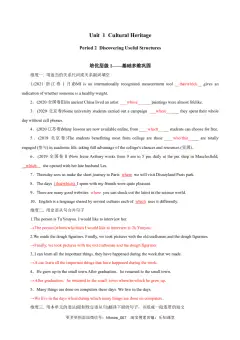
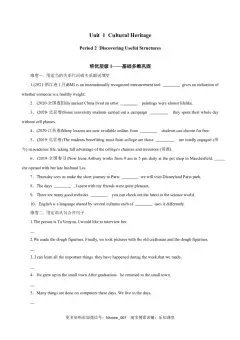
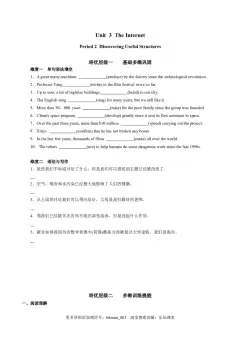
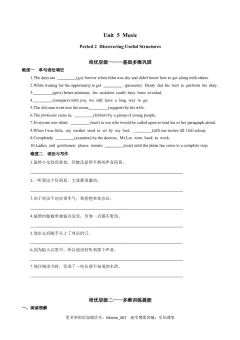
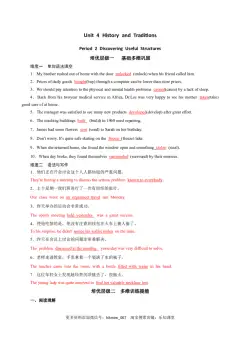
Unit 4 History and Traditions
Period 2 Discovering Useful Structures
培优层级一 基础多维巩固
维度一 单句语法填空
1.My brother rushed out of home with the door (unlock) when his friend called him.
2.Prices of daily goods (buy) through a computer can be lower than store prices.
3.We should pay attention to the physical and mental health problems (cause) by a lack of sleep.
4 . Back from his twoyear medical service in Africa, Dr.Lee was very happy to see his mother
(take) good care of at home.
5.The manager was satisfied to see many new products (develop) after great effort.
6.The teaching buildings (build) in 1960 need repairing.
7.James had some flowers (send) to Sarah on her birthday.
8.Don't worry. It's quite safe skating on the (freeze) lake.
9.When she returned home, she found the window open and something (steal).
10.When day broke, they found themselves (surround) by their enemies.
维度二 语法与写作
1.他们正在开会讨论这个人人都知道的严重问题。
2.上个星期一我们班进行了一次有组织的旅行。
3.昨天举办的运动会非常成功。
4.使他吃惊的是,他没有注意到钱包在火车上被人偷了。
5.昨天在会议上讨论的问题非常难解决。
6.老师走进教室,手里拿着一个装满了水的瓶子。
7.这位年轻女士发现她珍贵的项链丢了,很恼火。
培优层级二 多维训练提能
一、阅读理解
更多资料添加微信号:hiknow_007 淘宝搜索店铺:乐知课堂主题语境:人与社会 语篇类型:说明文 建议用时:8 min
In many countries of the world, people can confidently tell you the meaning of their town or city, but most
people who live in Manchester, Oxford or Birmingham would not be able to explain what the name of their city
means. The name of every British town and city, however, has a long history.
Two thousand years ago, most people living in Britain were Celts. Even the word “Britain” is Celtic (凯尔特
语的). Then the Romans arrived and built camps which became cities called “castra”. This is why there are so
many place names in England which end in “chester” or “caster” — Manchester, for example.
The Romans never reached Wales or Scotland, and many place names there are Celtic. For example, Welsh
place names that begin with “Llan” come from the Celtic word for church.
After the Romans left Britain, it was attacked by tribes called the AngloSaxons who were from the area of
Europe that is now Germany and Holland. Without the Roman army, it was impossible to protect the country from
these people. The names of their villages often ended in “ham” or “ton”. Some got their name from the leader of the
village, so Birmingham, for example, means “Beormund's village”.
The AngloSaxons were farmers and the landscape was very important to them, so we have villages called
Upton (“village on a hill” — a good place to build a village) and Moreton (“village by a lake”, where floods
could make life tough). Place names that end in “ford” (a place where you could cross a river) also describe the
location of AngloSaxon villages.
Twelve hundred years ago, the Vikings came to England from Scandinavia. They traded with the AngloSaxons
but lived in their own villages. These often ended in “by” or “thorpe”. The name “Kirkby” means “a village with a
church” and Scunthorpe was the village of a man called Skuma.
Finally, in 1066, England became Norman — the Normans gave us the place name “grange”, which means
farm.
And how about London? Experts cannot agree. The Romans called the city Londinium, but they were not the
first inhabitants (居民). People once believed that the United Kingdom's capital city got its name from the castle of
a King called Lud, but this is very unlikely. Our best guess today is that the name comes from a Celtic word
meaning a fast flowing river. Like a number of British place names, its history is lost in time.
1.The origin of British place names is unfamiliar to many local people because of .
A.the death of ancient languages
B.their lack of interest in the names
C.the long lost history of the names
更多资料添加微信号:hiknow_007 淘宝搜索店铺:乐知课堂D.the frequent changes to the names
2.According to the article, StratforduponAvon is most likely a town built .
A.beside a river B.near a castle
C.on a hill D.with a church
3.Which of the following shows the correct order of the arrival of inhabitants in Britain?
A.The Celts — The Romans — The Vikings — The Normans — The AngloSaxons
B.The Celts — The Romans — The AngloSaxons — The Vikings — The Normans
C.The Romans — The Celts — The Vikings — The AngloSaxons — The Normans
D.The Romans — The AngloSaxons — The Celts — The Normans — The Vikings
4.According to the text, where did the name for London come from?
A.It is short for Londinium.
B.It's from the term for a river.
C.It is puzzling and hard to confirm.
D.It comes from the castle of a King.
二、七选五
主题语境:人与社会 语篇类型:说明文 建议用时:8 min
Ancient Rome was one of the world's most powerful empires more than 2,000 years ago. The Romans' ideas
about roads, laws, government and buildings still influence us today. Italy is shaped like a boot.
The Colosseum (计兽场) in Rome was built during the time of the Roman Empire, in the first century CE. 1.
It is a popular tourist attraction today.
Italy is wellknown for its designers, who create cars, handbags, clothes, shoes and other items that are in
demand for their style and fine workmanship.
Today, the economy of Italy is stronger than in the past. 2. Today, manufacturing and tourism are the
main sources of income. There are some big companies, but Italy has many smaller companies, too.
3. The southern part does not offer as many manufacturing jobs, so it is not as prosperous.
Italy is a member of the European Union, a group of countries that join together for better trade. The currency,
or money they use is called the “euro”.
Food and eating good meals are important to Italians.4.
Popular food includes pasta, risotto, minestrone and pizza. McDonald's is also popular there. Many families
still eat their main meal in the middle of the day. 5. Families spend a lot of time together.
A.The family is very important to the Italian way of life.
B.The country used to depend on agriculture.
C.Mountains cover about threefourths of the country.
D.It could seat about 50,000 people, who went to see fights between animals and people.
E.While there are some supermarkets, many people shop at small, neighborhood markets.
更多资料添加微信号:hiknow_007 淘宝搜索店铺:乐知课堂F.Italy has several islands off the coast.
G.The northern part of the country is the main manufacturing center.
三、完形填空
主题语境:人与自我 语篇类型:记叙文 建议用时:8 min
For the past five years, I have been writing a book. It is almost __1__, and now it is time for my publisher
and me to agree on a title. It has not gone __2__.
The book is about a __3__day in history, a date __4__ at random. My idea is that there is no such thing as a(n)
“__5__” day. If you __6__ deeply enough into the events for 24 hours, you will find enough dramas, humor and so
on. I always __7__ that the book would be titled “One Day”,with three __8__ drawn from the hat “12/28/1986”.
__9__, that is clearly not how things are done anymore. Publishers believe books must have subtitles; the
more wordy,the __10__.
This wasn't my first such kind of __11__. Years ago, I wrote a book about dogs. The title was to be “Old
Dogs”, for that was what the book was about. On the cover would be a __12__of an old dog, connecting with the
__13__ elegantly. But the publisher insisted on a subtitle. The __14__ came out thus:“OLD DOGS:Are the
best dogs”.Whenever I see it, I feel embarrassed. This __15__ me wondering what old book covers would have
been like in the new age.
1.A.exposed B.written
C.finished D.gone
2.A.fairly B.naturally
C.freely D.smoothly
3.A.single B.rough
C.special D.big
4.A.named B.given
C.chosen D.scheduled
5.A.bad B.ordinary
C.long D.previous
6.A.dig B.fall
C.run D.break
7.A.showed B.admitted
C.agreed D.planned
8.A.pictures B.words
更多资料添加微信号:hiknow_007 淘宝搜索店铺:乐知课堂C.numbers D.signals
9.A.Therefore B.Otherwise
C.Meanwhile D.Nevertheless
10.A.easier B.better
C.older D.worse
11.A.agreement B.question
C.puzzle D.experience
12.A.photo B.film
C.toy D.story
13.A.cover B.theme
C.ending D.opinion
14.A.dog B.saying
C.cover D.change
15.A.caught B.left
C.witnessed D.prevented
培优层级三 真题滚动训练
一、阅读理解
A
(2020·江苏·高考真题)Sometimes it’s hard to let go. For many British people, that can apply to institutions
and objects that represent their country’s past-age-old castles, splendid homes… and red phone boxes.
Beaten first by the march of technology and lately by the terrible weather in junkyards (废品场), the phone
boxes representative of an age are now making something of a comeback. Adapted in imaginative ways, many have
reappeared on city streets and village greens housing tiny cafes, cellphone repair shops or even defibrillator
machines (除颤器).
The original iron boxes with the round roofs first appeared in 1926. They were designed by Giles Gilbert
Scott, the architect of the Battersea Power Station in London. After becoming an important part of many British
streets, the phone boxes began disappearing in the 1980s, with the rise of the mobile phone sending most of them
away to the junkyards.
About that time, Tony Inglis’ engineering and transport company got the job to remove phone boxes from the
streets and sell them out. But Inglis ended up buying hundreds of them himself, with the idea of repairing and
更多资料添加微信号:hiknow_007 淘宝搜索店铺:乐知课堂selling them. He said that he had heard the calls to preserve the boxes and had seen how some of them were listed
as historic buildings.
As Inglis and, later other businessmen, got to work, repurposed phone boxes began reappearing in cities and
villages as people found new uses for them. Today, they are once again a familiar sight, playing roles that are often
just as important for the community as their original purpose.
In rural areas, where ambulances can take a relatively long time to arrive, the phone boxes have taken on a
lifesaving role. Local organizations can adopt them for l pound, and install defibrillators to help in emergencies.
Others also looked at the phone boxes and saw business opportunities. LoveFone, a company that advocates
repairing cellphones rather than abandoning them, opened a mini workshop in a London phone box in 2016.
The tiny shops made economic sense, according to Robert Kerr, a founder of LoveFone. He said that one of
the boxes generated around $13,500 in revenue a month and cost only about $400 to rent.
Inglis said phone boxes called to mind an age when things were built to last. “I like what they are to people,
and I enjoy bringing things back,” he said.
1.The phone boxes are making a comeback ______.
A.to form a beautiful sight of the city
B.to improve telecommunications services
C.to remind people of a historical period
D.to meet the requirement of green economy
2.Why did the phone boxes begin to go out of service in the 1980s?
A.They were not well-designed. B.They provided bad services.
C.They had too short a history. D.They lost to new technologies.
3.The phone boxes are becoming popular mainly because of ______.
A.their new appearance and lower prices B.the push of the local organizations
C.their changed roles and functions D.the big funding of the businessmen
B
(2019·全国·高考真题)Before the 1830s, most newspapers were sold through annual subscriptions in
America, usually $8 to $10 a year. Today $8 or $10 seems a small amount of money, but at that time these amounts
were forbidding to most citizens. Accordingly, newspapers were read almost only by rich people in politics or the
trades. In addition, most newspapers had little in them that would appeal to a mass audience. They were dull and
visually forbidding. But the revolution that was taking place in the 1830s would change all that.
The trend, then, was toward the “penny paper”—a term referring to papers made widely available to the
更多资料添加微信号:hiknow_007 淘宝搜索店铺:乐知课堂public. It meant any inexpensive newspaper; perhaps more importantly it meant newspapers that could be bought in
single copies on the street.
This development did not take place overnight. It had been possible(but not easy) to buy single copies of
newspapers before 1830, but this usually meant the reader had to go down to the printer’s office to purchase a copy.
Street sales were almost unknown. However, within a few years, street sales of newspapers would be commonplace
in eastern cities. At first the price of single copies was seldom a penny—usually two or three cents was charged—
and some of the older well-known papers charged five or six cents. But the phrase “penny paper” caught the
public’s fancy, and soon there would be papers that did indeed sell for only a penny.
This new trend of newspapers for “the man on the street” did not begin well. Some of the early ventures(企业)
were immediate failures. Publishers already in business, people who were owners of successful papers, had little
desire to change the tradition. It took a few youthful and daring businessmen to get the ball rolling.
4.Which of the following best describes newspapers in America before the 1830s?
A.Academic. B.Unattractive. C.Inexpensive. D.Confidential.
5.What did street sales mean to newspapers?
A.They would be priced higher. B.They would disappear from cities.
C.They could have more readers. D.They could regain public trust.
6.Who were the newspapers of the new trend targeted at?
A.Local politicians. B.Common people.
C.Young publishers. D.Rich businessmen.
7.What can we say about the birth of the penny paper?
A.It was a difficult process. B.It was a temporary success.
C.It was a robbery of the poor. D.It was a disaster for printers.
更多资料添加微信号:hiknow_007 淘宝搜索店铺:乐知课堂更多资料添加微信号:hiknow_007 淘宝搜索店铺:乐知课堂