



文档内容
Verbal Test 8
Solutions Booklet
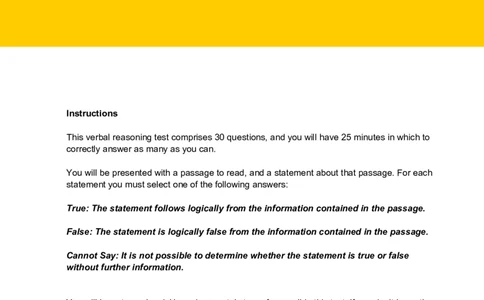
Instructions
This verbal reasoning test comprises 30 questions, and you will have 25 minutes in which to
correctly answer as many as you can.
You will be presented with a passage to read, and a statement about that passage. For each
statement you must select one of the following answers:
True: The statement follows logically from the information contained in the passage.
False: The statement is logically false from the information contained in the passage.
Cannot Say: It is not possible to determine whether the statement is true or false
without further information.
You will have to work quickly and accurately to perform well in this test. If you don’t know the
answer to a question, leave it and come back to it if you have time.
Try to find a time and place where you will not be interrupted during the test. When you
are ready, begin the test.
AssessmentDay
Practice Aptitude TestsThe merits of single-sex education have long been debated in the United
States, where demand for single-sex schools is on the rise. Title IV, a 1972
law prohibiting sex discrimination in education, was amended in 2006,
allowing for the establishment of single-sex state schools so long as a co-
educational alternative is available. While critics view single-sex schools as
discriminatory and inadequate preparation for adult life, advocates claim
that children, and particularly girls, benefit from a single-sex education.
Some American research shows that girls attending single-sex schools
have higher self-esteem, participate more in class, and score higher on
aptitude tests than their counterparts in co-educational schools. A 2005
study claimed that both girls and boys attending single-sex schools spent
more time on homework and had less disciplinary problems. Single-sex
schools subvert stereotypical course-taking patterns and results. Advocates
of single-sex schooling argue that educators can teach more effectively by
tailoring their tuition to reflect current research about gender-based brain
development. Many experts, however, believe that research into single-sex
education is inconclusive, and that so long as the education provided is
gender-fair, both girls and boys can thrive in a co-educational environment.
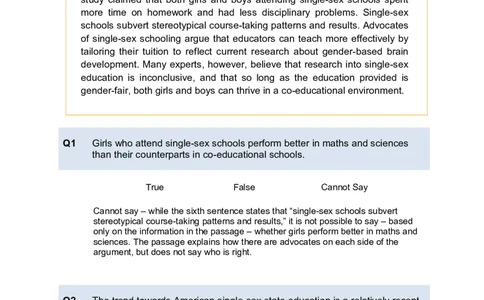
Q1 Girls who attend single-sex schools perform better in maths and sciences
than their counterparts in co-educational schools.
True False Cannot Say
Cannot say – while the sixth sentence states that “single-sex schools subvert
stereotypical course-taking patterns and results,” it is not possible to say – based
only on the information in the passage – whether girls perform better in maths and
sciences. The passage explains how there are advocates on each side of the
argument, but does not say who is right.
Q2 The trend towards American single-sex state education is a relatively recent
phenomenon.
True False Cannot Say
True – single-sex state schools were illegal between 1972 and 2006, as explained
in the second sentence.
For personal use only. Unauthorised copying or Page 2 AssessmentDay
distribution in printed, electronic, or any other
form in whole or in part, is prohibited without
Document last updated 25-03-2013
www.assessmentday.co.uk
prior written permission from AssessmentDay.Q3 Proponents of single-sex education believe there are neurological
differences between the two genders.
True False Cannot Say
True – the seventh sentence states that educators can tailor their tuition to reflect
current research about gender-based brain development.
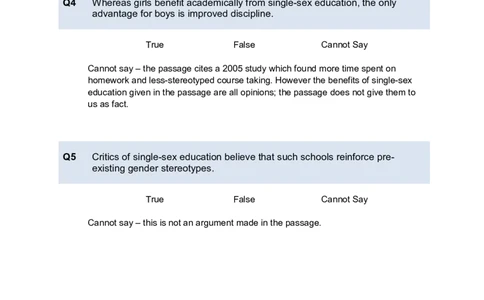
Q4 Whereas girls benefit academically from single-sex education, the only
advantage for boys is improved discipline.
True False Cannot Say
Cannot say – the passage cites a 2005 study which found more time spent on
homework and less-stereotyped course taking. However the benefits of single-sex
education given in the passage are all opinions; the passage does not give them to
us as fact.
Q5 Critics of single-sex education believe that such schools reinforce pre-
existing gender stereotypes.
True False Cannot Say
Cannot say – this is not an argument made in the passage.
For personal use only. Unauthorised copying or Page 3 AssessmentDay
distribution in printed, electronic, or any other
form in whole or in part, is prohibited without
Document last updated 25-03-2013
www.assessmentday.co.uk
prior written permission from AssessmentDay.The United States’ space programme is at a critical juncture. Between 1971
and 2011, spending on space has declined from 5% of the federal
budget to 0.5%. The US government recently announced it has cancelled
its Constellation human spaceflight programme, which was intended to
provide transportation to the International Space Station (ISS). Instead,
NASA will shift its emphasis to developing new technologies and
commercializing space flight. NASA will outsource its transportation to the
ISS – a move designed to dramatically reduce launch costs. Five private
companies – nearly all of which are headed by internet entrepreneurs – are
sharing $50 million of federal funds to develop cargo spacecraft. NASA’s
new vision has not been met by enthusiasm from all quarters, with critics
calling it the death knell of America’s former supremacy in space travel.
Politicians whose states are losing out on jobs as a result of NASA’s
cancelled programmes have been among the most vocal critics. With
entrepreneurs racing to achieve human spaceflight, the next American to
land on the moon could be a commercial passenger rather than a NASA
astronaut.
Q6 NASA aims to save money by outsourcing transport to the International
Space Station.
True False Cannot Say
True – the fifth sentence states that outsourcing transportation is “designed to
dramatically reduce launch costs”. So NASA has designed something to save
money, which is equivalent to aiming to save money. The passage also states that
“Five private companies” will help develop the cargo ship, indicating outsourcing to
the private sector.
Q7 Under NASA’s new plans, travel to the International Space Station will be
privatised.
True False Cannot Say
True – summarises the fifth sentence. Handing operation to private companies is
privatisation.
For personal use only. Unauthorised copying or Page 4 AssessmentDay
distribution in printed, electronic, or any other
form in whole or in part, is prohibited without
Document last updated 25-03-2013
www.assessmentday.co.uk
prior written permission from AssessmentDay.Q8 The five companies sharing the federal funds are using internet technology to
develop cargo spacecraft.
True False Cannot Say
Cannot say – while these companies are headed by internet entrepreneurs, this fact
is not necessarily related to the spacecraft they are developing for NASA.
Q9 Some critics believe that NASA’s new direction marks the end of American
leadership in space exploration.
True False Cannot Say
True – summarizes the seventh sentence. Death knell means the beginning of the
end.
Q10 The United States government recently announced plans to reduce its space
programme budget.
True False Cannot Say
Cannot say – the second sentence states that spending has declined over the past
40 years, however it does not say if the government announced this (they could
have just done it). Also this does not preclude a one-off cut 39 years ago with a
recent small increase. We cannot tell from the passage.
For personal use only. Unauthorised copying or Page 5 AssessmentDay
distribution in printed, electronic, or any other
form in whole or in part, is prohibited without
Document last updated 25-03-2013
www.assessmentday.co.uk
prior written permission from AssessmentDay.Although according to the EU-funded Psychonaut Research Project it has
only been available since 2008, mephedrone is now the fourth most popular
recreational drug in the United Kingdom. Also known as “meow meow” and
“drone”, mephedrone is a synthetic stimulant that is derived from cathinone
compounds found in the khat plant of Eastern Africa. Chemically similar to
amphetamines, mephedrone has the effect of euphoria and increased
stimulation. Because it is sold as plant fertilizer and thus not subject to
medical regulations, mephedrone is currently legal in the United Kingdom,
although it has been banned in many other countries, including Sweden,
Germany and Israel. Manufactured in China and sold cheaply, the drug’s
legality and availability have led to its meteoric rise. While it is not illegal, it
does not follow that mephedrone is safe to use – an international lack of
scientific research means that its effects on health are not fully known.
Following reports of addiction and the drug’s suspected involvement in
several deaths; there are calls in the UK to have mephedrone classified as
an illegal substance immediately. This legal decision, however, cannot be
taken until a government advisory council has fully investigated any
scientific evidence.
Q11 Mephedrone is a naturally occurring substance.
True False Cannot Say
False – the second sentence describes mephedrone as a “synthetic” stimulant
derived from cathinone compounds found in a type of plant.
Q12 Sweden and Germany have scientifically proven the health dangers of
mephedrone.
True False Cannot Say
False – the passage tell us there is an “international lack of scientific research” on the
effects on health from the drug. If there is a lack of research it cannot follow that it
has been scientifically proven.
For personal use only. Unauthorised copying or Page 6 AssessmentDay
distribution in printed, electronic, or any other
form in whole or in part, is prohibited without
Document last updated 25-03-2013
www.assessmentday.co.uk
prior written permission from AssessmentDay.Q13 Mephedrone’s low cost makes it especially attractive to teenage users.
True False Cannot Say
Cannot say – the passage does not mention the age of mephedrone users, nor the
reasons a particular age group use the drug.
Q14 Despite being a legal substance, mephedrone is not safe to use.
True False Cannot Say
Cannot say – the sixth sentence states that “a lack of scientific research means that
its effects on health are not fully known”.
Q15 The UK government has been criticised for failing to act quickly to criminalise
mephedrone.
True False Cannot Say
Cannot say – the penultimate sentence states there are calls to have mephedrone
classified as illegal, but the passage does not mention criticism of the government,
nor about the length or their inaction. nor about the length or their inaction.
For personal use only. Unauthorised copying or Page 7 AssessmentDay
distribution in printed, electronic, or any other
form in whole or in part, is prohibited without
Document last updated 25-03-2013
www.assessmentday.co.uk
prior written permission from AssessmentDay.Ecotourism can be defined as responsible travel to natural areas that aims
to both conserve the environment and bring economic opportunities to local
people. Ecotourism provides an alternative to environmentally damaging
industries such as logging and mining, while also stimulating the local
economy. However, its dependency on foreign investment leads to one of
the main criticisms of the industry: that the profits generated from
ecotourism do not benefit the local economy and work force. Furthermore,
while the ideals behind ecotourism are unobjectionable, the industry is
highly susceptible to “greenwashing” – whereby a false impression of
environmental friendliness is given. More radical opposition comes from
those critics who believe that ecotourism is inherently flawed because travel
that uses fossil fuels is damaging to the environment. Despite these voices
of dissent, ecotourism has become the fastest-growing sector of the tourism
industry, growing at an annual rate of twenty to thirty percent. Ironically,
ecotourism’s very success may counteract its environmental goals, as high
levels of visitors – even careful ones – inevitably damage the ecosystem.
Q16 Ecotourism strives to profit from a nation’s natural resources.
True False Cannot Say
Cannot say – whilst the second sentence mentions ecotourism as an alternative to
logging and mining, we are not told anywhere in the passage that profit from natural
resources is one of its aims.
Q17 Ecotourism’s critics believe that air travel contributes to global warming.
True False Cannot Say
Cannot say – the fifth sentence states that critics believe that travel using fossil fuels
is damaging to the environment, but it does not say how it is damaging to the
environment, for example they could just mean depletion of natural resources.
For personal use only. Unauthorised copying or Page 8 AssessmentDay
distribution in printed, electronic, or any other
form in whole or in part, is prohibited without
Document last updated 25-03-2013
www.assessmentday.co.uk
prior written permission from AssessmentDay.Q18 The passage dismisses the ecotourism industry as an example of
greenwashing.
True False Cannot Say
False – the fourth sentences merely says that ecotourism is susceptible to
greenwashing. The passage does not dismiss ecotourism.
Q19 The long-term environmental credentials of ecotourism are debatable.
True False Cannot Say
True – the last sentence states that high levels of visitors “may counteract its
environmental goals” and that all visitors inevitably damage the environment. The
passage leaves open the debate.
Q20 While ecotourism’s environmental benefits are disputed, there is consensus
that it benefits local people economically.
True False Cannot Say
False – while the second sentence states that stimulating the local economy is one of
the aims of ecotourism, the third sentence makes clear that critics believe that “the
profits generated from ecotourism do not benefit the local economy and work force. If
there are critics, there cannot be consensus.
For personal use only. Unauthorised copying or Page 9 AssessmentDay
distribution in printed, electronic, or any other
form in whole or in part, is prohibited without
Document last updated 25-03-2013
www.assessmentday.co.uk
prior written permission from AssessmentDay.The democratic peace theory holds that liberal democracies never, or
rarely, go to war against each other. The first to espouse this idea was the
German philosopher Immanuel Kant, who posited that constitutional
republics engender peace, because the majority of people will not vote to
go to war unless in self-defence. More recently, the democratic peace
theory was put forth in 1964 by Dean Babst. Babst carried out the first
statistical research to scientifically prove that democracies never or rarely
fight each other. Despite an undeniable statistical correlation between
democracy and peace, the democratic peace theory is highly debated
amongst political scientists. The definitions of “democracy” and “war” are
one contentious issue. Some opponents of the democratic peace theory
point to exceptions, such as the Spanish-American War. However, the main
criticism of the theory is that it is based on flawed logic – that peace
between democracies is not caused by the democratic nature of those
states. Furthermore, opponents argue that democracies frequently attack
non-democracies, dispelling the notion that democracies are inherently
pacifistic. There are several derivatives of the democratic peace theory,
including the economic peace theory, which states that increased economic
exchange between states helps to avoid conflict.
Q21 Immanuel Kant’s theory about democratic peace was the first to statistically
research whether democracies rarely or never fight each other.
True False Cannot Say
False – the third sentence states that the first statistical research into the theory was
not carried out until Babst’s work in the 1960s.
Q22 The premise for the democratic peace theory is the accountability of a
democratically elected government to its electorate.
True False Cannot Say
True – the second sentence explains that the majority of people will not vote to go to
war, and as a result the country will not go to war.
For personal use only. Unauthorised copying or Page 10 AssessmentDay
distribution in printed, electronic, or any other
form in whole or in part, is prohibited without
Document last updated 25-03-2013
www.assessmentday.co.uk
prior written permission from AssessmentDay.Q23 The definition of peace is divisive amongst political scientists.
True False Cannot Say
Cannot say – the fifth sentence states that the definitions of “democracy” and “war”
are the subject of contention, but the passage does not mention their interpretation
of “peace”, which may or may not be contentious.
Q24 The economic peace theory says that countries are less likely to engage in
war if their trade is independent of each other.
True False Cannot Say
False – the last sentence states that economic peace theory “states that increased
economic exchange between states helps to avoid conflict”. This is the opposite of
what the statement says, so it cannot be true.
Q25 Dean Babst found statistical evidence showing democracies do not fight in
wars.
True False Cannot Say
Cannot say – the passage tells us about the evidence Babst found showing that
democracies do not go to war against other democracies, but it says nothing of any
evidence proving or disproving that democracies get involved in any war, for
example against non-democracies.
For personal use only. Unauthorised copying or Page 11 AssessmentDay
distribution in printed, electronic, or any other
form in whole or in part, is prohibited without
Document last updated 25-03-2013
www.assessmentday.co.uk
prior written permission from AssessmentDay.The debate over the British Museum’s Parthenon sculptures, also called the
Elgin Marbles, has run for nearly two centuries. Marble statues were
removed – with official permission – from the ruins of the Parthenon in 1801
by Lord Elgin, the British Ambassador to the Ottoman Empire. He sold
these ancient Greek treasures to the British Museum in 1816, where they
have been housed ever since. Today, five million visitors from around the
world visit the sculptures, free of charge, at the British Museum. Since
gaining independence in 1830, however, the Greek government has argued
for their return to Athens. Historically, the Hellenic position centred on
ownership, claiming that Lord Elgin bribed authorities to acquire the
marbles illegally. The counterargument is that Lord Elgin saved these
classical treasures from neglect. Greece no longer disputes the British
Museum’s ownership, but states that the sculptures should be loaned to the
New Acropolis Museum in Athens, where they would be reunited with other
surviving sculptures and displayed in their proper geographic and cultural
context. Despite public sympathy for the return of the Elgin marbles, the
British Museum believes that the Parthenon marbles are part of shared
world heritage and thus should be widely accessible. Furthermore,
returning the Parthenon statues would set a precedent for returning other
artefacts to their land of origin.
Q26 The British Museum takes the view that the Parthenon sculptures transcend
national boundaries.
True False Cannot Say
True – the ninth sentence describes the British Museum’s view – that the marbles
are “part of shared world heritage”. Shared world heritage means they don’t believe
individual nations should claim more of an ownership over other nations.
Q27 Prior to 1830, Greece was part of the Ottoman Empire.
True False Cannot Say
Cannot say – the passage states that Greece won its independence in 1830, and that
Lord Elgin was Ambassador to the Ottoman Empire, but the statement above is an
assumption.
For personal use only. Unauthorised copying or Page 12 AssessmentDay
distribution in printed, electronic, or any other
form in whole or in part, is prohibited without
Document last updated 25-03-2013
www.assessmentday.co.uk
prior written permission from AssessmentDay.Q28 The British public cannot understand why the Greek government want the
Parthenon marbles returned.
True False Cannot Say
False – the ninth sentence mentions “public sympathy for the return of the Elgin
marbles”, contrary to the British Museum’s stance. If the public have sympathy, it
can be said that they understand why they might be wanted back.
Q29 The only surviving marble statues from the Parthenon are divided between the
British Museum and the New Acropolis Museum.
True False Cannot Say
Cannot say – whilst we are told that there are Parthenon marbles in the British
Museum and “other surviving sculptures” in the New Acropolis Museum, the passage
does not specify that these are the only remaining Parthenon statues. For example,
Lord Elgin may not have recovered all of them.
Q30 Greeks believe that the Elgin Marbles technically do not belong to the British
Museum.
True False Cannot Say
False – the seventh sentence states “Greece no longer disputes the British
Museum’s ownership”.
-- End of Test --
For personal use only. Unauthorised copying or Page 13 AssessmentDay
distribution in printed, electronic, or any other
form in whole or in part, is prohibited without
Document last updated 25-03-2013
www.assessmentday.co.uk
prior written permission from AssessmentDay.