商丘市一高 2023-2024 学年第一学期期中考试
高三英语
时间:100分钟 总分:120分
第二部分阅读理解(共两节,满分50分)
第一节(共15小题;每小题2.5分,满分37.5分)
阅读下列短文,从每题所给的A、B、C和D四个选项中,选出最佳选项,并在答题卡上将该项
涂黑。
A
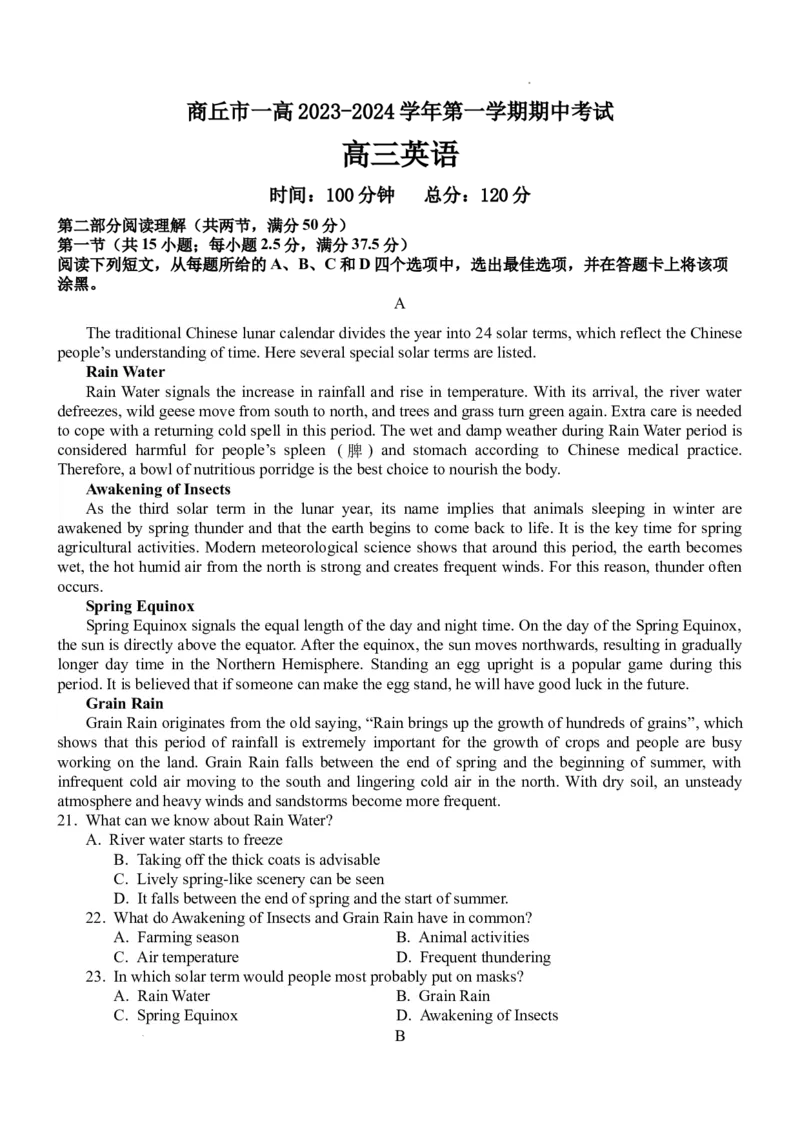
The traditional Chinese lunar calendar divides the year into 24 solar terms, which reflect the Chinese
people’s understanding of time. Here several special solar terms are listed.
Rain Water
Rain Water signals the increase in rainfall and rise in temperature. With its arrival, the river water
defreezes, wild geese move from south to north, and trees and grass turn green again. Extra care is needed
to cope with a returning cold spell in this period. The wet and damp weather during Rain Water period is
considered harmful for people’s spleen ( 脾 ) and stomach according to Chinese medical practice.
Therefore, a bowl of nutritious porridge is the best choice to nourish the body.
Awakening of Insects
As the third solar term in the lunar year, its name implies that animals sleeping in winter are
awakened by spring thunder and that the earth begins to come back to life. It is the key time for spring
agricultural activities. Modern meteorological science shows that around this period, the earth becomes
wet, the hot humid air from the north is strong and creates frequent winds. For this reason, thunder often
occurs.
Spring Equinox
Spring Equinox signals the equal length of the day and night time. On the day of the Spring Equinox,
the sun is directly above the equator. After the equinox, the sun moves northwards, resulting in gradually
longer day time in the Northern Hemisphere. Standing an egg upright is a popular game during this
period. It is believed that if someone can make the egg stand, he will have good luck in the future.
Grain Rain
Grain Rain originates from the old saying, “Rain brings up the growth of hundreds of grains”, which
shows that this period of rainfall is extremely important for the growth of crops and people are busy
working on the land. Grain Rain falls between the end of spring and the beginning of summer, with
infrequent cold air moving to the south and lingering cold air in the north. With dry soil, an unsteady
atmosphere and heavy winds and sandstorms become more frequent.
21. What can we know about Rain Water?
A. River water starts to freeze
B. Taking off the thick coats is advisable
C. Lively spring-like scenery can be seen
D. It falls between the end of spring and the start of summer.
22. What do Awakening of Insects and Grain Rain have in common?
A. Farming season B. Animal activities
C. Air temperature D. Frequent thundering
23. In which solar term would people most probably put on masks?
A. Rain Water B. Grain Rain
C. Spring Equinox D. Awakening of Insects
B
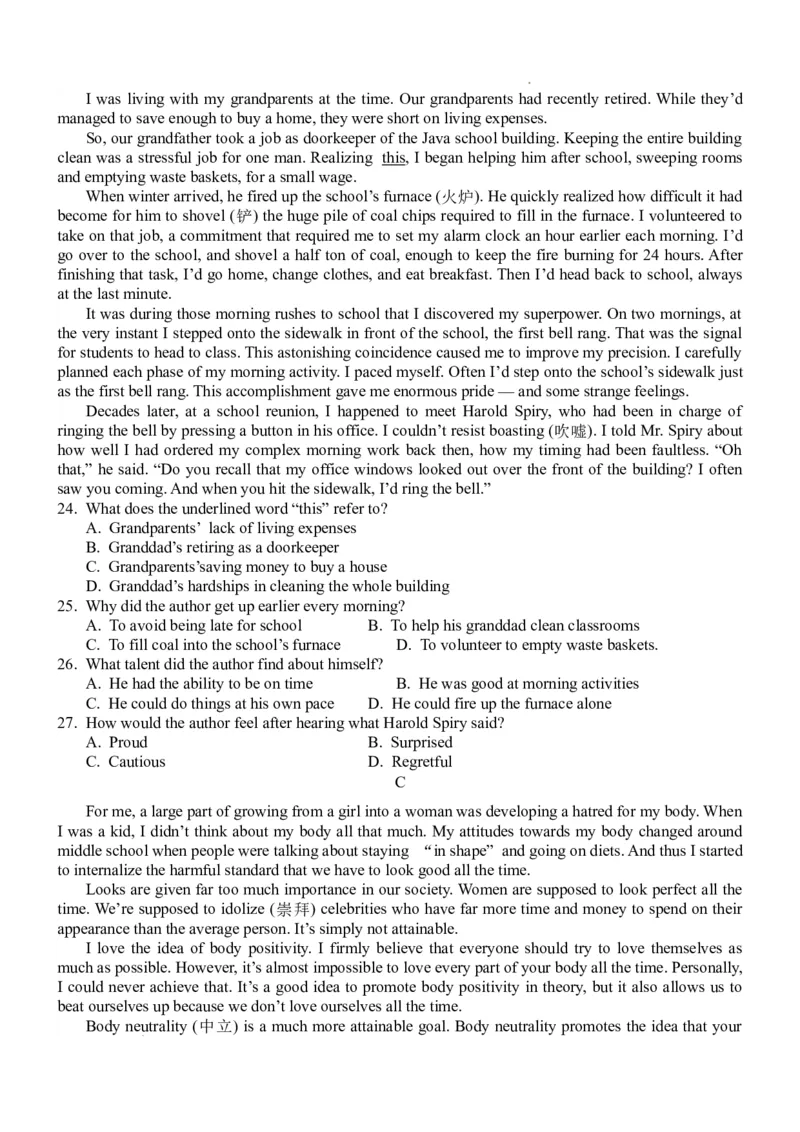
学科网(北京)股份有限公司I was living with my grandparents at the time. Our grandparents had recently retired. While they’d
managed to save enough to buy a home, they were short on living expenses.
So, our grandfather took a job as doorkeeper of the Java school building. Keeping the entire building
clean was a stressful job for one man. Realizing this, I began helping him after school, sweeping rooms
and emptying waste baskets, for a small wage.
When winter arrived, he fired up the school’s furnace (火炉). He quickly realized how difficult it had
become for him to shovel (铲) the huge pile of coal chips required to fill in the furnace. I volunteered to
take on that job, a commitment that required me to set my alarm clock an hour earlier each morning. I’d
go over to the school, and shovel a half ton of coal, enough to keep the fire burning for 24 hours. After
finishing that task, I’d go home, change clothes, and eat breakfast. Then I’d head back to school, always
at the last minute.
It was during those morning rushes to school that I discovered my superpower. On two mornings, at
the very instant I stepped onto the sidewalk in front of the school, the first bell rang. That was the signal
for students to head to class. This astonishing coincidence caused me to improve my precision. I carefully
planned each phase of my morning activity. I paced myself. Often I’d step onto the school’s sidewalk just
as the first bell rang. This accomplishment gave me enormous pride — and some strange feelings.
Decades later, at a school reunion, I happened to meet Harold Spiry, who had been in charge of
ringing the bell by pressing a button in his office. I couldn’t resist boasting (吹嘘). I told Mr. Spiry about
how well I had ordered my complex morning work back then, how my timing had been faultless. “Oh
that,” he said. “Do you recall that my office windows looked out over the front of the building? I often
saw you coming. And when you hit the sidewalk, I’d ring the bell.”
24. What does the underlined word “this” refer to?
A. Grandparents’ lack of living expenses
B. Granddad’s retiring as a doorkeeper
C. Grandparents’saving money to buy a house
D. Granddad’s hardships in cleaning the whole building
25. Why did the author get up earlier every morning?
A. To avoid being late for school B. To help his granddad clean classrooms
C. To fill coal into the school’s furnace D. To volunteer to empty waste baskets.
26. What talent did the author find about himself?
A. He had the ability to be on time B. He was good at morning activities
C. He could do things at his own pace D. He could fire up the furnace alone
27. How would the author feel after hearing what Harold Spiry said?
A. Proud B. Surprised
C. Cautious D. Regretful
C
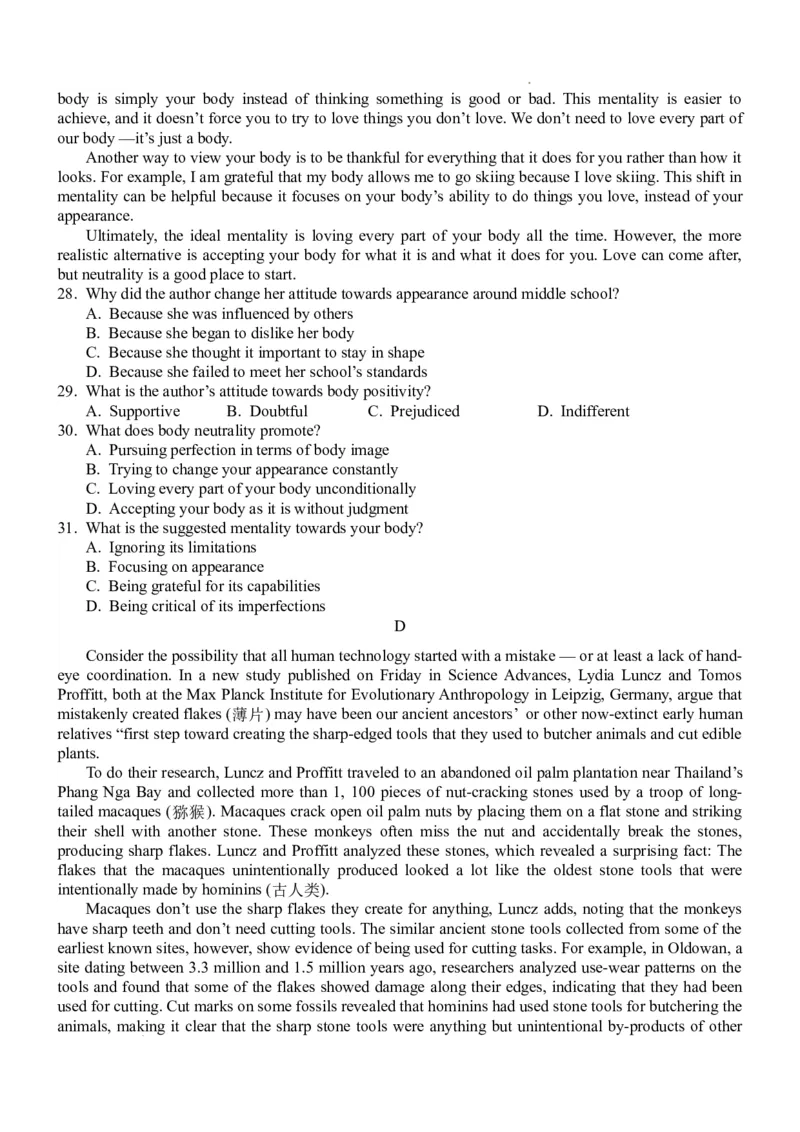
For me, a large part of growing from a girl into a woman was developing a hatred for my body. When
I was a kid, I didn’t think about my body all that much. My attitudes towards my body changed around
middle school when people were talking about staying “in shape” and going on diets. And thus I started
to internalize the harmful standard that we have to look good all the time.
Looks are given far too much importance in our society. Women are supposed to look perfect all the
time. We’re supposed to idolize (崇拜) celebrities who have far more time and money to spend on their
appearance than the average person. It’s simply not attainable.
I love the idea of body positivity. I firmly believe that everyone should try to love themselves as
much as possible. However, it’s almost impossible to love every part of your body all the time. Personally,
I could never achieve that. It’s a good idea to promote body positivity in theory, but it also allows us to
beat ourselves up because we don’t love ourselves all the time.
Body neutrality (中立) is a much more attainable goal. Body neutrality promotes the idea that your
学科网(北京)股份有限公司body is simply your body instead of thinking something is good or bad. This mentality is easier to
achieve, and it doesn’t force you to try to love things you don’t love. We don’t need to love every part of
our body —it’s just a body.
Another way to view your body is to be thankful for everything that it does for you rather than how it
looks. For example, I am grateful that my body allows me to go skiing because I love skiing. This shift in
mentality can be helpful because it focuses on your body’s ability to do things you love, instead of your
appearance.
Ultimately, the ideal mentality is loving every part of your body all the time. However, the more
realistic alternative is accepting your body for what it is and what it does for you. Love can come after,
but neutrality is a good place to start.
28. Why did the author change her attitude towards appearance around middle school?
A. Because she was influenced by others
B. Because she began to dislike her body
C. Because she thought it important to stay in shape
D. Because she failed to meet her school’s standards
29. What is the author’s attitude towards body positivity?
A. Supportive B. Doubtful C. Prejudiced D. Indifferent
30. What does body neutrality promote?
A. Pursuing perfection in terms of body image
B. Trying to change your appearance constantly
C. Loving every part of your body unconditionally
D. Accepting your body as it is without judgment
31. What is the suggested mentality towards your body?
A. Ignoring its limitations
B. Focusing on appearance
C. Being grateful for its capabilities
D. Being critical of its imperfections
D
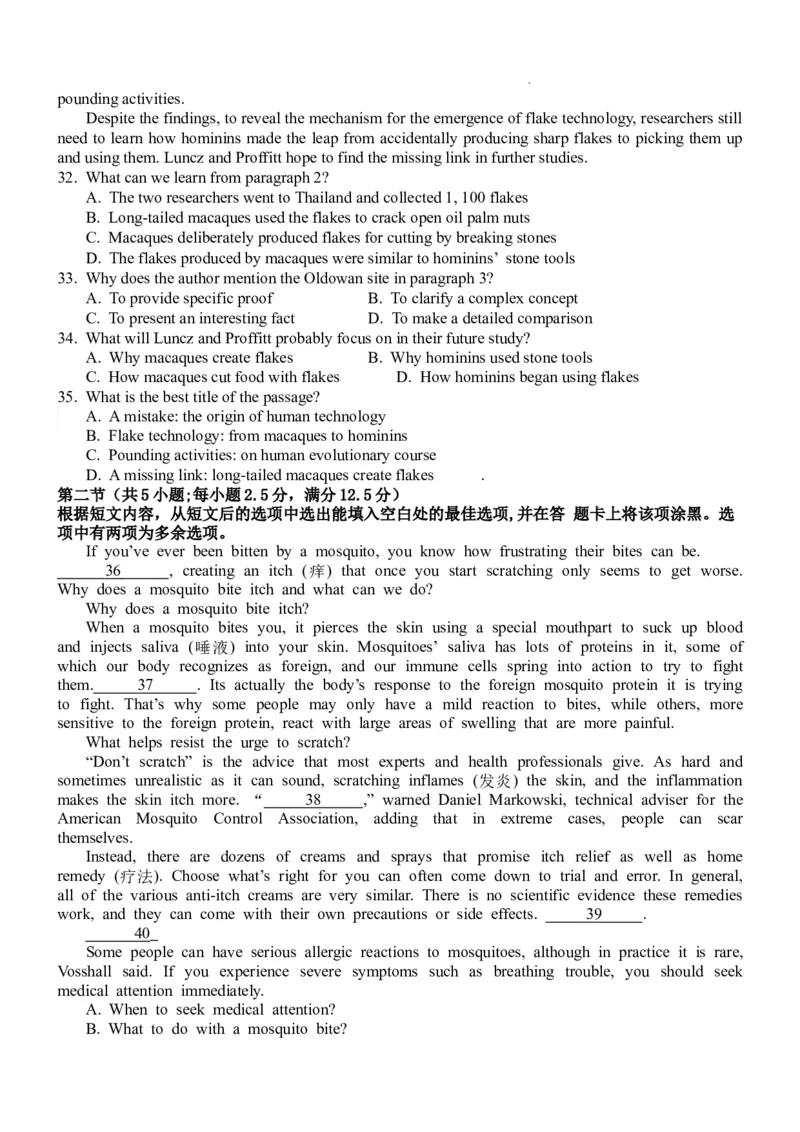
Consider the possibility that all human technology started with a mistake — or at least a lack of hand-
eye coordination. In a new study published on Friday in Science Advances, Lydia Luncz and Tomos
Proffitt, both at the Max Planck Institute for Evolutionary Anthropology in Leipzig, Germany, argue that
mistakenly created flakes (薄片) may have been our ancient ancestors’ or other now-extinct early human
relatives “first step toward creating the sharp-edged tools that they used to butcher animals and cut edible
plants.
To do their research, Luncz and Proffitt traveled to an abandoned oil palm plantation near Thailand’s
Phang Nga Bay and collected more than 1, 100 pieces of nut-cracking stones used by a troop of long-
tailed macaques (猕猴). Macaques crack open oil palm nuts by placing them on a flat stone and striking
their shell with another stone. These monkeys often miss the nut and accidentally break the stones,
producing sharp flakes. Luncz and Proffitt analyzed these stones, which revealed a surprising fact: The
flakes that the macaques unintentionally produced looked a lot like the oldest stone tools that were
intentionally made by hominins (古人类).
Macaques don’t use the sharp flakes they create for anything, Luncz adds, noting that the monkeys
have sharp teeth and don’t need cutting tools. The similar ancient stone tools collected from some of the
earliest known sites, however, show evidence of being used for cutting tasks. For example, in Oldowan, a
site dating between 3.3 million and 1.5 million years ago, researchers analyzed use-wear patterns on the
tools and found that some of the flakes showed damage along their edges, indicating that they had been
used for cutting. Cut marks on some fossils revealed that hominins had used stone tools for butchering the
animals, making it clear that the sharp stone tools were anything but unintentional by-products of other
学科网(北京)股份有限公司pounding activities.
Despite the findings, to reveal the mechanism for the emergence of flake technology, researchers still
need to learn how hominins made the leap from accidentally producing sharp flakes to picking them up
and using them. Luncz and Proffitt hope to find the missing link in further studies.
32. What can we learn from paragraph 2?
A. The two researchers went to Thailand and collected 1, 100 flakes
B. Long-tailed macaques used the flakes to crack open oil palm nuts
C. Macaques deliberately produced flakes for cutting by breaking stones
D. The flakes produced by macaques were similar to hominins’ stone tools
33. Why does the author mention the Oldowan site in paragraph 3?
A. To provide specific proof B. To clarify a complex concept
C. To present an interesting fact D. To make a detailed comparison
34. What will Luncz and Proffitt probably focus on in their future study?
A. Why macaques create flakes B. Why hominins used stone tools
C. How macaques cut food with flakes D. How hominins began using flakes
35. What is the best title of the passage?
A. A mistake: the origin of human technology
B. Flake technology: from macaques to hominins
C. Pounding activities: on human evolutionary course
D. A missing link: long-tailed macaques create flakes .
第二节(共5小题;每小题2.5分,满分12.5分)
根据短文内容,从短文后的选项中选出能填入空白处的最佳选项,并在答 题卡上将该项涂黑。选
项中有两项为多余选项。
If you’ve ever been bitten by a mosquito, you know how frustrating their bites can be.
3 6 , creating an itch (痒) that once you start scratching only seems to get worse.
Why does a mosquito bite itch and what can we do?
Why does a mosquito bite itch?
When a mosquito bites you, it pierces the skin using a special mouthpart to suck up blood
and injects saliva (唾液) into your skin. Mosquitoes’ saliva has lots of proteins in it, some of
which our body recognizes as foreign, and our immune cells spring into action to try to fight
them. 3 7 . Its actually the body’s response to the foreign mosquito protein it is trying
to fight. That’s why some people may only have a mild reaction to bites, while others, more
sensitive to the foreign protein, react with large areas of swelling that are more painful.
What helps resist the urge to scratch?
“Don’t scratch” is the advice that most experts and health professionals give. As hard and
sometimes unrealistic as it can sound, scratching inflames (发炎) the skin, and the inflammation
makes the skin itch more. “ 3 8 ,” warned Daniel Markowski, technical adviser for the
American Mosquito Control Association, adding that in extreme cases, people can scar
themselves.
Instead, there are dozens of creams and sprays that promise itch relief as well as home
remedy (疗法). Choose what’s right for you can often come down to trial and error. In general,
all of the various anti-itch creams are very similar. There is no scientific evidence these remedies
work, and they can come with their own precautions or side effects. 3 9 .
4 0
Some people can have serious allergic reactions to mosquitoes, although in practice it is rare,
Vosshall said. If you experience severe symptoms such as breathing trouble, you should seek
medical attention immediately.
A. When to seek medical attention?
B. What to do with a mosquito bite?
学科网(北京)股份有限公司C. It’s not the bite that causes the itch
D. The more you scratch, the more they itch
E. The little red bumps swell up almost immediately
F. Scratching can cause secondary infections and prolong the irritation
G. In fact, the best remedy to fight the itch is to prevent a bite in the first place
第三部分语言知识运用(共两节,满分30分)
第一节 完形填空(共15小题;每小题1分,满分15分)
阅读下面短文,从短文后各题所给的A、B、C和D四个选项中,选出可以填 入空白处的最佳选
项,并在答题卡上将该项涂黑。
Last year in early summer, I was walking to my house when I saw two large birds standing in my
yard. They didn’t seem to 4 1 me until I was right in front of them and then they
4 2 disappeared into the nearby bushes. I was quite excited by the 4 3 of two special birds
making a nest (巢) in my yard.
A few weeks later, the birds 4 4 . I found them crouching (蹲伏) beside a tree. As I approached
them, they 4 5 their heads and made a croaking (嘶哑地叫) sound. I didn’t know why they were
croaking at me until a short time later I made an amazing 4 6 : there were two small birds 4 7
around happily.
As I inched towards the birds, 4 8 not to make sudden movements, they started their croaking
again, putting their necks forward so they seemed 4 9 and more threatening.
The mother put the baby birds under her wings and carefully crouched down over them so her babies
were well 5 0 .
I was watching them with respect when I suddenly 5 1 and fell to the ground. The mother
took this as a/an 5 2 and the father raced towards me, 5 3 his wings to protect the mother
and the baby birds.
I felt sorry to have disturbed them and left quickly. I am amazed by their 5 4 actions. Their
parental love made them so courageous. It is hard not to show 5 5 for nature.
41. A. remind B. confirm C. notice D. protest
42. A. immediately B. familiarly C. creatively D. slowly
43. A. feeling B. sense C. opinion D. idea
44. A. investigated B. removed C. gathered D. reappeared
45. A. stuck out B. put down C. hang out D. turned aroun
46. A. collection B. discovery C. conclusion D. mission
47. A. jumping B. fighting C. seeking D. marching
48. A. curious B. patient C. worried D. careful
49. A. neater B. simpler C. longer D. stronger
50. A. fed B. hidden C. raised D. identified
51. A. tripped B. moved C. alarmed D. responded
52. A. target B. defence C. threat D. escape.
53. A. shooting B. spilling C. folding D. spreading
54. A. military B. individual C. brave D. average
55. A. gratitude B. respect C. emotion D. pleasure
第二节(共10小题;每小题1.5分,满分15分)
阅读下面短文,在空白处填入1个适当的单词或括号内单词的正确形式, 并将答案填写在答题卡
相应的位置上。
If you have the chance to go back to ancient China and ask (56) educated man what
his biggest dream was. He would tell you that he wants to become a zhuang yuan, a title (57)
(give) to the scholar (58) came first in the highest imperial examination.
In ancient China, it was not that (59) (ease) to be an official. You have to take exams
学科网(北京)股份有限公司first. The exams are very difficult and have many (60) (procedure). The outcome has to
be confirmed by the Emperor (61) (he). The number one scholar with the best score in the
imperial exam is called zhuang yuan. Once you (62)
(select) as zhuang yuan, you will be appreciated by the Emperor and appear in a parade
downtown (63) a red robe and a tall, strong horse. Zhuang yuan is referred to the elite
scholars. Now the imperial competitive examination has been canceled for many years.
However, people still like to call (64) (good) person in their field a zhuang yuan. An
old saying goes that there are 360 trades (65) every trade has his master, or zhuang
yuan.
第四部分 写作(共两节,满分40分)
第一节(满分15分)
假定你是李华,你的留学生朋友Jim对中国传统文化很感兴趣,准备参加中国传统技能冬令
营:“中国书法冬令营”或者“中国武术冬令营”。Jim希望你能给些建议帮助他进行选择。请
你给Jim回信,内容包括:
1.你建议的班型;
2.你的理由;
3.你的祝愿。
注意:
1.词数80左右;
2.可适当增加细节,以使行文连贯。
参考词汇:中国书法 Chinese Calligraphy 中国武术 Chinese Martial Arts
_________________________________________________________________________________________________
_________________________________________________________________________________________________
_________________________________________________________________________________________________
_________________________________________________________________________________________________
_______________________________________________
第二节(满分25分)
阅读下面材料,根据其内容和所给段落开头语续写两段,使之构成一篇完整的短文。
The Magic Bus
I was travelling on an overnight bus from Kolhapur to Aurangabad in Maharashtra. This was way
back in May 1972, when I was still in college. The bus — an ordinary, non-air-conditioned one — was
more than packed; all 55 seats were occupied and there were some 20 people standing in the aisle (过道).
The hot day added to the discomfort of the rough, 10-hour journey. Because I was travelling on a student
bus pass, I could not claim a reserved seat. I had no option but to stand — quite uncomfortably.
The bus started its journey a little later than scheduled. The passengers seated comfortably by the
windows wore happy expressions as they looked at the outside world, the breeze kissing their faces. The
people seated by the aisle complained about the standing ones, who had no option but to occasionally lean
on the seat corners. The air inside was hot and filled with strange, unpleasant smells. Some enthusiastic
travellers had carried small transistor radios with the slim hope that they would be able to listen to some
music on the way.
After around two very long hours, I was beyond exhausted and bored. I kept trying to balance myself,
shifting my body weight from one leg to the other to manage the discomfort. After another long hour, I
was wet with sweat in the noise and shaky rhythm of the bus. I suddenly sensed a soft hand tapping my
elbow (手肘), asking for attention. Turning around, I found a middle-aged man with a kind smile looking
up at me. He suddenly stood up and said I could take his seat for some time. I was pleasantly surprised
and immediately accepted his offer, my entire body heaving a sigh of relief. The man, whose seat I was
in, stood next to me, looking around in amusement. After about 20 minutes, I signalled him to take back
his space. A man, who was sitting by the window on the other side of the bus, had observed our exchange.
注意:
1. 所续写短文的词数应为150左右;
学科网(北京)股份有限公司2. 续写部分分为两段每段的开头语已为你写好。
Paragraph 1:
Just then, something magical happened._________________________________________________
_______________________________________________________________________________________
_________________________________________________________________________________________________
_________________________________________________________________________________________________
_________________________________________________________________________________________________
_________________________________________________________________________________________________
_________________________________________________________________________________________________
_________________________________________________________________________________________________
___________________________
Paragraph 2:
The bus reached its destination in the early hours of the morning. _____________________________
_________________________________________________________________________________________________
_________________________________________________________________________________________________
_________________________________________________________________________________________________
_________________________________________________________________________________________________
_________________________________________________________________________________________________
_________________________________________________________________________________________________
_________________________________________________________________________________________________
_________________________________________________________________________________________________
学科网(北京)股份有限公司学科网(北京)股份有限公司