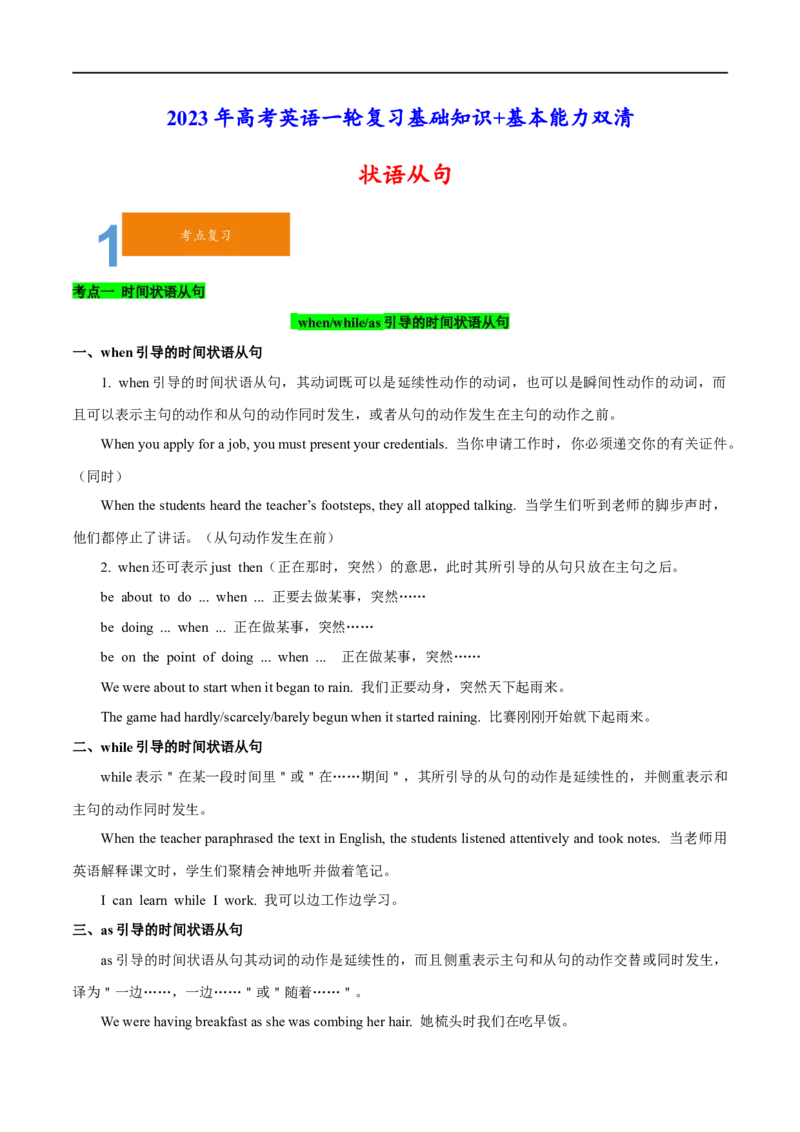
2023 年高考英语一轮复习基础知识+基本能力双清
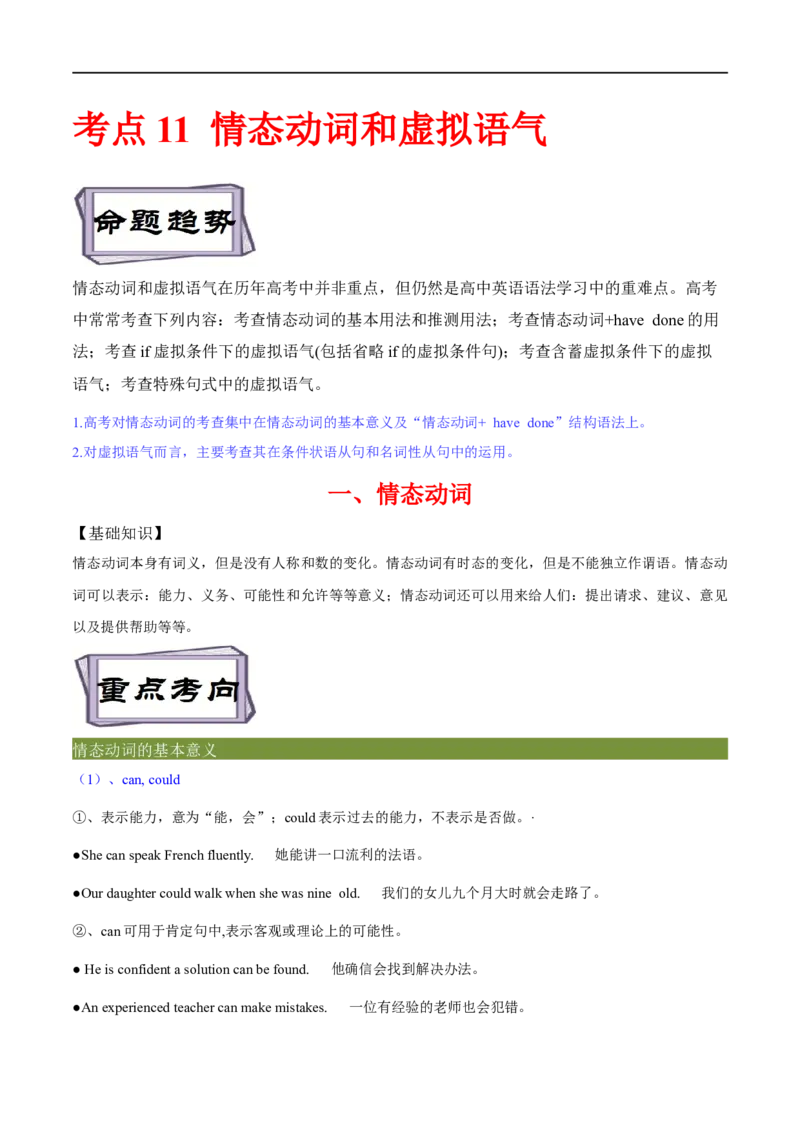
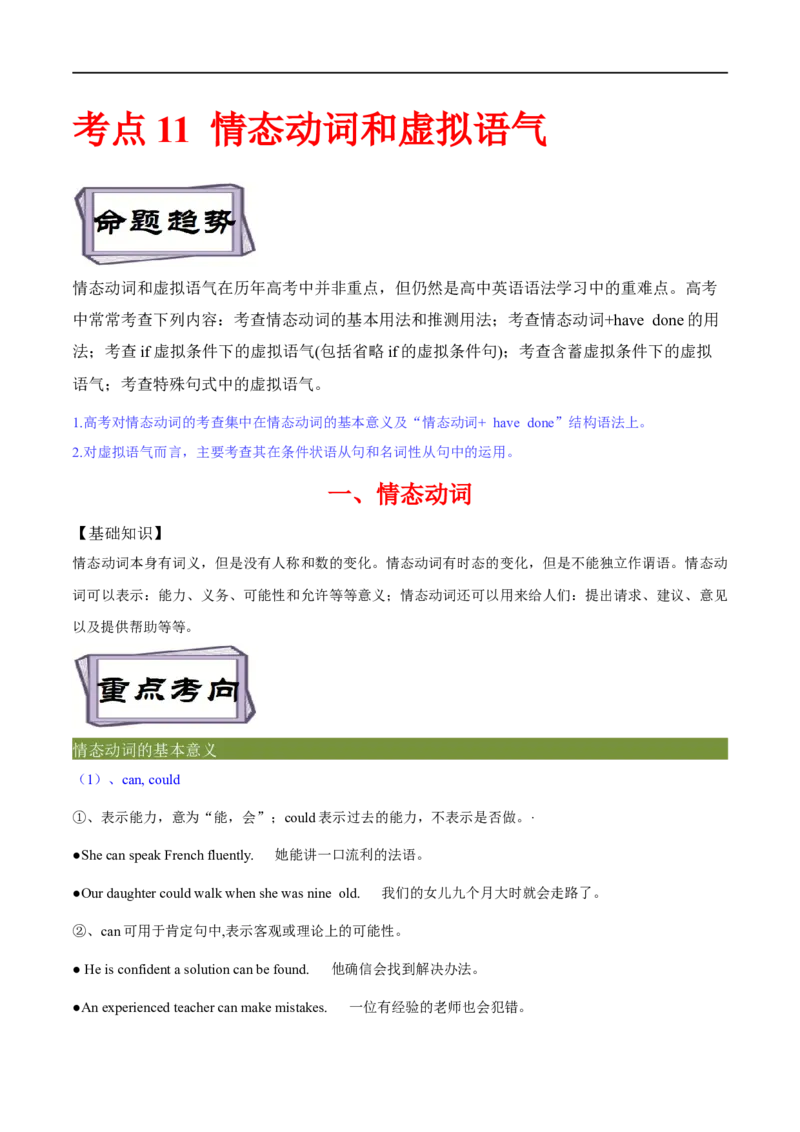
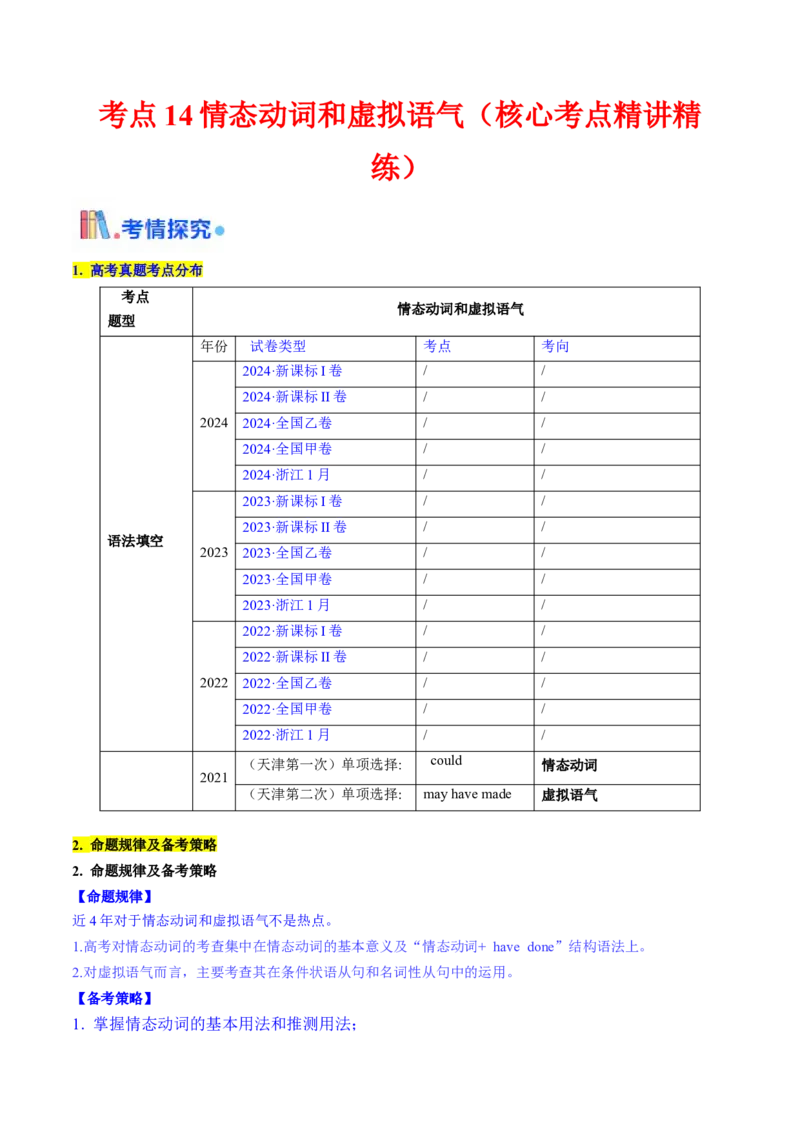
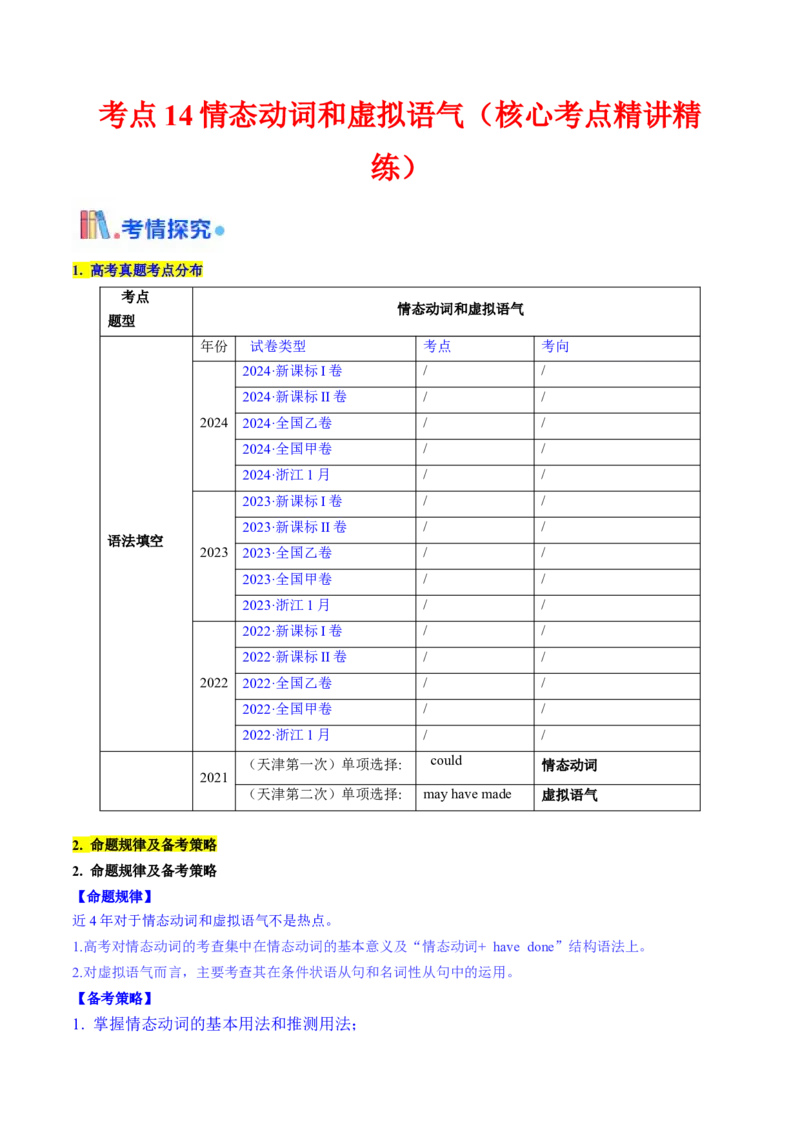
情态动词和虚拟语气
1
考点复习
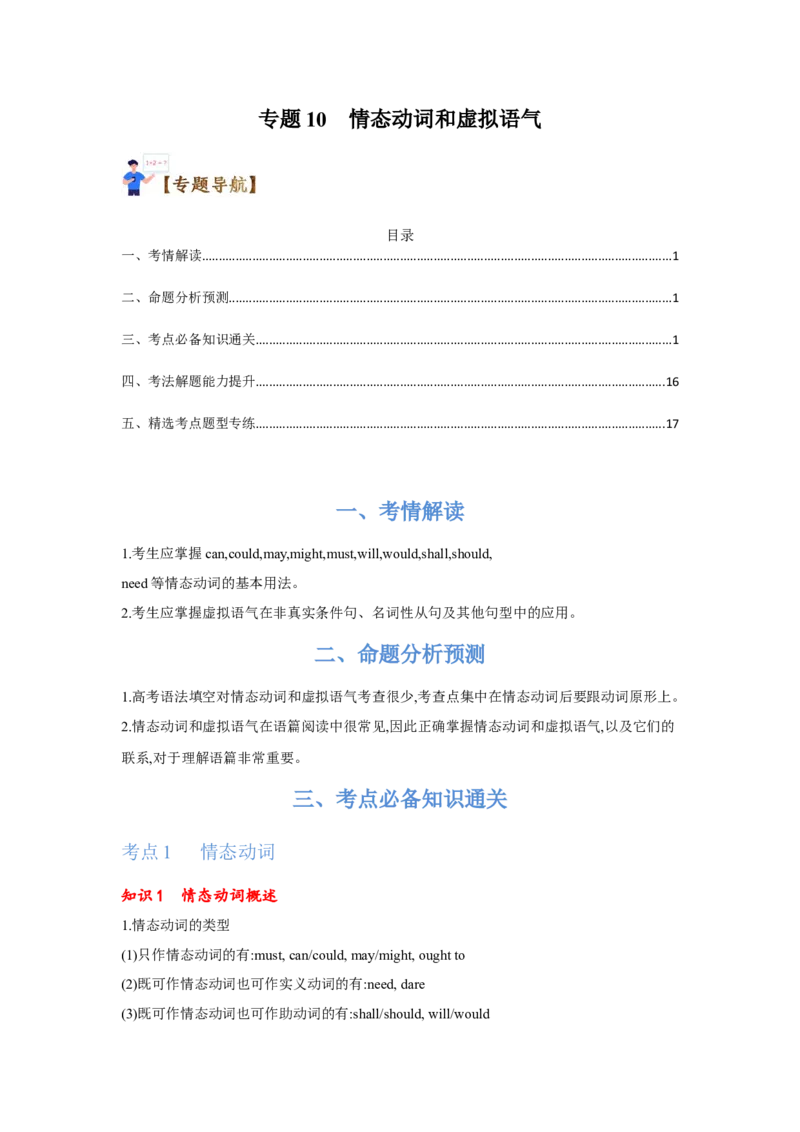
考点一 助动词与情态动词
一、英语中的助动词
助动词有be, have, do, will, shall。它们本身没有词义,只和实义动词的一定形式构成复合谓语,
用来表示时态和语态,构成否定、疑问及加强语气等。
1、be (am, is, are, were, been)
(1)“be + -ing”构成进行时态;
(2)“be + 过去分词”构成被动语态;
(3)“be + 动词不定式”构成复合谓语:
①表示按计划安排要发生的事。The prime minister is to visit Japan next year. 总理将于明
年访问日本。
② 用于命令。You're to do your homework before you watch TV.你得做完了作业才能看电
视。
2、have (has, had)
(1)“have+过去分词”构成完成时态。如:Have you seen the film ?
(2)“have been + -ing”构成完成进行时态。如:What have you been doing these days? 这些日
子你一直在干什么?
3、do (does, did)
(1)“do not + 动词原形”构成行为动词的否定式。如:His brother doesn’t like playing basket.;
(2)“Do + 主语 + 动词原形”构成行为动词的一般疑问句。Does he go to school by bike
every day?
(3)“do + 动词原形”用于祈使句或陈述句中表示加强语气。如:I did go to see him, but he
wasn’t in我确实去看望他了,但他不在家。Do do some work. 请一定做点什么;
(4)代替前面刚出现的动词以避免重复。My mother told me to go to bed early. So I did.
4.will, shall (would, should)“will (shall+动词原形”构成一般将来时,一般来说 shall用于第一人称,will用于第二人称
或第三人称,口语中常用will代替shall,如:We will have a meeting to discuss the problem.
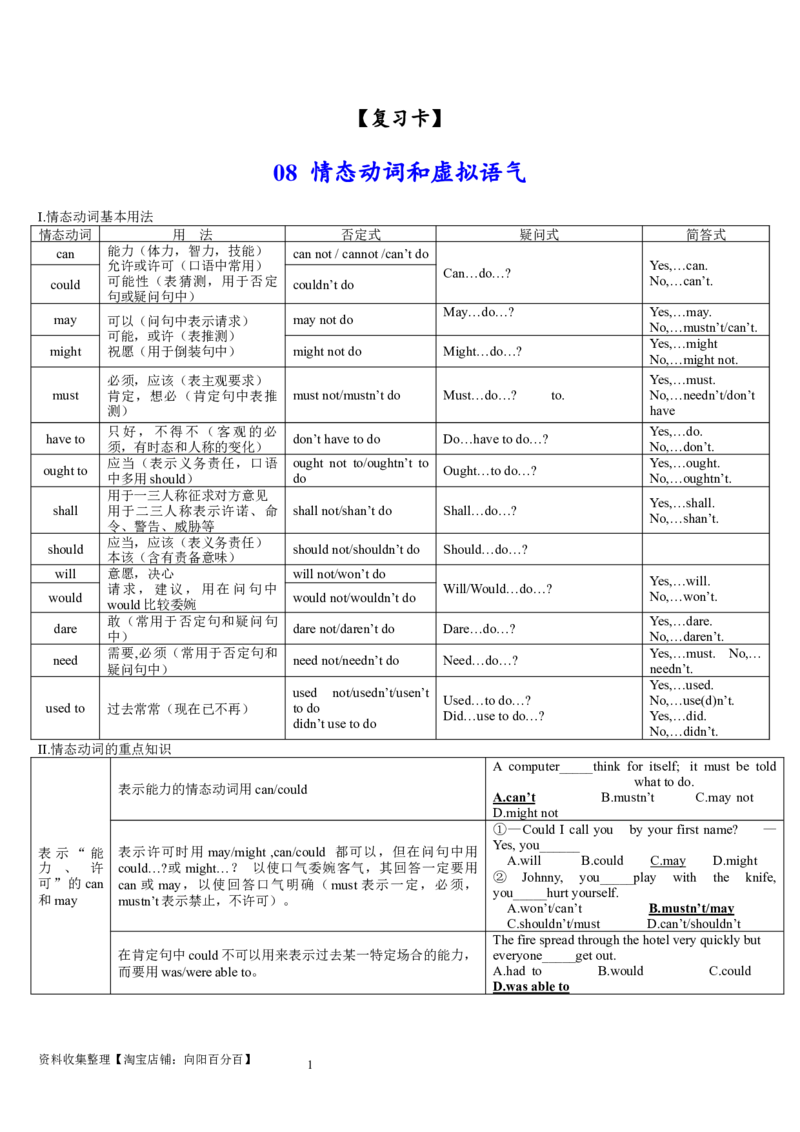
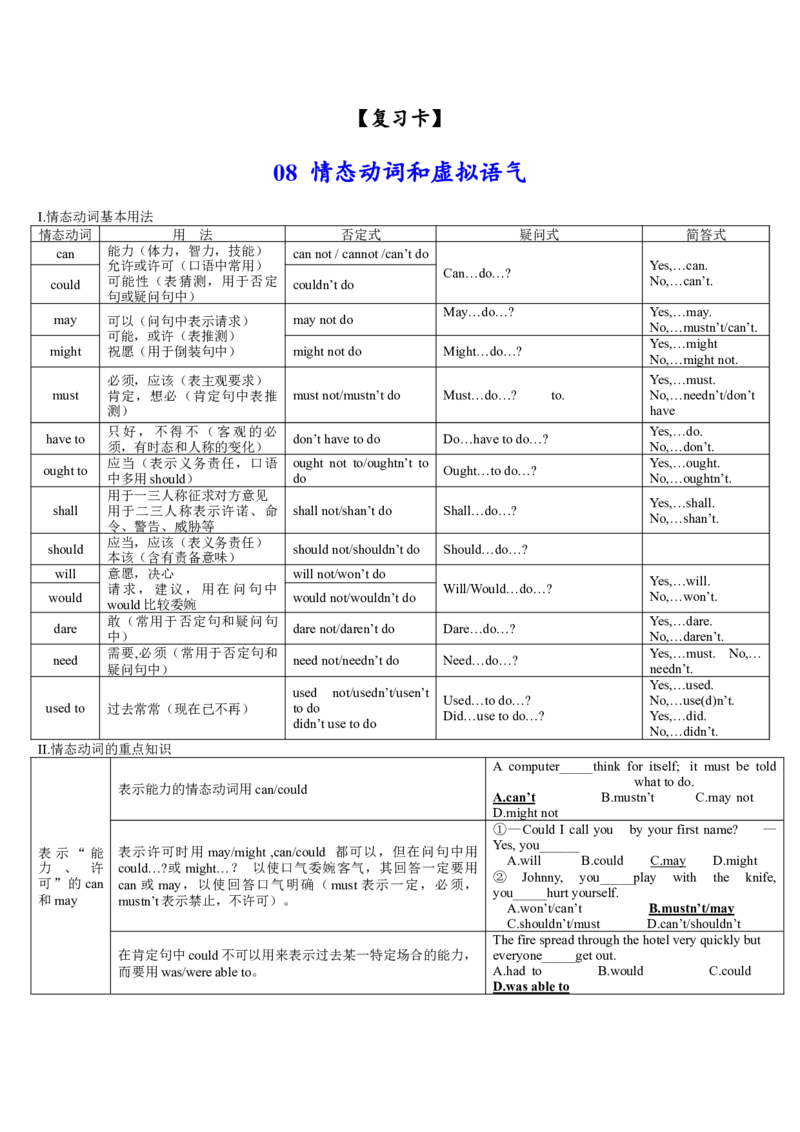
二、英语中的情态动词
情态动词表示说话人对某一动作或状态的态度,可以表示“可能”、“可以”、“需要”、
“必须”或“应当”等之意。情态动词没有人称和数的变化。但不能单独作谓语动词用,必须和
不带to的不定式连用构成谓语动词。只有情态动词ought要和带to的动词不定式连用,在句中作
谓语用。
将情态动词置于主语之前即构成其疑问式,在情态动词之后加 not既构成其否定式。现将各情
态动词的基本用法分述如下:
1、can和could (could为can的过去式) 的基本用法
(1)表示能力,如:He can speak English better than you.
(2)在疑问句和否定句中表示“怀疑”、“猜测”或“可能性”,如:Can this green bike be
Liu Dong's?
(3)表示“许可”时can可以和may换用,如:You can (may) go home now.
(4)如果要表示语气婉转,可用 could代替can,这时could不再是can的过去式,如:Could you
come again tomorrow?
(5)can和be able to都可表示能力,两者在意思上没有什么区别。但是can只能有现在式和过去
式,而be able to则有更多的形式,如:He will be able to do the work better.
2、may和might (might为may的过去式)的基本用法
(1)表示允许或征询对方许可,有“可以”之意,如:You may use my dictionary. 在回答对方
说“可以做某事”或“不可以做某事”时,一般多不用 may或 may not,以避免语气生硬或不容
气。而用比较婉转的说法进行回答。如:---- May I use this dictionary? ---- Yes, please. 或 ----
Certainly. 在请求对方许可时,如果Might I…? 就比用May I…? 语气更婉转些,如:May I have
a look at your new computer? 但是表示“阻止”或“禁止”对方做某事时,要用 must not代替
may not,如:---- May we swim in this lake? ---- No, you mustn’t. It’s too dangerous.
(2)may或 might都可以表示可能性,表示“或许”、“可能”之意,如果用 might表示可能性,
则语气更加不肯定,如:They may (might) be in the library now .
3、must的基本用法
(1)must表示“必须”、“应该”之意,其否定式 must not,缩写形式为 mustn't,表示“不
应该”,“不准”、“不许可”或“禁止”之意,如:We must study hard and make progressevery day. You mustn't touch the fire.
(2)对以must提出的疑问句,如作否定回答时,要用needn't或用don't (doesn't) have to (不
必)来回答,而不用mustn't,因为mustn't表示的是“禁止”或“不许可”之意,如:---- Must we
finish the work tomorrow? ---- No, you needn't (don't have to), but you must finish it in
three days.
(3)在肯定句中must可以表示推测,表示“一定”或“必定”之意,如:---- Whose new bike
can it be? ---- It must be Liu Dong's. I know his father has just bought him a new one.
4、can, could, may, must后接完成式的用法
(1)can, could后接完成式的用法:
①在否定句或疑问句中表示对过去发生过的事情的“怀疑”或“不肯定”的态度,Could he
have said so?
②在肯定句中,可以表示过去可能做到而实际并没做到的事情,有“劝告”或“责备”的语
气。如:---- When did you answer her letter? ---- Only yesterday. ---- It's too late. You could
have answered it earlier, I am sure.
(2)may, might后接完成式的用法
①表示对过去某事的推测,认为某一件事情在过去可能发生了。如果使用 might,语气就比
较婉转或更加不肯定,如:Mary might have learned some Chinese before.
②可以表示过去本来可以做到而实 际没有做到的事情,有“劝告”或“责备”的语气,如:
You didn't do the work well that day. You might have done it better.
(3)must后接完成式的用法:表示对过去某事的推测,认为某事在过去一定做到 了,如:
Liu Dong isn’t in the classroom. He must have gone to the library.
5、have to 的基本用法
have to和must的意义相近,只是 must侧重表示说话人的主观看法,而have to 则表示客观
需要,如:I must study hard. I had to give it up because of illness.
6、ought to的基本用法
(l)表示根据某种义务或必要“应当”做某事,语气比 should强,例如:Everyone ought to
obey the traffic regulations.
(2)表示推测,注意与must表示推测时的区别:He must be home by now .(断定他已到家),
He ought to be home by now .(不十分肯定),This is where the oil must be.(比较直率) ,This
is where the oil ought to be. (比较含蓄) ;(3)“ought + have+ 过去分词”表示过去应做某事而 实际未做。例如:You ought to have
helped him. (but you didn’t) 这时,ought与 should可以互相换用。注意,在美国英语中ought to
用于否定和疑问句时 to 可以省略。例如:Ought you smoke so much? You oughtn’t smoke so
much.
7、dare的基本用法
(l)dare (dared为其过去式) 作情态动词用时,主要用于否定句,疑问句和条件从句中,如:
Dared he bread the traffic regulations again?
(2)在现代英语中dare常用作行为动词,其变化与一般行为动词相同,如:She dares to stay at
home alone at night.
8、need的基本用法
(1)need作情态动词用时,主要用于否定句和疑问句中,如:He needn't worry about us now.
(2)need也可作为行为动词用,可用于肯定句,否定句和疑问句中,其后可接名词、代词、动
名词或带 to 的动词不定式为其宾语。如:You need to practise reading aloud every day.
(3)needn't后接完成式可以表示过去做了一件本来不必要做的事情,如:---- Did you answer
the letter yesterday? ---- Yes, I did. ---- But you needn’t have answered it.
9、shall的基本用法
(1)shall用作情态动词时,用于第二、三人称,表示说活人的意愿,可表示“命令”、“警
告”、“强制”、“威胁”或“允诺”等意,如:He shall go first, whether he wants to or not.
(2)在疑问句中,shall用于第一、三人称,表示说话人的征询对方意见或请求指示,如:Shall
I open the door?
10、should的基本用法
(1)should作为情态动词可以表示“建议”或“劝告”,有“应该”之意,如:You should
learn from each other.
(2)should后接完成式表示过去没有做到本来应该做的事情,或是做了本来不应该做的事情。
如:You should have give him more help.
11、will的基本用法
(1)用于各人称,可以表示“意志”或“决心”,如:I have told him again and again to stop
smoking, but he will not listen.
(2)在疑问句中用于第二人称,表示说话人向对方提出请求或询问对方的意愿,如:Will you
please tell me how to get to the Capital Gymnasium?(3)will 可以表示一种习惯性的动作,有“总是”或“会要”之意,如:Every morning he
will have a walk along this river.
12、would的基本用法
(1)would作为will的过去式,可用于各人称,表示过去时间的“意志”或“决心”,如:He
promised he would never smoke again.
(2)在疑问句中,用于第二人称,表示说话人向对方提出请求或许问对方的意愿时,比用will
的气更加婉转,如:Would you like some more coffee?
(3)在日常生活中,学用“I would like to…”表示“我想要”或“我愿意”之意,以使语气
婉转,如:I would like to do Ex.2 first.
(4)would可以表示过去的习惯动作,比used to正式,并没有“现已无此习惯”的含义。如:
Last year our English teacher would sometimes tell us stories in English after class. / During the vacation
he would visit me every week.
(5)表料想或猜想,如:It would be about ten when he left home./ What would she be doing
there?/ I thought he would have told you about it.
13、used to, had better, would rather的用法
(1)used to表示过去的习惯动作或状态,现在已不存在,在间接引语中,其形式可不变,例如:
He told us he used to play foot ball when he was young.
在疑问句、否定句、否定疑问句或强调句中,可有两种形式。
疑问句:Did you use to/ Used you to go to the same school as your brother?
否定句:I usedn’t to / didn’t use to go there. (usedn’t 也可写作usen’t);
否定疑问句:Usen’t you to/ Didn’t you use to be interested in the theatre?
强调句:I certainly used to/ did use to smoke, but it was a long time ago.;
其反意疑问句或简略回答中,也有两种形式:She used to be very fat. didn’t she?/ use(d)n’t she?
Did you use to play chess? Yes, I did./ Used you to get up early in the morning? Yes, I did./ used to.
(2)had better意为“最好”,后接不带to的不定式,例如:
---- We had better go now .
---- Yes, we had (we'd better/ we had better)./ Hadn’t we better stop now? (Had we better not
stop now?)/ I think I’d better be going. (用于进行时态,表“最好立即”)/ You had better have
done that (用于完成时态,表未完成动作)
注:had better用于同辈或小辈,对长辈不可用。(3)would rather 意为“宁愿”,表选择,后接不带 to 的不定式,例如:I’d rather not say
anything./ Would you rather work on a farm?/
---- Wouldn’t you rather stay here?
---- No, I would not. I’d rather go there.
由于would rather表选择,因 而后可接 than,例如:I would rather work on a farm than in a
factory. / I would rather watch TV than go to see the film/ I would rather lose a dozen cherry trees than
that you should tell me one lie./ I’d rather you didn’t talk about this to anyone. (句中的 'd rather不是情
态动词,would 在此是表愿望的实义动词)
【典例示例】
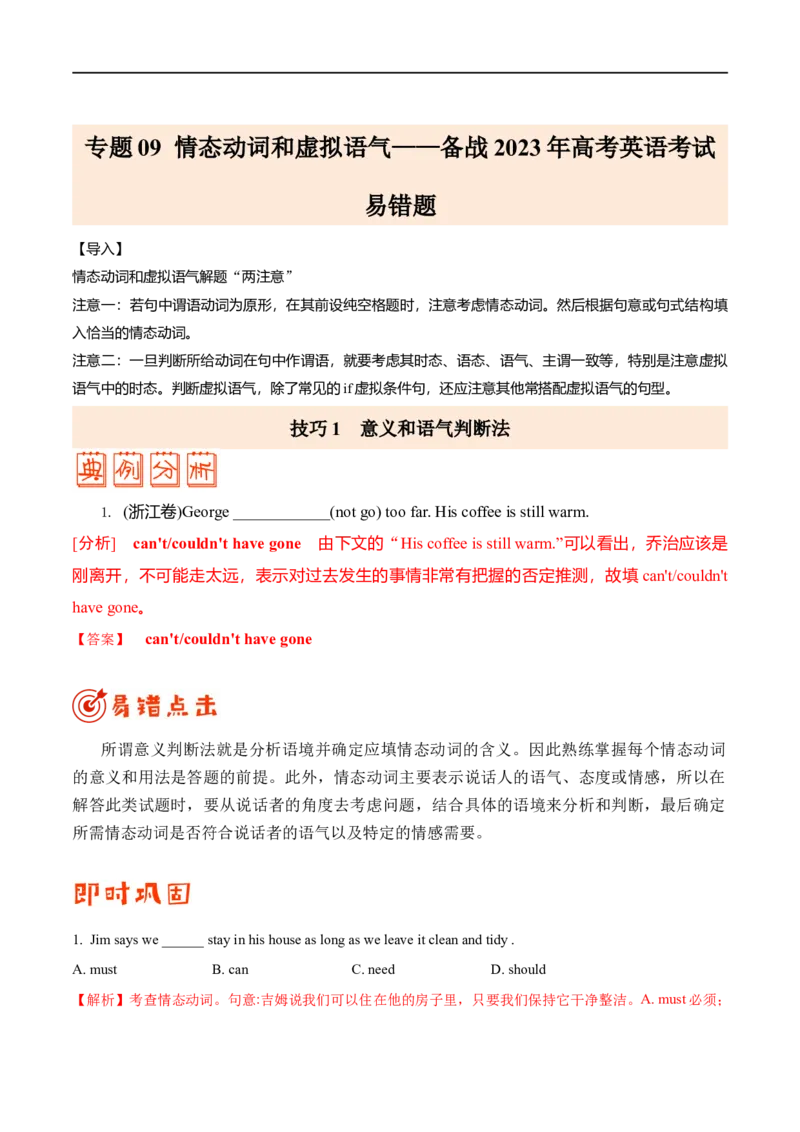
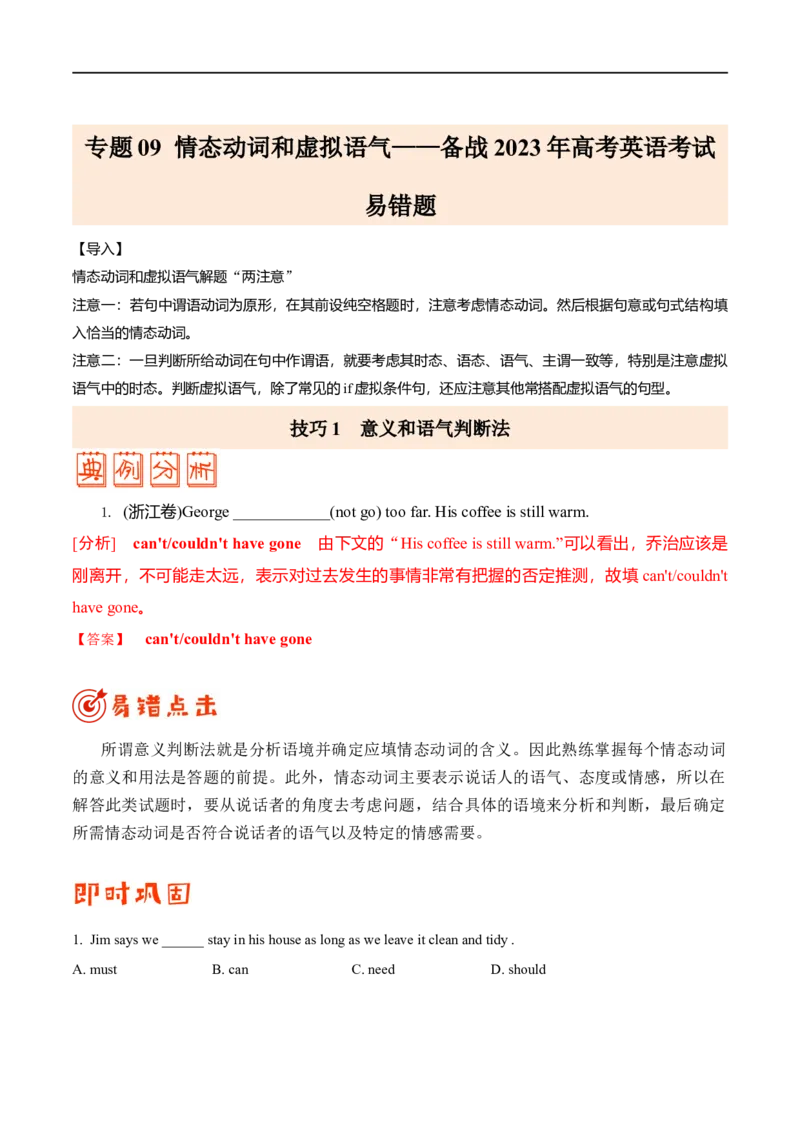
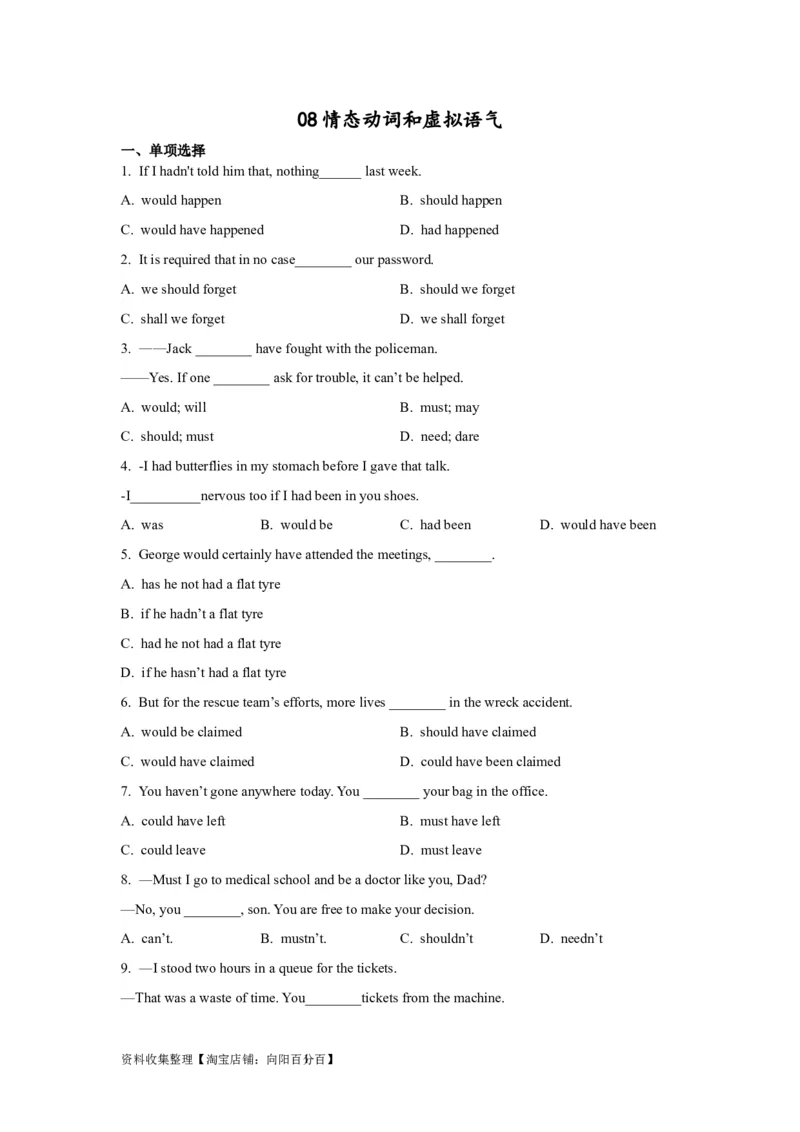
1.There’s no light on—they be at home.
A.can’t B.mustn’t C.needn’t D.shouldn’t
【答案】A
【解析】句意为:(家中)没有亮灯, ——他们肯定不在家。此处要用情态动词表推测, 且用于
否定句表示 “肯定不……”, 故can’t符合要求。must表推测时不用于否定句, mustn’t表示
“禁止, 不许”;needn’t表示 “不需要”;shouldn’t表示 “不应当”, 故A项符合要求。
2.We hope that as many people as possible join us for the picnic tomorrow.
A.need B.must C.should D.can
【答案】D
【解析】句意为:我们希望尽可能多的人能参加我们明天的野餐。用can.表示可能性。
3.— What’s the name?
— Khulaifi. I spell that for you?
A. Shall B.Would C.Can D.Might
【答案】A
【解析】shall在问句中征求对方意见, 主要用于第一人称。答语句意为: “我给你拼写一下好
吗?”
4.We have proved great adventurers, but we have done the greatest march ever made in the past
ten years.
A.needn’t B.may not C.shouldn’t D.mustn’t
【答案】B
【解析】句意为:我们或许还没有证明是伟大的探险者, 但我们已取得了在过去的10年里的最伟大的进展。故应用may not。
5.— Could I have a word with you, mum?
— Oh dear, if you .
A. can B.must C.may D.should
【答案】B
【解析】句意为:妈妈, 我可以和你说句话吗?” “噢, 亲爱的, 如果你非要说的话。”must表
示必须要做的事。
6.If it were not for the fact that she sing, I would invite her to the party.
A.couldn’t B.shouldn’t C.can’t D.might not
【答案】C
【解析】题中that引导同位语从句。 “she can’t sing”是一个事实, 是指在能力、技能等方面不
能、不会。
7.Some aspects of a pilot’s job be boring, and pilots often work at inconvenient hours.
A.can;have to B.may;can C.have to;may D.ought to;must
【答案】A
【解析】句意为:飞行员工作的某些方面可能是令人厌倦的, 并且飞行员经常在不方便的时候工
作。第一空表示的是客观的可能性, 应用can;而第二空说在不方便的时候还要干, 因此表示客观
上的必须, 用have to, 意为 “不得不”。
8. fired, your health care and other benefits will not be immediately cut off.
A.Would you be B.Should you be C.Could you be D.Might you be
【答案】B
【解析】句意为:如果你被炒了, 你的医疗保险和其他利益并不会立即取消。与将来事实相反的
假设, 从句用答案B项。
9.— May I smoke here?
— If you , choose a seat in the smoking section.
A. should B.could C.may D.must
【答案】D
【解析】由本题语境可知, 空白处应表示 “非得……”之意, 故须用must。
10.The weather turned out to be fine yesterday. I the trouble to carry my umbrella with me.
A.should have taken B.could have takenC.needn’t have taken D.mustn’t have taken
【答案】C
【解析】句意为:昨天天气不错, 我本没有必要不怕费事带把伞。could have done表示 “本能够
做而未做”;should have done 表示 “本应该做而未做”;mustn’t 表示 “禁止, 不许”;
needn’t have done表示 “本不必做而做了”。take the trouble to do sth.表示 “不怕费事或困
难尽力做某事”。
考点二 虚拟语气
一、语气的定义和种类
l、语气:语气是动词的一种形式,它表示说话人对某一行为或事情的看法和态度。
2、语气的种类:
(1)陈述语气: 表示动作或状态是现实的、确定的或符合事实的,用于陈述句、疑问句和某些
感叹句。如:We are not ready. 我们没准备好。What a fine day it is!多好的天气啊!
(2)祈使语气: 表示说话人的建议、请求、邀请、命令等。如: Open the door, please。请打开
门。
(3)虚拟语气: 表示动作或状态不是客观存在的事实,而是说话人的主观愿望、假设或推测等。
如: If I were you, I should study English. 如果我是你,我就学英语了。May you succeed! 祝您
成功!
二、虚拟语气在条件从句中的用法
条件句有两类,一类是真实条件句,一类是虚拟条件句。如果假设的情况是有可能发生的,
就是真实条件何。在这种真实条件句中的谓语用陈述语气。如: If it doesn’t rain tomorrow, we
will go to the park. 如果明天不下雨,我们就去公园。
如果假设的情况是过去或现在都不存在的,或将来不大可能发生的,则是虚拟条件句。如:
If he had seen you yesterday, he would have asked you about it. 如果他昨天见到你,他会问你
这件事的。(事实上他昨天没见到你,因此也未能问你这件事。)
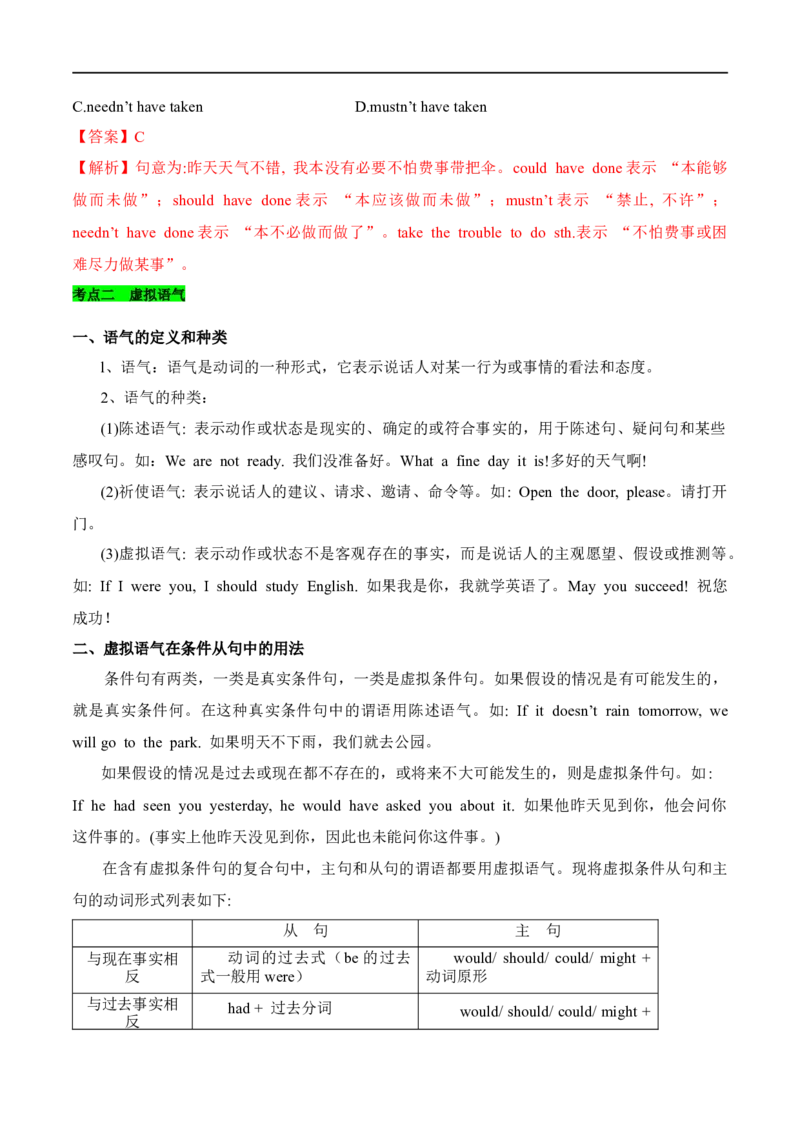
在含有虚拟条件句的复合句中,主句和从句的谓语都要用虚拟语气。现将虚拟条件从句和主
句的动词形式列表如下:
从 句 主 句
与现在事实相 动词的过去式(be 的过去 would/ should/ could/ might +
反 式一般用were) 动词原形
与过去事实相
had + 过去分词 would/ should/ could/ might +
反have + 过去分词
与将来事实相 动词过去式,should + 动 would/ should/ could/ might +
反 词原形,were to + 动词原形 动词原形
注: 主句中的 should 只用于 I、we,但在美国英语中,should 常被 would 代替;从句中的
should 可用于各种人称。
l、表示与现在事实相反的假设和结果。如: If my brother were here, everything would be all
right. 要是我哥哥在这儿 ,一切都没问题了。
2、表示与过去事实相反的假设和结果。如: If you had taken my advice,you wouldn't
(couldn’t) have failed in the exam. 如果你按照我的建议去做,你一定不会(不可能)考试不及格。
3、表示与将来事实可能相反的假设和结果。如: If it were Sunday tomorrow, I should
(would,could,might) go to see my grandmother. 如果明天是星期天,我就 (可能)去看望我奶
奶。If it were to snow this evening, they would not go out. 如果今晚下雪,他们将不出去了。
4、有时条件从句中的动作和主句中的动作发生的时间不一致(表示错综时间的虚拟语气),
这时动词的形式要根据它所表示的时间加以调整。例如: If you had listened to the doctor, you
would be all right now. 如果你当初听了医生的话,身体现在就好了。(从句动作指过去,主句动
作指现在)
5、虚拟条件句可以转换成下列形式:
(l)省略连词if。在书面语中,如果虚拟条件从句中有 were,had 或 should,可以把if省略,
把这几个词放到主语之前,构成主谓倒装。例如: Should he come (If he should come), tell him
to ring me up. 他要是来了,让他给我打个电话。Were I you (If I were you), I would not do it.
我要是你,就不做这事。
(2)用介词短语代替条件状语从句。有时假设的情况并不用条件从句表示出来,而是通过介词
短语来表示。如: Without air (If there were not air), there would be no living things. 如果没有空气的
话,就不会有生物了。But for your help (If it hadn’t been for your help) I couldn’t have done it. 要是
没有你的帮助,我就不可能完成这件事。
假设的情况有时可以通过上下文或其他方式表现出来。如: I was busy that day. Otherwise I
would have gone there with them. (If I hadn’t been busy that day, I would have gone there with them.)
我那天很忙,否则,我就和他们一起去那儿了。(如果我那天不忙的话,我就……);I would have
finished the work, but I have been ill. (If I hadn’t been ill, I would have finished the work.) 我本来该完
成这项工作的,但我生病了。(如果我没生病的话,我就会完成……)6、省去条件从句或主句:表示虚拟语气的主句或从句有时可以省略,但其含义仍可以推知。
(1)省去条件从句。如: You could have washed your clothes yourself. 你本可以自已洗衣服的。
省去了"If you had wanted to")(事实是:你自己没洗衣服,因为你不想洗。)
(2)省去主句(常用以表示愿望)。如: If my grandmother were with me! 如果我的祖母与我在
一起多好啊!(事实是:祖母已不在世。);If only she had not left! 如果她没走就好了!(事实是:她已经
走了。)
三、虚拟语气的其他用法
l、虚拟语气在主语从句中的用法:在"It is important (strange,natural,necessary)that…"这类
句型里,that所引导的主语从句中的谓语动词常用 “should十动词原形”结构,表示某事是"重
要"、"奇怪"、"自然"、"必要"等意义。如: It is important that every member (should) inform himself
of these rules. 重要的是每个成员知道这些规则。
2、虚拟语气在宾语从句中用法:
(1)在动词wish后的宾语从句中,表示与现在或过去的事实相反,或对将来的主观愿望,从句
通常省略连词 that。1)表示对现在情况的虚拟:从句动词用过去式或过去进行式(be动词一般用
were)。如: I wish I knew the answer to the question. 我希望知道这个问题的答案。(可惜不知道);
2)表示对过去情况的虚拟:从句动词常用"had十过去分词"。如: I wish (wished) I hadn’t spent so
much money. 我后悔不该花那么多钱。(实际上已经花掉);3)表示对将来的主观愿望:谓语动词形
式为"would十动词原形"。此时要注意,主句的主语与从句的主语不能相同,因为主句的主语所
期望的从句动作能否实现,取决于从句主语的态度或意愿(非动物名词除外)。如: I wish it would
stop raining. 但愿雨能停止;I wish you would come soon. 但愿你立刻来。
(2)在suggest,demand,order,propose,insist,command,request,desire等动词后的宾语从
句中,谓语动词用“should + 动词原形”,表示建议、要求、命令等。如: I demand that he
(should) answer me immediately. 我要求他立刻答复我。
3、虚拟语气在状语从句中的用法
(1)在带有even if/ even though引导的让步状语从句的主从复合句中,主句和从句都用虚拟语
气,动词形式与含有非真实条件句的虚拟语气相同。如: Even if he had been ill, he would have gone
t his office. 即使生了病,他俩去办公室。
(2)由as if或as though引导的状语从句表示比较或方式时。从句谓语形式为动词的过去式(be
用were)或 “had十过去分词”。如: He treated me as if I were a stranger. 他那样对待我,好像我
是陌生人似的。She talked about the film as if she had really seen it. 她谈论那部影片,就好像她确实看过
一样。
注:如果表示的事情可能会发生,那么方式状语从句中的谓语动词可用陈述语气。
(3)在in order that或so that引导的目的状语从句中,谓语动词多用 “could或might(有时也
用should)+ 动词原形”。如: Mr green spoke slowly so that his students could (might) hear clearly.
格林先生说得很慢,好让学生听清楚。
4、虚拟语气在定语从句中的用法:在"It is time (that) …"句型中,定语从句的谓语动词常用
虚拟语气表示将来,动词形式一般用过去式,意思是"该干某事的时候了"。如: It’s (high) time we
did our homework. 我们该做作业了。
5、虚拟语气在简单句中的用法
(1)情态动词的过去式用于现在时态时,表示说话人的谦虚、客气、有礼貌,或委婉的语气,
常见于日常会话中。如: It would be better for you not to stay up too late. 你最好别太晚睡觉。
(2)在一些习惯表达中。如: I would rather not tell you. 我宁愿不告诉你。
(3)用“may + 动词原形”表示"祝愿"、"但愿”,此时may须置于句首(多用于正式文体中)。
如:May you be happy!祝你快乐!May good luck be yours.祝你顺利。
【典例示例】
1.Eliza remembers everything exactly as if it yesterday.
A.was happening B.happens C.has happened D.happened
【答案】D
【解析】as if仿佛, 好像, 其后的从句可出现虚拟语气。句意为:Eliza清楚地记得每一件事, 仿
佛它是昨天发生的!句中remembers为一般现在时, 故as if从句中用一般过去时来表示虚拟语气。
2.He did not regret saying what he did but felt that he it differently.
A. could express B. would express
C. could have expressed D. must have expressed
【答案】C
【解析】could have expressed it differently.他要是用另一种方式来说该多好呀。
3.But for the help of my English teacher, I the first prize in the English Writing Competition.
A. would not win B. would not have won C. would win D. would have won
【答案】B
【解析】此处虚拟语气表示与过去事实相反, 句子谓语动词用4.Jack described his father, who _______a brave boy many years ago, as a strong– willed man
A. would be B. would have been C. must be D. must have been
【答案】D
【解析】句意为 “杰克把他的父亲描述为一个意志坚强的人, 他的父亲多年前肯定很勇敢。”用
must have been表示对过去事情的肯定推测。
5.Bob would have helped us yesterday, but he_______
A. was busy B. is busy C. had been busy D. will be busy
【答案】A
【解析】前句表示对过去的虚拟, 而but之后表示过去的客观事实, 故用一般过去时态。
6.If he my advice, he wouldn't have lost his job.
A. followed B. should follow C. had followed D. would follow
【答案】C
【解析】根据 “wouldn’t have lost”可判断if引导的状语从句表示与过去事实相反的虚拟, 故选C
项。
7.John went to the hospital alone. If he me about it, I would have gone with him.
A. should tell B. tells C. told D. had told
【答案】D
【解析】句意:约翰独自去了医院。如果他告诉我的话, 我会跟他一起去的。前一句是陈述语气,
说明动发生在过去, 而且后一句的主句已经是 would have gone说明是与过去事实相反的虚拟语
气。与之对应的从句结构, 应该用had +过去分词。
8.George is going to talk about the geography of his country, but I’d rather he_______ more on its
culture.
A. focus B. focused C. would focus D. had focused
【答案】B
【解析】would rather后应用虚拟语气, 表示与现在时间相反, 用动词的过去式。
9.If we ___ the other road, we might have arrived here in time for the meeting.
A. take B. had taken C. took D. have taken
【答案】B
【解析】所填词做虚拟语气中条件状语从句的谓语, 根据主句的谓语动词形式 might have arrived
可知题干是与过去事实相反, 故所填部分用had+过去分词形式, 选B。10.Mr. Johnson insisted that the problem worthy of attention ________ (讨论) at the meeting. (discuss)
【答案】(should) be discussed
【解析】“insist”引导的宾语从句要用虚拟, 从句结构是“should”(可省略)加动词原形, 主语
“problem” 是要 “被讨论”。
2
知识强化
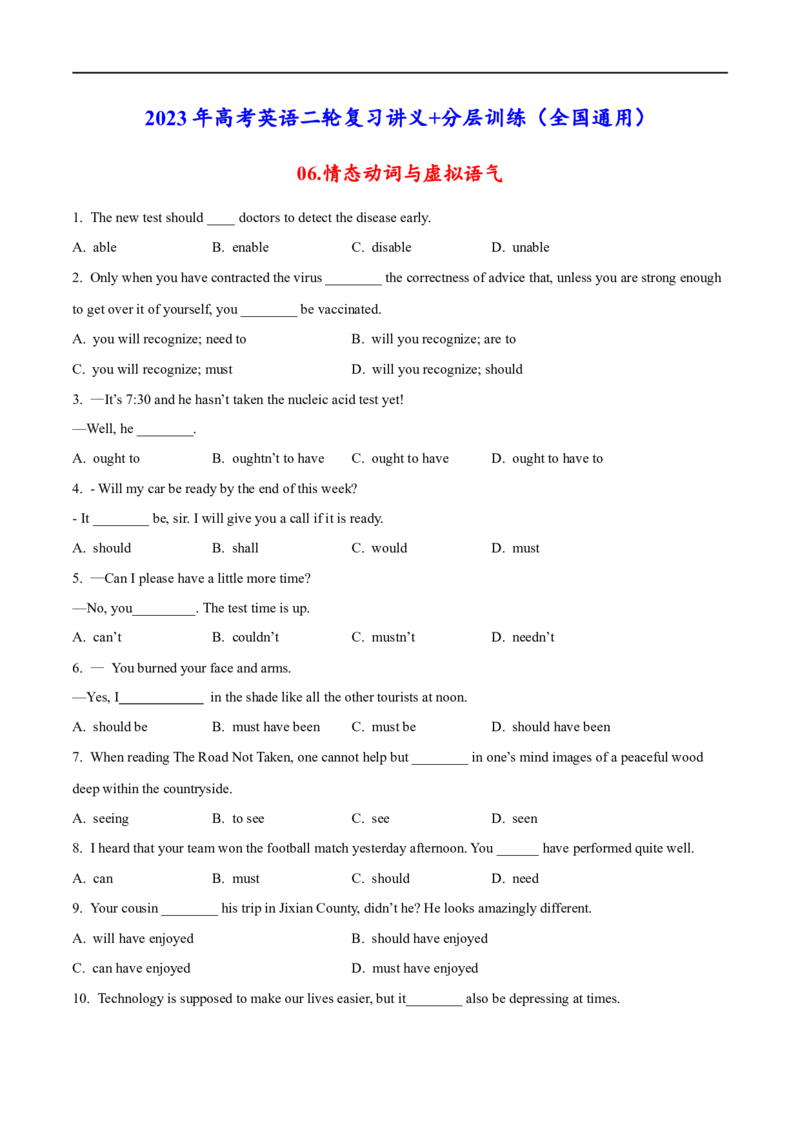
一、单项选择
1. —The computer keeps reminding me “Error, can’t save the file”.
—Well, you _____ the software yesterday as the technician recommended. This old version doesn’t work well.
A. should have updated B. must have updated
C. couldn’t have updated D. needn’t have updated
2. —Who ______ it be that left the door unlocked?
—It may be Mike. He is always forgetting things.
A. should B. must C. could D. might
3. When I was little, my mother used to sit by my bed,________ me stories and sing songs for me till I fell asleep.
A. having told B. tell C. telling D. told
4. 一Excuse me, can I use your computer to type a report?
一You________ have my computer if you take good care of it.
A. shall B. might C. should D. need
5. Because Lincoln had so little schooling, journalists thought he ________ not have been very smart.
A. must B. shall C. could D. would
6. Many adults report that even when out in nature, they ________ not take the time to admire a spectacular
mountain ________ pulling out their smartphone to take a picture.
A. may … before B. may … after
C. should … before D. should … after
7. Technology is supposed to make our lives easier, but it ________ also be frustrating at times.
A. must B. can C. will D. should
8. Her round figure, seen in the Tang Dynasty, ________ the admirable image.
A. would have been considered B. would have considered
C. had considered D. must have been considered
9. In the new TOFEL test, there are questions ________ test takers ________ read, listen and then speak into amicrophone.
A. which … must B. which … need
C. where … must ` D. where … need
10. This ___________an improvement, but “breakthrough” was an overstatement.
A. can have been B. should have been
C. may have been D. need have been
11. Mr. Baker, some students want to see you. ________ they come in right now?
A. May B. Should C. Shall D. Will
12. —I wonder why Robert hasn’t shown up at the interview yet. It’s a pity if he missed.
—I’m not sure, but he ________ in a traffic jam riding here.
A. could be stuck B. should be stuck C. must have been stuckD. might have been stuck
13. I believe he ________ an accident, otherwise he ________ have arrived on time.
A. might have;would
B. should have had; should
C. could have; should
D. must have had; would
14. William ________ be in the library at the moment, for I saw him playing basketball in the playground several
minutes ago.
A. can’t B. mustn’t C. needn’t D. wouldn’t
15. —Excuse me, is this the right way to Disneyland?
—It ________ be but I’m not completely sure.
A. must B. will C. shall D. might
16. —I honestly don’t think I’m going to be admitted.
—Well, you never know! You________ a better impression than you think.
A. may have made
B. should have made
C. couldn’t have made
D. needn’t have made
17. I hope we shall______ and come to understand one another .
A. be a friend B. being friends C. be friends D. to be a friend
18. Will you ______ playing basketball?A. join us in B. join to C. join us to D. to join us
19. —Is Lucy knocking at the door?
—No. It ______ be Lucy. She is in France now.
A. mustn’t B. can’t C. needn’t D. shouldn’t
20. You ______ park here! It is an emergency exit!
A. wouldn’t B. needn’t C. mustn’t D. couldn’t
21. —You needn’t take an umbrella. It isn’t going to rain.
—Well, I don’t know. It ______ do.
A. might B. need C. would D. ought to
22. China Hengda ________ have won the football match, but I’m not sure because I wasn’t there.
A. could B. may C. should D. must
23. — I think you ________ there in person; a phone call would have been fine.
— It is a good chance to know more of you from your parents.
A. couldn’t have been B. needn’t have been C. wouldn’t be D. shouldn’t be
24. The screw was so tight that it ________ not move.
A. could B. should C. would D. might
25. The professor warned the students that in no case ________ use mobile phones in his class.
A. should they B. they should C. dare they D. they dare
26. According to the rules of the shopping mall, you ______ keep your pet out of the gate.
A. would B. should C. may D. can
27. You ________ take photos of people in Egypt without first asking for permission.
A. mustn’t B. needn’t C. don’t have to D. wouldn’t
28. I wonder why we________ eat out all the time when we can cook our own meals at home.
A. may B. would C. should D. must
29. You ________allow a golden opportunity to slip through your fingers or you will regret it later.
A. may not B. wouldn’t C. needn’t D. mustn’t
30. —Must I finish the paper today?
— No, you _________.
A. must B. need C. couldn’t D. don’t have to
31. —You shouldn’t have talked back to our teacher like that. It was awfully impolite.
—You are right. I________ crazy at that moment.A. must have been B. might be C. could have been D. should have been
32. We ________ be seen by AI as a small inconvenience that is in the way of the solution to a bigger problem.
A. could B. should C. need D. dare
33. Darling, our son has grown up and is quite independent now, you ________ be too concerned about him.
A. mustn’t B. needn’t C. couldn’t D. shouldn’t
34. He speaks English with a strong American accent, so he ______ brought up in Britain.
A. couldn’t be B. shouldn’t be C. can’t have been D. needn’t have been
35. In the country Bhutan, weather ______ vary dramatically from place to place, day to day or even within the
same day.
A. can B. shall C. must D. need
36. I’d rather you ________ her at the airport tomorrow morning.
A. met B. meet C. have met D. had met
37. When a pencil is partly in a glass of water, it looks as if it __________.
A. was broken B. has broken C. were broken D. had been broken
38. All the doctors insisted that he __________ badly wounded and that he __________ at once.
A. should be, be operated on B. were, must be operated on
C. was, should be operated D. was, be operated on
39. We should take into account students’ suggestion that the school library ______ more books on popular
science.
A. provide B. provided C. providing D. provides
40. The headmaster made a suggestion that the sports meet ______ until next Sunday.
A. will be put off B. will put off C. put off D. be put off
41. It is strongly recommended that the machines ________ every year.
A. check B. be checked C. checked D. checking
42. —Where have you been?
—I got caught in traffic; otherwise ________ sooner.
A. I would be here B. I have been here C. I had been here D. I would have been here
43. The workers requested that their working conditions________.
A. must be improved B. be improved C. would be improved D. were improved
44. He looked as if he ________ ill for a long time.
A. was B. were C. has been D. had been45. ________ the fog, we should have reached our school.
A. Because of B. In spite of C. In case of D. But for
46. The opening ceremony is a great occasion. It is essential ________for that.
A. for us to be prepared B. that we are prepared
C. of us to be prepared D. our being prepared
47. It is recommended that the machine ______ once a year.
A. must be checked B. was checked C. is checked D. be checked
48. My advice is _______ he _____ to go abroad for further education.
A. that, chooses B. that, chose C. that, choose D. what, should choose
49. Some experts demanded that children ________ enough time for sleep and play.
A. give B. should give C. be given D. given
50. He _____ his potential had it not been for his desire to meet new challenges.
A. would never have realized B. would never realize
C. never realized D. had never realized
51. It’s recommended that you __________ to bed on time.
A. going B. go C. to go D. don’t go
52. Besides, it’s vital that you ________ your table manners.
A. minded B. mind C. to mind D. minds
53. As the day was fine, I made the suggestion ________ for a walk in the park.
A. we go B. we will go C. we should go D. that we go
54. —Shall the bike be repaired by him today?
—No, I’d rather he ______ it repaired tomorrow.
A. had B. has C. have D. would have
55. —I’m having a headache again.
—I suggest you________some medicine.
A. taking B. taken C. take D. to take
56. Aristotle proposed that teachers lead their students systematically, and that repetition ________as a key tool to
develop good habits, unlike Socrates' emphasis on questioning his listeners to bring out their own ideas.
A. is used B. would be used C. should use D. be used
57. Thank you for reminding me of the time, or I ________ late for the flight yesterday.
A. would be B. should be C. would have been D. will have been58. They demanded that the books ______ to the school library at once.
A. return B. should return C. be returned D. would be returned
59. You have scolded her for her failure. After all, she had tried her best.
A. must B. should C. mustn’t D. shouldn’t
60. It’s strongly recommended that the machine ________ every year.
A. repair B. to repair C. be repaired D. should repair
二、语法填空
1
阅读下面材料,在空白处填入适当的内容或括号内单词的正确形式。
We walked inside a museum in Garden City and looked around, eager __61__ (meet) Kobie Boykins, a
NASA engineer. He helped to design the Mars rover (探测器) Curiosity, __62__ is still exploring to this day.
In a big presentation room, Boykins __63__ (talk) about the team’s newest rover, Mars 2020. We asked him if
the new rover would be __64__ most complicated one he and his team __65__ (make) so far. He told us that most
of the engineering would be the same. However, the rover is still more __66__ (advance) and will be able to get
more accurate test __67__ (result).
When Boykins finished his presentation, some people brought him into another room where we would
interview him. We asked if he felt he was __68__ a lot of pressure at work. He told us that he __69__ (actual)
put a lot of pressure on himself. He said that working on the spacecraft wasn’t putting him in that position, but he
still wanted to make __70__ perfect.
2
阅读下面材料,在空格处填入适当的内容(1个单词)或括号内单词的正确形式。
I have a degree in business. However, it was my father's decision for me to pursue a business major.
Nevertheless, even if my college __71__ (experience) were fantastic, I still had no interest in any field of
commerce, let alone having a long-term career __72__ a businesswoman.
After I __73__ (graduate), I worked as a marketing __74__ (plan) at a computer company. My pay and
working environment were great; however, I still didn’t feel happy __75__ (do) something I wasn’t interested in.
After two months of working there, I made up my mind __76__ (quit) and decided to do __77__ I love, namely
teaching English. I have now been an English teacher for over twenty years. I love my job and love being with my
students.
If you are in a place __78__you don’t love what you are learning or doing, please ask yourself what you arereally passionate for, and what you __79__ (true) want for your life. Don’t rush to get yourself a quick answer.
Take some time to think about what career could make you happy. The important thing is that you are happy and
then you will be able to bring happiness to people around you. There is a quote that says, "Success is not the key to
happiness. Happiness is the key to success." If you love what you are doing, you will be __80__ (success).
3
阅读下面材料,在空白处填入适当的内容(1个单词)或括号内单词的正确形式。
A recent film has earned huge attention on social media platforms, many citizens___81___(praise) the short
video as the “best commercial video of 2019 ”. The film focuses on____82____question “Who is Peppa?” and tells
a touching story___83___highlights Chinese families. In the beginning, a senior man___84___(name) Li Yubao in
a remote mountainous area asked his grandson on the phone___85___gifts he wanted for the Spring Festival, but
only heard the word “Peppa” due to the poor mobile signal. Therefore, the man begins an interesting journey to
discover who Peppa is.___86___ the help of neighbors, the senior man made a Peppa model with irons and steels,
and___87___(surprise) his grandson. The short video ___88___(encourage) people working outside to come back
home often and accompany family members___89___(spend) a happy and warm Spring Festival holiday. After all,
family connections are the most ____90____(significance) thing in Chinese people’s hearts.
4
阅读下面材料,在空白处填入1个适当的单词或括号内单词的正确形式。
Wolf Warrior II(《战狼Ⅱ》) is such a hit that it has put China in the ___91___(globe) spotlight(公众关注).
It's also the first film ___92___(taste) success both in terms of box office earnings and promoting Chinese values.
The film focuses on ___93___rescue operation in Africa, led by Leng Feng, played by Wu Jing, the writer
___94___director of the film. It is based on the true events of the 2011 evacuation(撤离) of Chinese people from
Libya. It describes ___95___ the Chinese government manages to protect overseas Chinese___96___(city).
Just___97___the message at the end of the film reads:"When you encounter(遇到) danger in a foreign land, do not
give up! Please remember, at your back ___98___(stand) a strong motherland."
China's___99___(rise) military power and its positive role in the world have brought out a bigger sense
of____100____(proud) among young people in China.
5
阅读下面材料, 在空白处填入适当的内容(1个单词)或括号内单词的正确形式。
Dario and his mother loved their new apartment ___101___living room was large enough for their piano. That
night, the two of them sat side by side at the piano. They played jazz music ___102___(celebrate) their new home.The loud music filled the room and made them feel very happy. The next morning, ___103___, their happiness
disappeared. Someone had left a note under their door during the night. One of their neighbors___104___(write) to
complain(抱怨) about the sound of the piano. Dario’s mother asked the doorkeeper ___105___he knew anything
about it. But he said ‘no’. Later that morning, Dario suggested that they should hold a party at home and apologize
___106___ their playing.
They___107___ loved the idea. Over the next few days, they sent out ___108___(invite) and decorated the
apartment with party lights.___109___(final), the day of the party arrived. The guests brought different presents.
One woman even presented Dario with a book of piano music, which gave them a feeling of warmth. Dario
apologized and was already looking forward to ___110___ (practice ) the new music.
6
阅读下面材料,在空白处填入适当的内容(1个单词)或括号内单词的正确形式。
It was a short flight from Shanghai to Xi’an. Xi’an is one of the four great ancient capitals of China
___111___ a history of over 3,100 years. ___112___ (date) from the Ming Dynasty, its ancient walls are the best
preserved in the world. There are bicycles for people to hire. It is ___113___ (amaze) to ride along the walls to
survey this fascinating city.
The Tang Dynasty Music and Dance show is not to be missed, but my favorite is an art gallery, ___114___ we
can enjoy some beautiful artwork and learn how to write Chinese characters.
Most visitors make their way to Xi’an to see the life-size terracotta warriors (兵马俑) and we were not
___115___ (difference) at all. The collection, which shows the armies of the first Emperor of China, ___116___
(remain) hidden until 1974 when they were discovered by a farmer digging a well. Walking among the statues
___117___ (forbid) unless you are a VIP — but there are plenty of souvenir shops in which ___118___ (tourist)
can buy the replicas (复制品) of them.
All too soon it was time ___119___ (leave). I really enjoyed my stay in Xi’an. It is indeed a place of interest
worth ___120___ second visit.
参考答案
一、
1. A
【解析】考查should have done用法。句意:——电脑一直提醒我“出错了,不能保存文件”。——嗯,你
昨天本应该按照技术人员的建议更新软件的。这个旧版本不太好用。A.should have updated本应该更新;B.must have updated肯定更新了;C. couldn’t have updated不可能更新了;D. needn’t have updated本不必要更
新。根据“This old version doesn’t work well.”可知,此处表示“昨天本应该更新软件”,should have done
表示过去本应该做而没做的事情。故选A项。
2. C
【解析】考查情态动词辨析。句意:——忘记锁门的会是谁呢?——有可能是Mike。他经常忘记一些事情。
A. should应该;B. must必须;C. could可能,也许;D. might可能。由“It may be Mike”可知,空格处所在
的句子是问“忘记锁门的会是谁呢”,是一种猜测,could表示语气较为委婉的猜测,常用于否定句或疑问
句中。故选C。
3. B
【解析】考查非谓语动词。句意:当我还小的时候,妈妈常常坐在我的床边,给我讲故事,唱歌,直到我
睡着。情态used to后跟动词原形,此处应为动词原形tell和前文sit及后文sing并列,作谓语动词。故选B
项。
4. A
【解析】考查情态动词辨析。句意:——不好意思,我能不能用你的电脑打一份报告?——如果你好好使
用我的电脑,我就把它送给你。A. shall可以(用于第二、三人称时,表示说话人给对方的命令、警告、允
诺或威胁);B. might可能;C. should应该;D. need需要。由“if you take good care of it”可知,句子表示
“如果你好好使用我的电脑,我就把它送给你”,空格处意为“可以”,表示允诺,故选A。
5. C
【解析】考查情态动词。句意:因为林肯没有受过多少教育,记者们认为他不可能很聪明。A. must必须,
一定;B. shall将,应该,可能;C. could可能,(can的过去时形式);D. would将会,过去常常,(will
的过去时形式) 。结合句意可知,此处是对过去事实的否定推测,应用can/could not have done。故选C。
6. A
【解析】考查情态动词和介词。句意:许多成年人表示,即使在大自然中,他们在拿出智能手机拍照之前,
可能也不会花时间欣赏壮观的山峰。情态动词 may意为“也许,可能”; should意为“应该”。根据句
意,此处指成年人的习惯做法,但是不绝对,所以用“可能”符合句意;第二空填考查介词。not…
before…相当于not…until…或after…,意为“在拿出智能手机拍照之前,不会花时间欣赏壮观的山峰”。
故选A。
7. B
【解析】考查情态动词。句意:科技应该让我们的生活更轻松,但它有时也会让人沮丧。根据句意可知,
此处表示情态动词的推测功能,can表示理论可能、有时可能。故选B。8. D
【解析】考查情态动词。句意:在唐代,她那圆润的身材一定被认为是令人倾慕的形象。根据句意及时间
状语“in the Tang Dynasty”可知,此处表示对过去事情的推测。因主语her round figure与动词consider是被
动关系,因此应使用被动语态,“must have done”表示对过去事实的肯定推测,意为“过去一定……”。
故选D。
9. C
【解析】考查定语从句和情态动词。句意:在新的托福考试中,有一些问题,考生必须阅读、倾听,然后
对着麦克风说话。根据句型分析可知,第一空考查定语从句,先行词为questions,在从句中作状语,所以
应选where;第二空考查情态动词,need作为情态动词一般只用于否定和疑问句中,肯定句中,need为实
义动词,所以第二空应选must。故选C项。
10. C
【解析】考查情态动词+have done。句意:这或许是一种进步,但“突破”一词言过其实。A. can have
been可能是;B. should have been应该是;C. may have been或许是;D. need have been需要是。根据空后
“but “breakthrough” was an overstatement.”可知,这或许是一种进步,但“突破”一词言过其实。may have
been符合语境。故选C。
11. C
【解析】考查情态动词辨析。句意:贝克先生,有些学生想见你。他们是在这里等还是在外面等?A. May
可以;B. Should应该;C. Shall应该;D. Will将。Shall用于第一、第三人称疑问句中,表示说话人征求对
方的意见或向对方请示。故选C。
12. D
【解析】考查情态动词。句意:——我想知道为什么罗伯特还没有出现在采访中。 如果他错过了,那就
太可惜了。 ——我不确定,但他可能是在这里骑车时被堵车了。A. could be stuck可能堵车了;B. should
be stuck应该堵车了;C. must have been stuck一定是堵车了;D. might have been stuck可能堵车了。此处表
示对于过去已经发生的事情的推测应该用情态动词的完成式,且根据句意可知,应用被动语态,故选D项。
13. D
【解析】考查情态动词用法和虚拟语气。句意:我相信他肯定遇到意外事件了,否则他会按时到的。第一
空根据“otherwise he ________ have arrived on time”可知,此处表示对过去事实的肯定推测,需用 must
have done这种形式;第二空,根据otherwise可知,此处使用虚拟语气与过去事实相反,使用would have
done。故选D。
14. A【解析】考查情态动词辨析。句意:威廉此刻不可能在图书馆,因为几分钟前我还看见他在操场上打篮球。
A. can’t 不可能;B. mustn’t 禁止;C. needn’t 不必;D. wouldn’t 不会。根据后文“for I saw him playing
basketball in the playground several minutes ago”指不可能在图书馆里,应用can’t。故选A。
15. D
【解析】考查情态动词用法。句意:——请问,这是去迪斯尼乐园的路吗?——可能是,但我也不是非常
确定。A. must必须,肯定;B. will会;C. shall将要,必须;D. might可能。根据“but I’m not completely
sure”可知,回答者不太确定,因此认为这条可能是去迪斯尼的路。故选D。
16. A
【解析】考查情态动词用法。句意:——老实说,我觉得我不会被录取。——唉,谁知道呢!你给人的印
象可能比你想象的要好。A. may have made可能已经留下(印象);B. should have made本应该留下(印
象);C. couldn’t have made不可能留下(印象);D. needn’t have made本不必留下(印象)。根据空后
than you think可知,此处表示的是有可能给人留下很好的印象。故选A。
17. C
【解析】考查情态动词用法和名词的数。句意:我希望我们能成为朋友,互相了解。情态动词 shall后接动
词原形;主语是we,表语friend应用复数形式。综上,故选C。
18. A
【解析】考查情态动词用法和固定短语。句意:你愿意和我们一起打篮球吗?表示“和某人一起做某事”
用join sb. in doing sth.,情态动词will后用动词原形。故选A。
19. B
【解析】考查情态动词辨析。句意:——露西在敲门吗? ——不,不可能是露西。她现在在法国那。
A.mustn’t 禁止; B.can’t 不可能;C.needn’t没必要;D.shouldn’t不应该。根据后面的“She is in France
now.”可推测出,不可能是露西敲门。故选B。
20. C
【解析】考查情态动词。句意:你不能把车停在这里!这是紧急出口!A. wouldn’t不会;B. needn’t不必;
C. mustn’t不能(不允许)、禁止;D. couldn’t不可能。根据“It is an emergency exit!”可知此处表示“不能、
禁止”之意,故选C。
21. A
【解析】考查情态动词。句意:——你不必带雨伞。天不会下雨的。——哦,我不知道(会不会下)。它
可能会派上用场。A. might可能,表示的可能性最小;B. need需要;C. would将要;D. ought to应该,表
可能性较大的推测。根据I don’t know可知,“我”也不确定,用might最合适。故选A。22. B
【解析】考查情态动词对发生过的事情的推测。句意:中国恒大可能赢了这场足球比赛,但我不确定,因
为我当时不在。A. could可以,能;B. may也许,可能;C. should应该;D. must必须,一定。根据“but
I’m not sure because I wasn’t there”可知,此处是不确定的推测,表示“可能”,应用may。故选B项。
23. B
【解析】考查情态动词对过去事实的推测。句意:——我认为你本不需要亲自到场,打个电话就可以了。
——这是一个很好的机会,可以从你父母那里了解你更多的情况。A. couldn’t have been 不可能; B.
needn’t have been 本不必;C. wouldn’t be 将不;D. shouldn’t be不应该。结合句中“a phone call would have
been fine.”可知,本句表示对过去发生事实的推测,此处指一个电话就可以解决的事情,不需要亲自来,然
而你却来了。所以此处应用“本不必来的”,故选B。
24. A
【解析】考查情态动词。句意:螺丝拧得太紧,无法移动。A. could可能;B. 应该;C. would将要;D.
might也许。结合句意,could是can的过去式,表示能力,更符合题意。故选A项。
25. A
【解析】考查部分倒装和情态动词。句意:这位教授警告学生们,在他的课堂上,决不应该使用手机。on
no account意为“决不”,表示否定含义的副词或者短语位于句首时,句子要使用部分倒装,排除B项和
D项;should意为“应该”,dare意为“敢”,此处表示“不应该用手机”,需用情态动词 should。故选
A。
26. B
【解析】考查情态动词。句意:根据购物中心的规定,你应该把宠物关在门外。A. would将会;B. should
应该;C. may也许;D. can可能。根据句意,此处表达“应该”,should符合题意。故选B项。
27. A
【解析】考查情态动词。句意:未经许可,你不得在埃及为人们拍照。A. mustn’t不准,禁止;B. needn’t
不必;C. don’t have to不必;D. wouldn’t不会。根据“without first asking for permission.”可知,此处是指未
经许可禁止给当地人拍照。故选A。
28. D
【解析】考查情态动词。句意:既然我们很容易的在家烧饭,为什么偏要外去吃呢?A.may 可能;
B.would 将要;C.should 应该;D.must 偏偏,。分析句子可知,既然我们很容易的在家烧饭,为什么偏要
外去吃呢,故选D。
29. D【解析】考查情态动词辨析。句意:你千万不能让绝好的机会从指缝间溜走,否则你以后会后悔的。A.
may not也许不;B. wouldn’t不会;C. needn’t不必;D. mustn’t一定不要。根据“or you will regret it later.”
可知,一定不要将机会溜走,否则会后悔的,应用情态动词mustn’t。故选D。
30. D
【解析】考查情态动词。句意:——我今天必须得完成论文吗?——不,你不必。A. must必须;B. need
需要;C. couldn’t不能;D. don’t have to不必。根据回答No可知,此处表示“不必”,故用don’t have to
或needn’t,故选D。
31. A
【解析】考查情态动词+have done。句意:--你不应该那样跟老师顶嘴。这太不礼貌了。--你是对的。那一
刻我一定是疯了。A. must have been一定是……(对过去事实肯定的推测);B. might be可能会;C. could
have been本能够,但实际上没有;D. should have been本应该,但实际上没有。根据句意可知,说话人认
识到自己的错误,觉得自己当时一定是疯了,是对过去情况的肯定推测,用must have done结构。故选A
项。
32. A
【解析】考查情态动词。句意:我们可能被人工智能视为解决更大问题道路上的一个小麻烦。A.could可能;
B. should应该;C. need需要;D. dare敢。根据句意可知,我们可能被人工智能视为解决更大问题道路上的
一个小麻烦,这里表示可能性,对过去、现在、将来某种可能性的推测,所以用could。故选A。
33. B
【解析】考查情态动词。句意:亲爱的,我们的儿子已经长大,完全独立了,你不必太担心他了。A.
mustn't禁止,不准;B. needn't不必要;C. couldn't不能够;D. shouldn't不应该。根据“our son has grown
up and is quite independent now”可知,此处表示不必要太担心儿子。故选B。
34. C
【解析】考查情态动词。句意:他说英语带有很重的美国口音,所以他不可能是在英国长大的。分析句意
可知,此处用情态动词+have done形式表示对过去情况的推测,所以排除A项和B项;在根据“with a
strong American accent(带有很重的美国口音)”可知,他不可能是在英国长大的,所以此处用情态动词 can’t
表示“不可能”符合语境。故选C项。
35. A
【解析】考查情态动词。句意:在不丹,不同的地方,不同的日子,甚至同一天,天气都有可能有很大的
差异。A. can可能; B. shall应该;C. must必须;D. need需要。根据语境分析,can有时可能会(用于
偶尔的可能性),用于此处阐述天气比较合适。故选A项。36. A
【解析】考查虚拟语气。句意:我宁愿你明天早上去机场接她。would rather后宾语从句用虚拟语气。 根
据tomorrow morning.可知,与将来事实相反,用一般过去时。故选A。
37. C
【解析】考查虚拟语气。句意:当铅笔的一部分浸在盛水的玻璃杯中的时候,铅笔看上去好像断了。分析
句子可知,as if引导的从句内容与事实相反,应用虚拟语气。由句意可知,铅笔看起来好像断了,但实际
上铅笔并未断,上文陈述的也是现在事实,所以此处与现在事实相反,从句用一般过去时态,be动词要用
were。故选C项。
38. D
【解析】考查时态和虚拟语气。句意:所有的医生都坚持说他受了重伤,应该立即给他动手术。insist当意
为“坚持说,坚持认为”时,后接宾语从句用陈述语气;insist当意为“坚持要求”时,后接宾语从句用省
略should的虚拟语气。根据句意可知,第一个空意为“坚持认为”,故用陈述语气,主句为一般过去时,
故此处也用一般过去时,即was;第二个空意为“坚持要求”,主语he和动词operate之间为被动语态,即
be operated on,故选D。
39. A
【解析】考查虚拟语气。句意:我们应该考虑学生们的建议,即学校图书馆提供更多的科普书籍。
suggestion(建议)后的同位语从句要使用(should)do的虚拟语气,其中should可省略,故选A。
40. D
【解析】考查虚拟语气。句意:校长建议运动会推迟到下星期天举行。分析句子结构可知,that从句跟在
名词suggestion后面,是同位语从句,此处suggestion意为“建议”,所以同位语从句应用虚拟语气,即
should+动词原形,其中 should可以省略,所以 A和B项不对。根据句意可知,从句的主语 the sports
meet(运动会)和动词短语put off(推迟)二者之间是被动关系,所以应用should be put off,所以D项正确,省
略了should,故选D。
41. B
【解析】考查虚拟语气。句意:强烈建议机器每年进行一次检查。It is strongly recommended that...强烈建
议……,从句用should +动词原形的虚拟语气,should可以省略。主语the machines 与check之间为被动关
系,所以用被动语态。故选B。
42. D
【解析】考查含蓄条件句和虚拟语气。句意:——你上哪儿去了?——我遇上了交通堵塞;否则我早就来
了。结合句意可知,“otherwise”相当于一个含蓄条件句,意思是“如果我没有遇上交通堵塞”,是对过去事实的假设,主句中应用虚拟语气,谓语动词应用“should/would/could/might+have+过去分词”。故选D
项。
43. B
【解析】考查虚拟语气。句意:工人们要求改善他们的工作条件。根据题干中的requested可知,表示建议、
要求等动词后的宾语从句中应该用虚拟语气,所以此处应该用 should+动词原形,should可以省略,再分析
句意应该用被动语态,所以用should be improved且should可以省略。故选B项。
44. D
【解析】考查虚拟语气。句意:他看上去好像病了很长时间。根据句意及句中的 looked可知,此处描述的
是与过去事实相反的情况,应使用过去完成时。故选D项。
45. D
【解析】考查介词短语辨析。句意:要不是大雾,我们本应该到了学校。A.Because of由于,因为;B.In
spite of 尽管;C.In case of以防,万一;D.But for 要不是,but for通常用于含蓄条件句中,相当于 if条件
句的用法,主句中使用虚拟语气。根据后句“we should have reached our school(我们本应该到了学校)”
可知,要不是大雾,我们本应该到了学校。故选D。
46. A
【解析】考查虚拟语气及固定句式。句意:开幕式是一个伟大的时刻。我们必须为此做好准备。A.for us to
be prepared让我们做好准备;B.that we are prepared我们准备好了;C.of us to be prepared我们要做好准备;
D.our being prepared我们做好准备。虚拟语气用于主语从句中,it is essential+that从句,从句的谓语动词应
用(should)+动词原形,should可省略。故选项B不对;固定句式:it is+形容词+of/for sb +to do sth.而
essential后面应用for。故选A。
47. D
【解析】考查虚拟语气。句意:建议每年对机器进行一次检查。根据句型和句意可知,这里考查 it is
recommended that+ 主语从句,在这个主语从句中要用虚拟语气, 动词形式为(should)+ 动词原形,
should 可以省略。故选D项。
48. C
【解析】考查表语从句和虚拟语气。句意:我的建议是他应该选择出国深造。chooses选择;第一个设空处
引导表语从句,从句不缺成份,应用只起连接作用的 that;在advice后的表语从句应用虚拟语气,谓语构
成是“should+动词原形”should可省略,故第二个设空处应为(should) choose。故选C。
49. C
【解析】考查虚拟语气。句意:一些专家要求给孩子们足够的时间睡觉和玩耍。动词demand后接that从句时,从句中谓语动词用“should+动词原形”,should可省略,孩子们和给时间是被动关系,用be+过去
分词。故选C。
50. A
【解析】考查虚拟语气。句意:如果不是因为他渴望迎接新的挑战,他就不会实现他的潜能。分析句子结
构可知,本句考查if引导的条件句的虚拟,省略if倒装的情况,根据语法规则可知,从句中谓语动词用过
去完成时,主句谓语动词应用would have done;分析本句可知,空格处应为主句谓语部分且表示对过去情
况的虚拟。故选A。
51. B
【解析】考查虚拟语气。句意:建议你按时睡觉。句型It’s recommended that+虚拟语气,从句谓语动词用
should+动词原形,should可以省略。故选B。
52. B
【解析】考查动词虚拟语气。句意:此外,你应该注意餐桌礼仪,这是很重要的。分析可知,vital 后that
引导的从句要用虚拟语气,即“It’s vital that 主语 + (should) do”句型, should 可以省略,故谓语动词应
用动词原形。故选B项。
53. D
【解析】考查同位语从句和虚拟语气。句意:因为天气晴朗,我就建议我们去公园散步。根据句子结构和
意思可知,名词suggestion后面是用来解释它的具体内容,所以是同位语从句,从句中基本成分完整,不
需要意思连贯,所以用连词that引导,不能省略;表示“建议”意思的名词suggestion的相关从句的谓语
要用should+动词原形的虚拟语气结构,should可以省略。故选D。
54. A
【解析】考查虚拟语气。句意:——今天他来修自行车吗?——不,我宁愿他明天把它修好。would rather
后接宾语从句,谓语动词要用虚拟语气。表示现在或将来的愿望 ,用一般过去时。故选A。
55. C
【解析】考查虚拟语气。——我又头疼了。——我建议你吃点药。分析句子结构,you________some
medicine是一个省略了that的宾语从句,suggest表示建议,其后的宾语从句用should+动词原形,should可
以被省略的虚拟语气,故选C。
56. D
【解析】考查虚拟语气和被动语态。句意:亚里士多德建议教师系统地引导学生,重复是培养好习惯的关
键工具,而不是苏格拉底强调通过提问来引出自己的想法。分子句子结构可知,proposed表示“建议”,
后面是两个并列的宾语从句,从句谓语动词使用 (should) do,should 可以省略,排除 A项和B 项;repetition和use为被动关系,需用被动语态,排除C项。故选D。
57. C
【解析】考查虚拟语气。句意:谢谢你提醒我时间,否则我昨天的航班就迟到了。根据句意可知,此处表
示与过去事实相反的假设,谓语动词应用would+have+done表示“本来会……”。故选C。
58. C
【解析】考查虚拟语气。句意:他们要求马上把书还给学校图书馆。demand表示“要求”,其后的宾语从
句要用虚拟语气,即从句谓语部分用“(should)+动词原形”,should可省略,从句主语book和动词
return之间是被动关系,故用被动语态。故选C项。
59. D
【解析】考查情态动词及虚拟语气。句意:你本不应该因为她的失败斥责她。毕竟,她已经尽力了。A.
must必须;B. should应该;C. mustn’t禁止;D. shouldn’t不应该。根据句意、句子结构及时态可知,此句
是对过去的虚拟,表示“本不该做,但做了某事”。故选D项。
60. C
【解析】考查虚拟语气。句意:强烈建议这台机器每年被修理一次。分析句子可知,句子为主语从句,
“It”为形式主语,“that”引导的从句为真正的主语,“recommend”意为“建议”,此时从句要用虚拟语气,
谓语动词为“(should)+动词原形”,“machine”和“repair”之间为被动关系,故空格处应用“should be
repaired”或“be repaired”。故选C项。
二、
1
61. to meet
62. which
63. was talking/talked
64. the
65. had made
66. advanced
67. results
68. under
69. actually
70. it
【解析】本文是一篇记叙文,作者讲述了参观博物馆,拜访了航天科学家Kobie Boykins,明白了成功源自
对完美的追求。61. 考查非谓语动词。句意:我们走进 Garden City的一个博物馆,环顾四周,很想见见 NASA的工程师
Kobie Boykins。eager to do固定短语,“渴望做......”,不定式作目的状语,故填to meet。
62. 考查定语从句。句意:他帮助设计了火星探测器 Curiosity,至今仍在探索中。 is still
exploring to this day.是非限制性定语从句,先行词是Curiosity,在从句中作主语,故填which。
63. 考查一般过去时或者过去进行时。句意:在一个大的演示室里,Boykins谈到了团队最新的探测器,火
星2020。根据上文可知,事情发生在过去,因此用一般过去时或者过去进行时,故填was talking/talked。
64. 考查冠词。句意:我们问他这个新探测器是否是他和他的团队迄今为止制造的最复杂的一个。此处是
形容词最高级,故填the。
65. 考查过去完成时。句意:我们问他这个新探测器是否是他和他的团队迄今为止制造的最复杂的一个。
根据时间状语so far,可知谓语动词用完成时态;根据主句的谓语动词asked,可知此处用过去完成时,故
填had made。
66. 考查形容词。句意:不过,这个探测器会更先进,并且会得到更准确的测试结果。形容词作表语,故
填advanced。
67. 考查名词。句意:不过,这个探测器会更先进,并且会得到更准确的测试结果。result是可数名词,此
处应用复数形式,故填results。
68. 考查介词。句意:我们问他是否感到工作压力很大。under pressure固定短语,“在压力之下”,故填
under。
69. 考查副词。句意:他告诉我们,他实际上给自己施加了很大的压力。副词修饰动词作状语,故填
actually。
70. 考查代词。句意:他说在飞船上工作并不会让他陷入那种境地,但他还是想让它完美。此处指代
working on the spacecraft ,故用代词it,填it。
2
71. experiences
72. as
73. graduated
74. planner
75. doing
76. to quit
77. what
78. where79. truly
80. successful
【解析】本文属于叙事说理文,介绍自己的职业经历来说明选择自己喜欢的职业很重要。
71. 考查名词。分析句子可知,本空作主语,根据谓语动词的 were 可知,主语用复数形式,故用
experiences。
72. 考查介词。分析句子可知,更别提把商人作为一个长期的职业,故用介词as。
73. 考查动词的一般过去时。分析句子可知,graduate作谓语,与主语I为主谓关系,陈述过去事情,故用
一般过去时graduated。
74. 考查名词。由于a修饰名词,根据句意可知,在电脑公司当策划员,故用planner。
75. 考查现在分词作原因状语。分析句子可知,本句缺乏原因状语,do与其逻辑主语I为主谓关系,故用
现在分词形式doing。
76. 考查不定式。本句为短语make up my mind to do sth下定决心做某事,故用不定式to quit。
77. 考查宾语从句。分析句子可知, 7 I love作do的宾语,该从句缺乏love的宾语,故用连接代
词what。
78. 考查定语从句。分析句子可知,you don’t love what you are learning or doing作限制性定语从句修饰先行
词place,从句缺乏状语,故用关系副词where作地点状语。
79. 考查副词。修饰动词want用副词,故用truly。
80. 考查形容词作表语。分析句子可知,be 动词后接形容词作表语,本句缺乏表语,故用形容词
successful。
3
81. praising
82. the
83. that/which
84. named
85. what
86. With
87. surprised
88. encourages
89. to spend
90. significant
【解析】这是一篇说明文。短文介绍了在社交媒体上引起广泛关注的一部短视频的内容以及它所反映出的意义。
81. 考查现在分词。分析句子可知,本句的主语为 A recent film,谓语为has earned,所以praise为非谓语
且与 many citizens 在逻辑上是主动关系,所以用现在分词。本句是独立主格结构作伴随状语。故填
praising。
82. 考查冠词。由“Who is Peppa?”可知,本句在特指这个问题,所以用定冠词 the特指这个问题。故填
the。
83. 考查关系代词。分析句子可知,a touching story为先行词,在后面的定语从句中作主语,所以关系代词
为that/which。故填that/which。
84. 考查过去分词。分析句子可知,a senior man与name在逻辑上是被动关系,所以用过去分词named作
后置定语。故填named。
85. 考查连接代词。分析句子可知,ask后接双宾语,间接宾语为his grandson,直接宾语为 5 gifts
he wanted for the Spring Festival,这是一个宾语从句,主语为he,谓语为wanted,在此表示“……的”,
春节他想要的礼物,故填what。
86. 考查介词。句意:在邻居的帮助下,老人用钢铁做了一个佩奇模型。with the help of“在……帮助下”
为固定短语,且符合句意。故填With。
87. 考查一般过去时。分析句子可知,and并列连接谓语动词made和surprised。故填surprised。
88. 考查一般现在时。分析句子可知,本句在说明短片所反映出的意义,所以本句为一般现在时,主语为
The short video,谓语应为第三人称单数。故填encourages。
89. 考查动词不定式。分析句子可知,本句为动词不定式作目的状语。故填to spend。
90. 考查形容词。分析句子结构可知,本句为主系表结构,表语用形容词。故填significant。
4
91. global
92. to taste
93. a
94. and
95. how
96. citizens
97. as
98. stands
99. rising
100. pride【解析】这是一篇说明文。文章介绍了电影《战狼II》的内容介绍及其影响。
91. 考查形容词。句意:《战狼2》大获成功,使中国成为全球瞩目的焦点。此处修饰名词 spotlight 用形
容词,指全球的焦点,故填global。
92. 考查非谓语动词。句意:这也是第一部在票房收入和宣传中国价值观方面都取得成功的电影。名词
film由序数词修饰时,要用不定式作后置定语。故填to taste。
93. 考查冠词。句意:这部电影讲述的是在非洲的一次救援行动,由冷锋领衔,吴京饰演,他是这部电影
的编剧和导演。operation为可数名词,此处泛指“一次救援行动”应用不定冠词,故填a。
94. 考查连词。根据句意可知,表示“编剧和导演”为并列关系,故填and。
95. 考查连接词。句意:它描述了中国政府如何设法保护海外中国公民。本句为宾语从句,从句中缺少方
式状语,故填how。
96. 考查名词的数。短语Chinese citizen“中国人;中国公民”,此处没有冠词,故用复数形式citizens。
97. 考查介词。句意:正如电影结尾的那句话:“当你在异国他乡遇到危险时,不要放弃!”请记住,在你
的背后站着一个强大的祖国。”此处表示“正如,如同”用as,指正如电影最后的话,故填 as。
98. 考查主谓一致。介词短语at your back置句首,句子使用全部倒装,根据语境,用一般现在时,句中主
语是a strong motherland是单数,与之一致谓语也用第三人称单数,故填stands。
99. 考查现在分词。句意:中国军事实力的不断增强及其在世界上的积极作用,使中国年轻人产生了更大
的自豪感。指不断上升的军事实力用现在分词,故填rising。
100. 考查名词。短语sense of pride,此处指“骄傲感;自豪感”,用名词作宾语。故填 pride。
5
101. whose
102. to celebrate
103. however
104. had written
105. if/whether
106. for
107. both
108. invitations
109. Finally
110. practicing/practising
【解析】本文是记叙文,文章讲述了一对母子搬入新家,非常高兴,在深夜弹起钢琴庆祝,却打扰了周围
邻居。邻居留言抱怨投诉,母子积极回应,为邻居们办了一场派对来缓和邻里关系,并得到邻居们谅解的故事。
101. 考查定语从句连接词。句意:达里奥和他妈妈喜欢他们的新公寓,客厅大得可以放钢琴。本句为定语
从句修饰先行词apartment,且先行词在从句做living room的定语,因此使用关系代词whose。
102. 考查非谓语动词。句意:他们演奏爵士乐来庆祝他们的新家。本句中不定式 to do做目的状语,故填
to celebrate。
103. 考查副词。句意:但是,他们的幸福消失了。根据句意表示转折,后面有逗号,故填however。
104. 考查动词时态。句意:他们的一位邻居曾写信来抱怨钢琴的声音。表示曾经做过某事,过去的过去,
使用过去完成时,故填had written。
105. 考查连接词。句意:达里奥的妈妈问看门人他是否知道这件事。本句为宾语从句,从句中不缺少成分,
且表示“是否”,故填if/whether。
106. 考查介词。句意:那天上午晚些时候,达里奥建议他们应该在家里举行一个聚会,为他们的表演道歉。
短语apologize for“为……道歉”,故填for。
107. 考查代词。句意:他们两个都喜欢这个想法。表示达里奥和他妈妈“两者都……”,故填both。
108. 考查名词的数。句意:在接下来的几天里,他们发出请帖,用派对灯装饰公寓。发出邀请,不止一份
邀请,故填名词复数,故填invitations。
109. 考查副词。句意:最后,晚会的日子到了。修饰整个句子应用副词,故填Finally。
110. 考查非谓语动词。句意:达里奥道了歉,并已经开始期待练习新音乐了。短语look forward to doing
sth.“期待做某事”后跟-ing形式,故填practicing/practising。
6
111. with
112. Dating
113. amazing
114. where
115. different
116. remained
117. is forbidden
118. tourists
119. to leave
120. a
【解析】本文是一篇说明文。文章是对古代四大古都之一——西安的一次访问。文章描述了西安的一些名
胜古迹。111. 考查介词。with表示“具有”之意。句意:西安是中国四大古都之一,具有 3100多年的历史。故填
with。
112. 考查非谓语动词。短语date from不能用于被动,故用现在分词作状语。句意:从明朝开始,它的古
城墙是世界上保存最好的。故填Dating。
113. 考查形容词。此处的形容词用来形容“骑车绕城墙欣赏这个迷人的城市”这件事,故用-ing结尾的形
容词。句意:沿着墙壁骑车调查这个迷人的城市真是太神奇了。故填amazing。
114. 考查定语从句。此处an art gallery是先行词,在后面的非限制性定语从句中作地点状语,故用关系副
词where。句意:唐朝的歌舞表演是不容错过的,但我最喜欢的是一个艺术画廊,在那里我们可以欣赏一
些美丽的艺术品,学习如何写汉字。故填where。
115. 考查形容词。系动词be动词后面用形容词作表语。句意:游客们不远万里来到西安,去看真人大小
的兵马俑,我们也没有什么不同。故填different。
116. 考查时态。在这里remain(保持,依然)是一个连系动词,再根据后面的until 1974,可知句子用一
般过去时态。句意:这些藏品展示了中国第一位皇帝的军队,直到1974年才被一个挖井的农民发现。故填
remained。
117. 考查语态。句中动名词作主语,与动词 forbid之间被动关系,故用被动语态。句意:在雕像中行走是
被禁止的,除非你是贵宾。故填is forbidden。
118. 考查名词的数。名词tourist为可数名词,故用复数形式。句意:但商店里有许多纪念品,在那里游客
可以买复制品。故填tourists。
119. 考查非谓语动词。固定句式:It is time to do sth.“现在是该做某事的时间了”。句意:很快就该离开了。
故填to leave。
120. 考查冠词。a+ 序数词表示“又一、再一”,a second visit再一次拜访。句意:它是值得再拜访一次的
名胜古迹。故填a。