课时 02 考点拓展 2&冠词、数词、连词&写作指导(日常生活)
目录
一.词汇拓展...............................................................................................................................................................1
二.考点拓展...............................................................................................................................................................2
三.语法考点...............................................................................................................................................................4
四.写作考点.............................................................................................................................................................14
五. 阅读拓展...........................................................................................................................................................14
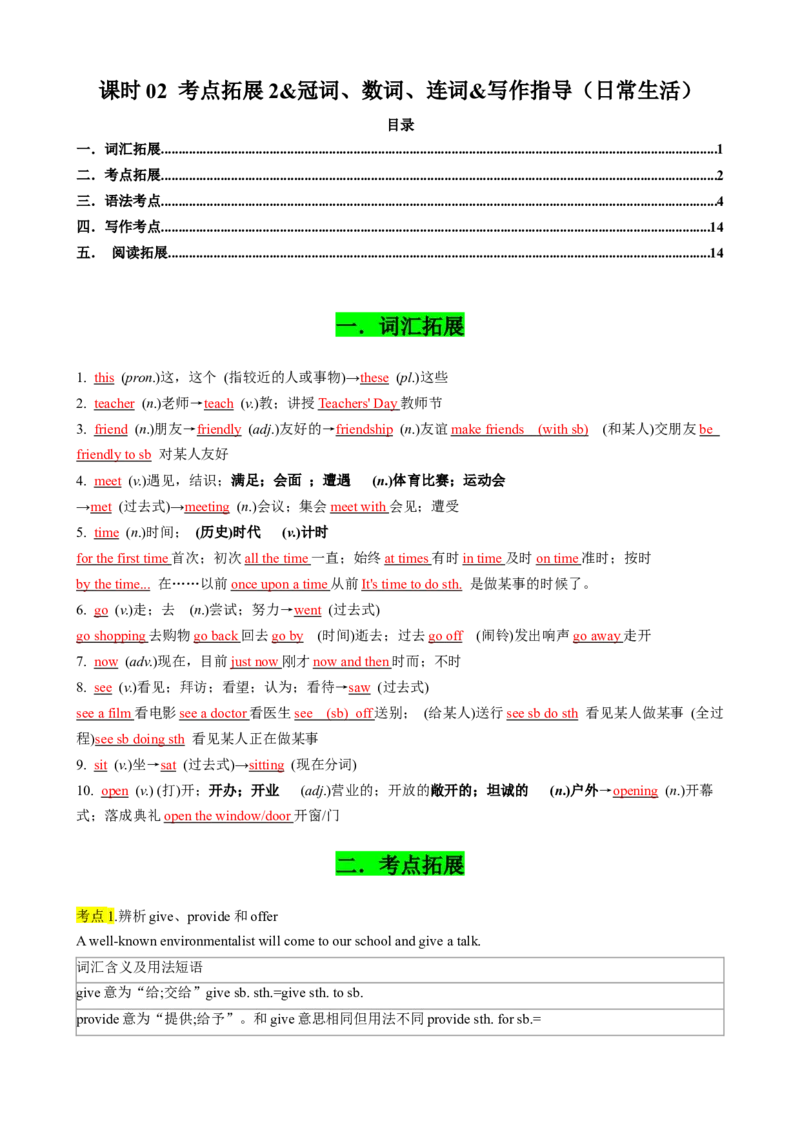
一.词汇拓展
1. this (pron.)这,这个 (指较近的人或事物)→these (pl.)这些
2. teacher (n.)老师→teach (v.)教;讲授Teachers' Day 教师节
3. friend (n.)朋友→friendly (adj.)友好的→friendship (n.)友谊 make friends ( with sb ) (和某人)交朋友be
friendly to sb 对某人友好
4. meet (v.)遇见,结识;满足;会面 ;遭遇 (n.)体育比赛;运动会
→met (过去式)→meeting (n.)会议;集会meet with 会见;遭受
5. time (n.)时间; (历史)时代 (v.)计时
for the first time 首次;初次all the time 一直;始终at times 有时in time 及时on time 准时;按时
by the time .. . 在……以前once upon a time 从前It's time to do sth. 是做某事的时候了。
6. go (v.)走;去 (n.)尝试;努力→went (过去式)
go shopping 去购物go back 回去go by (时间)逝去;过去go off (闹铃)发出响声go away 走开
7. now (adv.)现在,目前just now 刚才now and then 时而;不时
8. see (v.)看见;拜访;看望;认为;看待→saw (过去式)
see a film 看电影see a doctor 看医生 see ( sb ) off 送别; (给某人)送行see sb do sth 看见某人做某事 (全过
程)see sb doing sth 看见某人正在做某事
9. sit (v.)坐→sat (过去式)→sitting (现在分词)
10. open (v.) (打)开;开办;开业 (adj.)营业的;开放的敞开的;坦诚的 (n.)户外→opening (n.)开幕
式;落成典礼open the window/door 开窗/门
二.考点拓展
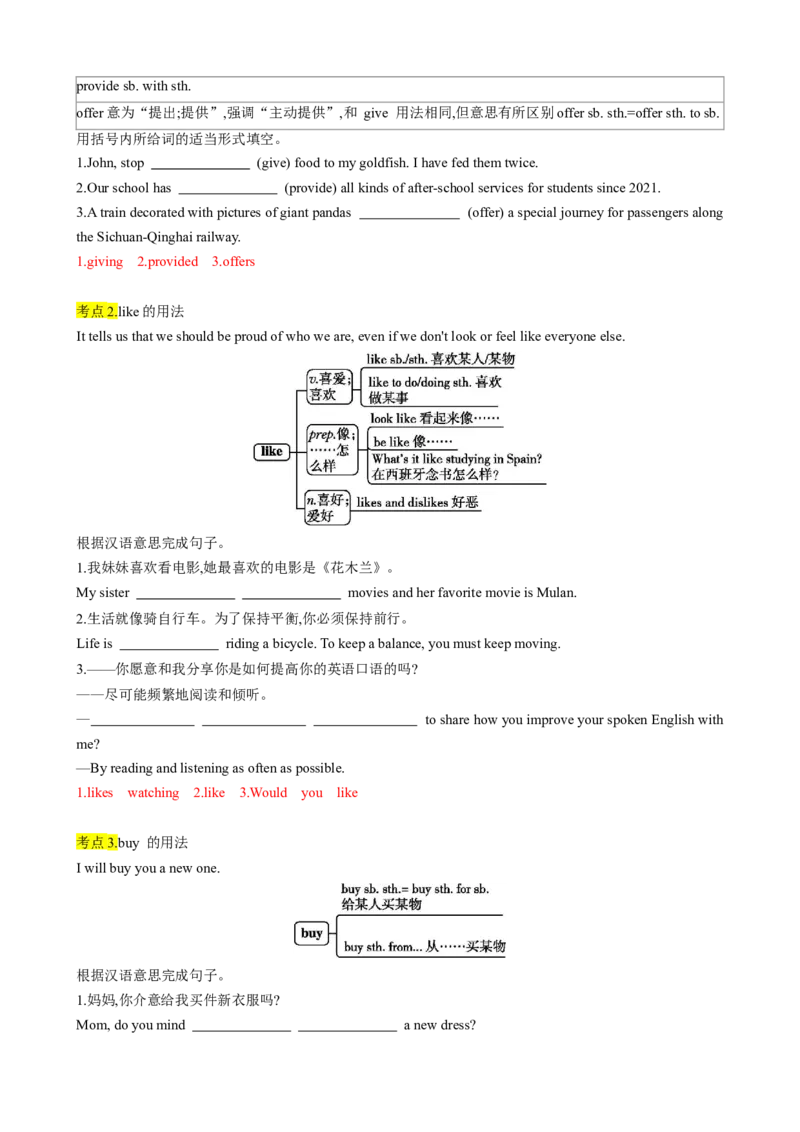
考点1.辨析give、provide和offer
A well-known environmentalist will come to our school and give a talk.
词汇含义及用法短语
give意为“给;交给”give sb. sth.=give sth. to sb.
provide意为“提供;给予”。和give意思相同但用法不同provide sth. for sb.=provide sb. with sth.
offer意为“提出;提供”,强调“主动提供”,和 give 用法相同,但意思有所区别offer sb. sth.=offer sth. to sb.
用括号内所给词的适当形式填空。
1.John, stop (give) food to my goldfish. I have fed them twice.
2.Our school has (provide) all kinds of after-school services for students since 2021.
3.A train decorated with pictures of giant pandas (offer) a special journey for passengers along
the Sichuan-Qinghai railway.
1.giving 2.provided 3.offers
考点2.like的用法
It tells us that we should be proud of who we are, even if we don't look or feel like everyone else.
根据汉语意思完成句子。
1.我妹妹喜欢看电影,她最喜欢的电影是《花木兰》。
My sister movies and her favorite movie is Mulan.
2.生活就像骑自行车。为了保持平衡,你必须保持前行。
Life is riding a bicycle. To keep a balance, you must keep moving.
3.——你愿意和我分享你是如何提高你的英语口语的吗?
——尽可能频繁地阅读和倾听。
— to share how you improve your spoken English with
me?
—By reading and listening as often as possible.
1.likes watching 2.like 3.Would you like
考点3.buy 的用法
I will buy you a new one.
根据汉语意思完成句子。
1.妈妈,你介意给我买件新衣服吗?
Mom, do you mind a new dress?2.Mary,你决定买哪一个了吗?外套还是裙子?
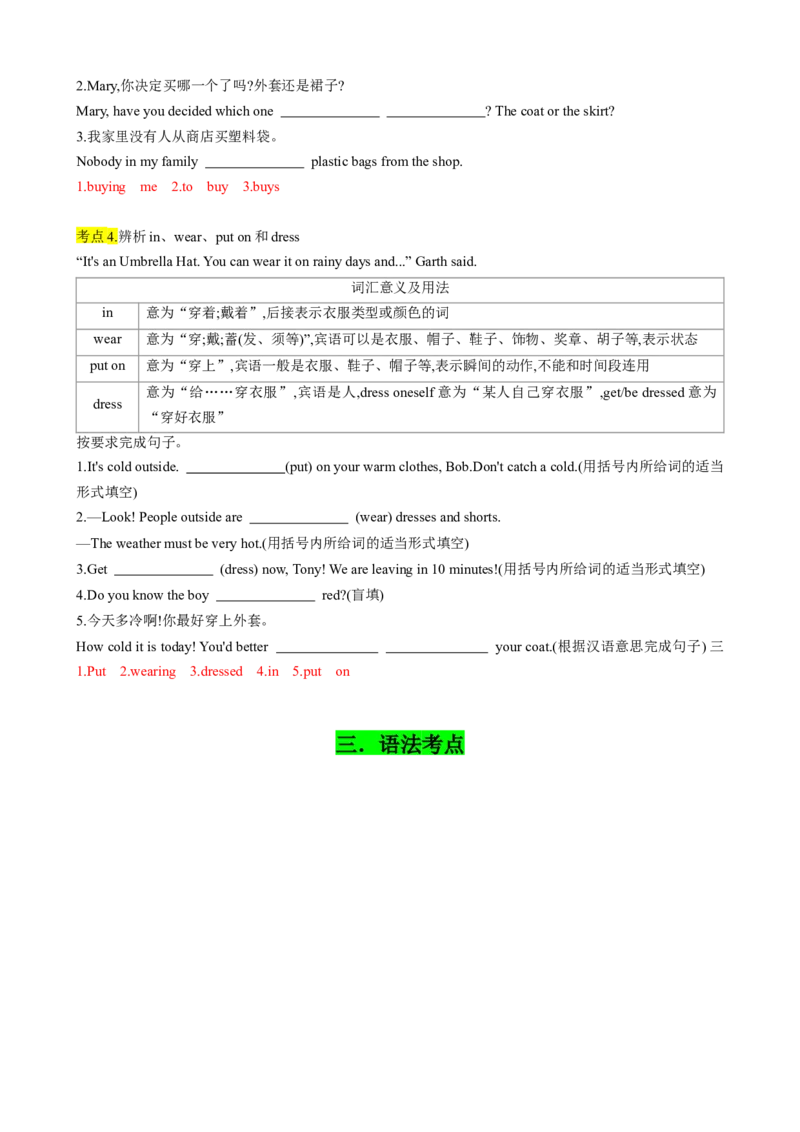
Mary, have you decided which one ? The coat or the skirt?
3.我家里没有人从商店买塑料袋。
Nobody in my family plastic bags from the shop.
1.buying me 2.to buy 3.buys
考点4.辨析in、wear、put on和dress
“It's an Umbrella Hat. You can wear it on rainy days and...” Garth said.
词汇意义及用法
in 意为“穿着;戴着”,后接表示衣服类型或颜色的词
wear 意为“穿;戴;蓄(发、须等)”,宾语可以是衣服、帽子、鞋子、饰物、奖章、胡子等,表示状态
put on 意为“穿上”,宾语一般是衣服、鞋子、帽子等,表示瞬间的动作,不能和时间段连用
意为“给……穿衣服”,宾语是人,dress oneself意为“某人自己穿衣服”,get/be dressed意为
dress
“穿好衣服”
按要求完成句子。
1.It's cold outside. (put) on your warm clothes, Bob.Don't catch a cold.(用括号内所给词的适当
形式填空)
2.—Look! People outside are (wear) dresses and shorts.
—The weather must be very hot.(用括号内所给词的适当形式填空)
3.Get (dress) now, Tony! We are leaving in 10 minutes!(用括号内所给词的适当形式填空)
4.Do you know the boy red?(盲填)
5.今天多冷啊!你最好穿上外套。
How cold it is today! You'd better your coat.(根据汉语意思完成句子) 三
1.Put 2.wearing 3.dressed 4.in 5.put on
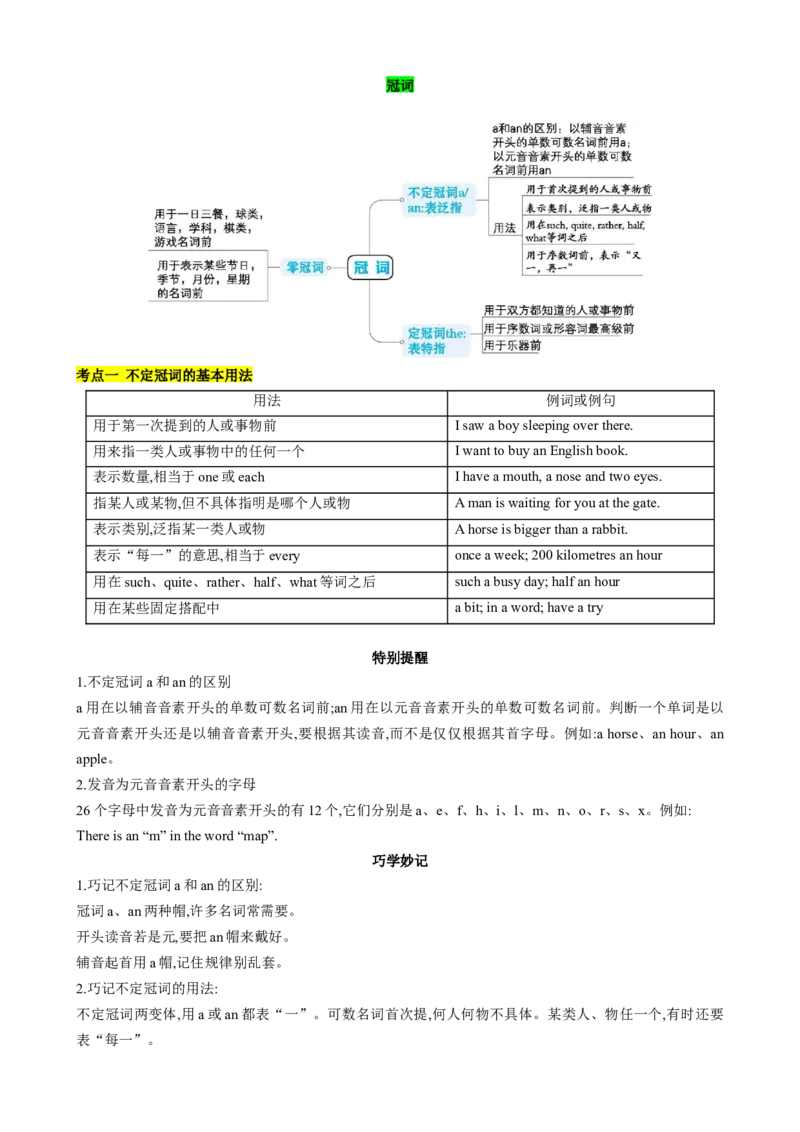
三.语法考点冠词
考点一 不定冠词的基本用法
用法 例词或例句
用于第一次提到的人或事物前 I saw a boy sleeping over there.
用来指一类人或事物中的任何一个 I want to buy an English book.
表示数量,相当于one或each I have a mouth, a nose and two eyes.
指某人或某物,但不具体指明是哪个人或物 A man is waiting for you at the gate.
表示类别,泛指某一类人或物 A horse is bigger than a rabbit.
表示“每一”的意思,相当于every once a week; 200 kilometres an hour
用在such、quite、rather、half、what等词之后 such a busy day; half an hour
用在某些固定搭配中 a bit; in a word; have a try
特别提醒
1.不定冠词a和an的区别
a用在以辅音音素开头的单数可数名词前;an用在以元音音素开头的单数可数名词前。判断一个单词是以
元音音素开头还是以辅音音素开头,要根据其读音,而不是仅仅根据其首字母。例如:a horse、an hour、an
apple。
2.发音为元音音素开头的字母
26个字母中发音为元音音素开头的有12个,它们分别是a、e、f、h、i、l、m、n、o、r、s、x。例如:
There is an “m” in the word “map”.
巧学妙记
1.巧记不定冠词a和an的区别:
冠词a、an两种帽,许多名词常需要。
开头读音若是元,要把an帽来戴好。
辅音起首用a帽,记住规律别乱套。
2.巧记不定冠词的用法:
不定冠词两变体,用a或an都表“一”。可数名词首次提,何人何物不具体。某类人、物任一个,有时还要
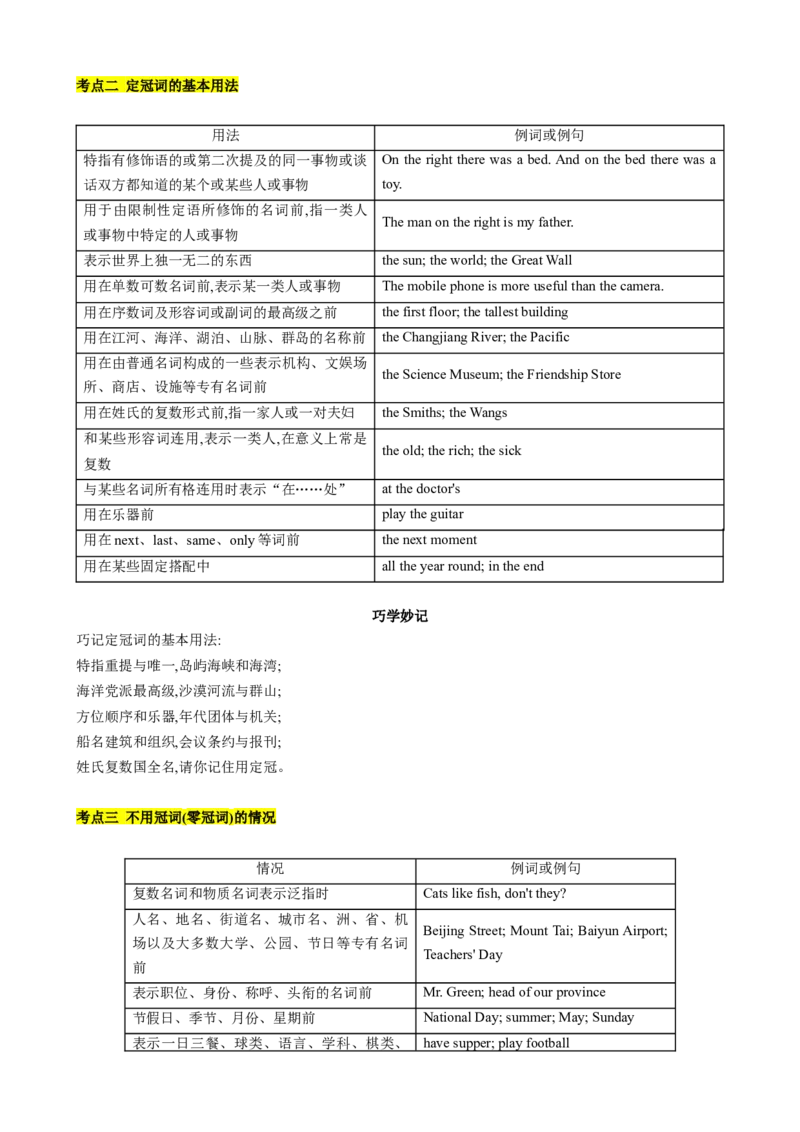
表“每一”。考点二 定冠词的基本用法
用法 例词或例句
特指有修饰语的或第二次提及的同一事物或谈 On the right there was a bed. And on the bed there was a
话双方都知道的某个或某些人或事物 toy.
用于由限制性定语所修饰的名词前,指一类人
The man on the right is my father.
或事物中特定的人或事物
表示世界上独一无二的东西 the sun; the world; the Great Wall
用在单数可数名词前,表示某一类人或事物 The mobile phone is more useful than the camera.
用在序数词及形容词或副词的最高级之前 the first floor; the tallest building
用在江河、海洋、湖泊、山脉、群岛的名称前 the Changjiang River; the Pacific
用在由普通名词构成的一些表示机构、文娱场
the Science Museum; the Friendship Store
所、商店、设施等专有名词前
用在姓氏的复数形式前,指一家人或一对夫妇 the Smiths; the Wangs
和某些形容词连用,表示一类人,在意义上常是
the old; the rich; the sick
复数
与某些名词所有格连用时表示“在……处” at the doctor's
用在乐器前 play the guitar
用在next、last、same、only等词前 the next moment
用在某些固定搭配中 all the year round; in the end
巧学妙记
巧记定冠词的基本用法:
特指重提与唯一,岛屿海峡和海湾;
海洋党派最高级,沙漠河流与群山;
方位顺序和乐器,年代团体与机关;
船名建筑和组织,会议条约与报刊;
姓氏复数国全名,请你记住用定冠。
考点三 不用冠词(零冠词)的情况
情况 例词或例句
复数名词和物质名词表示泛指时 Cats like fish, don't they?
人名、地名、街道名、城市名、洲、省、机
Beijing Street; Mount Tai; Baiyun Airport;
场以及大多数大学、公园、节日等专有名词
Teachers' Day
前
表示职位、身份、称呼、头衔的名词前 Mr. Green; head of our province
节假日、季节、月份、星期前 National Day; summer; May; Sunday
表示一日三餐、球类、语言、学科、棋类、 have supper; play football游戏等名词前
在与by连用的表示交通工具的名词前 by train; by bus
名词前有物主代词、指示代词、不定代词、
this book; my son; Jack's bike
疑问代词或名词所有格修饰时
在某些固定搭配中 day and night; by mistake
特别提醒
1.节假日前一般不加冠词,但节日名中含有“Festival”的中国传统节日名前,通常要加the。例如:
the Spring Festival
2.在表示一日三餐的名词前通常不加冠词,但如果特指或指具体的饮食,可用定冠词;有修饰词时用不定冠
词。例如:
①Were you at the lunch with the English teacher?
②I had a big supper just now.
3.某些短语中有无the表达的意义不同。例如:
be in hospital 住院;be in the hospital 在医院;go to school 去上学;go to the school 去学校
巧学妙记
巧记不用冠词的情况:
不用冠词有几点,名前代词这那限;
星期月份和季节,专名球类及语言;
复数名词表泛指,棋类学科三餐前;
交通方式和节日,称呼职务与头衔;
颜色电视和国名,固定搭配记心间。
用适当的冠词完成下列句子
1.There's new schoolbag on Bill's desk.
2.Don't forget to turn left at third crossing.I'll wait for you there.
3.My grandma used to tell me old story before going to bed every night.
4.My red sweater is in the washing machine, so I have to choose another one.
5.It's very surprising that the 65-year-old man has e-mail address.
6.It is increasingly clear that Internet is becoming more and more important.
7.What's address of your new school,Lily? I would like to visit you next month.
8.We all believe that Michael will become important and useful member of the society in the
future.
9. Greens arrived in Beijing last week.They will leave for Shanghai this weekend.
10.There will be talk on teenage problems tomorrow. All the students are asked to attend
talk.
11.Tomorrow Mr.Smith will leave Paris, capital of France, for Washington by
air.
12.We were having lunch when they came in.13.This is the book you gave me last week. book is interesting.
14.What did you do last Saturday?
15.March 8 is Women's Day.
16.If weather is fine tomorrow, we will go to the park.
17.I prefer playing piano to playing basketball.
18.At age of five, he read a lot of books.
19.Tom and Lucy are of same age.
20. harder we study, more we learn.
【参考答案】
1.a 2.the 3.an 4./ 5.an 6.the 7.the 8.an 9.The 10.a the 11.the / / 12./ 13.The 14./
15./ 16.the 17.the / 18.the 19.the 20.The the
数词
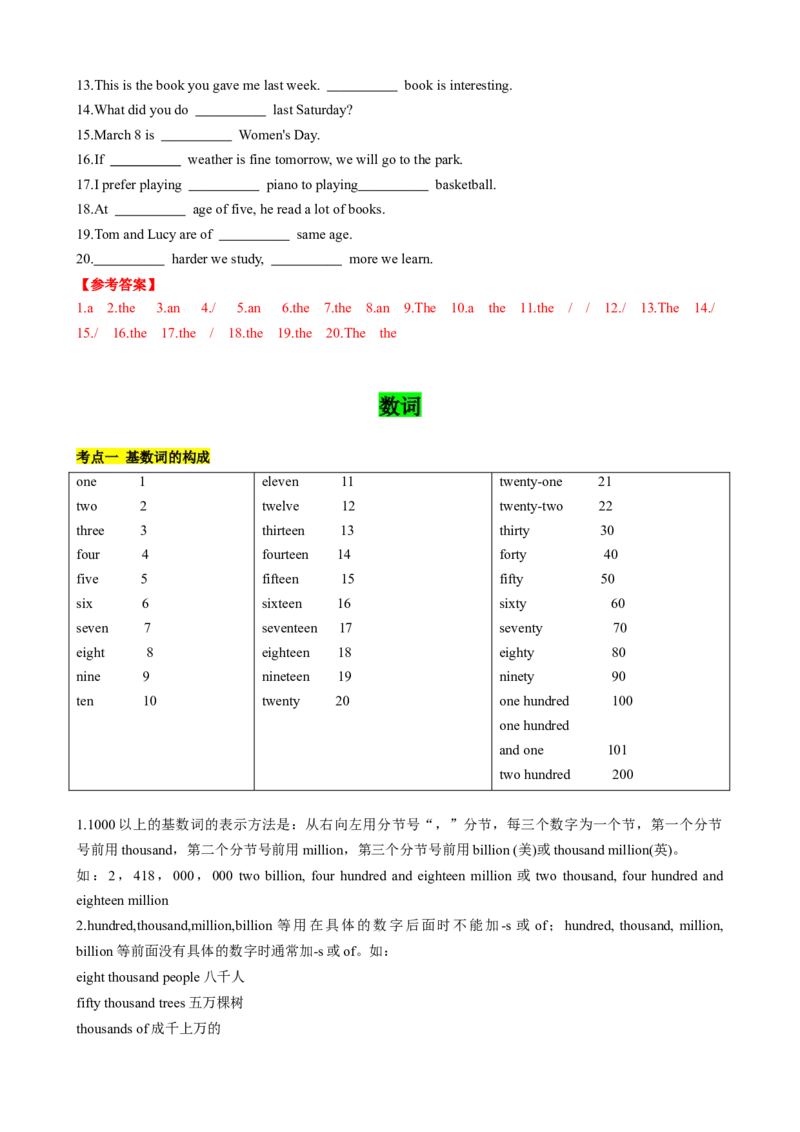
考点一 基数词的构成
one 1 eleven 11 twenty-one 21
two 2 twelve 12 twenty-two 22
three 3 thirteen 13 thirty 30
four 4 fourteen 14 forty 40
five 5 fifteen 15 fifty 50
six 6 sixteen 16 sixty 60
seven 7 seventeen 17 seventy 70
eight 8 eighteen 18 eighty 80
nine 9 nineteen 19 ninety 90
ten 10 twenty 20 one hundred 100
one hundred
and one 101
two hundred 200
1.1000以上的基数词的表示方法是:从右向左用分节号“,”分节,每三个数字为一个节,第一个分节
号前用thousand,第二个分节号前用million,第三个分节号前用billion (美)或thousand million(英)。
如:2,418,000,000 two billion, four hundred and eighteen million 或 two thousand, four hundred and
eighteen million
2.hundred,thousand,million,billion 等用在具体的数字后面时不能加-s 或 of;hundred, thousand, million,
billion等前面没有具体的数字时通常加-s或of。如:
eight thousand people八千人
fifty thousand trees五万棵树
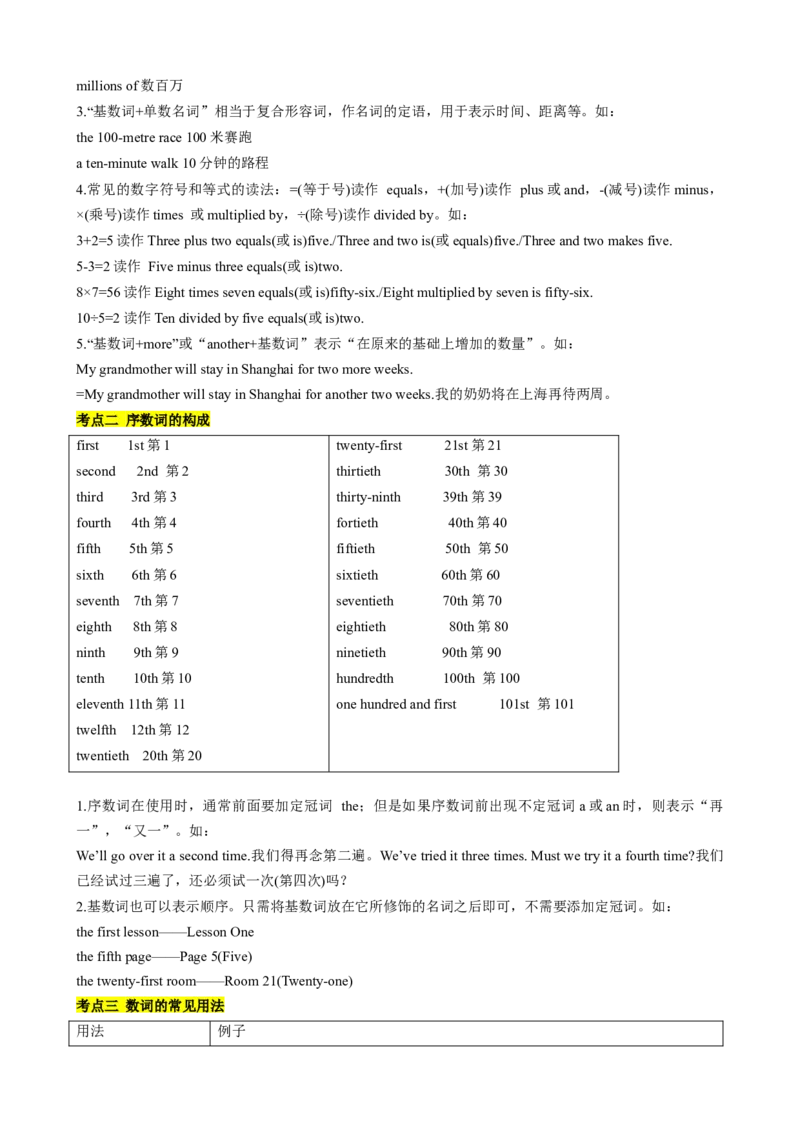
thousands of成千上万的millions of数百万
3.“基数词+单数名词”相当于复合形容词,作名词的定语,用于表示时间、距离等。如:
the 100-metre race 100米赛跑
a ten-minute walk 10分钟的路程
4.常见的数字符号和等式的读法:=(等于号)读作 equals,+(加号)读作 plus或and,-(减号)读作minus,
×(乘号)读作times 或multiplied by,÷(除号)读作divided by。如:
3+2=5读作Three plus two equals(或is)five./Three and two is(或equals)five./Three and two makes five.
5-3=2读作 Five minus three equals(或is)two.
8×7=56读作Eight times seven equals(或is)fifty-six./Eight multiplied by seven is fifty-six.
10÷5=2读作Ten divided by five equals(或is)two.
5.“基数词+more”或“another+基数词”表示“在原来的基础上增加的数量”。如:
My grandmother will stay in Shanghai for two more weeks.
=My grandmother will stay in Shanghai for another two weeks.我的奶奶将在上海再待两周。
考点二 序数词的构成
first 1st第1 twenty-first 21st第21
second 2nd 第2 thirtieth 30th 第30
third 3rd第3 thirty-ninth 39th第39
fourth 4th第4 fortieth 40th第40
fifth 5th第5 fiftieth 50th 第50
sixth 6th第6 sixtieth 60th第60
seventh 7th第7 seventieth 70th第70
eighth 8th第8 eightieth 80th第80
ninth 9th第9 ninetieth 90th第90
tenth 10th第10 hundredth 100th 第100
eleventh 11th第11 one hundred and first 101st 第101
twelfth 12th第12
twentieth 20th第20
1.序数词在使用时,通常前面要加定冠词 the;但是如果序数词前出现不定冠词 a或an时,则表示“再
一”,“又一”。如:
We’ll go over it a second time.我们得再念第二遍。We’ve tried it three times. Must we try it a fourth time?我们
已经试过三遍了,还必须试一次(第四次)吗?
2.基数词也可以表示顺序。只需将基数词放在它所修饰的名词之后即可,不需要添加定冠词。如:
the first lesson——Lesson One
the fifth page——Page 5(Five)
the twenty-first room——Room 21(Twenty-one)
考点三 数词的常见用法
用法 例子句 主语 It is said that thirteen is an unlucky number.
法 The first day of May is International Labour Day.
功 宾语 It is worth three hundred.
能 He was among the first to arrive.
定语 There are only three boys in the class.
May is the fifth month of a year.
表示事物编号 No. Ten Middle School, Lesson One
表示年代 in the 1890s
表示年、月、日 On May 1st,2008
表示分数 分子是基数词,分母是序数词,当分子大于1时,分母用复数形式。如:one
third, five sixths
表 整点 Tom often gets up at six in the morning.
示 与汉语 4:25four twenty-five
时 顺序相同 6:30six thirty
间 几点过几分 at twenty past six, at a quarter past eleven
差几分到 at five to six, at twenty-nine to ten
几点
1.表示年、月、日时,年用基数词,日用序数词。
如:July 5th,1989 1989年7月5日(读为July the fifth, nineteen, eighty-nine)
August 1st,2005 2005年8月1日(读为August the first, two thousand and five)
2.表示年代时,在年份的阿拉伯数字后面加-s或’s。如:
1730’s /1730s the seventeen thirties十八世纪三十年代
1960’s /1960s the nineteen sixties二十世纪六十年代
the late nineties九十年代末期
the early eighties八十年代初期
the mid 1960’s/1960s the mid nineteen sixties 二十世纪六十年代中期
3.表示某人约几十岁时,在表示整十位的基数词后面加-s。如:
Tom went to New York in his twenties.汤姆在二十多岁时去了纽约。
4.分数作主语时,谓语动词由of后面的名词的数来确定。of 后为可数名词复数时,谓语动词用复数形
式;of后面的名词为 不可数名词时,谓语动词用单数形式。如:
Two thirds of the work is hard to finish.三分之二的工作很难完成。
Two thirds of the students in our class are League members.我们班里三分之二的学生是团员。
一. 单项选择。
1. —Good morning, Madam. Can I help you?
—Sure, I’d like ________for cooking vegetables.
A. two cups of tea B. three pieces of breadC. five kilos of oil D. four bottles of milk
2. Nearly _______of the earth _______ covered by sea.
A. three fourth,is B. three fourths,is
C. three fourth,are D. three fourths,are
3. —We’ll be back for our school’s ____anniversary ceremony.
—I see. That means you’ll have a get-together with your classmates in _______ years.
A. fifteen,seven B. fifteenth,seven C. fifteen,seventh D. fifteenth,seventh
4. —Which class won the match in the end?
—I’m not quite sure. Perhaps _________did.
A. Class Third B. Third Class C. Class Three D. Three Class
5. There are ________ people in the supermarket. It’s so crowded.
A. hundred B. hundreds C. hundred of D. hundreds of
6. The number of the students in our school is about nine ______. ______ of them are boys.
A. hundred; Two thirds B. hundred; Two third
C. hundreds; Two thirds D. hundreds; Two third
7. My brother is a ______ boy and he can’t go to school now.
A. four years B. four-year-old
C. four-years-old D. four years old
8. It is said that the big fish in the lake is about ______.
A. four meters long B. four meter long
C. four-meter long D. four-meters long
9. —What’s the date today?
—It is _______.
A. March the eighth B. March eight C. eight March D. eighth March
10.—Where does your English teacher live?
—He lives on _____ floor of that red building..
A. five B. fifth C. the fifth D. the five
11. This is my _____time to play the piano at our school.
A. second B. two C. seconds D. the two
12. Our English teacher tells us that the _____day of the week is Sunday.
A. seven B. seventh C. first D. one
13. There are _____days in a year.
A. three hundreds sixty-five B. three hundred and sixty-five
C. three hundred and sixty five D. three hundreds and sixty five
14. My pen pal, Jack, is in_______ in a high school in American.
A. Three Class, One Grade B. Class Three, Grade One
C. Grade One, Class Three D. One Grade, Three Class
15. There are ______months in a year and December is the ______month of the year.
A. twelve; twelve B. twelve; twelfth
C. twelfth; twelve D. twelfth; twelfth1. C。本题考查数量词的表达法,由句意可知,需要油做菜,所以选C,指“五公斤食用油”。
2. B。本题考查分数的表达法,分子用基数词,分母用序数词,分子大于一时,分母要加-s。所以四分之
三是“three fourths”,地球表面是不可数名词,所以谓语用单数is。
3. B。本题考查基数词和序数词的用法,第一空指第十五个纪念仪式,用序数词fifteenth,第二空指七年
后,用基数词seven,注意in后接一段时间的句子,常用将来时。
4. C。本题考查基数词用来表示年级、班级、房间号码、电话号码和编号。要求单词开头字
母要大写。名词在前,数词在后。
5. D。本题考查基数词的单位hundred,thousand,million和billion等,当用来表示具体数
目,前面有具体的基数词时,这些词的后面不加-s。但是当hundred,thousand,million和
billion等用来表示不具体的数目时用“hundreds/ thousands/millions/ billions of +名词”来表
示,这些词的前面也不用具体的基数词。本题属于后者。
6. A。基数词后面的hundred不加-s,三分之二的正确表达是Two thirds。
7.B。本题考查复合形容词的用法,由基数词+单数名词+形容词构成,中间用连字符。所以选择B。
8.A。 本题考查形容词作表语的用法,表示某物多长、多宽或者多高,把形容词放在后面,中间的名词
用复数形式,这些词中间不用连字符。
9. A。表示日期用序数词,三月八日用March the eighth或者March 8th表示。
10. C。本题考查序数词的用法,表示居住在第几楼是定冠词the和序数词连用。
11.A。本题考查序数词的用法,物主代词和序数词连用表示“某人的第几次”的意思,从本句子的意思
理解是选择A表示“这是我的第二次在学校弹钢琴。”
12. C。本题考查序数词的用法。根据西方文化习惯Sunday是一星期的第一天,所以用the和first连用。
13. B。本题考查基数词的用法,三位数的基数词表达是百位和十位间用 and,十位和个位间用连字符。
14. B。本题考查基数词的用法。表示在几年级几班用基数词,注意:名词在前,数词在后;班级在前,
年级在后;第一个字母要大写。
15. B。本题考查基数词和序数词的用法。表示一年有十二个月用基数词twelve;十二月是一年的第十二
个月用序数词twelfth。所以选择B。
二. 用括号中所给的词的适当形式填空。
1. My sister is going to have a party for her _______ (twelve) birthday.
2. You can see ______ (thousand) of trees around our village.
3. Four ______ (seven) of the people are going to plant trees on the hill tomorrow
4. There are ______ (hundred) of people dancing at the square after supper.
5. His______ (one) name is Mike. But I don’t know his family name.
6. I am in my (three)year in this middle school.全品中考
7. He plans to take ______ (second)months for his climb.
8. Alex is ______ years old and is taken good care of in the kindergarten.(fourth)
1.twelfth 2.thousands 3.sevenths 4.hundreds 5. first 6. third 7. two 8. four
连词
关系 结构 例句I help him and he helps me.
顺承、递进、并列 常 用 and,both...and...,as well as,not 我帮助他,他帮助我。
关系 only...but also...,neither...nor...等连接 My sister not only sings well,but also dances well.
我妹妹不但唱得好,而且舞跳得也好。
I bought my sister a present,but she didn’t like it.
转折关系 常用连词but,while,yet等连接
我给我姐姐买了个礼物,但是她不喜欢。
常用连词 or,either...or...,not...but...等 Is it a boy or a girl?
选择关系
连接 是个男孩还是女孩?
They were making a lot of noise,so the teacher got
因果关系 常用连词 for,so 等连接
angry.他们很吵,所以老师生气了。
一.用and,but,or,so,while填空
①Many birds stay in the nature reserve of Zhalong all year round whil e some only go there for a short stay.
②Keep trying, an d you’ll succeed one day.
③Which is easier to learn,Japanese o r French?
④It snowed heavily last night, s o the ground is covered with snow now.
⑤Tom is a very smart boy, bu t he never shows off.
二.选择填空
1.Read the book Cute Pets, you will know how to take care of your cat.
A.or B.so C.and D.but
答案 C 句意:读一读《可爱的宠物》这本书,你就会知道该如何照顾你的猫了。本题考查连词。or或者,
否则;so所以;and和,那么;but但是。空格处前后为顺承关系。故选C。
2.The doctors worked for ten hours, nobody took a break.
A.so B.for C.but D.or
答案 C 句意:医生们工作了十个小时,但没有人休息一下。本题考查连词的用法。前面说“工作了十个
小时”,后面说“没有人休息”,前后有明显的转折关系,故选C。
3.Life is like a one-way race, treasure every moment as time cannot be won again.
A.so B.and C.or D.but
答案 A 句意:生活像一场单向的赛跑,所以要珍惜每时每刻,因为时间一去不再来。本题考查并列连词。
so因此,所以;and和;or或者,否则;but但是。根据语境可知,设空处前后是因果关系,故选A。
4.Love from parents is like the wind—you can’t see it you can feel it.
A.and B.or C.but D.so
答案 C 句意:父母的爱就像是风——你虽然看不见它,却能感受到它。本题考查并列连词。空格前的you
can’t see it和空格后的you can feel it之间存在转折关系,应用but。故选C项。
5.I’ve wanted to read Peter Pan for long, today I finally borrowed the book from the library.
A.or B.but C.and D.since
四.写作考点日常生活
John’s Day
John gets up at 6:30 a.m.in the morning. He has breakfast at 7:00 a.m. He goes to school by bike at 7:30 a.m.
He has English, Chinese, history and math in the morning. He has P.E., geography and science in the afternoon.
After school he often plays football with his classmates. Sometimes he watches TV in the evening at home.
约翰节 约翰早上六点半起床。他在7点吃早餐他早上7点半骑自行车去上学他早上有英语、中文、
历史和数学课。他下午有体育,地理和科学课程。放学后,他经常和同学们一起踢足球。有时他在晚上
在家看电视。
I get up early at six every day. After doing some morning exercises, I read English for twenty minutes. At
seven I have breakfast. After breakfast I take my schoolbag and go to school. Our class begins at eight, and we
have four classes in the morning. After lunch at 12 o’clock, I take a short rest in the classroom. We have three
more classes in the afternoon.After school at five , I go back home. I often help my mother do some housework.
Sometimes I watch TV. After dinner, I begin to do my homework. Then I take a shower. I go to bed at nine thirty.
我每天六点就会早起。在做了一些晨操后,我读了20分钟的英语。我七点就吃早餐。早餐后,我带着书
包去上学。我们从八点开始上课,早上我们有四节课。中午12点吃完午饭后,我在教室里休息了一会
儿。我们下午还有三节课。五点放学后,我就回家了。我经常帮我妈妈做一些家务。有时我也会看电
视。晚饭后,我开始做我的家庭作业。然后我去洗澡。我九点半上床睡觉。
五.阅读拓展
一
Everyone has a dream. For Wang Zishuo, 1 8-year-old boy from Shenzhen,
China his dream is to go rock climbing(攀岩).
In August 2022, he climbed up the" China Climb" and became the 2
(young)Chinese rock climber to finish this route(路线). The “China Climb" 3
(be ) one of the most difficult climbing routes in the world. It is in Yangshuo,
Guangxi and famous for 4 (it) difficulty.
Wang 5 (start) climbing when he was only six years old. He practiced four
or five 6 (time) a week. To get good practice, he went to the rock climbing club 30 km away 7 his
home every weekend. His coach was very strict and the 8 (train) was hard. 9 he never complained(抱
怨) about it. Thanks to his hard work, he 10 (final) made his dream come true.
1._________ 2._________ 3._________ 4._________ 5._________
6._________ 7._________ 8._________ 9._________ 10._________
长难句分析
原句:(第三段第一句)Wang started climbing when he was only six years old.
译文:王梓烁在只有六岁的时候就开始攀岩。
分析:本句是一个复合句。when he was only six years old是when引导的时间状语从句
答案解析:
1. an 此处指一个来自深圳的八岁男孩。空后的boy为可数名词单数,空处表示泛指,且8-year-old以元音音素开头,故填不定冠词an。
2. youngest 2022年8月,他爬上了“中国攀”,成为完成这条路线的年龄最小的中国攀岩者。结合空前
的the和空后的rock climber 可知,此处应填形容词young的最高级形式youngest。
3. is 此处指“中国攀”是世界上最难的攀岩路线之一。本句描述的是客观事实,应用一般现在时;且主
语The “China Climb”是第三人称单数,故填is。
4. its 此处指它位于广西阳朔,以其难度而闻名。空处用作定语,修饰名词difficulty,故填it的形容词性
物主代词its。
5. started 此处指当他六岁的时候他就开始攀岩了,空后的“when he was only six years old"提示此处,应
用一般过去时,故填start的过去式 started。
6. times 此处指他一周练习四到五次。time 表示“次:回”时是可数名词,且其前面有数词four or five
修饰,故填time的复数形式times。
7. from 此处指他每个周末都去离家30千米远的攀岩俱乐部,away from意为“远离”,是固定搭配,故
填from。
8. training 他的教练非常严格且训练很艰苦。分析句子结构可知,空处缺少主语,且空后为was,故填名
词training。
9. But 根据上一句可知,他的教练非常严格且训练很艰苦。空后的“他从来没有抱怨过”和上句构成转
折关系,故填连词But。单词位于句首,注意首字母大写。
10. finally 此处指多亏了他的勤奋练习,他最终实现了他的梦想。空处所填词修饰谓语,故填final的副词
形式finally。
二
It's getting dangerously close to “game over” for some players in
China. If you're under 18 and a fan of online(网络的)games, you
can't play them as much as you want now. 1
According to a report. China is the world's largest online
gaming market. About 63% of Chinese minors(未成年人)play
online games often. 2 And some parents find their kids being
lazy and even violent(暴力的) after playing online games.
To stop the minors from playing games too much, China sets a new rule for its young gamers at
the start of the new semester( 学期).From September 1, 2021, minors can only play online games
between 8 pm and 9 pm on Fridays and weekends. 3 When enrolling in(注册)to play, gamers need to
use their real names and ID numbers.
4 Parents don't need to worry that their children are again playing online games at school. And
less gaming is good for the players' health, especially for their eyes. 5 Go. outside ,and jump and run!
根据短文内容,从方框内所给的选项中选出能填入空白处的最佳选项。有两项多余。
A. Put down your phone now.
B. The new rule is a good thing.
C. It really makes some students unhappy.
D. For many people online games are fun.
E. You can only enjoy three hours of play a week.F. Many of these players can't do well in their lessons.
G. They can also play during the same time on national holidays.
长难句分析
原句:(第一段第二句)If you're under 18 and a fan of online games, you can't play them as much as you want
now.
译文:如果你是个未满18岁的网络游戏爱好者,现在你不能随心所欲地玩网络游戏了。
分析:这是一个复合句。If you're under... games 为if引导的条件状语从句,其中 under 18和a fan of
online games为两个并列的表语。
答案解析:
1. E 根据上一句“If you're under 18...as you want now.”可知,如果你是18岁以下的网络游戏爱好者,现
在你不能随心所欲地玩网络游戏了,故E项“你每周只能玩3个小时”承接上文,符合语境。
2. F 根据上一句可知,大约有63%的未成年人经常玩网络游戏。再结合下一句“并且一些家长发现,他
们的孩子玩完网络游戏后变得懒惰甚至暴力”可推知,此处应为未成年人玩网络游戏的坏处之一,故F项
“许多游戏玩家功课不好”承上启下,符合语境。
3. G 根据上一句“From September 1,2021,minors...on Fridays and weekends.”可知,未成年人只能在周五
和周末晚上的8点至9点玩网络游戏,由此推知,此处是对未成年人玩网络游戏时间限制的进一步说明,
故G项“他们还可以在国家法定假期的同一时间段玩(游戏)”承接上文,符合语境。
4. B 根据下一句“Parents don't need to worry that their children are again playing online games at school.”可
知,家长不用担心孩子又在学校玩网络游戏了,故B项“新规定是件好事”可引出下文,符合语境。
5. A 根据上一句可知,少玩网络游戏有益于玩家的健康;再结合下一句“Go outside, and jump and run!”
可知,空处应呼吁孩子少玩网络游戏。故A项“现在放下你的手机”承上启下,符合语境。
三
happy, learn, interest, with, also, dance, we, under, enjoy, so, eye, real
Brendan Jackson is a kindergarten(幼儿园)teacher in Australia. He works on making his young students like
school. So every morning, he starts with an l video.
The video can let kids 2 about the day's fun lessons. In a video posted on August 13, 2021, he is
3 to the music and telling his students about their PE class.
"I think all the kids in 4 school can't wait to watch Brendan's videos every morning," the head
teacher said. “His videos 5 interest other teachers. Nearly every teacher 6 his performances(表
演) in the videos very much.”
In the 7 of Brendan, the school life is fun. “I know that parents want kids to go to school 8
big smiles on their faces. 9 I am trying hard to get kids wanting to come to school. And I'm l0
that I can do my part," he said.
1._________ 2._________ 3._________ 4._________ 5._________
6._________ 7._________ 8._________ 9._________ 10._________
长难句分析原句:(最后一段第二句)I know that parents want kids to go to school with big smiles on their faces.
译文:我知道家长想让孩子的脸上挂着灿烂的笑容去上学。
分析:本句是一个复合句。that parents want kids to go to school with big smiles on their faces 是that引导的
宾语从句,作动词know的宾语。
答案解析:
1. interesting 根据第三段可知,孩子们和其他老师都非常喜欢 Brendan的视频,因此此处指一段有趣的
视频。空处修饰名词video,空前为不定冠词an,故填interest的形容词形式interesting。
2. learn 此处指视频可以让孩子们了解到当日有趣的课程。learn about 意为“了解”;let sb. do sth.意为
“让某人做某事”,为固定用法,故填learn。
3. dancing 根据空后的to the music 可知,此处指他随着音乐跳舞;再结合空前的is和空后的telling可
知,空处应填dancing。
4. our 根据语境可知,此处是校长说的话,“我认为每天早上我们学校所有的孩子都迫不及待地想要看
Brendan 的视频”,故填we 的形容词性物主代词 our。
5. also 根据上文内容可知,孩子们很喜欢Brendan 的视频,故此处指其他老师对他的视频也很感兴趣。
6. enjoys 根据语境并结合备选词可知,几乎所有老师都很喜欢他在视频中的表演;再根据引述部分句子
的时态可知,此处应用一般现在时,且主语为 Nearly every teacher,故填enjoy的第三人称单数形式
enjoys。
7. eyes 此处指在Brendan看来,学校生活是有趣的。in the eyes of...“在……看来”,为固定短语,故填
eye的复数形式eyes。
8. with 根据语境可知,家长想让孩子的脸上挂着灿烂的笑容去上学,with“带有”,符合语境。
9. So 根据上一句可知,家长想让孩子高兴地去上学;再根据空后的“我正努力让孩子们想来上学”可
知,空前后为因果关系,故填So单词在句首,注意首字母大写。
10. happy 根据空后的“I can do my part"可知,Brendan很高兴能尽到自己的职责。