课程主题: 6BU4 Road safety 授课时间:
学习目标 掌握本课重点词汇、短语和语法
教学内容
【进门测试】
一、根据所设情景,选择正确答案。
( ) 1.你看到有小孩在马路上奔跑,可以提醒他:
( ) 2.红灯亮了,你可以提醒大家:
( ) 3.你提醒某人可以过马路了,可以说:
( ) 4.你不知道怎样到达某人的家,可以问:
( ) 5.有人问你过马路时首先该做什么,你可以说:
A. How can I get to your house?
B. We can’t cross the road now.
C. You must look for a zebra crossing first.
D. You mustn’t run on the road.
E. You can cross the road now.
二、根据中文意思,完成句子。
1.我们学校附近有许多繁忙的马路。
There are many_______ _______ near our school.
2.我们怎样才能安全通过它们呢?
How can we cross_______ _______?
3.你必须先向左看,然后再向右看。
You must look _______first, and then _______.
4.你们千万不要在马路上踢足球。
You_______ _______football on the road.
5.为什么现在公共汽车停下来了?
Why _______the bus _______now?
【多元导学】【互动精讲】
知识点一:
一、新词导学与解读
1. cross
【用法】作动词意为“穿过”。
【举例】I cross the road. 我穿过马路。
【例题】汉译英:你可以和其他人一起穿过马路。
【拓展】区分cross和across的区别:
cross 作动词用,“穿过,越过”的意思。主要表示在物体表面上横穿。如横过马路、
过桥、过河等,与go across同义。
例如:Be careful when you cross the street.过马路时要小心。
across是介词,有“横跨,横穿,穿越”之意。
例如,The Great Green Wall is across the northwest of China.绿色长城横跨中国西
北。2. crossing
【用法】作名词,意为人行横道
【举例】Look, that girl is walking at the crossing .看那个女孩正在人行横道走。
【例题】单项选择:You must look for zebra ____________.
A: crossing B: cross
【拓展】a crossing from England to Ireland跨海旅程,
on the crossing 在路口
at the crossing 在过境处
【举例】We are all at the crossing now.我们现在都在过境处。
3. must
【用法】作情态动词,意为必须,后面直接加动词原形
【举例】You must talk to them about their study.你必须同他们谈谈关于他们学习的事。
【例题】汉译英。一到上海你得马上来看我们。
【拓展】must的否定形式mustn’t意思是“一定不要”、“不能”
must to do sth表示命令、要求、义务等
must do sth表示推测
例如:You must say hello to her.你应当跟她打个招呼。
例如:We mustn't think only of ourselves. 我们可不能只考虑自己。
4. look
【用法】作动词,和at构成固定词组:look at,意为“看...”
【举例】He is looking at the boys over there.他正在看那边的男孩。
【例题】填上合适的介词:To keep safe, you can look ______for cars and blkes.
【拓展】(1)look后接for,意为“寻找”。
例如:He is looking for his purse.他正在寻找他的钱包。
(2)look后接after,意为“照顾”。
例如:The girl is looking after her baby.女孩正在照顾她的孩子。
(3) look后接 around,意为“环顾”。
例如:The thief looks around and picks the note up.小偷四下环顾,捡起了纸币。
5. can
【用法】情态动词 ,表示:“会、能.后跟动词原形
【举例】I can swim.我会游泳。
【例题】单项选择: He can______ basketball well._
A. plays B. play【拓展】其否定形式can not=can’t有时还表示请求、允许,或推测
例如:(1)Can I help you?我能帮助你吗?
(2)The book can be Li's.这本书可能是李的
6.clean
【用法】做动词,解释为打扫,做形容词解释为干净的
【例题】1.This is my clean room.这是我干净的房间。
2.Let’s clean our classroom.让我们打扫一下我们的教室。
【点译】清洁的
【拓展】clean it up 把它打扫干净
二、课文要点及语法详解
1.You must look at the traffic lights and wait for the green man.
【用法】wait是一个不及物动词,其后不能直接加名词或代词,wait for,是固定搭配,“等待某人或某事”
【举例】I wait for you in the garden. 我在花园里等你。
【例题】汉译英。我在等王医生。
【拓展】同义词组:wait to 后面加动词wait on后面接的名词一般不是表示人的名词
【举例】She can’t wait to read the story.她迫不及待地要读这个故事。
We are still waiting on the report.我们还在等报告出来。
2. You must look for a zebra crossing.你必须寻找斑马线。
【用法】look for意为“照顾,照看,寻找”。 通常用look for sb/sth
【举例】She is looking for her lost child. 她正在寻找失去的孩子。
【例题】汉译英。为什么警察在四处找你?
【拓展】look for 意思是 寻找(但找到没找到 我们不得而知)
find意思就是发现了 找到了( 已经有了结果了)
【举例】(1) I am looking for my lost book.我正在寻找我丢失的书。
(2)I found my sweater yesterday.我昨天找到了我的毛衣。
3. You must not play on the road because there are many cars and bikes. 你不能在路上玩,因为路上有很多的
车子。
【用法】情态动词must 意思为必须,即 必须去做,用法为must do sth .而mustn't 意思为不必须
[来源:学科网]
【举例】(1)I must go to school now. 意思为 我现在必须去学校了
(2)You mustn't leave here.你不能离开这儿。
【例题】用所给词的适当形式填空:You must ________(talk )to them about their study.你必须同他们谈谈关于他们学习的事。
【拓展】 在这里建议老师还可以拓展其余的情态动词。比如说;must, can may, shall, will ... 让学生说出
他们的否定式。
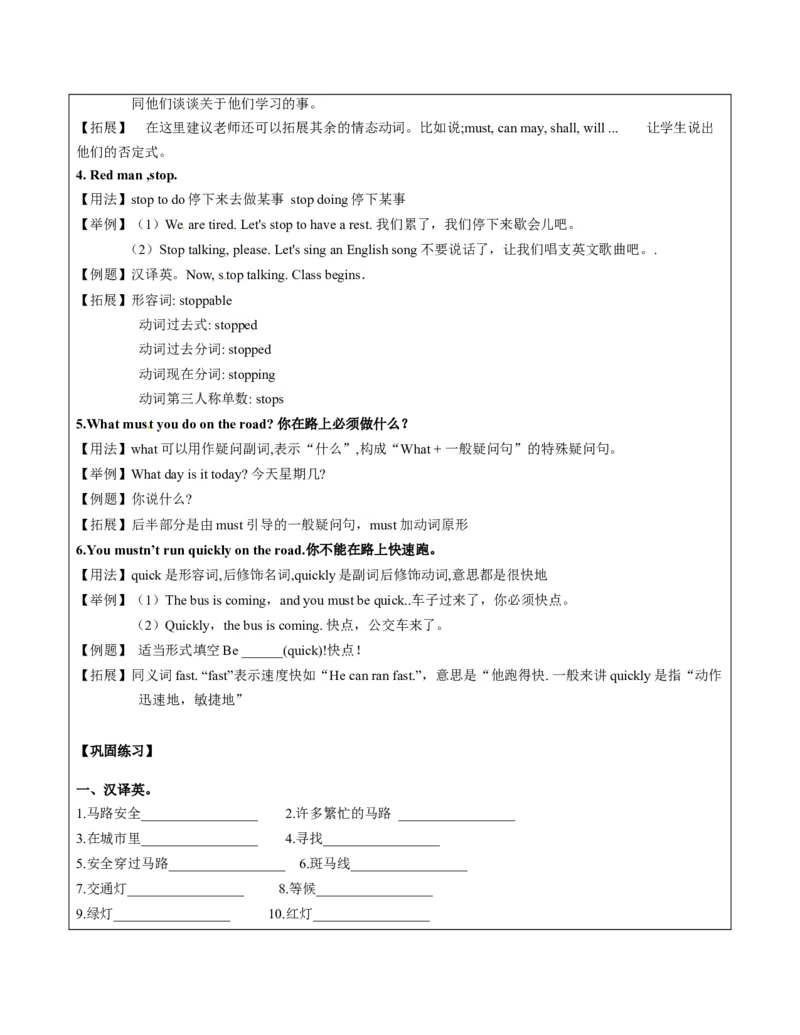
4. Red man ,stop.
【用法】stop to do停下来去做某事 stop doing停下某事
【举例】(1)We are tired. Let's stop to have a rest. 我们累了,我们停下来歇会儿吧。
(2)Stop talking, please. Let's sing an English song不要说话了,让我们唱支英文歌曲吧。.
【例题】汉译英。Now, stop talking. Class begins.
【拓展】形容词: stoppable
动词过去式: stopped
动词过去分词: stopped
动词现在分词: stopping
动词第三人称单数: stops
5.What must you do on the road? 你在路上必须做什么?
【用法】what可以用作疑问副词,表示“什么”,构成“What + 一般疑问句”的特殊疑问句。
【举例】What day is it today? 今天星期几?
【例题】你说什么?
【拓展】后半部分是由must 引导的一般疑问句,must 加动词原形
6.You mustn’t run quickly on the road.你不能在路上快速跑。
【用法】quick是形容词,后修饰名词,quickly是副词后修饰动词,意思都是很快地
【举例】(1)The bus is coming,and you must be quick..车子过来了,你必须快点。
(2)Quickly,the bus is coming. 快点,公交车来了。
【例题】 适当形式填空Be ______(quick)!快点!
【拓展】同义词fast. “fast”表示速度快如“He can ran fast.”,意思是“他跑得快. 一般来讲quickly是指“动作
迅速地,敏捷地”
【巩固练习】
一、汉译英。
1.马路安全_________________ 2.许多繁忙的马路 _________________
3.在城市里_________________ 4.寻找_________________
5.安全穿过马路_________________ 6.斑马线_________________
7.交通灯_________________ 8.等候_________________
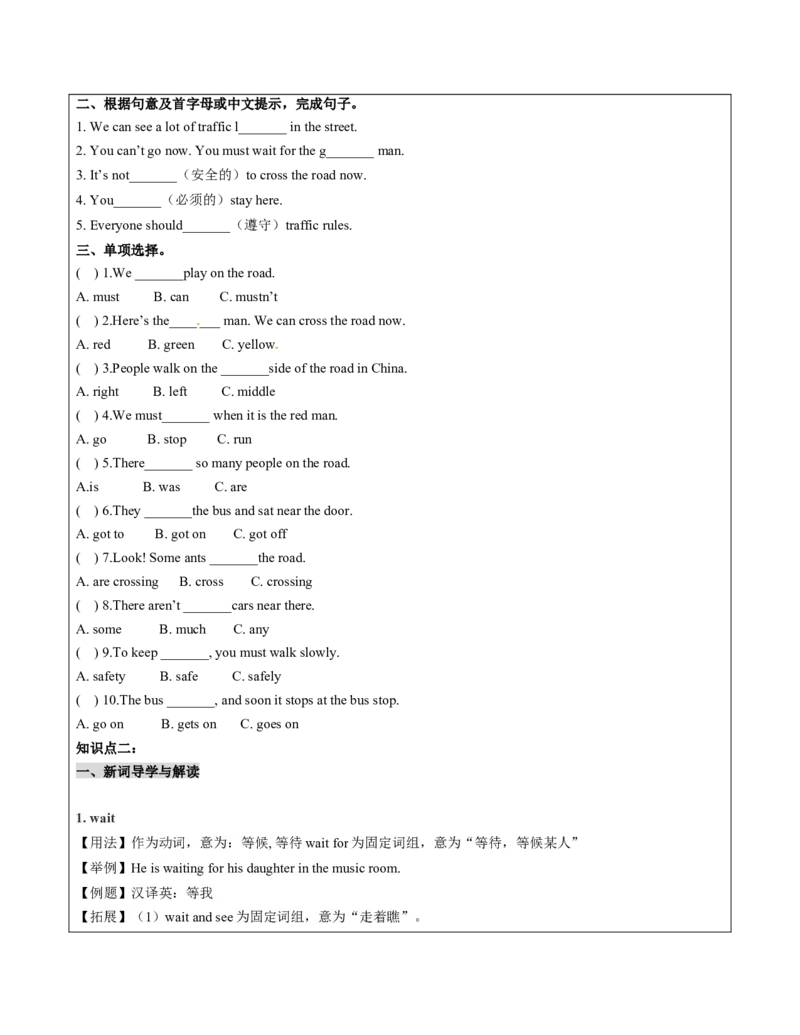
9.绿灯_________________ 10.红灯_________________二、根据句意及首字母或中文提示,完成句子。
1. We can see a lot of traffic l_______ in the street.
2. You can’t go now. You must wait for the g_______ man.
3. It’s not_______(安全的)to cross the road now.
4. You_______(必须的)stay here.
5. Everyone should_______(遵守)traffic rules.
三、单项选择。
( ) 1.We _______play on the road.
A. must B. can C. mustn’t
( ) 2.Here’s the_______ man. We can cross the road now.
A. red B. green C. yellow
( ) 3.People walk on the _______side of the road in China.
A. right B. left C. middle
( ) 4.We must_______ when it is the red man.
A. go B. stop C. run
( ) 5.There_______ so many people on the road.
A.is B. was C. are
( ) 6.They _______the bus and sat near the door.
A. got to B. got on C. got off
( ) 7.Look! Some ants _______the road.
[来源:学科网]
A. are crossing B. cross C. crossing
( ) 8.There aren’t _______cars near there.
A. some B. much C. any
( ) 9.To keep _______, you must walk slowly.
A. safety B. safe C. safely
( ) 10.The bus _______, and soon it stops at the bus stop.
A. go on B. gets on C. goes on
知识点二:
一、新词导学与解读
1. wait
【用法】作为动词,意为:等候, 等待wait for为固定词组,意为“等待,等候某人”
【举例】He is waiting for his daughter in the music room.
【例题】汉译英:等我
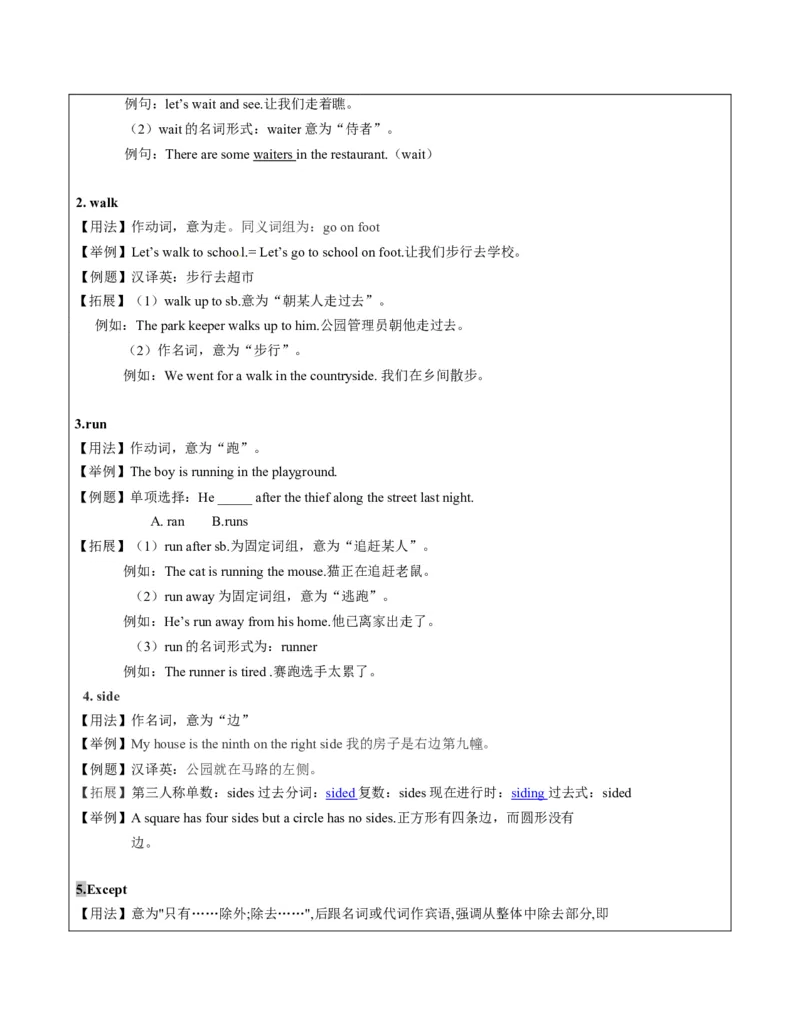
【拓展】(1)wait and see为固定词组,意为“走着瞧”。例句:let’s wait and see.让我们走着瞧。
(2)wait的名词形式:waiter意为“侍者”。
例句:There are some waiters in the restaurant.(wait)
2. walk
【用法】作动词,意为走。同义词组为:go on foot
【举例】Let’s walk to school.= Let’s go to school on foot.让我们步行去学校。
【例题】汉译英:步行去超市
【拓展】(1)walk up to sb.意为“朝某人走过去”。
例如:The park keeper walks up to him.公园管理员朝他走过去。
(2)作名词,意为“步行”。
例如:We went for a walk in the countryside. 我们在乡间散步。
3.run
[来源:Zxxk.Com]
【用法】作动词,意为“跑”。
【举例】The boy is running in the playground.
【例题】单项选择:He _____ after the thief along the street last night.
A. ran B.runs
【拓展】(1)run after sb.为固定词组,意为“追赶某人”。
例如:The cat is running the mouse.猫正在追赶老鼠。
(2)run away为固定词组,意为“逃跑”。
例如:He’s run away from his home.他已离家出走了。
(3)run的名词形式为:runner
例如:The runner is tired .赛跑选手太累了。
4. side
【用法】作名词,意为“边”
【举例】My house is the ninth on the right side 我的房子是右边第九幢。
【例题】汉译英:公园就在马路的左侧。
【拓展】第三人称单数:sides过去分词:sided 复数:sides现在进行时:siding 过去式:sided
【举例】A square has four sides but a circle has no sides.正方形有四条边,而圆形没有
边。
5.Except
【用法】意为"只有……除外;除去……",后跟名词或代词作宾语,强调从整体中除去部分,即except后的部分不包括在整体之内
【举例】 All of them went out for a walk except John. 除了约翰,所有的人都出去散步了。
【例题】单项选择:Everyone is here ________ Xiao Wang and me.
A. except B. besides C. beside D. excepts
【拓展】except 除后跟名词、代词作宾语外,还可跟介词,也可跟从句。
【举例】(1) It was dark in the city except a few weak lights.
(2)Mr Green usually goes to work by bus except when it rains.
6.take
【用法】作为动词,意为 拿,取,吃,喝,服用,放,乘车(船)等
【举例】He takes it to the school.他把它带到学校。
【例题】汉译英:公园就在马路的左侧。
【拓展】做……事情”, 常常和名词连用,表示与该名词意义相关的动作
【举例】 take away 拿走 ,take down 取下来 , take (good) care of (好好)照顾,照料
二、课文对译
Stop! There’s a red man. 红灯停。
We mustn’t walk now. 我们现在不好走。
We must wait for the green man.我们必须等到绿灯。
There he is! Now we can walk,But don’t run!
现在是绿灯了。我们可以走了,但是不能奔跑。
三、课文要点及语法详解
1.There’s a red man.
【用法】there be 句型意为“有”。此句型分为:there is / are...
there is 后接单数名词或者不可数名词; there are后接复数名词。
【举例】There is a new car. 有一辆新汽车。
【例题】单项选择:There ______two books on the desk.
A: is B: are
【拓展】there be 句型要遵守就近原则
【举例】There is a pen and two books.
[来源:学*科*网Z*X*X*K]2.Don’t run!
【用法】这是一个祈使句
【例题】Don’t talk in the class.在课上不要讲话。
【点译】run
【拓展】由don’t引导的祈使句也表示不要干某事,后面接动词的原形
例如:Don't be late . 别迟到
3. They get on the bus.他们上了公交车。
【用法】get on .意为:上车,
【举例】They got on at this station. 他们是在这个站上的车。
【例题】翻译:11路公交车过来了,让我们上车。
【拓展】get on 还可以解释为:继续, 进行 ,变老; 变晚
【举例】(1)He is getting on in years. 他年迈了。
(2)I asked how he was getting on at school. 我问他在学校情况怎样。
4. Look!Some elephants are crossing the road.看,一些大象正在过马路。
[来源:学#科#网Z#X#X#K]
【用法】此句为现在进行时的肯定句形式,其结构为:主语+be+现在分词。
【举例】Sam is flying kites in the park. 山姆正在公园放风筝。
【例题】用所给词的适当形式填空:Listen, who _____(cry)in the bedroom.
【拓展】动词现在分词的构成方式:
(1) 一般情况下直接加ing
例如:think---thinking sleep---sleeping study---studying
(2) 以不发音的字母e结尾的单词,去掉字母e,再加ing
例如:wake---waking make---making come---coming
(3)以重读闭音节结尾,呈现“辅,元,辅”结构的动词,先双写末尾的辅音字母,
再加ing。
例如:stop---stoppingsit---sitting run---running
(4)以重读闭音节结尾,呈现“辅,元,辅”结构的动词,先双写末尾的辅音字母,
再加ing 。
例如:cut, get, run, sit, stop, swim等。
【巩固练习】
一、英汉互译。
1.等待绿灯_________________ 2.看看交通灯_________________
3.穿过马路_________________ 4.小心汽车_________________
5.保持安全_________________ 6. cross the road with other people_________________7. stop and wait_________________ 8. look for a zebra crossing_________________
二、根据图片或中文提示补句子。
1. There is a __________.(斑马线)You can cross it.
2. You can __________(右转)in front of the post office.
3. There are __________(汽车和自行车)on the road.
4. You must __________(小心,注意)cars.
5. Look, the people are __________(穿过马路)now.
三、选择恰当的选项。
( ) 1. This is not ________.
A. safety B. safe C. safely
( ) 2. How can we cross the road________?
A. safety B. safe C. safely
( ) 3. We________ smoke in the library.
A. mustn’t B. must C. can
( ) 4. ---What ________your sister do? ---She can dance.
A. can B. must C. should
( ) 5. Can your cousin ________this English song?
A. sings B. singing C. sing
( ) 6.Your little sister ________walk now. She is only one year old.
A. can B. can’t C. mustn’t
( ) 7.You ________watch TV. You ________go to bed now. It’s too late.
A. can; must B. can’t; must C. mustn’t; can
( ) 8. I’m ________my camera now. It was in my bag yesterday.
A. looking for B. finding C. looking at
( ) 9. A good student must ________in class.
A. listens to the teacher B. listening to teacher
C. listen to the teacher
( ) 10. Look! They ________the bus.
A. take B. taking C. are taking
【课堂检测】
一、Read and transform(按照要求,改写句子)
1. Don’t turn left here.(写出同义句)
We _________turn left here.2. Helen cannot find a zebra crossing near her. (改成肯定句)
Helen ______find a zebra crossing near her.
3. You must walk quickly. (改成否定句)
You ______ ________ __________.
4. You mustn’t run on the road. You mustn’t skate on the road.
(将两句合并为一句。)
You_______ _________or _______ on the road.
二、阅读理解,根据短文内容判断正(T)语(F)。
The traffic rule in England is different from that in China. When you are in England, you must be very careful on
the street because the traffic drives on the left. You must look at the right first and then the left. If the traffic lights are
red, the traffic must stop. Then the people can cross the road on foot. If the traffic lights are green, the traffic can go.
People mustn’t cross on foot.
When you go by bus in England, you have to be careful too. Always remember the traffic moves on the left. You
mustn’t go the wrong way. In many English cities, there are big buses with two floors. You can sit on the second
floor. From there you can see the city very well. It’s very interesting.
( ) 1. England and Hong Kong have the same traffic rule.
( ) 2. The traffic drives on the left in China.
( ) 3. In England, you must look at the left first and then the right.
( ) 4. People mustn’t go on the left in England.
( ) 5. The traffic light is green; people mustn’t cross on foot in England.
【要点回顾】
1. 课堂错题收集
2. 学霸笔记本
【温故知新】
课后巩固
一、选出画线部分读音与其他两个不同的单词。
( ) 1. A. how B. yellow C. show
( ) 2. A. egg B. the C. bed
( ) 3. A. come B. mother C. cross
( ) 4. A. use B. rule C. music
( ) 5. A. find B. light C. with二、英汉互译。
1. 保持安全 __________ 2. look left and right __________
3. 过马路 __________ 4. wait on the pavement __________
5. 等绿灯 __________ 6. look out for __________
7. 在你附近 __________ 8. on the left side __________
9. 遵守规则 __________ 10. with other people __________
三、找出下列单词中不同类的一项。
( ) 1. A. safety B. safely C. quietly
( ) 2. A. right B. read C. write
( ) 3. A. can B. should C. sing
( ) 4. A. stop B. bus C. bike
( ) 5. A. cross B. crossing C. play
四、用所给单词的适当形式填空。
1. I finished my homework __________. It’s so __________. (easy)
2. Do you know more about road __________ (safe)?
3. Let’s finish __________ (they) quickly.
4. Some __________ (child) are on the pavement.
5. There are __________ (much) cars in the city.
6. What must we __________ (no) do here?
7. How many __________ (people) are there in your family?
8. The driver sees the red light. He __________ (stop) the bus again.
9. There are some traffic __________ (light) on this road.
五、单项选择。
( ) 1. We can see lots of cars ________ the city.
A. at B. on C. in
( ) 2. I can drive the car ________.
A. safety B. safely C. safe
( ) 3. My ________ car is over there. It’s red.
A. one B. first C. two
( ) 4. ---Here is the ________ man. Let’s cross the road now.
---OK.
A. yellow B. red C. green
( ) 5. We must ________ a zebra crossing.
A. look B. look for C. looked for
( ) 6. ---Will you go to the supermarket?---Yes, please ________ me.
A. wait B. wait to C. wait for
( ) 7. Look at the red man. You ________ cross the road.
A. can B. cannot C. may
( ) 8. The boy ________ the right is my brother.
A. if B. at C. on
( ) 9. We mustn’t shout ________ run in class.
A. and B. or C. with
( ) 10. In Hong Kong, people drive on the ________ side of the road.
A. right B. light C. left
预习思考
你认为怎样才能保证安全通过马路?