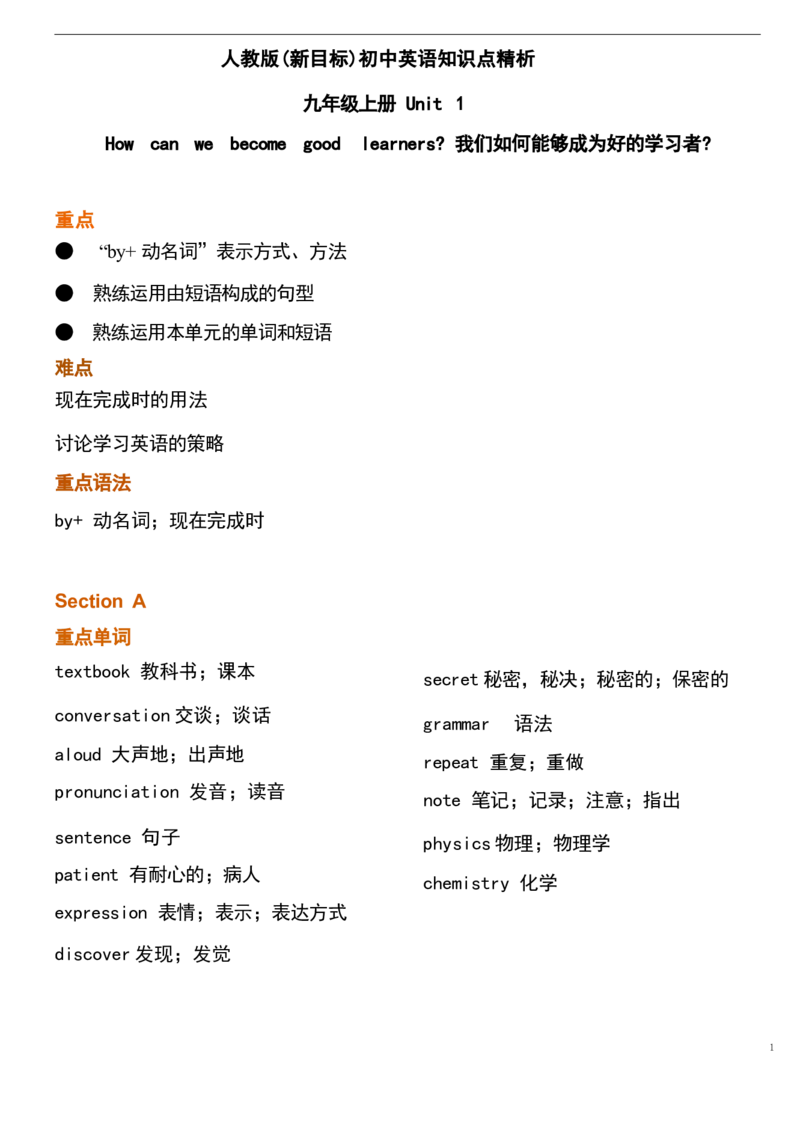
人教版(新目标)初中英语知识点精析
九年级上册 Unit 1
How can we become good learners? 我们如何能够成为好的学习者?
重点
● “by+ 动名词”表示方式、方法
● 熟练运用由短语构成的句型
● 熟练运用本单元的单词和短语
难点
现在完成时的用法
讨论学习英语的策略
重点语法
by+ 动名词;现在完成时
Section A
重点单词
textbook 教科书;课本
secret 秘密,秘决;秘密的;保密的
conversation 交谈;谈话
grammar 语法
aloud 大声地;出声地
repeat 重复;重做
pronunciation 发音;读音
note 笔记;记录;注意;指出
sentence 句子
physics 物理;物理学
patient 有耐心的;病人
chemistry 化学
expression 表情;表示;表达方式
discover 发现;发觉
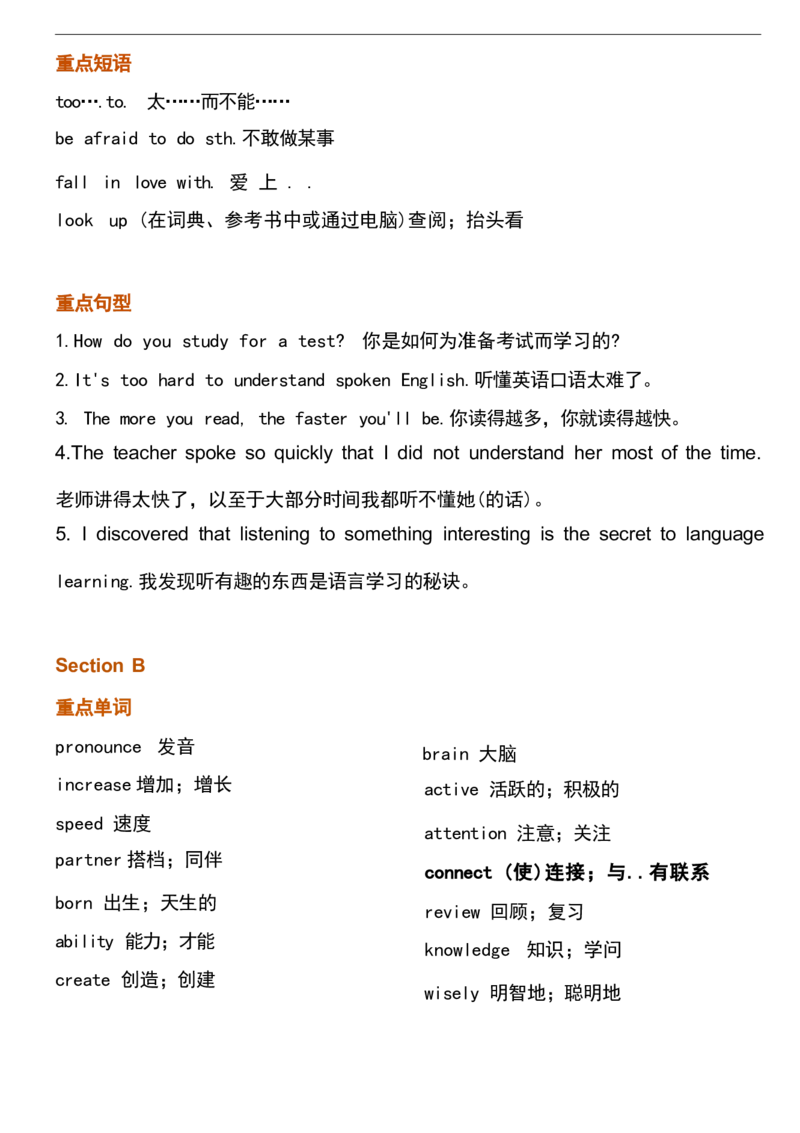
1重点短语
too….to. 太……而不能……
be afraid to do sth.不敢做某事
fall in love with. 爱 上 . .
look up (在词典、参考书中或通过电脑)查阅;抬头看
重点句型
1.How do you study for a test? 你是如何为准备考试而学习的?
2.It's too hard to understand spoken English.听懂英语口语太难了。
3. The more you read, the faster you'll be.你读得越多,你就读得越快。
4.The teacher spoke so quickly that I did not understand her most of the time.
老师讲得太快了,以至于大部分时间我都听不懂她(的话)。
5. I discovered that listening to something interesting is the secret to language
learning.我发现听有趣的东西是语言学习的秘诀。
Section B
重点单词
pronounce 发音
brain 大脑
increase 增加;增长
active 活跃的;积极的
speed 速度
attention 注意;关注
partner 搭档;同伴
connect (使)连接;与..有联系
born 出生;天生的
review 回顾;复习
ability 能力;才能
knowledge 知识;学问
create 创造;创建
wisely 明智地;聪明地重点短语
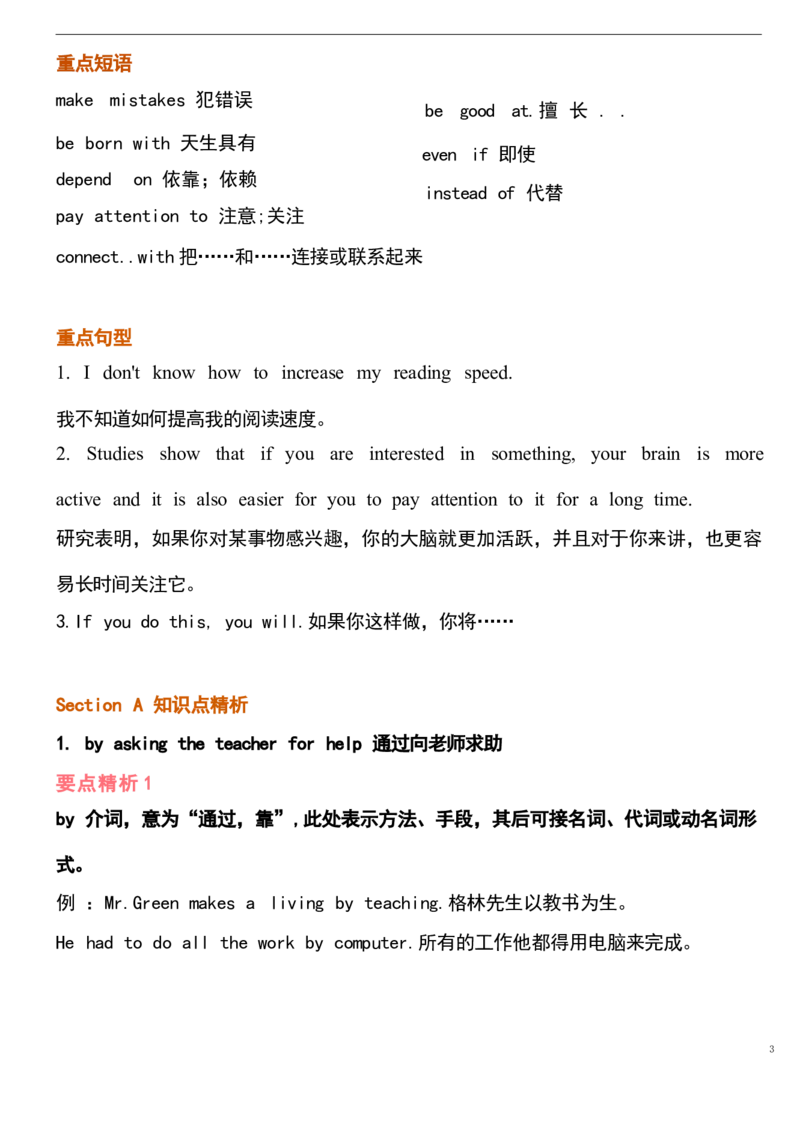
make mistakes 犯错误
be good at.擅 长 . .
be born with 天生具有
even if 即使
depend on 依靠;依赖
instead of 代替
pay attention to 注意;关注
connect..with 把……和……连接或联系起来
重点句型
1. I don't know how to increase my reading speed.
我不知道如何提高我的阅读速度。
2. Studies show that if you are interested in something, your brain is more
active and it is also easier for you to pay attention to it for a long time.
研究表明,如果你对某事物感兴趣,你的大脑就更加活跃,并且对于你来讲,也更容
易长时间关注它。
3.If you do this, you will.如果你这样做,你将……
Section A 知识点精析
1. by asking the teacher for help 通过向老师求助
要点精析 1
by 介词,意为“通过,靠”,此处表示方法、手段,其后可接名词、代词或动名词形
式。
例 :Mr.Green makes a living by teaching.格林先生以教书为生。
He had to do all the work by computer.所有的工作他都得用电脑来完成。
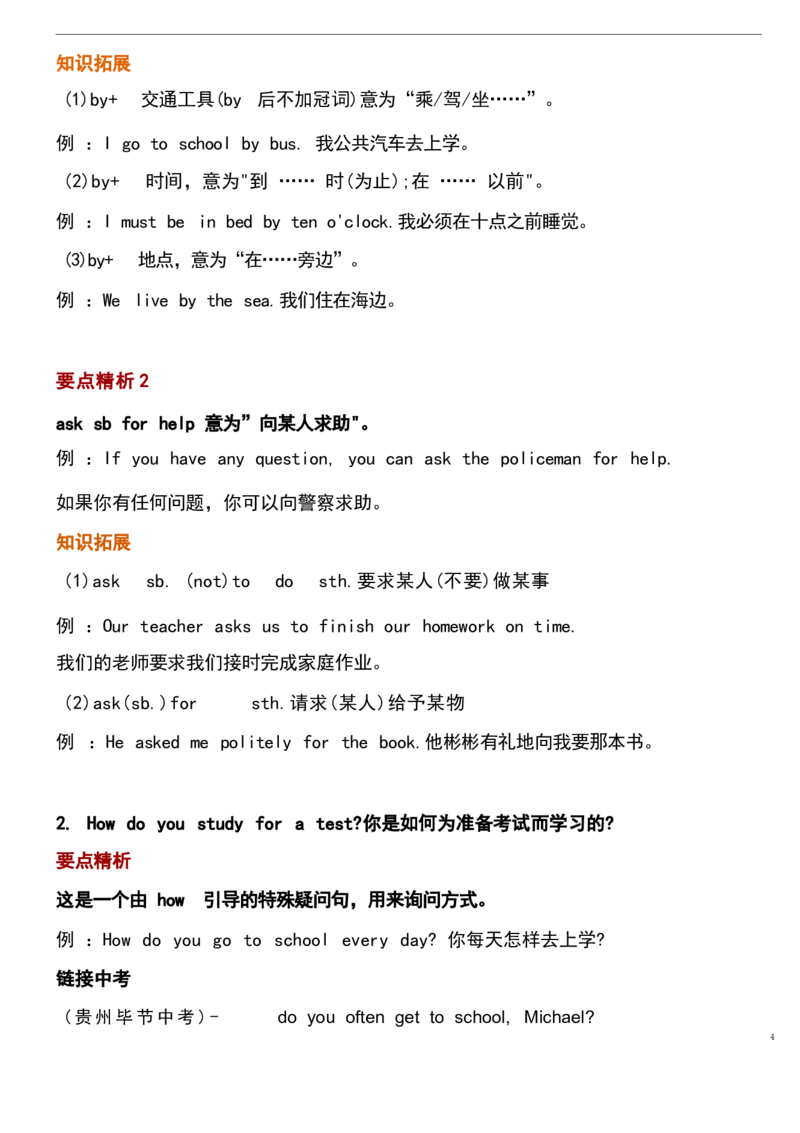
3知识拓展
(1)by+ 交通工具(by 后不加冠词)意为“乘/驾/坐……”。
例 :I go to school by bus. 我公共汽车去上学。
(2)by+ 时间,意为"到 …… 时(为止);在 …… 以前"。
例 :I must be in bed by ten o'clock.我必须在十点之前睡觉。
(3)by+ 地点,意为“在……旁边”。
例 :We live by the sea.我们住在海边。
要点精析 2
ask sb for help 意为”向某人求助"。
例 :If you have any question, you can ask the policeman for help.
如果你有任何问题,你可以向警察求助。
知识拓展
(1)ask sb. (not)to do sth.要求某人(不要)做某事
例 :Our teacher asks us to finish our homework on time.
我们的老师要求我们接时完成家庭作业。
(2)ask(sb.)for sth.请求(某人)给予某物
例 :He asked me politely for the book.他彬彬有礼地向我要那本书。
2. How do you study for a test?你是如何为准备考试而学习的?
要点精析
这是一个由 how 引导的特殊疑问句,用来询问方式。
例 :How do you go to school every day? 你每天怎样去上学?
链接中考
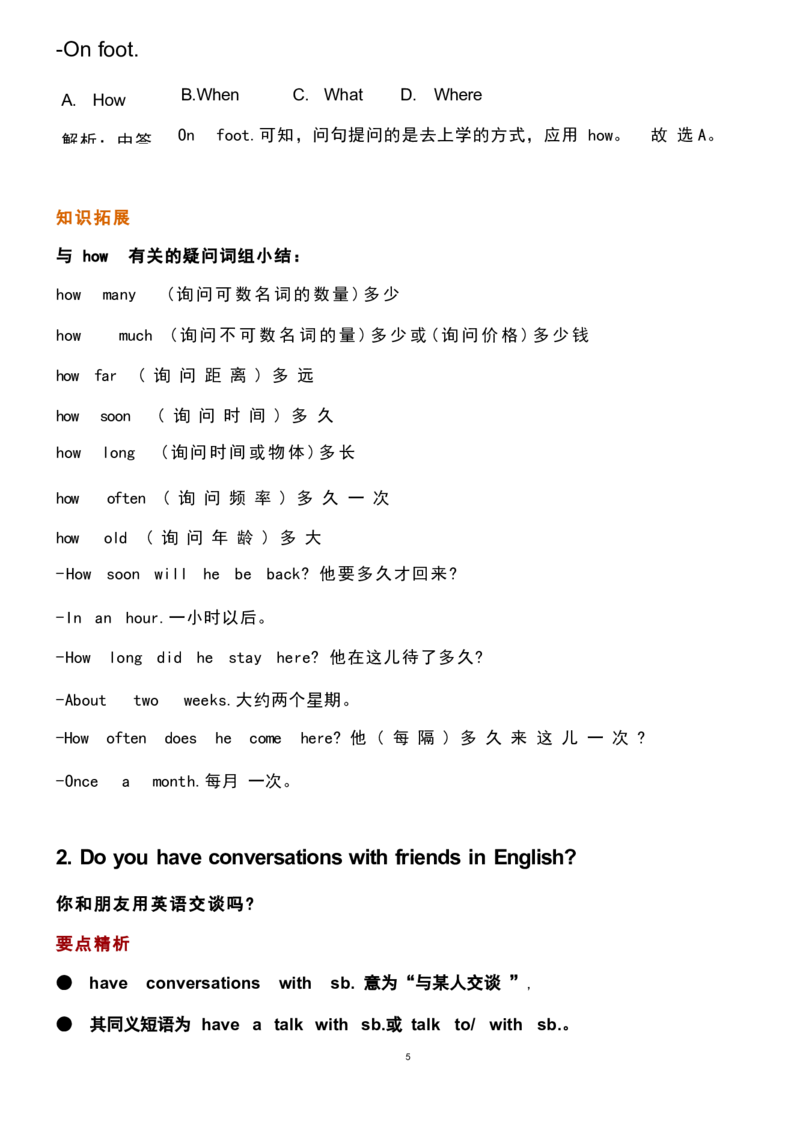
(贵州毕节中考)- do you often get to school, Michael?
4-On foot.
B.When C. What D. Where
A. How
On foot.可知,问句提问的是去上学的方式,应用 how。 故 选 A。
解析:由答
知识拓展
与 how 有关的疑问词组小结:
how many (询问可数名词的数量)多少
how much (询问不可数名词的量)多少或(询问价格)多少钱
how far ( 询 问 距 离 ) 多 远
how soon ( 询 问 时 间 ) 多 久
how long (询问时间或物体)多长
how often ( 询 问 频 率 ) 多 久 一 次
how old ( 询 问 年 龄 ) 多 大
-How soon will he be back? 他要多久才回来?
-In an hour.一小时以后。
-How long did he stay here? 他在这儿待了多久?
-About two weeks.大约两个星期。
-How often does he come here? 他 ( 每 隔 ) 多 久 来 这 儿 一 次 ?
-Once a month.每月 一次。
2. Do you have conversations with friends in English?
你和朋友用英语交谈吗?
要点精析
● have conversations with sb. 意为“与某人交谈 ”,
● 其同义短语为 have a talk with sb.或 talk to/ with sb.。
5例 :I had a long conversation with her the other day.
前几天,我与他作了一次长谈。
小贴士
conversation 可作可数名词,也可作不可数名词,意为"交谈;谈话"。
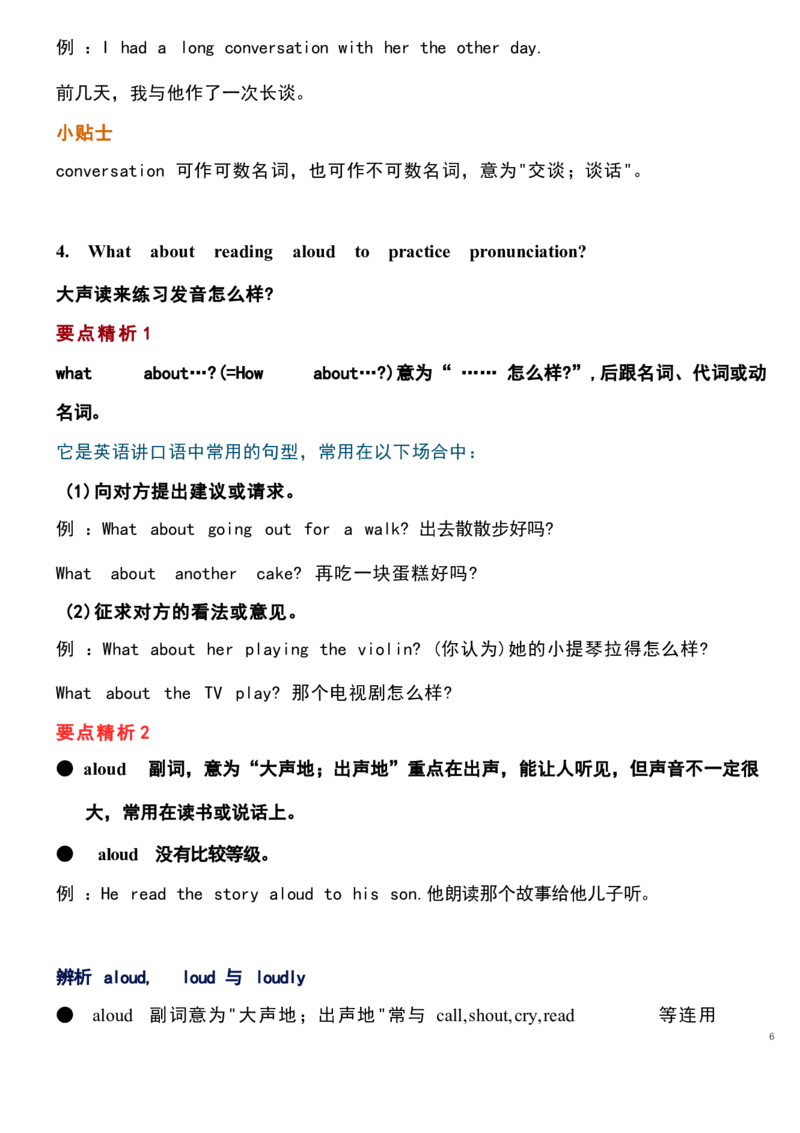
4. What about reading aloud to practice pronunciation?
大声读来练习发音怎么样?
要点精析 1
what about…?(=How about…?)意为“ …… 怎么样?”,后跟名词、代词或动
名词。
它是英语讲口语中常用的句型,常用在以下场合中:
(1)向对方提出建议或请求。
例 :What about going out for a walk? 出去散散步好吗?
What about another cake? 再吃一块蛋糕好吗?
(2)征求对方的看法或意见。
例 :What about her playing the violin? (你认为)她的小提琴拉得怎么样?
What about the TV play? 那个电视剧怎么样?
要点精析 2
● aloud 副词,意为“大声地;出声地”重点在出声,能让人听见,但声音不一定很
大,常用在读书或说话上。
● aloud 没有比较等级。
例 :He read the story aloud to his son.他朗读那个故事给他儿子听。
辨析 aloud, loud 与 loudly
● aloud 副词意为"大声地;出声地"常与 call,shout,cry,read 等连用
6● loud 形容词意为“大声的” 常与 noise,voice 等连用
● 副词意为“响亮地,高声地” 常与sing,talk,laugh,speak
等连用
● loudly副词意为“高声地”,含有“喧闹”的意味常与 ring,knock 等动词连用
例 :Please read the text aloud. 请朗读一下课文。
That music is too loud. Please turn it down.那音乐太吵了,请把音量调低一点儿。
Speak louder, please, or no one will hear you.请大声些,否则没有人能听见你
(说
话)。
Suddenly the bell on the wall rang loudly. 突然,墙上的铃大声地响起来。
要点精析 3
● pronunciation 名词,意为“发音;读音”,
● 其动词形式是 pronounce, 意为“发音;读(音)”。
例 :He is good at English. but his pronunciation is a bit poor.
他擅长英语,但他的发音有点儿不好。
I don't know how to pronounce the word.我不知道怎么读那个单词。
链接中考
(湖北十堰中考)-I am afraid to ask questions because of my poor
-You'd better practice speaking more.
B.inspiration
A. introduction
C. pronunciation
D. information
解析: introduction" 介绍"; inspiration" 灵感"; pronunciation “发音”;
information" 信息"。由下句"你最好练习口语"可知上句为”我害怕问问题,因
为
我的发音不好"。由语境及各选项含义可知选 C。
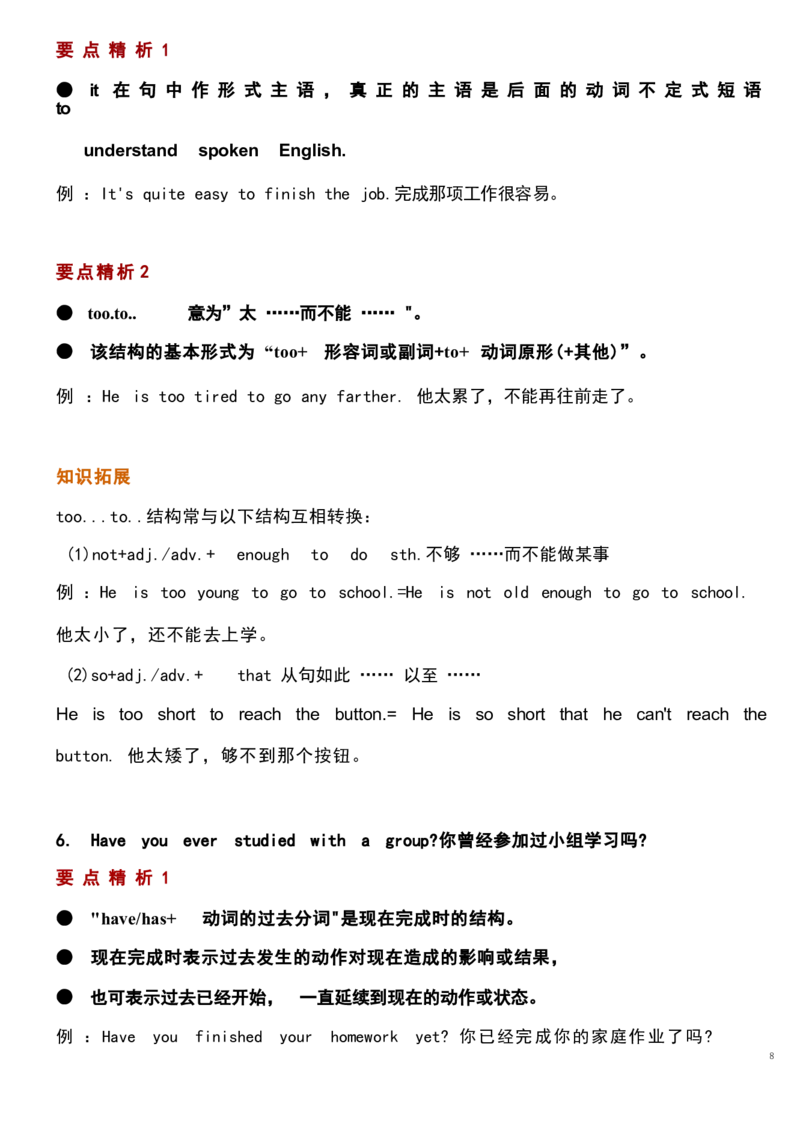
5.It's too hard to understand spoken English. 听懂英语口语太难了。
7要 点 精 析 1
● it 在 句 中 作 形 式 主 语 , 真 正 的 主 语 是 后 面 的 动 词 不 定 式 短 语
to
understand spoken English.
例 :It's quite easy to finish the job.完成那项工作很容易。
要点精析 2
● too.to.. 意为”太 ……而不能 …… "。
● 该结构的基本形式为 “too+ 形容词或副词+to+ 动词原形(+其他)”。
例 :He is too tired to go any farther. 他太累了,不能再往前走了。
知识拓展
too...to..结构常与以下结构互相转换:
(1)not+adj./adv.+ enough to do sth.不够 ……而不能做某事
例 :He is too young to go to school.=He is not old enough to go to school.
他太小了,还不能去上学。
(2)so+adj./adv.+ that 从句如此 …… 以至 ……
He is too short to reach the button.= He is so short that he can't reach the
button. 他太矮了,够不到那个按钮。
6. Have you ever studied with a group?你曾经参加过小组学习吗?
要 点 精 析 1
● "have/has+ 动词的过去分词"是现在完成时的结构。
● 现在完成时表示过去发生的动作对现在造成的影响或结果,
● 也可表示过去已经开始, 一直延续到现在的动作或状态。
例 :Have you finished your homework yet? 你已经完成你的家庭作业了吗?
8链接中考
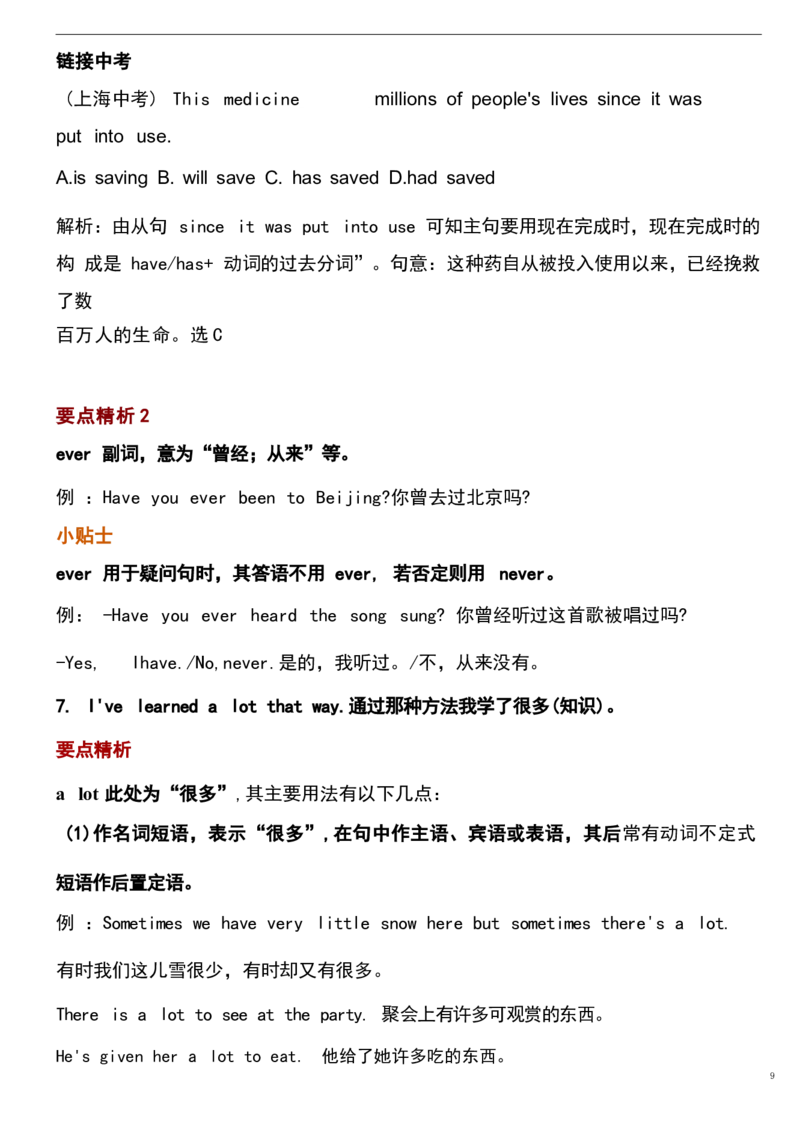
(上海中考) This medicine millions of people's lives since it was
put into use.
A.is saving B. will save C. has saved D.had saved
解析:由从句 since it was put into use 可知主句要用现在完成时,现在完成时的
构 成是 have/has+ 动词的过去分词”。句意:这种药自从被投入使用以来,已经挽救
了数
百万人的生命。选 C
要点精析 2
ever 副词,意为“曾经;从来”等。
例 :Have you ever been to Beijing?你曾去过北京吗?
小贴士
ever 用于疑问句时,其答语不用 ever, 若否定则用 never。
例: -Have you ever heard the song sung? 你曾经听过这首歌被唱过吗?
-Yes, Ihave./No,never.是的,我听过。/不,从来没有。
7. I've learned a lot that way.通过那种方法我学了很多(知识)。
要点精析
a lot 此处为“很多”,其主要用法有以下几点:
(1)作名词短语,表示“很多”,在句中作主语、宾语或表语,其后常有动词不定式
短语作后置定语。
例 :Sometimes we have very little snow here but sometimes there's a lot.
有时我们这儿雪很少,有时却又有很多。
There is a lot to see at the party. 聚会上有许多可观赏的东西。
He's given her a lot to eat. 他给了她许多吃的东西。
9(2)作副词短语,在句中作程度状语,表示“很;非常;常常”,修饰动词、
感叹词、介词短语、形容词或副词的比较级。
例 :It usually rains a lot at this time of year.每年这个时候通常都下雨。(修饰动
词
rains)
Do you wear your new watch a lot? 你常戴你的新手表吗?(修饰动词 wear)
Thanks a lot/ very much.多谢/十分感谢. (修饰感叹词 thanks, thanks= thank
you)
小贴士
a lot 前可被 such, what, quite,rather修饰。
例 :I like him quite a lot.我非常喜欢他。
How much money is left?还剩下多少钱?
Rather a lot.相当多。
8.I have to finish reading a book and give a report next Monday.我必须读完
一本书并且在下周一做个报告。
要点精析
● finish 动词,意为“完成,结束”。
● finish doing sth. 意为“做完某事”。
例 :If you finish reading the book, you must return it on time.
如果你看完这本书,你必须按时归还。
知识链接
只接动词 ing 形式作宾语的其他常考动词(短语):
1. enjoy doing sth. 喜欢做某事
2. practice doing sth.练习做某事
103.mind doing sth.介意(反对)做某事
4. spend.. ( in)doing sth.花费……做某事
5.keep doing sth.继续做某事;不停地做某事
6.be busy doing sth.忙着做某事
7. be worth doing sth.值得做某事
8.feel like doing sth. 想要做某事
9. can't help doing sth.情不自禁做某事
10.keep sb.doing sth.让某人一直做某事
11.Give up doing sth. 放弃做某事
12.put off doing sth.推迟做某事
13.be used to doing sth. 习惯于做某事
14. look forward to doing sth.期待做某事
方法技巧
常跟动词-ing 形式的动词及短语
● 完成,练习,盼望,忙( finish, practice , look forward to, be busy);
● 考虑,建议,不禁,想 (consider,suggest, can't help ,feel like);
● 错过,习惯,(别)放弃 (miss, be used to, give up);
● 继续,喜欢,(要)介意(keep on,enjoy,mind)。
9. That doesn't sound too bad.那听起来不是很糟糕。
要点精析
sound 在此处作连系动词,意为“听起来;听上去”,常接形容词或名词作表语。
例 :This piece of music sounds beautiful. 这段音乐听起来很美妙。方法技巧
11方法技巧
英语中常用的连系动词
一是 (be), 一 感 (feel), 一保持
四个起来( sound, look, smell, taste),
(keep),
任。
好像 (seem) 变了 (get,turn,become)
知识拓展
sound 还可用作名词,意为“声音”,指自然界的一切声音。
例 :At midnight he heard a strange sound. 半夜里,他听到一种奇怪的声音。
链接中考
(山东济南中考)-Do you like the songs by Taylor?
-Yes. Country music nice and full of feelings.
A. sounds B. listens C. hears D.looks
解析: sound 意为“听起来”,为连系动词; listen 意为"听",为实意动词; hear
意 为“听见;听到”,为实意动词; look 意为“看;看上去”,既可作实意动词,也
可作 连系动词。由空格后的 nice and full of feelings 可知,此处缺少连系动词,
故排除
B.C; 由该句的主语 country music可推知,不能是“看起来”,排除 D 项。故选 A。
10. You probably understand more than you think.
你理解的可能比你认为(能理解)的要多。
要点精析
● Probably 副词,意为“大概;很可能”,可以放在句首、句中或句末;
在句中时,通常放在实意动词之前,助动词或连系动词之后,但在否定句中,不能●
紧跟在否定词之后。
例 :Probably she won't come here.=She won't come here probably.=She
probably won't come here.她很可能不会来这里
12She won't probably come here.(X)
11. The more you read, the faster you'll be.你读得越多,你就读得越快。
要点精析
"the+ 比较级, the+ 比较级"意为“越 ……越 …… ”,表示一方的程度随着另一方的变
化而变化。
例 :The more you practice, the better you can understand.你练习得越多,理解
得就越透彻。
链接中考
(湖北黄石中考)The more junk food you eat, healthy you will be.
A. the less B. the more C. more D.less
解析:这里考查"the+ 比较级, the+ 比较级”这一固定句式。由句意“你吃的垃圾食
品越多你的身体越不健康。”可知选 A。
12.Why did Wei Fen find it difficult to learn English? 为什么魏芬发现学习英
语很难?
要点精析
● 当动词不定式(短语)、动名词或从句用作宾语,且其后跟有宾语补主语时,常用
it 作形式宾语,而真正的宾语移至句末。
● 这种用法的动词有 think,find, believe,make 等。
例 :I think it difficult to get there on time.我认为按时到达那里很难。
Tim finds it difficult to concentrate. 蒂姆觉得很难使注意力集中。
13. The teacher spoke so quickly that I did not understand her most of the
time. 老师讲得太快了,以至于大部分时间我都听不懂她(的话)。
13要点精析
so.that …,
意为“如此……以至于……”,that 引导一个结果状语从句。
例 :He was so tired that he couldn't go any farther.
他如此疲劳,以至于他不能再往前走了。
I was so excited that I could not sleep.我如此兴奋以至于睡不着觉!
知识拓展
so.that… 和 such.that… 都表示“如此……以至于……”。so…that… 中的 so 是
副 词,后面需跟形容词或副词; such..that… 中的 such 为限定词,其后需接名词,
而且
名词前可以有形容词修饰。
例 :He became so angry that he couldn't speak.
他变得很生气,以至于说不出话来。
He is such a clever boy that everybody likes him.
他是个如此聪明的男孩儿,以至于大家都非常喜欢他。
链接中考
(黑龙江齐齐哈尔中考) We had awful weather We
couldn't finish the work on time.
A. so; that B. such; that C. such an; that
解析:句意:天气如此糟糕,以至于我们不能接时完成工作。 so 和 such 都是"如此",
so 修饰形容词或副词, such 修饰名词,根据句子中的不可数名词 weather 可知
用
such..that…选 B。
14. I was afraid to ask questions because of my poor pronunciation.
因为我糟糕的发音,我不敢问问题。
要点精析 1
14be afraid to do sth. 意为“不敢做某事”,指的是按照经验或常识不敢去做某
事,或没有勇气去做某事。
例 :He is afraid to ask the teacher questions.他不敢问老师问题。
知识拓展
● beafraid of doing sth. 主要用来谈论一件自己(指句子主语)不希望,却可能
突然发生的事,这种事可能发生也可能不发生,只是自己有这样一种担心(即担心
发生)。
● 此时不能用 be afraid to do sth. 结构。
例 :She was afraid of waking her husband.她怕吵醒地的丈夫。
I was afraid of hurting his feelings. 我怕伤害他的感情。
【助记】
be afraid of falling 害怕掉下去
要点精析 2
because of 意为“因为,由于”, because of 后接代词、名词(性短语)或动词-ing
形式。
例 :She doesn't go to school because of her illness. 她病了,所以没有去上学。
辨析 because of与 because
● because of介词短语,不能引导从句,其后一般跟名词(性短语)、代词或动词-ing
形式
● because 连词,通常是说话人用来陈述理由或原因,后接句子
例 :We didn't go on a picnic because of the rain.=We didn't go on a picnic
because it rained. 因为下雨我们没有去野餐。
1515.I fell in love with this exciting and funny movie.
我爱上了这部令人兴奋而又有趣的电影。
要点精析 1
fall in love with.. 意为“爱上 …… “强调动作,不可与表示一段时间的状语连用。
例 :They fell in love with each other. 他们彼此相爱了。
I fell in love with this place. 我喜欢上了这个地方。
知识拓展
be in love with sb./sth.意为“与某人相爱/喜爱某物”,表示状态,可与表示一段时
间的状语连用。
例 :They have been in love with each other for ten years.他们已经相爱十年了。
要点精析 2
exciting 意为“使人兴奋的,使人激动的”,常作定语或表语,作表语时主语通常是物。
例 :He told me the exciting news.他告诉了我这个令人兴奋的消息。
知识拓展
● 由动词加上-ed 或-ing 构成的形容词有很多。
●一般来说, -ed 形式的形容词描述的是人受到某物的影响而表现出来的状态;
● -ing 形式的形容词描述事物本身具有的特性。
16这样的单词常见的还有:
动词 -ed形容词 ing形容词
interesting
interest interested
使感兴趣 感兴趣的 有趣的
surprise surprised surprising
使惊奇 吃惊的,惊奇的 令人吃惊的,令人惊奇的
amazing
amaze amazed
使大为惊奇 惊奇的,惊讶的 今人惊讶的
relax relaxed relaxing
(使)放松 使人放松的
放松的
embarrass embarrassed embarrassing
使尴尬 尴尬的 令人尴尬的
boring
bore bored
使厌烦 厌倦的,烦闷的 令人厌烦的,无聊的
16.Although I could not understand everything the characters said,
their body language and the expressions on their faces helped me to
get the
meaning.
尽管我不能完全理解(电影中)人物所说的话,但是他们的肢体语言和脸上的表情能
帮助我理解(他们的)意思。
要点精析
● Although 从属连词,意为“虽然;尽管”与 though 同义。
● although 引导的让步状语从句可以放在主句之前,也可以放在主句之后。
例 :Although he was tired, he went on working. 他虽然很累了,但还是继续工作。1He often helps me with my English although he is quite busy.
他尽管非常忙,但是常常帮我学英语。
知识拓展
although 引导的从句不能与连词 but,and,so 等连用,但可以和 yet,still 等词连
用。
例 :Although the book was old, we decided to buy it.
尽管这本书很旧,但我们还是决定买它。
Although he has a lot of money, yet/still he is unhappy.
他虽然有很多钱,但并不幸福。
链接中考
(福建福州中考) my cousin is very young,
she can help with the housework.
A.Once; 不填 B. Though: but C.Although;不 填
解析:结合题干和选项可知句意为"尽管我表妹很小,但地能帮着做家务"。
though/although 意为“尽管”,与 but (但是)不能同时出现在同一个句子中,排
除
B 项;而 once 意为"曾经, 一旦",不符合题意,故选 C。
17. I discovered that listening to something interesting is the secret to
language learning. 我发现听有趣的东西是语言学习的秘诀。
要点精析 1
本句是一个复合句, that 引导宾语从句,在宾语从句中, listening to something
interesting 是动名词短语作主语,因此,谓语动词用单数形式。
例 :I discovered that learning English is very useful. 我发现学习英语很有用。
18要点精析 2
discover 动词,意为“发现;发觉”。
例 :We discovered this beach while we were sailing around the island.
我们围绕这个海岛航行时,发现了这个海滩。
辨析 discover 与 invent
● discover 较为正式,指第一次发现原本就存在的只是过去不曾被人知晓的事物
● invent 指创造出原来不存在的东西
例 :Columbus discovered America in1492.哥伦布在 1492 年发现了美洲。
Watt invented the steam engine.瓦特发明了蒸汽机。
【助记】
discover 发现 invent 发明
要点精析 3
secret 可数名词,意为“秘密;秘诀”。
例: -How old are you, lady? 女士,你多大年纪了?
-Oh,it's a secret.哦,它是一个秘密。
18. I also learned useful sentences like "It's a piece of cake" or "It serves
you right".
● 我还学会了些有用的句子,像"It's a piece of cake (这简直是小菜一碟)",还有
"It serves you right (你自作自受)"。
要点精析
● also 意为“也”,在这里用于实意动词之前。
例 :They also agree with me.他们也同意我的看法。
I also began to be interested in sports.我也开始对运动感兴趣。
19辨析 also,as well/too 与 either
● also 意为”也",一般用于肯定句中。常用实意义动词之前,助动词、 be 动
词或情态动词之后
● as well/too 意为”也”,常用于口语中,且多用于肯定句的末尾。
● as well 前面不加逗号,而 too 前面一般用逗号隔开(有时也可不加)
● either 意为“也(不),一般只用于否定句句末
You need to go shopping and I also need to go shopping.=You need to go
shopping and I need to go shopping, too.=You need to go shopping and I
need to go shopping as well.你需要去购物,我也需要去购物。
例 :Peter can't go and I can't either.彼得不能去,我也不能。
19. But because I wanted to understand the story, I looked them up in a
dictionary. 但是,因为我想理解这个故事,所以我在词典中查阅了它们。
要点精析
● look up 意为“(在词典、参考书中或通过电脑)查阅;抬头看”。
● look up后跟代词作宾语时,代词要放在 look 与 up 中间。
例 :When you don't know how to pronounce a new word, you should look it up
in a dictionary.当你不知道生词怎么读时,你应当在词典中查阅它。
She looked up and saw many birds in the sky.她抬起头来,看到许多鸟儿在空中。
小贴士
● 短语动词的宾语为代词时,代词的位置:短语动词如果由“动词+副词”构成,则
代词置于动词和副词之间;
● 如果由“动词+介词”构成,则代词置于介词之后。
● throw it away 把它扔掉 look at me 看着我
20.How do you practice speaking?你如何练习口语?
20要点精析
● Practice
此处用作及物动词,意为”练习”,其后可接名词、代词或动词-ing
形式。
● practice
还可作名词,意为”练习"。
例 :I need to practice more.我需要多加练习。
Listen! Someone is practicing playing the piano.听!有人在练习弹钢琴。
Practice makes perfect.熟能生巧.
21. By taking notes, doing exercises and reading a lot.
通过记笔记、做练习和大量阅读。
要点精析 1
take notes 意为“记笔记;做记录”,同义短语为 make notes。
例 :It's a good habit to take/make notes in class.在课堂上记笔记是个好习惯。
要点精析 2
exercise 可数名词,意为”练习;习题"。
例 :He doesn't know the answers to the two exercises.
他不知道这两道练习题的答案。
知识拓展
exercise 可数名词,意为"(一套)动作,体操"。
例 :Doing morning exercises is good for our health.做早操对我们的健康有益。
22. memorizing sentence patterns 记忆句型
要点精析
● memorize 及物动词,意为“记忆;记住”相当于 remember。
21● memorize 的名词形式为memory, 意为“记忆;记忆力”。
例 :He memorized the number of that car.他记住了那辆小汽车的车牌号。
即学即试
用所给动词的适当形式填空
1.Why don't you join an English club to practice (speak)English?
2.I study by (have)conversations with friends.
3. It is so hot. What about (go)swimming with us?
4. Don't be afraid of (ask)if you don't understand.
5. I haven't finished (do)my homework yet.
单项填空
1.Yao Ming is famous t he basketball fans in China know him.
A. too; to B. enough; to C.so; that D. as; as
2. I don't know how to pronounce the word. Could you please help me
on the Internet?
A. look up it B. look it up C.look at it D.look it at
3. The little boy is young. d ress
himself. A. enough; to B. so; that
C. such; that D. too; to
4. The more you smile, the you will feel.
A. happy B. happier C. happily D. more happily
5. Mike didn't win the race, he was still wearing a smile on his face
A. If B.Since C. Although D. Because
22Section B 知识点精析
1. I can't always understand spoken English.我并非总是能听懂英语口语.
要点精析
● not always 意为“不一定总是;未必总是”。
● 当 not 与 always,both,all,everyone,everything 等词连用时,表示部
分否定。
例 :Those who have lots of money are not always happy.
有钱人不一定总是幸福的。
Not everyone likes the film.并非人人都喜欢这部电影。
2.I don't know how to increase my reading speed.
我不知道如何提高我的阅读速度。
要点精析 1
● 此句中的 how to increase my reading speed 是“疑问词+动词不定式”结构,
在句中作 know 的宾语。
● 疑问代词 what,which,who 和疑问副词 when,where,how 等后面可接动
词不定式,常放在tell show ,teach ,learn ,know, wonder, discuss, remember,
forget, find out 等及物动词(词组)之后作宾语。
例 :The young woman doesn't know what to do.那位年轻女子不知道该做什么。
知识拓展
“疑问词+动词不定式”在句中还可以作主语或表语。
例 :When to start depends on the weather.何时动身视天气而定。
The problem is how to get there in the shortest time.问题是如何在最短的时间内
赶到那里。
23链接中考
(四川自贡中考) I really don't know this question. It is too hard.
A. which to answer B. how to answer C. what to answer
解析:由句意“我真的不知道如何回答这个问题,它太难了。”可知,表示“如何回答”
用 how to answer。 故 选 B。
要点精析 2
increase 动词,意为“增加;增长”,既可作及物动词,也可作不及物动词。
例 :Food prices increased a lot.食品价格上涨了很多。
辨析 increase by..与 increase to..
increase by.意为"增长了 … … ",by 后常跟百分数、倍数等,表示增幅
increase to…意为"增长到 … … ",to 后常跟具体数字
例 :The production of iron increased to 120 million tons , which means it
increased by 20%.铁产量增加到一亿两千万吨,这意味着它增长了 20%。
3.I often make mistakes in grammar. 在语法方面我经常犯错误。
要点精析 3
● make mistakes= make a mistake, 意为"犯错误;出错"。
● make mistakes in …意为"在 …… 犯错或出错"。
例 :I often make mistakes in spelling. 我经常犯拼写错误。
Many people can make mistakes in their life.生活中许多人都可能犯错误。
3. I don't know enough words to write well.
我认识的单词不够多,不能把作文写好。
24要点精析
● enough
在这里作限定词,意为“足够的,充分的”,常与介词 for 或动词
不定式连用,可以作定语或表语。
● 作定语置于被修饰的名词前后均可,前置时强调 enough, 后置时强调被修饰词。
例 :Five men will be quite enough. 五个人就足够了。
I don't have enough money with me.我身上没有足够的钱。
知识拓展
(1)enough
作代词,意为“足够,充分”,在句中作主语或宾语。
例 :Enough has been said on this subject.关于这一话题说得已经够多了。
No ,thanks. I've had enough.不用了,谢谢。我已经吃饱了。( enough= enough
food)
(2)enough 作副词,意为“十分;充分地;相当;充足地”,置于被修饰的形容词
或副词之后,常与动词不定式或介词 for 连用,在句子中作状语,表示程度。
例 :He is rich enough to buy a plane.他很有钱,可以买一架飞机。
链接中考
(江苏盐城中考) Audrey Hepburn one of the greatest actresses, was
to
take on challenges in her life.
A. enough brave B. brave enough
C. stupid enough D.enough stupid
解析:句意:奥黛丽 · 赫本,最伟大的女演员之一,足够勇敢面对生活中的挑战。表
示“勇敢的”用 brave; enough修饰形容词时要放在形容词之后。故选 B。
5. Maybe you should join an English club.也许你应该加入一个英语俱乐部。
要点精析
25join 动词,意为“加入”
例 :join a math club 加入一个数学俱乐部
辨析 join, take part in 与 attend
● join 意为“参加,加入”,表示加入某一党派团体或群众性组织,并成为其中一员
● take part in 意为“参加”,指参加群众性的活动,如会议、竞争、运动、斗争等,
强调参加并积极参与某项活动
● attend 意为“出席;参加”,指参加会议或仪式婚礼、典礼、上课、上学等,强调
的是这动作的本身,而不强调参与者在活动中起作用
例 :He joined the English club last year.他去年加入了这个英语俱乐部。
Everyone can take part in this game.每个人都可以参加这个游戏。
Did you attend his last lecture?你听他上次讲座了吗?
6. Everyone is born with the ability to learn.每个人天生具有学习的能力。
要点精析 1
be born with sth.意为“天生具有某物”,常指生来就具有某种性格、天分或患有某
种疾病等。
例 :He was born with a gift for languages. 他天生具有语言天赋。
The girl was born with heart disease. 这个女孩儿生来就有心脏病。
知识拓展
(1)be born意为"出生",当说明某人的出生情况时, be 动词通常用 was 或 were。
I was born in2003.我出生于 2003 年。
(2)born 还可作形容词,意为“天生的”,只用于名词前作定语。
She was a born musician.她是一个天生的音乐家。要点精析 2
ability名词,意为“能力;才能”,其后常跟 to do sth.,表示“做某事的能
力"。
例 :She has the ability to speak French fluently.她能够流利地说法语。
7.But whether or not you can do this well depends on your learning habits.
但是,你是否能把这做好取决于你的学习习惯。
要点精析 1
● whether or not 是英语中的一个连词结构,常出现在主语从句或宾语从句中。
● 也可以说 whether …or not,or not 放在句末。
例 :It remains to be seen whether or not this idea can be put into practice.
这一想法能否付诸实践还有待观察。
知识拓展
whether 和 if 都可以引导实语从句,表示“是否”,在口语引语中两者可以呼唤使用。
例 :I wonder If/whether I can get some advice from you.
我想知道我是否能从你那儿得到一些建议。
Ask him whether/if he can come. 问问他是否能来。
但在有些情况下, whether 和 if的用法有一定区别:
(1)whether 引导的从句常可以与or 或 or not连用,而if一般不能。
正: Let me know whether you can come or not.
误:Let me know if you can come or not.
(2)当宾语从句提到句首时,只能用 whether 引导,而不能用 if。
正:Whether it is true or not, I can't tell.
误:If it is true or not, I can't tell.
27(3)whether 后可以接动词不定式, if则不能。
正:I don't know whether to accept or refuse.
误: I don't know if to accept or refuse.
要点精析 2
● depend on 意为”依靠;依赖;视……而定;取决于”,其后可接名词、代词、动
词-ing 形式或从句。
例 :You can't depend on your parents forever.你不能永远依赖你的父母。
Whether the game will be played depends on the weather.
比赛是否举行要视天气而定。
● depend on 既不能用于进行时态,也不能用于被动语态。
链接中考
(江苏南京中考)It's important for us to protect nature because we its rich
resources to live.
A. depend on B.leave for C. give up D.lead to
解析;句意:对于我们来说保护大自然很重要,因为我们依靠它丰富的资源而生存。
表示“依靠”用 depend on。 故选A。
8. Studies show that if you are interested in something, your brain is
more active and it is also easier for you to pay attention to it for a long
time. 研究 表明,如果你对某事物感兴趣,你的大脑就更加活跃,并且对于你来讲,
也更容易长
时间关注它。
要点精析 1
be interested in…意为“对 …… "感兴趣”,相当于 take an interest in…。
例 :He is interested in music and painting.他对音乐和绘画感兴趣。
28Edison was interested in inventing. 爱迪生对发明感兴趣。
辨析 interested 与 interesting
● interested 意为“对……感兴趣的”,主语通常是 interested 人,且多用于 be(
get, feel,become )interested in 结构中
● interesting 是形容词,有主动意味,意为“有趣的”,作表语时,主语通常是物;
作定语时,既可修饰人,也可修饰物
例 :Even before he was ten, he became interested in science.
甚至十岁之前,他就对科学产生了兴趣。
The story is very interesting. 这个故事很有趣。
【助记】
→ is interested in+物
物→is interesting
链接中考
(贵州铜仁中考)-There is something in today's newspaper.
-Really? Wow, great!
A. interesting B. interested C. interest D.interests
解析:句意:"在今天的报纸上有一些有趣的事情。" “真的吗?哇,太棒了!”修饰
不定代词 something 应用形容词,故排除 C、D 两项; interested 意为“感兴趣
的”
常修怖人,而 Interesting 意为“有趣的”,常修饰物。故选 A。
要点精析 2
It is+形容词+of/for sb.+ to do sth.
(1)若形容词是描述不定式行为者的性格、品质的,如 kind,good, nice, right,
wrong, clever, careless, polite ,foolish 等,用 of sb.
29例 :It's kind of you to help me.你真善良能帮助我。
(2)若形容词是描述事物特征或特点,而不是对不定式行为者的品质或性格进
行评价,用 for sb.,这类形容词有 difficult ,easy ,hard ,important ,dangerous,
(im)possible, necessary等。
例 :It is necessary for us to drink plenty of water.
对我们来说,喝大量的水是有必要的。
9. For example, if they need to learn English and they like music or sports,
they can listen to English songs or watch sports programs in English.
例如,如果他们需要学习英语,并且他们喜爱音乐或运动,他们会听英文歌曲或观看
英文体育节目。
要点精析
for example 意为“例如”,与 such as 意思相近。
例 :For example, air is invisible.例如,空气是看不见的。
辨析 for example 与 such as
● for example作“例如”讲时, 一般只以同类事物或人中的“一个”为例,作插
入 语,用逗号隔开,可置于句首、句中或句末
● such as“例如”讲,用来列举同类人或事物中的几个例子
He, for example, is a good student.例如,他就是一个好学生。
Some of the European languages come from Latin such as French , Italian and
Spanish. 有些欧洲语言来源于拉丁语,例如,法语、意大利语和西班牙语。
10.Good learners think about what they are good at and what they need to
practice more.
好的学习者考虑什么是他们擅长的和什么是他们需要更多练习的。
30要点精析
be good at..意为“擅长……”相当于 do wellin…。
例 :He is good at singing and dancing. 他擅长唱歌和跳舞。
知识拓展
be good for “对 ……有好处”,其反义短语是 be bad for"对.…有害"。
Reading in the sun isn't good for our eyes.=Reading in the sun is bad for our
eyes. 在阳光下看书对我们的眼睛有害。
11. Even if you learn something well, you will forget it unless you use it.
即使有些东西你学得很好,除非你使用它,否则你将会忘记。
要点精析 1
even if 意为“即使;尽管”,用来引导让步状语从句,相当于 even though。
例 :Even if it's raining, we go for a walk every day. 即使下雨,我们还是每天散步。
小贴士
even if/though 不能与连词 but 用在同一个句子中,但可以与 yet,still等副词连用。
与 although/ though引导让步状语从句的用法类似。
要点精析 2
unless 意为“除非,如果不”,引导条件状语从句,相当于 if…,not…。
例 :Don't play unless you finish your work.不要玩,除非你把工作做完了。
He will go to play the game unless he is ill tomorrow.
他将参加这场比赛,除非他明天病了。
小贴士
unless 引导的从的通常放在主句之后,也可以放在主句之前。当主句用一般将来时或
是祈使句时, unless 从句用一般现在时。
31链接中考
(江苏镇江中考)-Does your school hold the raising of the national flag
every Monday morning?
-Yes. it rains heavily.
A. if B. since C. because D.unless
解析:句意:“每周一早上你学校举行升旗仪式吗?""是的,除非下大雨。”表示“除
非”用unless。 选 D。
12.If you do this, you will...你如果这样做,将. …
要点精析
这是一个复合句。在含有 if引导的条件状语从句的主从复合句中,若主句用一般将来
时,则从句用一般现在时表示将来。
例 :If it rains tomorrow, I'll stay at home.如果明天下雨,我将待在家里。
链接中考
(重庆中考) Stop smoking,Joe!You yourself if you keep on doing it like
that!
A. will kill B. have killed C.kill D. killed
解析:句意:乔,戒烟吧!知果你继续那样做你会害死你自己的。在含有 if引导的条
件状语从句的主从复合句中,从句用一般现在时表将来,主句应用一般将来时。故选 A。
13.Remember to take notes in class and review them on your own or with
friends after class.记得在课堂上记笔记,课后自己或和你的朋友一起复习它们。
要点精析 1
remember to do sth.意为“记得去做某事(此事还未做) ”。
例 :Please remember to turn off the lights when you leave. 你离开时请记得关灯。知识拓展
例 :remember
doing sth.记得做过某事(此事已经做了)
I remember turning off the lights when I left home.出门时,我记得把灯关了。
链接中考
(贵州黔东南州中考) I remember to Beijing when I was a child.
A. to take B.taking C.to be taken D. being taken
解析:句意:我记得当我还是个孩子的时候被带到北京过。"记得做过某事"用
remember doing sth.,排除 A、C 两项;又因 take 与 I 之间为逻辑上的动宾关
系,
故用被动式。故选 D。
要点精析 2
on one's own 意为“独自;独立地”在句中作状语。
例 :Although her father was in the firm. she got the job on her own.
尽管她父亲在这家公司里,但她那份工作却是靠自己得到的。
14. Try to study and remember information bit by bit instead of w aiting
until the last minute to study everything at once.
尽量一点一点地学习并且记住信息,而不是直到最后一分钟才马上学习一切。
要点精析 1
try to do sth.意为“尽力做某事”强调付出努力,但不一定成功。
Please try to finish this work in thirty minutes. 请尽量在 30 分钟内完成这项工作。
知识拓展
try doing sth.表示“尝试做某事”,含有看结果如何之意。
例 :Why didn't you try riding a bike to go to school?
你为什么不试着骑自行车去上学呢?
33【助记】
try to do sth. 尽力做某事
try doing sth. 尝试做某事
要点精析 2
instead of 是介词短语,意为“代替;而不是”,后面可跟名词、代词或动词-ing 形
式。
例 :We'l ask Li Mei instead of Mary. 我们将去问李梅而不问玛丽。
知识拓展
instead 意为“代替,替代”,作副词用,通常位于句末。位于句首时常用逗号与后面
隔开。
例 :Lily isn't here. Ask Lucy instead。 莉莉不在这儿,去问露西吧。
即学即试
根据汉语意思完成句子
1.你是否能够把这做好取决于你的能力。
Whether or not you can do this well your ability.
2.你如果对英语感兴趣,就会学好。
If you English, You will learn well.
3.例如,他是我们班最好的学生。
, he is the best student in our class.
4 工作可以交给他一个人。
He can be left to work .
5 他不仅没有帮助我们,反而嘲笑我们。
lending a hand, he laughed at us.
34单项填空
1. You can't rely on her. , she arrived late yesterday.A.Such as B.For
example C. As a result D. That is to say
2. He will go to the mountains with his parents if it
next Sunday.
A. won't rain B.doesn't rain C. isn't rain D.will rain
3. Drinking too much bad for us.
A. is B.am C. are D.be
4.I don't know computers.
A. what to use B. how to use
C. that to use D.which to use
him to help me when I'm in trouble.
5 . ( 江 苏 扬 州 中 考 )It's very friendly
A.for B.to C.of D.with即学即试参考答案
Section A
即学即试
I
1.speaking 2. having 3. going 4. asking 5.doing
Ⅱ
1.C 由句意“姚明如此出名以至于在中国所有的篮球迷都知道他。”可知,此处选用表
示“如此……以至于……”的 so..that…,故选 C。
2.B 由句意“我不知道怎样读这个单词。请你帮我在网上查查好吗?”可知,这里选用
表示“查阅”的 look up; look up 跟代词作宾语时,代词放中间,故选 B。
3.D 由句意“那个小男孩儿太小了而不能自己穿衣服。”可知,表示"太……而不能…… "
too..to.结构,故选 D。
4.B“the+比较级, the+ 比较级”意为“越……越……”。A 项 happy 为形容词, C
项 为副词,均为原级,故排除 A、C 两项; feel 为连系动词,可跟形容词作表语,
不能跟 副词,排除 D 项 ;happy 的比较级为 happier, 故选 B。句意:你笑得越
多,你就会
感觉越快乐。
5.C 由句意“虽然迈克比赛没有获胜,但他仍然面带笑容。”可知,表示“虽然”用
although, 故 选 C。
Section B
即学即试
I
1. depends on 2 are interested in
3. For example 4. on his own/all by himself 5. Instead of
Ⅱ
361.B 句意:你不能指望她,比如,她昨天就迟到了。
2.B 含有 if 引导的条件状语从句的主从复合句中,主句用一般将来时,从句用
一般现在时表将来。根据语境应选 B。
3.A 动名词短语作主语,谓语动词用第三人称单数。
4.B 句意:我不知道如何使用电脑。考查“疑问词+动词不定式”结构作宾语。
5.It is+ adj.of/for sb.to do sth.为"对某人来说做某事是 ……的"。由句中的 friendly
可知介词用 of。 句意:在我有困难时,他帮助我真是太友好了。