2025 年泰安市初中学业水平考试
英语试题
本试卷共12页。满分150分。考试用时120分钟。考试结束后,将本试卷和答题卡一并交回。
注意事项:
1.答题前,考生务必用 0.5毫米黑色签字笔将自己的姓名、准考证号和座号填写在答题卡和
试卷规定的位置上。
2.选择题每小题选出答案后,用2B铅笔把答题卡上对应题目的答案标号涂黑;如需改动,
用橡皮擦干净后,再选涂其他答案标号。答案写在试卷上无效。
3.非选择题必须用0.5毫米黑色签字笔作答,答案必须写在答题卡各题目指定区域内相应的
位置,不能写在试卷上;如需改动,先划掉原来的答案,然后再写上新的答案;不能使用涂
改液、胶带纸、修正带。不按以上要求作答的答案无效。
第Ⅰ卷(共80分)
第一部分 听力(共25小题;1—20小题每题1分,21—25小题每题2分,满分30分)
(一)听句子,选择适当的应答语。每个句子读两遍。
1. .【此处可播放相关音频,请去附件查看】
A. Not really. B. Sounds fun! C. Of course.
2. 【此处可播放相关音频,请去附件查看】
A. Sorry to hear that.
B. That’s all right.
C. It doesn’t matter.
3. 【此处可播放相关音频,请去附件查看】
A. Nothing special.
B. I hope so.
C. No problem.
(二)听五段对话,选择正确答案。每段对话读两遍。你将有 20秒钟的时间阅读下面5个小
题。
4. What are the speakers mainly talking about?【此处可播放相关音频,请去附件查看】A. A new club.
B. A painting class.
C. A school trip.
5. How does Victor feel?【此处可播放相关音频,请去附件查看】
A. Excited.
B. Unhappy.
C. Lonely.
6. Why does Mom refuse to buy the shoes for Jack?【此处可播放相关音频,请去附件查看】
A. Because they are expensive.
B. Because they are too big.
C. Because Jack has many of this kind.
7. What’s the possible relationship between the two speakers?【此处可播放相关音频,请去附件查看】
A. Doctor and patient.
B. Teacher and parent.
C. Seller and customer.
(三)听两段长对话,选择正确答案。每段对话读两遍。听每段对话前你将有 10秒钟的时间
阅读对应的3个小题。
听对话,回答各小题。【此处可播放相关音频,请去附件查看】
8. How are Tom and his parents going to Hangzhou?
A. By bus. B. By plane. C. By train.
9. What’s the weather like in Hangzhou these days?
A. Rainy and windy. B. Sunny and hot. C. Cloudy and cool.
10. How much will Tom’s family pay for their hotel stay in total?
A. ¥400. B. ¥800. C. ¥1,200.
(四)听短文,回答下面四个问题,选择正确答案。短文读两遍。你将有 20秒钟的时间阅读
下面4个小题。
(五)听短文,填表格。根据短文内容,写出下面表格中所缺信息,每空一词。短文读三遍。
你将有20秒钟的时间阅读表格内容。答题完毕后,请将答案填写在答题卡的相应位置。【此处可播放相关音频,请去附件查看】
A New Music Center
Location It’s ___11___ the community park.
Aims To help young people learn music and show their ___12___.
★Offer free music classes every ___13___ morning to children, and
Activities workshops to teenagers.
★Local musicians will perform monthly in the big concert hall.
If you can teach an instrument or ___14___ events, and want to be volunteers, please call
Mrs. Green. Let’s make our community livelier and ___15___ with music!
阅读下面短文,掌握其大意,然后从每题所给的 A、B、C三个选项中,选出能填入短文相应
空白处的最佳选项,并在答题卡上将该项涂黑。
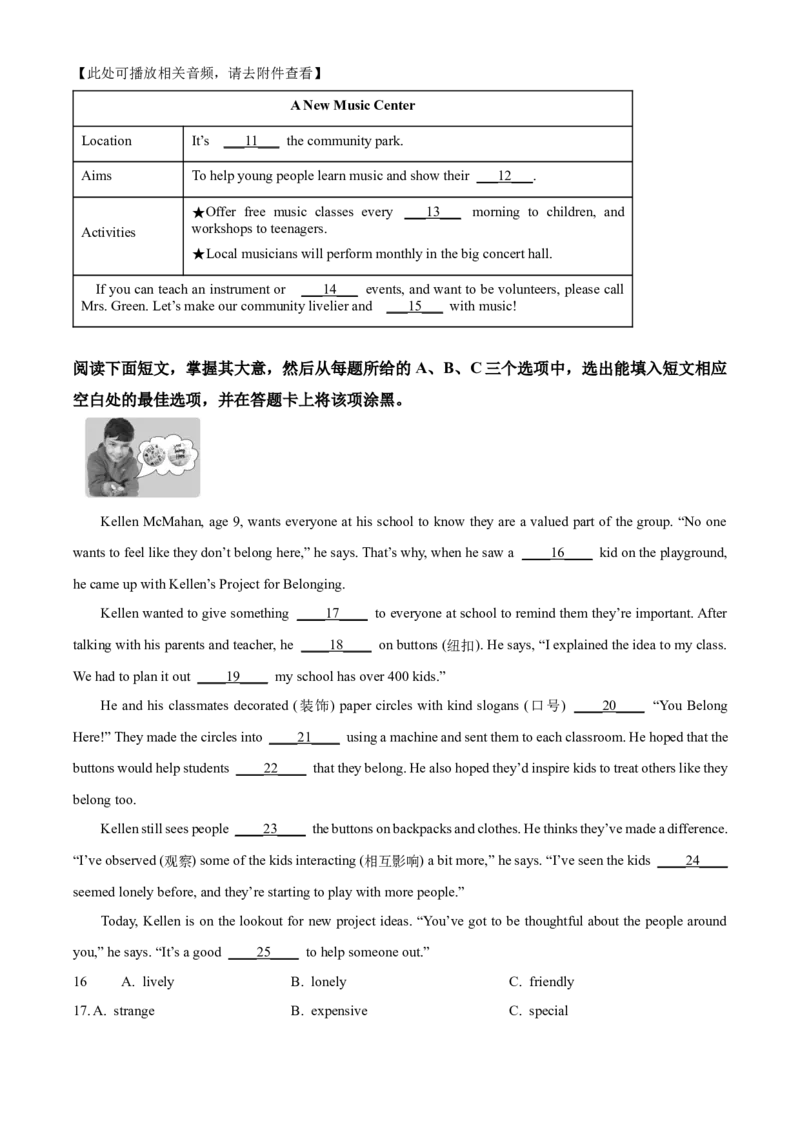
Kellen McMahan, age 9, wants everyone at his school to know they are a valued part of the group. “No one
wants to feel like they don’t belong here,” he says. That’s why, when he saw a ____16____ kid on the playground,
he came up with Kellen’s Project for Belonging.
Kellen wanted to give something ____17____ to everyone at school to remind them they’re important. After
talking with his parents and teacher, he ____18____ on buttons (纽扣). He says, “I explained the idea to my class.
We had to plan it out ____19____ my school has over 400 kids.”
He and his classmates decorated (装饰) paper circles with kind slogans (口号) ____20____ “You Belong
Here!” They made the circles into ____21____ using a machine and sent them to each classroom. He hoped that the
buttons would help students ____22____ that they belong. He also hoped they’d inspire kids to treat others like they
belong too.
Kellen still sees people ____23____ the buttons on backpacks and clothes. He thinks they’ve made a difference.
“I’ve observed (观察) some of the kids interacting (相互影响) a bit more,” he says. “I’ve seen the kids ____24____
seemed lonely before, and they’re starting to play with more people.”
Today, Kellen is on the lookout for new project ideas. “You’ve got to be thoughtful about the people around
you,” he says. “It’s a good ____25____ to help someone out.”
.
16 A. lively B. lonely C. friendly
17. A. strange B. expensive C. special18. A. decided B. kept C. enjoyed
19. A. although B. because C. until
20. A. for B. with C. like
21. A. buttons B. stars C. photos
22. A. explain B. agree C. remember
23. A. bringing B. wearing C. leaving
24. A. when B. which C. who
25. A. feeling B. training C. saying
第三部分 阅读理解(共两节;满分40分)
第一节 阅读下列短文或图表,从每题所给的A、B、C、D四个选项中,选出最佳选项,并在
答题卡上将该项涂黑。(共15小题;每小题2分,满分30分)
A
When Paul Jackson was a boy, he lived near an old copper smelter (冶炼厂) which polluted the environment
seriously. A beautiful forest nearby was made into a wasteland. He vowed (发誓) that someday he would make the
land green again.
While at college, he chose botany (植物学). He met a professor who was an expert in ecology (生态学). He told
Paul it would take about twenty thousand years to make that wasteland green again.
Then Paul got married and had some kids. But his dream would not die. He kept thinking about it. One night he
took some action. He sneaked out into the wasteland with a backpack full of seedlings and started planting. For
seven hours, he planted the seedlings. Every week, he made his secret journey and did the same job, but most of them
died. For fifteen years he did this.
Once, when all his young trees burned to the ground because of a careless sheepherder, Paul broke down and
cried. Then he got up and kept planting. Freezing winds and terrible heat, landslides and floods and fires destroyed
(毁坏) his work time and time again. However, he kept planting.
Very slowly, amazing things began to take place. Now the place is fourteen thousand acres of trees, grass and
bushes. Many kinds of wildlife live here. Paul received many environmental awards. His hair turned white, but he
managed to keep that impossible vow he made to himself as a child.
Just keep working, no matter who criticizes you, no matter how long it takes, no matter how many times you
fall.
26. What did Paul Jackson vow when he was a boy?
A. To work at the copper smelter. B. To make the wasteland green again.
C. To win an environmental award. D. To study the wildlife in the forest.27. Which can best explain the underlined phrase “sneaked out” in Paragraph 3?
A. Ran outside excitedly and rapidly. B. Invited others to go out together.
C. Walked out quickly and noisily. D. Left secretly to avoid being noticed.
28. How did Paul react (反应) when his young trees burned to the ground?
A. He gave up planting from then on. B. He built a wall to protect them.
C. He cried but continued planting. D. He decided to plant different kinds of trees.
29. What was the result of Paul’s long-term efforts?
A. The wildlife all disappeared from the area.
B. Paul became famous and moved to a big city.
C. The area was turned into 14,000 acres of green land.
D. All the trees he planted were destroyed by earthquakes.
B
This school year, the Service Stars community made a big difference. Kids, thank you for sharing your stories.
What will you do next?
Huson, 9, New York
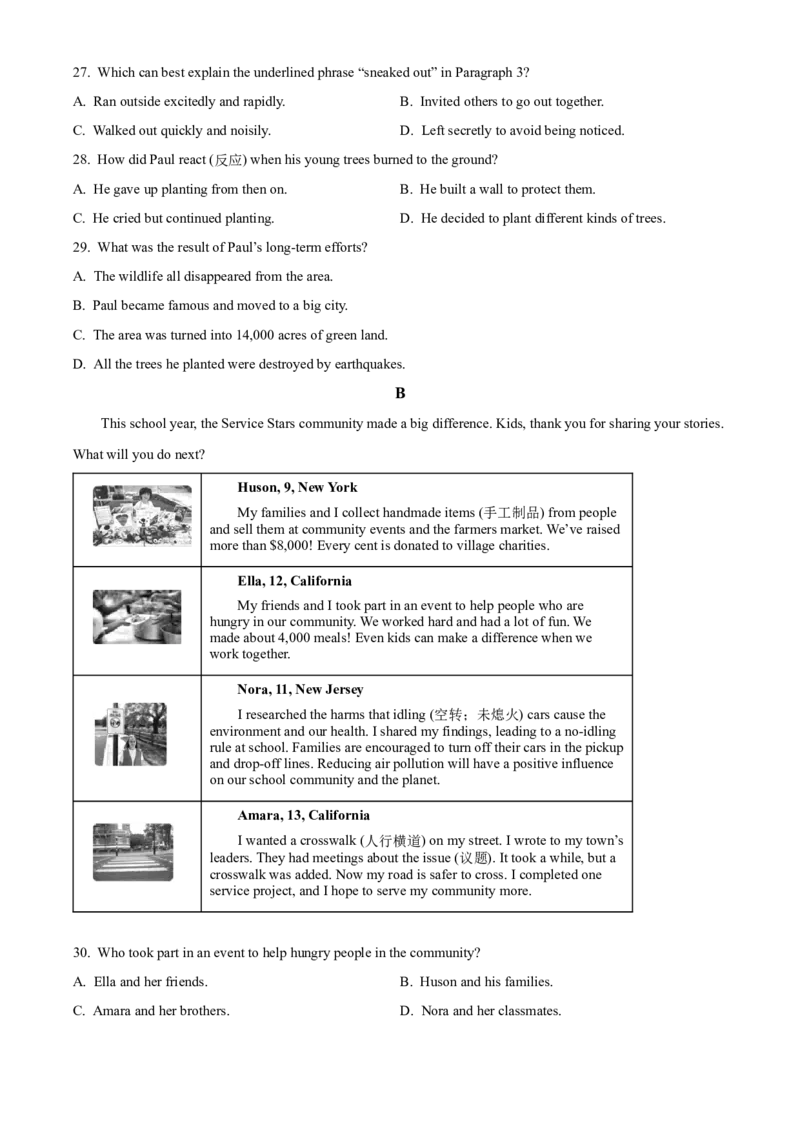
My families and I collect handmade items (手工制品) from people
and sell them at community events and the farmers market. We’ve raised
more than $8,000! Every cent is donated to village charities.
Ella, 12, California
My friends and I took part in an event to help people who are
hungry in our community. We worked hard and had a lot of fun. We
made about 4,000 meals! Even kids can make a difference when we
work together.
Nora, 11, New Jersey
I researched the harms that idling (空转;未熄火) cars cause the
environment and our health. I shared my findings, leading to a no-idling
rule at school. Families are encouraged to turn off their cars in the pickup
and drop-off lines. Reducing air pollution will have a positive influence
on our school community and the planet.
Amara, 13, California
I wanted a crosswalk (人行横道) on my street. I wrote to my town’s
leaders. They had meetings about the issue (议题). It took a while, but a
crosswalk was added. Now my road is safer to cross. I completed one
service project, and I hope to serve my community more.
30. Who took part in an event to help hungry people in the community?
A. Ella and her friends. B. Huson and his families.
C. Amara and her brothers. D. Nora and her classmates.31. From the passage, we can learn that ________.
A. Ella and Nora are both from California
.
B the money Huson and his families raised is donated to the old people’s home
C. Amara successfully completed the service project of adding a crosswalk
D. idling cars for 20 minutes is not harmful to the environment and people’s health
32. What do the four kids have in common?
A. They are at the same age and have the same interests.
B. They are caring and willing to serve their communities.
C. They volunteer to clean up their communities in their free time.
D. They are invited to give speeches about environmental protection.
C
Weiqi, commonly known as Go in English, is a board game that originated in ancient China. The game is
considered one of the Four Arts that Chinese literators (文人) were required to master. Besides Weiqi, they had to
learn Chinese calligraphy (shu), painting (hua) and guqin playing (qin).
Weiqi has a history of over 4,000 years, even older than Chinese chess. According to some historical records,
the game, known as Yi in its early years, is said to have been invented by Yao (尧). Seeing that his son had a bad
temper (脾气), Yao was rather worried. So he decided to find something that could help educate his son, and a simple
board game came to him.
The rules of Weiqi are simple: using black and white stones (棋子), two players take turns placing their stones
on empty cross points of the board. The goal is to surround (包围) a larger total area on the board while preventing
one’s own stones from being taken by the opponent (对手). Stones do not move and are only taken off the board if
they are completely surrounded.
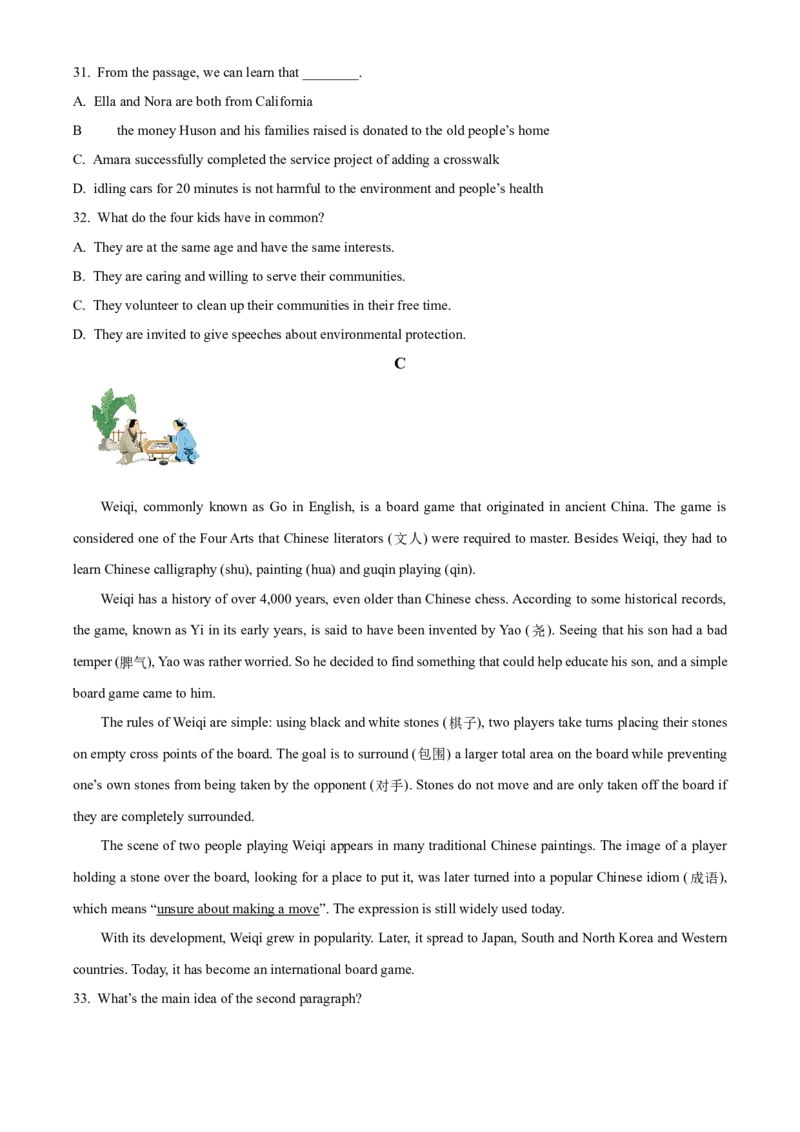
The scene of two people playing Weiqi appears in many traditional Chinese paintings. The image of a player
holding a stone over the board, looking for a place to put it, was later turned into a popular Chinese idiom (成语),
which means “unsure about making a move”. The expression is still widely used today.
With its development, Weiqi grew in popularity. Later, it spread to Japan, South and North Korea and Western
countries. Today, it has become an international board game.
33. What’s the main idea of the second paragraph?A. The origin (起源) of Weiqi. B. The rules of Weiqi.
C. The development of Weiqi. D. The popularity of Weiqi.
34. What does the underlined expression “unsure about making a move” mean in the fourth paragraph?
.
A 观棋不语 B. 举棋不定 C. 出其不意 D. 棋逢对手
35. What can we learn from the passage?
A. Weiqi has a history of more than 5,000 years.
B. Weiqi is a simple board game that is enjoyed by the old.
C. Weiqi has become more and more popular around the world.
D. The player who surrounds a smaller total area wins the game.
36. In which part of a newspaper can you probably read the passage?
A. Science. B. Travel. C. Stories. D. Culture.
D
Nowadays, some companies around the world are now offering humanoid (human-like) robots. They are being
designed (设计) to look as human as possible. These products of technology are at the center of a debate (辩论):
Should they be made to look like humans or just like what they are machines?
Robots are playing an increasingly bigger role in our lives. In some countries, robots have been entertaining kids
and helping the elderly. Some experts say robots will be more effective at such jobs if they look like humans. Research
has shown that people feel closer to human-like robots. Also, human-like robots suit environments that are designed
for humans. After all, the world is full of stairs (楼梯), hallways, shelves at shoulder height and sightlines at eye
level.
But other experts say robots don’t need to look like humans. Humanoid robots also have disadvantages. If robots
look like us, we may expect them to act like us. However, they may make us disappointed because they can’t always
do that yet. For example, they can’t laugh at the right moments during a conversation. Many people also find
human-like robots scary.
I think the human body is not the best design for many of the jobs we want robots to do. Just think of small, flat
robot vacuums (真空吸尘器). They can go under a sofa to pick up the dust balls. Can human-like robots also do this?
Even if robots can be made into humanlike ones, why do we limit (限定) them to two legs and two arms? Why not
four and six so they can pick up the elderly or sick people comfortably? And that super intelligent AI almost certainlywouldn’t pick one body design to carry its mind around in. Why limit computational capacity (算力) to what fits
inside a single head?
What’s your opinion about robots’ shapes?
37. According to the second paragraph, the reasons why robots should be designed to look like humans include
________.
①People feel closer to humanoid robots.
②Robots are widely used in the industrial field.
③Humanoid robots can serve the people effectively.
④Humanoid robots can suit human environments.
A. ①②④ B. ①③④ C. ②③④ D. ①②③
38. Other experts don’t agree that robots are designed to look like humans because humanoid robots ________.
A. cost a lot B. can’t cry or laugh
C. can’t have conversations with humans D. can’t always behave like us as we expect
39. What’s the writer’s opinion according to the fourth paragraph?
A. Robots can’t be made to look like humans.
B. Humanoid design is still the best choice for robots.
C. A robot should be designed with more arms, legs and heads.
D. The design of a robot’s shape should depend on its use.
40. What’s the best title of this passage?
A. The Development of Humanoid Robots
.
B A Debate about Improving the Services of Robots
C. Should Robots Look like Humans?
D. Different Robots, Different Services
第二节 (共5小题;每小题2分,满分10分)
根据短文内容,从短文后选出能填入空白处的最佳选项。
Have you ever been in trouble and wanted to get away? The white-tailed deer can swim, run, hide and fight to
stay out of trouble.
In early April, fawns (baby deer) are born. After a few weeks, the doe (the mother deer) leaves her fawns to find
food. ____41____ The trees and grass can help keep the fawns from being seen by hungry predators (掠食者).
The fawns’ camouflage (伪装;保护色) hides them in April’s trees and golden grasses. ____42____ In summer,
the fawns’ white spots disappear and never come back. In winter, their fur is gray, which helps them hide in the
snow.
When the deer see, smell or hear something suspicious (可疑的), they stick their white tails up to signal thatdanger is near. ____43____
When a deer is chased into water, it knows what to do. It runs into the water and swims to the deepest part.
____44____ The deer will kick and thrash until the predator dies or walks off wounded.
____45____ If a deer is in a wide-open field and notices a predator, it will run in a zigzag (之字形) to get away.
It runs in this way to confuse (混淆) the predator. If the deer ran straight, it would likely become a big meal.
A. The leader will run, and the others will follow.
B. She hides them in a bushy (灌木茂盛的) place.
C. If the predator thinks it’s going to win the battle (战斗), it is wrong.
D. There is one more way that deer stay out of trouble.
E. In spring, the fawns’ fur is brown with white spots.
第Ⅱ卷(共70分)
第四部分 书面表达(共三节)
第一节 词汇运用(共两题;满分30分)
(一)单词拼写(共5小题;每小题2分,满分10分)
根据句意、首字母或汉语提示,将单词的正确形式完整地写在答题卡的相应位置。
46. Jenny is very interested in traditional Chinese culture, and she has learned it s________ she came to China 5
years ago.
47. The government has started a three-year action plan to help people control their w________ to fight against
obesity (肥胖).
48. Our country has made great progress in science and technology in recent years. As a Chinese, I feel so
________ (自豪的) of these achievements!
49. —What happened to you yesterday afternoon?
—I ________ (跌落) off the electric bicycle. Luckily, I wore a helmet and didn’t hurt my head.
50. Community canteens (食堂) have become more and more popular in China, and they provide old people with
________ (更健康的) and cheaper dishes.
(二)综合填空(共10小题;每小题2分,满分20分)
根据短文内容,用方框中所给单词的适当形式填空,使文章通顺、完整,每词限用一次。
wrong, when, middle, after, comfortable, energy, anything, either, move, waitMany people believe that exercising on an empty stomach burns more calories (卡路里). But research shows
that it doesn’t actually make much of a difference. Does that mean you should eat a lot of protein and carbs (蛋白
质和碳水化合物) right before exercising? No, that’s not true, ____51____.Take a look at when and how you
should eat, before, after, or even during exercise.
The calories in food provide the ____52____ you need for exercising. But eating too much right before
exercise can cause problems. Exercising ____53____ blood from organs (器官), including the stomach, to the
muscles (肌肉). So exercising on a full stomach influences digestion (消化), which could make you feel
____54____ or sick. That’s particularly true of meals high in fat, protein or fiber, which take longer to digest than
carbs. Experts suggest eating more carbs than protein before exercising and ____55____ two to three hours before
starting exercise.
Protein is easier to digest ____56____ exercise. If you have to wait an hour or more for a full meal, it’s better
to have a high-protein snack to help control your appetite (食欲). People who are too hungry are more likely to eat
too much of the ____57____ food!
Most people who are eating enough throughout the day don’t need ____58____ during exercise. But if you
are training for more than an hour, you might benefit (受益) from a carb-rich snack in the ____59____.
However, experts agree that the most important part is a balanced diet. What you eat matters more than
____60____ you eat.
第二节 阅读表达(共6小题;71—73小题每题2分,74—76小题每题3分,满分15分)
阅读下面的短文,并根据短文后的要求答题(请注意问题后的词数要求)。
[1] Have you ever seen porcelain that has carved hollows (镂空雕刻) and clay flowers? This special kind of
porcelain is called Tonghua porcelain (通花瓷). It is from Chaozhou city, Guangdong province. In 2008, it was
listed as a national intangible cultural heritage (非物质文化遗产).
[2] It (4) ________ about 20 steps and 45 days to turn a porcelain design into a finished product. A
Tonghua porce①lain vase has as many as 10,000 hollows. The maker must plan carefully. If a hollow is carved too
large, it can crack (裂开) during firing.
[3] Born in 1995 into a family of Tonghua porcelain makers, Ye Hao is a young inheritor (传承人) of the art.
(5) As the number of people with Tonghua skills is falling in Guangdong, he feels it is very important to master it.Ye has been improving his skills for over 10 years.
[4] During a winter holiday, while Ye was practicing clay flower shaping, his grandfather came and laughed at
the cracks in the flowers he made. “My grandpa told me that I didn’t have the feel for clay. I didn’t understand (4)
________ he meant then, but now I realize he was encouraging me to practice more,” Ye said. Moisture levels
②(湿度水平) in clay are important, as dry clay cracks easily.
[5] Trying to be creative with the art, Ye chose to make it part of his everyday hobbies. For example, he
created a porcelain brooch (胸针) with a rose design. It was chosen (4) ________ a souvenir (纪念品) by the
Department of Culture and Tourism of Guangdong province. He also des③igned six Tonghua porcelain vases that
include main characters from a popular show. He successfully improved Tonghua skills by mixing traditional art
and pop culture.
[6] Ye said he would keep looking for ways to bring the art into everyday life and show it to more people with
fresh designs.
.
61 When was Tonghua porcelain listed as a national intangible cultural heritage? (No more than 2 words)
________________
62. What will happen if a hollow of the porcelain vase is carved too large? (No more than 6 words)
________________
63. How did Ye improve Tonghua skills according to the fifth paragraph? (No more than 10 words)
________________
64. Fill in each blank in the passage with a proper word.
________ ________ ________
①65. Translate the u②nderlined sentenc③e in the third paragraph into Chinese.
________________
66. There are many traditional art forms in our country. Which one do you like best? And why? Please list at least
two reasons.
________________
第三节 写作(共一题;满分25分)
67. 良好的情绪管理有助于人的身心健康。学会正确处理负面情绪,可以更好地应对生活中的各种困
难和挑战。某英语报刊正在以“Learn to Deal with Negative Emotions (负面情绪)”为题向广大中学生征文,
请你结合自己的经历写一篇英语短文,谈谈正确处理负面情绪的方法及重要意义,向报刊投稿。提示如下:写作要求:
1.要点齐全,语句通顺,可适当发挥;
2.文中不得出现真实的人名、校名等信息;
3.词数:80—100。
Learn to Deal with Negative Emotions
____________________________________________________________________________________________
____________________________________________________________________________________________
____________________________________________________________________________________________
____________________________________________________________________________________________
____________________________________________________________________________________________
____________________________________________________________________________________________
____________________________________________________________________________________________
____________________________