Unit 5 China and the World
Topic 3 Now it is a symbol of England.
(满分100分,时间80分钟)
I.单项选择。(共10小题,每小题1分,计10分。)
1.—Who sings better, Jane or Maria?
—Jane sings ________ Maria.
A.as good as B.as well as C.so good as D.so well as
2.I have only two tickets for TF boy’s concert. __________ you __________ he can go with me.
A.Either; or B.Neither; nor
C.Not only; but also D.Both; and
3.— Has Kate gone to the museum?
—Yes, not only she but also her mother ____ gone to the history museum.
A.is B.has C.are D.have
4.—Do you know the Statue of Liberty in the USA?
—Yes. It ________ New York Harbor.
A.stands in B.stands for C.stands up D.stands
5.I have my housework ________.
A.to be finished B.finish C.finished D.finishing
6.—How do you like the sound of my old watch?
—That’s grcat! It can still ________.
A.ring up B.ring out C.ring back D.ring off
7.Big Ben is________one of the symbols of both London and Britain.
A.considered for B.think of C.regarded as D.treat as
8.Each stone was ________ so well, ________ the ancient workers didn’t have any modern tools.
A.fixing; although B.fix; because C.fixed; so D.fixed; though
9.It was the tallest building ________ the earth. It ________ about 100 000 people over 10 years to finish it.
A.in;takes B.in;taking C.on;took D.at;take
10.Jane does her homework as ________ as Tony.
A.careful B.carefully C.more careful D.more carefully
II. 完形填空。(共15小题,每小题1分,计15分。)
Elias Howe finally fell asleep at about 4 o’clock in the morning as usual. 11 all night became his
living habit. Who’s Elias Howe? You 12 never heard of him. But do you know the sewing(缝纫)machine?Yes, he was the 13 .
Over 100 years ago, without modern machines, people 14 do the sewing by hand. It was hard
work, so Elias Howe decided to design a machine to make the sewing easy and quick. 15 he made some
progress, he met a problem. It seemed 16 to get the thread(线)to run around the needle(针)without
any problems.
He was tired, and slept 17 . He turned and turned. Then he had a dream. In the dream he was 18 by
a king. The king ordered him to build a perfect sewing machine, 19 he would be killed. When he tried to
do so, Howe met the same problem as before. The king was so 20 that he ordered his soldiers to kill
Howe. They raised spears(长矛)and came up to him. Everyone thought Howe would die. But suddenly he
noticed 21 . There was a hole in the tip(尖端)of each spear.
Before the spears stuck to his body, Howe 22 from the dream. And he realized he found the way to
solve the problem. Instead of getting the thread to run around the needle, he should make it run through a small hole
in the center of the needle. A simple 23 finally made Howe invent the first sewing machine.
Like Howe, many scientists found the way to solve their problems in this way. Thomas Edison said his best
ideas came into him in 24 . So did Albert Einstein.
How can a man 25 his problem in the dream? In fact, after you fall asleep, your mind never stops
working on the problem you met in the day. Sometimes, it can even show the information you didn’t notice. That’s
how dreams work.
11.A.Working B.Playing C.Reading D.Sleeping
12.A.can B.may C.must D.should
13.A.artist B.composer C.musician D.inventor
14.A.preferred to B.had to C.stopped to D.planned to
15.A.Because B.Until C.Though D.Before
16.A.impossible B.impolite C.uncomfortable D.unfair
17.A.early B.immediately C.quietly D.badly
18.A.praised B.honored C.caught D.hidden
19.A.or B.and C.so D.but
20.A.excited B.ugly C.funny D.angry
21.A.nothing B.anything C.something D.everything
22.A.put up B.woke up C.hurried up D.looked up
23.A.problem B.answer C.suggestion D.idea
24.A.labs B.dreams C.kitchens D.gyms25.A.agree with B.fill with C.compare with D.deal with
III.阅读理解。(共20小题,每小题2分,计40分。)
A
For the past 20 years, the Touching China Award has honored people across the country every year. They are
people who warm our hearts with their actions. Let’s look at three of them. They all have something in common:
they make a great difference to the country in their own way.
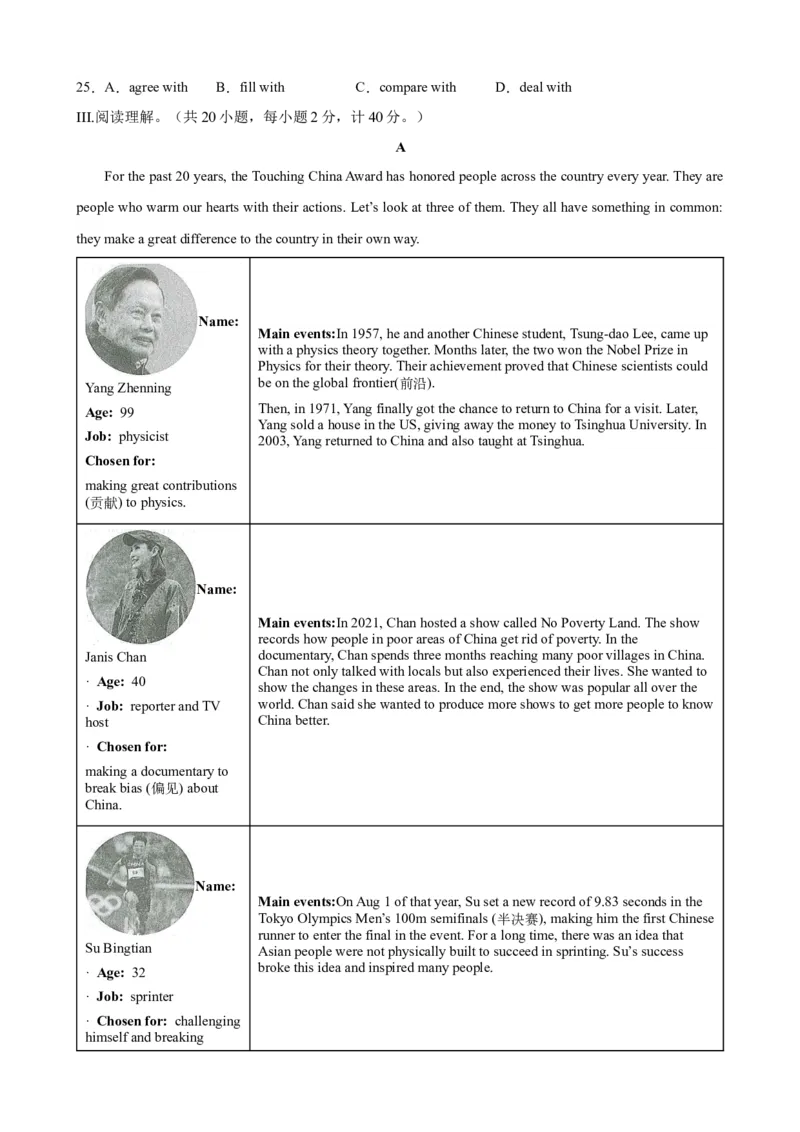
Name:
Main events:In 1957, he and another Chinese student, Tsung-dao Lee, came up
with a physics theory together. Months later, the two won the Nobel Prize in
Physics for their theory. Their achievement proved that Chinese scientists could
be on the global frontier(前沿).
Yang Zhenning
Age: 99 Then, in 1971, Yang finally got the chance to return to China for a visit. Later,
Yang sold a house in the US, giving away the money to Tsinghua University. In
Job: physicist
2003, Yang returned to China and also taught at Tsinghua.
Chosen for:
making great contributions
(贡献) to physics.
Name:
Main events:In 2021, Chan hosted a show called No Poverty Land. The show
records how people in poor areas of China get rid of poverty. In the
Janis Chan documentary, Chan spends three months reaching many poor villages in China.
Chan not only talked with locals but also experienced their lives. She wanted to
· Age: 40
show the changes in these areas. In the end, the show was popular all over the
· Job: reporter and TV world. Chan said she wanted to produce more shows to get more people to know
host China better.
· Chosen for:
making a documentary to
break bias (偏见) about
China.
Name:
Main events:On Aug 1 of that year, Su set a new record of 9.83 seconds in the
Tokyo Olympics Men’s 100m semifinals (半决赛), making him the first Chinese
runner to enter the final in the event. For a long time, there was an idea that
Su Bingtian Asian people were not physically built to succeed in sprinting. Su’s success
broke this idea and inspired many people.
· Age: 32
· Job: sprinter
· Chosen for: challenging
himself and breakinglimits(极限)
26.How old was Yang Zhenning when he taught at Tsinghua?
A.35 years old. B.100 years old. C.80 years old. D.60 years old.
27.Which word can describe Su Bingtian best according to the passage?
A.Lucky. B.Hard-working. C.Clever. D.Active.
28.What do the three people have in common?
A.They were injured seriously during their work.
B.They served the country in their own ways.
C.They made people know more about China.
D.They returned to China when they were needed.
B
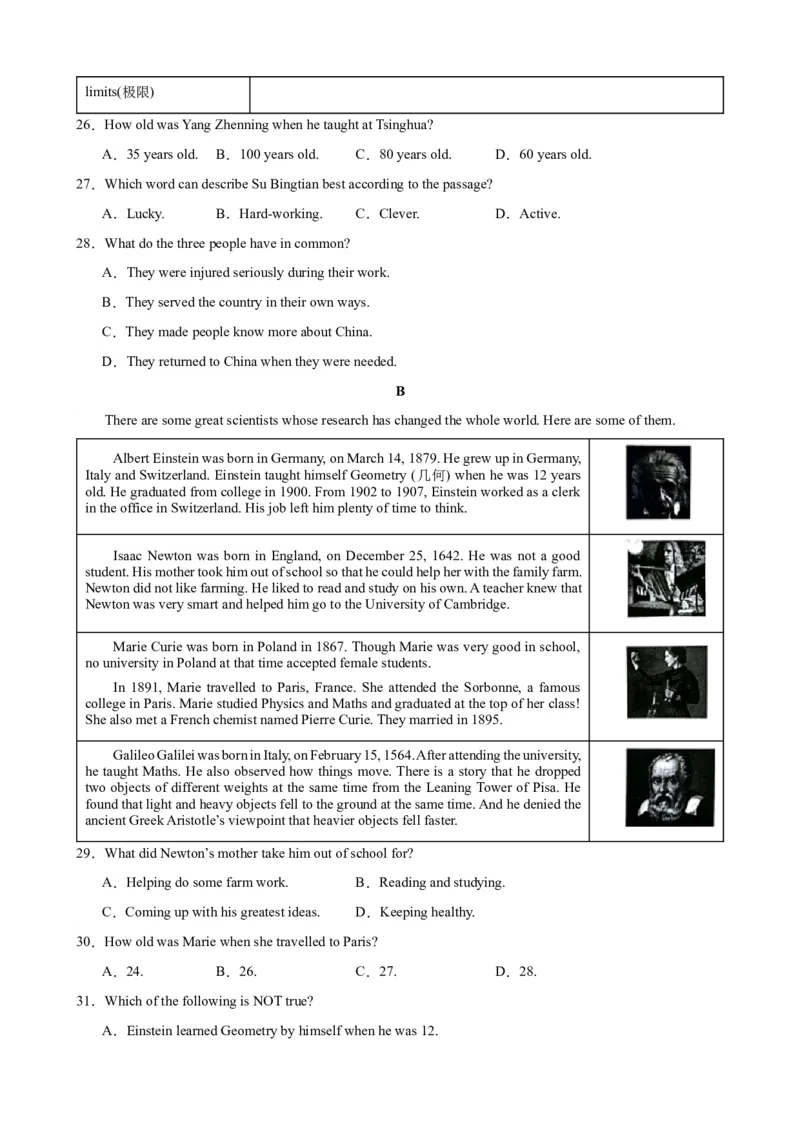
There are some great scientists whose research has changed the whole world. Here are some of them.
Albert Einstein was born in Germany, on March 14, 1879. He grew up in Germany,
Italy and Switzerland. Einstein taught himself Geometry (几何) when he was 12 years
old. He graduated from college in 1900. From 1902 to 1907, Einstein worked as a clerk
in the office in Switzerland. His job left him plenty of time to think.
Isaac Newton was born in England, on December 25, 1642. He was not a good
student. His mother took him out of school so that he could help her with the family farm.
Newton did not like farming. He liked to read and study on his own. A teacher knew that
Newton was very smart and helped him go to the University of Cambridge.
Marie Curie was born in Poland in 1867. Though Marie was very good in school,
no university in Poland at that time accepted female students.
In 1891, Marie travelled to Paris, France. She attended the Sorbonne, a famous
college in Paris. Marie studied Physics and Maths and graduated at the top of her class!
She also met a French chemist named Pierre Curie. They married in 1895.
Galileo Galilei was born in Italy, on February 15, 1564. After attending the university,
he taught Maths. He also observed how things move. There is a story that he dropped
two objects of different weights at the same time from the Leaning Tower of Pisa. He
found that light and heavy objects fell to the ground at the same time. And he denied the
ancient Greek Aristotle’s viewpoint that heavier objects fell faster.
29.What did Newton’s mother take him out of school for?
A.Helping do some farm work. B.Reading and studying.
C.Coming up with his greatest ideas. D.Keeping healthy.
30.How old was Marie when she travelled to Paris?
A.24. B.26. C.27. D.28.
31.Which of the following is NOT true?
A.Einstein learned Geometry by himself when he was 12.B.A teacher helped Newton go to university.
C.Marie married Pierre when she was around 38.
D.Galileo once did an experiment on the Leaning Tower of Pisa.
C
Thomas Edison lost his first job. For the next five years he went around the country from job to job. At last
Edison went to New York. He had little money. He could not buy enough food to eat. He had no place to sleep.
For many days Edison looked for work. He was hungry. At last he found work fixing machines. He could repair
the old machines. He could also make new ones. The head man liked Edison’s new machines. He was going to give
Edison $40,000 for them. Edison would now have money to do what he wanted.
Thomas Edison was then 23. He used the money to build a shop in New Jersey. He had many people working
for him. But he worked harder than any of them. He rested very little. Soon he was making more than 40 new things
at one time.
In 1876 Alexander Graham Bell made a telephone. But it could carry voices only a short way. Edison wanted
to make a better telephone. He soon made one. It could carry voices a long way.
32.After he lost his first job, Edison ___________.
A.found no jobs in the next five years
B.worked in New York for the next five years
C.had a bad time in the next five years
33.In New York ___________.
A.Edison did not get a job
B.Edison found the work to fix machines
C.Edison got $40,000 by fixing machines
34.The head man was interested in ___________.
A.Thomas Edison B.the old machines C.the new machines
35.Edison made a telephone. It ___________.
A.carried voices much farther
B.carried more voices
C.carried voices more clearly
D
Deng Jiaxian was a Chinese physicist, known as the Father of China’s Atomic Bomb(原子弹). Born in
Anhui Province, Deng attended the National Southwestern Associated University in 1941 and went to America for
a further study in physics. He studied a lot and got much useful knowledge.
After Deng’s graduation, he didn’t accept the high-paid positions and superb research conditions provided bythe American government or universities. Instead, he returned to Beijing in 1950 to work on nuclear research(核
能研究).
Deng faced great difficulties at that time because there was no such research information to learn from and few
scientists. He worked with a group of recent college graduates and used abacuses for calculation. It took about a
month to finish a stage of calculation and about a year to calculate it nine times.
For about eight years Deng worked very hard at the Gobi Desert nuclear testing site in northwest China.
In October 1964, under Deng’s leadership, China successfully tested its first atomic bomb. In June 1967,
China’s first hydrogen bomb test was also carried out successfully. In 1979, a parachute failure happened during
one experiment, which caused an atomic bomb to crash to the ground but it did not set off. Deng knew the danger
in cleaning up the crashed bomb. “You are young; you can’t go to do this, ” Deng said to his colleagues. So he
picked up the broken pieces of the bomb himself instead of sending his team.
Deng’s wife, a doctor, learned that Deng had touched the broken pieces of the atomic bomb, and ordered him
to return to Beijing for a full body checking. The results showed that he had been badly hurt by deadly nuclear
radiation(辐射). However, he still chose to return to the test site and continued to solve the problem himself.
In 1986, at age 62, Deng passed away because of the radiation. As a national hero, he was awarded the Two
Bombs and One Satellite Merit Medal in 1999.
36.When was Deng Jiaxian born?
A.In 1941. B.In 1924. C.In 1920. D.In 1950.
37.What does the underlined word “superb” mean in Paragraph 2?
A.silent B.excellent C.different D.patient
38.Which of the following is the correct order according to the passage?
①China successfully tested its first atomic bomb.
②Deng returned to Beijing and work on nuclear research.
③Deng studied in the USA.
④Deng was exposed to deadly nuclear radiation.
A.②③①④ B.②①③④ C.③②①④ D.③②④①
39.What can we infer from the passage?
A.Deng used abacuses for calculation because they made less mistakes.
B.Deng’s nuclear research was based on many scientists’ hard work.
C.Deng’s wife was greatly worried about Deng’s health condition.
D.Deng never took safety measures when picking up the broken pieces of the bomb.
40.What can be the best title for the passage?A.A Chinese physicist who achieved his dream with hard work.
B.A national hero who gave his whole life to China’s nuclear program.
C.The history and development of China’s nuclear program.
D.The greatest hero winning a Merit Medal in Chinese history.
E
People all over the world eat rice. Millions of people in Asia, Africa and South America live on it. Some people
eat almost nothing but rice. 41 There are more than 7,000 kinds of rice. Most kinds are water plants. Farmers
grow rice in many countries, even in the south of the United States and in eastern Australia.
Rice is also a big part of Chinese life. In the past, people greeted each other by saying “Have you had your
rice?” 42
China is the world’s largest rice-growing country. In 2003, China grew 166 million tons of rice. But it is not
easy to feed the world’s largest population. 43 In the 1970s, Yuan Longping, a Chinese scientist, grew a
kind of rice called hybrid rice. It makes 20% more rice than any other kind. Hybrid rice is a stronger plant, unlike
ordinary rice. It can grow in lots of water or in not much water. It doesn’t easily get diseases or worms.
Today, half of China’s rice plants are Yuan’s special hybrid rice. China uses Yuan’s hybrid rice to grow much
more rice than before. 44 He won the World Food Prize for his work to help feed so many people.
In his spare time, Yuan Longping loves playing the violin and listening to music. Every night, he reads for half
an hour before he goes to sleep. He likes swimming, too. It is said that Yuan is one of the richest people in China. 45
根据材料内容,从下面五个选项中选出能填入文中空缺处的最佳选项,使短文意思通顺,内容完整,并
将其标号填写在下面题号后的横线上。
A.Yuan is known as the Father of Hybrid Rice.
B.Some people still say it today.
C.Rice is a kind of grass.
D.But he cares about nothing but his research.
E.In the 1960s, millions of Chinese died because they didn’t have enough food to eat.
IV. 短文填空。(每小题1分,计10分。)
A Nobel Prize is 46 (consider) one of the highest international honors a person can receive. As you know,
the prizes were started by a Swede (瑞典人) 47 (call) Alfred Nobel. He was born in Stockholm, the
capital of Sweden. Alfred Nobel was a great 48 (scientific). He made two important 49 (invent),
and so he became very rich. 50 he was rich, Nobel was not a happy man. He never married or had
children. Also, he was a sick man during his large part of life. When he died 51 the age of 63, he left a
lot of money $9,000,000. The money was to be used in giving prizes to those who made great achievements 52physics, chemistry, medicine and literature (文学), and for world peace.
The first Nobel Prizes were given on December 10, 1901, five years after Nobel’s 53 (dead). Since then
many famous people from all over the world have been given Nobel Prizes 54 their achievements.
Each prize has three parts. The first part is a gold medal. Second, a winner of a Nobel Prize is given a
diploma (证书). The third is a large amount of money—about $40,000.
Often a prize is given to just one person, but not always. Sometimes a prize is shared. It may be given to two
or more people who have worked together. It is also sometimes true that a prize is not given at all 55
there is no great achievement. In 1972, for example, no Nobel Peace Prize was given.
46. ____________ 47. ____________ 48. ____________ 49. ____________ 50. ____________
51. ____________ 52. ____________ 53. ____________ 54. ____________ 55. ____________
V. 看图写话。(每小题2分,计10分。)
56.你想说:玫瑰是爱的象征,你可以这样说:
_____________________________________________
57.你想告诉别人,你总是积极参加课外活动。你可以这样说:
_____________________________________________
58.中国南方是鱼米之乡,你可以这样说:
_____________________________________________
59.如果你想说:长城是世界上最大的奇迹之一。你可以这样说:
_____________________________________________
60.如果你想介绍:西湖每年都吸引很多来自国内外的游客。你可以这样说:
_____________________________________________
VI. 书面表达。(计15分。)
61.我们的身边总会有那么一些人,不畏人言,不辞辛苦,用自己的默默奉献与坚持温暖了你,感
动了身边的人,描述你心目中的英雄。文中不得出现真实的人名或校名。不少于80词。
要求:
1.介绍你心目的英雄;
2.他/她都做了哪些让你感动的事儿,你为什么崇拜他/她;
3.你能从他/她身上学到什么?
______________________________________________________________________________________
__________________________________________________________________________________________
__________________________________________________________________________________________
__________________________________________________________________________________________
____________________________________________________________________________________________________________________________________________________________________________________
__________________________________________________________________________________________
__________________________________________________________________________________________
__________________________________________________________________________________________
__________________________________________________________________________________________
__________________________________________________________________________________________参考答案
1.B
【详解】句意:——谁唱歌唱得更好,Jane还是Maria?——Jane唱得跟Maria一样好。
考查as...as句式。as...as像……一样;so...as像……一样(用于否定句);good好的(形容词);
well好(副词)。根据“Jane sings...Maria.”可知,该句为肯定句,排除选项C和D;该句表示Jane唱
歌唱得像Maria一样好,此处应用“as+副词+as”,副词修饰动词sings,所以此空是as well as。故选
B。
2.A
【详解】句意:我只有两张TF boy’s音乐会的门票。要么你要么他可以和我一起去。
考查连词的用法。Either... or要么……,要么……;Neither...nor既不……,也不……;Not only...
but also不仅……,而且……;Both... and两者都。根据“I have only two tickets for TF boy’s concert.”可知
此处指要么你要么他可以和我一起去,两者择一。故选A。
3.B
【详解】句意:——Kate去博物馆了吗?——是的,不仅她还有她的妈妈都去了历史博物馆。
考查动词。“not only…but also…”意为“不仅……而且……”,连接两个并列的成分,在句中做
主语时,谓语动词应根据就近原则,与最近的主语保持一致,故这里应该用单数形式。has gone是现
在完成时,表示“去了……”。故选B。
4.A
【详解】句意:——你知道美国的自由女神像吗?——知道。它在纽约港。
考查stand的动词短语辨析。stands in位于某地;stands for代表;stands up站起来;stands站。根
据后文“New York Harbor.”可知位于某地应用stands in,故选A。
5.C
【详解】句意:我请人做完了家务。
考查have sth. done。根据“have my housework...”可知此处是have sth. done结构,表示让某事被
完成。“done”表示过去分词,给选C。
6.B
【详解】句意:——你觉得我的旧手表的声音怎么样?——很棒!它还能够发出声音。
考查ring的动词短语辨析。ring up打电话;ring out发出声音;ring back回电话;ring off挂断。
根据“the sound of my old watch”可知这个手表可以发出声音,故选B。
7.C
【详解】句意:大本钟被认为是伦敦和英国的象征之一。
考查固定搭配。consider for考虑;think of想,思考;regard as视作,认为;treat as把……看做。主语Big Ben和谓语动词之间为被动be done,排除B/D,选项C“regard as视作,认为”符合语境。故
选C。
8.D
【详解】句意:每一块石头都固定得很好,尽管古代的工人没有任何现代工具。
考查被动语态和从属连词辨析。fix固定;though/ although尽管; so因此。根据Each stone和
fix可知,石头是被固定的,需用被动语态,用fixed;结合句意,每一块石头都固定得很好和古代的
工人没有任何现代工具之间构成转折,用though/ although,故选D。
9.C
【详解】句意:它是世界上最高的建筑。约10万人花了10年时间才完成。
考查介词和动词时态。in在……里面;on在……上;at在(某地)。根据英语表达习惯,“在
地球上”应用介词on,即on the earth,且根据前文“It was the tallest building”提示,此处应用一般过
去时表示过去发生的事,动词take应用过去式,故选C。
10.B
【详解】句意:简和托尼一样认真地做家庭作业。
考查副词原级。careful认真的,形容词;carefully认真地,副词。as+形容词/副词原级+as,排除
CD;又因为此处在句中修饰动词does,所以用副词。故选B。
11.A 12.B 13.D 14.B 15.C 16.A 17.D 18.C 19.A
20.D 21.C 22.B 23.D 24.B 25.D
【导语】本文介绍了发明家伊莱亚斯·豪在梦中找到发明缝纫机的方法的故事。文章说明了梦境
如何帮助人们在现实中解决问题,并提到了其他科学家如爱迪生和爱因斯坦也有类似的经历。文章
还提到,在梦中,人们的大脑仍在思考白天遇到的问题,有时甚至能提供被忽视的信息。
11.句意:通宵工作成了他的生活习惯。
working工作;playing玩;reading阅读;sleeping睡觉。根据“Elias Howe finally fell asleep at
about 4 o’clock in the morning as usual.”可知,早上四点睡觉,说明是在通宵工作。故选A。
12.句意:你可能从来没有听说过他。
can能够;may可能;must必须;should应该。根据“You ... never heard of him”可知,可能从来
没有听说过他。故选B。
13.句意:是的。他是那个发明家。
artist艺术家;composer作曲家;musician音乐家;inventor发明家。根据“But do you know the
sewing(缝纫)machine? Yes, he was the ...”可知,他是发明缝纫机的人。故选D。14.句意:100多年前,没有现代机器,人们不得不手工缝纫。
preferred to宁愿;had to不得不;stopped to停止去做;planned to计划去做。根据“people ... do
the sewing by hand”可知,人们不得不手工缝纫。故选B。
15.句意:尽管他取得了一些进步,但他遇到了一个问题。
because因为;until直到;though尽管;before在……之前。根据“he made some progress, he met
a problem”可知,尽管有一些进步,用though引导让步状语从句。故选C。
16.句意:似乎不可能让线在针头周围不出任何问题地运行。
impossible不可能的;impolite不礼貌的;uncomfortable不舒服的;unfair不公平的。根据“It
seemed ... to get the thread(线)to run around the needle(针)without any problems.”可知,让线在针
头周围不出任何问题地运行是不可能的。故选A。
17.句意:他很累,睡得不好。
early早地;immediately立即;immediately悄悄地;badly不好地。根据“He turned and turned.
Then he had a dream.”可知,他翻来覆去,睡得不好。故选D。
18.句意:在梦中他被一个国王抓住了。
prasied表扬;honored尊敬;caught抓住;hidden隐藏。根据“In the dream he was ... by a king. The
king ordered him to build a perfect sewing machine”可知,他被国王抓住了。故选C。
19.句意:国王命令他造一台完美的缝纫机,否则他会被杀的。
or或者,否则;and和;so因此;but但是。根据“The king ordered him to build a perfect sewing
machine, ... he would be killed”可知,否则就会被杀。故选A。
20.句意:国王非常愤怒,他命令他的士兵杀死豪。
excited 兴奋的;ugly 丑陋的;funny 有趣的;angry 生气的。根据“The king was so ... that he
ordered his soldiers to kill Howe.”可知,国王非常愤怒。故选D。
21.句意:但突然他注意到了什么。
nothing没什么;anything任何事;something一些东西;everything所有事物。根据“Everyone
thought Howe would die. But suddenly he noticed”可知,他注意到了一些东西。故选C。
22.句意:在长矛刺在身上之前,豪从梦中醒来。
put up张贴;woke up醒来;hurried up匆忙;looked up查找。根据“Howe ... from the dream”可知
从梦中醒来。故选B。
23.句意:一个简单的想法最终使豪发明了第一台缝纫机。
problem问题;answer回答;suggestion建议;idea想法。根据“he should make it run through a
small hole in the center of the needle”可知,此处指的是这个想法使他发明了第一台缝纫机。故选D。
24.句意:托马斯·爱迪生说他最好的想法是在梦中产生的。labs实验室;dreams梦想;kitchens厨房;gyms体育馆。根据“Like Howe, many scientists found
the way to solve their problems in this way.”可知,此处介绍的其他科学家从梦中获得最好的想法。故
选B。
25.句意:一个人如何处理他在梦中的问题?
agree with同意;fill with装满;compare with比较;deal with处理。根据“How can a man ... his
problem in the dream?”可知,如何处理梦里的问题。故选D。
26.C 27.B 28.B
【导语】本文主要介绍了3位“感动中国人物”。
26.细节理解题。根据“In 2003, Yang returned to China and also taught at Tsinghua.”可知,2003
年在清华教书,2023年是99岁,则2003年时大约是80岁,故选C。
27.细节理解题。根据“challenging himself and breaking limits(极限)”可知,他不断的挑战自己,
打破极限,可见他是一个 努力的人,故选B。
28.推理判断题。根据“Chan said she wanted to produce more shows to get more people to know
China better.”;“ making him the first Chinese runner to enter the final in the event”和“ In 2003, Yang
returned to China and also taught at Tsinghua.”可知,三人都在以自己的方式去报效国家,故选B。
29.A 30.A 31.C
【导语】本文主要介绍了几位伟大的科学家。
29.细节理解题。根据“His mother took him out of school so that he could help her with the family
farm”可知,他母亲把他从学校接出来,这样他就可以帮她打理家里的农场。故选A。
30.细节理解题。根据“Marie Curie was born in Poland in 1867”和“In 1891, Marie travelled to Paris,
France.”可知,玛丽·居里1867年出生于波兰,1891年,玛丽前往法国巴黎。当时应该是24岁,故选
A。
31.细节理解题。根据“Marie Curie was born in Poland in 1867...They married in 1895.”可知,玛
丽·居里1867年出生,1895和皮埃尔结婚,结婚时是28岁,不是38岁,故选C。
32.C 33.B 34.C 35.A
【导语】本文叙述了爱迪生青年时期颠沛流离的生活。他不断地换工作,最后通过自己的努力
取得了伟大的成就。
32.细节理解题。根据“Thomas Edison lost his first job. For the next five years he went around the
country from job to job. At last Edison went to New York. He had little money. He could not buy enough foodto eat. He had no place to sleep.”可知,爱迪生失去工作后的五年内,生活过得很艰苦。故选C。
33.细节理解题。根据“At last he found work fixing machines.”可知,Edison找到了修理机器的工
作。故选B。
34.细节理解题。根据“He could also make new ones. The head man liked Edison’s new machines.”
可知,负责人对爱迪生制作的新机器感兴趣。故选C。
35.细节理解题。根据“Edison wanted to make a better telephone. He soon made one. It could carry
voices a long way.”可知,爱迪生制作的电话能把声音传播得更远。故选A。
36.B 37.B 38.C 39.C 40.B
【导语】本文主要讲了邓稼先的个人经历,他把一生都献给了中国的核研究,对中国的核事业
发展有着巨大的贡献。
36.推理判断题。根据最后一段“In 1986, at age 62, Deng passed away because of the radiation.”可
知,1986年他62岁,1986-62=1924年,故他于1924年出生。故选B。
37.词义猜测题。根据“he didn’t accept the high-paid positions and superb research conditions
provided by the American government or universities.”可知,他放弃了美国提供的高薪,那么研究条件也
应该是很优越的。故划线单词“superb”与excellent同义,译为“优越的”。故选B。
38.句子排序题。通读全文,先是介绍了他去美国深造,然后毕业之后放弃美国高薪而回国做
核研究,接着经过他和团队的艰苦努力,中国成功测试成功了第一颗原子弹,最后在一次失败的试
验中他遭受到原子弹的碎片引起的核辐射,导致在他62岁辞世。故这篇文章的正确顺序是③②①④,
故选C。
推理判断题。根据倒数第二段“and ordered him to return to Beijing for a full body checking.”可知,
他的妻子让他回北京做个全身体检,她是很担心他的身体状况。故选C。
39.最佳标题题。通读全文,主要讲了邓稼先的个人经历,他把一生都献给了中国的核研究,
对中国的核事业发展有着巨大的贡献。故最佳标题是:一个把自己整个生命都献给了中国核事业的
国家英雄。故选B。
41.C 42.B 43.E 44.A 45.D
【导语】本文介绍了水稻的种植区域以及中国伟大的科学家袁隆平是“杂交水稻之父”。
41.根据“There are more than 7,000 kinds of rice.”可知,此处介绍水稻,C项“水稻是一种草。”
符合语境。故选C。
42.根据“In the past, people greeted each other by saying ‘Have you had your rice?’”可知,空格前
介绍过去人们说的关于水稻的话,此处应介绍现在人们说的关于水稻的话,B项“今天仍有些人说它。” 符合语境。故选B。
43.根据“But it is not easy to feed the world’s largest population.”可知,养活世界上最多的人口是
不容易的,因此很多因为没有足够的食物而饿死,E项“在20世纪60年代,数百万的中国人去世,
因为他们没有足够的食物吃。” 符合语境。故选E。
44.根据“He won the World Food Prize for his work to help feed so many people.”可知,此处介绍
袁隆平获得的荣誉,A项“袁隆平被誉为‘杂交水稻之父’。”符合语境。故选A。
45.根据“It is said that Yuan is one of the richest people in China.”可知,据说袁隆平是中国最富有
的人之一,但是他不在乎这些,D项“但是他除了研究什么也不在乎。”符合语境。故选D。
46.considered 47.called 48.scientist 49.inventions 50.Although/Though
51.at 52.in 53.death 54.for 55.if
【导语】本文介绍了诺贝尔奖的来历以及组成。诺贝尔出生在斯德哥尔摩,瑞典的首都。诺贝
尔是一位伟大的科学家。他有两个重要的发明,所以他变得很富有。虽然他很富有,诺贝尔并不是
一个快乐的人。他从未结婚或有孩子。当他63岁时去世时,他留下了一个900万美元的基金用于物
理,化学,医药,文学和世界和平这五个奖项的奖励上了。
46.句意:诺贝尔奖被认为是一个人所能获得的最高国际荣誉之一。根据“A Nobel Prize is”和所
给单词提示可知,这里指诺贝尔奖被认为是最高国际荣誉之一,此句为被动语态,结构为“be+过去
分词”,故填considered。
47.句意:正如你所知,诺贝尔奖是由一位名叫阿尔弗雷德·诺贝尔的瑞典人创办的。根据“a
Swede (瑞典人)...Alfred Nobel.”可知,这里指叫阿尔弗雷德·诺贝尔的瑞典人,此处“a Swede”和
“call”之间存在逻辑上的被动关系,应用call的过去分词called作定语,故填called。
48.句意:阿尔弗雷德·诺贝尔是一位伟大的科学家。根据“Alfred Nobel was a great....”可知,诺
贝尔是杰出的科学家,此空应填scientific的名词形式scientist“科学家”。故填scientist。
49.句意:他做了两项重要的发明,因此他变得非常富有。根据“two”可知,是两项发明,此
空应填名词复数形式,invention“发明”。故填inventions。
50.句意:虽然诺贝尔很富有,但他并不是一个快乐的人。根据“…he was rich, Nobel was not a
happy man.”可知,前后两个句子为让步关系,因此用although或though“虽然”连接,句子首字母应
大写,故填Although/Though。
51.句意:当他63岁去世时,留下了900万美元的巨额财产。根据“the age of 63”可知,在63
岁时,at the age of表示“在几岁时”,故填at。
52.句意:这笔钱将用于奖励那些在物理、化学、医学和文学方面以及为了世界和平做出重大成就的人。根据“physics, chemistry, medicine and literature (文学), and for world peace.”可知,表示“在
某方面”用介词in,故填in。
53.句意:第一届诺贝尔奖于诺贝尔去世五年后,在 1901年12月10日颁发。根据“Nobel’s”可
知,表示“诺贝尔的死亡”,名词所有格后跟名词,故填death。
54.句意:从那时起,世界各地许多著名人士因其成就而获得诺贝尔奖。根据“Since then many
famous people from all over the world have been given Nobel Prizes…their achievements.”可知,因成就而
获得诺贝尔奖,此空用介词for表示“因为”,故填for。
55.句意:有时,如果没有伟大的成就,根本不会颁发任何奖项。根据“It is also sometimes true
that a prize is not given at all…there is no great achievement.”可知,如果没有伟大的成就,就不会颁发
任何奖项,if引导条件状语从句,故填if。
56.Roses are the symbol of love.
【详解】玫瑰:rose,此处用复数形式表泛指;the symbol of“……的象征”,此句是主系表结构,
句子是一般现在时,主语roses是复数,系动词用复数形式are,love“爱”,故填Roses are the symbol
of love。
57.I always take an active part in after-school activities.
【详解】表达“我总是积极参加课外活动”用陈述句。主语是“I”,表示“总是”用频度副词
“always”,放实义动词前面。表示“积极参加”用动词短语“take an active part in”,宾语用“after-
school activities”表示“课外活动”。故填I always take an active part in after-school activities.
58.The southern part of China is the home of fish and rice.
【详解】根据语境可知是一般现在时。中国南方:the southern part of China;是:因为地方作主
语,故系动词用is;鱼米之乡:the home of fish and rice。故填The southern part of China is the home of
fish and rice.
59.The Great Wall is one of the greatest wonders of the world.
【详解】表达“长城是世界上最大的奇迹之一”用陈述句。主语是“the Great Wall”,专有名词
G和W大写。be动词是单数is。用“one of the 最高级+复数名词”表示“最……之一”。表示“世
界上最大的奇迹之一”用“one of the greatest wonders of the world”。故填The Great Wall is one of the
greatest wonders of the world.
60.The West Lake attracts a lot of/lots of/many tourists from home and broad every year.
【详解】根据情景可知,句子时态使用一般现在时;主语The West Lake“西湖”是第三人称单数
形式,所以,谓语动词 attract“吸引”使用第三人称单数形式 attracts;“很多游客” a lot of/lots
of/many tourists;“来自国内外”from home and broad;“每年”every year;所以,当我们想介绍“西
湖每年都吸引很多来自国内外的游客”时,应该说“The West Lake attracts a lot of/lots of/many touristsfrom home and broad every year.”。故填The West Lake attracts a lot of/lots of/many tourists from home and
broad every year。
61.例文:
Hero in Heart
Yuan Longping is a hero in my heart.
He was born in 1930 and died at the age of 91. Mr. Yuan spent nearly 60 years doing research on better
rice in order to make people in the world have enough food. And he was successful! He was honored as Father
of Hybrid Rice.
I think Mr. Yuan was a great man. He was so selfless and hard-working that I respect him very much. I
will never forget him.
As a student, I have decided not to waste any food from now on. Also, I’ll study harder than before so
that I can master more knowledge and skills. When I grow up, I’ll work hard for our country like him.