上海教育出版社
英语
English
选择性必修
第三册
普通高中教科书
主 编:邹为诚
副 主 编:李伟英
编写人员:李继龙 顾 敏
本套教材项目编辑团队
总 编 辑:程 林
责任编辑:姚玉莹 倪雅菁
特约编辑:戴思泉 陈峤琦 Johan Uusitalo
装帧设计:赵志文 张淇萌
美术编辑:朱博
普通高中教科书 英语 选择性必修 第三册
上海市中小学(幼儿园)课程改革委员会组织编写
出 版 发 行 上海教育出版社有限公司
地 址 上海市闵行区号景路159 弄C 座
邮 编 201101
印 刷 上海中华印刷有限公司
开 本 890 毫米×1240 毫米 1/16
印 张 6.75
字 数 242 千字
版 次 2022 年1 月第1 版
印 次 2023 年1 月第2 次印刷
书 号 ISBN 978-7-5720-1036-1/G·0813
电子出版物号 ISBN 978-7-900841-94-0(音频和视频)
定 价 25.90 元(含音频和视频)
版权所有·未经许可不得采用任何方式擅自复制或使用本产品任何部分·违者必究
如发现内容质量问题,请拨打电话021-64319241,或发送邮件至jcjy@seph.com.cn
如发现印、装质量问题,影响阅读,请与上海教育出版社联系。电话:021-64373213
全国物价举报电话:12315
声明 按照《中华人民共和国著作权法》第二十五条有关规定,我们已尽量寻找著作权人支付报酬。
著作权人如有关于支付报酬事宜可及时与出版社联系。
亲爱的同学们:
本册为选择性必修第三册,共有四个核心主题(Across the globe、Things that matter、Mind and
body、Words)和两个文学探索板块。同学们在这四个主题语境引领下开展听说读写看的活动,并在文
学探索板块阅读赏析经典文学作品。
本册教材共由四个单元组成,每个单元有五个板块,第一和第三单元后各有一个文学探索板块。各
板块的具体内容和学习方式如下:
�Reading and interaction 是单元的核心内容,其中的主课文搭建了一个活动丰富的学习平台,供同学
们研读文章的思想内容和语言特点。同学们可以据此联系生活实际,开展听说读写的综合性交际活
动,全面提高语言能力、思维品质,把握文化内涵,提升文化意识和学习能力。
�Grammar activity 是《普通高中英语课程标准(2017 年版2020 年修订)》(以下简称《课程标准》)所
规定的相关语法学习内容,其中的语法范例展示了语法知识的特点,随后的语法合作学习活动将帮助
你们建立规范和得体的语法知识体系,发展有效的语法应用能力。
�Listening and speaking 分为听力活动和口语活动。同学们可在教师的指导下开展听前预备活动,准
备得越充分,听力学习的成效就越大; 口语活动和听力活动紧密相依,为同学们创造了听说相结合的
训练机会。
�Writing 为同学们提供了发展写作能力的机会。在教师的指导下,同学们可以首先根据问题提示研究
范文在内容和语言方面的特点,然后开展独立的写作训练。
�Cultural focus 提供了丰富的优秀中华文化和世界其他国家及地区的文化内容。同学们通过学习这些
内容,理解丰富多彩的文化现象和文化特点,提升文化意识和文化比较能力,加强对中国文化的自
信,树立家国情怀,培养人类命运共同体的理念,将价值塑造、知识传授和能力培养三者融为一体。
本板块还有一个视频学习项目,蕴含丰富的语言和文化内容,同学们通过视听学习,能够有效地提升
“看英语”的能力。
�Exploring literature 为同学们提供了一个用英语学习和欣赏中国文学和英语国家文学作品的机会。同学
们通过一系列的探究活动,学会欣赏中外经典作品的基本方法,在更高层次上提升英语学科核心素养。
本套教材还有以下特点:
�丰富的学习活动助你改进学习方式
《课程标准》提倡通过活动来提高语言学习效能。为此,本套教材含有大量的综合性语言交际活动,
有助于同学们不断改进学习方式,主动、积极地参与到合作探究的学习活动中去。
�“学习目标”和“自我评价”手段有助于提高“教学评”一体化程度
明确的学习目标和准确的自我评价是保证“教学评”一体化的重要条件。本套教材为同学们提供了
两个助学工具:(1) 单元开始时的“学习目标”提出了各个板块的学习内容和期望达成的学习结果;(2) 单
元结束时的自我评价活动可以帮助同学们准确地评价自己的学习成果,并据此规划下一步的学习目标。
成功的英语学习需要建立在强有力的动机、合理的学习方式和持之以恒的努力之上。希望同学们
在新的学习阶段中,积极参加各种交际活动,用耐心和恒心铺就成功之道。预祝同学们学习成功!
华东师范大学高中《英语》编写组
2020 年6 月
致同学们
1Across the globe
A Reading and interaction�
(p. 6)
Reading: Making school meaningful
Mini-project: Improving the school
curriculum
Focus on language: Expressions with nouns
+ prepositions; hyphenated words
B Grammar activity�
(p. 12)
The future in different forms
C Listening and speaking�
(p. 14)
Listening: Deciding on a new school club
Speaking: Choosing what new club to start
D Writing�
(p. 16)
Writing a description of a place
E Cultural focus�
(p. 18)
Reading: Songlines
Video: Reindeer girls
2 Things that matter
A Reading and interaction�
(p. 30)
Reading: The stuff in our lives
Mini-project: Promoting rubbish
classification
Focus on language: Synonyms; phrasal verbs
with out
B Grammar activity�
(p. 36)
The subject clause
C Listening and speaking�
(p. 38)
Listening: Creating an exhibit
Speaking: Selecting exhibits to display at a
museum
D Writing�
(p. 40)
Writing a story for a storytelling competition
E Cultural focus�
(p. 42)
Reading: Saved or stolen?
Video: Museums
Self-assessment �
(p. 22)
Exploring literature 1: Two poems �
(p. 23)
Self-assessment �
(p. 46)
Appendices
Vocabulary (p. 89)
Proper nouns (p. 98)
Glossary (p. 99)
Grammar reference
(p. 100)
3 Mind and body
C Listening and speaking�
(p. 56)
Listening: Plastic surgery
Speaking: Presenting one’s views on body
image and self-esteem
D Writing�
(p. 58)
Writing a letter to a newspaper about
teenagers’ concerns about body image
E Cultural focus�
(p. 60)
Reading: Frankenstein
Video: Great British writers
B Grammar activity�
(p. 54)
The verb-ed form as predicative
A Reading and interaction�
(p. 48)
Reading: Searching for balance in life
Mini-project: Looking for a perfect match
Focus on language: Pairs of adjectives or
nouns used for emphasis or clarification;
figurative language
4 Words
A Reading and interaction�
(p. 72)
Reading: Words, words, words
Mini-project: Introducing rules of forming
words in Chinese
Focus on language: Phrasal verbs with on;
prefixes: en-, em-
B Grammar activity�
(p. 78)
Modal verbs referring to the past
C Listening and speaking�
(p. 80)
Listening: The future of public libraries
Speaking: Doing a survey on the services of a
new public library
D Writing�
(p. 82)
Writing a review of a fiction book
E Cultural focus�
(p. 84)
Reading: A writer for all time
Video: Look it up!
Exploring literature 2: “After Twenty Years”
�
(p. 65)
Self-assessment �
(p. 64)
Self-assessment �
(p. 88)
C Listening and speaking
�Make a plan for a new
school club
D Writing
�Describe a place using
appropriate language and
format
A Reading and interaction
�Explore the importance of
preserving the local culture
and making it a part of
school education
B Grammar activity
�Use different structures for
talking about the future
correctly in the given
context
E Cultural focus
�Appreciate the culture of
the Australian Aborigines
�Describe the Sami people’s
way of life in Norway
Objectives
Across the globe
1
Pre-reading activity
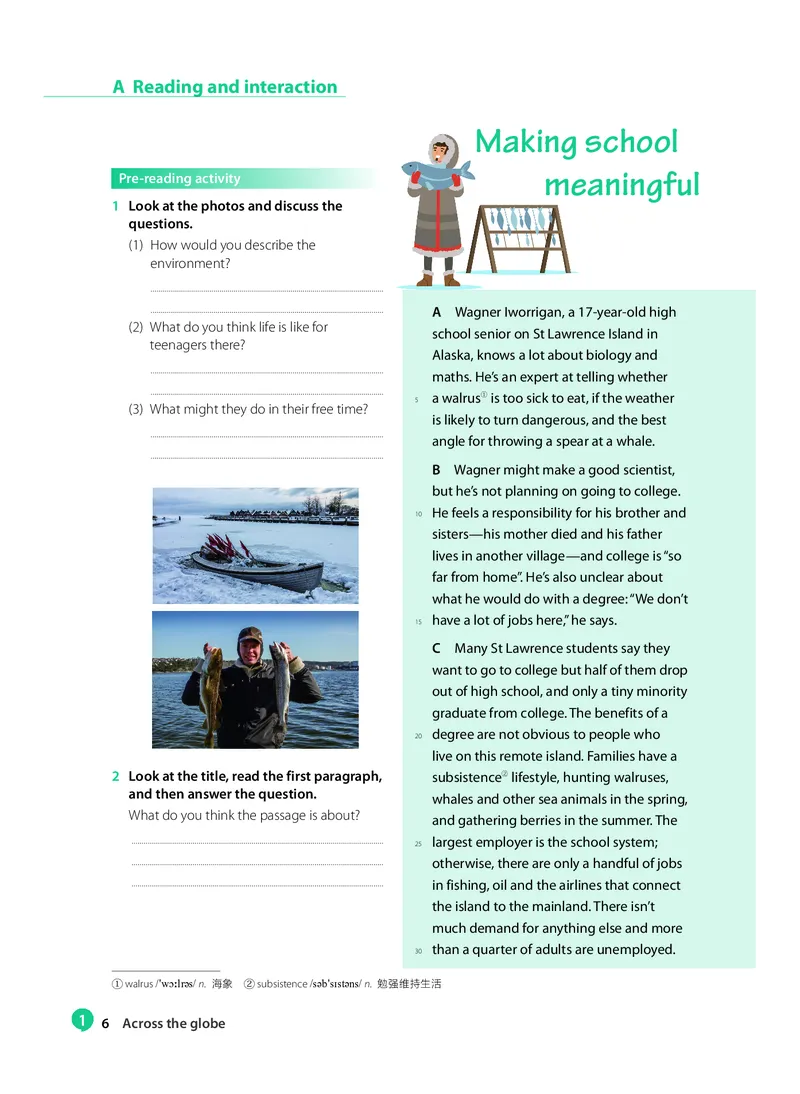
1 �Look at the photos and discuss the
questions.
(1) �How would you describe the
environment?
(2) �What do you think life is like for
teenagers there?
(3) �What might they do in their free time?
5
10
15
20
25
30
A Wagner Iworrigan, a 17-year-old high
school senior on St Lawrence Island in
Alaska, knows a lot about biology and
maths. He’s an expert at telling whether
a walrus
a is too sick to eat, if the weather
is likely to turn dangerous, and the best
angle for throwing a spear at a whale.
B Wagner might make a good scientist,
but he’s not planning on going to college.
He feels a responsibility for his brother and
sisters—his mother died and his father
lives in another village—and college is “so
far from home”. He’s also unclear about
what he would do with a degree: “We don’t
have a lot of jobs here,” he says.
C Many St Lawrence students say they
want to go to college but half of them drop
out of high school, and only a tiny minority
graduate from college. The benefits of a
degree are not obvious to people who
live on this remote island. Families have a
subsistence
b lifestyle, hunting walruses,
whales and other sea animals in the spring,
and gathering berries in the summer. The
largest employer is the school system;
otherwise, there are only a handful of jobs
in fishing, oil and the airlines that connect
the island to the mainland. There isn’t
much demand for anything else and more
than a quarter of adults are unemployed.
Making school
meaningful
2 �Look at the title, read the first paragraph,
and then answer the question.
What do you think the passage is about?
a walrus �/9wO:lrRs/ �n. �海象 b subsistence �/sRb9sIstRns/ �n. �勉强维持生活
1
6 Across the globe
A Reading and interaction
35
40
45
50
55
60
D Many people feel that the educational programs are too rigid and restricted, not
allowing students to go beyond the curriculum, with little connection to the real world.
“We want our children to achieve academically, but we need to be able to design programs
that deal with the challenges they face day-to-day,” said one teacher. Those challenges are
enormous with no easy solutions: what is the relevance of school to kids who spend much
of their time hunting and gathering berries?
E Families also worry that sending children away to study in higher education could
endanger the Yupik language and culture. Already, the younger generation is losing its
fluency and grasp of skills like sewing, walrus-ivory carving and fish-cutting. Respect for
the old ways and knowledge of traditions are disappearing. Can the community send more
students to university without losing its Native culture and language?
F The Yupik people have lived on St Lawrence Island continuously for the last 2,000
years. Today two villages remain with a population of just 1,400. People there are used to
the harsh landscape and climate—in the summer, fields of grassy frozen ground stretch
from snow-capped mountain ranges to the stony shorelines, but in the winter the sun
disappears, there is a lot of snow, and polar bears arrive on ice floes
a. Leaving the island is
not an option, as a ticket on a bush plane
b costs 400, a week’s earnings for many islanders.
The sense of community is strong. When a whale is killed, the houses and school empty as
everyone races to the beach to take a share of the meat. As Wagner put it, “We’re all one big
family because we’re so isolated.”
G But the old ways are inevitably changing. The children drink soda and eat macaroni and
cheese in addition to the traditional diet of fish, sea animals and berries. They ride snow
machines instead of walking. And in the evening, they prefer playing video games and
watching satellite television to listening to their elders tell stories.
H Unsurprisingly, locals are protective of their independence and their heritage. They
recognize the value of “education” but feel that the definition is too narrow. “I think about
when my grandmother taught me to cut fish,” remembers one resident. “It wasn’t ‘do it once
and I’ll give you a grade’. It was hours of practice until you get it right ... There’s a distinction
between education and school. Education is what Native people have been doing for their
children since the beginning of time. School has been what has been imposed on people
from outside,” she adds. “We need to get in the business of education again.”
a ice floe 大片浮冰 b bush plane � � (执行边远偏僻地区运输任务的)小飞机
1
Across the globe 7
Comprehension work
1 Read the passage and answer the questions.
(1) What is Wagner good at?
(2) Why isn’t Wagner planning to go to college?
(3) Why do so few students from St Lawrence Island go to college?
(4) What jobs are available in the local area?
(5) Why are local people worried about sending their children to college?
(6) Why do the Yupik people have a strong sense of community?
(7) What changes are taking place on the island? What are the locals’ attitudes towards them?
St Lawrence Island is located in a
1
region in Alaska. Many
high school students there do not want to go to college. Wagner Iworrigan
wants to stay in his home village: he feels he has a
2
to
look after his family. More importantly, the benefits of a college degree
are not obvious to the local
3
. In spite of their desire for
their children to achieve good
4
results, parents are not
satisfied with the school
5
. They think that the educational
programs in the school system are too
6
and restricted.
What students learn in college is not relevant to their daily challenges in life.
Besides, local residents are becoming more protective of their independence
and
7
. They worry that their local language and culture are
becoming
8
: the children are beginning to lose their ability
to speak local language, and they prefer watching TV or playing video games
to their traditional culture. The local residents question the value of modern
school education. They feel that there is a
9
between
education and school. Education is what Native people have been doing for
their children since the beginning of time, while school is something that has
been
10
on them from outside.
2 �Read the summary below and fill in each blank with a suitable word based on the
language of the passage. You may change the form if necessary.
1
8 Across the globe
A Reading and interaction
Deep reading
1 �Writers often use certain words in order to present their ideas more effectively. Work in
pairs. Identify these words and phrase and then complete the table.
Questions
My answers
(1) �Which word in paragraph C describes
the location of the island? How does this
affect students’ attitudes to education?
Remote. The word suggests that St Lawrence Island
is far away and difficult to get to. The people on the
island live very close to nature, and the skills they
need to learn aren’t taught in ordinary schools.
(2) �Which phrase in paragraph C sums
up the way of life on the island? What
examples does the writer give?
(3) �Which words in paragraph D imply a
criticism of the educational system?
Why?
(4) �Which word in paragraph D describes
the challenges the community
faces? Will these challenges be easily
overcome? Why?
(5) �Which verb in paragraph E emphasizes
the threat to Native culture if young
people go to college? Why?
(6) �Which word in paragraph F describes
the landscape and climate? What
examples does the writer give?
(7) �Which word in paragraph G implies that
changes are unavoidable? Why?
1
Across the globe 9
My reasons
I think the present English curriculum
does not provide us with enough
opportunities to talk in class, so there
should be more communicative activities.
The most important reason is that
practising communication is an effective
way to learn a language. We will never
learn English without speaking it. Also, it
may create a relaxing atmosphere in the
classroom, and raise students’ interest
in learning English.
My suggestion
More communicative activities
should be organized in the English
lesson.
My reasons
My suggestion
Mini-project
Improving the school curriculum
Imagine that you are the chairman of the Students’ Union in your school. You are going
to make three suggestions on how to improve the school curriculum and make it more
relevant to your life.
Discuss the questions in groups.
Does your school prepare you for day-to-day challenges?
If not, what changes would you like to make to the school curriculum? Why?
Share ideas within your group.
Select one person to report on behalf of your group.
2 Work in pairs and discuss the questions.
(1) �Should Wagner go to college? What is your opinion?
(2) �What is the difference between education and school according to the locals? Do you agree?
Why or why not?
1
10 Across the globe
A Reading and interaction
Focus on language
1 �Read the passage again. Find some language points in the passage and list them in the
blanks.
(1) Expressions that are made up of a noun and a preposition (e.g. responsibility for)
(2) Compound words formed with a hyphen (e.g. day-to-day)
2 �Complete the sentences with the correct form of the phrases below.
from different angles
meet the demand
be restricted to
hunt for
an enormous amount of
have a good grasp of
gain fluency
be relevant to
a positive atmosphere
overcome their differences
(1) �For years, the Chinese educational system has been working to
for graduates who can compete in the global marketplace.
(2) �When you start
a job, you need to look at job
advertisements and search for suitable employers.
(3) �Good teachers know how to create
in the
classroom.
(4) �After an honest discussion, the two parties managed to
on the issue.
(5) �He
vocabulary, which gives him an advantage when learning
English.
(6) �Look through the news headlines on the Internet and find what
your project.
(7) �Evolutionary biology is a field that has attracted
attention in recent decades.
(8) �You should examine the issue
before you
make the final decision.
(9) �An effective way to
in a foreign language is to
practise speaking.
(10) �The training ground is available to everyone, while some services
community members.
1
Across the globe 11
The future in different forms
In this unit you will review different structures for talking about the future.
1 �Read the interview about a bush pilot’s job, and match sentences 1–8 in the interview to
questions a–g.
Which sentence(s):
a talks about future plans and arrangements?
b �talk about future predictions (two sentences)?
c talks about scheduled events or a timetable?
d are about uncertain future predictions (two sentences)?
e refers to future intentions?
f refers to a decision or an offer at the moment of speaking?
g refers to a future hope or wish?
a glacier �/9GlCsiR(r)/ �n. �冰川 b icefall �/9aIsfO:l/ �n. �(冰瀑布似的)冰川陡峭部分
Fl
yin
g a
cr
os
s
Al
as
ka
Reporter: �Today on Life on the Edge, we’re talking to Brad, a bush pilot from a national park in
Alaska. The park is huge—to give you a sense of its size, imagine Yellowstone in the
USA and times it by six—that’s 20,000 square miles of mountain wilderness. It’s not
surprising then that the most popular form of transport is bush plane. An unusual
job, Brad, and also very dangerous. What exactly are the dangers?
Brad: �Well, the weather is inevitably extreme and pretty changeable. A clear sky might
suddenly become cloudy without warning, with very little visibility.
Reporter: �What about today’s flight? What’s the weather forecast?
Brad: �Well, they say
1it’ll be unseasonably warm and sunny, but we’ll see. There are
clouds on the horizon, which tells me
2it’s going to snow later. We
3might have to
cancel the afternoon flight—wet snow sticks to the plane wings, which makes it
impossible to gain height.
Reporter: �Better to be safe than sorry, I suppose. And where are you flying today?
Brad: �
4I’m taking food supplies and mail to St Lawrence.
Reporter: �How often
5do planes fly out there?
Brad: �Usually three times a day, as long as the weather is good. On today’s flight, there
are a handful of tourists too. There’s quite a demand for tours at the moment, so
6I’m going to fly over some remote glaciers
a and icefalls
b—they’re pretty awesome.
Hopefully,
7we’ll see some wildlife as well, such as eagles and bears.
Reporter: �It sounds like a fantastic experience.
Brad: �It is. Hop in and
8I’ll take you for a quick tour. I have some time.
Reporter: �Sure, but what you were saying about the snow ...
B Grammar activity
1
12 Across the globe
2 �Read the extract from another interview for Life on the Edge. Match sentences 1–4 to
descriptions a–d.
Reporter: How long have you been a volcano photographer?
Logan: �Well, next month I’ll have been working as a volcano photographer for
exactly eight years.
Reporter: �I understand that Hawaii is your next destination.
1What will you be doing
there?
Logan: �On Monday,
2we’ll be hiking in the island, looking for the best locations. Then,
according to the schedule, on Tuesday morning,
3we will be shooting. By
the time we leave,
4we’ll hopefully have taken some amazing images. And
survived!
Descriptions:
a an activity in progress at a certain time in the future
b an activity in the future that is fixed or decided
c an activity that will be completed in the future
d asking politely about someone’s plans for the near future
3 �Think about what you will do this weekend. Write at least three things. You may use the
example below to help you.
I will be looking after my nephew and niece on Saturday morning. I plan to take them to the circus. In
the evening, I’m going to visit my primary school teacher. Sunday evening is our family film night. So
as usual, Mum, Dad and I will watch a film together at the Star Cinema.
Now, ask your classmates about their plans. Select the busiest or the most interesting
weekend schedule and report to the class.
�You may ask questions like this: What will you do this weekend?
�You may respond like this: In the morning, I will sleep in. I might ask my classmates if they
want to go bowling in the afternoon, but I’m not sure if they have time.
�You may report like this: I think Linlin is the busiest girl I have ever seen. This Saturday, she
will be playing basketball with her cousin at 10: 00 a.m., and at noon, she’ll have lunch with
her classmates. At 2: 00 p.m., she’s going to have a piano lesson, and after that she’ll have time
to do her geometry homework. Before going to bed, she usually practises yoga
a for half an
hour.
a yoga �/9jRWGR/ �n. �瑜伽
1
Across the globe 13
C Listening and speaking
1
14 Across the globe
1 �Listen to students at a school meeting discussing the clubs they want to start.
Take notes and answer the questions.
(1) What clubs do they mention?
(2) Which one do they decide on?
Tak
e y
ou
r n
ot
es
h
er
e!
2 Listen again for details. Complete the sentences.
(1) They can’t start an English club because they
.
(2) Getting the school to approve a video gaming club
.
(3) They should have a list of requirements for
.
(4) �During the months when there aren’t any projects, the club members can
.
(5) Guest speakers can come in and talk to the club about
.
3 Listen again and complete the table.
Getting the club approved
Things club members are supposed to do
The speakers need to / should
Club members can / should
1
Across the globe 15
You may ask questions like this:
What club do you want to start?
What is the purpose of the club?
Who can join it?
�What are the requirements for its members?
How will you manage the club?
What facilities will the club need?
�Where will you get money to run the club?
How will it benefit the members?
�How will it benefit the students who are not members?
You may respond like this:
How about starting ...?
We could start a club that is ...
We should have a requirement about ...
I think the club should aim to ...
... should be the main priority of the club.
We could organize ...
It might be an idea to have ...
�If a student wishes to subscribe to the club newsletter, ...
Language guide
4 �Imagine you have received permission to start a new club at your school. Work in groups
and decide on a club. You may follow the steps below.
Brainstorm ideas for different school clubs individually.
Share ideas within your group. Decide on a club and explain your reasons.
Describe your club, considering aspects such as:
�the purpose of the club
�potential members
benefits of becoming a member
�budget
facilities needed
venue for the activities
club activities
the management
the deadline for application
Select a person to report your plan on behalf of your group.
Home Profile Photos
Search
a maple �/9meIpl/� n. �槭树;枫树 b ginkgo �/9GINkGRW/ �n.� 银杏
D Writing
1
16 Across the globe
1 �You would like to write about an impressive place for the writing competition. You may
prepare your writing by thinking about the questions.
(1) Which kind of place would you like to write about?
a mountain
a city or a town in China or abroad
a nature park / garden
a museum
an island
others:
(2) Which aspects would you like to focus on?
2 �Read the web page. Complete the table on page 17 before you write.
I had my doubts about spending my
day off visiting Hongcun. From what I
knew about the town, it seemed like
just a small, very traditional sort of
A town like a traditional painting
town. However, my friend promised that I wouldn’t be disappointed with a visit to the town.
And I wasn’t!
When we got off the bus at Hongcun, we were greeted by a really beautiful view of Nanhu
(the South Lake). I thought the scene of the lake and town would make a particularly
nice postcard. The black roofs, the white walls, and clear blue water made the view truly
unforgettable.
Then we walked around and started learning about Hongcun and its history. We went
into some houses that were built by extremely wealthy salt and silk traders. And then we
saw some houses where ordinary people had lived. They were small but seemed quite
comfortable.
The really interesting part of our tour came at the town gate. Two incredible trees grow at the
gate. One is a red maple
a and the other is a ginkgo
b tree. They seemed very old, judging by
their huge trunks. Our guide told us about two interesting traditions in Hongcun. When a girl
gets married, she is carried around the red maple for luck. And when an old person of the town
dies, the coffin is carried around the ginkgo tree for the health of that person’s children and
grandchildren. Now that’s totally different! I’ve never heard of customs like that before.
All in all, our day in Hongcun was more interesting than I thought it would be. And the town
really looks like something out of a traditional Chinese painting. Go and check it out yourself!
You must have been to a lot of places in the past years, but what’s the
most impressive one you’ve been to? Please send us your description of
the place.
Impressive places
3 �Now write your own description of a place. Edit your writing properly.
1
Across the globe 17
Aspects of
writing
Guiding questions
My exploration
Content
What is the purpose of the
article?
What place does it introduce?
What was the writer’s
experience like?
What aspects of the place does
the writer mention?
Language
How does the writer grab the
readers’ attention in the first
paragraph?
What language does the writer
use to describe the place?
What language is used to
describe the writer’s feelings?
1 Look at the title. Discuss the questions below in pairs.
What do you think the word songlines means? Could it be an oral tradition, lyrics or music
scales? Why do you think so?
2 Read the passage. Match paragraphs A–F to summaries 1–6.
5
Journalist Gina Baxter learns about songlines in the
Australian outback
a.
A “We don’t mind using GPS,” says our Aboriginal guide Baamba in his Australian accent, as he
looks out across the wilderness which belongs to his tribe, the Adnyamathanha people. The red
ground ahead is covered with bushes and trees. Although it’s early, it’s already 30 degrees in
the shade. It’s a difficult hike, but Baamba is a sensible guide: he always carries a satellite phone
in his backpack in case of emergencies. His ancestors, however, relied on songs.
Songlines
a outback �/9aWtbCk/ �n. �(澳大利亚的)内陆,内陆地区
There are a vast range of geographical environments in the world, yet people have found
ways of surviving and thriving across the globe. If we can understand each other, no
matter where we live or what culture we belong to, we can together build a shared future
for mankind.
In this section, you will first read a passage about the Australian Aborigines’ songlines.
You will then watch a video about the unique culture of the Sami people in Norway, who
make a living by raising reindeer.
E Cultural focus
1
18 Across the globe
Summary
Paragraph
(1) Songs tell the stories about how the world was created.
(2) �On our way back to the camp, we can almost hear those first Australians
singing the songs and following the songlines.
(3) �Songs and stories about the land show the Aborigines’ relationship with their
environment, their cultural identity and their way of life.
(4) �Generations of Australian Aborigines followed pathways through the landscape
with the help of songlines.
(5) �Our Aboriginal guide shows us the way by using GPS and a satellite phone.
(6) �Aboriginal culture was threatened as a result of conflicts between the European
settlers and the Aborigines.
10
15
20
25
30
35
40
45
B The early Australian Aborigines made the land navigable through songs, dance and
paintings. The songs described pathways or “songlines”, which provided an oral “map” of the land.
They showed people where to find a water hole, where there was a river and where they could
hunt. Generations of Aborigines followed these pathways, leaving clear marks and carvings on
rocks and trees to help future travellers. “But the songs describe more than a pathway,” explains
Baamba. “They also tell stories about how the world was created.”
C According to Aboriginal stories, the world was created, when giant beings, part human, part
animal, came down from the sky, from across the sea and from deep in the earth. These giant
beings travelled across the land, making rivers and mountains; then they disappeared back into
the landscape, in places which became sacred sites. The journeys of these beings were recorded
in songs, describing the first pathways or songlines.
D One of the many sacred sites called Arkaroo Rock was mentioned in the songs and stories
about the land. These songs and stories show the close relationship between the native people
and their environment, how they saw themselves as part of nature rather than masters of it,
and how their way of life resulted in a valuable knowledge of their land. It was a way of life
that developed before the Ice Age, beginning around 70,000 years ago, with more than 2,000
generations since then. It was a way of life that was safe from invasion and influence ... until 1788.
E When the Europeans arrived in 1788, they had a different attitude to the land. They believed
that the earth and its animals were there for the benefit of human beings. They also believed
that if land wasn’t farmed, then it didn’t belong to anyone. At first, Aborigines didn’t understand
this attitude, so their first contact was friendly. However, conflicts soon arose as new settlers
took away the Aboriginal hunting grounds. As more people arrived and more land was taken,
Aboriginal culture became increasingly threatened. Some tribes were not allowed to travel from
one place to another, while others were relocated into special camps. Sadly, this destroyed their
ancient way of life, and many Aboriginal songlines were lost. Today, people like Baamba are
trying to restore this heritage and preserve it.
F It’s late now and Baamba is waiting outside Arkaroo Rock until we’ve finished exploring.
Inside, we’re admiring the beautiful cave paintings, but as soon as we’ve taken some photos, we
leave. Dark clouds are visible on the horizon and
if we stay any longer, we’ll be caught in a storm.
“By the time we reach camp, the rain will be here,”
says Baamba. “We’ll have problems getting back
unless we leave now.” He’s right, of course—there
are already flashes of lightning
a and thunder in
the distance. As we drive away, the wind blows
through the trees, and we can almost hear the
voices of those first Australians, singing the songs
of their ancestors, and following the songlines.
a lightning �/9laItnIN/ �n. �闪电
1
Across the globe 19
4 �Work in groups. Analyse the differences in how Australian Aborigines and European
settlers thought about land. Then answer the questions.
(1) �How did they view land ownership?
(2) �How did their different attitudes to the land affect their relationship?
3 �Read the passage again and decide whether the following statements are true (T) or
false (F). Correct the false ones.
(1) Baamba uses modern equipment to navigate because he knows little about songlines.
(2) The ancestors of the Adnyamathanha people depended on songs to find their way
around.
(3) Songlines were created only to describe pathways and provide an oral “map”.
(4) The Aborigines regarded themselves as masters of nature and owners of the land.
(5) The European settlers believed they had the right to take away unfarmed land.
(6) �Conflicts arose between Aborigines and the European settlers as soon as they arrived
in 1788.
(7) Songlines remain because Aborigines and the European settlers resolved their conflicts.
1
20 Across the globe
E Cultural focus
Start thinking
1 Answer the questions.
(1) �What do you think life is like in northern Norway?
(2) �Which animals live in cold climates?
Comprehension check
2 �Watch the video. Correct the factual errors in the sentences.
(1) �Sami people still live in tents and ride reindeer instead of driving cars.
(2) �In autumn, Elle and her family follow their reindeer to migrate across Norway.
(3) �Elle and Inga do nothing but help herd the animals on the migration route.
(4) When reaching the coast, the reindeer eat grass and give birth to babies there.
(5) �Elle and her family take care of the herd during the summer.
(6) �When autumn arrives, they don’t have a lot of baby reindeer.
(7) �On their journey back home, the reindeer have to travel on a boat to the mainland.
(8) �Elle has decided to choose a different way of life.
Vocabulary
3 Complete the sentences with the correct form of the words below.
pack
prepare
check
base
count
feed
catch
(1) �She needed to
several times before she was sure that everyone was present.
(2) �One of the most important goals of education is to
children for life.
(3) �Jack always
a dozen books into his suitcase before going off on a long journey.
(4) �This is a story that will
the imagination of every child.
(5) �It takes researchers a lot of time to
data into their computers.
(6) �They
their conclusion on the evidence given by the witness.
(7) �Maybe we ought to go down to the library and
out the book.
Extension
4 �Imagine you have a farm. Work in groups. Decide on the animals to raise and how to
manage your farm. Present your ideas to the class.
(1) �Draw a picture of your farm.
(2) �List three to five kinds of animals you intend to raise on your farm.
(3) �Discuss in your group what animals to raise and how to manage your farm.
(4) �Write a speech to introduce your farm and present it to your class.
Video
Reindeer girls
1
Across the globe 21
Checklist
*
1
Me
2
My teacher /
classmate
3
Action
A Reading and interaction
�I can describe the daily life and the education of the
Yupik people.
�I can interpret the meaning and function of some words
and phrases used to express the writer’s purpose.
�I can use simple words to make suggestions on how to
improve the school curriculum.
B Grammar activity
�I can recognize the future structures in the passage.
�I can talk about the future in at least five ways if the
context is clear.
C �Listening and speaking
�I can understand the three speakers talking about their
ideas for new clubs.
�I can talk about my plan for starting a new school club
using suitable words and phrases.
D Writing
�I can identify the main content and the features of
language in the sample writing.
�I can write about an impressive place with enough
details in the correct format.
E Cultural focus
�I can explain the origin, functions and cultural meaning
of Aboriginal songlines.
�I can describe how the Sami people in Norway raise
reindeer.
Use the checklist and reflective questions below to evaluate your study in this unit.
Reflective questions
Which part gave you the most satisfactory engagement in learning? What lesson(s) can you draw
from this experience?
* �Ask your teacher or your classmate to assess what you can do. Use the four symbols (33, 3 and !, !!). In column 1 or 2, 33=I’m
confident about this; 3=I’m OK, but not quite sure. In column 3, ! = I must review this part; !! = I must seek help about this. The
symbols can be applied to other Self-assessment sections in the book.
Self-assessment
1
22 Across the globe
Exploring literature 1
Pre-reading activity
Work in pairs. Look at the ways of “thinking” listed below. Which ones have you ever done?
Share your experiences with your partner.
Daydreaming about a famous place
Meditating on the meaning of life
Imagining the life of a person or a friend
Having an inner dialogue with oneself
Read the poem below and find out what the speaker is thinking.
a Tao Qian (about 365–427): also known as Tao Yuanming in Chinese history, a poet during the era of the Eastern Jin Dynasty and
the Southern and Northern Dynasties b hustle �/9hVsl/ �n. �忙碌喧嚣 c commotion �/kR9mRWSn/ �n. �喧闹
d solitude �/9sBlItju:d/ �n. �独处;独居 e mum �/mVm/ �n. �(chrysanthemum 的简称) 菊花 f gaze �/GeIz/ �v. �凝视
Drinking wine
By Tao Qian
a
I build my cottage in the hustle
b of the world;
Of commotion
c and noise I hear not.
How can you resist the temptations?
A distant heart creates its own solitude
d.
I pluck mums
e under the eastern hedge
While gazing
f afar at the southern hills.
The mountain air is fresh day and night;
Together birds flock home in flight.
Lost deep in thought for the truth of life
To bring it back in words I have failed.
Two poems
23
Exploring literature 1
Questions for discussion
1 What kind of place does the speaker seem to live in? Describe its physical environment.
2 What doesn’t he claim to hear in his home? Is his claim reliable?
3 What does the speaker usually do in his leisure time? Make a list.
4 What does he often think about when he is following his daily routines?
5 �At the end of the poem, the speaker makes the point that he doesn’t have the words to express
his thoughts. Why?
6 �When do you feel that your language is inadequate for expressing your thoughts? Make a list
of such occasions and share them with your classmates.
7 �Some people say that poetry defies
a translation. Read the poem aloud several times. Can
you get the same level of satisfaction from reading the Chinese version? Try to make a list of
what you feel is missing when you read the translation or any extra advantages that increase
your appreciation of the poem.
Role-play writing
Imagine you meet the speaker in this poem. Think about and write down the dialogue that
would take place between the two of you. You may add some details to make it sound like
a real conversation. When you finish the writing, find a partner to role-play your dialogue
with for your class.
You: Sir, where did you build your cottage? Was it in the downtown area or in the suburbs?
Speaker:
a defy �/dI9faI/ �v. �不可能;无法(解释、描绘等)
24
Read the second poem. Find out what the speaker is thinking.
I wandered lonely as a cloud
By William Wordsworth
a
I wandered lonely as a cloud
That floats on high o’er
b vales
c and hills,
When all at once I saw a crowd,
A host of golden daffodils
d;
Beside the lake, beneath the trees,
Fluttering
e and dancing in the breeze.
Continuous as the stars that shine
And twinkle
f on the Milky Way
g,
They stretched in never-ending line
Along the margin of a bay
h:
Ten thousand saw I at a glance,
Tossing
i their heads in sprightly
j dance.
The waves beside them danced; but they
Out-did the sparkling waves in glee
k:
A poet could not but be gay
l,
In such a jocund
m company:
I gazed—and gazed—but little thought
What wealth the show to me had brought:
For oft
n, when on my couch
o I lie
In vacant or in pensive mood
p,
They flash upon that inward eye
Which is the bliss
q of solitude;
And then my heart with pleasure fills,
And dances with the daffodils.
a William Wordsworth (1770–1850): English poet, often considered as a representative of English Romantic movement
b o’er �/O:(r) / �prep. �在……上面 ( 为省略一个音节而将over 简化为o’er)
c vale �/veIl/ �n. �山谷 d daffodil �/9dCfRdIl/ �n. �黄水仙 e flutter �/9flVtR(r)/ �v. �飘动;颤动
f twinkle �/9twINkl/ �v. �闪耀;闪烁 g the Milky Way �银河 h bay �/beI/ �n. �湖湾;海湾
i toss �/tBs/ �v. �摇摆;摇动 j sprightly �/9spraItli/ �adj. �精力充沛的 k glee �/Gli:/ �n. �高兴;欢喜
l gay �/GeI/ �adj. �(old-fashioned) 开心的; 快乐的 m jocund �/9dZBkRnd/ �adj. �欢乐的;愉快的
n oft �/Bft/ �adv. �(old use) 时常(often) o couch �/kaWtS/ �n. �长沙发;长榻
p in vacant �/9veIkRnt/ or in pensive /9pensIv/ mood �在(我)心情茫然或忧伤的时候 q bliss �/blIs/ �n. �极乐
25
Exploring literature 1
Imagery study
1 Work with your partner to study the poem again. Answer the questions below.
Did the poet see the scenery with his own eyes, or just in his mind’s eye? Which line(s) in the
poem tell(s) you that?
2 �Study stanzas 1–3 again. Pay attention to the poetic images used to describe the
daffodils. Find the words or expressions that support the description.
Aspects
Images
Location
beside the lake, beneath the trees, along the margin of a bay, with vales and
hills nearby
Sound
Colour
Motion
Others
Association with
the poet’s mood
26
Comparative analysis
Work in groups to compare the two poems.
(1) Both poems mention “solitude”. How different are the two poets in dealing with this theme?
(2) �As a famous philosopher once said, “The last challenge for human civilization is to find a
proper thing to do in one’s solitude.” What would you like to do in your “solitude”? Make a list
and justify your choices.
Hands-on practice
1 Look at the picture and read the poem composed by a Chinese student.
a magnolia �/mCG9nRWliR/ �n. �木兰;木兰树 b rustle �/9rVsl/ �v. �发出沙沙声
Magnolias
a
By Jack Zhang (16 years old)
Gentle breeze rustles
b the trees.
A sweet scent comes through leaves.
The pink magnolias are budding out,
Merrily inviting the children to dance about.
27
Exploring literature 1
2 �Now, work with your partner to write a poem about the beautiful flowers. You must
follow these rules below. Then read it to the class.
Write about the flowers in the first two lines.
Write about human activities in the last two lines.
The last two lines must reveal some kind of emotions.
28
Objectives
2
Things that matter
A Reading and interaction
�Explore why people
accumulate personal
possessions and how
rubbish should be sorted
B Grammar activity
�Use the subject clause
correctly in the given
context
C Listening and speaking
�Make suggestions for
exhibits at a local museum
D Writing
�Write a story using
appropriate language
E Cultural focus
�Debate whether museum
objects should be returned
to the countries they came
from
�Give a brief description of
two famous art museums in
the world
Pre-reading activity
1 �Look at the photo and discuss the
questions.
(1) �How many of these things can you
name?
(2) �How are the things arranged?
(3) �How do you feel about the room?
2 �Before you read, answer the questions.
Why do we keep things we do not use or
need? Which of the reasons do you agree
with? Why?
(1) “It’s mine. Why should I give it away?”
(2) �“I don’t like throwing things out—it’s a
waste.”
(3) �“You never know; I might use it in the
future.”
(4) �“It has sentimental value.”
(5) �“I haven’t got time to sort out that stuff.”
(6) �“I hoard things, but I have the space, so
why not?”
Elaine and Susie Hall live in a large house
in a typical New Jersey suburb. They
appear to be normal American teenagers,
although appearances can be deceptive
a.
The truth is that everyday life for the
sisters is far from normal: things which
we might take for granted, like cooking
a meal or picking out a dress in front of
the mirror, are incredibly difficult for the
girls. Why? Because their mum, Sharon, is
a compulsive hoarder
b. “We spend most of
our time in a small area in the living room,
just in front of the TV,” complains Susie.
“Mum’s stuff has spread out everywhere.
It’s taken over our lives—it’s total chaos!”
In Sharon’s house, every room is filled with
piles of jazz records and CDs, mountains
of clothes and stacks of magazines. The
kitchen is impossible to use, so meals are
cooked in a microwave in the garage and
dishes are washed in the shower. Even
making a cup of tea is next to impossible:
the water kettle is hidden beneath a pile
of clothes on top of an empty fish tank.
All this stuff spread out at random around
the house makes daily life a nightmare.
5
10
15
20
25
The
in our lives
stuff
a deceptive �/dI9septIv/ �adj.� 欺骗性的;误导的;骗人的 b compulsive hoarder � �强迫症式的囤积者
A Reading and interaction
2
30 Things that matter
Compulsive hoarding can be an extreme condition and
this family has run out of space. But while it’s true that
most of us would never hoard to this extent, the fact is
that many of us buy more things than we need and, once
we have them, we’re reluctant to throw them away.
According to social scientists, people have been
collecting stuff for centuries. About 15,000 years ago, primitive communities began to
lose their nomadic
a ways and rely on stored food, resulting in a change in our material
culture. Permanent homes were built as people acquired more objects, and these things
soon became impossible to carry around. The loss of nomadic ways was not just thanks to
agriculture, but also to the number of possessions people had.
Back in New Jersey, Elaine is feeling increasingly annoyed by her mother’s junk as she
searches for a place to do her homework. The untidy living environment is a constant
source of friction. In the end, she uses a heap of clothes as a temporary desk. “After a while
you just put up with it,” she says. “You start thinking it’s normal.” In some ways it is normal,
because unfortunately our modern consumer culture actively encourages us to own things.
Advertisements convince us that we can’t live without certain products and imply that
these things can change our lives. It’s very difficult to resist this culture, to opt out and buy
less.
So why is it so difficult to get rid of things? One explanation is that people are naturally
resistant to change and prefer things the way they are; the end result is loads of clutter
b,
taking up valuable space. Psychologists also talk about the “endowment effect
c”, or the way
we attach more value to things once we own them. For example, you might not use your
old MP3 player, but it still has “value” because it belongs to you. Ownership is as important
as usefulness. But as Elaine says, “Mum needs to ask herself: if I didn’t have it, would I go out
and buy it? If the answer is ‘no’, then she should bin it.”
“Sentimental value” is another reason for not junking things. Many of the objects we keep
have connections to a place, an event or a person in our past, such as birthday cards from a
grandparent or an old football shirt from an important match. These objects, like Sharon’s
record collection, have emotional currency, which is why we never throw them out.
Luckily, Elaine and Susie’s story has a happy ending. Sharon
has finally got help with her hoarding and has slowly started
to clear out their home. “She had to,” says Elaine, “or our
family would have fallen apart.” It’s been a few months, but
the girls are helping out and things are gradually getting
better.
30
35
40
45
50
55
60
a nomadic �/nRW9mCdIk/� adj. �游牧的;流浪的 b clutter �/9klVtR(r)/ �n.� 杂乱的东西( 尤指不需要的或无用的);杂乱
c endowment effect �禀赋效应(心理学术语,指个人一旦拥有某项物品,那么他对该物品价值的评价要比未拥有时高)
2
Things that matter 31
Comprehension work
1 Read the passage and answer the questions.
(1) �What problems do Elaine and Susie face every day?
(2) �What does the inside of Sharon’s house look like?
(3) �When did people begin to collect stuff? What did they collect?
(4) �Why do some people hoard things?
(5) �Why is it difficult to get rid of things?
(6) �What do you think of Sharon’s hoarding behaviour?
2 �Read the summary below and fill in each blank with a suitable word based on the
language of the passage. You may change the form if necessary.
A compulsive
1
is a person who has gathered an
unhealthy amount of objects in his or her home. Most of us buy more
things than we actually need. Even though we never use a certain item,
we are often
2
to throw it away.
According to social scientists, hoarding has a long history. Due to the
development of agriculture,
3
communities began to
settle down in a particular place and build
4
homes to
store food and other objects. This resulted in a change in our material
culture. Our modern
5
culture is constantly persuading
us to hoard. We are
6
that we cannot live without certain
products.
It is difficult to get rid of things because human beings have a natural
7
to change. Most people’s preference is for things to
remain as they are. Another reason, according to psychologists, is the
“endowment effect”, or the tendency to
8
more value
to the things we own. “Sentimental value” is also a reason for not junking
things. Many of the objects we keep have
9
to a place, an
event or a person in our past; thus, they have
10
currency.
A Reading and interaction
2
32 Things that matter
Deep reading
1 �Read the passage again. Work in pairs, study the sentences below and explain how the
expressions in bold help express the writer’s implied meanings. Then complete the table.
Sentences in the passage
My understanding
(1) �Because their mum, Sharon, is a compulsive
hoarder.
The word “compulsive” means “being unable to
control or stop”. It implies that it is an abnormal
condition.
(2) �In Sharon’s house, every room is filled with
piles of jazz records and CDs, mountains of
clothes and stacks of magazines.
(3) �Compulsive hoarding can be an extreme
condition and this family has run out of
space.
(4) �Back in New Jersey, Elaine is feeling
increasingly annoyed by her mother’s
junk as she searches for a place to do her
homework.
(5) �In the end, she uses a heap of clothes as a
temporary desk.
(6) �... the end result is loads of clutter, taking up
valuable space.
2
Things that matter 33
Mini-project
Promoting rubbish classification
�Imagine you are going to promote recycling in your community. Choose four pieces of
rubbish and decide which of the four categories they belong to: residual waste, household
food waste, recyclable waste or hazardous waste.
Discuss the questions in groups.
(1) What rubbish will you choose?
(2) What category would you classify each piece of rubbish into? Why?
�Share your ideas within your group.
�Select one person to report on behalf of your group.
Reasons
The leftover paint, if not
disposed of properly, will harm
our health and pollute the
environment, so it should be
sorted as hazardous waste.
By doing so, we can make sure
the paint is safely processed.
My classification
I would sort leftover
a paint
as hazardous waste.
Reasons
My classification
a leftover �/9leftRWvR(r)/ �adj.� 剩余的; 吃剩的; 未用完的
2 Work in pairs and discuss the questions.
(1) �What ways of preventing compulsive hoarding can you think of?
(2) �Do you agree with the writer that today’s society puts too much emphasis on possessions?
Why or why not?
A Reading and interaction
2
34 Things that matter
Focus on language
1 �Read the passage again. Find the expressions with similar meanings in the passage and
list them in the blanks.
(1) �loads of:
,
,
,
(2) things:
,
,
,
(3) rubbish:
(4) throw out:
,
,
2 Study the phrasal verbs in bold in the passage. Match them to meanings a–f.
a to choose
b to remove
,
c to use up
d to extend over a large area
e to stop being involved
f to support or help
3 �Find synonyms for the underlined parts in the sentences below.
primitive
load
abnormal
mirror
friction
temporary
possessions
tendency
annoyed
reluctant
(1) �Among teenagers today, there is a trend towards socializing online rather than face-to-face.
�
(2) �The doctor told the patient that the drug can only give her a brief relief from the pain. She
shouldn’t expect it to have any long-term effect on her illness.�
(3) �Sometimes we’re angered by people who actually remind us of the worst qualities in
ourselves. �
(4) �Even the most successful team may experience internal conflict, which is often caused by
miscommunications or clashes of interest. �
(5) �Despite the heavy debt burden, the company managed to survive the economic crisis.
�
(6) �His doctor told him that the test results were unusual, so he needed to stay at the hospital
for observation.�
(7) �When they were moving house they had to pack their belongings into boxes.
�
(8) Our voice tends to reflect our mood and our confidence. �
(9) �Even if the child is unwilling to say goodbye to his friends, he knows that it is time to go
back home. �
(10) �The methods of communication used during the march were not advanced by today’s
standards, but very effective. �
2
Things that matter 35
Don’t forget your toothbrush …
The subject clause
A subject clause is a nominal clause used as the subject of a sentence. It is usually introduced
by a linking word such as that, whether or a wh-word.
What we are doing is offering a scholarship.
1 �Read the passage. Match sentences 1–5 to grammar rules a–c.
Over 70% of travellers return from their holidays, unpack their bags and find something missing. In
hotel rooms across the world, people have left toothbrushes, purses, driving licences and even their
diamond rings!
1Whether it’s expensive jewellery left by the rich or mobile phone chargers left by
business travellers doesn’t make a difference.
2It seems quite common that people forget things in
the places they stay. But perhaps the strangest item ever forgotten was found in a hotel in Portugal.
Maria is a hotel receptionist in the Algarve. She explained that the staff come across lots of left-behind
items.
3“What the maids
a find as they clean the rooms usually isn’t worth reporting or keeping, so
it just gets thrown away,” she added. However, one day, one of the maids discovered a fish in a bath
and had the fright of her life. Why? Because the fish was a fully-grown shark! A guest at the hotel had
caught it on a fishing trip and then left it behind. Luckily, the animal survived and the hotel returned
it to its natural habitat.
4Why so many of us forget things, big or small, may be due to a few common factors. Many people
are just in a hurry to leave; others bring too much stuff in the first place.
5That small items then get
left behind should not surprise anyone. As a wise man once said, “He who would travel happily must
travel light.”
Grammar reference 1 (p. 100)
We can use subject clauses in different ways:
a �When we want to comment on a fact, we can introduce the fact with a that clause.
b �When we want to talk about something that is not certain or definite, or about which a
choice has to be made, we use a clause, introduced by a wh-word or whether.
c �When we want to balance a sentence with a long subject, we can use it as the anticipatory
subject.
a maid �/meId/ �n.� ( 旅馆里的) 女服务员
B Grammar activity
2
36 Things that matter
2 Complete each sentence with it, that, what or whether.
(1) �
something needs to be done to clean up our beaches is obvious to
everyone.
(2) �
is a shame that more people don’t make an effort to clean up our beaches
and oceans.
(3) �
seems incredible that the flu virus kills hundreds of thousands of people
every year worldwide.
(4) �
we need to do is to educate people about the harm that tobacco does to
the body.
(5) �
you dropped something or someone else dropped it doesn’t matter. If you
see it, pick it up.
(6)
languages borrow words as they develop is inevitable.
(7)
you sort out things in your room or not makes a difference.
3 �Think about the questions. Then write answers on the lines, using subject clauses. You
may use the example below to help you.
What surprised me most today is my friend Li Ming’s performance in the running competition. It is
unbelievable that he won the race today.
What was the last thing that astonished you?
What is the most obvious similarity between you and your best friend?
What matters most to you right now?
�Now, ask your classmates about their answers. Select the most interesting one to report
to the class.
You may ask questions like this: What has astonished you most recently?
�You may respond like this: The thing that astonished me most is the bird nest that I found
on my balcony.
�You may report like this: I think Lili’s description is the most interesting one. She said, “I
watched a nature programme this week, and I learnt a number of surprising things. What
astonished me most is that giraffes sleep with their eyes open.”
2
Things that matter 37
1 �Listen to a discussion among three students. Take notes and answer the question.
What are they talking about?
2 �Listen again and decide whether the following statements are true (T) or false (F).
Correct the false ones.
(1) �The only criterion for choosing objects for the environment case is whether they
help raise awareness of environmental problems.
(2) �The speakers’ town is close to the sea.
(3) �People in the local community wear masks to celebrate an important festival.
(4) �The speakers think the Roman coin has historical value because it is the first coin
issued by the local government.
(5) �The speakers all think the picture of Christopher Columbus is more suitable
�than the Roman coin.
(6) �The speakers decide to present the objects through an interactive game.
3 Listen again for details. Complete the table.
Themes
Objects suggested
Reasons for the suggestions
Environment
Seashells
A part of local life
(1)
(2)
(3)
(5)
(4)
(6) �
Culture
(7)
(8) �
History
(9)
(11) �
(10) �
(12) �
C Listening and speaking
2
38 Things that matter
4 �Imagine you are preparing exhibits to display at a museum about your local community.
Work in groups and choose objects for each of the following display cases: environment,
culture and history. You may follow the steps below.
Define “your community”: is it your local area, your town, your street or your school?
�Think about what is interesting about the environment, culture and history of your local
community.
Decide on objects for the display cases and explain the reasons for your choices.
Select one person to report on behalf of your group.
You may decide on objects for the display cases like this:
�If we want to say something about the environment, we could
have ...
... would be good.
We might have ...
We could include some ...
That could be the best place for ...
You may explain your choices like this:
... to raise people’s awareness of ...
... will help illustrate ...
People associate ... with ...
... to show ... in our local culture.
... could be suitable.
You may report like this:
Our main objective is to ...
We chose to include ... because ...
Wri
te
yo
ur
id
ea
s
h
er
e
!
Language guide
2
Things that matter 39
1 �Read the event announcement above from The Campus Story Centre. Imagine you
would like to take part in this competition. Before you write your story, think about the
questions below.
(1) What kind of story would you like to tell?
(2) �How will you grab the readers’ attention from the very beginning?
2 �Read the story. Complete the table on page 41 before you write.
Do you have stories to share? Are you good at telling
stories? If the answer is yes, come and join us at The
Campus Story Centre. We are organizing a storytelling
competition this month: if you want to take part, submit
your stories now!
Storytelling competition
Part 1: Mark
Having found it, I wasn’t sure what to do with it. At first I looked around, at the other
people on the platform. Perhaps the owner wasn’t far away? Realizing they’d probably
gone, I slipped it into my backpack and decided to hand it in at the next stop. “All trains
to Waterloo have been cancelled. London Transport apologizes for any inconvenience ...,”
announced the station loudspeaker as everyone got off the train and struggled down the
narrow passageways. “Great,” I thought as I was pulled along by the crowd. “I’m going to
miss my first lecture.”
Later that day, after finishing lunch, I remembered the folder. I pulled it out of my
backpack and looked at it. It was smooth and black and had the initials S.D. on the front.
Feeling a little guilty, I opened it up. Inside there was a bunch of drawings—some in black
and white, others in colour, all of them pretty good: a street scene in the rain, a sunny day
in the park, a performer in Covent Garden.
“What’s that, Mark?” asked a friend sitting next to me.
“Ah, something I found on the tube this morning,” I said, showing her.
“They’re interesting. Why didn’t you hand them in?”
“I forgot,” I said.
“Well, don’t worry too much,” she laughed.
“You’re in luck. There’s an exhibition of
unclaimed art from the lost property
office of the London Transport this week,
and it’s at a gallery in Hoxton Square—
just round the corner. Why don’t you take
them along?”
D Writing
2
40 Things that matter
Aspects of
writing
Guiding questions
My exploration
Content
What is Mark’s story about?
What is Sarah’s story about?
From whose point of view is each story told?
Is it written in the first or third person?
Language
What language does the writer use to “show”,
rather than “tell” how the characters feel?
Why does the writer use several verb-ing
forms as adverbials in the story? What other
sentence structures can be used in a similar
way?
How does the writer report what the
different characters say?
3 Now write your own story. Edit your writing properly.
Part 2: Sarah
“Sarah Darwin?” called a cross-looking woman behind the desk as I ran through the
double doors. “Yes,” I answered. “I’m here.” I’d just about made it, despite the delay on the
Underground. It wouldn’t have looked good to arrive any later. Places at Central Saint
Martins College were few, the applicants were many and I was determined to make a good
impression. “They’re waiting for you inside,” said the woman, pointing to a door at the end of
the passage.
The room was a tutor’s office, with heaps of books, piles of drawings and photographs
everywhere. A middle-aged woman in a black sweater and jeans stood beside a bookcase,
and a grey-haired man in a tweed
a suit was sitting in an armchair nearby. The woman looked
up and smiled.
“Sarah?” she said. “Please take a seat ... ” Coughing a little, I sat in a chair opposite, and then
reached into my bag. That’s when I noticed it was missing. “Anything wrong?” asked the man.
Outside the wind was getting stronger and it was starting to rain—to pour down, in fact.
“I think I left my folder on the train,” I said.
An hour later, having finished the interview, I was back on the street. In the end it hadn’t
been a total disaster; I’d borrowed a laptop and presented work from my website, although
the pictures weren’t as striking. Still, it was better than nothing. By now it was raining hard,
but after losing my folder, I didn’t care about getting wet. All I cared about was finding my
drawings. And I wanted a place at Central Saint Martins.
a tweed �/twi:d/ �n.� ( 杂色) 粗花呢
2
Things that matter 41
1 Work in pairs and discuss the questions.
(1) �What objects should national museums have?
(2) �What is your understanding of the term encyclopaedic museum?
2 �Read the passage and decide whether the following statements are true (T) or false (F).
Correct the false ones.
(1) �The British Museum is well known for its wide-ranging collection.
(2) �The founder of the British Museum intended to collect objects from all over Britain.
(3) �The museum clearly documented how each object on display was acquired.
(4) �Many countries have tried to ask for their treasures back.
(5) �It is out of the question that the treasures should be returned to their original countries.
(6) �The Egyptian government succeeded in persuading the museum to return the Rosetta
Stone as a loan.
(7) �The British Museum’s attempt to bring different cultures together has failed to achieve
the desired effect.
A The British Museum has a well-earned reputation as an
“encyclopaedic
a” museum, with a global story told through
eight million objects. Inside, a wide-ranging collection
includes everything from prehistoric pottery
b to precious
handmade jewellery from India and Ming Dynasty vases
from China. The museum helps us understand how events
that happened at different times and in different places were
5
Saved
or stolen?
Saved
or stolen?
a encyclopaedic �/In0saIklR9pi:dIk/ �adj.� 百科全书的;百科知识的 b pottery �/9pBtRri/ �n.� 陶器
Objects play an important part in all human cultures: some are so important that they
are considered our shared heritage. What attitude should we have towards the things we
own, either individually or as a country?
In this section, you will first read a passage about the collections of the British Museum, and
whether some items should be returned to the countries they came from. You will then watch
a video about two famous European museums: the Musée d’Orsay and Tate Modern.
E Cultural focus
2
42 Things that matter
connected, and how they influenced each other. Indeed, this was the vision of its founder,
Sir Hans Sloane, who tried setting up cross-cultural comparisons in his original collection in
1753.
B As you walk around the British Museum today, it’s clear that Sloane’s broad-minded
vision is very much alive and well. What’s less clear is how the museum acquired many of
the objects on display and whether they should remain there. The collection has an obvious
political dimension: while some objects have a well-documented history, others were added
during Britain’s colonial period, so it’s possible they were stolen from famous archaeological
sites or acquired in the war. Imagine having an important national monument from your
country kept permanently in another country. How would you feel? Would you try to get
the country to return it? It’s not surprising that many countries have gone on to ask for
their treasures back. However, where they should be kept is a question that is still heatedly
debated.
C The Rosetta Stone is a well-known exhibit that illustrates this
problem. Carved in 196 BCE, the stone was the key to unlocking the
language of the ancient Egyptians. It was first discovered in 1799 near
the town of el-Rashid (Rosetta) by soldiers in Napoleon’s army, but
on Napoleon’s defeat in 1801, it became the property of the British.
Many of the museum’s treasures were acquired in a similar way, but
unsurprisingly, the British Museum is reluctant to let the Rosetta Stone
go. It argues that more people see the Stone in London than they would
in Cairo, the location is more secure and the exhibit is a critical part of
its global collection. The Egyptian government has other ideas and is trying to persuade the
museum to return it. They claim that it’s important for their nation’s history and identity, and
that many Egyptians can’t afford to go to London to see it. But the British Museum won’t let
the Rosetta Stone go, even as a loan, as they fear it won’t be returned.
D The British Museum is a place dedicated to international understanding, and the
advantages of an encyclopaedic museum are clear to see: “We need to explore common
ground, how people perceive their relationship to each other ... and (to) see human history
as an ongoing joint project,” explains MacGregor, former director of the British Museum. But
this attempt to bring different cultures together has been self-defeating, ultimately having
the opposite effect: taking treasures from other countries has resulted in never-ending
international arguments and frosty relations with foreign governments. So as you admire the
breathtaking objects on display at the museum, think about their heritage. Remember to
ask yourself: Does the end justify the means? Is taking an object for a museum different from
theft? And shouldn’t important objects be exhibited where they were originally made?
10
15
20
25
30
35
40
2
Things that matter 43
3 �Read the passage again. Write a summary for each paragraph.
Paragraph
Summary
A
B
C
D
4 Work in groups and discuss the questions.
According to the passage, many objects exhibited in the British Museum were originally taken
from other countries during times of war. What is your view on this? Should they be returned?
Why or why not?
E Cultural focus
2
44 Things that matter
Start thinking
1 Answer the questions.
(1) Which are the most famous museums and art galleries in China?
(2) What kind of art or artefacts can you see there?
(3) Would you like to visit any museums or art galleries abroad? Which ones, and why?
Comprehension check
2 �Read the sentences and watch the video. Write MO for the Musée d’Orsay and TM for
Tate Modern.
(1) �Its collection features modern and contemporary art. �
(2) �It is famous for its collection of impressionist and post-impressionist art. �
(3) �It was built as a train station and a luxury hotel. �
(4) �It was used for generating electricity to supply the capital. �
(5) �It opened as an art gallery in 1986. �
(6) �It was first opened to the public in 2000. �
(7) �The building was designed by a team of architects. �
(8) �One individual was responsible for its design. �
Vocabulary
3 Complete the text with the adjective form of the words in brackets.
In 2000, The Lowry gallery and theatre complex opened in a new and
1
(fashion)
area to the north of Manchester called Salford Quays. The development is on the
2
(history) site of Manchester docks, which served the city from 1894 to 1982.
The Lowry houses an
3
(impress) collection of the works of the artist of the same
name. Laurence Stephen Lowry is famous for his paintings of
4
(industry) scenes
in North West England. His style is easily recognizable because of the
5
(minimum)
amount of detail he gave his figures, which became known as “matchstick men”. Many of his
6
(origin) paintings can be seen in the gallery and some parts of the exhibition
are
7
(interact). Since its inauguration, the complex has had an important
8
(culture) impact on Manchester and has changed this part of the city forever.
Extension
4 Work in small groups. Make an advertisement for an exhibition. Present it to the class.
(1) Make a list of museums and art galleries in China. What can you see there?
(2) �Research one of the museums or galleries to find out what exhibitions are currently on.
When you have finished, take turns to ask questions about each place and the exhibitions
that are being held.
(3) �Choose one of the exhibitions. List five reasons why people should visit the exhibition.
(4) �Write a speech to advertise the exhibition you have chosen.
(5) Find a picture of the exhibition and come up with a slogan to advertise it.
(6) Present your advertisement to the class.
Video
Museums
2
Things that matter 45
Checklist
1
Me
2
My teacher /
classmate
3
Action
A Reading and interaction
�I can describe Sharon’s compulsive hoarding and the
consequences it has on her family life with at least
two examples.
�I can analyse how the writer’s argument is
strengthened by the deliberate choice of words.
�I can explain how to classify rubbish into the correct
categories.
B Grammar activity
�I can recognize the subject clause in the passage.
�I can use the subject clause correctly if the context is
clear.
C �Listening and speaking
�I can understand the three speakers’ conversation
about choosing objects for the exhibition.
�I can make suggestions on what objects to display at
my community museum using suitable words and
phrases.
D Writing
�I can analyse the content and the features of
language in the sample story.
�I can write a story with enough details in simple
language.
E Cultural focus
�I can explain why the British Museum is an
encyclopaedic museum.
�I can list at least two key facts and features about the
Musée d’Orsay and Tate Modern.
Use the checklist and reflective questions below to evaluate your study in this unit.
Reflective questions
Did you take note of your teacher’s responses to the presentations you and your classmates gave?
How do they help you in your English learning?
Self-assessment
2
46 Things that matter
Objectives
Mind and body
C Listening and speaking
�Evaluate the role of physical
appearance in a debate
D Writing
�Write a formal letter to
a newspaper using
appropriate language and
format
A Reading and interaction
�Explain how to find balance
in life and achieve peace of
mind
B Grammar activity
�Use the verb-ed form as the
predicative correctly in the
given context
E Cultural focus
�Analyse the descriptive
language used in
Frankenstein
�Summarize the life stories of
three famous British writers
3
A Reading and interaction
When I arrive at the park gate at 5:30 a.m.,
my tai chi teacher Mrs Kang is already there.
Moments later, the others arrive and our
training session begins. Even though I have
been practising tai chi with Mrs Kang for
several years, I’m still amazed by her smooth,
effortless movements, and it’s hard to believe
that she’s actually 68. We are about a dozen
people doing tai chi together with her every
morning. This simple routine has become
the most important part of my day; I’d go so
far as to say that it has changed my life.
Tai chi is a series of postures
a and motions
that develops one’s strength and flexibility
through careful, flowing movements and
focused breathing. Each posture slowly
transforms into another, and we gradually
need to shift our weight to maintain
balance. At the end of the form we return
to the starting position: in other words, the
movements are all connected in an endless,
unceasing flow.
The practice of tai chi is rooted in traditional
Chinese philosophy, particularly the ancient
concept of yin-yang. The tai chi symbol, or
tai ji tu, shows yin and yang together: yin
symbolizes the dark, female force in nature,
while yang represents the bright, male force.
Yin cannot exist without yang, and yang
Pre-reading activity
1 �Before you read the passage, look at the
picture and answer the questions.
(1) What are they doing?
(2) �What do you know about the activity
shown in the picture?
Searching for
5
10
15
20
25
By Geoff Jones
2 �Read the passage quickly and find the
sentences that provide a definition of tai
chi.
balance in life
a posture �/9pBstSR(r)/ �n. �(坐立的)姿势
48 Mind and body
3
3
cannot exist without yin. Tai chi aims to
achieve balance between opposites in
life: yin and yang; soft and hard; mind and
body, and so on. At the heart of tai chi is
the concept of qi, which roughly translates
as “vital energy”. The different exercises
help move the qi through your body, which
in turn has positive effects on one’s mental
and spiritual health.
A few years ago, I would never have
seriously considered doing tai chi, but then
a crisis came which forced me to rethink
my lifestyle: I had a heart attack at the
age of 49. Fortunately, a friend asked me
to come along to a tai chi lesson, which
turned out to be exactly what I needed to
get my life back on track.
The first training session was incredibly
challenging, and I was embarrassed to
discover how clumsy
a I was. Luckily,
I could gain some immediate benefits,
even though I was a complete beginner.
My body felt a lot more relaxed after the
lesson: I slept like a baby and even woke
up the next day feeling refreshed. That was
enough motivation for me to continue.
When you see a tai chi master perform
the routine, it looks extremely simple; it is
when you try it yourself that you realize
how hard it is. Some of the movements
are very difficult, and I have yet to master
them: the kicks are particularly hard, and
I often struggle to get my legs sufficiently
high up in the air. Another challenging
exercise is tui shou, or pushing hands,
which is done in pairs with the aim of
developing your balance and stability:
30
35
40
45
50
55
60
65
70
75
80
85
90
95
100
during tui shou, you need to keep your feet
on the ground while carefully following
the flow of your opponent’s movements,
neutralizing their force.
Over the years, I’ve learnt a lot from the
daily tai chi practice, both in terms of
physical fitness and state of mind. Once
I start performing the form together with
the group, all my worries disappear, and
I become one with the movements. I feel
happier and more relaxed afterwards, and
it is interesting that tai chi is also described
as a form of “dancing meditation
b”. The
biggest change, though, has been on
a deeper level. It has taught me self-
discipline, and it has also made me reflect
more on the things that really matter.
The principles of tai chi can be applied in
everyday life. There is often no need to be
aggressive or attack a problem head-on;
we can often attain our goals and achieve
more through indirect methods. Tai chi
is often compared to water, which is able
to change its shape and flow past any
barrier, and I believe this approach is useful
whenever we are faced with difficulties.
Water also instantly finds its equilibrium
c
wherever it lands, no matter how uneven
or hard a surface is; and tai chi is a method
of achieving a similar level of physical and
mental balance, regardless of what the
surrounding circumstances are.
In short, the daily training sessions in the
park help me channel my energy in more
productive ways, and also provide me with
the focus and the peace of mind to better
tackle the challenges of the day.
a clumsy �/9klVmzi/ �adj. �笨拙的;不灵巧的 b meditation �/0medI9teISn/ �n. �冥想;沉思
c equilibrium �/0i:kwI9lIbriRm/ �n. � 平衡;均衡
Mind and body 49
A Reading and interaction
Comprehension work
1 �Read the passage and answer the questions.
(1) �What does the concept of yin-yang mean?
(2) What is the central concept of tai chi?
(3) What is the fundamental aim of doing tai chi?
(4) What is the writer’s experience with tai chi?
(5) What are some of the difficult parts of tai chi?
(6) How does the writer benefit from doing tai chi?
2 �Read the summary below and fill in each blank with a suitable word based on the
language of the passage. You may change the form if necessary.
Deep reading
1 �Work in groups and discuss how to explain a concept or an idea. When we provide
explanations, we make the text easier to understand. There are a number of strategies to
achieve this purpose. Read the quotes. Match each concept or idea that is clarified to the
strategy the writer used. Then explain why.
The concepts or ideas clarified by the writer:
return to the starting position
tui shou
tai chi
tai chi principles applied in everyday life
qi
opposites in life
Strategies for clarifying these concepts or ideas:
a Using figurative language: likening
a something to something else
b Providing examples: giving specific cases, types, etc.
c Rephrasing the idea: expressing the same idea in other words, or through a translation
The writer started doing tai chi at the age of 49 when a heart attack forced him to
1
his lifestyle. He was
2
by the tai chi teacher’s smooth
and effortless movements. It looked extremely simple at first, but when the writer tried
it, he realized that it was incredibly
3
. He thought the kicks and tui shou
exercises, which aim at developing balance and
4
, were especially hard.
Fortunately, the
5
of doing tai chi were fairly obvious: after the session
the writer felt relaxed and
6
. He has been practising tai chi with a
7
people every morning for several years. This simple
8
not only allows him to develop his physical
9
, but also enables him to
10
the challenges in life more easily.
a liken �/9laIkRn/ �v. �把……比作
50 Mind and body
3
3
d Providing a definition: clearly stating what something is or means
e Expanding: using independent sentences to further develop the idea
Quotes
Strategy
My explanations
(1) �Tai chi is a series of postures and
motions that develops one’s
strength and flexibility through
careful, flowing movements and
focused breathing.
d
The concept of tai chi is explained by
providing a definition. I think the writer
wanted to provide a definition of tai chi early
on in the passage: that way, readers can
follow the passage.
(2) �At the end of the form we
return to the starting position:
in other words, the movements
are all connected in an endless,
unceasing flow.
(3) �Tai chi aims to achieve balance
between opposites in life: yin and
yang; soft and hard; mind and
body, and so on.
(4) �At the heart of tai chi is the
concept of qi, which roughly
translates as “vital energy”.
(5) �Another challenging exercise is
tui shou, or pushing hands, which
is done in pairs with the aim of
developing your balance and
stability ...
(6) �The principles of tai chi can be
applied in everyday life. There is
often no need to be aggressive
or attack a problem head-on; we
can often attain our goals and
achieve more through indirect
methods.
(7) �Tai chi is often compared to
water, which is able to change its
shape and flow past any barrier ...
Mind and body 51
A Reading and interaction
Mini-project
Looking for a perfect match
The Chinese philosophy of yin-yang emphasizes the balance between opposing forces.
What are the opposing forces in our lives? How can we reconcile the conflict between them
and achieve peace of mind?
�Work in groups. Match the sentence halves in A and B into meaningful sayings.
�Discuss how their meanings are related to the topic of the passage: finding balance in life and
achieving peace of mind.
�Share your ideas within your group.
Select one person to report on behalf of your group.
A
B
(1) The wise man is one
nor beautiful words the truth.
(2) He who conquers
a others is strong;
gathers.
(3) The flame that burns twice
and it will gradually become clear.
(4) The truth is not always beautiful,
as bright burns half as long.
(5) �When the student is ready, the teacher will
appear;
all things are at peace.
(6) Let it be still,
when the student is truly ready, the teacher
will disappear.
(7) The heart that gives,
he who conquers himself is mighty.
(8) When there is no desire,
who knows what he doesn’t know.
a conquer �/9kBNkR(r)/ �v. �击败;战胜
2 �Work in pairs and discuss the questions.
(1) �Would you like to practise tai chi? Why?
(2) �How could you apply the principles of tai chi in your life? Please give an example.
52 Mind and body
3
3
“The wise man is one” should be followed
by “who knows what he doesn’t know”.
This saying tells us that truly wise people
do not claim to know everything: instead,
they remain humble and value every
opportunity to learn something new.
a clarification �/0klærRfI9keISn/ �n. �阐明;解释
Mind and body 53
Focus on language
1 �Read the passage again. Find some language points in the passage and list them in the
blanks.
(1) �Pairs of adjectives or nouns used for emphasis or clarification
a (e.g. smooth, effortless
movements; postures and motions)
(2) Figurative language (e.g. sleep like a baby)
2 �Translate the Chinese parts into English by using the words given in brackets.
(1) �The significance of a man is
(不在于他所获得的),
but rather what he longs to attain. (attain)
(2) �
(开始始于动力); habit is what
keeps you going. (motivation)
(3) �Seeds of faith are always within us;
(有时候一场危机促使它们生长). (crisis)
(4) �
(如果你从未遭遇过尴尬或伤痛),
it means you never take any chances. (embarrassed)
(5) �Max is only clever at
(推卸责任). (shift)
(6) �There is nothing
(能与来自父母永恒的爱相提并论). (unceasing)
(7) �
(如果每年改正一
个坏习惯), even the worst of us can in time become thoroughly good. (root)
(8) �
(任何你想得到的物质的东西仅仅是个象征): you want it not for itself, but because it will content
your spirit for the moment. (symbol)
B Grammar activity
54 Mind and body
3
1 �Read the passage. Match sentences 1–7 to grammar rules a–c, and then complete the
rules.
The verb-ed form as the predicative
The verb-ed form can be used as a predicative to modify the subject.
He was deeply involved in the local school.
Grammar reference 2 (p. 100)
The verb-ed form can be used as a predicative. In this case, it usually acts like an adjective,
and is typically used to indicate:
a emotions and states of mind
b conditions and results
c relationships and connections
The structure is sometimes followed by prepositions, such as
1
,
2
and
3
.
It is common to use it after linking verbs such as be,
4
,
5
, get, look and
appear.
A lot of teens are struggling to cope with academic stress. While stress can motivate you to work
harder, it can also have the opposite results. If your goals are unrealistic,
1you will feel disappointed
about your performance, no matter how well you do. High-performing students are able to set
realistic goals and
2are well prepared. Since they divide their work into reasonable daily and weekly
targets,
3they tend to be less stressed about their exams.
Reward yourself when
4you are done with your daily tasks, for instance by watching an episode
of your favourite show. It is also good to find a hobby that
5you are interested in, preferably one
that allows you to have a social life. Teenagers
6who are involved in club activities generally cope
better with stress. Rest is an essential part of any work schedule. Whatever you do, remember to
get enough sleep. A good night’s sleep is crucial for maintaining normal concentration and focus,
as well as a healthy body and mind. Long-term stress and a constant lack of sleep can have serious
consequences.
While teens often have mood swings, these could also be the first signs of mental health problems.
Teenagers
7who seem depressed and avoid social interactions may need support, and friends and
family can be a huge source of comfort. If you’re struggling yourself, find someone you can talk to.
Finally, remember that there’s nothing wrong with seeking professional help.
How to cope with academic stress
S
T
R
E
S
S
M
A
N
A
G
E
M
E
N
T
3
Mind and body 55
2 �Rewrite the sentences with the verbs below. Use the verb-ed form as the predicative.
annoy
confuse
damage
astonish
prepare
involve
disappoint
relate
3 �Think about the questions, which are about emotions and conditions. Write answers
using the verb-ed form as the predicative and think of similar questions to ask your
classmates.
�What was something that confused you this week?
What are some things that you are concerned about?
When was the last time you were upset with someone?
When was the last time you were overjoyed by something?
Now, ask three different classmates about their experiences. Find out whose description
is the most unusual. Report your findings to the class. You may also use the verbs from
exercise 2.
You may ask questions like this: What / Who do you want to describe? How about ...?
�You may respond like this: I want to talk about my friend Li Ming. He’s overjoyed with the
results of the final exam.
�You may report like this: I think Lili’s description is the most unusual. She said, “Last night,
my sister had a bad dream and woke up screaming. She said she was scared by a dark
shadow on the window.”
(1) England lost the game, and everyone was unhappy because of that.
(2) There are going to be many people coming tonight, but we are ready for it.
(3) People find medical information difficult to understand.
People are often
.
(4) There is something wrong with the engine, but it can still be used.
The engine
.
(5) �The novelist looked a bit angry when I asked about his failure in publishing his latest novel.
(seem)
The novelist
.
(6) The problem is being solved: several different organizations are taking part.
Several different organizations
.
(7) It looked as if his wife couldn’t believe that he survived the accident. (seem)
His wife
.
(8) There is often a connection between diet and health problems.
Many health problems
.
C Listening and speaking
56 Mind and body
3
1 �Listen to the radio programme Real Life Profiles. Take notes and answer the questions.
(1) �Who is the guest?
(2) What is the radio programme about?
2 �Read the reasons for having plastic surgery. Then listen again and tick the reasons
mentioned in the radio programme.
to look like a famous person
to become more beautiful
to stop people bullying you
to get a better job or earn more money
to help with depression or other mental illness
to improve self-esteem and self-image
3 Listen again for details. Complete the profile of Lisa Santos.
Profile
Name: Lisa Santos
Nationality:
Profession:
Problems at high school:
—her schoolmates:
—her father:
Her solution:
Effect of her solution:
3
Mind and body 57
Discuss the meaning of the proverbs in your group.
Consider the viewpoints below. Decide on one position and give reasons for why you think so.
(1) Physical appearance doesn’t matter that much in our lives.
(2) Physical appearance counts for a lot in our lives.
Summarize the arguments in your group and present them to the class.
4 �Work in groups. Study the two English proverbs and discuss the topic of physical
appearance. You may follow the steps below.
You can’t judge a book by its cover.
All that glitters
a
is not gold.
You may express your agreement like this:
�I completely agree with what ... said. I would also argue that ...
�You raised an important point. I’d like to add that ...
�Exactly, and that leads me to conclude that ...
So there is no reason for ...
Of course, the problem is that ...
Language guide
You may express your disagreement like this:
It is true that ... However, ...
I agree that ..., but ...
�That’s a good point, but we also need to consider ...
�On the one hand, ... On the other hand, ...
�While ... matters a lot if ..., it might not be that important if ...
Wri
te
yo
ur
id
ea
s
h
er
e
!
a glitter �/9GlItR(r)/ �v. �闪亮;闪耀
D Writing
Body image problems are becoming more and more common among Britain’s teenagers.
A recent survey found that a surprising 48% of teenage girls would consider having plastic
surgery. “People shouldn’t undergo surgical procedures that are unnecessary,” says one
doctor. “Teenagers don’t need it. It won’t keep you looking young.” “It’s a question of self-
esteem,” commented a parenting expert. “Surgery isn’t the answer and we can boost self-
confidence without it.” It’s a message all parents should be giving to their kids. But sadly,
many teenagers would rather listen to the stars.
The value of life
To the Editor
I was fascinated by your article “The value of life”. As a college student whose friends
sometimes engage in the risky behaviour mentioned, I totally support the idea of
“punishing” people for making unhealthy lifestyle choices.
Firstly, I feel that we all have a moral responsibility to keep ourselves in good health.
Furthermore, there is enough information about different lifestyles for everyone to make
an informed choice. Besides the effect on our own health, most of us are aware of the cost
to the community too. In the USA, for example, 25% of health care funding is spent on the
treatment of diseases that result from smoking, overeating, alcohol abuse, etc. But even
though people are aware of the consequences, they carry on doing these things.
1 �Read the newspaper extract above. Write a letter to express your ideas. You may prepare
your writing by thinking about the questions below.
(1) What is the main idea of the extract?
(2) Do you agree or disagree with the ideas in the extract? What are your reasons?
2 �Read the sample letter responding to “The value of life” below. Then complete the table
on page 59 before you write.
It’s a sad fact, but in the near future most governments will be struggling to cover the
medical costs of their ageing populations. As a result, many countries are exploring
ways to save money to ease the financial problem. One way of cutting costs would be
to “punish” people with unhealthy lifestyles by making them pay for their own medical
care: people who smoke, drink too much, use sunbeds, overeat, don’t wear seatbelts,
etc. In other words, these people knowingly put their health at risk, so they should
cover these costs. The question is, will this approach make a difference, and who is
responsible for the way people behave?
Opinions vary on plastic surgery. Here is an extract from a newspaper article about
body image problems among teenagers. What is your view on this? Write a letter to the
newspaper to express your ideas.
58 Mind and body
3
Aspects of
writing
Guiding questions
My exploration
Content
What point of view does the writer
express at the beginning?
What arguments does the writer
use to support his ideas?
What is the writer’s conclusion?
Language
What phrases or sentences does
the writer use to present his main
point of view in the first paragraph?
What phrases or sentences does
the writer use to add or contrast
ideas?
What phrases does the writer use to
address the editor and sign off the
letter politely?
3 �Now write your letter to the newspaper. Edit your writing properly.
Providing information is clearly not enough to encourage change, which brings me to my
second point. Charging higher insurance fees for health care and increasing tax on alcohol
and cigarettes would force people to come to their senses and encourage more responsible
behaviour. In Canada, smoking decreased by 61% among teens when taxes on cigarettes
were increased. In spite of their “addiction”, people got used to living without cigarettes
fairly quickly.
In conclusion, public health care is a massive cost to the nation. Despite being informed,
some people insist on making unhealthy life choices. Although more expensive health care
may sound heartless to many, it could help people lead better and happier lives. It would
send a powerful warning to others, as well. They need to realize that their irresponsible
behaviour will have serious consequences.
Yours faithfully,
Wang Li
3
Mind and body 59
E Cultural focus
60 Mind and body
3
A
5
10
On a stormy night in 1815, a young,
18-year-old girl had a vivid nightmare. The
nightmare was terrible, but it gave her an
idea for a tale—a tale that would become
the most recognized horror story in the
world: the story of Frankenstein’s monster.
The author’s name was Mary Shelley
(1797–1851). Her novel describes the
trials of an ambitious young scientist, Dr
Frankenstein, who uses his knowledge to
bring an inanimate
a body to life, but then
rejects the shocking “monster” he creates. At
the time of writing, the story was a powerful
warning against scientific advances and
the Industrial Revolution, which was about
to spread across Europe. Many artists
and writers were concerned about this
industrialization and the effect it would
have on man’s relationship with nature. They
saw danger in the new scientific advances.
15
20
F
r
a
n
k
e
n
s
t
e
i
n
2 �Read extract A and complete the notes with information about the novel of Frankenstein.
a inanimate /In9CnImRt/ adj. 无生命的
Frankenstein
�Author:
�Type of story:
�Background:
�Purpose of the story:
�Main characters:
�Issues concerned with:
Throughout history, people have tried to answer the big questions: how should we live our
lives, and what does it mean to be human? Some have turned to science and philosophy for
guidance, while others have found answers in literature.
In this section, you will first read a passage about Mary Shelley’s Frankenstein, which some
consider to be the first science fiction novel. You will then watch a video about three famous
British writers: William Shakespeare, Jane Austen and Ian Fleming.
1 �Think about the qualities that make us human. Then look at the list below and choose the
three most important ones. Give reasons for your choices.
morality
sympathy
creativity
honesty
courage
self-discipline
determination
patience
vision
ambition
3
Mind and body 61
Note: Adapted from Mary Shelley’s Frankenstein
Volume 1, Chapter 4
It was on a dreary
a night in November
that I completed my work. With an
anxiety that almost amounted to pain, I
collected the instruments of life around
me that I might add a small amount
of being to the lifeless thing that lay
at my feet. It was already one in the
morning; the rain fell dismally
b against
the windows, and my candle was nearly
burnt out, when, by the failing light,
I saw the yellow eye of the creature
open; it breathed hard, and a sudden
movement disturbed its arms and legs.
How can I describe my emotions at
this disaster, or how to describe the
terrible creature I had tried to form? His
arms and legs were in proportion, and
I had selected his features as beautiful.
Beautiful! His yellow skin barely
covered the muscles beneath; his hair
was black and flowing; his teeth of a
pearly whiteness that formed a horrible
contrast with his watery eyes, his
wrinkled face and straight black mouth.
I had worked hard for nearly two years,
for the only purpose of breathing life
into an inanimate body. For this I had
deprived myself of rest and health, but
now that I had finished, the beauty of
the dream disappeared, and breathless
horror and disgust filled my heart.
Unable to bear the appearance of the
being I had created, I rushed out of the
room and spent a long time pacing
around my bedroom, unable to sleep.
At length tiredness overtook
c me,
and I threw myself on the bed in my
clothes, trying to find a few moments of
forgetfulness. But it was in vain; I slept,
indeed, but I was disturbed by the
wildest dreams. [...] I started from my
sleep with horror; a cold sweat covered
my forehead, my teeth were knocking
together, my arms and legs were tense;
when, by the yellow light of the moon,
I looked at the creature, the miserable
monster whom I had created. He held
up the curtain of the bed; and his eyes
were fixed on me. His jaws opened, and
he produced some unclear sounds in a
low voice, while a wide smile wrinkled
his cheeks. He might have spoken, but
I did not hear; one hand was stretched
out, as if to keep me there, but I
escaped and rushed downstairs. I hid in
the courtyard outside the house, and I
remained there for the rest of the night.
As I walked up and down, I listened
carefully, fearing each sound: I thought
it was the monster to which I had so
miserably given life.
5
10
15
20
25
30
a dreary �/9drIRri/ �adj. �沉闷的 b dismally �/9dIzmRli/ �adv. �忧郁地;惨淡地 c overtake �/0RWvR9teIk/ �v. �突然发生;突然降临
B
35
40
45
50
55
60
E Cultural focus
62 Mind and body
3
Description in the passage
My description
(1) yellow and watery eyes
pure and bright eyes
(2) breathing hard
(3) sudden movement of arms and legs
(4) �yellow skin barely covered the muscles
beneath
(5) a wrinkled face
(6) a straight black mouth
(7) speaking in an unclear low voice
(8) �a wide smile that wrinkled his cheeks
4 Read extract B again. Work in groups and discuss the questions.
(1) �Does Dr Frankenstein like his creature according to extract B? Why or why not?
(2) �Imagine a conversation between Dr Frankenstein and his creation. What questions do you
think the creature would ask? How would Dr Frankenstein reply?
3 �Work in groups. Read extract B and look at the descriptions of the monster’s frightening
physical appearance below. Brainstorm some suitable ideas for a good-looking creature
in the right column.
3
Mind and body 63
Start thinking
1 Answer the questions.
(1) What kind of books do you enjoy reading? Why?
(2) Who’s your favourite author? Why?
(3) How many British writers can you name? What do you know about them?
Comprehension check
2 Watch the video. Answer the questions.
(1) When was William Shakespeare born?
(2) What did his father make?
(3) When was the original Globe Theatre built?
(4) When was Jane Austen born?
(5) How old was Jane when she moved to Bath?
(6) How many people visit her old house in Chawton every year?
(7) What was Ian Fleming good at in school?
(8) Who did he work for during the war?
(9) When did Ian Fleming die?
Vocabulary
3 Complete the sentences with the words below.
close
created
performed
recreation
romance
well known
(1) The Globe Theatre in London is a
of the original building.
(2) The James Bond films are probably more
than the books.
(3) The characters in Jane Austen’s books are often looking for
.
(4) J. K. Rowling
the character Harry Potter in 1997.
(5) George Lazenby only
in one of the James Bond films.
(6) Stratford and London aren’t very
to each other.
Extension
4 �Work in groups. You are going to research a Shakespeare play and then tell the class about it.
(1) Make a list of all the Shakespeare plays you can think of.
(2) Choose one of the plays for your group. Research the story and the characters in the play.
(3) In groups, tell each other what you’ve found out about the play.
(4) Decide which part of the play each person in the group is going to talk about.
(5) Write down a summary of the play.
(6) Present the play to the class. Then have a class vote to choose the most popular play.
Video
Great British writers
Self-assessment
64 Mind and body
3
Checklist
1
Me
2
My teacher /
classmate
3
Action
A Reading and interaction
�I can provide a definition of tai chi and summarize
the writer’s story.
�I can identify ways of explaining concepts and ideas.
�I can present my views on ways of finding balance in
life and achieving peace of mind.
B Grammar activity
�I can recognize the verb-ed form used as the
predicative in the passage.
�I can use the verb-ed form as the predicative
correctly if the context is clear.
C Listening and speaking
�I can explain the reasons why the celebrity wanted
to have plastic surgery.
�I can express my ideas about the topic of physical
appearance with suitable words and phrases.
D Writing
�I can analyse the content and the features of
language in the sample letter.
�I can write a letter in response to the newspaper
article with supporting arguments and examples.
E Cultural focus
�I can brainstorm a description of a creature, based
on the language used in Frankenstein.
�I can give a brief account of the lives of William
Shakespeare, Jane Austen and Ian Fleming and
name at least one of their famous works.
Use the checklist and reflective questions below to evaluate your study in this unit.
Reflective questions
Which of the Chinese sayings in the Mini-project do you like best? How do they help you connect
your English learning to traditional Chinese wisdom?
5
10
15
20
25
65
Exploring literature 2
After Twenty Years
By O. Henry
a
The policeman on the beat
b moved up the avenue
c impressively. The impressiveness was habitual
and not for show, for spectators were few. The time was barely ten o’clock at night, but chilly gusts
of wind with a taste of rain in them had almost depeopled
d the streets.
Trying doors as he went, with a club in his hand, turning now and then to cast his watchful eye
down the pacific street, the officer, with his strong form, walked with confidence. This was a quiet
place. Now and then you might see the lights of a cigar store or of an all-night food counter; but
the majority of the businesses had long since been closed.
When about midway of a certain block the policeman suddenly slowed his walk. In the doorway of
a darkened hardware store a man leaned, with an unlighted cigar in his mouth. As the policeman
walked up to him, the man spoke up quickly.
“It’s all right, officer,” he said, reassuringly. “I’m just waiting for a friend. It’s an appointment made
twenty years ago. Sounds a little funny to you, doesn’t it? Well, I’ll explain if you’d like to make
certain it’s all straight. About that long ago there used to be a restaurant where this store stands—
‘Big Joe’ Brady’s restaurant.”
“Until five years ago,” said the policeman. “It was torn down then.”
The man in the doorway struck a match and lit his cigar. The light showed a pale, square-jawed
face with keen eyes, and a little white scar near his right eyebrow. His scarfpin
e was a large
diamond, oddly set.
“Twenty years ago tonight,” said the man, “I dined here at ‘Big Joe’ Brady’s with Jimmy Wells, my
best chum
f, and the finest chap
g in the world. He and I were raised here in New York, just like two
brothers, together. I was eighteen and Jimmy was twenty. The next morning I was to start for the
West to make my fortune. But Jimmy didn’t want to leave New York; he thought it was the only
place on earth. Well, we agreed that night that we would meet here again exactly twenty years
from that date and time, no matter what our conditions might be or from what distance we might
have to come. We figured that in twenty years each of us ought to have our destiny
h worked out
and our fortunes made, whatever they were going to be.”
“It sounds pretty interesting,” said the policeman. “Rather a long time between meets, though, it
a O. Henry (1862–1910): pen-name of the American writer William Sydney Porter, well known for writing short stories
b on the beat ( 警察) 执勤巡逻 c avenue �/3CvRnju:/ �n. �林荫道; 大街 d depeople �v. �古语,前缀de-, 表示“去掉;除
掉”,例如: deforestation( 砍伐森林)。depeople 的意思是“减少(某地)人口”,文中指“(因黑夜和风雨而)空无一人”。
e scarfpin �/9skA:fpIn/ �n. �领带夹 f chum �/tSVm/ �n. �(informal and old-fashioned ) 哥们;好朋友
g chap �/tSCp/ �n. �(informal and old-fashioned ) 小伙子;家伙 h destiny �/9destRni/ �n. �命运
Pre-reading activity
Before you read, think of the question.
How long do you think a friendship can last?
30
35
40
45
50
55
60
66
Exploring literature 2
seems to me. Haven’t you heard from your friend since you left?”
“Well, yes, for a time we corresponded,” said the other. “But after a year or two we lost track of each
other. You see, the West is a pretty big place, and I kept busy around over it. But I know Jimmy
will meet me here if he’s alive, for he always was the truest, most faithful old chap in the world.
He’ll never forget. I came a thousand miles to stand in this door tonight, and it’s worth it if my old
partner turns up.”
The waiting man pulled out a handsome watch, the lids of it set with small diamonds.
“Three minutes to ten,” he announced. “It was exactly ten o’clock when we parted here at the
restaurant door.”
“Did pretty well out West, didn’t you?” asked the policeman.
“You bet!
a I’ve had to compete with some of the sharpest wits going to get my pile
b.”
The policeman twirled
c his club and took a step or two.
“I’ll be on my way. Hope your friend comes around all right. Going to call time on him sharp
d?”
“I should say not!” said the other. “I’ll give him half an hour at least. If Jimmy is alive on earth he’ll be
here by that time. So long, officer.”
“Goodnight, sir,” said the policeman, passing on along his beat, trying doors as he went.
There was now a fine, cold drizzle
e falling, and the wind blew stronger. In the door of the hardware
store the man, who had come a thousand miles to fill an appointment with the friend of his youth,
smoked his cigar and waited.
About twenty minutes he waited, and then a tall man in a long overcoat, with collar turned up to
his ears, hurried across from the opposite side of the street. He went directly to the waiting man.
“Is that you, Bob?” he asked, doubtfully.
“Is that you, Jimmy Wells?” cried the man in the door.
“Bless my heart!” exclaimed the new arrival, grasping both the other’s hands with his own. ”It’s Bob,
sure as fate. I was certain I’d find you here if you were still in existence. Well, well, well! —twenty
years is a long time. The old restaurant’s gone, Bob; I wish it had lasted, so we could have had
another dinner there. How has the West treated you, old man?”
“Bully
f; it has given me everything I asked it for. You’ve changed lots, Jimmy. I never thought you
were so tall by two or three inches.”
“Oh, I grew a bit after I was twenty.”
“Doing well in New York, Jimmy?”
“Moderately
g. I have a position in one of the city departments. Come on, Bob; we’ll go around to a
place I know of, and have a good long talk about old times.”
The two men started up the street, arm in arm. The man from the West, feeling proud of his
success, was beginning to outline the history of his career. The other, submerged
h in his overcoat,
listened with interest.
a You bet!� �那当然了! b compete with some of the sharpest wits going to get my pile 与那些最聪明的人玩命才能搞到钱
c twirl �/twF:l/ �v. �转动 d call time on him sharp 过时不候 e drizzle �/9drIzl/ �n. �蒙蒙细雨 f bully �/9bWli/� �adj. (spoken) 棒
g moderately �/9mBdRrRtli/ �adv. �凑合(不算差) h submerge �/sRb9mF:dZ/ �v. �埋(把脖子埋在衣领子里面)
i glare �/GleR(r)/ �n. �刺眼的光
65
70
75
67
At the corner stood a drug store, brilliant with electric lights. When they came into this glare
i each
of them turned simultaneously to gaze upon the other’s face.
The man from the West stopped suddenly and released his arm.
“You’re not Jimmy Wells,” he snapped. “Twenty years is a long time, but not long enough to change
a man’s nose from a Roman to a pug.”
“It sometimes changes a good man into a bad one,” said the tall man. “You’ve been under arrest for
ten minutes, ‘Silky’ Bob. Chicago thinks you may have dropped over our way and wires us. Going
quietly, are you? That’s sensible. Now, before we go on to the station here’s a note I was asked to
hand to you. You may read it here at the window. It’s from Patrolman Wells.”
The man from the West unfolded the little piece of paper handed to him. His hand was steady when
he began to read, but it trembled a little by the time he had finished. The note was rather short.
“Bob: I was at the appointed place on time. When you struck the match to light your cigar I saw
it was the face of the man wanted in Chicago. Somehow I couldn’t do it myself, so I went around
and got a plain clothes man to do the job. JIMMY.”
Questions for discussion
1 �Is Jimmy a good friend for Bob? Why? Did he fulfil his promise? What do you think of the
promise that the two friends made 20 years ago?
2 �Discuss the position of the short paragraph: “The man in the doorway struck a match and lit his
cigar. The light showed a pale, square-jawed face with keen eyes, and a little white scar near his
right eyebrow. His scarfpin was a large diamond, oddly set.” Would it be possible to place it in
any other place in the story? Why?
3 �Discuss the sentence: “The waiting man pulled out a handsome watch, the lids of it set with
small diamonds.” Why does the writer describe Bob’s watch?
4 �Discuss the phrase “the sharpest wits” in the sentence: “You bet! I’ve had to compete with some
of the sharpest wits going to get my pile.” What does that phrase suggest about Bob?
5 �Discuss the sentence: “Going to call time on him sharp?” Why did the policeman ask this
question?
6 �Discuss the sentence: “The two men started up the street, arm in arm.” What does “arm in arm”
suggest?
7 �What do you think is the most important quality a friend should have? What kind of person
would you take as your friend? What would you do in this situation if you were Jimmy? Why?
68
Exploring literature 2
Word study
1 �Work in groups to discuss the use of adverbs in the story. How does it add the meaning
to the description?
Adverbs
Sentences
Effects
barely (L2)
The time was barely ten o’clock at
night ...
suddenly (L8)
... the policeman suddenly slowed
his walk.
quickly (L10)
... the man spoke up quickly.
reassuringly (L11)
“It’s all right, officer,” he said,
reassuringly.
oddly (L18)
His scarfpin was a large diamond,
oddly set.
always (L31)
... for he always was the truest,
most faithful old chap in the world.
exactly (L35)
It was exactly ten o’clock when we
parted here at the restaurant door.
directly (L48)
He went directly to the waiting
man.
doubtfully (L49)
“Is that you, Bob?” he asked,
doubtfully.
simultaneously
(L65)
When they came into this glare each
of them turned simultaneously to
gaze upon the other’s face.
suddenly (L66)
The man from the West stopped
suddenly and released his arm.
quietly (L71)
Going quietly, are you?
somehow (L76)
Somehow I couldn’t do it myself, ...
69
2 �Now study the adverbs below with the help of a dictionary, select three adverbs and add
them to the sentences you choose in the story. Read them to the class and explain how
they add extra meanings to the original sentences.
surreptitiously
proudly
humbly
gently
knowingly
heartily
boastfully
eerily
majestically
timidly
softly
conspicuously
Adverbs
Original sentences & new sentences
70
Exploring literature 2
Signs for foreshadowing
Your explanations
The impressiveness was
habitual and not for show, for
spectators were few.
Habitual impressiveness signifies that the character was an
honest officer, a reliable guardian of the law. It explains why he
would arrange the plain clothes man to arrest his friend Bob.
Appreciating the writing technique
Does the ending surprise you? Is the ending reasonable? A good story is able to give readers
a both surprising and reasonable ending, instead of surprising you by “chance”. A successful
writer, therefore, is able to “cheat” the readers all the way to the end by a technique called
“foreshadowing”. Foreshadowing means providing signs along the development of the story
to signify what will happen in the future. A good reader is able to pick up these signs and
enjoy the process of solving the mystery.
Work in groups to find the signs that foreshadow the ending of the story and discuss how
they direct you to a reasonable ending. The first one has been done as an example.
Designing a new ending
Imagine Jimmy hadn’t asked the plain clothes man to arrest his friend Bob, how would the
story have ended then? Work in groups to design a new ending.
C Listening and speaking
�Make proposals for a new
local library
D Writing
�Write a book review using
appropriate language and
format
A Reading and interaction
�Explain word formation
rules in English
B Grammar activity
�Use modal verbs referring
to the past correctly in the
given context
E Cultural focus
�Evaluate the literary
achievements of
Shakespeare
�Explain how new words are
added to the Oxford English
Dictionary
Objectives
Words
4
4
A Reading and interaction
Pre-reading activity
1 �Work in groups. Make as many English
words as possible using the letters below.
The words must be at least three letters
long.
2 �Work in pairs. Study the words and
discuss the meaning and origin of the
words.
dim sum embiggen
cyberbully
chillax
americano
floordrobe
soz
F
H
G
L
R
M
N
O
E
A
I
T
We use hundreds, maybe even thousands
of different words every day. Many of them
have been part of our vocabulary since early
childhood, but the words that fascinate us are
the other ones, the ones that didn’t even exist
a few years ago. As the world changes, the
vocabulary that people use moves on too. In
fact, experts estimate that at least 4,000 new
English words are coined every year. Have
you ever stopped to wonder where they
come from and why they have the meanings
that they do?
It’s no surprise that some of the new words
come from another language, but you would
be amazed to find out that Modern English,
which has evolved from Old English, has
taken about 80% of its vocabulary from other
sources: mostly from French and Latin, but
also from an incredible 350 other languages.
Some of these loanwords are used because
there is no existing word in English to
cover the meaning. In Britain, people now
eat Chinese dim sum and the Greek dish
kleftiko, and blow a South African vuvuzela
to cheer on a football team. Other words are
adopted even when there’s an existing English
alternative, because the foreign word sounds
superior or more clever and elegant in some
way. People think Italian coffee tastes better
than the coffee traditionally drunk in Britain, so
they often use the Italian word americano to
order a black coffee in a café.
5
10
15
20
25
30
w o
r d
s
w
o
r
d
s
Words, words, words
Words, words, words
72 Words
4
35
40
45
50
55
60
65
70
Whenever we switch on a computer or
mobile, we do things that were unheard
of a few decades ago. Sometimes, the new
language that we need for technology
evolves by giving new meanings to old
words. Hack used to mean cut or kick and
this usage carries on today. But as the
Internet developed, the use of the word
was extended to the metaphorical meaning
“access someone else’s computer illegally”.
This new meaning is now so universally
accepted that no one today thinks of it as a
metaphor. There are also new compounds
of existing words, for example, cloud
computing (computer resources delivered
over the Internet) and digital footprint (the
record left on the Internet of all your online
activity). And then there are those useful
things, prefixes. Instead of receiving an
old-fashioned card bought in a shop and
sent in the mail, you might now receive
an e-card bought in an e-shop and sent
by email. While e- is an abbreviation of
“electronic”, cyber- means “to do with the
Internet”: we often hear about cybercrime
and cyberbullies in cyberspace. There’s often
a need to rename the old technology too.
When email became popular, the mail with
envelopes and stamps seemed very slow,
so it got a new name: snail mail.
Sometimes words are invented by
comedians and scriptwriters
a for comic
reasons. The TV show The Simpsons has
invented several new words, and one in
particular is gaining in popularity. Take the
adjective big, add on the prefix en- or em-
and the suffix -en, and you have the funny-
sounding word embiggen. Just as ensure
means “make sure” and widen means “make
wider”, embiggen means “make bigger”. There
are now more than 300,000 mentions of the
word on the Internet, in contexts ranging from
fan fiction
b to physics!
When your friends are worrying about their
exams, you might tell them to chillax (chill out
+ relax). If your parents keep on complaining
about the clothes on your bedroom floor,
you can say that you’re using a new storage
system: a floordrobe (floor + wardrobe
c).
Putting two words together like this enables
us to create lots of fun new words, particularly
in informal English. Abbreviations and
acronyms also become informal words in
their own right. Soz is a word that’s short for
“sorry” and yolo stands for “you only live once”.
We sometimes use it as an excuse for doing
something a bit crazy, for example, “I’ve just
bought some £400 trainers ... yolo!”
Do you know your nouns from your verbs?
Don’t be too sure. Words that have been used
for a very long period of time as one part of
speech often start to appear as a different
part of speech. Nouns can easily be converted
into verbs because in English, unlike in many
other languages, verbs don’t have to have a
special verb ending. These days you friend
(make friends with) people on social media
and watch sportspeople medalling (winning a
medal) in the Olympics.
All these changes in English vocabulary are
great fun to listen out for and you might even
want to make up some new words yourself.
Go on, give it a try—yolo!
75
80
85
90
95
100
105
a scriptwriter /9skrIptraItR(r)/ n. 剧作家;编剧 b fan fiction 同人小说(由某小说、电影的爱好者创作,人物取自原作,常
为网络文学) c wardrobe /9wO:drRWb/ n. 衣柜;衣橱
Words 73
4
A Reading and interaction
Comprehension work
1 Read the passage and answer the questions.
(1) �Why does English borrow words from other languages?
(2) Does the meaning of English words stay the same? Why or why not?
(3) What does “snail mail” mean? What is the origin of the word?
(4) What does the example from The Simpsons tell us?
(5) How are informal words formed according to the passage?
(6) Why is it easy to convert nouns into verbs in English?
2 �Read the summary below and fill in each blank with a suitable word based on the
language of the passage. You may change the form if necessary.
New English words are
1
every year. There are different
reasons for introducing new words. Some are
2
from another
language, which either
3
meanings that cannot be expressed
in English, or serve as
4
to existing English words. Sometimes
new words are invented in response to the development of new technology.
Usually, there are three ways to form new words: giving new meanings to
old words, creating
5
words, and using
6
.
Besides these methods, comedians and scriptwriters also tend to invent new
expressions for
7
effect. The word embiggen is a case in point.
Using abbreviations and acronyms, and combining parts from different words,
such as floordrobe, are two other ways of forming new words that have been
8
in popularity in recent years. These are mostly used in
9
English. One thing that makes English different from many
other languages is that English nouns can be
10
into verbs.
Many new words are formed in this way, such as the verb friend.
74 Words
4
Deep reading
1 �Work in groups. Discuss the rules of English word formation in the passage, provide
more examples from real life and then complete the table.
English word
formation rules
Examples in the passage
My examples
Borrowing
dim sum: a Chinese dish
kleftiko: a Greek dish
vuvuzela: a long, plastic horn, typically blown
by South African fans at soccer matches
americano: a black coffee
tai chi, kung fu, sushi
Words 75
4
A Reading and interaction
Compounding (e.g. 情商,界面)
Neology (e.g. 网红,充电宝)
Abbreviation (e.g. 医改,科协)
Share ideas within your group.
Select one person to report on behalf of your group.
2 Work in pairs and discuss the questions.
(1) �Do you think it is important to learn English word formation rules? Please give at least two
reasons.
(2) Why do the words that people use change and develop all the time?
Mini-project
Introducing rules of forming words in Chinese
Work in groups. Imagine that your school asks you to introduce the rules of Chinese word
formation to a group of foreign students. Each of you should introduce one method.
Discuss the questions in groups.
(1) What rules of word formation are you going to introduce?
(2) What examples would you provide?
(3) What do the examples mean? You may consider the examples below in your discussion.
Affixation (e.g. 信息化,AA制)
Rhetoric (e.g. 瓶颈,山寨)
Borrowing (e.g. 雷达,图腾)
I would like to introduce affixation as
a way to coin new words in Chinese.
Affixation, like in English, is an effective
way to make words in Chinese. It means
placing a Chinese character before or
after another character to make a
new word with / without new meanings
added to a root. The suffix -zi (子) is
most often seen in Chinese words such
as fangzi (house), chezi (car), and lunzi
(wheel), etc. However, -zi does not add
new meaning to the roots fang, che and
lun, but only contributes a part to form
a noun.
76 Words
4
Focus on language
1 �Read the passage again. Find some language points in the passage and list them in the
blanks.
(1) �Phrasal verbs with the preposition on (e.g. add on)
(2) �Words formed by adding the prefix en- or em- (e.g. ensure)
2 �Change the given words into a different part of speech with prefixes or suffixes. Choose
a suitable derivational word to complete the sentences below.
estimate (n.)
superior (n.)
elegant (n. and adv.)
hack (n.)
extend (n.)
universal (adv.)
combine (n.)
alternative (adv.)
(1) �Different
of the same ingredients will produce different types
of cakes.
(2) �
of language may not be in the power of all of us, but simplicity
and straightforwardness are.
(3) �If you are frustrated by anything external, the pain is not due to the thing itself, but to your
of it.
(4) �The contract will end next month, but we have asked for a(n)
.
(5) �A weak password will make it easier for a(n)
to access your
personal data.
(6) �It is a truth
acknowledged that a single man in possession of a
good fortune
a must be in want of a wife.
(7) �What we decide to do about air pollution, or
, fail to do about
this, will affect the quality of the lives of our children.
(8) �His early success gave him a false sense of
, but he soon
discovered that he still needed to work hard to develop his skills.
a fortune /9fO:tSu:n/ n. 大笔的财富
Words 77
Modal verbs referring to the past
Some modal verbs can be used for talking about the past.
At the age of five, he could already play the piano.
1 �Read the three stories. Study modal verbs 1–7 in the stories and answer the questions.
Grammar reference 3 (p. 100)
When I needed to learn the African language Kirundi before a six-month period in
Burundi, I tried the “spaced repetition” method.
I played online vocabulary games which gradually introduced new words and then
revised them at increasing intervals. It was fun, and I
1didn’t have to play the games for
long for them to be effective. After 23 hours—in short bursts of five minutes—I knew
a thousand words. On the flight to Burundi, I was panicking because I didn’t know any
grammar, but I
2needn’t have worried. I
3could understand quite a lot with my thousand
words and I picked up the grammar easily once I was there.
Lin Yi
1
I once bought some expensive CDs that claimed to teach you a language in your
sleep. According to the instructions, you
4had to go to sleep each night with one of the CDs
playing, and this would enable you to speak in Italian after only a week. I
5shouldn’t have
wasted my time and money. At the end of the week, I knew no more Italian than I had done
before!
Zhou Nan
2
Last year, I tried a method called “shadowing” to improve my Greek. You had to listen to a
recording in the language and repeat it while walking around outside (the walking was meant
to get more oxygen to your brain). I gave it a go for a few weeks, and it worked really well.
I
6ought to have done it for longer, but people kept on staring at me and I felt like a complete
idiot. I soon decided that I didn’t need to get better at Greek after all, and I gave up on the
whole thing. I
7should have kept on learning, because I regret it now, of course ...
Wang Jie
3
Which modal verbs do we use to:
(1) express regret or say what the right thing to do was?
(2) say that something was necessary?
(3) say that something wasn’t necessary (and probably didn’t happen)?
(4) say that something that happened wasn’t necessary?
(5) talk about abilities in the past?
B Grammar activity
4
78 Words
2 Rewrite the sentences using the words in brackets.
(1) �In my first job, it was important for everyone to be an expert on the different schools of
Chinese philosophy, such as Confucianism. (had)
(2) It is not necessary for children in kindergarten to start learning foreign languages. (needn’t)
(3) �The people demanded that those who murdered innocent civilians during the war must
be punished. (ought to)
(4) �The scientists found it necessary to investigate the damage to muscle fibre with a powerful
microscope. (need)
(5) �My mother told me, “It’s unnecessary for you to post the parcel to me, because I will see
you next week.” (needn’t)
(6) �The report from the inspection was based on subjective opinions rather than objective
facts, which was a mistake. (should)
3 �Think of three things that you did in the past, but you didn’t actually need to do. Write
down your answers on the lines, using suitable past modals. You may use the example
below to help you.
I had to take English classes every day when I was five years old. I actually needn’t have started
so early.
Now, ask your classmates about their experiences. Select the most surprising story to
report to the class.
�You may ask questions like this: What did you do when you were younger? Was it
necessary for you to do it back then?
�You may respond like this: I was scared of the foxes in the zoo when I was little. But in fact I
needn’t have worried about it: they were in a cage.
�You may report like this: Lili told us a story about her neighbour’s big dog. She was scared
of it at the beginning. Later she discovered that she needn’t have worried about it. The dog
was actually very friendly.
4
Words 79
1 �Listen to the first part of a radio programme. Take notes and answer the questions.
(1) Who is Jo Scott?
(2) What is Jo Scott talking about?
2 �Listen to the first part of the radio programme again. Decide which library services are
mentioned by Jo Scott and whether they are traditional or new services, and which
services are not mentioned.
Services
Traditional service
New service
Not mentioned
Free movies
Free financial advice
Free baby-sitting
Craft-making activities
Sewing and knitting courses
Lending books
Parenting advice
Lending music and films
Free use of the Internet
Topics
Details
A new project that involves
teenagers in local libraries
The library has a special area for (1)
.
The library creates a wonderful environment where (2)
.
The library is organizing activities like (3)
.
Advantages of paper books
over e-books
Advantage 1: (4)
Advantage 2: (5)
3 Listen to the second part of the radio programme. Complete the table.
C Listening and speaking
4
80 Words
4 �Your city is going to build a new public library. Work in groups. Do a survey about what
types of library services high school students would like to see. You may follow the steps
below.
Make a list of questions you want to ask. Consider services such as:
lending books, films, etc.
entertainment
artificial intelligence courses
public lectures
hobby courses
buffet
others:
Interview at least three classmates in other groups and note down their answers.
Share your findings within your group.
Decide on a list of key library services you would like to see as a group.
Select one person to report on behalf of your group.
Language guide
You may interview your classmates
like this:
�What library services would you prefer
to see?
�Do you have any suggestions about /
on / for ...?
Could you explain how to ...?
What / How about ...?
Is it possible to ...?
You may share your findings like this:
Libraries do a lot more than ...
They’re not just places to ...
�There’s no doubt that ...
I’m convinced that ...
When it comes to ...
Wri
te y
our
id
ea
s h
er
e!
4
Words 81
1 �Choose a fiction book that you like and write a review. You may prepare your writing by
thinking about the questions below.
(1) What information would you like to include in the book review?
(2) How should you organize your ideas in it?
2 �Read the sample book review of The Great Gatsby. Complete the table on page 83 before
you write.
Next week, there will be a reading festival in our school. Each
student is expected to recommend his / her favourite book
to the other students by posting a book review online.
The summer is hot, the parties swing and the wine flows
in F. Scott Fitzgerald’s classic novel The Great Gatsby, set
in the ups and downs of 1920s New York.
The book is about the self-made millionaire Jay Gatsby
and his desire to win back his lost love, Daisy Buchanan.
The storyteller is Daisy’s cousin, Nick Carraway, who starts
renting a grand house across the bay from the one where
Daisy lives with her rich, but unfaithful husband Tom.
Nick’s mysterious next-door neighbour, Gatsby, throws
spectacular parties every weekend, and Nick discovers
that he does this with one purpose: to tempt Daisy back
into his life. Gatsby asks him to bring them together. Nick
succeeds in doing so, and that sets in motion a tragic
chain of events which expose some ugly truths about
love, wealth and the very soul of American Dream.
The novel has a fast-moving and extremely interesting plot, but what appealed to me
most was the way that the main characters’ complex personalities are revealed over the
course of the story. Daisy has a touching vulnerability and charm, but is self-centred and
shallow, whereas Gatsby, a liar, has a moral integrity unmatched by the characters who
grew up with money. Fitzgerald’s wise comments on the materialistic values of the 1920s
still feel relevant today, and his concise
a but expressive writing is a delight.
The Great Gatsby is a perceptive portrayal of a fascinating time in US history and the
gripping and moving story is told in expressive and precise detail. It’s a must-read.
Reading festival
a concise /kRn9saIs/ adj. 简明的;简练的;简洁的
D Writing
4
82 Words
The Great Gatsby
3 Now write your review of a fiction book. Edit your writing properly.
Aspects of
writing
Guiding questions
My exploration
Content
What does the reviewer introduce in
the first paragraph?
What additional information is
provided in the second and third
paragraphs?
How does the reviewer conclude the
book review?
Language
What expressions / phrases / words
does the reviewer use to:
�describe the type of book?
give the setting of the story?
describe the plot?
�describe the characters and their
relationships?
�explain why the book is worth
reading?
4
Words 83
A “He was not of an age, but for all time!” stated the
preface
a of William Shakespeare’s collected plays when they
were first published in 1623. At that point, seven years after
the playwright’s death, Shakespeare was just one of many
respected writers of his era, but in the years that followed,
the words of that preface proved to be true. His reputation
A writer for all time
5
1 Work in pairs and discuss the questions.
(1) What do you know about William Shakespeare?
(2) �Have you ever seen a Shakespeare play at the theatre or as a film? If you have, what do you
think of it? If not, would you like to see one? Why or why not?
2 �Read the passage and decide whether the following statements are true (T), false (F) or
not given (NG). Correct the false ones.
(1) Shakespeare’s reputation is better now than it was during his lifetime.
�
(2) All the stories for his plays were his own.
�
(3) To enjoy his stories, you have to know a lot about Britain’s past.
(4) His heroes have more contradictory qualities than people in real life.
(5) He liked to use humour after a particularly tragic scene.
(6) His plays are full of words of his own invention.
a preface /9prefRs/ n. 前言;序言
As societies evolve, so do the languages we use. New words constantly enter the English
language: sometimes new technologies lead to new words being coined, and sometimes,
words and expressions are borrowed from other languages.
In this section, you will first read a passage about William Shakespeare’s contribution to
the English language. You will then watch a video about how new words are added to the
Oxford English Dictionary.
E Cultural focus
4
84 Words
grew and grew and today Shakespeare is widely recognized as the greatest
writer in the history of English literature. His plays live on, translated into at least
80 languages and performed all over the globe. Why is it that, 400 years after his
death, his work is still rated so highly?
B Many writers before Shakespeare could write great comedy, or tragedy, or
history, but Shakespeare could tell great stories in all these genres and more:
from fantastic fairy tale (A Midsummer Night’s Dream) to political play (Richard
III). He rarely came up with original plots for his plays—in fact, he usually took
them from traditional stories, history or other writers. In his hands, however,
they became powerful tales that went beyond time and culture. Romeo and
Juliet is a story of love, hate and teenage rebellion against strict parents. Macbeth
shows the dangers of ruthless
a ambition. Othello deals with insecurity, trust and
jealousy
b. It’s no surprise that theatre and film directors return again and again
to his plays for their material. As well as productions using the original language
and settings, there have been imaginative reinterpretations as musicals (Romeo
and Juliet / West Side Story), sci-fi films (The Tempest / Forbidden Planet), high
school romantic comedies (Twelfth Night / She’s the Man), Bollywood films
(Macbeth / Maqbool), and even children’s cartoons (Hamlet / The Lion King).
C While some parts of Shakespeare’s plays are in prose, his greatest speeches
are in verse and their language, though old-fashioned, still arouses modern
audiences’ feelings. His jokes ensure that the theatre is often filled with laughter,
but moments later there might be a most beautiful passage about love or chilling
words about death, revenge
c or jealousy. As well as at least 37 plays, he is known
for 154 short poems called sonnets. It is thought that he started writing these in
1592 when the disease stopped Londoners from being able to go to the theatre.
They include some of the most famous lines about love and beauty in the English
language.
D Shakespeare enjoyed playing with words and his language is full of
interesting images and metaphors. People still use many of them today, unaware
that they were invented by him: green-eyed monster (meaning “jealousy”) and
wear your heart on your sleeve (meaning “show your emotions”) are two examples.
Even individual words were a chance for Shakespeare to show off his creativity.
Of the 17,000 different words that he used in his plays and poems, he made up an
incredible 1,700 of them, and we are still using 800 today. They include everyday
10
15
20
25
30
35
40
a ruthless /9ru:PlRs/ adj. 残酷无情的;残忍的 b jealousy /9dZelRsi/ n. 忌妒 c revenge /rI9vendZ/ n. 报复;复仇
4
Words 85
words, such as generous, apostrophe, hurry,
road and amazement.
E Perhaps one day a writer will be able
to match the achievements of William
Shakespeare, but until then he stands at
the peak of English literature, setting the
standard which all other great writers are
eager to achieve.
4 �Work in groups. Study the two famous lines written by Shakespeare and answer the
questions.
3 �Work in groups. Discuss the main ideas of paragraphs B–D and write a proper title for
each of them.
Paragraph B
Paragraph C
Paragraph D
45
Sweet are the uses of adversitya. (As You Like It)
What’s done cannot be undone. (Macbeth)
a adversity /Rd9vF:sRti/ n. 困境;逆境
(1) What do they mean?
(2) Do you agree with them? Why or why not?
E Cultural focus
4
86 Words
4
Words 87
Start thinking
1 Answer the questions.
(1) How often do you use a dictionary?
(2) Do you use an online dictionary or a printed one? Why?
(3) What kind of words do you usually look up?
Comprehension check
2 Watch the video. Complete the sentences.
(1) The second edition of the Oxford English Dictionary (OED) was published in
.
(2) The editor of the first edition planned to finish it in
years.
(3) The final part of the dictionary was published
years after the first.
(4) Updates used to be published as printed
.
(5) �The online dictionary’s second definition of “hoodie” is a person who is a hooligan or a
.
(6) The most common word in the Oxford English Corpus is “
”.
(7) “Incomings” are new words found by
and put into a database.
(8) Today “hoodies” are
in many schools and supermarkets.
Vocabulary
3 �Join the verbs in A to the prepositions in B to make phrasal verbs. Then complete the
text with the correct form of the phrasal verb.
A look
look
regard
publish
work
switch
log
type
B as
for
in
in
on
on
on
up
Like a dictionary, a thesaurus is a reference book; the difference is that a dictionary is used to
1
the meaning of words, while a thesaurus is used to
2
words
with a similar concept. The person
3
the author of the best known thesaurus
in the English language is a man called Peter Roget (1779–1869). He published Roget’s Thesaurus
in 1852 after
4
it during his retirement. His work was
5
one
volume containing 15,000 words, but since then each edition has been much larger. Today, you
can access the thesaurus online. Once you have
6
your computer, all you have
to do is
7
to the site and
8
the word you want to explore. You
will be rewarded with a screen full of synonyms and antonyms related to your search.
Extension
4 �Work in small groups. You are going to research ten new words or phrases in the English
language and teach them to the class.
(1) Make a list of all the information a dictionary entry can give you.
(2) �Research ten new words or phrases in English on the Internet. Make notes about each one
following the items on your list in exercise (1).
(3) In groups, compare your notes and choose the ten most interesting words or phrases.
(4) �Discuss how you could teach these words or phrases to another person.
(5) �Teach your ten words or phrases to the class. Then have a class vote on which group are the
best teachers.
Video
Look it up!
Checklist
1
Me
2
My teacher /
classmate
3
Action
A Reading and interaction
�I can retell the information in the passage about
words and their origins.
�I can summarize English word formation rules by
studying the examples in the passage.
�I can apply these rules to Chinese word formation
and give examples.
B Grammar activity
�I can recognize the modal verbs referring to the past
in the passage.
�I can use modal verbs to talk about situations in the
past.
C Listening and speaking
�I can understand the radio programme about the
value of public libraries.
�I can talk about my ideas on building a new public
library with suitable words and phrases.
D Writing
�I can analyse the content and the features of
language in the sample book review.
�I can write a book review using appropriate
language and format.
E Cultural focus
�I can summarize the literary achievements of
Shakespeare and briefly analyse some of his
famous lines.
�I can explain how new words are added to the
Oxford English Dictionary.
Use the checklist and reflective questions below to evaluate your study in this unit.
Reflective questions
Were you inspired by the ideas in the main reading passage about language learning? Will you pay
more attention to how language works in real life? Why?
4
88 Words
Self-assessment
Vocabulary
词汇等级说明:
1. 不标星的词汇为高中英语选择性必修课程要求。
2. 标一颗星的词汇为课标外高频词汇。
Words and phrases by unit
Unit 1
biology /baI9BlRdZi/ n. the scientific study of the life and structure of plants and animals 生物学
angle /9CNGl/ n. the direction that something is leaning or pointing in 角度;斜角
minority /maI9nBrRti/ n. the smaller part of a group; less than half of the people or things in a large group 少数;
少数人;少数派
remote /rI9mRWt/ adj. far away from places where other people live 偏远的;偏僻的
hunt /hVnt/ v. to chase wild animals or birds in order to catch or kill them for food, sport or to make money 打猎;
猎取;猎杀
to look for somebody / something that is difficult to find 搜寻
airline /9eRlaIn/ n. a company that provides regular flights to take passengers and goods to different places 航空公司
demand /dI9mA:nd/ n. something that somebody needs; a very firm request for something 所需之物;
(坚决的)要求
v. to ask for something very firmly 强烈要求
rigid /9rIJId/ adj. (of rules, methods, etc.) very strict and difficult to change (规则、方法等)死板的,僵硬的
restricted /rI9strIktId/ adj. limited in what you are able to do (指能做的事)有限的,受限制的
curriculum /kR9rIkjRlRm/ n. the subjects that are included in a course of study or taught in a school, college, etc.
(学校等的)全部课程
enormous /I9nO:mRs/ adj. extremely large 巨大的;庞大的
fluency /9flu:Rnsi/ n. the quality of doing something in a smooth and skilful way 熟练自如;流畅
grasp /GrA:sp/ n. a person’s understanding of a subject or of difficult facts 理解(力);领会
v. to take a firm hold of somebody / something 抓紧;抓牢
sew /sRW/ v. to use a needle and thread to make stitches in cloth 缝;做针线活
*harsh /hA:S/ adj. (of weather or living conditions) very difficult and unpleasant to live in 恶劣的;艰苦的
frozen /9frRWzn/ adj. with a layer of ice on the surface 冰封的;封冻的;结冰的
shoreline /9SO:laIn/ n. the edge of the sea, the ocean or a lake 海(或湖)滨线;海(或湖)岸线
*isolated /9aIsRleItId/ adj. (of buildings and places) far away from any others 偏远的
without much contact with other people or other countries 孤立的;孤独的
*inevitably /In9evItRbli/ adv. as is certain to happen 不可避免地;必然地
resident /9rezIdRnt/ n. a person who lives in a particular place or who has their home there 居民;住户
relevant /9relRvRnt/ adj. closely connected with the subject you are discussing or the situation you are thinking
about 紧密相关的;切题的
overcome /0RWvR9kVm/ v. to succeed in dealing with or controlling a problem that has been preventing you from
achieving something 克服;解决
Appendices
Appendices
89
atmosphere /9CtmRsfIR(r)/ n. the feeling or mood that you have in a particular place or situation; a feeling between
two people or in a group of people 气氛;氛围
the mixture of gases that surrounds the earth ( 围绕地球的) 大气,大气层,大气圈
vocabulary /vR9kCbjRlRri/ n. all the words that a person knows or uses (某人掌握或使用的)词汇;词汇量
wilderness /9wIldRnRs/ n. a large area of land that has never been developed or used for growing crops because it
is difficult to live there 荒无人烟的地区;荒野
*horizon /hR9raIzn/ n. the furthest that you can see, where the sky seems to meet the land or the sea 地平线
mail /meIl/ n. letters, packages, etc. that are sent and delivered 邮件;信件;邮包
v. to send something to somebody using the postal system 邮寄
awesome /9O:sRm/ adj. (informal) very good, enjoyable, etc. 很好的(或极好玩的等)
very impressive or very difficult and perhaps rather frightening 令人惊叹的;使人惊惧的
eagle /9i:Gl/ n. a large bird that kills other creatures for food with a sharp curved beak and very good sight 雕
*hop /hBp/ v. to go or move somewhere quickly and suddenly 突然快速去某处
photographer /fR9tBGrRfR(r)/ n. a person who takes photographs, especially as a job 摄影师;拍照者
nephew /9nefju:/ n. the son of your brother or sister; the son of your husband’s or wife’s brother or sister 侄子;外甥
niece /ni:s/ n. the daughter of your brother or sister; the daughter of your husband’s or wife’s brother or
sister 侄女;外甥女
circus /9sF:kRs/ n. a show performed by circus entertainers, usually in a large tent called Big Top 马戏表演
bowling /9bRWlIN/ n. a game in which players roll heavy balls (called bowls) along a special track towards a group
of pins (bottle-shaped objects) and try to knock over as many of them as possible 保龄球运动
geometry /dZi9BmRtri/ n. the branch of mathematics that deals with the measurements and relationships of lines,
angles, surfaces and solids 几何(学)
budget /9bVJIt/ n. the money that is available to a person or an organization and a plan of how it will be spent
over a period of time 预算
venue /9venju:/ n. a place where people meet for an organized event, for example a concert, sporting event or
conference 活动场地
deadline /9dedlaIn/ n. a point in time by which something must be done 最后期限;截止日期
subscribe /sRb9skraIb/ v. to pay an amount of money regularly in order to receive or use something 订阅;订购
to apply to take part in an activity, use a service, etc. 申请;预订;报名
impressive /Im9presIv/ adj. (of things or people) making you feel admiration, because they are very large, good,
skilful, etc. ( 事物或人) 令人赞叹的; 令人敬佩的
greet /Gri:t/ v. to say hello to somebody or to welcome them 和( 某人) 打招呼( 或问好);欢迎;迎接
roof /ru:f/ n. the structure that covers or forms the top of a building or vehicle 屋顶;顶部
trunk /trVNk/ n. the thick main stem of a tree, that the branches grow from 树干
*coffin /9kBfIn/ n. a box in which a dead body is buried 棺材;棺椁;棺木
grab /Græb/ v. to get somebody’s attention 引人注意;吸引
to take or hold somebody / something with your hand suddenly or roughly 抓住;攫取
*lyrics /9lIrIks/ n. (pl.) the words of a song 歌词
*scale /skeIl/ n. a series of musical notes moving upwards or downwards, with fixed intervals between each note,
especially a series of eight starting on a particular note 音阶
conflict /9kBnflIkt/ n. a situation in which people, groups or countries are involved in a serious disagreement or
argument 冲突;争执;争论
accent /9Cksent/ n. a way of pronouncing the words of a language that shows which country, area or social class a
person comes from 口音;腔调;土音
90
*tribe /traIb/ n. a group of people of the same race, and with the same customs, language, religion, etc., living in a
particular area and often led by a chief 部落
rely /rI9laI/ v. to need or depend on somebody / something 依赖;依靠
*navigable /9nCvIGRbl/ adj. (of rivers, etc.) wide and deep enough for ships and boats to sail on 可航行的;适于通航的
*giant /9dZaIRnt/ adj. very large; much larger or more important than similar things usually are 巨大的;特大的;
伟大的
*sacred /9seIkrId/ adj. connected with a god; considered to be good in a moral and religious way 神的;神圣的
*invasion /In9veIZn/ n. the act of an army entering another country by force in order to take control of it 武装入侵;
侵略;侵犯
arise /R9raIz/ v. (arose, arisen) (especially of a problem or a difficult situation) to happen; to start to exist 发生;
产生;出现
restore /rI9stO:(r)/ v. to bring back a situation or feeling that existed before 恢复(某种情况或感受)
cave /keIv/ n. a large hole in the side of a hill or under the ground 山洞;洞穴
visible /9vIzRbl/ adj. able to be seen 看得见的;可见的
thunder /9PVndR(r)/ n. the loud noise you hear after a flash of lightning 雷;雷声
resolve /rI9zBlv/ v. to find an acceptable solution to a problem or difficulty 解决(问题或困难)
Phrases
a handful of as much or as many as can be held in one hand 一把
walrus-ivory carving the carving of walrus-ivory, by using sharp cutting tools, either with a machine or by
hand 海象牙雕
macaroni and cheese macaroni prepared in a cheese sauce 奶酪通心粉
impose ... on to try to make somebody accept the same opinions, wishes, etc. as your own 使某人接受自己的
意见等
Unit 2
*sentimental /0sentI9mentl/ adj. connected with your emotions, rather than reason 情感的(非理性的)
mirror /9mIrR(r)/ n. a piece of special flat glass that reflects images, so that you can see yourself when you look
in it 镜子
jazz /dZCz/ n. a type of music with strong rhythms, in which the players often make up the music as they are
playing 爵士乐
tank /tCNk/ n. a large container for holding liquid or gas (贮放液体或气体的)箱,槽,罐
*reluctant /rI9lVktRnt/ adj. hesitating before doing something because you do not want to do it or because you are
not sure that it is the right thing to do 不情愿的; 勉强的
primitive /9prImRtIv/ adj. belonging to a very simple society with no industry, etc. 原始的; 远古的
permanent /9pF:mRnRnt/ adj. lasting for a long time or for all time in the future 永久的;永恒的;长久的
possession /pR9zeSn/ n. something that you own or have with you 个人财产;私人物品
the state of having or owning something 具有;拥有
annoyed /R9nOId/ adj. slightly angry 恼怒的;生气的;烦恼的
friction /9frIkSn/ n. disagreement or a lack of friendship among people who have different opinions about
something 争执;分歧;不合
temporary /9temprRri/ adj. lasting only for a short time, not permanent 短暂的; 暂时的; 临时的
resist /rI9zIst/ v. to refuse to accept something and try to stop it from happening 抵制;阻挡
load /lRWd/ n. a large number or amount of somebody / something 大量;许多
Appendices
91
a feeling of responsibility or worry that is difficult to deal with (责任或忧虑的)沉重感
something that is being carried (usually in large amounts) by a person, vehicle, etc. 负载;负荷
*currency /9kVrRnsi/ n. the fact that something is used or accepted by a lot of people 通用;流行;流传
the system of money that a country uses 通货;货币
tendency /9tendRnsi/ n. if somebody / something has a particular tendency, they are likely to behave or act in a
particular way 倾向; 偏好
abnormal /Cb9nO:ml/ adj. different from what is usual or expected, especially in a way that is worrying, harmful or
not wanted 不正常的;反常的;变态的;畸形的
*hazardous /9hCzRdRs/ adj. involving risk or danger, especially to somebody’s health or safety 危险的;有害的
purse /pF:s/ n. a small bag made of leather, plastic, etc. for carrying coins and often also paper money, cards, etc.,
used especially by women 钱包,皮夹子(尤指女用的)
licence /9laIsns/ n. an official document that shows that permission has been given to do, own or use
something 许可证;执照
diamond /9daIRmRnd/ n. a clear precious stone of pure carbon, the hardest substance known 金刚石;钻石
receptionist /rI9sepSRnIst/ n. a person whose job is to deal with people arriving at or telephoning a hotel, an office
building, a doctor’s surgery, etc. 接待员
*fright /fraIt/ n. a feeling of fear 惊吓;恐怖
shark /SA:k/ n. a large sea fish with sharp teeth and a pointed fin on its back 鲨鱼
flu /flu:/ n. an infectious disease like a very bad cold, that causes fever, pains and weakness 流行性感冒;流感
virus /9vaIrRs/ n. a living thing, too small to be seen without a microscope, that causes infectious disease in people,
animals and plants 病毒;滤过性病毒
tobacco /tR9bCkRW/ n. the dried leaves of the tobacco plant that are used for making cigarettes, smoking in a pipe
or chewing 烟叶;烟草
astonish /R9stBnIS/ v. to surprise somebody very much 使十分惊讶;使大为惊奇
criterion /kraI9tIRriRn/ n. (pl. criteria) a standard or principle by which something is judged, or with the help of
which a decision is made ( 评判或作决定的) 标准,准则,原则
*mask /mA:sk/ n. a covering for part or all of the face, worn to hide or protect it 面具;面罩
submit /sRb9mIt/ v. to give a document, proposal, etc. to somebody in authority so that they can study or consider
it 提交;呈递(文件、建议等)
platform /9plCtfO:m/ n. the raised flat area beside the track at a train station where passengers get on or off the
train 站台;月台
slip /slIp/ v. to put something somewhere quickly, quietly and easily 迅速放置;悄悄塞;偷偷放
folder /9fRWldR(r)/ n. a cardboard or plastic cover for holding loose papers, etc. 文件夹;纸夹
initial /I9nISl/ n. the first letter of a person’s name (名字的)首字母
adj. happening at the beginning; first 最初的;开始的;第一的
guilty /9GIlti/ adj. feeling ashamed because you have done something that you know is wrong or have not done
something that you should have done 感到内疚的;感到惭愧的
tube /tju:b/ n. the underground railway system in London 伦敦地下铁道
exhibition /0eksI9bISn/ n. the act of showing something, for example works of art, to the public 展览; 展出
gallery /9GælRri/ n. a room or building for showing works of art, especially to the public (艺术作品)陈列室,
展览馆;画廊
delay /dI9leI/ n. a period of time when somebody / something has to wait because of a problem that makes
something slow or late 延迟(或耽搁、拖延)的时间
applicant /9æplIkRnt/ n. a person who makes a formal request for something (= applies for it ), especially for a job,
92
a place at a college or a university, etc. 申请人(尤指求职、进高等院校等)
pour /pO:(r)/ v. (of rain) fall heavily (雨)倾盆而下
laptop /9lCptBp/ n. a small computer that can work with a battery and be easily carried 便携式电脑;笔记本电脑
loan /lRWn/ n. the act of lending something; the state of being lent 借出;贷给;被借出
reputation /0repju9teISn/ n. the opinion that people have about what somebody / something is like, based on what
has happened in the past 名誉;名声
precious /9preSRs/ adj. rare and worth a lot of money 珍奇的;珍稀的
vase /vA:z/ n. a container made of glass, etc., used for holding cut flowers or as a decorative object 花瓶;装饰瓶
comparison /kRm9pærIsn/ n. the process of comparing two or more people or things 比较
political /pR9lItIkl/ adj. connected with the state, government or public affairs 政治的;政府的
dimension /daI9menSn/ n. an aspect, or way of looking at or thinking about something 方面;侧面
a measurement in space, for example the height, width or length of something 维(构成空间的因素)
*colonial /kR9lRWniRl/ adj. connected with or belonging to a country that controls another country 殖民的;殖民
国家的
*monument /9mBnjumRnt/ n. a building that has special historical importance 历史遗迹;有历史价值的建筑
debate /dI9beIt/ v. to discuss something, especially formally, before making a decision or finding a solution (尤指
正式)讨论;辩论
soldier /9sRWldZR(r)/ n. a member of an army, especially one who is not an officer 军人;(尤指)士兵
defeat /dI9f i:t/ n. failure to win or to be successful 失败;战败;挫败
secure /sI9kjWR(r)/ adj. likely not to be affected or harmed by something 安全的;稳妥的
critical /9krItIkl/ adj. extremely important because a future situation will be affected by it 极重要的;关键的;
至关紧要的
*ongoing /9BnGRWIN/ adj. continuing to exist or develop 仍在进行的;持续存在的
joint /dZOInt/ adj. (only before noun) involving two or more people together 联合的;共同的
ultimately /9VltImRtli/ adv. in the end; finally 最终;最后;终归
frosty /9frBsti/ adj. unfriendly, in a way that suggests that somebody does not approve of something 冷淡的;
冷若冰霜的
covered with frost 结霜的
justify /9dZVstIfaI/ v. to show somebody / something is right or reasonable 证明……正确(或正当、有理)
theft /Peft/ n. the crime of stealing something from a person or place 偷;偷窃;盗窃罪
Phrases
take ... for granted to be used to something that you do not recognize their value anymore
(因习以为常)对……不予重视
stacks of a large number of; a large quantity of 大量;一大堆
at random without deciding in advance what is going to happen, or without any regular pattern 随意地
opt out to choose not to do something 决定退出
get rid of to throw away; to remove; to be free of 扔掉;除去;摆脱
dispose of to get rid of something that you do not want or cannot keep 去掉;清除;销毁
a bunch of a large amount of something; a large number of things or people 大量;大批
Unit 3
session /9seSn/ n. a period of time that is spent doing a particular activity 一场;一节;一段时间
routine /ru:9ti:n/ n. the normal order and way in which you regularly do things 常规;正常顺序
Appendices
93
shift /SIft/ v. to move, or move something, from one position or place to another 转移;挪动
n. a change in position or direction 改变;转移;转换;变换
unceasing /Vn9si:sIN/ adj. continuing all the time 持续不断的;连绵不绝的
root /ru:t/ v. to have developed from something and be strongly influenced by it 起源于某事物
n. the part of a plant that grows under the ground and absorbs water and minerals 根;根茎
philosophy /fR9lBsRf i/ n. a particular set or system of beliefs resulting from the search for knowledge about life
and the universe 哲学体系;思想体系
a set of beliefs or an attitude to life that guides somebody’s behaviour 人生哲学;生活的信条(或态度)
symbol /9sImbl/ n. a sign, number, letter, etc. that has a fixed meaning, especially in science, mathematics and
music 符号;代号;记号
a person, an object, an event, etc. that represents a more general quality or situation 象征
crisis /9kraIsIs/ n. (pl. crises) a time when a problem, a bad situation or an illness is at its worst point 危难时刻;病
危期
embarrassed /Im9bCrRst/ adj. shy, awkward or ashamed, especially in a social situation 窘迫的;尴尬的;害羞的
refresh /rI9freS/ v. to make somebody feel less tired or less hot 使恢复精力;使凉爽
motivation /0mRWtI9veISn/ n. the eagerness and willingness to do something without needing to be told or forced
to do it 动机;动力
attain /R9teIn/ v. to succeed in getting something, usually after a lot of effort 获得;得到
channel /9tSænl/ v. to direct money, feelings, ideas, etc. towards a particular thing or purpose 倾注于;贯注
n. a television station 电视台
tackle /9tækl/ v. to make a determined effort to deal with a difficult problem or situation 应付,处理,解决(难题
或局面)
*flame /f leIm/ n. a hot bright stream of burning gas that comes from something that is on fire 火焰;火舌
*mighty /9maIti/ adj. very strong and powerful 强而有力的
significance /sIG9nIfIkRns/ n. the importance of something, especially when this has an effect on what happens in
the future 意义;重要性
unrealistic /0VnrIR9lIstIk/ adj. not showing or accepting things as they are 不切实际的;不现实的
episode /9epIsRWd/ n. one part of a story that is broadcast on television or radio in several parts (电视连续剧或广
播剧的)一集
consequence /9kBnsIkwRns/ n. a result of something that has happened 结果;后果
swing /swIN/ n. a change from one opinion or situation to another; the amount by which something changes 改
变;改变的程度
v. if a party, etc. is swinging, there are a lot of people there having a good time 热闹;令人开心
comfort /9kVmfRt/ n. a feeling of not suffering or worrying so much; a feeling of being less unhappy 安慰;慰藉;
宽慰
confuse /kRn9fju:z/ v. to make a subject more difficult to understand 使更难以理解
to make somebody unable to think clearly or understand something 使糊涂;使迷惑
novelist /9nBvRlIst/ n. a person who writes novels 小说家
upset /0Vp9set/ adj. emotionally disturbed (unhappy, disappointed or annoyed) 不快的;心烦的;不适的(用来形
容对某人/ 某事感到难过、失望、生气等情绪)
shadow /9SædRW/ n. the dark shape that somebody / something’s form makes on a surface 阴影;影子
profession /prR9feSn/ n. a type of job that needs special training or skill, especially one that needs a high level of
education 行业;职业
*undergo /0VndR9GRW/ v. (underwent, undergone) to experience something, especially a change or something
unpleasant 经历;经受
94
surgical /9sF:JIkl/ adj. used in or connected with surgery 外科的;外科手术的
boost /bu:st/ v. to improve or increase something 提高;增强
ease /i:z/ v. to become or make something less unpleasant, painful or severe, etc. 减轻;缓解
n. lack of difficulty 容易;轻易
behave /bI9heIv/ v. to do things in a particular way 表现
engage /In9GeIdZ/ v. to take part in something 从事;参加
to succeed in attracting and keeping somebody’s attention and interest 吸引住(注意力、兴趣)
moral /9mBrRl/ adj. based on your own sense of what is right and fair, not on legal rights or duties 道义上的;
道德上的
alcohol /9ælkRhBl/ n. drinks such as beer, wine, etc. that can make people drunk 含酒精饮料;酒
abuse /R9bju:s/ n. the use of something in a way that is wrong or harmful 滥用;妄用
insurance /In9SWRrRns/ n. an agreement in which you pay a company money and they pay your costs if you have an
accident, injury, etc. 保险
tax /tCks/ n. (an amount of) money paid to the government that is based on your income or the cost of goods or
services you have bought 税;税款
cigarette /0sIGR9ret/ n. a small paper tube that people smoke 香烟
decrease /dI9kri:s/ v. to become less, or to make something become smaller in size, number, etc. 减少;减小
massive /9mCsIv/ adj. very large in size, amount, or number 大量的;大规模的
patience /9peISns/ n. the ability to spend a lot of time doing something difficult that needs a lot of attention and
effort 毅力;恒心
ambition /æm9bISn/ n. the desire or determination to be successful, rich, powerful, etc. 野心;雄心;志向;抱负
vivid /9vIvId/ adj. (of memories, a description, etc.) producing very clear pictures in your mind 生动的;清晰的
*nightmare /9naItmeR(r)/ n. a dream that is very frightening or unpleasant 噩梦;梦魇
tale /teIl/ n. a story, especially one that might be invented or difficult to believe 传说;故事
reject /rI9dZekt/ v. to refuse to accept or consider something 拒绝接受;不予考虑
volume /9vBlju:m/ n. a book, that is part of a series of books 一卷;一册
*proportion /prR9pO:Sn/ n. the correct relationship in size, degree, importance, etc. between one thing and another
or between the parts of a whole 正确的比例;均衡
muscle /9mVsl/ n. one of many tissues in the body that can tighten and relax to produce movement 肌肉
*pearly /9pF:li/ adj. of or like a pearl 珍珠的;似珍珠的
wrinkle /9rINkl/ v. to make the skin on your face form into lines or folds (使)起皱纹;皱起
n. lines on your face and skin that you get when you are old 皱纹
pace /peIs/ v. to walk up and down in a small area many times, especially because you are feeling nervous or
angry 来回踱步
n. the speed at which somebody / something walks, runs or moves ( 移动的) 速度;步速
forehead /9fO:hed/ n. the flat part of the face, above the eyes and below the hair 前额
curtain /9kF:tn/ n. a piece of material, especially cloth, that is hung across a window or opening to make a room or
part of a room dark or private 窗帘;帐幕
jaw /dZO:/ n. either of the two bones at the bottom of the face that contain the teeth and move when you talk or
eat 下巴;颌
(pl.) the mouth and teeth of a person or an animal 口部;嘴
cheek /tSi:k/ n. the soft part of your face that is below your eyes and between your mouth and ears 脸颊;脸蛋
pure /pjWR(r)/ adj. very clear; perfect 清晰的;纯正的
Appendices
95
Phrases
cope with to deal successfully with something difficult (成功地)对付,处理
deprive ... of to take something, especially something necessary or pleasant away from someone 剥夺;使丧失
in vain unsuccessful; of no value 无效果的;白费的
Unit 4
estimate /9estImeIt/ v. to form an idea of the cost, size, value, etc. of something, but without calculating it
exactly 估计;估价;估算
*evolve /i9vBlv/ v. to develop gradually, especially from a simple to a more complicated form 逐步发展;逐渐演变
alternative /O:l9tF:nRtIv/ n. a thing that you can choose to do or have out of two or more possibilities 可供选择的
事物
superior /su:9pIRriR(r)/ adj. better than average or better than other people or things of the same type 上等的;
较好的
elegant /9elIGRnt/ adj. attractive and showing a good sense of style 优美的;文雅的
clever but simple 简练的;简洁的;简明的
hack /hCk/ v. to access someone else’s computer illegally 非法侵入(他人的计算机系统)
to cut somebody / something with rough, heavy blows 砍;劈
extend /Ik9stend/ v. to make a business, an idea, an influence, etc. cover more areas or operate in more
places 扩大……的范围(或影响)
v. to make something longer or larger 使伸长;扩大
universally /0ju:nI9vF:sRli/ adv. by everyone 全体地;一致地;普遍地
cybercrime /9saIbRkraIm/ n. crime or an illegal activity that is done using the Internet 网络犯罪
comic /9kBmIk/ adj. connected with comedy 喜剧的
combine /kRm9baIn/ v. to come together to form a single thing or group 结合;组合
*formation /fO:9meISn/ n. the action of forming something; the process of being formed 组成;形成
*horn /hO:n/ n. a simple musical instrument that consists of a curved metal tube that you blow into (乐器)号
*interval /9IntRvl/ n. a period between two events or times 间隔;间隙
*burst /bF:st/ n. a short period of a particular activity or strong emotion that often starts suddenly 突发;迸发
*idiot /9IdiRt/ n. a stupid person or someone who is behaving in a stupid way 傻瓜;笨蛋
Confucianism /kRn9fju:SRnizRm/ n. the teachings of Confucius emphasizing love for humanity 儒家学说
kindergarten /9kIndRGA:tn/ n. a nursery school 幼儿园
murder /9mF:dR(r)/ v. to kill somebody deliberately and illegally 谋杀;凶杀
innocent /9InRsnt/ adj. not guilty of a crime, etc.; not having done something wrong 无辜的;清白的
civilian /sR9vIliRn/ n. a person who is not a member of the armed forces or the police 平民;老百姓
fibre /9faIbR(r)/ n. one of the many thin threads that form body tissue, such as muscle, and natural materials, such
as wood and cotton (人或动物身体组织及天然物质的)纤维
microscope /9maIkrRskRWp/ n. an instrument used in scientific study for making very small things look larger so
that you can examine them carefully 显微镜
parcel /9pA:sl/ n. something that is wrapped in paper or put into a thick envelope so that it can be sent by mail,
carried easily, or given as a present 包裹;小包
inspection /In9spekSn/ n. the act of looking closely at something / somebody, especially to check that everything is
as it should be 检查;查看
subjective /sRb9dZektIv/ adj. based on your own ideas or opinions rather than facts and therefore sometimes
96
unfair 主观的(非客观的)
fox /fBks/ n. a wild animal of the dog family, with reddish-brown fur, a pointed face and a thick heavy tail 狐狸
cage /keIdZ/ n. a structure made of metal bars or wire in which animals or birds are kept 笼子
*knit /nIt/ v. to make clothes, etc. by using two long needles to connect wool or another type of thread into joined
rows 编织
artificial /0A:tI9fISl/ adj. made or produced to copy something natural; not real 人工的;人造的
buffet /9bWfeI/ n. a meal at which people serve themselves from a table and then stand or sit somewhere else to
eat 自助餐
classic /9klæsIk/ adj. accepted or deserving to be accepted as one of the best or most important of its kind
最优秀的;第一流的
rent /rent/ v. to pay or receive a fixed amount of money for the use of a room, house, car, etc. 租借;出租
grand /Grænd/ adj. impressive and large or important 壮丽的;堂皇的
*mysterious /mI9stIRriRs/ adj. difficult to understand or explain 神秘的;奇怪的
*spectacular /spek9tækjRlR(r)/ adj. very impressive 壮观的;壮丽的;令人惊叹的
*tempt /tempt/ v. to try to persuade someone to do something by making it seem attractive 劝诱;鼓动
*tragic /9trædZIk/ adj. very sad, often involving death and suffering 悲惨的;悲剧的
expose /Ik9spRWz/ v. to show something that is usually hidden 暴露;显露
soul /sRWl/ n. the special quality or part that gives something its true character 精神;精髓
the spiritual part of a person, believed to exist after death 灵魂
plot /plBt/ n. the story of a book, film, play, etc. 故事情节
complex /9kBmpleks/ adj. made of many different things or parts that are connected; difficult to understand
复杂的;难懂的;费解的
*vulnerability /0vVlnRrR9bIlRti/ n. the quality of being able to be easily hurt, influenced, or attacked 脆弱性
*charm /tSA:m/ n. the power of pleasing or attracting people 魅力;吸引力
integrity /In9teGrRti/ n. the quality of being honest and having strong moral principles 诚实;正直
*delight /dI9laIt/ n. something that gives you great pleasure 令人高兴的事;乐事;乐趣
*perceptive /pR9septIv/ adj. having or showing the ability to see or understand things quickly, especially things
that are not obvious 理解力强的;有洞察力的;思维敏捷的
*portrayal /pO:9treIRl/ n. the act of showing or describing somebody / something in a picture, play, book, etc. 描绘;
描述
*gripping /9GrIpIN/ adj. exciting or interesting in a way that keeps your attention 扣人心弦的
setting /9setIN/ n. the place and time at which the action of a play, novel, etc. takes place 情节背景
era /9IRrR/ n. a period of time of which particular events or stages of development are typical 时代;年代
comedy /9kBmRdi/ n. a play or film / movie that is intended to be funny, usually with a happy ending 喜剧
*rebellion /rI9beljRn/ n. opposition to authority; being unwilling to obey rules or accept normal standards of
behaviour, dress, etc. 反抗;叛逆
*sleeve /sli:v/ n. a part of a piece of clothing that covers all or part of your arm 袖子
peak /pi:k/ n. the point when somebody / something is best, most successful, strongest, etc. 顶峰;高峰
Phrases
chill out to relax and stop feeling angry or nervous about something 放松;冷静
fairy tale a traditional story written for children that usually involves imaginary creatures and magic 童话
Appendices
97
Unit 1
Wagner Iworrigan 瓦格纳·阿沃瑞根
St Lawrence Island 圣劳伦斯岛
Alaska 阿拉斯加
Yupik 尤皮克人(居住在西伯利亚和阿拉斯加半岛的
因纽特人);尤皮克语
Yellowstone 黄石公园
Logan 洛根
Hawaii 夏威夷岛;夏威夷
Songline 歌之径
Gina Baxter 吉娜·巴克斯特
Baamba 巴姆巴
Adnyamathanha 澳洲的阿德亚曼塔哈人
Arkaroo Rock 阿卡罗岩
the Ice Age 冰期;冰河时代
Unit 2
Elaine 伊莱恩
Susie Hall 苏西·霍尔
New Jersey 新泽西州
Sharon 莎伦
Portugal 葡萄牙
Algarve 阿尔加韦
Christopher Columbus 克里斯托弗·哥伦布
Covent Garden 科芬园
Hoxton Square 霍斯顿广场
Sarah Darwin 萨拉·达尔文
Central Saint Martins College 中央圣马丁学院
the Rosetta Stone 罗塞塔石碑
Sir Hans Sloane 汉斯·斯隆爵士
MacGregor 麦格雷戈
Unit 3
Geoff Jones 杰夫·琼斯
Lisa Santos 莉萨·桑托斯
Frankenstein 《弗兰肯斯坦》
Mary Shelley 玛丽·雪莱
the Industrial Revolution 工业革命
Unit 4
The Simpsons 《辛普森家族》
Kirundi 基隆迪语
Burundi 布隆迪
The Great Gatsby 《了不起的盖茨比》
F. Scott Fitzgerald F. 斯科特·菲茨杰拉德
Jay Gatsby 杰伊·盖茨比
Daisy Buchanan 黛西·布坎南
Nick Carraway 尼克·卡拉维
Tom 汤姆
Oxford English Dictionary 《牛津英语大词典》
A Midsummer Night’s Dream 《仲夏夜之梦》
Richard III 《查理三世》
Othello 《奥赛罗》
West Side Story 《西区故事》
The Tempest 《暴风雨》
Forbidden Planet 《禁忌星球》
Twelfth Night 《第十二夜》
She’s the Man 《足球尤物》
Bollywood 宝莱坞
Maqbool 《麦克白》
Hamlet 《哈姆雷特》
The Lion King 《狮子王》
Proper nouns
说明:
专有名词表包括人名、地名、机构名、作品名和专有概念名。
98
subject clause 主语从句
nominal clause 名词性从句
figurative language 修辞语言
rephrase 改变词句( 以使意思更清楚)
loanword 外来语
compound 合成词
abbreviation 缩写词
acronym 首字母缩略词
neology 旧词新义
affixation 词缀法
rhetoric 修辞;修辞学
prose 散文
verse 诗;韵文
sonnet 十四行诗
apostrophe 撇号;所有格符号
Glossary
说明:
专业术语表按书中出现顺序排列,不分单元。
Appendices
99
Grammar reference
1 The subject clause
Subject clauses refer to nominal clauses used as the subjects of verbs, including nominal that-clauses and
nominal wh-clauses.
1 A nominal clause introduced by that can be used as a subject.
That he received a doctor’s degree at such a young age surprised us all.
That you cannot come is a great pity.
Most often, nominal clauses used as subjects come at the end of the sentence and it is used as an anticipatory
subject.
It surprised us all that he received a doctor’s degree at such a young age.
It is a great pity that you cannot come.
In formal English, should can be used in the that-clause to show an action is important, or to express a reaction.
It is important that you should always know what to do.
2 �A nominal clause introduced by a wh-word such as who, why, where, how and what can be used as the subject as
well. In this case, the clause can also come at the end of the sentence and it is used as an anticipatory subject.
Notice that the word order of the wh-clause is the same as the order in a statement.
It is known to everyone why Tom hates chocolate. (Why Tom hates chocolate is known to everyone.)
What caused the traffic accident remains unclear.
3 �When used as the subject to imply two possibilities, a nominal clause can only be introduced by whether instead
of if. Whether is usually used together with or not. In this case, the clause can also come at the end of the sentence
with it used as an anticipatory subject.
It can make a big difference whether you insist or give up. (One possibility is to insist, and the other is to give up. It
makes a big difference which possibility you choose.)
Whether or not you like the movie does not matter.
2 The verb-ed form as predicative
The verb-ed form is used as a predicative to add information about the subject. The verb-ed form usually follows the
verb be, sense verbs such as feel, look, taste, smell, sound, verbs of perception such as seem and appear, change-of-state
verbs such as become, grow, get, go, turn, etc.
The boy was disappointed when he heard that the sports meet had been delayed.
3 The modal verb referring to time
Modal verbs can be used to talk about events or situations at different times.
1 Shall and will can be used to talk about events or situations in the future.
Don’t worry. We shall find a solution to the problem.
I will always be with you.
100
2 Would can be used to talk about events that happened in the past, but no longer now.
My grandmother would tell me a story every night before I fell asleep.
3 The modal verb can be followed by have verb-ed to speculate about the past.
Must + have verb-ed is used when we feel certain about something in the past.
He must have left his keys in his office. (He left his keys in his office. I’m sure.)
Might / may / could + have verb-ed is used when we think something in the past was possible but we are not
certain.
He might have left his keys in his office. (Perhaps he left his keys in his office. I’m not very sure.)
Can’t + have verb-ed is used when we are certain that something didn’t happen in the past.
He can’t have left his keys in his office. (He did not leave his keys in his office. I’m sure about that.)
Appendices
101
后
记
本教材根据教育部颁布的《普通高中英语课程标准(2017 年版2020 年修
订)》编写并经国家教材委员会专家委员会审核通过。
1997 年底,上海市教委和课改委决定在“二期课改”中引进牛津英语教材
进行改编并试验用。2005 年原教材编写组依据课标对教材作成套修订,送审通
过后于2006 年始在全市范围内试用。该套教材对上海市英语教育教学水平、
教师专业发展、学生英语语言能力和交际能力的提高作出了较大贡献,在这些
方面所积累的宝贵经验是此次修订的主要基础和重要参考。本次修订也是对上
海市“二期课改”重要成果的传承和发展。
本次教材修订使用了牛津大学出版社语料库中的部分优秀素材,在修订过
程中牛津大学出版社的外籍专家帮助修改语篇、润色语言,在此表示衷心感谢。
修订过程中,上海市中小学(幼儿园)课程改革委员会专家工作委员会,上
海市教育委员会教学研究室,上海市课程方案教育教学研究基地、上海市心理教
育教学研究基地、上海市基础教育教材建设研究基地、上海市英语教育教学研究
基地(上海高校“立德树人”人文社会科学重点研究基地)及基地所在单位上海外
国语大学,编写组所在单位华东师范大学等单位给予了大力支持。此外,全市数
十位高中英语教师、教研员和专家给我们提供了良好的教学试验机会和有价值的
意见。在此表示衷心的感谢!
华东师范大学高中《英语》编写组
上海教育出版社
2020 年5 月
本书含有改编自牛津大学出版社2014 年出版的Insight: Upper-Intermediate Student’s Book
的内容,在此谨向原作者Jayne Wildman、Fiona Beddall 表示真挚的感谢!
另外,向为本书提供图片的单位致谢!
壹图网(第5 页五张图,第6 页两张图,第7 页一张图,第12 页一张图,第23 页一张
图,第29 页三张图,第30 页一张图,第31 页两张图,第40 页两张图,第47 页四张图,
第48 页一张图,第54 页一张图,第58 页两张图,第60 页一张图,第61 页一张图,第71
页两张图,第72 页一张图,第82 页三张图,第84 页一张图,第86 页一张图);
图虫网(第25 页一张图,第27 页一张图,第28 页一张图,第48 页一张图,第65 页
两张图);
123RF(第6 页一张图,第16 页一张图,第18 页一张图,第19 页一张图,第30 页一
张图,第43 页一张图,第84 页一张图)。
致 谢