The third period(第三课时)
Part B Let’s learn & Listen, match and say
教学内容
▶
课时教学内容 课时教学目标
Let’s learn ·听、说、读、写有关兴趣爱好的词组:cooks Chinese food, studies Chinese, does word
puzzles, goes hiking
·结合语境,在第三人称单数的句子中正确使用上述词组,并熟练运用句型“—Does
he/she…? —Yes, he/she does./No, he/she doesn’t.”进行提问并作答
Listen, match and ·根据听力连线,然后进行交谈
say
教学重点
▶
1. 能够理解和掌握本课时的重点词汇和句型。
2.能够运用句型“—Does he/she…? —Yes, he/she does./No, he/she doesn’t.”进行提问并作答。
教学难点
▶
能够熟练运用句型“—Does he/she…? —Yes, he/she does./No, he/she doesn’t.”进行提问
并作答。
教学准备
▶
1.预习《状元大课堂》《创优作业100分》《状元作业本》中本课时的相关内容。
2.PPT课件、课文录音、视频等。
教学过程
▶
Step 1: Warm-up & Revision & Lead-in
1. Greetings.
T: Good morning, boys and girls. In this class, if you can read the words Teaching purpose①
loudly, correctly and clearly, you can get more points for your groups. 借助直观形象的图片快
The group which gets the most points will be the winner. 速复习上节课所学的单词和
词组,为下面的学习奠定语
2. A quick review.①
言表达的基础。
Present the pictures of different hobbies. Lead students to review
the words and the expressions.
Revision: dancing, singing, reading stories, playing football, doing
kung fu, swimming, climbing mountains, listening to music, watching
3TV, playing the pipa, drawing cartoons… (课件出示:先出示相关
图片,后出示相应的单词或短语) Teaching purpose②
3. Enjoy a song—My new pen pal. (课件出示:歌曲《My new pen 由上节对话课出现的人
pal》的视频) 物导入,通过设问引导学生
初步感受一般现在时的一般
4. Lead-in.②
疑问句,在与学生的交谈过
Present the picture of Zhang Peng’s pen pal Peter. (课件出示:
程中,引导学生复习上节课
Peter的图片) 的核心词汇和句型。
T: Do you know who he is?
Ss: He is Zhang Peng’s pen pal Peter.
T: Does he live on a farm?
Ss: Yes, he does.
T: What are his hobbies? (课件出示:教材P38 Let’s talk板块的
图片及与Peter爱好对应的图片)
Ss: He likes reading stories, doing kung fu, swimming and
singing.
T: Good job! John has a pen pal, too. (出示课件) Let’s get to
know about him.
Step 2: Presentation
1. Learn the phrase “studies Chinese” and the key sentence Teaching purpose③
structures.③
通过问题设置,引导学
(1) Present the short video of “Let’s learn”. (课件出示:教材P41 生在看的过程中有目的地关
Let’s learn板块的视频) Ask students to think about the two questions: 注文本信息,理解对话内容。
在呈现不同国家的语言文化
①What’s the name of John’s pen pal? (His name is John, too.)
过程中,渗透中文的文化与
②Does he live in China, too? (No, he doesn’t.)
乐趣,导入新词,引导学生
Write down the sentences “—Does he live in China, too? —No, he 关注一般现在时中动词第三
doesn’t.” on the blackboard. 人称的形式及其不规则变化。
T: Good job! He lives in Australia.( 课件出示:澳大利亚的国旗
和图片)
Write down the words “Australia (country)” on the blackboard.
T: What language do people speak in Australia?
Ss: They speak English.
T: Right. Look! Is John studying English now? (课件出示:教材
P41 Let’s learn板块的图二)
Ss: No, he is studying Chinese.
T: John lives in Australia, but he studies Chinese every day. He Teaching purpose
thinks Chinese is interesting and full of culture. 通过问题设置,引导学
Write down the phrase “studies Chinese” and the sentence “He lives 生在看的过程中有目的地关
注文本信息,理解对话内容。
in Australia, but he studies Chinese.” on the blackboard.
在呈现不同国家的语言文化
(2) Present the two phrases “study Chinese, studies Chinese”. (出
过程中,渗透中文的文化与
示课件)Lead students to compare the two phrases and find the
乐趣,导入新词,引导学生
关注一般现在时中动词第三
人称的形式及其不规则变化。
4regulation. Let students learn the new phrases and read them after the
recording.
(3) Present the dialogue. (课件出示:教材P41 Let’s learn板块的
音频) Let students read it after the recording. Highlight the key
sentences “—Does he live in China, too? —No, he doesn’t.”
(补充说明:引导学生关注第三人称的一般疑问句,在句中含有
实义动词时,要用does帮助构成句子,does本身并无实际词义,不用
翻译。)
Lead students to practice the dialogue in pairs like this:
T: Does John study Chinese?
Ss: Yes, he does.
Teaching purpose④
2. Learn the phrase “cooks Chinese food”.④
基于外国人对中国文化
T: Many foreigners like the culture of China. They think it’s 的浓厚兴趣创设情境,通过
interesting and full of history. What else do they like about China? 中国美食、传统节日、汉服、
Ss: They like… (Chinese food, Chinese traditional festivals, Han 京剧等充满中国元素的文化
和活动拓展学生的相关表达
Fu, Peking Opera…)
引导学生向笔友介绍和传播
T: Well done! So they often learn to…
中国文化。
Ss: They often learn to… (cook Chinese food, enjoy Chinese
festivals, wear Han Fu, sing Peking Opera…) (课件出示:活动词组对
应的图片)
T: Chinese food is very delicious. Many people in other countries
like Chinese food. Look at this boy. He cooks Chinese food with his
classmates and teachers every week. (课件出示:教材P41 Let’s learn
板块的图一)
Present the new phrase “cooks Chinese food”. (出示课件)
Highlight the “s” at the end of the verb. Ask students to learn the new
phrase and read it after the recording. Write down the phrase “cooks
Chinese food” on the blackboard.
Point to the picture and ask.
T: Does he cook Chinese food?
Ss: Yes, he does.
Students practice the dialogue in pairs.
3. Learn the phrase “does word puzzles”.
Present the pictures of foreigners enjoying Lantern Festival. (课件
出示:一些外国人欢度元宵节的图片)
T: Do you know what festival it is?
Ss: Lantern Festival.
T: Lantern Festival is one of the most popular festivals in China.
What do you often do on this day?
Ss: I often… (get together, enjoy the Lantern Show, do Chinese
word puzzles…) (课件出示:活动词组对应的图片)
5(Transfer students’ answers into the third person.)
T: Excellent. He/ She often… Do you know the English word
puzzles? (课件出示:英语字谜的图片和词组,与中文字谜做 对比)
Write down the phrase “does word puzzles” on the blackboard.
Present the new phrase “does word puzzles”.( 出示课件)Highlight
the “es” at the end of the verb. Students learn the new phrase and read it
after the recording.
Point to the picture and ask.
T: Does she do word puzzles?
Ss: Yes, she does.
Students practice the dialogue in pairs.
4. Learn the phrase “goes hiking”.
T: After Lantern Festival, spring comes. The weather gets warmer.
It’s good for outdoor activities.
Present the new phrase “go hiking” and extend the phrases: fly a
kite, climb mountains, have a picnic, ride a bike. (课件出示:活动词组
对应的图片和拓展词组) Students read them after the teacher.
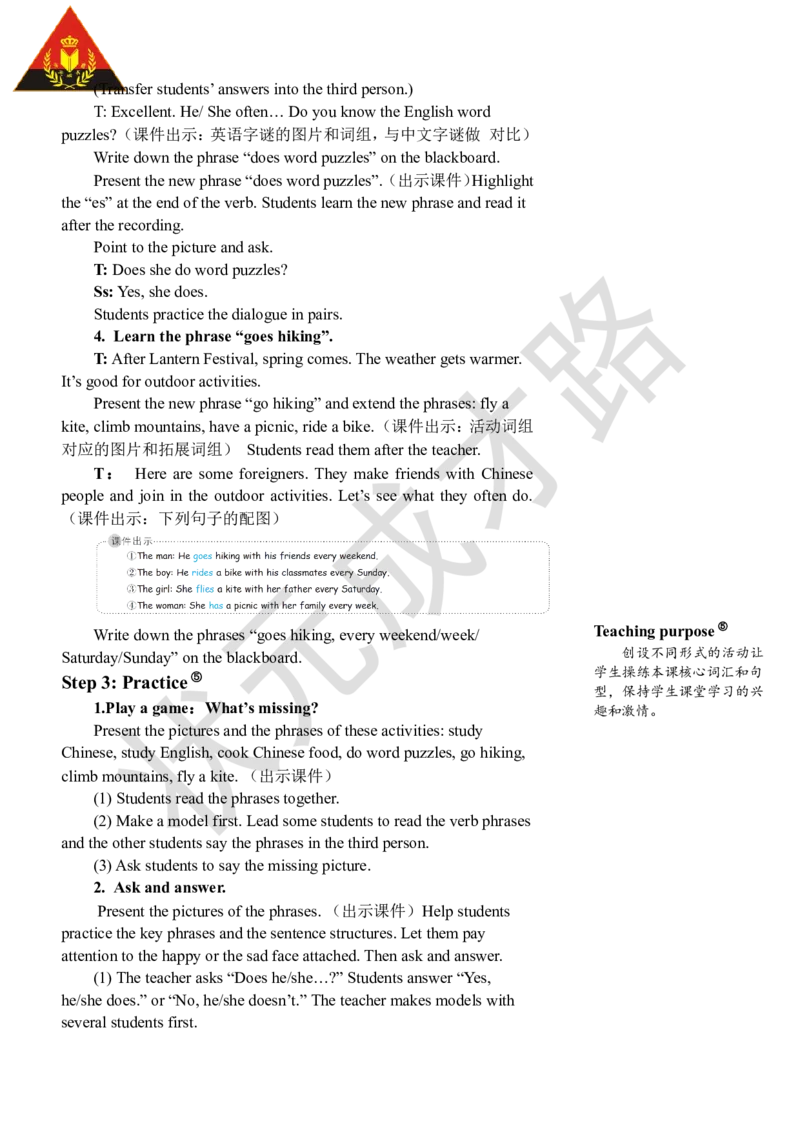
T: Here are some foreigners. They make friends with Chinese
people and join in the outdoor activities. Let’s see what they often do.
(课件出示:下列句子的配图)
Write down the phrases “goes hiking, every weekend/week/ Teaching purpose⑤
创设不同形式的活动让
Saturday/Sunday” on the blackboard.
学生操练本课核心词汇和句
Step 3: Practice⑤
型,保持学生课堂学习的兴
1.Play a game:What’s missing? 趣和激情。
Present the pictures and the phrases of these activities: study
Chinese, study English, cook Chinese food, do word puzzles, go hiking,
climb mountains, fly a kite. (出示课件)
(1) Students read the phrases together.
(2) Make a model first. Lead some students to read the verb phrases
and the other students say the phrases in the third person.
(3) Ask students to say the missing picture.
2. Ask and answer.
Present the pictures of the phrases. (出示课件)Help students
practice the key phrases and the sentence structures. Let them pay
attention to the happy or the sad face attached. Then ask and answer.
(1) The teacher asks “Does he/she…?” Students answer “Yes,
he/she does.” or “No, he/she doesn’t.” The teacher makes models with
several students first.
6(补充说明:强调以助动词开头的一般疑问句的句式,注意问句
中的动词要用原形,答句要先回答Yes或No。)
(2) Then students work in groups. Groups 1~3 ask. Groups 4~6
answer.
(3) Boys ask. Girls answer.
Step 4: Consolidation & Extension Teaching purpose⑥
1. Listen, match and say.⑥ 利用听音练习的活动检
(1) Present the pictures and the recording in “Listen, match, and 测学生对核心词句的掌握情
况,引导学生观察句子特征,
say”.( 课件出示:教材P41 Listen, match and say板块的图片和音频)
了解一般现在时的表达及其
Lead students to read the pictures first. Ask them to predict the key
常用的时间状语。通过记忆
phrases before listening.
游戏,巩固学生改写一般疑
T: We have to catch the names, he or she, and the phrases of 问句进行问答的语言能力。
hobbies while listening.
Then let students listen to the recording and match the pictures.
Listen again and check the answers. (课件出示:教材P41 Listen,
match and say板块的答案)
(2) Present the listening material. (课件出示:教材P41 Listen,
match and say板块的听力材料) Highlight the new word “characters”.
Ask students to guess its meaning. Help them get to know the word and
read the sentences together.
(3) Lead students to observe these four sentences and find some
regulations. Help them learn the simple present tense and the relevant
time adverbials.
(4) Let’s play a memory game.
(游戏说明:给学生2分钟时间记忆上面的四个句子,用does创
设一般疑问句对四个主人公进行提问,然后根据上面的描述进行回
答。)
Make a model:
A: Does John goes hiking every day?
B: No, he doesn’t. He goes hiking every Saturday.
2. Summary.
Make a brief summary according to the blackboard design.
Evaluate students’ group work and select the best group.
板书设计
▶
7作业设计
▶
1. Recite the phrases in “Let’s learn”.
2. Practice the key sentence structures.
3. Do the exercises. (见“状元成才路”系列丛书《创优作业100分》或《状元作业本》对应课
时作业)
教学反思
▶
1.利用直观形象的图片快速复习学过的重点单词和词组,活泼欢快的歌谣帮助复习核心句型,
为即将开展的学习奠定语言基础。
2.词组的授新和呈现注重情境创设,注重文化渗透。基于外国人对中国文化的浓厚兴趣,通过
中国美食、传统节日、汉服和京剧等充满中国元素的文化和活动拓展学生的相关表达,引导学生向
笔友介绍和传播中国文化。
3.以学生为主体,注重对学生的引导,启发思维,让学生观察和总结一般现在时的表达特点和
一般疑问句的表达方式。
4.创设不同形式的操练活动帮助学生巩固本课核心语言,保持学生课堂学习的兴趣和激情。
教学重难点得到了有效的突破。
5.板书设计清晰明了,重点突出,起到了很好的总结作用。
▶Teaching Contents
Let’s learn
·Listen, speak, read and write the phrases of interests and hobbies: cooks Chinese food, studies
Chinese, does word puzzles, goes hiking.
·Use the sentence structures “—Does he/she…? —Yes, he/she does./No, he/she doesn’t.”
to ask and answer.
Listen, match and say
·Listen and match, then make communication.
▶Teaching Priorities
·Be able to understand and master the key words and sentence structures of this period.
·Be able to use the sentence structures “—Does he/she…? —Yes, he/she does./No, he/she
doesn’t.” to ask and answer..
▶Teaching Difficulties
·Be able to use the sentence structures “—Does he/she…? —Yes, he/she does./No, he/she doesn’t.”
to ask and answer skillfully.
▶Teaching Procedures
Teaching Teacher’ s Activities Students Activities Teaching Purposes
8Stages
Warm-up 1. Greetings. Use the vivid
1. Greet the teacher. Acquire the
& Divide students into several pictures and the
evaluation rules of group work.
Revision groups. cheerful song to review
&
2. A quick review. 2. Review the words and the the vocabulary and the
Lead-in
Present the pictures of expressions they learned last phrases they learned
different hobbies. class. last class quickly.
3. Enjoy a song—My new 3. Enjoy and sing the song. Lay the foundation of
pen pal. language expression for
the following learning.
4. Lead-in. Talk with the teacher about Zhang Lead students to have a
Present the pictures. Peng’s pen pal Peter. preliminary experience
Talk with students about of the general questions
Zhang Peng’s pen pal Peter. in the simple present
tense through the
conversation.
Presentation 1. Learn the phrase “studies (1) Think about the questions and Extend students’
Chinese” and the key then watch the short video of expressions through
sentence structures. “Let’s learn”. Chinese food,
(1) Present the video of (2) Learn the new phrase. traditional
“Let’s learn” and ask (3) Learn the key sentence festivals, Han Fu,
students to think about two structures and practice in pairs. Peking Opera and other
questions before watching. cultural forms full of
(2) Teach the new phrase. Chinese elements which
(3) Teach the key sentence foreigners are greatly
structures. interested in. Lead
2. Learn the phrase “cooks Talk with the teacher. them to introduce and
Chinese food”. Brainstorm the elements that spread Chinese culture
Talk with students. Teach foreigners like about China. Learn to their pen pals.
the phrase. the phrase.
3. Learn the phrase “does Learn the new phrase. Pay
word puzzles”. attention to the third singular form
Present the pictures and of verbs.
teach the phrase.
4. Learn the phrase “goes Learn and read the phrase.
hiking”. Talk about what outdoor
Teach the phrase. activities foreigners often join in
in China.
(续表)
9Teaching
Teacher’ s Activities Students’ Activities Teaching Purposes
Stages
Practice 1. Play a game: What’s (1) Read the phrases Create different
missing? together. forms of activities to
Present the pictures and the (2) Some students read the let students practice
phrases of some activities verb phrases and the other the key words and
and then make a model. students say the phrases in phrases of this
the third person. lesson. Maintain
(3) Say the missing picture. students’ interest and
2. Ask and answer. (1) Practice the key phrases passion in learning.
Present the pictures. and the key sentence
Lead students to talk about structures with the teacher.
the pictures. (2) Work in groups.
(3) Work in boys and girls.
Consolidation 1. Listen, match and say. (1) Look at the pictures. Test students’
& (1)Present the pictures and Listen and match. Then mastery of the key
Extension play the recording. check the answers. words and the
Let students listen and (2) Read the listening phrases through the
match. material, learn the word listening and
Check the answers. “characters” and read the matching exercises.
(2)Present the listening sentences together. Get them to know the
material. (3) Learn the simple present simple present tense
(3)Help students learn the tense and the relevant time and its commonly
simple present tense and the adverbials. used adverbials.
relevant time adverbials. (4) Play a memory game. Through the memory
(4)Let students play a game. game, consolidate
2. Summary. Have an overview of the students’ language
Make a brief summary class according to the ability of rewriting
according to the blackboard design. general questions to
blackboard design. ask and answer.
Homework 1. Recite the phrases in “Let’s learn”.
2. Practice the key sentence structures.
3. Do the exercises.
10