每日小纸条
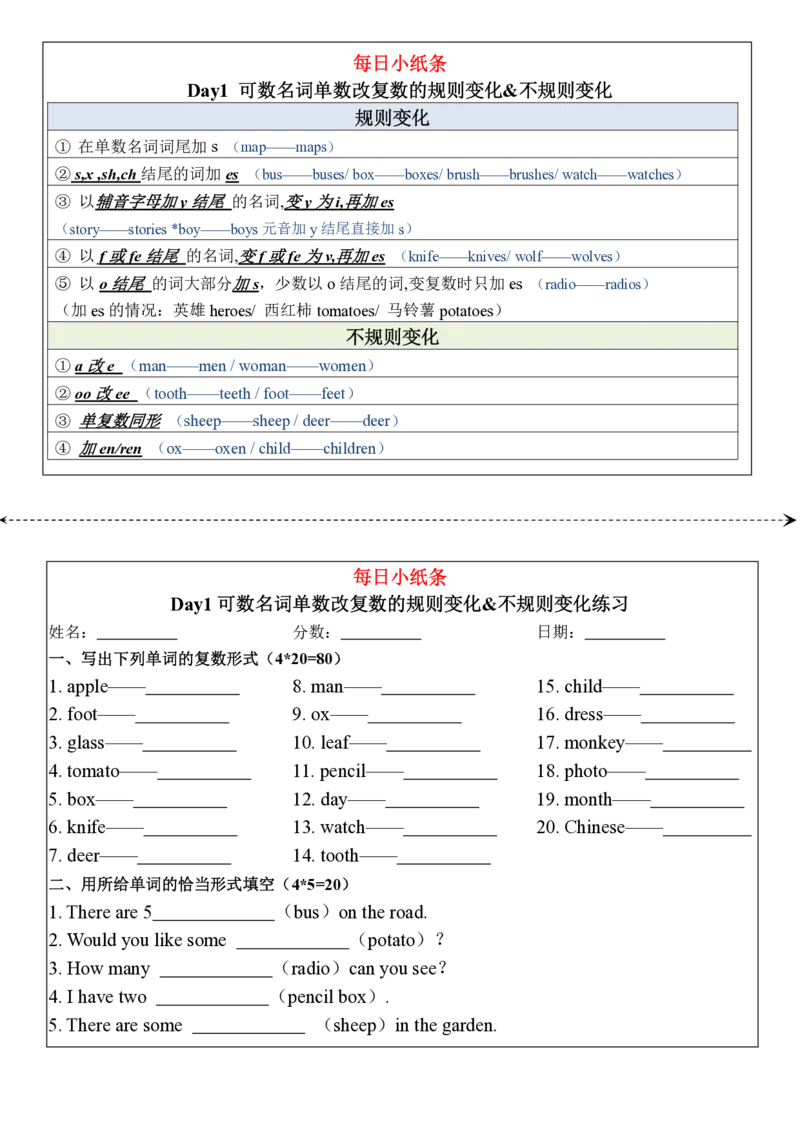
Day1 可数名词单数改复数的规则变化&不规则变化
规则变化
① 在单数名词词尾加 s (map——maps)
② s,x,sh,ch结尾的词加es (bus——buses/box——boxes/brush——brushes/watch——watches)
③ 以辅音字母加y结尾的名词,变y为i,再加es
(story——stories*boy——boys元音加y结尾直接加s)
④ 以 f或fe结尾的名词,变f或fe为v,再加es (knife——knives/ wolf——wolves)
⑤ 以 o结尾的词大部分加s,少数以o 结尾的词,变复数时只加es (radio——radios)
(加 es 的情况:英雄heroes/ 西红柿tomatoes/ 马铃薯potatoes)
不规则变化
① a改e (man——men/ woman——women)
② oo改ee (tooth——teeth/ foot——feet)
③ 单复数同形(sheep——sheep/ deer——deer)
④ 加en/ren (ox——oxen/ child——children)
每日小纸条
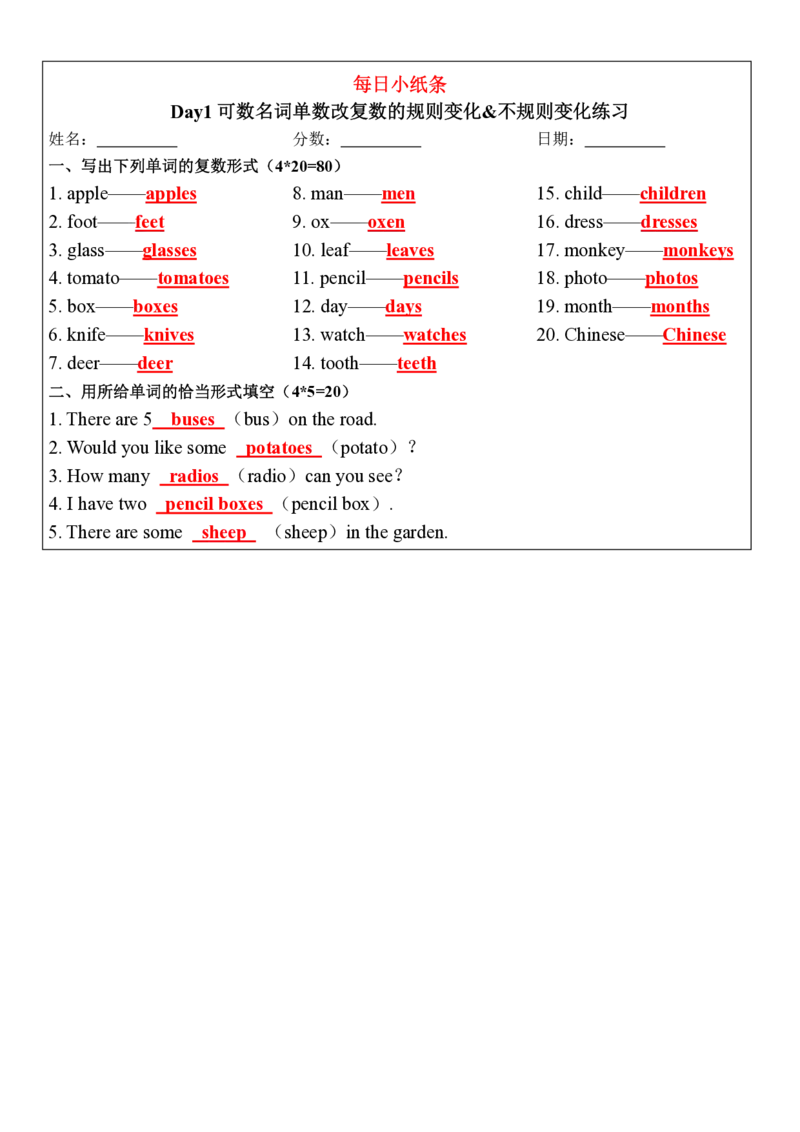
Day1 可数名词单数改复数的规则变化&不规则变化练习
姓名: 分数: 日期:
一、写出下列单词的复数形式(4*20=80)
1. apple—— 8. man—— 15. child——
2. foot—— 9. ox—— 16. dress——
3. glass—— 10. leaf—— 17. monkey——
4. tomato—— 11. pencil—— 18. photo——
5. box—— 12. day—— 19. month——
6. knife—— 13. watch—— 20. Chinese——
7. deer—— 14. tooth——
二、用所给单词的恰当形式填空(4*5=20)
1. There are 5 (bus)on the road.
2. Would you like some (potato)?
3. How many (radio)can you see?
4. I have two (pencil box).
5. There are some (sheep)in the garden.每日小纸条
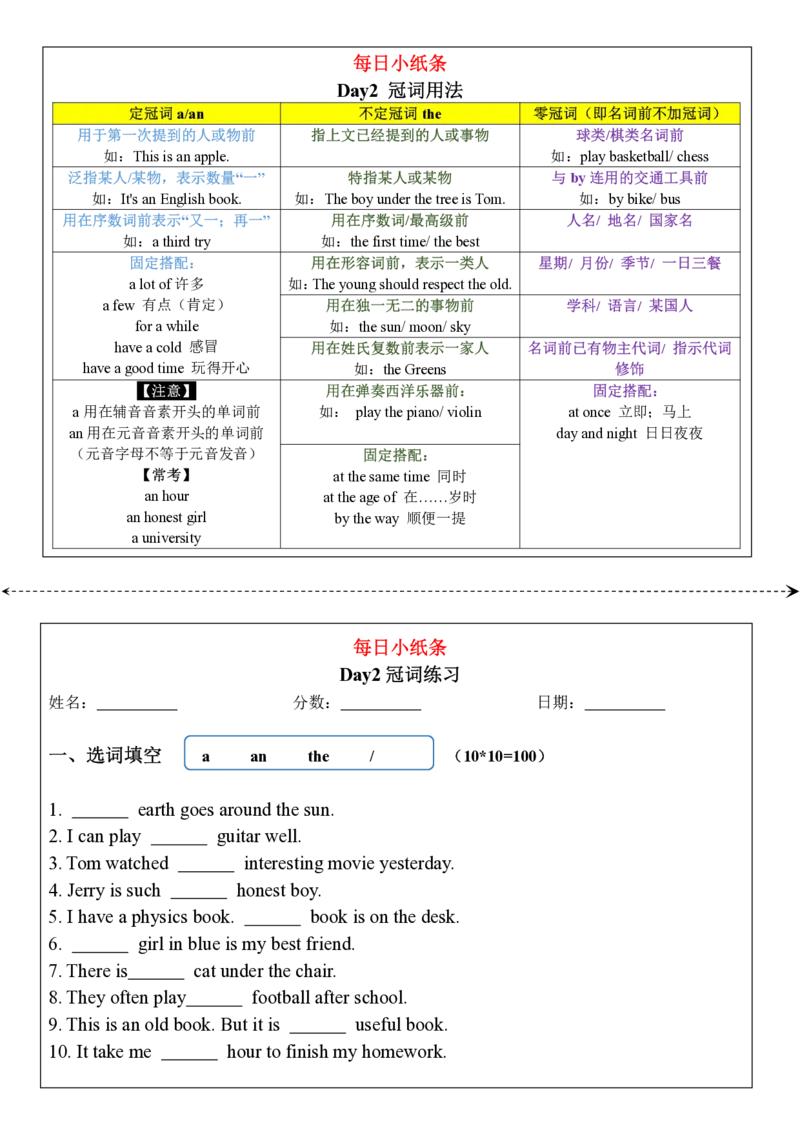
Day1 可数名词单数改复数的规则变化&不规则变化练习
姓名: 分数: 日期:
一、写出下列单词的复数形式(4*20=80)
1. apple——apples 8. man——men 15. child——children
2. foot——feet 9. ox——oxen 16. dress——dresses
3. glass——glasses 10. leaf——leaves 17. monkey——monkeys
4. tomato——tomatoes 11. pencil——pencils 18. photo——photos
5. box——boxes 12. day——days 19. month——months
6. knife——knives 13. watch——watches 20. Chinese——Chinese
7. deer——deer 14. tooth——teeth
二、用所给单词的恰当形式填空(4*5=20)
1. There are 5 buses (bus)on the road.
2. Would you like some potatoes (potato)?
3. How many radios (radio)can you see?
4. I have two pencil boxes (pencil box).
5. There are some sheep (sheep)in the garden.每日小纸条
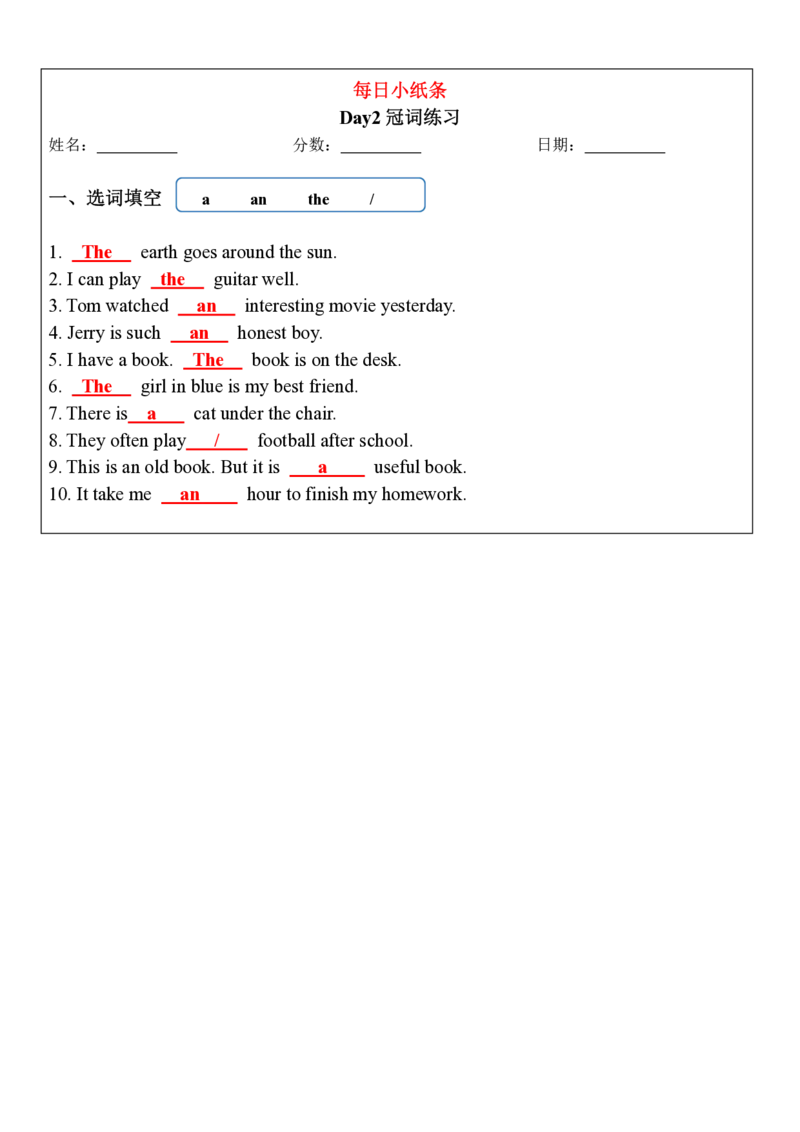
Day2 冠词用法
定冠词a/an 不定冠词the 零冠词(即名词前不加冠词)
用于第一次提到的人或物前 指上文已经提到的人或事物 球类/棋类名词前
如:Thisisanapple. 如:playbasketball/chess
泛指某人/某物,表示数量“一” 特指某人或某物 与by连用的交通工具前
如:It'sanEnglishbook. 如:TheboyunderthetreeisTom. 如:bybike/bus
用在序数词前表示“又一;再一” 用在序数词/最高级前 人名/ 地名/ 国家名
如:athirdtry 如:thefirsttime/thebest
固定搭配: 用在形容词前,表示一类人 星期/ 月份/ 季节/ 一日三餐
alotof许多 如:Theyoungshouldrespecttheold.
afew 有点(肯定) 用在独一无二的事物前 学科/ 语言/ 某国人
forawhile 如:thesun/moon/sky
haveacold 感冒 用在姓氏复数前表示一家人 名词前已有物主代词/ 指示代词
haveagoodtime 玩得开心 如:theGreens 修饰
【注意】 用在弹奏西洋乐器前: 固定搭配:
a用在辅音音素开头的单词前 如: playthepiano/violin atonce 立即;马上
an用在元音音素开头的单词前 dayandnight 日日夜夜
(元音字母不等于元音发音) 固定搭配:
【常考】 atthesametime 同时
anhour attheageof 在……岁时
anhonestgirl bytheway 顺便一提
auniversity
每日小纸条
Day2 冠词练习
姓名: 分数: 日期:
一、选词填空 a an the / (10*10=100)
1. earth goes around the sun.
2. I can play guitar well.
3. Tom watched interesting movie yesterday.
4. Jerry is such honest boy.
5. I have a physics book. book is on the desk.
6. girl in blue is my best friend.
7. There is cat under the chair.
8. They often play football after school.
9. This is an old book. But it is useful book.
10. It take me hour to finish my homework.每日小纸条
Day2 冠词练习
姓名: 分数: 日期:
一、选词填空 a an the /
1. The earth goes around the sun.
2. I can play the guitar well.
3. Tom watched an interesting movie yesterday.
4. Jerry is such an honest boy.
5. I have a book. The book is on the desk.
6. The girl in blue is my best friend.
7. There is a cat under the chair.
8. They often play / football after school.
9. This is an old book. But it is a useful book.
10. It take me an hour to finish my homework.每日小纸条
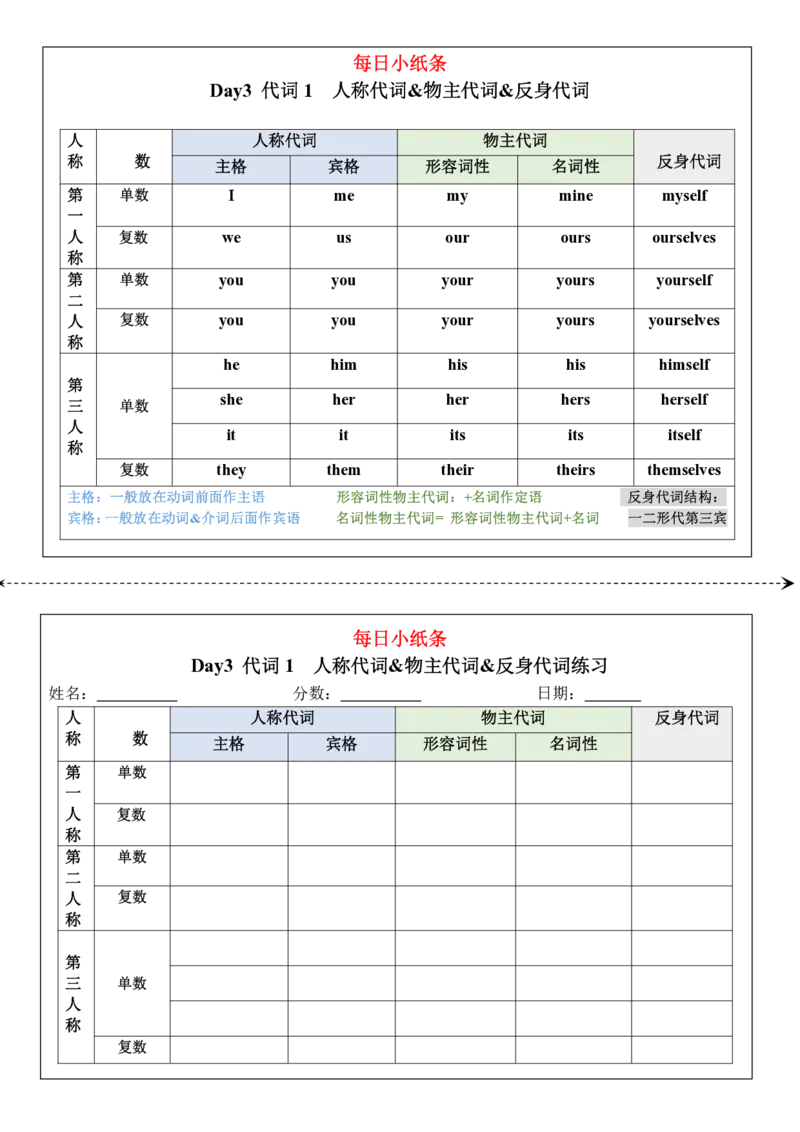
Day3 代词 1 人称代词&物主代词&反身代词
人 人称代词 物主代词
称 数 反身代词
主格 宾格 形容词性 名词性
第 单数 I me my mine myself
一
人 复数 we us our ours ourselves
称
第 单数 you you your yours yourself
二
人 复数 you you your yours yourselves
称
he him his his himself
第
she her her hers herself
三 单数
人
it it its its itself
称
复数 they them their theirs themselves
主格:一般放在动词前面作主语 形容词性物主代词:+名词作定语 反身代词结构:
宾格:一般放在动词&介词后面作宾语 名词性物主代词= 形容词性物主代词+名词 一二形代第三宾
每日小纸条
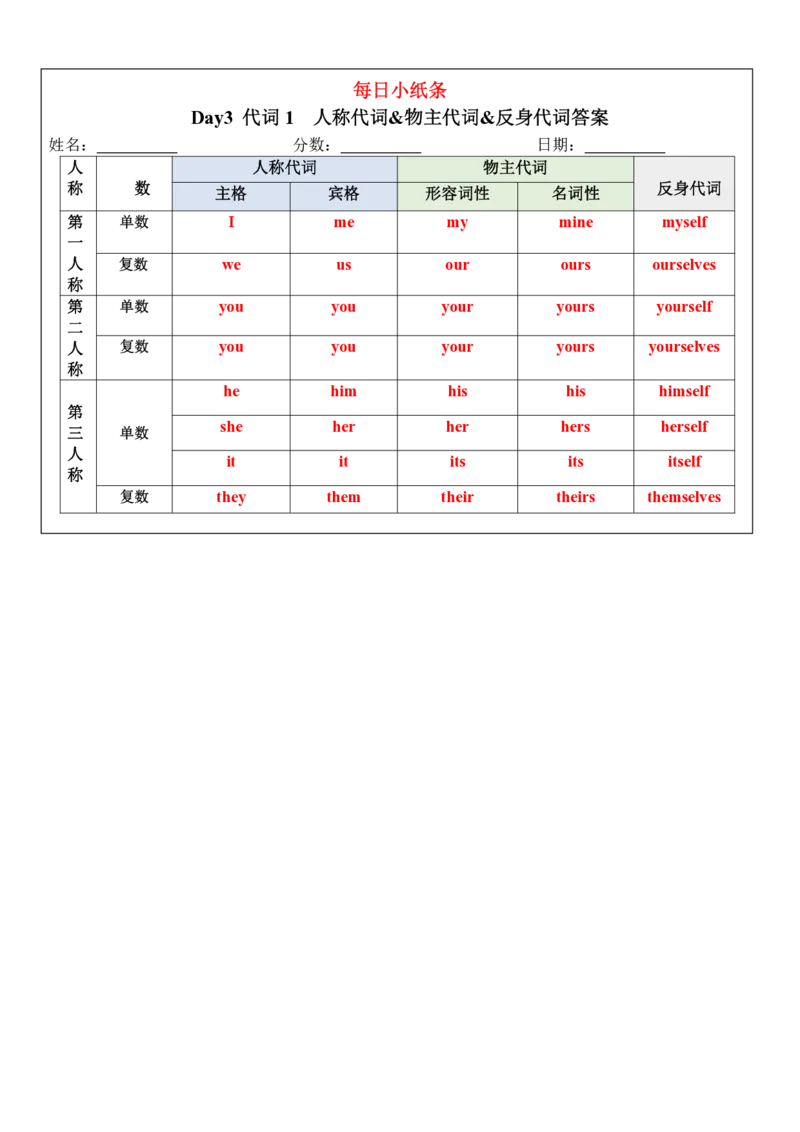
Day3 代词 1 人称代词&物主代词&反身代词练习
姓名: 分数: 日期:
人 人称代词 物主代词 反身代词
称 数
主格 宾格 形容词性 名词性
第 单数
一
人 复数
称
第 单数
二
人 复数
称
第
三 单数
人
称
复数每日小纸条
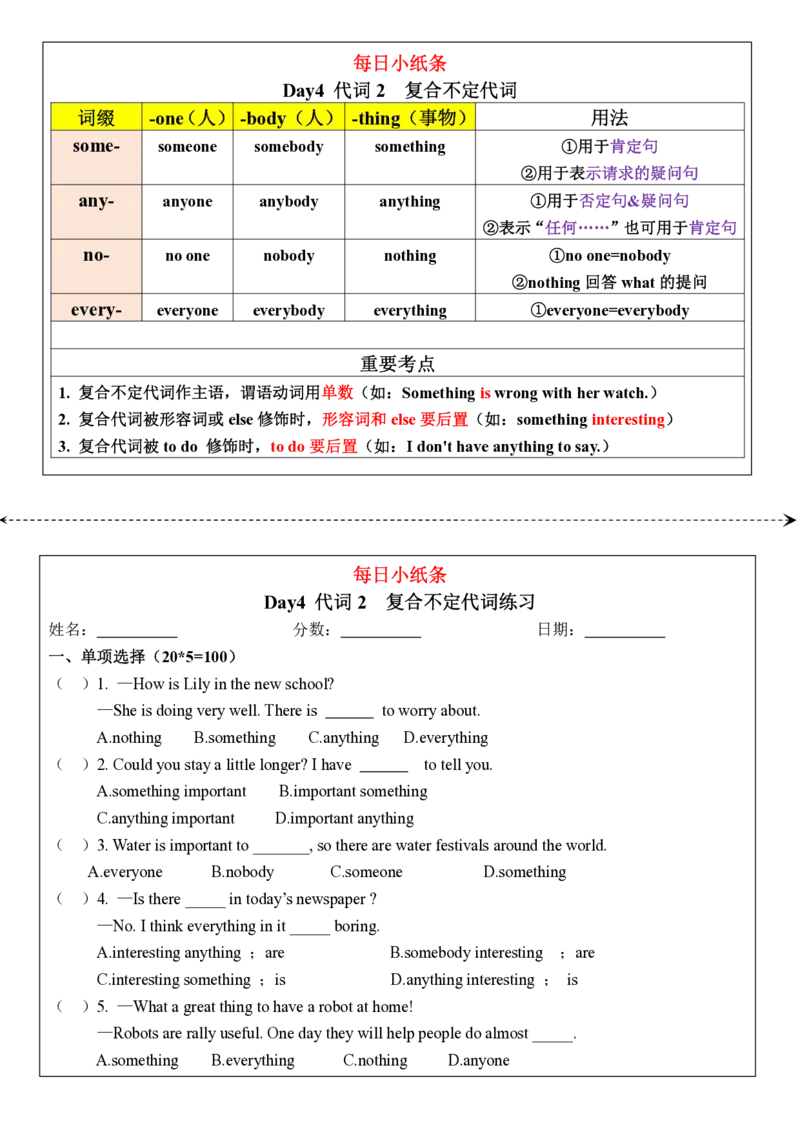
Day3 代词 1 人称代词&物主代词&反身代词答案
姓名: 分数: 日期:
人 人称代词 物主代词
称 数 反身代词
主格 宾格 形容词性 名词性
第 单数 I me my mine myself
一
人 复数 we us our ours ourselves
称
第 单数 you you your yours yourself
二
人 复数 you you your yours yourselves
称
he him his his himself
第
she her her hers herself
三 单数
人
it it its its itself
称
复数 they them their theirs themselves每日小纸条
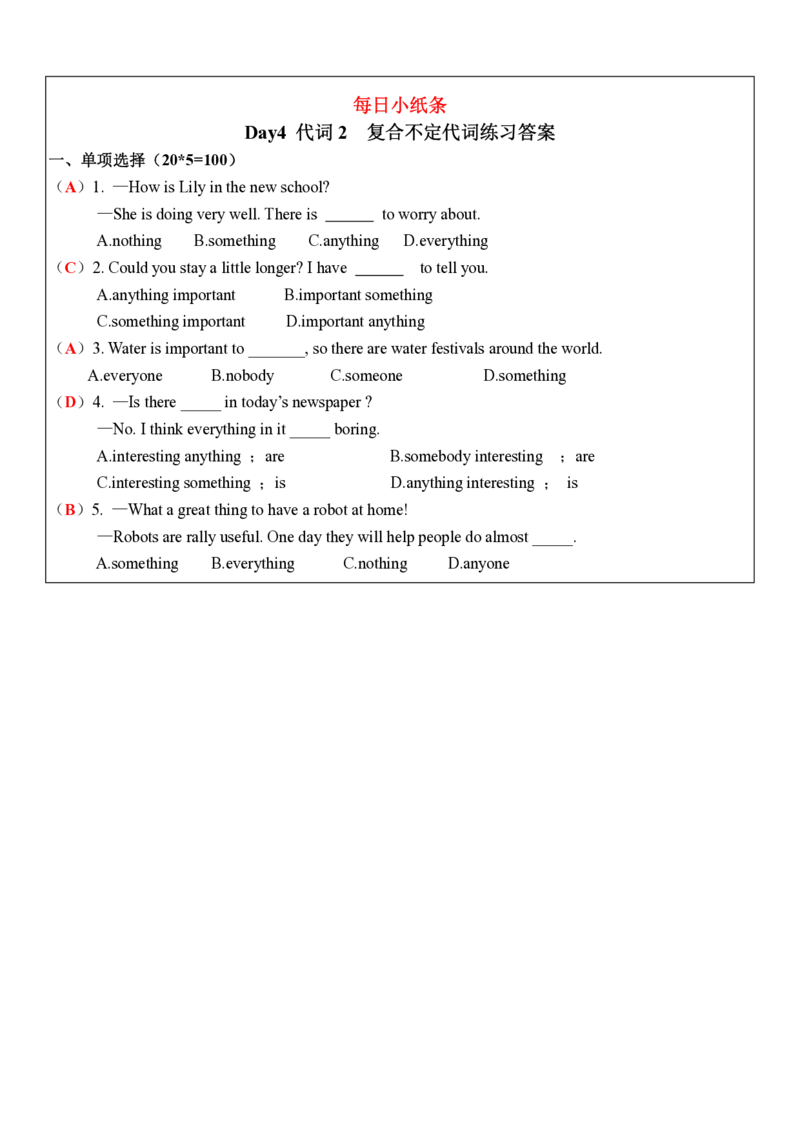
Day4 代词 2 复合不定代词
词缀 -one(人) -body(人) -thing(事物) 用法
some- someone somebody something ①用于肯定句
②用于表示请求的疑问句
any- anyone anybody anything ①用于否定句&疑问句
②表示“任何……”也可用于肯定句
no- noone nobody nothing ①noone=nobody
②nothing 回答 what的提问
every- everyone everybody everything ①everyone=everybody
重要考点
1. 复合不定代词作主语,谓语动词用单数(如:Something iswrongwith herwatch.)
2. 复合代词被形容词或 else修饰时,形容词和else 要后置(如:something interesting)
3. 复合代词被todo 修饰时,to do 要后置(如:I don'thaveanythingtosay.)
每日小纸条
Day4 代词 2 复合不定代词练习
姓名: 分数: 日期:
一、单项选择(20*5=100)
( )1. —Howis Lilyinthenew school?
—Sheis doingvery well.There is toworry about.
A.nothing B.something C.anything D.everything
( )2.Couldyou staya littlelonger? Ihave totellyou.
A.somethingimportant B.important something
C.anythingimportant D.important anything
( )3.Wateris important to_______,sothere are water festivals aroundtheworld.
A.everyone B.nobody C.someone D.something
( )4. —Is there _____intoday’snewspaper?
—No.Ithinkeverythinginit _____boring.
A.interestinganything ;are B.somebody interesting ;are
C.interestingsomething ;is D.anythinginteresting ; is
( )5. —Whata greatthingtohavea robot at home!
—Robotsare rallyuseful. One daytheywill helppeopledoalmost _____.
A.something B.everything C.nothing D.anyone每日小纸条
Day4 代词 2 复合不定代词练习答案
一、单项选择(20*5=100)
(A)1. —Howis Lily inthe newschool?
—Sheis doingvery well.There is toworry about.
A.nothing B.something C.anything D.everything
(C)2.Couldyou staya littlelonger? Ihave totellyou.
A.anythingimportant B.important something
C.somethingimportant D.important anything
(A)3.Wateris important to_______,sothereare water festivals around theworld.
A.everyone B.nobody C.someone D.something
(D)4. —Is there _____intoday’s newspaper?
—No.Ithinkeverythinginit _____boring.
A.interestinganything ;are B.somebody interesting ;are
C.interestingsomething ;is D.anythinginteresting ; is
(B)5. —Whatagreatthingtohave arobot at home!
—Robotsare rallyuseful. One daytheywill helppeopledoalmost _____.
A.something B.everything C.nothing D.anyone每日小纸条
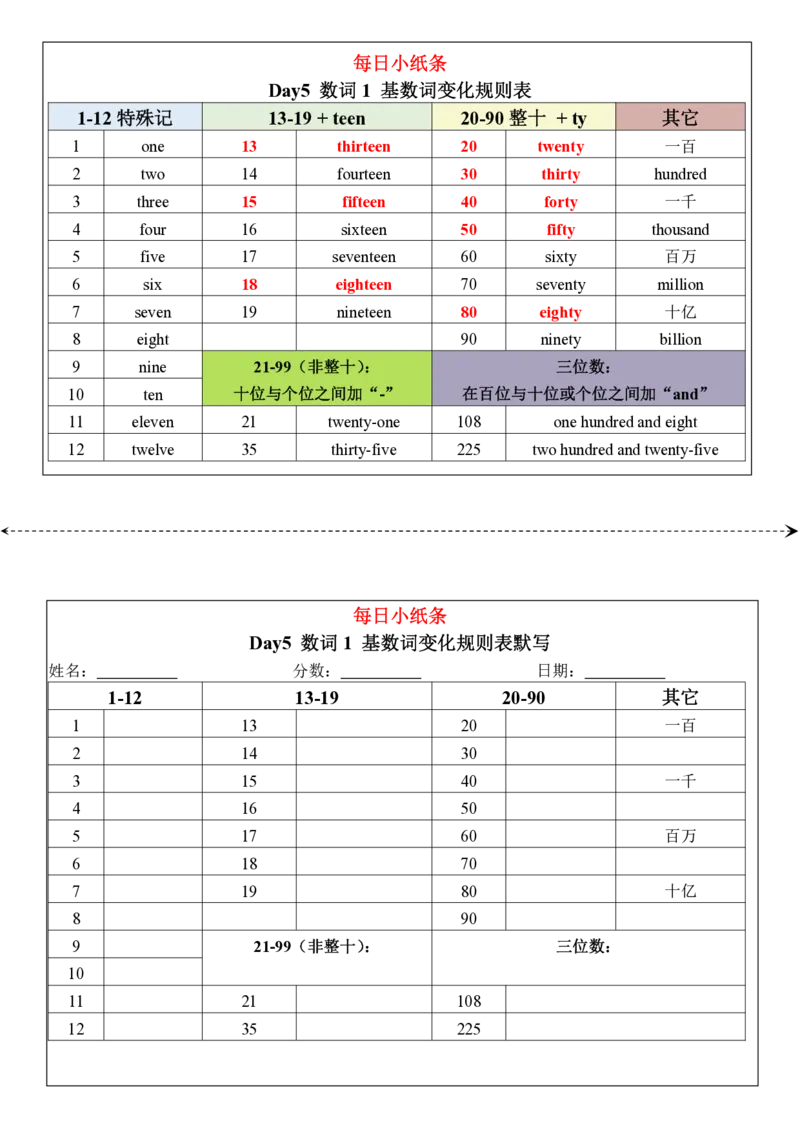
Day5 数词 1 基数词变化规则表
1-12 特殊记 13-19 + teen 20-90 整十 + ty 其它
1 one 13 thirteen 20 twenty 一百
2 two 14 fourteen 30 thirty hundred
3 three 15 fifteen 40 forty 一千
4 four 16 sixteen 50 fifty thousand
5 five 17 seventeen 60 sixty 百万
6 six 18 eighteen 70 seventy million
7 seven 19 nineteen 80 eighty 十亿
8 eight 90 ninety billion
9 nine 21-99(非整十): 三位数:
10 ten 十位与个位之间加“-” 在百位与十位或个位之间加“and”
11 eleven 21 twenty-one 108 one hundredand eight
12 twelve 35 thirty-five 225 twohundred andtwenty-five
每日小纸条
Day5 数词 1 基数词变化规则表默写
姓名: 分数: 日期:
1-12 13-19 20-90 其它
1 13 20 一百
2 14 30
3 15 40 一千
4 16 50
5 17 60 百万
6 18 70
7 19 80 十亿
8 90
9 21-99(非整十): 三位数:
10
11 21 108
12 35 225每日小纸条
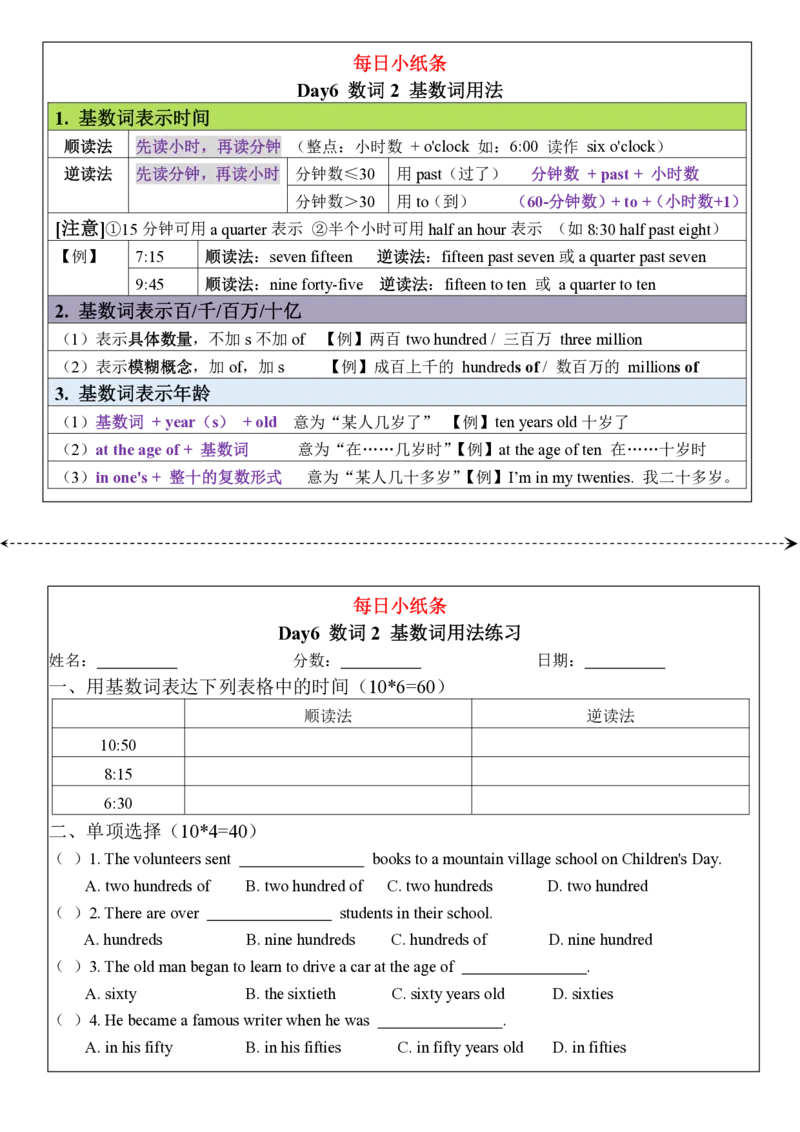
Day6 数词 2 基数词用法
1. 基数词表示时间
顺读法 先读小时,再读分钟 (整点:小时数 +o'clock 如:6:00 读作 sixo'clock)
逆读法 先读分钟,再读小时 分钟数≤30 用past(过了) 分钟数 + past+ 小时数
分钟数>30 用to(到) (60-分钟数)+to +(小时数+1)
[注意]①15 分钟可用a quarter 表示 ②半个小时可用 halfan hour表示 (如8:30halfpast eight)
【例】 7:15 顺读法:sevenfifteen 逆读法:fifteen past seven 或aquarter pastseven
9:45 顺读法:nine forty-five 逆读法:fifteen toten 或 aquarter toten
2. 基数词表示百/千/百万/十亿
(1)表示具体数量,不加 s 不加of 【例】两百 twohundred / 三百万 threemillion
(2)表示模糊概念,加 of,加s 【例】成百上千的 hundreds of/ 数百万的 millions of
3. 基数词表示年龄
(1)基数词 + year(s) + old 意为“某人几岁了” 【例】ten years old 十岁了
(2)attheageof + 基数词 意为“在……几岁时”【例】at theage often 在……十岁时
(3)inone's + 整十的复数形式 意为“某人几十多岁”【例】I’m inmytwenties. 我二十多岁。
每日小纸条
Day6 数词 2 基数词用法练习
姓名: 分数: 日期:
一、用基数词表达下列表格中的时间(10*6=60)
顺读法 逆读法
10:50
8:15
6:30
二、单项选择(10*4=40)
( )1.Thevolunteers sent books toamountainvillage schoolonChildren's Day.
A.twohundreds of B. twohundredof C.twohundreds D.twohundred
( )2.There are over students intheir school.
A. hundreds B. ninehundreds C.hundreds of D.ninehundred
( )3.Theoldmanbegan tolearn todriveacarat the age of .
A.sixty B. thesixtieth C.sixtyyears old D.sixties
( )4.Hebecame afamous writer when hewas .
A.inhis fifty B. inhis fifties C.infiftyyears old D.infifties每日小纸条
Day6 数词 2 基数词用法练习答案
姓名: 分数: 日期:
一、用基数词表达下列表格中的时间(10*6=60)
顺读法 逆读法
10:50 tenfifty tentoeleven
8:15 eight fifteen fifteen past eight/ aquarter past eight
6:30 sixthirty half past six
二、单项选择(10*4=40)
( D )1.Thevolunteers sent books toamountainvillage school onChildren's Day.
A.twohundreds of B. twohundredof C.twohundreds D.twohundred
( C )2.There are over studentsintheirschool.
A. hundreds B. ninehundreds C.hundreds of D.ninehundred
( A )3.Theoldmanbegan tolearn todrivea car at theage of .
A.sixty B. thesixtieth C.sixtyyears old D.sixties
( B )4.Hebecamea famous writer whenhe was .
A.inhis fifty B. inhis fifties C.infiftyyears old D.infifties每日小纸条
Day7 数词 3 序数词变化规则&用法
变化规则 例子
基变序,有规律,词尾要添th 如:four→ fourth ,six→ sixth
123,特殊记,词尾字母 tdd 如:one→first, two→second, three→third
八去t,九去 e 如,eight→eighth, nine→ninth
(第十九nineteenth /第九十ninetieth 不去e)
5 和12 一起记,ve要用 f替 如:five→fifth, twelve→twelfth
若要遇到整十数,ty 变成 tie,后面再加 th 如:forty→fortieth, fifty→fiftieth
若是遇到几十几,只变个位就可以 如:twenty-one→twenty-first
序数词用法
1. 用序数词表示顺序,前面一般要加冠词the(前面有形容词性物主代词和名词所有格修饰时除外)
2. 表达分数:分子用基数词,分母用序数词(当分子>1,分母+s)
如:三分之一 onethird/ 三分之二 twothirds/ 四分之一 one fourth或 aquarter
【注意】分数作主语时,谓语动词由分数后的名词决定,可数名词复数→复数,不可数名词→单数
每日小纸条
Day7 数词 3 序数词变化规则&用法练习
姓名: 分数: 日期:
一、写出下列基数词的序数词(5*9=45)
one five nine
two twelve fifty
three eight thirty-two
二、根据句意及所给单词提示完成下列句子(5*11=55)
1.February isthe (two)monthofa year.
2.Tomorrow isher (twenty)birthday.
3.There are monthinayear.The monthisDecember.(twelve)
4.In ourclass, three (five)of thestudents (be) girls.
5.The (thirty-three)lessons is difficult.
6. (五分之四)ofthewater (be)clean.
7.Susanisthe (three)tall girl inher class.
8.Mymotherwillbe fortyyears oldnextweek.I’mplanningtobuya gift forher birthday.
(forty)每日小纸条
Day7 数词 3 序数词变化规则&用法练习答案
姓名: 分数: 日期:
一、写出下列基数词的序数词(5*9=45)
one first five fifth nine ninth
two second twelve twelfth fifty fiftieth
three third eight eighth thirty-two thirty-second
二、根据句意及所给单词提示完成下列句子(5*11=55)
1.February isthe second (two)monthofa year.
2.Tomorrow isher twentieth (twenty)birthday.
3.There are twelve monthinayear.The twelfth monthisDecember.(twelve)
4.In ourclass, three fifths (five)of thestudents are (be) girls.
5.The thirty-third (thirty-three)lessons isdifficult.
6. Fourfifths (五分之四)of thewater is (be)clean.
7.Susanisthe third (three)tall girl inher class.
8.Mymotherwillbe fortyyears oldnextweek.I’mplanningtobuya gift forher fortieth birthday.
(forty)每日小纸条
Day8 介词 1 时间介词 in on at
in in年 in月 in季节 in 2024/in July/insummer
>1 天 或泛指一天当中的上午/下午/晚上 in themorning/afternoon/ evening
on Monday
on on 加具体某一天 on December25th
=1 天 或特定的早上/下午/晚上 on Children'sDay
on acold morning
at at要加具体时间点 at3o'clock
<1天 中午夜晚和黎明 atnoon/ night/ dawn
in 年 in月 in季节,上午下午和晚上
on 加具体某一天,星期节日和周末
at要加时间点,中午夜里和黎明
若是遇到有修饰,就把介词 on放前
这那上下每个前,in onat 都不填
每日小纸条
Day8 介词 1 时间介词 in on at 练习
姓名: 分数: 日期:
一、用“in/on/ at”或“/”填空(4*20=80)
1. autumn 7. 9:45 15. theevening
2. November 8. March7th 16. Mother's Day
3. Thursday 9. Saturday evening 17. thisafternoon
4. last Friday 12. noon 18. July12th
5. night 13. spring 19. Sundayafternoon
6. themorning 14. ten o'clock 20. nextFriday
二、单项选择(5*4=20)
( )1.--David,isyour mother’s birthday November? --Yes,it’s November 3rd.
A.in;on B. of; in C.on;at D.for; on
( )2.Lucywas born asummer evening June,2000.
A.in;in B. in; at C.on;at D.on; in
( )3.Tomusuallygets up 6:30.
A.in B. on C.at D./
( )4.Wewillholdan art festival nextTuesday.
A.in B. on C.at D./每日小纸条
Day8 介词 1 时间介词 in on at 练习答案
姓名: 分数: 日期:
一、用“in/on/ at”或“/”填空(4*20=80)
1. in autumn 7. at 9:45 15. in theevening
2. in November 8. on March 7th 16. on Mother's Day
3. on Thursday 9. on Saturdayevening 17. / this afternoon
4. / last Friday 12. at noon 18. on July12th
5. at night 13. in spring 19. on Sundayafternoon
6. in themorning 14. at ten o'clock 20. / next Friday
二、单项选择(5*4=20)
( A )1.--David,is your mother’sbirthday November? --Yes,it’s November 3rd.
A.in;on B. of; in C.on;at D.for; on
( D )2.Lucywas born a summerevening June,2000.
A.in;in B. in; at C.on;at D.on; in
( C )3.Tomusuallygets up 6:30.
A.in B. on C.at D./
( D )4.Wewill holdan art festival nextTuesday.
A.in B. on C.at D./每日小纸条
Day9 介词 2 其它介词
空间位置 in/ on/ at 上下 above/ below 穿过 考点
in+大地点(国家城市) above在……上方 across 表面穿过 ①介词+
on在……上(有接触) below在……下方 through 内部穿过 动词 ing
at+小地点/ 门牌号 正上正下 over/ under past旁边经过 ②介词+
之间 between/among over 在……正上方 along沿着…… 人称代词
between两者之间 under在……正下方 over 上面越过 宾格
among 三者及以上之间 用……工具/手段 在树上 ③地点副词
地理位置 in/ on/ to in+语言 on thetree(树上长出的) 前不加介词
(这那里
in 范围内 with+具体工具 in thetree (外来物)
on范围外,接壤 by+名词/ 动词 ing 在墙上 楼上下
家国外)
to 范围外,不接壤 by+交通工具 on thewall 在墙表面
④ 介 词 短
在……前面(里the 外不 the) in thewall在墙里面
语
infrontof在外部的前面/ in thefrontof在内部的前面
每日小纸条
Day9 介词 2 其它介词 练习
姓名: 分数: 日期:
一、用恰当的介词或“/”填空(6.25*16=100)
1.Iwill arrive Beijingtomorrow.
2.Hainan is thesouthofChina.
3.There is abook (在……上)the table.
4.There is aclock thewall.
5.Thesunshinegoes thewindow.
6.Go (穿过)thestreet, andyou will findthepark.
7.Shemademoney sellingflowers.
8.Amyis sitting (在……之间)Linda and Judy.
9.Ourteacher usuallystands (在……前面)ourclassroom.
10.Iwrote theletter this bluepen.
11.There are manybirds singing (在树上)thetree.
12.What’s this English?
13.Japanis theeast ofChina.
14.Tomis thetallestboy his classmates.
15.Toarrive theairport ontime,hetookataxi..
16.There is abigtree (在……前面)myhouse.每日小纸条
Day9 介词 2 其它介词 练习答案
姓名: 分数: 日期:
一、用恰当的介词或“/”填空(6.25*16=100)
1.Iwill arrive in Beijingtomorrow.
2.Hainan is in thesouthof China.
3.There is abook on thetable.
4.There is aclock on thewall.
5.Thesunshinegoes through thewindow.
6.Go across (穿过)thestreet,and you willfind thepark.
7.Shemademoney by sellingflowers.
8.Amyis sitting between Linda and Judy.
9.Ourteacher usuallystands inthe frontof (在……前面)our classroom.
10.Iwrote theletter with this bluepen.
11.There are manybirds singing in thetree.
12.What’s this in English?
13.Japanis to the eastofChina.
14.Tomis thetallestboy among hisclassmates.
15.Toarrive at theairport ontime,he tooka taxi..
16.There is abigtree infrontof myhouse.每日小纸条
Day10 形容词用法
基本用法 位置 例子
①放在名词或代词前,作定语 adj.+ n. a beautifulflower
②放在enough 前面 adj.+ enough interestingenough
③放在不定代词后,作后置定语 不定代词 + adj. somethingimportant
④放在系动词(be动词/感官动词后),作表语 系动词 + adj Sheissmart.
Thecatlooks cute.
⑤ed 结尾的形容词(人感到……),主语一般是人 excited 激动的
ing结尾的形容词(令人感到……),主语一般是物 exciting令人激动的
特殊句型 例句
①It’s+ adj.+ for/ ofsb.todosth. It's importantforus tolearn Englishwell.
(用for时,形容词形容物/用 of时,形容词形容人) It’skindofyou to helptheold man.
②sb.find/think it+ adj.todosth. I find/think itusefulto readmore books.
多个形容词顺序 【口诀】美小圆旧黄 中国木书房
(品质特征/大小长短高低/形状/新旧/颜色/国家地区出处/材质/用途)
【注意】有些词ly结尾实为形容词:friendly/ lovely/ lonely/ daily(每天的)
每日小纸条
Day10 形容词用法练习
姓名: 分数: 日期:
一、翻译(8*10=80)
1. 一辆新的自行车
2. 一个诚实的男孩
3. 没什么重要的
4. 尝起来美味的
5. 感到放松的
6. 令人感到有趣的
7. 足够耐心
8. 感觉糟糕的
9. 每天锻炼对我们来说是有必要的。
10. 我发现独自去河里游泳是很危险的。
二、单项选择(10*2=20)
( )1.Ibought formymother.
A.anythingspecial B.special anything C.somethingspecial D.special something
( )2.Mr.Green, doyou have totell me?
A.everythingimportant B. important anything C.anythingimportant D.somethingimportant每日小纸条
Day10 形容词用法练习
姓名: 分数: 日期:
一、翻译(8*10=80)
1. 一辆新的自行车 anewbike
2. 一个诚实的男孩 anhonestboy
3. 没什么重要的 nothingimportant
4. 尝起来美味的 taste delicious
5. 感到放松的 relaxing
6. 令人感到有趣的 interesting
7. 足够耐心 patientenough
8. 感觉糟糕的 feelterrible
9. 每天锻炼对我们来说是有必要的。 It's necessaryforus toexerciseeveryday.
10. 我发现独自去河里游泳是很危险的。I finditdangerous toswimalonein theriver.
二、单项选择(10*2=20)
(C)1.Ibought for mymother.
A.anythingspecial B.special anything C.somethingspecial D.special something
(C)2.Mr.Green,doyou have totellme?
A.everythingimportant B. important anything C.anythingimportant D.somethingimportant每日小纸条
Day11 副词用法
修饰 句子/ 副词/ 形容词/ 动词 (【助记】聚 富 行 动)
1.Luckily,Iachieved mydream intheend. (修饰句子)
用法
2.He runs very fast. (修饰副词)
3.Youare quite right. (修饰形容词)
4.Shespeaks English well. (修饰动词)
分类 例子
①时间副词(句首/句末) now,today,tomorrow,yesterday
②地点副词(一般放句末) here,there, down,up,inside,outside
③方式副词(一般放动词后面) simply,closely,slowly,carefully
④频度副词(be/情/助后,实义动词前) always, usually,often, sometimes,hardly ever,never
⑤程度副词(形/副/实义动词前) rather,pretty,quite,very,too,so
⑥疑问副词(句首) where,when, why,how
每日小纸条
Day11 副词用法练习
姓名: 分数: 日期:
一、翻译句子(10*5=50)
1.Tom有时候坐公交车去上学。
2. 这些花真的很美丽。
3.Jerry 能够很容易地回答出这个问题。
4. 他们非常相信我。
5. 不幸的是,John 数学考试不及格。
二、单项选择(10*5=50)
( )1.Ms.Green is a teacher andsheplays thepiano .
A.well; well B. well; good C.good; well D.good; good
( )2. were you latefor school? ——Because Imissedthebus.
A.When B.Why C.How D.Where
( )3.Iwill visitmyteacher .
A.tomorrow B. yesterday C.now D.last Friday
( )4.He drinks milkbecausehedoesn’t likeit.
A.always B. never C.often D.sometimes
( )5.Don’t talk .Yourgrandmotheris sleeping.
A.loud B. quiet C.loudly D.quietly每日小纸条
Day11 副词用法答案
一、翻译句子(10*5=50)
1.Tom有时候坐公交车去上学。Tomsometimes goes to schoolbybus.
2. 这些花真的很美丽。Theseflowersarereallybeautiful.
3.Jerry 能够很容易地回答出这个问题.。Jerrycan answerthisquestioneasily.
4. 他们非常相信我。 Theybelievemevery much.
5. 不幸的是,John 数学考试不及格。Unfortunately,Johnfailed hismath exam.
二、单项选择(10*5=50)
(C)1.Ms.Greenis a teacher andshe plays the piano .
A.well; well B. well; good C.good; well D.good; good
(B)2. were you latefor school? ——Because I missedthe bus.
A.When B.Why C.How D.Where
(A)3.Iwill visitmyteacher .
A.tomorrow B. yesterday C.now D.last Friday
(B)4.He drinks milkbecause hedoesn’t likeit.
A.always B. never C.often D.sometimes
(C)5.Don’ttalk .Yourgrandmotheris sleeping.
A.loud B. quiet C.loudly D.quietly每日小纸条
Day12 形容词/副词的比较级&最高级规则/不规则变化
规则变化
1. 直接+er/est fast faster fastest
2.e结尾,+r/ st late later latest
3. 辅音字母+y 结尾,改 y 为 i 加 er/est busy busier busiest
4. 重读闭音节,且词尾只有一个辅音字母,双写尾 big bigger biggest
字母,再加 er/est
5. 多音节和部分双音节,形容词前加 more/less careful morecareful mostcareful
不规则变化
两好 good/ well better best 一远 far farther farthest
两坏 bad/ badly worse worst further furthest
两多 many/mush more most 一老 old older oldest
一少 little less least elder eldest
每日小纸条
Day12 形容词/ 副词的比较级&最高级练规则不规则变化
姓名: 分数: 日期:
一、写出下列形容词/副词的比较级和最高级(5*20=100)
原级 比较级 最高级 原级 比较级 最高级
lazy good/well
bad many/much
little hot
hard beautiful
fat early每日小纸条
Day12 形容词/ 副词的比较级&最高级规则/不规则变化答案
姓名: 分数: 日期:
一、写出下列形容词/副词的比较级和最高级(5*20=100)
原级 比较级 最高级 原级 比较级 最高级
lazy lazier laziest good/well better best
bad worse worst many/much more most
little less least hot hotter hottest
hard harder hardest beautiful morebeautiful mostbeautiful
fat fatter fattest early earlier earliest每日小纸条
Day13 形容词/副词的比较级&最高级
用法 例子
原级 ①as + 原级 +as Tomisas thinas Jerry.
②not + as/so+原级 + as Lucyis botas/sotall asAmy.
③倍数 + as + 原级 + as Thistable is twiceas bigas that one.
比较级 ①比较级+ than Henryis more careful than me.
(两者之间) ②比较级 + and 比较级 It isgettinghotter andhotter.
③the + 比较级, the+ 比较级 Themore, thebetter.
最高级 ①the + 最高级 + of/in Fionais thetallest of thethreegirls.
(三者及以上) ②the + 序数词 + 最高级 TheYellowRiveris thesecondlongest inChina.
③oneof + the+最高级+名词复数 Beijingis theoneof thebiggest cities inChina.
比较级表示 比较级+than anyother+名词单数 Jackis tallerthan anyother boyinhis class.
最高级
每日小纸条
Day13 形容词/ 副词的比较级&最高级用法练习
姓名: 分数: 日期:
一、翻译句子(10*5=50)
1. 这本书比那本书有趣。
2. Jack是我们班最高的的学生。
3. 上海是中国最繁忙的城市之一.。
4. 你越努力学习,你就会取得越好的成绩。
5. Jerry 没Tom 跑得快。
二、单项选择(10*5=50)
( )1.Whoclimbs ,Jim,Peter orSam?
A.high B. higher C.thehighest D.highest
( )2.The you write, the mistakes you willmake.
A.morecareful; fewer B.careful; few C.morecarefully; few D.morecarefully; fewer
( )3.Whichdoyou like ,teaorcoffee?
A.good B. well C.better D.best
( )4.Johndoesn’t writeas asTom.In fact,he writes inhisclass.
A.carefully; theworst B. careful;worse C.carefully;worse D.careful;theworst
( )5.Lucy dances anyotherstudent inher class.
A.good than B. as good as C.betterthan D.thebest每日小纸条
Day13 形容词/ 副词的比较级&最高级用法练习答案
姓名: 分数: 日期:
一、翻译句子(10*5=50)
1. 这本书比那本书有趣。Thisbookis moreinterestingthanthatone.
2. Jack是我们班最高的的学生。Jack is thetallest studentinourclass.
3. 上海是中国最繁忙的城市之一。 Shanghaiis oneofthebusiest cities inChina.
4. 你越努力学习,你就会取得越好的成绩。Theharderyou study,the bettergradeyou can get.
5. Jerry 没Tom 跑得快。Jerrycan'trunas fastasTom.
二、单项选择(10*5=50)
( C )1.Whoclimbs ,Jim,Peteror Sam?
A.high B. higher C.thehighest D.highest
( D)2.The you write, the mistakes you will make.
A.morecareful; fewer B.careful; few C.morecarefully; few D.morecarefully; fewer
( C )3.Whichdoyou like ,teaor coffee?
A.good B. well C.better D.best
( A )4.Johndoesn’t writeas asTom.In fact,he writes inhisclass.
A.carefully; theworst B. careful;worse C.carefully;worse D.careful;theworst
( B )5.Lucydances anyotherstudent inher class.
A.good than B. better than C. as good as D.thebest每日小纸条
Day14 连词 1 并列连词
连词 注意
1.and①和(肯定句) ②然后 ③并且 and 前后连接的内容一般结构/时态相同
2.or 和(否定句) /
并列关系 3.both...and...两者都…… 谓语动词用复数
4.notonly...butalso...不仅……而且…… 就近原则,谓语动词的单复数由最靠近谓
5.neither...nor...两者都不…… 语动词的主语决定
1.or 或者(常用于疑问句) 常用于either...or...结构中
选择关系
2.either...or....或者……或者……(二选一) 就近原则
1.but 但是 but不能和although/though 一起使用
2.while 然而(强调对比性的转折) /
转折关系
3.yet 但是 /
4.however 然而 要用逗号把 however 与句子隔开
1.so 所以;因此 so 不能和because一起使用
因果关系 2.therefore 因此 /
3.for因为 补充说明,或为前面的内容提供推断理由
每日小纸条
Day14 连词 1 并列连词练习
姓名: 分数: 日期:
一、根据句意完成下列句子(5*20=100)
1. myfather mymother (like)popmusic.Theyprefer classical music.
2. Tom Jerry are going toNewYorktomorrow.
3.Neither Eric Nancy (like)bananas.
4.Idon’t likemilk juice.
5. his parents but alsohis sister (be)friendly tome.
6.There are nobuses, you have towalk.
7.It was difficult toclimbthe mountain, Sam go tothe topat last.
8.Hemay beill, he isabsent(缺席)from the meetingtoday.
9.Wouldyou liketoleave wouldyou liketostay?
10.Ilikeswimming mybrother likes playing basketball.
11. Lucy orherparents interested inreading,for there are manybooks intheirhouse.
12.Studyhard, you willmake great progress.
13.Weshould studyhard keep ingood health.每日小纸条
Day14 连词 1 并列连词练习答案
姓名: 分数: 日期:
一、根据句意完成下列句子(5*20=100)
1.Neither myfather normymother likes (like)popmusic.They prefer classicalmusic.
2.BothTomand Jerry are going toNewYorktomorrow.
3.Neither EricnorNancy likes (like)bananas.
4.Idon’t likemilkorjuice.
5.Notonly hisparents but alsohis sisteris (be)friendlytome.
6.There are nobuses,so you have towalk.
7.It was difficult toclimbthe mountain,butSam go tothe topat last.
8.Hemay beill,forhe isabsent(缺席)from themeetingtoday.
9.Wouldyou liketoleave orwouldyou liketostay?
10.Ilikeswimmingwhilemybrother likesplaying basketball.
11.EitherLucy orher parents areinterested inreading, forthere are manybooks intheirhouse.
12.Studyhard, andyou willmake greatprogress.
13.Weshouldnotonlystudyhardbutalsokeep ingood health.每日小纸条
Day15 连词 2 从属连词
概念:从属连词通常引导一个从句,作主句的一个成分。
引导宾语从句 if/whether 是否
1. 引导时间状从 when/ while/ after/ before/【as soonas(主将从现)】...
2. 引导地点状从 where/ wherever
3. 引导原因状从 because/since/ 【*as因为(一般放句首)】
引导 4. 引导条件状从 if/unless/as longas(主将从现)
状语从句 5. 引导目的状从 inorder that/ sothat
6. 引导让步状从 although/ though/ even if/ even though/【*as 虽然,尽管】
7. 引导结果状从 so/so...that.../ such...that...
8. 引导比较状从 than/*as 和……一样
①【主将从现】原则,主句用一般将来时,从句用一般现在时
注意 ②while引导的句子要用延续性动词
③so...that.../such...that...(名词前用such,形副前用 so)
每日小纸条
Day15 连词 2 从属连词练习
姓名: 分数: 日期:
一、根据句意填空(10*3=30)
1.Hegot upearly / hecouldcatch the bus.
2.Sanya is abeautiful citythatmany peoplego there for holidays.
3. Canada islarge, thepopulationis small.
二、翻译句子(10*5=50)
1. 他的英语讲得和美国人一样好。
2. 我一到巴黎就给你打电话。
3. 我想知道她是否会回来。
4. 当我们在外面玩时,突然下起了雨。
5. 她是如此的聪明以至于很容易就解决了问题。
三、单项选择(10*2=20)
( )1.Thestudentsweretalking theteachercamein.
A. while B.when C.since D.as
( )2.They a picnicunless it nextweekend.
A.have; rain B. have; rains C.will have; rains D.willhave; rain每日小纸条
Day15 连词 2 从属连词练习答案
姓名: 分数: 日期:
一、根据句意填空(10*3=30)
1.Hegot upearlysothat/ inorderthathe couldcatchthebus.
2.Sanya is sucha beautiful citythat manypeople go there forholidays.
3.Though/Although Canadais large,thepopulationis small.
二、翻译句子(10*5=50)
1. 他的英语讲得和美国人一样好。HespeaksEnglish as well asAmericans.
2. 我一到巴黎就给你打电话。I’llcall youas soonas I get toParis.
3. 我想知道她是否会回来。I wonderif/whethershewillcome back.
4. 当我们在外面玩时,突然下起了雨。Itstarted torain whilewewereplayingoutside.
5. 她是如此的聪明以至于很容易就解决了问题。Sheis sosmart thatshecan solvetheproblem easily.
三、单项选择(10*2=20)
(B)1. Thestudentsweretalking theteachercamein.
A.while B. when C.since D.as
(C)2.They apicnic unless it nextweekend.
A.have; rain B. have;rains C.willhave; rains D.willhave; rain每日小纸条
Day16 动词 1 动词的分类
概念:用来表示动作或状态的词【☆英语中最重要的词汇】
分类 例词 【注意】
实义 及物动词(可跟宾语) give,show,enjoy,love,borrow 部分动词可接双宾
动词 不及物动词(不跟宾语) laugh,work,listen,die 若要加宾语,须借助介词
状态系动词 be(am,is,are)
持续系动词 keep,stay,remain
连系 表象系动词 appear,seem
动词 感官系动词 feel,smell,sound,taste,look 接形容词作表语
变化系动词 become,grow,turn,get
终止系动词 prove
助动词 be,do,have 助动词do后加动词原形
情态动词 can,may,must,will,might 情态动词后加动词原形
补充
实义动词:具有实际意义,可单独作谓语 连系动词:表示主语身份、性质、状态的动词
助动词:帮助句中的谓语动词构成否定、疑问,时态、语态 情态动词:不独立作谓语,须加动词原形作谓语
每日小纸条
Day16 动词 1 动词的分类练习
姓名: 分数: 日期:
一、找出下列句子里的动词,并说明动词的类型(5*8=40)
1.Myparents bought mea nicebackpack. 动词: 类型:
2.Theywere veryangry then. 动词: 类型:
3.Idon’tlikepinkat all. 动词①: 类型: 动词②: 类型:
二、翻译句子(10*5=50)
1. 这汤尝起来很美味。
2. 上课时,你应该认真听老师讲课。
3.Tom喜欢打篮球吗?
4.Jerry 是一位语文老师。
5.Amy 会弹吉他。
三、改写句子(5*2=10)
1.Theyare from Canada.(改为否定句)
2.Bob hadagreattimevisitingtheGreatWall yesterday. (改为疑问句)每日小纸条
Day16 动词 1 动词的分类练习
姓名: 分数: 日期:
一、找出下列句子里的动词,并说明动词的类型(5*8=40)
1.Myparents bought mea nicebackpack. 动词:bought 类型:实义动词(及物动词)
2.Theywere veryangry then. 动词:were 类型:连系动词
3.Idon’tlikepinkat all. 动词①: do 类型:助动词 动词②: like 类型:实义动词(及物动词)
二、翻译句子(10*5=50)
1. 这汤尝起来很美味。Thesouptastes delicious.
2. 上课时,你应该认真听老师讲课。Youshouldlisten toyourteachercarefullyinclass.
3.Tom喜欢打篮球吗?DoesTomlikeplayingbasketball?
4.Jerry 是一位语文老师。Jerryis aChineseteacher.
5.Amy 会弹吉他。Amy can playthe guitar.
三、改写句子(5*2=10)
1.Theyare from Canada.(改为否定句)
Theyarenotfrom Canada.
2.Bob hadagreattimevisitingtheGreatWall yesterday. (改为疑问句)
DidBob haveagreattime visitingtheGreatWallyesterday?每日小纸条
Day17 动词 2 动词时态(3 个一般)
一般现在时
用法 ①客观真理 ②日常习惯 ③主将从现
主语 + 动词原形/ 三单 + 其它
结构
(当主语是第三人称单数时,谓语动词要用三单形式)
时间标志词 ①频度副词 ②every类 ③once/ twice
一般过去时
用法 ①过去发生的事或存在的状态 ②过去经常、反复发生的动作
结构 主语 + 动词过去式 + 其它
①yesterday类 ②last类 ③justnow
时间标志词
④...ago ⑤inthe past ⑥once uponatime
一般将来时
1. 主语 + will + 动词原形 + 其它 【一般用法】
结构 2. 主语 + begoingto+ 动词原形 + 其它 【已计划或思考过】
3. 主语 + beaboutto+ 动词原形 + 其它 【即将发生】
①tomorrow类 ②next类 ③in thefuture
时间标志词
④in + 一段时间(……之后) ⑤soon ⑥oneday/ someday
每日小纸条
Day17 动词 2 动词时态(3 个一般)练习
姓名: 分数: 日期:
一、用括号内动词的适当形式填空(10*5=50)
1.DavidandTom often (play) football after class.
2.I (not do)myhomework because I (have) afever yesterday.
3.There (be) a footballmatch tomorrow.
4.Gary (read) thenewspaperbythewindowjust now.
二、单项选择(10*5=50)
( )1. he tothepark at 6:30every morning? --No, he .
A.Does; goes;does B.Does; go; doesn’t C.Do; go; doesn’t D.Does;goes; doesn’t
( )2.Mr.Green usually hisnewspaper intheevening,but he TVyesterdayevening.
A.reads; watches B.reads; watch C.reads; watched D.read; watch
( )3.Bella aroundthe worldinthefuture.
A.travels B.traveled C.travel D.is going totravel
( )4.What willyou dotomorrow? --Wewill havea picnicifit sunny.
A.is B.be C.was D.will be
( )5.Theearth around thesun.
A.go B.goes C.went D.will go每日小纸条
Day17 动词 2 动词时态(3 个一般)练习答案
姓名: 分数: 日期:
一、用括号内动词的适当形式填空(10*5=50)
1.DavidandTom often play(play) football after class.
2.Ididn’tdo(not do)myhomework becauseI had(have) afever yesterday.
3.There will be(be)a football matchtomorrow.
4.Gary read(read) thenewspaperbythewindowjust now.
二、单项选择(10*5=50)
(B)1. he totheparkat 6:30everymorning? --No,he .
A.Does; goes;does B.Does; go; doesn’t C.Do; go; doesn’t D.Does;goes; doesn’t
(C)2.Mr.Greenusually his newspaperintheevening,but he TVyesterdayevening.
A.reads; watches B.reads; watch C.reads; watched D.read; watch
(D)3.Bella around theworldinthefuture.
A.travels B.traveled C.travel D.is going totravel
(A)4.What willyou dotomorrow? --Wewill have apicnic ifit sunny.
A.is B.be C.was D.will be
(B)5.Theearth aroundthe sun.
A.go B.goes C.went D.will go每日小纸条
Day18 动词 3 动词时态(2 进行 1 完成)
现在进行时
①表示说话时正在进行的动作
用法
②表示现阶段正在进行的动作,但是此时此刻动作不一定正在进行
结构 主语 + be(am/ is/are) + 现在分词 + 其它
时间标志词 ①now/ rightnow ②these days ③look/listen/ bequiet
过去进行时
①表示过去某个时刻正在进行的动作
用法
②表示过去某一段时间内一直持续进行的动作
结构 主语 + be(was/ were) + 现在分词 + 其它
时间标志词 ①atthat time ②this time yesterday ③过去某一个具体时间点
现在完成时
①表示过去的行为对现在产生的影响
用法
②表示过去的某一动作/状态一直持续到现在
结构 主语 + have/ has + 过去分词 + 其它 (主语是三单时用 has)
①already (肯定句) ②yet (疑问句/否定句) ③sofar
时间标志词
④since+ 时间点 ⑤for+ 时间段 ⑥recently
每日小纸条
Day18 动词 3 动词时态(2 进行 1 完成)练习
姓名: 分数: 日期:
一、用括号内动词的适当形式填空(10*5=50)
1.Whenhecalled me,I (have)dinner.
2.Be quiet!The baby (sleep).
3.Lucy (receive)manyletters from herfriends sofar.
4.I (have)thisdictionary for3years.
5.They (not read)this interestingbookyet.
二、单项选择(10*5=50)
( )1.Let's go for awalk.-- But I mywork yet.
A.don’t finish B.won’t finish C.haven’t finish D.didn’t finish
( )2.Tom his roomat sevenyesterday morning.
A.cleans B.cleaned C.was cleaning D.has cleaned
( )3.Myfather has worked inthefactory 1999.
A.in B.since C.for D.at
( )4.We each other three weeks .
A.haven’t seen; since B.haven’t seen; for C.didn’t see; for D.saw;since
( )5.Look!Jerry ontheplayground now.
A.run B. runs C.running D.isrunning每日小纸条
Day18 动词 3 动词时态(2 进行 1 完成)练习答案
姓名: 分数: 日期:
一、用括号内动词的适当形式填空(10*5=50)
1.Whenhecalled me,Iwas having (have)dinner.
2.Be quiet!The babyis sleeping(sleep).
3.Lucyhas received (receive)manyletters from herfriends sofar.
4.Ihavehad (have)thisdictionary for 3years.
5.Theyhaven’t read (not read)thisinteresting bookyet.
二、单项选择(10*5=50)
(C)1.Let's go for awalk.-- But I myworkyet.
A.don’t finish B.won’t finish C.haven’t finish D.didn’t finish
(C)2.Tom his room at sevenyesterday morning.
A.cleans B.cleaned C.was cleaning D.has cleaned
(B)3.Myfather has worked inthefactory 1999.
A.in B.since C.for D.at
(B)4.We eachother three weeks .
A.haven’t seen; since B.haven’t seen; for C.didn’t see; for D.saw;since
(D)5.Look!Jerry ontheplayground now.
A.run B.runs C.running D.is running每日小纸条
Day19 动词 4 动词变化规则
第三人称单数变化规则
1. 直接在动词词尾加 s speak——speaks,read——reads
2. 以 s,x,ch,sh,o 结尾的动词,在词尾加es pass——passes,go——goes
3.*以辅音字母加 y结尾的动词,改 y为 i 加 es study——studies,cry——cries
4. 不规则变化 have——has
动词 ing 变化规则(现在分词)
1. 直接在动词词尾加 ing fly——flying,play——playing
2. 以不发音的 e 结尾,去e再加 ing make——making,take——taking
3. 以 ie结尾的动词,改 ie为 y 再加 ing lie——lying,tie——tying
4.#重读闭音节,词尾只有一个辅音字母,双写尾字母,再加 ing put——putting
动词过去式变化规则
1. 直接在动词词尾加 ed look——looked
2. 以不发音的 e 结尾的动词,直接加d live——lived
3.*以辅音字母加 y结尾的动词,改 y为 i 加 ed study——studied
4. #重读闭音节,词尾只有一个辅音字母,双写尾字母,再加ed stop——stopped
5. 不规则变化 /
每日小纸条
Day19 动词 4 动词变化规则练习
姓名: 分数: 日期:
一、写出下列动词的过去式(4*6=24)
.
1 plant 3.plan 5.like
2.cook 4.dance 6.try
二、 写下列动词的三单形式(4*6=24)
1.do 3.teach 5.have
2.play 4.carry 6.fix
三、 写出下列动词的现在分词形式(4*6=24)
1.say 3.take 5.run
2.die 4.use 6.get
四、根据句意用所给单词的适当形式填空(4*7=28)
1. (do)Amylike (take)photos?
2.Mikeoften (watch)TVintheevening.
3.Listen!Eric (sing)intheclassroom.
4.Alice (arrive) inBeijinglast Sunday.
5.Sam’s grandpausually (have)breakfastontime.
6.They (swim)inthepool now.每日小纸条
Day19 动词 4 动词变化规则练习答案
姓名: 分数: 日期:
一、写出下列动词的过去式(4*6=24)
1. plantplanted 3.plan planned 5.likeliked
2.cookcooked 4.dance danced 6.trytried
二、 写下列动词的三单形式(4*6=24)
1.dodoes 3.teachteaches 5.have has
2.play plays 4.carrycarries 6.fixfixes
三、 写出下列动词的现在分词形式(4*6=24)
1.say saying 3.take taking 5.runrunning
2.diedying 4.useusing 6.get getting
四、根据句意用所给单词的适当形式填空(4*7=28)
1.Does (do)Amyliketaking (take)photos?
2.Mikeoften watches (watch)TVintheevening.
3.Listen!Ericis singing (sing)intheclassroom.
4.Alice arrived(arrive) inBeijinglast Sunday.
5.Sam’s grandpausuallyhas (have)breakfast ontime.
6.Theyareswimming (swim)inthepool now.每日小纸条
Day20 被动语态
被动语态是由“助动词 be+及物动词的过去分词”构成的。
be动词本身无词义,但有时态、人称和数的变化。
用法
1. 强调动作的承受者时 Mr.Greenis respectedbyall ofus.
2. 不必指出或不知动作的执行者时 Printingwas introduced intoEurope from China.
3. 动作的执行者是无生命的事物时 Iwas deeply impressedbythe GreatWall.
结构(以动词 do 为例,过去分词为 done)
一般现在时的被动语态 am/ is/ are+done Chineseisspokenbymanypeople.
一般过去时的被动语态 was/were+ done Thecup wasbroken bytheboy,
一般将来时的被动语态 will bedone Anew library will bebuiltnextyear.
am/ is/ aregoingtobe+ done
现在进行时的被动语态 am/ is/ are+being+ done Theproblem is beingdiscussednow.
现在完成时的被动语态 have/ hasbeen done Allthework has been finishedbynow.
含情态动词的被动语态 情态动词 + be+ done Teenagers should be allowed to choose
theirownclothes.
每日小纸条
Day20 被动语态练习
姓名: 分数: 日期:
一、翻译句子(10*5=50)
1. 我的工作将在明天完成。
2. 这封信是用英语写的。
3. 这些书不准被带出图书馆。
4. 一条新铁路正在被修建。
5.Jimmy应该为他的诚实受到表扬(praise)。
二、单项选择(10*5=50)
( )1.Last month,the littlegirl well enoughbytheneighbors whileher parents are volunteering.
A.is caredfor B.was caredfor C.willbecaredfor D.shouldbecaredfor
( )2.Nowteenagers totakepart inmore social activities.
A.have encouraged B.were encouraged C.willbeencouraged D.are encouraged
( )3.Manyresearch labs inthenextfive years todevelopscience andtechnologyinChina.
A.are building B.will bebuilding C.willbebuilt D.were built
( )4.Tomake theenvironment muchbetter,moretrees nextyear.
A.plant B.will beplanted C.are planted D.will plant
( )5.Sofar,the moon byman already.
A.has beenvisited B.is visited C.willbevisited D.was visited每日小纸条
Day20 被动语态练习答案
姓名: 分数: 日期:
一、翻译句子(10*5=50)
1. 我的工作将在明天完成。Myworkwill befinishedtomorrow.
2. 这封信是用英语写的。Theletterwaswritten in English.
3. 这些书不准被带出图书馆。Thesebooksmustn’tbetaken outof thelibrary.
4. 一条新铁路正在被修建。Anewrailwayisbeingbuilt.
5.Jimmy应该为他的诚实受到表扬(praise)。Jimmy should bepraisedforhis honesty.
二、单项选择(10*5=50)
(B)1.Last month,thelittle girl well enoughbytheneighbors whileher parents are volunteering.
A.is caredfor B.was caredfor C.willbecaredfor D.shouldbecaredfor
(D)2.Nowteenagers totakepart inmoresocialactivities.
A.have encouraged B.were encouraged C.willbeencouraged D.are encouraged
(C)3.Manyresearchlabs inthe next fiveyears todevelopscience andtechnologyinChina.
A.are building B.will bebuilding C.willbebuilt D.were built
(B)4.Tomaketheenvironment muchbetter,moretrees nextyear.
A.plant B.will beplanted C.are planted D.will plant
(A)5.Sofar,themoon bymanalready.
A.has beenvisited B.is visited C.willbevisited D.was visited每日小纸条
Day21 句子成分
主 一个句子叙述的主体,一般位于句首。
主语
要 Weoftenplaybasketball after school. (代词作主语)
成 说明主语所做的动作或具有的特征和状态,由动词或动词短语担当,位于主语后面。
谓语
分 Iusually get upat seveno’clock inthemorning. (动词短语作谓语)
说明主语的身份、特征和状态,位于连系动词之后。
表语
The tallyoung ladyis ateacher.(名词作表语)
表示动作的对象或承受者,位于及物动词或介词后面。
宾语
The young shouldrespect the old.(名词化的形容词作宾语)
次 对名词或代词起修饰、限定作用的句子成分。
定语
要 Shelikes thebluepen.(形容词作定语)
成 用来修饰动词、形容词、副词以及全句。
状语
分 There are manykinds oflivingthings in thesea.(介词短语作状语)
有些及物动词接宾语后意义仍不完整,还需要一个成分补充说明宾语的意义、状态
补足语
Weshouldkeep ourroom clean andtidy. (形容词作宾补)
对句子中的主语、宾语、表语等成分作进一步解释
同位语
The news thathediedshockedus.(从句作同位语)
每日小纸条
Day21 句子成分练习
姓名: 分数: 日期:
一、判断划线部分的句子成分(5*20=100)
1.Thepicturelooks nice.
2.Smokingis harmful tohealth.
3.Mikecan playtheguitar well.
4.Ioften go toschool onfoot.
5.Shesaidthatshewashappy.
6.Tomis adoctor.
7.Weeachhave amobilephonenow.
8.Swimmingalonein theriver isdangerous.
9.Ihave many things todo.
10.Jerry was lateforschoolbecausehegot uplate.
11.The boywhois readingabook ismybrother.
12.Pleasekeep thedog out.
13.Thegirl in pinkisAlice.
14.Ican see anEnglishbook on thetable.每日小纸条
Day21 句子成分练习答案
姓名: 分数: 日期:
一、判断划线部分的句子成分(5*20=100)
1.Thepicturelooks nice. 主语 表语
2.Smokingis harmful tohealth. 主语
3.Mikecan playtheguitar well. 谓语 状语
4.Ioften go toschool onfoot. 状语
5.Shesaidthatshewashappy. 宾语
6.Tomis adoctor. 表语
7.Weeachhave amobilephonenow. 同位语 状语
8.Swimmingalonein theriveris dangerous. 主语 表语
9.Ihave many things todo. 定语
10.Jerry was lateforschoolbecausehegot uplate. 谓语 状语
11.The boywhois readingabook ismybrother. 定语
12.Pleasekeep thedog out. 宾语补足语
13.Thegirl in pinkisAlice. 定语
14.Ican see anEnglishbook on thetable. 宾语 状语每日小纸条
Day22 句子结构
五个简单句的基本句型
主语 + 谓语 (S-V)
此句型中的谓语是不及物动词,不及物动词本身有完整意义,不需要加宾语。
Theywalkedandlaughed.
主语 + 系动词 + 表语 (S-V-P)
此句型中系动词包括 be动词、感官动词以及 seem、appear、remain、keep、become 等。
Theflowers look beautiful.
主语 + 谓语 + 宾语 (S-V-O)
此句型中的谓语是及物动词,本身不具有完整意义,需要加宾语完成整个动作。
Lucyplayed basketballyesterday.
主语 + 谓语 + 间接宾语 + 直接宾语(S-V-Oi-Od)
此句型中间接宾语一般是指人的名词或代词,直接宾语是指物的名词或代词,表明动作的承受者。
Jerryboughthissisterastory book.
主语 + 谓语 + 宾语 + 宾语补足语(S-V-O-C)
此句型中谓语动词是及物动词,在宾语后面加上宾语补足语对宾语进行补充说明,使句子更完整。
Grace wants meto helpher.
每日小纸条
Day22 句子结构练习
姓名: 分数: 日期:
一、判断下列句子的句子结构(10*10=100)
例:
Heis ateacher. 主 系 表
Sueworks hard. 主 谓
1.Theleaves turn yellow.
2.Isee Jackrunning inthe park.
3.MyfriendAmygives mea beautiful kite.
4.Ifounda lovelybirdinthetree.
5.Therain stopped.
6.Jimmy’s hobbyiscollecting stamps.
7.Mymotherasks metofinishmyhomework.
8.Nancy toldmean interestingstoryyesterday.
9.Thesunrises intheeast.
10.Theycarried out theplansuccessfully.每日小纸条
Day22 句子结构练习答案
姓名: 分数: 日期:
一、判断下列句子的句子结构(10*10=100)
例:
Heis ateacher. 主 系 表
Sueworks hard. 主 谓
1.Theleaves turn yellow. 主 系 表
2.Isee Jackrunning inthe park. 主 谓 宾 宾补
3.MyfriendAmygives mea beautiful kite. 主 谓 宾 宾
4.Ifounda lovelybirdinthetree. 主 谓 宾
5.Therain stopped. 主 谓
6.Jimmy’s hobbyiscollecting stamps. 主 系 表
7.Mymotherasks metofinishmyhomework. 主 谓 宾 宾补
8.Nancy toldmean interestingstoryyesterday. 主 谓 宾 宾
9.Thesunrises intheeast. 主 谓
10.Theycarried out theplansuccessfully. 主 谓 宾每日小纸条
Day23 句子种类 1 陈述句&疑问句
陈 用来说明一个事实或表明说话人的看法、态度等。
述 1. 肯定句 Weall agree.
句 2. 否定句 Kendoesn't likeplaying basketball.
用来提出问题让对方回答的句子叫作疑问句。
用yes 或 no来回答的疑问句
1. 一般疑问句
Doyou often go toschoolbybike?
用一个疑问代词或疑问副词就句子某一部分进行提问的疑问句
2. 特殊疑问句
Whereare you going?
疑 说话者对问题提出两个或两个以上的答案供对方选择,由or连接
问 3. 选择疑问句 (or连接的被选择部分成分必须相同)
句
Whichcolor doyou like,blueorgreen?
在陈述句之后,附加上一个简短问句,对陈述句所叙述的事情提出相反的
提问。
4. 反义疑问句 构成:①肯定陈述句 + 否定问句 或 ②否定陈述句 + 肯定问句
Amylikes English,doesn’t she?
Tomisn’t adoctor,is he?
每日小纸条
Day23 句子种类 1 陈述句&疑问句练习
姓名: 分数: 日期:
一、、翻译句子(10*6=60)
1.Emma是一位英语老师。
2.Freya 不会拉小提琴。
3. 你有没有一些新的故事书?
4. 你昨天去看望谁了?
5. 你的妈妈是一名医生还是一名律师?
6. 这本书是你的,不是吗?
二、单项选择(10*4=40)
( )1.Lucywasn't at homeyesterday, ?
A.didshe B. was she C.wasn't she D.is she
( )2. seasondoyo likebest? --Spring.
A.Why B.Where C.Which D.How
( )3.Howdoyou usuallygo toschool?-- .
A.By bike. B. Igo toschool at 6:00. C.Ilikemath. D.Twentyminutes.
( )4. you your homework now?
A.Do; do B.Are; do C.Are; doing D.Do; doing每日小纸条
Day23 句子种类 1 陈述句&疑问句练习答案
姓名: 分数: 日期:
一、翻译句子(10*6=60)
1.Emma是一位英语老师。Emma is anEnglish teacher.
2.Freya 不会拉小提琴。Freyacan’tplaythe violin.
3. 你有没有一些新的故事书?Doyouhaveanynewstory books?
4. 你昨天去看望谁了?Whodid youvisited yesterday?
5. 你的妈妈是一名医生还是一名律师?Isyourmotheradoctororalawyer?
6. 这本书是你的,不是吗?Thisbookis yours,isn’t it?
二、单项选择(10*4=40)
(B)1.Lucywasn't at homeyesterday, ?
A.didshe B. was she C.wasn't she D.is she
(C)2. seasondoyo likebest?--Spring.
A.Why B.Where C.Which D.How
(A)3.Howdoyou usuallygo toschool? -- .
A.By bike. B. Igo toschool at 6:00. C.Ilikemath. D.Twentyminutes.
(C)4. you your homework now?
A.Do; do B.Are; do C.Are; doing D.Do; doing每日小纸条
Day24 句子种类 2 祈使句
用来发出命令或指示,提出要求、建议、劝告等的句子
(主语通常被省略,谓语动词没有时态和数的变化)
1.Do 型:动词原形 + 其它
Put thebooks inyour bag.
2.Be型:Be+ 名词/形容词
肯定祈使句
Be careful. / Be agood student.
3.Let 型:Let + 宾语 + 动词原形 + 其它
Let me helpyou.
1.Don't型:Don't+ 动词原形 + 其它
Don't go there, please.
2.Never型:Never+ 动词原形 + 其它
否定祈使句
Never dothat again.
3.No 型:No+ 动名词/名词
No smoking!/ Nophotos!
祈使句 + and+ 陈述句(表结果) ……,那么……(陈述句用一般将来时)
补充
祈使句 + or+ 陈述句(表结果) ……,否则……(陈述句用一般将来时)
每日小纸条
Day24 句子种类 2 祈使句练习
姓名: 分数: 日期:
一、翻译句子(10*6=60)
1. 别担心。
2. 请把门打开。
3. 禁止钓鱼!
4. 不要在课上讲话!
5. 快点,否则你要迟到了。
6. 我们今晚去看电影吧。
二、单项选择(10*4=40)
( )1. inthe street.It’s dangerous.
A.Don’tplay B. Doesn’t play C.Didn’t play D.Don’tplaying
( )2.Tom, tobe here at 8o’clock.
A.is sure B. will besure C.besure D.sure
( )3.Let me a lookat your new watch.
A.tohave B. have C.has D.having
( )4. as manyEnglishwords as you can, you will improveyour readinga lot.
A.Know; and B. Know; or C.Knowing; and D.Knowing; or每日小纸条
Day24 句子种类 2 祈使句练习答案
姓名: 分数: 日期:
一、翻译句子(10*6=60)
1. 别担心。Don'tworry.
2. 请把门打开。Pleaseopen thedoor.
3. 禁止钓鱼!Nofishing!
4. 不要在课上讲话!Don'ttalkin theclass!
5. 快点,否则你要迟到了。Hurryup,oryou’llbelate.
6. 我们今晚去看电影吧。Let's gotothemovies tonight.
二、单项选择(10*4=40)
(A)1. inthestreet.It’s dangerous.
A.Don’tplay B. Doesn’t play C.Didn’t play D.Don’tplaying
(C)2.Tom, tobehere at 8o’clock.
A.is sure B. will besure C.besure D.sure
(B)3.Let me alookat your newwatch.
A.tohave B. have C.has D.having
(A)4. as manyEnglishwords as you can, you willimproveyour reading alot.
A.Know; and B. Know; or C.Knowing; and D.Knowing; or每日小纸条
Day25 句子种类 3 感叹句
用来表达喜悦、愤怒、悲哀、惊奇等不同的感情色彩。一般用 what 或how引导。
what 引导的感叹句中心词为名词
1.What+a/an + 形容词 + 可数名词单数(+ 主语 + 谓语)!
Whatacute girl (she is)! /What aninterestingstory(it is)!
What 2.What+ 形容词 + 可数名词复数(+ 主语 + 谓语)!
Whatbeautiful flowers (these are)!
3.What+ 形容词 + 不可数名词(+ 主语 + 谓语)!
Whatfineweather itis today!
how引导的感叹句中心词为形容词或副词
1.How+ 形容词/副词 + 主语 + 谓语 + 其他成分!
How Howlovelythecat is!/ Howhard she works!
2.How+ 主语 + 谓语!
Howtimeflies!
去主谓 定末尾 名词what 形副 how
做题口诀 a/an出现要注意 形名相连就用 what 形名不连就用 how
howa/ howan永不选 副词只能用 how
每日小纸条
Day25 句子种类 3 感叹句练习
姓名: 分数: 日期:
一、选用 What/ What a/ What an/ How 完成下列感叹句(10*10=100)
1. heavy the box is! I can’t carry it.
2. exciting news it is!
3. fast the boy is running!
4. important role she plays in this opera!
5. delicious food!
6. beautiful picture it is!
7. good students they are!
8. the wind blows!
9. honest boy he is!
10. useful tool it is!每日小纸条
Day25 句子种类 3 感叹句练习答案
姓名: 分数: 日期:
一、选用 What/ What a/ What an/ How 完成下列感叹句(10*10=100)
1. How heavy the box is! I can’t carry it.
2. What exciting news it is!
3. How fast the boy is running!
4. What an important role she plays in this opera!
5. What delicious food!
6. What a beautiful picture it is!
7. What good students they are!
8. How the wind blows!
9. What an honest boy he is!
10. What a useful tool it is!每日小纸条
Day26 主谓一致 1 语法一致
指句子的谓语动词和主语在人称和数上要保持一致,主要遵循三个原则
主谓一致
一、语法一致 二、意义一致 三、就近/就远一致
一、语法一致(主语和谓语从语法形式上保持一致)
1. 由单个动名词v-ing、不定式 todo作主语时,谓语动词用单数
Drinkingmilkis good for your health./Toworkout theproblem is difficult.
2.and/both...and...连接的是并列主语时两个或两个以上的人或事物时,谓语动词用复数;
若并列主语表示同一人或事物(and后面的主语无冠词),谓语动词用单数
Tomand Jerryare good friends. /Thewriter and teacheris Ms.Green. (and 后无冠词)
3. 复合不定代词(如 someone、everything)作主语时,谓语动词用单数
Everyone is here.
4. 有些只有复数形式的名词(如 trousers、glasses)单独作主语时,谓语动词用复数;
但当这些词前有 pair/piece/ bottle 等表示度量的词修饰时,由这些表示度量的词决定单复数
The trousers are comfortable./This pair oftrousers iscomfortable.
5.[anumberof + 可数名词复数]作主语,谓语动词用复数(表示许多,中心词是可数名词复数)
[the numberof+ 可数名词复数]作主语,谓语动词用单数(表示……的数量,中心词是number)
Anumberof trees are planted./Thenumber ofstudents inourclass is 50.
每日小纸条
Day26 主谓一致 1 语法一致练习
姓名: 分数: 日期:
一、用所给词的适当形式填空(10*10=100)
1. Reading books (be)good for our study.
2. The reporter and writer (be) her friend.
3. Both rice and wheat (be) grown in this place.
4.Apair of shoes (be)lying under the bed.
5. To read English aloud every day (do) you a lot of good.
6. The writer and the professor (have) arrived.
7. Playing football and swimming (be) his favorite sports.
8. Something (be)wrong with the computer.
9. The number of the books on the table (be) 32.
10.Anumber of measures (be)being taken to protect the endangered animals.每日小纸条
Day26 主谓一致 1 语法一致练习答案
姓名: 分数: 日期:
一、用所给词的适当形式填空(10*10=100)
1. Reading books is (be)good for our study.
2. The reporter and writer is (be) her friend.
3. Both rice and wheat are (be) grown in this place.
4.Apair of shoes is (be)lying under the bed.
5. To read English aloud every day does (do) you a lot of good.
6. The writer and the professor have (have) arrived.
7. Playing football and swimming are (be) his favorite sports.
8. Something is (be)wrong with the computer.
9. The number of the books on the table is (be) 32.
10.Anumber of measures are (be)being taken to protect the endangered animals.每日小纸条
Day27 主谓一致 2 意义一致
二、意义一致(谓语动词的变化以主语所表达的单复数概念而定)
1. 有些集体名词作主语,谓语动词取决于集体名词的意义,如family,class,public等
①若表示整体概念,谓语动词用单数
Myfamilyis asmall onewiththree people.
②若表示集体中的成员,谓语动词用复数
Myfamilyarehavingsupper.
2. 有些集体名词,如people、cattle、police等作主语时,谓语动词只用复数形式
The policearelookingfor him.
3. 以-ics 结尾的表示学科的名词作主语时,谓语动词用单数
Physic is oneofthehardest subject for a middleschool student.
4. 以-s 结尾的表示海峡、山脉、群岛等的名词作主语时,谓语动词常用复数
The Himalayasextend alongtheborder ofIndia andChina.
5. 分数、百分数作主语时,根据被指代的词的单复数决定谓语动词的形式
Three fourths ofsurface oftheearthis sea./ 60% ofthe studentsinourclass areboys.
6. 两数相加或相乘的算式作主语,谓语动词可用单数也可用复数;两数相减或相除,谓语用单数
Five andsix make/ makes eleven. /Tendividedbyfiveis two.
每日小纸条
Day27 主谓一致 2 意义一致练习
姓名: 分数: 日期:
一、用所给词的适当形式填空(10*10=100)
1. His family (be) music lovers.
2. Two thirds of the doctors in this hospital (be) women.
3. The injured (have) been sent to hospital.
4. Maths (be)the science of numbers.
5. Traffic police (be) always busy, especially at busy streets.
6. Three months (have) passed since you left.
7. Three and five (be) eight.
8. Two fifths of the water (be) dirty.
9. Physics (be) interesting and useful.
10. The people there (be) very friendly.每日小纸条
Day27 主谓一致 2 意义一致练习答案
姓名: 分数: 日期:
一、用所给词的适当形式填空(10*10=100)
1. His family are (be) music lovers.
2. Two thirds of the doctors in this hospital are (be) women.
3. The injured have (have) been sent to hospital.
4. Maths is (be)the science of numbers.
5. Traffic police are (be) always busy, especially at busy streets.
6. Three months has (have) passed since you left.
7. Three and five is/ are (be) eight.
8. Two fifths of the water is (be) dirty.
9. Physics is (be) interesting and useful.
10. The people there are (be) very friendly.每日小纸条
Day28 主谓一致 3 就近&就远一致
三、就近一致(谓语动词的单复数由最靠近它的主语决定)
There isa bookandsomebooks onthedesk.
1.therebe 句型
There aresomebooks anda penonthedesk.
2.neither...nor...既不……也不…… Neitherthestudents nor theteacher knowsanythingabout it.
3.either...or...要么……要么…… Eitheryou orI amgoingtoattend themeetingtomorrow.
4.notonly...butalso...不仅……而 Not onlyJerry but alsohis friends arehappy about thenews.
且……
5.whether...or...是……还是…… Whetherheoryou are wrongis still aquestion.
就远一致(谓语动词的单复数由离它最远的主语决定)
1. 四个和(with/togetherwith/alongwith/ as
Theteacher,withhis students,hasseen thefilm.
wellas)
2. 五个除(but/ besides/ except/ in addition to/
Nobody,but twostudents,is inthe classroom.
apartfrom)
3. 一个不是(ratherthan) Tom,rather thanJerry andDavid,is toblame.
4. 一个包括(including) Allhis children,includingAmy,areplaying chess.
【助记】不分主次就选近 陪伴跟随就选远
每日小纸条
Day28 主谓一致 3 就近&就远一致练习
姓名: 分数: 日期:
一、用所给词的适当形式填空(10*10=100)
1. Henry, with his classmates, (be) playing basketball on the playground now.
2. Everybody except John and Jack (be)in the classroom when the teacher came in.
3. There (be) some bread and two eggs on the table.
4. Neither Judy nor I (be) interested in playing computer games.
5.All the students including Cindy (take) part in the activity..
6. Either you or she (make) the mistakes.
7. The teacher, as well as the students, (enjoy) reading.
8. Not only my parents but also my sister (want) to go to the movies.
9. Ross and Rachael, rather than Joe, (be) responsible for the loss.
10. Linda, together with her sisters, often (go) to the zoo to see animals.每日小纸条
Day28 主谓一致 3 就近&就远一致练习答案
姓名: 分数: 日期:
一、用所给词的适当形式填空(10*10=100)
1. Henry, with his classmates, is (be) playing basketball on the playground now.
2. Everybody except John and Jack is (be) in the classroom when the teacher came in.
3. There is (be) some bread and two eggs on the table.
4. Neither Judy nor I am (be) interested in playing computer games.
5.All the students including Cindy take (take) part in the activity..
6. Either you or she makes (make) the mistakes.
7. The teacher, as well as the students, enjoys (enjoy) reading.
8. Not only my parents but also my sister wants (want) to go to the movies.
9. Ross and Rachael, rather than Joe, are (be) responsible for the loss.
10. Linda, together with her sisters, often goes (go) to the zoo to see animals.每日小纸条
Day29 宾语从句
在句子中起宾语作用的从句称为宾语从句(三大考点:1. 语序 2. 时态 3. 引导词)
语
陈述语序(主语 + 谓语 + 其它)
序
Wherewill hego?→ I wonder where hewill go.
①主现从不限:当宾语从句的主句是现在类时态时,从句可以是任何时态
时
②主过从必过:当宾语从句的主句是过去类的时态时,从句使用相应的过去时态
态
③真理永一现:当从句是客观事实或真理时,只能使用一般现在时
① that 引导宾从(无意义,不作句子成分,可省略)
Iknow(that) you are agood student.
②if/ whether 引导宾从(意为“是否”,不作句子成分,不可省略)
【注意】只能用 whether 的情况:介词之后&与 ornot 连用时
引
Tomasks meif/whether Jerry likes eatingcheese.
导
Tomasks mewhether Jerry likes eatingcheeseornot.
词
③关系代词(who/ whom/ whose/ which/ what)引导宾从(有意义,作主语或宾语,不可省)
Idon't knowwhatthey are goingtodo.
④关系副词(when/ where/ why/ how)引导宾从(有意义,作状语,不可省略)
Iwonder whereshegoes.
每日小纸条
Day29 宾语从句练习
姓名: 分数: 日期:
一、单项选择(5*10=50)
( )1.Canyou tell me thepost office?
A.howcan I get to B.howI canget to C.where Ican get to D.where can Iget to
( )2.Thepoliceman askedthe littleboy .
A.where helived B.where he lives C.whendoes he live D.when didhe live
( )3.Pleasetell me .--She lives inXiamen.
A.where Julialives B.where does Julialive C.where didJulialive D.where Julialived
( )4.IaskLinda whether .
A.will shecome B.she willcomes C.shewill come D.didshecome
( )5.Theteacher toldus that theearth around thesun.
A.went B.go C.willgo D.goes
二、翻译句子(5*10=50)
1. 我不知道这是什么。
2. 我听说Jack明天会回来。
3. 我想知道他们明天是否去钓鱼。
4.Nancy 告诉我为什么她喜欢下象棋。
5. 这取决于明天是否会下雨。每日小纸条
Day29 宾语从句练习答案
姓名: 分数: 日期:
一、单项选择(5*10=50)
( B )1.Canyou tell me the postoffice?
A.howcan I get to B.howI canget to C.where Ican get to D.where can Iget to
( B )2.Thepoliceman askedthe littleboy .
A.where helived B.where he lives C.whendoes he live D.when didhe live
( A )3.Pleasetell me .--Shelives inXiamen.
A.where Julialives B.where does Julialive C.where didJulialive D.where Julialived
( C )4.Iask Linda whether .
A.will shecome B.she willcomes C.shewill come D.didshecome
( D )5.The teachertoldus that theearth aroundthesun.
A.went B.go C.willgo D.goes
二、翻译句子(5*10=50)
1. 我不知道这是什么。I don'tknowwhatit is.
2. 我听说Jack明天会回来。I hearthatJack will come back tomorrow.
3. 我想知道他们明天是否去钓鱼。I wonderif/whetherthey willgofishingtomorrow.
4.Nancy 告诉我为什么她喜欢下象棋。Nancytold me whyshewasinterested in playingchess.
5. 这取决于明天是否会下雨。Itdependson whetheritwillrain tomorrow.每日小纸条
Day30 定语从句
在句子中起定语作用,修饰主句中的某一名词或代词的句子称为定语从句
被定语从句修饰的名词、代词称为先行词;引导定语从句的词称为关系词(考点:关系词)
关系代词(在定从中充当主语或宾语,作宾语时可省略)
关系代词 先行词 充当成分 例句
who 人 主语、宾语 Theboywho is intheofficeis mybrother.
whom 人 宾语 Theman whomtheyare talkingwithis Jack.
that 人/物 主语、宾语 Thisis thedress thatI bought yesterday.
which 物 主语、宾语 Ilikethedresswhich is beautiful.
whose 人/物 定语(……的) Iliketheroomwhose windows are big.
【注意】①介词后面用 whom或 which,且不能省略;②先行词既指人又指物只能用 that
关系副词(在定从中充当状语,定从本身不缺主语和宾语时用关系副词)
关系副词 先行词 充当成分 例句
when 时间 时间状语 Tomremembers thedaywhen hemet Jerry.
where 地点 地点状语 Tomremembers theparkwherehe met Jerry.
why 原因 原因状语 That isthe reasonwhy hewas latefor school.
每日小纸条
Day30 定语从句练习
姓名: 分数: 日期:
一、根据句意选择合适的关系代词或关系副词填空(10*10=100)
1. That’s the place I work.
2. He is the man / / I saw yesterday.
3. This is the house of the windows face south.
4. Daisy is my classmate mother is a doctor.
5. This is the city / I visited two years ago.
6. I am looking forward the day we will have a holiday.
7. I can’t forget the teacher and the school I visited in Shanghai years ago.
8. I will never forget the time / we spent on campus.
9. This is my friend Jerry / likes eating cheese.
10. I don’t know the reason he likes this book.每日小纸条
Day30 定语从句练习答案
姓名: 分数: 日期:
一、根据句意选择合适的关系代词或关系副词填空(10*10=100)
1. That’s the place where I work.
2. He is the man who/ whom/ that I saw yesterday.
3. This is the house of which the windows face south.
4. Daisy is my classmate whose mother is a doctor.
5. This is the city that/which I visited two years ago.
6. I am looking forward the day when we will have a holiday.
7. I can’t forget the teacher and the school that I visited in Shanghai years ago.
8. I will never forget the time that/which we spent on campus.
9. This is my friend Jerry who/that likes eating cheese.
10. I don’t know the reason why he likes this book.每日小纸条
Day31 状语从句 1 时间状从
在句中作状语的从句叫作状语从句,修饰谓语、定语、状语或整个句子(考点:引导状从的连词)
时间状从
连词(词组) 意思 用法
①引导的从句谓语既可用延续性动词也可用非延续性动词
when 当……时
②从句的动作与主句动作可同时发生也可先后发生
Judywas havingdinnerwhen I sawher.
当……时/ ①强调主句和从句的动作同时发生/ 对比转折
while
而 ②从句谓语动词必须是延续性动词或表示状态的动词
Tomisplaying the pianowhileJerry isdancing. /Theweatherwas fine whilewewere inXiamen.
until/ till 当主句为肯定句,意为“直到……为止”;
直到……
(till不可放句首) 当主句为否定句,结构为“not...until”,意为“直到……才……”
I’llwait until/till theconcert is over./ Ididn’tgo tobeduntilI finishedmyhomework.
before 在……之前 有时译为“……之后才……”;“没来得及……就……”
Ihave togo homebeforeit gets dark.
as soon as 一……就…… 从句的动作发生后主句的动作也随之发生(主将从现/主过从过
As soonas Iget toBeijing, Iwill call you. / As soon asBob got home,he dranksomeorange juice.
每日小纸条
Day31 状语从句 1 时间状从练习
姓名: 分数: 日期:
一、根据句意从括号内选择合适的词/短语完成句子(10*10=100)
1. (When/While/ Until) the firebroke out,all thestudentswere sleeping.
2. (When/While/ Until) Helen isplaying the violin,her father is cooking.
3.LittleMary says good night toherparents (until/ before / while) shegoes tobed every day.
4.It's rainingheavilyoutside.You’dbetter wait here (until/ while/as soonas)itstops.
5.I’m interestedinswimming (when/ while /before)he likes playing basketball.
6.Imustfinishthis (when/ while/ before) Igo home.
7.Iwas readinga newspaper (while/ when / until) therainstorm came.
8.Wemustn’tcross theroad (until/ after / when) thetrafficlight isgreen.
9.Henry willgives us a call as soonas he (arrive/ arrives/ willarrive)inGuangzhou.
10.Iwill (go/ went / willgo) tovisitmyaunt inEnglandas soonas theholidaystarts.每日小纸条
Day31 状语从句 1 时间状从练习答案
姓名: 分数: 日期:
一、根据句意从括号内选择合适的词/短语完成句子(10*10=100)
1.When(When/While /Until) thefire broke out,all thestudents were sleeping.
2.While(When/While/ Until) Helen isplaying the violin,her father is cooking.
3.LittleMary says good night toherparents before(until /before / while) shegoes tobedeveryday.
4.It's rainingheavilyoutside.You’dbetter wait here until(until/ while/ as soonas)itstops.
5.I’m interestedinswimmingwhile (when/ while/ before)he likes playing basketball.
6.Imustfinishthis before(when / while/ before) Igo home.
7.Iwas readinga newspaperwhen(while/ when /until) therainstorm came.
8.Wemustn’tcross theroad until(until/ after / when) thetrafficlight isgreen.
9.Henry willgives us a call as soonas hearrives(arrive/ arrives/ willarrive)inGuangzhou.
10.Iwill go(go/ went / willgo) tovisitmyaunt inEnglandas soonas theholidaystarts.每日小纸条
Day32 状语从句 2 地点状从&原因状从
在句中作状语的从句叫作状语从句,修饰谓语、定语、状语或整个句子(考点:引导状从的连词)
地点状从
连词(词组) 意思 用法&例句
where ……的地方 Welivewhere theroad crossestheriver.
wherever 无论什么地方 Sitwherever you like.
【注意】where 引导状从与定从的区别:where 引导定从时,需要有先行词,引导状从则不需要
原因状从
直接加未知的原因,语气最强,常用来回答 why 引起的提问
because 因为
It was because hewas latethat hedidn’t go withus.
语气最弱,常放于主句前,较口语化,所表达的原因比较明显
as 因为;由于
As you are achild,you can’t drive acar.
语气较弱,常放于主句前,表示对方已知的事实
since 既然
Sincehe can't answerthisquestion,you’dbetter asksomeone else.
表示推断的理由是对前面分句加以解释,只能后置
for 因为
Amywent tobedearly,forshe didn’t feel well.
【注意】若强调原因状语从句,只能用 because引导
每日小纸条
Day32 状语从句 2 地点状从&原因状从练习
姓名: 分数: 日期:
一、根据句意从括号内选择合适的词完成句子(10*10=100)
1.Charles was absent from school (because/since)he was ill..
2. (Where/Wherever)Alice goes,she always take manypictures.
3.It musthave rained yesterday, (for/ since)theground iswet.
4. (Because/ Since)everyone is here,let’s begin ourmeeting.
5.Youshouldput thebook (where/ wherever) it was.
6.Iwill followyou (where/ wherever) you go.
7. (Because/ Since) you can’t workout theproblem, whydon’tyou askyour teacherfor help?
8. (Where/Wherever) there is awill,there is away.
9.Hemust get good grades intheexam, (for/ as) helooks sohappy.
10. (Since/As) he was inahurry,he left his baghome.每日小纸条
Day32 状语从句 2 地点状从&原因状从练习答案
姓名: 分数: 日期:
一、根据句意从括号内选择合适的词完成句子(10*10=100)
1.Charles was absent from school because (because/since)hewas ill..
2.Wherever (Where/Wherever)Alice goes,shealways take manypictures.
3.It musthave rained yesterday,for (for/ since)theground iswet.
4.Since (Because/ Since)everyone is here, let’sbegin ourmeeting.
5.Youshouldput thebookwhere(where/ wherever) it was.
6.Iwill followyou wherever(where/ wherever) you go.
7.Since(Because/ Since) you can’t workout theproblem,why don’t you askyour teacher for help?
8.Where(Where/Wherever) there is awill,there isa way.
9.Hemust get good grades intheexam,for(for/ as) helooks sohappy.
10.As(Since/As) hewas ina hurry,heleft his baghome.每日小纸条
Day33 状语从句 3 目的状从&方式状从&让步状从
在句中作状语的从句叫作状语从句,修饰谓语、定语、状语或整个句子(考点:引导状从的连词)
目的状从
连词(词组) 意思 用法&例句
常位于句中,从句常含有情态动词
so that 为了;以便
Speaklouder sothateveryone here can hear you.
可位于句中/句首
in order that 为了;以便
In order that Icould get thebus,Iget upearly.
【注意】当主句主语和从句主语一致时,目的状从可以与 inorder to/soas to 的不定式转换
方式状从
as 按……方式 Youshoulddotheexperiment as Iam doing.
as if/ as though 好像;似乎 Sheclosedher eyes as if/ thoughshe was tired.
让步状从
两者通常可互换使用,不与 but连用
though/ although 虽然;尽管
Though/Although hewas ill,he stillwent toschool.
两者通常可互换
even if/ even though 即使
Evenif/ though you sayso,Idon’t believeit.
每日小纸条
Day33 状语从句 3 目的状从&方式状从&让步状从练习
姓名: 分数: 日期:
一、根据句意从括号内选择合适的词/短语完成句子(10*10=100)
1.Pleasedo (as/ as if) Itoldyou.
2.Takethismedicine (sothat/as if) you can recoversoon.
3.It looks (as if/ evenif)itwere goingtorain.
4.Hebehaved (eventhough/ as though) nothinghad happened.
5.WheninRome,do (as/ as if)Romans do.
6. (As/Though) shewas young, shecan speaksEnglishwell.
7. (Though/As if) he worked hard,yet hefailed.
8.Healways works hard (as if/sothat) he canmake progress.
9. (Though/ Evenif) it rains tomorrow,we won’t give upgoing hiking.
10. (In order that/ Sothat) we canhear clearly,we willsit inthefront of thehall.每日小纸条
Day33 状语从句 3 目的状从&方式状从&让步状从练习答案
姓名: 分数: 日期:
一、根据句意从括号内选择合适的词/短语完成句子(10*10=100)
1.Pleasedoas(as/as if) Itoldyou.
2.Takethismedicine sothat(sothat/ as if) you canrecoversoon.
3.It looksas if (as if/ evenif)itwere goingtorain.
4.Hebehaved asthough(eventhough/ as though) nothinghadhappened.
5.WheninRome,doas (as/ as if)Romansdo.
6.Though(As/Though) shewas young, she canspeaks Englishwell.
7.Though(Though/As if) heworked hard, yet hefailed.
8.Healways works hard sothat(as if/ sothat) he can makeprogress.
9.Even if(Though/ Even if) it rains tomorrow,wewon’t give upgoing hiking.
10.Inorderthat(In order that/Sothat) wecan hearclearly,we willsit inthe front ofthehall.每日小纸条
Day34 状语从句 4 结果状从&条件状从
在句中作状语的从句叫作状语从句,修饰谓语、定语、状语或整个句子(考点:引导状从的连词)
结果状从
连词(词组) 意思 用法/例句
1.so+ 形容词/副词 + that 从句
2.so+ 形容词 + a/an+ 可数名词单数 + that+ 从句
so...that... 如此……以至于
3.so+ many/few+ 可数名词复数 + that+ 从句
4.so+ much/little + 不可数名词 +that+ 从句
1.such+ a/an + 形容词 + 可数名词单数 + that+ 从句
such...that... 如此……以至于 2.such+ 形容词 + 可数名词复数 + that+ 从句
3.such+ 形容词 + 不可数名词 + that+ 从句
【口诀】多多少少要用 so 名短 such形副so 如遇little要记牢 小用such少用so
条件状从
if 如果 If you come totheparty,you’ll have agreat time!
unles(s if...not) 除非 Youwillbe lateagain unless you hurry.
as / so long as 只要 As/ Solongas you studyhard, you’ll get good grades.
【注意】1. 条件状从的时态:①主将从现 ②主情从现 ③主祈从现
每日小纸条
Day34 状语从句 4 结果状从&条件状从练习
姓名: 分数: 日期:
一、根据句意从括号内选择合适的词/短语完成句子(10*10=100)
1. (If/ Unless) it snows tomorrow,we willbuilda snowman.
2.Heis (so/ such) strongthat hecan carry theheavybox.
3.Sheis (so/such) acutegirl that we all likeher.
4.If she turns tome, I (try/ willtry) mybest tohelpher.
5.Iwill get toschoolontime (unless/as longas) Icatch thebus.
6.Theyare (so/ such) good children that theteacher likes them.
7.Wewillclimbthemountain (unless/as longas) it rains.
8.In summer,food goes badeasily (unless/ if) it is put intherefrigerator.
9.Hemade (so/ such) manymistakes that he failedtheexam once again.
10.There’s (so/such) littletimethat weneed tospeedup.每日小纸条
Day34 状语从句 4 结果状从&条件状从练习答案
姓名: 分数: 日期:
一、根据句意从括号内选择合适的词/短语完成句子(10*10=100)
1.If(If/ Unless) itsnows tomorrow,we willbuildasnowman.
2.Heis so(so/ such) strongthat hecan carrytheheavy box.
3.Sheis such(so/ such) acute girl that weall likeher.
4.If she turns tome, Iwilltry(try/ will try) mybesttohelpher.
5.Iwill get toschoolontimeas longas(unless/as longas) Icatchthebus.
6.Theyare such(so/ such) good childrenthat the teacherlikes them.
7.Wewillclimbthemountain unless(unless/ as longas) it rains.
8.In summer,food goes badeasily unless(unless/if) it is put intherefrigerator.
9.Hemade so(so/ such) manymistakes that hefailed theexam onceagain.
10.There’s so(so/such) littletimethat weneed tospeedup.