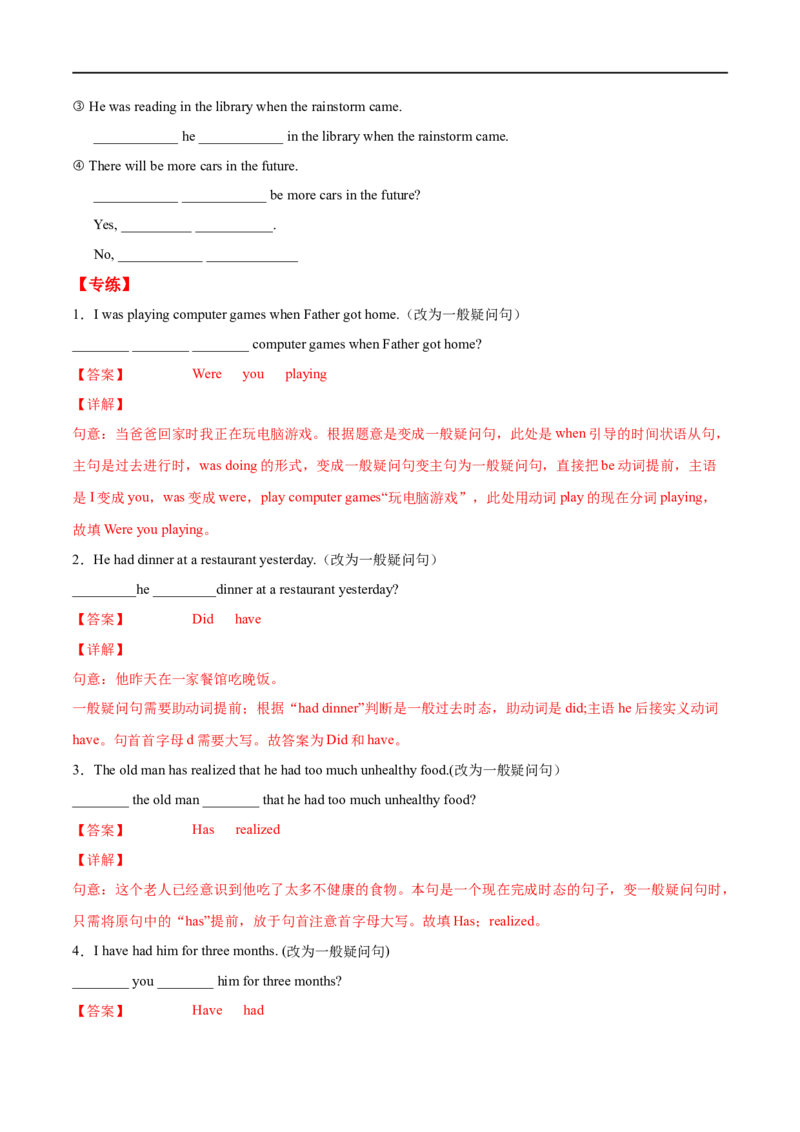
八年级下学期期末重难知识点串讲+精练
专题04 句型转换及专练
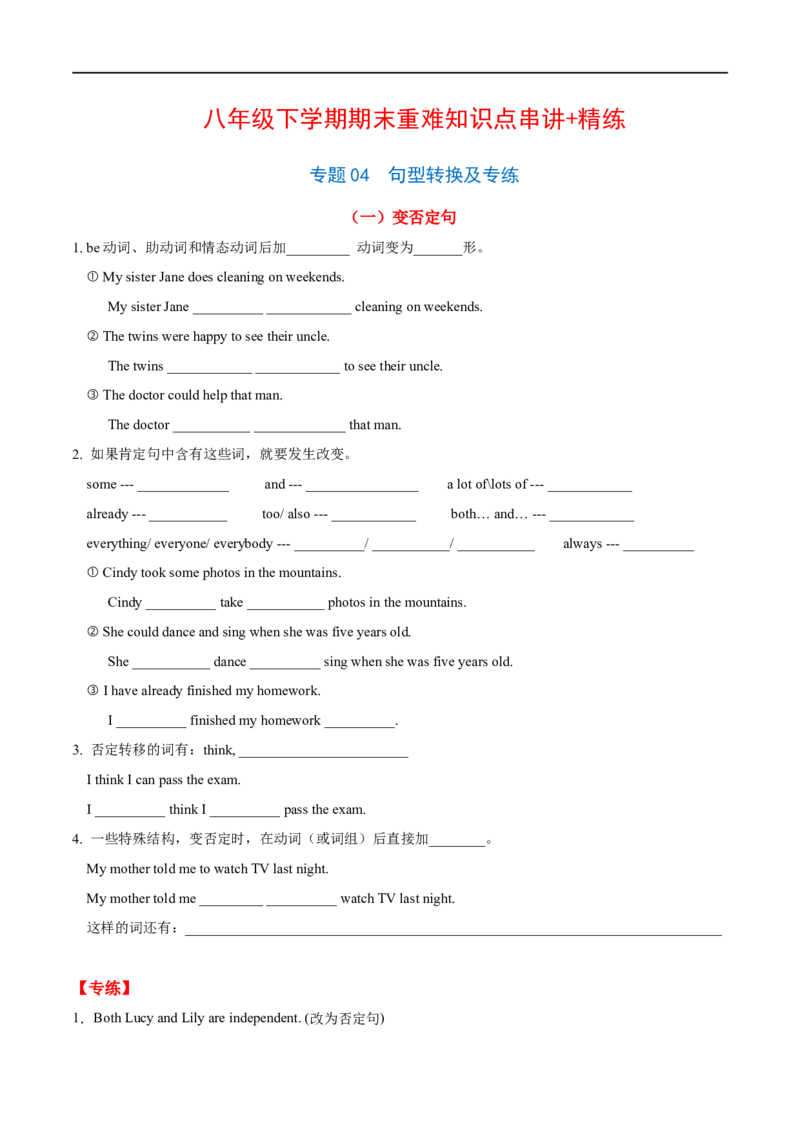
(一)变否定句
1. be动词、助动词和情态动词后加_________ 动词变为_______形。
① My sister Jane does cleaning on weekends.
My sister Jane __________ ____________ cleaning on weekends.
② The twins were happy to see their uncle.
The twins ____________ ____________ to see their uncle.
③ The doctor could help that man.
The doctor ___________ _____________ that man.
2. 如果肯定句中含有这些词,就要发生改变。
some --- _____________ and --- ________________ a lot of\lots of --- ____________
already --- ___________ too/ also --- ____________ both… and… --- ____________
everything/ everyone/ everybody --- __________/ ___________/ ___________ always --- __________
① Cindy took some photos in the mountains.
Cindy __________ take ___________ photos in the mountains.
② She could dance and sing when she was five years old.
She ___________ dance __________ sing when she was five years old.
③ I have already finished my homework.
I __________ finished my homework __________.
3. 否定转移的词有:think, ________________________
I think I can pass the exam.
I __________ think I __________ pass the exam.
4. 一些特殊结构,变否定时,在动词(或词组)后直接加________。
My mother told me to watch TV last night.
My mother told me _________ __________ watch TV last night.
这样的词还有:____________________________________________________________________________
【专练】
1.Both Lucy and Lily are independent. (改为否定句)________ Lucy nor Lily _____________ independent.
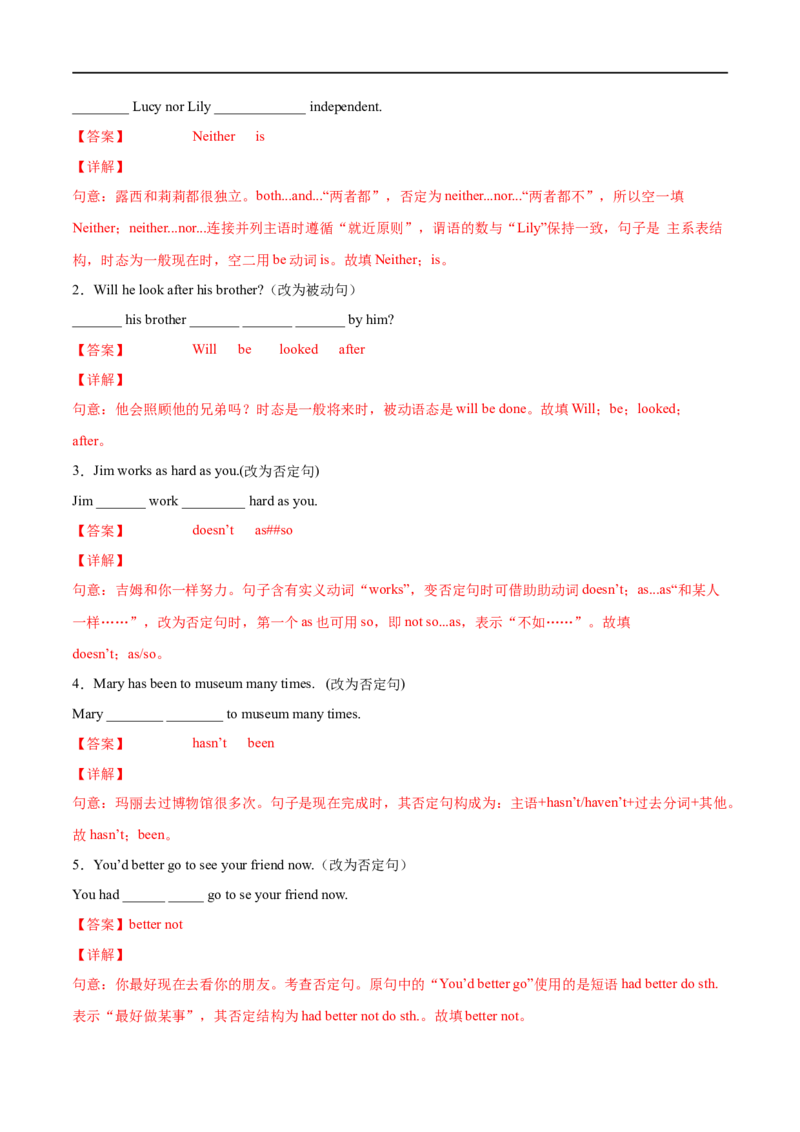
【答案】 Neither is
【详解】
句意:露西和莉莉都很独立。both...and...“两者都”,否定为neither...nor...“两者都不”,所以空一填
Neither;neither...nor...连接并列主语时遵循“就近原则”,谓语的数与“Lily”保持一致,句子是 主系表结
构,时态为一般现在时,空二用be动词is。故填Neither;is。
2.Will he look after his brother?(改为被动句)
_______ his brother _______ _______ _______ by him?
【答案】 Will be looked after
【详解】
句意:他会照顾他的兄弟吗?时态是一般将来时,被动语态是will be done。故填Will;be;looked;
after。
3.Jim works as hard as you.(改为否定句)
Jim _______ work _________ hard as you.
【答案】 doesn’t as##so
【详解】
句意:吉姆和你一样努力。句子含有实义动词“works”,变否定句时可借助助动词doesn’t;as...as“和某人
一样……”,改为否定句时,第一个as也可用so,即not so...as,表示“不如……”。故填
doesn’t;as/so。
4.Mary has been to museum many times. (改为否定句)
Mary ________ ________ to museum many times.
【答案】 hasn’t been
【详解】
句意:玛丽去过博物馆很多次。句子是现在完成时,其否定句构成为:主语+hasn’t/haven’t+过去分词+其他。
故hasn’t;been。
5.You’d better go to see your friend now.(改为否定句)
You had ______ _____ go to se your friend now.
【答案】better not
【详解】
句意:你最好现在去看你的朋友。考查否定句。原句中的“You’d better go”使用的是短语had better do sth.
表示“最好做某事”,其否定结构为had better not do sth.。故填better not。6.Lily put on a hat this morning.(否定句)
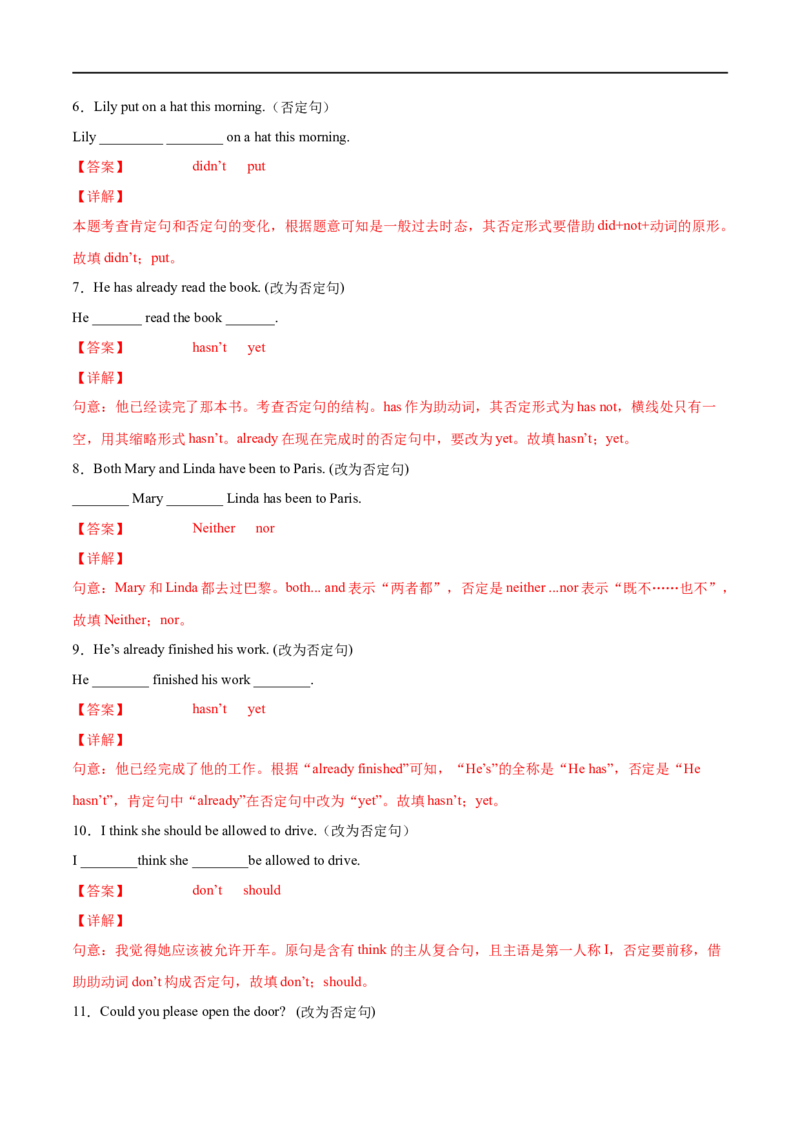
Lily _________ ________ on a hat this morning.
【答案】 didn’t put
【详解】
本题考查肯定句和否定句的变化,根据题意可知是一般过去时态,其否定形式要借助did+not+动词的原形。
故填didn’t;put。
7.He has already read the book. (改为否定句)
He _______ read the book _______.
【答案】 hasn’t yet
【详解】
句意:他已经读完了那本书。考查否定句的结构。has作为助动词,其否定形式为has not,横线处只有一
空,用其缩略形式hasn’t。already在现在完成时的否定句中,要改为yet。故填hasn’t;yet。
8.Both Mary and Linda have been to Paris. (改为否定句)
________ Mary ________ Linda has been to Paris.
【答案】 Neither nor
【详解】
句意:Mary和Linda都去过巴黎。both... and表示“两者都”,否定是neither ...nor表示“既不……也不”,
故填Neither;nor。
9.He’s already finished his work. (改为否定句)
He ________ finished his work ________.
【答案】 hasn’t yet
【详解】
句意:他已经完成了他的工作。根据“already finished”可知,“He’s”的全称是“He has”,否定是“He
hasn’t”,肯定句中“already”在否定句中改为“yet”。故填hasn’t;yet。
10.I think she should be allowed to drive.(改为否定句)
I ________think she ________be allowed to drive.
【答案】 don’t should
【详解】
句意:我觉得她应该被允许开车。原句是含有think的主从复合句,且主语是第一人称I,否定要前移,借
助助动词don’t构成否定句,故填don’t;should。
11.Could you please open the door? (改为否定句)Could you please _________ _________ the door?
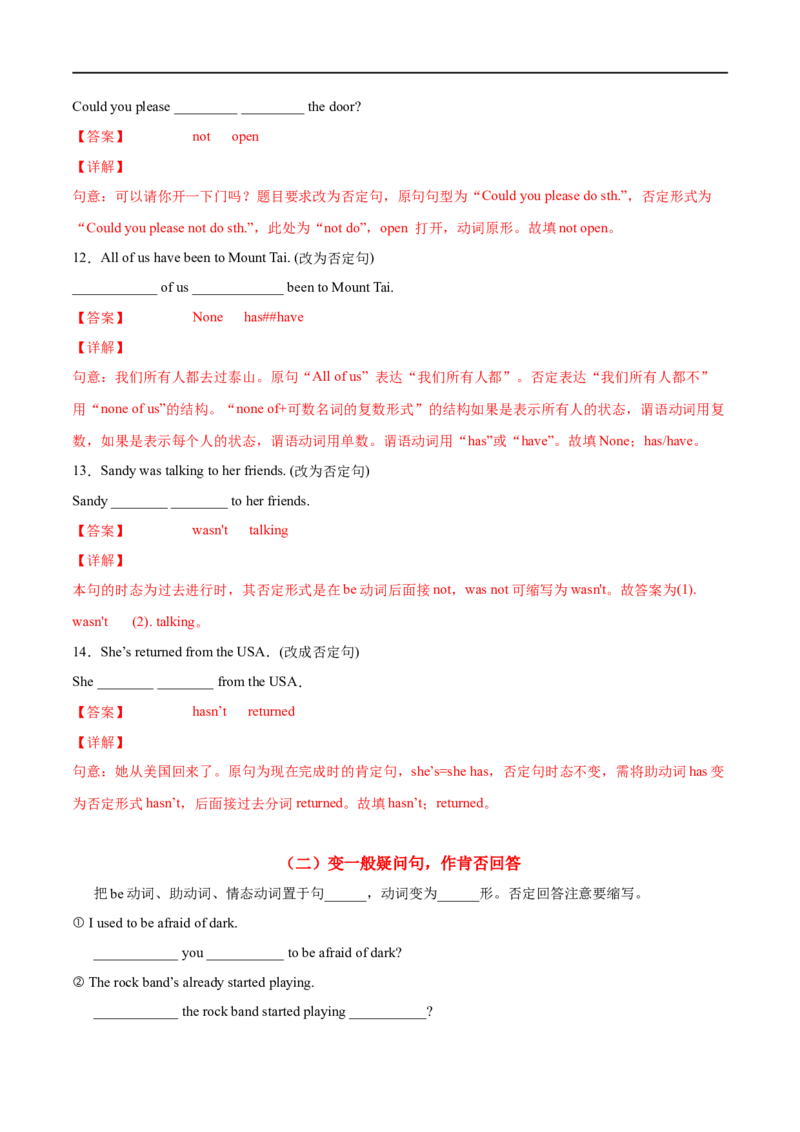
【答案】 not open
【详解】
句意:可以请你开一下门吗?题目要求改为否定句,原句句型为“Could you please do sth.”,否定形式为
“Could you please not do sth.”,此处为“not do”,open 打开,动词原形。故填not open。
12.All of us have been to Mount Tai. (改为否定句)
____________ of us _____________ been to Mount Tai.
【答案】 None has##have
【详解】
句意:我们所有人都去过泰山。原句“All of us” 表达“我们所有人都”。否定表达“我们所有人都不”
用“none of us”的结构。“none of+可数名词的复数形式”的结构如果是表示所有人的状态,谓语动词用复
数,如果是表示每个人的状态,谓语动词用单数。谓语动词用“has”或“have”。故填None;has/have。
13.Sandy was talking to her friends. (改为否定句)
Sandy ________ ________ to her friends.
【答案】 wasn't talking
【详解】
本句的时态为过去进行时,其否定形式是在be动词后面接not,was not可缩写为wasn't。故答案为(1).
wasn't (2). talking。
14.She’s returned from the USA.(改成否定句)
She ________ ________ from the USA.
【答案】 hasn’t returned
【详解】
句意:她从美国回来了。原句为现在完成时的肯定句,she’s=she has,否定句时态不变,需将助动词has变
为否定形式hasn’t,后面接过去分词returned。故填hasn’t;returned。
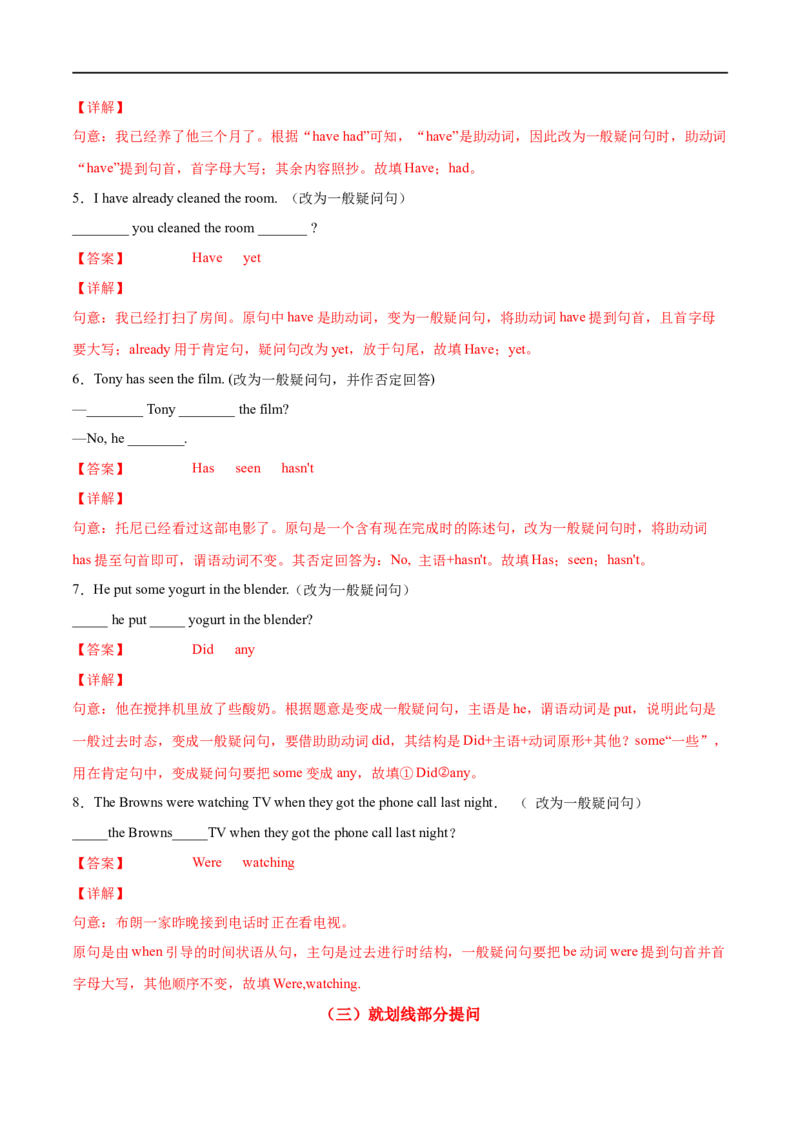
(二)变一般疑问句,作肯否回答
把be动词、助动词、情态动词置于句______,动词变为______形。否定回答注意要缩写。
① I used to be afraid of dark.
____________ you ___________ to be afraid of dark?
② The rock band’s already started playing.
____________ the rock band started playing ___________?③ He was reading in the library when the rainstorm came.
____________ he ____________ in the library when the rainstorm came.
④ There will be more cars in the future.
____________ ____________ be more cars in the future?
Yes, __________ ___________.
No, ____________ _____________
【专练】
1.I was playing computer games when Father got home.(改为一般疑问句)
________ ________ ________ computer games when Father got home?
【答案】 Were you playing
【详解】
句意:当爸爸回家时我正在玩电脑游戏。根据题意是变成一般疑问句,此处是when引导的时间状语从句,
主句是过去进行时,was doing的形式,变成一般疑问句变主句为一般疑问句,直接把be动词提前,主语
是I变成you,was变成were,play computer games“玩电脑游戏”,此处用动词play的现在分词playing,
故填Were you playing。
2.He had dinner at a restaurant yesterday.(改为一般疑问句)
_________he _________dinner at a restaurant yesterday?
【答案】 Did have
【详解】
句意:他昨天在一家餐馆吃晚饭。
一般疑问句需要助动词提前;根据“had dinner”判断是一般过去时态,助动词是did;主语he后接实义动词
have。句首首字母d需要大写。故答案为Did和have。
3.The old man has realized that he had too much unhealthy food.(改为一般疑问句)
________ the old man ________ that he had too much unhealthy food?
【答案】 Has realized
【详解】
句意:这个老人已经意识到他吃了太多不健康的食物。本句是一个现在完成时态的句子,变一般疑问句时,
只需将原句中的“has”提前,放于句首注意首字母大写。故填Has;realized。
4.I have had him for three months. (改为一般疑问句)
________ you ________ him for three months?
【答案】 Have had【详解】
句意:我已经养了他三个月了。根据“have had”可知,“have”是助动词,因此改为一般疑问句时,助动词
“have”提到句首,首字母大写;其余内容照抄。故填Have;had。
5.I have already cleaned the room. (改为一般疑问句)
________ you cleaned the room _______ ?
【答案】 Have yet
【详解】
句意:我已经打扫了房间。原句中have是助动词,变为一般疑问句,将助动词have提到句首,且首字母
要大写;already用于肯定句,疑问句改为yet,放于句尾,故填Have;yet。
6.Tony has seen the film. (改为一般疑问句,并作否定回答)
—________ Tony ________ the film?
—No, he ________.
【答案】 Has seen hasn't
【详解】
句意:托尼已经看过这部电影了。原句是一个含有现在完成时的陈述句,改为一般疑问句时,将助动词
has提至句首即可,谓语动词不变。其否定回答为:No, 主语+hasn't。故填Has;seen;hasn't。
7.He put some yogurt in the blender.(改为一般疑问句)
_____ he put _____ yogurt in the blender?
【答案】 Did any
【详解】
句意:他在搅拌机里放了些酸奶。根据题意是变成一般疑问句,主语是he,谓语动词是put,说明此句是
一般过去时态,变成一般疑问句,要借助助动词did,其结构是Did+主语+动词原形+其他?some“一些”,
用在肯定句中,变成疑问句要把some变成any,故填①Did②any。
8.The Browns were watching TV when they got the phone call last night. ( 改为一般疑问句)
_____the Browns_____TV when they got the phone call last night?
【答案】 Were watching
【详解】
句意:布朗一家昨晚接到电话时正在看电视。
原句是由when引导的时间状语从句,主句是过去进行时结构,一般疑问句要把be动词were提到句首并首
字母大写,其他顺序不变,故填Were,watching.
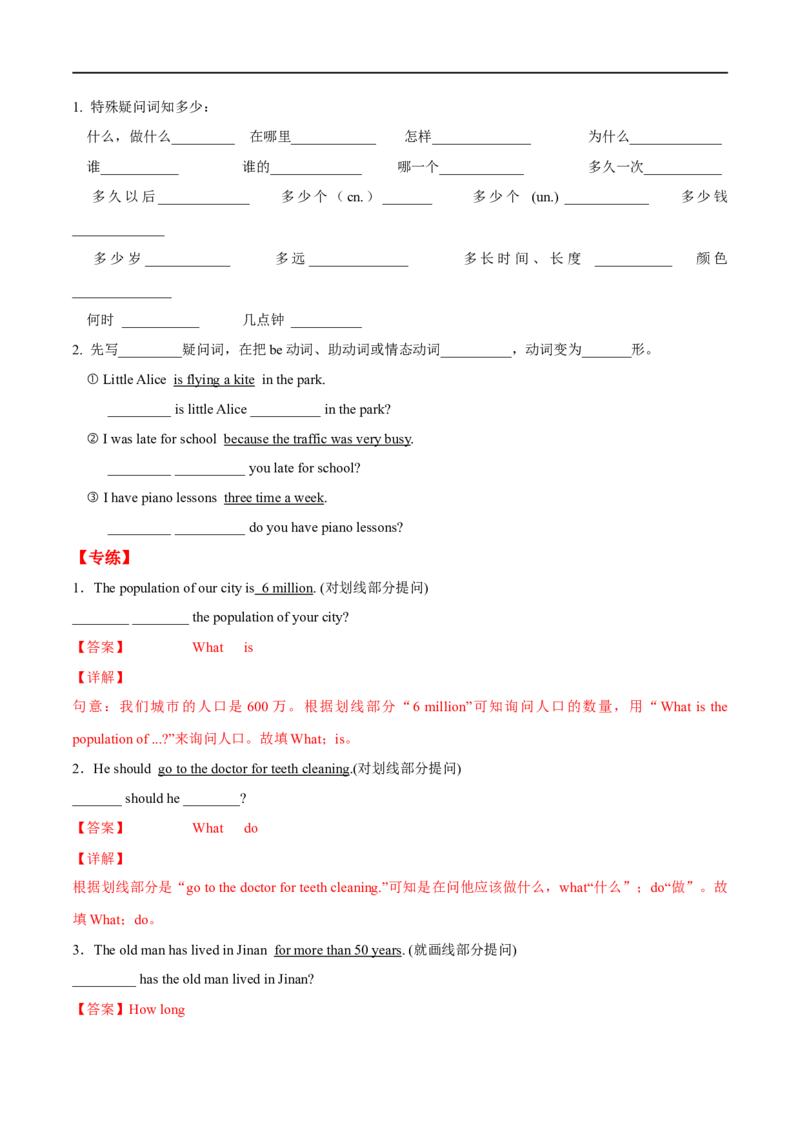
(三)就划线部分提问1. 特殊疑问词知多少:
什么,做什么_________ 在哪里____________ 怎样______________ 为什么_____________
谁___________ 谁的_____________ 哪一个____________ 多久一次___________
多久以后_____________ 多少个(cn.)_______ 多少个 (un.) ____________ 多少钱
_____________
多少岁____________ 多远______________ 多长时间、长度 ___________ 颜色
______________
何时 ___________ 几点钟 __________
2. 先写_________疑问词,在把be动词、助动词或情态动词__________,动词变为_______形。
① Little Alice is flying a kite in the park.
_________ is little Alice __________ in the park?
② I was late for school because the traffic was very busy.
_________ __________ you late for school?
③ I have piano lessons three time a week.
_________ __________ do you have piano lessons?
【专练】
1.The population of our city is 6 million. (对划线部分提问)
________ ________ the population of your city?
【答案】 What is
【详解】
句意:我们城市的人口是 600 万。根据划线部分“6 million”可知询问人口的数量,用“What is the
population of ...?”来询问人口。故填What;is。
2.He should go to the doctor for teeth cleaning.(对划线部分提问)
_______ should he ________?
【答案】 What do
【详解】
根据划线部分是“go to the doctor for teeth cleaning.”可知是在问他应该做什么,what“什么”;do“做”。故
填What;do。
3.The old man has lived in Jinan for more than 50 years. (就画线部分提问)
_________ has the old man lived in Jinan?
【答案】How long【详解】
句意:这位老人在济南住了50多年。划线部分是“for more than 50 years”可知,此处是提问一段时间,用
how long,注意首字母大写,故填How long。
4.Peter has worked as a teacher since 1998. (对划线部分提问)
________ ________ has Peter worked as a teacher?
【答案】 How long
【详解】
句意:彼得自1998年以来一直当教师。根据划线部分“since 1998”可知是对时间段的提问,应该用how
long“多久时间”符合语境,故填How;long。
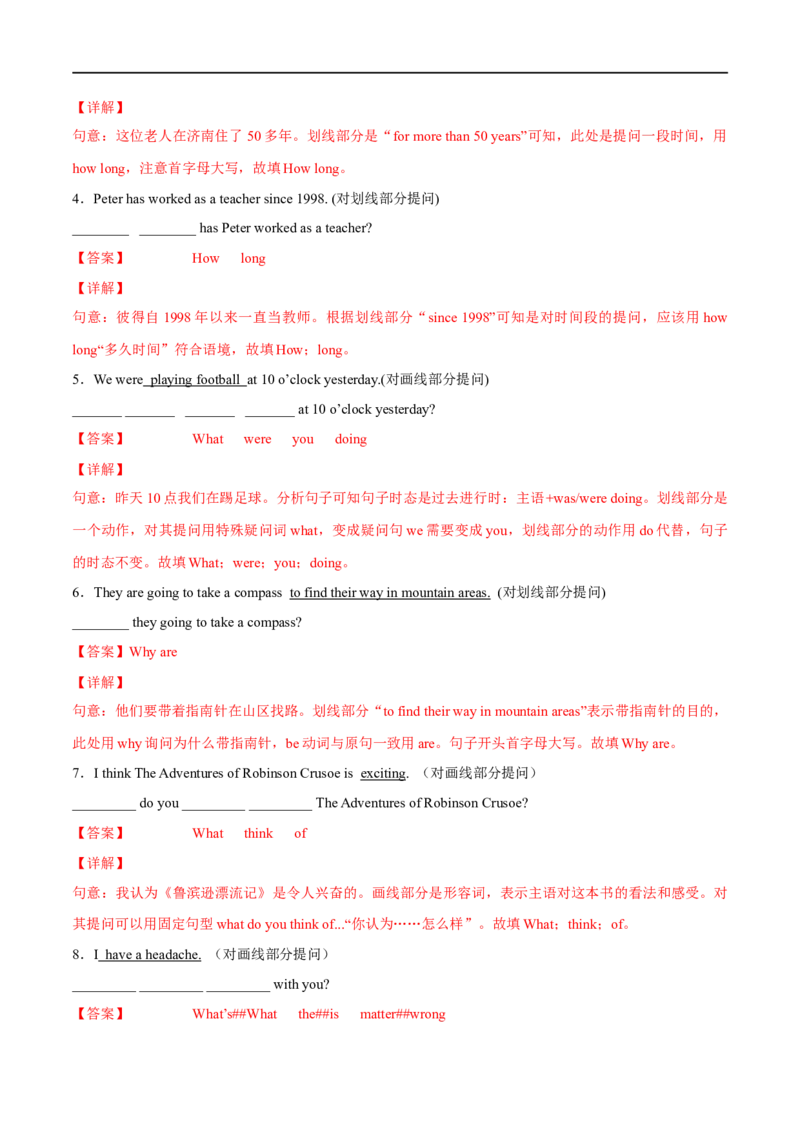
5.We were playing football at 10 o’clock yesterday.(对画线部分提问)
_______ _______ _______ _______ at 10 o’clock yesterday?
【答案】 What were you doing
【详解】
句意:昨天10点我们在踢足球。分析句子可知句子时态是过去进行时:主语+was/were doing。划线部分是
一个动作,对其提问用特殊疑问词what,变成疑问句we需要变成you,划线部分的动作用do代替,句子
的时态不变。故填What;were;you;doing。
6.They are going to take a compass to find their way in mountain areas. (对划线部分提问)
________ they going to take a compass?
【答案】Why are
【详解】
句意:他们要带着指南针在山区找路。划线部分“to find their way in mountain areas”表示带指南针的目的,
此处用why询问为什么带指南针,be动词与原句一致用are。句子开头首字母大写。故填Why are。
7.I think The Adventures of Robinson Crusoe is exciting. (对画线部分提问)
_________ do you _________ _________ The Adventures of Robinson Crusoe?
【答案】 What think of
【详解】
句意:我认为《鲁滨逊漂流记》是令人兴奋的。画线部分是形容词,表示主语对这本书的看法和感受。对
其提问可以用固定句型what do you think of...“你认为……怎么样”。故填What;think;of。
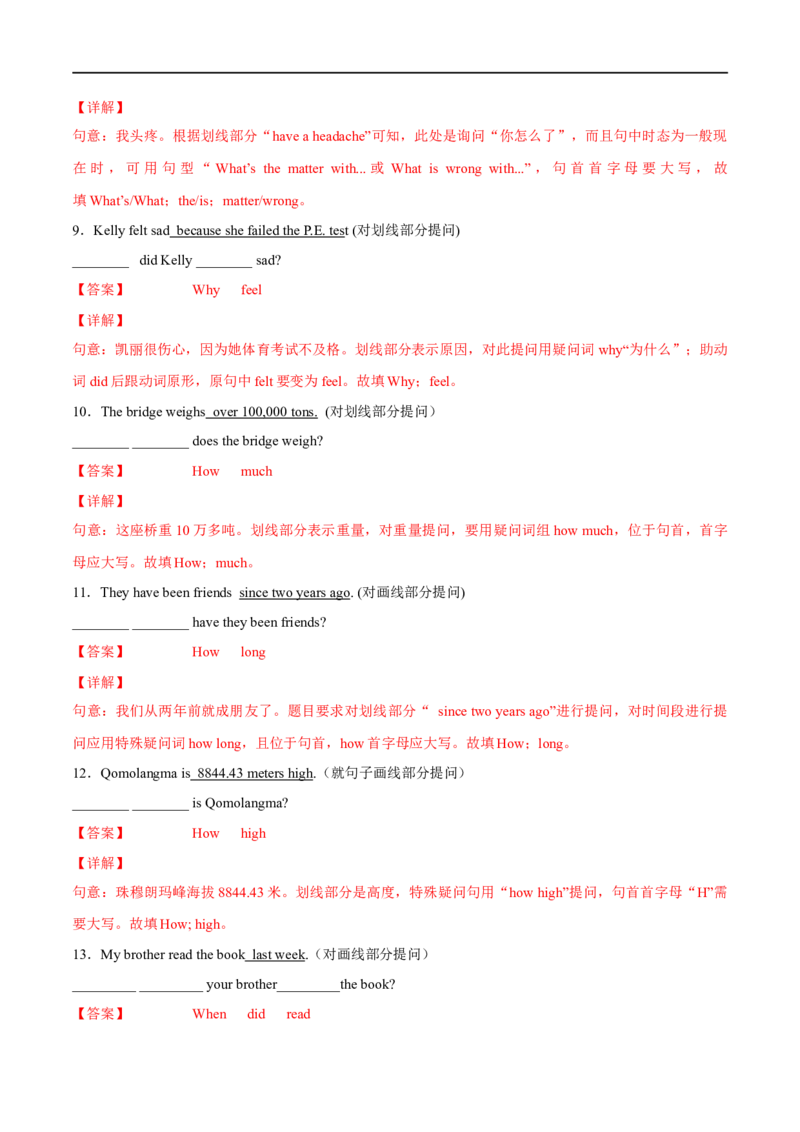
8.I have a headache. (对画线部分提问)
_________ _________ _________ with you?
【答案】 What’s##What the##is matter##wrong【详解】
句意:我头疼。根据划线部分“have a headache”可知,此处是询问“你怎么了”,而且句中时态为一般现
在时,可用句型“What’s the matter with...或 What is wrong with...”,句首首字母要大写,故
填What’s/What;the/is;matter/wrong。
9.Kelly felt sad because she failed the P.E. test (对划线部分提问)
________ did Kelly ________ sad?
【答案】 Why feel
【详解】
句意:凯丽很伤心,因为她体育考试不及格。划线部分表示原因,对此提问用疑问词why“为什么”;助动
词did后跟动词原形,原句中felt要变为feel。故填Why;feel。
10.The bridge weighs over 100,000 tons. (对划线部分提问)
________ ________ does the bridge weigh?
【答案】 How much
【详解】
句意:这座桥重10万多吨。划线部分表示重量,对重量提问,要用疑问词组how much,位于句首,首字
母应大写。故填How;much。
11.They have been friends since two years ago. (对画线部分提问)
________ ________ have they been friends?
【答案】 How long
【详解】
句意:我们从两年前就成朋友了。题目要求对划线部分“ since two years ago”进行提问,对时间段进行提
问应用特殊疑问词how long,且位于句首,how首字母应大写。故填How;long。
12.Qomolangma is 8844.43 meters high.(就句子画线部分提问)
________ ________ is Qomolangma?
【答案】 How high
【详解】
句意:珠穆朗玛峰海拔8844.43米。划线部分是高度,特殊疑问句用“how high”提问,句首首字母“H”需
要大写。故填How; high。
13.My brother read the book last week.(对画线部分提问)
_________ _________ your brother_________the book?
【答案】 When did read【详解】
句意:我弟弟上周看书了。
划线部分last week是时间状语,提问用when表示“什么时间”;疑问词后用助动词;句子是一般过去时态,
助动词是did;主语your brother后接实义动词read。句首首字母w需要大写。故答案为When, did和read。
14.I was washing some clothes at this time yesterday. (对画线部分提问)
________ were you ________ at this time yesterday?
【答案】 What doing
【详解】
此题是对画线部分提问。划线部分的was washing some clothes是所做的事情,因此用what提问。后跟一般
疑问句语序。此题又是过去进行时。用doing代替划线部分。故答案为:(1). What (2). doing
15.You should call the police for help when you’re in danger. (对划线部分提问)
________I do when I’m in danger?
【答案】What should
【详解】
句意:当你遇到危险时,你应该向警察求助。划线部分call the police for help“向警察求助”为面对危险时
应该做的事情,应用疑问词 what对其提问;在特殊疑问句中,应将情态动词 should提前。故填What
should。
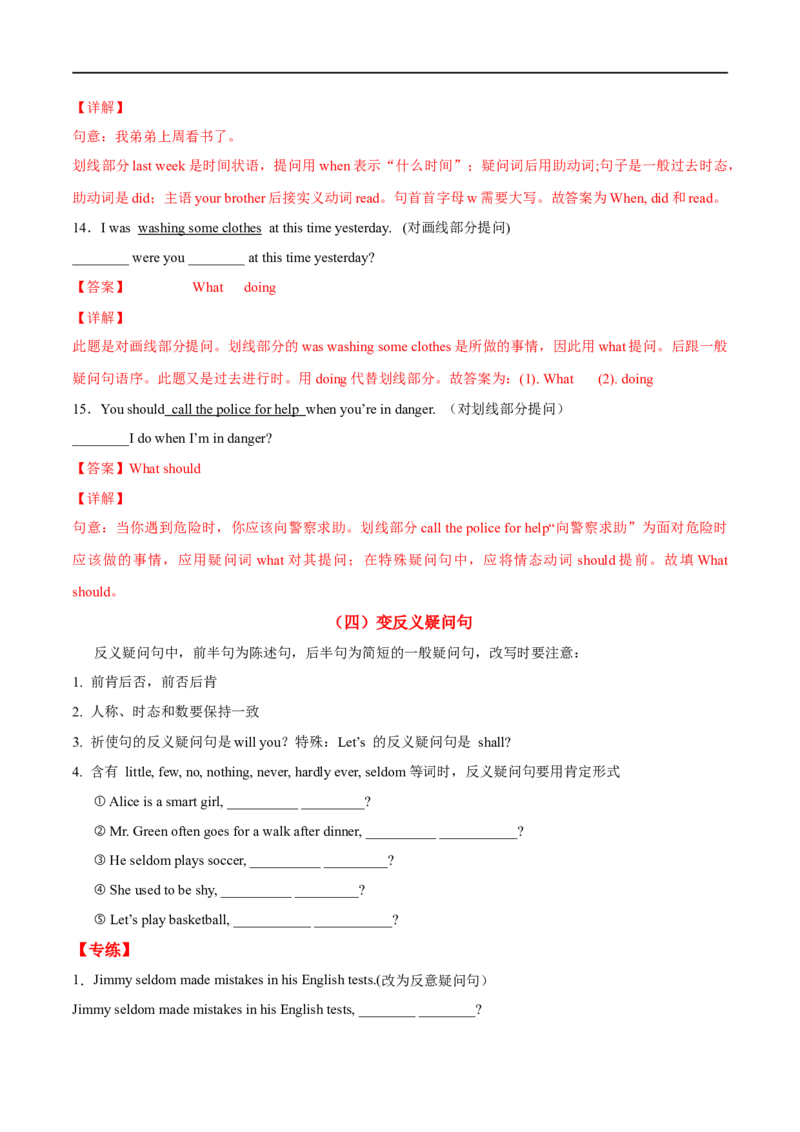
(四)变反义疑问句
反义疑问句中,前半句为陈述句,后半句为简短的一般疑问句,改写时要注意:
1. 前肯后否,前否后肯
2. 人称、时态和数要保持一致
3. 祈使句的反义疑问句是will you?特殊:Let’s 的反义疑问句是 shall?
4. 含有 little, few, no, nothing, never, hardly ever, seldom等词时,反义疑问句要用肯定形式
① Alice is a smart girl, __________ _________?
② Mr. Green often goes for a walk after dinner, __________ ___________?
③ He seldom plays soccer, __________ _________?
④ She used to be shy, __________ _________?
⑤ Let’s play basketball, ___________ ___________?
【专练】
1.Jimmy seldom made mistakes in his English tests.(改为反意疑问句)
Jimmy seldom made mistakes in his English tests, ________ ________?【答案】 did he
【详解】
句意:吉米在英语考试中很少出错。反意疑问句结构是“前肯后否,前否后肯”,因陈述句中含有否定词
“seldom”,疑问部分用肯定形式,根据“made”可知疑问部分应借助助动词did,主语用代词he代替
“Jimmy”。故填did;he。
2.He didn’t suppose that they would give him a surprise. (改为反义疑问句)
He didn’t suppose that they would give him a surprise, _________ _________?
【答案】 did he
【详解】
句意:他没想到他们会给他一个惊喜。分析句子可知这是一个宾语从句,主语是第三人称,不是第一人称,
所以反义疑问句根据主句。反义疑问句遵循“前肯后否,前否后肯”原则,主句是否定句,反问部分用肯
定,且助动词用did,主语用he。故填did;he。
3.They hardly know each other.(改为反意疑问句)
They hardly know each other, __________ __________?
【答案】 do they
【详解】
句意:他们几乎不认识。反意疑问句的构成形式为:陈述部分+疑问部分;陈述部分是否定形式,故疑问
部分应用肯定形式;陈述部分是一般现在时,动词是实义动词,故疑问句的助动词应用do,再加上陈述部
分的主语they。故填do;they。
4.He failed in the English exam again. (改为反意疑问句)
He failed in the English exam again, _______ _______?
【答案】 didn’t he
【详解】
句意:他英语考试又没及格。反意疑问句遵循“前肯后否,前否后肯”原则,陈述句部分是一般过去时的
肯定形式,所以反问部分用否定,且需借助助动词did;主语用he,故填didn’t;he。
5.Mike’s never seen such an amazing thing.( 改为反意疑问句 )
Mike’s never seen such an amazing thing, ________ ________?
【答案】 has he
【详解】
句意:迈克从没见过这么神奇的东西。前半句含有否定词never,反意疑问句遵循“前否后肯”原则,前半
句的’s是现在完成时中的助动词has,反意部分也用has,主语Mike是男性,反意部分用he。故填has;he。
6.Let’s discuss the problem after the meeting. (改为反意疑问句)
Let’s discuss the problem after the meeting, ________ ________?
【答案】 shall we
【详解】
句意:我们会后再讨论这个问题吧。根据题目要求可知,Let’s...的反意疑问句是“shall we”,故填shall;
we。
7.There is hardly any food in the fridge. (改成反义疑问句)
There is hardly any food in the fridge, _________ ________?
【答案】 is there
【详解】
句意:冰箱里几乎没有什么食物了。反义疑问句遵循“前肯后否,前否后肯”的原则,陈述部分有否定词
hardly“几乎不”,后面有肯定,因为陈述部分是there be句型,反义疑问句部分也需要there。故填is;
there。
8.It is not right to do exercise immediately after a full meal.(改为反意疑问句)
It is not right to do exercise immediately after a full meal, ________ ________?
【答案】 is it
【详解】
句意:饭后立即运动是不对的。反意疑问句由“陈述句+疑问尾句”两部分组成;前肯定,后否定;前否
定,后肯定。原句是否定句,陈述部分主谓部分是“It is...”,因此反义疑问句要用肯定。故填is;it。
9.You’re supposed to talk with your parents. (完成反意疑问句)
You’re supposed to talk with your parents, ________________ ________________?
【答案】 aren’t you
【详解】
句意:你应该和你的父母谈谈。考查陈述句变反义疑问句。当陈述句是肯定句,则附加疑问句用否定句。
当陈述句的谓语含有be动词,附加疑问句用be动词来构成,are变为aren’t;附加疑问句的主语与陈述句
的主语相同都是you。故填aren’t;you。
10.Jane never goes to school by bus, ________ ________? (完成反意疑问句)
【答案】 does she
【详解】
句意:Jane从不坐公交去学校,是吗?根据“never”可知,反意疑问句陈述部分是否定形式,因此反意疑问部分用肯定形式,且句子时态是一般现在时,主语是第三人称单数,因此反意疑问部分助动词用does,
因“Jane”通常是女孩名,所以用she来代替。故填does;she。
11.There is little water in the glass, ________ ________? (完成反意疑问句)
【答案】 is there
【详解】
句意:玻璃杯里几乎没有水,是吗?根据反意疑问句“前肯后否,前否后肯”的原则可知,陈述句中的
little表示“几乎没有”,属于否定句,故疑问句部分是肯定形式。根据陈述句中的there is可知,反意疑问
句应用is there。故填is;there。
12.Robert used to wear glasses. (改为一般疑问句)
________ Robert ________ to wear glasses?
【答案】 Did use
【详解】
句意:Robert过去常戴眼镜。原句中使用了used to do sth.“过去常常做某事”。变一般疑问句时,用助动词
Did,used变为原形use。故填Did;use。
13.You haven’t seen the film yet, ______ _______? (完成下列反意疑问句)
【答案】 have you
【详解】
句意:你还没看过这部电影,不是吗?反意疑问句遵循“前肯后否,前否后肯”原则,陈述部分是否定句,
反意疑问句用肯定形式:助动词/情态动词/be动词+主语;此处的主语是you,陈述句部分有助动词have,
故填have;you。
14.Mr. Fat has few good friends. (改为反意疑问句)
Mr. Fat has few good friends, _______________ _______________?
【答案】 does he
【详解】
反义疑问句。根据“前肯后否,前否后肯”的原则,以及陈述句中的few可知,疑问句部分用肯定形式,
且陈述句中为实意动词has,用助动词的三单形式,且疑问句中的主语为代词形式,故填does;he。
15.He has never been abroad.(改为反意疑问句)
He has never been abroad, __________ __________ ?
【答案】 has he
【详解】
句意:他从未出过国。反意疑问句遵循前肯后否,前否后肯的原则,结构是be/助动词/情态动词(not)+主语。因为陈述部分never表示“从不”之意,表否定。故之后的疑问部分应用肯定。陈述部分中的助动
词为has,疑问部分的助动词直接用has即可,主语为he。故填has;he。
(五)变同义句
1.复合句变简单句
a. 宾语从句变为特殊疑问词+________
① Jack’s grandmother doesn’t know how she can use the iPad. (2012年)
Jack’s grandmother doesn’t know how ___________ __________ the iPad.
② Could you tell me how I can get to the nearest supermarket? (2013年)
Could you tell me _________ ___________ to the nearest supermarket?
③ Can you tell me how I can get to the bank?
Can you tell me _________ _________ get to the bank?
b. 宾语从句变为 v. + sb doing
④ We noticed that he was standing at the school gate.
We noticed _________ ___________ at the school agte.
c. 条件状语从句”If not….”可转化为“祈使句+ or….”或“unless…”
⑤ If you don’t read the exam questions carefully, you’ll make some mistakes.
________ the exam questions carefully, _______ you’ll make some mistakes.
You ________ make any mistakes __________ you read the exam questions carefully.
d. so… that… = too… to… = (not) … enough to…
⑥ The box is so heavy that we can’t carry it.
The box is _________ heavy for us __________ carry it.
⑦ The kid is so young that he can’t go to school.
The kid __________ __________ enough to go to school.
e. because + 句子 变为 because of + n.
⑧ We couldn’t see anything because it rained hard.
We couldn’t see anything ___________ ___________ the heavy rain.
2. 简单句变复合句
a. in order to do = so that…
④ You could save money in order to buy a gift for your friend’s birthday.
You could save money ___________ ____________ you can buy a gift for your friend’s birthday.
b. at the age of four = When he was four⑤ Li Yundi began to learn the accordion at the age of four. (2008年)
Li Yundi began to learn the accordion ___________ he __________ four years old.
c. 变祈使句
⑥ Our math teacher Mr. Smith told us to be quiet in class.(2014年)
Our math teacher Mr. Smith said to us: “___________ ___________ in class.”
3. 变感叹句
What + a/an + adj. +cn. + (主谓)!
What + adj. + un. + (主谓)!
How + adj./ adv. + (the 主 + 谓) !
① It’s a very interesting story.
____________ ____________ interesting story it is!
② The little boy is very clever (2012年)
__________ ___________ the little boy is!
③ The weather is fine.
____________ ____________ weather it is!
4. so/ neither 的倒装
so 有肯定含义,neither 有否定含义, be动词、助动词和情态动词要置于主语的________。
① Jim wants to go boating and his cousins want to go boating, too.
Jim wants to go boating, and ________ ________ his cousins.
② Mr. Wang has been to Singapore? I’ve been there, too.
Mr. Wang has been to Singapore. __________ ___________ I.
5. 同义词组句型转换
高频考点:
(1) so…that… = too…to… = not … enough to…
(2) favorite → like… best
(3) prefer = like… better
(4) take, spend, cost, pay
(6) it 作形式主语或宾语
(7) if not… = 祈使句,or…
(8) 提建议:How/ What about doing? = Why don’t you do? = Why not do? = Would you mind doing? = Would
you like to do? = Could you please do? = Shall I/ we do? = Let’s do. = You’d better do.(9) after… = not… until
(10) have a great time doing = have fun doing= enjoy oneself doing
(11) 比较级、最高级 (taller than any other… = the tallest)
(12) not… = without doing
(13) instead = instead of
(14) unless = if not…
(15) at the age of 4 = when he was 4
(16) nothing = not… anything
(17) 问感受、评价 How you like…? = What do you think of…? = How do you feel about…?
(18) refuse = turn down
(19) not the same as = be different from
(20) be good at = do well in
(21) thanks to = because of
(22) be similar to = look like = take after
(23) borrow … from… = lend … to…
(24) make sb happy = cheer sb up
(25) in order to do = so that…
(26) alone = by oneself
(27) think up = come up with
(28) not… any longer = no longer…
(29) try/ do one’s best to do= go out of one’s way to do = make an effort to do
(30) What’s the matter? = What’s wrong?
【专练】
1.My sister teaches herself English. (改为同义句)
My sister learns English _______________.
【答案】by herself
【详解】
句意:我妹妹自学英语。teach oneself...“自学……”,同义替换为learn...by oneself,主语是“My sister”,
反身代词用herself“她自己”,指代主语本身。故填by herself。
2.They needn’t sweep the snow right now. (改为同义句)
________________ for them to sweep the snow right now.【答案】There is no need##There’s no need
【详解】
句意:他们现在不必扫雪。根据“right now”可知,时态用一般现在时,根据“...for them to sweep the
snow”可知,可替换为句型:There is no need for sb to do sth“某人没必要做某事”。故填There is no
need/There’s no need。
3.He is too young to attend school. (改为同义句)
He is _______ _______ _______ _______ attend school.
【答案】 not old enough to
【详解】
句意:他太小了,还不能上学。too...to...表示“太……而不能”,可用be not+adj+enough+to do sth结构进
行替换,故填not;old;enough;to。
4.She sings best in her class. (同义句转换)
She sings better than ________ ________ student in her class.
【答案】 any other
【详解】
句意:她在班上唱得最好。要求改为同义句,她在班上唱得最好说明“她比她的班里其他任何一个学生唱
得都好”,此处用any other+名词单数,表示“任何其他一个……”,故填any;other。
5.His father joined the Party two years ago.(同义句转换)
His father ________ ________ a member of the Party for two years.
【答案】 has been
【详解】
句意:他的父亲两年前入党。根据“for two years”可知,此处为现在完成时,join为非延续性动词,不能
和时间段连用,需要变为延续性动词be,主语为名词单数,使用has been。故填has;been。
6.It took Mike half an hour to work out the problem.(改为同义句)
Mike ________ half an hour ________ out the problem.
【答案】 spent woking
【详解】
句意:迈克花了半个小时才算出这道题。It took sb+一段时间+to do sth=sb spent+一段时间+doing sth“某人花
费时间做某事”,根据took可知,替换的句子也用一般过去时;work的动名词是working,故填spent;
working。
7.We have studied at this school for three years.(改为同义句)________ three years since we ________ to study at this school.
【答案】 It is began##started
【详解】
句意:我们已经在这所学校学习三年了。原句使用“现在完成时+for+段时间”,可替换为“It is...
+since+一般过去时”,“在这所学校学习三年了”也表示“三年前开始在这所学校学习”,begin/start“开
始”,此处需要用过去式。故填It is;began/started。
8.They asked their teacher when they should hand in the project. (保持句意基本不变)
They asked their teacher ________ ________ hand in the project.
【答案】 when to
【详解】
句意:他们问老师什么时候交作业。此处可用“疑问词+不定式”结构进行替换,when“何时”。故填
when;to。
9.We must develop a green lifestyle. (保持句意基本不变)
________ necessary for us ________ develop a green lifestyle.
【答案】 It’s to
【详解】
句意:我们必须发展绿色生活方式。原句可改为“对我们来说,发展绿色生活方式是有必要的”,固定句
式:It’s+形容词+for sb to do sth“对某人来说,做某事是……的”,动词不定式作真正的主语,it作形式主
语,故填It’s;to。
10.Nobody else is cleverer than Daniel in his class. (同义句改写)
Daniel is ________________ student in his class.
【答案】the cleverest
【详解】
句意:在他的班上没有人比丹尼尔更聪明。否定词nobody+比较级+than等同于最高级的用法,同义句为
“Daniel是班级上最聪明的学生”,clever的最高级是cleverest,形容词最高级前要加the,故填the
cleverest。
11.Tim writes most carefully in his class. (改为同义句)
Tim writes _______ _______ than any other student in his class.
【答案】 more carefully
【详解】
句意:Tim在班上写得最认真。根据题意是变成同义句,Tim比他班里任何其他同学更认真。carefully“认真地”,是多音节副词,比较级要借助more来构成,more carefully“更认真”,故填more;carefully。
12.After I finished my work, I went to bed.(保持句意不变)
I ________ go to bed __________ I finished my work.
【答案】 didn’t until
【详解】
句意:我完成工作后,就去睡觉了。此处可以表达为“昨晚我直到我完成工作,才去睡觉”,用
“not...until”句型,意为“直到……才”;本句是一般过去时,否定句在实义动词前用didn’t。故填didn’t;
until。
13.They arrived at the airport successfully in the end. (保持句意基本不变)
They arrived at the airport successfully ________ ________.
【答案】 at last
【详解】
句意:他们最后成功地到达了机场。in the end“最后”,还可以用at last“最后”来表达。故填at;last。
14.Benny is clever enough to write an English letter on his own. (保持原句意思不变)
Benny is ________ clever ________ he can write an English letter on his own.
【答案】 so that
【详解】
句意:Benny很聪明,能自己写一封英文信。结合题干可知,此处需用短语:so…that意为“如此……以至
于……”来改写。故填so;that。
15.His father stopped smoking last month. (改为同义句)
His father _________ ________ ___________ last month.
【答案】 gave up smoking
【详解】
句意:他父亲上个月戒烟了。stop smoking=give up smoking“戒烟”。根据“stopped”可知用一般过去时,
give的过去式为gave。故填gave;up;smoking。
16.He is good at playing football.
He ______ ______ ____ playing football.
【答案】 does well in
【详解】
句意:他擅长踢足球。be good at=do well in“擅长……”。时态与原句保持一致,用一般现在时,He后用
do的第三人称单数形式does。故填does;well;in。17.My friend Tony lent me some money.(改为同义句)
I ________ some money ________ my friend Tony.
【答案】 borrowed from
【详解】
句意:我的朋友托尼借给我一些钱。lend sb. sth.“借给某人某物”,borrow sth. from sb.“向某人借某物”,
二者同义。根据谓语动词“lent”可知,此处应用一般过去时。故填borrowed;from。
18.Alan bought the dictionary two weeks ago.(改为同义句)
Alan ________ ________ the dictionary for two weeks.
【答案】 has had
【详解】
句意:艾伦两周前买了这本字典。“艾伦两周前买了这本字典”可以换成“艾伦已经拥有这本字典两周
了”。由改后句中的“for two weeks”可知改后的句子用的是现在完成时,且与延续性动词连用。现在完成
时的构成为“have/has+动词的过去分词”。因为句子的主语Alan为第三人称单数,故助动词用has。“拥
有”用动词have来表示,其过去分词形式had。故填has;had。
19.You can ask my mother by yourself. (改为同义句)
You can ask my mother ________ ________.
【答案】 in person
【详解】
句意:你可以自己问我妈妈。此处需要替换的是“by yourself”,表示“你自己”,可以用in person“亲自”
替换,故填in;person。
20.I asked for part-time jobs in small radio stations when I was nine years old.(改为同义句)
I asked for part-time jobs in small radio stations ________ ________ ________ ________ nine.
【答案】 at the age of
【详解】
句意:在我九岁的时候,我在一家小电台找了份兼职工作。题目要求改为同义句,原句中“when I was
nine years old”表示“年龄”,此处可以使用“at the age of nine”进行替换。故填at;the;age;of。