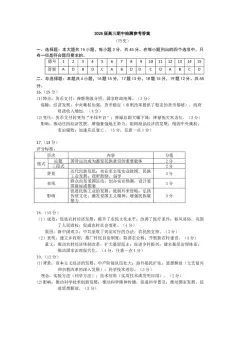
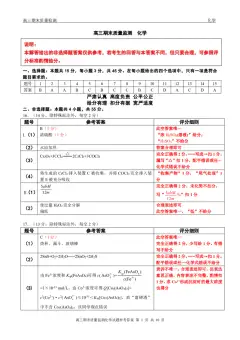
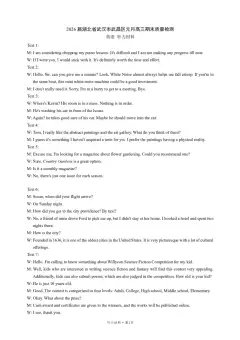
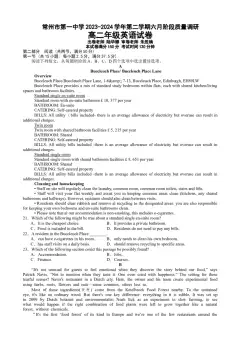
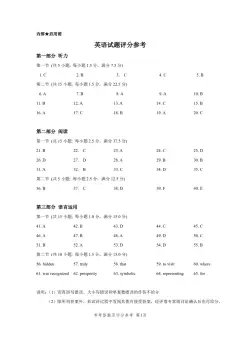
常州市2025-2026学年第一学期高三期末质量调研
英语
第一部分 听力 (共两节,满分 30分)
做题时,先将答案标在试卷上。录音内容结束后,你将有两分钟的时间将试卷上的答
案 转涂到答题卡上。
第一节 (共5小题; 每小题15分,满分75分)
听下面5段录音。每段录音后有一个小题,从题中所给的A、B、C三个选项中选出最佳选
项。听完每段录音后,你都有10秒钟的时间来回答有关小题和阅读下一小题。
1. What does the woman usually do when bored?
A. She runs.
B. She plays basketball.
C. She does the housecleaning.
2. What is the man describing to the woman?
A. A natural process. B. A historic event. C. A personal
experience.
3. What do we know about the piece of clothing?
A. It looks beautiful on the man.
B. There are some mistakes on it.
C. It fits the woman well.
4. What is the woman worried about?
A. She doesn’t have enough school supplies.
B. The exam will be too difficult.
C. She hasn’t studied enough.
5. What has the man probably been trying to do?
A. Watch a new show.
B. Review a new show.
C. Recommend a new show.
听第6段材料,回答第6、7题。
6. What is the main topic of the conversation?
A. The worries about getting old.
B. The concerns about taking a driving test.
C. The age limit for drivers.
7. Why didn’t the woman take her driving test in her 20s?
A. She wasn’t patient. B. She wasn’t confident. C. She wasn’t
interested.
听第7段材料,回答第8至10题。
8. What is the main challenge for the man?
A. Finding bands.
B. Choosing music.
C. Confirming the event location.
9. What will the speakers do next?
A. Talk to the nearby university.
学科网(北京)股份有限公司B. Study at a university.
C. Run in the park.
10. Where are the speakers probably?
A. In the hospital. B. At a restaurant. C. In the stadium.
听第8段材料,回答第11至13题。
11. What is the probable relationship between the speakers?
A. Decorator and house owner. B. Father and daughter. C. Friends.
12. What color does the man suggest?
A. A plain color. B. A light color. C. A dark color.
13. What might the woman do about decorating her new place?
A. Hire a home designer.
B. Change the decoration style.
C. Get inspiration from magazines.
听第9段材料,回答第14至17题。
14. What does the woman want the man to do?
A. Upgrade his package.
B. Cancel his TV subscription.
C. Keep his current package.
15. How much will it cost to get the Premium Package and equipment now?
A. Fifty dollars. B. Sixty dollars. C. Sixty-five dollars.
16. What does the Premium Package offer?
A. Extra movies. B. Extra TV series. C. Replaying
functions.
17. What will the woman do next?
A. Watch a film. B. Send over details. C. Read the
information.
听第10段材料,回答第18至20题。
18. What is the man doing?
A. Guiding a racing experience tour.
B. Broadcasting a racing competition.
C. Teaching people how to do car racing.
19. What will the audience be doing at noon?
A. Checking out the control center.
B. Sitting in the VIP stands.
C. Warming up their cars.
20. How does the speaker feel?
A. Excited. B. Nervous. C. Curious.
第二部分 阅读 (共两节,满分 50 分)
第一节 (共 15 小题;每小题 2.5 分,满分 37.5 分)
阅读下列短文,从每题所给的 A、B、C、D四个选项中选出最佳选项。
A
Definition and Characteristics
Classical music refers to a long-standing tradition of music rooted in the traditions of Europe.
It is characterized by its complexity,formal structure,and the use of notation to guide
学科网(北京)股份有限公司performance. Unlike popular or folk music, classical music often involves compositions that
require a high level of technical skill from performers.
Historical Context
Classical music has its roots in the Middle Ages (approximately 450-1450 AD) and has
evolved through several distinct periods, including the Renaissance, Baroque, Classical,
Romantic, and Modern eras.
Key Periods
● Renaissance Period (1450-1600) is distinguished by polyphonic (复调的) textures and
humanistic musical expressions, with representative composers including Thomas Tallis, Josquin
des Prez and Claudio Monteverdi.
● Baroque Era (1600-1750) is marked by splendid musical forms, with composers like
Johann Sebastian Bach and George Frideric Handel.
● Classical Period (1750-1820) is defined by clarity and balance, with famous figures
such as Joseph Haydn, Wolfgang Amadeus Mozart, and Ludwig van Beethoven, often referred
to as the “Viennese Classical School”.
● Romantic Period (1820-1900) focuses on emotional expression and individualism,
featuring composers like Franz Schubert and Johannes Brahms.
● 20th Century and Beyond saw the emergence of various styles, including Modernism and
Impressionism, with influential composers like Igor Stravinsky and Claude Debussy.
Influence and Legacy
Classical music has significantly influenced many modern music genres and continues to be
a vital part of cultural and intellectual life. Its emphasis on formal composition and
expressive depth has shaped not only the development of music but also broader artistic and
cultural movements throughout history.
In summary, classical music is a rich and diverse tradition that has evolved over centuries,
characterized by its formal structure and expressive depth, making it a cornerstone of Western
musical heritage.
21. What do we know about the Renaissance period?
A. It originates in Europe.
B. It is the shortest period.
C. It crosses over the Middle Ages.
D. It features emotion and individualism.
22. Whose music most probably displays clear and balanced structures?
A. Bach and Handel. B. Haydn and Mozart.
C. Beethoven and Debussy. D. Schubert and Brahms.
23. Which of the following about Classical music is true according to the author?
A. It has lasted over 2000 years.
B. It can be both formal and informal.
C. It is more popular than modern music.
D. It has a long-lasting cultural significance.
B
It all began at an unusual engineering class where non-engineers were challenged to combine
art and science to help the world. Two students — Julia Silverman and Jessica Matthews
学科网(北京)股份有限公司— decided to give it a try. The pair discussed issues faced by many people around the world to
see which they could help solve. Access to cheap electricity was one that came to mind right
away.
That’s when Julia, who used to play lots of sports in high school, had a sudden idea: what
if they were able to capture (捕获) some of the energy that is generated when people play
sports? Maybe they could turn it into electricity. Given its popularity among both young and old
all over the world, soccer seemed to be the natural choice, and the ball the perfect thing to do it
with!
They tried their ideas out first by sticking a shake-to-charge flashlight they had bought inside
a small, hollow ball. Then they kicked it around to see if the flashlight would pick up the charge
(电荷). The version they produced after that was an improved one. A mechanism inside the ball
captured the energy created as the ball moved, which could then be turned into electricity. They
made a number of these balls which were tested by delighted kids at the World Cup Soccer
Championships. Just under 150g heavier than a regulation soccer ball, the Soccket football had
the capacity to store enough energy to power up a small lamp for three hours following just 30
minutes of play.
They then worked on the first Soccket football to be produced in large numbers. The latest
model is said to be six to seven times more energy efficient than the original.
And the Soccket is not their only idea-having succeeded with the Soccket, they have many
similar ideas combining fun and function. Of course, they plan to develop these. As
Silverman says: “Just because we get older doesn’t mean we have to stop playing, and just
because we need important things in life, like electricity, doesn’t mean we can’t have fun
producing them.”
24. The unusual engineering class mentioned in the first paragraph ______.
A. is related to soccer
B. is designed for electrical engineers
C. admits non-engineers so long as they love sports
D. encourages learning to solve real-world problems
25. What is the primary purpose of this article?
A. To explain how to charge soccer balls with electricity.
B. To introduce an amazing invention with soccer balls.
C. To discuss the global shortage of electricity.
D. To show how soccer changes two students’ life.
26. What do we know about the Soccket football?
A. It can flash when kicked around.
B. It is being used in professional soccer matches.
C. It is the combined product of love and imagination.
D. It is created to turn electrical energy into other energy.
27. Why does the author quote Silverman at the end of the passage?
A. To praise Julia and Jessica’s contribution to the world.
B. To explain the function of Julia and Jessica’s product.
C. To highlight Julia and Jessica’s personal character of helpfulness.
D. To demonstrate the philosophy behind Julia and Jessica’s practice.
学科网(北京)股份有限公司C
Until recently, scientists thought animals’ mind was limited to associative memories:
recollections of the relationships between experiences or events, but not the episodic memories
(情景化记忆) of the experience itself.
But in recent years, research conducted by Miklósi and his colleague Claudia Fugazza has shaken
the idea that dogs are restricted to such Pavlovian (巴甫洛夫式的) recall. In 2016 they
confirmed, by way of an experiment in which they asked dogs to imitate actions modeled by a
human minutes earlier, that the dogs did remember specific elements of what they’d
experienced. In follow-up experiments, dogs repeated their own actions long after they first
performed them, a finding that added a self-focused layer to their episodic memories. Their
thoughts didn’t just contain a mess of separate details, but were integrated together by a sense of
self.
As for cats, tests of whether they returned to containers where they were previously fed lend
scientific support to their version of episodic memory. “Cat memory is probably very much like
dog memory,” says Miklósi.
Still, he notes that this kind of reminiscence (回忆) might differ from our own. Humans can
reflect on their memories in natural, self-directed ways:Humans can think about the first concert
they ever attended, without needing to see the ticket to remind them of it. How cats and dogs
guide their own recall — if they need reminders to activate it — is a mystery.
It’s also less clear how our furry companions relive their distant memories. Ours play like a movie
in our mind’s eye, which fits, as contemporary humans are a visually engaged species. But cats
and dogs are far more reliant on other senses, especially smell. Could their recall come
together as smells rather than images? Two studies — of dogs in a dark room finding familiar
objects with their noses, and of kittens recognizing their mothers by smell after years of
separation — suggest as much.
28. What is the main idea of the passage?
A. The differences between human memory and animal memory.
B. New research methods used to test episodic memory in animals.
C. The important role of smell in the memory of furry companions.
D. New research findings about the memory abilities of dogs and cats.
29. What can we know from Miklósi and Fugazza’s 2016 experiment?
A. Dogs can carry out Pavlovian recall effectively.
B. Dogs can remember specific details of past experiences.
C. Dogs need human reminders to recall their own past actions.
D. Dogs’ memories are completely different from human memories.
30. What mystery do scientists still need to solve about animal memory?
A. Whether cats and dogs have associative memories.
B. Whether cats and dogs rely on smell to memorize.
C. How cats and dogs reflect on their memories.
D. How cats and dogs use reminders to relive memories.
31. What does the author mainly want to say in the last paragraph?
A. Dogs have similar episodic memory to cats.
B. Humans tend to relive memories through images.
C. Cats and dogs most probably memorize by smell.
学科网(北京)股份有限公司D. It is unclear how humans memorize better than animals.
D
Cognitive (认知的) offloading, the act of delegating mental work to external tools,
should concern anyone who values their own intelligence. When given the choice between
thinking through a problem or letting technology handle it, will we choose the tool, even
when we’re perfectly capable of succeeding on our own?
Sam Gilbert noticed in his experiments something he calls “reminder bias.” This is the
tendency to use external memory aids even when your own memory would serve you better.
Participants chose to set digital reminders for tasks they could easily remember unaided. Even
when offered money to encourage people to rely on their own memory, they still couldn’t
overcome it.
The root reason seems to be that people underestimate their own cognitive abilities. They
think they’ll forget, so they set a reminder. They think they can’t solve the problem, so they ask
AI. Over time, by consistently choosing the external tool, they never exercise the internal
capability.
If the problem were limited to memory, it might not matter much. After all, what’s the
problem with setting a reminder on your phone? But research suggests the cognitive costs extend
far beyond remembering appointments.
Nathaniel Barr claimed that individuals who score lower on the Cognitive Reflection Test
show greater smartphone dependence when obtaining information. These are people who,
when faced with a problem, instinctively (本能地) reach for the quickest solution.
AI hasn’t created this tendency. Humans have often preferred mental shortcuts. But AI has
removed nearly all difficulties. You don’t have to go to a library or even type a search question.
You just ask, and the answer appears, exactly as you need it.
My concern is that people may begin using AI in ways that prevent the development of
analytical skills. For a college student who consistently uses AI to work through problems, I
question whether they’re building the neural infrastructure (神经基础结构) to handle similar
problems independently later in life.
32. What does the underlined word “delegating” most probably mean?
A. Assigning. B. Comparing. C. Applying. D. Linking.
33. Why did participants in Gilbert’s experiment set unnecessary digital reminders?
A. They lacked confidence in their own memory.
B. They were not offered enough money.
C. They were poor in cognitive abilities.
D. They never exercised their internal capability.
34. The author mentions the Cognitive Reflection Test to show ______.
A. people rely too much on smartphones
B. AI works better than human memory
C. reminder bias causes harm to more than just memory
D. smartphones are the quickest solution to many problems
35. What is the best title of the article?
A. Cognitive Offloading: The Cause of AI Reliance
B. How External Aids Like AI Enhance Reminder Bias
学科网(北京)股份有限公司C. External Tools or Internal Tool,Which Causes More Harm
D. Over-reliance on External AI Tools May Weaken Cognitive Abilities
第二节(共5小题;每小题2.5分,满分125,分)
阅读下面短文,从短文后的选项中选出可以填入空白处的最佳选项。选项中有两项为
多余选项。
A lot of parents think kids want to spend all their time on social media, and that’s why it’s so
hard to take away.
But here’s the truth: __36__ The reason they can’t decide not to use these apps for
themselves is because they’re afraid of missing out on social opportunities, since so many young
people maintain their friendships on these platforms. If parents all made the same decision
not to let our kids use social media, we’d solve the problem for them. Even if only some parents
restrict their kids’ use, it will be enough to force teens to find other ways of communicating.
When I talk to parents and teachers about this, I like to start by telling them about a 2023
study in which college students were asked how much money researchers would have to pay them
not to use social media accounts for a month. __37__
Actually, the average amount they wanted was $50, and the median (中位数), $30, was
even lower. Then the researchers asked the students how much they’d have to pay them to
deactivate their accounts if their friends did the same thing. The answer is: __38__ No
audience member of mine has ever correctly guessed the result.
In situations like this, our job as parents is to step in and help our kids. If parents all told
our kids they’re not allowed to use social media until they’re 16 years old, none of them would
face the dilemma (窘境) of losing social opportunities in the first place. Even if only a few of
their friends don’t have social media, they won’t be pariahs (被遗弃的人). __39__
Instead of seeing pictures of the parties to which they weren’t invited on social apps, they
could text with their friends on flip (老式翻盖) phones to make plans — or call and chat.
__40__ Instead of following the polished versions of one another’s lives, they could get together
in person and talk about how they’re really doing.
A. Kids will probably worry about it.
B. Our responsibility here is no different.
C. Many teenagers recognize that social media is unhealthy.
D. The students were willing to pay the researchers to make this happen.
E. So talk to the parents of your kids’ friends and get them to do the same thing.
F. My audience typically guesses that the students demanded tens of thousands of dollars.
G. Chat groups with people kids know are a good alternative to conversations on social apps.
第三部分 语言运用(共两节,满分30分)
第一节(共15小题;每小题1分,满分15分)
阅读下面短文,从每题所给的A、B、C、D四个选项中选出可以填入空白处的最佳选
项。
Eight years ago, then in my mid-40s, I overheard an older man ask a young girl: “What do
you want to be when you grow up?”
She cheerfully listed a(n) __41__ range of dreams: vet, painter, computer coder. I
listened with __42__, but soon it changed into unease. She still had time to become any of those
things. Yet at my age, no one was asking me that question anymore. More importantly, I had
__43__ asking myself that question.
学科网(北京)股份有限公司That conversation stayed in my mind, and I woke up the next morning still feeling
__44__. There are many reasons midlife often gets __45__ as a period of “crisis,” sitting at the
bottom of a U-shaped curve (曲线) of life happiness, but “as you begin to stop making
decisions, it won’t be long before you have __46__ actually making decisions,” one researcher
said. I decided to __47__. A(n) __48__ Google search of “What are the hardest things you
can do” led me to obstacle course racing (OCR, 障碍赛).
Growing up as a skinny kid, I had always wanted to be __49__. In reality, though, I was
mostly picked last for teams and __50__ the bench. OCR became my answer to the older man’s
question. For the last six years, I’ve __51__ almost every day to become something I always
wanted to be as a little girl but never thought __52__. As a competitive athlete, I’ve raced more
than 50 times and __53__ often in my age group.
Nothing in my younger years __54__ I could develop such abilities. However, by
drawing on the perspective (思维方式), experience and wisdom I now possess as an adult, I
made it happen. Your __55__ may differ from mine, but you, too, can bring it to life.
41. A. familiar B. creative C. annoying D.
impressive
42. A. admiration B. relief C. regret D. pride
43. A. delayed B. stopped C. risked D. finished
44. A. unsettled B. wronged C. committed D. inspired
45. A. mistaken B. labeled C. confirmed D. selected
46. A. advantage B. opportunity C. difficulty D. danger
47. A. quit B. seek C. act D. learn
48. A. routine B. frightening C. unexpected D. random
49. A. energetic B. athletic C. realistic D. romantic
50. A. warmed B. repaired C. cheered D. watched
51. A. operated B. trained C. competed D. worked
52. A. simple B. reliable C. possible D. sustainable
53. A. medaled B. struggled C. coached D. exercised
54. A. opposed B. insisted C. denied D. suggested
55. A. age B. problem C. ambition D. condition
第二节(共10小题;每小题1.5分,满分15 分)
阅读下面短文,在空白处填入1个适当的单词或括号内单词的正确形式。
Lithium-ion (锂离子) batteries are found in everything from smartphones to cars. While
they are generally very safe if stored and charged correctly, there are thousands of documented
cases of them 56.__________ (catch) fire-sometimes with deadly consequences.
Researchers all over the world 57.__________ (work) to solve the problem by developing
safer batteries, for example by replacing the liquid electrolyt (电解质) with a more fire-
resistant solid or gel. However, such solutions require significant changes to current production
lines, a barrier 58.__________ widespread adoption.
Now, a team of researchers from The Chinese University of Hong Kong has proposed a
change in lithium-ion battery design 59.__________ could rapidly integrate into current
manufacturing methods, because it 60.__________ (simple) involves swapping chemicals in
the existing electrolyte solution.
The method 61.__________ (detail) earlier this year in a study led by Yue Sun, now
学科网(北京)股份有限公司a postdoctoral fellow at Virginia Tech: “I think the most difficult thing for people to realize
about batteries is that 62.__________ you try to maximize performance, sometimes you
reduce safety, “she said, explaining that increasing performance 63.__________ (require) a
focus on chemical reactions that happen at room temperature, while increasing safety
focuses on reactions that happen at high temperatures.
“So we came up with an idea 64.__________ (break) this trade-off by designing a
temperature-sensitive material, which can provide a good performance at room temperature,
but can also offer good 65.__________ (stable) at high temperatures.”
第四部分写作(共两节,满分40分)
第一节(满分15分)
假定你是李华,你校英语报最近开设了“A Letter to the Principal(校长)”栏目,助
力缓解高中学生心理压力。请你向该栏目投稿,内容包括:
1. 心理压力形成的原因;
2. 学校可采取的措施。
注意:
1. 词数80左右;
2. 请在答题卡的相应位置作答。
Dear Principal,
Yours sincerely,
Li Hua
第二节(满分25 分)
阅读下面材料,根据其内容和所给段落开头语续写两段,使之构成一篇完整的短文。
I still remember the Provincial Handicraft (手工艺) Works Competition like it was
yesterday. That day, I woke up with my heart pounding,holding my backpack tightly to
my back as I rode to the venue. Inside were the materials for a homemade hand-woven bamboo
birdcage with a separable feeding wooden dish. I had practised for months:splitting bamboo
strips (竹条) to uniform thickness, weaving (编织) them into delicate patterns, and
polishing every surface to a smooth finish. I only needed to repeat the process in the competition.
It was my only shot at proving myself — until my bike tripped over a stone halfway there.
The case fell to the road,unfortunately run over by a passing car. When I opened it, my
stomach dropped: bamboo strips broken, the rattan cord (藤条) in a mess, the carved
wooden feeding disk split into two pieces. I sank onto the sidewalk, hot tears burning my eyes.
All the hope was gone in an instant. By the time I dragged myself into the competition hall, I
was a mess, seating myself in a corner, feeling helpless and frustrated.
That’s when Liam found me. I’d always known him as the quiet guy in the back of the
handicraft class, the one who never missed a deadline and excelled every woodcarving
and weaving project. His family’s situation wasn’t a secret — his dad’s leg injury, his
mom working two jobs — and I knew how badly he needed the scholarship from this
competition. So when he knelt down beside me, his voice soft, I thought he was just here
to offer a few comforting words.
I was wrong. He pulled out from his case some bamboo strips, some rattan cord, and
学科网(北京)股份有限公司a small block of polished wood. “When Professor Hayes helped me out of trouble during the
preparation a few days ago, he told me to pay kindness forward.” he said.
注意:
1. 续写词数应为150个左右;
2. 请在答题卡的相应位置作答。
Paragraph 1: I stared at him, disbelief washing over me.
Paragraph 2: Thankful and also curious, I went to see Liam the second day.
学科网(北京)股份有限公司