Section A
News Report One
• 听力原文 •
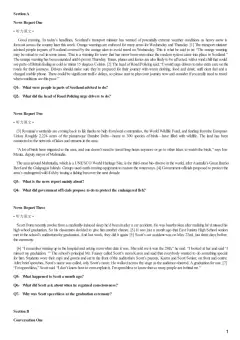
A NASA satellite orbiting over Portugal took photographs that reveal the effects of pollution from ships. One of the photos shows a thin film of
clouds above the brilliant blue of the North Atlantic, cut by white lines of thicker clouds that looked like scars.
[1] NASA officials explained those thicker clouds are signs of ship traffic below. When ships power their way through the ocean, they pump
exhaust into the atmosphere just as cars do. And those massive amounts of particles can cause clouds to form. Get enough of those particles in one
place, as from the exhaust of a ship, and they can lead to the creation of new clouds, easily visible from space. These clouds can be huge. Some of
them stretch hundreds of kilometers from end to end, NASA offi cials said. [2] It’s likely that these sorts of clouds are having some effect on the
global climate, according to NASA officials. But scientists aren’t yet sure what effect it has.
Q1::What has caused the thick clouds in the photos taken by a NASA satellite?
Q2::What do NASA officials think about the thick clouds?
News Report Two
• 听力原文 •
Staff at a suburban supermarket in Melbourne say they feel unsafe at work after security guards were removed. This came after a series of
physical attacks and verbal abuse by customers. [3] More than 50 workers at the store have signed a letter calling for a permanent security guard
following a series of incidents, including a customer threatening to attack a supervisor with a knife.
“A security worker had guarded the store each night from 7 p.m. until 12 a.m., but that had stopped suddenly on Monday,” employees said.
One worker said an angry customer had thrown a chicken at his head after complaining about how long she had waited to be served. Another
worker said the lack of protection at the store made her feel uncomfortable at work.
[4] However, the spokesman of the supermarket said the store had taken strong action in response to incidents. “We have found very few
instances of bad customer behavior at our store in the past year. In the rare cases we have seen bad behavior, we have taken strong action in
response, including banning a customer from the store.”
Q3::For what purpose did the staff at a supermarket in Melbourne sign a letter?
Q4::What did the spokesman of the supermarket say regarding the employees’ demand?
News Report Three
• 听听力力原原文文 •
[5] Drivers on their way to the Polish capital of Warsaw on Wednesday morning found the road blocked by an unusual obstacle—tons of liquid
chocolate that spilled onto the motorway. [6] A truck carrying the sweet load hit a road barrier and overturned, blocking two lanes. The cracked
tank spilled a pool of rapidly-hardening chocolate, which quickly covered the width of the road. While the driver was taken to hospital with a
broken arm, fi refi ghters struggled to remove a reported 12 tons of solid chocolate from the road.
[7] A representative for the firefi ghters told the local TV that removing the chocolate was worse than dealing with snow. After contacting the
chocolate manufacturer, the fi refi ghters resorted to spraying hot, pressurized water to get rid of the sticky substance.
[7] The local TV also noted that the cleanup spanned more than a mile, because drivers simply drove through the chocolate after the crash,
leaving a long chocolate trail. But despite the sticky situation, fi refighters and police attending to the cleanup were reportedly cheerful about the
long task ahead. After all, who could be mad about 12 tons of chocolate?
Q5::What did drivers on the motorway to Warsaw find?
Q6::What does the report say about the accident?
Q7::What did the firefighters’ representative tell the local TV?
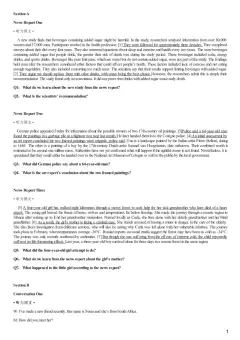
Section B
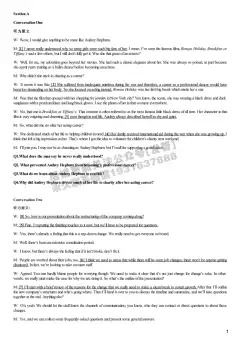
Conversation One
1• 听力原文 •
M: Lisa, why did you pay for your meal with cash instead of the payment apps on your phone?
W: Well, I’ve gone back to cash. I’m only using payment apps if that’s the only option. [8] I’m trying to save money for a new phone. And I fi nd
that using cash rather than payment apps helps me to save.
M: But how? Money is money, isn’t it? I don’t think it matters whether you take it out of the bank and put it in your wallet or simply transfer from
your bank account to the seller’s bank account using an app.
W: No, I believe it does matter. It’s a psychological phenomenon. [9] I believe we have less connection with the value of our money when we just
have the “approve” buttons on our phones.
M: You might have a point. Since I stopped carrying cash around and started using my phone apps to pay, [10] I may have developed a tendency
to buy more small or non-essential items.
W: That’s highly possible. Think about the amount of time we spend with our phones in our hands and all the things we do with our phones. It
sometimes seems that our phone is buying the product for us, not ourselves.
M: [11] So cashless payment aff ects our ability to budget?
W: I believe so. If we spend a hundred yuan in cash, we realize that we don’t have that hundred yuan to spend on something else. But if we’re
spending electronically, we are less likely to make that mental calculation.
M: [11] I stopped using my credit card because I found I was spending excessively. Perhaps I should take the same approach of paying using my
phone.
W: It’s worth considering.
Q8::Why did the woman decide to go back to cash for payment?
Q9::What happens when people use apps for payment according to the woman?
Q10::What might the man tend to buy with payment apps?
Q11::What does the man think of electronic payment?
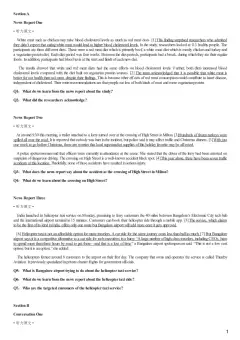
Conversation Two
• 听听力力原原文文 •
W: Hello, Mr. Brown. I was expecting your call. [12] My secretary told me you were having some problems with the wooden table. Is that right?
M: No, no, the table is fi ne. [12] The problem is the chairs.
W: Oh, the chairs. So what exactly is the issue?
M: Well, put simply, these are not the chairs my wife and I selected in your store last week. There must have been some confusion with our order.
W: Oh, I see. I’m looking through my fi les now, and I see that the delivery was this morning. Is that correct?
M: Yes.
W: [13] Do you mind describing the chairs that were delivered to your apartment, Mr. Brown?
M: Sure. These have a fl at back with a round top, and are very heavy—they’re light brown and look kind of cheap. The ones we ordered were
dark brown to match the table.
W: Right, of course. It says here you purchased the Arlington table and four Milano chairs. As you said, there must have been some confusion with
the order. I’m terribly sorry. [14] We will send a van to collect those four and replace them with the Milano you purchased. Will tomorrow 9 a.m.
be okay, Mr. Brown?
M: Yes, that would be great. Thank you.
W: Good. Did everything else you ordered from us arrive okay?
M: Yes, I think so. Let me check. The mirror and two paintings are here. The two coff ee tables are also here, and the sofa. Yes, we haven’t
noticed anything else wrong or missing. But if we do, we will certainly let you know.
2W: Okay, great. [15] Once again, I’m sorry for the confusion and trouble caused.
Q12::Why did the man call the woman?
Q13::What did the woman ask the man to do?
Q14::What did the woman promise to do for the man?
Q15::What did the woman do at the end of the conversation?
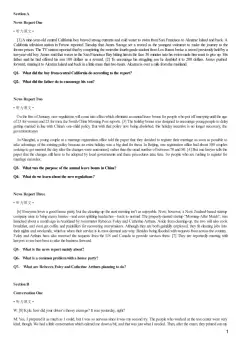
Section C
Passage One
• 听听力力原原文文 •
Do you have too much stuff ? Are you, dare we say it, untidy? [16] Say hello to a TV show called Tidying Up with Marie Kondo, a home
improvement show based on her widely popular book, The LifeChanging Magic of Tidying Up. In the show, Marie Kondo acts as a tiny
garbage fairy for messy people, visiting their houses to share the wisdom of the “KonMarie” method. This method is simple in theory, but can be
endlessly complex in practice.
[17] You divide all the stuff in your house—all of it—into several categories, and then examine each item—all of them—to see if it sparks joy. If
it does, you keep it. If it doesn’t, you thank it, and neatly discard it. So is the TV show inspiring people to tidy up? First-hand accounts seem to
indicate a small wave of people bringing piles of donation bags to used goods stores.
One store received thousands of bags of used possessions in one day. January is usually the stores slow season for donations, because it’s cold
and people don’t want to bother. But not this January. People seem determined to clean up their homes. [18] One used book store received a
month’s worth of books in donations in a week when a man gave over 50 boxes of books from his home. It seems Marie’s TV show is having a
big impact, after all.
Q16::What is Marie Kondo’s TV show about?
Q17::What things can be kept in one’s home according to Marie Kondo?
Q18::What do we learn about one used book store this January?
Passage Two
• 听听力力原原文文 •
At just twelve years old, Mike Hannon is making a diff erence in his community—one lunch at a time. Mike’s “Lunches of Love” has fed more
than 2,000 of the town’s most vulnerable residents. [19] Mike delivers meals to the homeless. “It’s like a way to give people joy, maybe spark
something in them that can change them.” Mike told WBZ-TV.
The mayor of Mike’s town feels that Mike is a great community leader, especially in such times of so much negative news. While his father
commented on how proud he was of his son. [20] Yet, Mike isn’t looking for praise but kindness in return. He hopes his acts of charity will
influence others to spread positive actions in their own towns.
Mike includes a handwritten message of joy on each bag. His message and star power has spread all over the country. To date, his online page
to raise funds has brought in more than $44,000 and counting—raising more than $17,000 in just one day, with the help of many famous actors
and others. [21] People from all over the country are sending special handcrafted bags to help the young man with his mission to help those in
need. Many are hoping the simple act of kindness spreads. Mike is seen as hope for the future of the town, the country, and the world.
Q19::What does Mike Hannon do to help people in his town?
Q20::What does Mike hope others will do?
Q21::How are people all over the country responding to what Mike is doing?
Passage Three
• 听听力力原原文文 •
In a recent study carried out by psychologists on the disruptive effect of small things, [22] two groups of college students were given word
3search puzzles. The first group was told to complete the puzzles with its participants’ smart things in their line of sight. The second group, however,
was told that the phones would interfere with the equipment in the experiment, and would need to be moved away from the testing area. Midway
through the second group’s solving of the puzzles, the experimenter called one of the phones, let it ring for a while before hanging up. [23] Many of
the students in that group were unable to focus from then on, becoming anxious and performing more poorly than the first group.
Use of electronics has also been known to lead to a decline in human interactions. Rather than having real-life conversations, many express
emotions and engage in deep conversations through social media sites. Many students use their phones and computers during class for non-
academic activities, which leads to poor grades.
[24] Perhaps the most dramatic impact is the reduction in the amount of sleep, which leads to poor health and weight gain. Technology is a great
tool, however, it’s important to recognize its downsides. Lack of sleep, reduction of productivity and weight gain are only a few. [25] If we’re not
careful about all these minor problems right now, the effect on the future generation is going to be much bigger.
Q22::What were the college students in both groups required to do in the study?
Q23::What do we learn about many of the students in the second test group after the phone ring?
Q24::According to the passage, what is the most dramatic impact of smartphone use?
Q25::What does the speaker suggest people do?
4
![《[1.1.9.18]--20年9月四级听力音频(仅一套)_文本_最新更新,视频都在这_2026、6月四级速转存易和谐_1、2025年6月四级_04.2026四级英语新东方_{9}--近五年听力音频+原文》第1页预览](https://static.diaifu.net/ssd/ssd5/wenku/2026-04-20/d609b44bf202d8946af1ff43c1d97042/d609b44bf202d8946af1ff43c1d97042_1.webp)
![《[1.1.9.18]--20年9月四级听力音频(仅一套)_文本_最新更新,视频都在这_2026、6月四级速转存易和谐_1、2025年6月四级_04.2026四级英语新东方_{9}--近五年听力音频+原文》第2页预览](https://static.diaifu.net/ssd/ssd5/wenku/2026-04-20/d609b44bf202d8946af1ff43c1d97042/d609b44bf202d8946af1ff43c1d97042_2.webp)
![《[1.1.9.18]--20年9月四级听力音频(仅一套)_文本_最新更新,视频都在这_2026、6月四级速转存易和谐_1、2025年6月四级_04.2026四级英语新东方_{9}--近五年听力音频+原文》第3页预览](https://static.diaifu.net/ssd/ssd5/wenku/2026-04-20/d609b44bf202d8946af1ff43c1d97042/d609b44bf202d8946af1ff43c1d97042_3.webp)
![《[1.1.9.18]--20年9月四级听力音频(仅一套)_文本_最新更新,视频都在这_2026、6月四级速转存易和谐_1、2025年6月四级_04.2026四级英语新东方_{9}--近五年听力音频+原文》第4页预览](https://static.diaifu.net/ssd/ssd5/wenku/2026-04-20/d609b44bf202d8946af1ff43c1d97042/d609b44bf202d8946af1ff43c1d97042_4.webp)
![《[1.1.9.18]--20年9月四级听力音频(仅一套)_文本_最新更新,视频都在这_2026、6月四级速转存易和谐_1、2025年6月四级_04.2026四级英语新东方_{9}--近五年听力音频+原文》第5页预览](https://static.diaifu.net/ssd/ssd5/wenku/2026-04-20/d609b44bf202d8946af1ff43c1d97042/d609b44bf202d8946af1ff43c1d97042_5.webp)
![《[1.1.9.18]--20年9月四级听力音频(仅一套)_文本_最新更新,视频都在这_2026、6月四级速转存易和谐_1、2025年6月四级_04.2026四级英语新东方_{9}--近五年听力音频+原文》第6页预览](https://static.diaifu.net/ssd/ssd5/wenku/2026-04-20/d609b44bf202d8946af1ff43c1d97042/d609b44bf202d8946af1ff43c1d97042_6.webp)
![《[1.1.9.18]--20年9月四级听力音频(仅一套)_文本_最新更新,视频都在这_2026、6月四级速转存易和谐_1、2025年6月四级_04.2026四级英语新东方_{9}--近五年听力音频+原文》第7页预览](https://static.diaifu.net/ssd/ssd5/wenku/2026-04-20/d609b44bf202d8946af1ff43c1d97042/d609b44bf202d8946af1ff43c1d97042_7.webp)
![《[1.1.9.18]--20年9月四级听力音频(仅一套)_文本_最新更新,视频都在这_2026、6月四级速转存易和谐_1、2025年6月四级_04.2026四级英语新东方_{9}--近五年听力音频+原文》第8页预览](https://static.diaifu.net/ssd/ssd5/wenku/2026-04-20/d609b44bf202d8946af1ff43c1d97042/d609b44bf202d8946af1ff43c1d97042_8.webp)
![《[1.1.9.18]--20年9月四级听力音频(仅一套)_文本_最新更新,视频都在这_2026、6月四级速转存易和谐_1、2025年6月四级_04.2026四级英语新东方_{9}--近五年听力音频+原文》第9页预览](https://static.diaifu.net/ssd/ssd5/wenku/2026-04-20/d609b44bf202d8946af1ff43c1d97042/d609b44bf202d8946af1ff43c1d97042_9.webp)
![《[1.1.9.18]--20年9月四级听力音频(仅一套)_文本_最新更新,视频都在这_2026、6月四级速转存易和谐_1、2025年6月四级_04.2026四级英语新东方_{9}--近五年听力音频+原文》第10页预览](https://static.diaifu.net/ssd/ssd5/wenku/2026-04-20/d609b44bf202d8946af1ff43c1d97042/d609b44bf202d8946af1ff43c1d97042_10.webp)