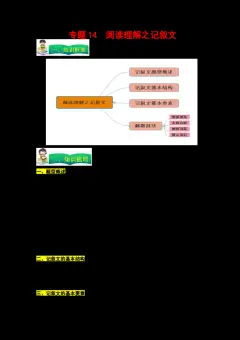
考点巩固卷 13 阅读理解之记叙文
2023 年高考真题
【2023 ▪新高考I卷】
When John Todd was a child, he loved to explore the woods around his house, observing how nature solved
problems. A dirty stream, for example, often became clear after flowing through plants and along rocks where tiny
creatures lived. When he got older, John started to wonder if this process could be used to clean up the messes
people were making.
After studying agriculture, medicine, and fisheries in college, John went back to observing nature and asking
questions. Why can certain plants trap harmful bacteria (细菌)? Which kinds of fish can eat cancer-causing
chemicals? With the right combination of animals and plants, he figured, maybe he could clean up waste the way
nature did. He decided to build what he would later call an eco-machine.
The task John set for himself was to remove harmful substances from some sludge (污泥). First, he
constructed a series of clear fiberglass tanks connected to each other. Then he went around to local ponds and
streams and brought back some plants and animals. He placed them in the tanks and waited. Little by little, these
different kinds of life got used to one another and formed their own ecosystem. After a few weeks, John added the
sludge.
He was amazed at the results. The plants and animals in the eco-machine took the sludge as food and began
to eat it! Within weeks, it had all been digested, and all that was left was pure water.
Over the years, John has taken on many big jobs. He developed a greenhouse — like facility that treated
sewage (污水) from 1,600 homes in South Burlington. He also designed an eco-machine to clean canal water in
Fuzhou, a city in southeast China.
“Ecological design” is the name John gives to what he does. “Life on Earth is kind of a box of spare parts for
the inventor,” he says. “You put organisms in new relationships and observe what’s happening. Then you let these
new systems develop their own ways to self-repair.”
4. What can we learn about John from the first two paragraphs?
A. He was fond of traveling. B. He enjoyed being alone.
C. He had an inquiring mind. D. He longed to be a doctor.
5. Why did John put the sludge into the tanks?
A. To feed the animals. B. To build an ecosystem.
C. To protect the plants. D. To test the eco-machine.
6. What is the author’s purpose in mentioning Fuzhou?A. To review John’s research plans. B. To show an application of John’s idea.
C. To compare John’s different jobs. D. To erase doubts about John’s invention.
7. What is the basis for John’s work?
A. Nature can repair itself. B. Organisms need water to survive.
C. Life on Earth is diverse. D. Most tiny creatures live in groups.
【2023 ▪新高考II卷】
Turning soil, pulling weeds, and harvesting cabbage sound like tough work for middle and high school kids.
And at first it is, says Abby Jaramillo, who with another teacher started Urban Sprouts, a school garden program at
four low-income schools. The program aims to help students develop science skills, environmental awareness, and
healthy lifestyles.
Jaramillo’s students live in neighborhoods where fresh food and green space are not easy to find and fast
food restaurants outnumber grocery stores. “The kids literally come to school with bags of snacks and large
bottles of soft drinks,” she says. “They come to us thinking vegetables are awful, dirt is awful, insects are awful.”
Though some are initially scared of the insects and turned off by the dirt, most are eager to try something new.
Urban Sprouts’ classes, at two middle schools and two high schools, include hands-on experiments such as
soil testing, flower-and-seed dissection, tastings of fresh or dried produce, and work in the garden. Several times a
year, students cook the vegetables they grow, and they occasionally make salads for their entire schools.
Program evaluations show that kids eat more vegetables as a result of the classes. “We have students who say
they went home and talked to their parents and now they’re eating differently,” Jaramillo says.
She adds that the program’s benefits go beyond nutrition. Some students get so interested in gardening that
they bring home seeds to start their own vegetable gardens. Besides, working in the garden seems to have a
calming effect on Jaramillo’s special education students, many of whom have emotional control issues. “They get
outside,” she says, “and they feel successful.”
4. What do we know about Abby Jaramillo?
A. She used to be a health worker. B. She grew up in a low-income family.
C. She owns a fast food restaurant. D. She is an initiator of Urban Sprouts.
5. What was a problem facing Jaramillo at the start of the program?
A. The kids’ parents distrusted her. B. Students had little time for her classes.
C. Some kids disliked garden work. D. There was no space for school gardens.
6. Which of the following best describes the impact of the program?
A. Far-reaching. B. Predictable.
C. Short-lived. D. Unidentifiable.
第2页,共17页7. What can be a suitable title for the text?
A. Rescuing School Gardens B. Experiencing Country Life
C. Growing Vegetable Lovers D. Changing Local Landscape
2021-2022 年高考真题
【2022▪新高考II卷】
We journalists live in a new age of storytelling, with many new multimedia tools. Many young people don’t
even realize it’s new. For them, it’s just normal.
This hit home for me as I was sitting with my 2-year-old grandson on a sofa over the Spring Festival
holiday. I had brought a children’s book to read. It had simple words and colorful pictures — a perfect match for
his age.
Picture this: my grandson sitting on my lap as I hold the book in front so he can see the pictures. As I read, he
reaches out and pokes (戳) the page with his finger.
What’s up with that? He just likes the pictures, I thought. Then I turned the page and continued. He poked the
page even harder. I nearly dropped the book. I was confused: Is there something wrong with this kid?
Then I realized what was happening. He was actually a stranger to books. His father frequently amused the
boy with a tablet computer which was loaded with colorful pictures that come alive when you poke them. He
thought my storybook was like that.
Sorry, kid. This book is not part of your high-tech world. It’s an outdated, lifeless thing. An antique, like your
grandfather. Well, I may be old, but I’m not hopelessly challenged, digitally speaking. I edit video and produce
audio. I use mobile payment. I’ve even built websites.
There’s one notable gap in my new-media experience, however: I’ve spent little time in front of a camera,
since I have a face made for radio. But that didn’t stop China Daily from asking me last week to share a personal
story for a video project about the integration of Beijing, Tianjin and Hebei province.
Anyway, grandpa is now an internet star — two minutes of fame! I promise not to let it go to my head. But I
will make sure my 2-year-old grandson sees it on his tablet.
24. What do the underlined words “hit home for me” mean in paragraph 2?
A. Provided shelter for me. B. Became very clear to me.
C. Took the pressure off me. D. Worked quite well on me.
25. Why did the kid poke the storybook?
A. He took it for a tablet computer. B. He disliked the colorful pictures.
C. He was angry with his grandpa. D. He wanted to read it by himself.
26. What does the author think of himself?A. Socially ambitious. B. Physically attractive.
C. Financially independent. D. Digitally competent.
27. What can we learn about the author as a journalist?
A. He lacks experience in his job. B. He seldom appears on television.
C. He manages a video department. D. He often interviews internet stars.
【2021▪新高考I卷】
By day, Robert Titterton is a lawyer. In his spare time though he goes on stage beside pianist
Maria Raspopova — not as a musician but as her page turner. “I’m not a trained musician, but I’ve
learnt to read music so I can help Maria in her performance.”
Mr Titterton is chairman of the Omega Ensemble but has been the group’s official page turner for
the past four years. His job is to sit beside the pianist and turn the pages of the score so the musician
doesn’t have to break the flow of sound by doing it themselves. He said he became just as nervous as
those playing instruments on stage.
“A lot of skills are needed for the job. You have to make sure you don’t turn two pages at once
and make sure you find the repeats in the music when you have to go back to the right spot.” Mr
Titterton explained.
Being a page turner requires plenty of practice. Some pieces of music can go for 40 minutes and
require up to 50 page turns, including back turns for repeat passages. Silent onstage communication is
key, and each pianist has their own style of “nodding” to indicate a page turn which they need to
practise with their page turner.
But like all performances, there are moments when things go wrong. “I was turning the page to
get ready for the next page, but the draft wind from the turn caused the spare pages to fall off the
stand,” Mr Titterton said, “Luckily I was able to catch them and put them back.”
Most page turners are piano students or up-and-coming concert pianists, although Ms Raspopova has
once asked her husband to help her out on stage.
“My husband is the worst page turner,” she laughed. “He’s interested in the music, feeling every
note, and I have to say: ‘Turn,turn!’ Robert is the best page turner I’ve had in my entire life.”
24. What should Titterton be able to do to be a page turner?
A. Read music. B. Play the piano. C. Sing songs. D. Fix the instruments.
25. Which of the following best describes Titterton’s job on stage?
A. Boring. B. Well-paid. C. Demanding. D. Dangerous.
26. What does Titterton need to practise?
第4页,共17页A. Counting the pages.
B. Recognizing the “nodding”.
C. Catching falling objects.
D. Performing in his own style.
27. Why is Ms Raspopova’s husband “the worse page turner”?
A. He has very poor eyesight.
B. He ignores the audience.
C. He has no interest in music.
D. He forgets to do his job
【2021▪新高考II卷】
I have worked as a keeper at the National Zoo, Paris for 11 years. Spot and Stripe are the first tiger cubs that
have ever been born here. Globally, a third of Sumatran cubs in zoos don't make it to adulthood, so I decided to
give them round-the-clock care at home.
I've got two children—the younger one, Kynan, was extremely happy about the tigers arriving - but all of us
really looked forward to being part of their lives and watching them grow. I wasn't worried about bringing them
into my home with my wife and kids. These were cubs. They weighed about 2.5 kg and were so small that there
was absolutely no risk.
As they grew more mobile, we let them move freely around the house during the day, but when we were
asleep we had to contain them in a large room, otherwise they'd get up to mischief. We'd come down in the
morning to find they'd turned the room upside down, and left it looking like a zoo.
Things quickly got very intense due to the huge amount of energy required to look after them. There were
some tough times and I just felt extremely tired. I was grateful that my family was there to help. We had to have a
bit of a production line going, making up “tiger milk”, washing baby bottles, and cleaning the floors.
When Spot and Stripe were four months old, they were learning how to open doors and jump fences, and we
knew it really was time for them to go. It was hard for us to finally part with them. For the first few days, Kynan
was always a bit disappointed that the cubs weren't there.
I'm not sad about it. I'm hands-on with them every day at the zoo, and I do look back very fondly on the time
that we had them.
24. Why did the author bring the tiger cubs home?
A. To ensure their survival. B. To observe their differences.
C. To teach them life skills. D. To let them play with his kids.
25. What do the underlined words “get up to mischief” mean in paragraph 3?A. Behave badly. B. Lose their way. C. Sleep soundly. D. Miss their mom.
26. What did the author think of raising the tiger cubs at home?
A. Boring. B. Tiring. C. Costly. D. Risky.
27. Why did the author decide to send Spot and Stripe back to the zoo?
A. They frightened the children. B. They became difficult to contain.
C. They annoyed the neighbours. D. They started fighting each other.
2023 年名校模拟题
【2023届山东省威海市高三5月高考模拟】
B
Massimo Bottura, a three-Michelin-Starred chef, has extended his culinary( 烹饪的) empire globally.
However, he says that the peak of all of his achievements is Milan’s Refettorio Ambrosiano and the following 12
global branches.
At Refettorio Ambrosiano, dinner guests are greeted by name. They dine on fine china at tables created by
the country’s most sought-after furniture designers. The waiters are polite, and the chefs have been trained under
the finest restaurateurs in the world. The set menu changes every day, depending on what comes in with the
morning’s delivery.
This morning’s delivery contains dry arugula(芝麻菜), chicken close to its sell-by date and too-ugly-to-be-
sold oranges. By dinner, however, the supermarket castoffs have been transformed into a three-course meal. The
100 or so diners — refugees, the homeless, and the unemployed — enjoy the meal with obvious pleasure,
laughing with the volunteer waiters, praising the volunteer chefs, and forgetting, at least for an hour, the
challenges of a life lived on the streets.
The brightest gems in Bottura’s culinary empire are not restaurants at all. He thinks of them as spaces that
shine a light on the dignity of their guests while focusing attention on the food-waste problem by turning foods
that were otherwise going to be headed toward rubbish bins into Michelin Guide-worthy meals.
Botura first thought of Refettorio Ambrosiano as a pop-up concept for the 2015 World Expo in Milan. The
organizers had invited him to cook for the grand opening. Bottura proposed something different. He wanted to
invite the world’s best chefs to cook with him for the city’s homeless,using leftovers. That idea soon got supported
and turned into something more permanent.
,
Today the Refettorio is “a movement,” Bottura says. “It is a model for fighting food waste and isolation on
the front lines. And it starts by looking at an old carrot or a piece of hard bread and catching sight of gold.”
4. How do the Refettorio Ambrosianos differ from Bottura’s other restaurants?
第6页,共17页A. The waiters are well-trained.
B. The tables are custom-made.
C. They are three-Michelin-starred.
D. Daily delivery decides the set menu.
5. Which of the following best describes the event at Refettorio Ambrosiano?
A. An evening gathering for local chefs. B. A charity sale of supermarket castoffs
C. A wealthy meal for the less-fortunate. D. A volunteer training for the homeless
6. What does Bottura think of the Refettorio?
A. It’s his best profitable restaurant.
B. It’s a good project for food safety.
C. It’s a pop-up concept to extend his business.
D. It’s win-win for the environment and society.
7. Which can be a suitable title for the text?
A. Less Waste, More Taste. B. A Dinner of Dignity
C. Best Restaurant, Best Service. D. The Power of Food
【2023届安徽省皖豫名校联盟高三第三次联考试题】
B
There’s another universe not far from land. It lacks buildings, trees, cars, cellphones and the Internet.
Seemingly limitless water extends uninterruptedly in all directions. Civilization goes away, along with any sign of
humanity. And it is why I’m really into sailing. I grew up around boats. My father liked sailing and built them. My
older sister and I were stuffed into a car nearly every summer weekend until my late teens to make the trip from
northeast Indiana to the south shore of Lake Erie in Ohio, where Talisman built by my father waited patiently
through the week.
As a kid, I read the adventures of Robin Lee Graham, a traveller exploring the sea alone, in the pages of
National Geographic and, later, in Graham's book, Dove. However, it wasn't until about 20 years ago, well into
my adulthood, that I took up sailing in a serious way. I've made voyages in fair stormy and weather, on my own
boats and those of my friends, and ranging from nearshore day sails to blue-water passages.
Still, I've made plenty of mistakes. While living in Asia, a sailing friend and I set off across the South China
Sea and intended to get to Thailand, only to be pushed by a late-season typhoon that forced us to make landfall in
Vietnam, glad to be alive.
Years later, my wife and I lived aboard our 37-foot ship, Symbiosis, while we saved enough to take a two-
year leave from our jobs to journey down the U.S. Atlantic coast and through the Bahamas and the Caribbean. Wevisited many places that never see ships or airplanes and that are nearly impossible to reach anyway other than at
the helm(舵柄) of a small boat. But boats are expensive and time-consuming. After returning from the Caribbean
a few years ago, we decided to sell Symbiosis, resolving instead to sail only “other people's boats”. It didn't last,
though. A few months ago, we found a good deal on a smaller sailboat—easier to maintain but still capable of
some short offshore journeys. I think we'll name her Talisman.
24.What would the author do on summer weekends as a kid?
A.He would help his father build Talisman.
B.He would sail with his father and his sister.
C.He would explore northeast Indiana in a car.
D.He would bring human civilization to sailing.
25.What can we learn about the book Dove?
A.It has something to do with exploring the sea.
B.It was published in National Geographic.
C.It is the most famous work by Graham.
D.It was an inspiration for the author's writing.
26.Why did the author sell his ship Symbiosis?
A.It didn’t function well. B.He couldn’t afford to maintain it.
C.He found a better one to replace it. D.It was damaged seriously during a storm.
27.What is the author’s main purpose in writing the text?
A.To show his passion for sailing boats.
B.To stress the influence of adventures on him.
C.To discuss the problems of sailing on the sea.
D.To share his success in exploring the world.
【2023届湖北省高中名校联盟高三第三次测试试题】
B
“Are you OK, Cassie?” Jonah asked, from the doorway of the Sea Holly Cafe.
Cassie had been sitting on a chair outside for the past 10 minutes, but not really taking in the beauty of the
sea.
“Oh, I should be getting back to work.” She rose hurriedly.
“We’re not busy, take your time.” Jonah came with a cappuccino for her. “Thanks.” She accepted the coffee,
“Everything’s fine.” Then Jonah nodded, revealing a comforting smile, and went back inside.
He was a great boss, but Cassie didn’t feel like telling him what was wrong.
Cassie had gone to study fine art hopefully but dropped out after only a year due to the unbearable
第8页,共17页homesickness. Since then, she hadn’t touched her paints for a whole year. Today was doomed to be a sad date, the
anniversary of her exciting plans turning to dust. She felt a crushing sense of disappointment. In her painting, she
had captured a good likeness of the cloudy sky and the reflection of the dying light upon the water, but the picture
did have a sad, dreary (沉闷的) quality.
About 20 minutes later, she was shocked by a voice at her shoulder, “That’s beautiful.”
Cassie turned, and there was a woman wearing a blue coat. The woman eyed it again. “You have talent, but
there is much sadness in it, for one so young.” Cassie’s eyes were filled with tears. “My name’s Willow,” the
woman said kindly, “Why not try painting the sunrise instead, my dear? You might find it helps.”
With Willow’s words echoing in her brain, Cassie rose an hour earlier the next day, caught a bus to the beach
and began to paint again.
When she finished, Jonah was just opening up. He picked the painting up and appreciated it at eye height.
“Hey, this is good. It’s really —“For a moment he struggled for the word, then found it and turned to her,
beaming, “Optimistic!”
In her picture the sun was powering into the sky, casting a clear, golden pathway across the sea.
24.Which of the following best explains “He was a great boss” underlined in paragraph 5?
A.Jonah offered a coffee to Cassie.
B.Jonah ran a successful cafe business.
C.Jonah figured out what was wrong with Cassie.
D.Jonah was considerate of Cassie’s emotional upset.
25.What led to Cassie’s low spirits?
A.That her paints were covered with dust.
B.That her homesickness was aroused again.
C.That her original plan was abandoned midway.
D.That her painting was full of a sorrowful and dull quality.
26.Why did Willow advise Cassie to paint the sunrise?
A.It was more beautiful. B.It might cheer Cassie up.
C.It had artistic inspiration. D.It made a difference to Willow.
27.What can be a suitable title for the passage?
A.The Sun Always Rises B.Every Man Has Its Price
C.Strike While the Iron Is Hot D.A Good Medicine Tastes Bitter
【2023届山东省济南市高三三模】
BSometimes people can find new interest in old things. For me, it was discovering a love for ballet more than
15 years after I first started training.
My parents put me in ballet classes as a young girl and I just sort of kept going. I don’t know I had any
particular passion for it. I quitted. It felt like I was slowly closing a chapter in my life, with no particular sorrow
about the matter.
Years later, something, maybe boredom, led me to a decision to start classes at a studio, where I met a group
of middle-aged ballet lovers, all of them starting ballet as adults.
Stepping into the ballet studio again unearthed a whole set of unexpected feelings. I wasn’t strong or flexible
enough to accomplish moves that used to be second nature. I had to stop to adjust my breath after each
combination in the center. Mostly, I felt ashamed. But those women cheered me on. The longer I watched them in
class, the more I was moved. This was the point staring me right in the face—it didn’t matter; they just loved to
dance. Their passion for ballet helped me see it in a new light. It didn’t need to be competitive; it was something
people did for fun, no matter what their skill level is. Slowly, it began to feel challenging in a good way. I started
having fun. I’ve found that when we dance, it’s an exercise in directing our energy to a number of different areas.
When we stepped on stage for our year-end performance, I felt the effects of that sustained attention and my
body flowed through well-practiced movements. I was totally lost in bright stage lights and felt the whole world
belonged to me. After the performance, one of the audience came to me and remarked, “Wow, I can tell you really
like to dance!” I smiled and nodded. It was true.
4. What did the author think of ballet at first?
A. It opened a new page in her life.
B. It required great determination.
C. It killed her passion for dance.
D. It made little difference to her.
5. What inspired the author’s interest in ballet?
A. Her parents’ encouragement.
B. The easy atmosphere in class.
C. Other dancers’ love for ballet.
D. Modern instruments in the studio.
6. What can best describe the yearend performance?
A. Satisfactory. B. Improvable.
C. Regretful. D. Creative.
7. What can be learned from the text?
第10页,共17页A. Success needs enthusiasm.
B. Passion can be awakened.
C. Talent matters a great deal.
D. Ambition is a key to growth.,
(2023·内蒙古赤峰·校联考三模)Shirley Raines makes the homeless community in Los Angeles’s skid
row (贫民区) neighborhood feel human. She is the founder of Beauty 2 The Streetz, a nonprofit that provides free
food, clothing, hair, and makeup services to the homeless. And Shirley is now the CNN Hero of the Year.
In 1990, Raines’ 2-year-old son Demetrius passed away from accidental poisoning while at his grandma’s
house. This event created a lot of pain for Shirley Raines. The pain lasted for many years. And she did not know
what to do about it. She struggled to understand what her purpose was in life. Until one day...
Six years ago, Shirley visited skid row with a friend from church who asked her to volunteer. She met a lot of
homeless people and realized how much help they needed. Not just in finding a home, but in finding themselves
and their own worth and beauty.
Shirley started to volunteer each Saturday. As she got to know the homeless, they often praised her makeup,
hair, and style. She started to offer to “make up” the homeless. They loved it, she loved it, they loved her and she
loved them. She found purpose. So she started an outdoor beauty salon to serve the homeless, which took most of
her spare time.
Raines started sharing her efforts on Instagram with photos and even live-streaming some of her events.
Things took off. She formed her nonprofit Beauty 2 The Streetz, and her followers quickly began donating to
grow Shirley’s impact. Her followers grew to over 200,000 people, including many beauty professionals such as
licensed hairstylists, barbers, make-up artists. Many of them regularly donate money to keep the services rolling.
Others donate their time to help Shirley serve the homeless.
Shirley’s boldness, courage, and desire to take action have led to making a real impact on people’s lives. And
she also served as a role model and inspiration to others.
1.What do we know about Beauty 2 The Streetz?
A.It is formed by Shirley and other kind people.
B.It aims to serve the homeless in several ways.
C.It records some of Shirley’s photos and events.
D.It is a government organization that helps the homeless.
2.Which of the following is TRUE about Shirley?
A.She mainly helped the homeless make up.
B.Her son passed away from a traffic accident.C.She just helped the homeless find their homes.
D.She regularly donated money to the homeless.
3.What does paragraph 5 mainly talk about?
A.Shirley’s impact on her community.
B.The ways in which people help Shirley.
C.Why Shirley founded Beauty 2 The Streetz.
D.The growing impact of Beauty 2 The Streetz.
4.What good qualities does Shirley have?
A.Brave and smart. B.Devoted and independent.
C.Selfless and caring. D.Ambitious and determined.
(2023·内蒙古呼和浩特·统考一模) “Did you forget your name?” someone asked me at a networking
event a few years ago after it took me almost a minute to say it. “No, I stutter (口吃),” I politely replied. This is
what I have to face every day. So I wasn’t upset.
I’ve stuttered since I was three years old. In my case, stuttering usually shows itself in terms of repetitions:
“My name is S-S-S-S-Samuel.” Instead of being unhappy about the experience at the networking event, I felt
proud that I’d brought up my stuttering. But I wasn’t always so forthcoming about it. When I was growing up, I
hardly spoke. Whether it was at school or at work, I avoided most social situations out of embarrassment and fear
of being laughed at.
But things became different after I attended the National Stuttering Association meeting, the largest gathering
of stutterers worldwide. It was the first time I’d met so many other professionals who stutter—lawyers, doctors,
actors, etc.—all in one place. To my surprise, everyone spoke without fear or embarrassment. In fact, they were
proud. Stuttering was celebrated. That was when I first realized that stuttering isn’t something to be ashamed of.
It’s just something I happen to do, and that’s okay.
The change didn’t happen overnight, but over the last eight years, I’ve started to bring up my stuttering more.
I’ve talked to friends and co-workers. I’ve mentioned it in every organization I’ve worked for. And when I talk
about it with others, it encourages them to open up, too. My stuttering has allowed me to connect with others and
develop stronger ties with them.
Don’t get me wrong. It’s still frustrating when I know exactly what I want to say but I just can’t seem to get
the words out of my mouth. But today I don’t let my stuttering hold me back. Instead, I let it push me forward and
help me make progress.
5.By saying “I wasn’t always so forthcoming about it”, the author means ________.
A.he was once an outgoing person
第12页,共17页B.he regretted talking about his stuttering
C.he used to avoid opening up about his stuttering
D.he was unwilling to receive comments on his speech
6.How did the National Stuttering Association meeting influence the author?
A.He began to make friends with stutterers.
B.He learned some skills at stopping stuttering there.
C.It made him focus his attention on good comments.
D.The confident stutterers changed his attitude to stuttering.
7.What happened after the author started bringing up his stuttering?
A.He has improved his work performance.
B.He became popular among his co-workers.
C.He learned to express himself with simple words.
D.He was able to build a close relationship with others.
8.Which of the following can be the best title for the text?
A.The power of accepting my stutter B.The challenge from normal people
C.Special ways to live with stuttering D.My experience of overcoming stuttering
(2023·河南开封·统考二模)Rural Patagonia is famous for its wonderful nature. A Google search for
“bicycle tour Patagonia” led my friend Rachel and me to the Carretera Austral: a 770-mile stretch of mostly
unpaved highway. We packed our bikes into hoxes and flew to Puerto Montt, a port city some 650 miles south of
Santiago. From there, we continued south for several days and set foot on the Carretera.
It took about two weeks to cycle the route through wild forests, windswept plains, and snow-capped
mountains. On our last full day along the Carretera-and three days into a constant rainstorm-we found ourselves at
a loss for where to sleep. We were cold and wet.
We were still 30 miles from Villa O’Higgins, which marked the end of the Carretera and the promise of a hot
shower. From there, we’d ride about 600 miles further along somewhat better roads to Ushuaia.
There was no way we were going to make O’Higgins by nightfall. We hadn’t passed a nice campsite in
hours. We’d just stopped beside a small stream when we spotted a cowboy-looking man walking out of the trees.
And we saw that the stream led to a small house. The man came to the road. “Do you know a dry place to camp?”
Rachel asked.
The man invited us into his home. We shared hot chocolate and conversation in his warm, rough kitchen. He
brought out an old copy of Patagon Journal, and we were amazed to see a photo of our host, Erasmo Betancourt,
on the cover. It turns out that our new friend was a well-known cowboy-turned-activist who had been anoutspoken opponent of the damming(筑坝)of Patagonia's rivers. In recent decades, local farmers, fishermen,
and conservationists have fiercely resisted the construction of hydroelectric(使用水力发电的)dams on the region
's mighty rivers. Our adventure wouldn’t have been possible if not for their fierce love of this beautiful land and
devotion to its protection.
The next morning, we thanked our host and hit the road. Is there anywhere on Earth so remote that one
cannot encounter humanity?
9.Where were the author and Rachel headed the next day?
A.Ushuaia. B.Santiago.
C.Puerto Montt. D.Villa O’Higgins.
10.What was the major problem facing the author and Rachel that night?
A.Where to find a dry campsite.
B.How to satisfy their hunger.
C.How to find their way in the forest.
D.Where to get some drinking water.
11.What was Betancourt’s attitude to building hydroelectric dams on Patagonia’s rivers?
A.Supportive. B.Disapproving.
C.Tolerant. D.Uncertain.
12.What is the best title for the text?
A.Dams on mighty rivers ruined our adventure.
B.A bicycle tour of Patagonia revealed nature to us.
C.A cowboy-turned-activist saved Patagonia’s rivers.
D.We encountered kindness in one of the wildest places on Earth.
(2023·河北石家庄·高三石家庄二中校考阶段练习)As Grammy-winning violinist Mads Tolling played
for parents of children receiving treatment at Comer Children’s Hospital, Jamie Freedlund spotted a mother who
was just taking it all in — she was listening and there were just tears streaming down her face.
Tolling was invited to play by a charity called Mattea’s Joy, founded by Jamie and her husband, Gary. The
non-profit provides dinner, snack boxes and other support for families with hospitalized children.
The Freedlunds founded Mattea’s Joy in honor of their daughter Mattea Joy Freedlund, who battled a variety
of health challenges during her short but impactful life and died in 2010.
An insurance had been planned for the family before Mattea’s passing and the pair decided to use the money
to cook meals for families whose children were hospitalized at Comer Children’s Hospital. Soon the dinners
became a regular occurrence and their non-profit organization was born. Its mission is to provide care and comfort
第14页,共17页to families just like them.
Mattea’s Joy’s current projects include serving dinner to about 100 families a month, distributing snack boxes
to hospitals, and providing packets filled with gift cards and parking passes.
Reese Freedlund, 15, was just 3 years old when her sister Mattea passed away. Their memory of Mattea lives
on in her family’s volunteer work, which is impressed into everything they do. “Mattea’s Joy has really become a
part of our lives,” said Reese. “Even though she passed away, her life was an inspiration for my parents to create
something more out of it.”
Since Mattea’s passing, the Freedlunds have added two boys to their family, Cooper, 11, and Kipton,
7. Cooper has learned valuable lessons from helping families through the organization. “Mattea’s Joy has taught
me to always serve others and to just be kind,” said Cooper.
13.Why was Mads Tolling mentioned in the first paragraph?
A.To introduce the topic. B.To put forward a concept.
C.To present a common scene. D.To provide background information.
14.What are the Freedlunds like?
A.They can relate to others. B.They have a gift for music.
C.They are easily persuaded. D.They can seize opportunities.
15.What can be inferred from the last two paragraphs?
A.Mattea Joy’s death remains a mystery.
B.The Freedlunds spent all their spare time volunteering.
C.Working for Mattea’s Joy benefits the Freedlunds’ kids.
D.Reese Freedlund was inspired to create a new organization.
16.What is the best title of the text?
A.Rewards for kindness B.Kindness Arising from Loss
C.Memories of the Freedlunds D.Comfort brought by Luckier People
(2023·湖南岳阳·统考二模)As a writer and game designer, I’ve spent most of the past 30 years trying to
do various types of creative work while sitting or standing at a computer keyboard. The power of those devices
has grown exponentially, enabling me with a click or a keystroke to create wonders that would have been
unimaginable just a few years ago.
And yet I’ve been increasingly confused to realize that the productivity such as words written, problems
solved, hasn’t increased one bit with the improvement of my tools.
For a long time I tried to talk myself out of this. I figured that if my computer time didn’t work efficiently, it
was because I didn’t have the right software, or wasn’t using it right. I created keyboard shortcuts. I downloadedapps to track time I spent using other apps. Nothing changed the basic observed fact: I was still trapped in the state
of low productivity.
For myself, I’ve found that I spend the vast majority of my working computer time staring at the screen in a
state of mind that ranges from “passive” to “somewhat productive, ” and in which a few minutes can stretch
unnoticed into a quarter-hour, or a couple of hours. During this process, I cheat myself into believing that because
I am at my desk, at my computer, I am therefore working.
It’s so easy to move words and sentences around in Word or Scrivener or Final Draft that it feels like writing,
even if what I’m actually doing would rate only a 2 on the scale in which 10 is “getting an idea and writing it
down. ” That is why I now keep my project notes and journals in actual notebooks. I’ve even switched to paper for
my “to-do lists,” and cross off action items literally. It’s simpler and I get more done this way.
17.What do the underlined words “exponentially” mean in paragraph 1?
A.Rapidly
B.Silently
C.Unexpectedly
D.Blindly
18.What does the author want to show in paragraph 3?
A.He avoided facing the reality of his work habits.
B.He usually chooses the simplest way to accomplish tasks.
C.He is able to learn new skills and computer programs quickly.
D.He was proud of his ability to master the use of high-tech tools.
19.What can be inferred from paragraph 4?
A.The author can focus on finishing the task at his computer.
B.The author may reduce working efficiency with longer screen time.
C.The author can be extremely productive when working at computer.
D.The author can work longer time with high efficiency at his computer.
20.What is the author’s current attitude towards writing down an idea by computer?
A.Supportive
B.Indifferent
C.Unfavorable
D.Objective
第16页,共17页