保密*启用前
2026 年高三一模考试
英语试题
2026.03
注意事项:
1.本试卷满分 150分,考试时间 120分钟。
2.答题前,考生务必将姓名、考生号等个人信息填写在答题卡指定位置。
3.考生作答时,请将答案答在答题卡上。选择题每小题选出答案后,用2B铅笔把答题卡
上对应题目的答案标号涂黑;非选择题请用直径0.5毫米黑色墨水签字笔在答题卡上各题的答
题区域内作答。超出答题区域书写的答案无效,在试题卷、草稿纸上作答无效。
第一部分 听力(共两节,满分30分)
第一节(共5小题;每小题1.5分,满分7.5分)
听下面5段对话。每段对话后有一个小题,从题中所给的A、B、C三个选项中选出最佳
选项。听完每段对话后,你都有 10秒钟的时间来回答有关小题和阅读下一小题。每段对话读
两遍。
1.Whatwillthespeakersprobablydothisweekend?
A.Playaballgame. B.Appreciateartworks. C.Makeamealtogether.
2.WhatwillBendoatlunchtime?
A.Attendameeting. B.Playchess. C.Practicesinging.
3.Whatdoesthewomanthinkoftheman’saction?
A.Unnecessary. B.Dangerous. C.Wise.
4.Whatdothespeakersplantodo?
A.Clearupthefallenleaves.
B.Cutbackanovergrownplant.
C.Growsomeplantsalongthepath.
5.Whydidthewomanchoosethenewmajor?
A.Toworkinsales.
B.Toimproveherwritingskills.
C.Tohelpsolvepeople’spersonalproblems.
第二节(共15小题;每小题1.5 分,满分22.5分)
听下面5段对话或独白。每段对话或独白后有几个小题,从题中所给的A、B、C三个选
项中选出最佳选项。听每段对话或独白前,你将有时间阅读各个小题,每小题5秒钟;听完后,
各小题将给出5秒钟的作答时间。每段对话或独白读两遍。
听第6段材料,回答第6、7题。
6.Whatistheprobablerelationshipbetweenthespeakers?
A.Motherandson. B.Teacherandstudent. C.Managerandemployee.
高三英语试题 第 1页(共 10页)7.Whydoesthewomanmentiontheoldsaying?
A.Tostressthe shareofhousework.
B.Toencouragethemantoactnow.
C.Toteachthemanaboutresponsibility.
听第7段材料,回答第8至10题。
8.WhatdidPaulbringforDebbie?
A.Afitnessequipment. B.Abagofbooks. C.Afullbagofcandy.
9.WhatchangedoesPaulnoticeinDebbie?
A.Shelookstired. B.Shehaslostweight. C.Shedressesdifferently.
10.WhattypeofexercisedoesPaulprobablyprefer?
A.Swimming. B.Running. C.Weightlifting.
听第8段材料,回答第11至13题。
11.Whatdidthemanthinkofhismuseumtripatfirst?
A.Itwasworthexpecting. B.Itwasabitscary. C.Itwasboring.
12.Whichpartdidthemanenjoymost?
A.Thevirtualtour. B.Thetouchtables. C.Themovingdinosaurs.
13.HowlongcanthemanusetheVRsystemperweekatschool?
A.30minutes. B.60minutes. C.90minutes.
听第9段材料,回答第14至17题。
14.Wheredoestheconversationprobablytakeplace?
,
A.Inthelibrary. B.Onabeach. C.Atacafe.
15.Whatwouldthewomanliketobeinthefuture?
A.Adoctor. B.Alawyer. C.An actress.
16.Whatdidtheman’scousindoasavolunteer?
A.Shejoinedintheclean-ups.
B.Sheworkedatacharityshop.
C.Shehelpedinthedramaclub.
17.Whatdoesthemanoffertodoforthewoman?
A.Introducehertoanewfriend.
B.Giveheradriveattheweekend.
C.Texthervolunteeringinformation.
听第10段材料,回答第18至20题。
18.WhatwillparentsfirstdoonWednesday?
A.Givelessonsoncareers. B.Talktotheheadmaster. C.Attendregularclasses.
19.Howwilltheschoolorganizethefinalsmallgroupsessions?
A.Bysubject. B.Bygrade. C.By class.
20.Whatcanthelistenersdoiftheywantmoreinformation?
A.Asktheirclassteachers.
B.Visitthestudentgovernmentoffice.
C.Listentotomorrow’sannouncement.
高三英语试题 第2页(共10页)
学科网(北京)股份有限公司第二部分 阅读(共两节,满分50分)
第一节(共15小题;每小题2.5分,满分37.5分)
阅读下列短文,从每题所给的A、B、C、D四个选项中选出最佳选项。
A
LeadingdigitallearningplatformsLibbyandKanopyconductedacomprehensive2025 survey
of3,500undergraduatestudentsacross50universitiesintheUnitedStatesandCanada.Thesurvey,
completed in January 2026, set out to identify the dominant learning styles of today’s
undergraduates, measure student demand for different types of multimodal (多模 态) course
materials, and explore the link between multimodal learning and academic performance and
engagement.
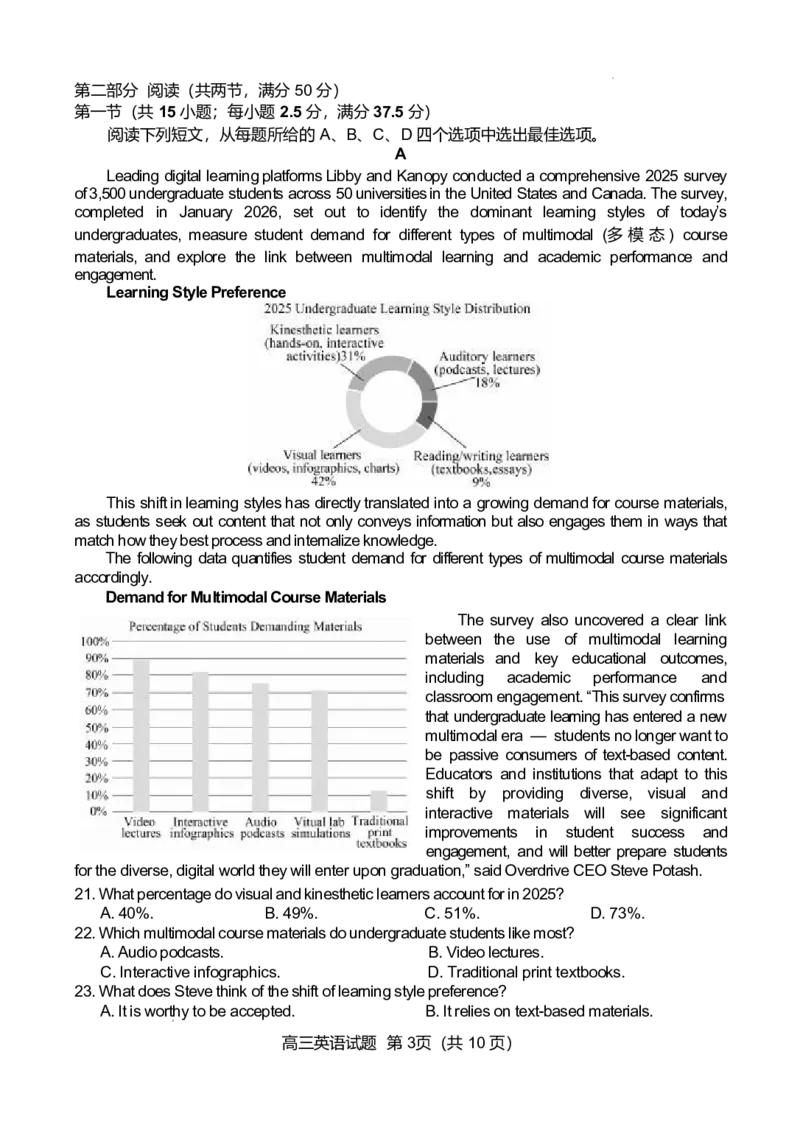
LearningStylePreference
This shiftinlearning styleshasdirectlytranslatedintoa growingdemandforcoursematerials,
as students seek out contentthat not only conveys informationbut also engages themin waysthat
matchhowtheybestprocessandinternalizeknowledge.
The following data quantifies student demand for different types ofmultimodal course materials
accordingly.
DemandforMultimodalCourseMaterials
The survey also uncovered a clear link
between the use of multimodal learning
materials and key educational outcomes,
including academic performance and
classroomengagement.“Thissurveyconfirms
thatundergraduatelearninghasenteredanew
multimodalera — studentsnolongerwantto
be passive consumers of text-based content.
Educators and institutions that adapt to this
shift by providing diverse, visual and
interactive materials will see significant
improvements in student success and
engagement, and will better prepare students
forthediverse,digitalworldtheywillenterupongraduation,”saidOverdriveCEOStevePotash.
21.Whatpercentagedovisualandkinestheticlearnersaccountforin2025?
A.40%. B.49%. C.51%. D.73%.
22.Whichmultimodalcoursematerialsdoundergraduatestudentslikemost?
A.Audiopodcasts. B.Videolectures.
C.Interactiveinfographics. D.Traditionalprinttextbooks.
23.WhatdoesStevethinkoftheshiftoflearningstylepreference?
A.Itisworthytobeaccepted. B.Itreliesontext-basedmaterials.
高三英语试题 第3页(共10页)
学科网(北京)股份有限公司C.Itisashort-livedtendency. D.Itlowersclassroomengagement.
B
Ms.Gupta’seighth-gradehistoryclasswereafraidoftheannual“LivingHistory”project.This
year’s theme was“The Industrial Revolution:Human Cost”. Students typicallyrecycled Wikipedia
facts for aposter. ButMs. Guptaraised a differentrequirement: each studentwould spend a week
performingthedull,minute-by-minutetaskofaspecifichistoricalworker,loggingtheirphysicaland
emotionalresponses.
SkepticalSamdrew “LinenMillDoffer (落纱工),age 12”.Histask:every45minutes,foran
hour after school,hemust stopwhateverhewasdoing andperformtenminutesofrapid,repetitive
motion — actingoutreplacingbobbins(纱线筒)onaspinningmachine.Hesetaphonetimer.The
first interruption came during an engaging video game. Annoyed, he hit hard at the air. The next
duringhomework.Frustrationgrew.Bydaythree,adeepsenseofpowerlessness setin.Hecouldn’t
immerse in anything, anticipating the next interruption. His log entry read: “I feel overwhelmed. I
can’tthinkafullthought.”
His research into actual doffers revealed more: lung diseases from dust, deafening noise,
14-hour days. A statistic — the average life expectancy ofa mill worker in 1830 wasjust 42 —
stopped him cold. It was no longer an abstract “cost”. It was stolen time, stolen focus, stolen
childhoods.Forhisfinalproject,Samdidn’tmakeaposter.Hewrotea simpleprogramcalled“The
Interruption”.Whenactivated,itwouldfreezethe screenevery45minuteswithanimageofa child
workerforexactlytenminutes.
Whenhepresentedit,theclasswassilent.Agirlwhohadembodieda“matchboxseller”spoke
throughtearsaboutchemicalpoisoning.Aboywhohadsimulatedacoalcarrierdescribedthesevere
acheinhisback.
Ms. Gupta’sgoaltobridgethegapbetweenhistoricaldataandhumanachewasachieved.The
students had moved from memorizing facts to feeling consequence. The project’s real lesson was
thatempathyisn’tjustfeelingbutthecourageousactofvoluntarilygivingupyourowncontrol,even
foramoment,tounderstandanother’smisery.
24.Whatmadethisyear’sLivingHistoryprojectspecial?
A.Itfeaturedroleplay. B.Itcreatedfineposters.
C.ItreferredtoWikipedia. D.Ithaddifferentthemes.
25.HowdidSam’semotionalchangeduringthetask?
A.Curious→ calm→ excited. B.Doubtful→ upset→ shocked.
C.Frightened→ nervous→ relieved. D.Uninterested→ anxious→ disappointed.
26.WhydidSamdesigntheprogram“TheInterruption”?
A.Toplayatrick. B.Tosharehisfeeling.
C.Tolearnhistory. D.Torecordhisdiscovery.
27.WhatlessonmightSamandhisclassmateslearnfromtheproject?
A.Historyisamirror. B. Sufferingbuildscharacter.
高三英语试题 第4页(共10页)
学科网(北京)股份有限公司C.Walkamileinsomeone’sshoes. D.Everycloudhasasilverlining.
C
Ethics (伦理) in Cybersecurity by Marquez, a former cybersecurity analyst for a global tech
firm,isatimelyexplorationofthemoraldilemmasthatdefinemoderndigitallife.
The book is organized around six “ethical crossroads”, each illustrated with a detailed case
study.Oneofthemoststrikingchaptersfocusesonthe2025“SecureData”case,whereamajortech
companydiscoveredweaknessinitspopularmessagingapp — onethatcouldexposeusers’private
conversations.Thecompanyfacedachoice:telluserstheproblemimmediatelyorfixitquietlyover
sixmonths.Marquezwalksreadersthroughtheargumentsonbothsides:the“dutytoprotectusers”
versusthe“dutytoavoidbadreputation”.Shedoesn’tofferasimpleanswer — instead,sheteaches
readerstoweighconflictingvalues,askillshecalls“ethicalreasoningforthedigitalage”.
Marquezalsochallengescommonmythsaboutcybersecurityethics.Shearguesagainsttheidea
that“the endjustifiesthemeans”whenitcomestofightingcybercrime,citing a 2024casewhere a
governmentaccessedacriminalgroup’s serverstorecoverstolendata,butindoing so,accidentally
obtainedtheprivateemailsof10,000innocentpeople.“Securitywithoutethicsisn’tsecurity — it’s
just control,”shewrites.Thisfocus onbalancing security and ethicsmakesthebook standoutin a
fieldoftendominatedbytechnicalsolutions.
Marquez’sengagingstylemakesthebookaccessible.She,forinstance,comparesacompany’s
decisiontohidea softwareproblemto“ateacherknowingaclassroomdoorisbrokenbutnotfixing
itbecausehedoesn’t wantto stop class.” She alsoincludes“Ethical Checklists”atthe end ofeach
chapter,whichguidereaderstoapplythebook’slessonstotheirownlives,forexample,shouldyou
reportafriendwhosharesyourpasswordwithothers?
Overall,Ethicsin Cybersecurityismorethanabook — it’satoolforthinkingcriticallyabout
daily digital choices. As Marquez puts it: “In cyberspace, every click is a choice — and every
choicehasanethicalcost.”
28.Whatcanbeinferredfromthe2025“SecureData”case?
A.Companiesprioritizeuserprivacy. B.Userdataishardtoprotect.
C.Cyberethicsinvolvestoughchoices. D.Messagingappsareeasytoaccess.
29.WhichofthefollowingisMarquesprobablyagainstaccordingtoparagraph3?
A.DownloadpapersontheCNKI. B.PolishanarticlebyDeepSeekApp.
C.Giveathump-uponafriend’sMoments. D.Discloseafriend’saddressontheinternet.
30.WhatisafeatureofEthicsinCybersecurityaccordingtothetext?
A.Itispackedwithcomplextheories. B.Itprovidesstep-by-stepinstructions.
C.Itisintendedforcyberprofessionals. D.Itadoptsadown-to-earthwritingstyle.
31.Whatistheauthor’spurposeinwritingthetext?
A.Topublicizecybercrimeprevention. B.Tohonoratalentedtechnicalexpert.
高三英语试题 第5页(共10页)
学科网(北京)股份有限公司C.TointroduceabookonCybersecurity. D.Torecommendanessayondigitallife.
D
Modernsocietyreliesheavilyonrefrigerationtechnology,frompreservingfoodtocoolingdata
centers. However, widely used vapor-compression (蒸汽压缩) cooling consumes vast amounts of
electricity and generates 7.8 percent ofthe country’s carbon emissions (排放). Solid-state cooling
has been considered cleaner, but the solid materials struggle with heat transmission efficiency,
restrictingtheirpracticaluseinlarge-scaleapplications.
Theresearchteam,ledbyLiBing,aprofessorattheChineseAcademyofSciences’Instituteof
MetalResearch,discovered awaytobypassthislimitationbyintegrating solid coolingeffects with
liquid flow.
In their study, they observed ammonium thiocyanate, a widely-used industrial salt, absorbs
massive amountsofheatwhenitdissolves (溶解)inwater.By applyingpressure,theprocessgoes
backward, separatingthe saltoutandreleasinga large amountofheat.Thistwo-waycycleenables
continuous cooling as pressure is applied and released in turn, making it an ideal one for
refrigeration systems. “Unlike traditional cooling methods, the approach integrates the cooling
material andheat-carryingmaterialinto a singleliquid,facilitatingheatconductivity.” Li said.This
approach solves what scientists described as the “impossible triangle”, achieving low emissions,
highcoolingpower,andefficientheattransmissionallatonce.
Laboratory experiments demonstrated excellent results. At room temperature, the method
achieved a temperature drop of nearly 30℃injust 20 seconds, while at higher temperatures the
coolingreachedashighas54℃,farexceedingthatofexistingmethods.Anotherexperimentproved
the process’ stability and instant response to pressure changes — key requirements for practical
refrigerationsystems.
Li emphasized that this technology lays foundation for the commercialization of powerful,
zero-emission refrigeration systems for industrial and home use, especially the next-generation
artificialintelligencecomputingcenters.He added,however,furthereffortsareneededforpractical
application,suchasbreakthroughsinengineeringpressure-tunedchanges.
32.Whatisoneproblemoftraditionalcoolingsystems?
A.Theyconsumemuchenergy. B.They’reusedinsmallscale.
C.Theydependonsolidmaterials. D.Theyhavelowcoolingefficiency.
33.Whatplaysakeyroleinsolvingthe“impossibletriangle”?
A.Thesolid-statematerials. B.Thetwo-wayliquidcycle.
C.Thepressure-tunedchanges. D.Thetraditionalcoolingmethod.
34.Whatisthepurposeoflistingthedatainparagraph4?
A.Toillustratetheprincipleofsolidcooling.
B.Toexplaintheneedforlowcarbonemission.
C.Toshowimpressiveeffectsofthenewmethod.
D.Tocomparethedifferencesoftwoexperiments.
35.Whichwouldbethebesttitleforthepassage?
A.Salt-basedMethodsWorkWonders B.TraditionalCoolingMeetsitsLimits
高三英语试题 第6页(共10页)
学科网(北京)股份有限公司C.AReportonEco-refrigerationIndustry D.ABreakthroughinCoolingTechnology
第二节(共5小题;每小题 2.5分,满分12.5分)
阅读下面短文,从短文后的选项中选出可以填入空白处的最佳选项。选项中有两项为多余
选项。
Mydaughterhadjustreturnedfrom a schoolcamp where smartphoneswerebanned, and she
couldn’t stoptalking abouthowpeacefulitfelt. “You shouldtry it,Mom,” she said.“Just a month.
Seewhathappens.” 36
Iboughtabasicphonethatcouldonlycallandtext,andputmy smartphoneina drawer.The
first few days were difficult. I reached for my phone constantly — waiting for coffee, sitting at a
red light, standing in line at the grocery store. 37 I felt empty, oddly anxious. What was I
supposedtodowiththesemoments?
Slowly,I startedtofigureitout. 38 Forexample,thewaylightfellthroughthewindows
in mykitchen,the sound ofbirds outside my office,the faces ofstrangers onthe street. I alsohad
conversations — realones — withpeopleIwouldotherwisehaveignoredwhilescrolling.
The month ended, and I tookmy smartphone from the drawer. 39 That’s notrealistic,
and it’s not the point. The point is to use it intentionally rather than habitually. Therefore, I made
changes.Iturnedoffallunnecessaryalerts.Ideletedsocialmediaappsfrommyhomescreen.Small
things,buttheyaddup.
40 I learned that boredom is not an emergency. Those empty moments — waiting,
walking,sitting — arenotproblemstobesolved.Theyareopportunitiestobepresent.Theyarethe
spaces where creativity happens, where thoughts form, where we connect with ourselves and the
worldaroundus.
A.InoticedthingsIhadbeenmissingforyears.
B.Whethertogiveitatryornotbecameaquestion.
C.Ididn’tthrowitawayorpromisetogiveitupforever.
D.ImissedthehappymomentsIhadexperiencedbefore.
E.Ifoundonlythephone’stinyscreenandlimitedfunctions.
F.Moreimportantthanthechanges,though,iswhatIlearned.
G.Ilaugheditoffatfirstbutdecidedtogowithoutmineforamonth.
高三英语试题 第7页(共10页)
学科网(北京)股份有限公司第三部分 语言运用(共两节,满分30分)
第一节(共15小题;每小题 1分,满分15分)
阅读下面短文,从每题所给的 A、B、C、D 四个选项中选出可以填入空白处的最佳选项。
I moved to Portland last spring,knowing no one. Torelieve the 41 that filled my quiet
apartment,Ididwhatmanynewcomersdo:I searched onlineforalocal 42 group.“Forest&
Friends”promisedweeklyactivitiesintheColumbiaRiverGorge.Itsoundedlikeaperfect 43 .
On our first group 44 — a moderate trail (小径) to a waterfall viewpoint — my
enthusiasm outweighed my caution. Halfwayup, I 45 on a looserock andhurtmy ankle.A
sharppainshotthroughme,andI 46 totheground,embarrassedandfrustrated.
What happened next was far from what I had expected. The group’s leader, a woman named
Sam, 47 thehikeimmediately.Butmore 48 ,nota singlepersonturnedbacktowardthe
trailhead.Instead,thedozen 49 Ihadmetonlyanhourearliergatheredaround.Someone 50 a
medical bandage. Another offered water and snacks. As we waited for help, we sat on the forest
floor.Weshared 51 — notjustabouthiking,butaboutourreasonsformovinghere,ourjobs,
ourhopes.Laughter 52 underthetree,myachinganklemomentarilyforgotten.
Ihadjoinedthegroup 53 beautiful scenery andperhaps apolite acquaintanceortwo.
I left that day with something far more 54 . The physical trail was steep, but the human
impulse (冲动) to connect, to stay beside someone in difficulty, was a powerful, leveling force. It
wasavivid 55 thatwearenevertrulyalone,evenonthemostdifficultpathslifesetsbeforeus.
41.A.panic B.sadness C.loneliness D.anxiety
42.A.running B.climbing C.jumping D.hiking
43.A.solution B.situation C.invitation D.explanation
44.A.picnic B.outing C.camp D.journey
45.A.stepped B.slept C.swung D.handed
46.A.bent B.jumped C.lay D.sank
47.A.putoff B.calledoff C.raninto D.lookedinto
48.A.naturally B.quietly C.strikingly D.horribly
49.A.visitors B.assistants C.organizers D.strangers
50.A.bought B.produced C.borrowed D.carried
51.A.stories B.goals C.secrets D.joys
52.A.paused B.faded C.resounded D.dropped
53.A.seeking B.developing C.chasing D.making
54.A.promising B.necessary C.valuable D.popular
55.A.memory B.symbol C. sign D.reminder
高三英语试题 第8页(共10 页)
学科网(北京)股份有限公司第二节(共10小题;每小题1.5分,满分15分)
阅读下面短文,在空白处填入1个适当的单词或括号内单词的正确形式。
Forty-nine young professionals from different countries recently completed a 10-day training
program in China, 56 (explore) rural revitalization practices in Yunnan. The program,
co-launched by China Agricultural University and Tencent, aimed to share China’s experience in
ruraldevelopmentwithglobal 57 (young).
DuringtheirvisittoMenglaCounty,Yunnan,the 58 (participant)wereimpressedbythe
“agri-tourism integration”model in Hebian Village. They learned how Yao ethnic group’s wooden
houses 59 (transform) into cozy guesthouses, and how villagers now earn income from
rubber tapping,beekeeping, and home-stay management. “Weusedto thinkrural areas could only
rely on farming,” said Mirembe from Uganda. “But here, culture and nature become treasures —
thisgivesusnewideas 60 ourvillages.”
They alsovisited a smartcoffee estate inJinghong, 61 AI anddrones areusedforpest
control and yield prediction. Hakim from Indonesia, who runs a coffee workshop, noted: “China’s
wayofconnectingsmallfarmerstobigmarketsvialive-streamingiseye-opening.Wecanadaptthis
tosellourIndonesiancoffee 62 (global).”
AkeytakeawaywasChina’sfocuson“farmer-centereddevelopment”.InManluanzhanVillage,
the group saw how 63 (abandon) water towers were turned into cafes, and how local
villagers lead decision-making for tourism projects. “China doesn’tjust build pretty villages — it
empowerspeopletoownthedevelopment,”saidMumbifromKenya.
The program ended with a 64 (commit) to apply these lessons at home. As Tanzanian
participantAboliputit:“China’sruralrevitalizationisn’tacopy-pastemodel, 65 amindset
ofusinglocalstrengths.That’swhatweneedtotakeback.”
第四部分 写作(共两节,满分40分)
第一节(满分15分)
假定你是李华,外教 Lisa 计划下周六上午在学校操场举行英语角活动,但是同学们参与
积极性不高。请你给她写一封邮件,内容包括:
1.分析问题;
2.提出建议。
注意:
1.写作词数应为80左右;
2.请按如下格式在答题卡的相应位置作答。
DearLisa,
I’m Li Hua from Class 1. I’m writing to talk about our campus English Corner next Saturday
morning.
_________________________________________________________________________
_________________________________________________________________________
Yours,
LiHua
高三英语试题 第9页(共10页)
学科网(北京)股份有限公司第二节(满分 25分)
阅读下面材料,根据其内容和所给段落开头语续写两段,使之构成一篇完整的短文。
Jake was 12, and words had always beenhis worst enemy. In class,he stuttered (口吃) over
sentences when called on; his worksheets came back covered in red marks for misspellings. The
jokingwasconstant — kidscalledhim“slow”or“stupid”inthehallway.
Jake stopped trying to keep up, skipping homework after school. His only escape was taking
apart old toy cars andremote controls,thenputting thembacktogether — sometimes evenbetter
thanbefore.Itwastheonlythingthatmadehimfeelsmart,evenifnooneelsenoticed.
Oneafternoon,ashesatonthesidewalkoutsidehisschool,fixinganeighbor’sbrokendrone,a
voiceinterruptedhisfocus.“That’ssomeimpressiveworkyou’vegotthere.”
JakelookeduptoseeMrs.Henderson,thefifth-gradeteacherwholivednexttotheschool.He
tensedup,ready to grab the drone andrun — he didn’t need anotherpersonto laugh athim.But
Mrs. Henderson sat down beside him, her eyes soft, and asked him to explain how he’d fixed the
drone’smotor.
Forthefirsttimeinyears,Jaketalkedwithoutfeeling self-conscious.Hechattedabouthowhe
could “feel”whatwaswrongwith amachinejustbytouchingit.Mrs.Hendersonlistenedcarefully,
noddingalong,then shesmiled.“You’renota slowlearner,Jake,”shesaid.“You’readifferentkind
oflearner.Yourgiftisinyourhands — you’reabornengineer.”
Shetoldhimabouttheregionalroboticscompetitioninthreemonths,whereteamsbuiltrobots
tocompletetasks.Jake shookhisheadimmediately.“Ican’t,”hesaid.“Ican’treadtherules,andI’
lllettheteamdown.”
But Mrs. Henderson refused to let him quit. She offered to read the competition guidelines
aloud to him, translating the technicaljargon (行话) into simple terms. She talked the school into
letting him use the science lab after hours to build his robot. And she even recruited (招募) two
classmates — Mia,wholovedcoding,andLeo,whowasgoodatbuildingstructures — tojoinhis
team.
注意:
1.续写词数应为 150左右;
2.请按如下格式在答题卡的相应位置作答。
Paragraph1:
Theroadtothecompetitionwasfilledwithobstacles.
_________________________________________________________________________
_________________________________________________________________________
Paragraph2:
Whenthefinalscoreswereannounced,theroomwentquiet.
_________________________________________________________________________
_________________________________________________________________________
高三英语试题 第 10页(共 10页)
学科网(北京)股份有限公司