广东省梅州市2026届高三3月总复习质检(一模)英语试卷
本试卷共8页。满分120分。考试用时120分钟。
注意事项:
1. 本试卷由三个部分组成。其中,第二部分和第三部分的第一节为选择题。第三部分的第二节和第四部分
为非选择题。
2. 答卷前,考生务必用 2B 铅笔在“考生号”处填涂考生号。用黑色字迹的钢笔或签字笔将自己所在的县
(市、区)、学校、班级以及自己的姓名和考生号、试室号、座位号填写在答题卡上。用2B铅笔将试卷类型
(A)填涂在答题卡相应位置上。
3. 作答选择题时,选出每小题答案后,用2B铅笔把答题卡上对应题目的答案标号涂黑;作答非选择题时
将答案写在答题卡上,写在本试卷上无效。
4. 考试结束后,将本试卷和答题卡一并交回。
第二部分 阅读 (共两节,满分50分)
第一节(共15小题;每小题2.5分,满分37.5分)
阅读下列短文,从每题所给的A、B、C、D四个选项中选出最佳选项。
A
The Best Movies of the Past Years
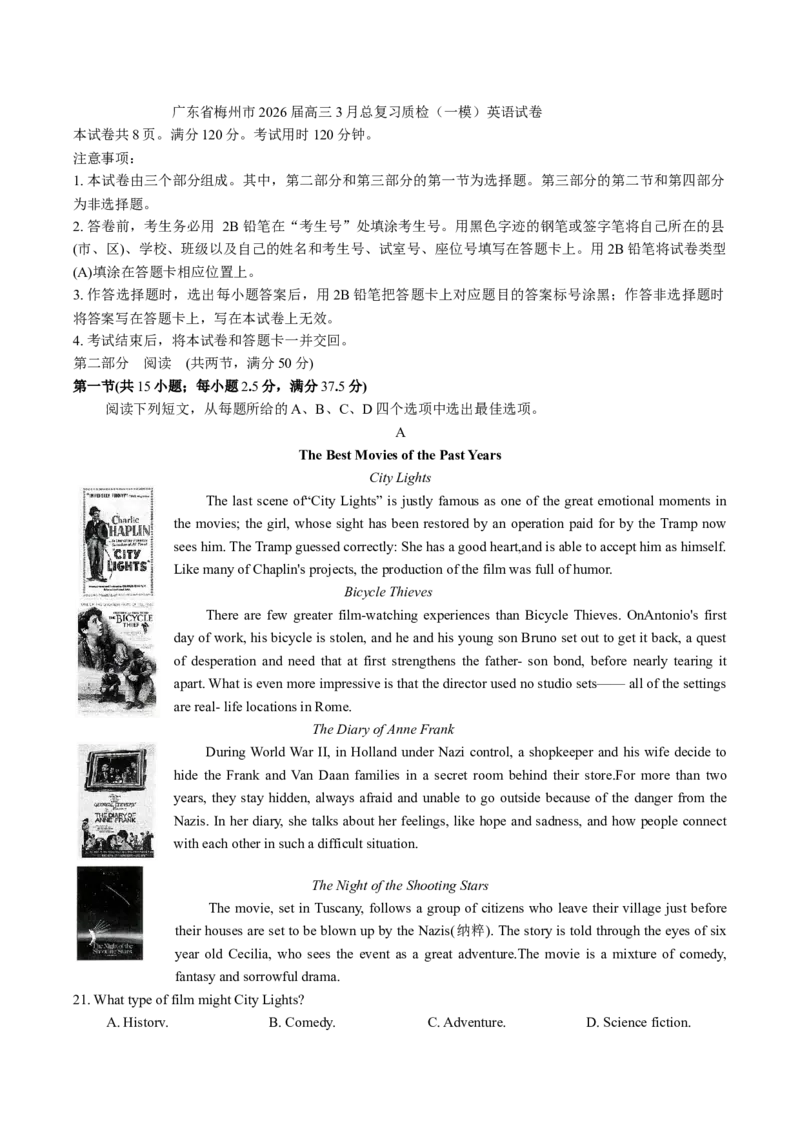
City Lights
The last scene of“City Lights” is justly famous as one of the great emotional moments in
the movies; the girl, whose sight has been restored by an operation paid for by the Tramp now
sees him. The Tramp guessed correctly: She has a good heart,and is able to accept him as himself.
Like many of Chaplin's projects, the production of the film was full of humor.
Bicycle Thieves
There are few greater film-watching experiences than Bicycle Thieves. OnAntonio's first
day of work, his bicycle is stolen, and he and his young son Bruno set out to get it back, a quest
of desperation and need that at first strengthens the father- son bond, before nearly tearing it
apart. What is even more impressive is that the director used no studio sets—— all of the settings
are real- life locations in Rome.
The Diary of Anne Frank
During World War II, in Holland under Nazi control, a shopkeeper and his wife decide to
hide the Frank and Van Daan families in a secret room behind their store.For more than two
years, they stay hidden, always afraid and unable to go outside because of the danger from the
Nazis. In her diary, she talks about her feelings, like hope and sadness, and how people connect
with each other in such a difficult situation.
The Night of the Shooting Stars
The movie, set in Tuscany, follows a group of citizens who leave their village just before
their houses are set to be blown up by the Nazis(纳粹). The story is told through the eyes of six
year old Cecilia, who sees the event as a great adventure.The movie is a mixture of comedy,
fantasy and sorrowful drama.
21. What type of film might City Lights?
A. Historv. B. Comedy. C. Adventure. D. Science fiction.22. Which aspect of Bicycle Thieves might impress the audiences most?
A. Its filming spots. B. Its special effects.
C. Its excellent actors. D. Its exciting plot.
23. What do The Diary of Anne Frank and The Night of the Shooting Stars have in common?
A. They are of the same type. B. They have elements of comedy.
C. They involve the influence of wars. D. They have the same shooting angle.
B
Mr. Johnson, a high school history teacher, had long noticed a worrying trend in his classroom.While his
students could carefully remember dates, names and events for exams, they always failed to understand the human
side of history. To them, the past seemed a fixed set of facts, without emotion, struggle or personal meaning.
Wanting to fix this gap, Mr. Johnson decided to completely change his teaching way in the middle of the semester,
trading a traditional research report for a story-writing task.
He asked his students to pick a historical figure and write a detailed story from that person's own point of
view. The task was confusing at first, but soon the classroom was full of active questions and discussion. One
student learned deeply about the life of a young soldier in World WarI, writing a sad and moving story of the mud,
fear and fragile friendship in the trench lines. Another told the story of a female scholar from the Renaissance,
making up a tale of her love for learning being held back by social rules. The thorough research and creative care
for how the figure felt that the students showed was amazing.
Mr. Johnson was surprised by the big change in his students. The essays he got were not just correct; they
were full of real feelings and a clear understanding of people's thoughts. The students had stopped just repeating
facts and truly connected with history, seeing historical figures as people with many different sides instead of just
names from a long time ago. In later class talks, their question: changed from“What happened?” to“Why did they
feel that way?” and“What would Ihave done?”. This story writing method didn't just help them remember facts
better; it built up their ability to think deeply and their real care for how others felt.
Inspired by this success, Mr. Johnson has now made story-telling a regular part of his lessons.He believes that
when students learn to experience history through story-telling, they do more than just remember it—— they start
to understand its long-lasting effects on their own lives and what it means to be human in general. In his classroom,
history is no longer just a subject about the past; it has become a talk with the past.
24. What was Mr. Johnson's initial problem with his students?
A. They preferred science over history.
B. They were not interested in history at all.
C. They could not memorize historical facts.
D. They lacked emotional connection to history.
25. How did Mr. Johnson change his teaching method?
A. He gave more tests on dates and names in history class.
B. He asked students to write from a historical-person's view.
C. He showed more historical documentaries with facts.
D. He invited historians to give lectures in his classroom.
26. What did the students' essays demonstrate after the new assignment?
A. They contained more dates and facts than before.
B. They showed better memorization of historical events.C. They reflected emotional understanding and personal insight.
D. They were shorter but more accurate than previous work.
27. What is the main message of the text?
A. History is more than facts—— it's human stories.
B. Teachers should use more technology in class.
C. Students prefer creative writing to exams.
D. Storytelling is only useful in English class.
C
For generations, sharing a bed has been widely seen as a key sign of closeness for couples. But a quiet shift is
taking place in some Western countries. The trend, called“sleep divorce,” is not about ending a relationship.
Instead, it means partners choose to sleep in separate beds or even separate rooms to improve their sleep quality.
Sleep divorce is a practical response to common sleep problems, such as snoring, different bedtimes,
disagreements over room temperature, shift work, and so on. And stress- related sleeplessness are among the main
reasons couples consider sleeping apart. Importantly, this choice is not a legal separation nor a sign of marriage
trouble.
Several forces are driving this trend. First, sleep troubles are rising worldwide, linked to noise,stress, and late-
night screen time in modern life. Second, snoring affects up to half of adults, far more than many realize. Third,
health is becoming a higher priority than tradition; couples now see good sleep as essential to well- being, just like
diet and exercise. Finally, younger generations are redefining relationship success, valuing flexibility over fixed
rules about how couples“should”sleep.
Interestingly, sleeping separately often brings couples closer. With better rest, they report fewer arguments,
better moods, and clearer communication. Poor sleep can make people easily annoyed and less empathetic, while
solid rest supports emotional strength.
Experts note that sleep divorce is helpful when partners feel bitter due to constant sleep interruption, wake up
tired despite enough time in bed, or deal with heavy snoring. But it can backfire if it's used to avoid dealing with
relationship conflicts, if one partner feels lonely or rejected,or if the decision is not mutual. Therapists advise
couples to talk about it as a health choice for both people, not as a way to escape each other. As health and
relationship satisfaction take priority over old expectations, sleeping apart may become a normal option for more
couples in the future.
28. What is“sleep divorce” according to the text?
A. A legal step to end a marriage. B. A sleep arrangement to improve rest.
C. A solution mainly for shift workers. D. A trend of avoiding emotional connection.
29. What does the word “backfire ” in paragraph 5 probably mean?
A. Improve quickly. B. Gain popularity.
C. Succeed unexpectedly. D. Cause harm instead.
30. What can be inferred about younger generations in paragraph 3?
A. They stick to traditional sleep habits.
B. They experience fewer sleep problems.
C. They value health less than older couples.
D. They are more flexible in defining relationships.
31. Which of the following is the best title for the text?
A. Why couples Choose to Sleep Apart. B. Get a Divorce: For a Better SleepC. The Science Behind Better Sleep. D. How to Design a Dual-Bedroom Home.
D
Coral reefs, long hailed as centers of marine biodiversity, are now being revealed as powerful conductors of
microscopic life in the waters around them. A pioneering study led by Dr. HerdisSteinsdóttir demonstrates that
reefs actively shape daily rhythms in nearby microbial communities,changing their makeup and numbers over each
24-hour period.
Published in Science Advances, the research monitored microbes in the northern Gulf of Aqaba in the Red
Sea. By comparing waters close to reefs with open ocean areas during both winter and summer, and collecting
samples every six hours, the team uncovered clear daily and seasonal patterns previously missed. They employed
advanced methods like genetic sequencing and high-resolution imaging to track bacteria, microalgae, and
microscopic predators with great detail.
Key findings emerged. Reef waters consistently had lower counts of bacteria and microalgae compared to
open waters, pointing to active removal by reef life. In contrast, populations of heterotrophic protists—— tiny
predators that consume bacteria—— reached their highest levels at night,sometimes increasing by 80%. This
nighttime spike emphasizes predation(捕食) as a major force driving changes in microbial communities.
Another major discovery involved Symbiodiniaceae, the microscopic algae(微观藻类) that live in symbiosis
with corals. Their genetic markers peaked around midday in reef waters, suggesting a daily cycle tied to light
availability and coral biological activity. This highlights the reef's active, not passive, role in organizing microbial
life. As co author Dr. Frada stated,“Reefs generate daily patterns that repeat with the seasons and affect how energy
moves through the system.”
Importantly, the study found that these daily microbial rhythms were as powerful as seasonal changes,
stressing the critical need to consider time of day in ecological studies. By combining genetic, imaging, and
environmental data, the research provided a comprehensive, time- based picture of microbial life around reefs. It
not only deepens our understanding of reefs’ broader ecological influence but also paves the way for new
conservation approaches that use an understanding of microbial rhythms to protect these vital ecosystems.
32. What is the main finding of the study led by Dr. Steinsdóttir?
A. Coral reefs are facing unprecedented threats from microbial activities.
B. Microbial populations near reefs show changes only with the seasons.
C. Reefs actively create daily rhythmic patterns in nearby microbial populations.
D. Reefs passively host a diverse but stable community of microbes year-round.
33. What can be inferred about heterotrophic protists from paragraph 3?
A. They are most active during the day.
B. They are a primary food source for corals.
C. They are less abundant in reef waters than in the open ocean.
D. Their population rise helps control bacterial numbers at night.
34. Why does the author quote Dr. Frada in paragraph 4?
A. To emphasize the passive nature of coral reefs.
B. To highlight the seasonal stability of reef ecosystems.
C. To stress the active role of reefs in shaping microbial cycles.
D. To explain the sampling methodology already used in the study.
35. What is the significance of the discovery that daily rhythms are as strong as seasonal ones?A. It proves that seasonal changes are irrelevant to reef studies.
B. It suggests that time of day is a crucial factor in ecological research.
C. It shows that all marine ecosystems operate on identical daily cycles.
D. It indicates that microbial activity is unrelated to environmental changes.
第二节(共5小题;每小题2.5分,满分12.5分)
阅读下面短文,从短文后的选项中选出可以填入空白处的最佳选项。选项中有两项为多余选项。
How to Deal with Impossible People
Many people have met someone who always makes situations stressful and hopeless. 36 .That's because they
likely don't see a problem with their behavior. Here are tips to handle this kind of people and keep your own mind
calm.
Avoid getting defensive. Stay calm, and be aware that you will never win in an argument with impossible
people —— they are referred to as“impossible” for a reason. In their mind, you are the problem. 37 . They feel
that your opinion doesn't matter because you are guilty, regardless.
Try to ignore them. Even if you cannot avoid impossible people in your daily life, don't think about them on
your“off” time. Remember that stressing about the person all the time is the same as giving them your precious
time when they don't even care about you. 38 . That way you aren't wasting time by thinking about what the
person said or did constantly.
39 . Impossible people offer valuable life experiences. After dealing with them, you will be able to get along
with most other people more easily. Try to keep perspective, and realize that what may seem crazy to you may be
another person's only way of coping. Try to view these communications as a way to build strengths.
Be careful not to copy the bad habits of people who are impossible to deal with. You often learn behaviors
from others around you. Because of this, you might accidentally start doing things you don't like. When you react
to them, you could end up acting just as illogical as they do. 40 .
A. Be the opposite of them
B. Consider what you can learn
C. Do other activities and make new friends
D. Catch yourself when you start to do this
E. So nothing you say can convince them to see your side of the story
F. Pointing out that these people are difficult and demanding won't help
G. An impossible pe. son is convinced that they have already made a mistake
第三部分 语言运用 (共两节,满分30分)
第一节(共15小题;每小题1分,满分15分)
阅读下面短文,从每题所给的A、B、C、D四个选项中选出可以填入空白处的最佳选项。
At 81, Betty, a lifelong waitress in Pittsburgh, faced a reality many of us hope to avoid: working late into her
eighties because her social security wasn't enough to 41 basic bills. Chronic(慢性的) back pain and long hours
didn't slow her down.“I'm 81, but I can still outdo all these youngsters,” she joked to 42 .
Her life changed 43 thanks to the compassion of a stranger, Tamie Konzier, who noticedBetty struggling
while serving her family at Eat'n Park. 44 by Betty's spirit, Konzier decided to take action. Instead of just leaving
a generous 45 , Konzier wanted to make a real difference.She shared Betty's story online and encouraged 46
through a GoFundMe campaign. What started as a single act of kindness quickly captured the 47 of thousands.
Within 24 hours, contributions 48 from strangers moved by Betty's story. The total rapidly 49 . People
across the country were inspired to support someone they had never met,showing the power of human empathy inaction. When Konzier returned with her son to 50 the funds, the total had reached a(n) 51 $328,739.18. Betty,
overwhelmed with gratitude, now has the ability to cover bills, enjoy her golden years, and live a life she could not
have imagined before this act of 52 .
Betty's story 53 us that empathy doesn't require fame or a platform. Simple and 54acts can create change
far beyond what we imagine. In a world often focused on hustle and competition, moments like these 55 as
examples of humanity at its best.
41. A. copy B. finish C. cover D. save
42. A. doctors B. passengers C. friends D. customers
43. A. dramatically B. hardly C. slightly D. successfully
44. A. Confused B. Moved C. Disappointed D. Interested
45. A. check B. tip C. bill D. pay
46. A. plans B. volunteers C. sponsors D. donations
47. A. attention B. intention C. responsibility D. action
48. A. handed in B. poured in C. turned in D. put in
49. A. elimed B. crashed C. crept D. flew
50. A. accept B. provide C. deliver D. obtain
51. A. annoying B. astonishing C. delighting D. disappointing
52. A. gratitude B. forgiveness C. honesty D. kindness
53. A. remains B. retells C. reminds D. recalls
54. A. careless B. hopeless C. selfless D. harmless
55. A. shine B. shape C. remember D. enjoy
第二节(共10小题;每小题1.5分,满分15分)
阅读下面短文,在空白处填入1个适当的单词或括号内单词的正确形式。
Xiao Xue, the 20th of the 24 solar terms, usually falls on November 22nd or the nearby days, 56 (indicate)
the beginning of the colder weather and the approach of snow. Xiao Xue literally means“minor snow.” During
Minor Snow, it starts to snow lightly in many places, 57 (especial)in northern China, and the temperature
continues to drop.
The name“Minor Snow” suggests that the snowfall at this time is not heavy, 58 it's a sign that colder weather
is coming. In ancient China, people 59 (observe) the changes of nature during Minor Snow and divided it 60
three phases: the disappearance of rainbows, the hiding of vitality by living things, and the withering of forests.
There are also many traditional customs which 61 (associate) with Minor Snow. For example, people in
northern China like to store vegetables like Chinese cabbage, radish and 62 (potato) in the cellar(地窖). In
southern China, people start making sausages and cured meat.Fishermen begin to dry fish for the winter, and the
neat 63 (arrange) of dried, salted fish in the winter sunshine is a vivid picture of early winter.
In addition, Minor Snow is a time for families 64 (gather) and enjoy delicious food.There's a special
liquor during Minor Snow called“Light Snow Liquor” 65 is made with the clearest spring water and tastes
delicious on a cold winter day.
第四部分 写作 (共两节,满分40分)
第一节(满分15分)假定你是李华,你在学校组织的庆祝“世界航天日”(World Space Day)海报设计大赛中获奖,请你给
英国朋友 Tom写一封邮件分享这次经历,内容包括:
1.你的作品介绍;
2.你的感想。
注意:
1.写作词数应为80个左右;
2.请按如下格式在答题卡的相应位置作答。
Dear Tom,
Yours,
Li Hua
第二节(满分25分)
阅读下面材料,根据其内容和所给段落开头语续写两段,使之构成一篇完整的短文。
The familiar smell of garlic, soy sauce, and onion spread through the air as I opened my lunch bag to see what
my mom had packed for me. On any other occasion,I would have been delighted to eat my mom's braised pan fried
tofu: a Chinese dish that I often ate for dinner. But not today, the day a nice girl had invited me, the new girl at
school, to sit with her friends during lunch.
“Chans. over here!” My new friend was waving her arms, trying to get my attention.
As I prepared to walk over to the table, memories of elementary and middle school lunch times resurfaced. I
remembered my embarrassment as my friends would hold their noses, or stay away from me when I brought
homemade Chinese food, tofu. I remembered how my embarrassment shifted to anger when I complained about the
smell to my mom.
I had argued with my mom that I wanted“normal” food for lunch. I remembered the look on my mom's face, a
mix between disappointment and confusion. But I was determined and she gave in because she worried about my
making new friends every time we moved. So for the remainder of middle school, my mom packed odorless(无味
的), non-Chinese fare like ham and cheese sandwiches.However, that day, she was in a rush to get to her new job
and packed me leftovers from dinner.
As soon as I got to my new lunch table, I tried to hide my bright lunch bag under my seat before anyone
noticed the strong smell. I looked up to see the other girls at the table, opening their normal American lunches. I sat
quietly, trying not to be noticed when Katrina, a new acquaintance,asked where my food was.
“I'm not really hungry,”I replied in an insecure voice. But Katrina had already seen me carry my lunch so shesaid,“Then, I' ll eat it!” The other girls laughed—— apparently Katrina was known to be the lunch scavenger.
注意:
1.续写词数应为150左右。
2.请按如下格式在答题卡的相应位置作答。
I didn't want to be rude to a new friend, so I reluctantly dragged out my lunch bag and unzipped it.
It took me a second to recognize that my homemade Chinese food was not being rejected.
梅州市高三总复习质检试卷(2026.3)
英语答案
第二部分(满分50分,每小题2.5分)
21-25 BACDB 26-30 CABDD 31-35 ACDCB
36-40 FECBD
第三部分 满分30分。
第一节(每小题1分,共15分)
41-45CDABB 46-50 DABAC 51-55 BDCCA
第二节(每小题1.5分,共15分) (形式不对不给分)
56. indicating 57. especially 58. but 59. observed 60. into
61. are associated 62. potatoes 63. arrangement 64. to gather
65. which/ that
第四部分:写作(共2节,满分40分)
第一节:书面表达(共1小题;满分15分)
Dear Tom,
I hope you' re doing well! I'm exeited to share that I won a prize in our school'sWorld Space Day poster
design competition!
My poster, themed“Exploring Space,” featured an astronaut strolling through space with Earth and twinkling
stars in the background. A key part was the quote“The sky is not the limit” by Yuri Gagarin, which I added to
inspire curiosity.Moreover, I used a vivid blue and white color scheme to create a sense of mystery and vastness.
This achievement has boosted my confidence and deepened my interest in space exploration. Hope to see you
soon and show you the poster in person!
Yours,Li Hua
应用文英语作文评分标准“易理解”版
综合评价,兼顾要点(内容包括: 1.你的作品介绍; 2.你的感想。)书写等。
第五档(13-15) :有多个漂亮的句子
第四档(10-12) :有漂亮的句子
第三档(7-9 分):有正确的句子
第二档(4-6 分):看上去像句子
第一档(1-3分):有相关的词或抄写有其他无关段落
0 分:无任何写作痕迹
第二节:读后续写(25分)
I didn’t want to be rude to a new friend, so I reluctantly dragged out my lunch bag and unzipped it. The
moment I partially lifted the lid, I could practically taste the garlic and soy sauce. I expected them to turn away —
and turn me away. What I did not expect was for Katrina to instantly grab a small piece of tofu and eat it
ravenously.And I most certainly did not expect for her to encourage the rest of the table to try my lunch.
It took me a second to recognize that my homemade Chinese food was not being rejected. In fact, it had
become a source of personal pride. My new friends were going on about how lucky I was that my mom took the
time to prepare a cooked meal for me.They were enchanted by the fact that tofu could actually taste good. While I
didn’t get to eat any of my mom’s pan- fried tofu, I was full — of pride and gratitude.When I arrived home, my
mom noticed that the container was empty, she hesitated before asking,“How was the food?” I paused a moment
before I replied,“Perfect.”
读后续写评分标准“易理解”版
综合评价,兼顾要点(续写内容的质量、续写的完整性以及与原文情境的融洽度)
第五档(21-25):有多个漂亮的句子
第四档(16-20) :有漂亮的句子
第三档(11-15 分) :有正确的句子
第二档(6-10 分):看上去像句子
第一档(1-5分):有相关的词或抄写有其他无关段落
0 分:无任何写作痕迹