Unit 6 When was it invented?
九年级英语上册必备知识清单
一、词汇知识清单
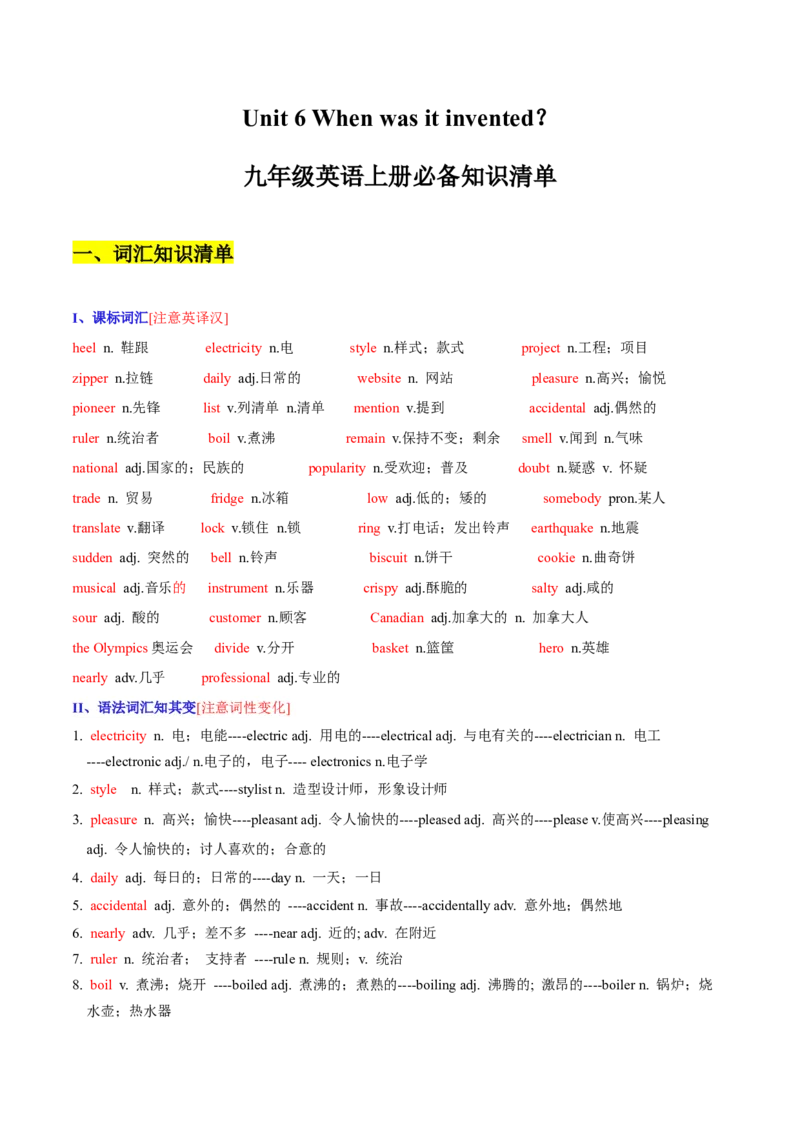
I、课标词汇[注意英译汉]
heel n. 鞋跟 electricity n.电 style n.样式;款式 project n.工程;项目
zipper n.拉链 daily adj.日常的 website n. 网站 pleasure n.高兴;愉悦
pioneer n.先锋 list v.列清单 n.清单 mention v.提到 accidental adj.偶然的
ruler n.统治者 boil v.煮沸 remain v.保持不变;剩余 smell v.闻到 n.气味
national adj.国家的;民族的 popularity n.受欢迎;普及 doubt n.疑惑 v. 怀疑
trade n. 贸易 fridge n.冰箱 low adj.低的;矮的 somebody pron.某人
translate v.翻译 lock v.锁住 n.锁 ring v.打电话;发出铃声 earthquake n.地震
sudden adj. 突然的 bell n.铃声 biscuit n.饼干 cookie n.曲奇饼
musical adj.音乐的 instrument n.乐器 crispy adj.酥脆的 salty adj.咸的
sour adj. 酸的 customer n.顾客 Canadian adj.加拿大的 n. 加拿大人
the Olympics奥运会 divide v.分开 basket n.篮筐 hero n.英雄
nearly adv.几乎 professional adj.专业的
II、语法词汇知其变[注意词性变化]
1. electricity n. 电;电能----electric adj. 用电的----electrical adj. 与电有关的----electrician n. 电工
----electronic adj./ n.电子的,电子---- electronics n.电子学
2. style n. 样式;款式----stylist n. 造型设计师,形象设计师
3. pleasure n. 高兴;愉快----pleasant adj. 令人愉快的----pleased adj. 高兴的----please v.使高兴----pleasing
adj. 令人愉快的;讨人喜欢的;合意的
4. daily adj. 每日的;日常的----day n. 一天;一日
5. accidental adj. 意外的;偶然的 ----accident n. 事故----accidentally adv. 意外地;偶然地
6. nearly adv. 几乎;差不多 ----near adj. 近的; adv. 在附近
7. ruler n. 统治者; 支持者 ----rule n. 规则;v. 统治
8. boil v. 煮沸;烧开 ----boiled adj. 煮沸的;煮熟的----boiling adj. 沸腾的; 激昂的----boiler n. 锅炉;烧
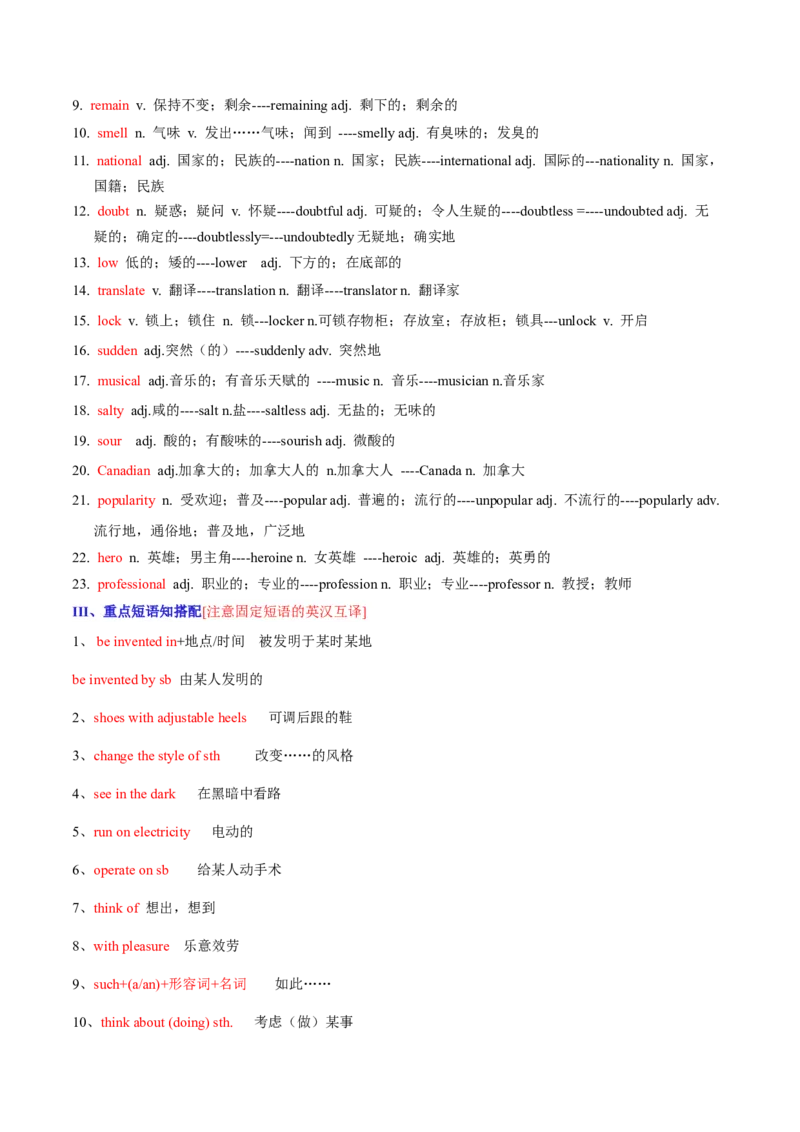
水壶;热水器9. remain v. 保持不变;剩余----remaining adj. 剩下的;剩余的
10. smell n. 气味 v. 发出……气味;闻到 ----smelly adj. 有臭味的;发臭的
11. national adj. 国家的;民族的----nation n. 国家;民族----international adj. 国际的---nationality n. 国家,
国籍;民族
12. doubt n. 疑惑;疑问 v. 怀疑----doubtful adj. 可疑的;令人生疑的----doubtless =----undoubted adj. 无
疑的;确定的----doubtlessly=---undoubtedly无疑地;确实地
13. low 低的;矮的----lower adj. 下方的;在底部的
14. translate v. 翻译----translation n. 翻译----translator n. 翻译家
15. lock v. 锁上;锁住 n. 锁---locker n.可锁存物柜;存放室;存放柜;锁具---unlock v. 开启
16. sudden adj.突然(的)----suddenly adv. 突然地
17. musical adj.音乐的;有音乐天赋的 ----music n. 音乐----musician n.音乐家
18. salty adj.咸的----salt n.盐----saltless adj. 无盐的;无味的
19. sour adj. 酸的;有酸味的----sourish adj. 微酸的
20. Canadian adj.加拿大的;加拿大人的 n.加拿大人 ----Canada n. 加拿大
21. popularity n. 受欢迎;普及----popular adj. 普遍的;流行的----unpopular adj. 不流行的----popularly adv.
流行地,通俗地;普及地,广泛地
22. hero n. 英雄;男主角----heroine n. 女英雄 ----heroic adj. 英雄的;英勇的
23. professional adj. 职业的;专业的----profession n. 职业;专业----professor n. 教授;教师
III、重点短语知搭配[注意固定短语的英汉互译]
1、be invented in+地点/时间 被发明于某时某地
be invented by sb 由某人发明的
2、shoes with adjustable heels 可调后跟的鞋
3、change the style of sth 改变……的风格
4、see in the dark 在黑暗中看路
5、run on electricity 电动的
6、operate on sb 给某人动手术
7、think of 想出,想到
8、with pleasure 乐意效劳
9、such+(a/an)+形容词+名词 如此……
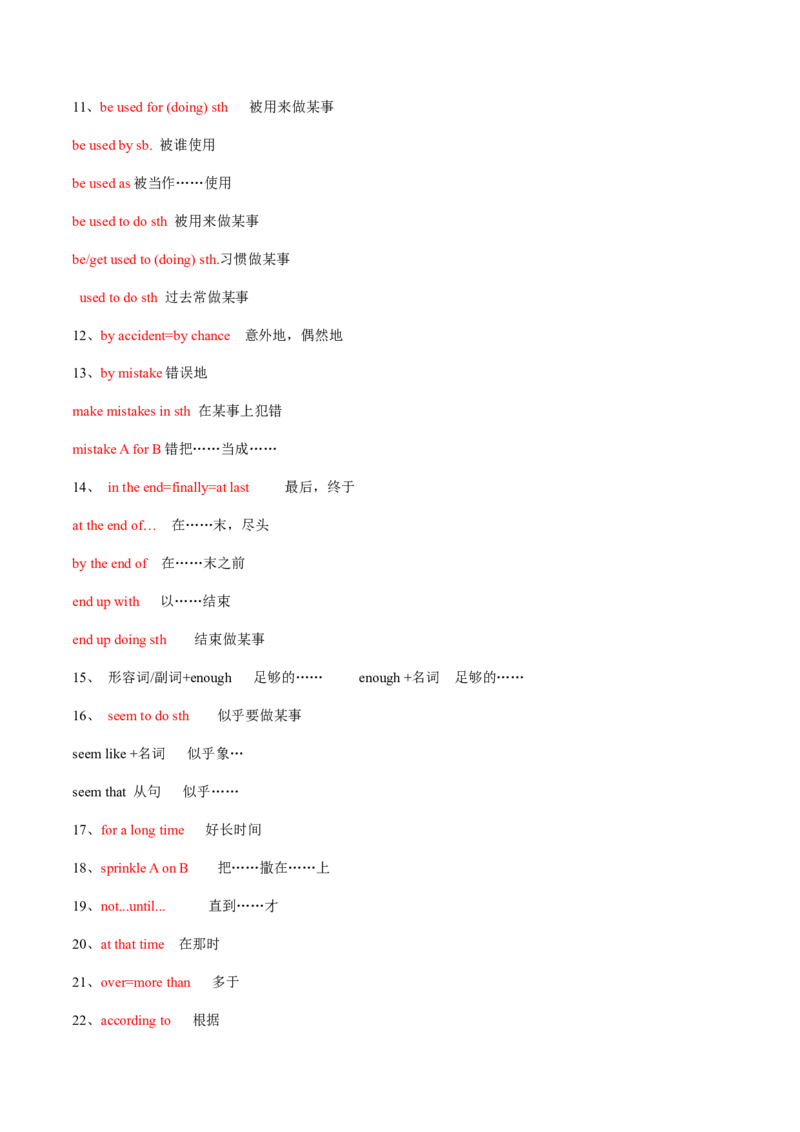
10、think about (doing) sth. 考虑(做)某事11、be used for (doing) sth 被用来做某事
be used by sb. 被谁使用
be used as被当作……使用
be used to do sth 被用来做某事
be/get used to (doing) sth.习惯做某事
used to do sth 过去常做某事
12、by accident=by chance 意外地,偶然地
13、by mistake错误地
make mistakes in sth 在某事上犯错
mistake A for B错把……当成……
14、 in the end=finally=at last 最后,终于
at the end of… 在……末,尽头
by the end of 在……末之前
end up with 以……结束
end up doing sth 结束做某事
15、 形容词/副词+enough 足够的…… enough +名词 足够的……
16、 seem to do sth 似乎要做某事
seem like +名词 似乎象…
seem that 从句 似乎……
17、for a long time 好长时间
18、sprinkle A on B 把……撒在……上
19、not...until... 直到……才
20、at that time 在那时
21、over=more than 多于
22、according to 根据23、It’s said that从句 据说……
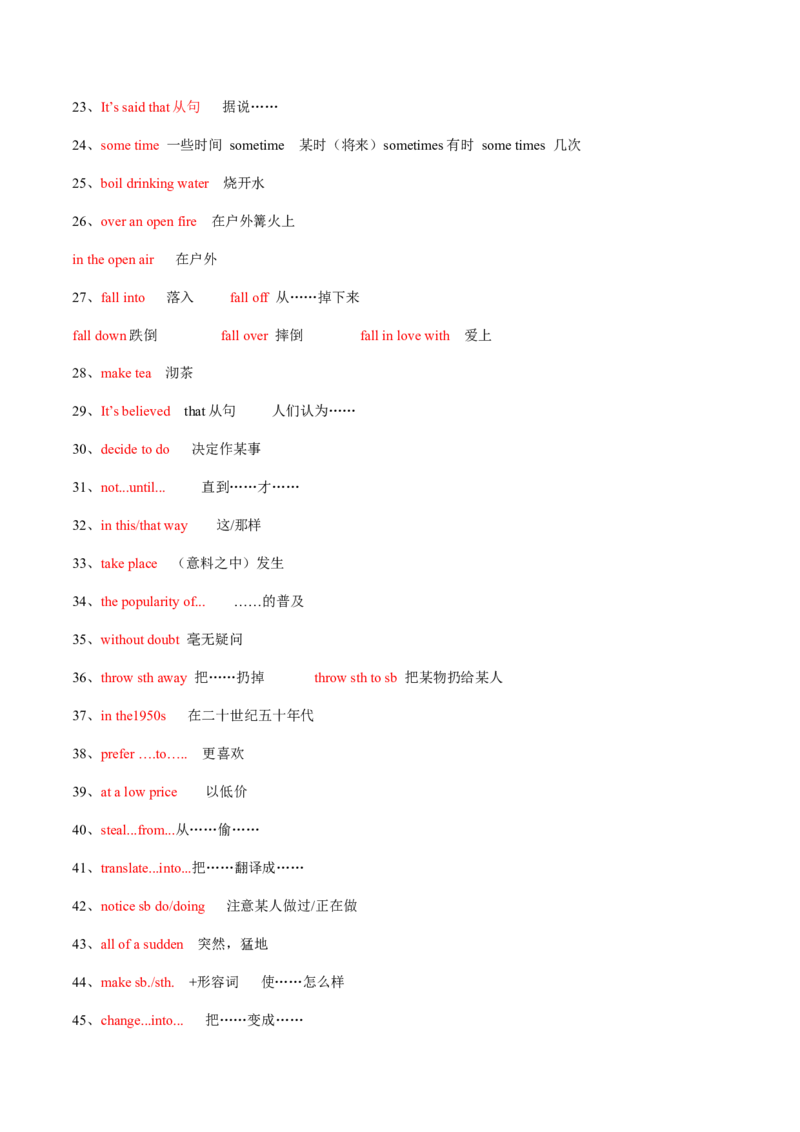
24、some time 一些时间 sometime 某时(将来)sometimes有时 some times 几次
25、boil drinking water 烧开水
26、over an open fire 在户外篝火上
in the open air 在户外
27、fall into 落入 fall off 从……掉下来
fall down跌倒 fall over 摔倒 fall in love with 爱上
28、make tea 沏茶
29、It’s believed that从句 人们认为……
30、decide to do 决定作某事
31、not...until... 直到……才……
32、in this/that way 这/那样
33、take place (意料之中)发生
34、the popularity of... ……的普及
35、without doubt 毫无疑问
36、throw sth away 把……扔掉 throw sth to sb 把某物扔给某人
37、in the1950s 在二十世纪五十年代
38、prefer ….to….. 更喜欢
39、at a low price 以低价
40、steal...from...从……偷……
41、translate...into...把……翻译成……
42、notice sb do/doing 注意某人做过/正在做
43、all of a sudden 突然,猛地
44、make sb./sth. +形容词 使……怎么样
45、change...into... 把……变成……46、in history 在历史上
47、play indoors 在室内玩
48、stop...from... 阻止……做某事
49、on the same team 在同一个对
50、the safety of ... ……的安全
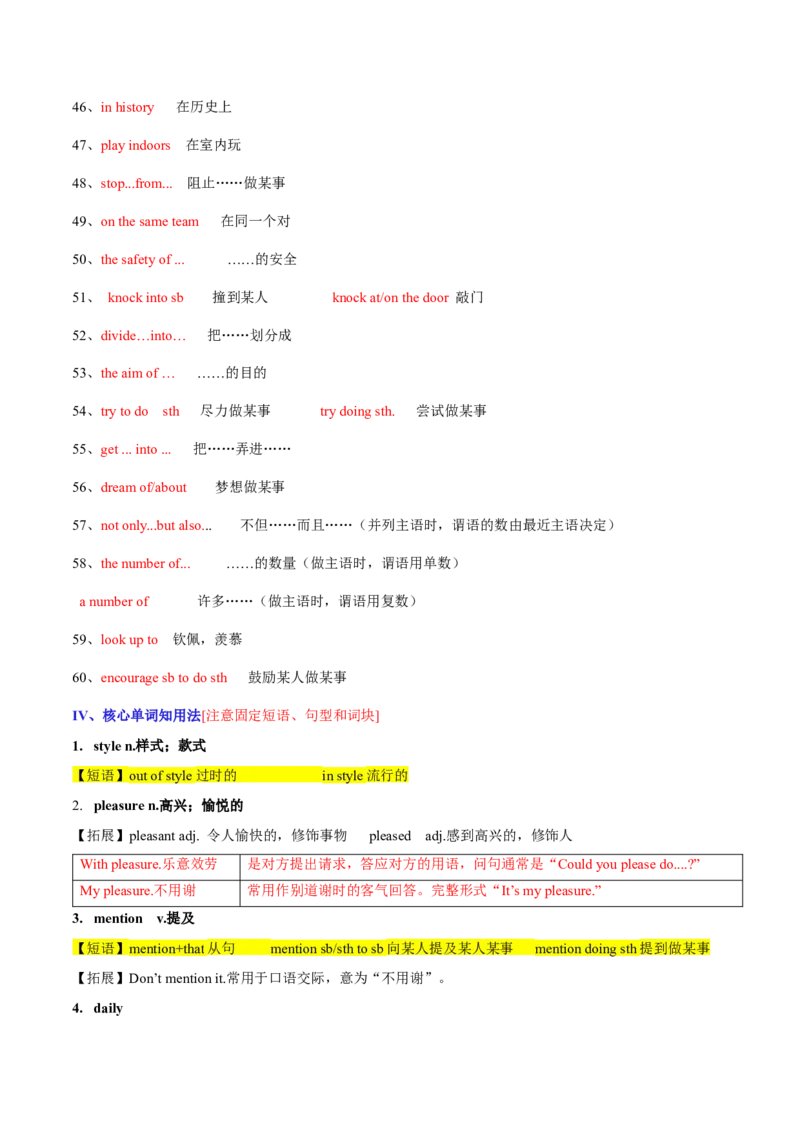
51、 knock into sb 撞到某人 knock at/on the door 敲门
52、divide…into… 把……划分成
53、the aim of … ……的目的
54、try to do sth 尽力做某事 try doing sth. 尝试做某事
55、get ... into ... 把……弄进……
56、dream of/about 梦想做某事
57、not only...but also... 不但……而且……(并列主语时,谓语的数由最近主语决定)
58、the number of... ……的数量(做主语时,谓语用单数)
a number of 许多……(做主语时,谓语用复数)
59、look up to 钦佩,羡慕
60、encourage sb to do sth 鼓励某人做某事
IV、核心单词知用法[注意固定短语、句型和词块]
1. style n.样式;款式
【短语】out of style过时的 in style流行的
2. pleasure n.高兴;愉悦的
【拓展】pleasant adj. 令人愉快的,修饰事物 pleased adj.感到高兴的,修饰人
With pleasure.乐意效劳 是对方提出请求,答应对方的用语,问句通常是“Could you please do....?”
My pleasure.不用谢 常用作别道谢时的客气回答。完整形式“It’s my pleasure.”
3. mention v.提及
【短语】mention+that从句 mention sb/sth to sb向某人提及某人某事 mention doing sth提到做某事
【拓展】Don’t mention it.常用于口语交际,意为“不用谢”。
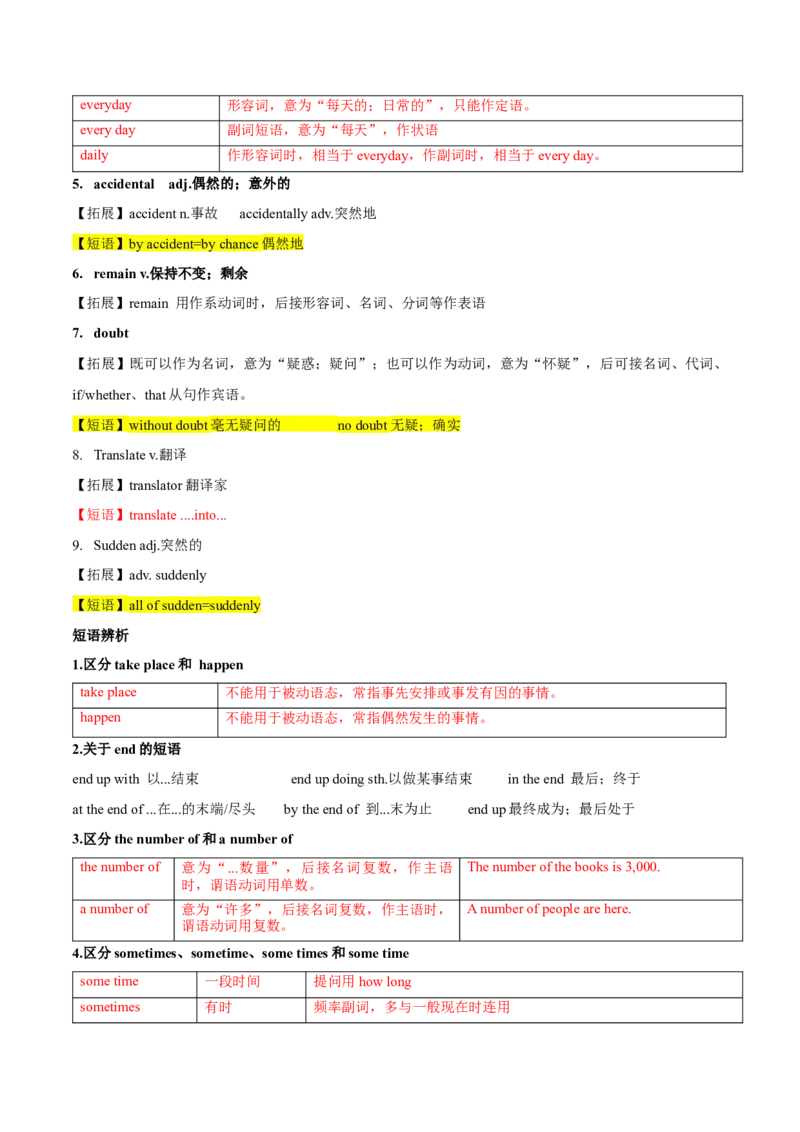
4. dailyeveryday 形容词,意为“每天的;日常的”,只能作定语。
every day 副词短语,意为“每天”,作状语
daily 作形容词时,相当于everyday,作副词时,相当于every day。
5. accidental adj.偶然的;意外的
【拓展】accident n.事故 accidentally adv.突然地
【短语】by accident=by chance偶然地
6. remain v.保持不变;剩余
【拓展】remain 用作系动词时,后接形容词、名词、分词等作表语
7. doubt
【拓展】既可以作为名词,意为“疑惑;疑问”;也可以作为动词,意为“怀疑”,后可接名词、代词、
if/whether、that从句作宾语。
【短语】without doubt毫无疑问的 no doubt无疑;确实
8. Translate v.翻译
【拓展】translator翻译家
【短语】translate ....into...
9. Sudden adj.突然的
【拓展】adv. suddenly
【短语】all of sudden=suddenly
短语辨析
1.区分take place和 happen
take place 不能用于被动语态,常指事先安排或事发有因的事情。
happen 不能用于被动语态,常指偶然发生的事情。
2.关于end的短语
end up with 以...结束 end up doing sth.以做某事结束 in the end 最后;终于
at the end of ...在...的末端/尽头 by the end of 到...末为止 end up最终成为;最后处于
3.区分the number of和a number of
the number of 意为“...数量”,后接名词复数,作主语 The number of the books is 3,000.
时,谓语动词用单数。
a number of 意为“许多”,后接名词复数,作主语时, A number of people are here.
谓语动词用复数。
4.区分sometimes、sometime、some times和some time
some time 一段时间 提问用how long
sometimes 有时 频率副词,多与一般现在时连用some times 几次;几倍 提问用how many times
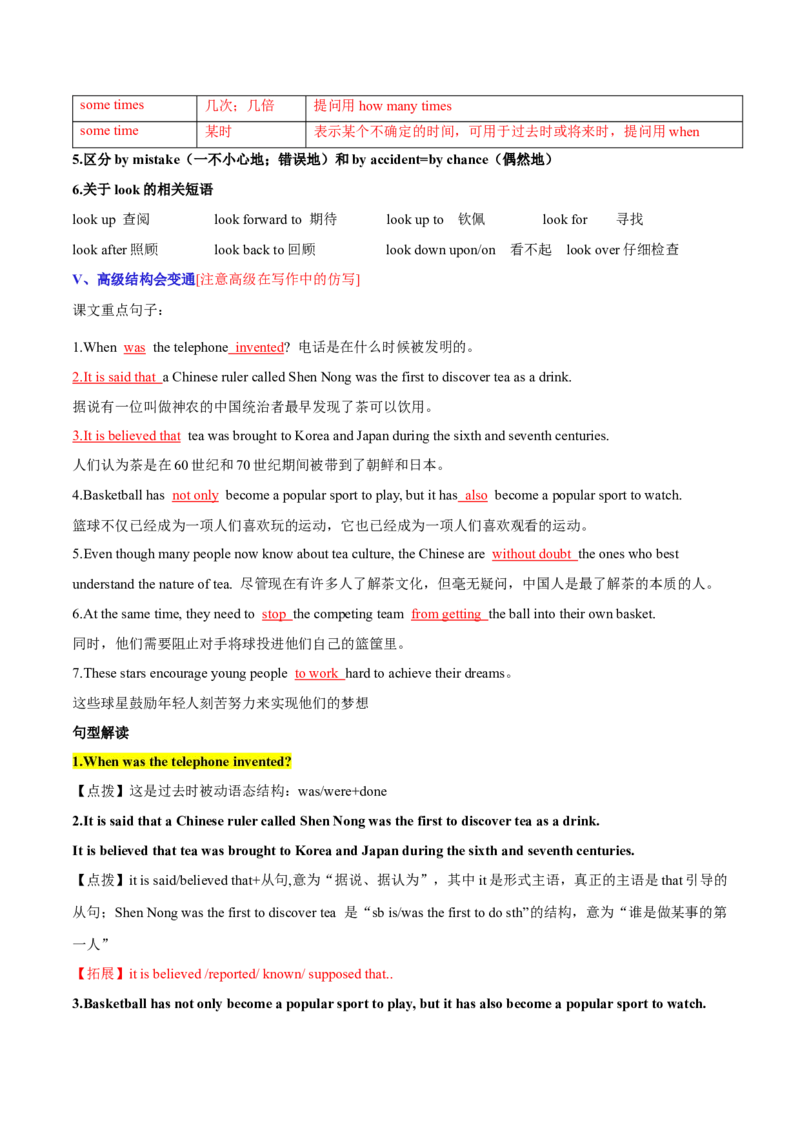
some time 某时 表示某个不确定的时间,可用于过去时或将来时,提问用when
5.区分by mistake(一不小心地;错误地)和by accident=by chance(偶然地)
6.关于look的相关短语
look up 查阅 look forward to 期待 look up to 钦佩 look for 寻找
look after照顾 look back to回顾 look down upon/on 看不起 look over仔细检查
V、高级结构会变通[注意高级在写作中的仿写]
课文重点句子:
1.When was the telephone invented? 电话是在什么时候被发明的。
2.It is said that a Chinese ruler called Shen Nong was the first to discover tea as a drink.
据说有一位叫做神农的中国统治者最早发现了茶可以饮用。
3.It is believed that tea was brought to Korea and Japan during the sixth and seventh centuries.
人们认为茶是在60世纪和70世纪期间被带到了朝鲜和日本。
4.Basketball has not only become a popular sport to play, but it has also become a popular sport to watch.
篮球不仅已经成为一项人们喜欢玩的运动,它也已经成为一项人们喜欢观看的运动。
5.Even though many people now know about tea culture, the Chinese are without doubt the ones who best
understand the nature of tea. 尽管现在有许多人了解茶文化,但毫无疑问,中国人是最了解茶的本质的人。
6.At the same time, they need to stop the competing team from getting the ball into their own basket.
同时,他们需要阻止对手将球投进他们自己的篮筐里。
7.These stars encourage young people to work hard to achieve their dreams。
这些球星鼓励年轻人刻苦努力来实现他们的梦想
句型解读
1.When was the telephone invented?
【点拨】这是过去时被动语态结构:was/were+done
2.It is said that a Chinese ruler called Shen Nong was the first to discover tea as a drink.
It is believed that tea was brought to Korea and Japan during the sixth and seventh centuries.
【点拨】it is said/believed that+从句,意为“据说、据认为”,其中it是形式主语,真正的主语是that引导的
从句;Shen Nong was the first to discover tea 是“sb is/was the first to do sth”的结构,意为“谁是做某事的第
一人”
【拓展】it is believed /reported/ known/ supposed that..
3.Basketball has not only become a popular sport to play, but it has also become a popular sport to watch.【点拨】not only,but also意为“不仅,而且”,to play和to watch修饰前面的名词sport,是作后置定语。
【拓展】1.连接两个并列的句子或句子成分;2.连接两个并列成分作主语时,谓语动词的数应和邻近它的
主语保持一致,也就是“就近原则”;3.当not only连接的句子位于句首时表示强调,要用部分倒装结构。
4.Even though many people now know about tea culture, the Chinese are without doubt the ones who best
understand the nature of tea.
【点拨】首先这是even though引导的让步状语从句,在主句“the Chinese are without doubt the ones who
best
understand the nature of tea”又包含了who引导的一个定语从句。
【拓展】without doubt意为“的确;毫无疑问”
4. At the same time, they need to stop the competing team from getting the ball into their own basket.
【点拨】stop sb. from doing sth=prevent sb. from sth=keep sb. from doing sth意为“阻止某人做某事”
【拓展】在主动语态中,from可以省略,在被动语态中不可省略。
5. These stars encourage young people to work hard to achieve their dreams。
【点拨】encourage sb. to do sth 鼓励某人做某事; achieve one’s dreams实现某人的愿望
【拓展】achieve one’s dream=realize one’s dream= make one’s dream come true实现某人的愿望
二、语法知识清单
一般过去时态的被动语态
1.被动语态定义:被动语态表示主语是谓语动词所表示的动作的承受者。
2.一般过去时的被动语态的构成:was/were + done(过去分词)
句式 构成 例句
肯定句 主语+was/were+过去分词(+by sb.) Many people were killed in a traffic accidents.
否定句 主语+was/were+not+过去分词(+by English wasn’t spoken by people here in the past.
sb.)
一般疑问句 Was/Were+主语+过去分词(+by sb.) Were the cars made in China?
特殊疑问句 特殊疑问句+was/were+not+主语+过去分 What was this kind of sweater made of?
词(+by sb.)?
How were these machines used?
3.主动语态变成被动语态的规则
Many people spoke English.
English was spoken by many people.6. 各种时态的被动语态形式归纳(以动词do为例)
一般时态 进行时态 完成时态
现在 am/is/are+done am/is/are+ being done has/have+ been done
过去 Was/were+done Was/were+being done had+ been done
将来 shall/will+be done Will/shall+have been done
含有情态动词 could/can/must/may/should+be done
5.主动句中用省to的不定式作宾补,变被动时定要加上 to。这种谓语动词有feel,hear,listen to,let,
make,have, see,notice,look at,watch(即常言道“一感二听三让四看见”)。
Eg. Mother often makes me finish my homework. I am often made to finish my homework.
6.①某些可用来表示主语内在品质或性能的不及物动词,如 sell, write, wash, clean,last(耐久), wear(耐穿), 等
可用主动形式表达被动意义.
Eg.This kind of food sells well.
②有些词如want/need后加动名词表示被动语态。
Eg. The car needs washing.=The car needs to be washed.
7.固定句型it is said/thought/supposed/reported/believed+ that从句,意为“据说/据认为/据报道”
三、语篇知识清单
一、话题分析
当前,科技发展日新月异,高新产业更是突飞猛进。现代科技改变了人们的生活,也激发了全民学科
学、爱科学、用科学的热情,形成了“大众创业,万众创新”的科学热潮。本单元以“谈论发明物的历史
及用途”为话题,涉及科普知识与技术等内容,是学生最感兴趣的话题之一。写作体裁多为说明文,写好
这类文章一定要抓住事物的特征、功能和用途。在中考中,说明文一般要按照“总一分”结构或并列结构
布局,而且在说明一件事物的时候,应按照一定的顺序:如时间顺序、空间顺序或逻提职序等。
二、写作方法
“3W法”介绍发明物
1人物:Who invented it?
2. 时间:When was it invented
3. 用途 What's a made for?
三、素材积累
发明物介细类作文常用词汇:fridge., invention, robot, mobile phone, TV. computer, light,
washing machine, helpful, useful, important, interesting, honing, change, be used for
发明物介绍类作文章用句型:
1. ...was invented by...
2. ...have changed our life a lot.
3. . Which is the most useful invention?
4. .was/is used for/to...
5. . I hope t will become...
6. . Though it was very small, it was very useful.
7. .It makes my life more enjoyable and more convenient.
【常用表达】
light bulb电灯泡 mobile phone移动电话 smarter phone智能手机 computer电脑
hand computer掌上电脑 GPS定位系统 spaceship宇宙飞船 space station空间站
robot机器人 WeChat 微信 science 科学 virus 病毒 information 信息
email电子邮件 robot机器人 screen荧光屏 mouse鼠标 application应用
invent 发明 operate操作 smart智能的 electronic电子的 laptop手提电脑
equipment 设备 software 软件 data数据 database 数据库 battery电池
chip 芯片 digital数字的 fax传真 remote遥远的 engineer 工程师 update 更新
test out the theory by experiment用实验检验理论 turn out 结果是 science and technology 科学技术
【常用短语】
be used to 被用来(做)
save us a lot of time节省我们许多时间
with the help of在……帮助下
in short总之
【写作模板】
第一段:介绍科技发明出现的原因。
算二段:具体描述该科学技术的特点和利弊。
第三段:总结并发表自己的观点。
__________(新兴事物名称) has become increasingly popular among middle school students. Some view it as a
great way to__________(对这种事物的观点1), while others think__________(对这种事物的观点2).
There are arguments both for and against__________(新兴事物名称).
On the negative side, (该事物的坏处). On the other hand, (该事物的优点1). Furthermore,(该事物的优点2).
Every coin has two sides. We should__________(发表观点).
【开头句】
1. Science plays an important part in our life.
2. … is an important/ useful invention.
2. WeChat is widely used in the world.
3. Shared bikes are more and more popular now.4. If I was an inventor. I want to invent a robot.
5. Shopping online is very popular among young people.
【中间句】
1. Generally, its advantages can be seen as follows.
2. Computers can do most of the things people can do.
3. Using smartphones distracts our attention from our lessons.
4. Some students spend too much time online, playing electronic games and sending text messages after class.
【结尾句】
Through the above, I believe that the positive aspects overweight the negative ones.
四、实例讲解
下周一上午轮到你在英语课上做课堂报告,你打算把爸爸最近网购的音乐机器人(music robot)介绍给同
学们,下图是关于这个音乐机器人的广告。请你根据所提供的信息写一份发言稿。
注意:
(1)选择所给信息进行介绍,建议举例说明并适当发挥;
(2)必须谈谈你对音乐机器人的看法;
(3)文中不得出现真实的姓名和校名;
(4)词数:80-100.
短文开头已给出,不计入总词数。
参考词汇:remind…of connect…to the Internet provide services
短文首句:
Good morning, everyone! Here, I'd like to introduce the music robot my father bought online.
____________________________________________________________________________________________
____________________________________________________________________________________________
____________________________________________________________________________________________
____________________________________________________________________________________________
____________________________________________________________________________________________
【参考范文】
Good morning, everyone! Here, I'd like to introduce the music robot my father bought online. It is small, so
you can even carry it in your backpack. After you connect it to the Internet and speak to it, it can provide different
kinds of services. For example, you just say, “Ding Dong, I want to listen to SHE's songs”, and it will play their songsimmediately. You can also ask it about weather or even your problems in study, besides, it can remind you of important
dates and so on. I am so amazed at my music robot because it makes my life more enjoyable and convenient. I really
love it!