文档文本内容
九年级初中英语知识归纳总结(第五部分):被动语态、非谓语动词
学生姓名: 年 级: 老 师:
上课日期: 时 间: 课 次:
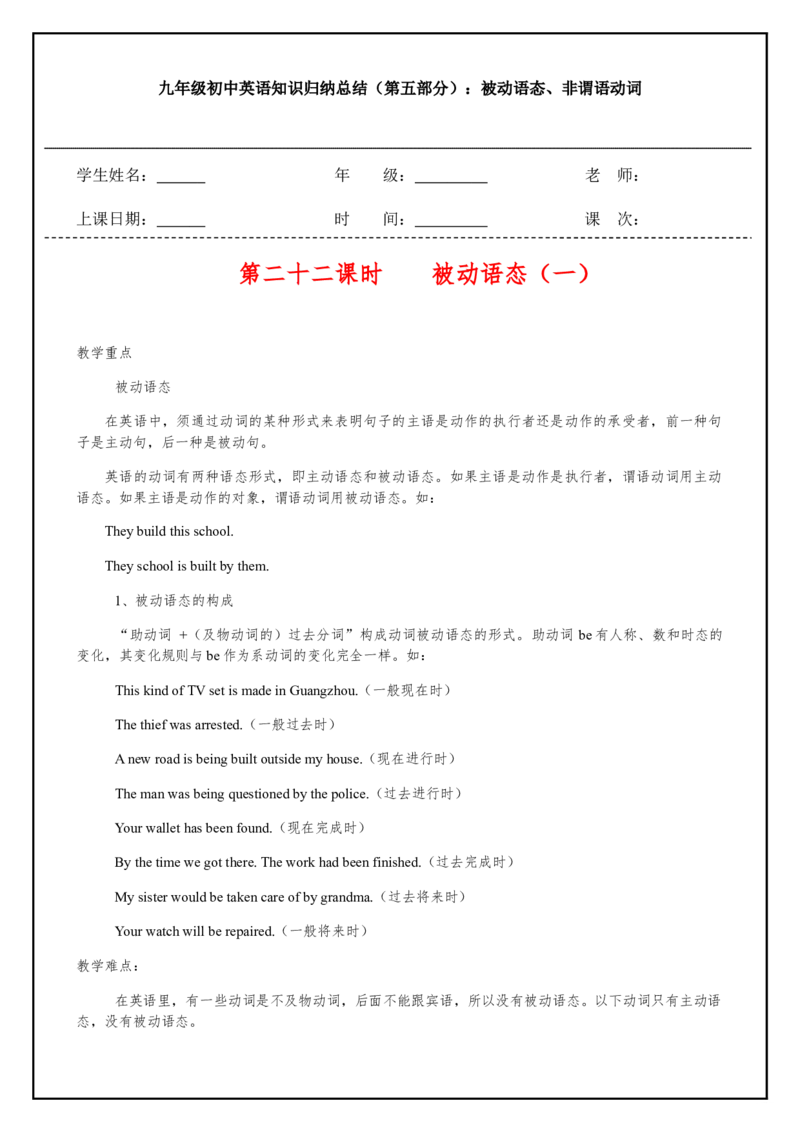
第二十二课时 被动语态(一)
教学重点
被动语态
在英语中,须通过动词的某种形式来表明句子的主语是动作的执行者还是动作的承受者,前一种句
子是主动句,后一种是被动句。
英语的动词有两种语态形式,即主动语态和被动语态。如果主语是动作是执行者,谓语动词用主动
语态。如果主语是动作的对象,谓语动词用被动语态。如:
They build this school.
They school is built by them.
1、被动语态的构成
“助动词 +(及物动词的)过去分词”构成动词被动语态的形式。助动词 be有人称、数和时态的
变化,其变化规则与be作为系动词的变化完全一样。如:
This kind of TV set is made in Guangzhou.(一般现在时)
The thief was arrested.(一般过去时)
A new road is being built outside my house.(现在进行时)
The man was being questioned by the police.(过去进行时)
Your wallet has been found.(现在完成时)
By the time we got there. The work had been finished.(过去完成时)
My sister would be taken care of by grandma.(过去将来时)
Your watch will be repaired.(一般将来时)
教学难点:
在英语里,有一些动词是不及物动词,后面不能跟宾语,所以没有被动语态。以下动词只有主动语
态,没有被动语态。appear, die, happen, fall, arrive.
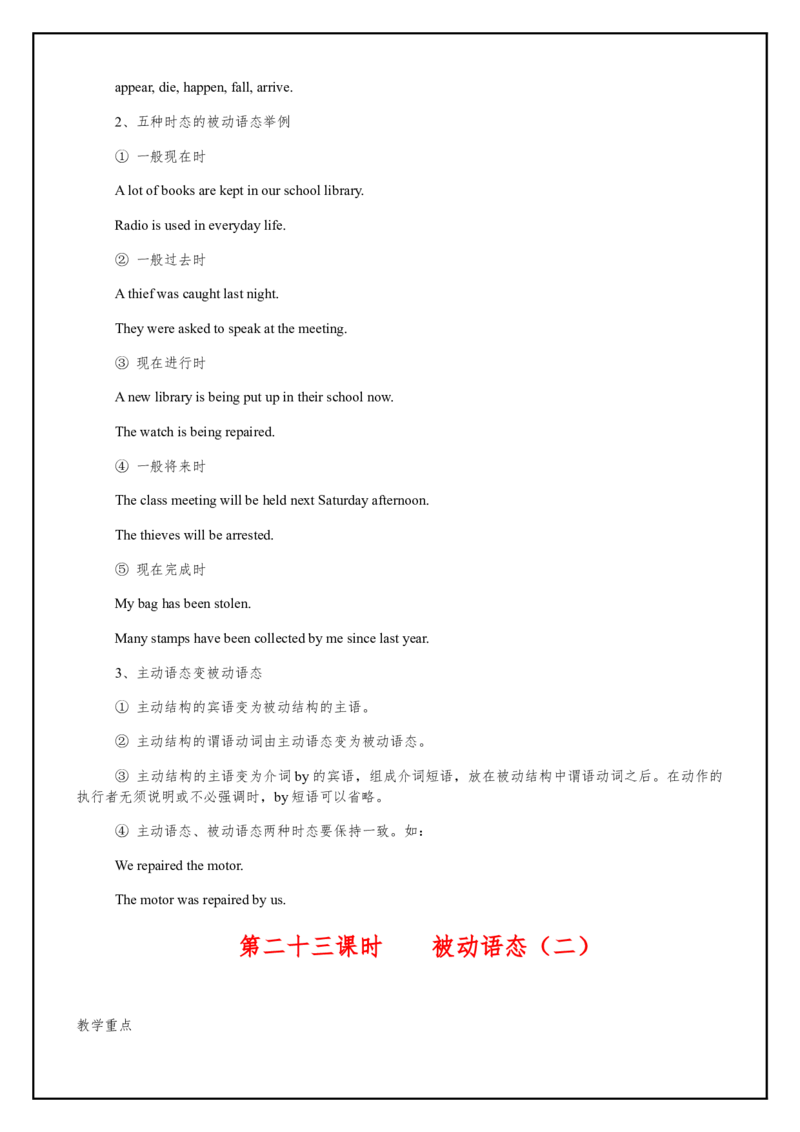
2、五种时态的被动语态举例
① 一般现在时
A lot of books are kept in our school library.
Radio is used in everyday life.
② 一般过去时
A thief was caught last night.
They were asked to speak at the meeting.
③ 现在进行时
A new library is being put up in their school now.
The watch is being repaired.
④ 一般将来时
The class meeting will be held next Saturday afternoon.
The thieves will be arrested.
⑤ 现在完成时
My bag has been stolen.
Many stamps have been collected by me since last year.
3、主动语态变被动语态
① 主动结构的宾语变为被动结构的主语。
② 主动结构的谓语动词由主动语态变为被动语态。
③ 主动结构的主语变为介词by的宾语,组成介词短语,放在被动结构中谓语动词之后。在动作的
执行者无须说明或不必强调时,by短语可以省略。
④ 主动语态、被动语态两种时态要保持一致。如:
We repaired the motor.
The motor was repaired by us.
第二十三课时 被动语态(二)
教学重点被动语态(二)
几种不同形式的被动语态
(1)含有直接宾语和间接宾语的主动结构,变为被动结构时,可以将其中一个宾语变为主语,另
一个不动,一般是主动结构的间接宾语变为被动结构的主语,这样句子显得自然一些。如:
He showed me his pictures.
I was shown his pictures by him.
I was sent a birthday present (by him).
A birthday present was sent to me (by him).
(2)含有复合宾语的主动句变为被动句的方法。
① 将宾语变为主语,宾语补足语保留不动。如:
They call her little Li. She is called little Li.
He left the door open. The door was left open by him.
② make, let, hear, watch, see, feel, have, notice, help等动词后面作宾语补足语的不定式一般不带 to,
可是当变为被动语态时,后面的不定式必须带to。如:
My brother often made me do this and that when I was young.
I was often made to do this and that by my brother when I was young.
③ 含有情态动词的被动语态,是由“情态动词 + be +(及物动词的)过去分词”构成。如:
They can not find him.
He can not be found.
④ 短语动词的被动语态
一般说来,只有及物动词才有被动语态,因为只有及物动词才可能有动作的承受者。但有许多由不
及物动词加介词及其他词类构成的短语动词,相当于及物动词,可以有宾语,因而也可以有被动语态。
但应注意,短语动词是一个不可分割的整体,在变为被动语态时,不可丢掉构成短语动词的介词或副词
如:
They had put out the fire before the fire brigade arrived.
The fire had been put out before the fire brigade arrived.
They will set up a new public school here.
A new public school will be set up here.
You must take good care of these trees.
These trees must be taken good care of.被动语态的基本用法
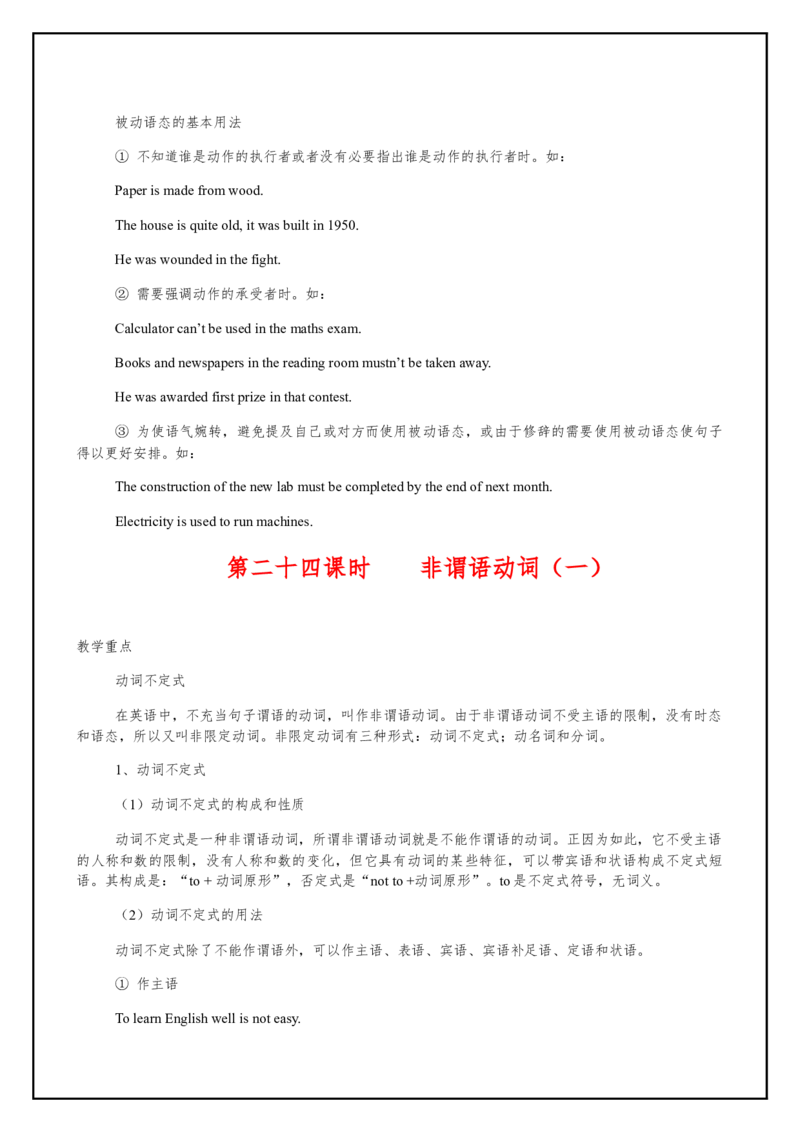
① 不知道谁是动作的执行者或者没有必要指出谁是动作的执行者时。如:
Paper is made from wood.
The house is quite old, it was built in 1950.
He was wounded in the fight.
② 需要强调动作的承受者时。如:
Calculator can’t be used in the maths exam.
Books and newspapers in the reading room mustn’t be taken away.
He was awarded first prize in that contest.
③ 为使语气婉转,避免提及自己或对方而使用被动语态,或由于修辞的需要使用被动语态使句子
得以更好安排。如:
The construction of the new lab must be completed by the end of next month.
Electricity is used to run machines.
第二十四课时 非谓语动词(一)
教学重点
动词不定式
在英语中,不充当句子谓语的动词,叫作非谓语动词。由于非谓语动词不受主语的限制,没有时态
和语态,所以又叫非限定动词。非限定动词有三种形式:动词不定式;动名词和分词。
1、动词不定式
(1)动词不定式的构成和性质
动词不定式是一种非谓语动词,所谓非谓语动词就是不能作谓语的动词。正因为如此,它不受主语
的人称和数的限制,没有人称和数的变化,但它具有动词的某些特征,可以带宾语和状语构成不定式短
语。其构成是:“to + 动词原形”,否定式是“not to +动词原形”。to是不定式符号,无词义。
(2)动词不定式的用法
动词不定式除了不能作谓语外,可以作主语、表语、宾语、宾语补足语、定语和状语。
① 作主语
To learn English well is not easy.To drive fast is quite dangerous.
不定式作主语时常常用it作形式主语,不定式放在谓语之后以上两个例句可以写成:
It is not easy to learn English well.
It is quite dangerous to drive fast.
这种用法可以归纳成这样一个句型:
It is (not) + 形容词 + (for sb.) to do sth.
It is very expensive for me to buy a car.
It is very difficult for a child to do that job.
有些形容词之后跟of + 名词(代词宾语)+不定式。如:
It is very kind of you to say so. It is very good of you to come.
② 作表语。如:
My job is to teach English. The first thing is to ring him up.
③ 作宾语。如:
She wanted to ask you a question. He forgot to turn off the light.
We decided to hold a class meeting.
常见的可以用不定式作宾语的动词有:like, love, begin, start, try, ask, prefer, hate, find等,有些形容
词可接不定式,这种不定式也可作宾语。如:
I’m very glad to see you He’s sure to come.
④ 作宾语补足语
不定式是用来补充说明宾语的,通常不定式的动作是宾语发出的。可以带不定式作宾补的动词有:
ask sb. To do sth. want sb. To do sth.
tell sb. To do sth. like sb. To do sth. help sb. (to) do sth.,还有些动词可以跟省略to的不定式作宾语补足语。
如:hear, watch, see, feel, make, let, have等。如:
I often help my mother do housework.
The policeman asked the driver to stop.
The teacher asked us not to talk in class
I want you to buy some bananas for me.
We saw him play football. We felt the house shake.
⑤ 作定语:常常放在所修饰的名词、代词之后,如:
I have a lot of of work to do. He wants something to drink.⑥ 作状语。如:
He went to the station to meet his friend.(表目的)
She has gone to the market to buy some vegetables.(表目的)
I’m so glad to hear that you have passed the exam.(表原因)
The boy is too young to go to school.(表结果)
(3)疑问词加动词不定式
疑问代词when, who, which和疑问副词when, where, why, how等加动词不定式,在句中可作主语、
宾语、表语等成分。如:
I’m don’t know how to use the computer.(作宾语)
We can’t decide which one to buy.(作宾语)
The question is how to get there.(作表语)
When to start has not been decided.(作主语)
第二十五课时 非谓语动词(二)
教学重点
动名词
动名词具有名词的特性,它在句子里主要起到主语、宾语和介词宾语的作用。
(1)动名词作主语
一般情况下表示一种抽象、泛指的动作,而不是一次性的具体的动作。动名词作主语时,常采用形
式主语it。
Swimming in this river is dangerous.
It is dangerous swimming in this river.
(2)动名词作宾语
英语中有些动词只能接动名词作宾语,不能接不定式,这些动词有:
admit(承认) avoid(避开) can’t help(禁不住)
consider(考虑) deny(否认) enjoy(喜欢)
excuse(原谅) finish(完成) mind(介意)
practise(练习) miss(错过) suggest(建议)
I can’t help laughing.
I enjoyed reading this novel.教学难点
动名词与不定式作直接宾语的比较
① remember doing sth. 表示“记午过去做过的一件事”。
remember to do sth. 表示“记得要去做某事”。
I remember seeing the man before.
② forget doing sth. 表示“忘记曾做过某事”。
forget to do sth.表示“忘记去做某事”。如
I forgot to turn off the lights when I left the room
③ regret doing sth. 表示“对过去做过的一件事情后悔”。
regret to do sth.表示“对还没做,或正在做的事情感到后悔、抱歉”。如:
I regret telling you the bad news.
I regret to say I’m unable to help you.
④ stop doing sth. 表示“停止正在做的事情”。
stop to do sth. 表示“停下来,去做另一件事情”。如:
We stopped to see what happened.
Let’s stop talking about it.
⑤ try doing sth. 表示“尝试着做某事”。
try to do sth. 表示“设法做某事”。如:
I’ll try doing it in a new way.
I once tried to learn Japanese.
⑥ mean doing sth 表示“意味着,意思是”
mean to do sth. 表示“打算,想要做某事”。如:
Giving up the job means missing a good opportunity.
放弃这份工作意味着错过了一个好机会。
I mean to help him with it.
⑦ prefer to do sth ……rather than do sth
prefer doing sth. to doing sth. 表示“喜欢做这件事而不喜欢做那件事”。如:
I prefer working to staying at home.This pair of shoes needs repairing.
The walls of the room want whitewashing.