Unit 4 I used to be afraid of the dark.
单元总览
类别 课程标准要求掌握的项目
单元话题 In this unit, students learn to talk about how we have changed and what we used to like
1. humorous adj. 有幽默感的;图 11. speech n. 讲话;发言;
2. silent adj. 沉默的; 12. ant n. 蚂蚁;
3. helpful adj. 有用的,有帮助的: 13. insect n. 昆虫
4. score n&v. 得分,进球。 14. influence n&v 影响;
5. interview v&n. 面试,采访; 15. proud adj. 自豪的,骄傲的;
重点单词
6. dare v. 敢于;胆敢; 16. seldom adv. 不常,很少;
7. private adj. 私人的,私密的。 17. fail v.不及格,失败;
8. require v. 需要;要求; 18. general adj. 普通的,常规的;
9. European adj. 欧洲的; 19. introduction n. 介绍;
10. British adj. 英国的;
1. used to过去曾经 14. be proud of ./take pride in 为…感到
2. be afraid of the dark惧怕黑暗 骄傲
[来源:Z_xx_k.Com]
3. from time to time时常 15. be absent from classes逃课
4. get good scores取得好的分数 16. fail the examinations考试不及格
5. deal with对付,应对 17. make a decision下决心
6. get tons of attention得到大量的关注 18. talk with sb in person 亲自找某人谈话
7. read books on European history 19. to one’ surprise使某人惊讶的是
重点词组 阅读有关欧洲历史的书 20. feel good about oneself对自己充满信心
8. African culture非洲文化 21. a general self-introduction
9. be alone独处 一个简要的自我介绍
10. give a speech in作一个公开演讲 public 22. in the last few years在最近几年
11. paint pictures画画 23. remain silent 保持沉默
12. be nervous about对考试感到紧张tests 24. have a great influence on sb
13. influence his way of thinking 对某人有很大的影响
影响他的思维方式
1. ---You used to be short, didn’t you? ---Yes, I did.---你过去个子矮,是吗?---是的,我
是。
2. ---What’s he like now? ---He’s tall now.---她现在是什么样?---她现在很高。
3. Paula used to be really quiet, she was never brave enough to ask questions.波拉以前很
文静,她从来不够勇敢来问题。
4. It’s three years since we last saw our primary school classmates.自从我们上次见到我们
重点句式 的初中同学以来已有三年了。
5. Emily didn’t use to eat a lot of vegetables, but now she loves carrots and tomatoes.艾
米丽过去不吃许多蔬菜,但是现在她喜爱胡萝卜和西红柿。
6. ----I used to be nervous about tests all the time. What about you?
---Yes, me too. And I used to hate P.E class.--我以前对考试一直感到紧张,你呢?
---是的,我也是。 并且我过去还讨厌上体育课。
7. My life has changed a lot in the last few years.我的生活在近几年改变了许多。
单元语法 Used to 结构
课时分解
第一课时 Section A(1a ~ 2d)
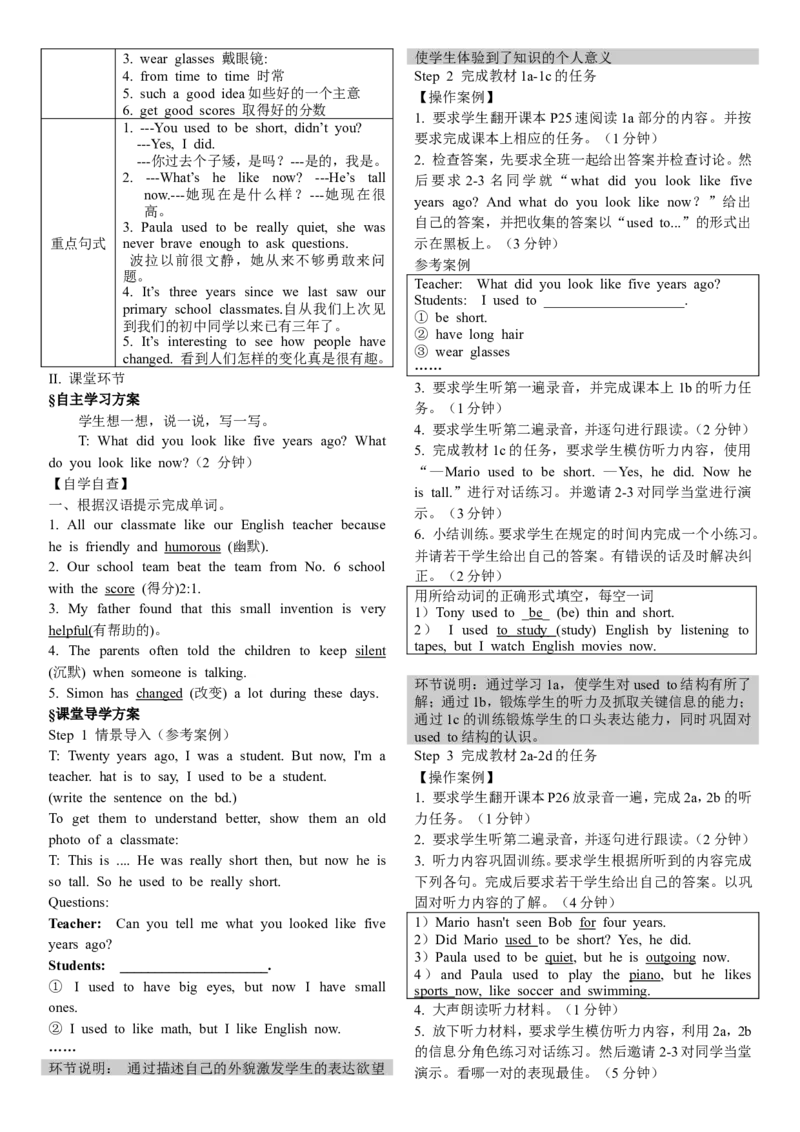
I. I. 知识目标 3. helpful adj. 有用的,有帮助的:
类别 课时要点 4. score n&v. 得分,进球。
1. humorous adj. 有幽默感的 1. used to过去曾经
重点单词 重点词组
2. silent adj. 沉默的; 2. be afraid of the dark惧怕黑暗3. wear glasses 戴眼镜: 使学生体验到了知识的个人意义
4. from time to time 时常 Step 2 完成教材1a-1c的任务
5. such a good idea如些好的一个主意 【操作案例】
6. get good scores 取得好的分数
1. 要求学生翻开课本P25速阅读1a部分的内容。并按
1. ---You used to be short, didn’t you?
---Yes, I did.
要求完成课本上相应的任务。(1分钟)
---你过去个子矮,是吗?---是的,我是。 2. 检查答案,先要求全班一起给出答案并检查讨论。然
2. ---What’s he like now? ---He’s tall 后要求 2-3 名同学就“what did you look like five
now.---她现在是什么样?---她现在很
years ago? And what do you look like now?”给出
高。
3. Paula used to be really quiet, she was
自己的答案,并把收集的答案以“used to...”的形式出
重点句式 never brave enough to ask questions. 示在黑板上。(3分钟)
波拉以前很文静,她从来不够勇敢来问
参考案例
题。
Teacher: What did you look like five years ago?
4. It’s three years since we last saw our
Students: I used to ____________________.
primary school classmates.自从我们上次见
① be short.
到我们的初中同学以来已有三年了。
② have long hair
5. It’s interesting to see how people have
③ wear glasses
changed. 看到人们怎样的变化真是很有趣。
……
II. 课堂环节
3. 要求学生听第一遍录音,并完成课本上1b的听力任
§自主学习方案
务。(1分钟)
学生想一想,说一说,写一写。
4. 要求学生听第二遍录音,并逐句进行跟读。(2分钟)
T: What did you look like five years ago? What
5. 完成教材1c的任务,要求学生模仿听力内容,使用
do you look like now?(2 分钟)
“—Mario used to be short. —Yes, he did. Now he
【自学自查】
is tall.”进行对话练习。并邀请2-3对同学当堂进行演
一、根据汉语提示完成单词。
示。(3分钟)
1. All our classmate like our English teacher because
6. 小结训练。要求学生在规定的时间内完成一个小练习。
he is friendly and humorous (幽默).
并请若干学生给出自己的答案。有错误的话及时解决纠
2. Our school team beat the team from No. 6 school
正。(2分钟)
with the score (得分)2:1.
用所给动词的正确形式填空,每空一词
3. My father found that this small invention is very 1)Tony used to _be_ (be) thin and short.
helpful(有帮助的)。 2) I used to study (study) English by listening to
4. The parents often told the children to keep silent
tapes, but I watch English movies now.
(沉默) when someone is talking.
[来源:学+科+网Z+X+X+K] 环节说明:通过学习1a,使学生对used to结构有所了
5. Simon has changed (改变) a lot during these days.
解;通过1b,锻炼学生的听力及抓取关键信息的能力;
§课堂导学方案
通过1c的训练锻炼学生的口头表达能力,同时巩固对
Step 1 情景导入(参考案例) used to结构的认识。
T: Twenty years ago, I was a student. But now, I'm a Step 3 完成教材2a-2d的任务
teacher. hat is to say, I used to be a student. 【操作案例】
(write the sentence on the bd.) 1. 要求学生翻开课本P26放录音一遍,完成2a,2b的听
To get them to understand better, show them an old 力任务。(1分钟)
photo of a classmate: 2. 要求学生听第二遍录音,并逐句进行跟读。(2分钟)
T: This is .... He was really short then, but now he is 3. 听力内容巩固训练。要求学生根据所听到的内容完成
so tall. So he used to be really short. 下列各句。完成后要求若干学生给出自己的答案。以巩
Questions: 固对听力内容的了解。(4分钟)
Teacher: Can you tell me what you looked like five 1)Mario hasn't seen Bob for four years.
years ago?
2)Did Mario used to be short? Yes, he did.
3)Paula used to be quiet, but he is outgoing now.
Students: _____________________.
4)and Paula used to play the piano, but he likes
① I used to have big eyes, but now I have small sports now, like soccer and swimming.
ones. 4. 大声朗读听力材料。(1分钟)
② I used to like math, but I like English now. 5. 放下听力材料,要求学生模仿听力内容,利用2a,2b
…… 的信息分角色练习对话练习。然后邀请2-3对同学当堂
环节说明: 通过描述自己的外貌激发学生的表达欲望
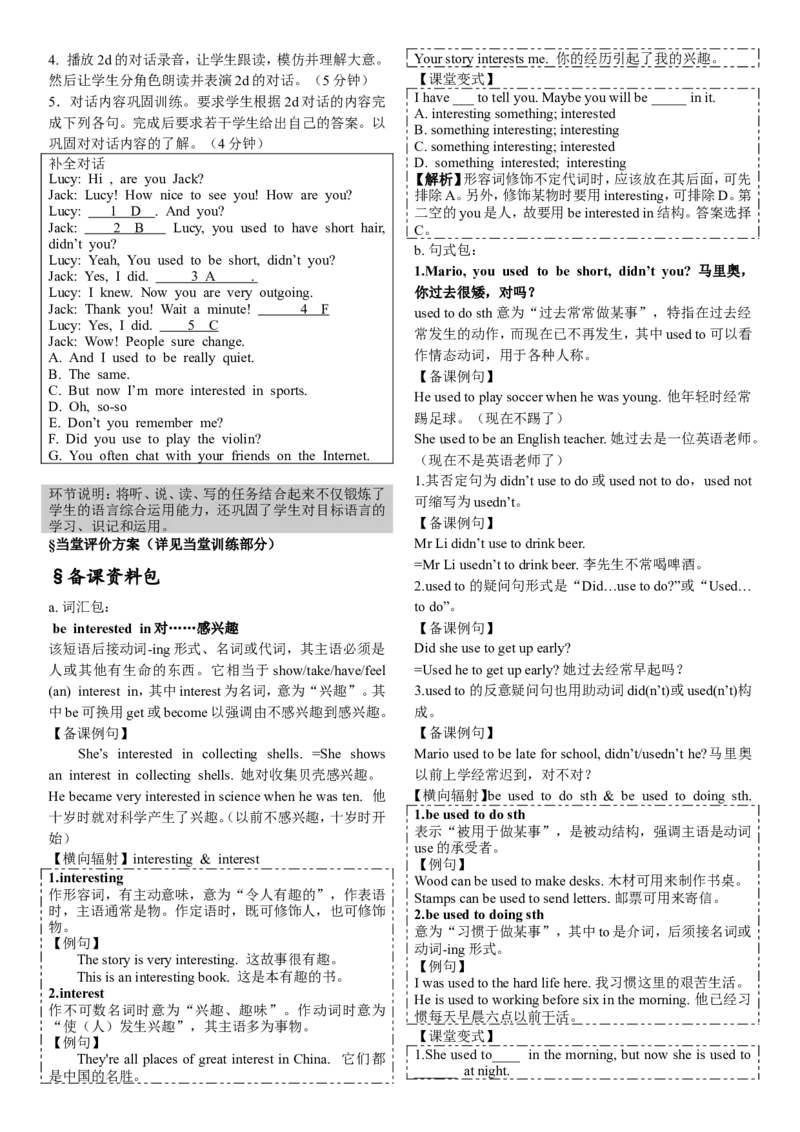
演示。看哪一对的表现最佳。(5分钟)4. 播放2d的对话录音,让学生跟读,模仿并理解大意。 Your story interests me. 你的经历引起了我的兴趣。
然后让学生分角色朗读并表演2d的对话。(5分钟) 【课堂变式】
5.对话内容巩固训练。要求学生根据2d对话的内容完 I have ___ to tell you. Maybe you will be _____ in it.
A. interesting something; interested
成下列各句。完成后要求若干学生给出自己的答案。以
B. something interesting; interesting
巩固对对话内容的了解。(4分钟) C. something interesting; interested
补全对话 D. something interested; interesting
Lucy: Hi , are you Jack? 【解析】形容词修饰不定代词时,应该放在其后面,可先
Jack: Lucy! How nice to see you! How are you? 排除A。另外,修饰某物时要用interesting,可排除D。第
Lucy: 1 D . And you? 二空的you是人,故要用be interested in结构。答案选择
Jack: 2 B Lucy, you used to have short hair, C。
didn’t you?
b. 句式包:
Lucy: Yeah, You used to be short, didn’t you?
1.Mario, you used to be short, didn’t you? 马里奥,
Jack: Yes, I did. 3 A .
Lucy: I knew. Now you are very outgoing. 你过去很矮,对吗?
Jack: Thank you! Wait a minute! 4 F used to do sth 意为“过去常常做某事”,特指在过去经
Lucy: Yes, I did. 5 C
常发生的动作,而现在已不再发生,其中used to 可以看
Jack: Wow! People sure change.
A. And I used to be really quiet. 作情态动词,用于各种人称。
B. The same. 【备课例句】
C. But now I’m more interested in sports.
He used to play soccer when he was young. 他年轻时经常
D. Oh, so-so
踢足球。(现在不踢了)
E. Don’t you remember me?
F. Did you use to play the violin? She used to be an English teacher. 她过去是一位英语老师。
G. You often chat with your friends on the Internet.
(现在不是英语老师了)
1.其否定句为didn’t use to do或used not to do,used not
环节说明:将听、说、读、写的任务结合起来不仅锻炼了
可缩写为usedn’t。
学生的语言综合运用能力,还巩固了学生对目标语言的
学习、识记和运用。 【备课例句】
§当堂评价方案(详见当堂训练部分) Mr Li didn’t use to drink beer.
=Mr Li usedn’t to drink beer. 李先生不常喝啤酒。
§备课资料包
2.used to 的疑问句形式是“Did…use to do?”或“Used…
a. 词汇包: to do”。
be interested in对……感兴趣 【备课例句】
该短语后接动词-ing形式、名词或代词,其主语必须是 Did she use to get up early?
人或其他有生命的东西。它相当于show/take/have/feel =Used he to get up early? 她过去经常早起吗?
(an) interest in,其中interest为名词,意为“兴趣”。其 3.used to 的反意疑问句也用助动词did(n’t)或used(n’t)构
中be可换用get或become以强调由不感兴趣到感兴趣。 成。
【备课例句】 【备课例句】
She’s interested in collecting shells. =She shows Mario used to be late for school, didn’t/usedn’t he?马里奥
an interest in collecting shells. 她对收集贝壳感兴趣。 以前上学经常迟到,对不对?
He became very interested in science when he was ten. 他 【横向辐射】be used to do sth & be used to doing sth.
十岁时就对科学产生了兴趣。(以前不感兴趣,十岁时开 1.be used to do sth
表示“被用于做某事”,是被动结构,强调主语是动词
始)
use的承受者。
【横向辐射】interesting & interest
【例句】
1.interesting Wood can be used to make desks. 木材可用来制作书桌。
作形容词,有主动意味,意为“令人有趣的”,作表语 Stamps can be used to send letters. 邮票可用来寄信。
时,主语通常是物。作定语时,既可修饰人,也可修饰
2.be used to doing sth
物。
意为“习惯于做某事”,其中to是介词,后须接名词或
【例句】
动词-ing形式。
The story is very interesting. 这故事很有趣。
【例句】
This is an interesting book. 这是本有趣的书。
I was used to the hard life here. 我习惯这里的艰苦生活。
2.interest
He is used to working before six in the morning. 他已经习
作不可数名词时意为“兴趣、趣味”。作动词时意为
惯每天早晨六点以前干活。
“使(人)发生兴趣”,其主语多为事物。
【课堂变式】
【例句】
They're all places of great interest in China. 它们都 1.She used to____ in the morning, but now she is used to
______ at night.
是中国的名胜。A. read; read B. read; reading 【例句】
C. reading; read D. reading; reading —What is Lily like? 莉莉是怎样的一个人?
【解析】前一空是used to do sth结构,后一空是be used —She’s a very nice girl. 她是个非常好的女孩。
to doing 结构。若第二空采用be used to do sth结构, —What’s the weather like? 今天天气怎么样?
主语she不能成为use的承受者。另外,由but now可知 —Very fine. 很晴朗。
前一句说的是过去的情况,后一空说的是现在的情况。 —What’s this book like? 这本书怎么样?
正确答案是B。 —Very interesting. 很有趣。
2.I used to go outside on weekends. (改为否定句) 2.What does sb like?
I____ ____ to go outside on weekends. 该句型用来询问某人“喜欢什么”,like为动词“喜
【解析】本题考查used to do的否定结构。其否定句为 欢”。
didn’t use to do 或 used not to do。正确答案是 didn’t 【例句】
use/used not。 —What does Li Hua like? 李华喜欢什么?
2.What did his friends used to look like? 他的朋友 —
过去长得什么样子?
What does sb look like? 只用来询问某人的外貌长相,相
He likes swimming. 他喜欢游泳。
当于What is sb like?, like在句中作介词,意为“像”。
【课堂变式】
【备课例句】
—What does the lady look like?
—What does Tom look like? (=What is Tom like?) 汤姆 — .
长得什么模样? A. She’s fine and well B. She’s really a nice lady
C. She’s tall and thin D. She likes wearing skirts
—He is very much like his father, tall and dark. 他非常像
【 解
他的父亲又高又黑。
【横向辐射】What is sb/ sth like?& What does sb like?
1.What is sb/ sth like? 析】A意为“她身体很好”,B意为“她的确是个好女
What is sb like? 还可用来询问某人的品质。What is 士”,C意为“她是个瘦高个”,D意为“她喜欢穿短
sth. like?用来询问事物的性质,特别是用来谈论天气状 裙子”。问句是问长相如何,应选C。
况, like在句中作介词,意为“像”。
第二课时 Section A(3a ~ 3c)
I. 知识目标 everywhere I go.我以前在学校并不出名,
类别 课时要点 但现在我无论到哪都受到广泛地关注。
3. You can never imagine how difficult
1. interview v&n. 面试,采访;
the road to success is.你可能永远也想象
2. dare v. 敢于;胆敢;
重点单词 不到通向成功的道路有多么的艰难。
3. private adj. 私人的,私密的。
4. require v. 需要;要求; [来源:学科网] II. 课堂环节
1. take up singing从事歌唱
§自主学习方案
2. deal with对付,应对
3. in front of crowd 在众人面前
【新词自查】
重点词组 4. get tons of attention得到大量的关注
根据汉语提示完成单词。
5. fight on 坚持
6. a small number of people 很小一部分 1. The man wanted to get some information about the
人 woman’s background (背景).
1. Candy told me that she used to be
2. Alice has to stay up late to prepare for her
really shy and took up singing to deal
interview (面试).
with her shyness. 凯迪告诉我她以前真的
重点句式
很害羞并且开始唱歌来应对她的害羞。 3. You should never ask any private ( 私 人 的 )
2. I didn’t use to be popular in school, questions when you talk to a foreigner.
but now I get tons of attention
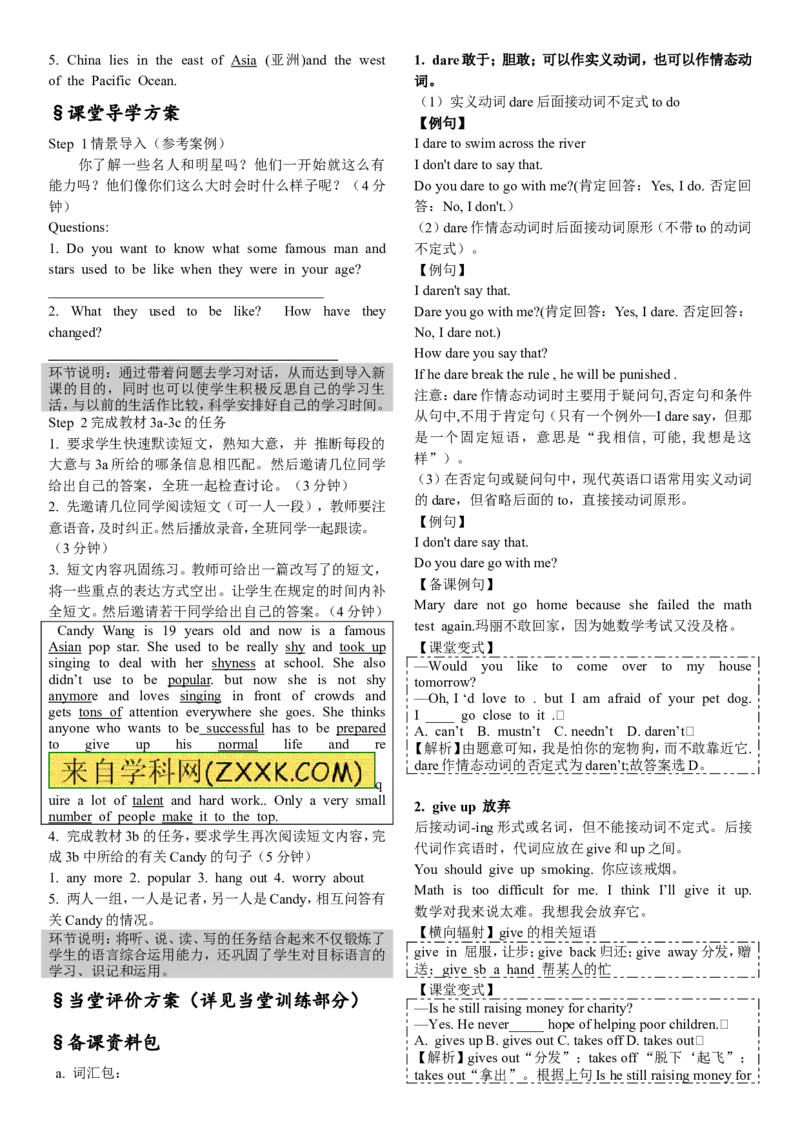
4. Paulo got a new job as a guard (警卫).5. China lies in the east of Asia (亚洲)and the west 1. dare敢于;胆敢;可以作实义动词,也可以作情态动
of the Pacific Ocean. 词。
(1)实义动词dare后面接动词不定式to do
§课堂导学方案
【例句】
Step 1情景导入(参考案例) I dare to swim across the river
你了解一些名人和明星吗?他们一开始就这么有 I don't dare to say that.
能力吗?他们像你们这么大时会时什么样子呢?(4分 Do you dare to go with me?(肯定回答:Yes, I do. 否定回
钟) 答:No, I don't.)
Questions: (2)dare作情态动词时后面接动词原形(不带to的动词
1. Do you want to know what some famous man and 不定式)。
stars used to be like when they were in your age? 【例句】
_______________________________________ I daren't say that.
2. What they used to be like? How have they Dare you go with me?(肯定回答:Yes, I dare. 否定回答:
changed? No, I dare not.)
_________________________________________ How dare you say that?
环节说明:通过带着问题去学习对话,从而达到导入新 If he dare break the rule , he will be punished .
课的目的,同时也可以使学生积极反思自己的学习生
注意:dare作情态动词时主要用于疑问句,否定句和条件
活,与以前的生活作比较,科学安排好自己的学习时间。
从句中,不用于肯定句(只有一个例外—I dare say,但那
Step 2完成教材3a-3c的任务
是一个固定短语,意思是“我相信, 可能, 我想是这
1. 要求学生快速默读短文,熟知大意,并 推断每段的
样”)。
大意与3a所给的哪条信息相匹配。然后邀请几位同学
(3)在否定句或疑问句中,现代英语口语常用实义动词
给出自己的答案,全班一起检查讨论。(3分钟)
的dare,但省略后面的to,直接接动词原形。
2. 先邀请几位同学阅读短文(可一人一段),教师要注
【例句】
意语音,及时纠正。然后播放录音,全班同学一起跟读。
I don't dare say that.
(3分钟)
Do you dare go with me?
3. 短文内容巩固练习。教师可给出一篇改写了的短文,
【备课例句】
将一些重点的表达方式空出。让学生在规定的时间内补
Mary dare not go home because she failed the math
全短文。然后邀请若干同学给出自己的答案。(4分钟)
Candy Wang is 19 years old and now is a famous
test again.玛丽不敢回家,因为她数学考试又没及格。
Asian pop star. She used to be really shy and took up 【课堂变式】
singing to deal with her shyness at school. She also —Would you like to come over to my house
didn’t use to be popular. but now she is not shy tomorrow?
anymore and loves singing in front of crowds and —Oh, I ‘d love to . but I am afraid of your pet dog.
gets tons of attention everywhere she goes. She thinks I ____ go close to it .
anyone who wants to be successfu l has to be prepared A. can’t B. mustn’t C. needn’t D. daren’t
to give up his normal life and re 【解析】由题意可知,我是怕你的宠物狗,而不敢靠近它.
dare作情态动词的否定式为daren’t;故答案选D。
q
uire a lot of talent and hard work.. Only a very small
2. give up 放弃
number of people make it to the top.
后接动词-ing形式或名词,但不能接动词不定式。后接
4. 完成教材3b的任务,要求学生再次阅读短文内容,完
代词作宾语时,代词应放在give和up之间。
成3b中所给的有关Candy的句子(5分钟)
You should give up smoking. 你应该戒烟。
1. any more 2. popular 3. hang out 4. worry about
Math is too difficult for me. I think I’ll give it up.
5. 两人一组,一人是记者,另一人是Candy,相互问答有
数学对我来说太难。我想我会放弃它。
关Candy的情况。
【横向辐射】give的相关短语
环节说明:将听、说、读、写的任务结合起来不仅锻炼了
学生的语言综合运用能力,还巩固了学生对目标语言的 give in 屈服,让步;give back归还;give away分发,赠
学习、识记和运用。 送;give sb a hand 帮某人的忙
【课堂变式】
§当堂评价方案(详见当堂训练部分)
—Is he still raising money for charity?
—Yes. He never_____ hope of helping poor children.
§备课资料包 A. gives up B. gives out C. takes off D. takes out
【解析】gives out“分发”;takes off “脱下‘起飞”;
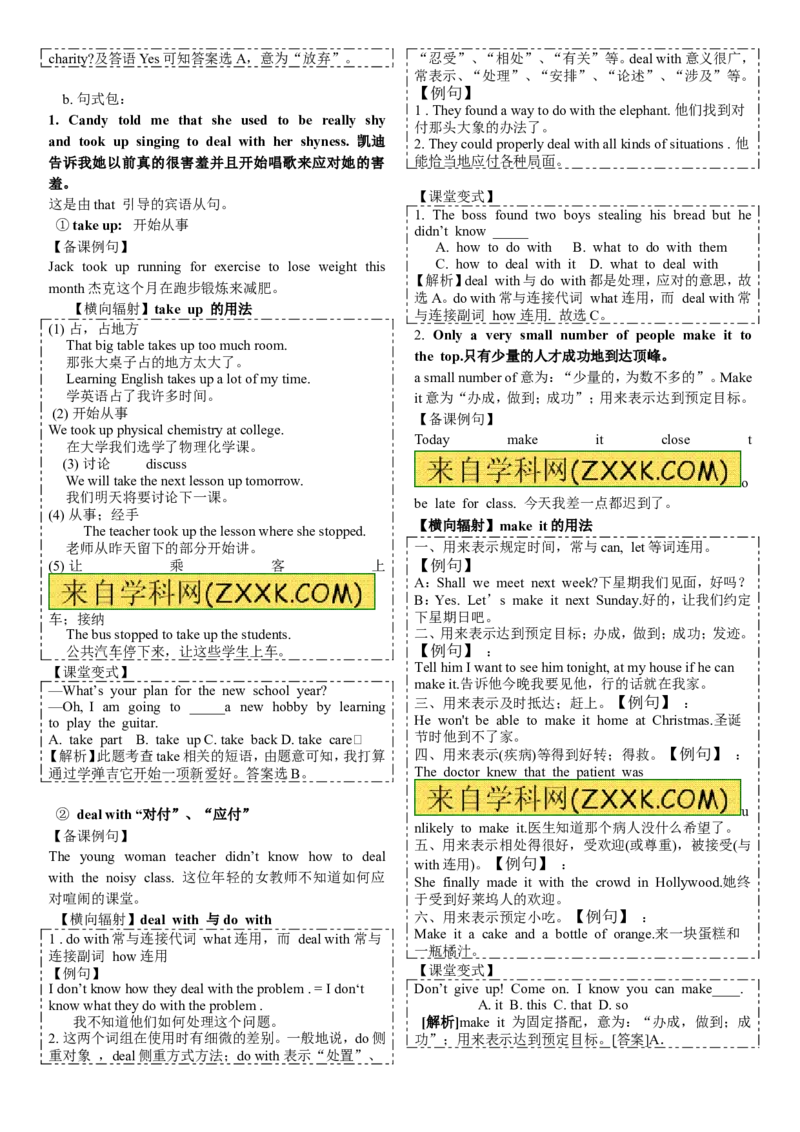
a. 词汇包: takes out“拿出”。根据上句Is he still raising money forcharity?及答语Yes可知答案选A,意为“放弃”。 “忍受”、“相处”、“有关”等。deal with 意义很广,
常表示、“处理”、“安排”、“论述”、“涉及”等。
【例句】
b. 句式包:
1 . They found a way to do with the elephant. 他们找到对
1. Candy told me that she used to be really shy
付那头大象的办法了。
and took up singing to deal with her shyness. 凯迪 2. They could properly deal with all kinds of situations . 他
告诉我她以前真的很害羞并且开始唱歌来应对她的害 能恰当地应付各种局面。
羞。
【课堂变式】
这是由that 引导的宾语从句。
1. The boss found two boys stealing his bread but he
①take up: 开始从事
didn’t know _____
【备课例句】 A. how to do with B. what to do with them
Jack took up running for exercise to lose weight this C. how to deal with it D. what to deal with
【解析】deal with与do with都是处理,应对的意思,故
month 杰克这个月在跑步锻炼来减肥。
选A。do with常与连接代词 what 连用,而 deal with 常
【横向辐射】take up 的用法
与连接副词 how 连用. 故选C。
(1) 占,占地方
2. Only a very small number of people make it to
That big table takes up too much room.
the top.只有少量的人才成功地到达顶峰。
那张大桌子占的地方太大了。
Learning English takes up a lot of my time. a small number of 意为:“少量的,为数不多的”。Make
学英语占了我许多时间。 it意为“办成,做到;成功”;用来表示达到预定目标。
(2) 开始从事
【备课例句】
We took up physical chemistry at college.
Today make it close t
在大学我们选学了物理化学课。
(3) 讨论 discuss
We will take the next lesson up tomorrow. o
我们明天将要讨论下一课。
be late for class. 今天我差一点都迟到了。
(4) 从事;经手
【横向辐射】make it的用法
The teacher took up the lesson where she stopped.
老师从昨天留下的部分开始讲。 一、用来表示规定时间,常与can, let等词连用。
(5) 让 乘 客 上 【例句】
A:Shall we meet next week?下星期我们见面,好吗?
B:Yes. Let’s make it next Sunday.好的,让我们约定
车;接纳 下星期日吧。
The bus stopped to take up the students. 二、用来表示达到预定目标;办成,做到;成功;发迹。
公共汽车停下来,让这些学生上车。 【例句】 :
Tell him I want to see him tonight, at my house if he can
【课堂变式】
make it.告诉他今晚我要见他,行的话就在我家。
—What’s your plan for the new school year?
—Oh, I am going to _____a new hobby by learning
三、用来表示及时抵达;赶上。【例句】 :
to play the guitar. He won't be able to make it home at Christmas.圣诞
A. take part B. take up C. take back D. take care 节时他到不了家。
【解析】此题考查take相关的短语,由题意可知,我打算 四、用来表示(疾病)等得到好转;得救。【例句】 :
通过学弹吉它开始一项新爱好。答案选B。 The doctor knew that the patient was
② deal with “对付”、“应付” u
nlikely to make it.医生知道那个病人没什么希望了。
【备课例句】
五、用来表示相处得很好,受欢迎(或尊重),被接受(与
The young woman teacher didn’t know how to deal
with连用)。【例句】 :
with the noisy class. 这位年轻的女教师不知道如何应 She finally made it with the crowd in Hollywood.她终
对喧闹的课堂。 于受到好莱坞人的欢迎。
【横向辐射】deal with 与do with 六、用来表示预定小吃。【例句】 :
Make it a cake and a bottle of orange.来一块蛋糕和
1 . do with常与连接代词 what 连用,而 deal with 常与
一瓶橘汁。
连接副词 how 连用
【例句】 【课堂变式】
I don’t know how they deal with the problem . = I don‘t Don’t give up! Come on. I know you can make____.
know what they do with the problem . A. it B. this C. that D. so
我不知道他们如何处理这个问题。 [解析]make it 为固定搭配,意为:“办成,做到;成
2. 这两个词组在使用时有细微的差别。一般地说,do侧 功”;用来表示达到预定目标。[答案]A.
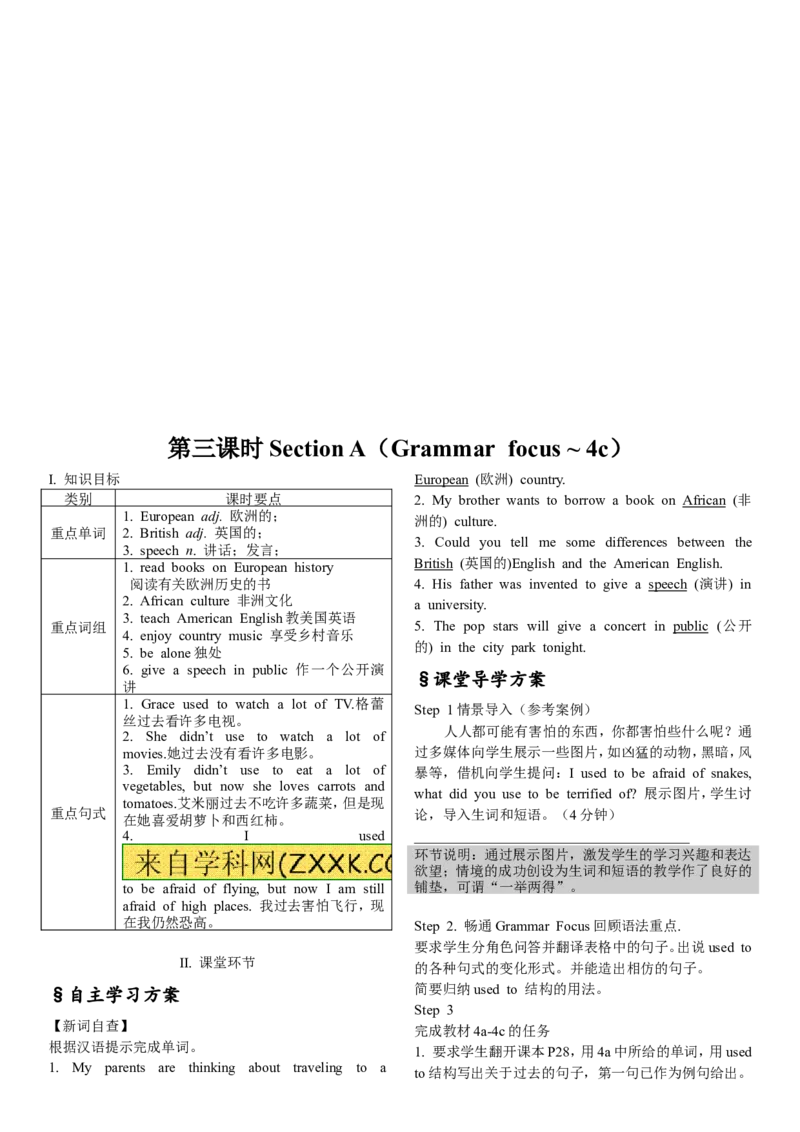
重对象 ,deal侧重方式方法;do with 表示“处置”、第三课时 Section A(Grammar focus ~ 4c)
I. 知识目标 European (欧洲) country.
类别 课时要点 2. My brother wants to borrow a book on African (非
1. European adj. 欧洲的;
洲的) culture.
重点单词 2. British adj. 英国的;
3. Could you tell me some differences between the
3. speech n. 讲话;发言;
1. read books on European history
British (英国的)English and the American English.
阅读有关欧洲历史的书 4. His father was invented to give a speech (演讲) in
2. African culture 非洲文化 a university.
3. teach American English教美国英语
重点词组 5. The pop stars will give a concert in public (公开
4. enjoy country music 享受乡村音乐
的) in the city park tonight.
5. be alone独处
6. give a speech in public 作一个公开演
§课堂导学方案
讲
1. Grace used to watch a lot of TV.格蕾
Step 1情景导入(参考案例)
丝过去看许多电视。
人人都可能有害怕的东西,你都害怕些什么呢?通
2. She didn’t use to watch a lot of
movies.她过去没有看许多电影。 过多媒体向学生展示一些图片,如凶猛的动物,黑暗,风
3. Emily didn’t use to eat a lot of 暴等,借机向学生提问:I used to be afraid of snakes,
vegetables, but now she loves carrots and
what did you use to be terrified of? 展示图片,学生讨
tomatoes.艾米丽过去不吃许多蔬菜,但是现
重点句式 论,导入生词和短语。(4分钟)
在她喜爱胡萝卜和西红柿。
4. I used _______________________________________
环节说明:通过展示图片,激发学生的学习兴趣和表达
欲望;情境的成功创设为生词和短语的教学作了良好的
to be afraid of flying, but now I am still 铺垫,可谓“一举两得”。
afraid of high places. 我过去害怕飞行,现
在我仍然恐高。 Step 2. 畅通Grammar Focus回顾语法重点.
要求学生分角色问答并翻译表格中的句子。出说used to
II. 课堂环节
的各种句式的变化形式。并能造出相仿的句子。
§自主学习方案 简要归纳used to 结构的用法。
Step 3
【新词自查】
完成教材4a-4c的任务
根据汉语提示完成单词。
1. 要求学生翻开课本P28,用4a中所给的单词,用used
1. My parents are thinking about traveling to a
to结构写出关于过去的句子,第一句已作为例句给出。给出5分钟的时限,并请另个3位同学在黑板上做。全 reads at least six books a year.
班集体核对答案。 3. 先根据自己的实际情况填写4c的表格,然后再与同
参考答案 伴交流讨论,完成另一半表格。
2.My mom used to have curly hair. She didn’t use to 4. 小结训练。要求学生在规定的时间内完成一个小练习。
have straight hair. 并请若干学生给出自己的答案。有错误的话及时解决纠
3. Jerry used to read books on European history. She 正。(2分钟)
didn’t use to read books on African culture. 用所给词的适当形式填空。
1. Tony is afraid of being (be) at school alone.
4. Sandy used to teach British English. She didn’t use
2. Grace used to hate(hate)watching scary movies.
to teach American English.
3. The scientist will give a speech (speak) on how
2. 参照4b表格中所提供的信息和例句,写出关于Emily to study English.
的句子。(2分钟) 4. Mr. Chen is friendly (friend) to her students.
5. You like Chinese music but I like the African
参考答案
(Africa) music.
Emily used to listen to pop music, but now she
enjoys country music.
环节说明:将听、说、读、写的任务结合起来不仅锻炼了
Emily used to watch scary movies, but now he hates 学生的语言综合运用能力,还巩固了学生对目标语言的
学习、识记和运用。
scary movies.
Emily didn’t used to read a lot of books, but now he §当堂评价方案(详见当堂训练部分)
第四课时 Section B(1a ~ 1e)
I. 知识目标 5. Bruce is from America but he can speak good
British English.
类别 课时要点
1. ant n. 蚂蚁; §课堂导学方案
重点单词
2. insect n. 昆虫;
1. We used to play every day after Step 1情景导入(参考案例)
school, but now we study all the time.
回顾:在前面的课程我们已经学习并了解了同学们
我们过去每天放学后就是玩,但是现在我们
外貌和身高的变化,现在和以前所害怕的东西。今天,我
一直学习。
2. ---I used to be nervous about tests all 们将一起讨论同学们的爱好。请同学们认真思考老师提
the time. What about you?
出的问题,然后作出回答。(3分钟)
重点句式 ---Yes, me too. And I used to hate P.E
-What did you use to like when you were a c
class.
---我以前对考试一直感到紧张,你呢?
---是的,我也是。 并且我过去还讨厌上体 h
育课。
ild?-I used to like______________.
然后,出示相关图片和短语,使同学们的表达更容易、更
顺畅。
II. 课堂环节 Step 2完成教材1a-1e的任务
1. 要求学生翻开课本P29,迅速阅读1a部分的内容。并
§自主学习方案
按要求完成课本上相应的任务。然后要求5-8名同学给
【新词自查】 出自己的答案,教师可把这些句子在黑板上列举出来以
根据句意及首字母提示完成单词。 进一步巩固used to结构。(3分钟)
1. –What do you think of ants/ 参考案例
---Well, I think they are hard-working insects. I used to like gym class
2. ---Do you have to wear glasses all the time?
---No, just for reading.
.
3. Little Tom is afraid of speaking aloud. He’s shy. I used to like painting pictures.
4. Lily’s hair used to be straight, but now hers is I used to like music class.
I used to like spiders and other insects.
curly.
2. 先要求学生完成1b部分的任务。然后邀请几名同学给出自己的答案。并把收集的答案列举在黑板上。(2分 7. 听第三遍录音,并打开听力材料,全班逐句进行跟读。
钟) (2分钟)
3. 针对于黑板上所列出句子,教师让同学们大声朗读, 8. 放下听力材料,要求学生模仿听力内容,利用1c,1d
反复朗读,以培养学生的语感。(3分钟) 的信息分角色练习对话练习。然后邀请2-3对同学当堂
4. 听第一遍录音,完成课本上1c部分的任务。找4个同 演示。看哪一对的表现最佳。(5分钟)
学核对答案。要求读出序号和完整的句子。 环节说明:将听、说、读、写的任务结合起来不仅锻炼了
学生的语言综合运用能力,还巩固了学生对目标语言的
5. 听第二遍录音,完成课本上1d部分的任务。在播放录
学习、识记和运用。
音前,要求学生抓住要点,并注意一些听写技巧。核对答
§当堂评价方案(详见当堂训练部分)
案时,要求先读出要填写的单词,然后读出完整的句子。
6. 听力内容巩固训练。要求学生根据所听到的内容完成
§备课资料包
下列对话。完成后要求若干学生给出自己的答案。以巩
固对听力内容的了解。(3分钟)
a. 词汇包:
all the time一直;总是
— You look worried, Paul
相当于always。
— I’m having trouble learning English. I can’t get
【备课例句】
the pronunciation right.
— Listening can help. Why don’t you borrow the I have been busy all the time. 我一直很忙。
teacher’s tapes? 【横向辐射】time的相关短语
— I always forget a lot of new words .
in time及时
—类Y别ou can write the new 课w时or要ds 点in your notebook
on time 按时
and stud1y. itnhfelmue nacte hno m&e . v Y影ou响 c;an even study in
for the first time 第一次
the 2. ptrroaiund adj. 自豪 on的 ,骄傲 的 th;e( 名词) p wriadye
重点单词 at the same time 同时
3. seldom adv. 不常,很少;(近义词)hardly
have a good time 过得愉快;玩得开心
4. fail v.不及格,失败;
at times (=sometimes) 有时
to schoo1l.. a “problem child”一个问题小孩
【课堂变式】
— I can’t u2nderstand what people are saying.
Look! The monkeys are jumping _____.
— Why don ’ t you join an English language club to
A. in time B. for the first time
practice speaking.
C. all the time D. at times
. influence his way of thinking影响他的思
【解析】根据句意“瞧!这些猴子一直在跳”可确定答
维方式
案是C。
3. be proud of ./take pride in 为…感到
骄傲
4. cause problems for sb 不某人制造麻
重点词组 烦
5. be absent from classes 逃课
6.fail the examinations 考试不及格
7.make a decision 下决心
8.talk with sb in person 亲自找某人谈话
9. to one’ surprise 使某人惊讶的是
第五课时 Section B(2a ~ 2f)
10. feel good about oneself 对自己充满信
心
1. It is hard to believe that he used to be I. 知识目标
a “problem child” until a conversation
with his parents influenced his way of
thinking.
II. 课堂环节
很难相信他以前曾经是一个问题小孩只到
一次和父母的谈话影响了他的思维方式。
§自主学习方案
2. He was no longer interested in
studying.
【新词自查】
他不再对学习感兴趣。
重点句式
3. There were so many rules, and he
根据句意和提示完成句子。
used to break them all the time. 1.Little Tom used to cause(造成) a lot of trouble for
那儿有如些多的规矩,他曾经一直不停地违
his parents.
反他们。
2. Yao Ming is the pride (骄傲) of our Chinese
4. It was exactly what I needed.
这正是我所需要的。 people.
5. It’s very important for parents to be
there for their children. 对父母来说,陪伴
自己的孩子很重要。3. My mother often asks me not to waste (浪费)
§当堂评价方案(详见当堂训练部分)
money.
4. Emily seldom(很少)helps her mother with the
§备课资料包
housework.
5. Mary works hard and is never absent(缺席的) from a.词汇包
classes at school. 1. cause (v.)造成;使发生
作动词,常见用法有:
§课堂导学方案
(1)后接名词或代词。
Step 1 2a 情景导入(参考案例) 【备课例句】
1. 情景导入:本课时的主要内容是一篇短文,在学习短 What cause his illness? 是什么使他生病?
文之前教师可准备几个与短文内容相关的问题,然后邀 (2)后接双宾语,即 cause sb sth,意为“给某人带
请几位同学就提出的问题给出自己的答案或见解。(4分
来……”。
钟)
【 备 课 例
Question:
[来源:Zxxk.Com]
We all have problems in our life. Whom will you go
to if you get into trouble? How did he or she help
句】
you? I’m afraid I’m going to cause you much trouble. 恐怕
_______________________________________
我会给你添很多麻烦。
2. 进行短文学习之前,教师引导学生浏览2a关于短文 (3) 后接动词不定式作宾补,即cause sb/sth to do sth,
的介绍。告诉学生下面的短文是关于一个叫李文的 15 意为“促使某人做某事”。
岁男孩的故事,他的父母都在另一个城市工作,看一下
【备课例句】
短文的标题,请你们预测一下李文会出现什么样的问题。 Success causes him to work hard. 成功促使他更加努
环节说明:通过带着问题去学习短文,从而达到导入新
力工作。
课的目的,同时也可以使学生积极反思自己的学习生
【横向辐射】cause 作名词
活,与以前的生活作比较,科学安排好自己的学习时
间。 cause 作名词时,意为“原因”,近义词为reason。表示
Step 2 “……的原因”常用the cause of 或the reason for。
【例句】
1. 要求学生快速默读短文,熟知大意, 然后邀请几位
What was the cause of the accident? 这起事故的原因
同学给出自己的答案,全班一起检查讨论。(3分钟)
是什么?
2. 先邀请几位同学阅读短文(可一人一段),教师要注 Give me your reason for doing that. 给我你那样做的
意语音,及时纠正。然后播放录音,全班同学一起跟读。 理由。
【课堂变式】
(3分钟)
Every year driving after drinking wine _____ a lot of
Step 3 完成教材2c-2f的任务
traffic accidents.
1.让学生再细读短文, 把2c的表格中的句子放入短文中
A. happens B. provides C. causes D. affords
恰当的位置。(5分钟) 【解析】happen“发生”;provide“提供”;affords“买得
1c. 2. d 3. b. 4 a
起”。根据句意“每年酒后驾车引发大量交通事故”可
确定选C。
2.要求学生用短文中的句子来猜测2d方框中所给单词
2. waste (v.)浪费;滥用
的意义。(3分钟)
作动词,表示浪费时间、精力、财力和物力等,常接名词
3. 用2e方框中所给的单词或短语的正确形式完成与2a
作宾语。另外 waste 还可用于 waste sth on sth/sb 和
相似的短文。设置一个5分钟的时限,然后请一个同学
waste sth (in) doing sth结构。
朗读短文,核对答案。
【备课例句】
1. look after 2. no longer 3. made a decision 4.
He never wasted a moment. 他从不浪费一刻时间。
hated
Don’t waste your time on these things. 不要把你的时
5. changed, 6. be proud of
间浪费在这些事上。
4. 让学生分组先讨论一下,李文和他的父母谈了些什么。
He wasted lots of time in playing computer games. 玩
然后根据3f方框中所给的提示,编一组李文与其父母间
电脑游戏浪费了他很多时间。
的对话,并分角色在班上表演。
【课堂变式】
环节说明:将听、说、读、写的任务结合起来不仅锻炼了
学生的语言综合运用能力,还巩固了学生对目标语言的
1.你不要把时间浪费在看电视上。
学习、识记和运用。 Don’t waste your time ____ ____ TV.
2.让那个孩子不要浪费时间了。Ask the child ____ ____ ____time. We felt ________ when Liu Xiang won the first prize again
【解析】1.in watching 2.not to waste in the race.
3. make a decision 下决定;下决心 A. pride B. proud C. successful D. worried
【解析】pride是 名词,意为“骄傲,自豪”;proud是形容
该短语相当于动词decide。decision是动词decide的名
词,意为“骄傲的,自豪的”;successful是形容词,意为
词形式。
“成功的”;worried是形容词,意为“焦虑的”,feel在
【备课例句】 此是连系动词,后接形容词作表语,排除 A。再根据
She could not make a decision about the dresses. 她对(买 when Liu Xiang won the first prize again in the race 确定
选B。
不买)这衣服下不了决心。
We need to make a decision on this by next week. 我们得
b. 句式包:
在下周前就这一问题作出决定。
He has been working hard and is now one of the best
【课堂变式】
students in his class. 他一直非常努力学习,现在是班上
—Jack, will your family move to Shanghai?
—Yes. That’s a very big my parents made. 最出色的学生之一。
A. decide B. decision C. education D. difference “one of +the+形容词最高级+复数名词”意为“最……
【解析】decide是动词,意为“决定”;decision是名词,
之一”。
意为“决定”; education 是名词,意为“教育”;
【备课例句】
difference是名词,意为“差异,不同”。根据句意“那
是我父母做的一个大决定”以及空格前的 a 确定用 Tom is one of the youngest students in our school 在我们
decide的名词形式,故选B。 学校里,汤姆是年纪最小的学生之一。
4. no longer 不再;已不 In England, one of the most popular kinds of food is fish
【备课例句】 and chips. 在英国,最受欢迎的食品之一是炸鱼和炸土豆
I go there no longer. 我不再去那儿了。 条。
She no longer needed the shoe! 她不再需要那只鞋子 【横向辐射】“one of+复数名词或代词”
了。 “one of+复数名词或代词”意为“……中的一个”,作
【横向辐射】not…any longer & not any more 主语时,谓语动词用单数形式。
【例句】
1.not…any longer
One of the brothers is a scientist. 那些兄弟中有一位是科
意为“不再”,常可与no longer 替换,多指过去持续
学家。
的动作或存在的状态现在已不能再继续下去,侧重指时
间上不再延长。 【课堂变式】
【例句】 1.October 12th was one of day in 2005, for Shenzhou
I can’t wait for you any longer. VI was sent up successfully into the space.
=I can’t no longer wait for you. 我不能再等到你了。 A. exciting B. more exciting
2.not…any more C. much exciting D. the most exciting
也意为“不再”,可与no more替换,多指再也不重复 【解析】“one of +the+形容词最高级+复数名词”结
过去反复做或发生的具体动作。 构。exciting的最高级形式是the most exciting。正确答
【例句】 案是D。
The baby didn’t cry any more. 2.刘翔是世界上最受欢迎的体育明星之一。
=The baby no more cried. _______________________________________________
那个婴儿不再哭了。 【解析】Liu Xiang is one of the most popular sports stars
【课堂变式】 in the world.
He no longer lives here. (同义句转换) 文化背景导读
He ____ ____here ____ ____ .
American boarding schools
【解析】doesn’t live, any longer。
In t
5. take pride in 对……感到自豪
在此短语中,pride 为名词,意为“骄傲”。另外 be
h
proud of 也意为“为……感到自豪”,但proud是形容
e United States most of boarding schools are from New
词。同时我们要注意这两个短语中的介词不同。
York to Florida, California, Texas and all the smaller states.
【备课例句】
Although a typical boarding s
They take pride in their daughter, who is now a
movie star.
c
=They are proud of their daughter, who is now a
hool has been for more than a century, it is not the boring
movie star.
experience you might imagine. Each school has it own
女儿成为电影明星,他们感到很自豪。
personality (特色). Boarding schools for troubled teens are
【课堂变式】
becoming more common. In fact, 10-12% of the students inthe typical boarding school are from non-US countries. Students at boarding schools have a better experience in
15% are students of colour. high school than students in public and private schools.
A good boarding school deepens students’ interests and Students at boarding schools are better prepared for college
learning. In a typical boarding school, many of teachers and attend (上学) more prestigious (声望高的) colleges
have advanced (高等的) degrees. But they must understand and universities than students in public and private schools.
different needs, attitudes (态度) and interests of teenagers. Boarding students are more likely (可能地) to attend a top
Pay attention to these facts: college or university than non-boarders.
第六课时 3a ~Self Check
I. 知识目标 II. 课堂环节
类别 课时要点
§自主学习方案
1. a general self-introduction 一个简要的
自我介绍
【新词自查】
2. in the last few years 在最近几年
根据汉语提示完成单词。
3. the most important change 最重要的改
重点词组
1. I have seldom seen my best friend in the last few
变
4. remain silent保持沉默 days, I don’t know where he is.
5. have a great influence on sb 2. The writer gave a general instruction about this
对某人有很大的影响
book in the first page.
1. My life has changed a lot in the last
few years.我的生活在近几年改变了许多。 3. The girl got the full score in all subjects and her
2. He used to be a very quiet teenager. parents are proud of her.
他曾经是个十分安静的青少年。
4. Julia works hard at school and she is sure to pass
3. If you are always absent from class,
the final examinations.
you will fail the examinations. 如果你总
是上课缺席,你考试会不及格的。 5. Jack didn’t come to school again and he is often
重点句式
4. The teacher took pride in helping his absent from class.
students win the English competition.老师
以帮助学生们赢得了英语竞赛而自豪。 §课堂导学方案
5. Tina played very well in the basketball
game and her parents are proud of her. 蒂 Step 1完成教材3a-ab部分的任务。
拉在篮球比赛中打得很好她的父母为她感 1. 列举出自己在外表、性格及爱好等方面的变化,然后
到骄傲。
和同伴进行交流,谈谈这些变化是怎么发生的。2.要求学生们根据3a 写的提要以及3b方框中所给的句
型、短语提示写出你是怎样改变的,你以前是什么样子
的,哪个变化以对你来说最重要,为什么?
学生完成后评出优秀的作文在班上展示。
[来源:学科网]
环节说明:本节主要是将读、写的任务结合起来不仅锻
炼了学生的写作及对语言综合运用能力,还巩固了学生
对目标语言的学习、综合运用。
Step 2完成教材self check 1-2部分的任务。
1. 用方框中所给单词的正确形式填空完成1部分的句
子。要求学生在规定时间内边读边完成句子,让学生朗
读句子并核对答案。
正确答案:1.in person 2. silent, seldom 3. absent, fail
4. take pride in, 5. influence 6.humorous
7. required, interview 8. are proud of
2. 参照所给的提示,完成下面的陈述写出你在小学时是
什么样子。
环节说明:本节主要是针对本单元的主要目标语言进行
加强巩固训练,巩固了学生对目标语言的学习、识记和
运用。
§当堂评价方案(详见当堂训练部分)