Module 7 模块测试题
一、听力(听力)(共20小题;共20分)
Ⅰ. 听句子,选出句中所包含的信息。(共5小题,每小题1分,计5分)
1. A. milk B. meat C. meal
2. A. umbrella B. celebration C. album
3. A. thanks for B. thanks to C. thank you
4. A. Jim is a dentist.
B. Jim's dream job is a dentist.
C. Jim wants to see a dentist.
5. A. I can see some baby sheep in the city.
B. I want to see baby pigs in town.
C. There are some baby pigs in the countryside.
Ⅱ. 听句子,选出该句的最佳答语。(共5小题,每小题1分,计5分)
6. A. He is my English teacher.
B. Yes, he is.
C. You're welcome.
7. A. It's blue. B. It's 4:15. C. I wrote a letter.
8. A. Not yet! B. Thank you. C. Yes, I can.
9. A. We'll have a big dinner.
B. I don't like it.
C. Next month.
10. A. It's too big for me. B. Sure. Here you are. C. That's OK.
Ⅲ. 听对话和问题,选择正确答案。(共5小题,每小题1分,计5分)
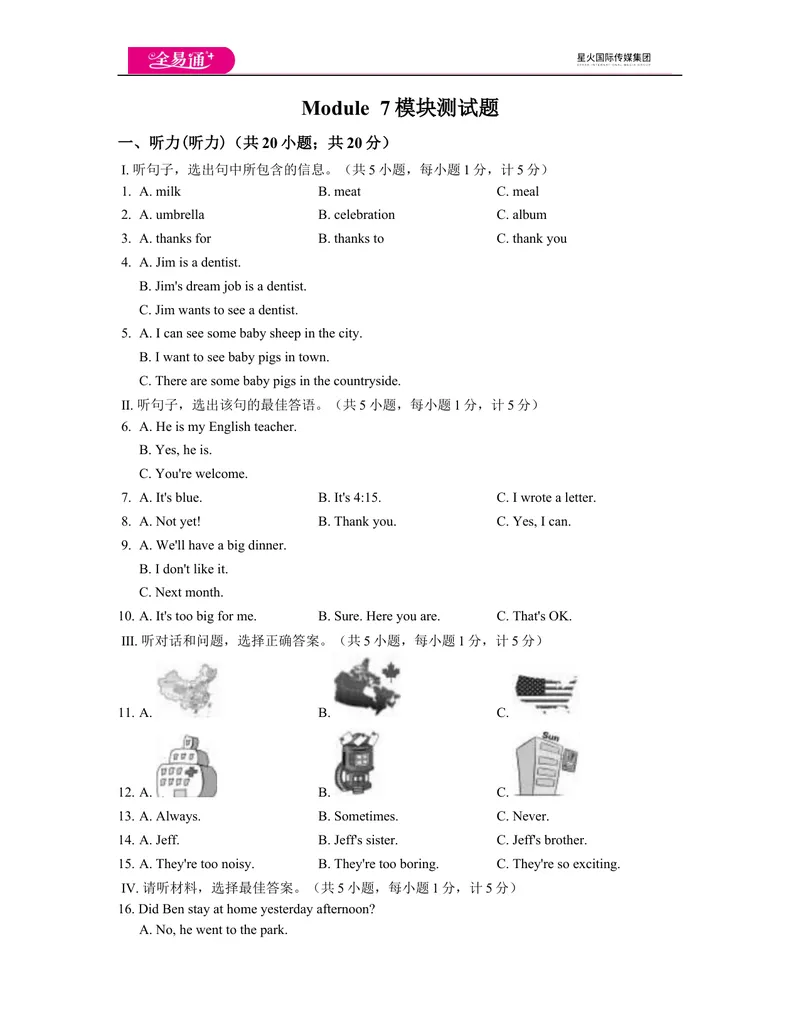
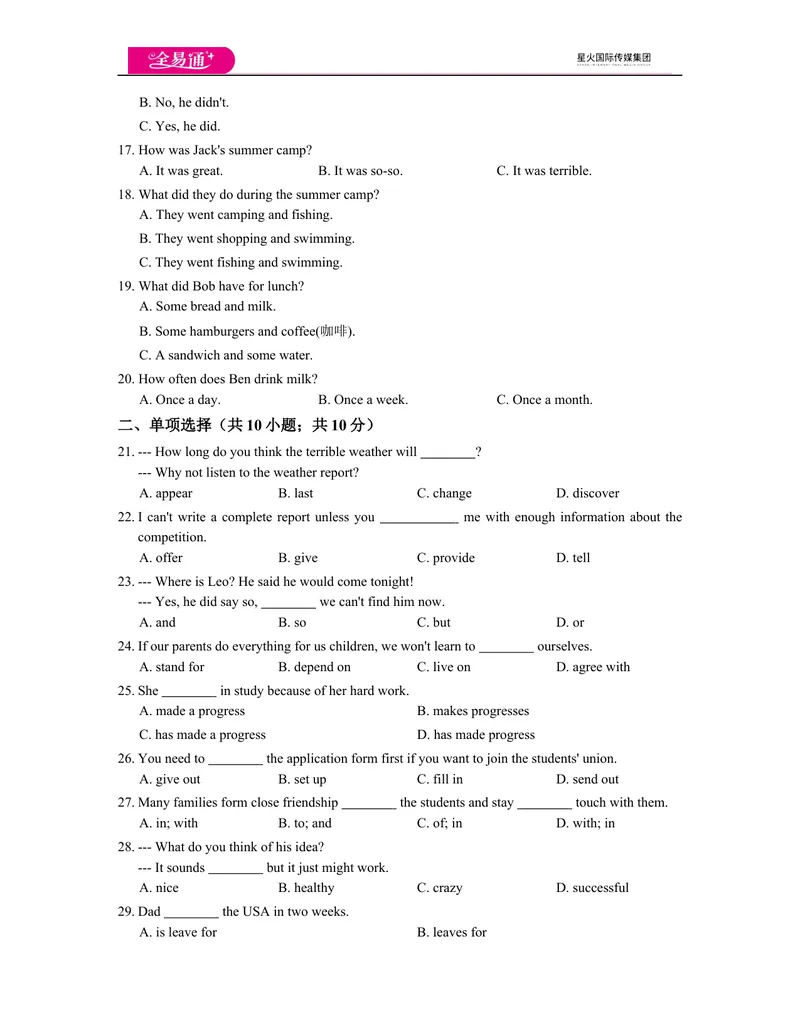
11. A. B. C.
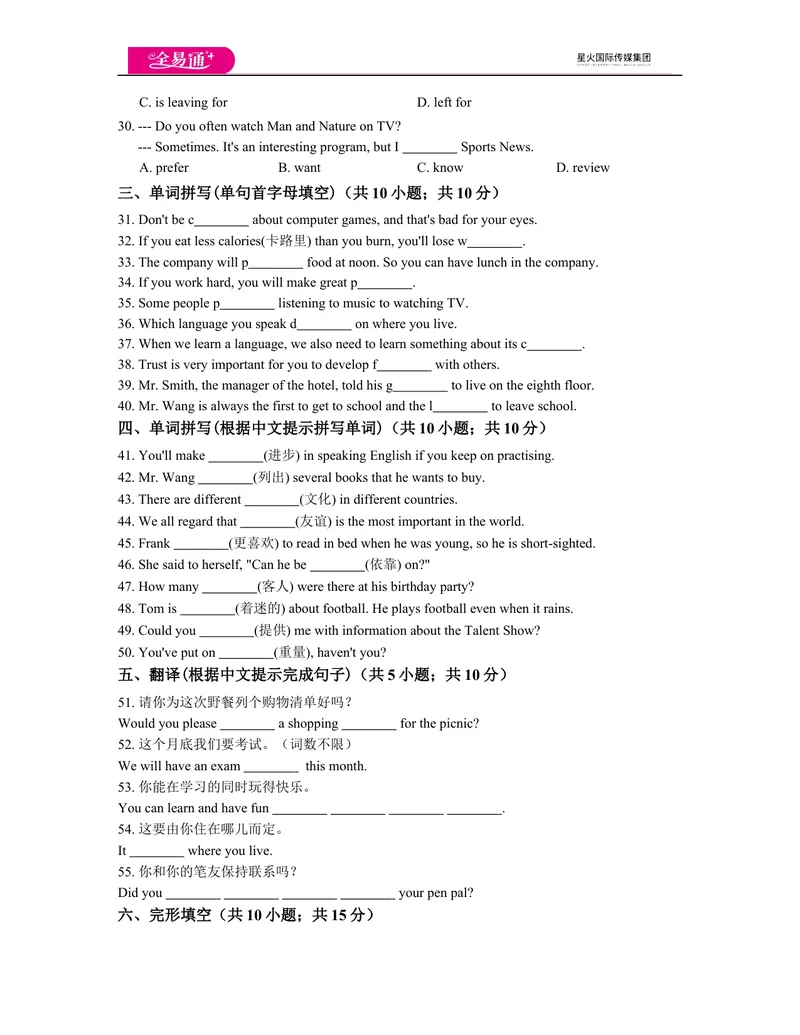
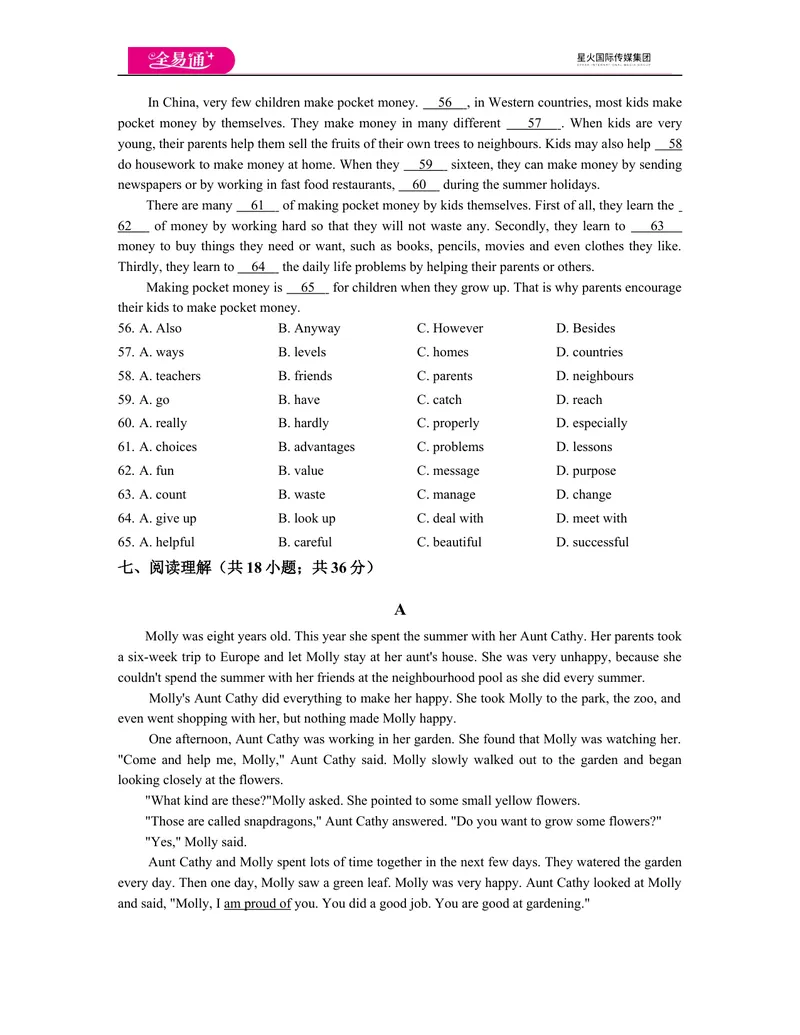
12. A. B. C.
13. A. Always. B. Sometimes. C. Never.
14. A. Jeff. B. Jeff's sister. C. Jeff's brother.
15. A. They're too noisy. B. They're too boring. C. They're so exciting.
Ⅳ. 请听材料,选择最佳答案。(共5小题,每小题1分,计5分)
16. Did Ben stay at home yesterday afternoon?
A. No, he went to the park.B. No, he didn't.
C. Yes, he did.
17. How was Jack's summer camp?
A. It was great. B. It was so-so. C. It was terrible.
18. What did they do during the summer camp?
A. They went camping and fishing.
B. They went shopping and swimming.
C. They went fishing and swimming.
19. What did Bob have for lunch?
A. Some bread and milk.
B. Some hamburgers and coffee(咖啡).
C. A sandwich and some water.
20. How often does Ben drink milk?
A. Once a day. B. Once a week. C. Once a month.
二、单项选择(共10小题;共10分)
21.--- How long do you think the terrible weather will ?
--- Why not listen to the weather report?
A. appear B. last C. change D. discover
22.I can't write a complete report unless you me with enough information about the
competition.
A. offer B. give C. provide D. tell
23.--- Where is Leo? He said he would come tonight!
--- Yes, he did say so, we can't find him now.
A. and B. so C. but D. or
24.If our parents do everything for us children, we won't learn to ourselves.
A. stand for B. depend on C. live on D. agree with
25.She in study because of her hard work.
A. made a progress B. makes progresses
C. has made a progress D. has made progress
26.You need to the application form first if you want to join the students' union.
A. give out B. set up C. fill in D. send out
27.Many families form close friendship the students and stay touch with them.
A. in; with B. to; and C. of; in D. with; in
28.--- What do you think of his idea?
--- It sounds but it just might work.
A. nice B. healthy C. crazy D. successful
29.Dad the USA in two weeks.
A. is leave for B. leaves forC. is leaving for D. left for
30.--- Do you often watch Man and Nature on TV?
--- Sometimes. It's an interesting program, but I Sports News.
A. prefer B. want C. know D. review
三、单词拼写(单句首字母填空)(共10小题;共10分)
31. Don't be c about computer games, and that's bad for your eyes.
32. If you eat less calories(卡路里) than you burn, you'll lose w .
33. The company will p food at noon. So you can have lunch in the company.
34. If you work hard, you will make great p .
35. Some people p listening to music to watching TV.
36. Which language you speak d on where you live.
37. When we learn a language, we also need to learn something about its c .
38. Trust is very important for you to develop f with others.
39. Mr. Smith, the manager of the hotel, told his g to live on the eighth floor.
40. Mr. Wang is always the first to get to school and the l to leave school.
四、单词拼写(根据中文提示拼写单词)(共10小题;共10分)
41. You'll make (进步) in speaking English if you keep on practising.
42. Mr. Wang (列出) several books that he wants to buy.
43. There are different (文化) in different countries.
44. We all regard that (友谊) is the most important in the world.
45. Frank (更喜欢) to read in bed when he was young, so he is short-sighted.
46. She said to herself, "Can he be (依靠) on?"
47. How many (客人) were there at his birthday party?
48. Tom is (着迷的) about football. He plays football even when it rains.
49. Could you (提供) me with information about the Talent Show?
50. You've put on (重量), haven't you?
五、翻译(根据中文提示完成句子)(共5小题;共10分)
51. 请你为这次野餐列个购物清单好吗?
Would you please a shopping for the picnic?
52. 这个月底我们要考试。(词数不限)
We will have an exam this month.
53. 你能在学习的同时玩得快乐。
You can learn and have fun .
54. 这要由你住在哪儿而定。
It where you live.
55. 你和你的笔友保持联系吗?
Did you your pen pal?
六、完形填空(共10小题;共15分)In China, very few children make pocket money. 56 , in Western countries, most kids make
pocket money by themselves. They make money in many different 57 . When kids are very
young, their parents help them sell the fruits of their own trees to neighbours. Kids may also help 58
do housework to make money at home. When they 59 sixteen, they can make money by sending
newspapers or by working in fast food restaurants, 60 during the summer holidays.
There are many 61 of making pocket money by kids themselves. First of all, they learn the
62 of money by working hard so that they will not waste any. Secondly, they learn to 63
money to buy things they need or want, such as books, pencils, movies and even clothes they like.
Thirdly, they learn to 64 the daily life problems by helping their parents or others.
Making pocket money is 65 for children when they grow up. That is why parents encourage
their kids to make pocket money.
56. A. Also B. Anyway C. However D. Besides
57. A. ways B. levels C. homes D. countries
58. A. teachers B. friends C. parents D. neighbours
59. A. go B. have C. catch D. reach
60. A. really B. hardly C. properly D. especially
61. A. choices B. advantages C. problems D. lessons
62. A. fun B. value C. message D. purpose
63. A. count B. waste C. manage D. change
64. A. give up B. look up C. deal with D. meet with
65. A. helpful B. careful C. beautiful D. successful
七、阅读理解(共18小题;共36分)
A
Molly was eight years old. This year she spent the summer with her Aunt Cathy. Her parents took
a six-week trip to Europe and let Molly stay at her aunt's house. She was very unhappy, because she
couldn't spend the summer with her friends at the neighbourhood pool as she did every summer.
Molly's Aunt Cathy did everything to make her happy. She took Molly to the park, the zoo, and
even went shopping with her, but nothing made Molly happy.
One afternoon, Aunt Cathy was working in her garden. She found that Molly was watching her.
"Come and help me, Molly," Aunt Cathy said. Molly slowly walked out to the garden and began
looking closely at the flowers.
"What kind are these?"Molly asked. She pointed to some small yellow flowers.
"Those are called snapdragons," Aunt Cathy answered. "Do you want to grow some flowers?"
"Yes," Molly said.
Aunt Cathy and Molly spent lots of time together in the next few days. They watered the garden
every day. Then one day, Molly saw a green leaf. Molly was very happy. Aunt Cathy looked at Molly
and said, "Molly, I am proud of you. You did a good job. You are good at gardening."When Molly's parents got back from their trip, she showed them her flowers. Aunt Cathy told
Molly how to look after her flowers when she got home. Molly thanked her for the best summer.
66. Why was Molly unhappy at the beginning of the story?
A. Because she did not like flowers.
B. Because she did not like Aunt Cathy.
C. Because she couldn't go with her parents to Europe.
D. Because she couldn't go swimming with her friends.
67. Where didn't Aunt Cathy go with Molly?
A. To the zoo. B. To the pool. C. To the park. D. To the shops.
68. The underlined words "am proud of" mean " " in Chinese.
A. 为……感到自豪 B. 对……感到失望 C. 为……感到难过 D. 对……感到紧张
69. How did Molly show Aunt Cathy she enjoyed the summer?
A. She thanked Aunt Cathy.
B. She gave Aunt Cathy a flower.
C. She sang a song for Aunt Cathy.
D. She showed Aunt Cathy her flowers.
70. Which of the following is TRUE according to the passage?
A. Aunt Cathy liked to read in the garden.
B. Molly's parents went on a one-month trip.
C. Aunt Cathy grew snapdragons to make Molly happy.
D. Molly learnt how to look after her flowers from Aunt Cathy.
B
More than nine million American children are spending part of their summer at a camp. They are
swimming, playing sports, making music or learning to use a computer. Traditional American summer
camps offer children a chance to play many sports outdoors. These camps may be in the mountains, in
the woods or in a lake. Other camps teach activities like painting, music or computer programming.
Children at all kinds of camps meet new friends, learn new skills and develop independence(自立).
Some children go to camp during the day and return home at night. Others stay at camps all day
and all night. Most children who attend camps are between the ages of about six and sixteen.
Some children stay at an overnight camp for one or two weeks. Others stay for as many as eight
weeks. Parents pay from one hundred to more than seven hundred dollars a week for overnight camps.
Day camps are much cheaper. The American tradition of sending children to summer camps began
more than one hundred years ago.
71. How many American children are involved in summer camps?
A. More than 1,000,000. B. More than 10,000,000.
C. More than 9,000,000. D. Over 90,000,000.
72. How long does an overnight camp last?A. From 6 to 16 weeks. B. One or two weeks.
C. From 1 to 8 weeks. D. Eight weeks.
73. What can we learn about the overnight camps?
A. Overnight camps cost more.
B. Overnight campers are older.
C. Overnight camps last longer.
D. Overnight campers can learn more.
74. How much do parents pay for a week overnight camps?
A. From one hundred to more than eight hundred.
B. From one hundred to more than seven hundred.
C. From one hundred to less than eight hundred.
D. From one hundred to less than seven hundred.
75. What is the passage about?
A. The American children's activities.
B. The American children's summer courses.
C. The American children's winter camps.
D. The American children's summer camps.
C
English is very important in the modern world. Many people want to learn it well. Here are some
things that I want to say about learning it.
To learn English well, you need two things—passion and good learning methods(方法). Passion
is the more important one. Why? Because passion makes you want to learn English. Learning methods
only tell you how to learn it better and faster.
If you love learning English, you will learn it regularly(有规律地) and spend much time on it. It
will also be easy for you to remember new words and grammar rules. For example, some
people like history and know a lot about World War II. If you ask a person who doesn't like history to
memorize all the facts, he probably can't do it.
When you don't want to learn English, you can do the following things.
First, imagine that you can talk to native speakers just as you talk in your mother language.
Imagine yourself to be a manager in a foreign company. Imagine you're living in an English-speaking
country.
Second, use English as much as possible. This is very important. The more you use English, the
better you'll learn it. English is very popular, so you can use it everywhere. You can watch American
cartoons, write English diaries, and read interesting books written in English.
76. The underlined word "passion" means " " in Chinese.
A. 态度 B. 热情 C. 步骤 D. 情绪
77. The missing part in the Paragraph 3 can be .A. You can't memorize everything while learning English.
B. You will find it hard to learn English.
C. That's because you can easily remember what you like.
D. Everyone likes to learn what they like most.
78. What can you do if you don't want to learn English according to (根据) the passage?
A. Go to English-speaking countries.
B. Read interesting English books.
C. Stop learning it for some time.
D. Listen to music or play sports.
79. Which of the following is NOT true according to the writer?
A. You need two things if you want to learn English well.
B. It's difficult for a person to know a lot about World War II if he isn't interested in history.
C. Learning methods are more important than passion.
D. It's easy for you to remember new words or grammar rules if you're an English lover.
80. The main idea of this passage is about .
A. the importance of learning English
B. English in the modern world
C. how to write e-mails to other people
D. some advice on how to learn English
D
You may know the English letters A, B and C. But do you know there are people called ABC?
You may like eating bananas. But did you know there is such a thing as a “banana person”? How
strange! Are these people from “another earth”? No. They are just Chinese people like you and me.
ABC means American-born Chinese. An ABC is a Chinese, but was born in the United States.
Sometimes, people call an ABC a “banana person”. A banana is yellow outside and white inside. So,
when a person is a banana, he or she is white inside---thinking like a Westerner and yellow outside---
looking like a Chinese.
Do you know why? Usually, ABCs know little about China or the Chinese language. Some of
them don't speak Chinese. But if ABCs cannot speak Chinese, can we still call them Chinese people?
Yes, of course. They are Chinese. They are overseas Chinese. These people may be citizens of another
country like the US, England, Canada or Singapore. But they have Chinese blood. Their parents,
grandparents of even great-grandparents were from China. They all have black eyes and black hair.
But they are not Chinese citizens. They are not people of the PRC. For example, we all know the
famous scientist C.N.Yang. He got the Noble Prize for Physics in 1957. Chinese people love him. But
he is an American citizen.
81. “ABC” in this passage means .
A. three English words B. a kind of bananaC. Chinese born in America D. Americans born in China
82. Chinese in Western countries is called “banana persons” because .
A. their bodies are white inside but yellow outside
B. they think like Westerners but look like Chinese
C. they were born in China but go to study in America
D. they like to eat bananas,
83. Which is not true about C.N.Yang?
A. a famous scientist B. a Chinese citizen
C. got the Noble Prize in 1957 D. people love him
八、短文7选5(5选5等)(共5小题;共10分)
Last Sunday Li Lei did his lessons almost the whole day. He wanted to relax himself and he went
downtown. He walked on and on along the streets. He was pleased to see that people were very happy.
When he was enjoying himself, he was stopped by a foreigner.
" 84. ?"
"Yes, but I…" Li Lei was very nervous, and his face turned red. He is a junior middle school
student and now is in Grade Three, but he didn't spend much time on English in the past and is not
good at it.
"I don't know Chinese," the foreigner went on. "Would you please tell me something about the
town?"
"Yes, but I…" 85. , but he didn't know how to answer it. His heart beat fast. "I was born
here," he said, "This is my hometown. I like my hometown. I …My…My hometown is beautiful…"
He wanted to say more but he couldn't. 86. . "I'm sorry, I can't tell you more. I'm not good at
English," Li Lei had to say.
The foreigner smiled to him kindly and said, "OK, OK. Thank you all the same. Goodbye."
87. "If I studied English harder, I could speak more English. If I could speak more
English, I would tell the foreigner more about my hometown." How sorry he felt!
Li Lei went home with heavy steps. 88. . He took out his English book and began to
read. He decided to study English more carefully than before. He decided to practise speaking English
every day from then on.
A. He understood what he said
B. The foreigner smiled and went away
C. As soon as he got home
D. Excuse me, can you speak English
E. He looked up and found the foreigner was listening to him carefully
F. On his way home Li Lei thought to himself
九、阅读与表达(问答式)(共5小题;共10分)Do you know something about the Akuapem people? They live in eastern Ghana(加纳), where
the sunshine hugs all the time. They are very friendly. Now let's have a look at how the Akuapem
people receive a visitor.
A visitor is often welcomed warmly in a family of Akuapem. After the visitor is welcomed into
the house, he is offered a seat and water at the very beginning, for the host(主人) thinks that the visitor
must have come from a very long trip and is in need of water. Then the host family greet the visitor by
saying "Akwaaba". More interestingly, if there is a group of visitors, the host will greet the visitors
from right to left. And the host shakes only with his right hand, because the left hand is regarded dirty
according to the Akuapem people.
Next, the visitor is asked how his trip was and why he has come. While the conversation is going
on, the wife and children, especially girls, are cooking food for the visitor. The visitor can choose the
food. After the visitor has finished eating, the host and the visitor continue their conversation. Usually
this is a short one since the visitor is getting ready to say goodbye.
When the visitor is leaving, he is often given some food to take along. He is also accompanied(陪
伴) by one of the children to the nearest station. The child who accompanies the visitor will not come
back home until the visitor leaves safely.
No matter if he is a close friend or just a passer-by (过路人), this is always the way that the
friendly Akuapem people receive a visitor.
根据短文内容,完成下列小题。
89. What is the visitor offered at first by the family of Akuapem?
90. Why does the host shake only with his right hand?
91. Who are cooking food while the host is chatting with the visitor?
92. When will the child who accompanies the visitor to the station come back home?
93. What does the article mainly talk about?答案
一、听力(听力)
1. C 2. A 3. B 4. B 5. C 6. B 7. C 8. A 9. A 10. B
11. B 12. C 13. C 14. B 15. A 16. B 17. A 18. C 19. C 20. A
听力原文
Ⅰ. 听句子, 选出句中所包含的信息。
1. How much is a meal here?
2. We need an umbrella for our summer camp.
3. Thanks to you for your big help.
4. Jim wants to be a dentist.
5. I saw some baby pigs in the countryside.
Ⅱ. 听句子, 选出该句的最佳答语。
6. Is Mr. Smith coming this morning?
7. What did you write in the card, Bob?
8. Have you posted the letter, Jack?
9. How do you celebrate Thanksgiving Day?
10. May I see what you drew?
Ⅲ. 听对话和问题, 选择最佳答案。
11. W: Did you go to America for vacation?
M: No. I went to Canada.
Q: Where did the man go for vacation?
12. W: Let' s go to Sun Restaurant. It's only one kilometre from here.
M: OK.
Q: Where are they going?
13. M: How often do you stay up late?
W: Never. I think it' s a bad habit.
Q: Ho often does the woman stay up late?
14. W: Is Jeff a shy boy?
M: No. He is outgoing. But his sister is shy.
Q: Who is shy?
15. W: I think action movies are exciting. What about you?
M: I don' t like them. They' re too noisy.
Q: Why didn' t the man like action movies?
Ⅳ. 请听材料, 选择最佳答案。
W: Were you at home yesterday afternoon, Ben?M: No, I went to summer camp with Jack and Bob.
W: Did you have a good time?
M: Yes, we did. We went fishing and swimming.
W: What did you have for lunch?
M: I ate bread and drank milk. Jack ate two hamburgers and drank coffee.
Bob ate a sandwich and drank water.
W: Do you like milk?
M: No, I don't, Ann. But my mom says it's good for me. So I drink it
every day.
W: Does Jack like coffee?
M: Yes, it's his favourite drink.
16. Did Ben stay at home yesterday afternoon?
17. How was Jack's summer camp?
18. What did they do during the summer camp?
19. What did Bob have for lunch?
20. How often does Ben drink milk?
二、单项选择
21. B 22. C 23. C 24. B 25. D
26. C 27. D 28. C 29. C 30. A
三、单词拼写(单句首字母填空)
31. crazy 32. weight 33. provide 34. progress
35. prefer
36. depends 37. culture 38. friendship 39. guests
40. last
四、单词拼写(根据中文提示拼写单词)
41. progress 42. lists 43. cultures 44. friendship
45. preferred
46. depended 47. guests 48. crazy 49. provide
50. weight
五、翻译(根据中文提示完成句子)
51. make, list 52. at the end of 53. at the same time 54. depends on 55. stay in
touch with
六、完形填空
56. C 57. A 58. C 59. D 60. D 61. B 62. B 63. C 64. C 65. A
七、阅读理解66. D 67. B 68. A 69. A 70. D 71. C 72. D 73. A 74. B 75. D
76. B 77. D 78. B 79. C 80. D 81. C 82. B 83. B
八、短文7选5(5选5等)
84. D 85. A 86. E 87. F 88. C
九、阅读与表达(问答式)
89. A seat and water.
90. Because the left had is regarded dirty according to the Akuapem people.
91. The wife and children, especially girls.
92. After the visitor leaves safely. (The child who accompanies the visitor to the station won't come
back home until the visitor leaves safely.)
93. How the Akuapem people receive a visitor. (The way that the friendly Akuapem people receive a
visitor. )