某定制
阅读下面材料,根据其内容和所给段落开头语续写两段,使之构成一篇完整的短
文。
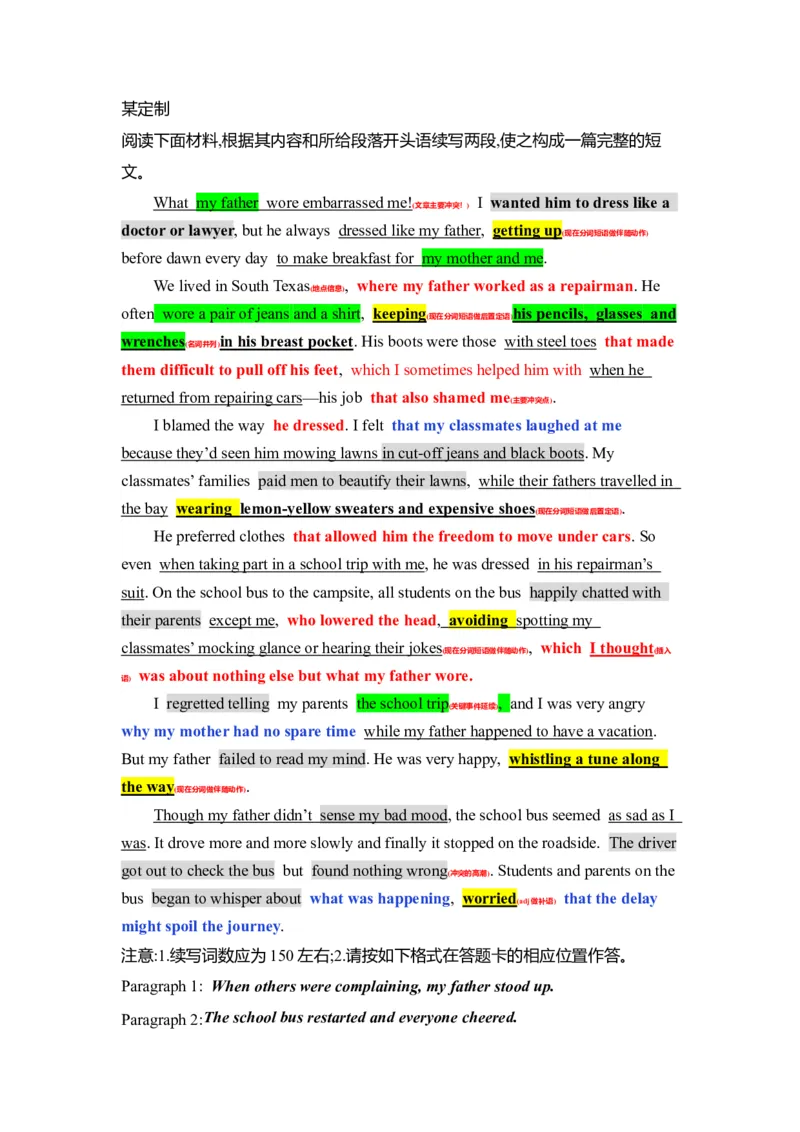
What

 my father

  wore embarrassed me!

 (文章主要冲突!) I wanted him to dress like a
doctor or lawyer, but he always dressed like my father, getting up(现在分词短语做伴随动作)
before dawn every day to make breakfast for

 my mother and me

 .
We lived in South Texas(地点信息), where my father worked as a repairman. He
often wore a pair of jeans and a shirt, keeping(现在分词短语做后置定语)his pencils

 ,   glasses

  and


wrenches(名词并列)in his breast pocket. His boots were those with steel toes that made
them difficult to pull off his feet, which I sometimes helped him with when he
returned from repairing cars—his job that also shamed me(主要冲突点).
I blamed the way he dressed. I felt that my classmates laughed at me
because they’d seen him

   mowing lawns

   in cut-off jeans and black boots

 . My
classmates’ families paid men to beautify their lawns, while their fathers travelled in
the bay wearing

 lemon-yellow sweaters and expensive shoes

 (现在分词短语做后置定语).
He preferred clothes that allowed him the freedom to move under cars. So
even when taking part in a school trip with me, he was dressed in his repairman’s
suit. On the school bus to the campsite, all students on the bus happily chatted with
their parents except me, who lowered the head,  avoiding

 spotting my


classmates’

   mocking glance or hearing their jokes

 (现在分词短语做伴随动作), which I thought(插入
语) was about nothing else but what my father wore.
I regretted telling my parents the school trip(关键事件延续), and I was very angry
why my mother had no spare time while my father happened to have a vacation.
But my father failed to read my mind. He was very happy, whistling a tune along
the way(现在分词做伴随动作).
Though my father didn’t

 sense my bad mood

 , the school bus seemed as sad as I
was. It drove more and more slowly and finally it stopped on the roadside. The driver
got out to check the bus but found nothing wrong(冲突的高潮). Students and parents on the
bus began to whisper about what was happening, worried(adj 做补语) that the delay
might spoil the journey.
注意:1.续写词数应为150 左右;2.请按如下格式在答题卡的相应位置作答。
Paragraph 1: When others were complaining, my father stood up.
Paragraph 2:The school bus restarted and everyone cheered.
某定制
阅读下面材料,根据其内容和所给段落开头语续写两段,使之构成一篇完整的短
文。
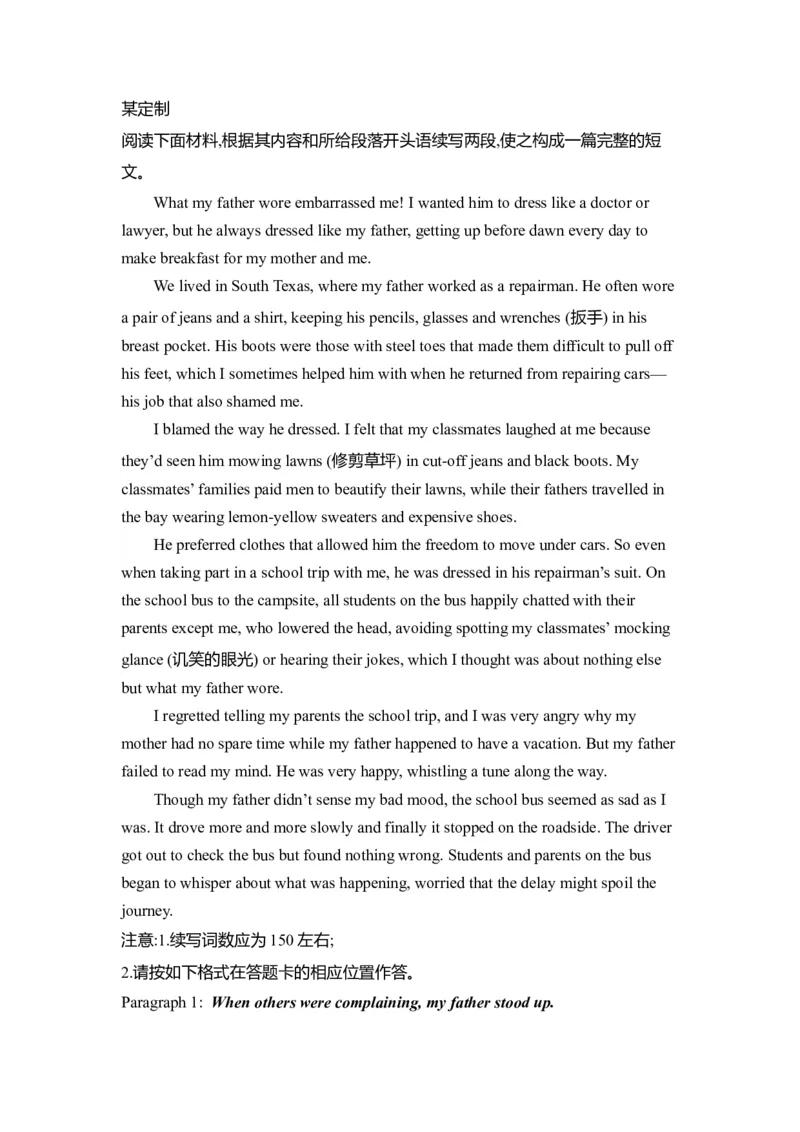
What my father wore embarrassed me! I wanted him to dress like a doctor or
lawyer, but he always dressed like my father, getting up before dawn every day to
make breakfast for my mother and me.
We lived in South Texas, where my father worked as a repairman. He often wore
a pair of jeans and a shirt, keeping his pencils, glasses and wrenches (扳手) in his
breast pocket. His boots were those with steel toes that made them difficult to pull off
his feet, which I sometimes helped him with when he returned from repairing cars—
his job that also shamed me.
I blamed the way he dressed. I felt that my classmates laughed at me because
they’d seen him mowing lawns (修剪草坪) in cut-off jeans and black boots. My
classmates’ families paid men to beautify their lawns, while their fathers travelled in
the bay wearing lemon-yellow sweaters and expensive shoes.
He preferred clothes that allowed him the freedom to move under cars. So even
when taking part in a school trip with me, he was dressed in his repairman’s suit. On
the school bus to the campsite, all students on the bus happily chatted with their
parents except me, who lowered the head, avoiding spotting my classmates’ mocking
glance (讥笑的眼光) or hearing their jokes, which I thought was about nothing else
but what my father wore.
I regretted telling my parents the school trip, and I was very angry why my
mother had no spare time while my father happened to have a vacation. But my father
failed to read my mind. He was very happy, whistling a tune along the way.
Though my father didn’t sense my bad mood, the school bus seemed as sad as I
was. It drove more and more slowly and finally it stopped on the roadside. The driver
got out to check the bus but found nothing wrong. Students and parents on the bus
began to whisper about what was happening, worried that the delay might spoil the
journey.
注意:1.续写词数应为150 左右;
2.请按如下格式在答题卡的相应位置作答。
Paragraph 1: When others were complaining, my father stood up.
Paragraph 2:The school bus restarted and everyone cheered.
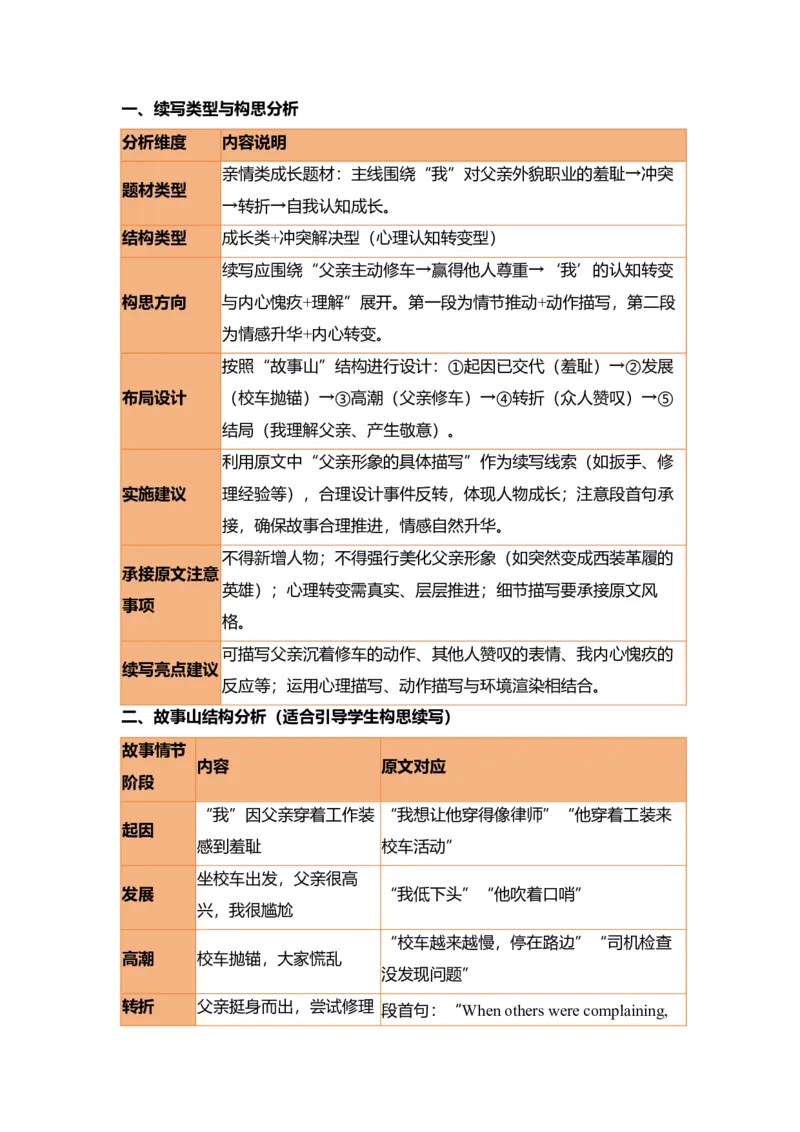
一、续写类型与构思分析
分析维度
内容说明
题材类型
亲情类成长题材:主线围绕“我”对父亲外貌职业的羞耻→冲突
→转折→自我认知成长。
结构类型
成长类+冲突解决型(心理认知转变型)
构思方向
续写应围绕“父亲主动修车→赢得他人尊重→‘我’的认知转变
与内心愧疚+理解”展开。第一段为情节推动+动作描写,第二段
为情感升华+内心转变。
布局设计
按照“故事山”结构进行设计:①起因已交代(羞耻)→②发展
(校车抛锚)→③高潮(父亲修车)→④转折(众人赞叹)→⑤
结局(我理解父亲、产生敬意)。
实施建议
利用原文中“父亲形象的具体描写”作为续写线索(如扳手、修
理经验等),合理设计事件反转,体现人物成长;注意段首句承
接,确保故事合理推进,情感自然升华。
承接原文注意
事项
不得新增人物;不得强行美化父亲形象(如突然变成西装革履的
英雄);心理转变需真实、层层推进;细节描写要承接原文风
格。
续写亮点建议
可描写父亲沉着修车的动作、其他人赞叹的表情、我内心愧疚的
反应等;运用心理描写、动作描写与环境渲染相结合。
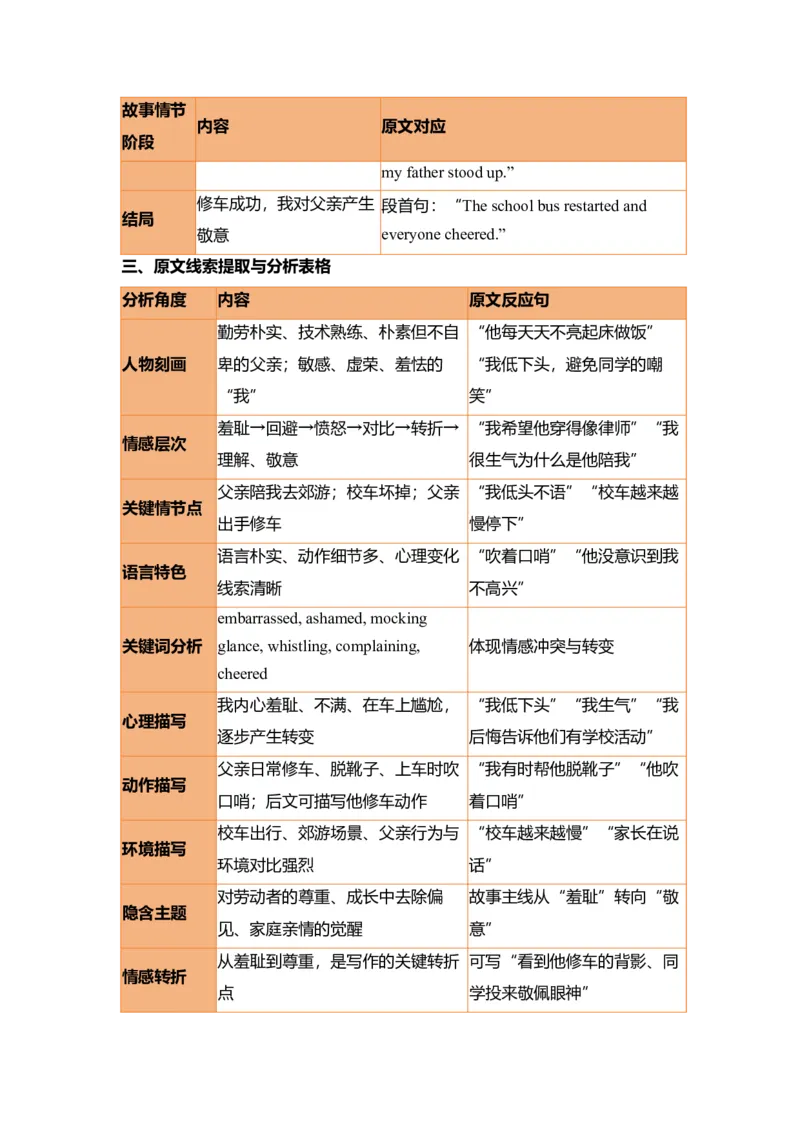
二、故事山结构分析(适合引导学生构思续写)
故事情节
阶段
内容
原文对应
起因
“我”因父亲穿着工作装
感到羞耻
“我想让他穿得像律师”“他穿着工装来
校车活动”
发展
坐校车出发,父亲很高
兴,我很尴尬
“我低下头”“他吹着口哨”
高潮
校车抛锚,大家慌乱
“校车越来越慢,停在路边”“司机检查
没发现问题”
转折
父亲挺身而出,尝试修理段首句:“When others were complaining,
故事情节
阶段
内容
原文对应
my father stood up.”
结局
修车成功,我对父亲产生
敬意
段首句:“The school bus restarted and
everyone cheered.”
三、原文线索提取与分析表格
分析角度
内容
原文反应句
人物刻画
勤劳朴实、技术熟练、朴素但不自
卑的父亲;敏感、虚荣、羞怯的
“我”
“他每天天不亮起床做饭”
“我低下头,避免同学的嘲
笑”
情感层次
羞耻→回避→愤怒→对比→转折→
理解、敬意
“我希望他穿得像律师”“我
很生气为什么是他陪我”
关键情节点
父亲陪我去郊游;校车坏掉;父亲
出手修车
“我低头不语”“校车越来越
慢停下”
语言特色
语言朴实、动作细节多、心理变化
线索清晰
“吹着口哨”“他没意识到我
不高兴”
关键词分析
embarrassed, ashamed, mocking
glance, whistling, complaining,
cheered
体现情感冲突与转变
心理描写
我内心羞耻、不满、在车上尴尬,
逐步产生转变
“我低下头”“我生气”“我
后悔告诉他们有学校活动”
动作描写
父亲日常修车、脱靴子、上车时吹
口哨;后文可描写他修车动作
“我有时帮他脱靴子”“他吹
着口哨”
环境描写
校车出行、郊游场景、父亲行为与
环境对比强烈
“校车越来越慢”“家长在说
话”
隐含主题
对劳动者的尊重、成长中去除偏
见、家庭亲情的觉醒
故事主线从“羞耻”转向“敬
意”
情感转折
从羞耻到尊重,是写作的关键转折
点
可写“看到他修车的背影、同
学投来敬佩眼神”
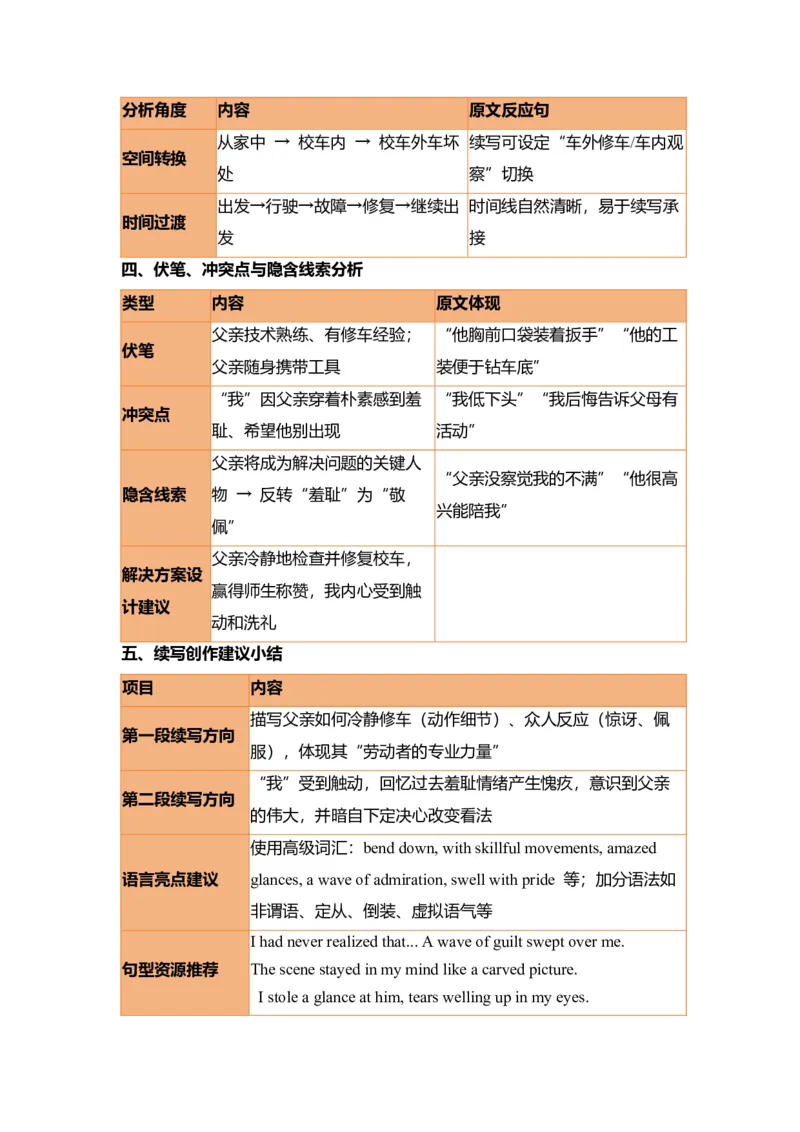
分析角度
内容
原文反应句
空间转换
从家中 → 校车内 → 校车外车坏
处
续写可设定“车外修车/车内观
察”切换
时间过渡
出发→行驶→故障→修复→继续出
发
时间线自然清晰,易于续写承
接
四、伏笔、冲突点与隐含线索分析
类型
内容
原文体现
伏笔
父亲技术熟练、有修车经验;
父亲随身携带工具
“他胸前口袋装着扳手”“他的工
装便于钻车底”
冲突点
“我”因父亲穿着朴素感到羞
耻、希望他别出现
“我低下头”“我后悔告诉父母有
活动”
隐含线索
父亲将成为解决问题的关键人
物 → 反转“羞耻”为“敬
佩”
“父亲没察觉我的不满”“他很高
兴能陪我”
解决方案设
计建议
父亲冷静地检查并修复校车,
赢得师生称赞,我内心受到触
动和洗礼
五、续写创作建议小结
项目
内容
第一段续写方向
描写父亲如何冷静修车(动作细节)、众人反应(惊讶、佩
服),体现其“劳动者的专业力量”
第二段续写方向
“我”受到触动,回忆过去羞耻情绪产生愧疚,意识到父亲
的伟大,并暗自下定决心改变看法
语言亮点建议
使用高级词汇:bend down, with skillful movements, amazed
glances, a wave of admiration, swell with pride 等;加分语法如
非谓语、定从、倒装、虚拟语气等
句型资源推荐
I had never realized that... A wave of guilt swept over me.
The scene stayed in my mind like a carved picture.
 I stole a glance at him, tears welling up in my eyes.
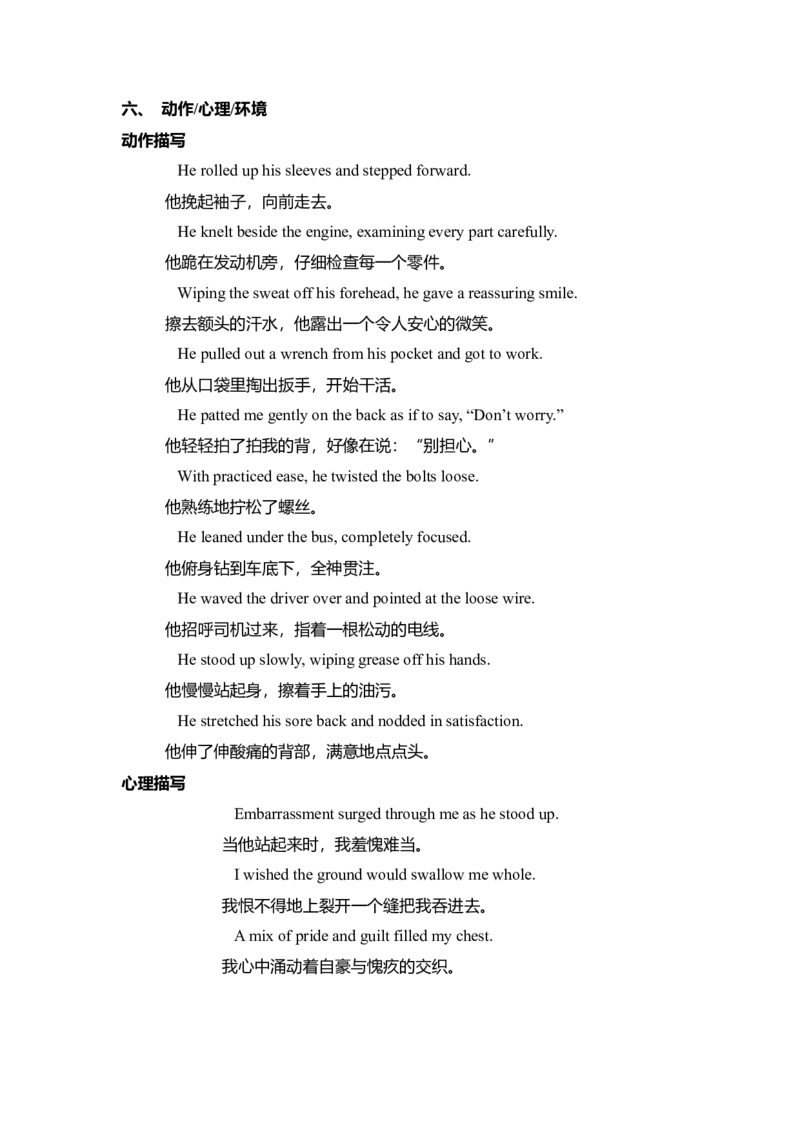
六、 动作/心理/环境
动作描写
He rolled up his sleeves and stepped forward.
 他挽起袖子,向前走去。
He knelt beside the engine, examining every part carefully.
 他跪在发动机旁,仔细检查每一个零件。
Wiping the sweat off his forehead, he gave a reassuring smile.
 擦去额头的汗水,他露出一个令人安心的微笑。
He pulled out a wrench from his pocket and got to work.
 他从口袋里掏出扳手,开始干活。
He patted me gently on the back as if to say, “Don’t worry.”
 他轻轻拍了拍我的背,好像在说:“别担心。”
With practiced ease, he twisted the bolts loose.
 他熟练地拧松了螺丝。
He leaned under the bus, completely focused.
 他俯身钻到车底下,全神贯注。
He waved the driver over and pointed at the loose wire.
 他招呼司机过来,指着一根松动的电线。
He stood up slowly, wiping grease off his hands.
 他慢慢站起身,擦着手上的油污。
He stretched his sore back and nodded in satisfaction.
 他伸了伸酸痛的背部,满意地点点头。
心理描写
Embarrassment surged through me as he stood up.
 当他站起来时,我羞愧难当。
I wished the ground would swallow me whole.
 我恨不得地上裂开一个缝把我吞进去。
A mix of pride and guilt filled my chest.
 我心中涌动着自豪与愧疚的交织。
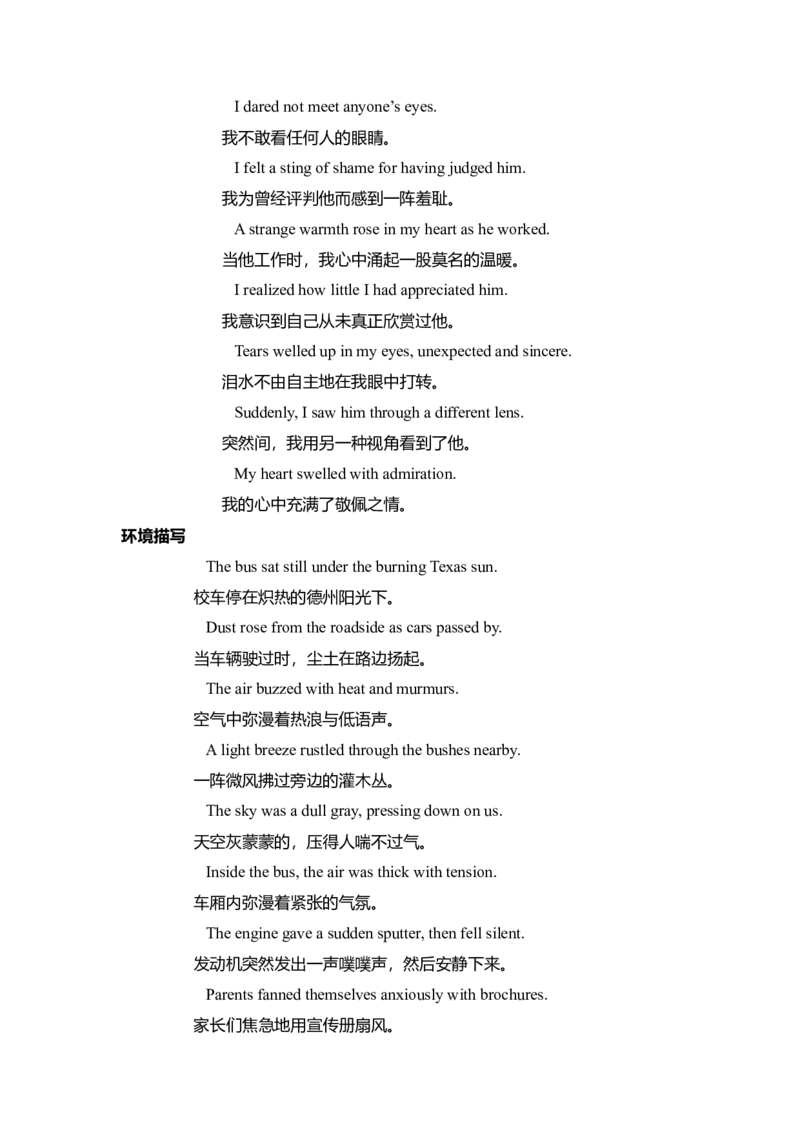
I dared not meet anyone’s eyes.
 我不敢看任何人的眼睛。
I felt a sting of shame for having judged him.
 我为曾经评判他而感到一阵羞耻。
A strange warmth rose in my heart as he worked.
 当他工作时,我心中涌起一股莫名的温暖。
I realized how little I had appreciated him.
 我意识到自己从未真正欣赏过他。
Tears welled up in my eyes, unexpected and sincere.
 泪水不由自主地在我眼中打转。
Suddenly, I saw him through a different lens.
 突然间,我用另一种视角看到了他。
My heart swelled with admiration.
 我的心中充满了敬佩之情。
环境描写
The bus sat still under the burning Texas sun.
 校车停在炽热的德州阳光下。
Dust rose from the roadside as cars passed by.
 当车辆驶过时,尘土在路边扬起。
The air buzzed with heat and murmurs.
 空气中弥漫着热浪与低语声。
A light breeze rustled through the bushes nearby.
 一阵微风拂过旁边的灌木丛。
The sky was a dull gray, pressing down on us.
 天空灰蒙蒙的,压得人喘不过气。
Inside the bus, the air was thick with tension.
 车厢内弥漫着紧张的气氛。
The engine gave a sudden sputter, then fell silent.
 发动机突然发出一声噗噗声,然后安静下来。
Parents fanned themselves anxiously with brochures.
 家长们焦急地用宣传册扇风。
Kids’ laughter faded as the delay dragged on.
 随着延误的持续,孩子们的笑声也逐渐消失。
Sweat trickled down my neck as I sat frozen.
 我坐着一动不动,汗水顺着脖子流下。
高级替换词
场景
常见词高级替换词
描述情绪sad
gloomy / disheartened / dejected / downcast / crestfallen
表达感激thankful grateful / appreciative / overwhelmed with gratitude
描述行动walk
stroll / stride / march / pace / tiptoe
描述生气angry
furious / irritated / outraged / indignant / infuriated
描述高兴happy
delighted / elated / overjoyed / thrilled / jubilant
搭配、语法、词汇
地道搭配
make breakfast for sb. —— 为某人做早餐(固定搭配)
stand up / step forward —— 表示主动采取行动的经典动作短语
fail to do sth. —— 没有做到某事,常用于表达期望落空或理解错误
whistle a tune —— 吹口哨,表达轻松或愉快心情
mocking glance / mocking tone —— 讥讽的眼神 / 语气,常用于表达“被
羞辱”
keep (sth) in one’s pocket —— 放在口袋里,常用于物品描写(pencils,
glasses)
get more and more slowly —— 表示状态递进的比较句式
help sb. with sth. —— 帮助某人做某事
complain about sth. —— 抱怨……,常用于情绪描写引出冲突
sense one’s mood —— 察觉到某人的情绪,体现人物细腻描写能力
可积累的词汇短语
词汇短语
词
性
词义
近义词
反义词
示例句1
示例句2
embarrassed adj. 尴尬
ashamed /
proud /
He looked
I felt
词汇短语
词
性
词义
近义词
反义词
示例句1
示例句2
的,难
为情的
uneasy
confident
embarrassed as
people stared
at him.
embarrassed
by my father's
outfit.
mocking
adj.
嘲讽
的,挖
苦的
ridiculing /
sarcastic
respectful
/ admiring
Their mocking
voices echoed
in the bus.
I couldn’t bear
their mocking
glances.
wrench
n.
扳手
spanner / tool
—
He grabbed a
wrench and
started fixing.
I handed him
the wrench
quietly.
steel-toed
adj.
钢头的
(鞋)
reinforced-toed —
His steel-toed
boots clanked
on the steps.
I struggled to
pull off his
steel-toed
boots.
lawn mowing n.
修剪草
坪
trimming /
cutting grass
—
He was
mowing the
lawn under the
sun.
I saw him
lawn mowing
again in those
boots.
七、 Possible Versions(3)
Version 1
Paragraph 1:
When others were complaining, my father stood up. Without hesitation, he
walked to the driver and offered to help, his rough hands pulling a

 wrench

  from


his breast pocket(独立主格). Kneeling beside the engine(现在分词做伴随动作), he examined it
with the precision of a seasoned repairman, his steel-toed boots firmly planted on the
ground. As he worked, whispers spread among my classmates(无灵主语句), but this
time, their tones shifted from mockery to curiosity(无灵主语句). I clenched my fists,
torn

 between embarrassment and an odd sense of pride

 (过去分词做后置定语).
Paragraph 2:
The school bus restarted and everyone cheered. My father wiped his greasy
hands on his jeans, smiling

 modestly

 (现在分词做伴随动作) as the driver thanked him. A
classmate’s father clapped him on the shoulder, saying(现在分词做伴随动作), “That was
impressive!” My face burned(无灵主语句), but not with shame this time. Glancing at


my father’s calloused hands and stained shirt(现在分词做伴随动作), I realized his clothes
weren’t a mark of inadequacy—they were proof of his strength and dedication(递
进句式). For the first time, I saw him not as a source of embarrassment, but as
someone quietly extraordinary(递进句式).
亮点词汇与表达
类别
原文表达
升级替换/联想词
动作描写
stood up, walked, knelt
strode forward, crouched, inspected
情绪描写
clenched fists, face burned
heart pounded, flushed with warmth
搭配
rough hands, steel-toed boots
calloused fingers, sturdy work boots
近义词
mockery → teasing
embarrassment → self-consciousness
例句积累:
He worked with the precision of a seasoned professional. (比喻)
Torn between conflicting emotions, I hesitated. (心理描写)
The whispers shifted from scorn to awe. (情绪变化)
His modesty only highlighted his competence. (人物特质)
Version 2
Paragraph 1:
When others were complaining, my father stood up. “Mind if I take a look?”
he asked the driver, his voice calm amid the chaos(独立主格). As he

  lifted the bus hood

 ,
his stained shirt sleeves rolled up(无灵主语句), revealing

 scars from years of labor

 (现在分词
做伴随动作). My classmates’ murmurs faded(无灵主语) as he

 tapped the engine

   with his


wrench, diagnosing

 the issue within seconds

 (现在分词做伴随动作). I slumped in my seat, yet
my eyes stayed fixed on him(独立主格)—his focused expression, the way his hands
moved with certainty.
Paragraph 2:
The school bus restarted and everyone cheered. A girl behind me whispered,
“Your dad’s amazing!” Her words struck me.  I felt a swell of pride, my earlier
embarrassment fading(独立主格). Looking

 at my father

 (现在分词做做伴随动作),His actions spoke
volumes

 .   I’d been so fixated on his appearance that I’d ignored his skill. He
returned to his seat, smelling

 of oil and effort

 (现在分词做伴随动作), and ruffled my hair. “All
good,” he said simply. The bus rolled forward, but my mind raced. Maybe real
strength wasn’t in clothes designs but in the quiet ability to solve problems—and in
the love that fueled it.
亮点词汇与表达
类别
原文表达
升级替换/联想词
动作描写
lifted, tapped, slumped
hoisted, adjusted, sagged
情绪描写
fixated, struck me, mind raced
obsessed, jolted me, thoughts whirled
搭配
stained shirt, rolled up sleeves
grease-smudged collar, pushed-up cuffs
近义词
chaos → commotion
skill → expertise
例句积累:
His hands moved with the confidence of a master. (动作+比喻)
The scent of oil clung to him like a second skin. (感官细节)
Her praise dissolved my resentment like sugar in tea. (比喻心理变化)
Real worth isn’t sewn into labels but etched in actions. (哲理句)
Version 3
Paragraph 1:
When others were complaining, my father stood up. He nudged me gently—
a silent request to pass

 the toolkit

  under our seat

 . As he

 strode to

  the front

 , his
steel toes boots thudded against the floor, drawing all eyes(现在分词做伴随动作). With
practiced ease, he loosened a bolt, his muscles straining under his faded

 jeans

 (独立主
格). Kneeling beside the bus(现在分词段做伴随动作), he inspected the engine, his brow
furrowed in concentration(独立主格刻画人物神态). I watched from a distance, conflicted
emotions swirling within me(独立主格刻画人物心理). Despite my earlier embarrassment, I
couldn't deny his competence. After a thorough check, he tightened a bolt and
signaled the driver. The engine roared to life(无灵主语句), and my chest tightened (无灵主
语句), yet I noticed something new: the respect in the driver’s, my classmates and
their parents’ gaze.
Paragraph 2:
The school bus restarted and everyone cheered. My father wiped sweat from
his brow, leaving a smudge of grease (现在分词做伴随动作). “Thanks, sir,” the driver said,
shaking

 his hand

  (现在分词做伴随动作). Back in our seat, Dad whispered, “Sometimes, son,
usefulness outweighs appearances.” I nodded, staring at

  his worn boots

 (现在分词做伴随动
作)—the same ones that had steadied him while fixing the bus. Suddenly, they
didn’t seem so awkward anymore. They were tools, just like him: unpolished but
essential.
亮点词汇与表达
类别
原文表达
升级替换/联想词
动作描写
nudged, thudded, strained
prodded, clunked, flexed
情绪描写
chest tightened, snorted
heart constricted, sneered
搭配
faded shirt, smudge of grease
threadbare fabric, streak of dirt
近义词
respect → admiration
awkward → ungainly
例句积累:
His hands were rough but capable, like well-used leather. (触觉比喻)
The smudge on his cheek was a badge of labor. (象征手法)
Mockery lost its sting when met with quiet competence. (对比)
Appearances are like wrapping paper; they hide the real gift inside. (哲理句)
Version 4
Paragraph 1: When others were complaining, my father stood up. He
approached the driver, offering

 assistance

 (现在分词做伴随动作). Rolling up his sleeves(现在分词做
伴随动作), he examined the engine, his movements confident and precise(独立主格刻画人物). I
observed silently, recalling

 the countless times

 (现在分词做伴随动作) he'd fixed things at
home. Within minutes, his
    wrench

   in
    hand

 (独立主格), he identified the issue—a
disconnected wire—and reattached it. The driver turned the key, and the engine
hummed back to life(无灵主语句). A chorus of cheers filled the air, and my father smiled
sheepishly, returning

 to his seat

 ,   some

   oil
    spots

   on
    his
    jeans

 (独立主格)..
Paragraph 2: The school bus restarted and everyone cheered. As we
continued our journey, classmates whispered about my father's skills. Some
approached me, expressing admiration(现在分词做伴随动作). I felt a swell of pride, my
earlier embarrassment fading(独立主格). Looking

 at my father

 (现在分词做做伴随动作), I saw not
just a man in worn clothes but someone dependable and capable(adj 做补语). His
actions spoke volumes, teaching me(现在分词做伴随动作) that true worth isn't in
appearances but in deeds(递进语气). From that day, I embraced who he was, proud


to call him my father(adj 短语做补语).
亮点词汇短语:
动作描写: approached, offered assistance, rolling up sleeves, examined,
reattached
心理描写: recalled, observed silently, felt a swell of pride
环境描写: chorus of cheers, continued our journey, whispered
高级词汇替换:
confident → assured, self-reliant
dependable → reliable, trustworthy
固定搭配: offer assistance, speak volumes, embrace who someone is
语法结构: 使用动词不定式作主语(to call him my father)、现在分词作状语
(rolling up sleeves)等。