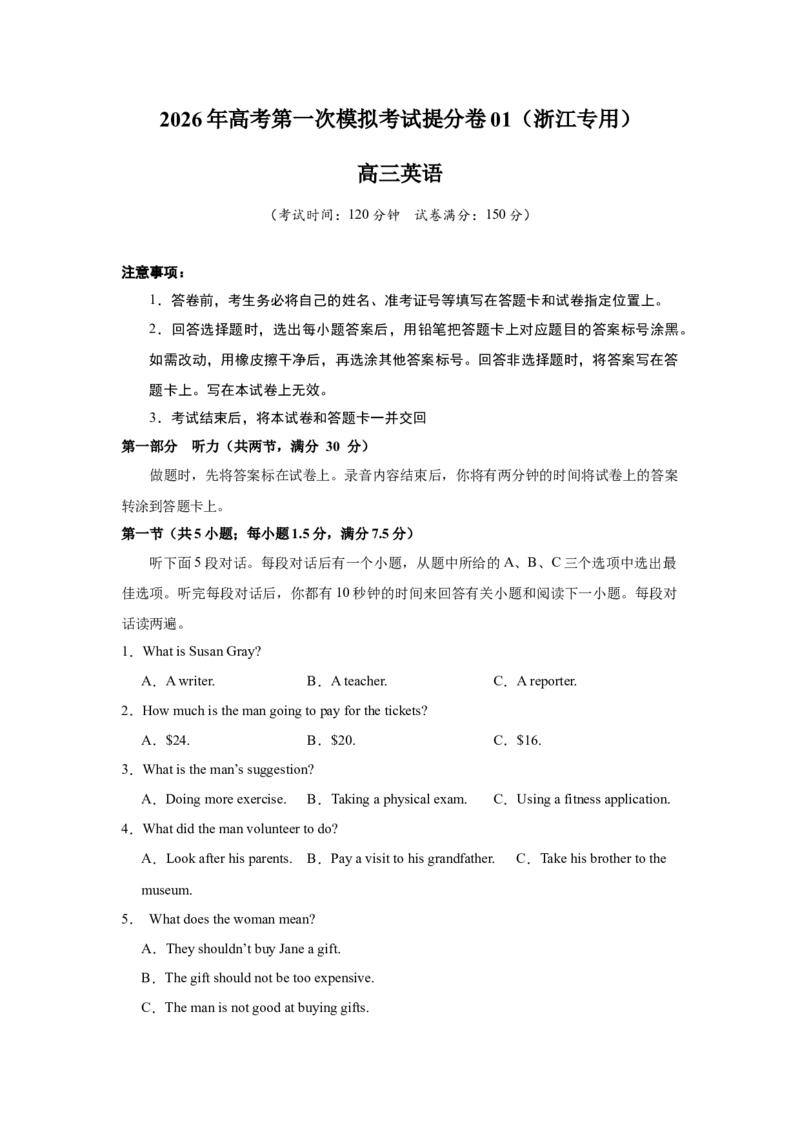
2026 年高考第一次模拟考试提分卷01(浙江专用)
高三英语
(考试时间:120 分钟  试卷满分:150 分)
注意事项:
1.答卷前,考生务必将自己的姓名、准考证号等填写在答题卡和试卷指定位置上。
2.回答选择题时,选出每小题答案后,用铅笔把答题卡上对应题目的答案标号涂黑。
如需改动,用橡皮擦干净后,再选涂其他答案标号。回答非选择题时,将答案写在答
题卡上。写在本试卷上无效。
3.考试结束后,将本试卷和答题卡一并交回
第一部分  听力(共两节,满分 30 分)
做题时,先将答案标在试卷上。录音内容结束后,你将有两分钟的时间将试卷上的答案
转涂到答题卡上。
第一节(共5 小题;每小题1.5 分,满分7.5 分)
听下面5 段对话。每段对话后有一个小题,从题中所给的A、B、C 三个选项中选出最
佳选项。听完每段对话后,你都有10 秒钟的时间来回答有关小题和阅读下一小题。每段对
话读两遍。
1.What is Susan Gray?
A.A writer.
B.A teacher.
C.A reporter.
2.How much is the man going to pay for the tickets?
A.$24.
B.$20.
C.$16.
3.What is the man’s suggestion?
A.Doing more exercise.
B.Taking a physical exam.
C.Using a fitness application.
4.What did the man volunteer to do?
A.Look after his parents.
B.Pay a visit to his grandfather.
C.Take his brother to the
museum.
5. What does the woman mean?
A.They shouldn’t buy Jane a gift.
B.The gift should not be too expensive.
C.The man is not good at buying gifts.
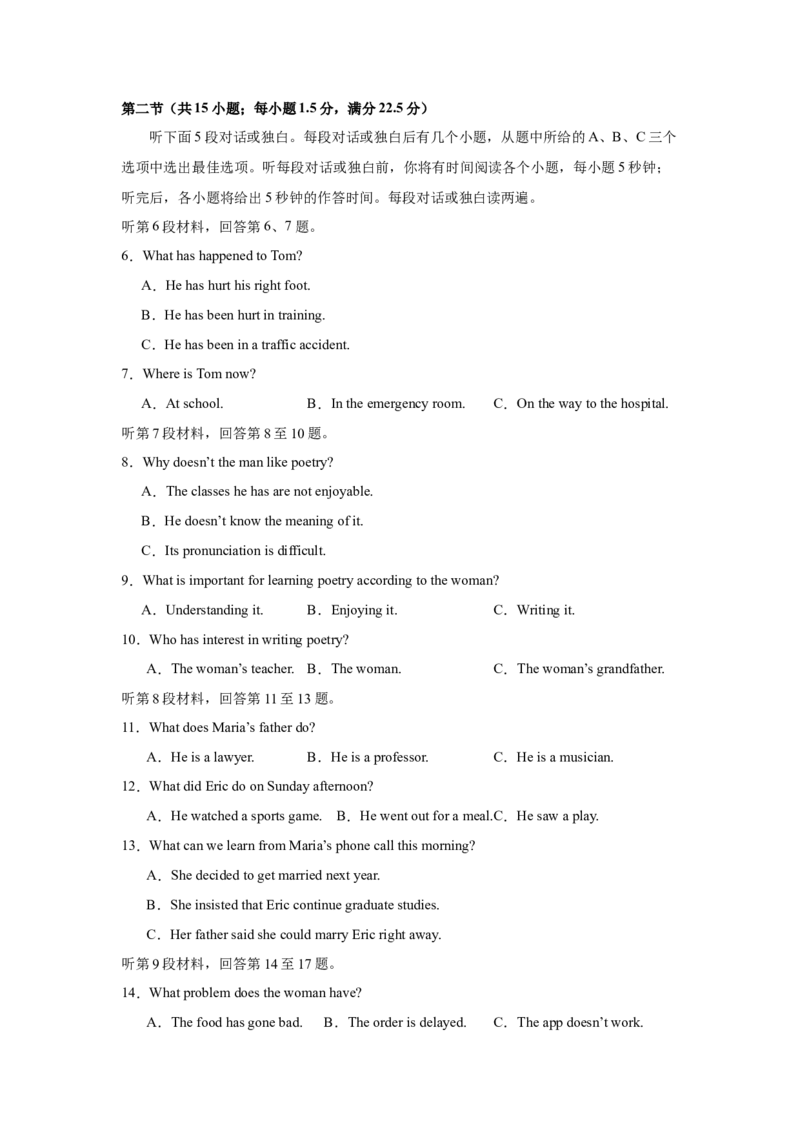
第二节(共15 小题;每小题1.5 分,满分22.5 分)
听下面5 段对话或独白。每段对话或独白后有几个小题,从题中所给的A、B、C 三个
选项中选出最佳选项。听每段对话或独白前,你将有时间阅读各个小题,每小题5 秒钟;
听完后,各小题将给出5 秒钟的作答时间。每段对话或独白读两遍。
听第6 段材料,回答第6、7 题。
6.What has happened to Tom?
A.He has hurt his right foot.
B.He has been hurt in training.
C.He has been in a traffic accident.
7.Where is Tom now?
A.At school.
B.In the emergency room.
C.On the way to the hospital.
听第7 段材料,回答第8 至10 题。
8.Why doesn’t the man like poetry?
A.The classes he has are not enjoyable.
B.He doesn’t know the meaning of it.
C.Its pronunciation is difficult.
9.What is important for learning poetry according to the woman?
A.Understanding it.
B.Enjoying it.
C.Writing it.
10.Who has interest in writing poetry?
A.The woman’s teacher.
B.The woman.
C.The woman’s grandfather.
听第8 段材料,回答第11 至13 题。
11.What does Maria’s father do?
A.He is a lawyer.
B.He is a professor.
C.He is a musician.
12.What did Eric do on Sunday afternoon?
A.He watched a sports game.  B.He went out for a meal.C.He saw a play.
13.What can we learn from Maria’s phone call this morning?
A.She decided to get married next year.
B.She insisted that Eric continue graduate studies.
C.Her father said she could marry Eric right away.
听第9 段材料,回答第14 至17 题。
14.What problem does the woman have?
A.The food has gone bad.   B.The order is delayed.
C.The app doesn’t work.
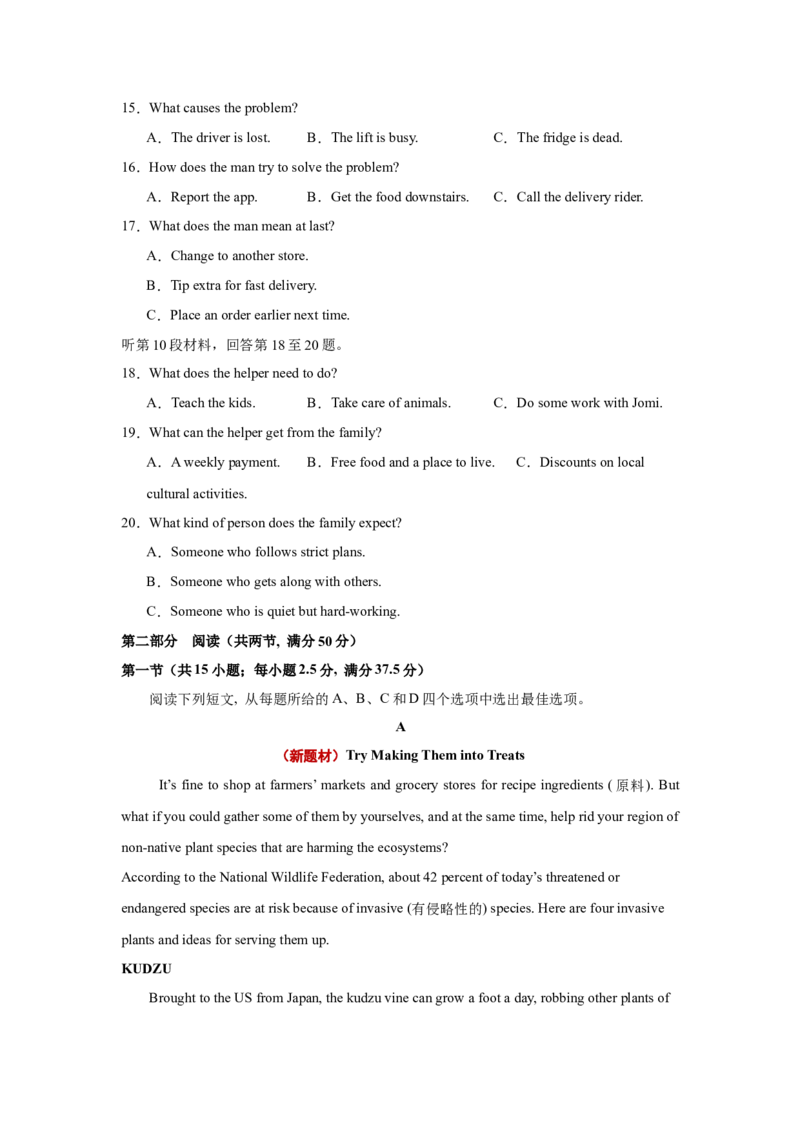
15.What causes the problem?
A.The driver is lost.
B.The lift is busy.
C.The fridge is dead.
16.How does the man try to solve the problem?
A.Report the app.
B.Get the food downstairs.
C.Call the delivery rider.
17.What does the man mean at last?
A.Change to another store.
B.Tip extra for fast delivery.
C.Place an order earlier next time.
听第10 段材料,回答第18 至20 题。
18.What does the helper need to do?
A.Teach the kids.
B.Take care of animals.
C.Do some work with Jomi.
19.What can the helper get from the family?
A.A weekly payment.
B.Free food and a place to live.
C.Discounts on local
cultural activities.
20.What kind of person does the family expect?
A.Someone who follows strict plans.
B.Someone who gets along with others.
C.Someone who is quiet but hard-working.
第二部分  阅读(共两节, 满分50 分)
第一节(共15 小题;每小题2.5 分, 满分37.5 分)
阅读下列短文, 从每题所给的A、B、C 和D 四个选项中选出最佳选项。
A
(新题材)Try Making Them into Treats
It’s fine to shop at farmers’ markets and grocery stores for recipe ingredients ( 原料). But
what if you could gather some of them by yourselves, and at the same time, help rid your region of
non-native plant species that are harming the ecosystems?
According to the National Wildlife Federation, about 42 percent of today’s threatened or
endangered species are at risk because of invasive (有侵略性的) species. Here are four invasive
plants and ideas for serving them up.
KUDZU
Brought to the US from Japan, the kudzu vine can grow a foot a day, robbing other plants of
sunlight. Its beautiful flowers bloom from July to September, but its leaves, roots, and vine tips are
more readily available. Pick flowers to use in making drinks.
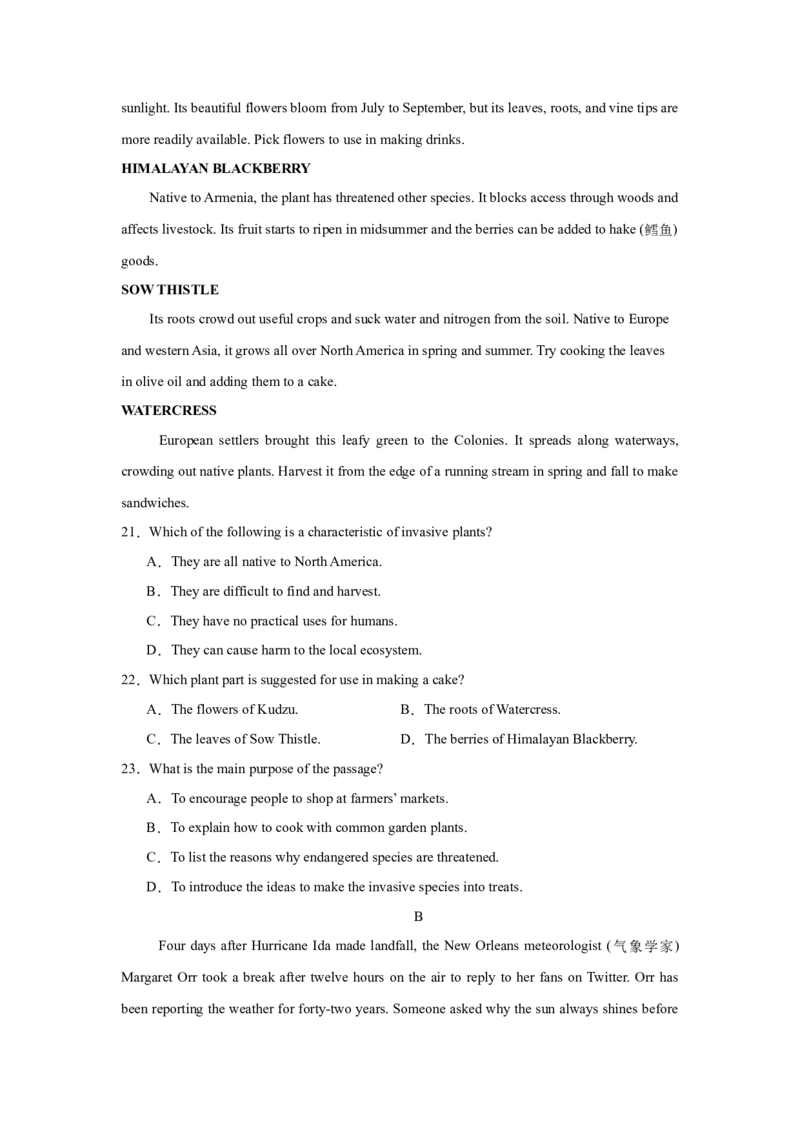
HIMALAYAN BLACKBERRY
Native to Armenia, the plant has threatened other species. It blocks access through woods and
affects livestock. Its fruit starts to ripen in midsummer and the berries can be added to hake (鳕鱼)
goods.
SOW THISTLE
Its roots crowd out useful crops and suck water and nitrogen from the soil. Native to Europe
and western Asia, it grows all over North America in spring and summer. Try cooking the leaves
in olive oil and adding them to a cake.
WATERCRESS
European settlers brought this leafy green to the Colonies. It spreads along waterways,
crowding out native plants. Harvest it from the edge of a running stream in spring and fall to make
sandwiches.
21.Which of the following is a characteristic of invasive plants?
A.They are all native to North America.
B.They are difficult to find and harvest.
C.They have no practical uses for humans.
D.They can cause harm to the local ecosystem.
22.Which plant part is suggested for use in making a cake?
A.The flowers of Kudzu.
B.The roots of Watercress.
C.The leaves of Sow Thistle.
D.The berries of Himalayan Blackberry.
23.What is the main purpose of the passage?
A.To encourage people to shop at farmers’ markets.
B.To explain how to cook with common garden plants.
C.To list the reasons why endangered species are threatened.
D.To introduce the ideas to make the invasive species into treats.
B
Four days after Hurricane Ida made landfall, the New Orleans meteorologist (气象学家)
Margaret Orr took a break after twelve hours on the air to reply to her fans on Twitter. Orr has
been reporting the weather for forty-two years. Someone asked why the sun always shines before
a storm. “To remind us that the sun will shine again,” she replied, adding a heart emoji. “The real
reason? Because you’ve often got high pressure right over you, and it’s hot. The high moves off to
the east and pushes the system our way.”
Many of her workmates were sleeping at the station, but Orr preferred to go home, where
she had running water but no electricity. She could handle not having an air-conditioner. Not
having Internet, though, was a hardship. She said, “I couldn’t check my social media until I got to
work, which was annoying.” In the days leading up to Ida, people contacted Orr through Twitter to
get individualized, practical advice. Orr tried to respond to everyone. This dedication earned her,
great respect from the residents.
Orr has always been fascinated by weather. In 1965, when she was twelve years old, the
wind from Hurricane Betsy blew the roof off her family’s house in New Orleans. She remembers
going outside and standing in the eye of the storm. “I looked up and saw the sky and saw the
stars,” she said.
“Bad weather happens everywhere,” she said. “Every now and then, on Twitter, you’ll see
people saying, why do you live there? Well, I live here because it’s my home. This is where I grew
up. This is the place I love.” She went on, “After Hurricane Katrina, I thought, could I live
anywhere else? And I decided, no, I couldn’t.” She added, “As my daughter said about New
Orleans when she was a little girl, ‘I even love the dirt.’”
24.What kind of person is Orr according to paragraph 1?
A.Hardworking and serious.
B.Curious and committed.
C.Professional and inspiring.
D.Knowledgeable and brave.
25.Why was Orr respected by the residents?
A.She overcame tough living conditions.
B.She devoted herself to helping others.
C.She had many contacts on the Internet.
D.She returned home after the hurricane.
26.Why as Orr’s experience in 1965 mentioned?
A.To indicate the absence of rescue efforts.
B.To highlight the power of natural disasters.
C.To stress the necessity of weather forecasting.
D.To show weather conditions’ attraction to her.
27.What is the last paragraph mainly about?
A.Orr’s connection with home.
B.Orr’s knowledge of weather.
C.Orr’s optimism about life.
D.Orr’s love for her daughter.
C
(原创题)Music has long been valued for its healing effects. Now, by combining it with
artificial intelligence (AI), its healing power is becoming more precise and accessible. At a recent
conference, the Shanghai Conservatory of Music introduced a groundbreaking AI music therapy
pod, offering a new way to achieve personal well-being.
Inside the pod, users lie in a comfortable chair while sensors monitor their brainwaves and
heart rate. They begin by filling out a questionnaire about their health and personal background.
This information, combined with the real-time body data collected by the sensors, drives an AI
model. The model then creates a unique, multisensory experience with synchronized music and
visuals, often featuring calming natural sounds. After the session, each user receives a report on
their process and a "personalized music prescription" designed for their specific needs. Experts
state that this system helps improve focus, aids relaxation, and stabilizes heart rate.
The science behind this innovation is impressive. Each person's resting brainwaves are
unique, and AI can transform these brainwave patterns into sound. This process requires handling
huge amounts of data, a task perfectly suited for AI's computing power. The therapy pod
represents a major achievement by combining different fields like acoustic engineering, biological
sensing, and AI to create dynamic healing plans based on a person's body information.
The potential applications for this technology are vast. It could be used to help people with
sleep disorders, depression, and other mental health challenges. The project is already working
with hospitals to support children with conditions like autism and to provide comfort for students
suffering from exam anxiety. Beyond music therapy, AI's role in mental health is expanding. It can
analyze online conversations to detect early signs of emotional problems, guide users through
therapeutic exercises, and even offer virtual reality training to improve emotional management
skills. As mental health issues rise globally, this fusion of technology and art offers a promising
new path toward healing and public well-being.
28. How does the AI in the therapy pod create a personalized music experience for a user?
A. By analyzing the user's social media activities.
B. By using the user's health background and real-time body data.
C. By selecting music from a large library of natural sounds.
D. By following a fixed program designed for all users.
29. What is the key innovation of the AI music therapy pod according to the passage?
A. Its use of zero-gravity chairs and large screens.
B. Its ability to produce music for entertainment purposes.
C. The integration of various fields to create dynamic healing plans.
D. The publication of numerous scientific research papers.
30. Why is the AI music therapy considered particularly timely?
A. Because it is cheaper than traditional medical treatments.
B. Because it can be used without any professional guidance.
C. Because there is a growing need for new solutions to mental health problems.
D. Because most people are already familiar with music therapy.
31. What can be inferred about the future role of AI in mental health from the last paragraph?
A. AI will completely replace human therapists in the near future.
B. Its role will be limited to analyzing data and generating reports.
C. It will become a core tool offering diverse support in mental health care.
D. Its effectiveness is still uncertain and requires more evidence.
D
(原创题)A new international study is changing our long-held view of lead exposure as a
modern problem. Scientists have discovered that early human ancestors repeatedly encountered
this toxic metal for over two million years. This suggests that lead may have played a surprising
role in the evolution of human brains, behavior, and even language.
The evidence comes from the analysis of 51 fossil teeth from various ancient human species.
Advanced chemical techniques revealed distinct "lead bands" within the teeth. These bands
formed during childhood, indicating that our ancestors repeatedly took in lead from environmental
sources like contaminated water or soil. This means the brains of our ancestors developed under
the influence of this harmful metal, potentially shaping their social behavior and thinking abilities.
To understand the impact, researchers created lab-grown brain models. They tested a key
gene called NOVA1, which regulates lead's effect during brain development. The modern human
version of NOVA1 is different from the Neanderthal version. When exposed to lead, models with
the Neanderthal-type gene showed significant damage in brain areas crucial for language
development. Models with the modern human gene experienced far less disruption.
These results suggest that our NOVA1 gene variant offered protection against lead's harmful
neurological effects. This protection may have given modern humans a survival advantage over
Neanderthals. By safeguarding gene pathways related to language, our genetic changes may have
promoted better communication skills, helping our species eventually surpass other ancient
humans. This shows how environmental pressures can drive evolution.
Today, lead exposure remains a serious health threat, mainly from industrial sources. This
research reveals that our vulnerability to lead is deeply rooted in our evolutionary history, shaped
by the interaction between our genes and the environment. This shaping process has continued for
millions of years and continues today, reminding us that our past is closely linked to our present
health.
32. How did scientists find the evidence of ancient lead exposure?
A. By studying the genes of modern humans.
B. By analyzing fossilized teeth.
C. By comparing modern and Neanderthal brains.
D. By measuring contaminated soil.
33. What does the modern human NOVA1 gene suggest?
A. It made them more vulnerable to lead.
B. It could be a factor in their success over Neanderthals.
C. It directly caused the Industrial Revolution.
D. It made them completely immune to lead's toxicity.
34. Which of the following is the best title for the passage?
A. Lead: A Modern Health Crisis
B. The Rise and Fall of Neanderthals
C. The Role of Ancient Lead in Human Evolution
D. How Fossil Teeth Tell Stories
35. What view does the research present about environmental pressures?
A. They are always harmful to species development.
B. They can act as a driving force for genetic changes.
C. Their effects were only understood after the Industrial Age.
D. They primarily influence the development of language.
第二节(共5 小题;每小题2. 5 分, 满分12. 5 分)
阅读下面短文, 从短文后的选项中选出可以填入空白处的最佳选项。选项中有两项为
多余选项。
Diaries are usually very helpful in managing what happens to us on a daily basis.     36
I spent a long time investigating how to create a mood journal. However, no matter how
hard I tried, I couldn’t find anything. There was a lot of theory, but I didn’t know where to start.
37     The experience was so positive that today I am going to share it with you.
To create a mood journal, the first step is to get a notebook dedicated for this purpose alone.
38     When they are all in one place, you can return to your mood journal whenever you need to
and analyze them from a different perspective.
Once you have a notebook, it’s time to begin. When you’re writing, you should be calm,
alone, and not in a hurry. You can write every day if you need to.     39     The important
thing to remember is that your mood journal isn’t just for negative emotions like anger, frustration,
and anxiety. It is also for positive emotions like happiness and joy. This will help you get to know
yourself on a deeper level.
Writing in your mood journal consistently will help you understand yourself better. You will
be able to identify the problem areas in your life and notice which emotion comes up the most. Is
it fear, or maybe insecurity?     40     So you can put them into practice and not just leave
them on the page.
A.Or just write when you feel the need.
B.It will be easier to connect to your emotions.
C.Are you a person with a lot of negative emotions?
D.Being aware of it will help you come up with suggestions.
E.That way you don’t have your notes all scattered (分散的) around.
F.So, I decided to grab my own notebook and manage my emotions my way.
G.Emotional diaries have the particularity of helping us restructure our thinking.
第三部分 语言运用(共两节,满分30 分)
第一节(共15 小题,每小题1 分,满分15 分)
阅读下面短文, 从每题所给的A、B、C 和D 四个选项中选出可以填入空白处的最佳选
项。
I always give the same advice to travel enthusiasts: Wherever home is, that is where you
should begin. However, I was     41     at following my own advice, for I have rarely
explored my hometown — until now. With all of my foreign trips     42    , I decided to travel
north from my home, Sweden.
Unsurprisingly, my journey went smoothly, the scenery along the way breathtaking and
picturesque, but my guide, Johan, opened my     43     to something else. One day, on a
snowmobile path     44     tall trees on both sides, he asked me what I saw. “Trees,” I
answered. “A forest.” Johan shook his head, explaining, “Not a forest. A     45    . Soon, this
is all that will be left.” He added that the straight rows of trees of the same species and size were
grown by people.
Johan was right. For over half a century now, the ancient forest that once seemed so     46
has continued to be cruelly cut down for biofuels and paper, and, in its place stand plantations of
pine (松树). Only a small part of the ancient forest     47    , and that part grows smaller
every year.
The Sám, a native people there, are facing an. existential     48    . Their lives and
culture are     49     linked to the ancient forest and the reindeer that populate the region. The
slow-growing lichen (地衣) and mushrooms which the reindeer     50     are not found in any
pine plantations.    51    , the death of one means the death of the other, and an     52

future for an entire people.
“We’re not     53     in nature, but part of it.” Johan’s words echoed in my mind as I
looked at the      54      forest of the North. Too many of us have forgotten this truth — and
with that forgetfulness, we may risk the     55     of not only the wild but also ourselves.
41.A.skilful
B.powerless
C.terrible
D.surprised
42.A.extended
B.canceled
C.scheduled
D.confirmed
43.A.eyes
B.ears
C.heart
D.arms
44.A.equipped with B.coated with
C.dotted with
D.lined with
45.A.jungle
B.grassland
C.tree
D.plantation
46.A.valueless
B.endless
C.limited
D.deserted
47.A.remains
B.decreases
C.matters
D.evolves
48.A.condition
B.crisis
C.opportunity
D.question
49.A.negatively
B.hardly
C.slightly
D.closely
50.A.feed on
B.sleep on
C.step on
D.move on
51.A.However
B.Otherwise
C.Therefore
D.Nevertheless
52.A.unfamiliar
B.uncertain
C.incredible
D.upcoming
53.A.friends
B.residents
C.volunteers
D.visitors
54.A.emerging
B.expanding
C.disappearing
D.growing
55.A.survival
B.revival
C.safety
D.stability
第二节(共10 小题;每小题1.5 分 ,满分15 分)
阅读下面短文,在空白处填入1 个适当的单词或括号内单词的正确形式。
(原创题)Brussels: Where Great Minds Met
In the heart of Brussels lies the Grand Place, a square famous for its rich history. For
centuries, it

 56

   (serve) as the city's main market and a center for political life. Its beautiful
buildings and cobblestone surface attract countless visitors. However, beyond its tourist appeal,
the square holds a deeper significance as a meeting place for great minds and spirits.
The square became a haven for many exiled thinkers. Among them was Karl Marx,
  57


lived nearby from 1846 to 1848. He often met his friend Friedrich Engels at a cafe on the square.
There, they spent hours in heated debate and focused writing. It was in Brussels
  58

   they
completed the draft of The Communist Manifesto, a work that would later inspire movements
across the world.
Another great figure who found refuge here was the French writer Victor Hugo. He arrived in
1851 after being forced
  59

   exile for political reasons. Hugo was deeply impressed by the
square's architecture,
  60

   (praise) it as a "marvel". During his stay, he wrote a
  61


(power) work criticizing the government, which further established his fame as both a literary and
political voice.
The poet Charles Baudelaire also spent time in Brussels, though his experience was more
difficult. He struggled with money problems and health issues. Despite these challenges, he
continued to write,
  62

   he even produced a work filled with sharp critiques of Belgium.
Interestingly, the city now honors him with a plaque on his former residence, showing respect for
his artistic legacy.
These brilliant individuals were not alone. Many other
  63

   (write) and revolutionaries
walked the same streets. The city's tolerant atmosphere provided them with a safe space to think
and create. Thus, the true grandeur of the Grand Place is not just in its stones, but in the ideas that
64

   (shape) here. It
  65

   (remain) a powerful symbol of where art, politics, and history
have gathered together .
第四部分 写作(共两节, 满分40 分)
第一节(满分15 分)
    假定你是校学生会主席李华,外教Chris 上个月答应为学校“缤纷艺术节”宣传册撰
写英文简介,请给Chris 写一封邮件,内容包括:
(1)询问进展;
(2)提醒提交时间。
注意:
(1)写作词数应为80 个左右;
(2)请按如下格式在答题卡的相应位置作答。
_______________________________________________________________________________
_______________________________________________________________________________
_______________________________________________________________________________
_______________________________________________________________________________
_______________________________________________________________________________
_______________________________________________________________________________
_____________________
第二节(满分25 分)
阅读下面材料,根据其内容和所给段落开头语续写两段,使之构成一篇完整的短文。
My friend Ollie found a super-cool treasure near his house — a little bird.
On my way to the park, I saw Ollie sitting on his steps, signaling me to be quiet. To my
surprise, the cutest little bird was perched right on his shoulder! It seemed completely at ease!
Ollie explained that it had hopped onto him without any fear. We figured it must be someone’s lost
pet.
Ollie’s grandmother, Abuela, came out with a dish of water and suggested calling the
animal shelter. When we got through, the man on the phone told us that no one had reported a
missing bird recently. He advised us to put up “Found Bird” flyers in the neighborhood.
Meanwhile, I suggested we also post Blue’s information and cute pictures on our local
community’s online bulletin board, hoping the power of the internet would help. Abuela’s friend
Michiko, who knew a lot about birds, brought a cage, some seeds and helpful advice. A wave of
relief washed over Ollie when Michiko approved of the name “Blue” that Ollie had given her.
That afternoon, Ollie and I were busy making “Found Bird” flyers. Blue, perched happily
on the edge of the table, provided a sweet soundtrack with her cheerful chirps. Abuela watched us
with a warm smile, sighing softly, “I would miss Blue’s beautiful songs”. Seeing this as the perfect
opportunity, Ollie looked up, his eyes full of hope.“Abuela,” he begged, his voice a little shaky,
“if...if no one claims her, could we please keep her? I promise I’ ll be fully responsible” Looking
at Ollie’s earnest face, then at the content little bird, Abuela finally nodded slowly. “Well,” she
said firmly, “we must try our best to find her owner first.”
However, one flyer Ollie made was full of “accidents” — the picture of Blue was glued
upside down, and the title mistakenly read “Found Bread”. He admitted he might have messed up
a little on purpose, because he was conflicted between his desire to keep Blue and his
responsibility to find her owner.
We put up all the correct flyers. After a month and a half with no response, Blue officially
became a member of Ollie’s family, her cheerful songs filling their home with lasting joy.
注意: 1.续写词数应为150 个左右;
2.请按如下格式在答题卡的相应位置作答。
With Blue now a beloved family member, Ollie’s days were filled with joyful responsibility.
_______________________________________________________________________________
_______________________________________________________________________________
_______________________________________________________________________________
_______________________________________________________________________________
_______________________________________________________________________________
_________________________________________________________________
One sunny afternoon, a timid knock interrupted their peace.
_______________________________________________________________________________
_______________________________________________________________________________
_______________________________________________________________________________
_______________________________________________________________________________
_______________________________________________________________________________
_________________________________________________________________