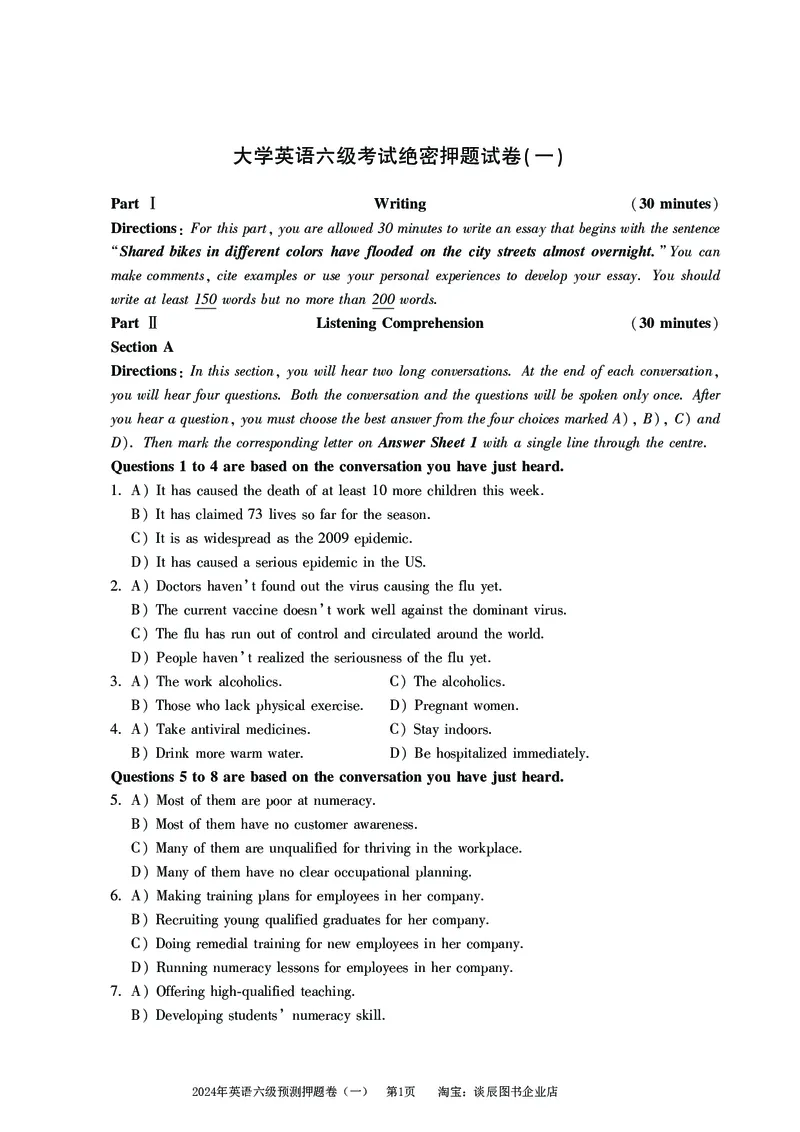
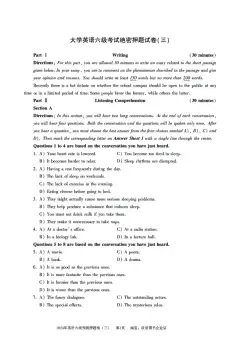
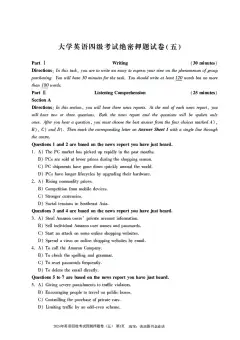
大学英语六级考试绝密押题试卷(一)
Part Writing 30 minutes
Ⅰ ( )
Directions For this part you are allowed 30 minutes to write an essay that begins with the sentence
: ,
Shared bikes in different colors have flooded on the city streets almost overnight. You can
“ ”
make comments cite examples or use your personal experiences to develop your essay. You should
,
write at least 150 words but no more than 200 words.
Part Listening Comprehension 30 minutes
Ⅱ ( )
Section A
Directions In this section you will hear two long conversations. At the end of each conversation
: , ,
you will hear four questions. Both the conversation and the questions will be spoken only once. After
you hear a question you must choose the best answer from the four choices marked A B C and
, ), ), )
D . Then mark the corresponding letter on Answer Sheet 1 with a single line through the centre.
)
Questions 1 to 4 are based on the conversation you have just heard.
1. A) It has caused the death of at least 10 more children this week.
B) It has claimed 73 lives so far for the season.
C) It is as widespread as the 2009 epidemic.
D) It has caused a serious epidemic in the US.
2. A) Doctors haven’t found out the virus causing the flu yet.
B) The current vaccine doesn’t work well against the dominant virus.
C) The flu has run out of control and circulated around the world.
D) People haven’t realized the seriousness of the flu yet.
3. A) The work alcoholics. C) The alcoholics.
B) Those who lack physical exercise. D) Pregnant women.
4. A) Take antiviral medicines. C) Stay indoors.
B) Drink more warm water. D) Be hospitalized immediately.
Questions 5 to 8 are based on the conversation you have just heard.
5. A) Most of them are poor at numeracy.
B) Most of them have no customer awareness.
C) Many of them are unqualified for thriving in the workplace.
D) Many of them have no clear occupational planning.
6. A) Making training plans for employees in her company.
B) Recruiting young qualified graduates for her company.
C) Doing remedial training for new employees in her company.
D) Running numeracy lessons for employees in her company.
7. A) Offering high-qualified teaching.
B) Developing students’ numeracy skill.
2024年英语六级预测押题卷(一) 第1页 淘宝:谈辰图书企业店C) Helping students achieve all-round development.
D) Being strict with students’ academic achievement.
8. A) The poor teaching quality of schools nowadays.
B) The decreasing number of graduates nowadays.
C) The reduction of cost in business payroll nowadays.
D) The reduction of funding for further education nowadays.
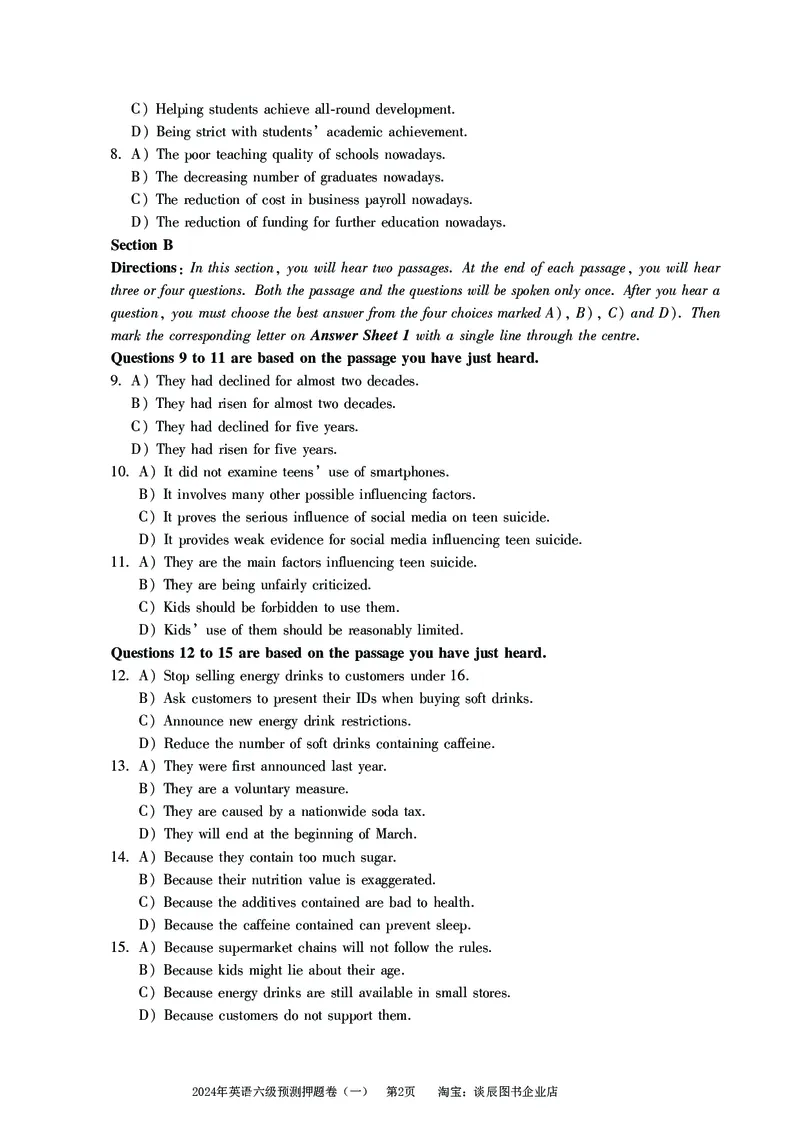
Section B
Directions In this section you will hear two passages. At the end of each passage you will hear
: , ,
three or four questions. Both the passage and the questions will be spoken only once. After you hear a
question you must choose the best answer from the four choices marked A B C and D . Then
, ), ), ) )
mark the corresponding letter on Answer Sheet 1 with a single line through the centre.
Questions 9 to 11 are based on the passage you have just heard.
9. A) They had declined for almost two decades.
B) They had risen for almost two decades.
C) They had declined for five years.
D) They had risen for five years.
10. A) It did not examine teens’ use of smartphones.
B) It involves many other possible influencing factors.
C) It proves the serious influence of social media on teen suicide.
D) It provides weak evidence for social media influencing teen suicide.
11. A) They are the main factors influencing teen suicide.
B) They are being unfairly criticized.
C) Kids should be forbidden to use them.
D) Kids’ use of them should be reasonably limited.
Questions 12 to 15 are based on the passage you have just heard.
12. A) Stop selling energy drinks to customers under 16.
B) Ask customers to present their IDs when buying soft drinks.
C) Announce new energy drink restrictions.
D) Reduce the number of soft drinks containing caffeine.
13. A) They were first announced last year.
B) They are a voluntary measure.
C) They are caused by a nationwide soda tax.
D) They will end at the beginning of March.
14. A) Because they contain too much sugar.
B) Because their nutrition value is exaggerated.
C) Because the additives contained are bad to health.
D) Because the caffeine contained can prevent sleep.
15. A) Because supermarket chains will not follow the rules.
B) Because kids might lie about their age.
C) Because energy drinks are still available in small stores.
D) Because customers do not support them.
2024年英语六级预测押题卷(一) 第2页 淘宝:谈辰图书企业店Section C
Directions In this section you will hear three recordings of lectures or talks followed by three or
: ,
four questions. The recordings will be played only once. After you hear a question you must choose
,
the best answer from the four choices marked A B C and D . Then mark the corresponding
), ), ) )
letter on Answer Sheet 1 with a single line through the centre.
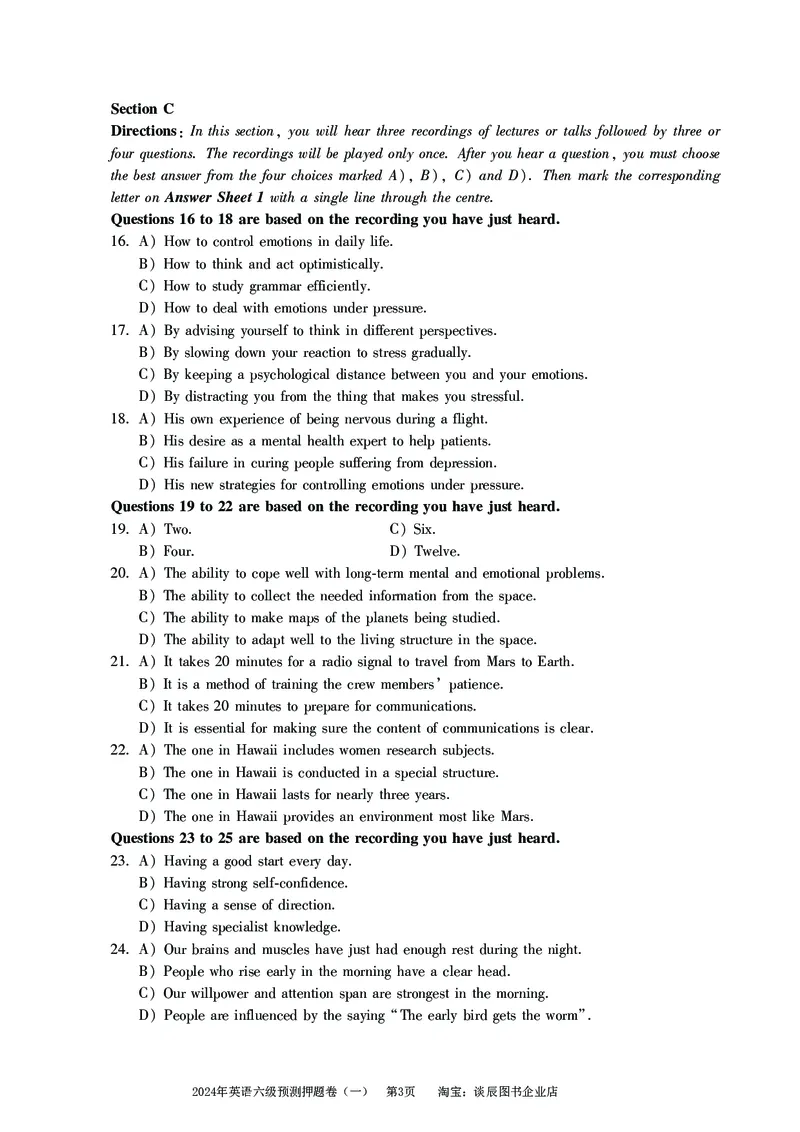
Questions 16 to 18 are based on the recording you have just heard.
16. A) How to control emotions in daily life.
B) How to think and act optimistically.
C) How to study grammar efficiently.
D) How to deal with emotions under pressure.
17. A) By advising yourself to think in different perspectives.
B) By slowing down your reaction to stress gradually.
C) By keeping a psychological distance between you and your emotions.
D) By distracting you from the thing that makes you stressful.
18. A) His own experience of being nervous during a flight.
B) His desire as a mental health expert to help patients.
C) His failure in curing people suffering from depression.
D) His new strategies for controlling emotions under pressure.
Questions 19 to 22 are based on the recording you have just heard.
19. A) Two. C) Six.
B) Four. D) Twelve.
20. A) The ability to cope well with long-term mental and emotional problems.
B) The ability to collect the needed information from the space.
C) The ability to make maps of the planets being studied.
D) The ability to adapt well to the living structure in the space.
21. A) It takes 20 minutes for a radio signal to travel from Mars to Earth.
B) It is a method of training the crew members’ patience.
C) It takes 20 minutes to prepare for communications.
D) It is essential for making sure the content of communications is clear.
22. A) The one in Hawaii includes women research subjects.
B) The one in Hawaii is conducted in a special structure.
C) The one in Hawaii lasts for nearly three years.
D) The one in Hawaii provides an environment most like Mars.
Questions 23 to 25 are based on the recording you have just heard.
23. A) Having a good start every day.
B) Having strong self-confidence.
C) Having a sense of direction.
D) Having specialist knowledge.
24. A) Our brains and muscles have just had enough rest during the night.
B) People who rise early in the morning have a clear head.
C) Our willpower and attention span are strongest in the morning.
D) People are influenced by the saying “The early bird gets the worm”.
2024年英语六级预测押题卷(一) 第3页 淘宝:谈辰图书企业店25. A) It helps us review our mistakes.
B) It helps us make full use of our time.
C) It helps us set our goals.
D) It helps us get prepared.
Part Reading Comprehension 40 minutes
Ⅲ ( )
Section A
Directions In this section there is a passage with ten blanks. You are required to select one word
: ,
for each blank from a list of choices given in a word bank following the passage. Read the passage
through carefully before making your choices. Each choice in the bank is identified by a letter.
Please mark the corresponding letter for each item on Answer Sheet 2 with a single line through the
centre. You may not use any of the words in the bank more than once.
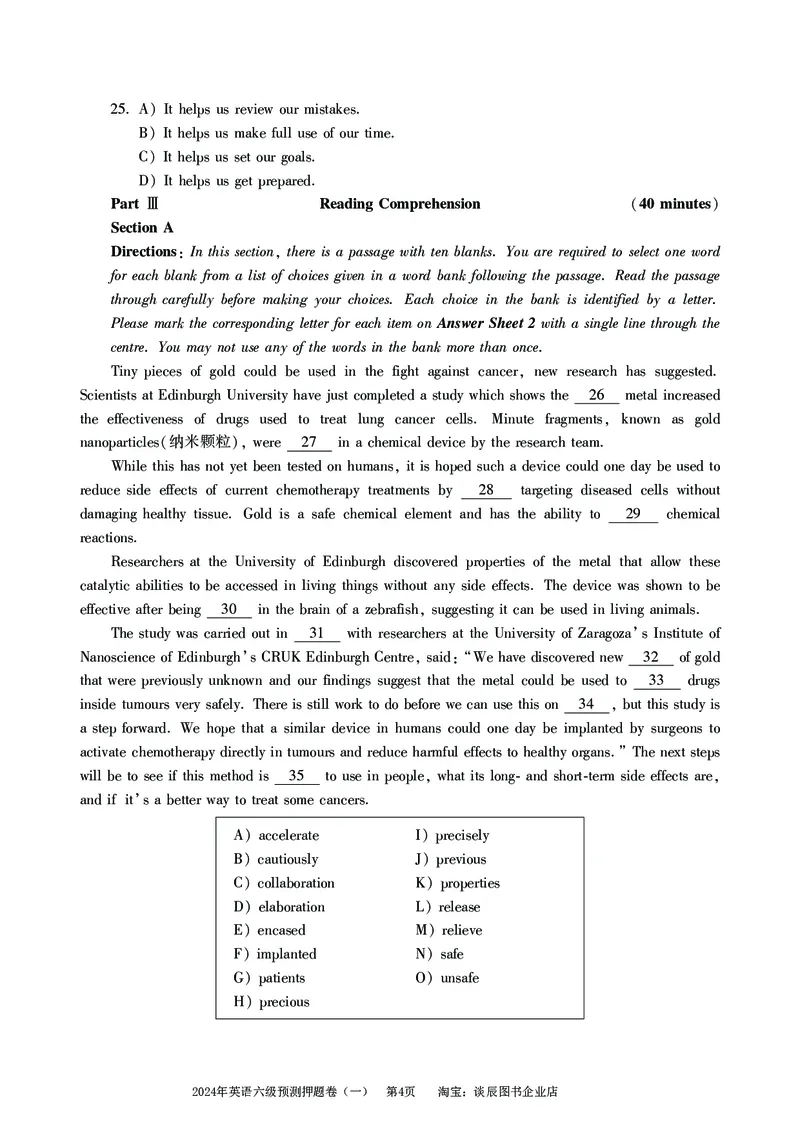
Tiny pieces of gold could be used in the fight against cancer, new research has suggested.
Scientists at Edinburgh University have just completed a study which shows the 26 metal increased
the effectiveness of drugs used to treat lung cancer cells. Minute fragments, known as gold
纳米颗粒
nanoparticles( ), were 27 in a chemical device by the research team.
While this has not yet been tested on humans, it is hoped such a device could one day be used to
reduce side effects of current chemotherapy treatments by 28 targeting diseased cells without
damaging healthy tissue. Gold is a safe chemical element and has the ability to 29 chemical
reactions.
Researchers at the University of Edinburgh discovered properties of the metal that allow these
catalytic abilities to be accessed in living things without any side effects. The device was shown to be
effective after being 30 in the brain of a zebrafish, suggesting it can be used in living animals.
The study was carried out in 31 with researchers at the University of Zaragoza’s Institute of
Nanoscience of Edinburgh’s CRUK Edinburgh Centre, said: “We have discovered new 32 of gold
that were previously unknown and our findings suggest that the metal could be used to 33 drugs
inside tumours very safely. There is still work to do before we can use this on 34 , but this study is
a step forward. We hope that a similar device in humans could one day be implanted by surgeons to
activate chemotherapy directly in tumours and reduce harmful effects to healthy organs.” The next steps
will be to see if this method is 35 to use in people, what its long- and short-term side effects are,
and if it’s a better way to treat some cancers.
A) accelerate I) precisely
B) cautiously J) previous
C) collaboration K) properties
D) elaboration L) release
E) encased M) relieve
F) implanted N) safe
G) patients O) unsafe
H) precious
2024年英语六级预测押题卷(一) 第4页 淘宝:谈辰图书企业店Section B
Directions In this section you are going to read a passage with ten statements attached to it. Each
: ,
statement contains information given in one of the paragraphs. Identify the paragraph from which the
information is derived. You may choose a paragraph more than once. Each paragraph is marked
with a letter. Answer the questions by marking the corresponding letter on Answer Sheet 2.
Have Smartphones Destroyed a Generation
?
A) I’ve been researching generational differences for 25 years, starting when I was a 22-year-old
doctoral student in psychology. Typically, the characteristics that come to define a generation appear
gradually, and along a continuum. Beliefs and behaviors that were already rising simply continue to do
so. Millennials, for instance, are a highly individualistic generation, but individualism had been
increasing since the Baby Boomers turned on, tuned in and dropped out. I had grown accustomed to
line graphs of trends that looked like modest hills and valleys.
B) Around 2012, I noticed abrupt shifts in teen behaviors and emotional states. The gentle slopes
of the line graphs became steep mountains and sheer cliffs, and many of the distinctive characteristics of
the Millennial generation began to disappear. In all my analyses of generational data—some reaching
back to the 1930s—I had never seen anything like it.
暂时性问题
C) At first I presumed these might be blips( ), but the trends persisted across several
years and a series of national surveys. The changes weren’t just in degree, but in kind. The biggest
difference between the Millennials and their predecessors was in how they viewed the world; teens today
differ from the Millennials not just in their views but in how they spend their time. The experiences they
have every day are radically different from those of the generation that came of age just a few years
before them.
D) What happened in 2012 to cause such dramatic shifts in behavior? It was after the Great
Recession, which officially lasted from 2007 to 2009 and had a starker effect on Millennials trying to
find a place in a sputtering economy. But it was exactly the moment when the proportion of Americans
who owned a smartphone surpassed 50 percent.
E) The more I pored over yearly surveys of teen attitudes and behaviors, and the more I talked
with young people, the clearer it became that theirs is a generation shaped by the smartphone and by the
伴随的
concomitant( ) rise of social media. I call them iGen. Born between 1995 and 2012, members
of this generation are growing up with smartphones, have an Instagram account before they start high
school, and do not remember a time before the internet. iGen’s oldest members were early adolescents
when the iPhone was introduced, in 2007, and high-school students when the iPad entered the scene,
in 2010. A 2017 survey of more than 5,000 American teens found that three out of four owned an
iPhone.
F) The advent of the smartphone and its cousin the tablet was followed quickly by hand-wringing
about the harmful effects of “screen time”. But the impact of these devices has not been fully
appreciated, and goes far beyond the usual concerns about curtailed attention spans. The arrival of the
smartphone has radically changed every aspect of teenagers’ lives, from the nature of their social
interactions to their mental health. These changes have affected young people in every corner of the
nation and in every type of household. The trends appear among teens poor and rich; of every ethnic
2024年英语六级预测押题卷(一) 第5页 淘宝:谈辰图书企业店background; in cities, suburbs, and small towns. Where there are call towers, there are teens living
their lives on their smartphone.
G) To those of us who fondly recall a more analog adolescence, this may seem foreign and
troubling. The aim of generational study, however, is not to succumb to nostalgia for the way things
used to be; it’s to understand how they are now. Some generational changes are positive, some are
negative, and many are both. More comfortable in their bedrooms than in a car or at a party, today’s
teens are physically safer than teens have ever been. They’re markedly less likely to get into a car
accident and, having less of a taste for alcohol than their predecessors, are less susceptible to drinking’s
attendant ills.
H) Psychologically, however, they are more vulnerable than Millennials were: Rates of teen
depression and suicide have skyrocketed since 2011. It’s not an exaggeration to describe iGen as being
on the brink of the worst mental-health crisis in decades. Much of this deterioration can be traced to
重大的
their phones. Even when a seismic( ) event—a war, a technological leap, a free concert in the
mud—plays an outsize role in shaping a group of young people, no single factor ever defines a
generation. Parenting styles continue to change, as do school curricula and culture, and these things
matter. But the twin rise of the smartphone and social media has caused an earthquake of a magnitude
we’ve not seen in a very long time, if ever. There is compelling evidence that the devices we’ve
placed in young people’s hands are having profound effects on their lives—and making them seriously
unhappy.
I) The allure of independence was so powerful to previous generations. However, it now holds less
sway over today’s teens, who are less likely to leave the house without their parents. The shift is
stunning: 12th-graders in 2015 were going out less often than eighth-graders did as recently as 2009.
J) Today’s teens are also less likely to date. The initial stage of courtship, which Gen Xers called
“liking”(as in “Ooh, he likes you!”), kids now call “talking”—an ironic choice for a generation that
prefers texting to actual conversation. After two teens have “talked” for a while, they might start
dating. But only about 56 percent of high-school seniors in 2015 went out on dates; for Boomers and
Gen Xers, the number was about 85 percent.
K) The decline in dating tracks with a decline in sexual activity. The drop is the sharpest for
ninth-graders, among whom the number of sexually active teens has been cut by almost 40 percent since
1991. The average teen now has had sex for the first time by the spring of 11th grade, a full year later
than the average Gen Xer. Fewer teens having sex has contributed to what many see as one of the most
positive youth trends in recent years: The teen birth rate hit an all-time low in 2016, down 67 percent
since its modern peak, in 1991.
L) Even driving, a symbol of adolescent freedom inscribed in American popular culture, from
Rebel Without a Cause Ferris Bueller s Day Off
to ’ , has lost its appeal for today’s teens. Nearly all
Boomer high-school students had their driver’s license by the spring of their senior year; more than one
in four teens today still lack one at the end of high school. For some, Mom and Dad are such good
chauffeurs that there’ s no urgent need to drive. “My parents drove me everywhere and never
complained, so I always had rides,” a 21-year-old student in San Diego told me. “I didn’t get my
license until my mom told me I had to because she could not keep driving me to school.” She finally got
2024年英语六级预测押题卷(一) 第6页 淘宝:谈辰图书企业店her license six months after her 18th birthday. In conversation after conversation, teens described
getting their license as something to be nagged into by their parents—a notion that would have been
unthinkable to previous generations.
M) Independence isn’t free—you need some money in your pocket to pay for gas, or for that
bottle of schnapps. iGen teens aren’t working (or, managing their own money). Statistically, in the
late 1970s, 77 percent of high-school seniors worked for pay during the school year; by the mid-2010s,
only 55 percent did. The number of eighth-graders who work for pay has been cut in half. These
declines accelerated during the Great Recession, but teen employment has not bounced back, even
though job availability has.
36. Millennials and their former generations viewed the world in a way different from teens do
today.
37. It is obvious that iGen teens are deeply influenced by cellphone as well as social media.
38. Teens behavior changed suddenly at the time when over half of Americans had smartphones.
39. Physically speaking, today’s teens are much safer than ever before, which is one of the
positive outcomes of smartphones.
40. The author’s study is more than two decades, which shows that a generation has relatively
stable characteristics.
41. Teenagers nowadays prefer chatting online for some time before they may have a date.
42. Although many factors influence the teens today, nothing can be compared to those from the
smartphone and social media.
43. Jobs for the young are sufficient today, but they are unwilling to work for pay.
44. Today’s American teenagers have been changed into a generation heavily dependent on their
smartphone.
45. Having driver’s licence was once treated as important, but teens nowadays do not think much
of it.
Section C
Directions There are 2 passages in this section. Each passage is followed by some questions or
:
unfinished statements. For each of them there are four choices marked A B C and D . You
), ), ) )
should decide on the best choice and mark the corresponding letter on Answer Sheet 2 with a single
line through the centre.
Passage One
Questions 46 to 50 are based on the following passage.
Business cards have been around a long time in one form or another. The Chinese invented calling
cards in the 15th century to give people notice that they intended to visit. European merchants invented
trade cards in the 17th century to act as miniature advertisements.
Lots of companies try to turn their cards into miniature plugs for their products. Employees at Lego
give out miniature plastic figures with their contact details stamped on them. McDonald’s business
cards are shaped like a portion of fries. A Canadian divorce lawyer once gave out cards that can be torn
in two—one half for each of the feuding spouses.
Such tricks can quickly pall. For techno-utopians, they just go to show that the physical business
2024年英语六级预测押题卷(一) 第7页 淘宝:谈辰图书企业店垂死挣扎
card is in its death throes( ). After all, why bother exchanging bits of thick paper at all when
you can simply swap electronic versions by smartphone?
However, one can just as well argue the opposite: that business cards are here to stay, and in a
大风雪
blizzard( ) of meetings and correspondence, it is more important than ever that your card stands
out. Attempts to reinvent business cards for the digital age have got nowhere.
That business cards are thriving in a digital age is a forceful reminder that there is much about
business that is timeless. Take, for instance, the eternal and inescapable question of whether you can
trust someone. The number of things that machines can do better than humans grows by the day. But
they cannot look people in the eye and decide what sort of person they are.
And they cannot transform acquaintanceships into relationships. A good deal of business life will
always be about building social bonds—having dinner with people, playing sport with them, even
getting drunk with them—and the more that machines take over the quantitative stuff more human beings
will have to focus on the touchy-feely.
The rapid advance of both globalization and virtualization means that this trust-building process is
becoming ever more demanding. Managers have to work harder at establishing trust with people from
different cultures: chief executives of global organizations routinely spend three out of every four weeks
traveling. They also have to get better at using personal meetings to reinforce bonds that were first
formed over the phone or Internet.
Here, business cards are doubly useful. They can be a quick way of establishing connections, and
can also act as a physical reminder that you have actually met someone rather than just Googled
快速搜寻
them. Rifling( ) through piles of different cards helps to summon up memories of meetings in
ways that simply looking through uniform electronic lists never would.
46. The example of divorce lawyer’s cards is mentioned to .
A) reveal the historical change of business cards
B) illustrate the function of cards as advertisements
C) display the ingenious designs of business cards
D) testify the effect of business cards is declining
47. The word “pall”(Line 1, Para. 3) most probably means “ ”.
A) to have effect C) to make troubles
B) to become popular D) to lose appeal
48. The reason why business cards cannot be replaced lies in .
A) they help to build actual social bonds in business life
B) they make the trust-building process more urgent
C) they set people free from their quantitative routines
D) they bring more sentiments into the business contact
49. It is implied in the last two paragraphs that .
A) people from different cultures can hardly trust each other
B) it is impossible to establish trust over the phone or Internet
C) business cards remind people of their face-to-face contact
D) uniform electronic lists may not help people get acquainted
2024年英语六级预测押题卷(一) 第8页 淘宝:谈辰图书企业店50. What is this passage mainly about?
A) Why business cards thrive in digital age.
B) When business cards will be replaced.
C) How elaborately the cards can be designed.
D) What business cards can help managers do.
Passage Two
Questions 51 to 55 are based on the following passage.
A hard Brexit poses risks to the integrity of financial markets and could make it harder to protect
consumers from wrongdoing by banks, the head of the city regulator has warned MPs.
Andrew Bailey, chief executive of the Financial Conduct Authority, said a cliff-edge Brexit—one
in which the regulatory framework changes the instant the UK leaves the EU—also presented
competition risks, alongside threats to legal and market stability.
In his latest letter to the Treasury Select Committee, Bailey said a sudden exit from the EU could
make it difficult for regulators to obtain information about the firms they regulate. “Any lack of certainty
with regard to the regulatory framework may affect the ability of the FCA, and perhaps other regulators,
to take enforcement action as a means of both addressing and deterring misconduct,” said Bailey.
He also highlighted the risks associated with the sudden loss of the “passport” that firms based in
the EU use to operate freely within the 28 member states. Bailey has previously told the committee that
5,476 UK-registered firms hold at least one passport to do business in another EU or EEA member state
while just over 8,000 companies authorized in other EU states use these rules to do business in
the UK.
There was a risk, he said, that firms could end up without the correct permissions to sell products
or find themselves vulnerable to legal action if they were not able to meet pledges to provide services for
customers. The FCA may not have enough time to process applications—which take about 23 weeks—if
the loss of passporting is only agreed late in the negotiations.
Former shadow chancellor Chris Leslie, a leading supporter of the Open Britain campaign, said:
“The last thing post-Brexit Britain needs is to tie the hands of the Financial Conduct Authority behind
their back. A hard Brexit doesn’t just risk pushing our economy over a cliff edge, it risks throwing
robust regulation into the void as well.”
“If we learned anything from the 2008 global economic crash, it is that a clear system of regulation
for financial services is essential. It is deeply worrying that the people responsible for that in country are
saying they will not be able to do their job properly if Britain crashes out of the EU without a transitional
deal in place.”
“When the financial watchdogs are themselves saying they will not be able to properly protect
consumers following a hard Brexit, the government needs to sit up and take notice.” “If the watchdog
cannot watch financial transactions properly, we are leaving both people’ s finances and markets
vulnerable to abuse.”
51. What do we know about Andrew Bailey?
A) He strongly opposes the hard Brexit.
B) He calls for a clear regulatory system.
2024年英语六级预测押题卷(一) 第9页 淘宝:谈辰图书企业店C) He requires enhanced financial regulation.
D) He predicts some post-Brexit problems.
52. The data quoted in Paragraph Four illustrates .
A) the extensive influence of Brexit on business
B) the large amount of workload of the FCA
C) the significance of acquiring the “passport”
D) the enormous scale of the overseas market
53. What may be the problem posed by a sudden loss of firms’ “passport”?
A) Restriction on travel around EU member states.
B) Influence on the firms’ ability to provide service.
C) Increase of legal disputes in international trade.
D) Extended time to deal with passport application.
54. In the last two paragraphs, Chris Leslie emphasizes .
A) the urgency to reinforce the function of FCA
B) the importance of a manifest regulators
C) the responsibility of the financial regulators
D) the necessity of the government’s involvement
55. What can we learn about Chris Leslie’s position on the result of a hard Brexit?
A) He provides proofs for Bailey’s view.
B) He challenges Bailey’s conclusion.
C) He poses a whole new insight.
D) He echoes Bailey’s opinion on the issue.
Part Translation 30 minutes
Ⅳ ( )
Directions For this part you are allowed 30 minutes to translate a passage from Chinese into
: ,
English. You should write your answer on Answer Sheet 2
.
世界机器人大会在北京圆满召开了 会议的主题是 合作创新 共同建设智能社会 全球
。 “ , ”。
的顶级机器人专家和机器人产品汇聚于此 天的会议邀请了来自全球 家机器人公司的代
。 5 150
表 参会的机器人种类繁多 既有工业机器人 也有服务机器人 例如可以用来帮忙做家务 照顾
。 , , , 、
孩子的机器人 中国是机器人领域的一个领跑者 去年的出货量达到 台 而中国市场上
。 , 68,000 ,
工业机器人的销量连续 年都以 的速度递增
5 35% 。
2024年英语六级预测押题卷(一) 第10页 淘宝:谈辰图书企业店