文档文本内容
Review of Units 1-5
综合能力演练
                                                                         第I 卷 (共55
分)
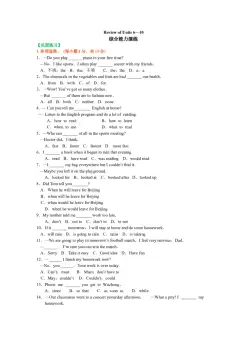
I. 单项选择。(每空1 分,共15 分)
   1.—What’s the matter ______ your younger sister?
      —She has a cough.
     A.for    B.at    C.with    D.on
2.—I have too much housework to do at home.
      —______ ask your husband for help?
     A.You could    B.Why don’t    C.Why not    D.How about
3.     we keep our hearts open, we can experience the happiness friendship brings us.
  A. Since           B. If                C. Unless           D. Though
4.—Helen,when did you move here?
—I ________ here since two years ago.
A.moved        B.lived        C.have moved        D.have lived
5.________ Ms.Zhou ________ Mr.Li is humorous.They are popular among us students.
A.Both;and    B.Neither;nor    C.Either;or    D.Not only;but also
6.—Do you think yesterday’s math problem was difficult?
—Yes.I could _______ work it out.
A.hardly   B.easily    C.finally    D.nearly
7.—How is your English study?
—Not bad.But I _______ learning English grammar.
     A.am interested in    B.am good at    C.have a little trouble    D.have no trouble
8.I’m feeling much better now so you ______ call the doctor.
      A.couldn’t    B.wouldn’t    C.can’t    D.needn’t
9.Linda bought a large house ______ a swimming pool.
A.with    B.in    C.on    D.from
10.—The doctor told me not to eat too much,but I find it difficult.
       —The doctor is right.________ you eat,________ you will be.
      A.The less;the healthier    B.The less;the more healthier
      C.The more;the healthier    D.The more;the more healthier
11.—Alice,please tell Eric to call me when he _______ back.
—No problem.
       A.come    B.comes    C.came    D.will come
12.Lisa is a little poor at Chinese.I think she needs _______ it every day.
A.practise to speak    B.to practice to speak    C.practise speaking    D.to practice
speaking
13.—Why do you collect so many old bikes?
—I’ll have them _______ and give away to the children who don’t have bikes.
       A.used up    B.given up    C.fixed up    D.set up
14.How kind you are! You always do what you can _______ others.
A.help    B.helping    C.helps    D.to help
15.—I’m not going swimming tomorrow afternoon.
       —________.I have to clean up my bedroom.
       A.So am I    B.Neither am I    C.Neither I am    D.So I am
II. 完形填空。(每空1 分,共10 分)
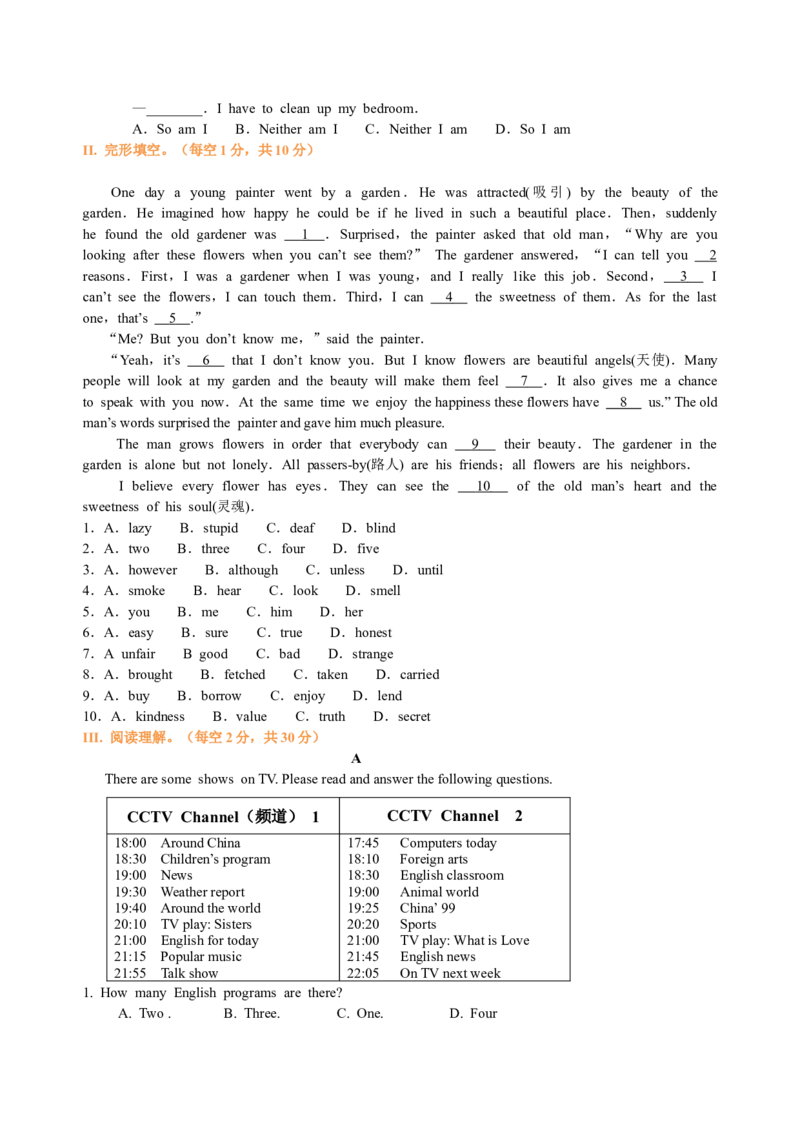
One day a young painter went by a garden .He was attracted( 吸引) by the beauty of the
garden.He imagined how happy he could be if he lived in such a beautiful place.Then,suddenly
he found the old gardener was
  1
  .Surprised,the painter asked that old man,“Why are you
looking after these flowers when you can’t see them?” The gardener answered,“I can tell you
  2
reasons.First,I was a gardener when I was young,and I really 1ike this job.Second,
  3
   I
can’t see the flowers,I can touch them.Third,I can
  4
   the sweetness of them.As for the last
one,that’s
  5
  .”
   “Me? But you don’t know me,”said the painter.
   “Yeah,it’s
  6
   that I don’t know you.But I know flowers are beautiful angels(天使).Many
people will look at my garden and the beauty will make them feel
  7
  .It also gives me a chance
to speak with you now.At the same time we enjoy the happiness these flowers have   8   us.” The old
man’s words surprised the painter and gave him much pleasure.
    The man grows flowers in order that everybody can
  9
   their beauty.The gardener in the
garden is alone but not lonely.All passers-by(路人) are his friends;all flowers are his neighbors.
    I believe every flower has eyes.They can see the
  10

   of the old man’s heart and the
sweetness of his soul(灵魂).
1.A.lazy    B.stupid    C.deaf    D.blind
2.A.two    B.three    C.four    D.five
3.A.however    B.although    C.unless    D.until
4.A.smoke    B.hear    C.look    D.smell
5.A.you    B.me    C.him    D.her
6.A.easy    B.sure    C.true    D.honest
7.A unfair    B good    C.bad    D.strange
8.A.brought    B.fetched    C.taken    D.carried
9.A.buy    B.borrow    C.enjoy    D.lend
10.A.kindness    B.value    C.truth    D.secret
III. 阅读理解。(每空2 分,共30 分)
                                      A
There are some shows on TV. Please read and answer the following questions.
CCTV Channel(频道) 1
CCTV Channel  2
18:00  Around China
18:30  Children’s program
19:00  News
19:30  Weather report
19:40  Around the world
20:10  TV play: Sisters
21:00  English for today
21:15  Popular music
21:55  Talk show
17:45   Computers today
18:10   Foreign arts
18:30   English classroom
19:00   Animal world
19:25   China’ 99
20:20   Sports
21:00   TV play: What is Love
21:45   English news
22:05   On TV next week
1. How many English programs are there?
     A. Two .
B. Three.
C. One.
D. Four
2. You like playing football. You may watch TV at ______.
A. 20:20 on Channel 2
B. 19:40 on Channel 1
C. 19:00 on Channel 2
D. 18:30 on Channel 1
3. If you like animals, which of the following programs would be the best one?
A. Weather report.    B. Around the world.    C. Animal world.     D. Talk show.
4. What program will follow(在……后)Popular Music?
  A. Weather Report   B. Talk Show    C. English Today    D. Computers Today
B
 One day James came up to Dick and said, “Look, what I’ve found in Mr. Trotter’s rubbish bin!” It
was a piece of paper. On it were test questions for history. “That’s our history paper. I’m sure of
it,” said James, “It’s in Mr. Trotter’s handwriting.” “Yes, I think so.” said Dick. “I’ll sell the paper for $1
to our classmates.” said James. So in the three days he went round the class and sold the “test paper” to his
classmates. James felt happy because he got $40. All the students were sure that these questions would be in the
test paper. The questions were quite difficult so they had to work hard at preparing them.
  The day for the exam came. Mr. Trotter walked into the classroom. “History test,” he said and
then gave out the test paper. Oh dear! It was different from the paper that James had found. None of
the questions were the same. None of the students did well. James had to give all their money back to his
classmates. Ever since he has never looked in teachers’ rubbish bins again.
  5. Who wrote the test questions on the paper?
  A. Mr. Trotter.    B. James.    C. Dick.    D. The headmaster.
  6. In the end, James got _________ from his classmates.
  A. $40      B. $1     C. no money D. some money
  7. Which of the following was true?
  A. The questions in the paper were quite easy.
  B. James never sold the test paper to his classmates.
  C. The test paper Mr. Trotter gave out was different from the one James had found.
  D. Some students did very well in the history exam.
  8. The best title for this passage is __________________.
  A. History Test         B. A Lucky Boy
  C. A good way to make money     D. The best way to pass an exam
C
   Some people remember the things by writing notes to themselves. Then they leave the notes in
obvious(明显的) places, such as on the table or on the floor in the middle of the living room. I don’t
think I like to write notes to myself. Most of the time I lose them or forget to look at them until it’s
too late. I prefer to use an alarm clock(闹钟) to tell me what I should do. I have ten alarm clocks in
my house. They could tell me about things. For example, if I have to make a telephone call at a
certain time, I’ll set an alarm clock to go off a few minutes early and put the clock by the telephone. Or if I
want to watch a certain television programme, I’ll set an alarm clock at the right time and put the clock on top
of the TV set. I can remember almost anything if I use my clocks. However, sometimes an alarm clock goes off
and I don’t know what it means. I always remember setting it, but not why I set it. If the clock is by the
telephone. I know I may have set it to tell me to call someone, but I can’t be sure. I might have set it to tell
myself that somebody was to call me at a certain time.
  9. Some people like to write notes to themselves so that they can __________.
  A. leave them in obvious places
  B. remember what to do at a certain time
  C. watch a certain programme
  D. make a phone call at a certain time
  10. I don’t like to write notes to myself because __________.
  A. they are easy to lose or forget to look at
  B. I don’t know where to put them
  C. my handwriting is poor
  D. it gives me too much trouble
  11. I often use _________ to help me remember things.
A. a notebook B. a computer  C. telephone calls D. alarm clocks
                                       D
In 1971 there was a war in a part of Nigeria called Biafra,in western Africa.People were
dying,children were hungry and there was a lot of disease.There were thousands of people who
needed medical help—but there were no doctors or nurses to help them.Some doctors from France
went to work there as volunteers,and some of them decided to start an organization to help the
people in disasters(灾难) all over the world.That was when Medecins Sans Frontieres(MSF) was
born.
    Since it started,MSF has helped people all over the world.The disaster might be war or an
earthquake that means people need medical help.
    About 90% money that MSF needs comes from personal donations(捐款);the rest come from
governments and business.MSF helps everyone,it doesn’t matter who they are.
    MFS has about 3,000 volunteer doctors in nearly 60 different countries.These volunteers do
many different things:some,of course,care for people who are sick or injured,and others,train
local doctors and nurses in their own countries.MSF also sends engineers to poor countries to help
people to do things like making wells,so they can have clean water.
    __________________They are sometimes attacked( 进攻) or killed .For example ,five MSF
volunteers were killed in Afghanistan in 2004.
All the volunteers worked hard,the act of their great bravery and their selfless spirit moved the
world in 1999.MSF won the Nobel Peace Prize.
12.When did Medecins Sans Frontieres begin?
A.In 1999.    B.In 2004.    C.In 1971.    D.In 1949.
13.Where does the money for MSF come from?
    A.It comes from personal donations only.
    B.It comes from governments and Business only.
    C.About 10% money comes from personal donations.
D.About 10% money comes from governments and business.
14.Which of the following can be put in the blank(空白处) in Paragraph 5 properly?
    A.There was a war in Africa.
    B.The local people are in danger.
    C.It is often dangerous work for the volunteers.
D.Some volunteers were killed in Afghanistan.
15.Which of the following shows the writer’s opinion?
    A.1n 1999,MSF won the Nobel Peace Prize.
    B.MSF has about 3,000 volunteer doctors.
    C.MSF has helped people all over the world.
D.All the volunteers are brave and selfless.
                            第II 卷(共45 分)
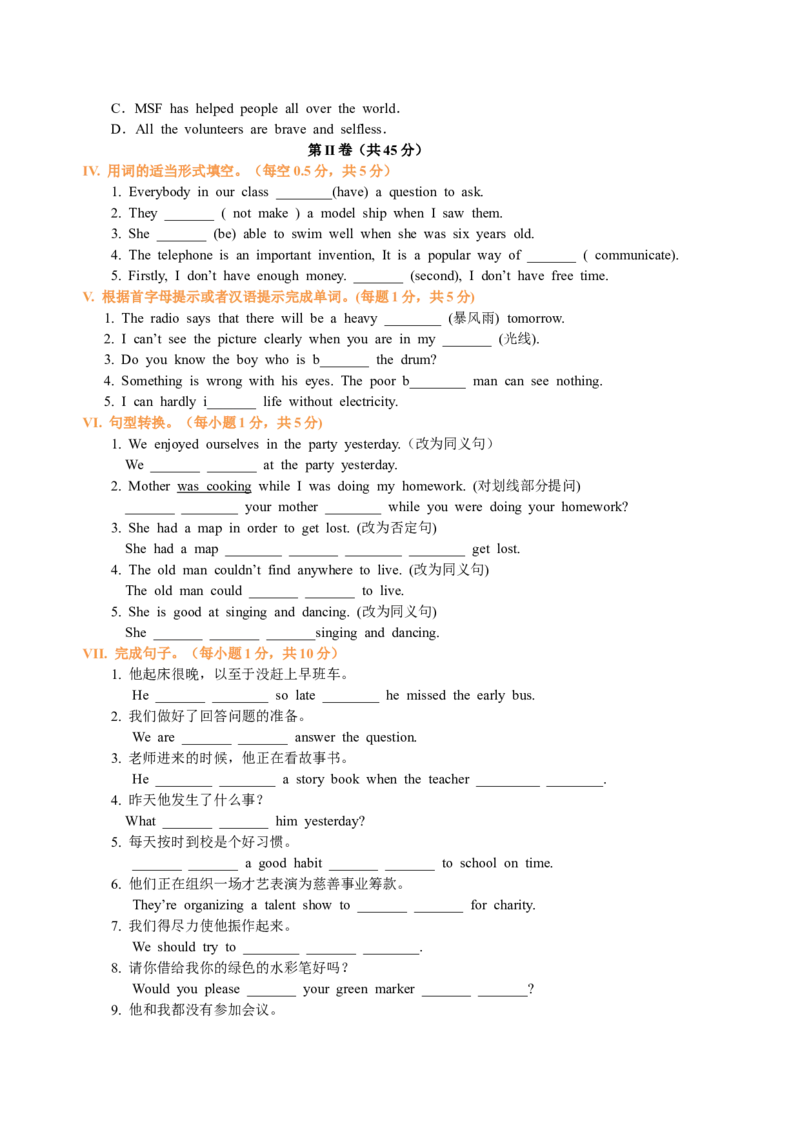
IV. 用词的适当形式填空。(每空0.5 分,共5 分)
    1. Everybody in our class ________(have) a question to ask.
    2. They _______ ( not make ) a model ship when I saw them.
    3. She _______ (be) able to swim well when she was six years old.
    4. The telephone is an important invention, It is a popular way of _______ ( communicate).
    5. Firstly, I don’t have enough money. _______ (second), I don’t have free time.
V. 根据首字母提示或者汉语提示完成单词。(每题1 分,共5 分)
   1. The radio says that there will be a heavy ________ (暴风雨) tomorrow.
   2. I can’t see the picture clearly when you are in my _______ (光线).
   3. Do you know the boy who is b_______ the drum?
   4. Something is wrong with his eyes. The poor b________ man can see nothing.
   5. I can hardly i_______ life without electricity.
VI. 句型转换。(每小题1 分,共5 分)
    1. We enjoyed ourselves in the party yesterday.(改为同义句)
      We _______ _______ at the party yesterday.
    2. Mother was

   cooking

  while I was doing my homework. (对划线部分提问)
  _______ ________ your mother ________ while you were doing your homework?
3. She had a map in order to get lost. (改为否定句)
    She had a map ________ _______ ________ ________ get lost.
4. The old man couldn’t find anywhere to live. (改为同义句)
  The old man could _______ _______ to live.
5. She is good at singing and dancing. (改为同义句)
  She _______ _______ _______singing and dancing.
VII. 完成句子。(每小题1 分,共10 分)
    1. 他起床很晚,以至于没赶上早班车。
       He _______ ________ so late ________ he missed the early bus.
2. 我们做好了回答问题的准备。
   We are _______ _______ answer the question.
3. 老师进来的时候,他正在看故事书。
   He ________ ________ a story book when the teacher _________ ________.
4. 昨天他发生了什么事?
  What _______ _______ him yesterday?
5. 每天按时到校是个好习惯。
   _______ _______ a good habit _______ _______ to school on time.
6. 他们正在组织一场才艺表演为慈善事业筹款。
   They’re organizing a talent show to _______ _______ for charity.
7. 我们得尽力使他振作起来。
   We should try to ________ _______ ________.
8. 请你借给我你的绿色的水彩笔好吗?
   Would you please _______ your green marker _______ _______?
9. 他和我都没有参加会议。
   _______ he ______ I _______ to attend the meeting.
10. 那个男孩儿直到妈妈回来才上床睡觉。
    The boy _______ _______ to bed ________ his mother came back.
VIII.补全对话。(每空1 分,共5 分)
     从方框中选择最恰当的选项完成下面的对话,方框中有两项多余。

A. We both cried.
B. What did you do?
C. What were you doing?
D. Was Julia late as usual?
E. We laughed happily at night.
F. We decided to see the movies.
A: Did you and Julia have a good time last night?
  B: Hmm…Yes and no.
  A: ___1___
  B: Yes, she was. And waiting for her made me angry.
  A: ___2___
  B: First we went to the Rock Club. But she didn’t want to stay. ___3___
  A: That’s funny. I always want to dance to that exciting music.
B: Me too. So then we went to the Blue Moon Restaurant. It was quiet and the ice cream was
great. We       enjoyed ourselves.
A: Did you go to the concert by Backstreet Boys?
B: No. ___4___We saw a tragedy named The Missing Rose. ___5___But it was really nice.
A: If I were you, I would stand up and leave right away.
B: You sound just like my father!
Ⅸ. 书面表达。(15 分)
    假设你是菲菲,最近一直不开心,你正在向你的姑姑倾诉你的烦恼:
1. 我在学校有很多朋友。我们彼此相处得都很好。
2. 我们每天一起打球,有时候去看电影。
3. 但是有一天,我的一个朋友丢了一百元钱。他认为是我拿了他的钱,而且还把这件事告诉了其
他朋友。
4. 我很伤心,不知道该怎么办。我需要你的帮助。你能给我建议吗?
要求:1) 80 词左右;
   2) 条理清晰,语句连贯。(信的开头和结尾已给出)
Dear Aunt,
—————————————————————————————————————————
————————————————————————————————————————
—————————————————————————————————————————
—————————————————————————————————————————
—————————————————————————————————————————
—————————————————————————————————————————
                                   Yours,
                                  Feifei
【答案与解析】
I. 单项选择。
   1.C。What’s the matter with sb.? 是固定句型,故所缺的介词是with。
2.C。因为是问句,所以选项A 不能使用;因为空后是动词原形,所以只能是“why not+动词原
形”的形式。B 项若改为Why don’t you 就正确了。
3.B。句意:如果我们敞开心扉,我们可以体验友谊带给我们的快乐。本题考查连词的用法。Since
因为,既然,自从……以来,自从……的时候起;If 如果;Unless 除非,如果不;Though 即使,虽
然,尽管,纵然。所以选B。
4.D。move 是瞬时动词;live 是延续性动词。由“since two years ago”可知,应用现在完成时;
由句意“我从两年前起就住在这儿”可知,应用延续性动词。故选D。
5.D。both...and...意为“两者都”,连接两个主语时,谓语动词应用复数形式;neither...nor...意为
“两者中的任何一个都不”;either...or...意为“两者中的任何一个”;not only...but also...表示“不
但……,而且……”,连接两个主语时,谓语动词应符合“就近一致”原则。由“They are popular
among us students.”可知,周老师和李老师都幽默。由“is”可知,应用not only...but also...来连
接两个主语。故选D。
6.A。hardly“几乎不”;easily“容易地”;finally“最后”;nearly“几乎”。句意:“你认为昨
天的数学题难吗?”“是的,我几乎做不出来。”故选A。
7.C。be interested in doing sth.“对做某事感兴趣”.be good at doing sth.“擅长做某事”;
have trouble doing sth. “做某事有困难”。句意:“你的英语学习怎么样?”“不错。但我学习英
语语法有点儿困难。”故选C。
8.D。由前一分句语境“我现在感觉好多了”可推知,此句的意思是“因此你不必叫医生了”。故
选D 项。
9.A。介词with 意为“带有,具有”,表示伴随的状况。句意:琳达买了一个带有游泳池的大房子。
10.A。healthy 的比较级为healthy,故排除B,D;且由上句中的内容可知是“你吃得越少就越健
康。”可知选A。
11.B。在含有when 引导的时间状语从句的主从复合句中,主句用了祈使句,从句应用一般现在时
表示将来,排除C、D 两项;由从句的主语he 可知,此处应用come 的第三人称单数形式,故选B
项。
12.D。practise 后面只跟动名词,不能跟动词不定式,由此可排除A、B 两项;再由needs 可看出,
need 在这里为实义动词其后应接带to 的动词不定式,故选D。
13.C。句意:“你为什么收集了这么多旧自行车。”“我将找人把它们修理一下然后捐给那些没
有自行车的孩子。”fix up“修理”,use up“用尽”,give up“放弃”,set up“建立”。注意本
句使用了句式:have sth.done,表示“让别人做某事”。
14.D。根据题干的意义“你总是竭尽全力地帮助别人”可以知道竭尽全力的目的是帮助别人。不
定式做目的状语,故选D。此题的最大迷惑项是在空格前有情态动词can,学生很容易误选A。
15.B。由上句中的not 可知下句为否定的倒装句,故排除A,D 两项;B 项表示“我也不……”;
C 项则表示“我确实不……”。理解句意:“我明天下午不去游泳。”“我也是。我要打扫我的卧
室。”可知选B。
II. 完形填空。
1. D。考查形容词辨析。A 项意为“懒惰的”;B 项意为“愚蠢的”;C 项意为“聋的”;D 项意为
“瞎的”。根据下文“Why are you looking after these flowers when you can’t see them?”可知,
花匠眼睛看不见,是个盲人。故选D。
2. C。考查数词。根据下文“First...Second...Third...As for the last one...”可知,花匠照料花园里的
花的原因有四条。故选C。
3. B。考查连词辨析。A 项意为“然而,无论如何”;B 项意为“尽管,虽然”;C 项意为“除非,
如果不”;D 项意为“直到……才”。句意为:第二,尽管我看不见花,但是我可以摸到它们。
although 引导让步状语从句,符合语境。故选B。
4. D。考查动词辨析。A 项意为“吸烟”;B 项意为“听到”;C 项意为“看”;D 项意为“闻到”。
句意为:第三,我能闻到这些花的花香。故选D。
5. A。考查代词辨析。A 项意为“你”;B 项意为“我”;C 项意为“他”;D 项意为“她”。根据
下文“Me? But you don’t know me.”可知,最后一条原因是因为“你”。故选A。
6. C。考查形容词辨析。A 项意为“容易的”;B 项意为“确信的”;C 项意为“真实的”;D 项意
为“诚实的”。句型It is true that...意为“……是真实的”。句意为:是,我不认识你是真的。故
选C。
7. B。考查形容词辨析。A 项意为“不公平的”;B 项意为“好的”;C 项意为“坏的”;D 项意
为“陌生的”。句意为:许多人将会看到我的花园,这些美丽的花使他们感觉很好。故选B。
8. A。考查动词辨析。A 项意为“带来”;B 项意为“取来”;C 项意为“拿走”;D 项意为“带
走”。四个选项都是及物动词,含“带、拿”的意思,但用法差别很大。bring 是指把人或物从别处
带到说话人所在的地方;take 是指把人或物从说话处带到别处去;fetch 指到别处去把某人或某物带
来或拿来;carry 不表示动作的方向,一般指随身携带,如“扛”“提”“运”等。句意为:同时我
们享受这些花带给我们的快乐。故选A。
9. C。考查动词辨析。A 项意为“买”;B 项意为“借入”;C 项意为“欣赏”;D 项意为“借出”。
句意为:花匠种花是为了让每个人都能欣赏花的美丽。故选C。
10. A。考查名词辨析。A 项意为“善良”;B 项意为“价值”;C 项意为“事实”;D 项意为“秘
密”。句意为:它们能够看到老人的善良,领悟到他灵魂的芳香。故选A。
III. 阅读理解。
    A
    1. B。根据表格中的“21:00 English for today;18:30 English classroom;21:45 English news”可知
有三个英语类的节目。
2. A。playing football 和体育节目有关,所以应该是“CCTV Channel 2 中20:20 Sports”。3.
C。和animal 有关的,只能是“19:00 Animal world”。
4. B。根据“CCTV Channel 1”最后两行可知答案。
    B
    5. A。根据文中的“It’s in Mr. Trotter’s handwriting.”可知答案。
6. C。根据“James had to give all their money back to his classmates.”可知答案。
7. C。根据“It was different from the paper that James had found.”可知答案。
8. A。全文是围绕历史考试展开的,所以选A 合适。
C
9. B。根据文章第一句话可知答案。
10. A。根据“Most of the time I lose them or forget to look at them until it’s too late.”可知答
案。
11. D。根据“I prefer to use an alarm clock(闹钟) to tell me what I should do.”可知答案。
D
12. C。由文章第一段内容可知1971 年志愿者支援非洲的尼日利亚时决定建立这个组织。
13. D。由文章第三段内容可知,MSF90%的资金来源于个人捐赠,其余部分来自政府或者商业。
14. C。由下文内容“他们有时会受到攻击或者杀害”可知,他们的工作具有危险性。
15. D。这句话可以看出作者对志愿者的赞美和肯定。
IV. 用词的适当形式填空。
    1. has   2. weren’t making   3. was  4. communication  5. secondly
V. 根据首字母提示或者汉语提示完成单词。
   1. storm  2. light  3. beating  4. blind  5. imagine
VI. 句型转换。
1. had fun  2. What was, doing  3. in order not to  4. find nowhere  5. does well in
VII. 完成句子。
1. got up, that  2. ready to 3. was reading, came in  4. happened to
5. It is, to get  6. raise money  7. cheer him up  8. lend, to me
9. Neither, nor, went  10. didn’t go, until
VIII.补全对话。
1-5: DBGFA
Ⅸ. 书面表达。
Dear Aunt,
I have many friends at school. We are getting along very well. Every day we play basketball
together.   Sometimes we go to the movies. But one day, one of my friends lost 100 yuan. He
thought I took his money and he told others about it. They are not as friendly to me as they were
before, and they don’t play with me anymore. I’m very unhappy and don’t know what to do.
  Can you give me some advice?
                                     Yours
                                      Feifei