文档文本内容
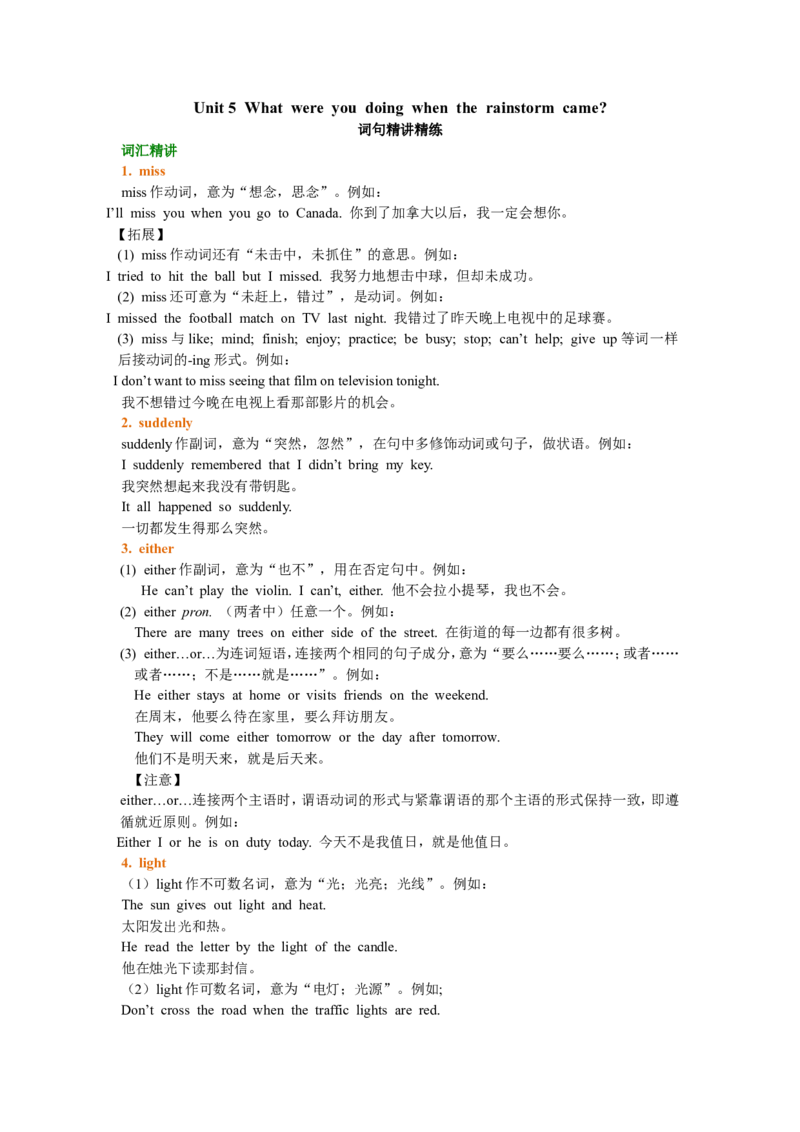
Unit 5 What were you doing when the rainstorm came?
词句精讲精练
词汇精讲
1. miss
miss 作动词,意为“想念,思念”。例如:
   I’ll miss you when you go to Canada. 你到了加拿大以后,我一定会想你。
    【拓展】
(1) miss 作动词还有“未击中,未抓住”的意思。例如:
   I tried to hit the ball but I missed. 我努力地想击中球,但却未成功。
(2) miss 还可意为“未赶上,错过”,是动词。例如:
   I missed the football match on TV last night. 我错过了昨天晚上电视中的足球赛。
(3) miss 与like; mind; finish; enjoy; practice; be busy; stop; can’t help; give up 等词一样
后接动词的-ing 形式。例如:
    I don’t want to miss seeing that film on television tonight.
我不想错过今晚在电视上看那部影片的机会。
2. suddenly
suddenly 作副词,意为“突然,忽然”,在句中多修饰动词或句子,做状语。例如:
I suddenly remembered that I didn’t bring my key.
我突然想起来我没有带钥匙。
It all happened so suddenly.
一切都发生得那么突然。
3. either
(1) either 作副词,意为“也不”,用在否定句中。例如:
        He can’t play the violin. I can’t, either. 他不会拉小提琴,我也不会。
     (2) either pron. (两者中)任意一个。例如:
       There are many trees on either side of the street. 在街道的每一边都有很多树。
     (3) either…or…为连词短语,连接两个相同的句子成分,意为“要么……要么……;或者……
或者……;不是……就是……”。例如:
       He either stays at home or visits friends on the weekend.
在周末,他要么待在家里,要么拜访朋友。
They will come either tomorrow or the day after tomorrow.
他们不是明天来,就是后天来。
【注意】
either…or…连接两个主语时,谓语动词的形式与紧靠谓语的那个主语的形式保持一致,即遵
循就近原则。例如:
Either I or he is on duty today. 今天不是我值日,就是他值日。
4. light
(1)light 作不可数名词,意为“光;光亮;光线”。例如:
The sun gives out light and heat.
太阳发出光和热。
He read the letter by the light of the candle.
他在烛光下读那封信。
(2)light 作可数名词,意为“电灯;光源”。例如;
Don’t cross the road when the traffic lights are red.
当交通灯是红色时,不要横穿马路。
(3)light 作形容词,意为“轻的;浅色的”。例如:
Is the box heavy or light?
那箱子是重还是轻?
I like the light green dress.
我喜欢哪件浅绿色的裙子。
(4)light 作动词,意为“点燃;照亮”。例如:
He sat down and lit a cigarette.
他坐下来,点了一支烟。
5. beat
beat 是及物动词,有以下用法:
     (1) 意为“赢;打败;战胜”,后接人或某一团队、组织等,其过去式为beat。例如:
I beat him at long jump yesterday. 昨天跳远我赢了他。
     (2) 意为“打;击”,表示连续不断的打击。例如:
     Who is beating the drum? 谁在打鼓?
     (3) 表示“(心脏等)跳动”。例如:
     I feel my heart is beating fast. 我觉得我的心脏在剧烈跳动。
【拓展】
     beat 和win 都有“赢”的意思,但用法不同:
     beat 的宾语为人或相当于人的团体、组织;而win 的宾语为比赛或某个项目,过去式为won。
例如:
     Though we were weak, we beat them. 虽然我们弱,但我们赢了他们。
     Who won the first prize in the competition? 谁在比赛中赢得了一等奖?
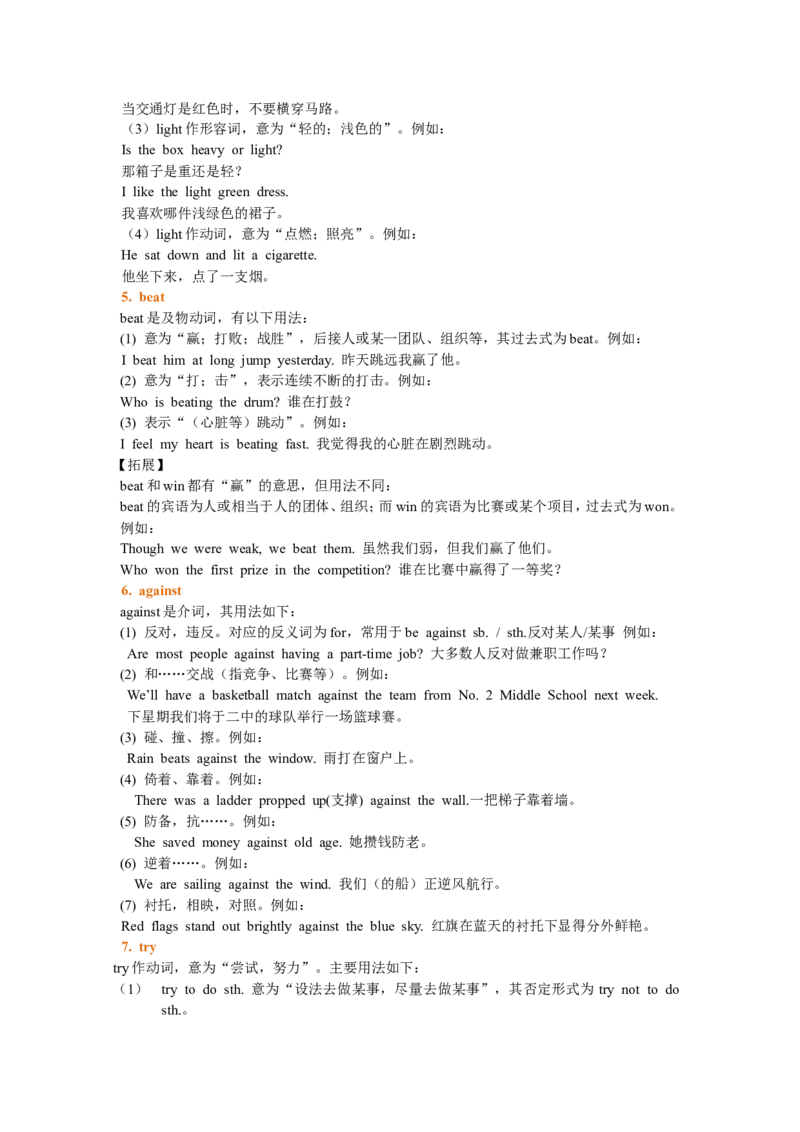
6. against
against 是介词,其用法如下:
     (1) 反对,违反。对应的反义词为for,常用于be against sb. / sth.反对某人/某事 例如:
      Are most people against having a part-time job? 大多数人反对做兼职工作吗?
     (2) 和……交战(指竞争、比赛等)。例如:
      We’ll have a basketball match against the team from No. 2 Middle School next week.
      下星期我们将于二中的球队举行一场篮球赛。
     (3) 碰、撞、擦。例如:
      Rain beats against the window. 雨打在窗户上。
     (4) 倚着、靠着。例如:
       There was a ladder propped up(支撑) against the wall.一把梯子靠着墙。
     (5) 防备,抗……。例如:
       She saved money against old age. 她攒钱防老。
     (6) 逆着……。例如:
       We are sailing against the wind. 我们(的船)正逆风航行。
     (7) 衬托,相映,对照。例如:
Red flags stand out brightly against the blue sky. 红旗在蓝天的衬托下显得分外鲜艳。
7. try
try 作动词,意为“尝试,努力”。主要用法如下:
(1)
try to do sth. 意为“设法去做某事,尽量去做某事”,其否定形式为try not to do
sth.。
例如:
Try not to be late again.
尽量别再迟到了。
Try to get here in two hours.
尽量在两小时之内到达。
(2)try doing sth. 意为“试着做某事”,强调尝试做某事。例如:
You should try eating more vegetables.
你应当试着多吃点蔬菜。
(3)try one’s best to do sth. 意为“尽某人最大努力做某事”。例如:
We should try our best to finish the work on time.
我们应该尽最大努力准时完成这项工作。
8. hard/hardly
hardly 和hard 形式上很接近,但意义截然不同。
(1)hard 作形容词时,意为“困难的;硬的;勤奋的;严厉的;苛刻的”。
hard 作副词时常用来表示程度,意为“努力地;猛烈地;剧烈地”。例如:
I work hard at school. 我在学校努力学习。
This ground is too hard to dig. 这块地太硬,挖不动。
They tried hard to succeed. 他们努力工作,以求得成功。
【拓展】
work hard at…意为“努力于……”。例如:
 He is working hard at English. 他正在努力学习英语。
(2)hardly 是表频率的副词,意为“几乎不;几乎没有”,相当于almost not,并非hard 的副
词形式。例如:
There is hardly any coffee left. = There’s almost no coffee left. 几乎没有剩余的咖啡了。
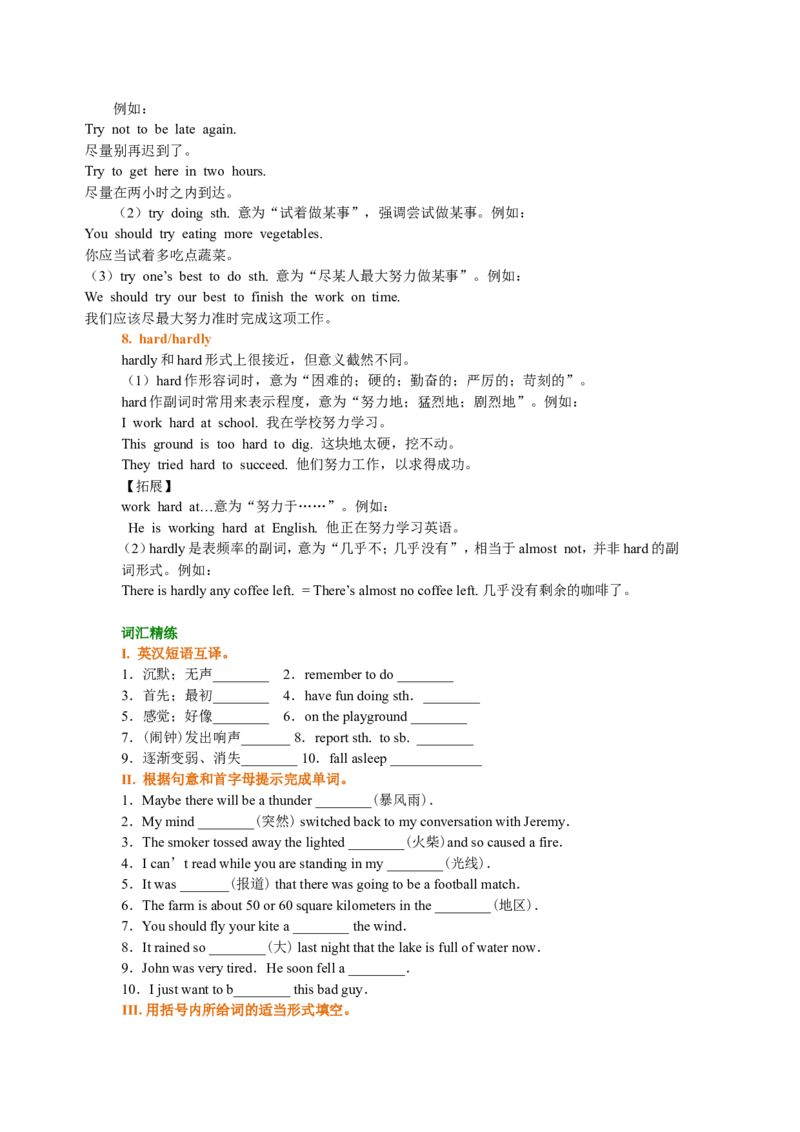
词汇精练
I. 英汉短语互译。
1.沉默;无声________    2.remember to do ________
3.首先;最初________    4.have fun doing sth.________
5.感觉;好像________    6.on the playground ________
7.(闹钟)发出响声_______ 8.report sth. to sb. ________
9.逐渐变弱、消失________ 10.fall asleep _____________
II. 根据句意和首字母提示完成单词。
1.Maybe there will be a thunder ________(暴风雨).
2.My mind ________(突然) switched back to my conversation with Jeremy.
3.The smoker tossed away the lighted ________(火柴)and so caused a fire.
4.I can’t read while you are standing in my ________(光线).
5.It was _______(报道) that there was going to be a football match.
6.The farm is about 50 or 60 square kilometers in the ________(地区).
7.You should fly your kite a ________ the wind.
8.It rained so ________(大) last night that the lake is full of water now.
9.John was very tired.He soon fell a ________.
10.I just want to b________ this bad guy.
III. 用括号内所给词的适当形式填空。
1.I guess from his red eyes that he has been working too _____ (hard) recently.
2.Please remember _______(clean) the room after work.
3.Wish you have fun _______(learn) English this term.
4.—Why didn’t you attend yesterday’s presentation?
   —Sorry,I ________(wait)for an important EMS then from an editor.
5.Almost everyone knows that the moon ________(rise) in the east.
IV. 听力链接。
 听短文,根据短文内容,判断下列句子正误,正确的用“A”表示,不正确的用“B”表示。短
文读两遍。听短文前,你们有20 秒钟的时间阅读下列句子。
11.Jack,a 7-year-old American boy,was happy because it was thanksgiving.
12.Jack’s mother put five small candies into the cake for good luck.
13.One coin was lost, but Jack’s mother didn’t notice.
14.Jack couldn’t speak for 15 years.
15.At the age of 27, Jack could speak again after he coughed up(咳出) the cake .
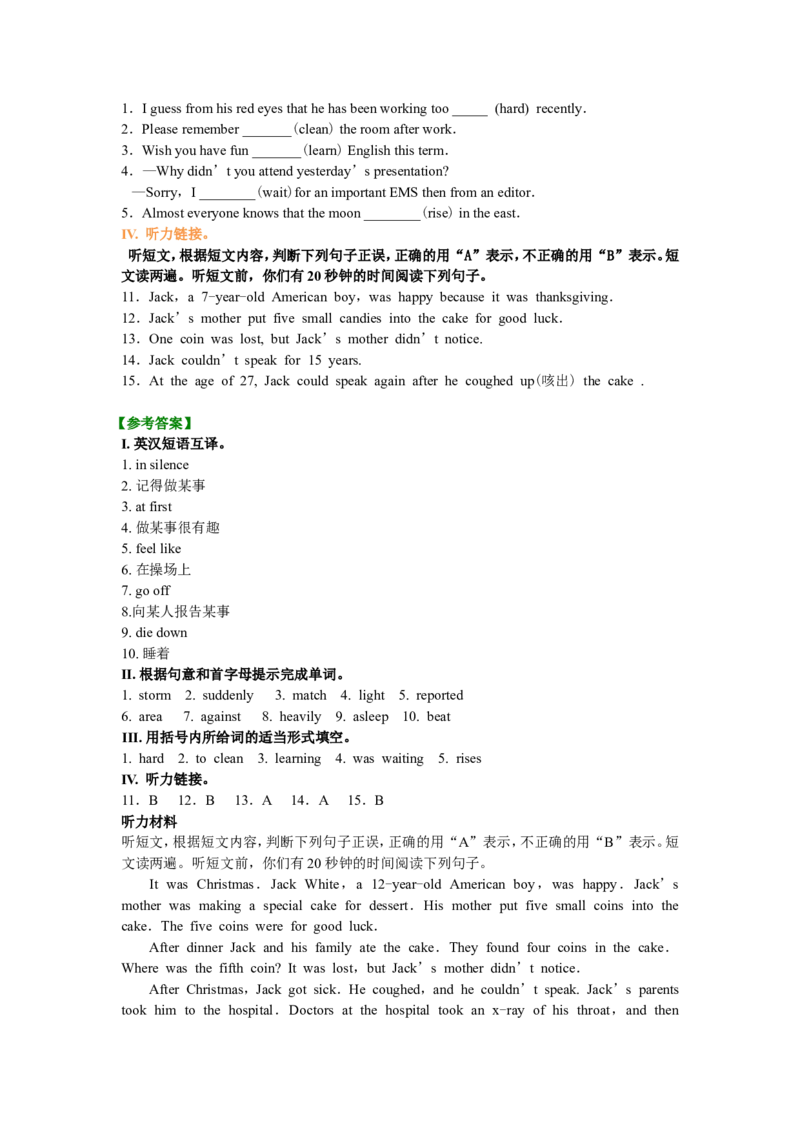
【参考答案】
I. 英汉短语互译。
1. in silence
2. 记得做某事
3. at first
4. 做某事很有趣
5. feel like
6. 在操场上
7. go off
8.向某人报告某事
9. die down
10. 睡着
II. 根据句意和首字母提示完成单词。
1. storm  2. suddenly   3. match  4. light  5. reported
6. area   7. against   8. heavily  9. asleep  10. beat
III. 用括号内所给词的适当形式填空。
1. hard  2. to clean  3. learning  4. was waiting  5. rises
IV. 听力链接。
11.B
12.B
13.A
14.A
15.B
听力材料
听短文,根据短文内容,判断下列句子正误,正确的用“A”表示,不正确的用“B”表示。短
文读两遍。听短文前,你们有20 秒钟的时间阅读下列句子。
It was Christmas.Jack White,a 12-year-old American boy,was happy.Jack’s
mother was making a special cake for dessert.His mother put five small coins into the
cake.The five coins were for good luck.
After dinner Jack and his family ate the cake.They found four coins in the cake.
Where was the fifth coin? It was lost,but Jack’s mother didn’t notice.
After Christmas,Jack got sick.He coughed,and he couldn’t speak. Jack’s parents
took him to the hospital.Doctors at the hospital took an x-ray of his throat,and then
said,“We’re sorry.but we can’t help him.”
For 15 years Jack never spoke.He grew up,he got a job,and he got married.
One day,when Jack was 27 years old,he coughed up something small and black. What
was it? It was a coin! Jack went to a special doctor,and soon he was talking.
句式精讲
1. When he woke up, the sun was rising.
was rising 意为“正在升起”,为过去进行时态,该时态表示在过去某时间某动作正在发生,由
“助动词was/were + doing”构成。例如:
They were playing in the park.
他们正在公园里玩。
She was reading a book when I came in.
我进来时她正在看书。
2. But luckily, the driver was fine.
luckily 作副词,意为“幸运地;幸亏”,做状语。例如:
Luckily,she found my book.
幸运的是,她找到了我的书。
Luckily, we caught the last train.
很幸运,我们搭上了末班火车。
【拓展】
(1)lucky 作形容词,意为“幸运的;有好运的”。例如:
Some people seem to be always lucky.
有些人似乎总是很幸运。
Nine is my lucky number.
9 是我的幸运数字。
(2)luck 作不可数名词,意为“好运;幸运;运气”。例如:
I hope it will bring you luck.
我希望它会给你带来好运。
Good luck to you!
祝你好运!
3. The roads were icy…
icy 作形容词,意为“结冰的;冰冷的;冷淡的”。例如:
It’s not easy to walk on the icy roads.
在结冰的路面上行走不容易。
Because of the icy street, they can’t drive the car.
因为街上结满了冰,他们不能开车。
Most people don’t want to swim in the icy water.
大多数人都不想在冰冷的水里游泳。
【拓展】
ice 作不可数名词,意为“冰”。例如:
The ice is thick enough to skate on.
这冰够厚的,可以在上面滑冰。
The boy isn’t afraid of cold. He is holding a piece of ice.
这个男孩不怕冷,手里握着一块冰。
4. But when I pointed it out to my friend…
point out 意为“指出”,是“动词+副词”结构,人称代词作宾语时应放在动词之后、副词之
前。例如:
There is a mistake in this sentence. Can you point it out?
这个句子有一处错误,你能把它指出来吗?
He pointed out the woman from these photos.
他从这些照片中指出了那个女子。
【拓展】
(1)point 作不及物动词,意为“指;指向”,常与介词at,to,towards 等连用,表示“指向某位
置或方向”。例如:
She pointed at me, laughing.
她指着我笑。
(2)point 作可数名词,意为“点;要点”。例如:
Let’s discuss the difficult points in the passage.
让我们讨论一下文中的难点。
5. Why did you call so many times?
so many 意为“那么多”,修饰复数名词,例如:
He has so many friends.
他有那么多的朋友。
There are so many people in the exhibition.
展览会上有那么多人。
句式精练
I. 句型转换,按要求完成下列句子。
1.The old man couldn’t find anywhere to live. (改为同义句)
   The old man could ________ _______ to live.
2.Mother was cooking while I was doing my homework.(对画线部分提问)
   ________ ________ your mother ________ while you were doing your homework?
3.Lily was reading in the room at that time(改为一般疑问句)
   ________ Lily ________ in the room at that time?
4.I was sleeping at nine last night.Linda was doing her homework at nine last night.(用while
将句子合并为一句)
  I ________ ________ ________ Linda ________ ________ her homework at nine last night.
5.Don’t forget to lock the door before you leave.(改为同义句)
   ______ _______ _______ the door before you leave.
II. 根据汉语提示,完成句子。
1.这时,我要做的只是默默地服从他。
   All I had to do now was to obey him _______ _______.
2.天在下雨,记着随身携带你的雨衣。
   It’s raining.______ ______ ______ your raincoat with you.
3.起初我们并没有意识到她的伤口的严重性。
   ______ ______ we didn’t realize the severity of her wounds.
4.我今天不太想散步。
   I don’t ______ ______ _______ very much today.
5.昨天我和我的朋友打篮球打得很开心。
   I ______ ______ playing basketball with my friends yesterday.
6.据报道约200 人在芦山地震中丧生。
    It ______ ______ that about 200 people had lost their lives in Lushan earthquake.
7.一直到早上4 点聚会的人群才渐渐散去。
   The party didn’t ________ ________ until about four in the morning.
8.当我去接电话时,没有人说话。
   When I ________ ________ the phone,no one spoke.
9.我室友的闹钟总是在午夜响起。
   My roommate’s alarm clock always ______ _______ at mid-night.
10.如果我开车时睡着了,就叫醒我。
   If I fell asleep at the wheel,______ me ______.
III. 补全对话。
根据对话内容,从方框中选出能填入空白处的最佳选项(有两个选项为多余选项)。
A: It is such a lovely day. I love sunshine.
B:
  1
  .
A: I hope it stays like this.
B:
  2
  .
A: Is the weather usually like this here?
B: A bit hotter than today.
A:
  3
  .
B: It’s pretty cold and it often snows in winter.
  4
  .
A: A lot like the weather here, not too hot or cold.
B: I heard it rains a lot.
  5
  .
A: Mmm, yes. It rains but not any more than other places.
【参考答案】
I. 句型转换,按要求完成下列句子。
1. find nowhere
2. What was; doing
3. Was; reading
4. was sleeping while; was doing
5. Remember to lock
II. 根据汉语提示,完成句子。
1. in silence
2. Remember to take
A. I hope so, too.
B. What’s the weather like in Winter?
C. Is that true?
D. I don’t think so.
E. Thank you for your kindness.
F. Yes, it’s really a nice and bright day.
G. What about your hometown?
3. At first
4. feel like walking
5. had fun
6. was reported
7.die down
8. picked up
9. goes off
10. woke; up
III. 补全对话。
1. F   2. A    3. B     4. G    5. C