2026
人教版英语八下学霸预习讲义和练习
Unit 6 Crossing Cultures 单元讲义
一、单元主题与内容总览
本单元围绕 “Crossing Cultures(跨文化交流)” 展开,核心探讨不同文化的习俗差异、跨
文化沟通技巧及文化尊重的重要性。内容涵盖三大模块:
1. 文化习俗认知:学习不同国家的日常习俗(如问候方式、餐桌礼仪、拜访礼仪),识别文化
差异(如印度用右手吃饭、法国派对迟到礼仪),掌握用英语描述习俗的表达;
2. 跨文化沟通技巧:通过 “安娜与日本学生的问候误会”“南希在法国的派对失误” 等案例,学
习避免文化冲突的方法(如提前了解习俗、尊重当地礼仪),理解 “入乡随俗(When in
Rome, do as the Romans do)” 的原则;
3. 实践任务:设计 “对比两国习俗” 项目,引导学生分组研究中国与其他国家(如巴西、日本)
在问候、餐桌礼仪等方面的异同,用表格整理并展示,提升跨文化对比与表达能力。
本单元旨在帮助学生掌握 “谈论文化习俗与给出跨文化建议” 的英语表达,培养文化包容意
识,同时巩固连词(so...that/unless/as soon as)的用法。
二、学习方法与建议
1. 词汇记忆:“文化场景 + 对比” 关联记忆将核心词汇与具体文化场景绑定,并对比中外差异
(如 “greet” 关联 “ 中国点头 / 美国握手 / 日本鞠躬”,“ manner ” 关联 “ 中国用公筷 /
英国刀叉 / 印度右手吃饭” ),结合单元例句仿写,如:“ In China, it’s proper to use
serving chopsticks, but it’s uncommon in Western countries.”
2. 语法练习:“文化建议 + 句型” 巩固针对三大连词,围绕 “ 给外国友人的建议” 造句(如
“so...that:Chinese table manners are so important that you should learn them;unless:
Don’t eat with your left hand unless you want to be rude;as soon as:As soon as you
visit a Chinese family, you will get tea” ),确保用法准确。
3. 口语表达:模拟 “跨文化咨询”参考课本 1d、3d 的对话模板,和同学分别扮演 “外国访客”
与 “文化顾问” ,用 “What should I do when...?”“ Is it polite to...?” 的流程练习,如:
Visitor: What should I do when I meet a Chinese elder?Advisor: You should greet them
with “ Ni Hao” politely. As soon as they offer you a seat, you can sit down.Visitor: Is it
polite to bring
第 1 页 共 13 页2026
人教版英语八下学霸预习讲义和练习
a gift?Advisor: Yes, you could bring some fruit. Unless you know their favorite, don’t
bring expensive gifts.
4. 阅读拓展:积累 “文化符号” 表达阅读单元 B 部分 “法国派对礼仪” 和 “ 中国文化符号” 文
本时,摘抄文化相关短语(如 “ red for luck in China”“dragon as power ”“avoid number 4
in China” ),整理成 “文化符号手册” ,为写作和实践任务做准备。
三、考点解析
(一)核心单词
1. custom /.kʌstəm/n. 习俗;风俗
搭配:local customs 当地习俗;follow customs 遵循习俗
例句 : Before visiting India, you should learn about its local customs, like greeting with
“ Namaste”.
2. greet /ɡri:t/v. 问候;打招呼(名词:greeting /ˈɡriːtɪŋ/ 问候语)
搭配:greet sb with a smile 微笑问候某人;formal greetings 正式问候
例句:People in Japan usually greet teachers by bowing, while Americans often shake hands.
3. manner /.mænə(r)/n. 方式;(pl. )礼仪
搭配:table manners 餐桌礼仪;good manners 有礼貌
例句:Hongli was worried about English table manners, like how to use a knife and fork.
4. formal / .fɔ:ml/adj. 正式的(反义词:informal /ɪnˈfɔːml/ 非正式
的)搭配:formal clothes 正式服装;formal greetings 正式问候
例句:Bowing is a formal way to greet in Japan, but it’s too formal for daily use in the US.
5. embarrassed /ɪm .bærəst/adj. 尴尬的(修饰人);embarrassing /ɪm .bærəsɪŋ/adj.
令人尴尬的(修饰事 / 物)
搭配:feel embarrassed 感到尴尬;an embarrassing mistake 令人尴尬的错误
例句:Nancy felt embarrassed when she arrived early at the French party—she didn’t
know it’s impolite.
第 2 页 共 13 页2026
人教版英语八下学霸预习讲义和练习
6. confused /kən .fju:zd/adj. 困惑的(修饰人);confusing /kən .fju:zɪŋ/adj. 令人困惑
的(修饰事 / 物)
搭配:be confused about 对… … 困惑;confusing rules 令人困惑的规则
例句:Ji-Hoon was confused when Marie kissed his cheek—this greeting is uncommon in
Korea.
7. proper /.prɒpə(r)/adj. 恰当的;正确的
搭配:proper way 恰当的方式;proper manners 得体的礼仪
例句:You should use the proper hand to eat in India—only the right hand is acceptable.
8. private / .praɪvət/adj. 私人的;不喜欢谈论私事的
搭配:private questions 私人问题;keep sth private 保密某事
例句:French people are quite private—they don’t like talking about their age or income.
9. occasion /ə .keɪʒn/n. 场合;重大活动
搭配:formal occasion 正式场合;dress for the occasion 根据场合着装
例句:At the French party, everyone dressed nicely for the occasion, so Nancy’s shorts
felt silly.
10. receive /rɪ .si:v/v. 收到;接纳
搭配:receive a gift 收到礼物;receive guests 接待客人
例句:When visiting a Chinese family, you will receive a cup of tea as a polite gesture.
11. impression /ɪm .preʃn/n. 印象
搭配:first impression 第一印象;give a good impression 留下好印象
例句:Tina was worried about making a bad impression when staying with the Zhao family.
12. cultural / .kʌltʃərəl/adj. 与文化有关的
搭配:cultural differences 文化差异;cultural symbols 文化符号
例句 :Understanding cultural differences helps avoid misunderstandings in cross-cultural
communication.
13. rude /ru:d/adj. 粗鲁的
第 3 页 共 13 页2026
人教版英语八下学霸预习讲义和练习
搭配:be rude to sb 对某人粗鲁;rude behavior 粗鲁行为
例句:It’s rude to point at people in many cultures, so you should avoid doing it.
14. uncommon /ʌn .kɒmən/adj. 罕见的;不寻常的
搭配:uncommon custom 罕见的习俗;uncommon greeting 不寻常的问候
例句:Kissing cheeks is common in France but uncommon in Korea.
15. congratulate /kən .ɡrætʃuleɪt/v. 祝贺
搭配:congratulate sb on sth 因某事祝贺某人
例句:People usually congratulate others on weddings or birthdays in most cultures.
(二)重点短语
1. shake hands 握手
例句:Americans often shake hands when they meet for the first time.
2. table manners 餐桌礼仪
例句:Before eating in the UK, you should learn basic table manners, like using a knife
and fork correctly.
3. as soon as 一…… 就……
搭配:as soon as sb arrives 某人一到达就… …
例句:In Japan, people bow as soon as they meet their teachers.
4. so...that 如此…… 以至于……
例 句 : English table manners are so confusing that Hongli was worried about making
mistakes.
5. unless 如果不;除非
例句:Don’t ask personal questions in France unless you know the person well.
6. dress for the occasion 根据场合着装
例句:Nancy learned to dress for the occasion after wearing shorts to a formal French party.
第 4 页 共 13 页2026
人教版英语八下学霸预习讲义和练习
7. first impression 第一印象
例句:First impressions are so important that you should be careful with your behavior in a
new culture.
8. be used to 习惯于
搭配:be used to doing sth 习惯于做某事
例句:After staying in Peru for a month, the writer got used to people standing close.
9. hear from 得到…… 的消息
例句:It was great for Nancy to hear from Diana and share French customs with her.
10. When in Rome, do as the Romans do. 入乡随俗。
例 句 : When visiting a new country, remember “When in Rome, do as the Romans
do”—follow local customs.
(三)重点句子
1. In Japan, we bow as soon as we meet a teacher.(在日本,我们一见到老师就鞠躬。)
解析:“as soon as” 引导时间状语从句,表 “一… … 就… …”,主句和从句均用一般现在时
(描述客观习俗);体现不同文化的问候差异,单元 1b 对话中高频用于对比文化习俗。仿写:In
China, people usually offer tea as soon as guests arrive.
2. English table manners are so confusing that I’m a little worried.(英国的餐桌礼仪太令
人困惑了,我有点担心。)
解析:“so...that” 引导结果状语从句,“so” 后接形容词(confusing),“that” 后接结果
(worried);用于表达因文化差异产生的困扰,单元 3a 对话中洪丽的担忧即为此用法。仿写:
Indian customs are so different that I need to learn more before visiting.
3. Don’t ask personal questions unless you know the person quite well.(除非你很了解对
方,否则不要问私人问题。)
解析:“unless” 引导条件状语从句,相当于 “if not” ,表 “如果不… …”;用于给出跨文化沟
通的建议,单元 B 部分南希分享法国习俗时提到此点。仿写:Don’t arrive early to a French
party unless the host invites you to.
第 5 页 共 13 页2026
人教版英语八下学霸预习讲义和练习
4. It’s polite to greet others with “Namaste” in India.(在印度,用 “Namaste” 问候他人
是礼貌的。)
解析:“ It’s + 形容词 + to do sth” 是固定句型,“it” 作形式主语,真正主语是 “to
greet...”;用于描述某文化中 “礼貌的行为”,单元 2a 中用于介绍印度问候习俗。仿写:It’s
impolite to use your left hand to eat in India.
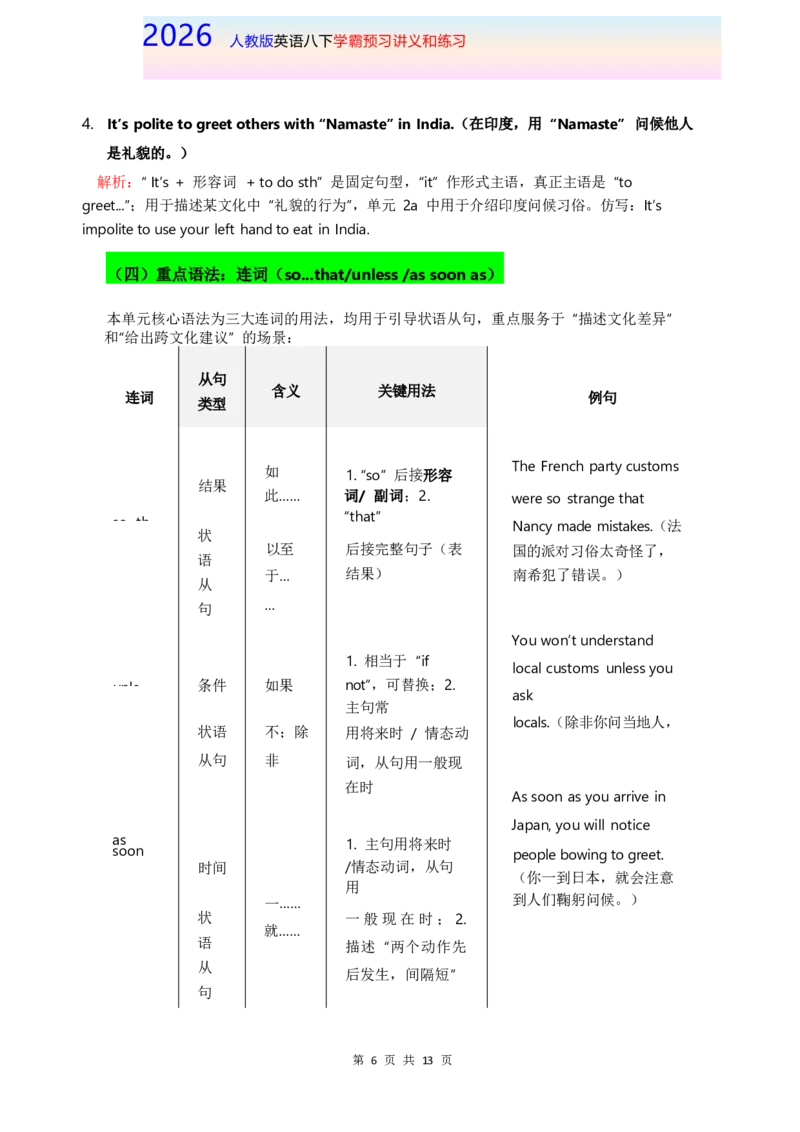
(四)重点语法:连词(so...that/unless /as soon as)
本单元核心语法为三大连词的用法,均用于引导状语从句,重点服务于 “描述文化差异”
和“给出跨文化建议” 的场景:
从句
含义 关键用法
连词 例句
类型
The French party customs
如 1. “so” 后接形容
结果
此…… 词/ 副词;2. were so strange that
“that”
so...th Nancy made mistakes.(法
状
以至 后接完整句子(表 国的派对习俗太奇怪了,
语
于… 结果) 南希犯了错误。)
从
句 …
You won’t understand
1. 相当于 “if
local customs unless you
unle 条件 如果 not”,可替换;2.
ask
主句常
locals.(除非你问当地人,
状语 不;除 用将来时 / 情态动
从句 非 词,从句用一般现
在时
As soon as you arrive in
Japan, you will notice
as 1. 主句用将来时
soon people bowing to greet.
时间 /情态动词,从句
(你一到日本,就会注意
用
到人们鞠躬问候。)
一……
状 一般现在时;2.
就……
语 描述 “两个动作先
从
后发生,间隔短”
句
第 6 页 共 13 页语法易错点:
第 6 页 共 13 页2026
人教版英语八下学霸预习讲义和练习
. “so...that” 中 “so” 后不能接名词,若接名词需用 “such...that”(如:It’s such a common
custom that everyone follows it. );
. “unless” 引导的从句不能再用 “not”,否则语义重复(如:× Don’t go unless you don’t
know the customs. √ Don’t go unless you know the customs. );
. “as soon as” 引导的从句,主语是第三人称单数时,动词需变形式(如:As soon as he
arrives, he will shake hands. )。
(五)作文指导
写作主题:Advice for Visiting My Country(给来访我国的建议)
写作要求:
1. 针对外国友人来访中国,给出至少 3 条关于习俗的建议(如问候、餐桌礼仪、拜访礼仪);
2. 每条建议需说明 “具体做法” 和 “背后的文化原因” ,体现对本土文化的介绍;
3. 字数不少于 80 词,正确使用连词(so...that/unless /as soon as)和单元核心词汇(如
custom、 manner、greet 等)。
写作结构:
开头段:引入主题模板:If you plan to visit China, it’s important to learn some local customs
first. Following these customs will help you avoid misunderstandings and make a good first
impression. Here are some useful tips for you.
中间段:具体建议(分点阐述)模板:First, about greetings: You should greet others with a
smile and a nod. As soon as you meet elders, you can say “ Ni Hao”
(Hello) politely—bowing is not necessary unless it’s a very formal occasion. Second,
for table manners: It’s polite to wait for elders to start eating first. You should use
chopsticks instead of a knife and fork, and remember not to stick chopsticks into the rice—
it’s so impolite that it may make others uncomfortable. Third, when visiting a family: You’d
better bring a small gift, like fruit or flowers. The host will be very happy to receive it, and
they will offer you tea as soon as you enter the house.
结尾段:总结与欢迎模板:These customs are not difficult to follow, and they show your
respect for Chinese culture. I believe you will have a great time in China if you
remember these tips. Welcome to my country!
第 7 页 共 13 页2026
人教版英语八下学霸预习讲义和练习
四、过关检测
(一)单项选择(10 题)
( ) 1. People in Japan usually __________ to greet teachers as soon as they meet them.
A. shake hands B. bow C. hug D. kiss cheeks
( )2. English table manners are ______ confusing that many visitors feel worried at first.
A. so B. such C. too D. very
( ) 3. You shouldn’t ask French people about their age _____ you know them quite well.
A. if B. unless C. as soon as D. so that
( ) 4. —What’s the proper way __________ in India?—You should use your right
hand, not your left.
A. greet B. to greet C. eat D. to eat
( ) 5. Nancy felt __________ when she arrived early at the French party—she
didn’t know it’s impolite.
A. embarrassed B. embarrassing C. confused D. confusing
( ) 6. As soon as you __________ a Chinese family, the host will offer you a cup of tea.
A. visit B. will visit C. visited D. are visiting
( ) 7. It’s rude __________ at people in most cultures, so you should avoid doing it.
A. point B. to point C. pointing D. pointed
( ) 8. —Is it common __________ cheeks in Korea?—No, it’s uncommon.
People usually bow there.
A. kiss B. to kiss C. kissing D. kissed
( ) 9. The Indian custom of greeting with “Namaste” is __________ that many
tourists love to learn it.
A. so interesting B. such interesting C. so interested D. such interested
( ) 10. You will make a good impression on Chinese families __________ you
follow their basic customs.
A. if B. unless C. so that D. as soon as
第 8 页 共 13 页2026
人教版英语八下学霸预习讲义和练习
(二)完形填空(10 题)
If you plan to visit France, learning about local customs will make your trip easier. Here
are some important tips.
First, about party arrival time. You shouldn’t arrive early. It’s normal to be on time or a
few minutes late. As soon as you arrive too early, the host may still be busy preparing, and
you will make them 1 __________. Nancy once arrived 10 minutes early, and she
felt so embarrassed that she wanted to leave.
Second, bring a small gift. You don’t need to buy expensive things—chocolates or
flowers are fine. Unless you know the host’s favorite, 2 __________ choose red flowers—
they are a symbol of love in France. Your gift will make the host feel happy, and it shows
your respect for them.
Third, dress for the occasion. French people care about their clothes, especially at parties. If
you wear casual clothes like shorts or T-shirts, others will think you are rude. It’s 3
___________ important to dress nicely that you should check the party dress code first.
Fourth, avoid personal questions. French people are quite private. They don’t like
talking about their age, income, or family unless they know you well. You can talk about
food or culture 4 __________—these are safe topics.
Fifth, use basic French phrases. Even simple words like “ bonjour” (hello) and “merci”
(thank you) go a long way in France. Locals will appreciate your effort to speak their
language, 5 __________ it shows you respect their culture. I once tried ordering coffee in
French, and the waiter was much friendlier than I expected.
Following these customs is not difficult, 6 __________ it’s easy to forget them if you’re
not careful. Last year, my friend Tom visited France and forgot to bring a gift to a party. He
told me he felt awkward, but the host was kind and said it was no problem. This
shows that most French people are understanding, but it’s still better to be prepared.
You might wonder 7 __________ to remember all these customs. The best way is to
take simple notes before your trip. Write down key tips like “don’t arrive early” or
“avoid red flowers”—this will help you not miss anything important.
第 9 页 共 13 页2026
人教版英语八下学霸预习讲义和练习
It’s also good to know that some small mistakes are okay. No one expects you to
be perfect, but being polite and respectful will always make a good impression. For
example, if you accidentally ask a personal question, just apologize politely—most
people will forgive you quickly. Being rude, however, is never acceptable, as it will make
others feel 8
__________.
In the end, learning about French customs is 9 __________ than you think. It’s all
about showing respect and being open to new cultures. If you follow these tips, your
trip to France will be more enjoyable, and you might even make some new friends.
Remember: When in Rome, do as the Romans do. This old saying tells us why cultural
respect is 10 __________ for any trip abroad.
( ) 1. A. comfortable B. uncomfortable C. happy D. excited
( ) 2. A. don’t B. do C. won’t D. will
( ) 3. A. so B. such C. too D. very
( ) 4. A. instead B. instead of C. too D. either
( ) 5. A. because B. but C. so D. or
( ) 6. A. and B. but C. so D. or
( ) 7. A. what B. how C. why D. where
( ) 8. A. polite B. impolite C. happy D. sad
( ) 9. A. difficult B. easier C. more difficult D. easiest
( ) 10. A. difficult B. easy C. important D. unimportant
(三)语法填空
Visiting a new country can be exciting, but you may face cultural differences. Here is
some advice for you.
First, learn about local customs 1 __________ you go. As soon as you arrive, you will notice
第 10 页 共 13 页2026
人教版英语八下学霸预习讲义和练习
many new things. For example, in India, it’s rude to eat with your left hand. It’s 2
__________ rude that you may make others angry if you do so.
Second, be careful with greetings. In Japan, people bow as soon as they meet, but in the
US, shaking hands is more common. You 3 __________ (not make) mistakes unless you learn
these differences.
Third, respect table manners. In China, you should wait for elders to start eating first. You 4
__________ (use) serving chopsticks to take food from shared dishes. It’s so important to
follow these rules that everyone 5 ___________ (appreciate) your respect.
Finally, avoid personal questions. People in many countries are private. You shouldn’t
ask about their age 6 __________ you know them well.
By following these tips, you will have a great trip and enjoy cross-cultural communication.
(四)作文
写作任务:
以 “Advice for Visiting My Country” 为题,写一篇短文,给来访中国的外国友人提 3 条习
俗建议(如问候、餐桌礼仪、拜访礼仪),每条建议说明 “做法” 和 “文化原因”,字数 80-
100词,需使用连词(so...that/unless /as soon as)和单元核心词汇(如 custom、manner、
greet等)。
第 11 页 共 13 页2026
人教版英语八下学霸预习讲义和练习
(五)答案和解析
(一)单项选择
1. B(bow 鞠躬,单元 1b 中日本学生问候老师用鞠躬,选 B)
2. A(so...that 如此… … 以至于,“so” 后接形容词 confusing ,选 A)
3. B( unless 除非,“ 除非你很了解法国人,否则不要问年龄” ,选 B)
4. D(to eat 动词不定式,“在印度吃饭的正确方式” ,单元中印度用右手吃饭,选 D)
5. A(embarrassed 尴尬的,修饰人 “南希感到尴尬” ,选 A)
6. A(visit 一般现在时,as soon as 从句用一般现在时表将来,选 A)
7. B(to point 动词不定式,“ It’s + 形容词 + to do sth” 固定句型,选 B)
8. B(to kiss 动词不定式,“ It’s common to do sth” 固定句型,选 B)
9. A(so interesting 如此有趣,“so” 后接形容词,修饰 “ 习俗” 用 interesting ,选 A)
10. A(if 如果,“如果你遵循习俗,会留下好印象” ,表条件,选 A)
(二)完形填空
1.B( uncomfortable 意为 “ 不舒服的” ,结合文档中 Nancy 早到派对使主人忙碌的案
例,提前到达会干扰主人准备,让对方处于不便的状态,符合法国派对 “不早到” 的礼仪要
求)。
2.A(don’t 引导否定祈使句,文档明确法国文化中红玫瑰象征爱情,除非知晓主人喜好,
否则避免选择,防止造成误解,贴合 “赠送礼物的文化禁忌” 内容)。
3.A(so 与后文 “that” 构成 “so...that...” 结构,文档强调法国派对着装需贴合场合,“着装
得体如此重要,以至于要先确认着装要求”,符合单元 “so...that 引导结果状语从句” 的语法
重点)。
4.A(instead 表 “反而” ,文档指出法国人重视隐私,避免谈论私人话题,用食物、文化
等安全话题代替,符合 “跨文化沟通安全话题” 的建议)。
5.A(because 表原因,“ 当地人欣赏你说法语的努力,因为这体现对他们文化的尊重”,符
合文档中 “使用法语促进跨文化友好互动” 的案例)。
6.B(But 表转折,“遵循习俗不难,但不小心就容易忘记” ,呼应文档中朋友 Tom 因疏忽
忘带礼物的案例,体现 “ 需谨慎对待习俗” 的逻辑)。
7.B(how 引导宾语从句,“你可能想知道如何记住所有习俗” ,后文 “记笔记” 是具体方
法,符合单元 “跨文化沟通技巧” 的核心 —— 通过实用方法掌握习俗)。
8.D( sad 意为 “难过的” ,文档强调礼貌的重要性,“粗鲁会让他人感到难过” ,与 “礼貌
能留下好印象” 形成对比,贴合 “跨文化沟通中礼貌原则” )。
9.B(easier 意为 “更容易”,“ 了解法国习俗比你想象中更容易” ,呼应前文 “遵循习俗不
难”,符合文档中 “跨文化习俗学习并非难事” 的观点)。
10.C(important 意为 “重要的” ,“这句谚语告诉我们为何文化尊重对海外旅行很重要” ,
呼应单元主题 “Crossing Cultures” 的核心 —— 文化尊重是跨文化交流的关键)。
(三)语法填空
1. before(before 在… … 之前,“去之前了解当地习俗” ,选 before)
2. so(so 如此,“so rude that” 如此粗鲁以至于,选 so)
第 12 页 共 13 页2026
人教版英语八下学霸预习讲义和练习
3. won’t make(will not make 一般将来时,unless 从句用一般现在时,主句用将来时,选
won’t make)
4. should use(should use 应该使用,“应该用公筷” ,表建议,选 should use)
5. will appreciate(will appreciate 一般将来时,“so...that” 从句用将来时,选 will appreciate)
6. unless(unless 除非,“ 除非你了解他们,否则不要问年龄” ,选 unless)
(四)范文:
Advice for Visiting My Country
If you plan to visit China, here are some important customs to remember.
First, about greetings: You should greet others with a smile and say “ Ni Hao”. As soon
as you meet elders, you can nod politely—bowing is not necessary unless it’s a
formal occasion. This shows your respect for them. Second, for table manners: Wait for
elders to start eating first. Use chopsticks instead of a knife and fork, and don’t stick
chopsticks into rice—it’s so impolite that it may upset others. Third, when visiting a
family: Bring a small gift like fruit. The host will offer you tea as soon as you enter, and
you should accept it to show politeness.
These tips are easy to follow, and they will help you have a great time in China. Welcome!
第 13 页 共 13 页