2026 人教版英语八下单元知识清单
Unit 6 Crossing Cultures 单元知识清单
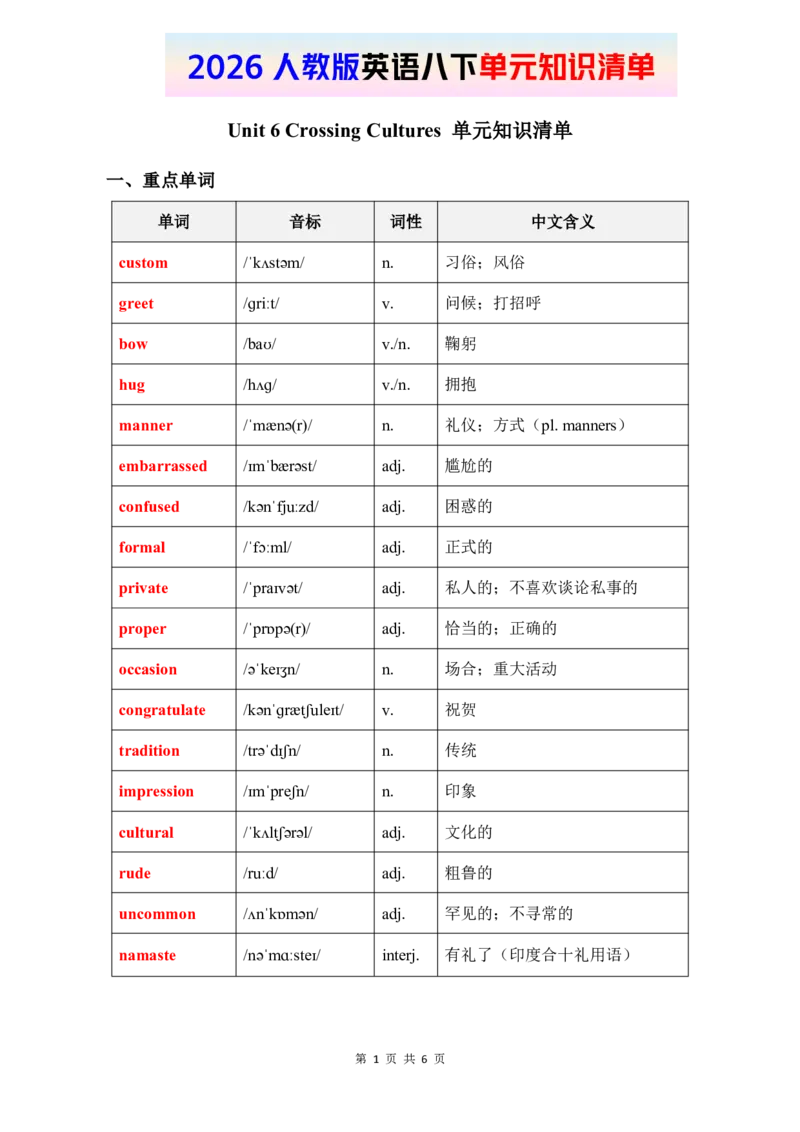
一、重点单词
单词 音标 词性 中文含义
custom /ˈkʌstəm/ n. 习俗;风俗
greet /ɡriːt/ v. 问候;打招呼
bow /baʊ/ v./n. 鞠躬
hug /hʌɡ/ v./n. 拥抱
manner /ˈmænə(r)/ n. 礼仪;方式(pl. manners)
embarrassed /ɪmˈbærəst/ adj. 尴尬的
confused /kənˈfjuːzd/ adj. 困惑的
formal /ˈfɔːml/ adj. 正式的
private /ˈpraɪvət/ adj. 私人的;不喜欢谈论私事的
proper /ˈprɒpə(r)/ adj. 恰当的;正确的
occasion /əˈkeɪʒn/ n. 场合;重大活动
congratulate /kənˈɡrætʃuleɪt/ v. 祝贺
tradition /trəˈdɪʃn/ n. 传统
impression /ɪmˈpreʃn/ n. 印象
cultural /ˈkʌltʃərəl/ adj. 文化的
rude /ruːd/ adj. 粗鲁的
uncommon /ʌnˈkɒmən/ adj. 罕见的;不寻常的
namaste /nəˈmɑːsteɪ/ interj. 有礼了(印度合十礼用语)
第 1 页 共 6 页2026 人教版英语八下单元知识清单
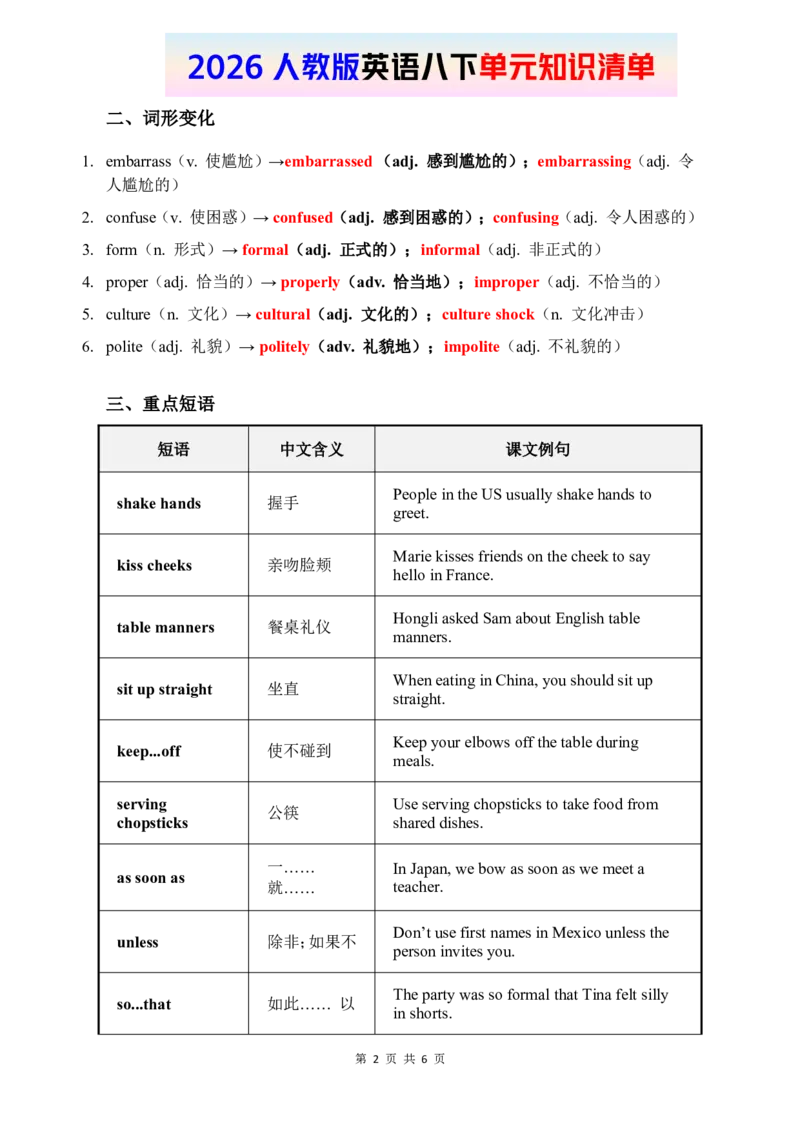
二、词形变化
1. embarrass(v. 使尴尬)→embarrassed(adj. 感到尴尬的);embarrassing(adj. 令
人尴尬的)
2. confuse(v. 使困惑)→confused(adj. 感到困惑的);confusing(adj. 令人困惑的)
3. form(n. 形式)→formal(adj. 正式的);informal(adj. 非正式的)
4. proper(adj. 恰当的)→properly(adv. 恰当地);improper(adj. 不恰当的)
5. culture(n. 文化)→cultural(adj. 文化的);culture shock(n. 文化冲击)
6. polite(adj. 礼貌)→politely(adv. 礼貌地);impolite(adj. 不礼貌的)
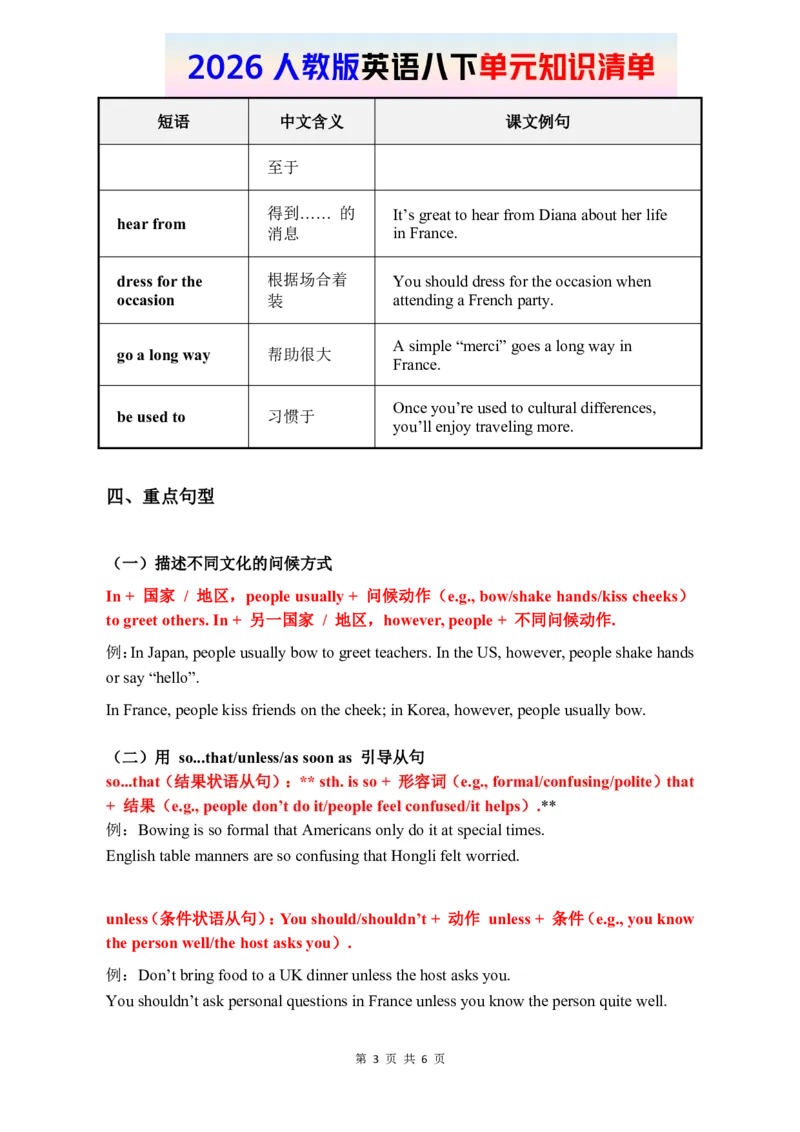
三、重点短语
短语 中文含义 课文例句
Peoplein theUS usually shakehands to
shakehands 握手
greet.
Marie kisses friends onthe cheek to say
kisscheeks 亲吻脸颊
hello in France.
Hongli asked Sam about English table
tablemanners 餐桌礼仪
manners.
When eating inChina, you shouldsit up
situpstraight 坐直
straight.
Keep your elbows offthetableduring
keep...off 使不碰到
meals.
serving Useserving chopsticks to takefood from
公筷
chopsticks shared dishes.
一…… In Japan, we bowas soon as we meet a
assoon as
就…… teacher.
Don’t usefirst names inMexicounless the
unless 除非;如果不
person invites you.
Theparty was so formal that Tinafelt silly
so...that 如此…… 以
in shorts.
第 2 页 共 6 页2026 人教版英语八下单元知识清单
短语 中文含义 课文例句
至于
得到…… 的 It’s great tohear from Diana about her life
hearfrom
消息 in France.
dress forthe 根据场合着 You should dress for theoccasion when
occasion 装 attending aFrench party.
Asimple“merci”goes a longway in
goalongway 帮助很大
France.
Once you’re used to cultural differences,
beusedto 习惯于
you’ll enjoytraveling more.
四、重点句型
(一)描述不同文化的问候方式
In + 国家 / 地区,people usually + 问候动作(e.g., bow/shake hands/kiss cheeks)
to greet others. In+ 另一国家 / 地区,however,people+ 不同问候动作.
例:In Japan, people usuallybowto greet teachers. In theUS, however,people shake hands
orsay“hello”.
In France, peoplekiss friends onthecheek; inKorea, however,people usuallybow.
(二)用 so...that/unless/as soon as 引导从句
so...that(结果状语从句):**sth. isso + 形容词(e.g., formal/confusing/polite)that
+ 结果(e.g., peopledon’t doit/peoplefeel confused/ithelps).**
例:Bowing is so formal that Americans only doit at special times.
English tablemanners are so confusing that Hongli felt worried.
unless(条件状语从句):Youshould/shouldn’t+ 动作 unless+ 条件(e.g., youknow
theperson well/thehostasksyou).
例:Don’t bring food to aUK dinnerunless thehost asks you.
You shouldn’t ask personal questions in France unless you knowtheperson quitewell.
第 3 页 共 6 页2026 人教版英语八下单元知识清单
assoon as(时间状语从句):People+ 动作(e.g., bow/greet/say thanks)assoon as
+ 时间点(e.g., theymeet/they arrive/they receive gifts).
例:In Japan, people bowas soonas they meet ateacher.
Say “merci” as soon as you receive agift inFrance.
(三)提供跨文化交流建议
When visiting + 国家 / 地区,you should + 建议(e.g., bring small gifts/dress
nicely/use local language). You shouldn’t + 禁忌(e.g., arrive early/ask personal
questions/use left hand ) because + 原 因 ( e.g., it’s embarrassing/it’s rude/it’s
impolite).
例:WhenvisitingIndia, you shoulduse your right hand toeat.Youshouldn’t useyour left
hand because it’s impolite.
When visiting France, you should arrive on time. You shouldn’t arrive early because the
hostmay not beready.
(四)对比文化差异
There are differences between + 文化 Aand + 文化 B. For example, in + 文化 A,
people + 行为 A; in + 文化 B, people + 行为 B. However, both cultures + 共同之
处(e.g., valuerespect/politegreetings).
例:There are differences between Chineseand UKtable manners. For example, in China,
we use chopsticks; in the UK, people use a knife and fork. However, both cultures think
it’s impoliteto talk withyour mouthfull.
There are differences between French and Korean greetings. In France, people kiss cheeks;
inKorea, people bow.However,both cultures value friendly communication.
第 4 页 共 6 页2026 人教版英语八下单元知识清单
Unit 6 Crossing Cultures 单元知识清单(默写版)
一、重点单词
1. _______/_______ n. 习俗;风俗 → 例句:Weshould learn about local _______when
traveling.
2. _______ /_______ v. 问候;打招呼 → 例句:How do people _______ each other in
Japan?
3. _______/_______v./n. 鞠躬 → 例句:He _______to showrespect.
4. _______/_______v./n. 拥抱 → 例句:Friends often _______when they meet.
5. _______/_______n. 礼仪(pl.)→ 例句:Weshould learn table _______.
6. _______/_______adj. 尴尬的 → 例句:Shefelt _______when she madeamistake.
7. _______/_______adj. 困惑的 → 例句:I was _______about the newrules.
8. _______/_______adj. 正式的 → 例句:This is a_______meeting.
9. _______/_______adj. 私人的 → 例句:Don’t ask _______questions.
10. _______/_______adj. 恰当的 → 例句:You shouldchoose the_______gift.
二、词形变化
1. embarrass(v. 使尴尬)→_______(adj. 感到尴尬的);_______(adj. 令人尴尬的)
2. confuse(v. 使困惑)→_______(adj. 感到困惑的);_______(adj. 令人困惑的)
3. form(n. 形式)→_______(adj. 正式的);_______(adj. 非正式的)
4. proper(adj. 恰当的)→_______(adv. 恰当地);_______(adj. 不恰当的)
5. culture(n. 文化)→_______(adj. 文化的);_______(n. 文化冲击)
6. polite(adj. 礼貌)→_______(adv. 礼貌地);_______(adj. 不礼貌的)
三、重点短语
1. 握手 →shake_______→ 例句:People______________in theUS.
2. 亲吻脸颊 →kiss_______→ 例句:They ______________in France.
3. 餐桌礼仪 →table_______→ 例句:Shelearned ______________.
4. 坐直 →sit______________→ 例句:_____________________when eating.
5. 一…… 就……→as _______as → 例句:I’ll call you ___________________I arrive.
第 5 页 共 6 页2026 人教版英语八下单元知识清单
6. 除非 →_______→ 例句:Iwon’t go _______you come withme.
7. 如此…… 以至于 →so..._______→ 例句:It’s _______cold _______I stay home.
四、重点句型
1. _______________________________________________________________.
在某国家 / 地区,人们通常做某事问候;在另一国家 / 地区,人们做不同的事。
例:In India, people _______(合十并说 “namaste”).
In theUS, however, people_____________(握手).
仿写:在法国,人们亲吻脸颊问候;在中国,人们通常握手或点头。
_______________________________________________________________.
2. _______________________________________________________________.
某物如此…… 以至于……(so...that)。
例:Theparty was _______(如此正式)that I_____________(感到不自在).
仿写:这些礼仪如此复杂以至于我感到困惑。
_______________________________________________________________.
3. _______________________________________________________________.
你应该 / 不应该做某事,除非……(unless)。
例:You _______(不应该迟到)unless _____________(你有特殊原因).
仿写:你应该带礼物,除非主人告诉你不用带。
_______________________________________________________________.
4. _______________________________________________________________.
当访问某国家时,你应该做某事,不应该做某事,因为……。
例:WhenvisitingFrance, you _______(应该准时到).You _______(不应该早到)
because __________________________(主人可能还没准备好).
仿写:当访问印度时,你应该用右手吃饭,不应该用左手,因为左手被认为不卫生。
_______________________________________________________________.
5. _______________________________________________________________.
某文化 A 和文化 B 之间有差异,例如……,但两者都……。
例:There are differences between _______(中国和英国).
Forexample, in China, _______(我们用筷子);
intheUK, _______(人们用刀叉).However, both _____________(认为满嘴食物说
话不礼貌).
仿写:日本和韩国之间有问候差异,例如在日本人们鞠躬,在韩国人们也鞠躬但角
度不同,但两者都重视尊重。
_______________________________________________________________.
第 6 页 共 6 页