文档文本内容
2026 外研版英语八下单元重点知识
Unit 5 Looking into nature 单元重点知识
一、词汇巩固
核心名词
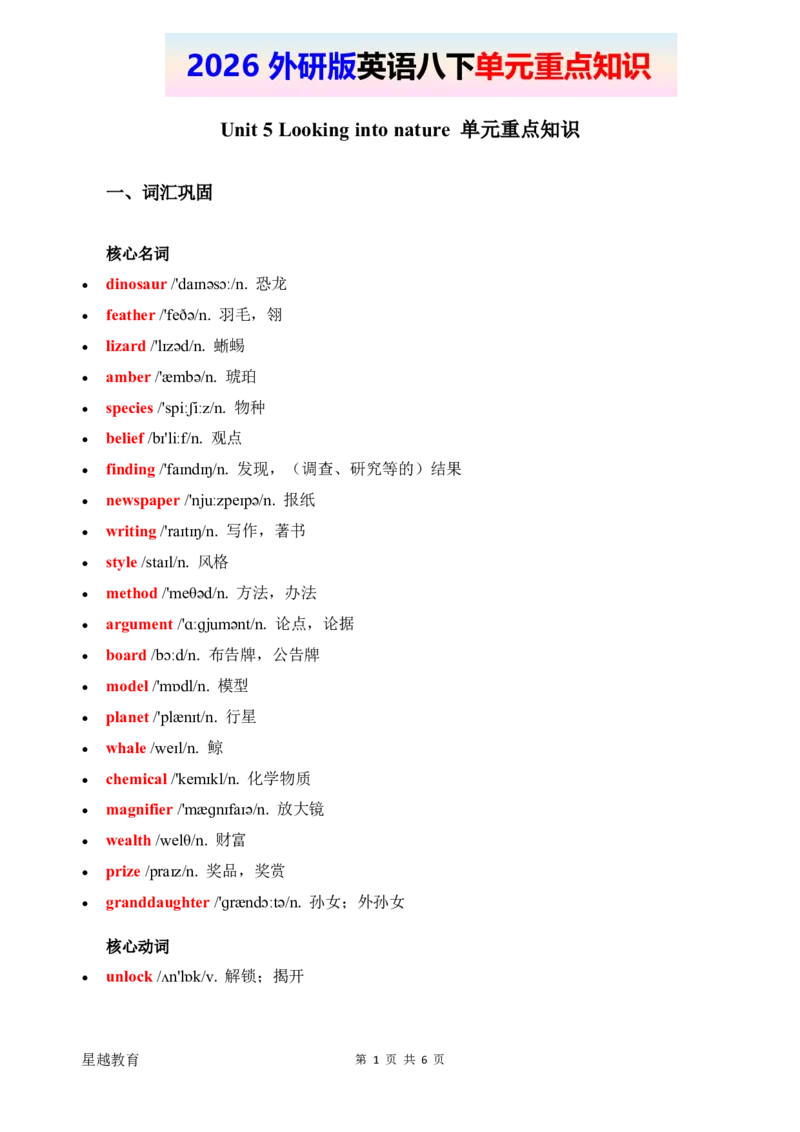
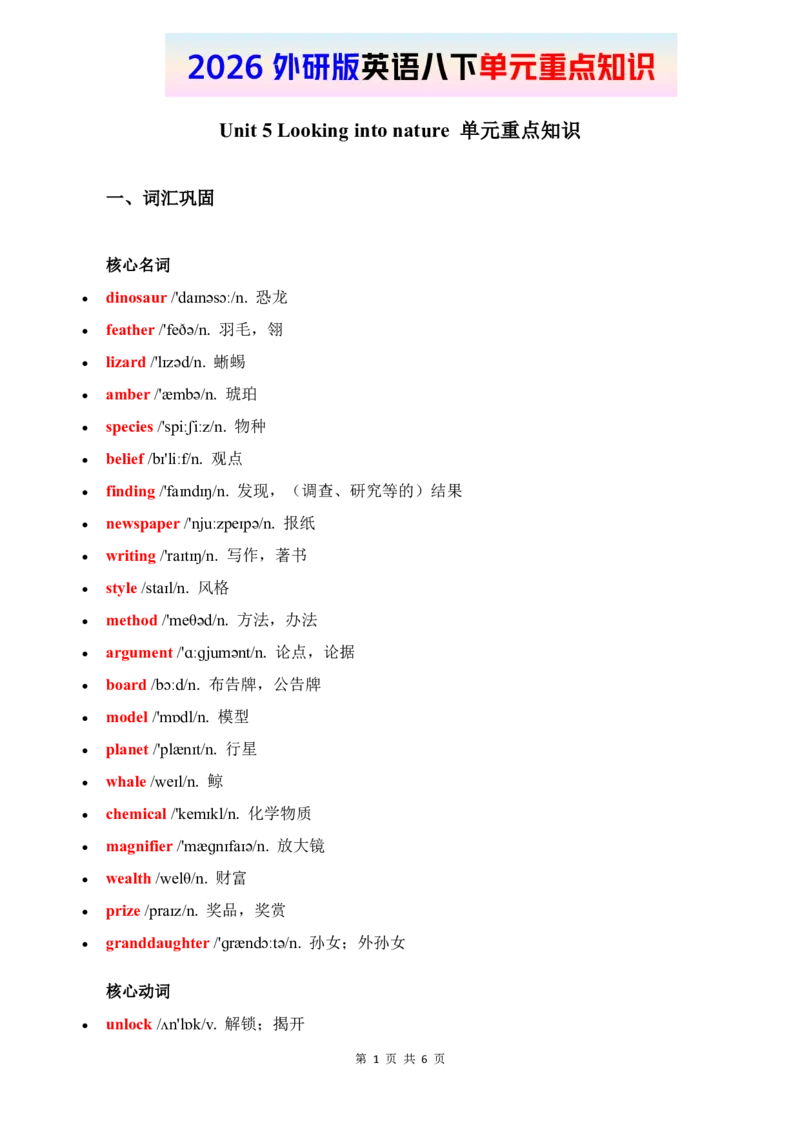
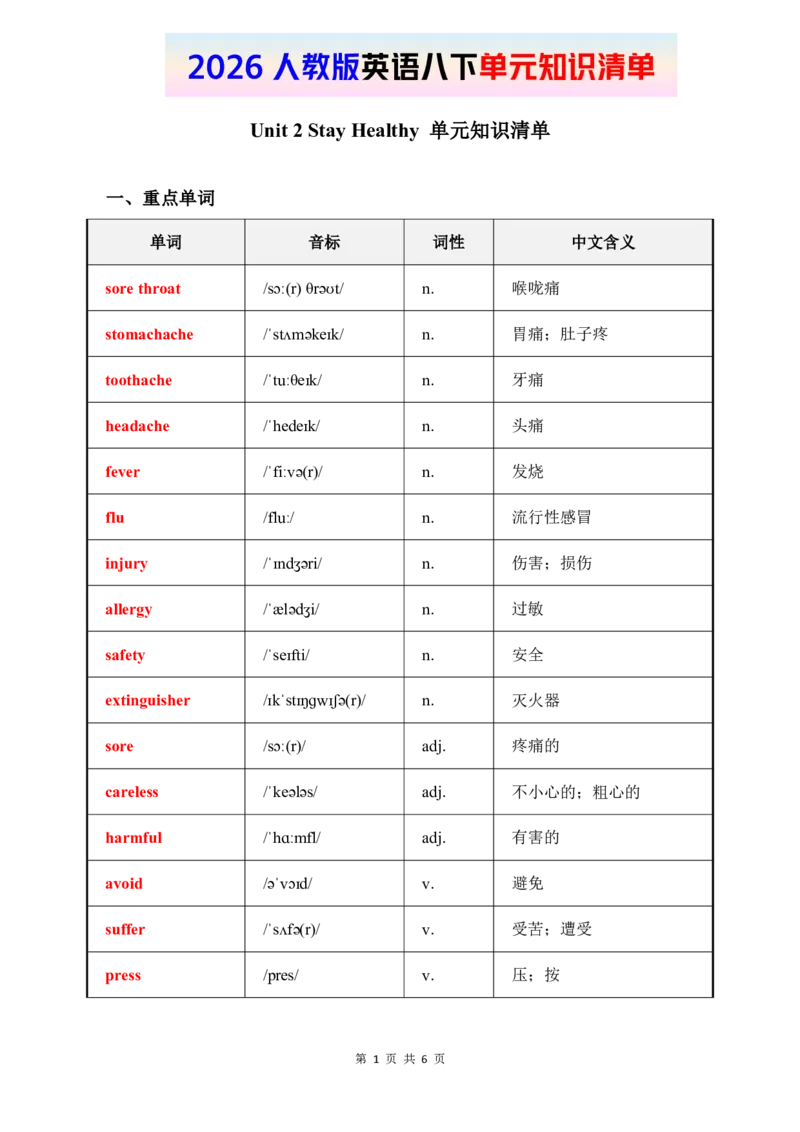
dinosaur /'daɪnəsɔː/n. 恐龙
feather /'feðə/n. 羽毛,翎
lizard /'lɪzəd/n. 蜥蜴
amber /'æmbə/n. 琥珀
species /'spiːʃiːz/n. 物种
belief /bɪ'liːf/n. 观点
finding /'faɪndɪŋ/n. 发现,(调查、研究等的)结果
newspaper /'njuːzpeɪpə/n. 报纸
writing /'raɪtɪŋ/n. 写作,著书
style /staɪl/n. 风格
method /'meθəd/n. 方法,办法
argument /'ɑːɡjumənt/n. 论点,论据
board /bɔːd/n. 布告牌,公告牌
model /'mɒdl/n. 模型
planet /'plænɪt/n. 行星
whale /weɪl/n. 鲸
chemical /'kemɪkl/n. 化学物质
magnifier /'mæɡnɪfaɪə/n. 放大镜
wealth /welθ/n. 财富
prize /praɪz/n. 奖品,奖赏
granddaughter /'ɡrændɔːtə/n. 孙女;外孙女
核心动词
unlock /ʌn'lɒk/v. 解锁;揭开
星越教育 第 1 页 共 6 页2026 外研版英语八下单元重点知识
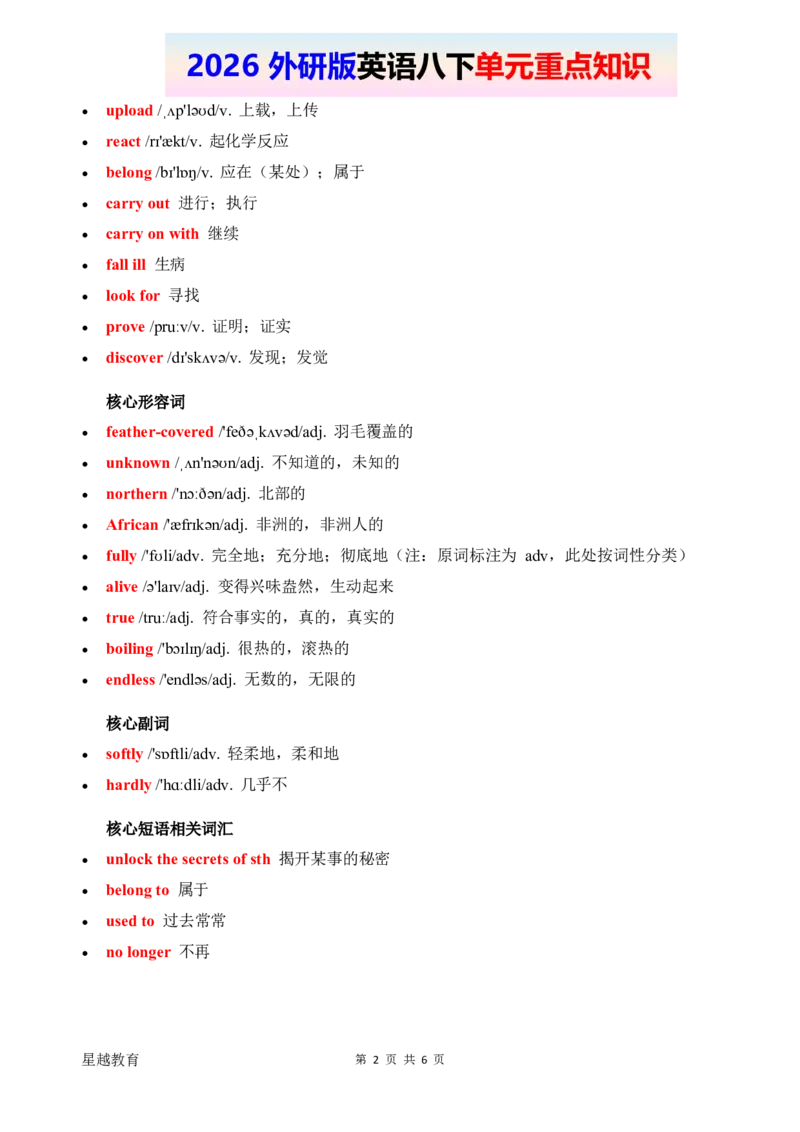
upload /ˌʌp'ləʊd/v. 上载,上传
react /rɪ'ækt/v. 起化学反应
belong /bɪ'lɒŋ/v. 应在(某处);属于
carry out 进行;执行
carry on with 继续
fall ill 生病
look for 寻找
prove /pruːv/v. 证明;证实
discover /dɪ'skʌvə/v. 发现;发觉
核心形容词
feather-covered /'feðəˌkʌvəd/adj. 羽毛覆盖的
unknown /ˌʌn'nəʊn/adj. 不知道的,未知的
northern /'nɔːðən/adj. 北部的
African /'æfrɪkən/adj. 非洲的,非洲人的
fully /'fʊli/adv. 完全地;充分地;彻底地(注:原词标注为 adv,此处按词性分类)
alive /ə'laɪv/adj. 变得兴味盎然,生动起来
true /truː/adj. 符合事实的,真的,真实的
boiling /'bɔɪlɪŋ/adj. 很热的,滚热的
endless /'endləs/adj. 无数的,无限的
核心副词
softly /'sɒftli/adv. 轻柔地,柔和地
hardly /'hɑːdli/adv. 几乎不
核心短语相关词汇
unlock the secrets of sth 揭开某事的秘密
belong to 属于
used to 过去常常
no longer 不再
星越教育 第 2 页 共 6 页2026 外研版英语八下单元重点知识
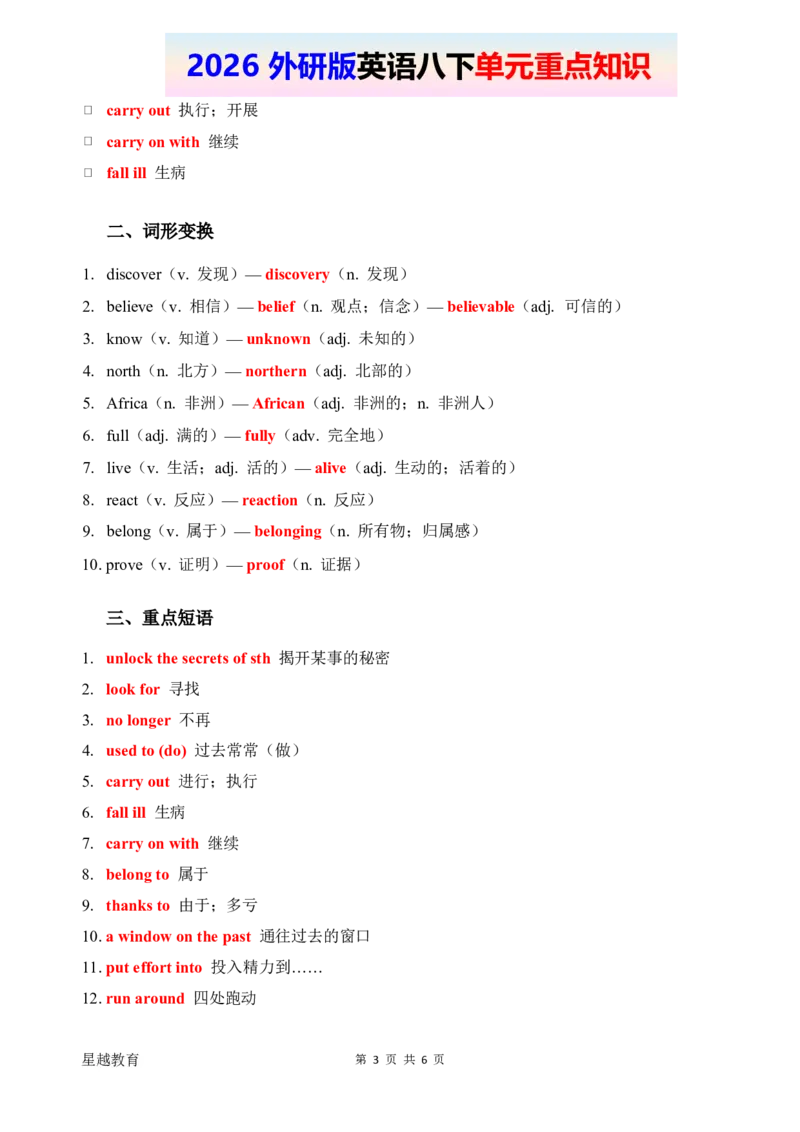
carry out 执行;开展
carry on with 继续
fall ill 生病
二、词形变换
1. discover(v. 发现)— discovery(n. 发现)
2. believe(v. 相信)— belief(n. 观点;信念)— believable(adj. 可信的)
3. know(v. 知道)— unknown(adj. 未知的)
4. north(n. 北方)— northern(adj. 北部的)
5. Africa(n. 非洲)— African(adj. 非洲的;n. 非洲人)
6. full(adj. 满的)— fully(adv. 完全地)
7. live(v. 生活;adj. 活的)— alive(adj. 生动的;活着的)
8. react(v. 反应)— reaction(n. 反应)
9. belong(v. 属于)— belonging(n. 所有物;归属感)
10. prove(v. 证明)— proof(n. 证据)
三、重点短语
1. unlock the secrets of sth 揭开某事的秘密
2. look for 寻找
3. no longer 不再
4. used to (do) 过去常常(做)
5. carry out 进行;执行
6. fall ill 生病
7. carry on with 继续
8. belong to 属于
9. thanks to 由于;多亏
10.a window on the past 通往过去的窗口
11.put effort into 投入精力到……
12.run around 四处跑动
星越教育 第 3 页 共 6 页2026 外研版英语八下单元重点知识
13.raise one's arms 举起手臂
14.by no means 绝不(拓展复用)
15.take interest in 对…… 感兴趣
四、重点句型
1. For hundreds of years, people believed that dinosaurs looked like huge lizards.
译文:数百年来,人们认为恐龙看起来像巨大的蜥蜴。
解析:that 引导宾语从句,作 believed 的宾语,that 可省略;look like 表示 “看起
来像”。
2. Thanks to a piece of amber, scientists now know that this idea is wrong.
译文:多亏了一块琥珀,科学家们现在知道这个观点是错误的。
解析:thanks to 后接名词短语表示原因;that 引导宾语从句,说明 know 的内容。
3. They can tell us whether dinosaurs had feathers, but that's not all.
译文:它们能告诉我们恐龙是否有羽毛,但这还不是全部。
解析:whether 引导宾语从句,表 “是否”,可与 if 互换(此处无 or not,二者通
用)。
4. This species no longer grows in this area. But the find proves that it did 35 million
years ago.
译文:这个物种不再在该地区生长,但这一发现证明它在 3500 万年前曾在这里生
长过。
解析:no longer 表示 “不再”,位于实义动词前;that 引导宾语从句,it did 指代 “it
grew in this area”。
5. Scientists used to believe that ants came from the northern half of the earth.
译文:科学家们过去认为蚂蚁来自地球的北半球。
解析:used to do 表示 “过去常常做某事”,暗含现在不这样;that 引导宾语从句。
6. To carry out his research, he spent years in wild mountains and forests.
译文:为了开展他的研究,他在荒山野林中度过了多年。
解析:to carry out 作目的状语;carry out 表示 “执行;开展”(研究、计划等)。
7. Though he nearly died, Wang never stopped his work.
译文:尽管他差点去世,王文采从未停止过他的工作。
解析:though 引导让步状语从句,意为 “尽管”;stop doing sth 表示 “停止做某事”。
星越教育 第 4 页 共 6 页2026 外研版英语八下单元重点知识
8. With a magnifier in hand, he still carried on with his research for another 10 years.
译文:他手里拿着放大镜,又继续研究了 10 年。
解析:with a magnifier in hand 是独立主格结构,表伴随;carry on with 表示 “继续”。
9. Although he received the First Class Award of National Natural Science Awards
twice, he hardly mentioned it.
译文:尽管他两次获得国家自然科学一等奖,但他几乎从未提起过。
解析:although 引导让步状语从句;hardly 表示 “几乎不”,表否定。
10.It softly told people about his lifelong exploration and love of nature.
译文:它轻柔地向人们诉说着他对自然的毕生探索与热爱。
解析:tell sb about sth 表示 “告诉某人关于某事”;lifelong 作定语,意为 “毕生的”。
五、重点语法
that 引导的宾语从句
1. 用法:当谓语动词表示 “相信、希望、知道、说” 等肯定概念时,后接 that 引导的
宾语从句。
that 无实际含义,仅起语法连接作用,多数情况下可省略。
常接此类从句的动词有:believe, know, think, prove, hope, say, tell 等。
2. 结构:主语 + 谓语动词 + (that) + 宾语从句(陈述句语序)
3. 例句(来自单元内容)
People believed (that) dinosaurs looked like huge lizards
人们认为恐龙看起来像巨大的
(.
蜥蜴。)
The find proves (that) it did 35 million years ago
这一发现证明它在 3500 万年前曾存
(.
在。)
4. 单元应用:用于描述自然探索中的已知事实、科学结论等。
whether/if 引导的宾语从句
1. 用法:当谓语动词表示 “不确定、疑问” 等概念时,后接 whether/if 引导的宾语从
句,意为 “是否”。
从句为陈述句语序。
星越教育 第 5 页 共 6 页2026 外研版英语八下单元重点知识
若从句后有 or not,只能用 whether,构成 whether...or not 结构。
2. 结构:主语 + 谓语动词 + whether/if + 宾语从句(陈述句语序)
3. 例句(来自单元内容)
They can tell us whether dinosaurs had feathers.(它们能告诉我们恐龙是否有羽毛。)
I don't know if/whether this is a mistake.(我不知道这是否是一个错误。)
4. 单元应用:用于表达自然探索中的疑问、不确定的发现等。
宾语从句的语序规则
1. 无论原句是陈述句、一般疑问句还是特殊疑问句,宾语从句都必须用陈述句语序(主
语在前,谓语在后)。
2. 示例
原问句:Will scientists find the reason?(科学家们会找到原因吗?)
宾语从句:I'm not sure if/whether scientists will find the reason.(我不确定科学家们是
否会找到原因。)
原问句:Is Mr Brown interested in insects?(布朗先生对昆虫感兴趣吗?)
宾语从句:Emily wants to know if/whether Mr Brown is interested in insects.(埃米莉
想知道布朗先生是否对昆虫感兴趣。)
宾语从句的时态呼应
1. 主句为一般现在时,从句可根据实际情况用任意时态。
例句:Scientists now know that dinosaurs had feathers.(主句一般现在时,从句一般过
去时)
2. 主句为一般过去时,从句需用相应的过去时态(一般过去时、过去进行时、过去将
来时等)。
例句:People believed that dinosaurs looked like lizards.(主句一般过去时,从句一般
过去时)
星越教育 第 6 页 共 6 页