2026 人教版英语八下单元重点知识
Unit 6 Crossing Cultures 单元重点知识
一、词汇巩固
(一)核心名词(文化礼仪 & 习俗相关)
1. custom/ˈkʌstəm/ (n.) 习俗;风俗
例:Different countries have different customs—forexample, people inJapan bowto greet
others, whilepeople inthe USusually shake hands.(不同国家有不同习俗 —— 比如日
本人鞠躬问候,而美国人通常握手。)单元围绕 “跨文化习俗差异” 展开,该词是主
题核心载体。
2. manner /ˈmænə(r)/ (n.) 方式;(pl.)礼仪
例:Tablemanners are important in cross-cultural communication—using serving
chopsticks inChinais apolitemanner.(餐桌礼仪在跨文化交流中很重要 —— 在中国
使用公筷是礼貌的礼仪。)
3. greeting /ˈɡriːtɪŋ/(n.) 问候;招呼
例:“Namaste”is atraditional greeting inIndia, where people press theirpalms together
and bow.(“Namaste” 是印度的传统问候语,人们会双手合十并鞠躬。)
4. occasion/əˈkeɪʒn/(n.) 场合;重大活动
例:You shoulddress nicely for aformal occasionlikea French party, instead of wearing
casual clothes likeshorts.(参加法国派对这类正式场合,你应该穿得得体,而不是穿
短裤等休闲服装。)
5. impression/ɪmˈpreʃn/ (n.) 印象
例:First impressions are soimportant that you shouldpay attention to your manners when
meeting peoplefrom othercultures.(第一印象非常重要,所以和其他文化背景的人见
面时,你应该注意自己的礼仪。)
6. curry /ˈkʌri/ (n.) 咖喱菜
例:Curry is apopular food inIndia, but you shoulduse your right hand to eat itinstead of
your left hand—it’s a local custom.(咖喱是印度的流行食物,但你应该用右手而不是
左手吃,这是当地习俗。)
(二)重点动词(文化交流 & 礼仪行为)
第 1 页 共 10 页2026 人教版英语八下单元重点知识
1. greet/ɡriːt/(v.) 问候;招呼
例:PeopleinFrance usually greet friends bykissingtheir cheeks, whilepeoplein theUK
often greet each otherwith a“hello”or ahug.(法国人通常通过亲吻脸颊问候朋友,而
英国人常以 “你好” 或拥抱打招呼。)
2. embarrass /ɪmˈbærəs/ (v.) 使尴尬;使难堪
例:Nancy was embarrassed when shearrived early at a French party—shedidn’t knowit’s
normal tobe afew minutes latethere.(南希提前到达法国派对时感到很尴尬 —— 她
不知道在那里迟到几分钟是正常的。)
3. congratulate/kənˈɡrætʃuleɪt/(v.) 祝贺
例:Weusually congratulatepeople on important occasions likeweddings orbirthdays, but
theway todoit varies across cultures.(我们通常在婚礼、生日等重要场合祝贺他人,
但方式因文化而异。)
4. avoid/əˈvɔɪd/ (v.) 避免;防止
例:In France, you shouldavoid asking personal questions likeage orincome unless you
knowtheperson well.(在法国,除非你很了解对方,否则应避免问年龄、收入等私人
问题。)
5. receive/rɪˈsiːv/ (v.) 收到;接纳
例:Whenyou receive agift in China, it’s politeto open it later instead ofopeningit
immediately.(在中国收到礼物时,稍后打开而不是立即打开是礼貌的做法。)
6. adapt/əˈdæpt/ (v.) 适应
例:It takes timetoadapt tonew cultures, but learning about local customs can makethe
process easier.(适应新文化需要时间,但了解当地习俗能让这个过程更顺利。)
(三)关键形容词(文化特征 & 感受)
1. formal /ˈfɔːml/(adj.) 正式的
例:Bowis a formal greeting inJapan, which is usually used when meeting teachers or
elders.(鞠躬在日本是正式的问候方式,通常用于见到老师或长辈时。)
2. embarrassed /ɪmˈbærəst/ (adj.) 尴尬的
例:Ji-Hoon felt embarrassed whenMarie kissed his cheek—hewasn’t used to this
greeting in his culture.(当玛丽亲吻智勋的脸颊时,他感到很尴尬 —— 他不习惯自
己文化中的这种问候方式。)
3. confused/kənˈfjuːzd/(adj.) 困惑的
第 2 页 共 10 页2026 人教版英语八下单元重点知识
例:Hongli was confused about English tablemanners at first—she didn’tknow howto use
aknifeand fork properly.(起初,红丽对英国餐桌礼仪感到困惑 —— 她不知道如何
正确使用刀叉。)
4. polite/pəˈlaɪt/(adj.) 礼貌的
例:It’s politeto bring asmallgift likechocolates when attending a French party, as away
tothank the host.(参加法国派对时带巧克力等小礼物是礼貌的,这是感谢主人的一种
方式。)
5. casual/ˈkæʒuəl/(adj.) 随意的;休闲的
例:Wearing jeans and a T-shirt is casual, which is suitablefor a picnicbut notfor aformal
party.(穿牛仔裤和 T 恤很随意,适合野餐但不适合正式派对。)
6. cultural/ˈkʌltʃərəl/ (adj.) 与文化有关的;文化的
例:Cultural differences can lead tomisunderstandings, so it’s important to learn about
othercultures before communicating.(文化差异可能导致误解,所以交流前了解其他
文化很重要。)
二、词形变换
1. embarrass (v. 使尴尬) →embarrassed (adj. 感到尴尬的) → embarrassing (adj. 令人
尴尬的)→embarrassment(n. 尴尬)
例:Marie’s kissembarrassed Ji-Hoon infront ofothers.(玛丽的亲吻让智勋在众人面前
很尴尬。)
Ji-Hoon felt embarrassed whenhedidn’t knowthelocal greeting.(当智勋不知道当地的
问候方式时,他感到很尴尬。)
It was an embarrassing moment when Nancy arrived early at theFrench party.(南希提前
到达法国派对的场景很令人尴尬。)
Shetried tohide herembarrassment after making amistakein tablemanners(. 在餐桌礼仪
上出错后,她试图掩饰自己的尴尬。)
2. confuse (v. 使困惑) → confused (adj. 感到困惑的) → confusing (adj. 令人困惑的)
→confusion(n. 困惑)
例:Different tablemanners in different countries often confuse visitors.(不同国家的餐
桌礼仪常让访客感到困惑。)
Hongli was confused about howtouseaknife and fork at a UKdinner.(在英国的晚餐
上,红丽不知道如何用刀叉,感到很困惑。)
第 3 页 共 10 页2026 人教版英语八下单元重点知识
English tablemanners can beconfusing for people from countries that usechopsticks.(对
于用筷子的国家的人来说,英国餐桌礼仪可能很令人困惑。)
There was someconfusion when Kaito bowed to Anna—she didn’texpect this greeting.
(当海斗向安娜鞠躬时,出现了一些困惑 —— 她没料到这种问候方式。)
3. polite (adj. 礼 貌 的 ) → politely (adv. 礼 貌 地 ) → impolite (adj. 不 礼 貌 的 )
→politeness (n. 礼貌)
例:It’s politeto say “thank you” when receiving agift in most cultures.(在大多数文化
中,收到礼物时说 “谢谢” 是礼貌的。)
Hegreeted the teacher politely bybowing.(他通过鞠躬礼貌地问候老师。)
It’s impoliteto pointat peopleinmany Asian countries.(在很多亚洲国家,指着别人是
不礼貌的。)
Politeness is importantin cross-cultural communication to showrespect.(礼貌在跨文化
交流中很重要,是表达尊重的方式。)
4. formal (adj. 正式的)→formally (adv. 正式地)→informal (adj. 非正式的)
例:Abusinessmeeting isa formal occasion, so you shoulddress nicely.(商务会议是正
式场合,所以你应该穿得得体。)
They greeted each other formally with ahandshake at themeeting.(他们在会议上以握手
正式问候彼此。)
Chattingwith friends over coffee isan informal activity, socasual clothes are suitable.(和
朋友喝咖啡聊天是非正式活动,所以穿休闲服装合适。)
5. culture (n. 文化) → cultural (adj. 文化的) → culturally (adv. 在文化上) → culture
shock(短语:文化冲击)
例:Chineseculture has a long historyoftraditions likeusing chopsticks.(中国文化有使
用筷子等悠久的传统。)
Cultural differences can sometimes cause misunderstandings.(文化差异有时会导致误
解。)
Culturally, red symbolizes luck in Chinabut danger in someWestern countries(. 从文化角
度看,红色在中国象征幸运,但在一些西方国家象征危险。)
Many peopleexperience culture shock when they first liveinaforeign country(. 很多人第
一次在国外生活时会经历文化冲击。)
三、重点短语
第 4 页 共 10 页2026 人教版英语八下单元重点知识
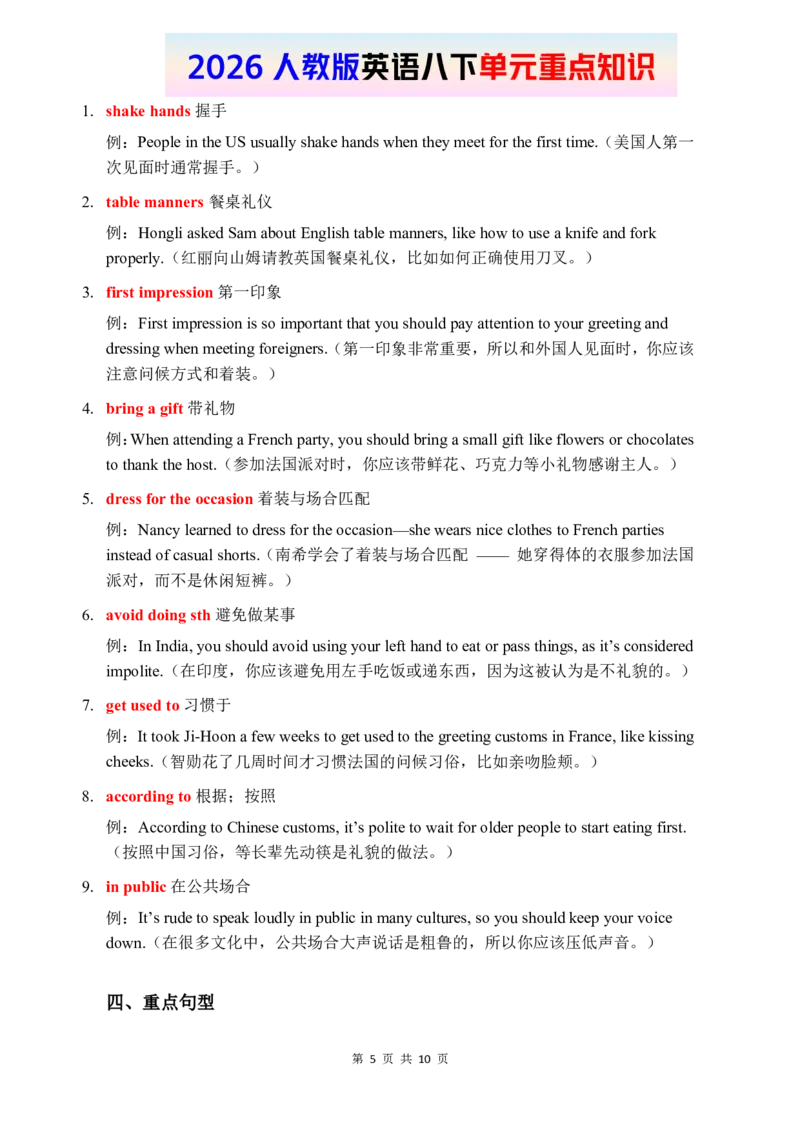
1. shakehands 握手
例:Peoplein theUS usually shake hands when theymeet for thefirst time.(美国人第一
次见面时通常握手。)
2. tablemanners 餐桌礼仪
例:Hongli asked Sam about Englishtable manners, likehow touse aknife andfork
properly.(红丽向山姆请教英国餐桌礼仪,比如如何正确使用刀叉。)
3. firstimpression第一印象
例:First impression isso important that you should pay attention to your greeting and
dressing when meeting foreigners.(第一印象非常重要,所以和外国人见面时,你应该
注意问候方式和着装。)
4. bring agift带礼物
例:When attending aFrench party, you shouldbring asmall gift likeflowers orchocolates
tothank the host.(参加法国派对时,你应该带鲜花、巧克力等小礼物感谢主人。)
5. dressfortheoccasion 着装与场合匹配
例:Nancy learned to dress for theoccasion—shewears nice clothes toFrench parties
instead ofcasual shorts.(南希学会了着装与场合匹配 —— 她穿得体的衣服参加法国
派对,而不是休闲短裤。)
6. avoiddoingsth 避免做某事
例:In India, you should avoid using your left hand to eat orpass things, as it’s considered
impolite.(在印度,你应该避免用左手吃饭或递东西,因为这被认为是不礼貌的。)
7. getused to 习惯于
例:It took Ji-Hoon afew weeks to get used tothegreeting customs inFrance, likekissing
cheeks.(智勋花了几周时间才习惯法国的问候习俗,比如亲吻脸颊。)
8. according to 根据;按照
例:According to Chinesecustoms, it’s politeto wait forolder peopletostart eating first.
(按照中国习俗,等长辈先动筷是礼貌的做法。)
9. inpublic在公共场合
例:It’s rudeto speak loudlyin publicin many cultures, so you shouldkeep your voice
down.(在很多文化中,公共场合大声说话是粗鲁的,所以你应该压低声音。)
四、重点句型
第 5 页 共 10 页2026 人教版英语八下单元重点知识
1. 描述不同国家的习俗(国家 + 习俗 + 方式):In [country], people usually + 习俗
动作 (e.g., greet each otherby.../eatwith...).
例:In Japan, peopleusually greet each other bybowing, especiallywhen meeting teachers.
(在日本,人们通常通过鞠躬问候彼此,尤其是见到老师时。)In India, people usually
eat with theirright hands instead ofusing aknifeand fork.(在印度,人们通常用右手吃
饭,而不是用刀叉。)
2. 提出跨文化交流建议(should/shouldn’t + 行为):When communicating with people
from[culture], you should+ 恰当行为./You shouldn’t+ 不当行为.
例:Whencommunicating with people from France, you should arrive ontimeorafew
minuteslatefor aparty.(和法国人交流时,参加派对你应该准时或晚几分钟到。)You
shouldn’task personal questions likeage orincomewhen talking toFrench people.(和法
国人聊天时,不要问年龄、收入等私人问题。)
3. 表达文化差异导致的感受(sb. felt+ 情绪 + because+ 文化差异):Sb.felt[emotion]
because[cultural difference], e.g., they weren’t usedto...
例:Ji-Hoon felt embarrassed because Marie kissed his cheek—hewasn’t used to this
greeting in his culture.(智勋感到尴尬,因为玛丽亲吻了他的脸颊 —— 他不习惯自
己文化中的这种问候方式。)Hongli felt confused because shedidn’t knowhowto use a
knifeand fork at a UKdinner.(红丽感到困惑,因为在英国的晚餐上她不知道如何用
刀叉。)
4. 解释习俗的原因(习俗 + because+ 文化意义):Peoplein[country] + 习俗动作 +
because+ 文化意义 (e.g., itsymbolizes.../it’sawayto...).
例:PeopleinChinause red decorations during festivals because it symbolizesgood luck
and happiness.(中国人在节日期间用红色装饰,因为红色象征幸运和快乐。)People
inIndia avoid eating beef because cows are considered special and sacred(. 印度人不吃牛
肉,因为牛被认为是特殊且神圣的。)
5. 对比不同文化的异同(A 文化 + 习俗,whileB 文化 + 习俗):In[CultureA], people
+ 习俗 A, while in [Culture B], people + 习俗 B. They are the same /different
because...
例:In China, peopleusually opengifts later, whilein theUS, peopleoften open gifts
immediately. They are different because ofdifferent ideas about gift-giving.(在中国,人
们通常稍后打开礼物,而在美国,人们常立即打开礼物。这种差异源于对送礼的不
同理解。)In bothChinaand theUK, it’s politeto say “thank you” when receiving agift.
They are thesame because gratitudeis valued in mostcultures.(在中国和英国,收到礼
物时说 “谢谢” 都是礼貌的。这种相同源于大多数文化都重视感恩。)
第 6 页 共 10 页2026 人教版英语八下单元重点知识
6. 表达文化适应的过程(atfirst+ 困难,butlater+ 适应):At first, sb. + 文化适应
困难 (e.g., felt confused /couldn’t get used to...), but later, sb. + 适应结果 (e.g.,
learned to.../gotusedto...).
例:At first,Nancy felt lonely and confused in France, but later, she learned about local
customsand madefriends.(起初,南希在法国感到孤独和困惑,但后来她了解了当地
习俗并交到了朋友。)At first,Kaito couldn’t get usedto shaking hands intheUS,but
later, helearned it’san informal greeting and accepted it(. 起初,海斗不习惯在美国握手,
但后来他了解到这是一种非正式问候并接受了它。)
7. 使用连词 so...that 描述文化习俗的影响(习俗 + so...that + 结果):In [country],
[custom] isso + 特征 (e.g., important /common) that+ 具体结果.
例:In Japan, bowing is soimportant that peoplepractice ittoshowrespect to different
people(likeelders orteachers) .In France, being ontimeforparties is socommon that
arriving early can makethehost feel uncomfortable .(该句型直接呼应单元语法重点
“so...that 引导结果状语从句”,结合日本鞠躬、法国派对时间等文档中明确提及的习
俗,体现习俗的重要性及影响。)
8. 使用连词 unless 说明文化禁忌(允许的行为 + unless + 例外情况):Youcan + 允
许的行为 (e.g., ask personal questions /use first names) in [country] unless + 例外条
件 (e.g., youdon’tknowthe person well).
例:You can ask Frenchpeople about food or cultureunless you don’tknow them
well—personal topics likeage are not allowed .You can use someone’sfirst namein
Mexico unless theperson doesn’t inviteyou todoso.(该句型贴合文档中 “文化禁忌与
例外” 的内容,如法国的私人话题禁忌、墨西哥的称呼习俗,是单元语法 “unless 引
导条件状语从句” 的典型应用。)
9. 使用连词 as soon as 描述文化交流中的即时反应(动作 + as soonas + 触发场景):
People in [country] + 即时动作 (e.g., bow /kiss cheeks) as soon as + 触发场景 (e.g.,
they meet ateacher/seeafriend).
例:PeopleinJapan bowas soonas they meet a teacher—it’s aformal greeting
custom.You will feel theimportance ofusing French in Paris as soonas you talk to
locals—evena “merci”helps build closer relationships.(该句型结合文档中日本的问候
反应、法国的语言尊重等场景,体现 “as soonas 引导时间状语从句” 在文化交流中
的应用,突出习俗的即时性。)
10. 描述文化符号的不同含义(符号 + means...inAculture, while+ 符号 + means...inB
culture):[Symbol, e.g., red /dragons]means + 含义 Ain[CultureA], whileitmeans
+ 含义 B in[CultureB].
第 7 页 共 10 页2026 人教版英语八下单元重点知识
例:Redmeans good luck inChineseculture, whileitmeans danger in manyWestern
cultures .Dragons mean monsters inWestern stories, whilethey mean power and good
fortuneinChineseculture(. 该句型直接对应文档中 “文化符号差异” 的内容,如红色、
龙的象征意义对比,帮助理解跨文化中符号的不同解读,避免误解。)
五、重点语法
(一)连词 so...that, unless, as soon as(单元核心语法)
1.so...that(引导结果状语从句)
用法:表示 “如此…… 以至于……”,前接形容词 / 副词,后接结果,强调习俗或
行为带来的具体影响,文档中多次用于描述文化习俗的重要性。
例:English tablemanners are so confusing that Hongli felt worried before theUK
dinner .Chinesedragons are so popularthat you can see themonvases, buildings and
2
even jewellery .
注意:so 后接形容词 / 副词,与 “such...that” 区分(such 后接名词短语),文档
语法部分明确对比两者用法。
2.unless(引导条件状语从句)
用法:表示 “除非;如果不”,相当于 “ifnot”,用于说明文化中的 “允许行为” 与 “例
外禁忌”,文档中多涉及私人话题、称呼等场景。
例:PeopleinTurkive don’t kiss oneanother onthecheek unless they are good
friends .Youshouldn’t bring food toa UKdinnerunless the host asks you to .
5
句式转换:可将 “unless 从句” 改为 “if not 从句”,如 “You can’t use first names in
Mexico iftheperson doesn’tinviteyou”。
3.assoon as(引导时间状语从句)
用法:表示 “一…… 就……”,用于描述文化交流中 “场景触发即时动作”,强调习
俗的即时性,文档中常见于问候、语言使用等场景。
例:As soon as Kaito met Anna, he bowed—heforgot the USuses handshakes .As soon as
you arrive inFrance,you’llfind usingFrench helps you get along with locals .
第 8 页 共 10 页2026 人教版英语八下单元重点知识
时态规则:主句用一般将来时 / 情态动词时,从句用一般现在时(如 “As soon as you
visitIndia, you should learn ‘Namaste’”),文档语法部分明确该规则。
(二)-ed/-ing 形容词(描述感受与事物特征)
1. 核心区别
-ed 形容词:描述 “人感受到的情绪”,如 embarrassed(感到尴尬的)、confused(感
到困惑的),文档中多用于人物的文化冲击体验。
例:Ji-Hoon felt embarrassed whenMarie kissed his cheek—hewasn’t used to theFrench
greeting .Hongli was confused about usinga knifeand fork at theUKdinner .
16 2
-ing 形容词:描述 “事物 / 场景引发的感受”,如 embarrassing(令人尴尬的)、
confusing(令人困惑的),文档中用于描述文化习俗的特征。
例:Arriving early at aFrench party is embarrassing for both theguest and the host .UK
6
tablemanners are confusing forpeople who use chopsticks .
2
2. 常见搭配
-ed 形容词 搭配主语(人) 文档例句
Ji-Hoon felt embarrassed about the
embarrassed Ji-Hoon, Nancy
cheekkiss
confused Hongli, Anna Annawas confused byKaito’s bow
surprised Anna, thehost Annawas surprised byKaito’s bow
-ing 形容词 搭配主语(事物 / 场景) 文档例句
Theearly arrival was embarrassing
embarrassing arriving early, cheek kiss
forNancy
Englishtable manners are
confusing table manners, customs
confusing
Kaito’s bowwas surprising for
surprising bow, greeting
Anna
(三)否定前缀 un- /im-/in-(单元词汇重点)
第 9 页 共 10 页2026 人教版英语八下单元重点知识
1. 构成与文档高频词
un-:加在形容词前,表 “不……”,文档中常见词:unsafe(不安全的)、uncommon
(不常见的)、unpolite(不礼貌的)。
例:Using left hand to eat in Indiais unpolite.Beef dishes are uncommon in Indiabecause
cows are special .
im- / in-:加在以 “p/m/b” 开头或 “n/l/r” 开头的形容词前,表 “不……”,文档中常
见词:improper(不恰当的)、informal(非正式的)、impolite(不礼貌的)。
例:Wearing shorts toa French party is improper.Shaking hands is informal in
Japan—bowing is formal .
2. 用法注意
部分形容词否定前缀唯一,如 “formal” 否定式为 “informal”(不用 “unformal”),
“proper” 否定式为 “improper”(不用 “unproper”),文档 Vocabulary in Use 部分明
确该规则。
否定形容词在句子中多用于描述 “文化禁忌行为”,如 “impolite to point at
people”“improperto wear casual clothes”,帮助判断行为恰当性。
第 10 页 共 10 页