2026 人教版英语八下单元知识清单
Unit 5 Nature's Temper 单元知识清单
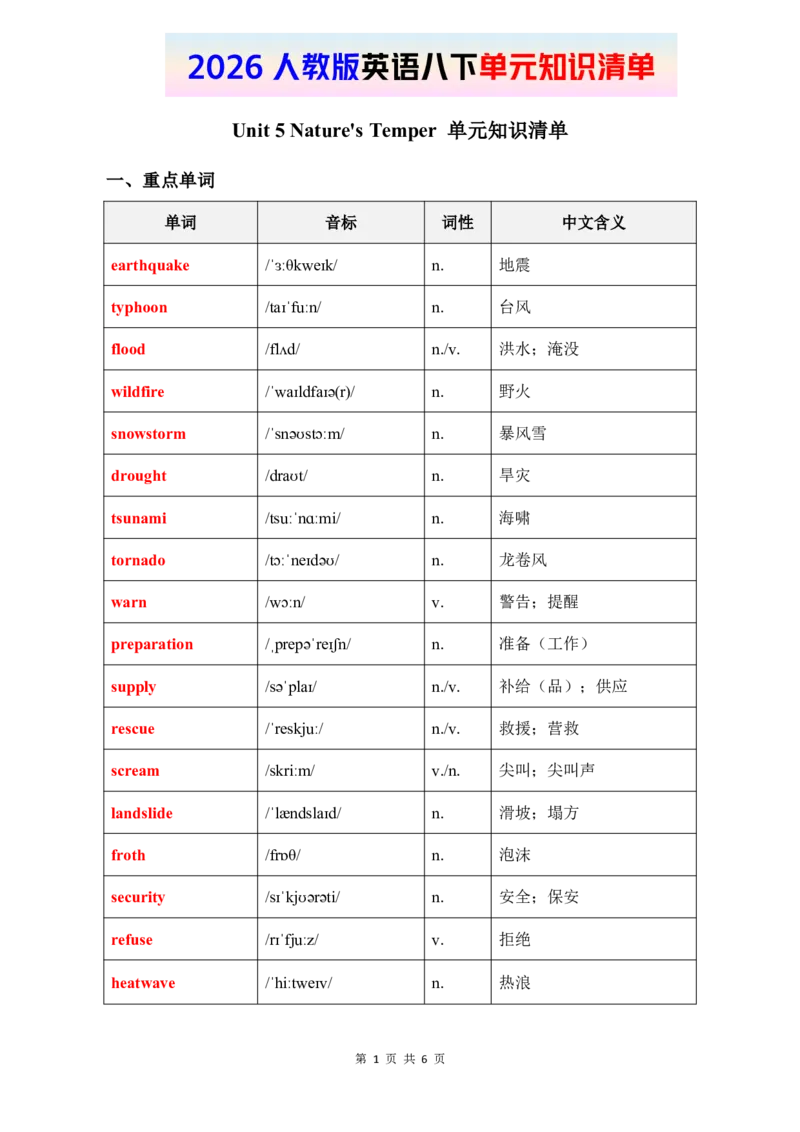
一、重点单词
单词 音标 词性 中文含义
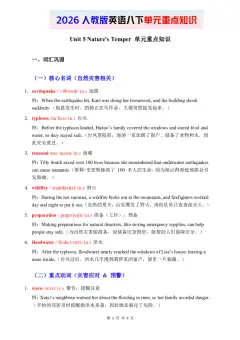
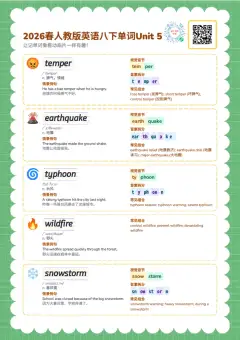
earthquake /ˈɜːθkweɪk/ n. 地震
typhoon /taɪˈfuːn/ n. 台风
flood /flʌd/ n./v. 洪水;淹没
wildfire /ˈwaɪldfaɪə(r)/ n. 野火
snowstorm /ˈsnəʊstɔːm/ n. 暴风雪
drought /draʊt/ n. 旱灾
tsunami /tsuːˈnɑːmi/ n. 海啸
tornado /tɔːˈneɪdəʊ/ n. 龙卷风
warn /wɔːn/ v. 警告;提醒
preparation /ˌprepəˈreɪʃn/ n. 准备(工作)
supply /səˈplaɪ/ n./v. 补给(品);供应
rescue /ˈreskjuː/ n./v. 救援;营救
scream /skriːm/ v./n. 尖叫;尖叫声
landslide /ˈlændslaɪd/ n. 滑坡;塌方
froth /frɒθ/ n. 泡沫
security /sɪˈkjʊərəti/ n. 安全;保安
refuse /rɪˈfjuːz/ v. 拒绝
heatwave /ˈhiːtweɪv/ n. 热浪
第 1 页 共 6 页2026 人教版英语八下单元知识清单
二、词形变化
1. prepare(v. 准备)→preparation(n. 准备工作);prepared(adj. 有准备的)
2. safe(adj. 安全的)→safety (n. 安全);safely(adv. 安全地)
3. danger(n. 危险)→dangerous(adj. 危险的);dangerously(adv. 危险地)
4. frighten(v. 使害怕)→frightened(adj. 感到害怕的);frightening(adj. 令人害怕
的)
5. rescue(v./n. 救援)→rescuer(n. 救援者)
6. luck(n. 运气)→lucky(adj. 幸运的);luckily(adv. 幸运地)
三、重点短语
短语 中文含义 课文例句
Jiamingwas doing chores when the
do chores 做家务
earthquake started.
make Weshould makepreparations for natural
做准备
preparations disasters.
(警报器等) MaLi’salarm clock didn’tgo off, so she
gooff
突然响 wokeuplate.
The buildingshook all ofasudden during the
all ofasudden 突然;猛地
earthquake.
到…… 的时 By thetimethe bus came, MaLi was cold
by thetime
候 and wet.
上气不接下 MaLi reached theclassroom out ofbreath
outofbreath
气 becauseof therainstorm.(p.49 短文)
Many students were late; as aresult, thetest
as aresult 因此
was canceled.
The tsunamiswept through the coastal
sweep through 席卷;横扫
village.
rushto 冲向;急忙做 The security guard rushed to get people off
第 2 页 共 6 页2026 人教版英语八下单元知识清单
短语 中文含义 课文例句
thebeach.
The reporter advised people tostay inside
stay inside 待在室内
during thetyphoon.
Firefighters worked hard toput outthe
putout 扑灭(火)
wildfire.
After thetyphoon, peoplehelped take care of
takecare of 照顾;处理
theclean-up.
四、重点句型
(一)描述过去灾难发生时正在做的事(过去进行时 + when/while)
Sb.was/were+ 动词 -ing(持续动作)+ when + Sb.did+ 动词原形(短暂动作 / 灾
难发生).
例:Xinyi’s family were having dinnerwhen her neighbourcalled about theflood.
Kate was doinghomework when theearthquake shookthebuilding.
变式:While Sb.was/were + 动词 - ing(持续动作),Sb.did + 动词原形(短暂动作
/ 灾难发生).
例:While Jiamingwas doing chores, theearthquake took them bysurprise.
(二)说明自然灾害的影响与应对措施
[Natural disaster] + 动词(e.g., hit/break/cause)+ 影响(e.g., damage/floods/deaths).
Peopleshould + 应对措施(e.g., stay inside/make preparations).
例:The typhoon hit the coast and caused floods. People should stay inside and avoid
traveling.
The wildfirecaused damage totheforest. Firefighters shouldput it outquickly.
变式:To deal with [natural disaster], people can + 具体措施(e.g., store food/cover
windows).
例:Todeal with atyphoon, peoplecan cover windows and storeemergency supplies.
第 3 页 共 6 页2026 人教版英语八下单元知识清单
(三)描述灾难发生前后的时间顺序
Before [natural disaster], Sb. + 事 前 动 作 ( e.g., made preparations/ignored
warnings).Duringthe disaster,Sb.+ 事中动作(e.g., hid/helped others).Afterthe
disaster,Sb.+ 事后动作(e.g., cleaned up/helpedthe hurt).
例:Before the typhoon, Haitao’s family covered windows. During the typhoon, they
stayed inside.After thetyphoon, they helped clean theneighbourhood.
Before the tsunami, Tilly noticed strange waves. During the tsunami, people ran to safety.
After thetsunami, everyone thankedTilly for warning them.
(四)表达对灾难的感受与看法
[Natural disaster] was + 形容词(e.g., frightening/awful/dangerous).Itmadepeople
+ 感受(e.g., scared/worried/thankful)because + 原因(e.g., itdestroyed houses/it
broughtpeoplecloser).
例:The tornado was frightening. It made people scared because it nearly blew off the
roof.
The typhoon was awful. It made Lisa worried because her house was flooded, but she
was thankful noonewas hurt.
(五)强调知识与准备的重要性
Thanksto + 因素(e.g., knowledge/preparations/warnings),Sb.wasableto + 积极
结果(e.g., savelives/stay safe/avoiddanger).
例:Thanks to Tilly’s geography knowledge, she was able to warn people about the
tsunami.
Thanks totheir preparations, Haitao’s family was ableto stay safe during thetyphoon.
第 4 页 共 6 页2026 人教版英语八下单元知识清单
Unit 5 Nature's Temper 单元知识清单(默写版)
一、重点单词
1. _______/_______n. 地震 → 例句:Wefelt the_______when we were having class.
2. _______/_______n. 台风 → 例句:Astrong _______hit thecoast last night.
3. _______/_______n. 洪水 → 例句:The heavyrain caused a_______inthetown.
4. _______/_______n. 海啸 → 例句:Tilly saved people from the_______.
5. _______/_______n. 龙卷风 → 例句:The _______destroyed many houses.
6. _______/_______v. 警告 → 例句:Thereporter _______peopleto stay inside.
7. _______/_______n. 准备 → 例句:Weneed to make_______for thestorm.
8. _______/_______n. 救援 → 例句:The _______team arrived quickly.
9. _______/_______v. 尖叫 → 例句:People_______when they sawthefire.
10. _______/_______n. 热浪 → 例句:The _______madetheweather very hot.
二、词形变化
1. prepare(v. 准备)→_______(n. 准备工作);_______(adj. 有准备的)
2. safe(adj. 安全的)→_______(n. 安全);_______(adv. 安全地)
3. danger(n. 危险)→_______(adj. 危险的);_______(adv. 危险地)
4. frighten(v. 使害怕)→_______(adj. 感到害怕的);_______(adj. 令人害怕的)
5. rescue(v./n. 救援)→_______(n. 救援者)
6. luck(n. 运气)→_______(adj. 幸运的);_______(adv. 幸运地)
三、重点短语
1. 做家务 →do_______→ 例句:I_______when thephone rang.
2. 做准备 →make_______→ 例句:They _______for thetrip.
3. 突然响 →go _______→ 例句:Thealarm _______at 6a.m.
4. 突然 →allof a_______→ 例句:It started to rain _____________________.
5. 到…… 的时候 →bythe_______→ 例句:______________we arrived, theparty had
started.
6. 上气不接下气 →outof_______→ 例句:I ranto school _____________________.
第 5 页 共 6 页2026 人教版英语八下单元知识清单
7. 因此 →as a_______→ 例句:It rained hard; ______________,we stayed home.
四、重点句型
1. ________________________________________________________.
某人正在做某事,这时灾难发生了。
例:Myfamily _______(正在吃晚饭)when thetyphoon _______________(袭来).
仿写:我正在写作业,这时地震发生了。
________________________________________________________.
2. ________________________________________________________.
某自然灾害造成了…… 影响,人们应该……
例:The wildfire_______(烧毁了森林),sopeople_______________(应该尽快扑灭
它).
仿写:洪水淹没了街道,人们应该待在室内。
________________________________________________________.
3. ________________________________________________________.
灾难前 / 中 / 后,某人做了某事。
例:_______(台风前),wecovered windows. _______(台风中),westayed
inside._______________(台风后),wecleaned thestreet.
仿写:地震前,我在看电视;地震中,我躲到了桌子下;地震后,我帮忙救助他人。
________________________________________________________.
4. ________________________________________________________.
某灾难很……(形容词),它让人们感到…… 因为……
例:Thetsunami _______(很可怕).It madepeople _______(感到害怕)
because _______________(它摧毁了很多房屋).
仿写:暴风雪很糟糕,它让人们感到担心因为它阻断了道路。
________________________________________________________.
5. ________________________________________________________.
多亏了……,某人能够……
例:_______(多亏了蒂莉的警告),people _______________(能够到达安全地带).
仿写:多亏了提前准备,我们能够安全度过暴风雪。
________________________________________________________.
第 6 页 共 6 页