文档文本内容
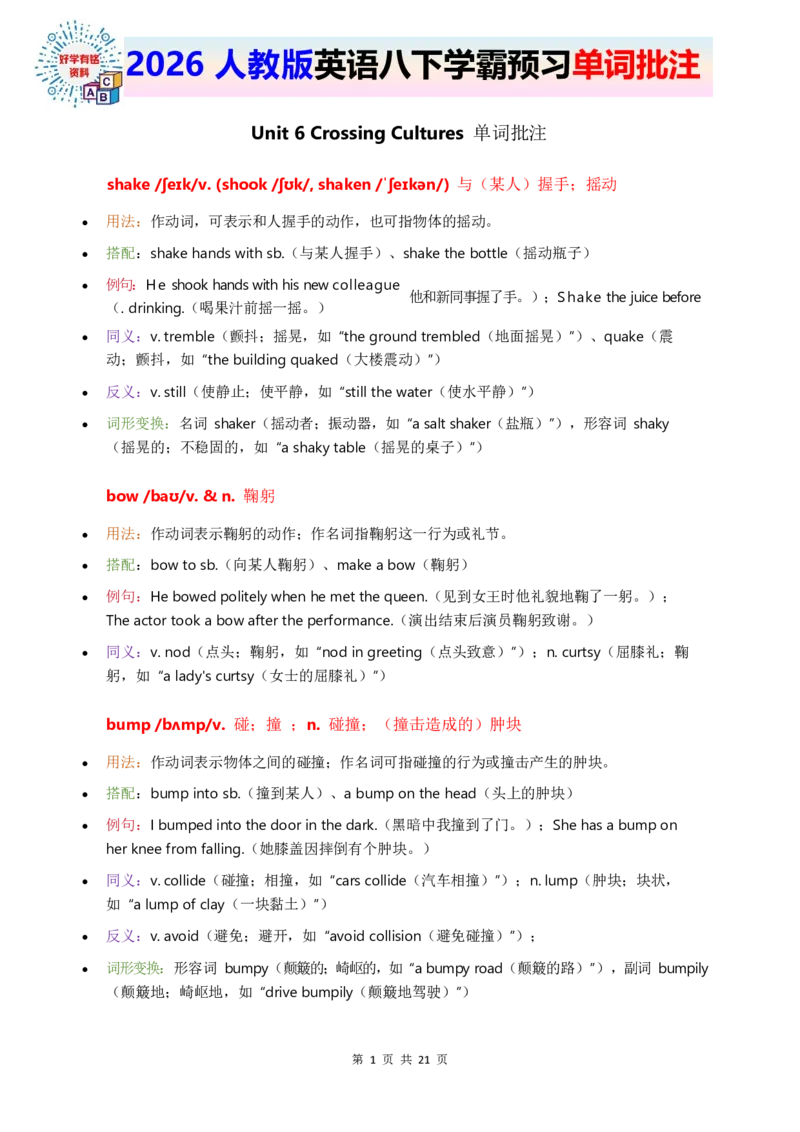
2026 人教版英语八下学霸预习单词批注
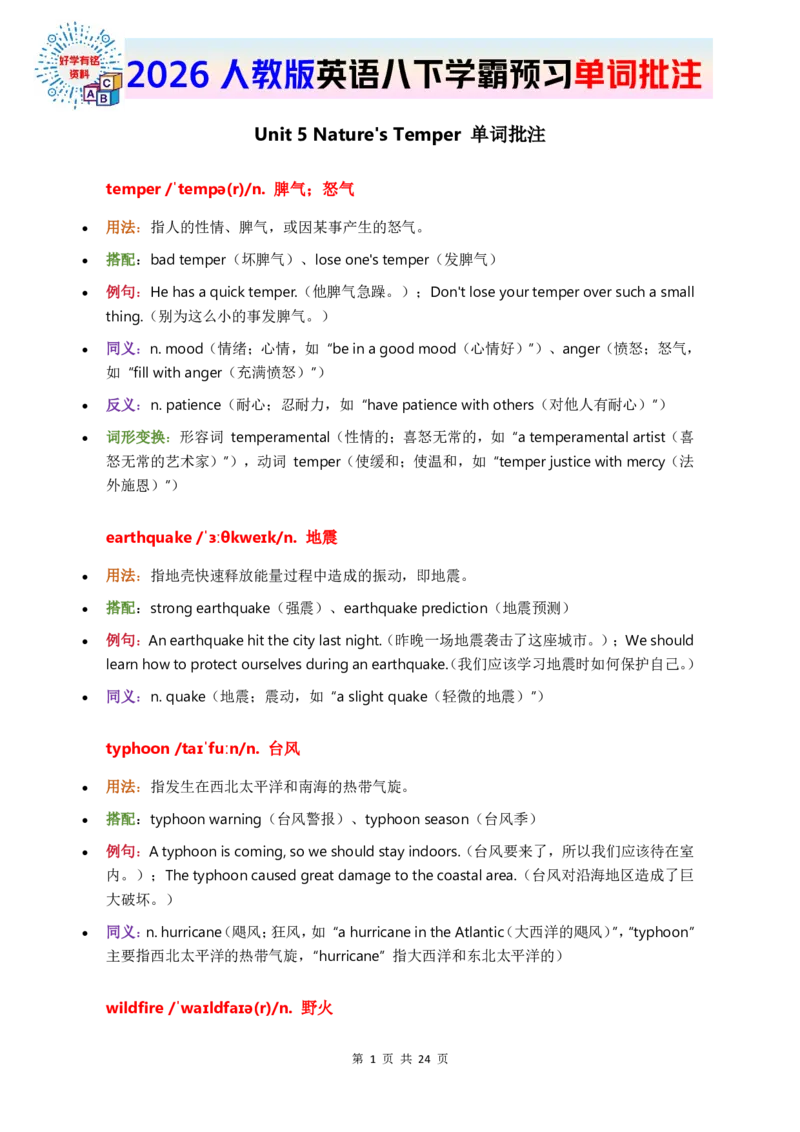
Unit 5 Nature's Temper 单词批注
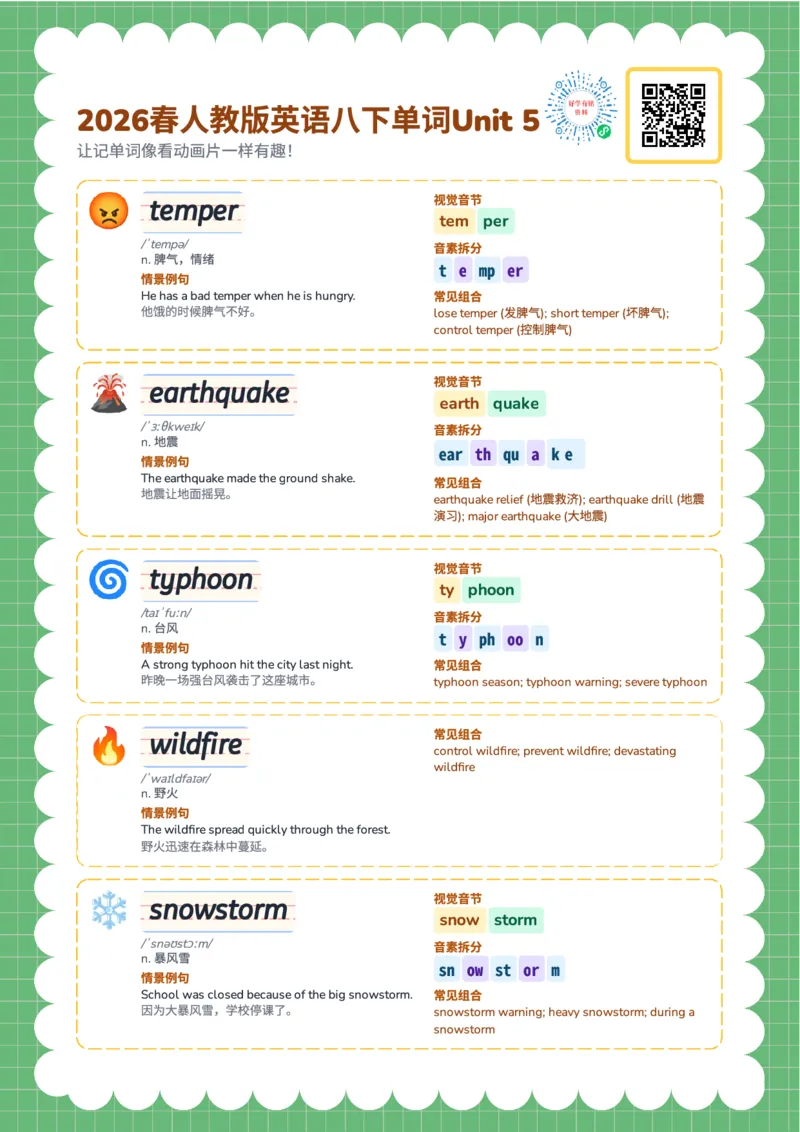
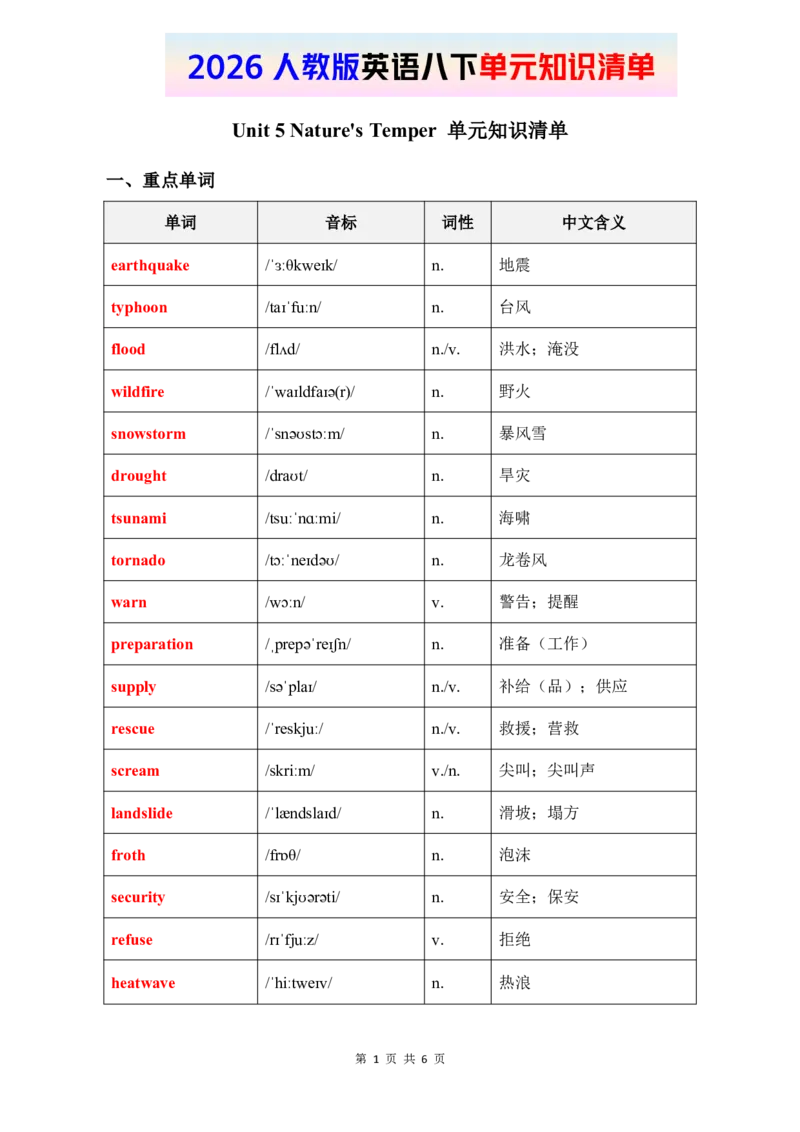
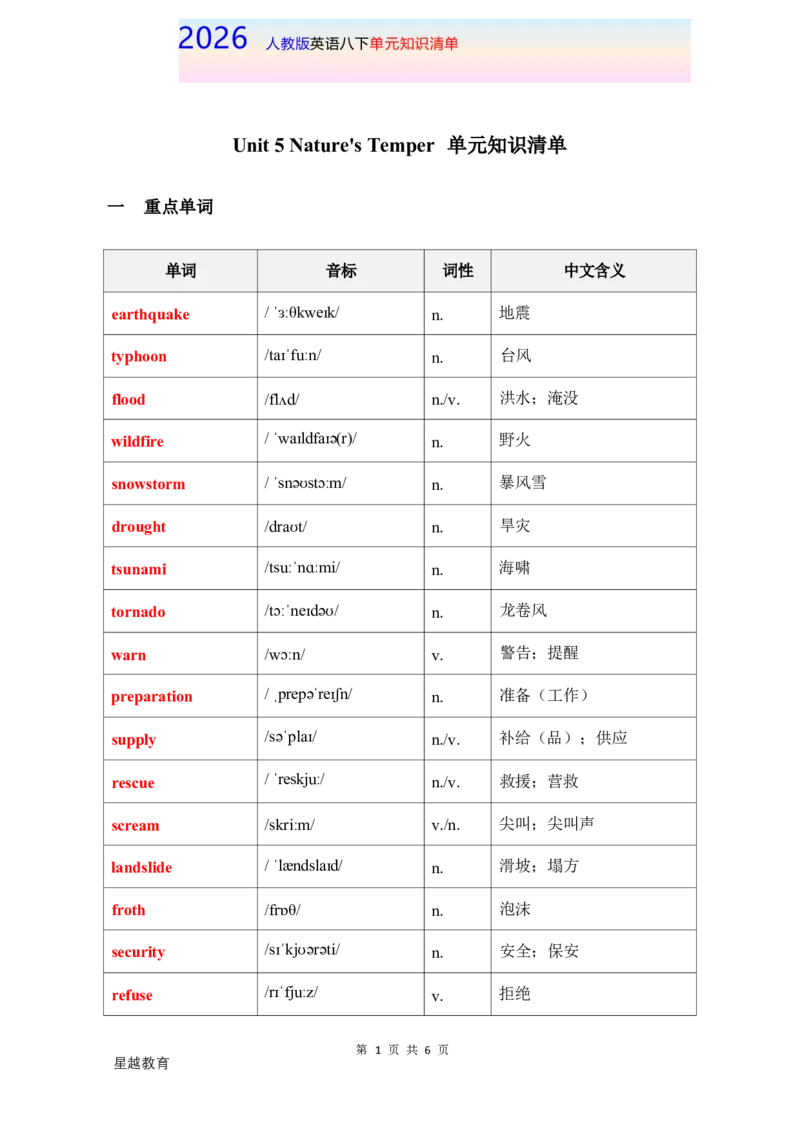
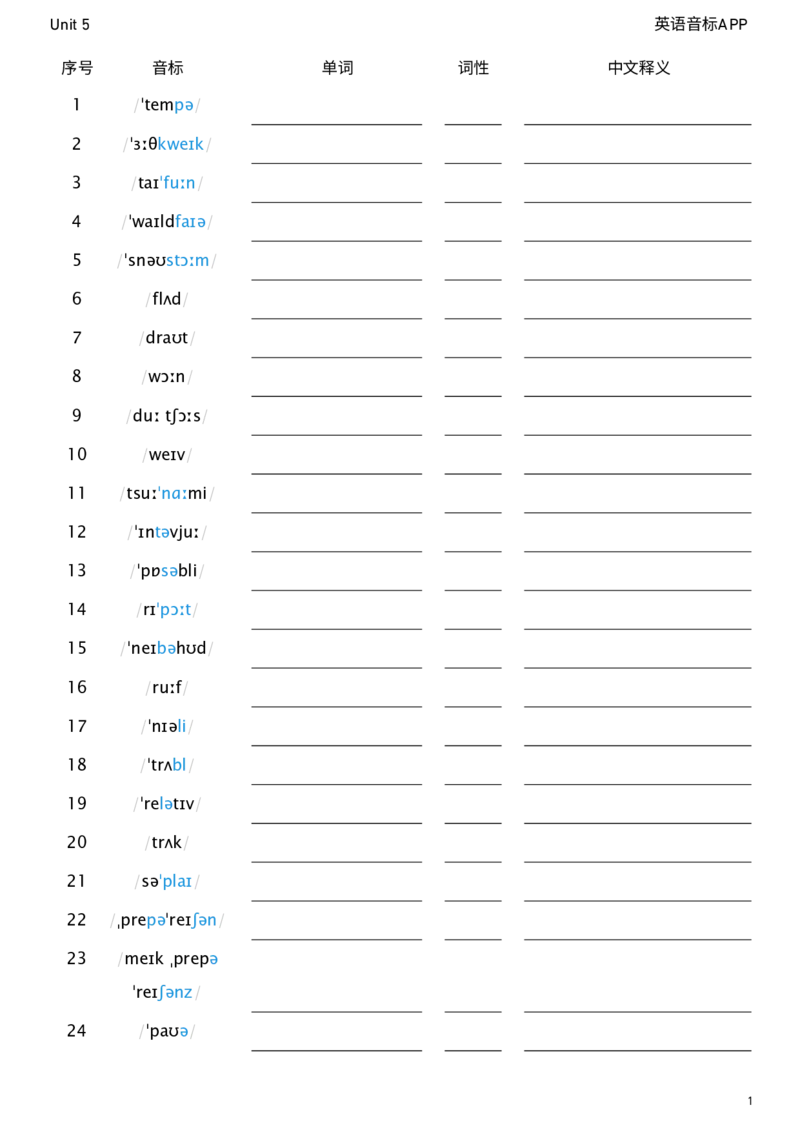
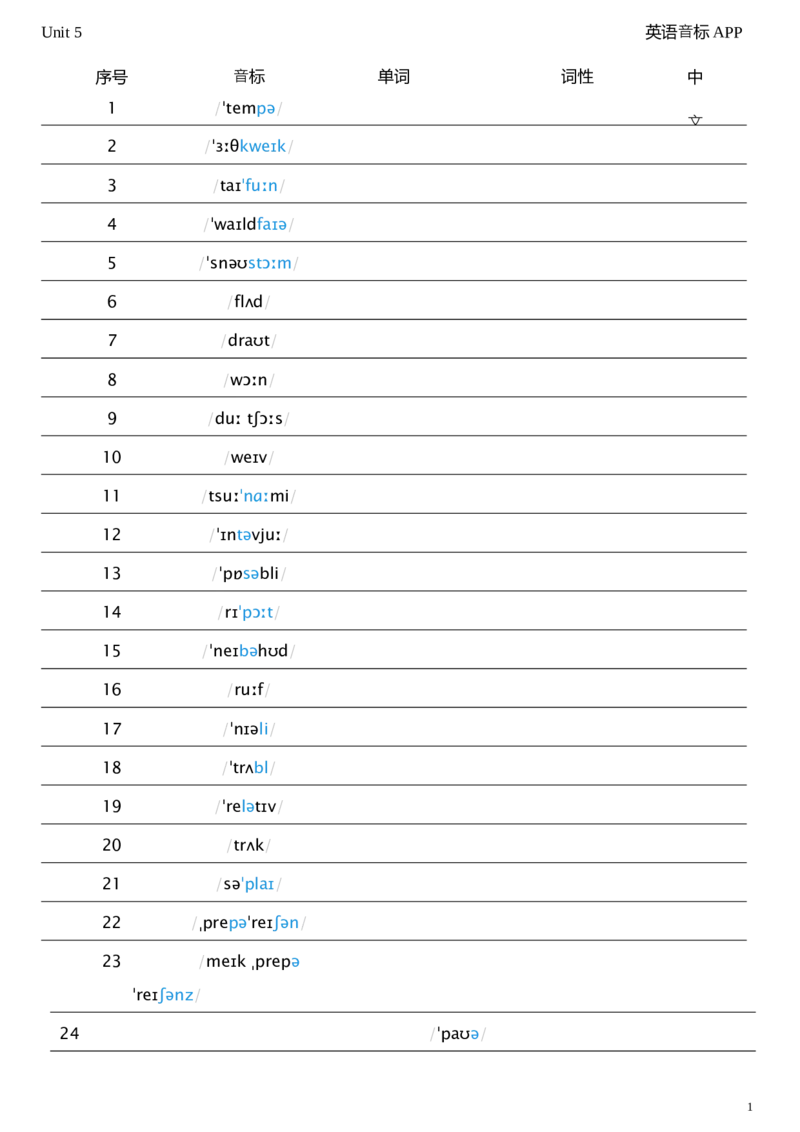
temper /ˈtempə(r)/n. 脾气;怒气
用法:指人的性情、脾气,或因某事产生的怒气。
搭配:bad temper(坏脾气)、lose one's temper(发脾气)
例句:He has a quick temper.(他脾气急躁。);Don't lose your temper over such a
small thing.(别为这么小的事发脾气。)
同义:n. mood(情绪;心情,如 “be in a good mood(心情好)”)、anger(愤怒;怒
气,如 “fill with anger(充满愤怒)”)
反义:n. patience(耐心;忍耐力,如 “have patience with others(对他人有耐心)”)
词形变换:形容词 temperamental(性情的;喜怒无常的,如 “a temperamental artist
(喜怒无常的艺术家)”),动词 temper(使缓和;使温和,如 “temper justice with
mercy(法外施恩)”)
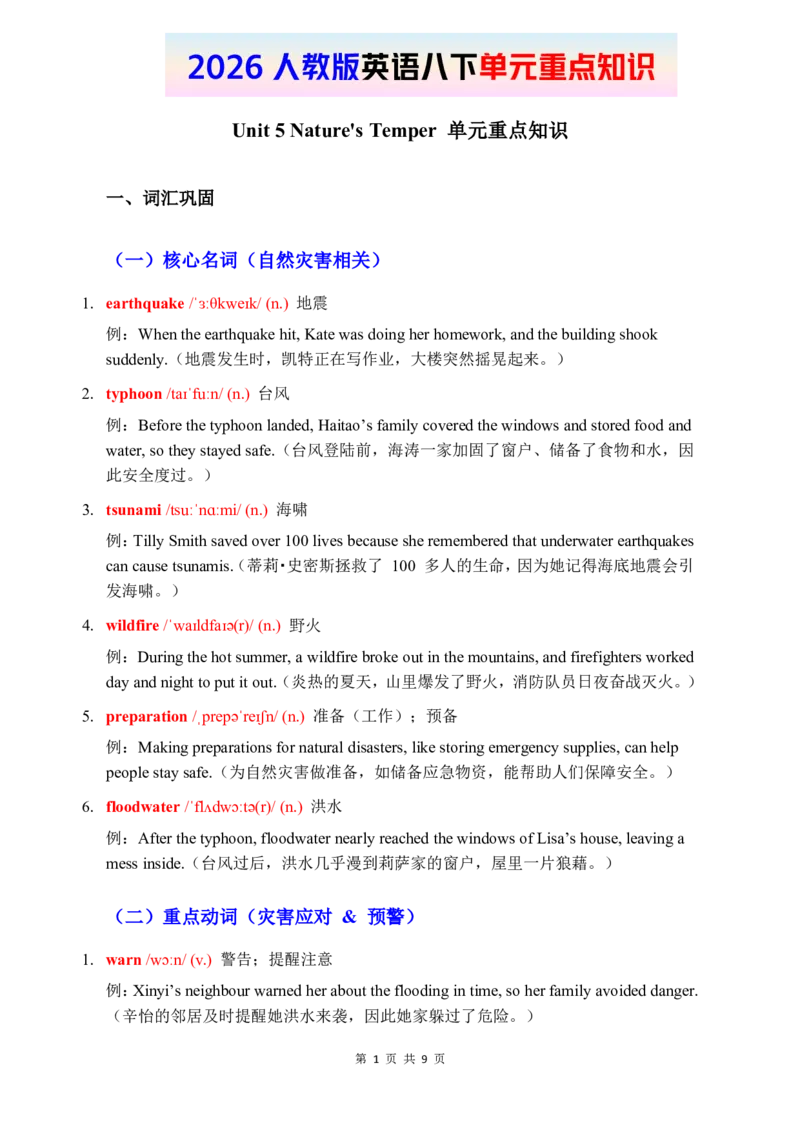
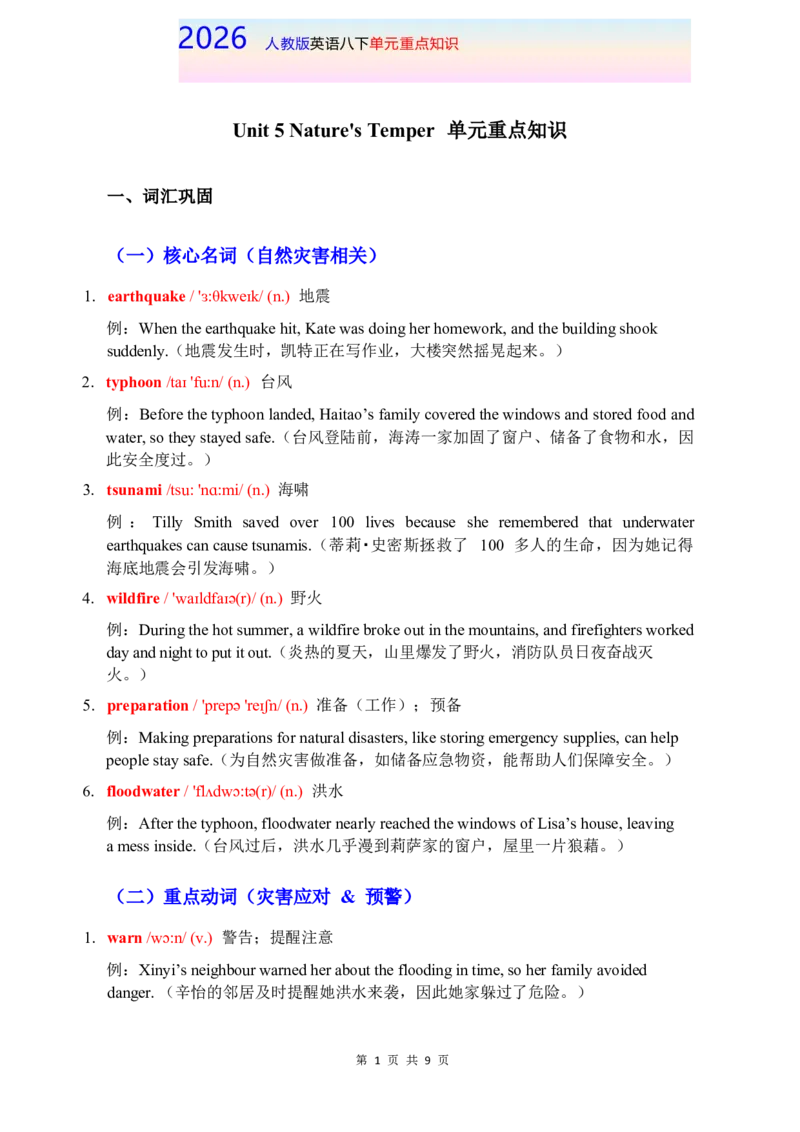
earthquake /ˈɜːθkweɪk/n. 地震
用法:指地壳快速释放能量过程中造成的振动,即地震。
搭配:strong earthquake(强震)、earthquake prediction(地震预测)
例句:An earthquake hit the city last night.(昨晚一场地震袭击了这座城市。);We should
learn how to protect ourselves during an 我们应该学习地震时如何保护自己。)
earthquake(.
同义:n. quake(地震;震动,如 “a slight quake(轻微的地震)”)
typhoon /taɪˈfuːn/n. 台风
用法:指发生在西北太平洋和南海的热带气旋。
搭配:typhoon warning(台风警报)、typhoon season(台风季)
例句:A typhoon is coming, so we should stay indoors.(台风要来了,所以我们应该待在
室内。);The typhoon caused great damage to the coastal area.(台风对沿海地区造成
了巨大破坏。)
同义:n. hurricane(飓风;狂风,如 “a hurricane in the Atlantic(大西洋的飓风)”,“typhoon”
主要指西北太平洋的热带气旋,“hurricane” 指大西洋和东北太平洋的)
wildfire /ˈwaɪldfaɪə(r)/n. 野火
第 1 页 共 25 页2026 人教版英语八下学霸预习单词批注
用法:指在野外自然燃烧的火,常具有破坏性。
搭配:forest wildfire(森林野火)、wildfire prevention(野火预防)
例句:The wildfire spread rapidly due to the strong wind.(由于大风,野火迅速蔓延。);
Firefighters worked hard to put out the wildfire.(消防员努力扑灭野火。)
同义:n. forest fire(森林火灾;森林火,如 “a serious forest fire(严重的森林火灾)”)
snowstorm /ˈsnəʊstɔːm/n. 雪暴;暴风雪
用法:指伴有强风的大雪天气现象。
搭配:heavy snowstorm(强暴风雪)、be caught in a snowstorm(遭遇暴风雪)
例句:We were stuck at home during the snowstorm.(暴风雪期间我们被困在家里。);
The snowstorm made the roads very dangerous.(暴风雪使道路非常危险。)
同义:n. blizzard(暴风雪;大风雪,如 “a fierce blizzard(猛烈的暴风雪)”)
flood /flʌd/n. 水灾;洪水 ;v. 泛滥;淹没
用法:作名词指因大量积水造成的灾害;作动词表示水大量溢出,淹没土地等。
搭配:flood disaster(洪水灾害)、flood into(涌入;大量进入)
例句:The flood destroyed many houses(. 洪水摧毁了许多房屋。);Rivers flood during the
rainy season.(雨季河流泛滥。);People flooded into the stadium to watch the game.
(人们涌入体育场看比赛。)
同义:n. inundation(洪水;淹没,如 “the inundation of the village(村庄被淹没)”);
v. overflow(溢出;泛滥,如 “the river overflows(河水溢出)”)
反义:v. drain(排水;流干,如 “drain the water(排水)”)
词形变换:名词 floodwate
洪水;水灾,如 “floodwater leve 洪水水位)”),形容词 flooded
(r
(l
(被淹没的;洪水泛滥的,如 “a flooded street(被淹没的街道)”)
drought /draʊt/n. 久旱;旱灾
用法:指长时间无雨或降水异常偏少造成的干旱现象。
搭配:severe drought(严重旱灾)、suffer from drought(遭受旱灾)
例句:The area has been facing drought for three years.(这个地区已经面临三年旱灾
了。); Drought has affected the growth of crops.(旱灾影响了农作物的生长。)
同义:n. dry spell(干旱期;干燥期,如 “a long dry spell(漫长的干旱期)”)
第 2 页 共 25 页2026 人教版英语八下学霸预习单词批注
反义:n. rain(雨;降雨,如 “the arrival of rain(降雨的到来)”)
warn /wɔːn/v. 警告;提醒注意
用法:表示提醒他人注意可能的危险、问题等。
搭配:warn sb. of sth.(警告某人某事)、warn sb. not to do sth.(警告某人不要做某事)
例句:The teacher warned the students about the exam.(老师提醒学生们注意考试。);
He warned me not to touch the hot stove.(他警告我不要碰热炉子。)
同义:v. alert(使警觉;提醒,如 “alert the police(提醒警方)”)、caution(警告;告
诫,如 “caution against danger(告诫防范危险)”)
反义:v. reassure(使安心;使放心,如 “reassure the worried parent(使担忧的家长安心)”)
词形变换:名词 warning(警告;警示,如 “a warning sign(警示标志)”),形容词 warned
(受到警告的;被告诫的,如 “a warned driver(受到警告的司机)”)
do chores 做家务
用法:表示从事家庭中的各种杂务劳动。
搭配:do daily chores(做日常家务)、help do chores(帮忙做家务)
例句:Children should learn to do chores at home.(孩子们应该学会在家做家务。);
She spends an hour doing chores every day.(她每天花一小时做家务。)
同义:phr. do housework(做家务,如 “do housework on weekends(周末做家务)”)
反义:phr. be lazy at home(在家偷懒,如 “be lazy at home all day(整天在家偷懒)”)
wave /weɪv/n. 波浪;波;挥手 ;v. 挥手;挥舞
用法:作名词可指水面的波浪、物理中的波,或挥手的动作;作动词表示挥手、挥舞的动作。
搭配:ocean wave(海浪)、sound wave(声波)、wave at sb.(向某人挥手)
例句:Waves are crashing against the shore.(海浪拍打着海岸。);Light travels in waves.
(光以波的形式传播。);He waved at me when I left 我离开时他向我挥手。);She waved
(. her hand to say goodbye.(她挥手告别。)
同义:n. ripple(涟漪;波纹,如 “ripples on the water(水面的涟漪)”);v. gesture(做
手势;用手势表示,如 “gesture for silence(做手势示意安静)”)
词形变换:名词 waver(动摇者;犹豫者,如 “a waver in decision(决策中的犹豫
者)”),形容词 wavy(波浪形的;波动的,如 “wavy hair(波浪形的头发)”)
第 3 页 共 25 页2026 人教版英语八下学霸预习单词批注
tsunami /tsuˈnɑːmi/n. 海啸
用法:指由海底地震、火山爆发等引起的具有强大破坏力的海浪。
搭配:tsunami warning system(海啸预警系统)、tsunami damage(海啸破坏)
例句:The tsunami destroyed the coastal cities.(海啸摧毁了沿海城市。);Scientists are
working on improving the tsunami warning system.(科学家们正在努力改进海啸预警系
统。)
同义:n. seismic sea wave(地震海浪;海啸,如 “a seismic sea wave caused by an earthquake
(由地震引起的海啸)”)
interview /ˈɪntəvjuː/n. 采访;面试 ;v. 采访;对(某人)进行面试
用法:作名词可指新闻采访或求职等的面试;作动词表示对他人进行采访或面试。
搭配:job interview(求职面试)、conduct an interview(进行采访 / 面试)
例句:He gave an interview to the newspaper(. 他接受了报纸的采访。);I have an interview
for the position tomorrow.(我明天有这个职位的面试。);The reporter interviewed the
famous actor.(记者采访了这位著名演员。);The company interviews many candidates.
(公司面试了许多候选人。)
同义:n. meeting(会面;会见,如 “a meeting with the manager(与经理的会面)”);v.
question(询问;审问,如 “question the witness(询问证人)”)
词形变换:名词 interviewer(采访者;面试官,如 “a friendly interviewer(友好的面试
官)”),名词 interviewee(被采访者;被面试者,如 “a nervous interviewee(紧张的被面
试者)”)
possibly /ˈpɒsəbli/adv. 可能;或许
用法:用于表示某事有发生的可能性,或对情况的推测。
搭配:possibly true(可能是真的)、as soon as possibly(尽快,常写作 “as soon as possible”)
例句:It could possibly rain tomorrow(. 明天可能下雨。);Can you finish the work possibly
by Friday?(你能周五前或许完成这项工作吗?)
同义:adv. perhaps(也许;可能,如 “perhaps he is right(也许他是对的)”)、maybe
(也许;可能,如 “maybe we can go(也许我们可以去)”)
反义:adv. impossibly(不可能地;办不到地,如 “impossibly difficult(难到不可能)”)
词形变换:形容词 possible(可能的;有可能的,如 “a possible solution(可能的解决方
案)”),名词 possibility(可能性;可能的事,如 “the possibility of success(成功的可能
性)”)
第 4 页 共 25 页report /rɪˈpɔːt/n. & v. 汇报;报道
第 5 页 共 25 页2026 人教版英语八下学霸预习单词批注
用法:作名词指对事情的汇报、报告或新闻报道;作动词表示向他人汇报情况或进行新闻报
道。
搭配:news report(新闻报道)、write a report(写报告)、report to sb.(向某人汇报)
例句:The report shows that sales have increased(. 报告显示销售额增长了。);The journalist
reported the event accurately.(记者准确报道了这件事。);He will report to his boss
tomorrow.(他明天将向老板汇报。)
同义:n. account(叙述;报道,如 “an account of the accident(对事故的叙述)”);v. inform
(通知;告知,如 “inform the police(通知警方)”)
反义:v. conceal(隐瞒;隐藏,如 “conceal the truth(隐瞒真相)”)
词形变换:名词 reporter(记者;通讯员,如 “a newspaper reporter(报纸记者)”),形
容词 reportable(可报告的;值得报告的,如 “reportable incidents(值得报告的事件)”)
neighbourhood /ˈneɪbəhʊd/n. 街区;临近的地方
用法:指城市或城镇中人们居住的一个区域,即街区,或临近的一片地方。
搭配:quiet neighbourhood(安静的街区)、in the neighbourhood(在附近)
例句:We live in a friendly neighbourhood.(我们住在一个友好的街区。);There's a
park in the neighbourhood.(附近有一个公园。)
同义:n. district(区域;地区,如 “a residential district(住宅区)”)、community(社
区;群落,如 “a small community(小社区)”)
词形变换:名词 neighbour(邻居;邻国,如 “a good neighbour(好邻居)”)
roof /ruːf/n. 屋顶;顶部
用法:指房屋、车辆等的顶部覆盖结构,即屋顶,也可泛指物体的顶部。
搭配:house roof(房屋屋顶)、roof of the mouth(上颚,口语中也用 “the roof of one's
mouth”)
例句:The roof of the house is leaking(. 房子的屋顶在漏水。);He stood on the roof to look
at the view 他站在屋顶上看风景。);The roof of the cave is very 山洞的顶部很高。)
(.
high(.
同义:n. top(顶部;顶端,如 “the top of the mountain(山顶)”)
反义:n. bottom(底部;底端,如 “the bottom of the box(盒子底部)”)
词形变换:动词 roof(给…… 装屋顶;覆盖,如 “roof a house(给房子装屋顶)”),形容
词 roofed(有屋顶的;屋顶覆盖的,如 “a roofed patio(有屋顶的露台)”)
第 6 页 共 25 页2026 人教版英语八下学霸预习单词批注
nearly /ˈnɪəli/adv. 几乎;差不多;将近
用法:用于表示程度上接近,快要达到某种状态或数量。
搭配:nearly finished(几乎完成)、nearly ten o'clock(将近十点)
例句:The project is nearly complete(. 这个项目几乎完成了。);There are nearly one hundred
people in the hall.(大厅里将近有一百人。)
同义:adv. almost(几乎;差不多,如 “almost there(几乎到了)”)
反义:adv. far from(远非;完全不,如 “far from perfect(远非完美)”)
trouble /ˈtrʌbl/n. 苦恼;困难 ;v. 使忧虑、苦恼;劳驾;麻烦
用法:作名词指让人苦恼的事或遇到的困难;作动词表示使他人忧虑、苦恼,或用于礼貌地
请求他人帮忙,意为 “劳驾、麻烦”。
搭配:in trouble(处于困境;有麻烦)、trouble sb. with sth.(因某事麻烦某人)、trouble
to do sth.(费心做某事)
例句:He is having trouble with his car.(他的车出问题了。);Don't trouble yourself
about me.(别为我担心。);Could you trouble to open the door?(麻烦你开下门好
吗?)
同义:n. difficulty(困难;难题,如 “face difficulties(面临困难)”)、worry(烦恼;忧虑,
如 “a lot of worry(很多烦恼)”);v. bother(打扰;麻烦,如 “bother sb. for help(麻烦
某人帮忙)”)
反义:n. ease(安逸;舒适,如 “live in ease(生活安逸)”);v. comfort(安慰;使舒
适,如 “comfort the sad child(安慰伤心的孩子)”)
词形变换:形容词 troublesome(麻烦的;讨厌的,如 “a troublesome problem(麻烦的
问题)”),名词 troubler(麻烦制造者;捣乱者,如 “a troubler in class(班上的捣乱
者)”)
relative /ˈrelətɪv/n. 亲戚;亲属
用法:指与自己有血缘或婚姻关系的人。
搭配:close relative(近亲)、distant relative(远亲)
例句:I have many relatives in that city.(我在那个城市有很多亲戚。);She visited her
relatives during the holiday.(假期里她去看望了亲戚。)
同义:n. kin(亲戚;家族,如 “one's kin(某人的亲戚)”)、family member(家庭成员;
亲属,如 “a family member(一位家庭成员)”)
反义:n. stranger(陌生人;外地人,如 “a complete stranger(完全陌生的人)”)
第 7 页 共 25 页2026 人教版英语八下学霸预习单词批注
词形变换:形容词 relative(相对的;比较的,如 “relative speed(相对速度)”),名词 relativity
(相对论;相关性,如 “the theory of relativity(相对论)”)
truck /trʌk/n. 卡车
用法:指用于运输货物的大型车辆。
搭配:delivery truck(送货卡车)、pickup truck(皮卡车)
例句:A truck is carrying goods to the warehouse
一辆卡车正把货物运往仓库。);He drives
(. a truck for a living.(他靠开卡车谋生。)
同义:n. lorry(卡车;货车,英式英语,如 “a heavy lorry(重型卡车)”)
supply /səˈplaɪ/n. 供应(量);(pl.supplies) 补给(品) ;v. 供应;供给
用法:作名词时,可表示物资、资源等的供应数量,复数形式常指补给品;作动词表示为他
人提供所需的物品、资源等。
搭配:water supply(水供应)、medical supplies(医疗补给品)、supply sb. with sth.(给
某人供应某物)
例句:The electricity supply was cut off last night.(昨晚电力供应被切断了。);We need
to get more supplies for the trip.(我们需要为旅行准备更多补给品。);The company
supplies food to the school.(公司给学校供应食物。)
同义:n. provision(供应;物资,如 “provision of goods(货物供应)”);v. provide(提
供;供应,如 “provide support(提供支持)”)
反义:v. deprive(剥夺;使丧失,如 “deprive of resources(剥夺资源)”)
词形变换:名词 supplier(供应商;供应者,如 “a food supplier(食品供应商)”)
preparation /ˌprepəˈreɪʃn/n. 准备(工作);预备
用法:指为某件事、某个活动等提前做的准备工作、预备事宜。
搭配:make preparations(作准备)、preparation for(为…… 做准备)
例句:We need to start preparation for the party
我们现在得开始为派对做准备了。);
now(.
The preparation of the meal took two hours.(准备这顿饭花了两个小时。)
同义:n. readiness(准备就绪;预备状态,如 “in readiness for(为…… 准备就绪)”)、
arrangement(安排;筹备,如 “arrangement of the event(活动的筹备)”)
反义:n. unpreparedness(无准备;未准备好,如 “the unpreparedness for the exam(对
考试的无准备)”)
第 8 页 共 25 页2026 人教版英语八下学霸预习单词批注
词形变换:动词 prepare(准备;预备,如 “prepare for the exam(准备考试)”),形容
词 prepared(准备好的;有所准备的,如 “be prepared for difficulties(为困难做好准
备)”)
make preparations 作准备
用法:表示为即将发生的事情、活动等做预先的准备工作。
搭配:make preparations carefully(认真作准备)、make preparations in advance(提前
作准备)
例句:They are making preparations for the upcoming sports meeting.(他们正在为即将
到来的运动会作准备。);We should make preparations before traveling.(我们旅行前应
该作准备。)
同义:phr. get ready(准备好;作好准备,如 “get ready for the trip(为旅行准备好)”)
反义:phr. be unprepared(无准备;未准备好,如 “be unprepared for the challenge(对
挑战未准备好)”)
power /ˈpaʊə(r)/n. 电力供应;能量;力量
用法:可指电力方面的供应,也可表示人或事物所具有的能量、力量。
搭配:power supply(电力供应)、nuclear power(核能)、have the power to do sth.
(有力量做某事)
例句:The power went out during the storm(. 暴风雨期间电力供应中断了。);The car engine
has a lot of power.(汽车发动机动力很强。);He has the power to change the situation.
(他有力量改变局势。)
同义:n. electricity(电;电力,如 “electricity supply(电力供应)”)、energy(能量;精
力,如 “solar energy(太阳能)”)、strength(力量;力气,如 “physical strength(体
力)”)
反义:n. powerlessness(无力;无权,如 “the powerlessness in front of nature(在自然
面前的无力)”)
词形变换:形容词 powerful(强大的;有力的,如 “a powerful machine(强大的机
器)”),副词 powerfully(强大地;有力地,如 “speak powerfully(有力地讲话)”)
soundly /ˈsaʊndli/adv. (睡觉) 酣畅地;可靠地;完全彻底地
用法:用于描述睡觉的状态很沉、很酣畅,也可表示做事等很可靠、完全彻底。
搭配:sleep soundly(酣睡)、argue soundly(有根有据地争论)、defeat soundly(彻
底击败)
第 9 页 共 25 页2026 人教版英语八下学霸预习单词批注
例句:After a long day, he slept soundly.(劳累一天后,他酣睡了。);She argued her
point soundly.(她有根有据地论证了自己的观点。);Our team defeated the opponent
soundly.
(我们队彻底击败了对手。)
同义:adv. deeply(深深地;酣畅地,如 “sleep deeply(酣睡)”)、reliably(可靠地;可
信赖地,如 “work reliably(可靠地工作)”)、thoroughly(彻底地;完全地,如 “clean
thoroughly(彻底打扫)”)
反义:adv. lightly(轻轻地;浅地,如 “sleep lightly(浅睡)”)、unreliably(不可靠地;
不可信赖地,如 “act unreliably(行为不可靠)”)
词形变换:形容词 sound(健康的;可靠的;彻底的,如 “a sound sleep(酣睡)”“a
sound argument(可靠的论证)”),名词 soundness(健康;可靠;彻底,如 “the
soundness of the plan(计划的可靠性)”)
thick /θɪk/adj. 厚的;浓密的
用法:可形容物体的厚度大,也可表示毛发、植被等浓密。
搭配:a thick book(一本厚书)、thick hair(浓密的头发)、thick forest(茂密的森林)
例句:The ice on the lake is thick enough to walk on.(湖上的冰厚得可以在上面走。);
He has thick eyebrows.(他有浓密的眉毛。);We walked through the thick jungle.(我
们穿过茂密的丛林。)
同义:adj. dense(密集的;浓密的,如 “dense population(密集的人口)”“dense fog(浓
雾)”)
反义:adj. thin(薄的;稀疏的,如 “a thin sheet(薄片)”“thin hair(稀疏的头发)”)
词形变换:副词 thickly(厚厚地;浓密地,如 “snow thickly(雪下得很大)”),名词 thickness
(厚度;浓密,如 “the thickness of the wall(墙的厚度)”)
beat /biːt/v. (beat, beaten /ˈbiːtn/) 敲;打
用法:表示用手、工具等敲击、拍打物体。
搭配:beat a drum(打鼓)、beat the door(敲门)、beat eggs(打鸡蛋)
例句:He beat the drum loudly.(他大声打鼓。);She beat the door to get someone's
attention.(她敲门以引起注意。);Beat the eggs before adding them to the mixture.
(把鸡蛋打好后再加入混合物中。)
同义:v. strike(打;击,如 “strike the bell(敲钟)”)、hit(打;击,如 “hit the ball
(击球)”)
反义:v. caress(抚摸;轻抚,如 “caress the cat(抚摸猫)”)
第 10 页 共 25
页2026 人教版英语八下学霸预习单词批注
词形变换:名词 beat(节拍;敲打,如 “the beat of music(音乐的节拍)”),形容词 beaten
(被打败的;锤薄的,如 “a beaten path(常走的路)”)
hide /haɪd/v. (hid /hɪd/, hidden /ˈhɪdn/) 躲藏;隐蔽
用法:表示把自己或物体藏起来,使不被发现。
搭配:hide behind(躲在…… 后面)、hide sth. from sb.(对某人隐瞒某事)
例句:The little boy hid behind the door.(小男孩躲在门后。);She hid the gift under
the bed.(她把礼物藏在床底下。);He tried to hide his sadness.(他试图掩饰自己的悲
伤。)
同义:v. conceal(隐藏;隐瞒,如 “conceal the truth(隐瞒真相)”)
反义:v. reveal(揭示;显露,如 “reveal the secret(揭示秘密)”)
词形变换:名词 hiding(躲藏;隐藏处,如 “go into hiding(躲藏起来)”),形容词 hidden
(隐藏的;隐秘的,如 “a hidden treasure(隐藏的宝藏)”)
tornado /tɔːˈneɪdəʊ/n. 龙卷风;旋风
用法:指一种强烈的、旋转的空气柱,即龙卷风或旋风。
搭配:a fierce tornado(强烈的龙卷风)、tornado warning(龙卷风警报)
例句:A tornado swept through the town, causing great damage.(一场龙卷风席卷了小
镇,造成了巨大破坏。);People were warned to take shelter from the tornado.(人们被
警告要躲避龙卷风。)
同义:n. twister(龙卷风;旋风,非正式用法,如 “a powerful twister(强大的龙卷风)”)
worst /wɜːst/adj. & adv. 最坏(的);最糟(的)
用法:是 “bad” 和 “badly” 的最高级形式,用于形容人、事、物在质量、程度等方面是最
差、最糟的。
搭配:the worst day(最糟糕的一天)、perform worst(表现最差)
例句:This is the worst movie I've ever seen.(这是我看过的最糟糕的电影。);He did
worst in the final exam.(他期末考试考得最差。)
同义:adj. & adv. poorest(最差的;最糟的,如 “the poorest result(最差的结果)”)
反义:adj. & adv. best(最好的;最棒的,如 “the best choice(最好的选择)”)
schoolgirl /ˈskuːlɡɜːl/n. (学校的) 女生
第 11 页 共 25 页2026 人教版英语八下学霸预习单词批注
用法:指在学校上学的女孩子。
搭配:a group of schoolgirls(一群女学生)、young schoolgirl(年轻的女学生)
例句:The schoolgirl won the first prize in the competition.(这名女学生在比 中获得了一
等奖。);She was a shy schoolgirl when she was young.(她年轻时是个害羞的女学生。)
同义:n. female student(女学生,如 “a female student in high school(高中女学生)”)
反义:n. schoolboy(男学生,如 “a lively schoolboy(活泼的男学生)”)
froth /frɒθ/n. 泡;泡沫
用法:指液体表面形成的泡沫、气泡。
搭配:the froth on the coffee(咖啡上的泡沫)、sea froth(海泡沫)
例句:There's a lot of froth in the beer.(啤酒里有很多泡沫。);The waves left froth on
the beach.(海浪在沙滩上留下了泡沫。)
同义:n. foam(泡沫;泡沫材料,如 “foam on the soap(肥皂上的泡沫)”)
词形变换:动词 froth(起泡沫;吐白沫,如 “the river froths(河水起泡沫)”),形容词 frothy
(多泡沫的;起泡沫的,如 “frothy milk(多泡沫的牛奶)”)
refuse /rɪˈfjuːz/v. 拒绝;退却
用法:表示不接受提议、请求等,或因害怕等而退却。
搭配:refuse an invitation(拒绝邀请)、refuse to do 拒绝做某事)、refuse to back down
sth(.
(拒绝退却)
例句:He refused my help.(他拒绝了我的帮助。);She refused to tell me the secret.
(她拒绝告诉我这个秘密。);The enemy refused to retreat.(敌人拒绝退却。)
同义:v. decline(谢绝;拒绝,如 “decline a job offer(谢绝工作邀请)”)、reject(拒
绝;排斥,如 “reject the plan(拒绝计划)”)
反义:v. accept(接受;认可,如 “accept the gift(接受礼物)”)
词形变换:名词 refusal(拒绝;回绝,如 “a firm refusal(坚决的拒绝)”)
security /sɪˈkjʊərəti/n. 安全;保安;保障
用法:可指人或事物的安全状态,也可指从事保安工作的人员,还能表示对安全的保障。
搭配:national security(国家安全)、security guard(保安人员)、social security(社会
保障)
第 12 页 共 25 页2026 人教版英语八下学霸预习单词批注
例句:We need to ensure the security of the building.(我们需要确保大楼的安全。);The
security stopped him at the gate(. 保安在门口拦住了他。);The government provides social
security for the elderly.(政府为老年人提供社会保障。)
同义:n. safety(安全;平安,如 “public safety(公共安全)”)、protection(保护;保
障,如 “environmental protection(环境保护)”)
反义:n. danger(危险;威胁,如 “in danger(处于危险中)”)
词形变换:形容词 secure(安全的;可靠的,如 “a secure job(稳定的工作)”),副词 securely
(安全地;可靠地,如 “lock the door securely(把门锁牢)”)
guard /ɡɑːd/n. 卫兵;保卫 ;v. 保卫
用法:作名词指负责保卫的人员,或保卫这一行为;作动词表示保护、守卫。
搭配:a palace guard( palace 卫兵)、keep guard(站岗;守卫)、guard the city(保
卫城市)
例句:The guard stood at the entrance.(卫兵站在入口处。);He kept guard all night.
(他整晚都在守卫。);Soldiers guard the border.(士兵保卫边境。)
同义:n. sentry(哨兵;卫兵,如 “a sentry on duty(值班哨兵)”);v. defend(保卫;
防御,如 “defend the country(保卫国家)”)
反义:v. attack(攻击;进攻,如 “attack the enemy(攻击敌人)”)
词形变换:形容词 guarded(谨慎的;有保留的,如 “a guarded answer(谨慎的回
答)”),名词 guardian(监护人;保卫者,如 “a legal guardian(法定监护人)”)
security guard 保安人员
用法:指从事保安工作,负责场所安全的人员。
搭配:hire a security guard(雇佣保安人员)、security guard patrol(保安巡逻)
例句:The security guard checked everyone's ID.(保安人员检查了每个人的身份证。);
We need a security guard for the event.(我们活动需要一名保安人员。)
nearby /ˌnɪəˈbaɪ/adj. 附近的 ;adv. 在附近
用法:作形容词用于修饰名词,说明在附近的;作副词表示在附近的位置。
搭配:a nearby park(附近的公园)、live nearby(住在附近)
例句:There's a supermarket in the nearby area(. 附近区域有一家超市。);The hotel is
nearby,
so we can walk there.(酒店在附近,所以我们可以步行去那里。)
第 13 页 共 25 页2026 人教版英语八下学霸预习单词批注
同义:adj. adjacent(邻近的;毗连的,如 “adjacent rooms(相邻的房间)”);adv. close
by(在附近;不远,如 “a cafe close by(附近的咖啡馆)”)
反义:adj. distant(遥远的;远处的,如 “distant lands(遥远的土地)”);adv. far away
(遥远;在远处,如 “live far away(住在远处)”)
scream /skriːm/v. 尖叫
用法:表示因恐惧、疼痛、兴奋等而发出尖锐的叫声。
搭配:scream with fear(因恐惧而尖叫)、scream loudly(大声尖叫)
例句:She screamed when she saw the snake(. 看到蛇时她尖叫起来。);The fans screamed
as the star appeared.(明星出现时粉丝们尖叫起来。)
同义:v. shriek(尖叫;尖声喊叫,如 “shriek in surprise(惊讶地尖叫)”)、yell(大叫;
呼喊,如 “yell for help(大声呼救)”)
反义:v. whisper(耳语;低声说,如 “whisper a secret(耳语一个秘密)”)
词形变换:名词 scream(尖叫;尖叫声,如 “a blood - curdling scream(令人毛骨悚然的
尖叫)”),形容词 screaming(尖叫的;使人捧腹的,如 “a screaming laugh(捧腹大
笑)”)
thankfully /ˈθæŋkfəli/adv. 幸亏;感激地
用法:用于表达因某事感到庆幸,或怀着感激的心情。
搭配:thankfully, no one was hurt(幸亏没人受伤)、say thankfully(感激地说)
例句:Thankfully, the rain stopped before the game started.(幸亏比 开始前雨停了。);
She looked at him thankfully for his help.(她感激地看着他,感谢他的帮助。)
同义:adv. fortunately(幸运地;幸亏,如 “fortunately, we arrived on time(幸运的是,我
们按时到了)”)、gratefully(感激地;感谢地,如 “accept the gift gratefully(感激地接受
礼物)”)
反义:adv. unfortunately(不幸地;遗憾地,如 “unfortunately, he missed the train(不幸
的是,他没赶上火车)”)
词形变换:形容词 thankful(感激的;欣慰的,如 “be thankful for help(感激帮助)”),
名词 thankfulness(感激;感谢,如 “the thankfulness in her heart(她心中的感激)”)
knowledge /ˈnɒlɪdʒ/n. 知识;学问
用法:指通过学习、经验等获得的认识、学问。
第 14 页 共 25 页2026 人教版英语八下学霸预习单词批注
搭配:knowledge of history(历史知识)、scientific knowledge(科学知识)、gain knowledge
(获得知识)
例句:He has a wide knowledge of art.(他有广博的艺术知识。);We should keep
learning to increase our knowledge.(我们应该不断学习来增长知识。)
同义:n. learning(学问;知识,如 “a man of great learning(博学的人)”)、wisdom
(智慧;学识,如 “traditional wisdom(传统智慧)”)
反义:n. ignorance(无知;愚昧,如 “in ignorance of the facts(对事实无知)”)
词形变换:形容词 knowledgeable(有知识的;博学的,如 “a knowledgeable teacher
(博学的老师)”),副词 knowledgeably(有知识地;博学地,如 “speak knowledgeably
about the topic(对这个话题讲得很有见地)”)
thinking /ˈθɪŋkɪŋ/n. 思考;想法
用法:可表示思考的行为、过程,也可指思考后形成的想法、见解。
搭配:critical thinking(批判性思考)、change one's thinking(改变想法)、share one's
thinking
(分享想法)
例句:His thinking on the problem is very deep.(他对这个问题的思考很深刻。);I'd
like to hear your thinking on this matter.(我想听听你对这件事的想法。)
同义:n. thought(思想;想法,如 “a sudden thought(突然的想法)”)、reflection(沉
思;思考,如 “after much reflection(经过深思)”)
反义:n. thoughtlessness(轻率;欠考虑,如 “the thoughtlessness of his action(他行为
的轻率)”)
词形变换:动词 think(思考;想,如 “think carefully(仔细思考)”),形容词 thoughtful
(深思的;体贴的,如 “a thoughtful person(体贴的人)”)
except for 除…… 之外
用法:用于引出整体中除去的部分,强调对整体的修正。
搭配:except for a few mistakes(除了几个错误之外)、the room is clean except for the desk
(房间除了桌子之外都很干净)
例句:The essay is good except for some spelling errors.(这篇文章除了一些拼写错误之
外都很好。);The park is beautiful except for the litter here and there.(公园除了到处有
垃圾之外都很漂亮。)
同义:phr. apart from(除…… 之外,如 “apart from the weather, we had a good time
(除了天气,我们玩得很开心)”)、besides(除…… 之外(还),如 “besides English, he
speaks
第 15 页 共 25 页2026 人教版英语八下学霸预习单词批注
French(除了英语,他还说法语)”,注意 “except for” 侧重整体中排除部分,“besides” 侧
重附加)
反义:phr. including(包括;包含,如 “including all costs(包括所有费用)”)
as soon as 一…… 就……
用法:引导时间状语从句,表示两个动作紧接着发生。
搭配:as soon as possible(尽快)、as soon as he arrives(他一到就……)
例句:Call me as soon as you get there.(你一到那儿就给我打电话。);As soon as the
bell rang, the students left the classroom.(铃一响,学生们就离开了教室。)
同义:phr. the moment(一…… 就……,如 “the moment I saw her, I recognized her(我
一看到她就认出了她)”)、immediately(一…… 就……,如 “immediately he came, we
started
(他一来我们就开始了)”)
反义:phr. not...until(直到…… 才……,如 “he didn't leave until midnight(他直到午夜才
离开)”)
hero /ˈhɪərəʊ/n. (pl. heroes) 英雄;男主角;偶像
用法:指在某方面有英勇表现、令人钦佩的人,也可指文学、影视作品中的男主角,或受人
追捧的偶像。
搭配:national hero(民族英雄)、war hero(战争英雄)、movie hero(电影男主角)
例句:He is a hero in the fight against the disease.(他是与疾病作斗争中的英雄。);
The hero in this novel is very brave.(这部小说的男主角很勇敢。);Many young people
regard him as a hero.(许多年轻人把他当作偶像。)
同义:n. heroine(女英雄;女主角,如 “a brave heroine(勇敢的女英雄)”)、idol(偶
像;崇拜对象,如 “a pop idol(流行偶像)”)
反义:n. villain(坏人;反派角色,如 “the villain in the story(故事里的反派)”)
词形变换:形容词 heroic(英雄的;英勇的,如 “a heroic ac
英勇的行为)”),副词 heroically
(t
(英雄地;英勇地,如 “fight heroically(英勇战斗)”)
landslide /ˈlændslaɪd/n. (山坡或悬崖的) 滑坡;塌方
用法:指山坡或悬崖等因地质等原因发生的滑坡、塌方现象。
搭配:a massive landslide(大规模滑坡)、cause a landslide(导致滑坡)
第 16 页 共 25 页2026 人教版英语八下学霸预习单词批注
例句:The heavy rain caused a landslide in the mountain area.(暴雨导致山区发生滑
坡。); Many houses were destroyed by the landslide.(许多房屋被滑坡摧毁。)
同义:n. landslip(山崩;滑坡,如 “a sudden landslip(突然的山崩)”)
safeguard /ˈseɪfɡɑːd/v. 保护;捍卫 ;n. 安全设施
用法:作动词表示采取措施保护、捍卫人或事物;作名词指用于保障安全的设施。
搭配:safeguard one's rights(捍卫某人的权利)、safeguard equipment(安全设施)
例句:We must safeguard the environment.(我们必须保护环境。);The factory has
many safeguards to prevent accidents.(工厂有许多安全设施防止事故。)
同义:v. protect(保护;保卫,如 “protect the children(保护孩子)”)、defend(保卫;
防御,如 “defend the country(保卫国家)”);n. protection(保护;防护物,如 “a
protection device(保护装置)”)
反义:v. endanger(危及;危害,如 “endanger the species(危及物种)”);n. danger
(危险;威胁,如 “a source of danger(危险来源)”)
floodwater /ˈflʌdwɔːtə(r)/n. 洪水
用法:指因洪水产生的大量积水。
搭配:floodwater level(洪水水位)、be trapped by floodwater(被洪水困住)
例句:The streets were covered with floodwater
街道被洪水淹没。);People had to escape
(. from the floodwater.(人们不得不逃离洪
水。)
同义:n. flood(洪水;水灾,如 “a serious flood(严重的洪水)”)
反义:n. drought(干旱;旱灾,如 “suffer from drought(遭受旱灾)”)
manpower /ˈmænpaʊə(r)/n. 劳动力;人力
用法:指可用于工作的人力、劳动力资源。
搭配:need more manpower(需要更多人力)、manpower shortage(劳动力短缺)
例句:The project requires a lot of manpower.(这个项目需要大量人力。);The
company is facing a manpower shortage.(公司正面临劳动力短缺。)
同义:n. workforce(劳动力;职工总数,如 “a skilled workforce(熟练劳动力)”)、labor
(劳动;劳动力,如 “cheap labor(廉价劳动力)”)
heartbeat /ˈhɑːtbiːt/n. 心跳(声)
第 17 页 共 25 页2026 人教版英语八下学霸预习单词批注
用法:指心脏跳动的动作或声音。
搭配:fast heartbeat(心跳快)、hear one's heartbeat(听到自己的心跳声)
例句:His heartbeat increased when he saw the snake.(看到蛇时,他的心跳加快了。);
I could hear my own heartbeat in the quiet room.(在安静的房间里,我能听到自己的心跳
声。)
同义:n. pulse(脉搏;节拍,如 “feel one's pulse(摸脉搏)”)
rescue /ˈreskjuː/n. 救援 ;v. 援救;营救
用法:作名词表示救援的行为或过程;作动词表示救助、营救处于危险中的人或物。
搭配:carry out a rescue(实施救援)、rescue sb. from danger(把某人从危险中营救出来)
例句:The rescue of the trapped miners took hours.(营救被困矿工花了数小时。);
They rescued the cat from the tree.(他们把猫从树上救了下来。)
同义:v. save(拯救;挽救,如 “save a life(拯救生命)”)、retrieve(营救;找回,如
“retrieve the drowning child(营救溺水儿童)”);n. salvation(拯救;救助,如 “the
salvation of the victims(对受害者的救助)”)
反义:v. abandon(抛弃;放弃,如 “abandon the injured(抛弃伤者)”);n. abandonment
(抛弃;放弃,如 “the abandonment of hope(放弃希望)”)
词形变换:名词 rescuer(救援者;救助者,如 “a brave rescuer(勇敢的救援者)”)
heatwave /ˈhiːtweɪv/n. 热浪
用法:指持续的高温天气现象。
搭配:a severe heatwave(严重的热浪)、during a heatwave(在热浪期间)
例句:The heatwave caused many people to suffer from heatstroke
热浪导致许多人中暑。);
(.
We need to stay cool during the heatwave.(在热浪期间我们需要保持凉爽。)
同义:n. hot spell(热期;酷暑期,如 “a long hot spell(漫长的酷暑期)”)
反义:n. cold snap(寒流;骤冷,如 “a sudden cold snap(突然的寒流)”)
since /sɪns/prep., adv. & conj. 自…… 以后;从…… 以来 ;conj. 既然;由于
用法:作介词和副词时,用于表示从过去某时到现在的时间段;作连词时,可引导原因状语
从句,表 “既然、由于”。
搭配:since last year(自去年以来)、long since(很久以前)、since you are here(既然
你在这儿)
第 18 页 共 25 页2026 人教版英语八下学霸预习单词批注
例句:I haven't seen him since yesterday.(自昨天以来我就没见过他。);He left home
long since.(他很久以前就离开了家。);Since you don't like it, we won't do it.(既然你不
喜欢,我们就不做了。)
同义:prep. & adv. from(从……;自……,如 “from then on(从那时起)”);conj. as
(因为;由于,如 “as you know(如你所知)”)、because(因为;由于,如 “because it's
raining
(因为下雨)”)
反义:prep. & adv. before(在…… 之前,如 “before now(在现在之前)”)
southwestern /ˌsaʊθˈwestən/adj. 西南的;西南方向的
用法:用于描述方位,指西南的、西南方向的。
搭配:southwestern region(西南地区)、southwestern wind(西南风)
例句:The southwestern part of the country is mountainous.(这个国家的西南部多
山。); A southwestern wind is blowing gently.(正刮着轻柔的西南风。)
同义:adj. southwesterly(西南的;向西南的,如 “a southwesterly direction(西南方向)”)
反义:adj. northeastern(东北的;东北方向的,如 “northeastern city(东北城市)”)
词形变换:名词 southwest(西南;西南部,如 “in the southwest(在西南部)”),副词
southwestward(向西南;在西南,如 “travel southwestward(向西南旅行)”)
firefighter /ˈfaɪəfaɪtə(r)/n. 消防队员
用法:指从事消防工作的人员。
搭配:brave firefighter(勇敢的消防队员)、firefighter team(消防队)
例句:Firefighters rushed to the burning building.(消防队员冲向着火的大楼。);The
firefighter saved the child from the fire.(消防队员从火中救出了孩子。)
同义:n. fireman(消防队员;救火队员,如 “a fireman on duty(值班消防队员)”)
volunteer /ˌvɒlənˈtɪə(r)/n. 志愿者;自告奋勇者 ;v. 自愿做;义务做
用法:作名词指自愿参与某项活动或工作的人;作动词表示自愿去做某事,不求回报。
搭配:volunteer worker(志愿工作者)、volunteer to help(自愿帮忙)
例句:She is a volunteer at the local hospital.(她是当地医院的志愿者。);Many people
volunteered to clean up the park.(许多人自愿清理公园。)
同义:n. helper(帮助者;助手,如 “a helper in the charity(慈善机构的助手)”);v. offer
(主动提出;自愿,如 “offer to do sth.(主动提出做某事)”)
第 19 页 共 25 页2026 人教版英语八下学霸预习单词批注
反义:v. refuse(拒绝;回绝,如 “refuse to help(拒绝帮忙)”)
词形变换:形容词 voluntary(自愿的;志愿的,如 “voluntary work(志愿工作)”),名
词 voluntarism(志愿主义;自愿主义,如 “the spirit of voluntarism(志愿精神)”)
terribly /ˈterəbli/adv. 非常糟地;非常
用法:可表示程度 “非常”,也可用于形容情况 “非常糟地”。
搭配:terribly ill(病得很重)、terribly cold(非常冷)
例句:He felt terribly sick after eating the bad food
吃了变质的食物后,他感觉病得很重。);
(. It's terribly cold outside.(外面非常冷。)
同义:adv. extremely(极其;非常,如 “extremely happy(极其快乐)”)、awfully(非
常;极其,如 “awfully sorry(非常抱歉)”)
反义:adv. slightly(轻微地;稍微,如 “slightly cold(稍微冷)”)
词形变换:形容词 terrible(可怕的;非常糟的,如 “a terrible accident(可怕的事故)”),
名词 terribleness(可怕;糟糕,如 “the terribleness of the storm(暴风雨的可怕)”)
alarm /əˈlɑːm/n. 警报(器);惊恐 ;v. 使惊恐;向…… 报警
用法:作名词可指警报装置或因危险等产生的惊恐情绪;作动词表示使某人惊恐或发出警报。
搭配:fire alarm(火灾警报器)、in alarm(惊恐地)、alarm sb.(使某人惊恐)
例句:The alarm went off when the thief broke in.(小偷闯入时警报响了。);She looked
at him in alarm.(她惊恐地看着他。);The noise alarmed the birds.(噪音使鸟儿惊恐。)
同义:n. warning(警告;警报,如 “a warning signal(警告信号)”)、fright(惊吓;惊
恐,如 “with fright(惊恐地)”);v. frighten(使惊恐;吓唬,如 “frighten the children
(吓唬孩子)”)
反义:n. calm(平静;镇定,如 “keep calm(保持镇定)”);v. reassure(使安心;使放
心,如 “reassure the worried mother(使担忧的母亲安心)”)
词形变换:形容词 alarming(令人惊恐的;令人担忧的,如 “an alarming situation(令人
担忧的情况)”),副词 alarmingly(令人惊恐地;令人担忧地,如 “alarmingly high
prices
(令人担忧的高价)”)
alarm clock 闹钟
用法:指用于叫醒人的计时闹钟。
搭配:set an alarm clock(设置闹钟)、alarm clock rings(闹钟响)
第 20 页 共 25 页2026 人教版英语八下学霸预习单词批注
例句:I set my alarm clock for 6 o'clock.(我把闹钟设在 6 点。);The alarm clock woke me
up this morning.(今天早上闹钟把我叫醒了。)
wake up 醒来
用法:表示从睡眠状态中醒来。
搭配:wake up early(早起)、wake up sb.(叫醒某人)
例句:I wake up at 7 every morning.(我每天早上 7 点醒来。);Please wake me up at 8
tomorrow.(请明天 8 点叫醒我。)
同义:phr. awake(醒来;唤醒,如 “awake from sleep(从睡眠中醒来)”)
反义:phr. fall asleep(入睡;睡着,如 “fall asleep quickly(很快入睡)”)
go off (警报器等)突然发出巨响
用法:用于描述警报器、炸弹等突然发出巨大声响。
搭配:the alarm goes off(警报响起)、the bomb went off(炸弹爆炸)
例句:The fire alarm went off in the middle of the night.(半夜火灾警报响了。);The
bomb went off, causing great damage.(炸弹爆炸,造成了巨大破坏。)
同义:phr. ring out(响起;发出响声,如 “the bell rang out(铃声响起)”)
反义:phr. stay silent(保持沉默;不响,如 “the alarm stayed silent(警报没响)”)
review /rɪˈvjuː/v. 复习;回顾;复查 ;n. 回顾;审查
用法:作动词表示对知识等进行复习,或对事情进行回顾、复查;作名词指回顾、审查的行
为或结果。
搭配:review lessons(复习功课)、review a plan(审查计划)、a book review(书评)
例句:She reviews her notes every evening.(她每天晚上复习笔记。);We need to
review the project before moving on.(在继续之前我们需要审查这个项目。);The
magazine has a review of the new movie.(杂志上有对这部新电影的评论。)
同义:v. revise(复习;修订,如 “revise for exams(复习迎考)”)、recall(回忆;回顾,
如 “recall past events(回顾过去的事件)”);n. survey(调查;回顾,如 “a survey of
history
(历史回顾)”)
词形变换:名词 reviewer(评论者;审查者,如 “a book reviewer(书评家)”)
sudden /ˈsʌdn/adj. 突然的;骤然的
第 21 页 共 25 页2026 人教版英语八下学霸预习单词批注
用法:用于形容事情发生得迅速、出乎意料。
搭配:sudden change(突然的变化)、sudden stop(突然的停止)
例句:There was a sudden rainstorm yesterday.(昨天突然下了一场暴雨。);He made a
sudden decision to leave.(他突然决定离开。)
同义:adj. abrupt(突然的;意外的,如 “an abrupt end(突然的结束)”)、unexpected
(出乎意料的;意外的,如 “an unexpected guest(意外的客人)”)
反义:adj. gradual(逐渐的;逐步的,如 “gradual progress(逐步的进展)”)
词形变换:副词 suddenly(突然地;忽然,如 “suddenly appear(突然出现)”),名词
suddenness(突然;意外,如 “the suddenness of the attack(袭击的突然性)”)
all of a sudden 突然;猛地
用法:表示事情在短时间内、出乎意料地发生。
搭配:all of a sudden, it rained(突然下雨了)、happen all of a sudden(突然发生)
例句:All of a sudden, the lights went out.(突然,灯灭了。);He appeared all of a sudden.
(他猛地出现了。)
同义:phr. suddenly(突然地;忽然,如 “suddenly, she cried(突然,她哭了)”)、all at once
(突然;同时,如 “all at once, I remembered(突然,我想起来了)”)
反义:phr. gradually(逐渐地;逐步地,如 “gradually get better(逐渐变好)”)
thunder /ˈθʌndə(r)/n. 雷;雷声 ;v. 打雷;发出雷鸣般响声
用法:作名词指雷电现象中的雷或发出的雷声;作动词表示打雷或发出类似雷鸣的响声。
搭配:thunder and lightning(雷电)、thunder loudly(大声打雷)
例句:We heard the thunder in the distance(. 我们听到远处的雷声。);It thundered all night.
(整晚都在打雷。);The gunfire thundered in the valley.(枪声在山谷里雷鸣般作响。)
同义:n. thunderclap(霹雳;雷声,如 “a loud thunderclap(一声巨响)”);v. roar(轰
鸣;咆哮,如 “the engine roared(引擎轰鸣)”)
词形变换:形容词 thundery(雷鸣般的;有雷雨的,如 “a thundery sky(有雷雨的天
空)”),名词 thunderstorm(雷雨;雷暴,如 “a heavy thunderstorm(大雷雨)”)
by the time 到…… 的时候
用法:用于引导时间状语从句,表示到某个时间点为止。
第 22 页 共 25 页2026 人教版英语八下学霸预习单词批注
搭配:by the time I arrived(到我到达的时候)、by the time he comes(到他来的时候)
例句:By the time we got there, the party had started.(到我们到达那里的时候,派对已经
开始了。);By the time you finish this book, you'll learn a lot.(到你读完这本书的时候,
你会学到很多。)
同义:phr. when(当…… 时候,如 “when he left(当他离开的时候)”)
反义:phr. before(在…… 之前,如 “before he came(在他来之前)”)
usual /ˈjuːʒuəl/adj. 通常的;寻常的
用法:用于描述符合常规、平常的人或事物。
搭配:as usual(像往常一样)、usual time(平常时间)
例句:She arrived late as usual.(她像往常一样迟到了。);We meet at the usual place.
(我们在平常的地方见面。)
同义:adj. normal(正常的;平常的,如 “normal temperature(正常温度)”)、common
(常见的;普通的,如 “a common mistake(常见的错误)”)
反义:adj. unusual(不寻常的;与众不同的,如 “an unusual idea(不寻常的想法)”)
词形变换:副词 usually(通常;平常,如 “he usually goes to work by bus(他通常坐公
交上班)”),名词 usualness(平常;通常,如 “the usualness of life(生活的平常)”)
out of breath 上气不接下气
用法:用于描述人因劳累、运动等而呼吸急促的状态。
搭配:run out of breath(跑得上气不接下气)、be out of breath(上气不接下气)
例句:After running up the stairs, he was out of breath.(跑上楼梯后,他上气不接下
气。); She was out of breath from chasing the bus.(她追公交车追得上气不接下气。)
同义:phr. short of breath(呼吸短促;气喘,如 “feel short of breath(感觉气喘)”)
反义:phr. breathe easily(呼吸顺畅;轻松呼吸,如 “breathe easily after resting(休息后
呼吸顺畅)”)
rainstorm /ˈreɪnstɔːm/n. 暴风雨
用法:指伴有强风的大暴雨天气现象。
搭配:heavy rainstorm(大暴风雨)、be caught in a rainstorm(遭遇暴风雨)
第 23 页 共 25 页2026 人教版英语八下学霸预习单词批注
例句:A rainstorm is coming, so we should stay indoors.(暴风雨要来了,所以我们应该待
在室内。);The rainstorm caused the river to flood.(暴风雨导致河水泛滥。)
同义:n. storm(暴风雨;风暴,如 “a severe storm(严重的暴风雨)”)
as a result 因此
用法:用于引出某件事产生的结果。
搭配:as a result of(由于;因为)、as a result, he succeeded(因此,他成功了)
例句:He studied hard. As a result, he passed the exam.(他努力学习。因此,他通过了考
试。);As a result of the accident, he was late.(由于事故,他迟到了。)
同义:phr. therefore(因此;所以,如 “therefore, we decided to go(因此,我们决定
去)”)、 thus(因此;从而,如 “thus, the problem was solved(因此,问题解决了)”)
反义:phr. on the contrary(相反;反之,如 “on the contrary, he failed(相反,他失败了)”)
unlucky /ʌnˈlʌki/adj. 不幸的;不顺利的;不吉利的
用法:用于形容人或事处于不幸、不顺利或不吉利的状态。
搭配:an unlucky day(不幸的一天)、unlucky number(不吉利的数字)
例句:He had an unlucky start to the year.(他今年开局不顺。);Thirteen is considered
an unlucky number in some cultures.(在一些文化中,13 被认为是不吉利的数字。)
同义:adj. unfortunate(不幸的;倒霉的,如 “an unfortunate accident(不幸的事故)”)
反义:adj. lucky(幸运的;吉利的,如 “a lucky person(幸运的人)”)
词形变换:副词 unluckily(不幸地;倒霉地,如 “unluckily, he missed the bus(不幸的
是,他没赶上公交车)”),名词 unluckiness(不幸;倒霉,如 “the unluckiness of his
situation
(他处境的不幸)”)
rainy /ˈreɪni/adj. 阴雨的;多雨的
用法:用于描述天气阴雨、多雨的。
搭配:rainy day(雨天)、rainy season(雨季)
例句:It's a rainy day today.(今天是雨天。);The rainy season in this area lasts for
three months.(这个地区的雨季持续三个月。)
同义:adj. showery(阵雨的;多阵雨的,如 “a showery afternoon(多阵雨的下午)”)
反义:adj. sunny(晴朗的;阳光充足的,如 “a sunny morning(晴朗的早晨)”)
第 24 页 共 25 页2026 人教版英语八下学霸预习单词批注
词形变换:名词 raininess(多雨;下雨,如 “the raininess of the region(这个地区的多
雨)”),副词 rainily(下雨地;多雨地,如 “it rained rainily(雨下得很大)”)
go wrong 出现问题;发生故障;搞错
用法:表示事情偏离正常轨道,出现问题、故障或被搞错。
搭配:something goes wrong(某事出问题)、go wrong with the machine(机器出故障)
例句:Everything went wrong during the party(. 派对期间一切都出问题了。);The plan went
wrong because of bad weather(. 由于天气不好,计划出问题了。);I must have gone wrong
in my calculation.(我肯定是计算错了。)
同义:phr. malfunction(发生故障;运转失常,如 “the computer malfunctioned(电脑出
故障了)”)、make a mistake(犯错误;搞错,如 “make a mistake in spelling(拼写错
误)”)
反义:phr. go right(进展顺利;正常,如 “everything went right(一切进展顺利)”)
第 25 页 共 25 页