文档文本内容
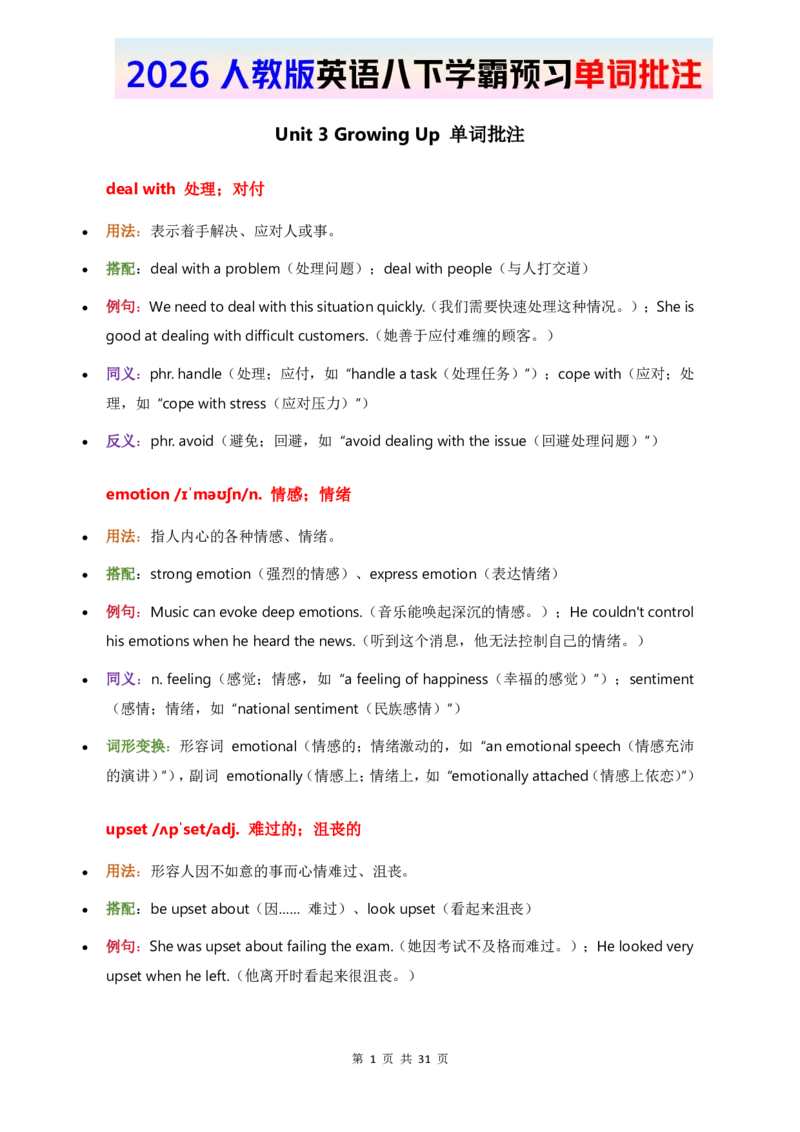
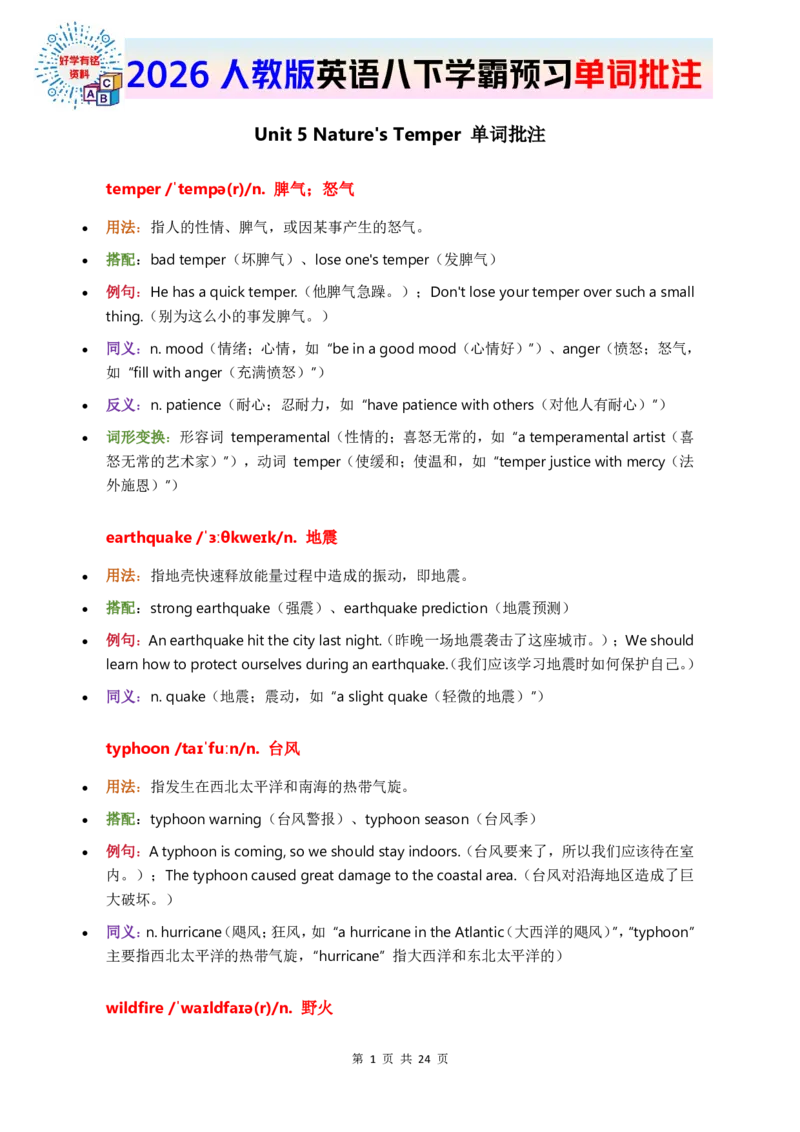
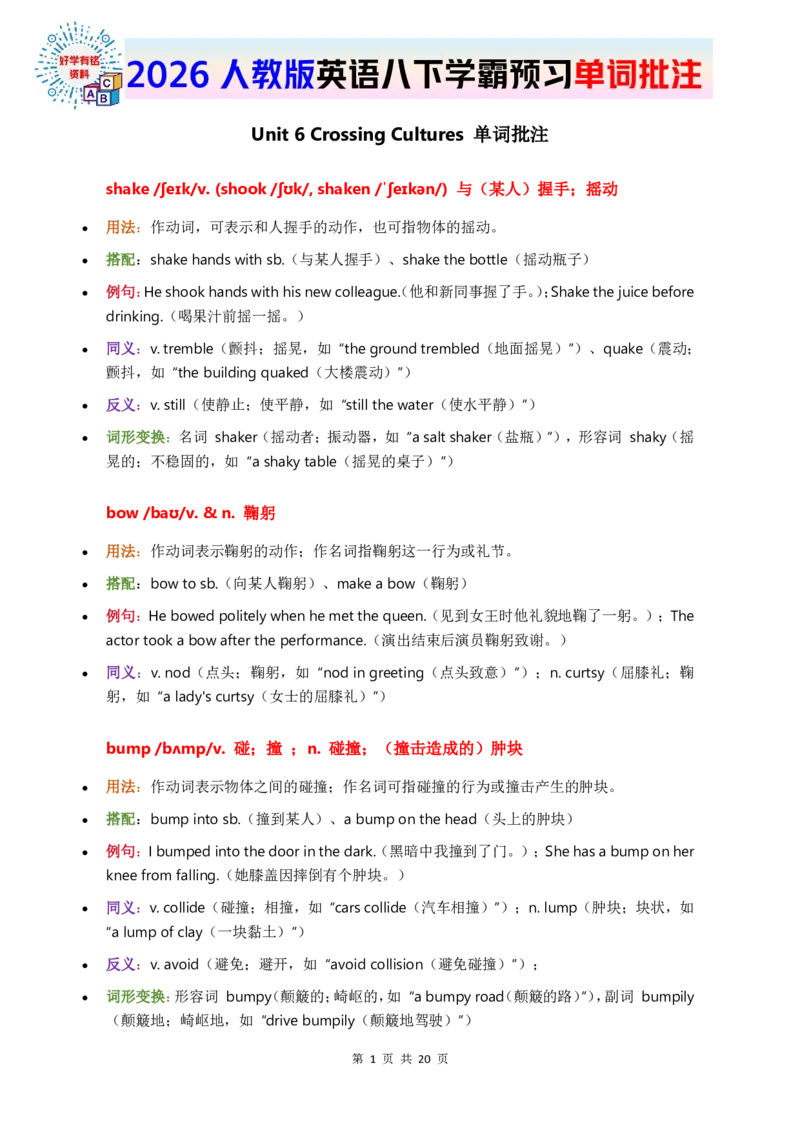
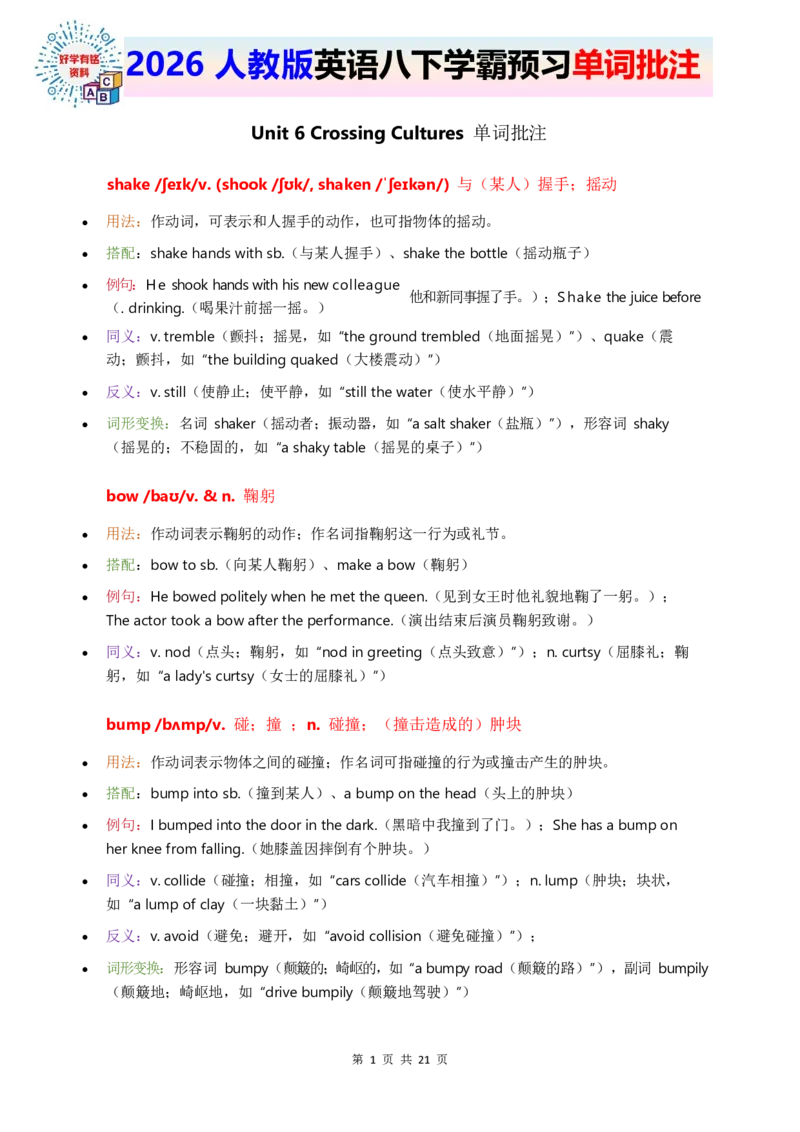
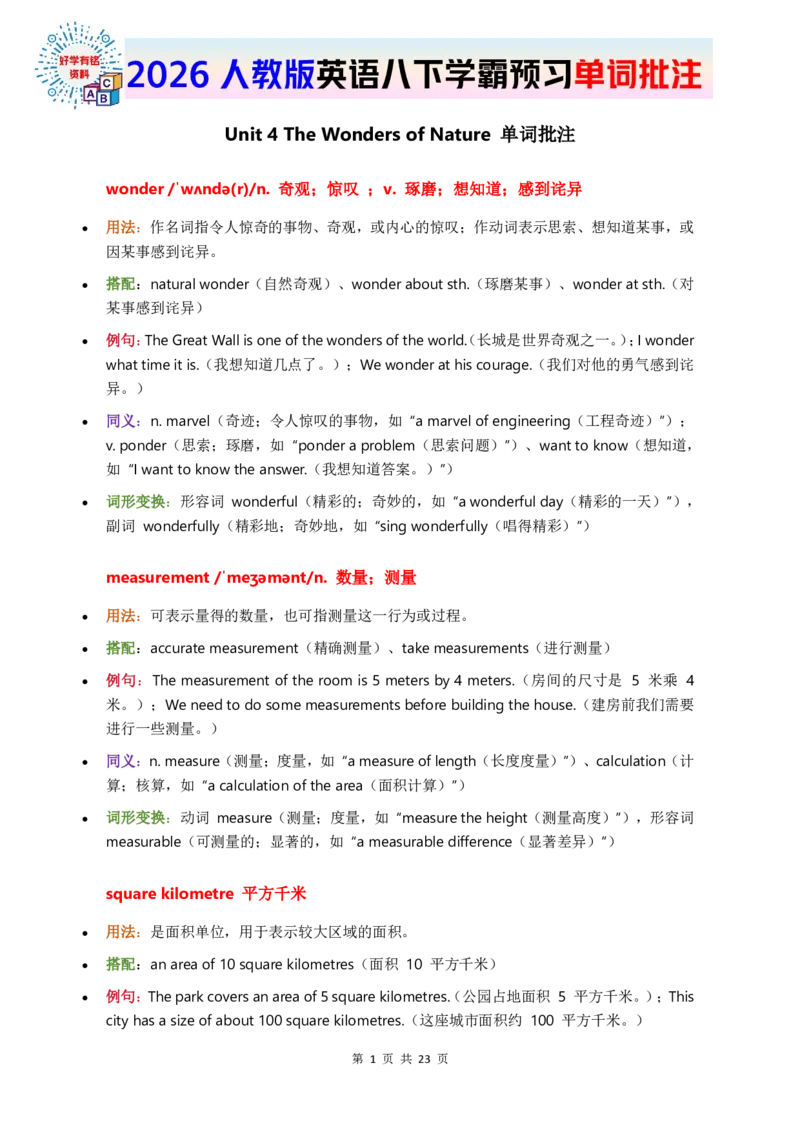
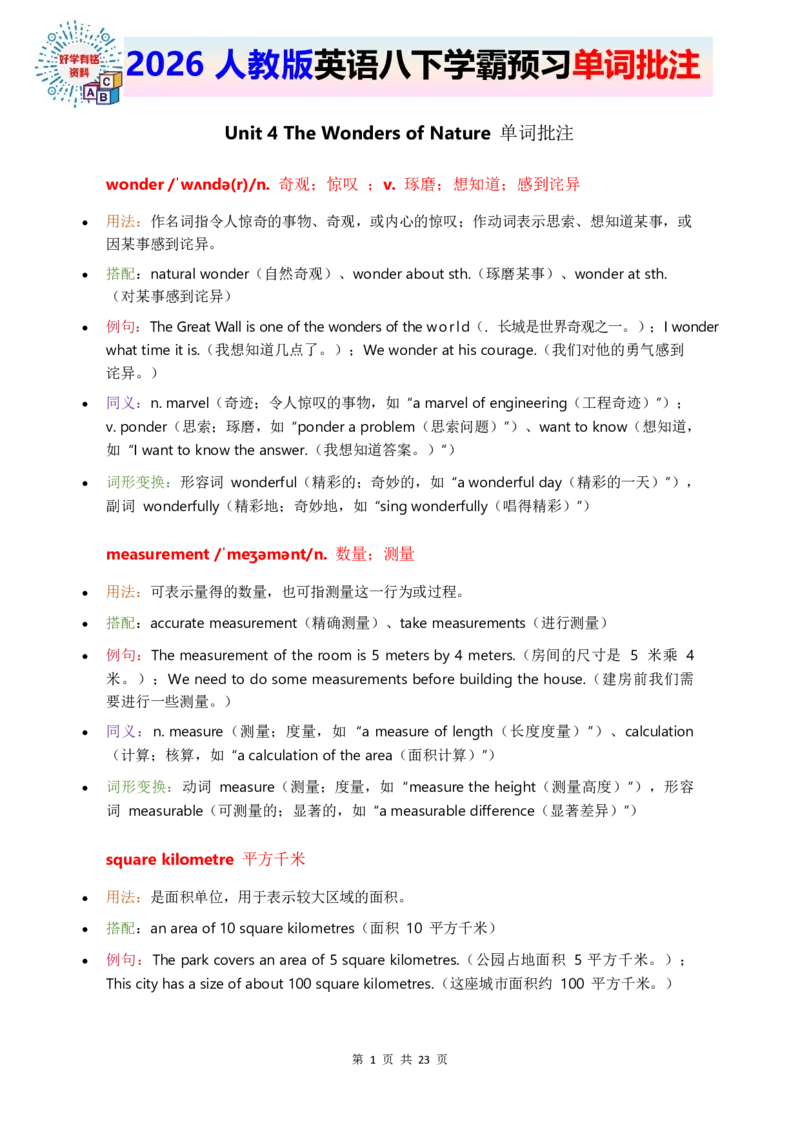
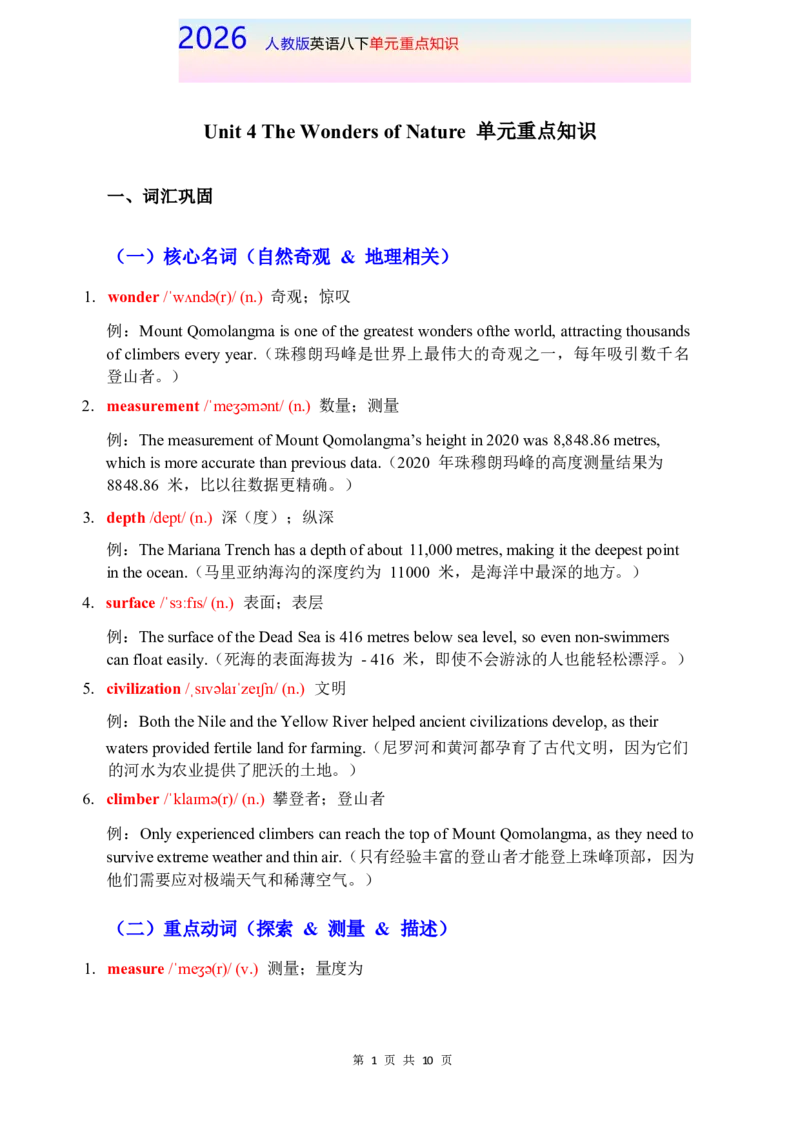
2026 人教版英语八下学霸预习单词批注
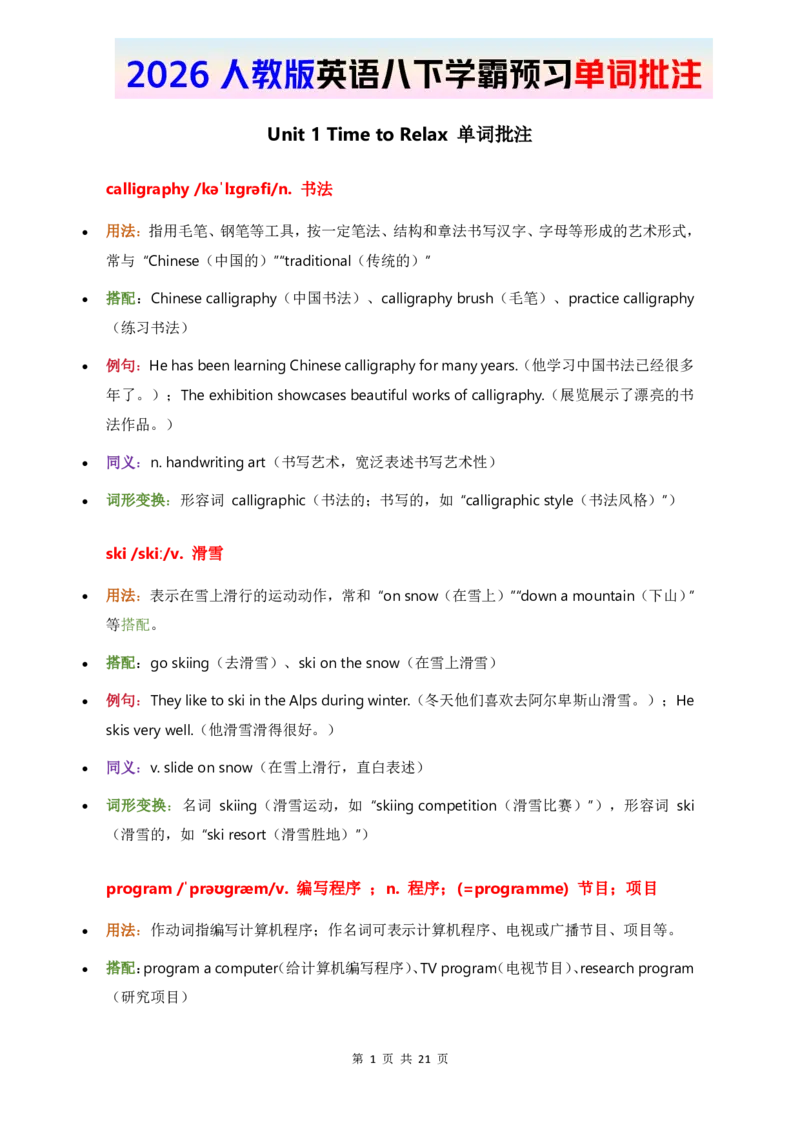
Unit 1 Time to Relax 单词批注
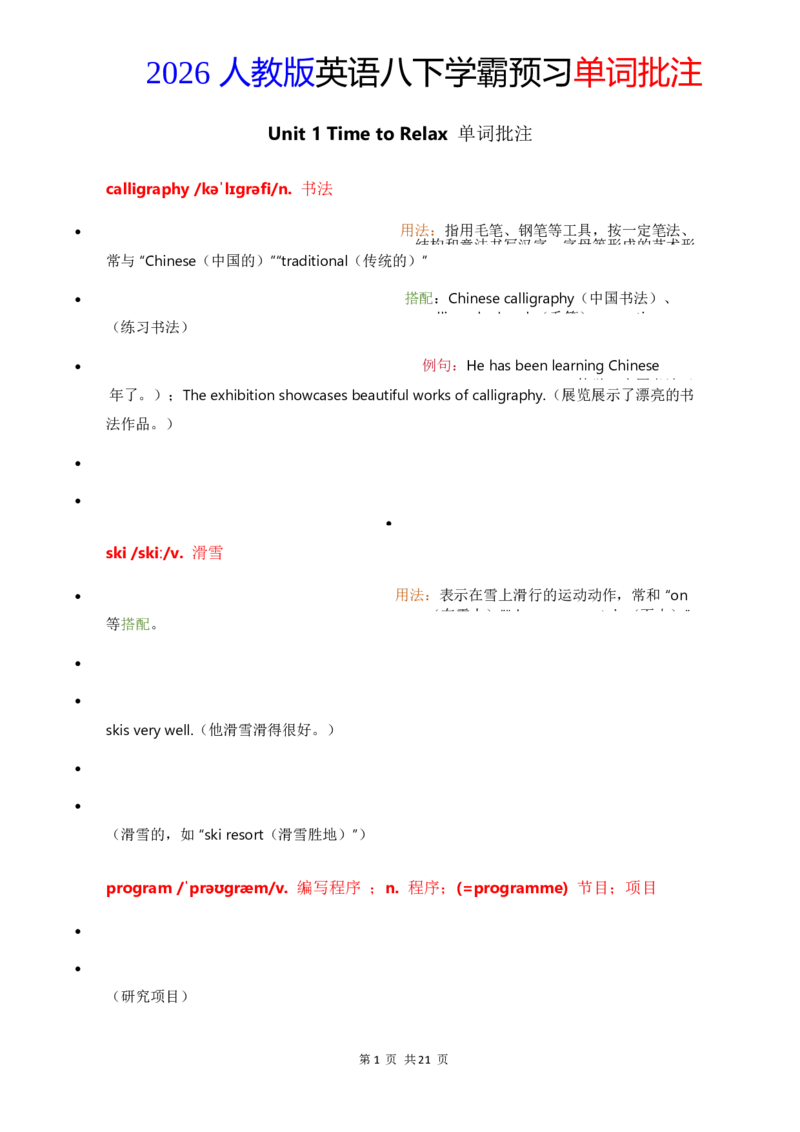
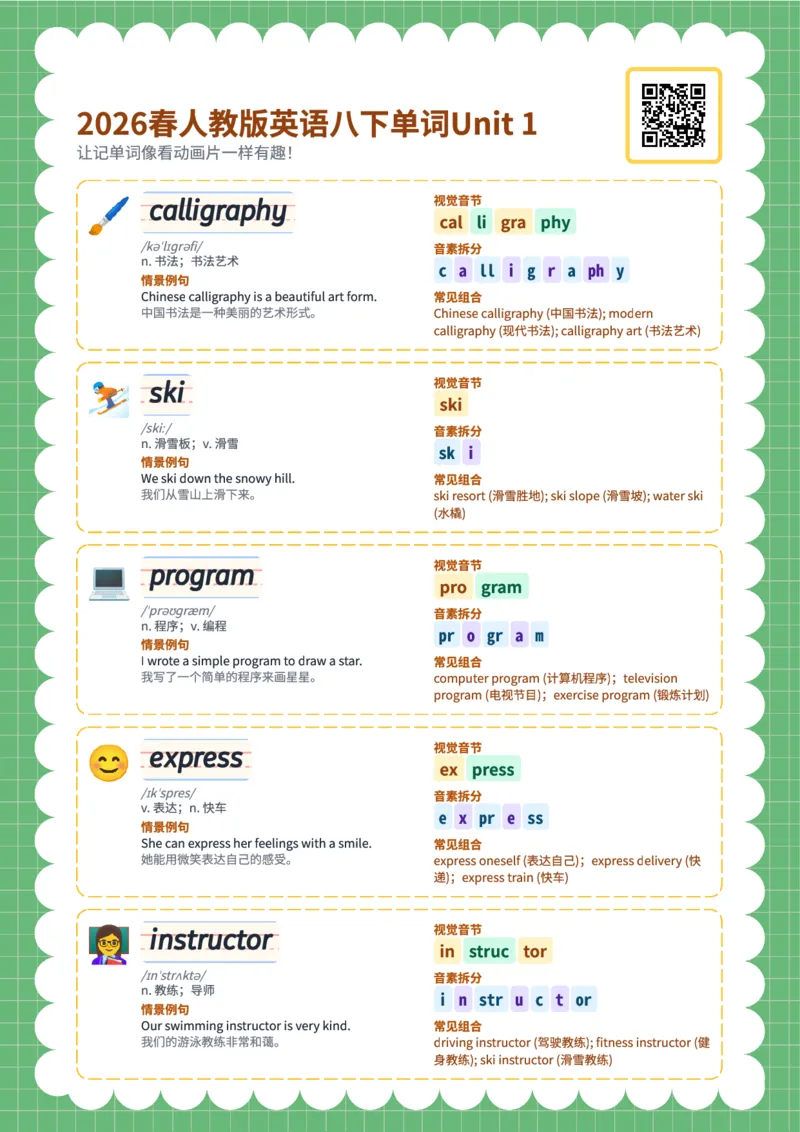
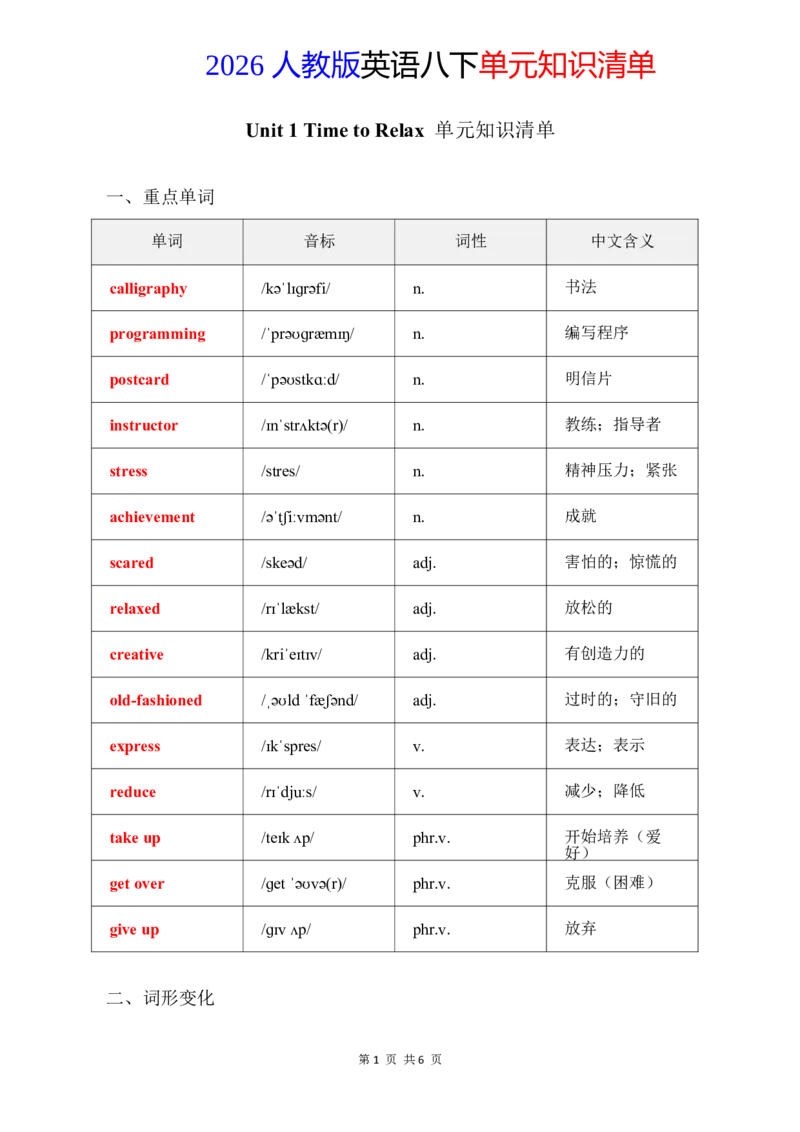
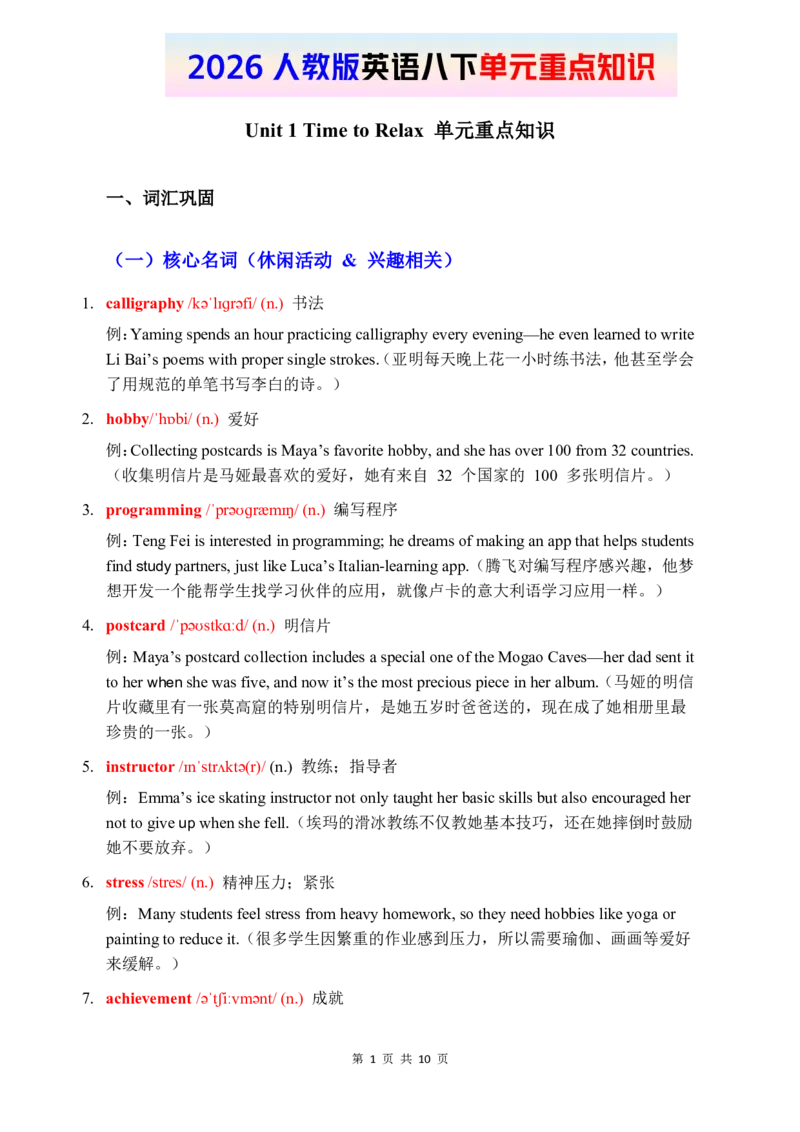
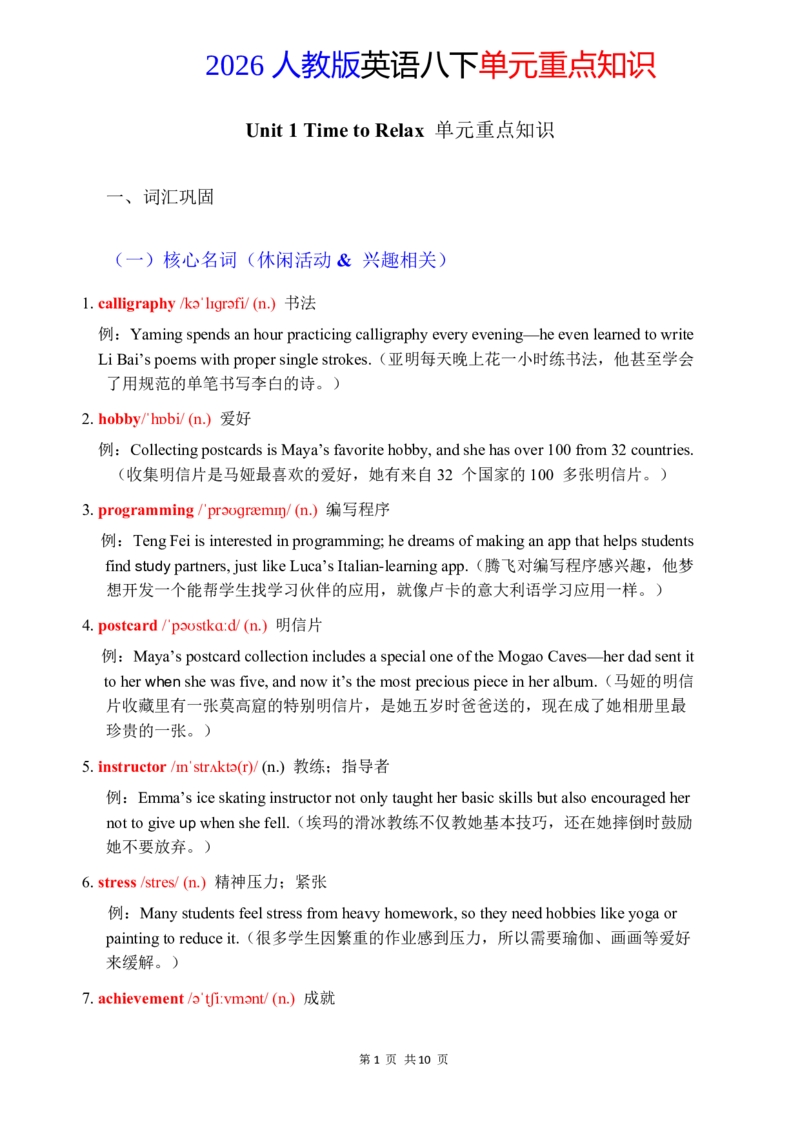
calligraphy /kəˈlɪɡrəfi/n. 书法
用法:指用毛笔、钢笔等工具,按一定笔法、
结构和章法书写汉字、字母等形成的艺术形
常与 “Chinese(中国的)”“traditional(传统的)”
搭配:Chinese calligraphy(中国书法)、
calligraphy brush(毛笔)、practice
(练习书法)
例句:He has been learning Chinese
calligraphy for many years.(他学习中国书法已
年了。);The exhibition showcases beautiful works of calligraphy.(展览展示了漂亮的书
法作品。)
ski /skiː/v. 滑雪
用法:表示在雪上滑行的运动动作,常和 “on
snow(在雪上)”“down a mountain(下山)”
等搭配。
skis very well.(他滑雪滑得很好。)
(滑雪的,如 “ski resort(滑雪胜地)”)
program /ˈprəʊɡræm/v. 编写程序 ;n. 程序;(=programme) 节目;项目
(研究项目)
第 1 页 共 21 页2026 人教版英语八下学霸预习单词批注
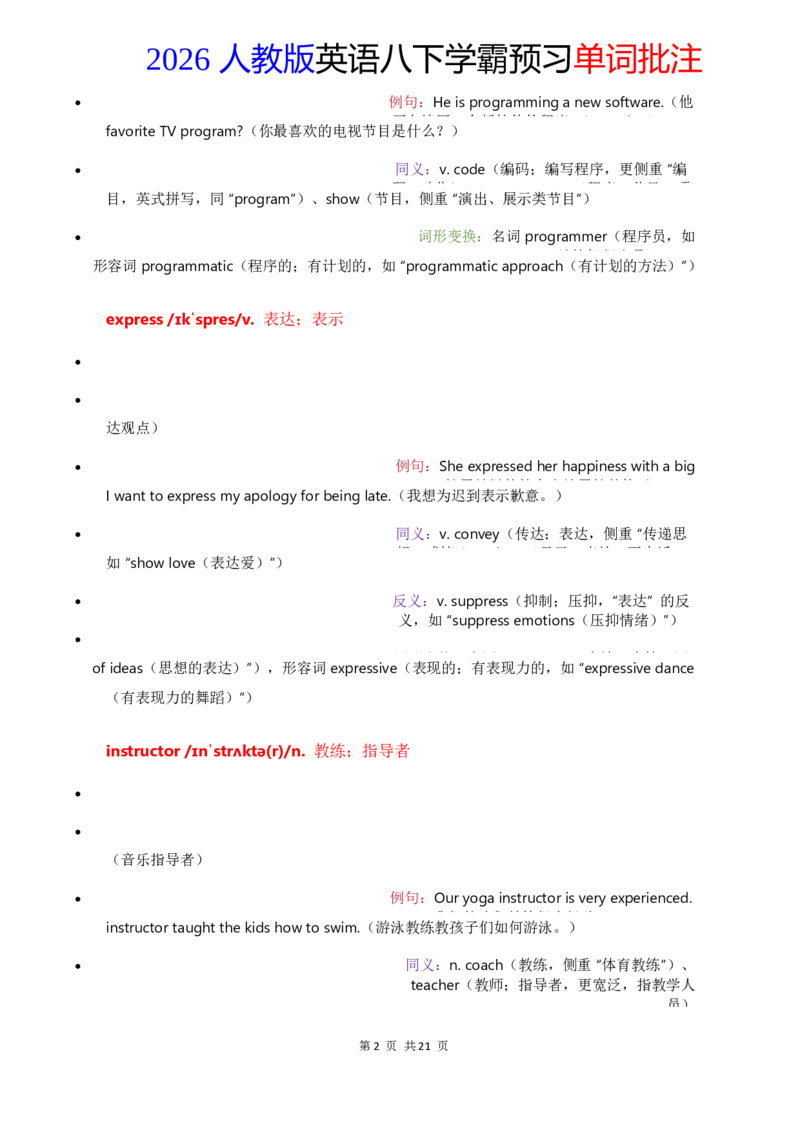
例句:He is programming a new software.(他
正在编写一个新软件的程序。);What’s your
favorite TV program?(你最喜欢的电视节目是什么?)
同义:v. code(编码;编写程序,更侧重 “编
码” 动作);n. programme(程序;节目;项
目,英式拼写,同 “program”)、show(节目,侧重 “演出、展示类节目”)
词形变换:名词 programmer(程序员,如
“computer programmer(计算机程序员)”),
形容词 programmatic(程序的;有计划的,如 “programmatic approach(有计划的方法)”)
express /ɪkˈspres/v. 表达;表示
达观点)
例句:She expressed her happiness with a big
smile.(她用灿烂的笑容表达了她的快乐。);
I want to express my apology for being late.(我想为迟到表示歉意。)
同义:v. convey(传达;表达,侧重 “传递思
想、感情”)、show(显示;表达,更宽泛,
如 “show love(表达爱)”)
反义:v. suppress(抑制;压抑,“表达” 的反
义,如 “suppress emotions(压抑情绪)”)
词形变换:名词 expression(表达;表情;词
of ideas(思想的表达)”),形容词 expressive(表现的;有表现力的,如 “expressive dance
(有表现力的舞蹈)”)
instructor /ɪnˈstrʌktə(r)/n. 教练;指导者
(音乐指导者)
例句:Our yoga instructor is very experienced.
(我们的瑜伽教练很有经验。);The
instructor taught the kids how to swim.(游泳教练教孩子们如何游泳。)
同义:n. coach(教练,侧重 “体育教练”)、
teacher(教师;指导者,更宽泛,指教学人
员)
第 2 页 共 21 页2026 人教版英语八下学霸预习单词批注
词形变换:动词 instruct(教导;指示,如
“instruct students(教导学生)”),形容词
instructional(指导的;教学的,如 “instructional video(教学视频)”)
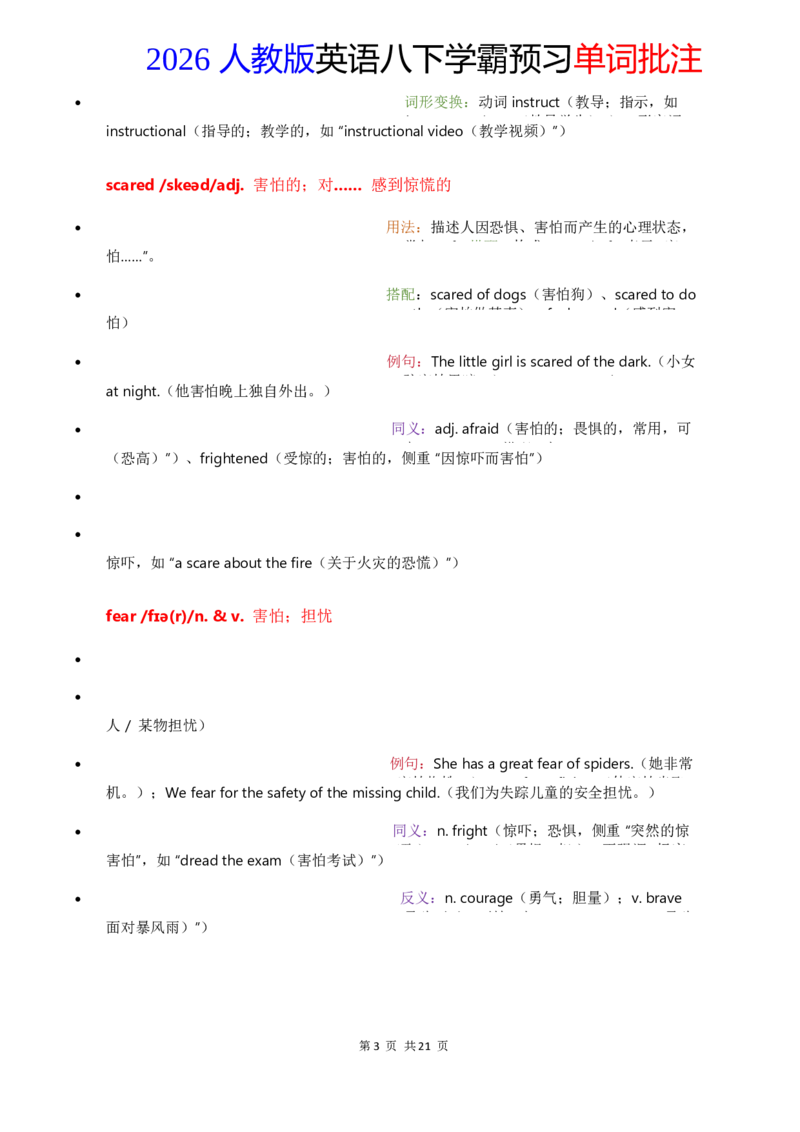
scared /skeəd/adj. 害怕的;对…… 感到惊慌的
用法:描述人因恐惧、害怕而产生的心理状态,
常与 “of” 搭配,构成 “scared of” 表示 “害
怕……”。
搭配:scared of dogs(害怕狗)、scared to do
sth.(害怕做某事)、feel scared(感到害
怕)
例句:The little girl is scared of the dark.(小女
孩害怕黑暗。);He was scared to go out
at night.(他害怕晚上独自外出。)
同义:adj. afraid(害怕的;畏惧的,常用,可
与 “of”“to do” 搭配,如 “afraid of heights
(恐高)”)、frightened(受惊的;害怕的,侧重 “因惊吓而害怕”)
惊吓,如 “a scare about the fire(关于火灾的恐慌)”)
fear /fɪə(r)/n. & v. 害怕;担忧
人 / 某物担忧)
例句:She has a great fear of spiders.(她非常
害怕蜘蛛。);He fears flying.(他害怕坐飞
机。);We fear for the safety of the missing child.(我们为失踪儿童的安全担忧。)
同义:n. fright(惊吓;恐惧,侧重 “突然的惊
吓”);v. dread(畏惧;担心,更强调 “极度
害怕”,如 “dread the exam(害怕考试)”)
反义:n. courage(勇气;胆量);v. brave
(勇敢面对;不怕,如 “brave the storm(勇敢
面对暴风雨)”)
第 3 页 共 21 页2026 人教版英语八下学霸预习单词批注
词形变换:形容词 fearful(可怕的;害怕的,
如 “fearful situation(可怕的局面)”“be fearful
of(害怕)”),副词 fearfully(可怕地;害怕地,如 “look around fearfully(害怕地环顾
四周)”)
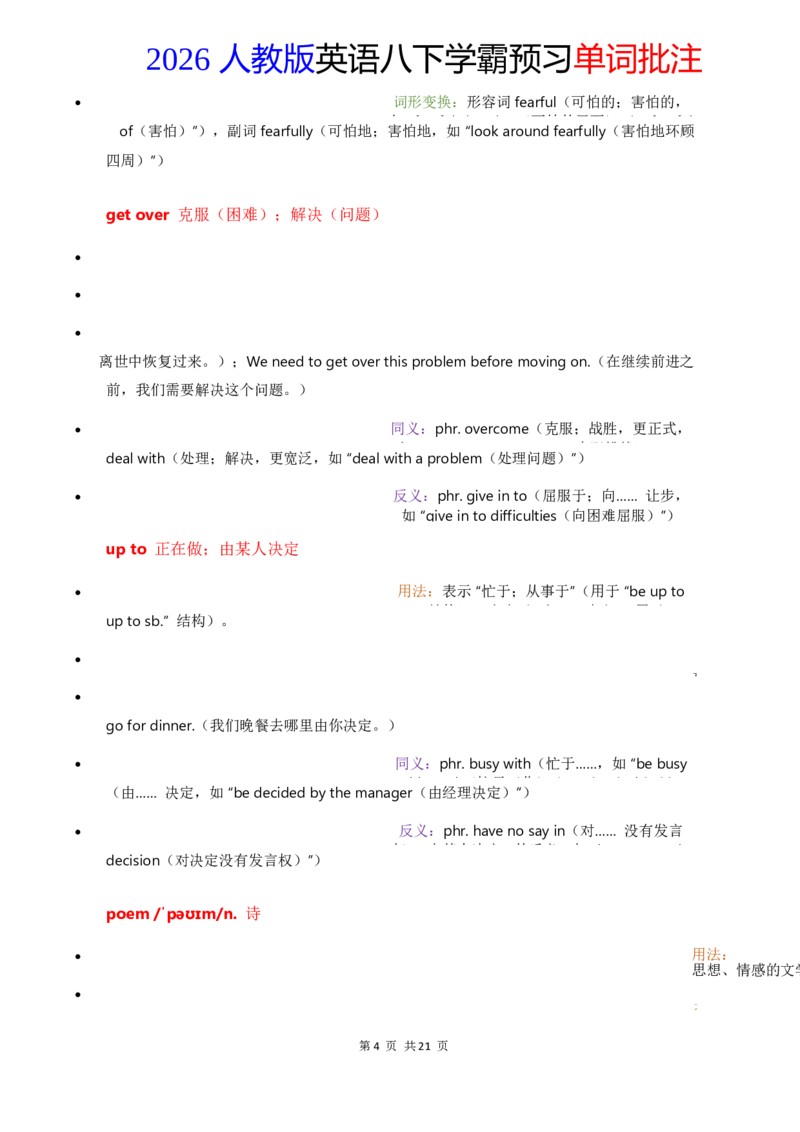
get over 克服(困难);解决(问题)
离世中恢复过来。);We need to get over this problem before moving on.(在继续前进之
前,我们需要解决这个问题。)
同义:phr. overcome(克服;战胜,更正式,
如 “overcome challenges(克服挑战)”)、
deal with(处理;解决,更宽泛,如 “deal with a problem(处理问题)”)
反义:phr. give in to(屈服于;向…… 让步,
如 “give in to difficulties(向困难屈服)”)
up to 正在做;由某人决定
用法:表示 “忙于;从事于”(用于 “be up to
sth.” 结构);也表示 “由…… 决定”(用于 “be
up to sb.” 结构)。
事)、
go for dinner.(我们晚餐去哪里由你决定。)
同义:phr. busy with(忙于……,如 “be busy
with work(忙于工作)”);“be decided by
(由…… 决定,如 “be decided by the manager(由经理决定)”)
反义:phr. have no say in(对…… 没有发言
权,“由某人决定” 的反义,如 “have no say in
decision(对决定没有发言权)”)
poem /ˈpəʊɪm/n. 诗
用法:
思想、情感的文学作品。
搭配
第 4 页 共 21 页2026 人教版英语八下学霸预习单词批注
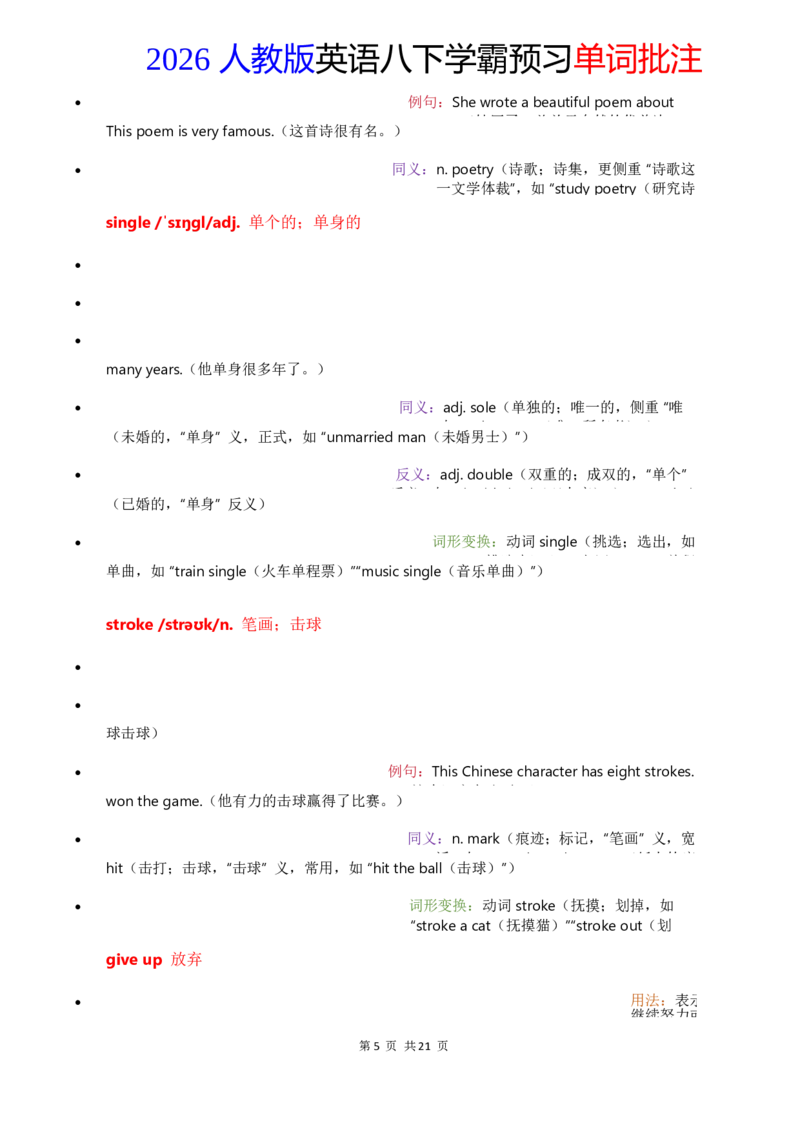
例句:She wrote a beautiful poem about
nature.(她写了一首关于自然的优美诗
This poem is very famous.(这首诗很有名。)
同义:n. poetry(诗歌;诗集,更侧重 “诗歌这
一文学体裁”,如 “study poetry(研究诗
single /ˈsɪŋɡl/adj. 单个的;单身的
many years.(他单身很多年了。)
同义:adj. sole(单独的;唯一的,侧重 “唯
一”,如 “sole owner(唯一所有者)”)、
(未婚的,“单身” 义,正式,如 “unmarried man(未婚男士)”)
反义:adj. double(双重的;成双的,“单个”
反义,如 “double bed(双人床)”)、married
(已婚的,“单身” 反义)
词形变换:动词 single(挑选;选出,如
“single out(挑选出)”),名词 single(单程
单曲,如 “train single(火车单程票)”“music single(音乐单曲)”)
stroke /strəʊk/n. 笔画;击球
球击球)
例句:This Chinese character has eight strokes.
(这个汉字有八画。);His powerful stroke
won the game.(他有力的击球赢得了比赛。)
同义:n. mark(痕迹;标记,“笔画” 义,宽
泛,如 “a mark on the paper(纸上的痕
hit(击打;击球,“击球” 义,常用,如 “hit the ball(击球)”)
词形变换:动词 stroke(抚摸;划掉,如
“stroke a cat(抚摸猫)”“stroke out(划
give up 放弃
用法:表示停止做某事,不再
继续努力或尝试。
第 5 页 共 21 页2026 人教版英语八下学霸预习单词批注
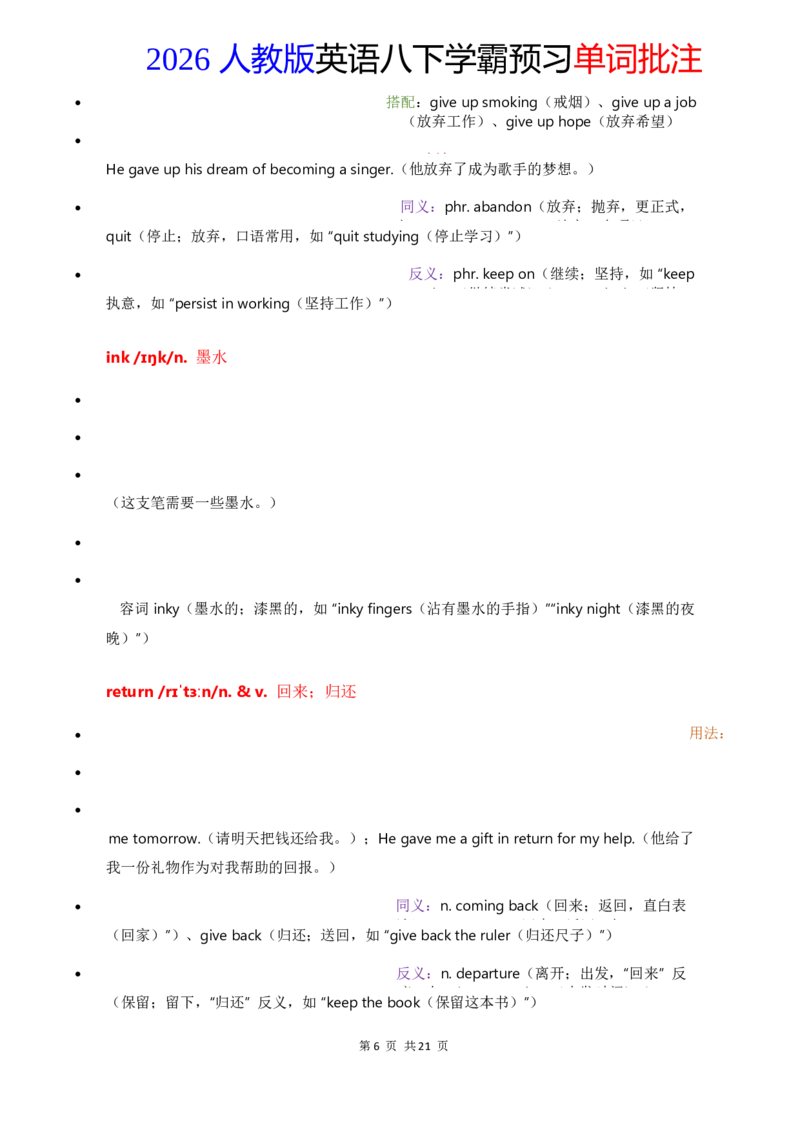
搭配:give up smoking(戒烟)、give up a job
(放弃工作)、give up hope(放弃希望)
例句:Don’t give up easily when you face
He gave up his dream of becoming a singer.(他放弃了成为歌手的梦想。)
同义:phr. abandon(放弃;抛弃,更正式,
如 “abandon a project(放弃一个项目)”)、
quit(停止;放弃,口语常用,如 “quit studying(停止学习)”)
反义:phr. keep on(继续;坚持,如 “keep
on trying(继续尝试)”)、persist in(坚持;
执意,如 “persist in working(坚持工作)”)
ink /ɪŋk/n. 墨水
(这支笔需要一些墨水。)
容词 inky(墨水的;漆黑的,如 “inky fingers(沾有墨水的手指)”“inky night(漆黑的夜
晚)”)
return /rɪˈtɜːn/n. & v. 回来;归还
用法:
me tomorrow.(请明天把钱还给我。);He gave me a gift in return for my help.(他给了
我一份礼物作为对我帮助的回报。)
同义:n. coming back(回来;返回,直白表
述);v. go back(回去;返回,如 “go back
(回家)”)、give back(归还;送回,如 “give back the ruler(归还尺子)”)
反义:n. departure(离开;出发,“回来” 反
义,如 “departure time(出发时间)”);v.
(保留;留下,“归还” 反义,如 “keep the book(保留这本书)”)
第 6 页 共 21 页2026 人教版英语八下学霸预习单词批注
词形变换:
程的,如
in return 作为回报
搭配
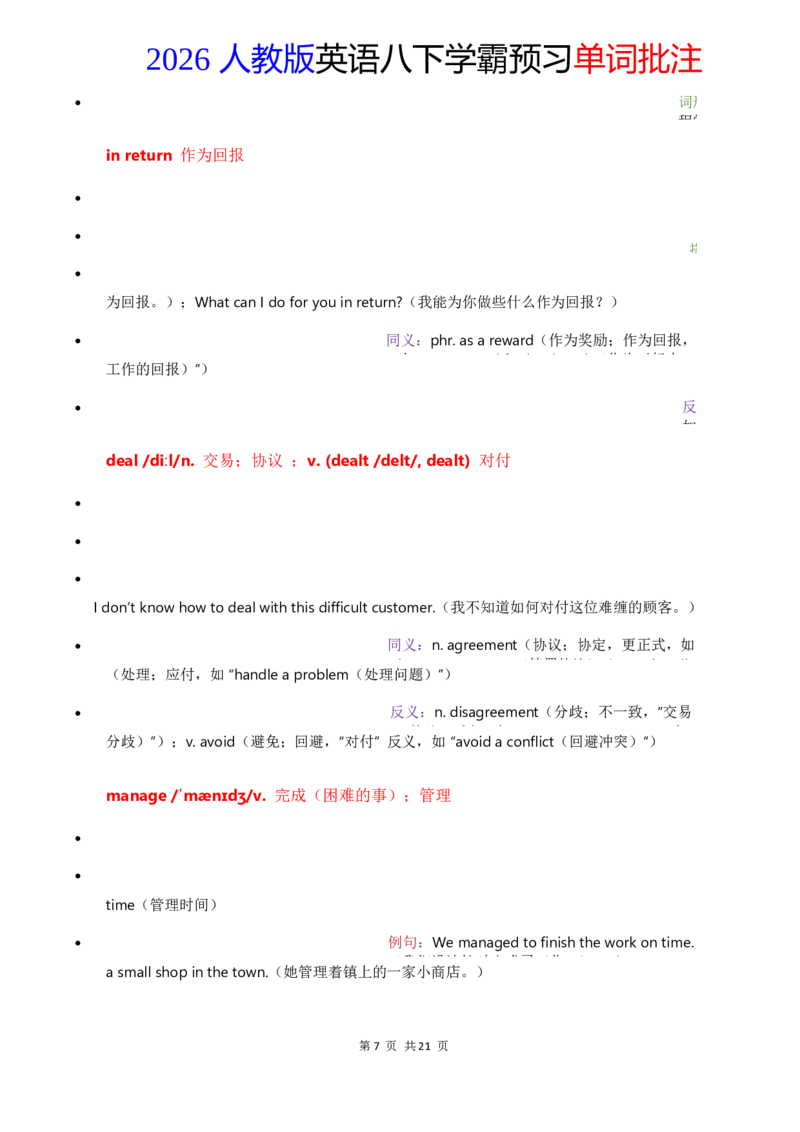
为回报。);What can I do for you in return?(我能为你做些什么作为回报?)
同义:phr. as a reward(作为奖励;作为回报,
如 “as a reward for hard work(作为对努力
工作的回报)”)
反义:
如
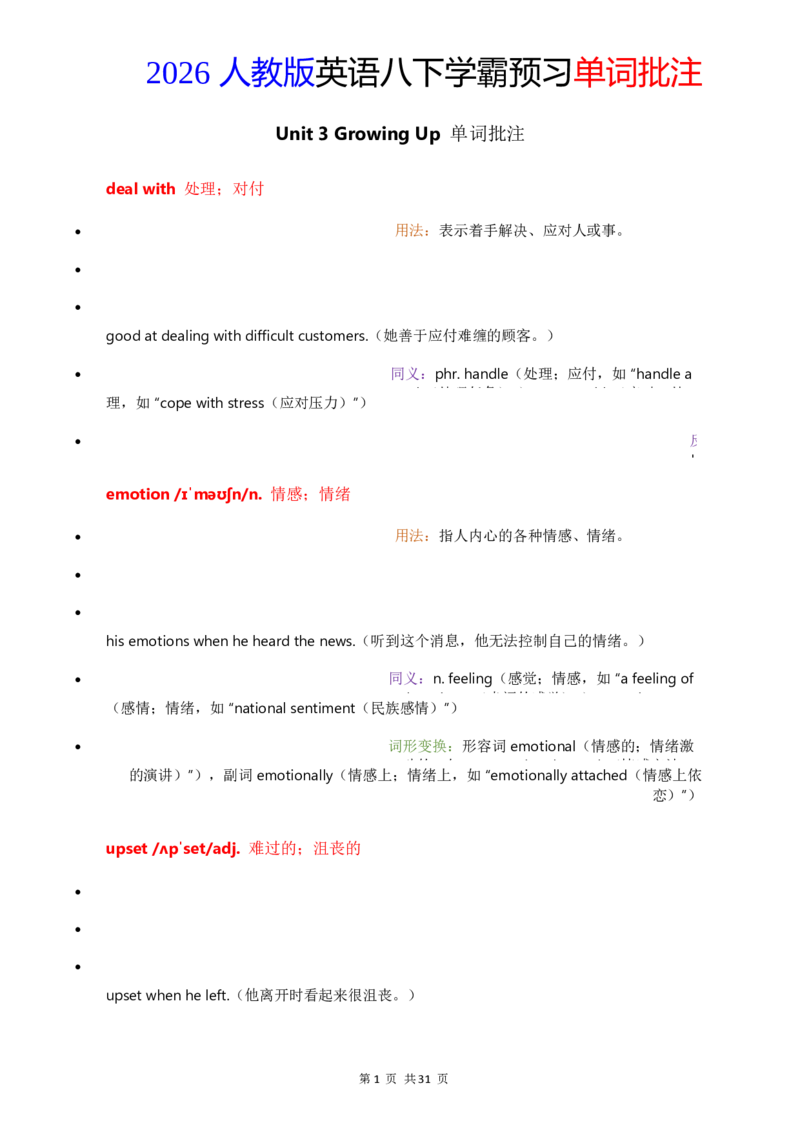
deal /diːl/n. 交易;协议 ;v. (dealt /delt/, dealt) 对付
I don’t know how to deal with this difficult customer.(我不知道如何对付这位难缠的顾客。)
同义:n. agreement(协议;协定,更正式,如
“sign an agreement(签署协议)”);v. handle
(处理;应付,如 “handle a problem(处理问题)”)
反义:n. disagreement(分歧;不一致,“交易
/ 协议” 反义,如 “have a disagreement(有
分歧)”);v. avoid(避免;回避,“对付” 反义,如 “avoid a conflict(回避冲突)”)
manage /ˈmænɪdʒ/v. 完成(困难的事);管理
time(管理时间)
例句:We managed to finish the work on time.
(我们设法按时完成了工作。);She manages
a small shop in the town.(她管理着镇上的一家小商店。)
第 7 页 共 21 页2026 人教版英语八下学霸预习单词批注
同义:v. succeed in(成功做……,如 “succeed
in passing the exam(成功通过考试)”)、
run(经营;管理,如 “run a business(经营生意)”)
反义:v. fail(失败;未能,“完成” 反义,如
“fail to finish(未能完成)”)、mismanage(管
理不善;处置失当,“管理” 反义,如 “mismanage funds(管理资金不善)”)
词形变换:名词 management(管理;管理人
员,如 “business management(商业管
理)”“management team(管理团队)”),形容词 manageable(可管理的;易处理的,
如 “a manageable task(可处理的任务)”)
get into 开始做某事;进入
入麻烦)
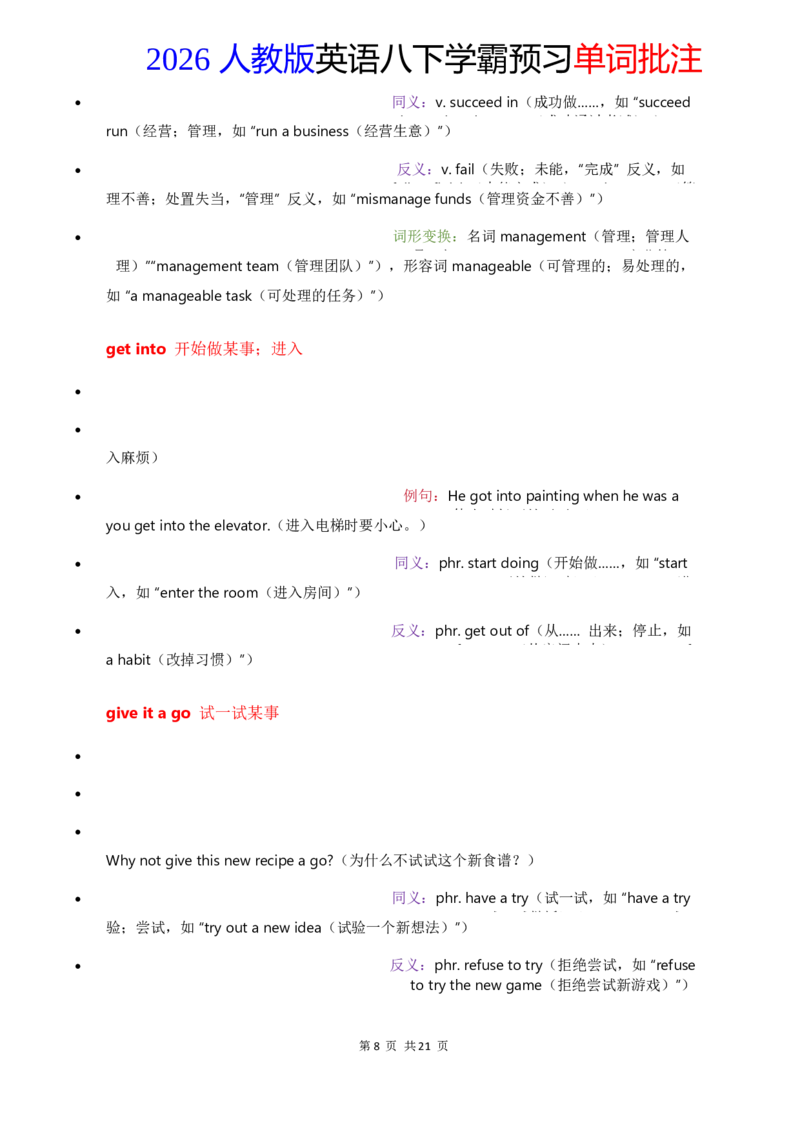
例句:He got into painting when he was a
child.(他小时候开始画画。);Be careful
you get into the elevator.(进入电梯时要小心。)
同义:phr. start doing(开始做……,如 “start
doing exercise(开始做运动)”);“enter(进
入,如 “enter the room(进入房间)”)
反义:phr. get out of(从…… 出来;停止,如
“get out of a room(从房间出来)”“get out of
a habit(改掉习惯)”)
give it a go 试一试某事
Why not give this new recipe a go?(为什么不试试这个新食谱?)
同义:phr. have a try(试一试,如 “have a try
at cooking(试一试做饭)”)、try out(试
验;尝试,如 “try out a new idea(试验一个新想法)”)
反义:phr. refuse to try(拒绝尝试,如 “refuse
to try the new game(拒绝尝试新游戏)”)
第 8 页 共 21 页2026 人教版英语八下学霸预习单词批注
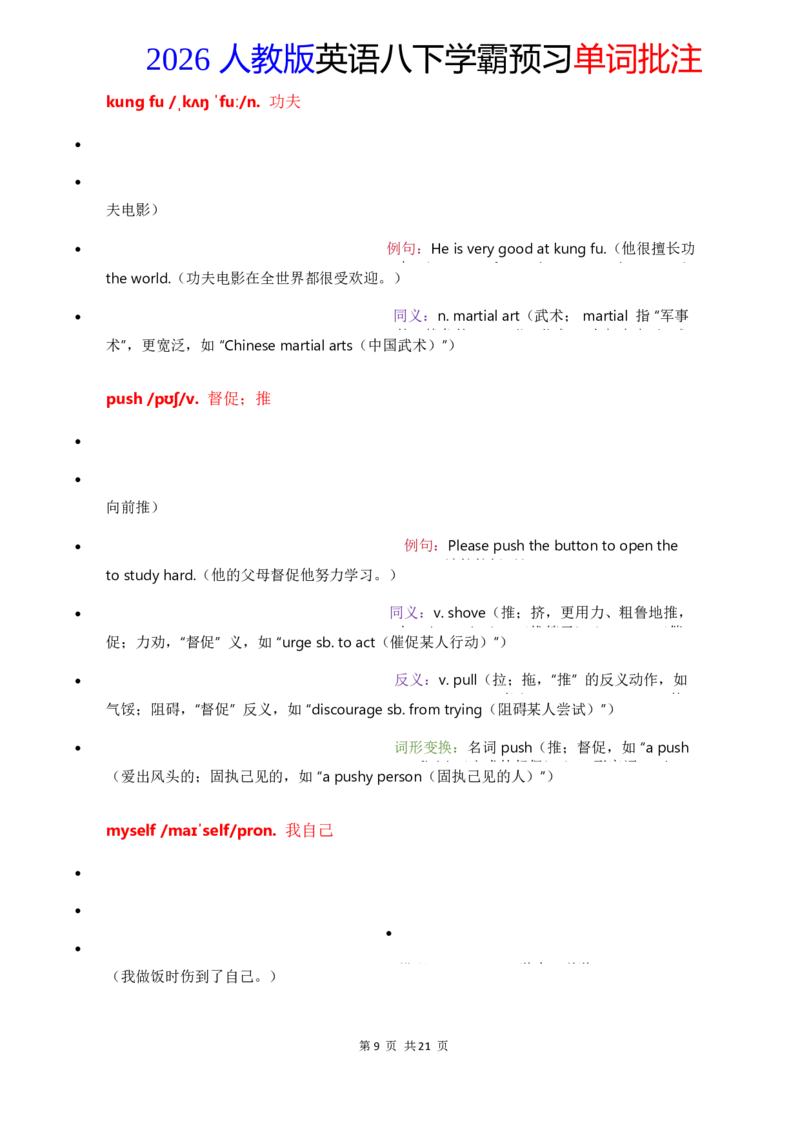
kung fu /ˌkʌŋ ˈfuː/n. 功夫
夫电影)
例句:He is very good at kung fu.(他很擅长功
夫。);Kung fu movies are popular around
the world.(功夫电影在全世界都很受欢迎。)
同义:n. martial art(武术; martial 指 “军事
的;战争的”,art 指 “艺术”,合起来表示 “武
术”,更宽泛,如 “Chinese martial arts(中国武术)”)
push /pʊʃ/v. 督促;推
向前推)
例句:Please push the button to open the
door.(请按按钮开门。);His parents push
to study hard.(他的父母督促他努力学习。)
同义:v. shove(推;挤,更用力、粗鲁地推,
如 “shove the box(推箱子)”)、urge(催
促;力劝,“督促” 义,如 “urge sb. to act(催促某人行动)”)
反义:v. pull(拉;拖,“推” 的反义动作,如
“pull the door(拉门)”)、discourage(使
气馁;阻碍,“督促” 反义,如 “discourage sb. from trying(阻碍某人尝试)”)
词形变换:名词 push(推;督促,如 “a push
to finish(完成的督促)”),形容词 pushy
(爱出风头的;固执己见的,如 “a pushy person(固执己见的人)”)
myself /maɪˈself/pron. 我自己
搭配:by myself(独自;单独)、hurt myself
(我做饭时伤到了自己。)
第 9 页 共 21 页2026 人教版英语八下学霸预习单词批注
同义:
身,如
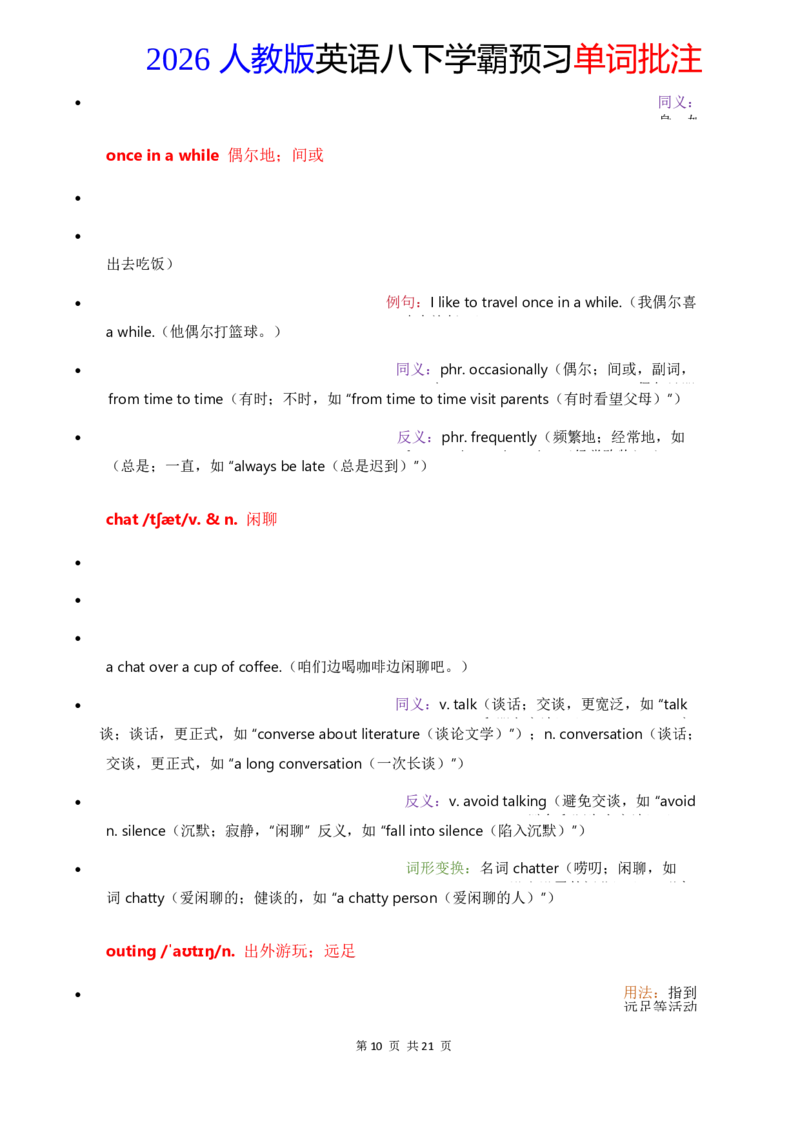
once in a while 偶尔地;间或
出去吃饭)
例句:I like to travel once in a while.(我偶尔喜
欢去旅行。);He plays basketball once in
a while.(他偶尔打篮球。)
同义:phr. occasionally(偶尔;间或,副词,
如 “occasionally meet friends(偶尔见朋
from time to time(有时;不时,如 “from time to time visit parents(有时看望父母)”)
反义:phr. frequently(频繁地;经常地,如
“frequently go shopping(经常购物)”)、
(总是;一直,如 “always be late(总是迟到)”)
chat /tʃæt/v. & n. 闲聊
a chat over a cup of coffee.(咱们边喝咖啡边闲聊吧。)
同义:v. talk(谈话;交谈,更宽泛,如 “talk
with friends(和朋友交谈)”)、converse(交
谈;谈话,更正式,如 “converse about literature(谈论文学)”);n. conversation(谈话;
交谈,更正式,如 “a long conversation(一次长谈)”)
反义:v. avoid talking(避免交谈,如 “avoid
talking to strangers(避免和陌生人交谈)”);
n. silence(沉默;寂静,“闲聊” 反义,如 “fall into silence(陷入沉默)”)
词形变换:名词 chatter(唠叨;闲聊,如
“endless chatter(没完没了的闲聊)”),形容
词 chatty(爱闲聊的;健谈的,如 “a chatty person(爱闲聊的人)”)
outing /ˈaʊtɪŋ/n. 出外游玩;远足
用法:指到户外进行的游玩、
远足等活动。
第 10 页 共 21 页2026 人教版英语八下学霸预习单词批注
搭配:go on an outing(去远足;去游玩)、
family outing(家庭游玩)、school outing(学
校郊游)
例句:We had a great outing to the
countryside last weekend.(上周末我们去乡下
玩得很开心。);The school outing is scheduled for next Friday.(学校郊游定在下周五。)
同义:n. trip(旅行;出行,更宽泛,如 “a trip
to the beach(去海滩的旅行)”)、excursion
(远足;短途旅行,更正式,如 “a day excursion(一日远足)”)
反义:n. stay - at - home(待在家里,如
“prefer a stay - at - home day(更喜欢待在家的
一天)”)
go on an outing 出外游玩
园游玩)
例句:They decided to go on an outing to the
mountains.(他们决定去山里游玩。);We
often go on an outing during holidays.(我们假期经常去游玩。)
同义:phr. go for an outing(去游玩;去远
足,与 “go on an outing” 意思相近)、take an
outing(进行一次游玩,如 “take an outing to the lake(去湖边游玩)”)
反义:phr. stay indoors(待在室内,如 “stay
indoors on rainy days(下雨天待在室内)”)
reduce /rɪˈdjuːs/v. 减少
搭配:reduce pollution(减少污染)、reduce
advised him to reduce his sugar intake.(医生建议他减少糖的摄入量。)
同义:v. decrease(减少;降低,更正式,如
“decrease the number(减少数量)”)、lessen
(减少;减轻,侧重 “程度减轻”,如 “lessen pain(减轻疼痛)”)
反义:v. increase(增加;提高,如 “increase
production(增加产量)”)、raise(提高;
增加,如 “raise salary(提高工资)”)
第 11 页 共 21 页2026 人教版英语八下学霸预习单词批注
词形变换:名词 reduction(减少;降低,如 “a
reduction in price(价格降低)”),形容
词 reducible(可减少的;可简化的,如 “reducible problems(可简化的问题)”)
stress /stres/n. 精神压力;紧张
力下)
例句:Too much stress is bad for health.(太多
压力对健康有害。);She is under a lot of
because of the exam.(因为考试,她处于很大的压力下。)
同义:n. pressure(压力;压强,“精神压力”
义,常用,如 “peer pressure(同伴压
tension(紧张;张力,侧重 “紧张的氛围或状态”,如 “tension in the room(房间里的紧张
氛围)”)
反义:n. relaxation(放松;缓和,如 “need
relaxation after work(工作后需要放松)”)、
ease(安逸;轻松,如 “live in ease(生活安逸)”)
词形变换:动词 stress(强调;加压,如 “stress
the importance(强调重要性)”“stress a
material(给材料加压)”),形容词 stressful(有压力的;紧张的,如 “a stressful job(有
压力的工作)”)
yoga /ˈjəʊɡə/n. 瑜伽
a yoga class last month.(我上个月参加了一个瑜伽课。)
词形变换:
的,如
object /ˈɒbdʒɪkt/n. 物品;宾语
用法:
“宾语
第 12 页 共 21 页2026 人教版英语八下学霸预习单词批注
搭配:everyday object(日常物品)、direct
object(直接宾语)、indirect object(间接宾
语)
例句:There are many strange objects in the
museum.(博物馆里有很多奇怪的物品。);
In the sentence “I like apples”, “apples” is the object.(在句子 “I like apples” 中,“apples” 是
宾语。)
同义:n. thing(东西;事物,“物品” 义,常
用,宽泛,如 “a small thing(一个小东西)”)
词形变换:动词 object(反对;拒绝,发音 /əb
划)”),形容词 objective(客观的;目标的,如 “objective opinion(客观意见)”“main
objective
(主要目标)”)
Italian /ɪˈtæliən/adj. 意大利的;意大利人的;意大利语的 ;n. 意大利人;意大利
语
用法:
利语)
例句:Italian pizza is very popular around the
world.(意大利披萨在全世界都很受欢迎。);
He is Italian and he speaks Italian fluently.(他是意大利人,意大利语说得很流利。)
词形变换:
如
programmer /ˈprəʊɡræmə(r)/n. 程序设计员
员)、programmer skills(程序设计员技能)
例句:He works as a programmer in a tech
company.(他在一家科技公司当程序设计
The programmer developed a new app.(程序设计员开发了一个新应用程序。)
同义:n. coder(编码员;程序员,更侧重 “编
码” 工作,如 “web coder(网页编码员)”)、
software developer(软件开发者,范围更广,包括程序设计等,如 “software developer
team
(软件开发团队)”)
第 13 页 共 21 页2026 人教版英语八下学霸预习单词批注
词形变换:动词 program(编写程序,如
“program a computer(给计算机编写程
形容词 programmatic(程序的;有计划的,如 “programmatic testing(程序测试)”)
allow /əˈlaʊ/v. 使…… 成为可能;允许
(留出时间)
例句:My parents allow me to go out with
friends on weekends.(我父母允许我周末和朋
出去。);The rules don’t allow smoking here.(规定不允许在这里吸烟。);We should
allow
enough time for preparation.(我们应该留出足够的时间准备。)
同义:v. permit(允许;许可,更正式,如
“permit entry(准许进入)”)、let(让;允
口语常用,如 “let me go(让我走)”)
反义:v. forbid(禁止;不许,如 “forbid
parking(禁止停车)”)、prohibit(禁止;阻
更正式,如 “prohibit smoking(禁止吸烟)”)
词形变换:名词 allowance(允许;津贴,如
“monthly allowance(每月津贴)”),形容
词 allowable(允许的;可容许的,如 “allowable error(容许误差)”)
sense /sens/n. 感觉;感官
Dogs have a good sense of smell.(狗有很好的嗅觉。)
同义:n. feeling(感觉;情感,“感觉” 义,常
用,如 “a feeling of happiness(幸福的感
sensation(感觉;知觉,“感官” 义,更强调 “感官刺激”,如 “a strange sensation(奇怪的
感觉)”)
词形变换:动词 sense(感觉到;意识到,如
“sense danger(感觉到危险)”),形容词
(明智的;合情理的,如 “a sensible decision(明智的决定)”)
第 14 页 共 21 页2026 人教版英语八下学霸预习单词批注
achievement /əˈtʃiːvmənt/n. 成就
award(成就奖)
例句:Winning the championship is a great
achievement for the team.(赢得冠军对球队来
说是一项伟大的成就。);His scientific achievements are well - known.(他的科学成就很
有名。)
同义:n. accomplishment(成就;完成,更侧
重 “完成某事”,如 “the accomplishment of a
task(任务的完成)”)、success(成功;成就,更宽泛,如 “a success in business(商业
上的成功)”)
(可实现的;可达到的,如 “achievable target(可实现的目标)”)
coin /kɔɪn/n. 硬币
(铸造货币)”))
stamp /stæmp/n. 邮票
念邮票)
第 15 页 共 21 页2026 人教版英语八下学霸预习单词批注
例句:She has a huge stamp collection from all
over the world.(她有大量来自世界各地的
邮票收藏。);I need a stamp to send this letter.(我需要一张邮票寄这封信。)
foot(跺脚)”),形容词 stamped(盖有邮戳的;有印记的,如 “stamped envelope(盖
有邮戳的信封)”)
teenage /ˈtiːneɪdʒ/adj. 青少年的
(青少年时尚)
例句:Teenage boys are often interested in
sports.(青少年男孩通常对运动感兴趣。);
wrote a book about teenage life.(她写了一本关于青少年生活的书。)
同义:adj. teen(青少年的,更口语化,如
“teen culture(青少年文化)”)、adolescent
(青春期的;青少年的,更正式,如 “adolescent development(青春期发展)”)
反义:
responsibility
词形变换:
postcard /ˈpəʊstkɑːd/n. 明信片
(漂亮的明信片)
例句:He sent me a postcard from Paris.(他从
巴黎给我寄了一张明信片。);I have a
collection of postcards from different countries.(我有一批来自不同国家的明信片收藏。)
同义:
片,“postal”
rather /ˈrɑːðə(r)/adv. 相当;更准确地说
用法:用于修饰形容词、副词,表程度 “相
当”;也用于纠正或更准确表述,“更准确地
第 16 页 共 21 页2026 人教版英语八下学霸预习单词批注
a teacher rather than a doctor.(他是老师而不是医生。);I would rather stay at home than
go out.(我宁愿待在家里也不愿出去。)
同义:adv. quite(相当;很,如 “quite good
(相当好)”)、fairly(相当地;公平地,如
easy(相当容易)”);“instead of(而不是,短语,如 “instead of coffee(而不是咖啡)”)
old - fashioned /ˌəʊld ˈfæʃnd/adj. 过时的;守旧的
fashioned way(老式的方法)
时的信息)”)、antiquated(陈旧的;过时的,更正式,如 “antiquated machinery(陈旧
的机器)”)
反义:adj. modern(现代的;时髦的,如
“modern design(现代设计)”)、fashionable
(流行的;时髦的,如 “fashionable trend(流行趋势)”)
foreign /ˈfɒrən/adj. 外国的;国外的
搭配:foreign country(外国)、foreign
language is important.(学习一门外语很重要。)
同义:adj. overseas(海外的;国外的,更侧重
“海外”,如 “overseas study(海外留学)”)、
international(国际的;外国的,更宽泛,如 “international trade(国际贸易)”)
反义:
的,如
场)
第 17 页 共 21 页2026 人教版英语八下学霸预习单词批注
dream of 梦想;希望
people dream of traveling around the world.(很多人梦想环游世界。)
同义:phr. dream about(梦想;梦见,与
“dream of” 意思相近,如 “dream about future
(梦想未来)”)、long for(渴望;向往,更强烈,如 “long for success(渴望成功)”)
反义:phr. give up on dreams(放弃梦想,如
“give up on one’s dreams(放弃自己的梦
suggestion /səˈdʒestʃn/n. 建议;提议
(有用的建议)
例句:Can you give me some suggestions for
my trip?(你能给我一些关于旅行的建议
His suggestion helped solve the problem.(他的建议帮助解决了问题。)
同义:n. advice(建议;忠告,更正式,不可
数,如 “give advice(提建议)”)、proposal
(提议;建议,更正式,如 “proposal for a project(项目提议)”)
词形变换:动词 suggest(建议;暗示,如
“suggest a plan(建议一个计划)”“suggest
happiness(暗示快乐)”),形容词 suggestive(暗示的;提示的,如 “suggestive remarks
(暗示性的话)”)
failure /ˈfeɪljə(r)/n. 失败
搭配
We should learn from failure.(我们应该从失败中学习。)
第 18 页 共 21 页2026 人教版英语八下学霸预习单词批注
同义:n. defeat(失败;击败,更侧重 “被打
败”,如 “suffer defeat(遭受失败)”)、loss
(损失;失败,更宽泛,如 “loss in business(商业失败)”)
形容词 failed(失败的;不成功的,如 “a failed experiment(失败的实验)”)
inspire /ɪnˈspaɪə(r)/v. 激励;鼓舞
speech(鼓舞人心的演讲)
例句:His story inspired many people to work
hard.(他的故事激励了很多人努力工作。)
同义:v. encourage(鼓励;激励,常用,如 “encourage students(鼓励学生)”)、
motivate
(激发;激励,更侧重 “动力”,如 “motivate employees(激励员工)”)
inspiration(灵感来源)”),形容词 inspiring(鼓舞人心的;激励的,如 “an inspiring
movie
(鼓舞人心的电影)”)
strict /strɪkt/adj. 严厉的;严格的
人严格)
例句:Our teacher is very strict with us.(我们
的老师对我们很严格。);The company has
strict regulations.(公司有严格的规定。)
同义:adj. severe(严厉的;严重的,更强调
“严厉程度深”,如 “severe punishment(严厉
的惩罚)”)、rigorous(严格的;严厉的,更正式,如 “rigorous training(严格的训练)”)
反义:adj. lenient(宽容的;仁慈的,如 “a
lenient judge(宽容的法官)”)、easy - going
(随和的;容易相处的,如 “an easy - going boss(随和的老板)”)
第 19 页 共 21 页2026 人教版英语八下学霸预习单词批注
词形变换:副词 strictly(严格地;严厉地,如
“follow rules strictly(严格遵守规则)”),
名词 strictness(严格;严厉,如 “the strictness of the law(法律的严格性)”)
surprisingly /səˈpraɪzɪŋli/adv. 惊人地;出人意料地
用法:用于修饰形容词、副词或整个句子,强调
事情发生的意外性,常置于句首、句中或句
末。
小时就完成了这项艰巨的任务。);The movie was surprisingly interesting.(这部电影惊人
地有趣。)
同义:adv. astonishingly(令人惊讶地,侧重
“令人震惊”)、unexpectedly(意外地,强调
“非预期”)
surprising(令人惊讶的,修饰物,如 “a surprising result(一个令人惊讶的结果)”)、
surprised
(感到惊讶的,修饰人,如 “a surprised look(惊讶的表情)”)
so far 到目前为止
搭配:so far, ...(到目前为止,……)
He has not made any mistakes so far.(到目前为止,他还没有犯任何错误。)
同义:phr. up to now(到现在为止,如 “Up to
now, everything is going well.(到现在为止,
一切都很顺利。)”)、until now(直到现在,如 “Until now, I didn't know the truth.(直到
现在,我才知道真相。)”)
反义:phr. in the future(在将来,如 “In the
future, we will travel to space.(在将来,我们
会去太空旅行。)”)
第 20 页 共 21 页2026 人教版英语八下学霸预习单词批注
stage /steɪdʒ/n. 舞台;阶段
展阶段)
例句:The actor stood on the stage.(演员站在
舞台上。);We are in the final stage of the
project.(我们处于项目的最后阶段。)
同义:n. platform(平台;舞台,更侧重 “平面
的舞台”,如 “a platform for speeches(演
讲的平台)”)、phase(阶段;时期,更强调 “周期中的阶段”,如 “a phase of growth(生
长阶段)”)
词形变换:动词 stage(举办;上演,如 “stage
a play(上演一出戏)”),形容词 stage
(舞台的;戏剧的,如 “stage directions(舞台提示)”)
importantly /ɪmˈpɔːtntli/adv. 重要地
任务。);Importantly, safety comes first.(重要的是,安全第一。)
同义:adv. importantly(同词,如 “More
importantly, he is honest.(更重要的是,他很
实。)”)、significantly(显著地;重要地,如 “Significantly, the discovery changed science.
(重要的是,这个发现改变了科学。)”)
反义:adv. unimportantly(不重要地,如
“Unimportantly, the color doesn't matter.(不
要的是,颜色无关紧要。)”)
词形变换:形容词 important(重要的;重大
的,如 “an important meeting(重要的会
名词 importance(重要性;重大,如 “the importance of education(教育的重要性)”)
第 21 页 共 21 页