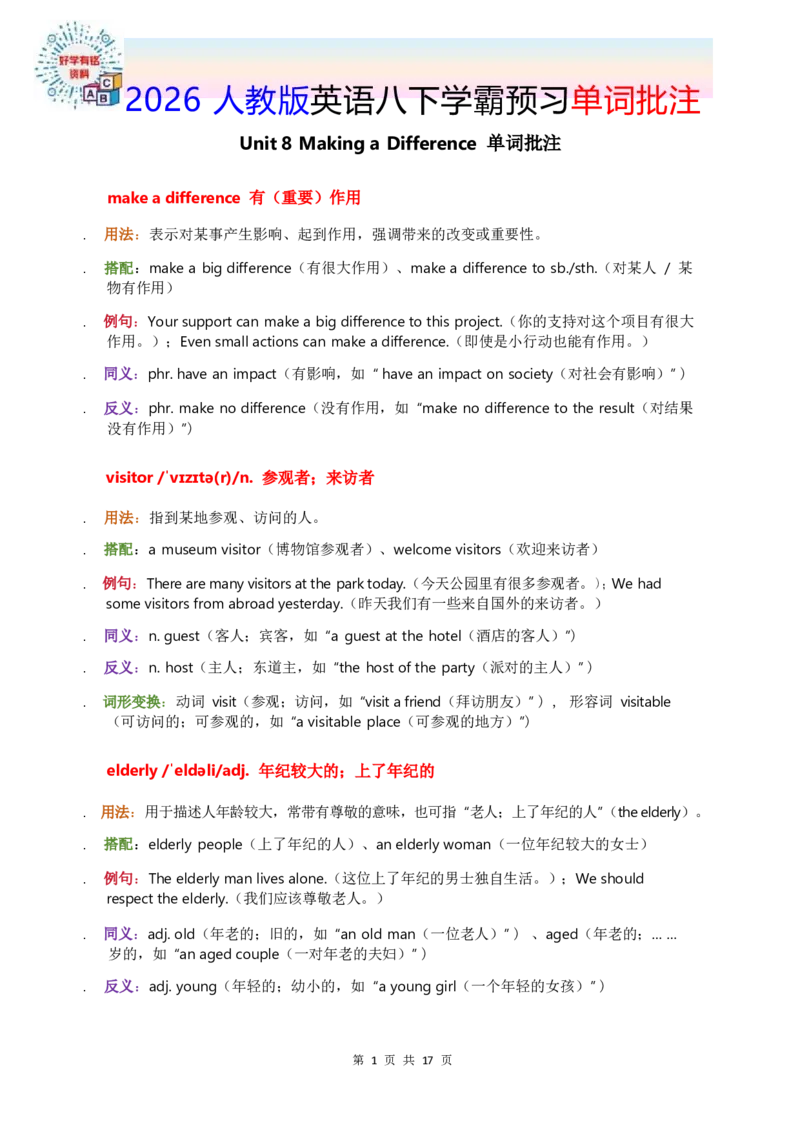
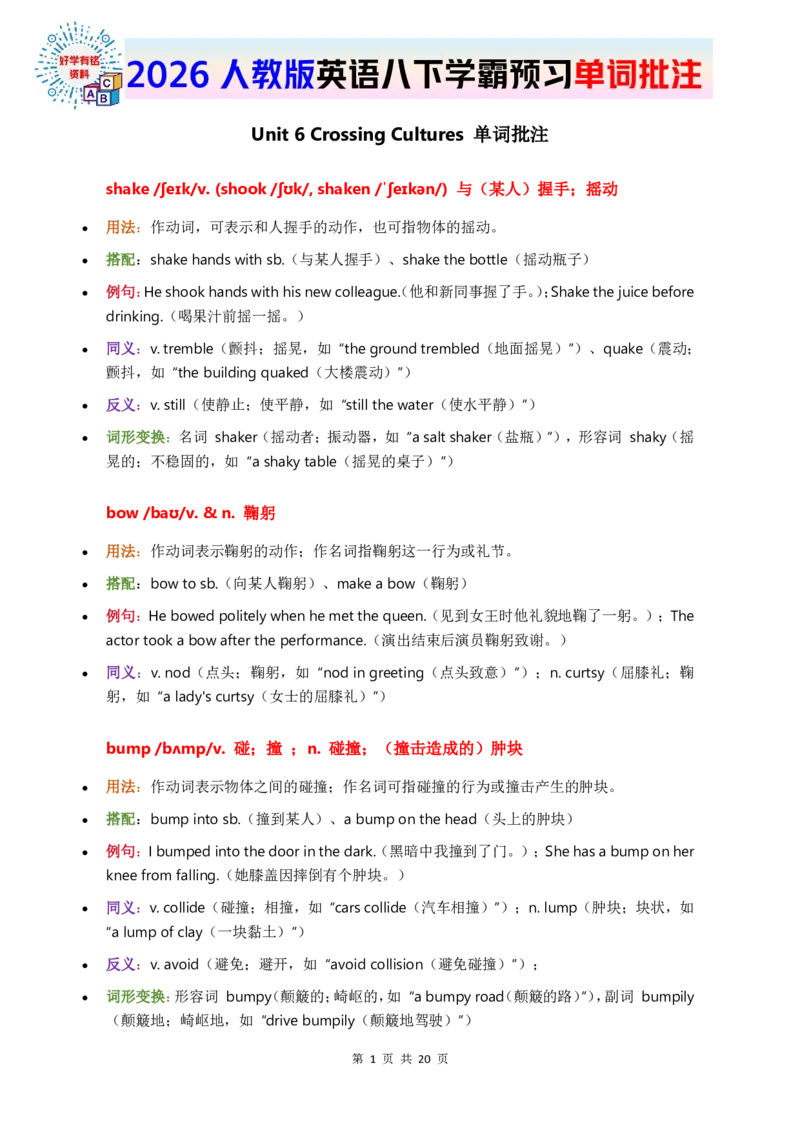
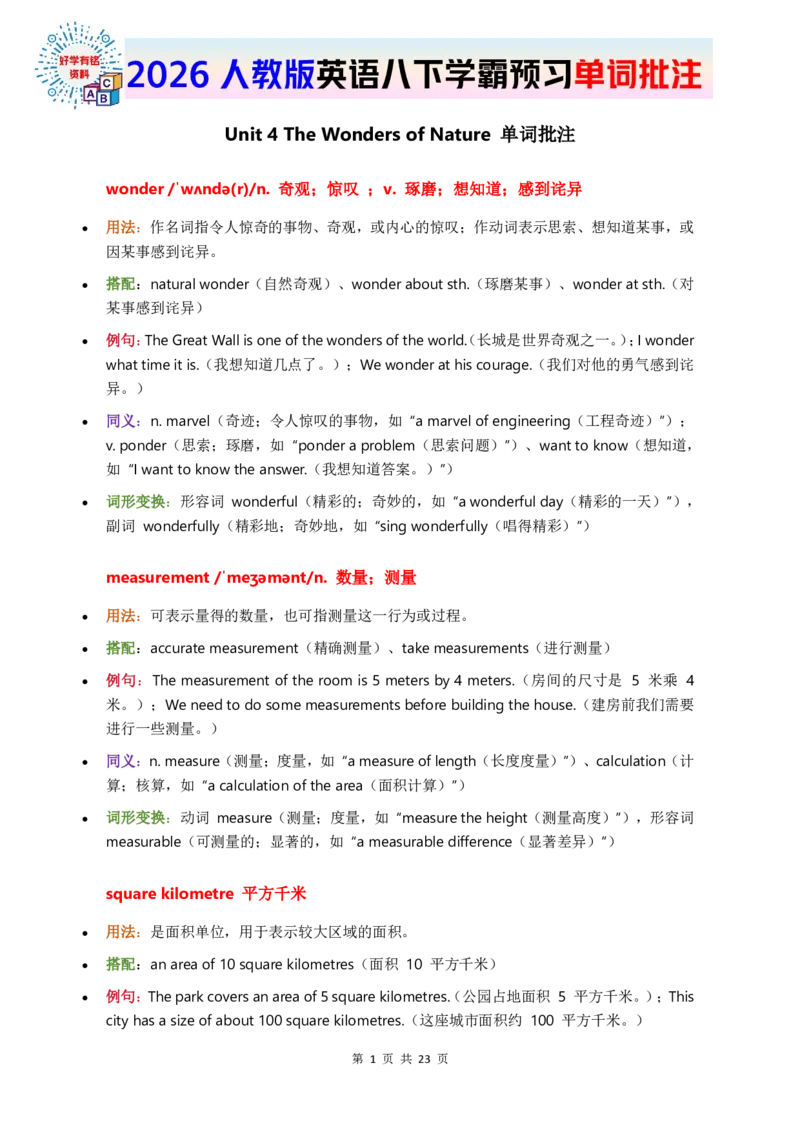
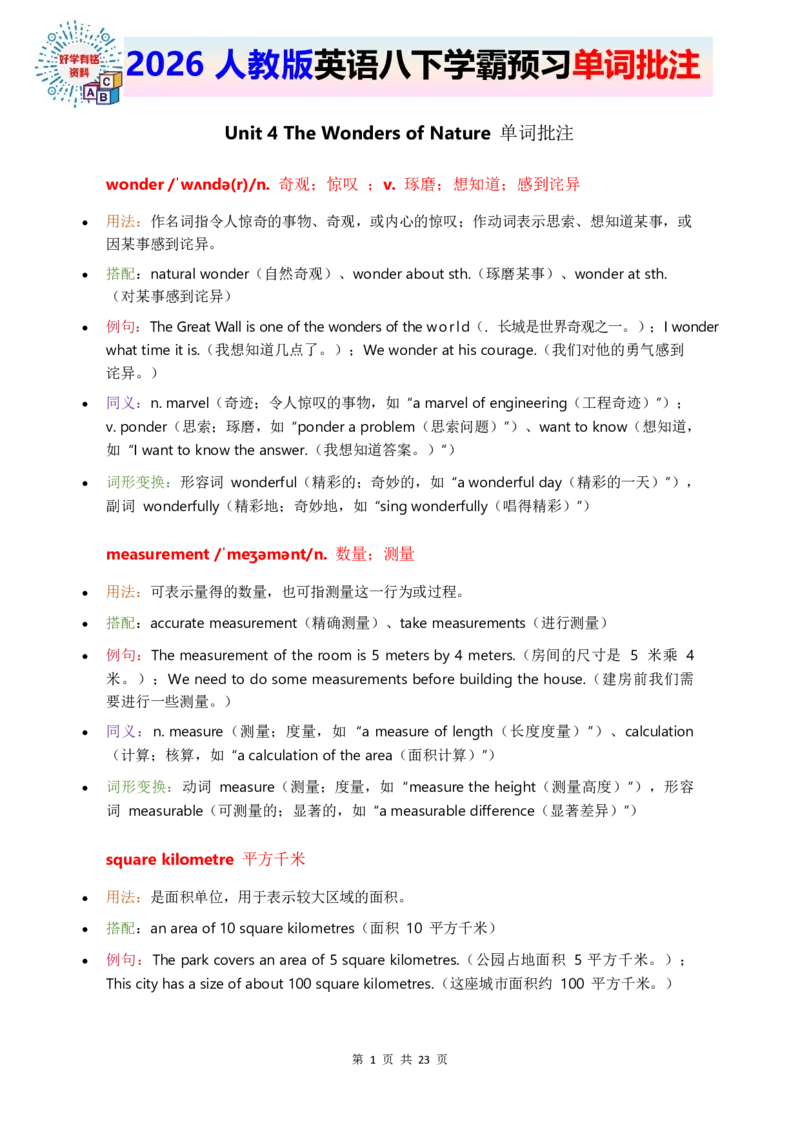
2026 人教版英语八下单元重点知识
Unit 1 Time to Relax 单元重点知识
一、词汇巩固
(一)核心名词(休闲活动 & 兴趣相关)
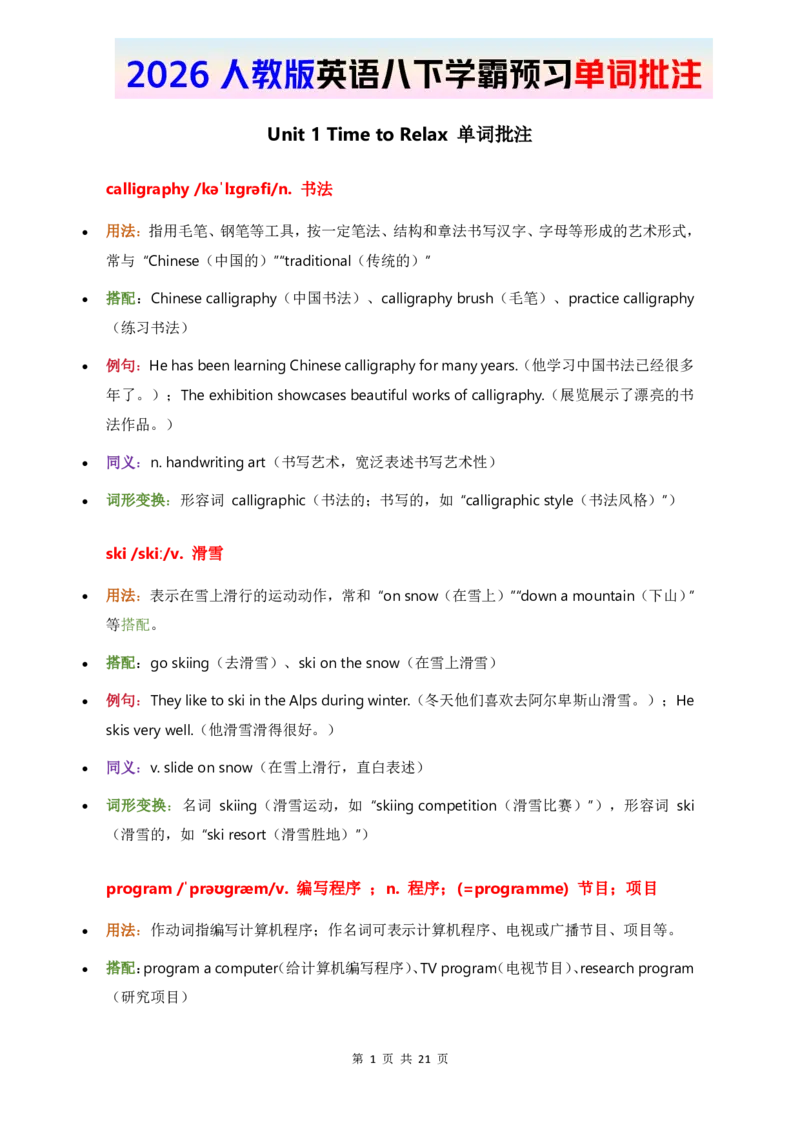
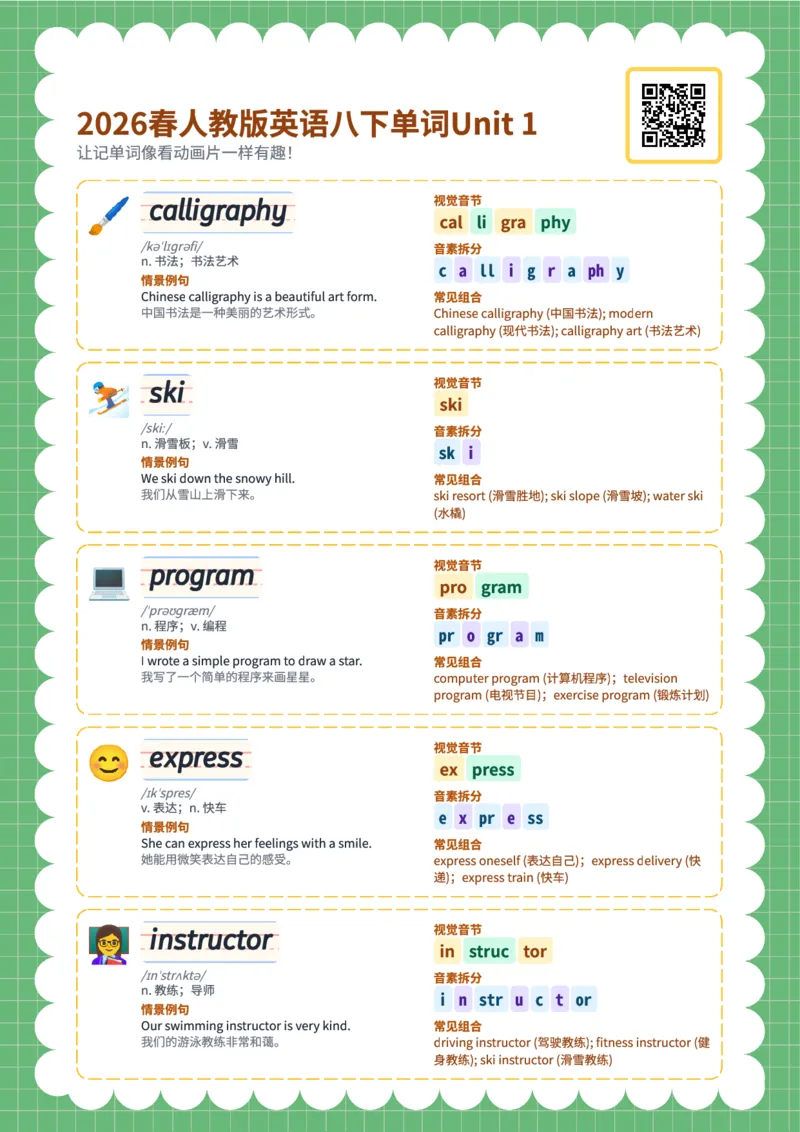
1. calligraphy /kəˈlɪɡrəfi/ (n.) 书法
例:Yaming spends an hour practicing calligraphy every evening—he even learned to write
Li Bai’s poems with proper single strokes.(亚明每天晚上花一小时练书法,他甚至学会
了用规范的单笔书写李白的诗。)
2. hobby/ˈhɒbi/ (n.) 爱好
例:Collecting postcards is Maya’s favorite hobby, and she has over 100 from 32 countries.
(收集明信片是马娅最喜欢的爱好,她有来自 32 个国家的 100 多张明信片。)
3. programming /ˈprəʊɡræmɪŋ/ (n.) 编写程序
例:Teng Fei is interested in programming; he dreams of making an app that helps students
find study partners, just like Luca’s Italian-learning app.(腾飞对编写程序感兴趣,他梦
想开发一个能帮学生找学习伙伴的应用,就像卢卡的意大利语学习应用一样。)
4. postcard /ˈpəʊstkɑːd/ (n.) 明信片
例:Maya’s postcard collection includes a special one of the Mogao Caves—her dad sent it
to her when she was five, and now it’s the most precious piece in her album.(马娅的明信
片收藏里有一张莫高窟的特别明信片,是她五岁时爸爸送的,现在成了她相册里最
珍贵的一张。)
5. instructor /ɪnˈstrʌktə(r)/ (n.) 教练;指导者
例:Emma’s ice skating instructor not only taught her basic skills but also encouraged her
not to give up when she fell.(埃玛的滑冰教练不仅教她基本技巧,还在她摔倒时鼓励
她不要放弃。)
6. stress /stres/ (n.) 精神压力;紧张
例:Many students feel stress from heavy homework, so they need hobbies like yoga or
painting to reduce it.(很多学生因繁重的作业感到压力,所以需要瑜伽、画画等爱好
来缓解。)
7. achievement /əˈtʃiːvmənt/ (n.) 成就
第 1 页 共 10 页2026 人教版英语八下单元重点知识
例:When Luca saw people from different countries using his app to learn Italian, he felt a
strong sense of achievement.(当卢卡看到不同国家的人用他的应用学意大利语时,他
感到强烈的成就感。)
8. ink /ɪŋk/(n.) 墨水
例:Yaming likes the smell of ink when he does calligraphy—it makes him feel relaxed.
(亚明练书法时喜欢墨水的味道,这能让他感到放松。)
(二)重点动词(活动参与 & 情绪调节)
1. take up 开始培养(爱好);从事
例:Peter took up playing the guitar last month—his dad teaches him on weekends, and he
practices for 30 minutes every day after school.(彼得上个月开始学弹吉他,爸爸周末
教他,他每天放学后练 30 分钟。)
2. give up 放弃
例:Fu Xing used to be scared of water, but she didn’t give up—she kept practicing and
finally learned to swim.(傅星以前怕水,但她没有放弃,坚持练习,最后学会了游
泳。)
3. get over 克服(困难);解决(问题)
例:Fu Xing used to be scared of water, but she got over her fear by taking swimming
lessons—now she goes swimming every Saturday.(傅星以前怕水,但她通过上游泳课
克服了恐惧,现在每周六都去游泳。)
4. express /ɪkˈspres/ (v.) 表达;表示
例:Helen loves painting because it helps her express her happiness or sadness when she
can’t put her feelings into words.(海伦喜欢画画,因为当她无法用语言表达情绪时,
画画能帮她传递喜怒哀乐。)
5. reduce /rɪˈdjuːs/ (v.) 减少;降低
例:Listening to soft music can reduce stress, and hiking in nature also works well for
many people.(听轻音乐能减压,去大自然徒步对很多人来说也很有效。)
6. dream of 梦想;渴望
例:Maya dreams of traveling to all the places on her postcards, especially the Mogao
Caves in Dunhuang.(马娅梦想去她明信片上所有的地方旅行,尤其是敦煌莫高窟。)
7. manage /ˈmænɪdʒ/ (v.) 完成(困难的事);管理
第 2 页 共 10 页2026 人教版英语八下单元重点知识
例:Yaming found it hard to hold the brush correctly at first, but he managed to master it
after two weeks of practice.(刚开始亚明觉得很难握对毛笔,但经过两周练习,他成
功掌握了握笔技巧。)
(三)关键形容词(感受 & 活动特征)
1. scared /skeəd/ (adj.) 害怕的;对…… 感到惊慌的
例:Emma was scared of ice skating at first because she fell many times, but she became
brave with her instructor’s help.(埃玛一开始怕滑冰,因为摔了很多次,但在教练的帮
助下变得勇敢了。)
2. relaxed /rɪˈlækst/ (adj.) 放松的
例:Shuyin feels relaxed when she rides her horse Nini—she can forget all her school
worries while being in the quiet farm.(舒音骑她的马妮妮时感到很放松,在安静的农
场里,她能忘记所有学业烦恼。)
3. creative /kriˈeɪtɪv/ (adj.) 有创造力的
例:Luca is creative—instead of doing traditional hobbies like painting, he makes mobile
apps to help others learn languages.(卢卡很有创造力,他不做画画这类传统爱好,而
是开发手机应用帮别人学语言。)
4. old-fashioned /ˌəʊld ˈfæʃənd/ (adj.) 过时的;守旧的
例:Some people think collecting postcards is old-fashioned, but Maya thinks they’re a
special way to keep memories of different places.(有些人觉得收集明信片过时了,但马
娅认为它们是保存不同地方记忆的特别方式。)
5. difficult /ˈdɪfɪkəlt/ (adj.) 困难的
例:Playing the guitar was difficult for Peter at first—his fingers hurt, and he couldn’t
remember the chords, but he didn’t give up.(刚开始弹吉他对彼得来说很难,手指疼,
还记不住和弦,但他没有放弃。)
二、词形变换
1. create (v. 创 造 ) → creative 有 创 造 力 的 ) → 创 造 物 )
(adj. creation (n.
→ creatively (adv. 创造性地)
例:Luca likes to create useful apps for language learning.(卢卡喜欢为语言学习开发实
用的应用。)
第 3 页 共 10 页2026 人教版英语八下单元重点知识
He is one of the most creative students in his school—he always has new ideas for apps.
(他是学校里最有创造力的学生之一,总能想出应用开发的新点子。)
The Italian-learning app is his latest creation, and it’s popular among students worldwide.
(这个意大利语学习应用是他最新的作品,在全球学生中很受欢迎。)
She solves problems creatively by using her programming skills to design new tools.(她通
过编程技能创造性地解决问题,设计新工具。)
2. relax (v. 放 松 ) → relaxed (adj. 感 到 放 松 的 ) → relaxing (adj. 令 人 放 松 的 )
→ relaxation (n. 放松)
例:Yaming relaxes by practicing calligraphy every evening after study.(亚明每天晚上
学习后通过练书法放松。)
After a long session of calligraphy, he feels relaxed and calm.(练完很长时间书法后,他
感到放松又平静。)
Calligraphy is a relaxing activity that helps people calm down when stressed.(书法是能让
人平静的放松活动,帮人在压力大时平复情绪。)
We all need enough relaxation after a busy week of schoolwork.(忙碌一周的学业后,我
们都需要充足的放松时间。)
3. achieve (v. 实现;取得) → achievement (n. 成就) → achievable (adj. 可实现的)
→ successfully (adv. 成功地)
例:Luca achieved his goal of helping others learn Italian through his app.(卢卡通过应
用实现了帮别人学意大利语的目标。)
Seeing users’ positive feedback gives him a strong sense of achievement.(看到用户的积
极反馈,他感到强烈的成就感。)
With daily practice, learning calligraphy is achievable for most people.(只要每天练习,
大多数人都能学会书法。)
Yaming successfully mastered single strokes after three weeks of hard work.(经过三周努
力,亚明成功掌握了单笔书写。)
4. express (v. 表达) → expression (n. 表达;表情) → expressive (adj. 善于表达的)
→ expressively (adv. 富有表现力地)
例:Helen expresses her feelings through painting when words fail her.(当语言无法表达
时,海伦通过画画传递情绪。)
第 4 页 共 10 页2026 人教版英语八下单元重点知识
Her paintings are full of expression—everyone can feel her joy or sadness from the colors.
(她的画充满情感表达,每个人都能从色彩中感受到她的喜怒哀乐。)
She is an expressive artist who uses brush strokes to show her ideas.(她是个善于表达的
艺术家,用笔触传递想法。)
Peter played the guitar expressively at the school party, and the audience was deeply
moved.(彼得在学校派对上弹吉他富有表现力,观众被深深打动。)
5. difficult (adj. 困难的) → difficulty (n. 困难 ) → more difficult (比较级) → most
difficult (最高级)
例:The first step of learning ice skating is difficult for beginners.(对初学者来说,学滑
冰的第一步很难。)
Emma faced many difficulties when she started ice skating, like falling and feeling scared.
(埃玛刚开始学滑冰时遇到很多困难,比如摔倒和害怕。)
Programming is more difficult than painting for most students, but it’s more creative.(对
大多数学生来说,编程比画画难,但更有创造力。)
The most difficult part of collecting postcards is finding rare ones from small countries.
(收集明信片最难的部分是找到小众国家的稀有明信片。)
三、重点短语
1. take up a hobby 开始培养爱好
例:Jason wants to take up a new hobby this semester, so he’s considering calligraphy or
hiking.(贾森这学期想培养一个新爱好,所以在考虑书法或徒步。)
2. give up 放弃
例:Don’t give up learning to play the flute—even if your fingers hurt, keep practicing, and
you’ll get better.(别放弃学吹长笛,即使手指疼,坚持练习,你会进步的。)
3. get over 克服(困难);解决(问题)
例:With her instructor’s help, Emma got over her fear of ice skating and can now skate
smoothly.(在教练的帮助下,埃玛克服了对滑冰的恐惧,现在能滑得很流畅。)
4. in return 作为回报
例:Yaming agreed to teach Peter to write a poem in calligraphy, and Peter offered to
teach him to play a simple guitar song in return.(亚明同意教彼得用书法写一首诗,彼
得提出教他弹一首简单的吉他曲作为回报。)
第 5 页 共 10 页2026 人教版英语八下单元重点知识
5. a sense of achievement 成就感
例:When Maya added the 100th postcard to her album, she felt a strong sense of
achievement.(当马娅往相册里加第 100 张明信片时,她感到强烈的成就感。)
6. deal with stress 应对压力
例:Many students deal with study stress by doing hobbies like yoga, painting, or listening
to music.(很多学生通过瑜伽、画画、听音乐等爱好应对学习压力。)
7. dream of 梦想;渴望
例:Maya dreams of traveling to every place shown on her postcards, and she’s saving
money for her first trip to Dunhuang.(马娅梦想去她明信片上所有的地方旅行,正在存
钱准备第一次去敦煌。)
8. once in a while 偶尔;间或
例:Teng Fei usually programs in his free time, but once in a while he goes hiking with his
family to enjoy nature.(腾飞空闲时通常编程,但偶尔会和家人去徒步,享受自然。)
9. go on an outing 外出游玩;远足
例:Shuyin’s family goes on an outing every Sunday—sometimes they go to the farm to
ride horses, and sometimes they hike in the mountains.(舒音一家每周日都去郊游,有时
去农场骑马,有时去山里徒步。)
10. give it a go 试一试
例:When Peter invited Yaming to try playing the guitar, Yaming said, “I’ve never played
it before, but I’ll give it a go.”(当彼得邀请亚明试试弹吉他时,亚明说:“我从没弹过,
但我会试试。”)
四、重点句型
1. 谈论日常休闲活动(频率 + 动作 + 目的):Sb. usually /often/every + 时间 + does
sth. in one’s free time. / Sb. spends + 时间 + (in) doing sth. to + 目的.
例:Teng Fei usually programs in his room every evening after finishing homework.(腾
飞每天晚上做完作业后,通常在房间里编程。)
Shuyin spends two hours riding her horse Nini every weekend to relax and enjoy nature.
(舒音每周花两小时骑她的马妮妮,为了放松和享受自然。)
2. 说明爱好的目的(动作 + 目的):Sb. does sth. to + 动词原形(目的). / The reason
why sb. does sth. is to + 动词原形(目的).
第 6 页 共 10 页2026 人教版英语八下单元重点知识
例:Yaming does calligraphy to relax after a busy day of study.(亚明在忙碌的学习日过
后,通过练书法放松。)
The reason why Luca makes mobile apps is to help people learn languages more easily.
(卢卡开发手机应用的原因,是为了帮人们更轻松地学语言。)
3. 描述爱好的起点(时间 + 动作):Sb. started doing sth. when sb. was + 年龄. / Sb.
first tried sth. + 时间状语,and it became sb.’s hobby later.
例:Maya started collecting postcards when she was five—her dad sent her the first one
from Dunhuang.(马娅五岁时开始收集明信片,爸爸从敦煌给她寄了第一张。)
Fu Xing first tried swimming when she was ten, and it became her favorite hobby after
she got over her fear of water.(傅星十岁时第一次尝试游泳,克服怕水的恐惧后,游
泳成了她最喜欢的爱好。)
4. 表达克服爱好困难的过程(过去状态 + 转折 + 现在结果):Sb. used to be + 困难
状态(如 scared /bad at...), but sb. + 克服动作(如 practiced /got help), and
nowsb. + 积极结果.
例:Emma used to be scared of ice skating and fell many times, but she practiced every
weekend with her instructor, and now she can skate smoothly.
(埃玛以前怕滑冰,摔了很多次,但她每周和教练一起练习,现在能滑得很流畅。)
Peter used to be bad at playing the guitar—his fingers hurt and he forgot chords, but he
practiced for 30 minutes every day, and now he can play simple songs.(彼得以前弹吉他
很差,手指疼还记不住和弦,但他每天练 30 分钟,现在能弹简单的曲子了。)
5. 提出尝试新爱好的建议(建议 + 理由):Why don’t you try + doing sth.(爱好)?
It’s
+ 积极特征(如 relaxing /fun), and it can help you + 好处(如 reduce stress
/makefriends).
例:Why don’t you try doing calligraphy? It’s relaxing, and it can help you learn about
Chinese culture.(你为什么不试试练书法呢?它很让人放松,还能帮你了解中国文
化。)
Why don’t you try collecting postcards? It’s fun, and it can help you learn about different
countries around the world.(你为什么不试试收集明信片呢?它很有趣,还能帮你了
解世界各地的国家。)
6. 对比不同爱好的特点(A 与 B 的差异 + 共同好处):Doing hobby A is + 特征(如
creative /modern), while doing hobby B is + 另一特征(如 traditional
/relaxing).Both can + 共同好处.
第 7 页 共 10 页2026 人教版英语八下单元重点知识
例:Programming is creative and modern, while calligraphy is traditional and relaxing.
Both can help you develop new skills.(编程有创造力且现代,而书法传统且放松,两
者都能帮你培养新技能。)
Collecting postcards is a quiet hobby that lets you learn about culture, while hiking is an
active hobby that keeps you fit. Both can make your free time meaningful.(收集明信片是
能让你了解文化的安静爱好,而徒步是能让你保持健康的活跃爱好,两者都能让你
的休闲时间有意义。)
7. 描述爱好带来的积极感受(爱好 + 感受 + 原因):Doing sth. makes sb. feel + 感
受(如 relaxed /proud)because + 原因(如 it helps sb. .../it lets sb. ...).
例:Playing the guitar makes Peter feel proud because he can play songs for his friends.(弹
吉他让彼得感到自豪,因为他能给朋友弹曲子。)
Collecting postcards makes Maya feel happy because it lets her learn about different places.
(收集明信片让马娅感到开心,因为这让她了解不同的地方。)
五、重点语法
(一)动词不定式(Infinitives)
1. 核心用法
作目的状语:说明主句动作的 “目的”,常位于主句后,可译为 “为了……”,是单元
描述 “爱好目的” 的核心语法。
例:I play the flute to relax after study.(我学习后吹长笛是为了放松。——“放松”
是“吹长笛” 的目的)They went to the sports centre to ice skate.(他们去运动中心是
为了滑冰。——“滑冰” 是 “去运动中心” 的目的)
作 宾 语 补 足 语 “ 宾 语 的 动 作 或 “ 主 语 + 动 词
(t : ell / 补 ask / 充 en c 说 ou ra 明 ge/w 状 a n 态 t 等 ” ), + 常宾 语见 + 于 to do” 结构,单元中多出现于 “他人建议、
鼓励培养爱好” 的场景。
例:The instructor told Emma not to give up so easily.(教练告诉埃玛不要轻易放弃。
——“不要放弃” 补充说明 “埃玛” 的动作)Peter’s dad encouraged him to practice
theguitar every day.(彼得的爸爸鼓励他每天练吉他。——“每天练吉他” 补充说明
“彼得” 的动作)
2. 关键注意点
省略 to 的情况:感官动词(see/hear/watch 等)和使役动词(let/make/have 等)后
第 8 页 共 10 页2026 人教版英语八下单元重点知识
接宾语补足语时,不定式省略 to。
例:I saw my mother paint when I was young.(我小时候看到妈妈画画。——see 后省
略 to)Let me help you with your calligraphy.(让我帮你练书法吧。——let 后省略
to)
“疑问词 + 不定式” 结构:what/how/where/when 等疑问词可与不定式连用,构成名
词性短语,在句中作主语、宾语等,单元中多出现于 “询问爱好相关的方法” 场景。
例:I don’t know how to use this brush.(我不知道怎么用这支毛笔。—— 作宾语)
What to do in free time is a question for many students.(空闲时做什么是很多学生的
疑问。—— 作主语)
否定式:由 “not + to + 动词原形” 构成,用于表达 “不建议、禁止的动作”,单元中
多出现于 “爱好相关的提醒”。
例:My parents told me not to push myself too hard when practicing the piano.(爸妈告
诉我练钢琴时不要太勉强自己。)The instructor warned Emma not to be afraid of
falling.(教练提醒埃玛不要怕摔倒。)
(二)一般过去时(Simple Past Tense)
1. 核心用法
描述过去的爱好经历:表示过去某个时间发生的 “短暂动作” 或存在的 “状态”,常
与明确的过去时间状语(yesterday, last week, when sb. was... 等)连用。
例:Yaming started doing calligraphy when he was ten.(亚明十岁时开始练书法。
——“开始” 是过去的短暂动作)Maya received her first postcard from her dad
fiveyears ago.(五年前,马娅收到了爸爸送的第一张明信片。——“收到” 是过去的
短暂动作)
否定句与疑问句:
例:Emma didn’t want to go ice skating again at first.(刚开始埃玛不想再去滑冰了。
—— 否定句:didn’t + 动词原形)Did Teng Fei go hiking last weekend?(腾飞上周
末去徒步了吗?—— 疑问句:Did + 主语 + 动词原形)
(三)一般现在时(Simple Present Tense)
1. 单元高频用法
描述经常性、习惯性的休闲活动:常与 every day, usually, often, on weekends 等频率
状语连用,是单元 “谈论日常爱好” 的核心语法。
例:Chen Jie does yoga every evening to reduce stress.(陈洁每天晚上练瑜伽减压。——
第 9 页 共 10 页2026 人教版英语八下单元重点知识
经常性动作)Teng Fei usually programs in his free time.(腾飞空闲时通常编程。
——习惯性动作)
描述爱好的客观特征或好处:表示 “客观事实”,不随时间变化,单元中用于说明
“爱好的普遍价值”。
例:Calligraphy helps people relax.(书法帮人们放松。—— 客观好处)Postcards
are agood way to learn about different places.(明信片是了解不同地方的好方式。——
客观特征)
2. 第三人称单数变化
主语为第三人称单数(he, she, it, 单数名
词等)时,谓语动词需变化,规则如下:
①一般动词加 - s(如 likes, practices,
programs);② 以 s, x, sh, ch 结尾的动词
加 - es(如 watches, finishes);③ 以辅音
字母 + y 结尾的动词变 y 为 i 加 - es(如
studies, tries)。
例:Luca creates useful apps.(卢卡开发实
用的应用。)Shuyin rides her horse
everyweekend.(舒音每周骑她的马。)
第 10 页 共 10 页