文档文本内容
2026 人教版英语八下学霸预习单词批注
Unit 4 The Wonders of Nature 单词批注
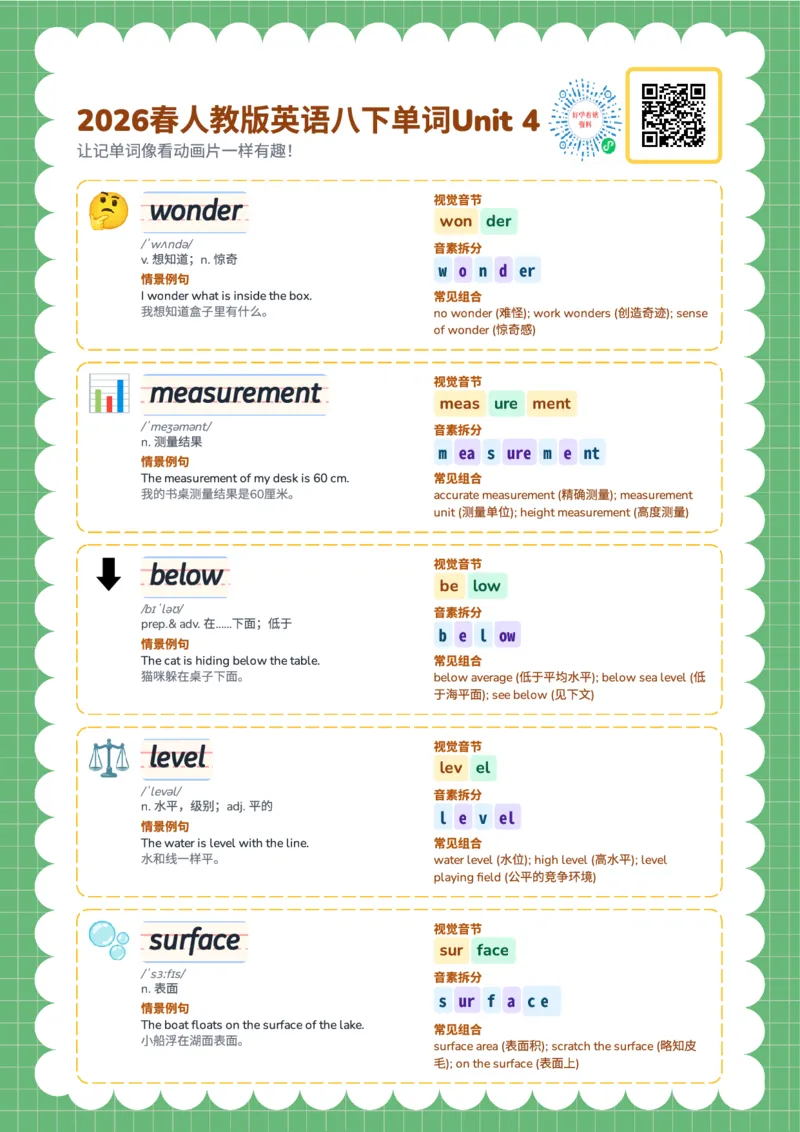
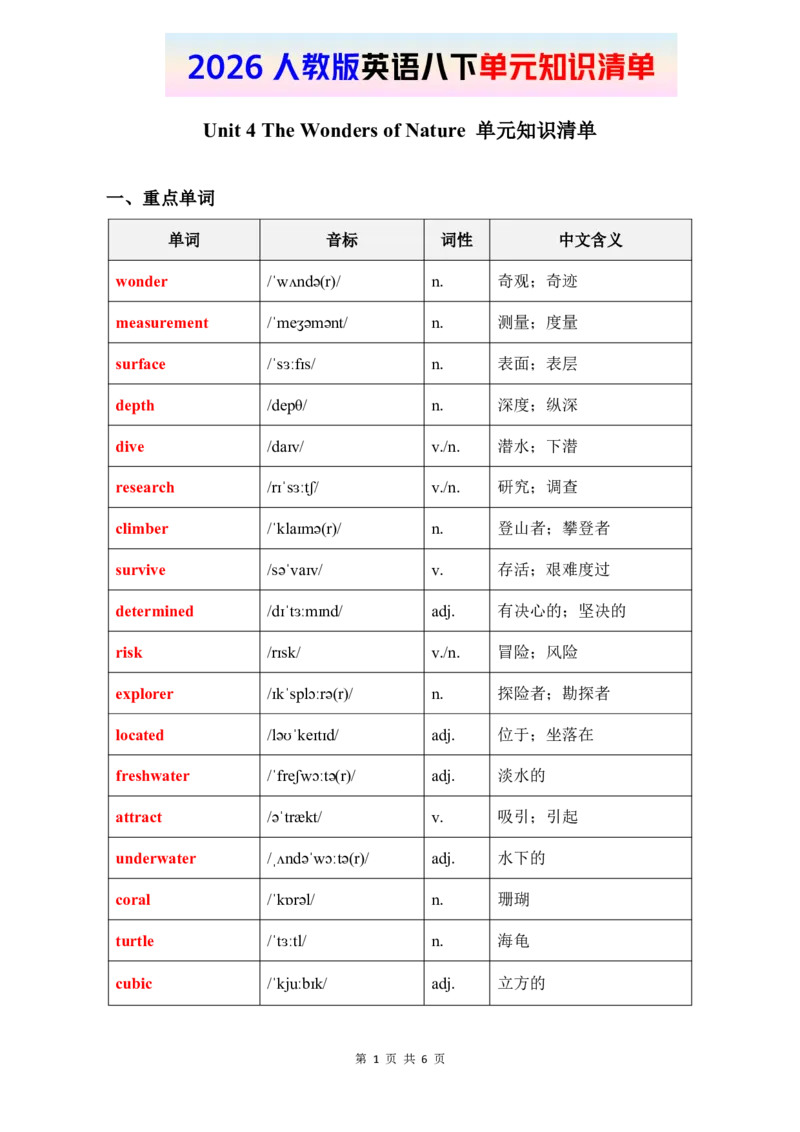
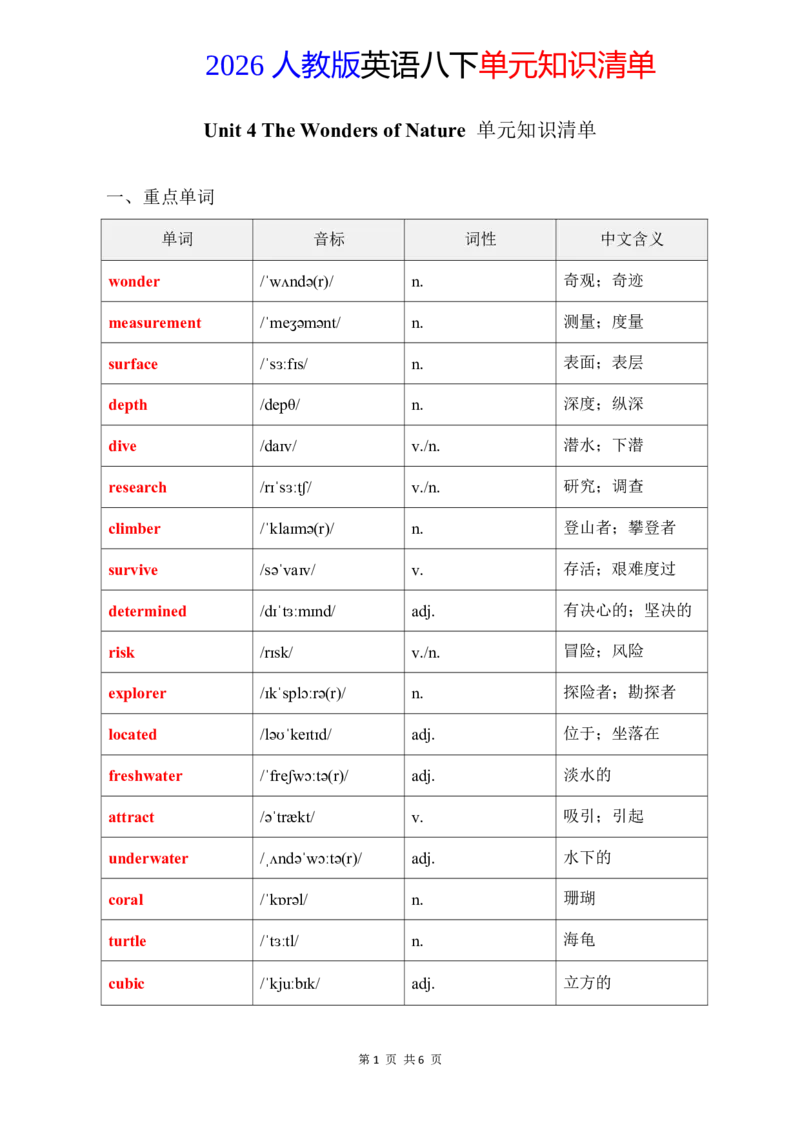
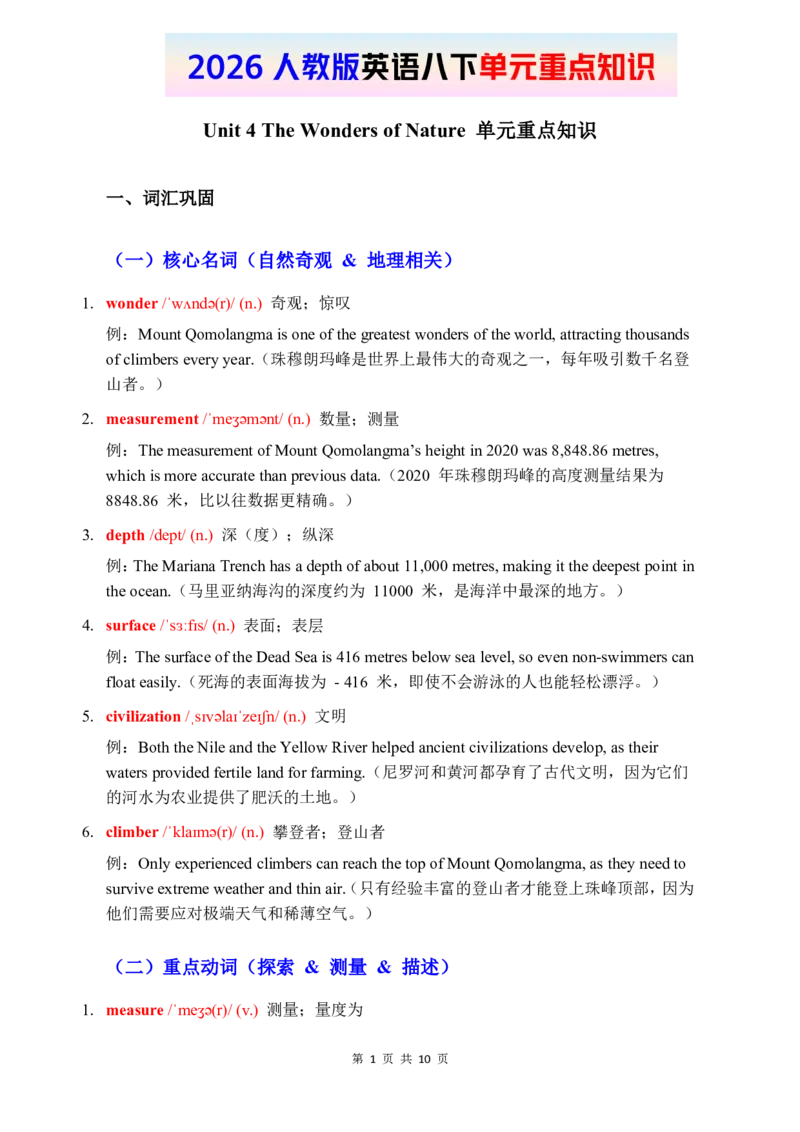
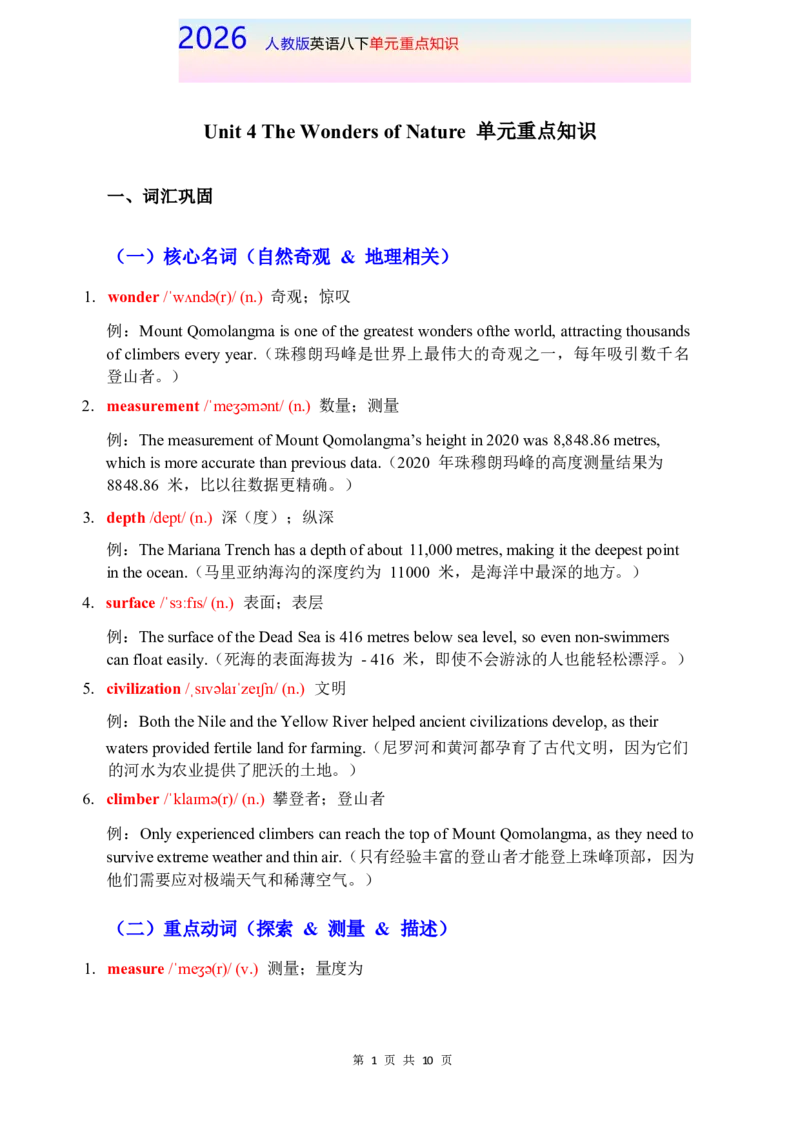
wonder /ˈwʌndə(r)/n. 奇观;惊叹 ;v. 琢磨;想知道;感到诧异
用法:作名词指令人惊奇的事物、奇观,或内心的惊叹;作动词表示思索、想知道某事,或
因某事感到诧异。
搭配:natural wonder(自然奇观)、wonder about sth.(琢磨某事)、wonder at sth.
(对某事感到诧异)
例句:The Great Wall is one of the wonders of the world(. 长城是世界奇观之一。);I wonder
what time it is.(我想知道几点了。);We wonder at his courage.(我们对他的勇气感到
诧异。)
同义:n. marvel(奇迹;令人惊叹的事物,如 “a marvel of engineering(工程奇迹)”);
v. ponder(思索;琢磨,如 “ponder a problem(思索问题)”)、want to know(想知道,
如 “I want to know the answer.(我想知道答案。)”)
词形变换:形容词 wonderful(精彩的;奇妙的,如 “a wonderful day(精彩的一天)”),
副词 wonderfully(精彩地;奇妙地,如 “sing wonderfully(唱得精彩)”)
measurement /ˈmeʒəmənt/n. 数量;测量
用法:可表示量得的数量,也可指测量这一行为或过程。
搭配:accurate measurement(精确测量)、take measurements(进行测量)
例句:The measurement of the room is 5 meters by 4 meters.(房间的尺寸是 5 米乘 4
米。);We need to do some measurements before building the house.(建房前我们需
要进行一些测量。)
同义:n. measure(测量;度量,如 “a measure of length(长度度量)”)、calculation
(计算;核算,如 “a calculation of the area(面积计算)”)
词形变换:动词 measure(测量;度量,如 “measure the height(测量高度)”),形容
词 measurable(可测量的;显著的,如 “a measurable difference(显著差异)”)
square kilometre 平方千米
用法:是面积单位,用于表示较大区域的面积。
搭配:an area of 10 square kilometres(面积 10 平方千米)
例句:The park covers an area of 5 square kilometres.(公园占地面积 5 平方千米。);
This city has a size of about 100 square kilometres.(这座城市面积约 100 平方千米。)
第 1 页 共 23 页2026 人教版英语八下学霸预习单词批注
同义:phr. square kilometer(平方千米,美式拼写)
below /bɪˈləʊ/prep. 在(或到)…… 下面;少于;低于 ;adv. 在(或到)下面
用法:作介词表示位置在…… 下方,或数量、程度等少于、低于;作副词表示在下方的位置。
搭配:below the table(在桌子下面)、temperature below zero(温度低于零度)、look below
(向下看)
例句:The cat is hiding below the chair.(猫躲在椅子下面。);His score is below average.
(他的分数低于平均水平。);She looked below and saw a river.(她向下看,看到了一
条河。)
同义:prep. beneath(在…… 下方;低于,如 “beneath the surface(在表面下方)”);
adv. underneath(在下面;在底下,如 “the book is underneath(书在下面)”)
反义:prep. above(在…… 上面;高于,如 “above the mountain(在山上)”);adv. above
(在上面;在高处,如 “the bird flies above(鸟在上面飞)”)
level /ˈlevl/n. 高度;水平;程度
用法:可指物体的高度,也可指技能、知识等的水平,或事物的程度。
搭配:water level(水位)、English level(英语水平)、a high level of difficulty(高难度)
例句:The water level in the lake is rising(. 湖水位在上升。);His level of English is very high.
(他的英语水平很高。);This task is at a difficult level.(这项任务难度大。)
同义:n. height(高度;身高,如 “the height of the building(建筑物高度)”)、standard
(水平;标准,如 “a high standard of living(高水平生活)”)
词形变换:动词 level(使平整;使同等,如 “level the ground(平整地面)”),形容词 level
(水平的;平稳的,如 “a level surface(水平表面)”)
surface /ˈsɜːfɪs/n. 表面;表层
用法:指物体的外部表层、表面。
搭配:the surface of the earth(地球表面)、smooth surface(光滑表面)
例句:The surface of the table is
桌子表面脏了。);Oil floats on the surface of water.
dirty(.
(油浮在水面上。)
同义:n. exterior(外部;表面,如 “the exterior of the house(房子外部)”)、outside
(外面;外表,如 “the outside of the box(盒子外面)”)
反义:n. interior(内部;内里,如 “the interior of the car(汽车内部)”)
第 2 页 共 23 页2026 人教版英语八下学霸预习单词批注
词形变换:动词 surface(浮出水面;显露,如 “the submarine surfaced(潜艇浮出水
面)”),形容词 surface(表面的;肤浅的,如 “surface knowledge(肤浅的知识)”)
depth /depθ/n. 深(度);纵深
用法:指从物体表面到底部的距离,即深度,也可表示事物的纵深程度。
搭配:the depth of the sea(海的深度)、depth of field(景深)
例句:The depth of the well is 20 meters.(井深 20 米。);This painting has great depth.
(这幅画很有纵深感。)
同义:n. deepness(深度;浓度,如 “the deepness of the river(河流深度)”)
反义:n. shallowness(浅;浅薄,如 “the shallowness of the lake(湖的浅)”)
词形变换:形容词 deep(深的;深厚的,如 “a deep river(深河)”),副词 deeply(深
深地;深入地,如 “love deeply(深爱)”)
dive /daɪv/v. & n. 潜水;跳水;俯冲
用法:作动词表示潜入水中、跳水,或(飞机等)俯冲;作名词指潜水、跳水或俯冲的动作。
搭配:dive into the water(潜入水中)、a dive from the cliff(从悬崖跳水)、dive bombing
(俯冲轰炸)
例句:He dived into the pool.(他潜入泳池。);She did a beautiful dive.(她跳水动作优
美。);The plane dived towards the ground.(飞机向地面俯冲。)
同义:v. plunge(跳入;俯冲,如 “plunge into the lake(跳入湖中)”);n. plunge(投
入;跳水,如 “a plunge into the water(跳入水中)”)
反义:v. ascend(上升;升高,如 “the plane ascended(飞机上升)”);n. ascent(上
升;升高,如 “the ascent of the mountain(登山)”)
词形变换:名词 diver(潜水员;跳水者,如 “a scuba diver(水肺潜水员)”),形容词 diving
(潜水的;跳水的,如 “diving equipment(潜水装备)”)
research /rɪˈsɜːtʃ/v. & n. 研究;调查
用法:作动词和名词都表示对某事物进行探究、调查以获取知识等。
搭配:do research(做研究)、research into sth.(研究某事)
例句:She is researching the history of the city
她在研究这座城市的历史。);This research
(. is very important.(这项研究很重要。)
第 3 页 共 23 页2026 人教版英语八下学霸预习单词批注
同义:v. investigate(调查;研究,如 “investigate a crime(调查犯罪)”);n. investigation
(调查;研究,如 “an investigation into the matter(对事情的调查)”)
词形变换:名词 researcher(研究者;调查者,如 “a scientific researcher(科学研究
者)”),形容词 research(研究的;有关研究的,如 “research findings(研究成果)”)
vessel /ˈvesl/n. 大船;轮船
用法:指大型的船、轮船,用于水上运输等。
搭配:a cargo vessel(货船)、passenger vessel(客轮)
例句:The vessel sailed across the ocean(. 轮船横渡大洋。);This vessel can carry thousands
of tons of goods.(这艘船能运载数千吨货物。)
同义:n. ship(船;舰,如 “a war ship(军舰)”)、boat(船;小舟,如 “a fishing boat
(渔船)”,但 “vessel” 更侧重大型船)
unusual /ʌnˈjuːʒuəl/adj. 特别的;不寻常的
用法:形容事物不同于平常、特别、不常见。
搭配:an unusual event(不寻常的事件)、unusual weather(反常天气)
例句:It's unusual for him to be late.(他迟到很不寻常。);She has an unusual talent
for music.(她在音乐方面有特别的天赋。)
同义:adj. extraordinary(非凡的;特别的,如 “an extraordinary idea(非凡的想法)”)、
peculiar(奇特的;不寻常的,如 “a peculiar custom(奇特的习俗)”)
反义:adj. usual(通常的;寻常的,如 “the usual time(通常的时间)”)、ordinary(普
通的;平常的,如 “an ordinary day(平常的一天)”)
词形变换:副词 unusually(特别地;不寻常地,如 “unusually cold weather(异常寒冷的
天气)”),名词 unusualness(特别;不寻常,如 “the unusualness of the situation(情
况的不寻常)”)
bottom /ˈbɒtəm/n. 底部;最下部
用法:指物体的最下端部分。
搭配:at the bottom of(在…… 的底部)、bottom of the sea(海底)
例句:There is a stone at the bottom of the lake.(湖底有一块石头。);The bottom of
the box is broken.(盒子的底部破了。)
第 4 页 共 23 页2026 人教版英语八下学霸预习单词批注
同义:n. base(底部;基础,如 “the base of a mountain(山底)”)、foot(底部;脚,
如 “the foot of the bed(床脚)”)
反义:n. top(顶部;顶端,如 “the top of the building(楼顶)”)
词形变换:形容词 bottom(底部的;最下部的,如 “bottom layer(底层)”),动词 bottom
(以…… 为底;基于,如 “bottom the plan on facts(以事实为计划基础)”)
waterfall /ˈwɔːtəfɔːl/n. 瀑布
用法:指从高处倾泻而下的水流,即瀑布。
搭配:beautiful waterfall(美丽的瀑布)、visit a waterfall(参观瀑布)
例句:They saw a magnificent waterfall in the
他们在山里看到了壮观的瀑布。);
mountains(.
The waterfall makes a loud noise.(瀑布发出很大的声响。)
同义:n. cascade(小瀑布;瀑布状物,如 “a cascade in the forest(森林里的小瀑布)”)
civilization /ˌsɪvəlaɪˈzeɪʃn/ (= civilisation) n. 文明
用法:指人类社会发展到较高阶段的文化、文明状态。
搭配:ancient civilization(古代文明)、modern civilization(现代文明)
例句:The ancient Egyptian civilization is very famous(. 古埃及文明非常著名。);We should
protect our traditional civilization.(我们应该保护我们的传统文明。)
同义:n. culture(文化;文明,如 “Chinese culture(中国文化)”)
反义:n. barbarism(野蛮;未开化,如 “the barbarism of the tribe(部落的野蛮)”)
词形变换:形容词 civilized(文明的;有教养的,如 “a civilized society(文明社会)”),
动词 civilize(使文明;教化,如 “civilize the natives(教化当地人)”)
means /miːnz/n. (pl. means) 方式;途径
用法:表示做某事的方法、途径,单复数同形。
搭配:by means of(用;依靠)、a means of transport(一种交通方式)
第 5 页 共 23 页2026 人教版英语八下学霸预习单词批注
例句:We can solve the problem by this means(. 我们可以用这种方式解决问题。);
Television
is an important means of communication.(电视是一种重要的交流途径。)
同义:n. method(方法;办法,如 “a method of teaching(教学方法)”)、way(方式;
方法,如 “a way to success(成功的方式)”)
development /dɪˈveləpmənt/n. 发展;壮大
用法:指事物由小到大、由简单到复杂的变化过程,即发展。
搭配:economic development(经济发展)、the development of science(科学的发展)
例句:The development of the city is rapid(. 城市的发展很迅速。);We should pay attention
to the development of children.(我们应该关注儿童的发展。)
同义:n. growth(生长;发展,如 “the growth of a plant(植物的生长)”)、progress
(进步;发展,如 “make progress(取得进步)”)
反义:n. decline(衰退;衰落,如 “the decline of the empire(帝国的衰落)”)
词形变换:动词 develop(发展;开发,如 “develop a new product(开发新产品)”),
形容词 developmental(发展的;发育的,如 “developmental stages(发展阶段)”)
desert /ˈdezət/n. 沙漠;荒原
用法:指干旱、少雨、植被稀少的大片沙地,即沙漠。
搭配:vast desert(广阔的沙漠)、cross a desert(穿越沙漠)
例句:They traveled through the desert.(他们穿越了沙漠。);Few plants can grow in
the desert.(很少有植物能在沙漠里生长。)
同义:n. sandy desert(沙质沙漠,如 “a sandy desert in Africa(非洲的沙质沙漠)”)
反义:n. oasis(绿洲;乐土,如 “an oasis in the desert(沙漠中的绿洲)”)
词形变换:形容词 desert(沙漠的;荒凉的,如 “desert landscape(沙漠景观)”),动词
desert(抛弃;遗弃,如 “desert one's family(抛弃家庭)”)
cubic /ˈkjuːbɪk/adj. 立方的
用法:用于描述与立方体、立方度量相关的事物。
第 6 页 共 23 页2026 人教版英语八下学霸预习单词批注
搭配:cubic meter(立方米)、cubic centimeter(立方厘米)
例句:The box has a volume of 1 cubic meter(. 这个盒子的体积是 1 立方米。);This material
has a density of 5 grams per cubic centimeter.(这种材料的密度是每立方厘米 5 克。)
同义:adj. cubical(立方的;立方体的,如 “a cubical room(立方体的房间)”)
词形变换:名词 cube(立方体;立方,如 “a sugar cube(方糖)”“the cube of 3(3 的立
方)”),副词 cubically(立方地;按立方,如 “measure cubically(按立方测量)”)
mile /maɪl/n. 英里
用法:是英制长度单位,1 英里约等于 1.609 千米。
搭配:a mile away(一英里远)、run a mile(跑一英里)
例句:The town is five miles from here.(城镇离这里五英里。);He can walk three miles
an hour.(他每小时能走三英里。)
词形变换:名词 mileage(英里数;里程,如 “the mileage of the car(汽车的里程)”)
pool /puːl/n. 池塘;水坑
用法:指自然或人工形成的小水域,如池塘、水坑。
搭配:swimming pool(游泳池)、a pool of water(一滩水)
例句:There is a small pool in the garden.(花园里有一个小池塘。);After the rain, a
pool of water formed on the road.(雨后,路上形成了一滩水。)
同义:n. pond(池塘;水塘,如 “a fish pond(鱼塘)”)
词形变换:动词 pool(集中;共用,如 “pool resources(集中资源)”),形容词 pooled
(集中的;共用的,如 “pooled money(共用的钱)”)
climber /ˈklaɪmə(r)/n. 攀登者;登山者
用法:指从事攀登、登山活动的人。
搭配:mountain climber(登山者)、experienced climber(有经验的攀登者)
第 7 页 共 23 页2026 人教版英语八下学霸预习单词批注
例句:The climber reached the top of the mountain(. 攀登者到达了山顶。);Climbers need
special equipment.(攀登者需要特殊装备。)
同义:n. mountaineer(登山家;山地人,如 “a professional mountaineer(职业登山家)”)
词形变换:动词 climb(攀登;爬,如 “climb a tree(爬树)”),形容词 climbing(攀登
的;上升的,如 “climbing boots(登山靴)”)
northern /ˈnɔːðən/adj. 北部的;向北的
用法:用于描述方位,指北部的、向北的。
搭配:northern part(北部)、northern city(北部城市)
例句:The northern part of the country is very cold.(这个国家的北部非常冷。);We are
heading to a northern city.(我们正前往一个北部城市。)
同义:adj. north(北方的;北部的,如 “north wind(北风)”)
反义:adj. southern(南部的;向南的,如 “southern region(南部地区)”)
词形变换:名词 north(北;北方,如 “in the north(在北方)”),副词 northward(向
北;向北地,如 “travel northward(向北旅行)”)
distance /ˈdɪstəns/n. 距离;遥远
用法:指两点之间的空间间隔,即距离,也可表示遥远的状态。
搭配:long distance(长距离)、distance between A and B(A 和 B 之间的距离)
例句:What's the distance from here to the station?(从这里到车站的距离是多少?);
The town is at a distance.(城镇在远处。)
同义:n. space(空间;距离,如 “the space between two trees(两棵树之间的距离)”)
反义:n. proximity(接近;邻近,如 “in proximity to the school(靠近学校)”)
词形变换:动词 distance(疏远;与…… 保持距离,如 “distance oneself from others(与
他人保持距离)”),形容词 distant(遥远的;远处的,如 “a distant star(遥远的星
星)”)
survive /səˈvaɪv/v. 生存;存活;艰难度过
第 8 页 共 23 页2026 人教版英语八下学霸预习单词批注
用法:表示在困难、危险等情况下存活下来,或艰难度过某段时期。
搭配:survive an accident(在事故中存活)、survive the winter(艰难度过冬天)
例句:Only a few people survived the earthquake.(只有少数人在地震中存活下来。);The
plant can survive in harsh conditions.(这种植物能在恶劣条件下存活。)
同义:v. live through(经历…… 而活下来,如 “live through the war(经历战争活下
来)”)、 endure(忍受;忍耐,如 “endure the pain(忍受痛苦)”)
反义:v. perish(死亡;毁灭,如 “perish in the fire(在火灾中死亡)”)
词形变换:名词 survival(生存;幸存,如 “the survival of the fittest(适者生存)”),形
容词 surviving(幸存的;残存的,如 “the surviving members(幸存的成员)”)
condition /kənˈdɪʃn/n. 状态;境况
用法:指人或事物所处的状态、情况。
搭配:good condition(良好状态)、living conditions(生活境况)
例句:The car is in excellent condition.(这辆车状况极佳。);The workers' living conditions
need to be improved.(工人们的生活境况需要改善。)
同义:n. state(状态;状况,如 “the state of health(健康状态)”)、situation(情况;
形势,如 “the economic situation(经济形势)”)
词形变换:动词 condition(训练;使适应,如 “condition athletes(训练运动员)”),形
容词 conditional(有条件的;假定的,如 “a conditional agreement(有条件的协议)”)
degree /dɪˈɡriː/n. 度;度数;程度
用法:可表示角度的度、温度的度数,也可表示程度。
搭配:degree of freedom(自由度)、30 degrees Celsius(30 摄氏度)
例句:The angle is 90 degrees.(角度是 90 度。);To what degree do you agree with him?
(你在多大程度上同意他?)
同义:n. extent(程度;范围,如 “to a certain extent(在一定程度上)”)、level(水平;
程度,如 “a high level of skill(高水平的技能)”)
第 9 页 共 23 页2026 人教版英语八下学霸预习单词批注
词形变换:形容词 degreed(有学位的,如 “a degreed engineer(有学位的工程师)”),
副词 degreewise(在程度上;就程度而言,如 “degreewise, it's acceptable(在程度上,
这是可接受的)”)
cliff /klɪf/n. 悬崖;峭壁
用法:指陡峭的山崖、悬崖。
搭配:steep cliff(陡峭的悬崖)、cliff diving(悬崖跳水)
例句:The village is at the foot of a cliff.(村庄在悬崖脚下。);He is afraid of heights, so
he dare not look down from the cliff.(他恐高,所以不敢从悬崖往下看。)
同义:n. bluff(悬崖;峭壁,如 “a river bluff(河边峭壁)”)
反义:n. plain(平原;平地,如 “a vast plain(广阔的平原)”)
词形变换:形容词 cliffy(多悬崖的;陡峭的,如 “a cliffy coast(多悬崖的海岸)”)
changeable /ˈtʃeɪndʒəbl/adj. 可能变化的;易变的;常变的
用法:形容事物容易变化、不稳定。
搭配:changeable weather(多变的天气)、changeable mood(易变的情绪)
例句:The weather here is very changeable
这里的天气非常多变。);She has a changeable
(. personality.(她性格易变。)
同义:adj. variable(可变的;易变的,如 “variable temperature(可变的温度)”)、unstable
(不稳定的;易变的,如 “an unstable situation(不稳定的局势)”)
反义:adj. stable(稳定的;稳固的,如 “a stable job(稳定的工作)”)、constant(恒定
的;不变的,如 “constant speed(恒定的速度)”)
词形变换:动词 change(改变;变化,如 “change one's mind(改变主意)”),名词
changeability(可变性;易变性,如 “the changeability of fashion(时尚的易变性)”)
death /deθ/n. 死亡;毁灭;破灭
用法:指生命的终止,或事物的毁灭、破灭。
搭配:die of death(死于……)、fear of death(对死亡的恐惧)
第 10 页 共 23 页2026 人教版英语八下学霸预习单词批注
例句:His death made us very sad.(他的死亡让我们非常悲伤。);The war led to the death
of many people.(战争导致许多人死亡。)
同义:n. demise(死亡;终止,更正式,如 “the demise of the company(公司的倒闭)”)
反义:n. life(生命;生活,如 “value life(珍惜生命)”)
词形变换:动词 die(死亡;凋零,如 “die peacefully(安详去世)”),形容词 dead(死
的;无生命的,如 “a dead tree(枯树)”)
determined /dɪˈtɜːmɪnd/adj. 有决心的;坚决的
用法:形容人意志坚定、有决心去做某事。
搭配:be determined to do sth.(决心做某事)、a determined look(坚决的神情)
例句:She is determined to finish the work on time.(她决心按时完成工作。);He has a
determined attitude towards his goals.(他对自己的目标态度坚决。)
同义:adj. resolute(坚决的;果断的,如 “a resolute decision(果断的决定)”)、firm(坚
定的;牢固的,如 “a firm belief(坚定的信念)”)
反义:adj. indecisive(优柔寡断的;犹豫不决的,如 “an indecisive person(优柔寡断的
人)”)、 hesitant(犹豫的;迟疑的,如 “be hesitant to act(犹豫行动)”)
词形变换:动词 determine(决定;确定,如 “determine to go(决定去)”),名词
determination(决心;决定,如 “show determination(展现决心)”)
above /əˈbʌv/prep. 在(或向)…… 上面;超过 ;adv. 在(或向)上面;在(或
向)高处;超过
用法:作介词表示位置在…… 之上或数量等超过;作副词表示在上方、超过的状态。
搭配:above the table(在桌子上方)、temperature above 30℃(温度超过 30℃)、fly above
(在上方飞)
例句:The picture is above the bed.(画在床的上方。);The number is above 100.(数
字超过 100。);The plane flew above.(飞机在上方飞行。)
同义:prep. over(在…… 之上;超过,如 “over the mountain(在山之上)”);adv. overhead
(在头顶上方;在空中,如 “lights overhead(头顶的灯)”)
第 11 页 共 23 页2026 人教版英语八下学霸预习单词批注
反义:prep. below(在…… 下面;低于,如 “below the bridge(在桥下面)”);adv. below
(在下面;在低处,如 “write below(在下面写)”)
词形变换:名词 above(上文;上述内容,如 “as mentioned above(如上文所述)”),
形容词 above(上述的;上文的,如 “the above points(上述要点)”)
teammate /ˈtiːmmeɪt/n. 同队队员;队友
用法:指在同一队伍中的伙伴、队员。
搭配:good teammate(好队友)、support teammates(支持队友)
例句:He is a reliable teammate
他是个可靠的队友。);Teammates should help each other.
(.
(队友们应该互相帮助。)
同义:n. partner(伙伴;队友,如 “a partner in the game(比 中的伙伴)”)
反义:n. opponent(对手;反对者,如 “a strong opponent(强大的对手)”)
shoulder /ˈʃəʊldə(r)/n. 肩膀;肩部
用法:指人体的肩膀、肩部部位。
搭配:shoulder pain(肩痛)、rest one's hand on the shoulder(把手放在肩膀上)
例句:He carried the bag on his shoulder.(他把包扛在肩上。);She has a tattoo on her
shoulder.(她肩膀上有个纹身。)
词形变换:动词 shoulder(肩负;承担,如 “shoulder the responsibility(承担责任)”)
bit by bit 一点一点地;逐渐地
用法:表示以缓慢、逐步的方式进行。
搭配:learn bit by bit(一点一点地学习)、improve bit by bit(逐渐改进)
例句:He built the model plane bit by bit(. 他一点一点地制作飞机模型。);The city changed
bit by bit over the years.(这些年城市逐渐发生变化。)
同义:phr. gradually(逐渐地;逐步地,如 “gradually get better(逐渐变好)”)、step by
step(逐步地;一步一步地,如 “solve the problem step by step(逐步解决问题)”)
第 12 页 共 23 页2026 人教版英语八下学霸预习单词批注
反义:phr. all at once(突然;一下子,如 “finish the work all at once(一下子完成工作)”)
ladder /ˈlædə(r)/n. 梯子;阶梯;途径
用法:可指实际的梯子,也可比喻为达到目的的途径、阶梯。
搭配:climb a ladder(爬梯子)、a ladder to success(成功的阶梯)
例句:He used a ladder to reach the high shelf.(他用梯子够到高架子。);Education is
a ladder to a better life.(教育是通往更好生活的途径。)
同义:n. stair(楼梯;阶梯,如 “a flight of stairs(一段楼梯)”)、stepladder(活梯;踏
步梯,如 “a stepladder for painting(画画用的活梯)”)
词形变换:动词 ladder(使成阶梯状;使梯化,如 “ladder the fields(把田地弄成阶梯状)”)
measure /ˈmeʒə(r)/v. 测量;量度为 ;n. 措施;度量单位
用法:作动词时,指用工具等测定尺寸、数量等;作名词可表示为达到目的采取的办法或度
量的单位。
搭配:measure the length(测量长度)、take measures(采取措施)、unit of measure(度
量单位)
例句:Can you measure the room for me?(你能帮我测量一下房间吗?);The
government has taken measures to improve the economy.(政府已采取措施改善经
济。);Meter is a measure of length.(米是长度度量单位。)
同义:v. gauge(测量;估量,如 “gauge the temperature(测量温度)”);n. step(步
骤;措施,如 “a step to solve the problem(解决问题的措施)”)、unit(单位;单元,如
“a unit of weight(重量单位)”)
词形变换:名词 measurement(测量;尺寸,如 “the measurement of the desk(书桌的
尺寸)”),形容词 measurable(可测量的;显著的,如 “a measurable change(显著的变
化)”)
successfully /səkˈsesfəli/adv. 成功地;顺利地
用法:用于修饰动词,说明动作以成功、顺利的方式完成。
第 13 页 共 23 页2026 人教版英语八下学霸预习单词批注
搭配:complete successfully(成功完成)、pass successfully(顺利通过)
例句:They successfully climbed the mountain.(他们成功地爬上了山。);The project
was completed successfully.(项目顺利完成了。)
同义:adv. triumphantly(胜利地;成功地,如 “win triumphantly(胜利获胜)”)、smoothly
(顺利地;平稳地,如 “go smoothly(进展顺利)”)
反义:adv. unsuccessfully(不成功地;失败地,如 “try unsuccessfully(尝试失败)”)
词形变换:形容词 successfu(l 成功的;有成效的,如 “a successful business(成功的生
意)”),
名词 success(成功;胜利,如 “achieve success(取得成功)”)
risk /rɪsk/v. 使…… 冒风险(或面临危险) ;n. 危险;风险
用法:作动词表示让某人或某物处于危险境地;作名词指可能发生的危险、风险。
搭配:risk one's life(冒生命危险)、take a risk(冒险)、high risk(高风险)
例句:He risked his health to finish the work.(他为完成工作冒损害健康的风险。);
There is a risk of rain today.(今天有下雨的风险。)
同义:v. endanger(危及;使遭受危险,如 “endanger the environment(危及环境)”);
n. danger(危险;威胁,如 “in danger(处于危险中)”)
反义:v. protect(保护;保卫,如 “protect the children(保护孩子)”);n. safety(安全;
平安,如 “ensure safety(确保安全)”)
词形变换:形容词 risky(有危险的;冒险的,如 “a risky investment(冒险的投资)”),
副词 riskily(冒险地;危险地,如 “act riskily(冒险行动)”)
curiosity /ˌkjʊəriˈɒsəti/n. 好奇心;求知欲
用法:指对事物好奇、渴望了解的心理。
搭配:out of curiosity(出于好奇心)、arouse curiosity(引起好奇心)
例句:Children are full of curiosity.(孩子们充满好奇心。);His curiosity about space
led him to study astronomy.(他对太空的好奇心促使他研究天文学。)
第 14 页 共 23 页2026 人教版英语八下学霸预习单词批注
同义:n. inquisitiveness(好问;求知欲,如 “his inquisitiveness about nature(他对自然的
求知欲)”)
反义:n. indifference(漠不关心;冷淡,如 “show indifference to others(对他人漠不关心)”)
词形变换:形容词 curious(好奇的;求知欲强的,如 “a curious child(好奇的孩子)”),
副词 curiously(好奇地;奇怪地,如 “look curiously(好奇地看)”)
ambition /æmˈbɪʃn/n. 追求的目标;野心;雄心
用法:可指积极追求的理想、目标,也可指带有贬义的野心。
搭配:achieve one's ambition(实现抱负)、political ambition(政治野心)
例句:She has the ambition to become a doctor.(她有成为医生的抱负。);His
ambition for power made him do bad things.(他对权力的野心使他做了坏事。)
同义:n. aspiration(抱负;渴望,如 “aspiration for success(对成功的渴望)”)、drive
(干劲;驱动力,如 “a drive to succeed(成功的干劲)”)
反义:n. contentment(满足;知足,如 “find contentment in life(在生活中找到满足)”)
词形变换:形容词 ambitious(有雄心的;野心勃勃的,如 “an ambitious plan(雄心勃勃
的计划)”),副词 ambitiously(雄心勃勃地;劲头十足地,如 “work ambitiously(劲头
十足地工作)”)
explorer /ɪkˈsplɔːrə(r)/n. 探险者;勘探者
用法:指从事探险、勘探活动的人。
搭配:polar explorer(极地探险者)、explorer of the universe(宇宙勘探者)
例句:The explorer discovered a new river.(探险者发现了一条新河流。);Many
explorers went to the unknown land.(许多勘探者前往未知的土地。)
同义:n. adventurer(冒险家;探险者,如 “an adventurer in the jungle(丛林冒险家)”)
词形变换:动词 explore(探索;勘探,如 “explore the fores(t 探索森林)”),名词 exploration
(探索;勘探,如 “the exploration of space(太空探索)”)
simply /ˈsɪmpli/adv. 仅仅;只;简单地
第 15 页 共 23 页2026 人教版英语八下学霸预习单词批注
用法:用于强调 “只、仅仅”,或说明方式 “简单地”。
搭配:simply a mistake(仅仅是个错误)、explain simply(简单解释)
例句:It's simply a matter of time.(这仅仅是时间问题。);She dressed simply for the party.
(她为派对简单打扮了一下。)
同义:adv. merely(仅仅;只不过,如 “merely a suggestion(仅仅是个建议)”)、just
(仅仅;只是,如 “just a little(只是一点)”)
反义:adv. complicatedly(复杂地;难懂地,如 “explain complicatedly(复杂解释)”)
词形变换:形容词 simple(简单的;单纯的,如 “a simple question(简单的问题)”),
名词 simplicity(简单;朴素,如 “the simplicity of life(生活的朴素)”)
risky /ˈrɪski/adj. 有危险(或风险)的
用法:形容事物具有危险、冒险的性质。
搭配:risky behavior(危险行为)、risky investment(有风险的投资)
例句:Skiing in bad weather is
在恶劣天气滑雪很危险。);This is a risky business deal.
risky(.
(这是一笔有风险的商业交易。)
同义:adj. dangerous(危险的;不安全的,如 “a dangerous road(危险的道路)”)、hazardous
(危险的;有害的,如 “hazardous chemicals(危险化学品)”)
反义:adj. safe(安全的;无危险的,如 “a safe place(安全的地方)”)
词形变换:名词 risk(危险;风险,如 “take a risk(冒险)”),副词 riskily(冒险地;危
险地,如 “drive riskily(冒险驾驶)”)
southern /ˈsʌðən/adj. 南部的;向南的
用法:用于描述方位,指南部的、向南的。
搭配:southern region(南部地区)、southern city(南部城市)
例句:The southern part of the country is warmer(. 这个国家的南部更温暖。);We're going
to a southern town.(我们要去一个南部的城镇。)
同义:adj. south(南方的;南部的,如 “south wind(南风)”)
第 16 页 共 23 页2026 人教版英语八下学霸预习单词批注
反义:adj. northern(北部的;向北的,如 “northern climate(北部气候)”)
词形变换:名词 south(南;南方,如 “in the south(在南方)”),副词 southward(向
南;向南地,如 “travel southward(向南旅行)”)
located /ləʊˈkeɪtɪd/adj. 位于;坐落在
用法:用于说明人或事物所处的位置。
搭配:be located in/at(位于……)
例句:The hotel is located near the beach.(酒店坐落在海滩附近。);Our school is located
in the city center.(我们学校位于市中心。)
同义:adj. situated(位于;坐落在,如 “a house situated by the river(坐落在河边的房子)”)
词形变换:动词 locate(定位;找到,如 “locate the source(找到源头)”),名词 location
(位置;场所,如 “the location of the accident(事故地点)”)
freshwater /ˈfreʃwɔːtə(r)/adj. 淡水的;淡水中生长的
用法:形容与淡水相关的,或在淡水中生长的。
搭配:freshwater fish(淡水鱼)、freshwater lake(淡水湖)
例句:There are many freshwater species in this river.(这条河里有许多淡水物种。);
The lake provides freshwater for the village.(这个湖为村庄提供淡水。)
反义:adj. saltwater(咸水的;海水的,如 “saltwater crocodile(咸水鳄)”)
type /taɪp/n. 类型;种类
用法:指事物的类别、种类。
搭配:different types of(不同类型的)、type of music(音乐类型)
例句:What type of book do you like?(你喜欢什么类型的书?);There are several
types of flowers in the garden.(花园里有几种类型的花。)
同义:n. kind(种类;类型,如 “a kind of fruit(一种水果)”)、sort(种类;类别,如
“a sort of activity(一种活动)”)
第 17 页 共 23 页2026 人教版英语八下学霸预习单词批注
词形变换:动词 type(打字;输入,如 “type a letter(打一封信)”),形容词 typical(典
型的;有代表性的,如 “a typical example(典型例子)”)
attract /əˈtrækt/v. 吸引;招引;引起(反应)
用法:表示把人、物等吸引过来,或引起某种反应。
搭配:attract attention(吸引注意力)、attract customers(吸引顾客)
例句:The beautiful scenery attracts many tourists.(美丽的风景吸引了许多游客。);
Her smile attracted him.(她的微笑吸引了他。)
同义:v. draw(吸引;拉,如 “draw a crowd(吸引人群)”)、charm(吸引;迷住,如
“charm the audience(迷住观众)”)
反义:v. repel(排斥;使厌恶,如 “repel insects(排斥昆虫)”)
词形变换:名词 attraction(吸引;吸引力,如 “the attraction of the city(城市的吸引
力)”),形容词 attractive(有吸引力的;迷人的,如 “an attractive person(迷人的
人)”)
curious /ˈkjʊəriəs/adj. 好奇的;求知欲强的
用法:形容人对事物充满好奇、有很强的求知欲。
搭配:curious about(对…… 好奇)、a curious child(好奇的孩子)
例句:He is curious about everything around him(. 他对周围的一切都很好奇。);The curious
student asked many questions.(求知欲强的学生问了许多问题。)
同义:adj. inquisitive(好奇的;好问的,如 “an inquisitive mind(好奇的头脑)”)
反义:adj. indifferent(漠不关心的;冷淡的,如 “be indifferent to news(对新闻漠不关心)”)
词形变换:名词 curiosity(好奇心;求知欲,如 “out of curiosity(出于好奇心)”),副
词 curiously(好奇地;奇怪地,如 “look curiously at(好奇地看)”)
traveller /ˈtrævələ(r)/ (= traveler) n. 旅行者;游客
用法:指外出旅行、游览的人。
搭配:foreign traveller(外国旅行者)、traveller's guide(旅行者指南)
第 18 页 共 23 页2026 人教版英语八下学霸预习单词批注
例句:Travellers come to this city for its history.(旅行者因这座城市的历史而来。);She is
a frequent traveller.(她是个常旅行的人。)
同义:n. tourist(游客;旅行者,如 “a tourist attraction(旅游景点)”)、voyager(航海
者;旅行者,如 “a voyager across the ocean(穿越大洋的旅行者)”)
词形变换:动词 travel(旅行;行进,如 “travel around the world(环游世界)”)
natural /ˈnætʃrəl/adj. 自然的;天然的;天生的
用法:可形容事物是自然存在的、天然的,或人有天生的特质。
搭配:natural beauty(自然美)、natural talent(天生的才能)
例句:The park has many natural landscapes.(公园有许多自然景观。);She has a
natural ability to sing.(她有天生的歌唱才能。)
同义:adj. innate(天生的;固有的,如 “innate intelligence(天生的智力)”)、organic
(有机的;天然的,如 “organic food(有机食品)”)
反义:adj. artificial(人造的;人工的,如 “artificial flowers(人造花)”)、unnatural(不
自然的;反常的,如 “an unnatural pose(不自然的姿势)”)
词形变换:名词 nature(自然;本性,如 “love nature(热爱自然)”),副词 naturally
(自然地;天生地,如 “speak naturally(自然地说话)”)
underwater /ˌʌndəˈwɔːtə(r)/adj. 水下的;用于水下的 ;adv. 在水下
用法:作形容词表示在水下的或用于水下的;作副词表示在水下的状态。
搭配:underwater world(水下世界)、underwater camera(水下相机)、swim underwater
(在水下游泳)
例句:There are many strange creatures in the underwater world.(水下世界有许多奇怪的
生物。);He took photos with an underwater camera.(他用水下相机拍照。);
同义:adj. subaqueous(水下的;水中的,如 “subaqueous plants(水下植物)”);adv.
beneath the water(在水下,如 “dive beneath the water(潜入水下)”)
反义:adj. abovewater(水上的;水面上的,如 “abovewater activities(水上活动)”);
adv. above water(在水面上,如 “float above water(浮在水面上)”)
第 19 页 共 23 页2026 人教版英语八下学霸预习单词批注
northeastern /ˌnɔːθˈiːstən/adj. 东北的;东北方向的
用法:用于描述方位,指东北的、东北方向的。
搭配:northeastern city(东北城市)、northeastern wind(东北风)
例句:The northeastern part of the country is cold in
这个国家的东北部冬天很冷。);
winter(. A northeastern wind is blowing.(正刮着东北
风。)
同义:adj. northeasterly(东北的;向东北的,如 “northeasterly direction(东北方向)”)
反义:adj. southwestern(西南的;西南方向的,如 “southwestern region(西南地区)”)
词形变换:名词 northeast(东北;东北部,如 “in the northeast(在东北部)”),副词
northeastward(向东北;在东北,如 “travel northeastward(向东北旅行)”)
coast /kəʊst/n. 海岸;海滨
用法:指陆地与海洋交界的地带,即海岸、海滨。
搭配:seaside coast(海滨海岸)、coast city(沿海城市)
例句:We walked along the coast.(我们沿着海岸散步。);There are many resorts on
the coast.(海岸上有许多度假胜地。)
同义:n. shore(岸;滨,如 “the shore of the lake(湖滨)”)、seashore(海岸;海滨,
如 “play on the seashore(在海滨玩耍)”)
反义:n. inland(内陆;内地,如 “live in the inland(住在内陆)”)
词形变换:形容词 coastal(沿海的;海岸的,如 “coastal areas(沿海地区)”),动词 coast
(滑行;沿岸航行,如 “coast down the hill(滑下山)”)
coral /ˈkɒrəl/n. 珊瑚;珊瑚虫
用法:指珊瑚这种海洋生物或其骨骼堆积成的物质。
搭配:coral reef(珊瑚礁)、coral island(珊瑚岛)
例句:Coral is very beautiful.(珊瑚非常美丽。);Many fish live around the coral reef.
(许多鱼生活在珊瑚礁周围。)
词形变换:形容词 coral(珊瑚的;珊瑚色的,如 “coral color(珊瑚色)”)
第 20 页 共 23 页2026 人教版英语八下学霸预习单词批注
reef /riːf/n. 礁;礁脉
用法:指海洋中由岩石、珊瑚等形成的礁石、礁脉。
搭配:coral reef(珊瑚礁)、reef ecosystem(礁脉生态系统)
例句:The ship hit a reef and sank.(船撞上礁石沉没了。);
同义:n. rock(岩石;礁石,如 “a rock in the sea(海里的礁石)”)
include /ɪnˈkluːd/v. 包含;包括
用法:表示把某事物包含在整体里面。
搭配:include sb. in(把某人包括在内)、include sth. as(把某物作为…… 包括)
例句:The price includes tax.(价格包含税款。);We included him in our team.(我们把
他纳入我们的团队。)
同义:v. contain(包含;容纳,如 “a box containing toys(装着玩具的盒子)”)、comprise
(包含;由…… 组成,如 “a team comprising five members(由五名成员组成的团队)”)
反义:v. exclude(排除;不包括,如 “exclude irrelevant details(排除无关细节)”)
词形变换:名词 inclusion(包含;加入,如 “the inclusion of new members(新成员的加
入)”),形容词 inclusive(包含的;包括的,如 “an inclusive policy(包容的政策)”)
sand /sænd/n. 沙子
用法:指细小的石粒,通常存在于海滩、沙漠等地。
搭配:play in the sand(在沙子里玩)、sand beach(沙滩)
例句:Children like to build castles with sand.(孩子们喜欢用沙子堆城堡。);The desert
is covered with sand.(沙漠被沙子覆盖。)
词形变换:形容词 sandy(多沙的; sandy 含沙的,如 “a sandy beach(沙滩)”),动词
sand(用砂纸磨;撒沙于,如 “sand the floor(用砂纸磨地板)”)
alive /əˈlaɪv/adj. 活着;在世;有活力
用法:用于描述人或生物有生命、活着的状态,或事物充满活力。
第 21 页 共 23 页2026 人教版英语八下学霸预习单词批注
搭配:stay alive(活着)、alive with energy(充满活力)
例句:Is the fish still alive?(鱼还活着吗?);The city is alive at
城市夜晚充满活力。)
night(.
同义:adj. living(活着的;现存的,如 “living creatures(生物)”)、active(活跃的;积
极的,如 “an active person(活跃的人)”)
反义:adj. dead(死的;无生命的,如 “a dead plant(枯死的植物)”)、lifeless(无生命
的;死气沉沉的,如 “a lifeless room(死气沉沉的房间)”)
词形变换:名词 aliveness(活力;活泼,如 “the aliveness of the party(派对的活力)”)
structure /ˈstrʌktʃə(r)/n. 结构(体);构造;体系
用法:可指物体的结构、构造,也可指组织、制度等的体系。
搭配:building structure(建筑结构)、social structure(社会结构)
例句:The structure of the bridge is very strong.(桥的结构很坚固。);
同义:n. framework(框架;结构,如 “a framework of ideas(思想框架)”)、construction
(构造;建设,如 “the construction of a house(房屋的构造)”)
反义:n. chaos(混乱;无秩序,如 “a state of chaos(混乱状态)”)
词形变换:动词 structure(组织;构成,如 “structure a speech(组织演讲)”),形容词
structural(结构的;建筑的,如 “structural problems(结构问题)”)
snorkel /ˈsnɔːkl/v. 使用呼吸管潜泳 ;n. (浮潜用的) 呼吸管
用法:作动词表示用呼吸管潜泳的动作;作名词指浮潜时用的呼吸管。
搭配:snorkel in the sea(在海里用呼吸管潜泳)、a snorkel set(一套呼吸管装备)
例句:We went snorkeling in the tropical waters.(我们去热带海域用呼吸管潜泳了。);
He bought a new snorkel for his vacation.(他为假期买了一个新的呼吸管。)
同义:v. dive(潜水;下潜,如 “dive underwater(潜水)”);n. breather(呼吸管;通气
装置,如 “a diving breather(潜水呼吸管)”)
school /skuːl/n. (鱼、鲸、海豚等的) 群
第 22 页 共 23 页2026 人教版英语八下学霸预习单词批注
用法:用于表示鱼、鲸、海豚等水生动物的群体。
搭配:a school of fish(一群鱼)、a school of dolphins(一群海豚)
例句:We saw a large school of whales in the ocean.(我们在海里看到了一大群鲸。);A
school of fish swam past the boat.(一群鱼游过了船。)
同义:n. shoal(鱼群;浅滩,如 “a shoal of herring(一群鲱鱼)”)
turtle /ˈtɜːtl/n. 海龟;龟
用法:指海龟或一般的龟类动物。
搭配:sea turtle(海龟)、turtle shell(龟壳)
例句:Turtles lay eggs on the beach.(海龟在海滩上产卵。);The turtle moves very slowly.
(龟移动得很慢。)
同义:n. tortoise(陆龟;龟,如 “a land tortoise(陆龟)”)
lifetime /ˈlaɪftaɪm/n. 一生;终身
用法:指一个人从出生到死亡的整个生命期间,或某事物存在的整个时期。
搭配:in one's lifetime(在某人一生中)、a lifetime achievement(终身成就)
例句:He traveled to many countries in his lifetime.(他一生中去过许多国家。);This book
is his lifetime work.(这本书是他的终身著作。)
同义:n. life(生命;一生,如 “all one's life(一生)”)、duration(持续时间;期间,如
“the duration of the project(项目期间)”)
反义:n. moment(片刻;瞬间,如 “a moment of happiness(片刻的幸福)”)
词形变换:形容词 lifetime(终身的;一生的,如 “a lifetime friend(终身朋友)”)
第 23 页 共 23 页