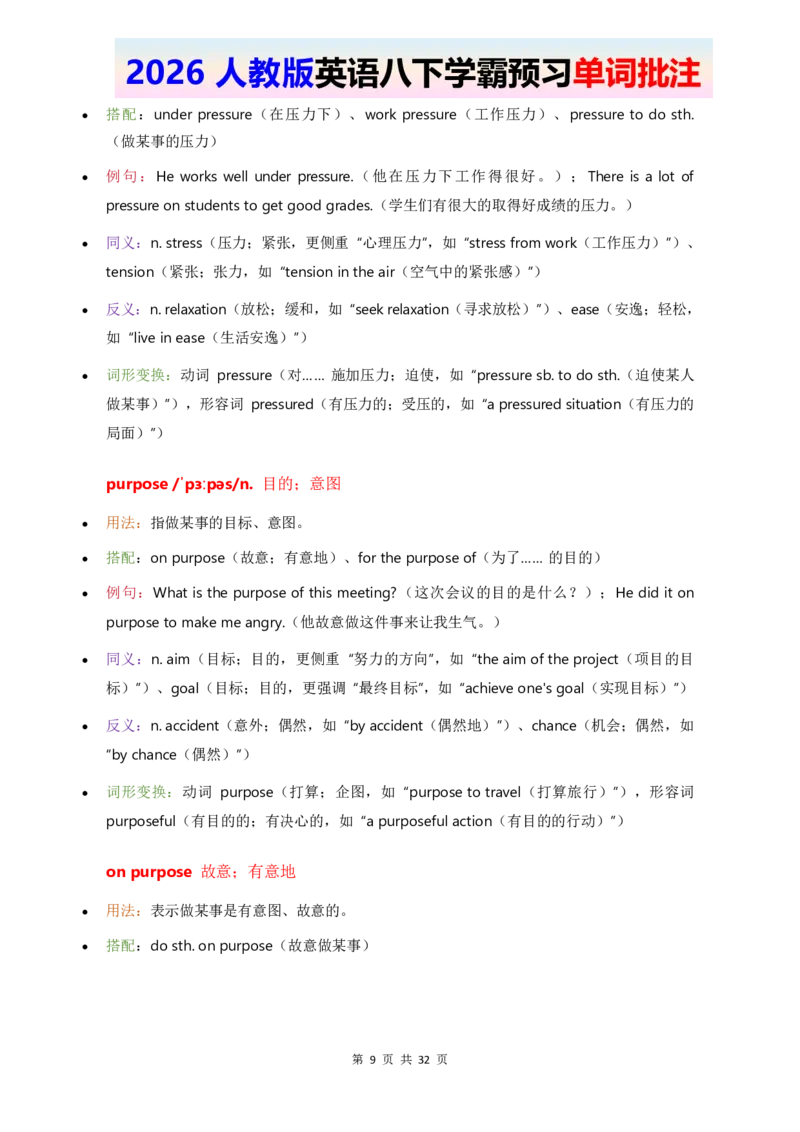
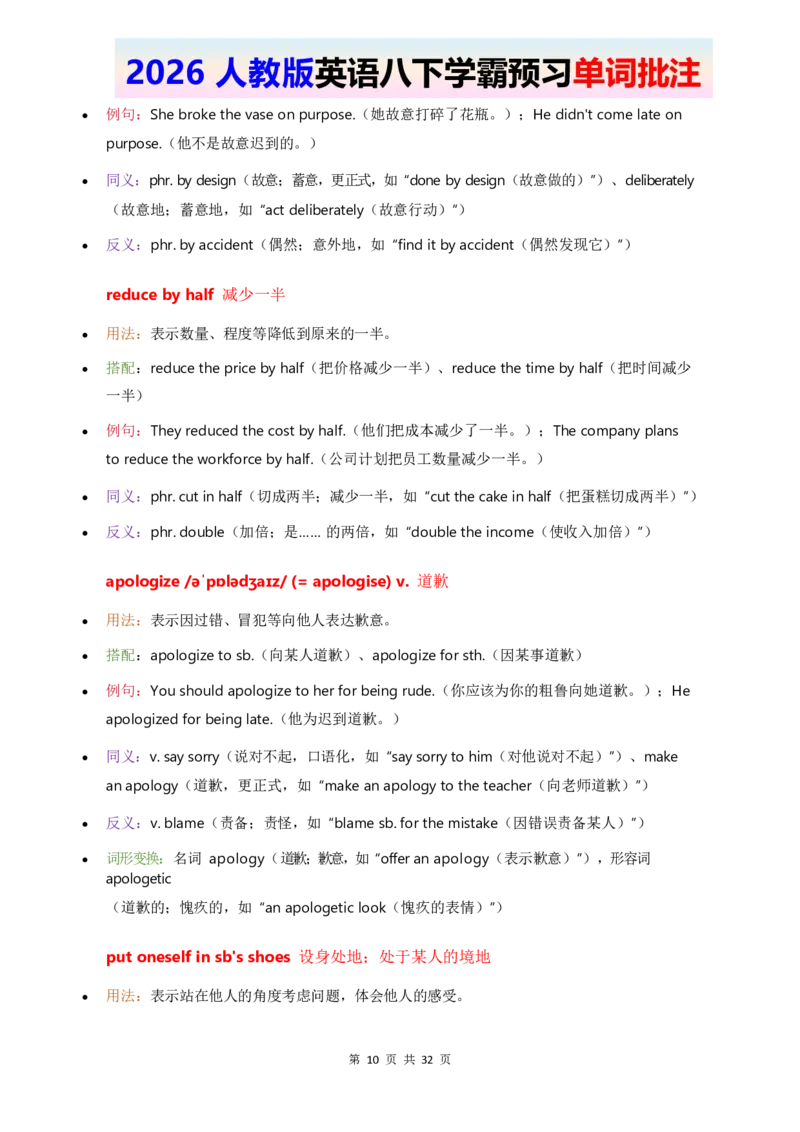
2026 人教版英语八下学霸预习单词批注
Unit 3 Growing Up 单词批注
deal with 处理;对付
用法:表示着手解决、应对人或事。
搭配:deal with a problem(处理问题);deal with people(与人打交道)
例句:We need to deal with this situation quickly.(我们需要快速处理这种情况。);She
is good at dealing with difficult customers.(她善于应付难缠的顾客。)
同义:phr. handle(处理;应付,如 “handle a task(处理任务)”);cope with(应对;
处理,如 “cope with stress(应对压力)”)
反义:phr. avoid(避免;回避,如 “avoid dealing with the issue(回避处理问题)”)
emotion /ɪˈməʊʃn/n. 情感;情绪
用法:指人内心的各种情感、情绪。
搭配:strong emotion(强烈的情感)、express emotion(表达情绪)
例句:Music can evoke deep emotions.(音乐能唤起深沉的情感。);He couldn't
control his emotions when he heard the news.(听到这个消息,他无法控制自己的情
绪。)
同义:n. feeling(感觉;情感,如 “a feeling of happiness(幸福的感觉)”);sentiment
(感情;情绪,如 “national sentiment(民族感情)”)
词形变换:形容词 emotional(情感的;情绪激动的,如 “an emotional speech(情感充沛
的演讲)”),副词 emotionally(情感上;情绪上,如 “emotionally attached(情感上依
恋)”)
upset /ʌpˈset/adj. 难过的;沮丧的
用法:形容人因不如意的事而心情难过、沮丧。
搭配:be upset about(因…… 难过)、look upset(看起来沮丧)
例句:She was upset about failing the exam.(她因考试不及格而难过。);He looked
very upset when he left.(他离开时看起来很沮丧。)
第 1 页 共 32 页2026 人教版英语八下学霸预习单词批注
同义:adj. sad(悲伤的;难过的,如 “a sad story(悲伤的故事)”)、depressed(抑郁
的;沮丧的,如 “feel depressed(感到沮丧)”)
反义:adj. happy(高兴的;快乐的,如 “a happy child(快乐的孩子)”)、cheerful(快乐
的;愉快的,如 “a cheerful song(愉快的歌曲)”)
词形变换:动词 upset(使心烦;打乱,如 “upset the plan(打乱计划)”),名词 upset
(心烦;混乱,如 “an upset in his mind(他心中的烦乱)”)
lonely /ˈləʊnli/adj. 孤独的;寂寞的
用法:形容人因缺少陪伴而感到孤独、寂寞。
搭配:a lonely person(孤独的人)、feel lonely(感到寂寞)
例句:The old man lives alone and feels lonely
老人独自生活,感到孤独。);She was lonely
(. in the new city.(她在新城市里感到寂
寞。)
同义:adj. solitary(孤独的;独居的,如 “a solitary life(独居生活)”)、lonesome(寂寞
的;孤单的,如 “a lonesome night(寂寞的夜晚)”)
反义:adj. accompanied(有人陪伴的;结伴的,如 “be accompanied by friends(有朋友
陪伴)”)、social(社交的;合群的,如 “a social person(合群的人)”)
词形变换:名词 loneliness(孤独;寂寞,如 “the loneliness of the long journey(长途旅
行的孤独)”)
shocked /ʃɒkt/adj. 震惊的
用法:形容人因意外、可怕的事而感到震惊。
搭配:be shocked at/by(因…… 震惊)、a shocked expression(震惊的表情)
例句:They were shocked by the news of his death.(他们对他的死讯感到震惊。);I
was shocked to see the damage.(看到损失我很震惊。)
同义:adj. astonished(惊讶的;惊愕的,如 “be astonished at the result(对结果惊
讶)”)、 astounded(震惊的;惊呆的,如 “be astounded by the sight(被景象惊
呆)”)
反义:adj. unshocked(不震惊的;平静的,如 “remain unshocked(保持平静)”)
第 2 页 共 32 页2026 人教版英语八下学霸预习单词批注
词形变换:动词 shock(使震惊;震动,如 “shock the audience(使观众震惊)”),名词 shock
(震惊;冲击,如 “a shock to his system(对他身心的冲击)”)
alone /əˈləʊn/adv. 独自;单独
用法:表示独自一人、没有他人陪伴的状态。
搭配:live alone(独自生活)、go alone(独自去)
例句:He likes to walk alone in the park
他喜欢独自在公园散步。);She finished the work
(. alone.(她独自完成了工作。)
同义:adv. by oneself(独自;单独,如 “do it by oneself(独自做)”)、solo(单独地;
独奏,如 “fly solo(独自飞行)”)
反义:adv. together(一起;共同,如 “work together(一起工作)”)
词形变换:形容词 alone(单独的;独自的,如 “an alone traveler(独自的旅行者)”)
control /kənˈtrəʊl/v. & n. 控制
用法:作动词表示支配、管理;作名词指对事物的掌控。
搭配:control a machine(控制机器)、take control of(控制;掌管)
例句:He can control his temper well(. 他能很好地控制自己的脾气。);The company is
under
new control.(公司处于新的管理之下。)
同义:v. manage(管理;控制,如 “manage a team(管理团队)”);n. command(指挥;
控制,如 “have command over(对…… 有控制)”)
反义:v. lose control(失去控制,如 “lose control of the car(汽车失控)”);n. chaos
(混乱;失控,如 “a state of chaos(混乱状态)”)
词形变换:形容词 controllable(可控制的;可管理的,如 “a controllable situation(可控
制的局面)”),名词 controller(控制者;控制器,如 “a traffic controller(交通控制者)”)
anger /ˈæŋɡə(r)/n. 怒火
用法:指愤怒的情绪、怒火。
搭配:show anger(表现出愤怒)、in anger(愤怒地)
第 3 页 共 32 页2026 人教版英语八下学霸预习单词批注
例句:His face was red with anger.(他气得满脸通红。);She spoke to him in anger.
(她愤怒地对他说话。)
同义:n. rage(愤怒;狂暴,如 “fly into a rage(勃然大怒)”)、fury(狂怒;暴怒,如
“in a fury(暴怒)”)
反义:n. calm(平静;冷静,如 “keep calm(保持冷静)”)、patience(耐心;忍耐,如
“have patience(有耐心)”)
词形变换:动词 anger(使生气;激怒,如 “anger his parents(惹父母生气)”),形容词
angry(生气的;愤怒的,如 “an angry look(愤怒的神情)”)
advise /ədˈvaɪz/v. 建议;劝告
用法:表示向他人提出意见、建议或劝告。
搭配:advise sb. to do sth.(建议某人做某事)、advise doing sth.(建议做某事)
例句:I advise you to see a doctor.(我建议你去看医生。);He advised waiting for a while.
(他建议等一会儿。)
同义:v. suggest(建议;提议,如 “suggest a plan(提议一个计划)”)、recommend
(推荐;劝告,如 “recommend a book(推荐一本书)”)
反义:v. dissuade(劝阻;劝止,如 “dissuade him from going(劝阻他去)”)
词形变换:名词 advice(建议;忠告,如 “a piece of advice(一条建议)”),形容词 advisable
(明智的;可取的,如 “it's advisable to go(去是明智的)”)
hurtful /ˈhɜːtfl/adj. 伤感情的
用法:形容言语、行为等伤害他人感情。
搭配:hurtful words(伤人的话)、a hurtful remark(伤感情的评论)
例句:His hurtful comments made her cry
他伤人的评论让她哭了。);It was a hurtful thing
(. to say.(说那样的话很伤感情。)
同义:adj. offensive(冒犯的;无礼的,如 “offensive language(冒犯性的语言)”)、insulting
(侮辱的;冒犯的,如 “an insulting gesture(侮辱性的手势)”)
第 4 页 共 32 页2026 人教版英语八下学霸预习单词批注
反义:adj. kind(善良的;友好的,如 “kind words(友善的话语)”)、considerate(体贴
的;考虑周到的,如 “a considerate friend(体贴的朋友)”)
词形变换:动词 hurt(伤害;使疼痛,如 “hurt someone's feelings(伤害某人的感
情)”),名词 hurt(伤害;痛苦,如 “the hurt in his heart(他心中的痛苦)”)
in future 今后;从今以后
用法:表示从现在开始的将来时间范围。
搭配:in future, ...(今后,……)
例句:In future, we should be more careful.(今后,我们应该更小心。);He promised
to study hard in future.(他承诺今后会努力学习。)
同义:phr. from now on(从现在起,如 “From now on, I will exercise every day.(从现在
起,我会每天锻炼。)”)、hereafter(今后;此后,更正式,如 “Hereafter, follow the new
rules.
(今后,遵守新规则。)”)
反义:phr. in the past(在过去,如 “In the past, people lived a simple life.(在过去,人们
过着简单的生活。)”)
forgive /fəˈɡɪv/v. (forgave /fəˈɡeɪv/, forgiven /fəˈɡɪvn/) 原谅;宽恕
用法:表示对他人的过错、冒犯等给予原谅、宽恕。
搭配:forgive sb.(原谅某人)、forgive a mistake(原谅一个错误)
例句:I forgive you for what you did.(我原谅你所做的事。);She forgave him after he
apologized.(他道歉后,她原谅了他。)
同义:v. pardon(原谅;赦免,更正式,如 “pardon a crime(赦免一项罪行)”)、excuse
(原谅;宽恕,如 “excuse his rudeness(原谅他的粗鲁)”)
反义:v. blame(责备;责怪,如 “blame sb. for sth.(因某事责备某人)”)、punish(惩
罚;处罚,如 “punish the criminal(惩罚罪犯)”)
词形变换:名词 forgiveness(原谅;宽恕,如 “ask for forgiveness(请求原谅)”),形容
词 forgiving(宽容的;宽恕的,如 “a forgiving person(宽容的人)”)
第 5 页 共 32 页2026 人教版英语八下学霸预习单词批注
fault /fɔːlt/n. 过错;责任
用法:指因个人失误、错误而应承担的责任或过错。
搭配:find fault with(挑剔;找…… 的岔子)、one's fault(某人的过错)
例句:It's not my fault that the project failed.(项目失败不是我的过错。);She always
finds fault with others.(她总是挑剔别人。)
同义:n. mistake(错误;过失,如 “a mistake in the report(报告中的错误)”)、error
(错误;差错,更正式,如 “an error in calculation(计算错误)”)
反义:n. merit(优点;功绩,如 “the merit of the plan(计划的优点)”)、virtue(美德;
优点,如 “a virtue of honesty(诚实的美德)”)
词形变换:动词 fault(挑剔;指责,如 “fault sb. for laziness(指责某人懒惰)”),形容
词 faulty(有错误的;有缺点的,如 “a faulty machine(有故障的机器)”)
clear the air 尽释前嫌
用法:表示消除人与人之间的误会、隔阂,让关系恢复融洽。
搭配:clear the air between sb.(消除某人之间的隔阂)
例句:They had a talk to clear the air.(他们谈了一次话来尽释前嫌。);We need to
clear the air after that argument.(那次争吵后我们需要尽释前嫌。)
同义:phr. resolve differences(解决分歧,如 “resolve differences through discussion(通
过讨论解决分歧)”)、smooth things over(缓和;调解,如 “smooth things over after a
fight
(打架后缓和关系)”)
反义:phr. create tension(制造紧张,如 “create tension between friends(在朋友间制造
紧张)”)
present /ˈpreznt/n. 礼物
用法:指为了庆祝、表达心意等赠送的物品。
搭配:birthday present(生日礼物)、give a present(送礼物)
第 6 页 共 32 页2026 人教版英语八下学霸预习单词批注
例句:He gave me a present for Christmas.(他给了我一份圣诞礼物。);The present is
beautifully wrapped.(礼物包装得很漂亮。)
同义:n. gift(礼物;赠品,更常用,如 “a gift from a friend(朋友送的礼物)”)
词形变换:动词 present(赠送;呈现,如 “present a trophy(赠送奖杯)”“present a new
idea(呈现新想法)”),形容词 present(现在的;出席的,如 “the present time(现
在)”“be present at the meeting(出席会议)”)
standard /ˈstændəd/n. 标准;水平 ;adj. 标准的
用法:作名词指衡量事物的准则、水平;作形容词指符合标准的。
搭配:high standard(高标准)、standard of living(生活水平)、standard size(标准尺
寸)
例句:We should set a high standard for ourselves.(我们应该为自己设定高标准。);
This is a standard part for the machine.(这是机器的标准部件。)
同义:n. criterion(标准;准则,更正式,如 “a criterion for success(成功的标准)”)、level
(水平;程度,如 “a high level of skill(高水平的技能)”);adj. typical(典型的;有代
表性的,如 “a typical example(典型例子)”)
反义:n. substandard(低于标准的;不合格的,如 “substandard products(不合格产
品)”); adj. substandard(同名词反义,如 “substandard quality(不合格的质量)”)
词形变换:副词 standardly(标准地;按标准,如 “perform standardly(按标准执行)”),
名词 standardization(标准化;规范化,如 “the standardization of products(产品标准
化)”)
award /əˈwɔːd/n. 奖;奖品
用法:指因成就、表现等获得的奖励、奖品。
搭配:win an award(获奖)、award ceremony(颁奖典礼)
例句:He won an award for his excellent work.(他因出色的工作获奖。);The award is a
gold medal.(奖品是一枚金牌。)
同义:n. prize(奖;奖品,更常用,如 “a prize in the competition(比赛中的奖品)”)、
reward(奖励;回报,更侧重 “回报”,如 “a reward for kindness(对善良的回报)”)
第 7 页 共 32 页2026 人教版英语八下学霸预习单词批注
反义:n. penalty(惩罚;处罚,如 “a penalty for breaking rules(违反规则的处罚)”)
词形变换:动词 award(授予;给予,如 “award a scholarship(授予奖学金)”)
get across 解释清楚;传达
用法:表示将想法、信息等清楚地传达给他人,让他人理解。
搭配:get a message across(传达清楚一条信息)、get an idea across(解释清楚一个想
法)
例句:He tried to get his point across to the
他试图向观众解释清楚他的观点。);
audience(.
The teacher can't get the lesson across to the students.(老师无法把课程内容给学生讲清
楚。)
同义:phr. make clear(使清楚;说明白,如 “make clear the problem(说明白问
题)”)、 convey(传达;表达,如 “convey feelings(传达情感)”)
反义:phr. be unclear(不清楚;不明确,如 “His explanation is unclear(. 他的解释不清
楚。)”)
clearly /ˈklɪəli/adv. 清楚地
用法:用于修饰动词、形容词等,描述动作或状态的清晰程度。
搭配:speak clearly(清楚地说话)、see clearly(清楚地看见)
例句:Please explain the question clearly(. 请清楚地解释这个问题。);I can't see the words
clearly without glasses.(不戴眼镜我看不清这些字。)
同义:adv. distinctly(清晰地;明显地,如 “hear distinctly(清晰地听到)”)、plainly(清
楚地;明白地,如 “state plainly(清楚地陈述)”)
反义:adv. unclearly(不清楚地;模糊地,如 “speak unclearly(说话不清楚)”)、vaguely
(模糊地;含糊地,如 “remember vaguely(模糊地记得)”)
词形变换:形容词 clear(清楚的;清晰的,如 “a clear voice(清晰的声音)”),名词 clearness
(清楚;清晰,如 “the clearness of the water(水的清澈)”)
pressure /ˈpreʃə(r)/n. 压力
用法:指来自外界或内心的压迫、紧张感。
第 8 页 共 32 页2026 人教版英语八下学霸预习单词批注
搭配:under pressure(在压力下)、work pressure(工作压力)、pressure to do sth.
(做某事的压力)
例句:He works well under pressure.(他在压力下工作得很好。);There is a lot of
pressure on students to get good grades.(学生们有很大的取得好成绩的压力。)
同义:n. stress(压力;紧张,更侧重 “心理压力”,如 “stress from work(工作压力)”)、
tension(紧张;张力,如 “tension in the air(空气中的紧张感)”)
反义:n. relaxation(放松;缓和,如 “seek relaxation(寻求放松)”)、ease(安逸;轻松,
如 “live in ease(生活安逸)”)
词形变换:动词 pressure(对…… 施加压力;迫使,如 “pressure sb. to do sth.(迫使某人
做某事)”),形容词 pressured(有压力的;受压的,如 “a pressured situation(有压力的
局面)”)
purpose /ˈpɜːpəs/n. 目的;意图
用法:指做某事的目标、意图。
搭配:on purpose(故意;有意地)、for the purpose of(为了…… 的目的)
例句:What is the purpose of this meeting?(这次会议的目的是什么?);He did it on
purpose to make me angry.(他故意做这件事来让我生气。)
同义:n. aim(目标;目的,更侧重 “努力的方向”,如 “the aim of the project(项目的目
标)”)、goal(目标;目的,更强调 “最终目标”,如 “achieve one's goal(实现目标)”)
反义:n. accident(意外;偶然,如 “by accident(偶然地)”)、chance(机会;偶然,如
“by chance(偶然)”)
词形变换:动词 purpose(打算;企图,如 “purpose to travel(打算旅行)”),形容词
purposeful(有目的的;有决心的,如 “a purposeful action(有目的的行动)”)
on purpose 故意;有意地
用法:表示做某事是有意图、故意的。
搭配:do sth. on purpose(故意做某事)
第 9 页 共 32 页2026 人教版英语八下学霸预习单词批注
例句:She broke the vase on purpose.(她故意打碎了花瓶。);He didn't come late on
purpose.(他不是故意迟到的。)
同义:phr. by design(故意;蓄意,更正式,如 “done by design(故意做的)”)、deliberately
(故意地;蓄意地,如 “act deliberately(故意行动)”)
反义:phr. by accident(偶然;意外地,如 “find it by accident(偶然发现它)”)
reduce by half 减少一半
用法:表示数量、程度等降低到原来的一半。
搭配:reduce the price by half(把价格减少一半)、reduce the time by half(把时间减少
一半)
例句:They reduced the cost by half.(他们把成本减少了一半。);The company plans
to reduce the workforce by half.(公司计划把员工数量减少一半。)
同义:phr. cut in half(切成两半;减少一半,如 “cut the cake in half(把蛋糕切成两半)”)
反义:phr. double(加倍;是…… 的两倍,如 “double the income(使收入加倍)”)
apologize /əˈpɒlədʒaɪz/ (= apologise) v. 道歉
用法:表示因过错、冒犯等向他人表达歉意。
搭配:apologize to sb.(向某人道歉)、apologize for sth.(因某事道歉)
例句:You should apologize to her for being rude.(你应该为你的粗鲁向她道歉。);He
apologized for being late.(他为迟到道歉。)
同义:v. say sorry(说对不起,口语化,如 “say sorry to him(对他说对不起)”)、make
an apology(道歉,更正式,如 “make an apology to the teacher(向老师道歉)”)
反义:v. blame(责备;责怪,如 “blame sb. for the mistake(因错误责备某人)”)
词形变换:名词 apology(道歉;歉意,如 “offer an apology(表示歉意)”),形容词
apologetic
(道歉的;愧疚的,如 “an apologetic look(愧疚的表情)”)
put oneself in sb's shoes 设身处地;处于某人的境地
用法:表示站在他人的角度考虑问题,体会他人的感受。
第 10 页 共 32 页2026 人教版英语八下学霸预习单词批注
搭配:put yourself in my shoes(设身处地为我想想)
例句:You should put yourself in his shoes before criticizing him.(批评他之前你应该设身
处地为他想想。);Putting oneself in others' shoes helps to understand them better.(设
身处地为他人着想有助于更好地理解他们。)
同义:phr. see things from sb's perspective(从某人的角度看问题,如 “see things from
her perspective(从她的角度看问题)”)、empathize with(同情;共鸣,如 “empathize
with his situation(同情他的处境)”)
反义:phr. be self - centered(以自我为中心,如 “be self - centered and ignore others
(以自我为中心,忽视他人)”)
shut /ʃʌt/v. (shut, shut) 关闭;合上;住嘴
用法:表示关闭门、窗、嘴等,或停止说话。
搭配:shut the door(关门)、shut up(住嘴)、shut one's eyes(闭上眼睛)
例句:Please shut the window before you leave.(离开前请关上窗户。);Shut up! I
don't want to hear it.(住嘴!我不想听。)
同义:v. close(关闭;合上,更常用,如 “close the book(合上书)”)、lock(锁;锁住,
如 “lock the door(锁门)”)
反义:v. open(打开;张开,如 “open the door(开门)”)、speak(说话;讲话,如
“speak up(大声说)”)
词形变换:名词 shut(关闭;关闭状态,如 “the shut of the door(门的关闭)”),形容
词 shut(关闭的;合拢的,如 “a shut box(关闭的盒子)”)
shut sb /sth away 把…… 关(藏)起来;隔离
用法:表示将人或物关起来、藏起来,使其与外界隔离。
搭配:shut the criminal away(把罪犯关起来)、shut the old books away(把旧书藏起来)
例句:They shut the dangerous animal away in a cage.(他们把危险的动物关在笼子里隔
离起来。);She shut herself away in her room after the argument.(争吵后她把自己关在
房间里。)
第 11 页 共 32 页2026 人教版英语八下学霸预习单词批注
同义:phr. lock up(锁起来;关起来,如 “lock up the thief(把小偷关起来)”)、isolate
(隔离;孤立,如 “isolate the patient(隔离病人)”)
反义:phr. let out(放出;释放,如 “let out the prisoner(释放囚犯)”)
lastly /ˈlɑːstli/adv. 最后
用法:用于列举事物时,强调最后一点。
搭配:firstly, ...; secondly, ...; lastly, ...(首先,……;其次,……;最后,……)
例句:Firstly, we need to prepare the materials. Secondly, we should make a plan. Lastly,
we can start the work.(首先,我们需要准备材料。其次,我们应该制定计划。最后,我们
可以开始工作。);Lastly, I want to thank everyone for coming.(最后,我想感谢大家的到
来。)
同义:adv. finally(最后;终于,如 “Finally, the project was completed.(最后,项目完成
了。)”)、in the end(最后;终于,如 “In the end, he succeeded.(最后,他成功
了。)”)
反义:adv. firstly(首先;第一,如 “Firstly, let's discuss this problem.(首先,我们来讨论
这个问题。)”)、first(首先;第一,如 “First, turn on the computer.(首先,打开电
脑。)”)
词形变换:形容词 last(最后的;上一个的,如 “the last day(最后一天)”“last week(上
周)”),名词 last(最后;末尾,如 “at last(最后)”)
plenty /ˈplenti/pron. 充足;丰富;大量
用法:表示数量多、充足。
搭配:plenty of(充足;大量,后接可数名词复数或不可数名词)
例句:There is plenty of food in the fridge(. 冰箱里有大量的食物。);We have plenty of
time
to finish the task.(我们有充足的时间完成任务。)
同义:pron. a lot of(许多;大量,如 “a lot of books(许多书)”)、lots of(许多;大
量,如 “lots of water(大量的水)”)
反义:pron. little(很少;几乎没有,修饰不可数名词,如 “little money(很少的钱)”)、
few(很少;几乎没有,修饰可数名词复数,如 “few friends(很少的朋友)”)
第 12 页 共 32 页2026 人教版英语八下学霸预习单词批注
词形变换:形容词 plentiful(丰富的;大量的,如 “plentiful resources(丰富的资源)”),
副词 plentifully(丰富地;大量地,如 “rain plentifully(雨水充沛)”)
第 13 页 共 32 页2026 人教版英语八下学霸预习单词批注
plenty of 充足;大量
用法:用于修饰可数名词复数或不可数名词,表示数量充足、很多。
搭配:plenty of books(大量的书)、plenty of time(充足的时间)
例句:She has plenty of friends(. 她有很多朋友。);We need plenty of energy to do the
work.
(我们需要大量的精力来做这项工作。)
同义:phr. a great deal of(大量;许多,修饰不可数名词,如 “a great deal of patience
(大量的耐心)”)、a large number of(大量;许多,修饰可数名词复数,如 “a large
number of students(大量的学生)”)
反义:phr. a little(一点;少量,修饰不可数名词,如 “a little sugar(一点糖)”)、a few
(几个;少量,修饰可数名词复数,如 “a few apples(几个苹果)”)
feel blue 感到忧郁
用法:表示情绪低落、忧郁。
搭配:feel blue for no reason(莫名感到忧郁)
例句:He has been feeling blue since he lost his job.(自从失业后,他一直感到忧郁。);
Don't feel blue. Everything will be okay.(别感到忧郁。一切都会好起来的。)
同义:phr. be in low spirits(情绪低落;精神不振,如 “be in low spirits after the failure
(失败后情绪低落)”)、be down(情绪低落;沮丧,如 “be down about the result(对
结果感到沮丧)”)
反义:phr. be in high spirits(情绪高涨;兴高采烈,如 “be in high spirits at the party(在
派对上兴高采烈)”)
on top of the world 欢天喜地
用法:表示情绪非常好、极度开心。
搭配:feel on top of the world(感觉欢天喜地)
例句:When she won the award, she felt on top of the world.(当她获奖时,她感觉欢天
喜地。);After the vacation, he was on top of the world.(度假后,他欢天喜地。)
第 14 页 共 32 页2026 人教版英语八下学霸预习单词批注
同义:phr. over the moon(欣喜若狂;兴高采烈,如 “be over the moon about the news
(对这个消息欣喜若狂)”)、ecstatic(狂喜的;入迷的,如 “be ecstatic about the success
(对成功狂喜)”)
反义:phr. feel blue(感到忧郁,如 “feel blue after the loss(失败后感到忧郁)”)
all smiles 笑容满面
用法:表示满脸笑容、非常开心的样子。
搭配:be all smiles(笑容满面)
例句:When she saw her children, she was all smiles.(当她看到孩子们时,她笑容满
面。); He came into the room, all smiles.(他笑容满面地走进房间。)
同义:phr. be full of smiles(满脸笑容,如 “be full of smiles at the party(在派对上满脸
笑容)”)、grin from ear to ear(咧着嘴笑;笑容灿烂,如 “grin from ear to ear with joy
(因高兴咧着嘴笑)”)
反义:phr. be gloomy( gloomy 阴沉的;忧郁的,如 “be gloomy after the argument
(争吵后忧郁)”)
low /ləʊ/adj. 沮丧的;低的
用法:作 “沮丧的” 形容情绪低落;作 “低的” 形容高度、位置等低。
搭配:low mood(沮丧的情绪)、low temperature(低温)、low voice(低声)
例句:He is in a low mood today.(他今天情绪沮丧。);The plane flew at a low altitude.
(飞机在低空飞行。)
同义:adj. depressed(沮丧的;抑郁的,更正式,如 “depressed after the breakup(分手
后沮丧)”)、down(情绪低落的;向下的,如 “feel down(情绪低落)”“a down slope
(下坡)”)
反义:adj. high(高的;高涨的,如 “a high mountain(高山)”“high spirits(高涨的情
绪)”)
词形变换:副词 lowly(低地;下贱地,如 “speak lowly(低声说话)”),名词 low(低
点;低水平,如 “a new low in sales(销售新低)”)
第 15 页 共 32 页2026 人教版英语八下学霸预习单词批注
in low spirits 情绪低落;精神不振
用法:表示情绪处于低落、不振的状态。
搭配:be in low spirits(情绪低落;精神不振)
例句:She has been in low spirits since her pet died.(自从宠物去世后,她一直情绪低
落。); Don't talk to him now. He is in low spirits.(现在别和他说话。他情绪低落。)
同义:phr. be down in the dumps(情绪低落;垂头丧气,口语化,如 “be down in the
dumps about the exam(因考试情绪低落)”)、be melancholy(忧郁的;悲伤的,更正
式,如 “be melancholy in winter(冬天忧郁)”)
反义:phr. be in high spirits(情绪高涨;兴高采烈,如 “be in high spirits at the celebration
(在庆祝活动上兴高采烈)”)
ring /rɪŋ/v. (rang /ræŋ/, rung /rʌŋ/) 发出铃声
用法:表示(电话、门铃等)发出铃声,或使(铃等)发出声音。
搭配:ring the bell(按铃;摇铃)、the phone rings(电话铃响)
例句:Someone rang the doorbell.(有人按了门铃。);The alarm rang loudly.(警报大声
响起。)
同义:v. chime(鸣响;发出钟声,如 “the clock chimes(钟鸣响)”)、toll(鸣钟;敲
钟,如 “toll the bell(敲钟)”)
反义:v. silence(使安静;使沉默,如 “silence the alarm(使警报安静)”)
词形变换:名词 ring(戒指;铃声,如 “a gold ring(金戒指)”“the ring of a bell(铃
声)”),形容词 ringing(响亮的;清脆的,如 “a ringing voice(响亮的声音)”)
enter /ˈentə(r)/v. 进入
用法:表示进入某个地方、状态等。
搭配:enter the room(进入房间)、enter a new stage(进入新阶段)
例句:He entered the building quietly(. 他悄悄地进入大楼。);The country entered a period
of prosperity.(这个国家进入了繁荣时期。)
第 16 页 共 32 页2026 人教版英语八下学霸预习单词批注
同义:v. go into(进入;走进,如 “go into the shop(走进商店)”)、come into(进
入;得到,如 “come into the house(进入房子)”)
反义:v. exit(离开;退出,如 “exit the cinema(离开电影院)”)
词形变换:名词 entrance(入口;进入,如 “the entrance to the park(公园入口)”),
形容词 enterable(可进入的,如 “an enterable cave(可进入的洞穴)”)
dare /deə(r)/v. & modal v. 敢于
用法:作实义动词时,后接不定式,有人称、数和时态的变化;作情态动词时,后接动词原
形,多用于否定句和疑问句。
搭配:dare to do sth.(敢于做某事)、dare not do sth.(不敢做某事)
例句:He doesn't dare to swim in the river.(他不敢在河里游泳。);Dare you jump off
the wall?(你敢从墙上跳下来吗?)
同义:v. venture(冒险;敢于,如 “venture to try(敢于尝试)”)、presume(敢于;擅
自,如 “presume to criticize(擅自批评)”)
反义:v. fear(害怕;畏惧,如 “fear to speak(害怕说话)”)
词形变换:名词 dare(挑战;激将,如 “a dare to jump(跳的挑战)”),形容词 daring
(大胆的;勇敢的,如 “a daring plan(大胆的计划)”)
everybody /ˈevribɒdi/pron. 每人;所有人
用法:表示所有的人,相当于 “everyone”。
搭配:everybody knows(大家都知道)、everybody here(这里的每个人)
例句:Everybody is here except Tom(. 除了汤姆,大家都在这里。);Everybody should follow
the rules.(每个人都应该遵守规则。)
同义:pron. everyone(每人;所有人,如 “everyone likes the movie(每个人都喜欢这部
电影)”)
反义:pron. nobody(没有人;无人,如 “nobody is at home(家里没人)”)
let down 使失望
第 17 页 共 32 页2026 人教版英语八下学霸预习单词批注
用法:表示让某人感到失望。
搭配:let sb. down(使某人失望)
例句:Don't let your parents down
不要让你的父母失望。);He let me down by not coming
(.
to the party.(他没来参加派对,让我失望了。)
同义:phr. disappoint(使失望;使沮丧,如 “disappoint his fans(使他的粉丝失望)”)、
fail(使失望;辜负,如 “fail one's expectations(辜负某人的期望)”)
反义:phr. satisfy(使满意;使满足,如 “satisfy the customers(使顾客满意)”)
be hard on 对…… 苛刻或过分严厉
用法:表示对某人要求过高、过于严厉。
搭配:be hard on children(对孩子苛刻)、be hard on oneself(对自己严厉)
例句:Teachers shouldn't be too hard on students.(老师不应该对学生太苛刻。);He is
always hard on himself.(他对自己总是很严厉。)
同义:phr. be strict with(对…… 严格,如 “be strict with the employees(对员工严
格)”)、 be tough on(对…… 强硬;对…… 严厉,如 “be tough on crime(对犯罪强
硬)”)
反义:phr. be lenient with(对…… 宽容;对…… 宽厚,如 “be lenient with the mistake
(对错误宽容)”)
player /ˈpleɪə(r)/n. 运动员;选手
用法:指从事体育运动的人,或比 中的选手。
搭配:football player(足球运动员)、tennis player(网球选手)
例句:He is a famous basketball player.(他是一位著名的篮球运动员。);The players
are preparing for the match.(选手们正在为比 做准备。)
同义:n. athlete(运动员;体育家,更正式,如 “an Olympic athlete(奥运运动员)”)、
competitor(竞争者;选手,如 “a competitor in the race(比 中的选手)”)
词形变换:动词 play(玩;演奏;参加比 ,如 “play football(踢足球)”“play the piano
(弹钢琴)”),形容词 playful(爱玩的;调皮的,如 “a playful child(爱玩的孩子)”)
第 18 页 共 32 页2026 人教版英语八下学霸预习单词批注
referee /ˌrefəˈriː/n. 裁判
用法:指在体育比 等中负责裁决的人。
搭配:football referee(足球裁判)、basketball referee(篮球裁判)
例句:The referee made a fair decision.(裁判做出了公正的裁决。);The referee blew
the whistle to end the game.(裁判吹哨结束了比 。)
同义:n. judge(裁判;法官,如 “a judge in the competition(比 中的裁判)”)、umpire
(裁判;仲裁人,如 “an umpire in baseball(棒球裁判)”)
词形变换:动词 referee(担任裁判;为…… 当裁判,如 “referee a match(为比 当裁
判)”)
take back 撤回;收回
用法:表示收回说过的话、送出的东西等。
搭配:take back one's words(收回某人的话)、take back a gift(收回礼物)
例句:He took back what he said about her.(他收回了关于她的话。);She decided to
take back the book she lent him.(她决定收回借给他的书。)
同义:phr. withdraw(撤回;收回,如 “withdraw a statement(撤回声明)”)、retract(收
回;撤销,如 “retract a promise(撤销承诺)”)
反义:phr. give out(发出;公布,如 “give out a statement(公布声明)”)
decision /dɪˈsɪʒn/n. 决定
用法:指对事情做出的判断、选择。
搭配:make a decision(做决定)、final decision(最终决定)
例句:We need to make a decision about where to go.(我们需要决定去哪里。);The
final decision is up to you.(最终决定由你做。)
同义:n. choice(选择;抉择,如 “a choice between two options(两个选项之间的选
择)”)、 resolution(决心;决定,更正式,如 “a resolution to study hard(努力学习的
决心)”)
反义:n. indecision(犹豫不决;优柔寡断,如 “be in indecision(犹豫不决)”)
第 19 页 共 32 页2026 人教版英语八下学霸预习单词批注
词形变换:动词 decide(决定;下决心,如 “decide to go(决定去)”),形容词 decisive
(决定性的;果断的,如 “a decisive victory(决定性的胜利)”)
kick oneself (因干了蠢事等) 自责或懊恼
用法:表示因自己做了蠢事、错事而自责、懊恼。
搭配:kick oneself for doing sth.(因做某事而自责)
例句:He kicked himself for missing the chance.(他因错过机会而自责。);I kicked
myself for forgetting her birthday.(我因忘记她的生日而懊恼。)
同义:phr. blame onesel(f 责备自己,如 “blame oneself for the mistake(因错误责备自
己)”)、
regret(后悔;懊悔,如 “regret doing sth.(后悔做某事)”)
反义:phr. be proud of oneself(为自己骄傲,如 “be proud of oneself for the achievement
(为成就为自己骄傲)”)
look on the bright side 从好的方面想;抱乐观态度
用法:表示面对困难、不如意时,往好的方面想,保持乐观。
搭配:look on the bright side of sth.(从某事好的方面想)
例句:You should look on the bright side. Maybe you'll get a better job.(你应该往好的方
面想。也许你会得到更好的工作。);Even though it's raining, look on the bright side —
we
don't have to water the garden(. 尽管在下雨,往好的方面想 —— 我们不用给花园浇水
了。)
同义:phr. be optimistic(乐观的;乐观,如 “be optimistic about the future(对未来乐
观)”)、 see the positive side(看到积极的一面,如 “see the positive side of the
problem(看到问题积极的一面)”)
反义:phr. look on the dark side(往坏的方面想;抱悲观态度,如 “look on the dark side
of life(对生活抱悲观态度)”)
score /skɔː(r)/n. 得分;比分
用法:指比 中的得分、比分。
搭配:final score(最终比分)、score a goal(进一球得分)
第 20 页 共 32 页2026 人教版英语八下学霸预习单词批注
例句:The score is 2 - 1 in our favor(. 比分是 2 比 1,对我们有利。);He scored three
points
in the game.(他在比 中得了三分。)
同义:n. point(分数;得分,如 “get ten points(得十分)”)、mark(分数;标记,如
“a high mark in the test(测试中高分)”)
词形变换:动词 score(得分;记分,如 “score a point(得分)”“score the game(为
比记分)”)
proud /praʊd/adj. 骄傲的;自豪的
用法:形容因自身或他人的成就、品质等而感到骄傲、自豪。
搭配:be proud of(为…… 感到骄傲)、proud mother(自豪的母亲)
例句:She is proud of her son's success(. 她为儿子的成功感到骄傲。);He has a proud look
on his face.(他脸上带着骄傲的神情。)
同义:adj. 自豪的;adj. boastful(自夸的;自负的,更侧重 “自夸”,如 “a boastful person
(自负的人)”)、honored(荣幸的;受尊敬的,如 “feel honored to be here(在这里感
到荣幸)”)
反义:adj. humble(谦逊的;谦虚的,如 “a humble person(谦逊的人)”)、ashamed
(羞愧的;惭愧的,如 “be ashamed of oneself(为自己羞愧)”)
词形变换:副词 proudly(骄傲地;自豪地,如 “speak proudly(自豪地说)”),名词 pride
(骄傲;自豪,如 “take pride in(为…… 自豪)”)
proud of 为…… 感到骄傲
用法:表示因某人、某事而感到骄傲、自豪。
搭配:be proud of sb./sth.(为某人 / 某事感到骄傲)
例句:I'm proud of my country.(我为我的国家感到骄傲。);They are proud of their
daughter's achievements.(他们为女儿的成就感到骄傲。)
同义:phr. take pride in(为…… 自豪,如 “take pride in one's work(为自己的工作自豪)”)
反义:phr. be ashamed of(为…… 羞愧,如 “be ashamed of the mistake(为错误羞愧)”)
第 21 页 共 32 页2026 人教版英语八下学霸预习单词批注
coach /kəʊtʃ/n. 教练
用法:指指导运动员、团队训练的人。
搭配:football coach(足球教练)、personal coach(私人教练)
例句:Our coach is very experienced.(我们的教练很有经验。);The coach is training
the team for the match.(教练正在为比 训练队伍。)
同义:n. instructor(指导者;教练,如 “a driving instructor(驾驶教练)”)、trainer(训
练员;教练,如 “a fitness trainer(健身教练)”)
词形变换:动词 coach(训练;指导,如 “coach a team(训练队伍)”)
as well 也;又
用法:表示 “也”,常用于句末。
搭配:as well as(也;和…… 一样,连接并列成分)
例句:I like apples, and I like bananas as well.(我喜欢苹果,也喜欢香蕉。);She is
clever as well as beautiful.(她既聪明又漂亮。)
同义:phr. too(也,口语化,如 “I like it too.(我也喜欢它。)”)、also(也,用于句中,
如 “I also like it.(我也喜欢它。)”)
反义:phr. not ... either(也不,如 “I don't like it, and he doesn't like it either.(我不喜欢
它,他也不喜欢。)”)
bit /bɪt/n. 有点;稍微
用法:表示 “一点;稍微”,常与 “a” 连用,构成 “a bit”。
搭配:a bit(有点;稍微)、a bit of(一点;少量)
例句:It's a bit cold today.(今天有点冷。);Can you give me a bit of sugar?(你能给我
一点糖吗?)
同义:n. little(一点;少量,修饰不可数名词,如 “a little water(一点水)”)、piece
(块;片;一点,如 “a piece of advice(一点建议)”)
反义:n. lot(许多;大量,如 “a lot of money(许多钱)”)
第 22 页 共 32 页2026 人教版英语八下学霸预习单词批注
词形变换:动词 bite(咬;叮,如 “bite an apple(咬苹果)”)
a bit 有点儿;稍微
用法:用于修饰形容词、副词等,表示程度 “有点;稍微”。
搭配:a bit tired(有点累)、a bit late(稍微晚)
例句:He is a bit nervous.(他有点紧张。);The movie is a bit boring.(这部电影有点无
聊。)
同义:phr. a little(有点;稍微,如 “a little hungry(有点饿)”)、slightly(稍微;略微,
如 “slightly different(稍微不同)”)
反义:phr. very(非常;很,如 “very happy(非常开心)”)
repeat /rɪˈpiːt/v. 重复
用法:表示重复说、做某事。
搭配:repeat a word(重复一个词)、repeat an action(重复一个动作)
例句:Please repeat what you said.(请重复你说的话。);He repeated the mistake.(他
重复了这个错误。)
同义:v. reiterate(重申;反复说,更正式,如 “reiterate a point(重申观点)”)、recite
(背诵;朗诵,如 “recite a poem(背诵诗歌)”)
反义:v. originate(创造;发起,如 “originate an idea(创造想法)”)
词形变换:名词 repetition(重复;反复,如 “the repetition of words(单词的重复)”),
形容词 repetitive(重复的;反复的,如 “repetitive work(重复的工作)”)
pull together 齐心协力;通力合作
用法:表示为了共同目标而齐心协力、合作。
搭配:pull together to do sth.(齐心协力做某事)
例句:We need to pull together to finish the project.(我们需要齐心协力完成这个项
目。); The team pulled together and won the game.(队伍齐心协力赢得了比 。)
第 23 页 共 32 页2026 人教版英语八下学霸预习单词批注
同义:phr. work together(一起工作;合作,如 “work together on a task(一起做任
务)”)、 cooperate(合作;协作,如 “cooperate with others(与他人合作)”)
反义:phr. pull apart(分开;分裂,如 “pull apart the team(分裂队伍)”)
though /ðəʊ/conj. 即使;虽然;尽管
用法:引导让步状语从句,表示 “即使;虽然;尽管”。
搭配:though ..., ...(虽然……,……)
例句:Though it was raining, he went out.(虽然在下雨,他还是出去了。);She passed
the exam though she didn't study much.(尽管她没怎么学习,还是通过了考试。)
同义:conj. although(虽然;尽管,更正式,如 “Although it's late, I'll finish the work.
(虽然很晚了,我还是会完成工作。)”)、even though(即使;尽管,如 “Even though
he's rich, he's not happy.(即使他很富有,他也不开心。)”)
反义:conj. because(因为;由于,引导原因状语从句,如 “Because it's sunny, we'll go out.
(因为天气晴朗,我们要出去。)”)
词形变换:副词 though(可是;然而,用于句末,如 “It's hard work. I enjoy it though.
(这是辛苦的工作。不过我喜欢。)”)
even though 即使;虽然
用法:引导让步状语从句,语气比 “though”“although” 更强。
搭配:even though ..., ...(即使……,……)
例句:Even though he is poor, he is happy(. 即使他很穷,他也很开心。);She went to
school
even though she was ill.(即使她生病了,还是去上学了。)
同义:phr. even if(即使;纵然,如 “Even if it rains, we'll go.(即使下雨,我们也会去。)”)
反义:phr. because(因为;由于,如 “Because he is rich, he can buy it.(因为他富有,他
能买它。)”)
solution /səˈluːʃn/n. 解决办法;解决
用法:指解决问题的办法、方案。
第 24 页 共 32 页2026 人教版英语八下学霸预习单词批注
搭配:find a solution(找到解决办法)、solution to a problem(问题的解决办法)
例句:We need a solution to this problem
我们需要这个问题的解决办法。);The solution
(. is simple.(解决办法很简单。)
同义:n. answe(r 答案;解决办法,如 “an answer to the question(问题的答案)”)、
resolution
(解决;决心,如 “a resolution of the conflict(冲突的解决)”)
反义:n. problem(问题;难题,如 “a difficult problem(难题)”)
词形变换:动词 solve(解决;解答,如 “solve a puzzle(解决谜题)”),形容词 solvable
(可解决的;可解答的,如 “a solvable problem(可解决的问题)”)
joyful /ˈdʒɔɪfl/adj. 高兴的;令人愉快的
用法:形容人情绪高兴,或事物令人愉快。
搭配:joyful news(令人愉快的消息)、joyful smile(高兴的笑容)
例句:They had a joyful party.(他们举办了一场令人愉快的派对。);She has a joyful look.
(她面带高兴的神情。)
同义:adj. happy(高兴的;快乐的,如 “a happy child(快乐的孩子)”)、cheerful(快乐
的;愉快的,如 “a cheerful song(愉快的歌曲)”)
反义:adj. sad(悲伤的;难过的,如 “a sad story(悲伤的故事)”)、miserable(痛苦的;
悲惨的,如 “a miserable life(悲惨的生活)”)
词形变换:副词 joyfully(高兴地;快乐地,如 “sing joyfully(快乐地唱歌)”),名词 joy
(高兴;快乐,如 “the joy of success(成功的快乐)”)
thankful /ˈθæŋkfl/adj. 感谢的;感激的
用法:形容对他人的帮助、好意等心怀感谢、感激。
搭配:be thankful to sb.(对某人感激)、be thankful for sth.(因某事感激)
例句:I'm thankful to you for your help
我感激你的帮助。);We are thankful for the good
(. weather.(我们因好天气而感
激。)
第 25 页 共 32 页2026 人教版英语八下学霸预习单词批注
同义:adj. gratefu
感激的;感谢的,如 “be grateful for the gif 因礼物感激)”)、
(l
(t appreciative
(感激的;有欣赏力的,如 “be appreciative of the effort(感激付出的努力)”)
反义:adj. ungrateful(忘恩负义的;不感激的,如 “an ungrateful person(忘恩负义的
人)”)
词形变换:副词 thankfully(感谢地;感激地,如 “thankfully, he arrived safely(感激的
是,他安全到达了)”),名词 thankfulness(感谢;感激,如 “the thankfulness in his
heart(他心中的感激)”)
negative /ˈneɡətɪv/adj. 否定的;消极的
用法:表示否定的态度、观点,或情绪、影响等消极。
搭配:negative answer(否定的回答)、negative attitude(消极的态度)
例句:His response was negative
他的回应是否定的。);Don't have a negative view of life.
(.
(不要对生活持消极看法。)
同义:adj. pessimistic(悲观的;消极的,如 “a pessimistic person(悲观的人)”)、denying
(否定的;拒绝的,如 “a denying statement(否定的陈述)”)
反义:adj. positive(积极的;肯定的,如 “a positive attitude(积极的态度)”)、affirmative
(肯定的;赞成的,如 “an affirmative reply(肯定的答复)”)
词形变换:名词 negativity(否定性;消极性,如 “the negativity in his words(他话语中
的消极性)”),动词 negate(否定;取消,如 “negate an idea(否定想法)”)
bully /ˈbʊli/v. 霸凌;恐吓 ;n. 恶霸
用法:作动词指以强凌弱、霸凌他人;作名词指仗势欺人的恶霸。
搭配:bully sb.(霸凌某人)、school bully(校园恶霸)
例句:He was bullied at school.(他在学校被霸凌了。);That boy is a real bully.(那个
男孩真是个恶霸。)
同义:v. harass(骚扰;欺凌,如 “harass colleagues(骚扰同事)”)、intimidate(恐吓;
威胁,如 “intimidate others(恐吓他人)”);n. tyrant(暴君;恶霸,如 “a tyrant in the
neighborhood(邻里间的恶霸)”)
第 26 页 共 32 页2026 人教版英语八下学霸预习单词批注
反义:v. protect(保护;保卫,如 “protect the weak(保护弱者)”);n. protector(保护
者;保卫者,如 “a protector of children(儿童的保护者)”)
词形变换:形容词 bullying(霸凌的;恐吓的,如 “bullying behavior(霸凌行为)”),名
词 bullying(霸凌;恐吓行为,如 “stop bullying(制止霸凌)”)
shout at sb 冲某人喊叫
用法:表示因生气、激动等冲某人大声喊叫。
搭配:shout at sb. angrily(生气地冲某人喊叫)
例句:Don't shout at the kids.(别冲孩子们喊叫。);He shouted at me when he was angry.
(他生气时冲我喊叫。)
同义:phr. yell at sb.(冲某人大喊,如 “yell at him for being late(因他迟到冲他大
喊)”)、 scream at sb.(冲某人尖叫,如 “scream at the thief(冲小偷尖叫)”)
反义:phr. speak to sb. gently(温和地对某人说话,如 “speak to her gently(温和地对她
说话)”)
from time to time 不时;偶尔
用法:表示偶尔、间或发生的情况。
搭配:visit friends from time to time(不时拜访朋友)
例句:He goes to the museum from time to time.(他偶尔去博物馆。);From time to
time, I miss my hometown.(我不时想念我的家乡。)
同义:phr. occasionally(偶尔;间或,如 “occasionally eat out(偶尔外出就餐)”)、now
and then(偶尔;有时,如 “see him now and then(有时见到他)”)
反义:phr. always(总是;一直,如 “always be on time(总是准时)”)、constantly(不
断地;时常,如 “constantly work hard(不断努力工作)”)
behave /bɪˈheɪv/v. 表现;举止得体
用法:表示人在行为、举止方面的表现,可指是否得体、规范。
搭配:behave well(表现好;举止得体)、behave badly(表现差;举止恶劣)
第 27 页 共 32 页2026 人教版英语八下学霸预习单词批注
例句:The children behaved well in class.(孩子们在课堂上表现好。);He didn't behave
properly at the party.(他在派对上举止不得体。)
同义:v. act(行动;表现,如 “act politely(表现礼貌)”)、conduct oneself(为人;表
现,如 “conduct oneself with dignity(举止有尊严)”)
反义:v. misbehave(行为不端;举止失礼,如 “misbehave in public(在公共场合行为不
端)”)
词形变换:名词 behavio
行为;举止,如 “good behavio 良好行为)”),形容词 behavioral
(r
(r
(行为的;关于行为的,如 “behavioral problems(行为问题)”)
differently /ˈdɪfrəntli/adv. 不同地
用法:用于修饰动词,说明动作以不同的方式进行。
搭配:think differently(想法不同)、do sth. differently(以不同方式做某事)
例句:They solved the problem differently.(他们以不同方式解决了问题。);She sees
the world differently from others.(她看待世界的方式与他人不同。)
同义:adv. distinctively(独特地;有区别地,如 “dress distinctively(穿着独特)”)、variously
(不同地;各种各样地,如 “be treated variously(受到不同对待)”)
反义:adv. similarly(相似地;类似地,如 “react similarly(反应相似)”)
词形变换:形容词 different(不同的;有差异的,如 “different opinions(不同意见)”),
名词 difference(差异;不同,如 “the difference between A and B(A 和 B 之间的差
异)”)
physics /ˈfɪzɪks/n. 物理;物理学
用法:指物理学这门学科。
搭配:study physics(学习物理)、physics teacher(物理老师)
例句:He is interested in physics(. 他对物理感兴趣。);Physics is a difficult subject for
some
students.(对一些学生来说,物理是一门难学的学科。)
同义:n. physical science(物理科学;自然科学,如 “study physical science(学习物理科
学)”)
第 28 页 共 32 页2026 人教版英语八下学霸预习单词批注
词形变换:形容词 physical(物理的;身体的,如 “physical exercise(体育锻炼)”),名
词 physicist(物理学家,如 “a famous physicist(著名物理学家)”)
awake /əˈweɪk/adj. 醒着的
用法:表示处于清醒、没有睡着的状态。
搭配:be awake(醒着)、stay awake(保持清醒)
例句:He was awake all night.(他整晚都醒着。);The baby is still awake.(宝宝还醒着。)
同义:adj. conscious(清醒的;有意识的,如 “be conscious after the accident(事故后清
醒)”)
反义:adj. asleep(睡着的;熟睡的,如 “fall asleep(入睡)”)
词形变换:动词 awake(唤醒;使觉醒,如 “awake from a dream(从梦中醒来)”),副
词 awake(醒着,如 “lie awake(醒着躺着)”)
normal /ˈnɔːml/adj. 正常的;普通的
用法:形容事物符合常规、平常的状态。
搭配:normal life(正常生活)、normal temperature(正常温度)
例句:Everything is back to normal now.(现在一切都恢复正常了。);It's normal to feel
nervous before an exam.(考试前感到紧张是正常的。)
同义:adj. ordinary(普通的;平常的,如 “an ordinary day(平常的一天)”)、regular
(有规律的;正常的,如 “regular work hours(正常工作时间)”)
反义:adj. abnormal(不正常的;反常的,如 “abnormal behavior(反常行为)”)、unusual
(不寻常的;罕见的,如 “an unusual event(不寻常的事件)”)
词形变换:副词 normally(正常地;通常,如 “normally go to bed early(通常早睡)”),
名词 normality(常态;正常,如 “return to normality(恢复常态)”)
mad /mæd/adj. 发狂的;疯的
用法:形容人精神失常、发疯,或因愤怒、激动等而疯狂。
搭配:go mad(发疯)、mad with anger(气得发疯)
第 29 页 共 32 页2026 人教版英语八下学霸预习单词批注
例句:He went mad after the accident.(事故后他发疯了。);She was mad at me for
losing her book.(她因为我弄丢了她的书而生我的气。)
同义:adj. crazy(疯狂的;发疯的,如 “a crazy idea(疯狂的想法)”)、insane(精神失
常的;疯狂的,更正式,如 “an insane person(精神失常的人)”)
反义:adj. sane(健全的;理智的,如 “a sane decision(理智的决定)”)
词形变换:副词 madly(疯狂地;发狂地,如 “love madly(疯狂相爱)”),名词 madness
(疯狂;愚蠢的行为,如 “the madness of war(战争的疯狂)”)
mean /miːn/adj. 刻薄的;吝啬的
用法:形容人言语、行为刻薄,或对财物吝啬。
搭配:a mean person(刻薄的人)、mean with money(吝啬钱财)
例句:Don't be so mean to your sister.(别对你妹妹那么刻薄。);He is very mean with
his money.(他对钱财很吝啬。)
同义:adj. unkind(不友善的;刻薄的,如 “an unkind remark(刻薄的话)”)、stingy
(吝啬的;小气的,如 “a stingy boss(吝啬的老板)”)
反义:adj. kind(善良的;友好的,如 “a kind heart(善良的心)”)、generous(慷慨的;
大方的,如 “a generous donation(慷慨的捐赠)”)
词形变换:副词 meanly(刻薄地;吝啬地,如 “treat meanly(刻薄对待)”),名词 meanness
(刻薄;吝啬,如 “the meanness of his words(他言语的刻薄)”)
deep /diːp/adj. 深的;有…… 深的
用法:形容物体从表面到底部的距离大,或程度深。
搭配:a deep river(深河)、deep love(深爱)
例句:The lake is very deep.(这个湖很深。);She has a deep interest in art.(她对艺术
有浓厚的兴趣。)
同义:adj. profound(深远的;深刻的,如 “a profound effect(深远的影响)”)
反义:adj. shallow(浅的;肤浅的,如 “a shallow pool(浅水池)”)
第 30 页 共 32 页2026 人教版英语八下学霸预习单词批注
词形变换:副词 deeply(深深地;深入地,如 “love deeply(深爱)”),名词 depth(深
度;深处,如 “the depth of the ocean(海洋的深度)”)
take a deep breath 深呼吸
用法:表示做深呼吸的动作,常用来缓解紧张、放松等。
搭配:take a deep breath before speaking(说话前深呼吸)
例句:Take a deep breath and calm down.(深呼吸,冷静下来。);He took a deep
breath and jumped into the water.(他深呼吸后跳进水里。)
同义:phr. breathe deeply(深呼吸,如 “breathe deeply to relax(深呼吸放松)”)
反义:phr. take a shallow breath(浅呼吸,如 “take a shallow breath due to nervousness
(因紧张浅呼吸)”)
pass away 去世(委婉说法)
用法:是 “die” 的委婉表达,用于描述人去世。
搭配:pass away peacefully(安详去世)
例句:His grandfather passed away last year.(他的祖父去年去世了。);She passed away
at the age of 90.(她 90 岁时去世了。)
同义:phr. die(去世;死亡,如 “die of illness(因病去世)”)、depart(离开;去世,更
正式,如 “depart this life(去世)”)
反义:phr. be alive(活着;在世,如 “be alive and well(活着且健康)”)
anybody /ˈenibɒdi/pron. 任何人
用法:表示 “任何人”,用于否定句、疑问句和条件句中,相当于 “anyone”。
搭配:anybody can do it(任何人都能做这件事)、not see anybody(没看到任何人)
例句:Is anybody here?(有人在吗?);I don't know anybody in this city.(我在这个城
市不认识任何人。)
同义:pron. anyone(任何人,如 “anyone interested(任何感兴趣的人)”)
第 31 页 共 32 页2026 人教版英语八下学霸预习单词批注
反义:pron. nobody(没有人;无人,如 “nobody came(没人来)”)
remain /rɪˈmeɪn/v. 继续存在;保持不变
用法:表示人或事物持续存在,或状态保持不变。
搭配:remain silent(保持沉默)、remain the same(保持不变)
例句:Little of the house remained after the fire.(火灾后房子所剩无几。);He
remained calm in the face of danger.(面对危险他保持冷静。)
同义:v. stay(停留;保持,如 “stay healthy(保持健康)”)、continue(继续;持续,如
“continue to work(继续工作)”)
反义:v. disappear(消失;不见,如 “disappear into the night(消失在夜色中)”)
词形变换:名词 remainder(剩余物;其余的人,如 “the remainder of the food(剩余的
食物)”),形容词 remaining(剩余的;剩下的,如 “the remaining time(剩余的时
间)”)
not only ... but also ... 不但…… 而且……
用法:用于连接两个并列的成分,表示递进关系。
搭配:not only A but also B(不但 A 而且 B)
例句:He is not only tall but also strong(. 他不但高而且壮。);She can speak not only
English
but also French.(她不但会说英语而且会说法语。)
同义:phr. both ... and ...(既…… 又……,如 “both smart and hard - working(既聪明又勤
奋)”)
反义:phr. neither ... nor ...(既不…… 也不……,如 “neither hot nor cold(既不热也不冷)”)
第 32 页 共 32 页