2026 人教版英语八下学霸预习单词批注
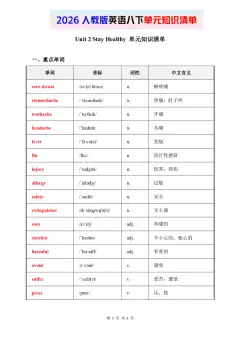
Unit 2 Stay Healthy 单词批注
ourselves /ˌaʊəˈselvz; ɑːrˈselvz/pron. 我们自己
用法:反身代词,用于强调主语是 “我们自己”,或表示独自、亲自。
搭配:by ourselves(独自;单独)、hurt ourselves(伤到我们自己)、introduce ourselves
(自我介绍)
例句:We built the model by ourselves.(我们自己建了这个模型。);We shouldn't hurt
ourselves.(我们不应该伤到自己。)
同义:pron. us(我们,宾格,非反身,如 “Tell us(告诉我们)”)
sore /sɔː(r)/adj. 疼痛的;酸痛的
用法:用于描述身体部位因受伤、劳累等产生的疼痛、酸痛感觉。
搭配:sore throat(喉咙痛)、sore muscles(肌肉酸痛)、sore back(背痛)
例句:I have a sore throat and can't speak loudly.(我喉咙痛,不能大声说话。);After
exercising, my legs are sore.(运动后,我的腿酸痛。)
同义:adj. painful(疼痛的,更宽泛,如 “a painful wound(疼痛的伤口)”)、achy(疼痛
的;酸痛的,侧重 “持续的隐痛”,如 “feel achy all over(浑身酸痛)”)
反义:adj. painless(无痛的,如 “a painless injection(无痛注射)”)
词形变换:名词 soreness(疼痛;酸痛,如 “muscle soreness(肌肉酸痛)”)
throat /θrəʊt/n. 喉咙
用法:指人或动物的咽喉部位,是呼吸和吞咽的通道。
搭配:have a sore throat(喉咙痛)、clear one's throat(清喉咙)、throat infection(喉
咙感染)
例句:He has a bad throat infection.(他喉咙严重感染。);She cleared her throat
before speaking.(她说话前清了清喉咙。)
同义:n. pharynx(咽;咽喉,更专业的解剖学名词)
第 1 页 共 33 页2026 人教版英语八下学霸预习单词批注
stomachache /ˈstʌməkeɪk/n. 胃痛;肚子疼
用法:指胃部疼痛的症状,常因饮食不当、疾病等引起。
搭配:have a stomachache(胃痛;肚子疼)、severe stomachache(严重的胃痛)
例句:She has a stomachache after eating too much.(她吃太多后胃痛。);The boy
complained of a stomachache.(男孩抱怨肚子疼。)
同义:n. bellyache(腹痛;肚子痛,口语化,如 “have a bellyache(肚子疼)”)
headache /ˈhedeɪk/n. 头痛
用法:指头部疼痛的症状,可由多种原因引起,如疲劳、疾病等。
搭配:have a headache(头痛)、migraine headache(偏头痛)、severe headache(严重
的头痛)
例句:I have a terrible headache today.(我今天头痛得厉害。);She often suffers from
migraine headaches.(她经常偏头痛。)
同义:n. cephalalgia(头痛,医学术语)
toothache /ˈtuːθeɪk/n. 牙痛
用法:指牙齿疼痛的症状,多因蛀牙、牙龈炎等引起。
搭配:have a toothache(牙痛)、terrible toothache(严重的牙痛)、toothache relief
(牙痛缓解)
例句:He has a toothache and needs to see a dentist
他牙痛,需要看牙医。);The toothache
(. kept me awake all night.(牙痛让我整晚没
睡。)
同义:n. odontalgia(牙痛,医学术语)
backache /ˈbækeɪk/n. 背痛;腰痛
用法:指背部或腰部疼痛的症状,常因劳累、受伤等引起。
搭配:have a backache(背痛;腰痛)、lower backache(下腰痛)、chronic backache(慢
性背痛)
第 2 页 共 33 页2026 人教版英语八下学霸预习单词批注
例句:After lifting the heavy box, he had a backache
搬了重箱子后,他背痛。);She suffers
(. from chronic backache.(她患有慢性背痛。)
同义:n. lumbago(腰痛,医学术语,侧重 “腰痛”)
press /pres/v. 压;按;挤;推
用法:表示用力量压、按、挤或推物体,也可表示媒体 “报道;出版”(较少见,此处取 “压;
按” 等义)。
搭配:press a button(按按钮)、press clothes(熨衣服)、press against(挤靠;压在……
上)
例句:Press this button to start the machine.(按这个按钮启动机器。);She pressed the
clothes with an iron.(她用熨斗熨衣服。)
同义:v. push(推;按,更宽泛,如 “push the door(推门)”)、squeeze(挤;压榨,侧
重 “挤压”,如 “squeeze juice(挤果汁)”)
反义:v. release(释放;松开,如 “release pressure(释放压力)”)
词形变换:名词 press(新闻界;出版社;压具,如 “the press(新闻界)”“printing press
(印刷机)”),形容词 pressed(紧缺的;受压的,如 “time - pressed(时间紧迫的)”)
nosebleed /ˈnəʊzbliːd/n. 鼻出血
用法:指鼻子出血的症状,常因外伤、干燥等引起。
搭配:have a nosebleed(鼻出血)、stop a nosebleed(止住鼻出血)
例句:He had a nosebleed after being hit in the face.(他脸部被打后鼻出血。);To stop
a nosebleed, lean forward and pinch the nose.(要止住鼻出血,身体前倾并捏住鼻子。)
同义:n. epistaxis(鼻出血,医学术语)
dentist /ˈdentɪst/n. 牙科医生
用法:指专门治疗牙齿疾病、进行牙齿护理的医生。
搭配:see a dentist(看牙医)、dentist office(牙医诊所)、family dentist(家庭牙医)
第 3 页 共 33 页2026 人教版英语八下学霸预习单词批注
例句:I need to see a dentist for my toothache.(我牙痛,需要看牙医。);The dentist
fixed my broken tooth.(牙医补了我破损的牙齿。)
同义:n. dental surgeon(牙科外科医生,更侧重 “外科治疗”)
词形变换:名词 dentistry(牙科学;牙科医术,如 “study dentistry(学习牙科学)”),形
容词 dental(牙齿的;牙科的,如 “dental care(牙齿护理)”)
fever /ˈfiːvə(r)/n. 发烧
用法:指体温升高的症状,是疾病的常见表现。
搭配:have a fever(发烧)、high fever(高烧)、fever reducer(退烧药)
例句:She has a fever and needs to rest.(她发烧了,需要休息。);The child developed
a high fever.(孩子发高烧了。)
同义:n. pyrexia(发烧,医学术语)
词形变换:动词 fever(使发烧;使狂热,如 “fever with excitement(因兴奋而狂热)”),
形容词 feverish( 发烧的; 狂热的, 如 “a feverish patient( 发烧的病人)”“a feverish
atmosphere(狂热的氛围)”)
stomach /ˈstʌmək/n. 胃;腹部
用法:作 “胃” 指人体消化器官;作 “腹部” 指身体的腹部区域。
搭配:stomach ache(胃痛)、empty stomach(空腹)、stomach cancer(胃癌)
例句:The stomach helps digest food.(胃帮助消化食物。);He felt a pain in his stomach.
(他腹部疼痛。)
同义:n. belly(肚子;腹部,口语化,如 “a big belly(大肚子)”)、abdomen(腹部;下
腹,更正式,解剖学名词,如 “abdomen surgery(腹部手术)”)
词形变换:动词 stomach(忍受;承受,如 “can't stomach the idea(无法忍受这个想
法)”),形容词 stomachic(健胃的;胃的,如 “stomachic medicine(健胃药)”)
avoid /əˈvɔɪd/v. 避免;防止
用法:表示设法不做某事、不处于某种状态,或防止某事发生。
第 4 页 共 33 页2026 人教版英语八下学霸预习单词批注
搭配:avoid doing sth.(避免做某事)、avoid danger(避免危险)、avoid mistakes(避
免错误)
例句:We should avoid making the same mistake.(我们应该避免犯同样的错误。);To
stay safe, avoid dark alleys at night.(为了安全,晚上避免走黑暗的小巷。)
同义:v. evade(逃避;回避,更侧重 “巧妙躲避”,如 “evade taxes(逃税)”)、shun
(避开;回避,更正式,如 “shun bad company(避开不良同伴)”)
反义:v. seek(寻求;寻找,如 “seek adventure(寻求冒险)”)、embrace(拥抱;欣然
接受,如 “embrace challenges(欣然接受挑战)”)
词形变换:名词 avoidance(避免;回避,如 “the avoidance of conflict(避免冲突)”),
形容词 avoidable(可避免的;可回避的,如 “avoidable accidents(可避免的事故)”)
gas /ɡæs/n. 气体;燃气
用法:作 “气体” 指物质的气态形式;作 “燃气” 指用于燃烧供热、供电等的气体燃料。
搭配:natural gas(天然气)、toxic gas(有毒气体)、gas stove(煤气灶)
例句:Oxygen is a gas we need to breathe.(氧气是我们需要呼吸的气体。);We use
gas to heat our home.(我们用燃气给家里供暖。)
同义:n. gaseous substance(气态物质,“气体” 义,宽泛表述);“fuel gas(燃气,如
“fuel gas for cooking(烹饪用燃气)”)
反义:n. solid(固体,“气体” 反义,如 “solid rock(固体岩石)”)、liquid(液体,“气体”
反义,如 “liquid water(液态水)”)
词形变换:动词 gas(用毒气攻击;空谈,如 “gas the enemy(用毒气攻击敌人)”“gas on
about(空谈关于……)”),形容词 gaseous(气体的;气态的,如 “gaseous state(气
态)”)
ache /eɪk/n. & v. 疼痛
用法:作名词指持续的、隐隐的疼痛;作动词表示疼痛。
搭配:head ache(头痛)、back ache(背痛)、ache all over(浑身疼痛)
例句:She has an ache in her shoulder.(她肩膀疼痛。);My legs ache after the long walk.
(长时间走路后我的腿疼痛。)
第 5 页 共 33 页2026 人教版英语八下学霸预习单词批注
同义:n. pain(疼痛,更宽泛,如 “a sharp pain(锐痛)”);v. hurt(疼痛;受伤,更宽
泛,如 “hurt one's leg(腿受伤 / 疼痛)”)
词形变换:形容词 achy(疼痛的;酸痛的,如 “feel achy(感到酸痛)”),名词 aching
(疼痛;酸痛,如 “the aching of the wound(伤口的疼痛)”)
X-ray /ˈeks reɪ/n. X 光照片;X 射线
用法:作 “X 光照片” 指通过 X 射线拍摄的人体内部影像;作 “X 射线” 指一种电磁辐射,
用于医学成像、工业检测等。
搭配:take an X-ray(拍 X 光片)、X-ray machine(X 光机)、X-ray vision(X 射线透
视能力,比喻)
例句:The doctor took an X-ray of my chest.(医生给我的胸部拍了 X 光片。);X-rays
can penetrate some materials.(X 射线能穿透一些材料。)
同义:n. radiograph(X 光照片,医学术语)、X-radiation(X 射线,物理术语)
词形变换:动词 X-ray(用 X 光检查;用 X 光拍摄,如 “X-ray the luggage(用 X 光检
查行李)”),形容词 X-ray(X 射线的;X 光的,如 “X-ray examination(X 光检查)”)
careless /ˈkeələs/adj. 不小心的;粗心的
用法:描述人做事不仔细、不认真,容易出错。
搭配:careless mistake(粗心的错误)、careless driver(粗心的司机)、be careless with
(对…… 粗心)
例句:It was a careless mistake that could have been avoided.(这是一个本可以避免的粗
心错误。);The careless driver caused the accident.(粗心的司机造成了事故。)
同义:adj. negligent(疏忽的;粗心大意的,更正式,如 “negligent behavior(疏忽行
为)”)、 reckless(鲁莽的;粗心的,更强调 “不顾后果”,如 “reckless driving(鲁莽驾
驶)”)
反义:adj. careful(仔细的;小心的,如 “a careful worker(仔细的工人)”)、attentive
(注意的;专心的,如 “attentive student(专心的学生)”)
词形变换:副词 carelessly(粗心地;不注意地,如 “drive carelessly(粗心驾驶)”),名
词 carelessness(粗心;疏忽,如 “his carelessness led to failure(他的粗心导致失败)”)
第 6 页 共 33 页2026 人教版英语八下学霸预习单词批注
runny /ˈrʌni/adj. 流鼻涕的;流眼泪的
用法:用于描述鼻子或眼睛有液体流出的状态,常因感冒、过敏等引起。
搭配:runny nose(流鼻涕)、runny eyes(流眼泪)、runny cold(流鼻涕的感冒)
例句:He has a runny nose because of the cold(. 因为感冒,他流鼻涕。);Her eyes are
runny
after cutting onions.(切洋葱后她的眼睛流眼泪。)
同义:adj. dripping(滴水的;滴下的,如 “dripping nose(流鼻涕的鼻子)”)、watery
(水状的;流泪的,如 “watery eyes(流泪的眼睛)”)
反义:adj. dry(干燥的,如 “dry nose(干燥的鼻子)”)
词形变换:名词 runniness(流鼻涕;流眼泪的状态,如 “the runniness of the nose(流鼻
涕的状态)”)
cough /kɒf/n. & v. 咳嗽
用法:作名词指咳嗽的动作或病症;作动词表示咳嗽的行为。
搭配:have a cough(咳嗽)、dry cough(干咳)、cough up(咳出)
例句:He has a bad cough.(他咳嗽得很厉害。);She coughed to clear her throat.(她
咳嗽清喉咙。)
同义:n. coughing(咳嗽,动名词形式,如 “a fit of coughing(一阵咳嗽)”)
bruised /bruːzd/adj. 受了瘀伤的
用法:描述身体部位因碰撞等出现瘀青的状态。
搭配:bruised knee(瘀伤的膝盖)、bruised arm(瘀伤的手臂)
例句:His leg is bruised from the fall.(他摔倒后腿瘀伤了。);She has a bruised forehead.
(她额头有瘀伤。)
同义:adj. black - and - blue(青一块紫一块的,口语化,如 “a black - and - blue eye(青
肿的眼睛)”)、contused(受挫伤的,医学术语)
反义:adj. unbruised(无瘀伤的,如 “an unbruised apple(无瘀伤的苹果)”)
第 7 页 共 33 页2026 人教版英语八下学霸预习单词批注
词形变换:动词 bruise(使瘀伤;擦伤,如 “bruise the fruit(擦伤水果)”“bruise one's skin
(使皮肤瘀伤)”),名词 bruise(瘀伤;擦伤,如 “a bruise on the arm(手臂上的瘀伤)”)
suffer /ˈsʌfə(r)/v. 受苦;遭受
用法:表示经历痛苦、困难、疾病等负面情况。
搭配:suffer pain(遭受痛苦)、suffer from(受苦;受折磨,常接疾病等)、suffer loss(遭
受损失)
例句:He suffered a lot during the war(. 他在战争中受了很多苦。);Many people suffer
from
hunger in some areas.(一些地区很多人受饥饿之苦。)
同义:v. endure(忍受;忍耐,更强调 “长时间忍受”,如 “endure hardship(忍受苦
难)”)、 undergo(经历;遭受,更正式,如 “undergo surgery(经历手术)”)
反义:v. enjoy(享受;喜爱,如 “enjoy life(享受生活)”)
词形变换:名词 suffering(痛苦;苦难,如 “the suffering of the poor(穷人的苦
难)”),形容词 sufferable(可忍受的;可容忍的,如 “a sufferable mistake(可容忍的错
误)”)
suffer from 受苦;受折磨
用法:表示因疾病、不良状况等而受苦、受折磨。
搭配:suffer from a disease(患一种疾病)、suffer from loneliness(受孤独折磨)
例句:She suffers from a rare illness.(她患有一种罕见的疾病。);Some people suffer
from anxiety.(一些人受焦虑折磨。)
同义:phr. be afflicted with(受…… 折磨,更正式,如 “be afflicted with sadness(受悲伤
折磨)”)、be troubled by(被…… 困扰,如 “be troubled by nightmares(被噩梦困
扰)”)
反义:phr. be free from(免于;不受…… 影响,如 “be free from pain(免于痛苦)”)
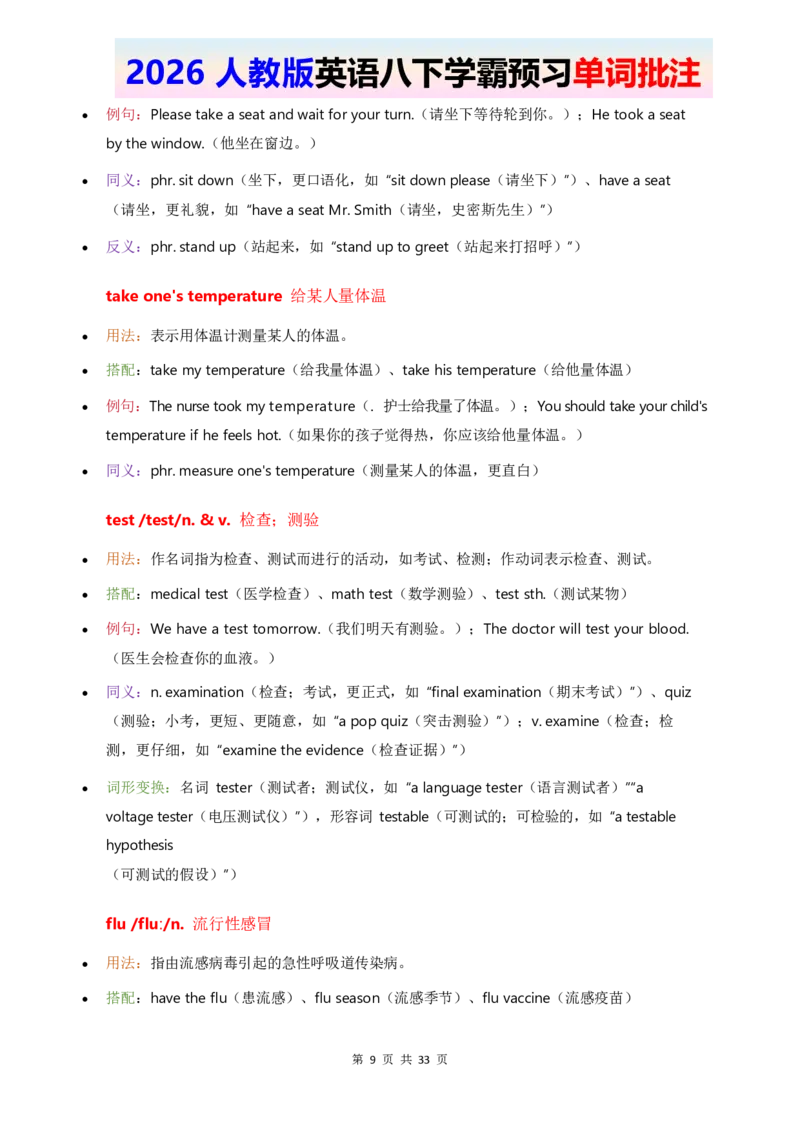
take a seat 坐下
用法:表示请人或自己坐下的礼貌表达。
搭配:take a seat here(在这里坐下)、take a comfortable seat(坐一个舒服的座位)
第 8 页 共 33 页2026 人教版英语八下学霸预习单词批注
例句:Please take a seat and wait for your turn.(请坐下等待轮到你。);He took a seat
by the window.(他坐在窗边。)
同义:phr. sit down(坐下,更口语化,如 “sit down please(请坐下)”)、have a seat
(请坐,更礼貌,如 “have a seat Mr. Smith(请坐,史密斯先生)”)
反义:phr. stand up(站起来,如 “stand up to greet(站起来打招呼)”)
take one's temperature 给某人量体温
用法:表示用体温计测量某人的体温。
搭配:take my temperature(给我量体温)、take his temperature(给他量体温)
例句:The nurse took my temperature(. 护士给我量了体温。);You should take your child's
temperature if he feels hot.(如果你的孩子觉得热,你应该给他量体温。)
同义:phr. measure one's temperature(测量某人的体温,更直白)
test /test/n. & v. 检查;测验
用法:作名词指为检查、测试而进行的活动,如考试、检测;作动词表示检查、测试。
搭配:medical test(医学检查)、math test(数学测验)、test sth.(测试某物)
例句:We have a test tomorrow.(我们明天有测验。);The doctor will test your blood.
(医生会检查你的血液。)
同义:n. examination(检查;考试,更正式,如 “final examination(期末考试)”)、quiz
(测验;小考,更短、更随意,如 “a pop quiz(突击测验)”);v. examine(检查;检
测,更仔细,如 “examine the evidence(检查证据)”)
词形变换:名词 tester(测试者;测试仪,如 “a language tester(语言测试者)”“a
voltage tester(电压测试仪)”),形容词 testable(可测试的;可检验的,如 “a testable
hypothesis
(可测试的假设)”)
flu /fluː/n. 流行性感冒
用法:指由流感病毒引起的急性呼吸道传染病。
搭配:have the flu(患流感)、flu season(流感季节)、flu vaccine(流感疫苗)
第 9 页 共 33 页2026 人教版英语八下学霸预习单词批注
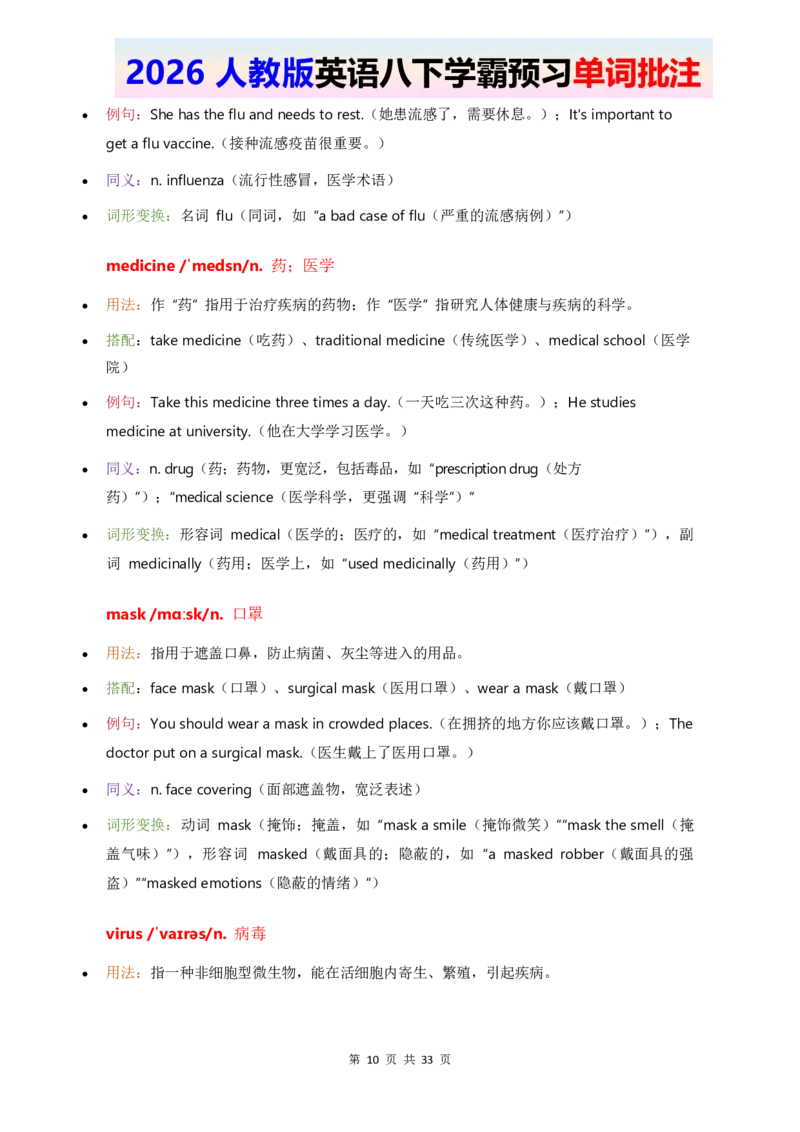
例句:She has the flu and needs to rest.(她患流感了,需要休息。);It's important to
get a flu vaccine.(接种流感疫苗很重要。)
同义:n. influenza(流行性感冒,医学术语)
词形变换:名词 flu(同词,如 “a bad case of flu(严重的流感病例)”)
medicine /ˈmedsn/n. 药;医学
用法:作 “药” 指用于治疗疾病的药物;作 “医学” 指研究人体健康与疾病的科学。
搭配:take medicine(吃药)、traditional medicine(传统医学)、medical school(医学
院)
例句:Take this medicine three times a day.(一天吃三次这种药。);He studies
medicine at university.(他在大学学习医学。)
同义:n. drug(药;药物,更宽泛,包括毒品,如 “prescription drug(处方
药)”);“medical science(医学科学,更强调 “科学”)”
词形变换:形容词 medical(医学的;医疗的,如 “medical treatment(医疗治疗)”),副
词 medicinally(药用;医学上,如 “used medicinally(药用)”)
mask /mɑːsk/n. 口罩
用法:指用于遮盖口鼻,防止病菌、灰尘等进入的用品。
搭配:face mask(口罩)、surgical mask(医用口罩)、wear a mask(戴口罩)
例句:You should wear a mask in crowded places.(在拥挤的地方你应该戴口罩。);The
doctor put on a surgical mask.(医生戴上了医用口罩。)
同义:n. face covering(面部遮盖物,宽泛表述)
词形变换:动词 mask(掩饰;掩盖,如 “mask a smile(掩饰微笑)”“mask the smell(掩
盖气味)”),形容词 masked(戴面具的;隐蔽的,如 “a masked robber(戴面具的强
盗)”“masked emotions(隐蔽的情绪)”)
virus /ˈvaɪrəs/n. 病毒
用法:指一种非细胞型微生物,能在活细胞内寄生、繁殖,引起疾病。
第 10 页 共 33 页2026 人教版英语八下学霸预习单词批注
搭配:computer virus(计算机病毒)、flu virus(流感病毒)、virus infection(病毒感染)
例句:The flu is caused by a virus
流感由病毒引起。);A computer virus can damage data.
(.
(计算机病毒能破坏数据。)
词形变换:形容词 viral(病毒的;病毒性的,如 “viral disease(病毒性疾病)”“viral video
(病毒式传播的视频)”)
stop ... from doing 防止……;阻止……
用法:表示阻止某人或某物做某事。
搭配:stop him from leaving(阻止他离开)、stop the rain from coming in(阻止雨水进来)
例句:We should stop pollution from harming the environment.(我们应该阻止污染危害环
境。);Nothing can stop her from achieving her goal.(没有什么能阻止她实现目标。)
同义:phr. prevent ... from doing(防止…… 做……,更正式,如 “prevent children from danger
(防止孩子陷入危险)”)、keep ... from doing(阻止…… 做……,如 “keep the dog from
barking(阻止狗叫)”)
反义:phr. encourage ... to do(鼓励…… 做……,如 “encourage students to study(鼓励
学生学习)”)
description /dɪˈskrɪpʃn/n. 描写;形容
用法:指对人、事物、事件等的描述、说明。
搭配:give a description(进行描述)、detailed description(详细的描述)、beyond
description
(难以描述)
例句:Can you give a description of the thief?(你能描述一下小偷吗?);The beauty of
the scenery is beyond description.(风景之美难以描述。)
同义:n. account(描述;叙述,更侧重 “讲述”,如 “an account of the event(事件的叙
述)”)、 depiction(描绘;描写,更视觉化,如 “a depiction of nature(自然的描
绘)”)
词形变换:动词 describe(描述;形容,如 “describe a person(描述一个人)”),形容词
descriptive(描述的;说明的,如 “descriptive writing(描述性写作)”)
第 11 页 共 33 页2026 人教版英语八下学霸预习单词批注
patient /ˈpeɪʃnt/n. 病人 ;adj. 有耐心的
用法:作名词指接受医疗护理的人;作形容词指能容忍、不急躁。
搭配:hospital patient(医院病人)、be patient with(对…… 有耐心)、patient teacher
(有耐心的老师)
例句:The patient is waiting to see the doctor(. 病人正等着看医生。);You need to be
patient
when teaching kids.(教孩子时你需要有耐心。)
同义:n. sick person(病人,直白表述);adj. tolerant(容忍的;宽容的,如 “tolerant attitude
(宽容的态度)”)
反义:adj. impatient(不耐烦的;急躁的,如 “an impatient driver(急躁的司机)”)
词形变换:名词 patience(耐心;忍耐,如 “have patience(有耐心)”),副词 patiently
(耐心地;忍耐地,如 “wait patiently(耐心等待)”)
injury /ˈɪndʒəri/n. 伤害;损伤
用法:指因外力等造成的身体或精神上的伤害、损伤。
搭配:serious injury(严重的伤害)、injury to the head(头部损伤)、sports injury(运
动损伤)
例句:He got an injury in the
他在事故中受伤了。);The player has a sports injury.
accident(.
(运动员有运动损伤。)
同义:n. harm(伤害;损害,更宽泛,如 “do harm to(对…… 造成伤害)”)、damage
(损害;损伤,更侧重 “对物体的损害”,如 “damage to property(财产损害)”)
反义:n. health(健康;安好,如 “restore health(恢复健康)”)
词形变换:动词 injure(伤害;损害,如 “injure oneself(伤到自己)”),形容词 injured
(受伤的;受损害的,如 “injured workers(受伤的工人)”)
illness /ˈɪlnəs/n. 疾病
用法:指身体或精神上的疾病、不健康状态。
第 12 页 共 33 页2026 人教版英语八下学霸预习单词批注
搭配:serious illness(严重的疾病)、suffer from an illness(患一种疾病)、mental illness
(精神疾病)
例句:He had a long illness.(他病了很久。);Mental illness should be taken seriously.
(精神疾病应该被重视。)
同义:n. disease(疾病,更正式,常指 “具体的、严重的疾病”,如 “infectious disease(传
染病)”)、sickness(疾病; sickness 更口语化,如 “feel sickness(感觉不适)”)
反义:n. health(健康;健康状态,如 “enjoy good health(身体健康)”)
词形变换:形容词 ill(生病的;坏的,如 “fall ill(生病)”“ill luck(坏运气)”),副词 ill
(恶劣地;不利地,如 “speak ill of(说…… 坏话)”)
knife /naɪf/n. (pl. knives /naɪvz/) 刀
用法:指用于切割的工具,有单刃或多刃,复数为 “knives”。
搭配:kitchen knife(菜刀)、sharp knife(锋利的刀)、cut with a knife(用刀切割)
例句:She used a knife to cut the cake.(她用刀切蛋糕。);Be careful with that sharp knife.
(小心那把锋利的刀。)
同义:n. blade(刀刃;刀片,更侧重 “刃”,如 “a sharp blade(锋利的刀刃)”)
词形变换:动词 knife(用刀刺;用刀切割,如 “knife the meat(用刀切割肉)”“knife an
opponent(用刀刺对手)”),
clear /klɪə(r)/adj. 清晰的;清楚的 ;v. 清理
用法:作形容词指容易看见、听到或理解的;作动词表示去除、清理某物。
搭配:clear voice(清晰的声音)、clear explanation(清楚的解释)、clear the table(清
理桌子)
例句:His explanation is very clear
他的解释很清楚。);Please clear the dishes after dinner.
(.
(饭后请清理餐具。)
同义:adj. distinct(清晰的;明显的,如 “distinct shape(清晰的形状)”)、obvious(明
显的;显然的,如 “obvious mistake(明显的错误)”);v. clean(打扫;清理,更宽泛,
如 “clean the room(打扫房间)”)
第 13 页 共 33 页2026 人教版英语八下学霸预习单词批注
反义:adj. unclear(不清楚的;模糊的,如 “unclear instructions(不清楚的指示)”)、vague
(模糊的;含糊的,如 “vague memory(模糊的记忆)”);v. clutter(使杂乱;堆满,如
“clutter the desk(把桌子堆满)”)
词形变换:副词 clearly(清晰地;清楚地,如 “speak clearly(清晰地说话)”),名词 clearness
(清晰;清楚,如 “the clearness of the water(水的清澈)”)
pain /peɪn/n. 疼痛;痛苦
用法:指身体上的疼痛感觉或精神上的痛苦情绪。
搭配:physical pain(身体疼痛)、emotional pain(情感痛苦)、pain in the leg(腿部疼
痛)
例句:She felt a sharp pain in her stomach.(她胃部感到一阵剧痛。);The loss caused
him great pain.(失去(某物 / 人)给他带来极大痛苦。)
同义:n. ache(疼痛,更侧重 “持续的隐痛”,如 “back ache(背痛)”)、suffering(痛
苦;苦难,更强调 “苦难经历”,如 “suffering from war(战争带来的苦难)”)
反义:n. pleasure(愉快;快乐,如 “a moment of pleasure(片刻的快乐)”)、happiness
(幸福;快乐,如 “seek happiness(寻求幸福)”)
词形变换:动词 pain(使痛苦;使烦恼,如 “pain sb. deeply(使某人深感痛苦)”),形
容词 painful(疼痛的;痛苦的,如 “painful experience(痛苦的经历)”)
what's more 更有甚者;更为重要的是
用法:用于补充信息,强调更重要的一点或进一步说明。
搭配:what's more, ...(更有甚者,……)
例句:The movie is boring. What's more, it's too long.(这部电影很无聊。更有甚者,它太
长了。);He is smart. What's more, he works hard.(他很聪明。更为重要的是,他很努
力。)
同义:phr. moreover(而且;此外,更正式,如 “Moreover, we need to consider cost.
(而且,我们需要考虑成本。)”)、furthermore(此外;而且,更正式,如
“Furthermore, the plan is practical.(此外,这个计划很实用。)”)
反义:phr. on the contrary(相反,如 “On the contrary, he is lazy.(相反,他很懒。)”)
第 14 页 共 33 页2026 人教版英语八下学霸预习单词批注
brightness /ˈbraɪtnəs/n. 亮度
用法:指光线的明亮程度。
搭配:high brightness(高亮度)、adjust the brightness(调节亮度)
例句:The brightness of the sun hurts my eyes.(太阳的亮度刺痛了我的眼睛。);You
can adjust the brightness of the screen.(你可以调节屏幕的亮度。)
同义:n. luminance(亮度;发光度,物理术语)
反义:n. darkness(黑暗;昏暗,如 “in darkness(在黑暗中)”)
词形变换:动词 brighten(使明亮;使愉快,如 “brighten the room(使房间明
亮)”“brighten one's day(使某人的一天愉快)”),形容词 bright(明亮的;聪明的,如
“bright light(明亮的光)”“bright student(聪明的学生)”)
environment /ɪnˈvaɪrənmənt/n. 环境
用法:指周围的自然或社会条件、情况。
搭配:natural environment(自然环境)、social environment(社会环境)、protect the
environment(保护环境)
例句:We should protect the natural environment.(我们应该保护自然环境。);The
child grew up in a good social environment.(孩子在良好的社会环境中长大。)
同义:n. surroundings(周围环境; surroundings 更侧重 “周围的具体事物”,如 “beautiful
surroundings(美丽的周围环境)”)、setting(环境;背景,更侧重 “场景、背景”,如
“the setting of a story(故事的背景)”)
词形变换:形容词 environmental(环境的;有关环境的,如 “environmental protection
(环境保护)”),副词 environmentally(有关环境地;在环境方面,如 “environmentally
friendly
(环保的)”)
cross /krɒs/v. 穿越;横过;交叉
用法:表示从一边到另一边,或线条等交叉。
搭配:cross the road(过马路)、cross a river(过河)、cross one's arms(交叉手臂)
第 15 页 共 33 页2026 人教版英语八下学霸预习单词批注
例句:Be careful when you cross the
过马路时要小心。);The two roads cross here.
street(.
(两条路在这里交叉。)
同义:v. traverse(穿越;横过,更正式,如 “traverse the forest(穿越森林)”)、intersect
(相交;交叉,更侧重 “线条交叉”,如 “two lines intersect(两条线相交)”)
反义:v. stay(停留;保持,如 “stay on this side(停留在这边)”)
词形变换:名词 crossing(十字路口;穿越,如 “a pedestrian crossing(人行横道)”“the
crossing of the river(过河)”),形容词 cross(生气的;交叉的,如 “a cross look(生
气的表情)”“cross roads(交叉路)”)
catch fire 着火
用法:表示物体开始燃烧。
搭配:catch fire easily(容易着火)、catch fire accidentally(意外着火)
例句:The dry wood catches fire
干木头容易着火。);The house caught fire last night.
easily(.
(房子昨晚着火了。)
同义:phr. start burning(开始燃烧,直白表述)、be on fire(着火;在燃烧,如 “the
building is on fire(大楼着火了)”)
反义:phr. put out fire(灭火,如 “put out the fire quickly(迅速灭火)”)
themselves /ðəmˈselvz/pron. 他(或她、它)们自己
用法:反身代词,用于强调主语是 “他们自己”,或表示独自、亲自。
搭配:by themselves(独自;单独)、hurt themselves(伤到他们自己)、introduce
themselves
(自我介绍)
例句:They built the house by themselves(. 他们自己建了房子。);The kids hurt themselves
while playing.(孩子们玩耍时伤到了自己。)
同义:pron. them(他们,宾格,非反身,如 “Tell them(告诉他们)”)
fry /fraɪ/v. 油炸;油煎;油炒
用法:表示用油炸、煎、炒食物。
第 16 页 共 33 页2026 人教版英语八下学霸预习单词批注
搭配:fry eggs(煎鸡蛋)、fry chicken(炸鸡肉)、fry in oil(用油煎)
例句:She likes to fry potatoes for breakfast.(她喜欢早餐煎土豆。);Fry the vegetables
in a little oil.(用少量油炒蔬菜。)
同义:v. sauté(炒;嫩煎,更侧重 “用少量油快速炒”,如 “sauté mushrooms(炒蘑
菇)”)、 deep - fry(油炸,更侧重 “ deep - 深炸”,如 “deep - fry dough sticks(炸油
条)”)
反义:v. boil(煮;煮沸,如 “boil water(煮水)”)、steam(蒸;用蒸汽煮,如 “steam fish
(蒸鱼)”)
词形变换:名词 fry(鱼苗;油炸食品,如 “fish fry(鱼苗)”“a bag of fries(一袋油炸食
品)”),形容词 fried(油炸的;油煎的,如 “fried chicken(炸鸡)”)
turn on 接通(电流、煤气、水等);打开
用法:表示使电器、煤气、水等开始工作或流动。
搭配:turn on the light(开灯)、turn on the TV(开电视)、turn on the tap(开水龙头)
例句:Turn on the radio, please.(请打开收音机。);He turned on the gas to cook.(他
打开煤气做饭。)
同义:phr. switch on(打开;接通,更侧重 “用开关打开”,如 “switch on the computer
(打开电脑)”)
反义:phr. turn off(关掉;关闭,如 “turn off the light(关灯)”)
stove /stəʊv/n. 厨房灶具;炉子
用法:指用于烹饪的炉灶,有煤气灶、电炉等。
搭配:gas stove(煤气灶)、electric stove(电炉)、cook on the stove(在炉灶上烹饪)
例句:We have a new gas stove in the kitchen.(我们厨房有一个新煤气灶。);She
cooked dinner on the stove.(她在炉灶上做了晚餐。)
同义:n. cooker(炊具;炉灶,英式英语,如 “an electric cooker(电炉)”)、range(炉
灶;烤箱,更大型,如 “a kitchen range(厨房炉灶)”)
happily /ˈhæpɪli/adv. 快乐地;高兴地
第 17 页 共 33 页2026 人教版英语八下学霸预习单词批注
用法:用于修饰动词,描述动作进行时的快乐、高兴状态。
搭配:sing happily(快乐地唱歌)、live happily(快乐地生活)、dance happily(高兴地
跳舞)
例句:The children are playing happily in the park.(孩子们在公园里快乐地玩耍。);
They lived happily ever after.(从此他们幸福地生活在一起。)
同义:adv. joyfully(快乐地;高兴地,更强调 “joy - 喜悦”,如 “joyfully celebrate(快乐地
庆祝)”)、merrily(愉快地;高兴地,更活泼,如 “merrily skip(愉快地蹦跳)”)
反义:adv. unhappily(不快乐地;不高兴地,如 “unhappily leave(不高兴地离开)”)、
sadly(悲伤地;难过地,如 “sadly cry(悲伤地哭)”)
词形变换:形容词 happy(快乐的;高兴的,如 “a happy child(快乐的孩子)”),名词
happiness(幸福;快乐,如 “seek happiness(寻求幸福)”)
no way 不可能;没门
用法:用于口语中,表示拒绝、不同意或认为某事不可能。
搭配:no way ...(不可能……;没门……)
例句:Can you finish this in an hour? No way!(你能在一小时内完成这个吗?不可能!);
No way am I going there.(我绝不去那里。)
同义:phr. impossible(不可能,形容词,如 “It's impossible.(这不可能。)”)、not a chance
(没机会;不可能,如 “Not a chance he'll agree.(他绝不可能同意。)”)
反义:phr. definitely(肯定;当然,如 “Definitely, I'll do it.(当然,我会做的。)”)、for sure
(肯定;确定,如 “For sure, he's coming.(他肯定会来。)”)
burn /bɜːn/v. (burnt /bɜːnt/, burnt) 燃烧;着火
用法:表示物质燃烧,或身体被火焰、高温等烧伤、烫伤。
搭配:burn wood(烧木头)、get burnt(被烧伤)、burn with anger(怒火中烧)
例句:The fire is burning brightly.(火正熊熊燃烧。);She burnt her hand on the hot pan.
(她的手被热锅烫伤了。)
第 18 页 共 33 页2026 人教版英语八下学霸预习单词批注
同义:v. blaze(燃烧;熊熊燃烧,更侧重 “猛烈燃烧”,如 “blaze with fire(熊熊燃
烧)”)、 scorch(烧焦;烤焦,更侧重 “烤焦”,如 “scorch the paper(烧焦纸)”)
反义:v. extinguish(熄灭;扑灭,如 “extinguish the fire(灭火)”)
词形变换:名词 burn(烧伤;灼伤,如 “a bad burn(严重的烧伤)”),形容词 burnt
(烧焦的;烧伤的,如 “burnt toast(烧焦的吐司)”“burnt skin(烧伤的皮肤)”)
on fire 着火;起火
用法:用于描述物体处于燃烧的状态。
搭配:be on fire(着火)、put out on fire(扑灭火灾)
例句:The house is on fire.(房子着火了。);Firefighters worked hard to put out the fire
on the building.(消防员努力扑灭大楼的火。)
同义:phr. catch fire(着火;开始燃烧,强调 “开始燃烧” 的动作,如 “The dry grass
caught fire easily.(干草很容易着火。)”)
反义:phr. be out(熄灭;扑灭,如 “The fire is out.(火熄灭了。)”)
flame /fleɪm/n. 火焰
用法:指燃烧时产生的火苗、火焰。
搭配:burning flame(燃烧的火焰)、flame of a candle(蜡烛的火焰)
例句:The flame of the campfire danced in the wind.(篝火的火焰在风中跳动。);She
watched the flame of the candle slowly burn down.(她看着蜡烛的火焰慢慢燃尽。)
同义:n. blaze(火焰;烈火,更强调 “熊熊燃烧的火焰”,如 “a blaze in the fireplace(壁
炉里的烈火)”)
词形变换:动词 flame(燃烧;泛红,如 “flame with ange(r 气得满脸通红)”“the wood flamed
up(木头燃烧起来)”),形容词 flaming(燃烧的;火红的,如 “flaming logs(燃烧的木
头)”“flaming red(火红色)”)
panic /ˈpænɪk/n. 惊恐;恐慌
用法:指因害怕、紧张等产生的恐慌情绪。
第 19 页 共 33 页2026 人教版英语八下学霸预习单词批注
搭配:in panic(恐慌地)、cause panic(引起恐慌)
例句:There was a panic when the fire broke out.(火灾发生时出现了恐慌。);The news
caused panic among the people.(这则消息在人群中引起了恐慌。)
同义:n. fear(恐惧;害怕,更宽泛,如 “a fear of heights(恐高)”)、terror(恐怖;恐
惧,更强烈,如 “terror at the sight of the monster(看到怪物时的恐怖)”)
反义:n. calm(平静;冷静,如 “keep calm(保持冷静)”)
词形变换:动词 panic(使恐慌;惊慌,如 “panic the crowd(使人群恐慌)”“panic at the noise
(听到噪音惊慌)”),形容词 panicky(恐慌的;惊慌失措的,如 “a panicky feeling(恐
慌的感觉)”)
onto /ˈɒntu; ˈɑːntu/prep. 向;朝
用法:表示向、朝某个物体或方向移动并接触。
搭配:jump onto(跳到…… 上)、climb onto(爬到…… 上)
例句:He jumped onto the bed.(他跳到床上。);The cat climbed onto the table.(猫
爬到桌子上。)
同义:prep. on(在…… 上,更宽泛,如 “put a book on the table(把书放在桌子上)”)
反义:prep. off(离开;从…… 上,如 “get off the bus(下公交车)”)
throw /θrəʊ/v. (threw /θruː/, thrown /θrəʊn/) 猛动身体(部位);扔;抛
用法:表示用力扔、抛物体,或猛动身体部位。
搭配:throw a ball(扔球)、throw oneself into(投身于;积极从事)
例句:He threw the stone into the river.(他把石头扔进河里。);She threw herself into
her work.(她全身心投入工作。)
同义:v. toss(扔;抛,更轻松、随意,如 “toss a coin(抛硬币)”)、cast(投;抛,更
正式,如 “cast a fishing line(投钓鱼线)”)
反义:v. catch(抓住;接住,如 “catch the ball(接球)”)
词形变换:名词 throw(投掷;扔,如 “a long throw(远距离投掷)”)
第 20 页 共 33 页2026 人教版英语八下学霸预习单词批注
roll /rəʊl/v. (使) 翻滚;滚动
用法:表示物体滚动,或使人、物翻滚。
搭配:roll down(滚下)、roll a ball(滚球)
例句:The ball rolled down the hill.(球滚下山坡。);He rolled the carpet up.(他把地
毯卷起来。)
同义:v. tumble(翻滚;摔倒,更强调 “失控地翻滚”,如 “tumble down the stairs(从楼
梯上摔下来)”)
反义:v. stop(停止;阻止,如 “stop the ball from rolling(阻止球滚动)”)
词形变换:名词 roll(卷;滚动,如 “a roll of paper(一卷纸)”“the roll of the ship(船的
摇晃)”),形容词 rolled(轧制的;滚制的,如 “rolled steel(轧制钢)”)
quick /kwɪk/adj. 快的;迅速的 ;adv. 迅速地;快速地
用法:作形容词描述物体、动作等速度快;作副词修饰动词,表动作迅速。
搭配:quick reaction(快速反应)、run quick(快速跑)
例句:He has a quick mind.(他思维敏捷。);She ran quick to catch the bus.(她快速跑
着去赶公交车。)
同义:adj. fast(快的;迅速的,更常用,如 “a fast car(快车)”)、swift(迅速的;敏捷
的,更正式,如 “a swift decision(迅速的决定)”);adv. quickly(迅速地;快速地,更常
用,如 “act quickly(迅速行动)”)
反义:adj. slow(慢的;缓慢的,如 “a slow walk(慢走)”);adv. slowly(缓慢地;慢慢
地,如 “walk slowly(慢慢走)”)
词形变换:副词 quickly(迅速地;快速地,如 “quickly finish(迅速完成)”),名词 quickness
(迅速;敏捷,如 “the quickness of his response(他反应的迅速)”)
be about to 即将;正要(做某事)
用法:表示即将要做某事,常与 “when” 连用,构成 “be about to do...when...” 结构。
搭配:be about to leave(即将离开)、be about to start(正要开始)
第 21 页 共 33 页2026 人教版英语八下学霸预习单词批注
例句:I was about to go to bed when the phone rang.(我正要上床睡觉,这时电话响
了。); They are about to start the meeting.(他们即将开始会议。)
同义:phr. be going to(将要;打算,更侧重 “计划、打算”,如 “be going to travel(打
算去旅行)”)、be on the point of(正要;即将,更正式,如 “be on the point of leaving
(正要离开)”)
反义:phr. have just done(刚做完,如 “have just finished homework(刚做完作业)”)
stop short 突然停住
用法:表示突然停止,常因惊讶、危险等原因。
搭配:stop short of(险些;差点)
例句:He stopped short when he saw the snake.(他看到蛇时突然停住了。);She
stopped short of telling him the truth.(她差点告诉他真相。)
同义:phr. come to a sudden stop(突然停止,直白表述)、halt abruptly(突然停止,更
正式,如 “halt abruptly in surprise(因惊讶突然停止)”)
反义:phr. keep going(继续前进,如 “keep going straight(继续直走)”)
aid /eɪd/n. & v. 帮助;援助
用法:作名词指帮助、援助的行为或物品;作动词表示帮助、援助。
搭配:first aid(急救)、give aid(提供帮助)、aid sb.(帮助某人)
例句:We need aid to rebuild the village.(我们需要援助来重建村庄。);He aided the
old man to cross the road.(他帮助老人过马路。)
同义:n. help(帮助;援助,更常用,如 “ask for help(寻求帮助)”)、assistance(帮
助;援助,更正式,如 “technical assistance(技术援助)”);v. help(帮助;帮忙,更常
用,如 “help a friend(帮助朋友)”)
反义:n. harm(伤害;损害,如 “do harm to(对…… 造成伤害)”);v. harm(伤害;损
害,如 “harm others(伤害他人)”)
词形变换:形容词 aiding(帮助的;援助的,如 “an aiding hand(援助之手)”),名词 aider
(帮助者;援助者,如 “a volunteer aider(志愿帮助者)”)
第 22 页 共 33 页2026 人教版英语八下学霸预习单词批注
first aid 急救
用法:指在专业医疗救助到来前,对伤病员进行的初步救助。
搭配:first aid kit(急救包)、give first aid(进行急救)
例句:Everyone should learn some first aid skills.(每个人都应该学习一些急救技能。);
He used first aid to help the injured person.(他用急救知识帮助受伤的人。)
同义:phr. emergency treatment(紧急治疗,更侧重 “治疗”)
反义:phr. no aid(无援助,如 “left with no aid(得不到援助)”)
safety /ˈseɪfti/n. 安全;安全处所
用法:指没有危险、伤害的状态,或安全的地方。
搭配:safety first(安全第一)、ensure safety(确保安全)、safety zone(安全区)
例句:We must put safety first in everything we do.(我们做任何事都必须把安全放在第一
位。);The safety of the children is important.(孩子们的安全很重要。)
同义:n. security(安全;保障,更侧重 “防护、保障”,如 “national security(国家安全)”)
反义:n. danger(危险;危害,如 “in danger(处于危险中)”)
词形变换:形容词 safe(安全的;平安的,如 “a safe place(安全的地方)”),副词 safely
(安全地;平安地,如 “arrive safely(安全到达)”)
extinguisher /ɪkˈstɪŋɡwɪʃə(r)/n. 灭火器
用法:指用于扑灭火灾的设备。
搭配:fire extinguisher(灭火器)、use an extinguisher(使用灭火器)
例句:There is a fire extinguisher in the corridor(. 走廊里有一个灭火器。);He learned
how
to use an extinguisher.(他学习了如何使用灭火器。)
同义:n. fire extinguisher(灭火器,完整表述)
词形变换:动词 extinguish(熄灭;扑灭,如 “extinguish the fire(灭火)”),形容词
extinguishable(可熄灭的;可扑灭的,如 “extinguishable flames(可扑灭的火焰)”)
第 23 页 共 33 页2026 人教版英语八下学霸预习单词批注
eat out 上馆子吃饭;在外用餐
用法:表示不在家里,而是在餐馆等地方吃饭。
搭配:eat out with friends(和朋友在外吃饭)、often eat out(经常在外吃饭)
例句:We decided to eat out tonight.(我们决定今晚在外吃饭。);They like to eat out
on weekends.(他们喜欢周末在外吃饭。)
同义:phr. dine out(外出就餐,更正式,如 “dine out at a fancy restaurant(在高级餐馆
外出就餐)”)
反义:phr. eat in(在家吃饭,如 “prefer to eat in(更喜欢在家吃饭)”)
tonight /təˈnaɪt/adv. 在今晚 ;n. 今夜;今晚
用法:作副词表示时间 “在今晚”;作名词指 “今夜、今晚” 这个时间段。
搭配:tonight's show(今晚的演出)、go out tonight(今晚出去)
例句:We're going to the cinema tonight.(我们今晚要去看电影。);Tonight is going to
be fun.(今晚将会很有趣。)
同义:adv. this evening(今晚,更口语化,如 “see you this evening(今晚见)”);n.
this night(今夜,直白表述)
反义:n. last night(昨晚,如 “last night's party(昨晚的派对)”)、tomorrow night(明
晚,如 “tomorrow night's plan(明晚的计划)”)
sadly /ˈsædli/adv. 伤心地;令人遗憾地
用法:用于修饰动词,描述动作进行时的伤心状态,或表示遗憾。
搭配:look sadly(伤心地看)、say sadly(伤心地说)
例句:She looked at him sadly.(她伤心地看着他。);Sadly, we can't go to the party.
(遗憾的是,我们不能去参加派对。)
同义:adv. unhappily(不快乐地;不高兴地,如 “unhappily leave(不高兴地离开)”)、
regretfully(遗憾地;后悔地,如 “regretfully decline(遗憾地拒绝)”)
第 24 页 共 33 页2026 人教版英语八下学霸预习单词批注
反义:adv. happily(快乐地;高兴地,如 “happily sing(快乐地唱歌)”)、joyfully(快
乐地;高兴地,如 “joyfully celebrate(快乐地庆祝)”)
词形变换:形容词 sad(悲伤的;难过的,如 “a sad story(悲伤的故事)”),名词 sadness
(悲伤;难过,如 “feel sadness(感到悲伤)”)
smoke /sməʊk/n. 烟 ;v. 吸烟;冒烟
用法:作名词指燃烧产生的烟;作动词表示吸烟或物体冒烟。
搭配:smoke from a fire(火冒出的烟)、smoke a cigarette(吸烟)、smoke out(用烟熏
出)
例句:There is a lot of smoke in the room.(房间里有很多烟。);He smokes two packs
of cigarettes a day.(他一天抽两包烟。)
同义:n. fume(烟;烟雾,更侧重 “有害烟雾”,如 “car fumes(汽车尾气)”);v. inhale
(吸入;吸烟,更侧重 “吸入”,如 “inhale smoke(吸入烟雾)”)
反义:v. quit smoking(戒烟,如 “decide to quit smoking(决定戒烟)”)
词形变换:名词 smoke
吸烟者;冒烟的东西,如 “a heavy smoke 烟瘾大的人)”“a smoker
(r
(r
for meat(熏肉用的熏制器)”),形容词 smoky(冒烟的;烟雾弥漫的,如 “a smoky room
(烟雾弥漫的房间)”)
unfortunately /ʌnˈfɔːtʃənətli/adv. 不幸地;可惜地
用法:用于表达不幸、可惜的情况。
搭配:unfortunately, ...(不幸的是,……)
例句:Unfortunately, he missed the train.(不幸的是,他错过了火车。);Unfortunately,
the project failed.(可惜的是,项目失败了。)
同义:adv. unluckily(不幸地;倒霉地,如 “unluckily, it rained(不幸的是,下雨了)”)、
regrettably(遗憾地;可惜地,如 “regrettably, we can't come(遗憾地,我们不能来)”)
反义:adv. fortunately(幸运地;幸好,如 “fortunately, we arrived on time(幸好,我们按
时到达了)”)、luckily(幸运地;幸好,如 “luckily, she found her keys(幸好,她找到了
钥匙)”)
第 25 页 共 33 页2026 人教版英语八下学霸预习单词批注
词形变换:形容词 unfortunate(不幸的;可惜的,如 “an unfortunate even 不幸的事
(t 件)”),
名词 misfortune(不幸;灾祸,如 “suffer misfortune(遭受不幸)”)
luckily /ˈlʌkɪli/adv. 幸运地
用法:用于表达幸运的情况,常置于句首。
搭配:luckily, ...(幸运的是,……)
例句:Luckily, no one was hurt in the accident.(幸运的是,事故中没人受伤。);Luckily,
I found my wallet before leaving.(幸运的是,我离开前找到了钱包。)
同义:adv. fortunately(幸运地;幸好,如 “fortunately, the rain stopped(幸好,雨停
了)”)
反义:adv. unfortunately(不幸地;可惜地,如 “unfortunately, he was late(不幸地,他迟
到了)”)
词形变换:形容词 lucky(幸运的;侥幸的,如 “a lucky person(幸运的人)”),名词 luck
(运气;幸运,如 “good luck(好运)”)
badly /ˈbædli/adv. (worse /wɜːs/, worst /wɜːst/) 严重地
用法:用于描述程度严重,常修饰动词、形容词等。
搭配:hurt badly(伤得严重)、need sth. badly(非常需要某物)
例句:He was badly injured in the accident.(他在事故中伤得很严重。);I need a
holiday badly.(我非常需要一个假期。)
同义:adv. seriously(严重地;严肃地,如 “seriously ill(病得严重)”)、severely(严重
地;严厉地,如 “severely damaged(严重受损)”)
反义:adv. slightly(轻微地;稍微,如 “slightly hurt(轻微受伤)”)、mildly(温和地;轻
微地,如 “mildly ill(轻微生病)”)
词形变换:形容词 bad(坏的;严重的,如 “a bad mistake(严重的错误)”),名词 badness
(坏;恶劣,如 “the badness of the weather(天气的恶劣)”)
harm /hɑːm/n. & v. 伤害;损害
用法:作名词指伤害、损害的行为或结果;作动词表示伤害、损害。
第 26 页 共 33 页2026 人教版英语八下学霸预习单词批注
搭配:do harm to(对…… 造成伤害)、harm sb./sth.(伤害某人 / 某物)
例句:The pollution does great harm to the environment.(污染对环境造成很大损
害。); Don't harm the animals.(不要伤害动物。)
同义:n. damage(损害;损伤,更侧重 “对物体的损害”,如 “damage to property(财产
损害)”)、injury(伤害;损伤,更侧重 “身体伤害”,如 “injury to the leg(腿部伤
害)”);
v. damage(损害;毁坏,如 “damage the car(损坏汽车)”)
反义:n. benefit(益处;好处,如 “bring benefit to(给…… 带来好处)”);v. benefit
(有益于;对…… 有好处,如 “benefit health(有益于健康)”)
词形变换:形容词 harmful(有害的;能造成损害的,如 “harmful chemicals(有害化学物
质)”),副词 harmfully(有害地;伤害地,如 “act harmfully(有害地行动)”)
pill /pɪl/n. 药丸;药片
用法:指用于治疗疾病的药丸、药片。
搭配:take a pill(吃药丸)、sleeping pill(安眠药)
例句:Take this pill three times a day.(一天吃三次这种药丸。);She took a sleeping pill
to help her sleep.(她吃了一片安眠药帮助睡眠。)
同义:n. tablet(药片;平板,如 “vitamin tablet(维生素片)”)、capsule(胶囊;太空
舱,如 “medicine capsule(药胶囊)”)
词形变换:动词 pill(抢劫;掠夺,如 “pill the village(掠夺村庄)”,较少见)
painful /ˈpeɪnfl/adj. (身体部位) 疼痛的;令人痛苦的
用法:用于描述身体部位疼痛,或事情令人痛苦。
搭配:painful knee(疼痛的膝盖)、painful experience(痛苦的经历)
例句:His arm is painful after the fall(. 他摔倒后手臂疼痛。);Losing a loved one is a painful
experience.(失去亲人是痛苦的经历。)
同义:adj. aching(疼痛的;酸痛的,如 “aching muscles(酸痛的肌肉)”)、sore(疼痛
的;酸痛的,如 “a sore throat(喉咙痛)”)
第 27 页 共 33 页2026 人教版英语八下学霸预习单词批注
反义:adj. painless(无痛的;不疼的,如 “a painless injection(无痛注射)”)、pleasant
(令人愉快的;舒适的,如 “a pleasant trip(愉快的旅行)”)
词形变换:副词 painfully(痛苦地;疼痛地,如 “walk painfully(痛苦地走路)”),名词
painfulness(疼痛;痛苦,如 “the painfulness of the wound(伤口的疼痛)”)
lie /laɪ/v. (lay /leɪ/, lain /leɪn/) 平躺;平放
用法:表示身体平躺或物体平放的状态。
搭配:lie on the bed(躺在床上)、lie flat(平放)
例句:She likes to lie on the beach in summer.(夏天她喜欢躺在沙滩上。);The book
lies open on the desk.(书平摊在桌子上。)
同义:v. recline(斜倚;躺下,更正式,如 “recline on the sofa(斜倚在沙发上)”)、rest
(休息;躺着,如 “rest on the grass(躺在草地上休息)”)
反义:v. stand(站立;直立,如 “stand up(站起来)”)、sit(坐;就座,如 “sit down
(坐下)”)
词形变换:名词 lie(谎言;谎言,如 “tell a lie(说谎)”),形容词 lying(躺着的;说谎
的,如 “a lying position(躺着的姿势)”“a lying person(说谎的人)”)
lie down 平躺;平卧
用法:表示平躺、平卧的动作。
搭配:lie down on the bed(躺在床上)、lie down to rest(躺下休息)
例句:He was tired and lay down on the sofa
他累了,躺在沙发上。);You should lie down
(. and have a rest.(你应该躺下休息。)
同义:phr. recline(斜倚;躺下,更正式,如 “recline for a while(斜倚一会儿)”)
反义:phr. stand up(站起来,如 “stand up quickly(迅速站起来)”)
harmful /ˈhɑːmfl/adj. 有害的
用法:用于描述对人、物、环境等有害的事物。
搭配:harmful substance(有害物质)、harmful habit(有害的习惯)
第 28 页 共 33 页2026 人教版英语八下学霸预习单词批注
例句:Smoking is harmful to health.(吸烟有害健康。);The chemical is harmful to the
environment.(这种化学物质对环境有害。)
同义:adj. damaging(有破坏性的;损害的,如 “damaging weather(破坏性天气)”)、
detrimental(有害的;不利的,更正式,如 “detrimental to growth(对生长有害)”)
反义:adj. beneficial(有益的;有利的,如 “beneficial to health(有益健康)”)、harmless
(无害的;无恶意的,如 “a harmless joke(无害的笑话)”)
词形变换:副词 harmfully(有害地;伤害地,如 “act harmfully(有害地行动)”),名词
harmfulness(有害;危害性,如 “the harmfulness of pollution(污染的危害性)”)
hit /hɪt/v. (hit, hit) 碰撞;击;打 ;n. 打;击;击中
用法:作动词表示碰撞、击打;作名词指击打、击中的动作或结果。
搭配:hit the ball(击球)、hit sb.(打某人)、a hit on the head(头部的一击)
例句:He hit the nail with a hammer.(他用锤子钉钉子。);The car hit a tree.(汽车撞
到了树。);That was a hard hit.(那是重重的一击。)
同义:v. strike(打;击;罢工,更正式,如 “strike a match(划火柴)”)、knock(敲;
打;碰撞,如 “knock on the door(敲门)”);n. blow(打击;殴打,如 “a blow to the
face
(脸部的一击)”)
反义:v. miss(错过;未击中,如 “miss the target(未击中目标)”);
词形变换:名词 hitter(击球员;打击者,如 “a baseball hitter(棒球击球员)”),形容
词 hit(受欢迎的;成功的,如 “a hit song(热门歌曲)”)
shock /ʃɒk/n. 震惊;令人震惊的事 ;v. 使震惊;使惊愕
用法:作名词指震惊的情绪或令人震惊的事;作动词表示使某人震惊。
搭配:in shock(处于震惊中)、shock sb.(使某人震惊)、a shock to(对…… 的震惊)
例句:The news gave me a great shock.(这则消息让我非常震惊。);He was shocked
by what he saw.(他被看到的景象震惊了。)
第 29 页 共 33 页2026 人教版英语八下学霸预习单词批注
同义:n. surprise(惊讶;惊奇,更侧重 “意外”,如 “a surprise party(惊喜派对)”)、
astonishment(惊讶;惊愕,更强烈,如 “to one's astonishment(令某人惊讶的是)”);
v. astonish(使惊讶;使吃惊,如 “astonish everyone(使所有人惊讶)”)
反义:n. calm(平静;冷静,如 “return to calm(恢复平静)”);v. calm(使平静;使冷
静,如 “calm the crowd(使人群平静)”)
词形变换:形容词 shocked(震惊的;惊愕的,如 “a shocked expression(震惊的表
情)”),副词 shockingly(令人震惊地;可怕地,如 “shockingly bad(糟糕得令人震
惊)”)
bleed /bliːd/v. (bled /bled/, bled) 流血;出血
用法:表示身体出血的动作。
搭配:bleed from(从…… 流血)、bleed heavily(大量出血)
例句:He cut his finger and it started to bleed.(他割伤了手指,开始流血。);The
wound bled for a long time.(伤口流了很长时间的血。)
同义:v. hemorrhage(出血;流血,医学术语,如 “hemorrhage from the nose(鼻出血)”)
反义:v. clot(凝结;止血,如 “blood clots(血液凝结)”)
词形变换:名词 blood(血;血液,如 “lose blood(失血)”),形容词 bloody(流血的;
血腥的,如 “a bloody fight(血腥的战斗)”)
check /tʃek/v. 检查;查明 ;n. 检查;调查
用法:作动词表示检查、查明情况;作名词指检查、调查的行为。
搭配:check sth.(检查某物)、check in(登记;报到)、a health check(健康检查)
例句:Please check your homework carefully.(请仔细检查你的作业。);We need to do
a check on the equipment.(我们需要对设备进行检查。)
同义:v. examine(检查;检测,更仔细,如 “examine the evidence(检查证据)”)、inspect
(检查;视察,更正式,如 “inspect the building(视察大楼)”);n. examination(检查;
考试,如 “medical examination(医疗检查)”)
反义:v. ignore(忽视;忽略,如 “ignore the problem(忽视问题)”);
第 30 页 共 33 页2026 人教版英语八下学霸预习单词批注
词形变换:名词 checker(检验员;Checker 跳棋,如 “a ticket checker(检票员)”“play
Checker(下跳棋)”),形容词 checked(方格图案的;检查过的,如 “a checked shirt
(方格衬衫)”“checked work(检查过的工作)”)
tight /taɪt/adj. 疼痛的;憋气的;紧的;牢固的
用法:可描述身体部位疼痛、憋气的感觉,或物体紧、牢固的状态。
搭配:tight chest(憋气的胸部)、tight clothes(紧身的衣服)、hold tight(抓紧)
例句:She has a tight chest and can't breathe well.(她胸部憋气,呼吸不畅。);The
door is stuck tight.(门卡得很紧。)
同义:adj. constricted(受限制的;紧缩的,如 “a constricted throat(紧缩的喉咙)”)、
firm(坚固的;牢固的,如 “a firm grip(牢固的紧握)”)
反义:adj. loose(松的;宽松的,如 “loose clothes(宽松的衣服)”)、relaxed(放松的;
自在的,如 “a relaxed mood(放松的心情)”)
词形变换:副词 tightly(紧紧地;牢固地,如 “hold tightly(紧紧抓住)”),名词 tightness
(紧密;牢固;憋气,如 “the tightness of the rope(绳子的牢固)”“chest tightness(胸
部憋气)”)
peanut /ˈpiːnʌt/n. 花生
用法:指花生这种植物的果实。
搭配:peanut butter(花生酱)、roasted peanuts(烤花生)
例句:I like eating peanuts as a snack.(我喜欢把花生当零食吃。);Peanut butter is
made from peanuts.(花生酱由花生制成。)
同义:n. groundnut(花生,英式英语)
词形变换:名词 peanut(同词,如 “a bag of peanuts(一袋花生)”)
nervously /ˈnɜːvəsli/adv. 紧张不安地
用法:用于修饰动词,描述动作进行时的紧张不安状态。
搭配:talk nervously(紧张不安地说话)、wait nervously(紧张不安地等待)
第 31 页 共 33 页2026 人教版英语八下学霸预习单词批注
例句:He paced nervously in the room.(他在房间里紧张不安地踱步。);She answered
the question nervously.(她紧张不安地回答了问题。)
同义:adv. anxiously(焦虑地;不安地,如 “anxiously await(焦虑地等待)”)、uneasily
(不安地;不稳定地,如 “uneasily sit(不安地坐着)”)
反义:adv. calmly(冷静地;平静地,如 “calmly respond(冷静地回应)”)、confidently
(自信地;有信心地,如 “confidently speak(自信地说话)”)
词形变换:形容词 nervous(紧张的;不安的,如 “a nervous person(紧张的人)”),名
词 nervousness(紧张;不安,如 “feel nervousness(感到紧张)”)
allergic /əˈlɜːdʒɪk/adj. 过敏的
用法:用于描述对某种物质过敏的状态。
搭配:allergic to(对…… 过敏)、allergic reaction(过敏反应)
例句:She is allergic to pollen.(她对花粉过敏。);His allergic reaction was severe.(他
的过敏反应很严重。)
同义:adj. hypersensitive(过敏的;过度敏感的,更正式,如 “hypersensitive to dust(对
灰尘过敏)”)
反义:adj. non - allergic(不过敏的,如 “non - allergic to cats(对猫不过敏)”)
词形变换:名词 allergy(过敏;过敏症,如 “have an allergy(有过敏症)”),副词 allergically
(过敏地;因过敏,如 “react allergically(过敏地反应)”)
from now on 从现在起
用法:表示从现在这个时间点开始。
搭配:from now on, ...(从现在起,……)
例句:From now on, I will study harder.(从现在起,我会更努力学习。);From now on,
we should be more careful.(从现在起,我们应该更小心。)
同义:phr. from this moment on(从这一刻起,更强调 “此刻”)、henceforth(从今以后;
自此,更正式,如 “henceforth, follow the rules(从今以后,遵守规则)”)
第 32 页 共 33 页2026 人教版英语八下学霸预习单词批注
反义:phr. from then on(从那时起,如 “From then on, he changed his habits.(从那时
起,他改变了习惯。)”)、in the past(在过去,如 “In the past, people traveled by horse.
(在过去,人们骑马旅行。)”)
第 33 页 共 33 页