文档文本内容
2026 人教版英语八下学霸预习单词批注
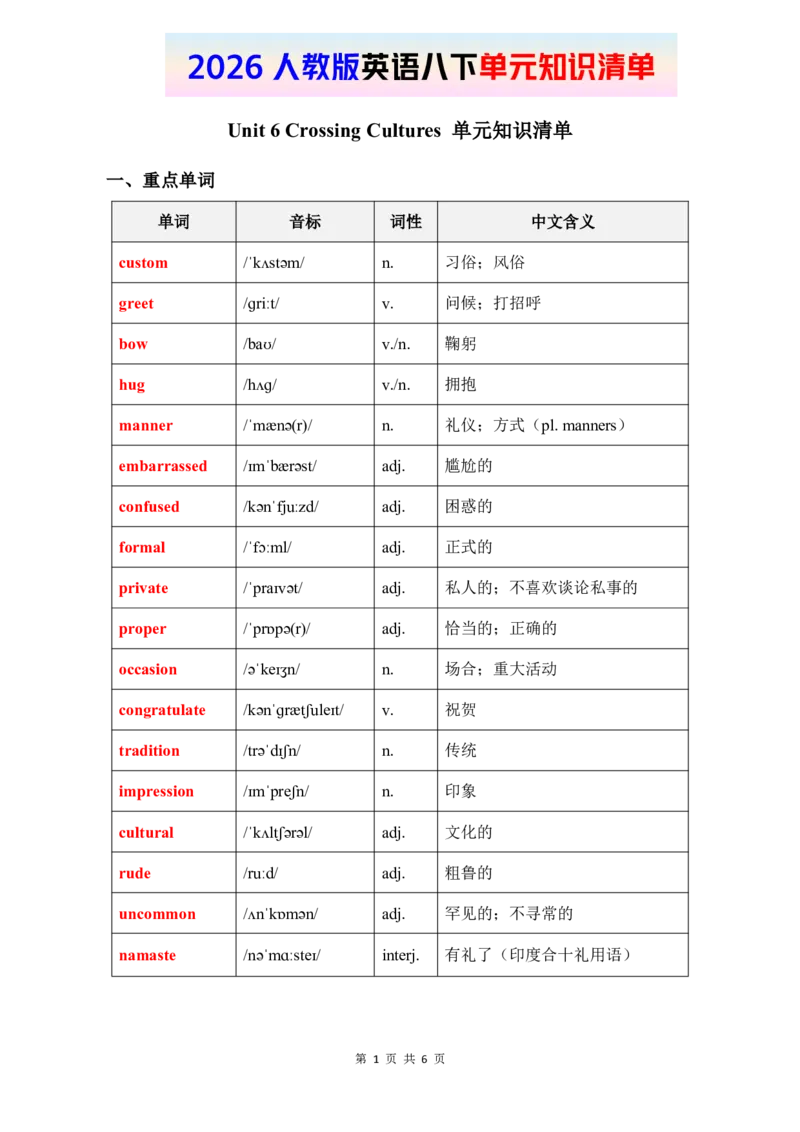
Unit 6 Crossing Cultures 单词批注
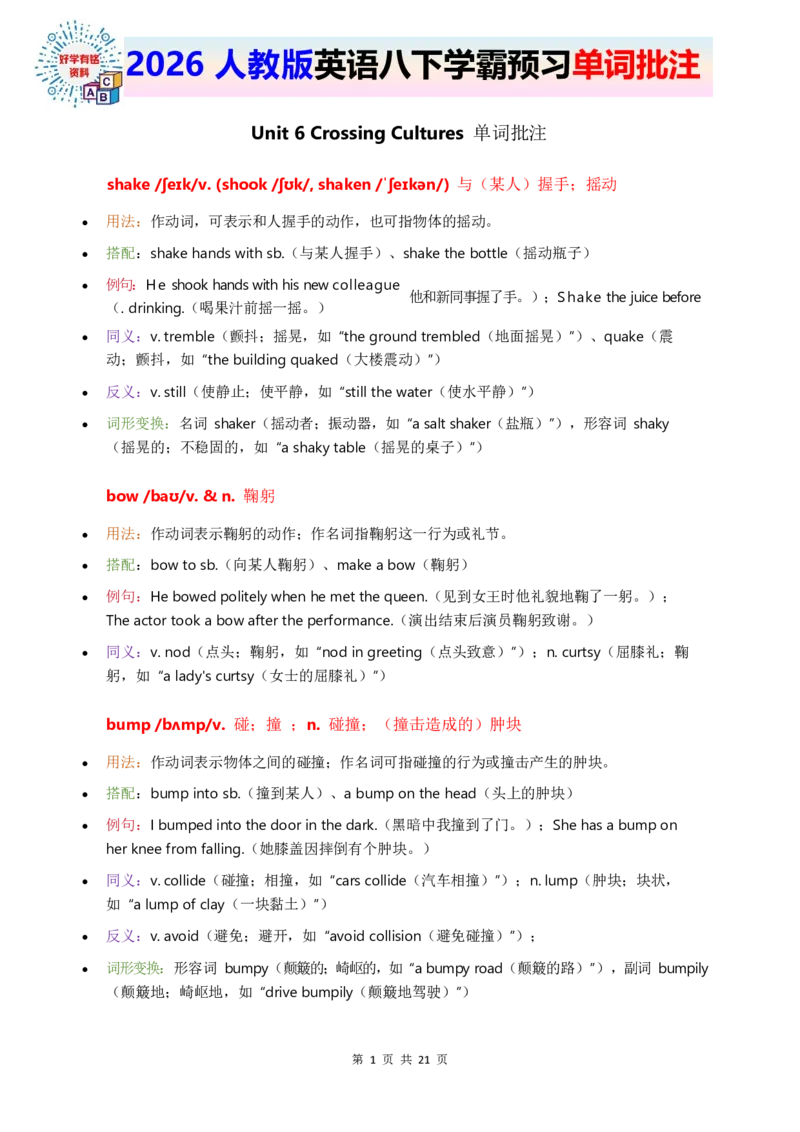
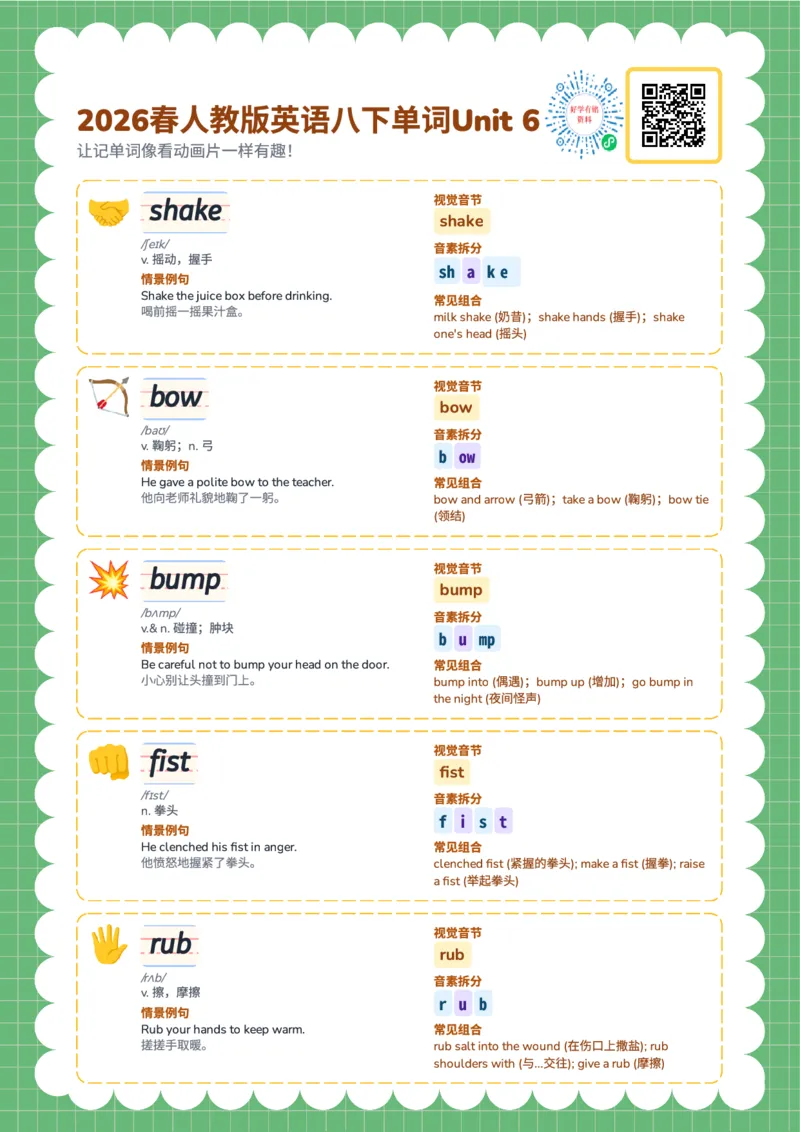
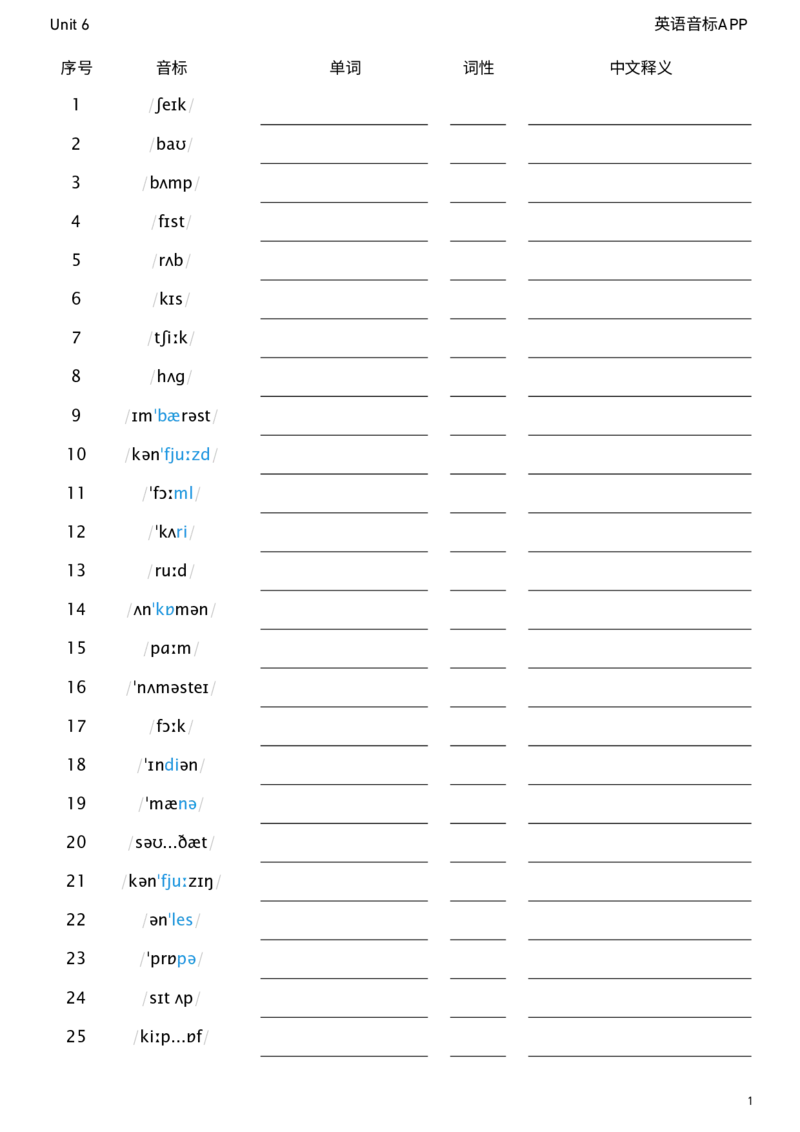
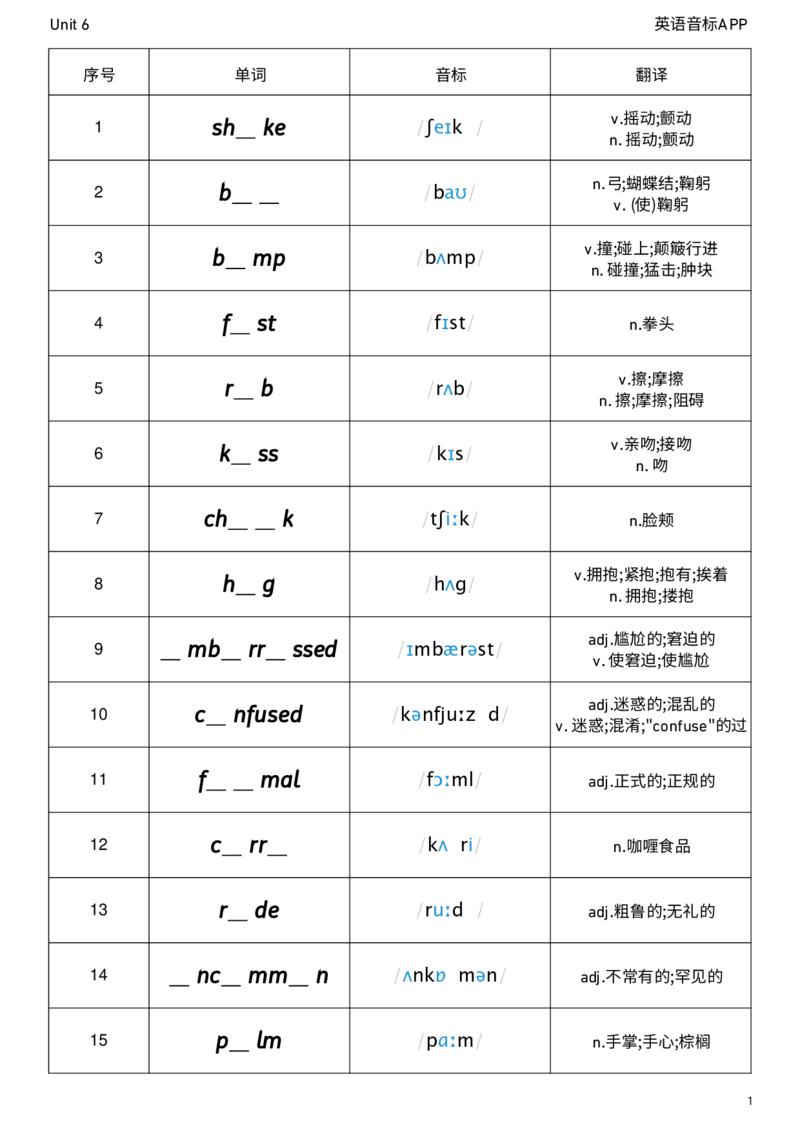
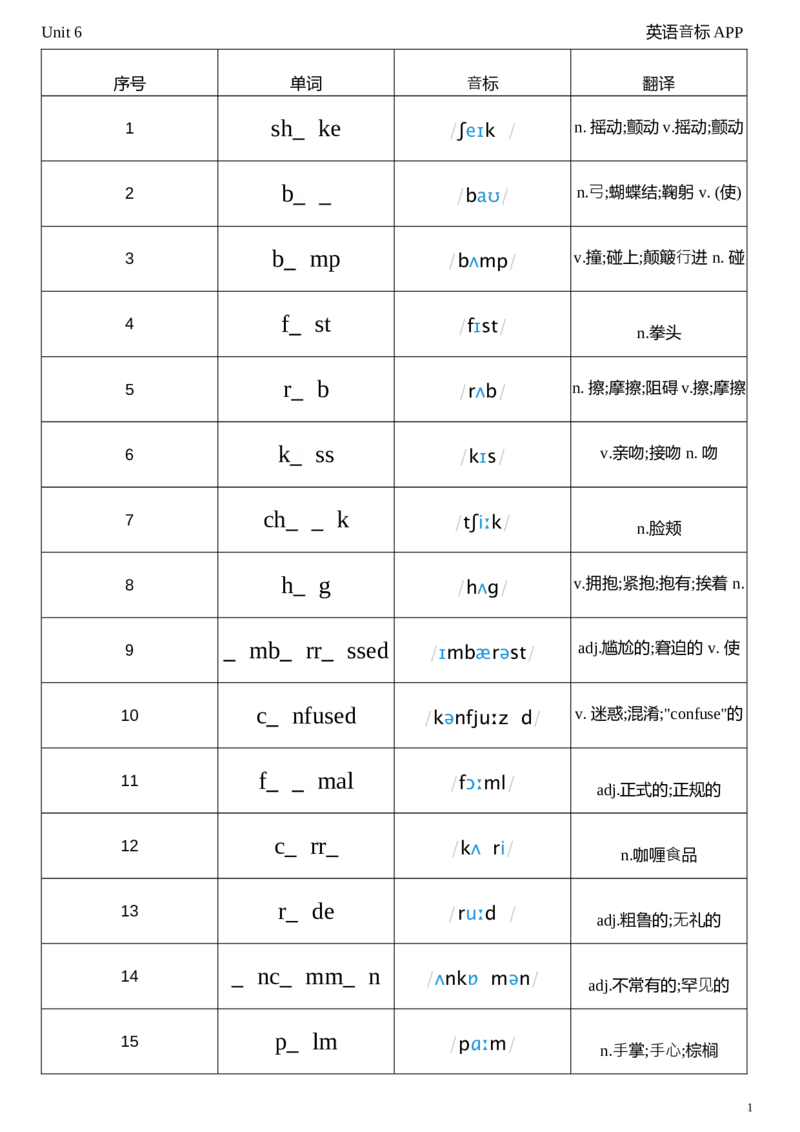
shake /ʃeɪk/v. (shook /ʃʊk/, shaken /ˈʃeɪkən/) 与(某人)握手;摇动
用法:作动词,可表示和人握手的动作,也可指物体的摇动。
搭配:shake hands with sb.(与某人握手)、shake the bottle(摇动瓶子)
例句:He shook hands with his new colleague
他和新同事握了手。);Shake the juice before
(. drinking.(喝果汁前摇一摇。)
同义:v. tremble(颤抖;摇晃,如 “the ground trembled(地面摇晃)”)、quake(震
动;颤抖,如 “the building quaked(大楼震动)”)
反义:v. still(使静止;使平静,如 “still the water(使水平静)”)
词形变换:名词 shaker(摇动者;振动器,如 “a salt shaker(盐瓶)”),形容词 shaky
(摇晃的;不稳固的,如 “a shaky table(摇晃的桌子)”)
bow /baʊ/v. & n. 鞠躬
用法:作动词表示鞠躬的动作;作名词指鞠躬这一行为或礼节。
搭配:bow to sb.(向某人鞠躬)、make a bow(鞠躬)
例句:He bowed politely when he met the queen.(见到女王时他礼貌地鞠了一躬。);
The actor took a bow after the performance.(演出结束后演员鞠躬致谢。)
同义:v. nod(点头;鞠躬,如 “nod in greeting(点头致意)”);n. curtsy(屈膝礼;鞠
躬,如 “a lady's curtsy(女士的屈膝礼)”)
bump /bʌmp/v. 碰;撞 ;n. 碰撞;(撞击造成的)肿块
用法:作动词表示物体之间的碰撞;作名词可指碰撞的行为或撞击产生的肿块。
搭配:bump into sb.(撞到某人)、a bump on the head(头上的肿块)
例句:I bumped into the door in the dark.(黑暗中我撞到了门。);She has a bump on
her knee from falling.(她膝盖因摔倒有个肿块。)
同义:v. collide(碰撞;相撞,如 “cars collide(汽车相撞)”);n. lump(肿块;块状,
如 “a lump of clay(一块黏土)”)
反义:v. avoid(避免;避开,如 “avoid collision(避免碰撞)”);
词形变换:形容词 bumpy(颠簸的;崎岖的,如 “a bumpy road(颠簸的路)”),副词 bumpily
(颠簸地;崎岖地,如 “drive bumpily(颠簸地驾驶)”)
第 1 页 共 21 页2026 人教版英语八下学霸预习单词批注
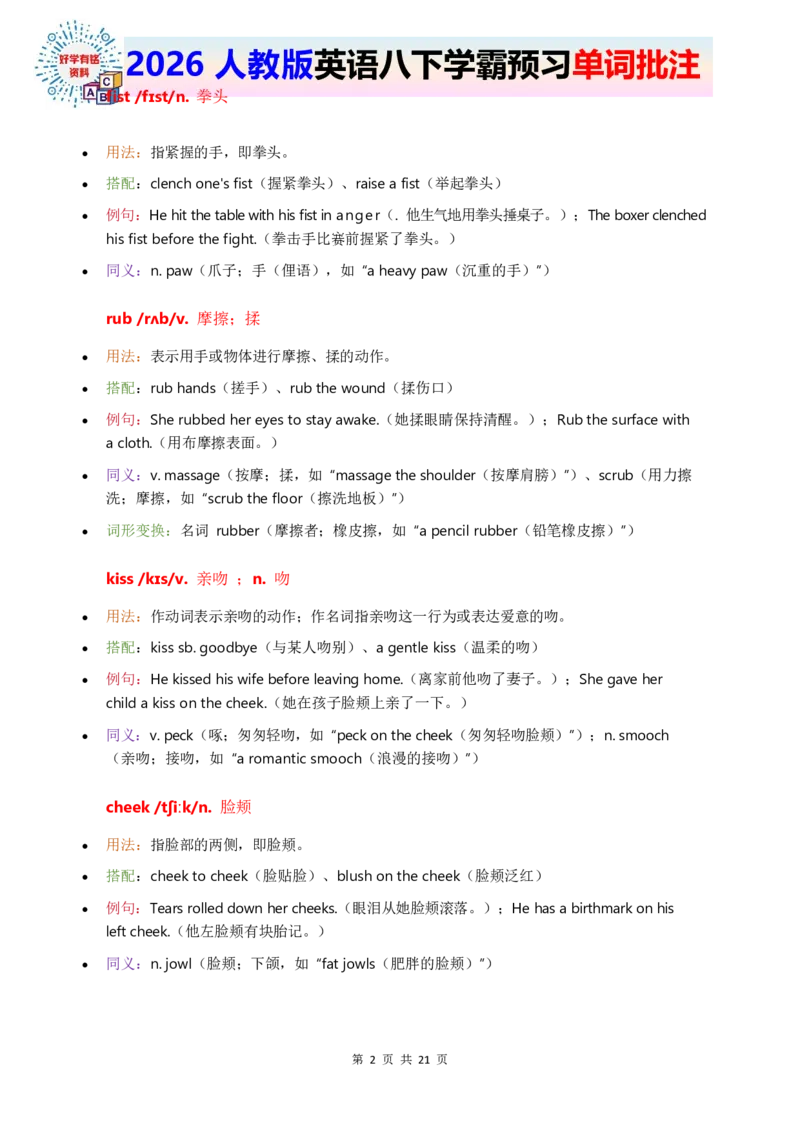
fist /fɪst/n. 拳头
用法:指紧握的手,即拳头。
搭配:clench one's fist(握紧拳头)、raise a fist(举起拳头)
例句:He hit the table with his fist in anger(. 他生气地用拳头捶桌子。);The boxer clenched
his fist before the fight.(拳击手比 前握紧了拳头。)
同义:n. paw(爪子;手(俚语),如 “a heavy paw(沉重的手)”)
rub /rʌb/v. 摩擦;揉
用法:表示用手或物体进行摩擦、揉的动作。
搭配:rub hands(搓手)、rub the wound(揉伤口)
例句:She rubbed her eyes to stay awake.(她揉眼睛保持清醒。);Rub the surface with
a cloth.(用布摩擦表面。)
同义:v. massage(按摩;揉,如 “massage the shoulder(按摩肩膀)”)、scrub(用力擦
洗;摩擦,如 “scrub the floor(擦洗地板)”)
词形变换:名词 rubber(摩擦者;橡皮擦,如 “a pencil rubber(铅笔橡皮擦)”)
kiss /kɪs/v. 亲吻 ;n. 吻
用法:作动词表示亲吻的动作;作名词指亲吻这一行为或表达爱意的吻。
搭配:kiss sb. goodbye(与某人吻别)、a gentle kiss(温柔的吻)
例句:He kissed his wife before leaving home.(离家前他吻了妻子。);She gave her
child a kiss on the cheek.(她在孩子脸颊上亲了一下。)
同义:v. peck(啄;匆匆轻吻,如 “peck on the cheek(匆匆轻吻脸颊)”);n. smooch
(亲吻;接吻,如 “a romantic smooch(浪漫的接吻)”)
cheek /tʃiːk/n. 脸颊
用法:指脸部的两侧,即脸颊。
搭配:cheek to cheek(脸贴脸)、blush on the cheek(脸颊泛红)
例句:Tears rolled down her cheeks.(眼泪从她脸颊滚落。);He has a birthmark on his
left cheek.(他左脸颊有块胎记。)
同义:n. jowl(脸颊;下颌,如 “fat jowls(肥胖的脸颊)”)
第 2 页 共 21 页2026 人教版英语八下学霸预习单词批注
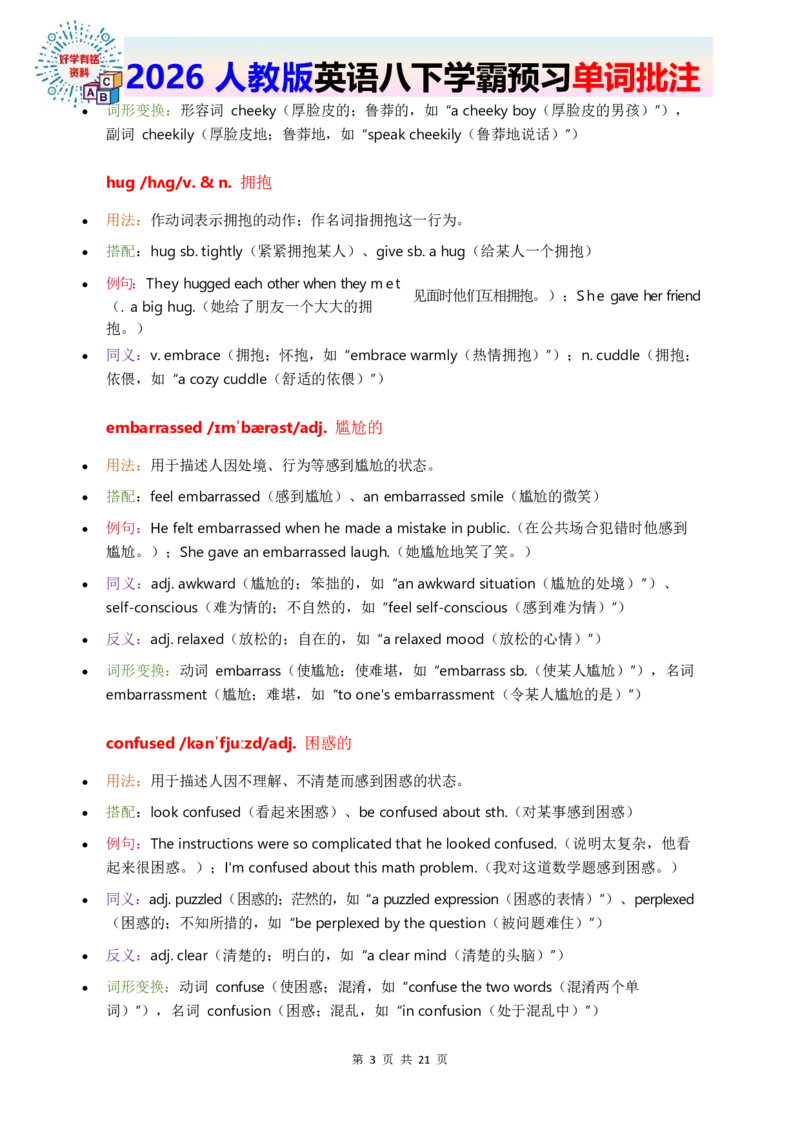
词形变换:形容词 cheeky(厚脸皮的;鲁莽的,如 “a cheeky boy(厚脸皮的男孩)”),
副词 cheekily(厚脸皮地;鲁莽地,如 “speak cheekily(鲁莽地说话)”)
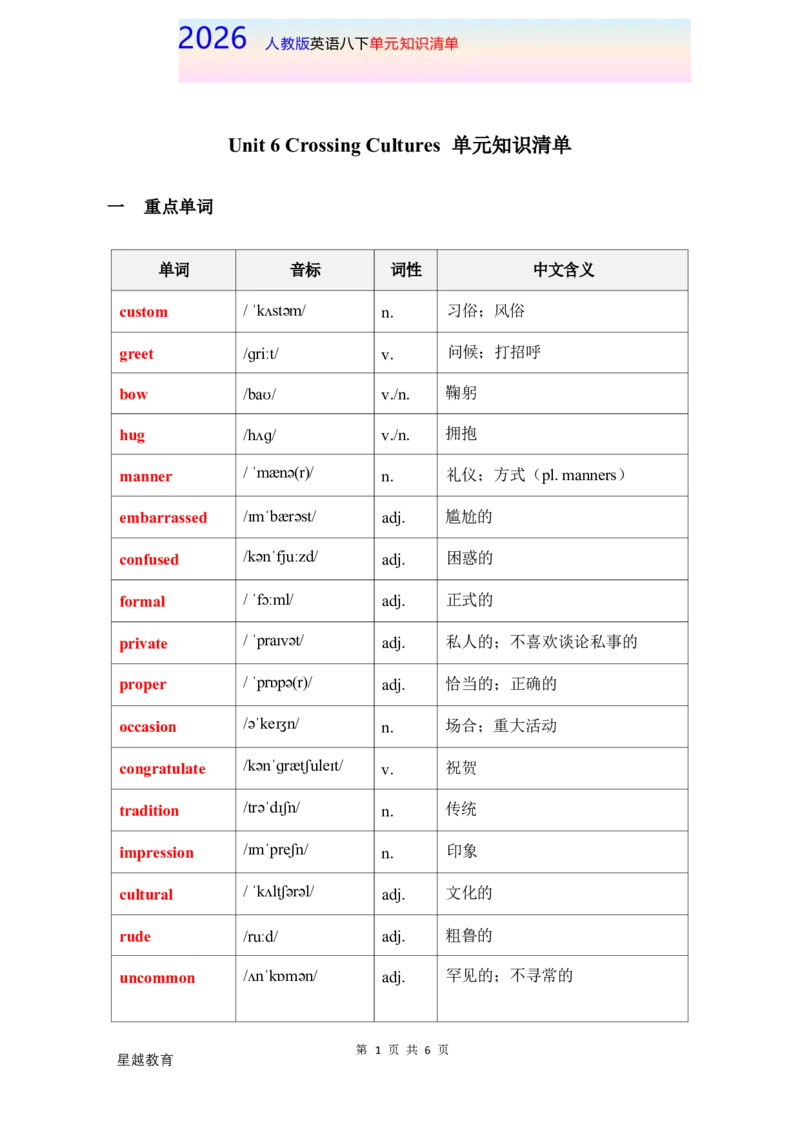
hug /hʌɡ/v. & n. 拥抱
用法:作动词表示拥抱的动作;作名词指拥抱这一行为。
搭配:hug sb. tightly(紧紧拥抱某人)、give sb. a hug(给某人一个拥抱)
例句:They hugged each other when they met
见面时他们互相拥抱。);She gave her friend
(. a big hug.(她给了朋友一个大大的拥
抱。)
同义:v. embrace(拥抱;怀抱,如 “embrace warmly(热情拥抱)”);n. cuddle(拥抱;
依偎,如 “a cozy cuddle(舒适的依偎)”)
embarrassed /ɪmˈbærəst/adj. 尴尬的
用法:用于描述人因处境、行为等感到尴尬的状态。
搭配:feel embarrassed(感到尴尬)、an embarrassed smile(尴尬的微笑)
例句:He felt embarrassed when he made a mistake in public.(在公共场合犯错时他感到
尴尬。);She gave an embarrassed laugh.(她尴尬地笑了笑。)
同义:adj. awkward(尴尬的;笨拙的,如 “an awkward situation(尴尬的处境)”)、
self-conscious(难为情的;不自然的,如 “feel self-conscious(感到难为情)”)
反义:adj. relaxed(放松的;自在的,如 “a relaxed mood(放松的心情)”)
词形变换:动词 embarrass(使尴尬;使难堪,如 “embarrass sb.(使某人尴尬)”),名词
embarrassment(尴尬;难堪,如 “to one's embarrassment(令某人尴尬的是)”)
confused /kənˈfjuːzd/adj. 困惑的
用法:用于描述人因不理解、不清楚而感到困惑的状态。
搭配:look confused(看起来困惑)、be confused about sth.(对某事感到困惑)
例句:The instructions were so complicated that he looked confused.(说明太复杂,他看
起来很困惑。);I'm confused about this math problem.(我对这道数学题感到困惑。)
同义:adj. puzzled(困惑的;茫然的,如 “a puzzled expression(困惑的表情)”)、perplexed
(困惑的;不知所措的,如 “be perplexed by the question(被问题难住)”)
反义:adj. clear(清楚的;明白的,如 “a clear mind(清楚的头脑)”)
词形变换:动词 confuse(使困惑;混淆,如 “confuse the two words(混淆两个单
词)”),名词 confusion(困惑;混乱,如 “in confusion(处于混乱中)”)
第 3 页 共 21 页2026 人教版英语八下学霸预习单词批注
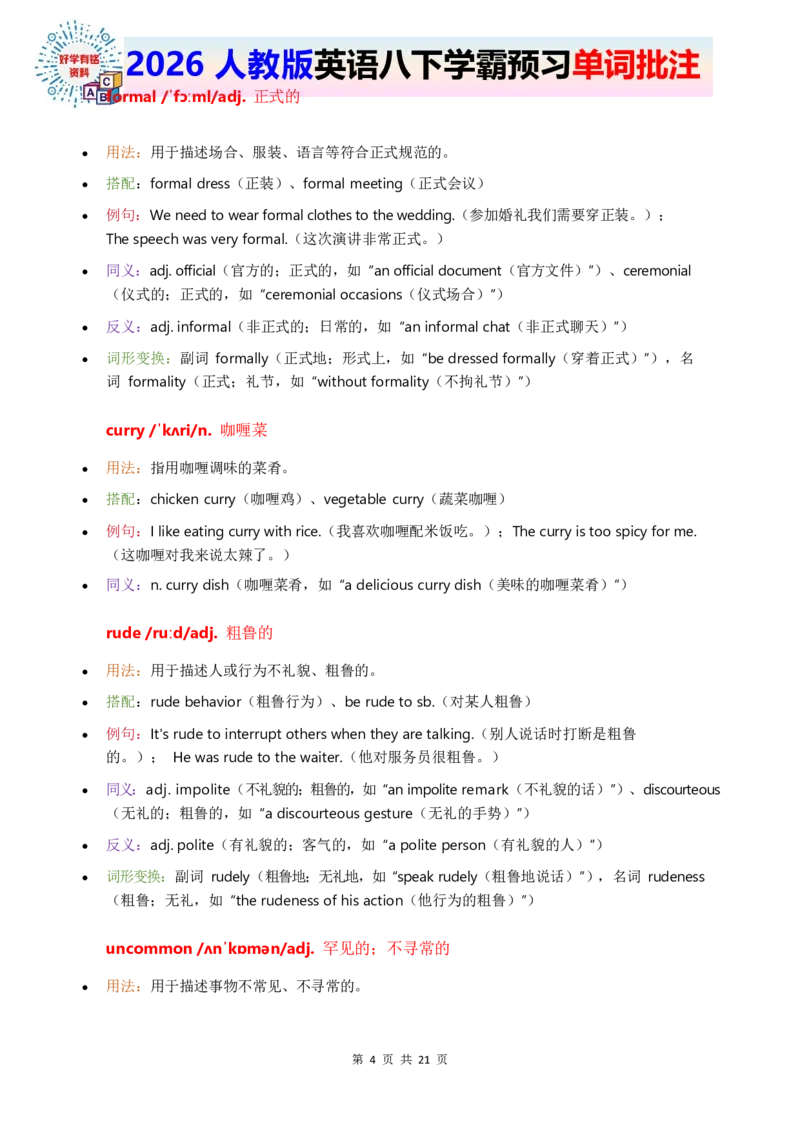
formal /ˈfɔːml/adj. 正式的
用法:用于描述场合、服装、语言等符合正式规范的。
搭配:formal dress(正装)、formal meeting(正式会议)
例句:We need to wear formal clothes to the wedding.(参加婚礼我们需要穿正装。);
The speech was very formal.(这次演讲非常正式。)
同义:adj. official(官方的;正式的,如 “an official document(官方文件)”)、ceremonial
(仪式的;正式的,如 “ceremonial occasions(仪式场合)”)
反义:adj. informal(非正式的;日常的,如 “an informal chat(非正式聊天)”)
词形变换:副词 formally(正式地;形式上,如 “be dressed formally(穿着正式)”),名
词 formality(正式;礼节,如 “without formality(不拘礼节)”)
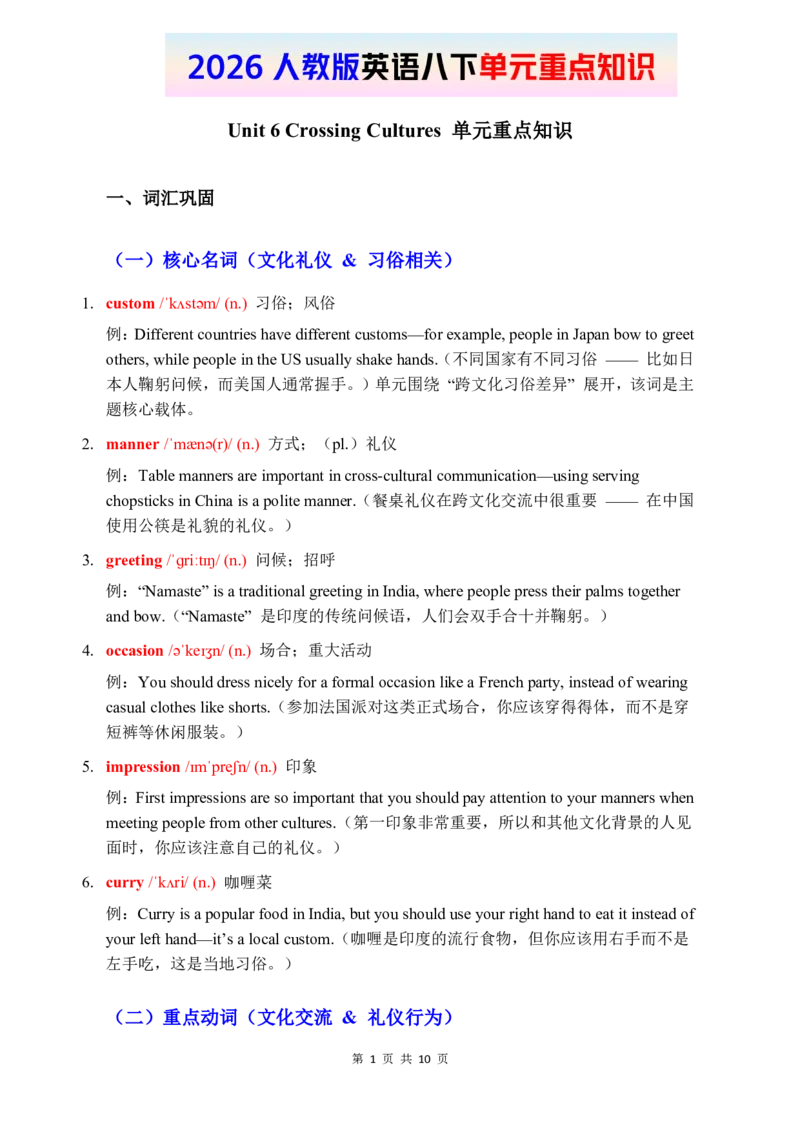
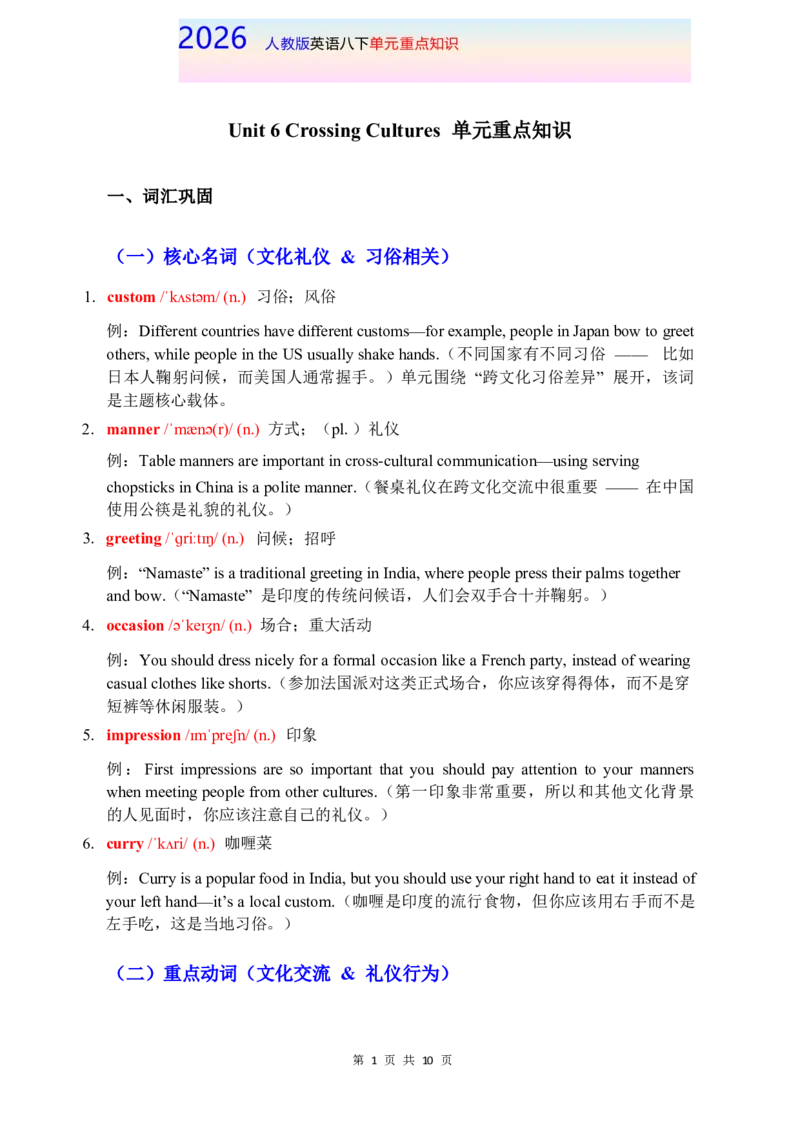
curry /ˈkʌri/n. 咖喱菜
用法:指用咖喱调味的菜肴。
搭配:chicken curry(咖喱鸡)、vegetable curry(蔬菜咖喱)
例句:I like eating curry with rice.(我喜欢咖喱配米饭吃。);The curry is too spicy for me.
(这咖喱对我来说太辣了。)
同义:n. curry dish(咖喱菜肴,如 “a delicious curry dish(美味的咖喱菜肴)”)
rude /ruːd/adj. 粗鲁的
用法:用于描述人或行为不礼貌、粗鲁的。
搭配:rude behavior(粗鲁行为)、be rude to sb.(对某人粗鲁)
例句:It's rude to interrupt others when they are talking.(别人说话时打断是粗鲁
的。); He was rude to the waiter.(他对服务员很粗鲁。)
同义:adj. impolite(不礼貌的;粗鲁的,如 “an impolite remark(不礼貌的话)”)、discourteous
(无礼的;粗鲁的,如 “a discourteous gesture(无礼的手势)”)
反义:adj. polite(有礼貌的;客气的,如 “a polite person(有礼貌的人)”)
词形变换:副词 rudely(粗鲁地;无礼地,如 “speak rudely(粗鲁地说话)”),名词 rudeness
(粗鲁;无礼,如 “the rudeness of his action(他行为的粗鲁)”)
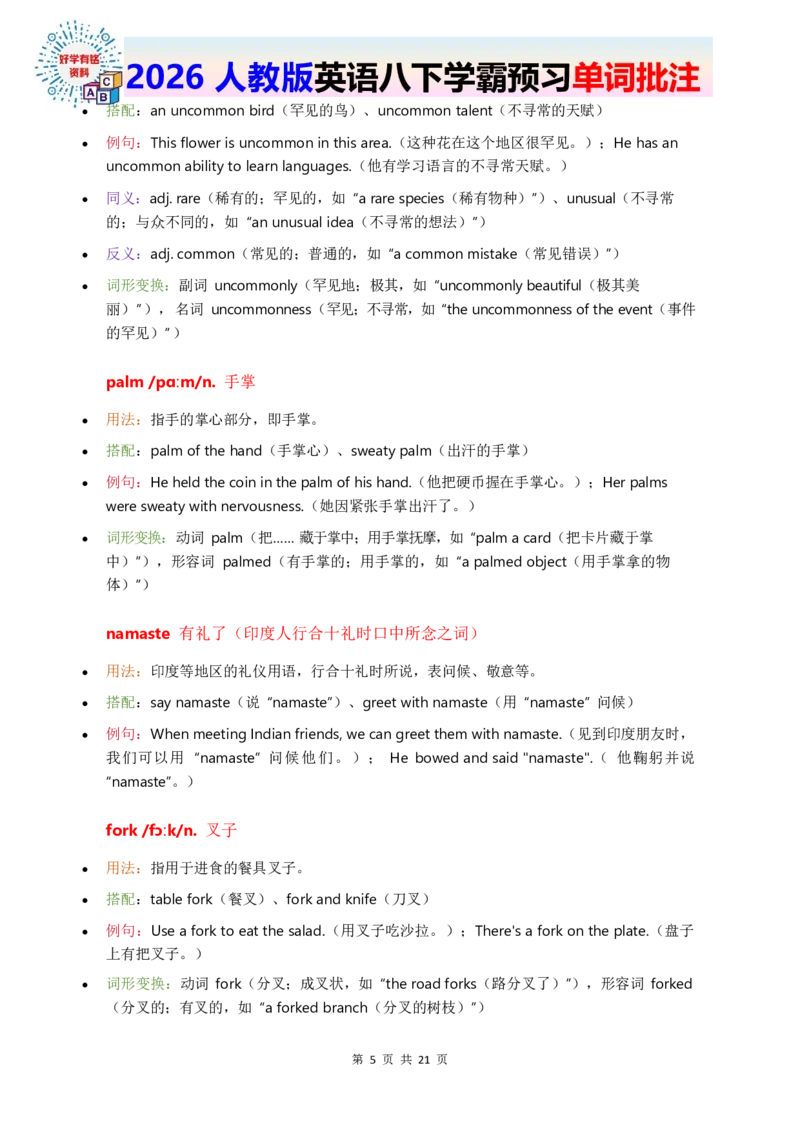
uncommon /ʌnˈkɒmən/adj. 罕见的;不寻常的
用法:用于描述事物不常见、不寻常的。
第 4 页 共 21 页2026 人教版英语八下学霸预习单词批注
搭配:an uncommon bird(罕见的鸟)、uncommon talent(不寻常的天赋)
例句:This flower is uncommon in this area.(这种花在这个地区很罕见。);He has an
uncommon ability to learn languages.(他有学习语言的不寻常天赋。)
同义:adj. rare(稀有的;罕见的,如 “a rare species(稀有物种)”)、unusual(不寻常
的;与众不同的,如 “an unusual idea(不寻常的想法)”)
反义:adj. common(常见的;普通的,如 “a common mistake(常见错误)”)
词形变换:副词 uncommonly(罕见地;极其,如 “uncommonly beautiful(极其美
丽)”),名词 uncommonness(罕见;不寻常,如 “the uncommonness of the event(事件
的罕见)”)
palm /pɑːm/n. 手掌
用法:指手的掌心部分,即手掌。
搭配:palm of the hand(手掌心)、sweaty palm(出汗的手掌)
例句:He held the coin in the palm of his hand.(他把硬币握在手掌心。);Her palms
were sweaty with nervousness.(她因紧张手掌出汗了。)
词形变换:动词 palm(把…… 藏于掌中;用手掌抚摩,如 “palm a card(把卡片藏于掌
中)”),形容词 palmed(有手掌的;用手掌的,如 “a palmed object(用手掌拿的物
体)”)
namaste 有礼了(印度人行合十礼时口中所念之词)
用法:印度等地区的礼仪用语,行合十礼时所说,表问候、敬意等。
搭配:say namaste(说 “namaste”)、greet with namaste(用 “namaste” 问候)
例句:When meeting Indian friends, we can greet them with namaste.(见到印度朋友时,
我们可以用 “namaste” 问候他们。); He bowed and said "namaste".( 他鞠躬并说
“namaste”。)
fork /fɔːk/n. 叉子
用法:指用于进食的餐具叉子。
搭配:table fork(餐叉)、fork and knife(刀叉)
例句:Use a fork to eat the salad.(用叉子吃沙拉。);There's a fork on the plate.(盘子
上有把叉子。)
词形变换:动词 fork(分叉;成叉状,如 “the road forks(路分叉了)”),形容词 forked
(分叉的;有叉的,如 “a forked branch(分叉的树枝)”)
第 5 页 共 21 页2026 人教版英语八下学霸预习单词批注
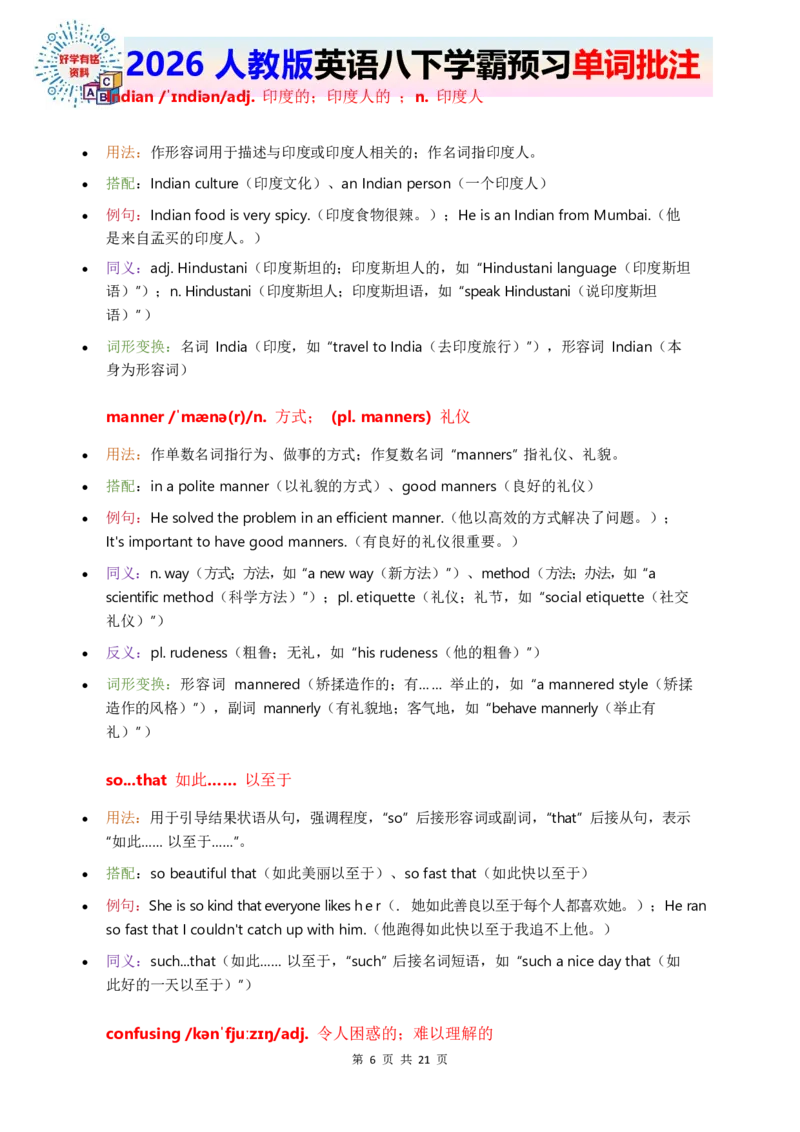
Indian /ˈɪndiən/adj. 印度的;印度人的 ;n. 印度人
用法:作形容词用于描述与印度或印度人相关的;作名词指印度人。
搭配:Indian culture(印度文化)、an Indian person(一个印度人)
例句:Indian food is very spicy.(印度食物很辣。);He is an Indian from Mumbai.(他
是来自孟买的印度人。)
同义:adj. Hindustani(印度斯坦的;印度斯坦人的,如 “Hindustani language(印度斯坦
语)”);n. Hindustani(印度斯坦人;印度斯坦语,如 “speak Hindustani(说印度斯坦
语)”)
词形变换:名词 India(印度,如 “travel to India(去印度旅行)”),形容词 Indian(本
身为形容词)
manner /ˈmænə(r)/n. 方式; (pl. manners) 礼仪
用法:作单数名词指行为、做事的方式;作复数名词 “manners” 指礼仪、礼貌。
搭配:in a polite manner(以礼貌的方式)、good manners(良好的礼仪)
例句:He solved the problem in an efficient manner.(他以高效的方式解决了问题。);
It's important to have good manners.(有良好的礼仪很重要。)
同义:n. way(方式;方法,如 “a new way(新方法)”)、method(方法;办法,如 “a
scientific method(科学方法)”);pl. etiquette(礼仪;礼节,如 “social etiquette(社交
礼仪)”)
反义:pl. rudeness(粗鲁;无礼,如 “his rudeness(他的粗鲁)”)
词形变换:形容词 mannered(矫揉造作的;有…… 举止的,如 “a mannered style(矫揉
造作的风格)”),副词 mannerly(有礼貌地;客气地,如 “behave mannerly(举止有
礼)”)
so...that 如此…… 以至于
用法:用于引导结果状语从句,强调程度,“so” 后接形容词或副词,“that” 后接从句,表示
“如此…… 以至于……”。
搭配:so beautiful that(如此美丽以至于)、so fast that(如此快以至于)
例句:She is so kind that everyone likes her(. 她如此善良以至于每个人都喜欢她。);He ran
so fast that I couldn't catch up with him.(他跑得如此快以至于我追不上他。)
同义:such...that(如此…… 以至于,“such” 后接名词短语,如 “such a nice day that(如
此好的一天以至于)”)
confusing /kənˈfjuːzɪŋ/adj. 令人困惑的;难以理解的
第 6 页 共 21 页2026 人教版英语八下学霸预习单词批注
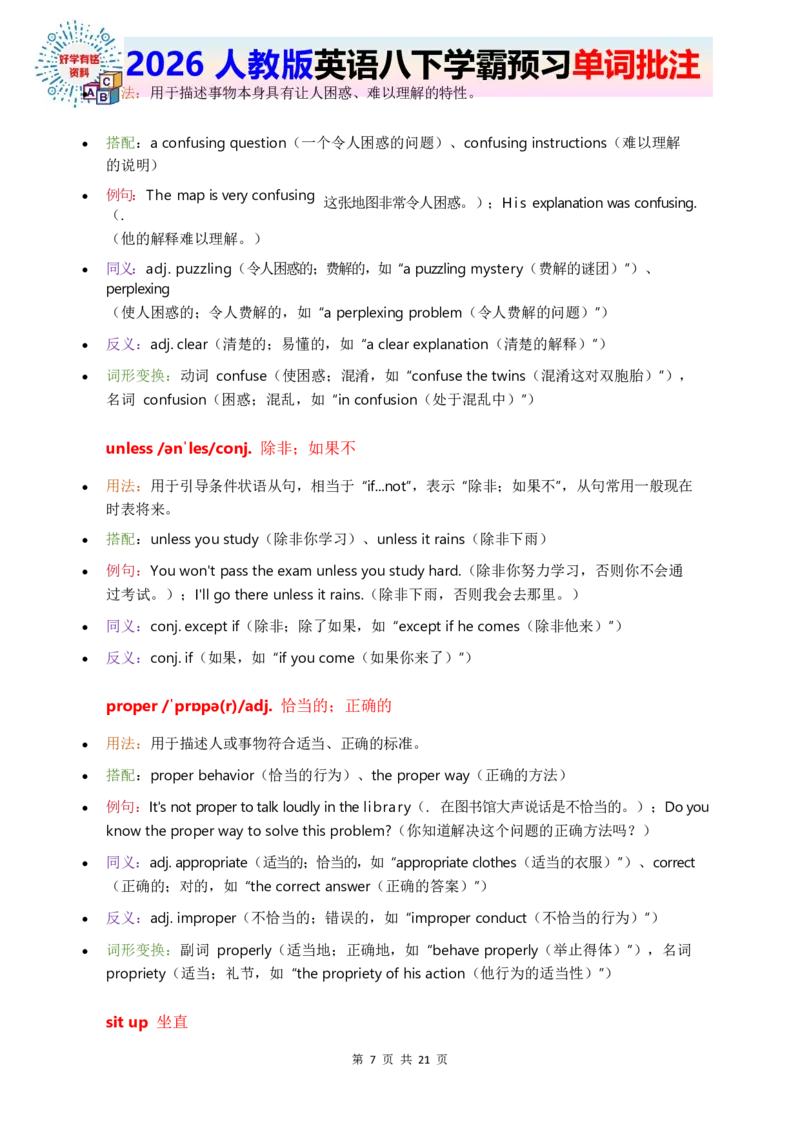
用法:用于描述事物本身具有让人困惑、难以理解的特性。
搭配:a confusing question(一个令人困惑的问题)、confusing instructions(难以理解
的说明)
例句:The map is very confusing
这张地图非常令人困惑。);His explanation was confusing.
(.
(他的解释难以理解。)
同义:adj. puzzling(令人困惑的;费解的,如 “a puzzling mystery(费解的谜团)”)、
perplexing
(使人困惑的;令人费解的,如 “a perplexing problem(令人费解的问题)”)
反义:adj. clear(清楚的;易懂的,如 “a clear explanation(清楚的解释)”)
词形变换:动词 confuse(使困惑;混淆,如 “confuse the twins(混淆这对双胞胎)”),
名词 confusion(困惑;混乱,如 “in confusion(处于混乱中)”)
unless /ənˈles/conj. 除非;如果不
用法:用于引导条件状语从句,相当于 “if...not”,表示 “除非;如果不”,从句常用一般现在
时表将来。
搭配:unless you study(除非你学习)、unless it rains(除非下雨)
例句:You won't pass the exam unless you study hard.(除非你努力学习,否则你不会通
过考试。);I'll go there unless it rains.(除非下雨,否则我会去那里。)
同义:conj. except if(除非;除了如果,如 “except if he comes(除非他来)”)
反义:conj. if(如果,如 “if you come(如果你来了)”)
proper /ˈprɒpə(r)/adj. 恰当的;正确的
用法:用于描述人或事物符合适当、正确的标准。
搭配:proper behavior(恰当的行为)、the proper way(正确的方法)
例句:It's not proper to talk loudly in the library(. 在图书馆大声说话是不恰当的。);Do you
know the proper way to solve this problem?(你知道解决这个问题的正确方法吗?)
同义:adj. appropriate(适当的;恰当的,如 “appropriate clothes(适当的衣服)”)、correct
(正确的;对的,如 “the correct answer(正确的答案)”)
反义:adj. improper(不恰当的;错误的,如 “improper conduct(不恰当的行为)”)
词形变换:副词 properly(适当地;正确地,如 “behave properly(举止得体)”),名词
propriety(适当;礼节,如 “the propriety of his action(他行为的适当性)”)
sit up 坐直
第 7 页 共 21 页2026 人教版英语八下学霸预习单词批注
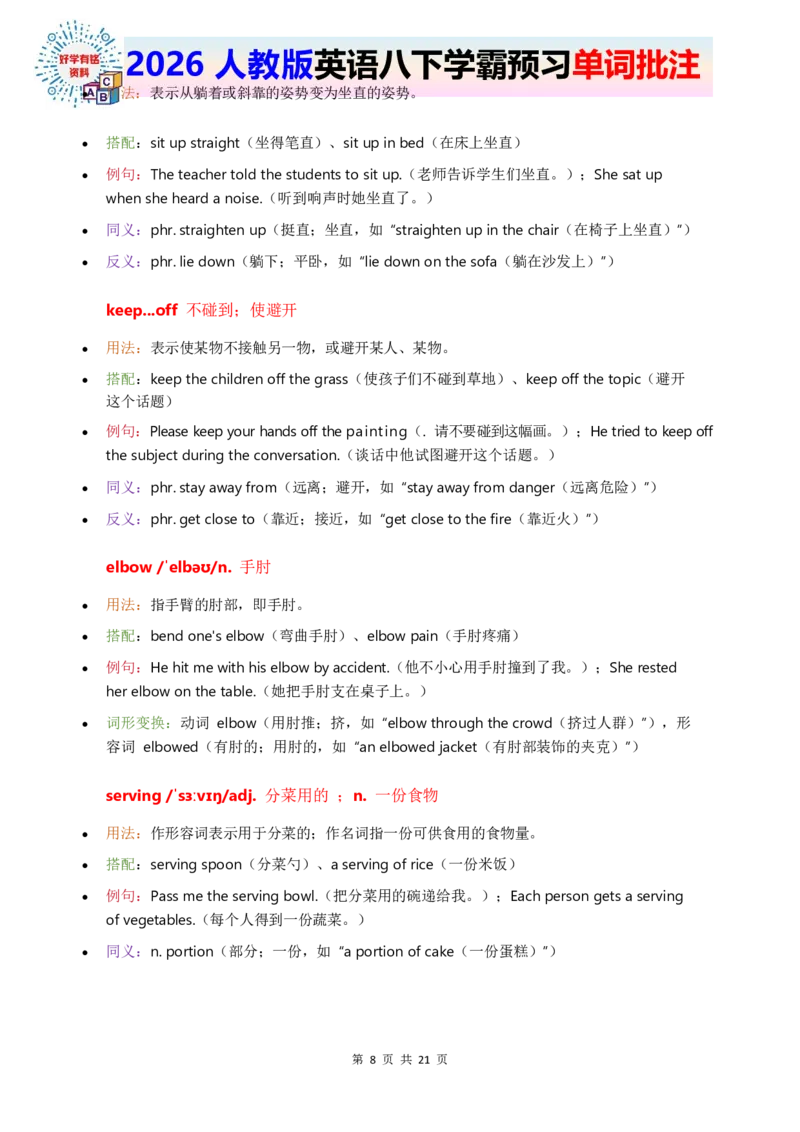
用法:表示从躺着或斜靠的姿势变为坐直的姿势。
搭配:sit up straight(坐得笔直)、sit up in bed(在床上坐直)
例句:The teacher told the students to sit up.(老师告诉学生们坐直。);She sat up
when she heard a noise.(听到响声时她坐直了。)
同义:phr. straighten up(挺直;坐直,如 “straighten up in the chair(在椅子上坐直)”)
反义:phr. lie down(躺下;平卧,如 “lie down on the sofa(躺在沙发上)”)
keep...off 不碰到;使避开
用法:表示使某物不接触另一物,或避开某人、某物。
搭配:keep the children off the grass(使孩子们不碰到草地)、keep off the topic(避开
这个话题)
例句:Please keep your hands off the painting(. 请不要碰到这幅画。);He tried to keep off
the subject during the conversation.(谈话中他试图避开这个话题。)
同义:phr. stay away from(远离;避开,如 “stay away from danger(远离危险)”)
反义:phr. get close to(靠近;接近,如 “get close to the fire(靠近火)”)
elbow /ˈelbəʊ/n. 手肘
用法:指手臂的肘部,即手肘。
搭配:bend one's elbow(弯曲手肘)、elbow pain(手肘疼痛)
例句:He hit me with his elbow by accident.(他不小心用手肘撞到了我。);She rested
her elbow on the table.(她把手肘支在桌子上。)
词形变换:动词 elbow(用肘推;挤,如 “elbow through the crowd(挤过人群)”),形
容词 elbowed(有肘的;用肘的,如 “an elbowed jacket(有肘部装饰的夹克)”)
serving /ˈsɜːvɪŋ/adj. 分菜用的 ;n. 一份食物
用法:作形容词表示用于分菜的;作名词指一份可供食用的食物量。
搭配:serving spoon(分菜勺)、a serving of rice(一份米饭)
例句:Pass me the serving bowl.(把分菜用的碗递给我。);Each person gets a serving
of vegetables.(每个人得到一份蔬菜。)
同义:n. portion(部分;一份,如 “a portion of cake(一份蛋糕)”)
第 8 页 共 21 页2026 人教版英语八下学霸预习单词批注
词形变换:动词 serve(服务;提供,如 “serve food(提供食物)”),名词 server(服务
员;服务器,如 “a restaurant server(餐厅服务员)”)
chopstick /ˈtʃɒpstɪk/n. (usually pl.) 筷子
用法:指用于夹取食物的餐具筷子,常用复数形式。
搭配:use chopsticks(用筷子)、a pair of chopsticks(一双筷子)
例句:Chinese people often use chopsticks to eat.(中国人常用筷子吃饭。);Can you
pass me that pair of chopsticks?(你能把那双筷子递给我吗?)
serving chopsticks 公筷
用法:指用于分取公共食物的筷子,区别于个人使用的筷子。
搭配:use serving chopsticks(使用公筷)、provide serving chopsticks(提供公筷)
例句:It's more hygienic to use serving chopsticks when eating together.(一起吃饭时使
用公筷更卫生。);The restaurant provides serving chopsticks for customers.(餐厅为顾客
提供公筷。)
embarrassing /ɪmˈbærəsɪŋ/adj. 使人难堪的
用法:用于描述事物本身具有让人感到难堪的特性。
搭配:an embarrassing mistake(一个使人难堪的错误)、embarrassing situation(难堪
的处境)
例句:His embarrassing remark made everyone uncomfortable.(他那使人难堪的话让每
个人都不舒服。);We were in an embarrassing position.(我们处于难堪的处境。)
同义:adj. humiliating(丢脸的;使人难堪的,如 “a humiliating defeat(丢脸的失败)”)
反义:adj. comfortable(舒适的;自在的,如 “a comfortable conversation(自在的谈话)”)
词形变换:动词 embarrass(使难堪;使尴尬,如 “embarrass the speaker(使演讲者难
堪)”),名词 embarrassment(难堪;尴尬,如 “to one's embarrassment(令某人难堪的
是)”)
be /get used to 习惯于
用法:“be used to” 表示已经习惯于;“get used to” 表示逐渐习惯于,后接名词、代词或
动名词。
搭配:be used to the weather(习惯于这种天气)、get used to living here(逐渐习惯于
住在这里)
第 9 页 共 21 页2026 人教版英语八下学霸预习单词批注
例句:I'm used to getting up early.(我习惯于早起。);It takes time to get used to a new
job.(要逐渐习惯于一份新工作需要时间。)
同义:phr. accustom oneself to(使自己习惯于,如 “accustom oneself to the noise(使
自己习惯于噪音)”)
反义:phr. be unaccustomed to(不习惯;对…… 不熟悉,如 “be unaccustomed to the cold
(不习惯寒冷)”)
cultural /ˈkʌltʃərəl/adj. 与文化有关的;文化的
用法:用于描述与文化相关的人、事、物。
搭配:cultural differences(文化差异)、cultural heritage(文化遗产)
例句:We should respect cultural diversity.(我们应该尊重文化多样性。);This festival has
great cultural significance.(这个节日有重大的文化意义。)
同义:adj. cultural-related(与文化相关的,如 “cultural-related activities(与文化相关的活
动)”)
反义:adj. non-cultural(非文化的;与文化无关的,如 “non-cultural factors(非文化因素)”)
词形变换:名词 culture(文化;文明,如 “Chinese culture(中国文化)”),副词 culturally
(在文化上;从文化角度,如 “culturally diverse(文化上多样化的)”)
hear from 得到…… 消息
用法:表示收到某人的来信、来电等,得到某人的消息。
搭配:hear from a friend(得到朋友的消息)、hear from home(得到家里的消息)
例句:I haven't heard from my sister for a long time.(我很久没得到我姐姐的消息
了。); She was happy to hear from her pen pal.(她很高兴得到笔友的消息。)
同义:phr. receive a message from(收到…… 的消息,如 “receive a message from him
(收到他的消息)”)
反义:phr. lose touch with(与…… 失去联系,如 “lose touch with classmates(与同学失
去联系)”)
custom /ˈkʌstəm/n. 习俗
用法:指一个群体或社会长期形成的习惯、风俗。
搭配:local custom(当地习俗)、social custom(社会习俗)
第 10 页 共 21 页2026 人教版英语八下学霸预习单词批注
例句:It's a custom to give gifts at Christmas in some countries.(在一些国家,圣诞节送
礼物是一种习俗。);We should follow the local customs when traveling.(旅行时我们应
该遵循当地习俗。)
同义:n. tradition(传统;惯例,如 “a family tradition(家庭传统)”)、practice(惯例;
习惯,如 “common practice(惯例)”)
反义:n. innovation(创新;革新,如 “innovation in culture(文化创新)”)
词形变换:形容词 customary(习惯的;通常的,如 “customary behavior(习惯行
为)”),动词 customize(定制;定做,如 “customize a product(定制产品)”)
occasion /əˈkeɪʒn/n. 场合;重大活动
用法:指特定的时间、场合或重要的活动。
搭配:formal occasion(正式场合)、special occasion(特殊场合)
例句:We need to dress up for this occasion.(这个场合我们需要盛装打扮。);
Weddings are important occasions.(婚礼是重要的活动。)
同义:n. event(事件;活动,如 “a big event(重大活动)”)、ceremony(典礼;仪式,
如 “a graduation ceremony(毕业典礼)”)
词形变换:形容词 occasional(偶尔的;间或的,如 “occasional visits(偶尔的拜访)”),
副词 occasionally(偶尔;间或,如 “meet occasionally(偶尔见面)”)
nicely /ˈnaɪsli/adv. 漂亮地;令人愉快地
用法:用于描述动作完成得漂亮,或状态令人愉快。
搭配:sing nicely(唱得漂亮)、fit nicely(很合身)
例句:The dress fits her nicely.(这条裙子很合身。);The room is decorated nicely.(房
间装饰得很漂亮。)
同义:adv. beautifully(漂亮地;美好地,如 “dance beautifully(舞跳得漂亮)”)、pleasantly
(愉快地;舒适地,如 “talk pleasantly(愉快地交谈)”)
反义:adv. badly(糟糕地;差地,如 “sing badly(唱得差)”)
词形变换:形容词 nice(美好的;令人愉快的,如 “a nice day(美好的一天)”),名词 niceness
(美好;愉快,如 “the niceness of the weather(天气的美好)”)
blouse /blaʊz/n. (女式) 衬衫或短上衣
用法:指女性穿的衬衫或短上衣。
第 11 页 共 21 页2026 人教版英语八下学霸预习单词批注
搭配:a silk blouse(丝绸女式衬衫)、blouse and skirt(衬衫和裙子)
例句:She bought a new blouse yesterday.(她昨天买了一件新的女式衬衫。);The blouse
matches her pants well.(这件衬衫和她的裤子很配。)
同义:n. shirt(衬衫;衬衣,如 “a cotton shirt(棉衬衫)”)
private /ˈpraɪvət/adj. 不喜欢谈论私事的;私人的
用法:可表示人不喜欢谈及个人私事,也可描述事物属于私人领域的。
搭配:private life(私人生活)、private conversation(私人谈话)
例句:He is very private about his family.(他对自己的家庭私事很避讳。);This is a
private meeting.(这是一场私人会议。)
同义:adj. personal(个人的;私人的,如 “personal information(个人信息)”)、intimate
(亲密的;私人的,如 “intimate details(私人细节)”)
反义:adj. public(公共的;公开的,如 “public place(公共场所)”)
词形变换:副词 privately(私下地;秘密地,如 “talk privately(私下交谈)”),名词 privacy
(隐私;私密,如 “respect privacy(尊重隐私)”)
whether /ˈweðə(r)/conj. 是否
用法:用于引导宾语从句等,表 “是否”,常与 “or not” 连用。
搭配:whether...or not(是否……)、I wonder whether(我想知道是否)
例句:I don't know whether he will come.(我不知道他是否会来。);She asked whether
I liked the movie.(她问我是否喜欢这部电影。)
同义:conj. if(如果;是否,如 “ask if(问是否)”)
married /ˈmærid/adj. 已婚的;婚姻的
用法:用于描述人处于已婚的状态,或与婚姻相关的。
搭配:a married couple(一对已婚夫妇)、married life(婚姻生活)
例句:They have been married for ten years(. 他们已经结婚十年了。);Married people often
have different responsibilities.(已婚人士通常有不同的责任。)
同义:adj. wedded(已婚的;结婚的,如 “a wedded couple(已婚夫妇)”)
反义:adj. single(单身的;未婚的,如 “a single person(单身人士)”)、unmarried(未
婚的;未结婚的,如 “unmarried parents(未婚父母)”)
第 12 页 共 21 页2026 人教版英语八下学霸预习单词批注
词形变换:动词 marry(结婚;嫁;娶,如 “marry sb.(与某人结婚)”),名词 marriage
(婚姻;婚姻生活,如 “a happy marriage(幸福的婚姻)”)
merci 谢谢(法语)
用法:法语中用于表达感谢的常用语。
搭配:say merci(说 “谢谢”)、with merci(带着谢意)
例句:When she received the gift, she said "merci".(当她收到礼物时,她说了 “谢
谢”。); He smiled and nodded with merci.(他微笑着点头表示谢意。)
go a long way 帮助很大
用法:表示对某事有很大的帮助、作用,能起到长远的影响。
搭配:go a long way in doing sth.(在做某事方面帮助很大)、go a long way to improve
(对改善帮助很大)
例句:A little kindness can go a long way.(一点善意能帮助很大。);Your advice will go
a long way in solving this problem.(你的建议对解决这个问题帮助很大。)
同义:phr. be of great help(有很大帮助,如 “be of great help to us(对我们有很大帮
助)”)、 be very helpful(非常有帮助,如 “be very helpful for learning(对学习非常有帮
助)”)
反义:phr. be of little help(没什么帮助,如 “be of little help to the situation(对局势没
什么帮助)”)
au revoir 再见(法语)
用法:法语中用于告别时的常用语。
搭配:say au revoir(说 “再见”)、wave au revoir(挥手告别说 “再见”)
例句:They said "au revoir" to each other at the station.(他们在车站互相说 “再见”。);
She waved and said "au revoir".(她挥手并说 “再见”。)
unsafe /ʌnˈseɪf/adj. 不安全的;危险的
用法:用于描述人、事、物处于不安全、有危险的状态。
搭配:unsafe conditions(不安全的状况)、unsafe place(危险的地方)
例句:The bridge is in an unsafe condition(. 这座桥处于不安全的状况。);It's an unsafe area
to walk at night.(晚上在这个区域行走很危险。)
第 13 页 共 21 页2026 人教版英语八下学霸预习单词批注
同义:adj. dangerous(危险的;不安全的,如 “a dangerous road(危险的道路)”)、hazardous
(危险的;有害的,如 “hazardous materials(危险材料)”)
反义:adj. safe(安全的;无危险的,如 “a safe environment(安全的环境)”)
词形变换:副词 unsafely(不安全地;危险地,如 “drive unsafely(不安全地驾驶)”),
名词 unsafety(不安全;危险,如 “the unsafety of the building(建筑物的不安全)”)
improper /ɪmˈprɒpə(r)/adj. 不合适的
用法:用于描述人、行为、事物等不符合适当、合理的标准。
搭配:improper behavior(不合适的行为)、improper time(不合适的时间)
例句:It's improper to laugh at others' mistakes.(嘲笑别人的错误是不合适的。);This
is an improper way to solve the problem.(这是解决问题的不合适方法。)
同义:adj. inappropriate(不适当的;不相称的,如 “inappropriate clothes(不适当的衣
服)”)、 unsuitable(不合适的;不适用的,如 “unsuitable for children(不适合儿
童)”)
反义:adj. proper(适当的;恰当的,如 “a proper decision(恰当的决定)”)、suitable
(合适的;适宜的,如 “suitable for the job(适合这份工作)”)
词形变换:副词 improperly(不合适地;不正确地,如 “act improperly(行为不当)”),
名词 impropriety(不适当;不得体,如 “the impropriety of his remark(他言论的不得
体)”)
informal /ɪnˈfɔːml/adj. 非正式的
用法:用于描述场合、语言、服装等不符合正式规范,比较随意的。
搭配:informal meeting(非正式会议)、informal dress(便装)
例句:We had an informal chat over coffee.(我们边喝咖啡边进行了一次非正式的聊天。);
Jeans are suitable for informal occasions.(牛仔裤适合非正式场合。)
同义:adj. casua(l 随便的;非正式的,如 “a casual conversation(随便的谈话)”)、unofficial
(非官方的;非正式的,如 “an unofficial visit(非正式访问)”)
反义:adj. formal(正式的;正规的,如 “a formal ceremony(正式仪式)”)
词形变换:副词 informally(非正式地;不拘礼节地,如 “dress informally(穿着随意)”),
名词 informality(非正式;不拘礼节,如 “the informality of the party(派对的不拘礼
节)”)
jeans /dʒiːnz/n. 牛仔裤
用法:指一种用牛仔布制作的裤子,常为休闲穿着。
第 14 页 共 21 页 搭配:a pair of jeans(一条牛仔裤)、blue jeans(蓝色牛仔裤)
第 15 页 共 21 页2026 人教版英语八下学霸预习单词批注
例句:He wears jeans to work every day.(他每天穿牛仔裤上班。);She bought a new
pair of jeans yesterday.(她昨天买了一条新牛仔裤。)
同义:n. denim pants(牛仔长裤,如 “a pair of denim pants(一条牛仔长裤)”)
marry /ˈmæri/v. 结婚;娶;嫁
用法:表示男女双方结为夫妻,“marry sb.” 可指 “娶某人” 或 “嫁某人”。
搭配:marry sb.(与某人结婚)、get married(结婚)
例句:He is going to marry his girlfriend next month.(他下个月要和女朋友结婚。);
They got married in a small church.(他们在一个小教堂结婚了。)
同义:v. wed(结婚;娶;嫁,如 “wed his childhood friend(娶了他儿时的朋友)”)
反义:v. divorce(离婚;与…… 离婚,如 “divorce his wife(和妻子离婚)”)
词形变换:名词 marriage(婚姻;结婚,如 “a happy marriage(幸福的婚姻)”),形容
词 married(已婚的;婚姻的,如 “a married couple(一对已婚夫妇)”)
congratulate /kənˈɡrætʃuleɪt/v. 祝贺
用法:表示对他人的成功、喜事等表示祝贺。
搭配:congratulate sb. on sth.(因某事祝贺某人)、congratulate the winner(祝贺获胜者)
例句: We congratulated him on his promotion.( 我们祝贺他升职。); She called to
congratulate her friend on the birth of her baby.(她打电话祝贺朋友喜得贵子。)
同义:v. felicitate(祝贺;庆贺,如 “felicitate the team(祝贺团队)”)
词形变换:名词 congratulation(祝贺;贺词,如 “send congratulations(送上祝贺)”),
形容词 congratulatory(祝贺的;庆贺的,如 “a congratulatory message(祝贺的信
息)”)
Asian /ˈeɪʃn/adj. 亚洲的 ;n. 亚洲人
用法:作形容词用于描述与亚洲相关的;作名词指亚洲人。
搭配:Asian culture(亚洲文化)、an Asian person(一个亚洲人)
例句:Asian cuisine is very diverse.(亚洲美食非常多样化。);He is an Asian from Japan.
(他是来自日本的亚洲人。)
同义:adj. Asiatic(亚洲的;亚洲人的,如 “Asiatic countries(亚洲国家)”);n. Asiatic
(亚洲人;亚洲的,如 “an Asiatic immigrant(亚洲移民)”)
第 16 页 共 21 页2026 人教版英语八下学霸预习单词批注
词形变换:名词 Asia(亚洲,如 “travel to Asia(去亚洲旅行)”),形容词 Asian(本身为
形容词)
tradition /trəˈdɪʃn/n. 传统
用法:指一个群体、民族等长期形成并传承的风俗、信仰、习惯等。
搭配:cultural tradition(文化传统)、family tradition(家庭传统)
例句:It's a tradition to give red envelopes during Chinese New Year.(春节期间发红包是
一种传统。);This festival is an important part of our tradition.(这个节日是我们传统的
重要部分。)
同义:n. custom(习俗;惯例,如 “local custom(当地习俗)”)、heritage(遗产;传统,
如 “cultural heritage(文化遗产)”)
反义:n. innovation(创新;革新,如 “innovation in education(教育创新)”)
词形变换:形容词 traditional(传统的;惯例的,如 “traditional food(传统食物)”),副
词 traditionally(传统上;习惯上,如 “traditionally made(传统制作的)”)
firstly /ˈfɜːstli/adv. 第一;首先
用法:用于列举事项时,引出第一个要点,表 “第一、首先”。
搭配:firstly, ...(首先,……)、firstly and most importantly(首先且最重要的是)
例句:Firstly, we need to collect all the materials.(首先,我们需要收集所有材料。);
Firstly, let's talk about the plan.(首先,我们来谈谈这个计划。)
同义:adv. first(第一;首先,如 “first, check the list(首先,检查清单)”)、in the first place
(首先;起初,如 “in the first place, we should prepare(首先,我们应该准备)”)
反义:adv. lastly(最后;终于,如 “lastly, summarize the points(最后,总结要点)”)
词形变换:形容词 first(第一的;最初的,如 “the first day(第一天)”),名词 first(第
一个;开始,如 “at first(起初)”)
secondly /ˈsekəndli/adv. 第二;其次
用法:用于列举事项时,引出第二个要点,表 “第二、其次”。
搭配:secondly, ...(其次,……)、secondly, consider the cost(其次,考虑成本)
例句:Firstly, we need money. Secondly, we need time.(首先,我们需要钱。其次,我们
需要时间。);Secondly, we should think about the location.(其次,我们应该考虑地
点。)
同义:adv. second(第二;其次,如 “second, look at the details(其次,看细节)”)
第 17 页 共 21 页2026 人教版英语八下学霸预习单词批注
反义:adv. firstly(第一;首先,如 “firstly, make a plan(首先,制定计划)”)
词形变换:形容词 second(第二的;次要的,如 “the second option(第二个选择)”),
名词 second(秒;第二名,如 “a few seconds(几秒钟)”)
thirdly /ˈθɜːdli/adv. 第三
用法:用于列举事项时,引出第三个要点,表 “第三”。
搭配:thirdly, ...(第三,……)、thirdly, check the quality(第三,检查质量)
例句:Firstly, buy the tickets. Secondly, pack the bags. Thirdly, go to the station.(首先,
买票。其次,打包行李。第三,去车站。);Thirdly, we must ensure safety.(第三,我们
必须确保安全。)
同义:adv. third(第三,如 “third, finish the report(第三,完成报告)”)
反义:adv. lastly(最后;终于,如 “lastly, conclude the meeting(最后,结束会议)”)
词形变换:形容词 third(第三的;三分之一的,如 “the third chapter(第三章)”),名词
third(三分之一;第三名,如 “a third of the cake(三分之一的蛋糕)”)
correctly /kəˈrektli/adv. 正确地;得体地
用法:用于描述动作完成得正确、恰当,符合规范或礼仪。
搭配:answer correctly(正确回答)、behave correctly(举止得体)
例句:She spelled the word correctly(. 她把这个单词拼写正确了。);You should act correctly
in public.(在公共场合你应该举止得体。)
同义:adv. properly(适当地;正确地,如 “speak properly(正确说话)”)、accurately
(准确地;精确地,如 “measure accurately(准确测量)”)
反义:adv. incorrectly(错误地;不正确地,如 “answer incorrectly(错误回答)”)、improperly
(不适当地;不正确地,如 “behave improperly(举止不当)”)
词形变换:形容词 correct(正确的;恰当的,如 “a correct answer(正确的答案)”),名
词 correctness(正确;恰当,如 “the correctness of his view(他观点的正确性)”)
receive /rɪˈsiːv/v. 收到
用法:表示接到、得到某物,不强调主动去获取。
搭配:receive a letter(收到一封信)、receive a gift(收到一份礼物)
例句:I received a call from my friend yesterday(. 昨天我接到了朋友的电话。);She received
a prize for her work.(她因工作获得了一个奖项。)
第 18 页 共 21 页2026 人教版英语八下学霸预习单词批注
同义:v. get(得到;收到,如 “get a package(收到一个包裹)”)、obtain(获得;得到,
如 “obtain information(获得信息)”)
反义:v. send(发送;寄出,如 “send a message(发送一条消息)”)
词形变换:名词 reception(接待;接收,如 “a warm reception(热情的接待)”),形容
词 received(被普遍接受的;公认的,如 “a received opinion(公认的观点)”)
sign-off /ˈsaɪn ɒf/n. 结束写信
用法:指书信结尾处的签名或结束语部分,用于结束信件。
搭配:a formal sign-off(正式的结束写信用语)、write the sign-off(写结束写信的内容)
例句:In English letters, "Yours sincerely" is a common sign-off.(在英文信中,“谨上” 是
常见的结束写信用语。);He spent some time thinking about the sign-off.(他花了些时
间思考结束写信的内容。)
同义:n. closing(结尾;结束语,如 “the closing of the letter(信的结尾)”)
反义:n. opening(开头;起始,如 “the opening of the letter(信的开头)”)
main /meɪn/adj. 主要的
用法:用于描述人、事、物中最重要、最核心的部分。
搭配:main reason(主要原因)、main idea(主要思想)
例句:The main problem is lack of money.(主要问题是缺钱。);What's the main point
of this article?(这篇文章的主要观点是什么?)
同义:adj. principal(主要的;首要的,如 “the principal cause(主要原因)”)、primary
(主要的;初级的,如 “primary goal(主要目标)”)
反义:adj. minor(次要的;较小的,如 “minor details(次要细节)”)
词形变换:副词 mainly(主要地;大部分地,如 “mainly because(主要因为)”),名词 main
(总管道;干线,如 “water main(自来水总管道)”)
in one's forties 四十多岁
用法:用于描述人处于四十岁到四十九岁之间的年龄段。
搭配:a man in his forties(一个四十多岁的男人)、be in one's forties(处于四十多岁)
例句:He started his own business in his forties.(他四十多岁时开创了自己的事业。);
She looks very young for a woman in her forties.(作为一个四十多岁的女人,她看起来很年
轻。)
第 19 页 共 21 页2026 人教版英语八下学霸预习单词批注
false /fɔːls/adj. 错误的;不真实的
用法:用于描述信息、陈述、事物等不符合事实,是错误或不真实的。
搭配:false information(错误信息)、false hope(虚假的希望)
例句:The report contains some false data
这份报告包含一些错误数据。);Don't give me
(. false hope.(别给我虚假的希望。)
同义:adj. incorrect(不正确的;错误的,如 “incorrect answer(不正确的答案)”)、untrue
(不真实的;假的,如 “an untrue story(不真实的故事)”)
反义:adj. true(真实的;正确的,如 “a true fact(真实的事实)”)、correct(正确的;
恰当的,如 “a correct statement(正确的陈述)”)
词形变换:副词 falsely(错误地;虚假地,如 “accuse falsely(错误指控)”),名词 falseness
(错误;虚假,如 “the falseness of his claim(他主张的虚假)”)
impression /ɪmˈpreʃn/n. 印象
用法:指人对事物、他人等形成的初步看法、感觉。
搭配:first impression(第一印象)、leave an impression(留下印象)
例句:My first impression of him was very good(. 我对他的第一印象非常好。);The concert
left a deep impression on me.(这场音乐会给我留下了深刻的印象。)
同义:n. perception(感知;印象,如 “public perception(公众印象)”)、opinion(意见;
看法,如 “a personal opinion(个人看法)”)
词形变换:动词 impress(给…… 留下印象;使钦佩,如 “impress the audience(给观众留
下印象)”),形容词 impressive(令人印象深刻的;感人的,如 “an impressive performance
(令人印象深刻的表演)”)
cheer /tʃɪə(r)/n. 欢呼 ;v. 庆祝
用法:作名词指因高兴、兴奋等发出的欢呼;作动词表示为某事庆祝、欢呼。
搭配:cheer for(为…… 欢呼)、a loud cheer(大声欢呼)
例句:The crowd gave a cheer when the team scored.(球队得分时,人群发出欢呼。);
We cheered the victory of our team.(我们为球队的胜利欢呼庆祝。)
同义:n. applause(掌声;喝彩,如 “applause from the audience(观众的掌声)”);v. celebrate
(庆祝;庆贺,如 “celebrate the festival(庆祝节日)”)
反义:v. mourn(哀悼;忧伤,如 “mourn the loss(哀悼损失)”)
第 20 页 共 21 页2026 人教版英语八下学霸预习单词批注
词形变换:形容词 cheerful(快乐的;愉快的,如 “a cheerful person(快乐的人)”),副
词 cheerfully(快乐地;愉快地,如 “sing cheerfully(快乐地唱歌)”)
cheers /tʃɪəz/interj. 再见;干杯
用法:作感叹词,可用于告别时表示 “再见”,也可用于举杯时表示 “干杯”。
搭配:say cheers(说 “再见 / 干杯”)、cheers to sb./sth.(为某人 / 某事干杯)
例句:"Cheers!" he said as he left.(“再见!” 他离开时说。);Let's raise our glasses and
say "Cheers!" to our friendship.(让我们举杯,为我们的友谊干杯!)
同义:interj. goodbye(再见,如 “wave goodbye(挥手告别)”)、cheerio(再见;干杯,
如 “say cheerio(说再见)”)
第 21 页 共 21 页