【同步 100 分背默】Unit5 What were you doing when the rainstorm
came 知识清单
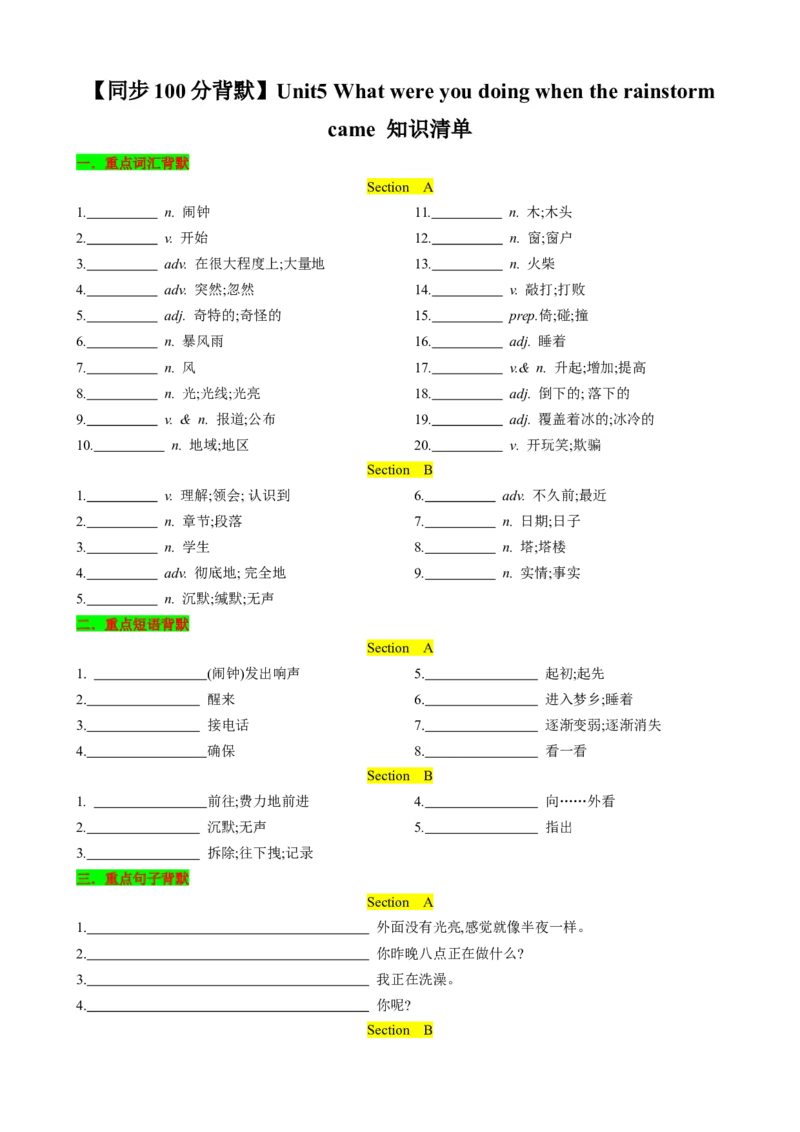
一.重点词汇背默
Section A
1. n. 闹钟 11. n. 木;木头
2. v. 开始 12. n. 窗;窗户
3. adv. 在很大程度上;大量地 13. n. 火柴
4. adv. 突然;忽然 14. v. 敲打;打败
5. adj. 奇特的;奇怪的 15. prep.倚;碰;撞
6. n. 暴风雨 16. adj. 睡着
7. n. 风 17. v.& n. 升起;增加;提高
8. n. 光;光线;光亮 18. adj. 倒下的; 落下的
9. v. & n. 报道;公布 19. adj. 覆盖着冰的;冰冷的
10. n. 地域;地区 20. v. 开玩笑;欺骗
Section B
1. v. 理解;领会; 认识到 6. adv. 不久前;最近
2. n. 章节;段落 7. n. 日期;日子
3. n. 学生 8. n. 塔;塔楼
4. adv. 彻底地; 完全地 9. n. 实情;事实
5. n. 沉默;缄默;无声
二.重点短语背默
Section A
1. (闹钟)发出响声 5. 起初;起先
2. 醒来 6. 进入梦乡;睡着
3. 接电话 7. 逐渐变弱;逐渐消失
4. 确保 8. 看一看
Section B
1. 前往;费力地前进 4. 向……外看
2. 沉默;无声 5. 指出
3. 拆除;往下拽;记录
三.重点句子背默
Section A
1. 外面没有光亮,感觉就像半夜一样。
2. 你昨晚八点正在做什么?
3. 我正在洗澡。
4. 你呢?
Section B1. 凯特在路边看到一只狗。
2. 你还记得你正在做什么吗?
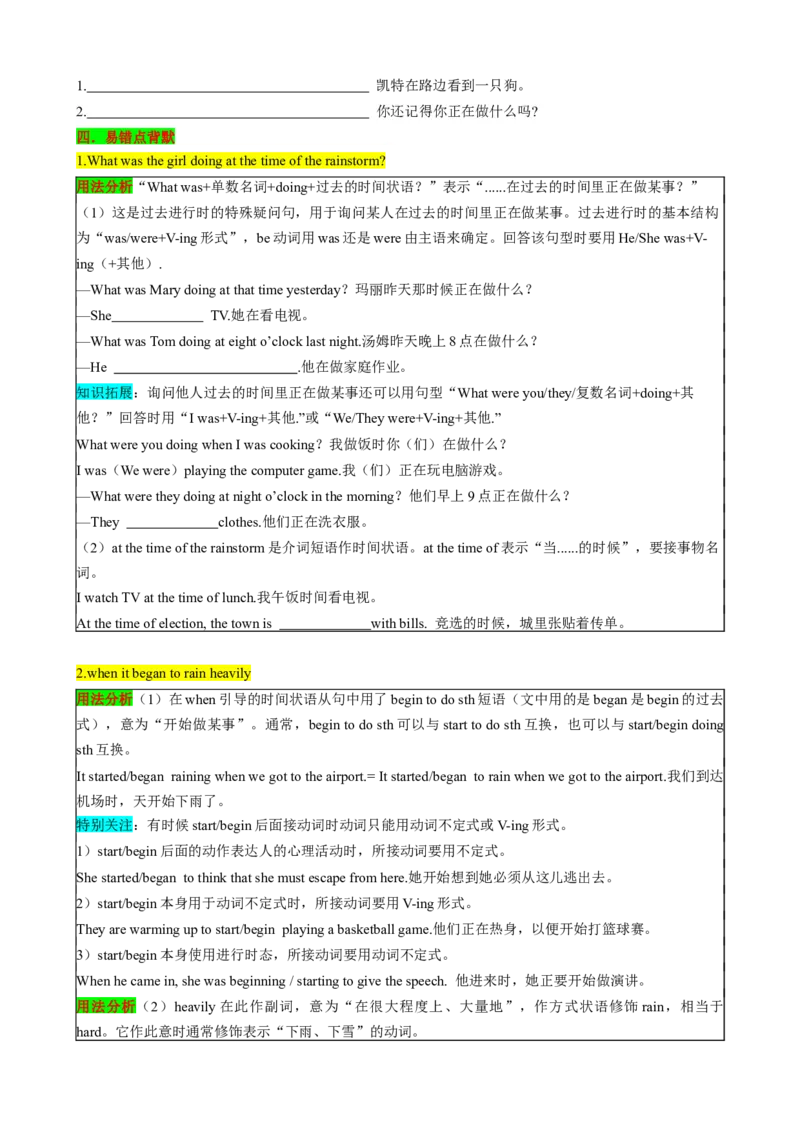
四.易错点背默
1.What was the girl doing at the time of the rainstorm?
用法分析“What was+单数名词+doing+过去的时间状语?”表示“......在过去的时间里正在做某事?”
(1)这是过去进行时的特殊疑问句,用于询问某人在过去的时间里正在做某事。过去进行时的基本结构
为“was/were+V-ing形式”,be动词用was还是were由主语来确定。回答该句型时要用He/She was+V-
ing(+其他).
—What was Mary doing at that time yesterday?玛丽昨天那时候正在做什么?
—She TV.她在看电视。
—What was Tom doing at eight o’clock last night.汤姆昨天晚上8点在做什么?
—He .他在做家庭作业。
知识拓展:询问他人过去的时间里正在做某事还可以用句型“What were you/they/复数名词+doing+其
他?”回答时用“I was+V-ing+其他.”或“We/They were+V-ing+其他.”
What were you doing when I was cooking?我做饭时你(们)在做什么?
I was(We were)playing the computer game.我(们)正在玩电脑游戏。
—What were they doing at night o’clock in the morning?他们早上9点正在做什么?
—They clothes.他们正在洗衣服。
(2)at the time of the rainstorm是介词短语作时间状语。at the time of表示“当......的时候”,要接事物名
词。
I watch TV at the time of lunch.我午饭时间看电视。
At the time of election, the town is with bills. 竞选的时候,城里张贴着传单。
2.when it began to rain heavily
用法分析(1)在when引导的时间状语从句中用了begin to do sth短语(文中用的是began是begin的过去
式),意为“开始做某事”。通常,begin to do sth可以与start to do sth互换,也可以与start/begin doing
sth互换。
It started/began raining when we got to the airport.= It started/began to rain when we got to the airport.我们到达
机场时,天开始下雨了。
特别关注:有时候start/begin后面接动词时动词只能用动词不定式或V-ing形式。
1)start/begin后面的动作表达人的心理活动时,所接动词要用不定式。
She started/began to think that she must escape from here.她开始想到她必须从这儿逃出去。
2)start/begin本身用于动词不定式时,所接动词要用V-ing形式。
They are warming up to start/begin playing a basketball game.他们正在热身,以便开始打篮球赛。
3)start/begin本身使用进行时态,所接动词要用动词不定式。
When he came in, she was beginning / starting to give the speech. 他进来时,她正要开始做演讲。
用法分析(2)heavily在此作副词,意为“在很大程度上、大量地”,作方式状语修饰rain,相当于
hard。它作此意时通常修饰表示“下雨、下雪”的动词。It is hard / heavily outside. You can’t go out. 外面正下着大雨。你不能出去。
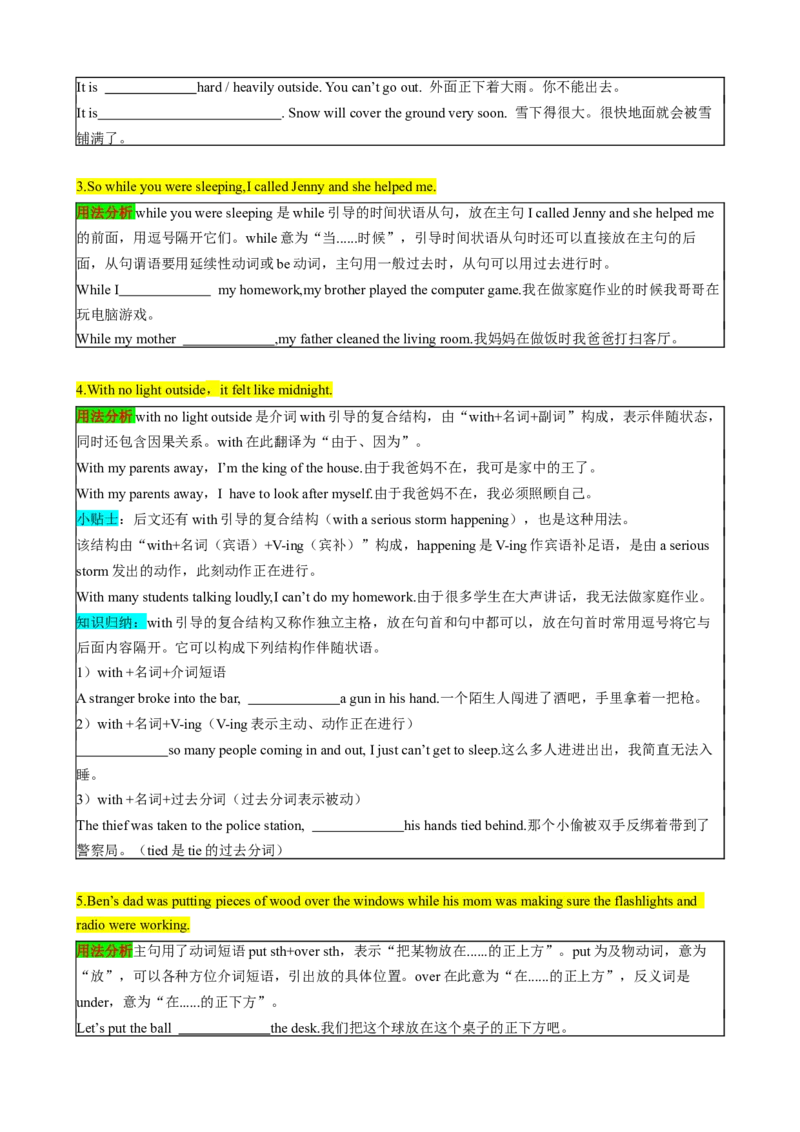
It is . Snow will cover the ground very soon. 雪下得很大。很快地面就会被雪
铺满了。
3.So while you were sleeping,I called Jenny and she helped me.
用法分析while you were sleeping是while引导的时间状语从句,放在主句I called Jenny and she helped me
的前面,用逗号隔开它们。while意为“当......时候”,引导时间状语从句时还可以直接放在主句的后
面,从句谓语要用延续性动词或be动词,主句用一般过去时,从句可以用过去进行时。
While I my homework,my brother played the computer game.我在做家庭作业的时候我哥哥在
玩电脑游戏。
While my mother ,my father cleaned the living room.我妈妈在做饭时我爸爸打扫客厅。
4.With no light outside,it felt like midnight.
用法分析with no light outside是介词with引导的复合结构,由“with+名词+副词”构成,表示伴随状态,
同时还包含因果关系。with在此翻译为“由于、因为”。
With my parents away,I’m the king of the house.由于我爸妈不在,我可是家中的王了。
With my parents away,I have to look after myself.由于我爸妈不在,我必须照顾自己。
小贴士:后文还有with引导的复合结构(with a serious storm happening),也是这种用法。
该结构由“with+名词(宾语)+V-ing(宾补)”构成,happening是V-ing作宾语补足语,是由a serious
storm发出的动作,此刻动作正在进行。
With many students talking loudly,I can’t do my homework.由于很多学生在大声讲话,我无法做家庭作业。
知识归纳:with引导的复合结构又称作独立主格,放在句首和句中都可以,放在句首时常用逗号将它与
后面内容隔开。它可以构成下列结构作伴随状语。
1)with +名词+介词短语
A stranger broke into the bar, a gun in his hand.一个陌生人闯进了酒吧,手里拿着一把枪。
2)with +名词+V-ing(V-ing表示主动、动作正在进行)
so many people coming in and out, I just can’t get to sleep.这么多人进进出出,我简直无法入
睡。
3)with +名词+过去分词(过去分词表示被动)
The thief was taken to the police station, his hands tied behind.那个小偷被双手反绑着带到了
警察局。(tied是tie的过去分词)
5.Ben’s dad was putting pieces of wood over the windows while his mom was making sure the flashlights and
radio were working.
用法分析主句用了动词短语put sth+over sth,表示“把某物放在......的正上方”。put为及物动词,意为
“放”,可以各种方位介词短语,引出放的具体位置。over在此意为“在......的正上方”,反义词是
under,意为“在......的正下方”。
Let’s put the ball the desk.我们把这个球放在这个桌子的正下方吧。There is a light the table.餐桌的正上方有一盏灯。
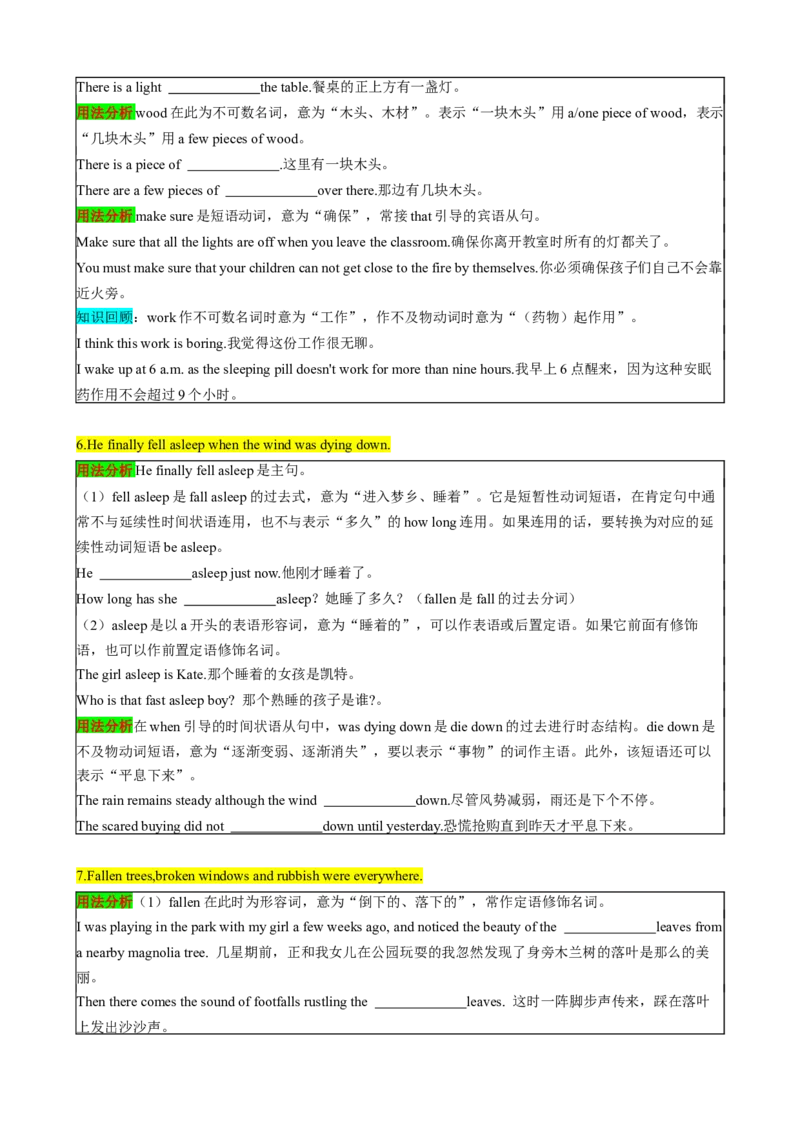
用法分析wood在此为不可数名词,意为“木头、木材”。表示“一块木头”用a/one piece of wood,表示
“几块木头”用a few pieces of wood。
There is a piece of .这里有一块木头。
There are a few pieces of over there.那边有几块木头。
用法分析make sure是短语动词,意为“确保”,常接that引导的宾语从句。
Make sure that all the lights are off when you leave the classroom.确保你离开教室时所有的灯都关了。
You must make sure that your children can not get close to the fire by themselves.你必须确保孩子们自己不会靠
近火旁。
知识回顾:work作不可数名词时意为“工作”,作不及物动词时意为“(药物)起作用”。
I think this work is boring.我觉得这份工作很无聊。
I wake up at 6 a.m. as the sleeping pill doesn't work for more than nine hours.我早上6点醒来,因为这种安眠
药作用不会超过9个小时。
6.He finally fell asleep when the wind was dying down.
用法分析He finally fell asleep是主句。
(1)fell asleep是fall asleep的过去式,意为“进入梦乡、睡着”。它是短暂性动词短语,在肯定句中通
常不与延续性时间状语连用,也不与表示“多久”的how long连用。如果连用的话,要转换为对应的延
续性动词短语be asleep。
He asleep just now.他刚才睡着了。
How long has she asleep?她睡了多久?(fallen是fall的过去分词)
(2)asleep是以a开头的表语形容词,意为“睡着的”,可以作表语或后置定语。如果它前面有修饰
语,也可以作前置定语修饰名词。
The girl asleep is Kate.那个睡着的女孩是凯特。
Who is that fast asleep boy? 那个熟睡的孩子是谁?。
用法分析在when引导的时间状语从句中,was dying down是die down的过去进行时态结构。die down是
不及物动词短语,意为“逐渐变弱、逐渐消失”,要以表示“事物”的词作主语。此外,该短语还可以
表示“平息下来”。
The rain remains steady although the wind down.尽管风势减弱,雨还是下个不停。
The scared buying did not down until yesterday.恐慌抢购直到昨天才平息下来。
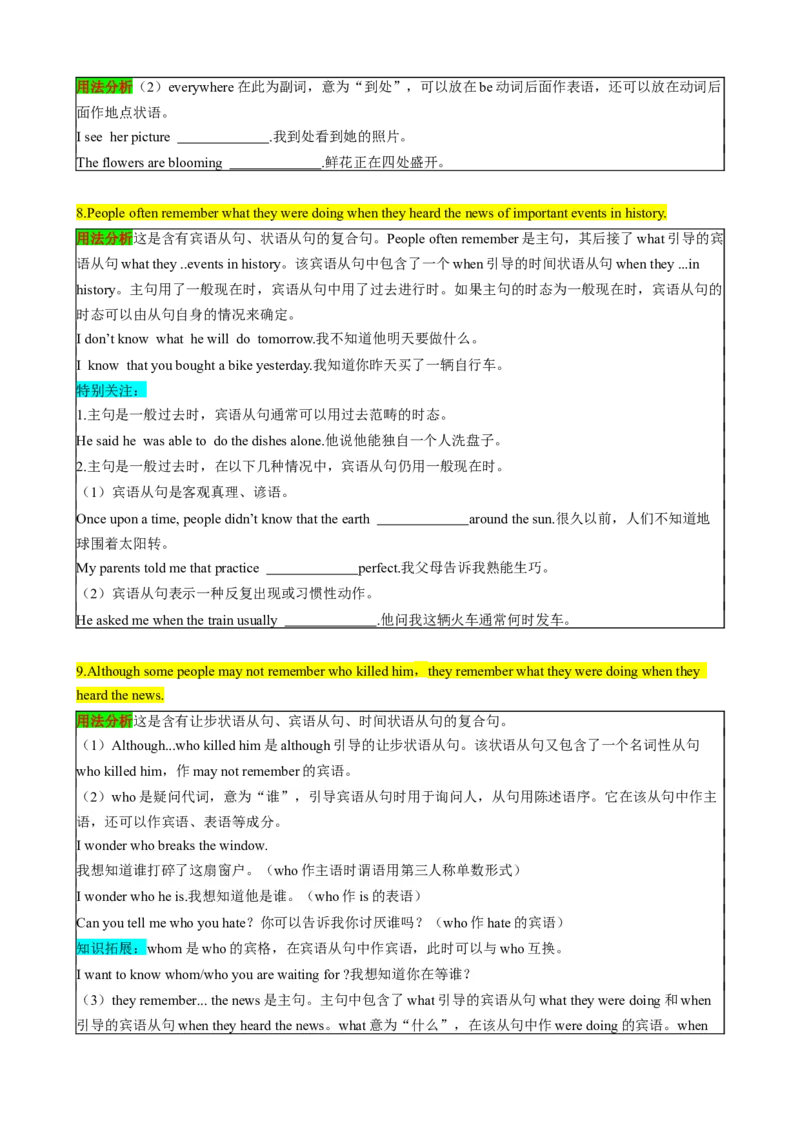
7.Fallen trees,broken windows and rubbish were everywhere.
用法分析(1)fallen在此时为形容词,意为“倒下的、落下的”,常作定语修饰名词。
I was playing in the park with my girl a few weeks ago, and noticed the beauty of the leaves from
a nearby magnolia tree. 几星期前,正和我女儿在公园玩耍的我忽然发现了身旁木兰树的落叶是那么的美
丽。
Then there comes the sound of footfalls rustling the leaves. 这时一阵脚步声传来,踩在落叶
上发出沙沙声。用法分析(2)everywhere在此为副词,意为“到处”,可以放在be动词后面作表语,还可以放在动词后
面作地点状语。
I see her picture .我到处看到她的照片。
The flowers are blooming .鲜花正在四处盛开。
8.People often remember what they were doing when they heard the news of important events in history.
用法分析这是含有宾语从句、状语从句的复合句。People often remember是主句,其后接了what引导的宾
语从句what they ..events in history。该宾语从句中包含了一个when引导的时间状语从句when they ...in
history。主句用了一般现在时,宾语从句中用了过去进行时。如果主句的时态为一般现在时,宾语从句的
时态可以由从句自身的情况来确定。
I don’t know what he will do tomorrow.我不知道他明天要做什么。
I know that you bought a bike yesterday.我知道你昨天买了一辆自行车。
特别关注:
1.主句是一般过去时,宾语从句通常可以用过去范畴的时态。
He said he was able to do the dishes alone.他说他能独自一个人洗盘子。
2.主句是一般过去时,在以下几种情况中,宾语从句仍用一般现在时。
(1)宾语从句是客观真理、谚语。
Once upon a time, people didn’t know that the earth around the sun.很久以前,人们不知道地
球围着太阳转。
My parents told me that practice perfect.我父母告诉我熟能生巧。
(2)宾语从句表示一种反复出现或习惯性动作。
He asked me when the train usually .他问我这辆火车通常何时发车。
9.Although some people may not remember who killed him,they remember what they were doing when they
heard the news.
用法分析这是含有让步状语从句、宾语从句、时间状语从句的复合句。
(1)Although...who killed him是although引导的让步状语从句。该状语从句又包含了一个名词性从句
who killed him,作may not remember的宾语。
(2)who是疑问代词,意为“谁”,引导宾语从句时用于询问人,从句用陈述语序。它在该从句中作主
语,还可以作宾语、表语等成分。
I wonder who breaks the window.
我想知道谁打碎了这扇窗户。(who作主语时谓语用第三人称单数形式)
I wonder who he is.我想知道他是谁。(who作is的表语)
Can you tell me who you hate?你可以告诉我你讨厌谁吗?(who作hate的宾语)
知识拓展:whom是who的宾格,在宾语从句中作宾语,此时可以与who互换。
I want to know whom/who you are waiting for ?我想知道你在等谁?
(3)they remember... the news是主句。主句中包含了what引导的宾语从句what they were doing和when
引导的宾语从句when they heard the news。what意为“什么”,在该从句中作were doing的宾语。when意为“什么时候”,在宾语从句中作时间状语,此时宾语从句必须用陈述语序。
I want to know you are able to do.我想知道你会做什么。
I wonder the meeting will begin.我想知道会议将在什么时候开始。
10.My parents were completely shocked!
用法分析(1)shocked是形容词,意为“惊愕的、感到震惊的”,常作表语描述人的状态。
I feel shocked when hearing the piece of news.
听到这则新闻的时候我感到震惊。
知识拓展:shocking是形容词,意为“令人震惊的”,可以作表语和定语描述事物、事情。
When hearing the news, people were surprised mouth-wide-open.
听到这条令人震惊的消息时,人们都惊得张大了嘴巴。
It is that nothing was said.
11.She remembers working in her office near the two towers.
用法分析句中用了remember+V-ing结构,表示“记得做过某事”,强调事情做完了。the two towers指的
是世贸中心的双子塔。
I remember cleaning the classroom.我记得打扫了教室。
I remember turning off the lights and locking the door as I left.我记得我走的时候已关灯锁门了。
知识归纳:remember的其他用法
(1)remember也可以接动词不定式作宾语,表示“记得要做某事”,强调事情还没做。
(2)使用主语+remember+that引导的宾语从句时,如果主从句主语一致,而且从句用了完成时,可以将
从句转换为V-ing结构。如果主从句主语一致,从句用了将来时,可以将从句转换为动词不定式结构。如
果从句含有否定词,转换成动词不定式或V-ing时要在其前加not。
We remember that we haven’t called him.(haven’t called是现在完成时的否定结构)
=We remember not him.我们记得没给他打过电话。
I remember that I will clean the classroom.
=I remember clean the classroom.我记得要打扫教室。
12.I was so scared that I could hardly think clearly after that.
用法分析(1)这是“主语+be+so+形容词原级+that引导的结果状语从句.”句型,表示“.......如此......以
致......”。scared是形容词,意为“害怕的”,常用作表语。
It is so hot that we have to stay at home.天气是如此之热,以致我们只好呆在家里。
I was too scared to move.我吓得动弹不得。
用法分析(2)在that引导的结果状语从句中,hardly是频率副词,意为“几乎不”,表示否定含义。它
要放在be动词、助动词、情态动词的后面,行为动词的前面。
He can hardly speak English, can he? 他不太会说英语,对吧?
He is hardly late for school.他上学几乎不迟到。
词语辨析:hard和hardly的区别(1)hard既可以作形容词,又可以作副词。作形容词时意为“硬的、难的”,作副词时意为“努力
地”。
The steak tastes good, but the meat is too to chew.牛排味道很好,但肉太老了,咬不动。
The problem is too . 这个问题太难了。
He works very in the company.他在那家公司努力工作。
(2)hardly只作频率副词,意为“几乎不”。
I know him. 我不大认识他。
13.I had trouble thinking clearly after that because I was very afraid.
用法分析句中用了have trouble+V-ing短语,表示“做某事有困难”,trouble后面省略了介词in。
I have trouble (in) out this math problem.我计算出这道数学题有困难。
We have trouble(in) the task on time.我们按时完成这项任务有困难。
知识回顾:have trouble with表示“在......方面有困难”。
They usually have trouble social interactions.他们通常在社会交往方面有困难。
五.语法点记忆
when与while引导的时间状语从句
when和while都可引导时间状语从句,通常情况下可互换。但在以下情况下,when与while是有区别的。
(1)when引导的时间状语从句表示主句动作发生的特定时间,既可指时间点,也可指时间段;while引导的时间
状语从句只指时间段。
When my mother came home, I was doing my homework.我妈妈回家时,我正在做作业。
While my mother was asleep, I cooked dinner for my family. 当我妈妈睡觉时,我为家人做了晚饭。
(2)when引导的时间状语从句的谓语动词既可以是延续性动词,也可以是非延续性动词;while引导的时间状
语从句的谓语动词通常为延续性动词。
When he was a child, he always tried out new ideas.他小时候常常试验一些新想法。
They arrived while we were having dinner.他们到时,我们正在吃晚饭。
(3)when引导的时间状语从句的动作和主句的动作既可以同时发生,也可以先后发生;含有while引导的时间
状语从句的主从复合句强调主从句动作同时发生,或主句的动作在从句的动作发生过程中发生。
It was snowing when he arrived at the station.他到车站时,正下着雪。
Tony’s father was working while Tony’s mother was doing the dishes.当托尼的妈妈正在刷碗时,托尼的爸爸在
工作。
过去进行时
一.概念
过去进行时表示过去某个时刻或某一段时间正在进行的动作。它常与表示过去某一特定时间的状语,
如at six yesterday morning, at that time, then等连用,也可与 when或 while引导的时间状语从句连用。
I was watering flowers in the garden at 4:00 yesterday afternoon. 昨天下午四点我正在花园里浇花。
When I came in, she was watching TV. 当我进来的时候,她正在看电视。
二.句式结构句式 结构 例句
主语+was/were+动词-ing形式 I was drawing when you called me yesterday.你昨天给我打电
肯定句
(+其他). 话时,我正在画画。
主语+wasn’t/weren’t+动词-ing Alan was not sleeping at ten last night. 昨天晚上十点艾伦没在
否定句
形式(+其他). 睡觉。
句式 结构 例句
一般 Was/Were+主语+动词-ing形式
—Was Jim reading a book at this time yesterday? 昨天这个时
疑问 (+其他)?
候吉姆在看书吗?
句及 肯定回答:Yes,主语+was/were.
—Yes, he was./No, he wasn’t. 是的,他在看书。/不,他没在看
简略 否定回答:No,主语+wasn’t/
书。
回答 weren’t.
特殊疑 特殊疑问词+was/were+主语+动 What were you doing when I called you yesterday? 我昨天给你
问句 词-ing形式(+其他)? 打电话时,你在干什么?
1.—I called you at eight last night, but you didn’t answer. What were you doing?
—I ______.
A. took a shower B. was taking a shower C. take a shower D. have taken a shower
2. While Alan was writing a letter, the children ______ outside.
A. play B. were playing C. will play
3. Linda was busy when I went to see her yesterday. She ______ for an exam.
A. will study B. was studying C. has studied D. is studying
4. —Uncle Wang, I dropped by your home at 6:00 p. m. yesterday, but nobody was in.
—Oh, I ______ a meeting.
A. was having B. am having C. will have D. have had
5. My father ______ when I came back last night.
A. will watch TV B. is watching TV C. was watching TV D. watches TV
6. The robot ______ my mother sweep the floor when she got home.
A. was helping B. is helping C. will help D. helps
7. Jack ______ a shower when his mother rang him up.
A. takes B. has taken C. is taking D. was taking
8. While Nick ______ CCTV News, someone knocked at the door.
A. watched B. was watching C. watch D. watches
9. —I saw the light of.your room was still on at two o‘clock last night.
—Oh, I ______ a football match of the Russia World Cup.
A. watched B. was watched C. am watching D. was watching
10. —I saw Mr. Smith in the office at ten yesterday morning.
—That’s impossible. He ______ an English party with us then.
A. has B. had C. was having D. has had
11. My mother ______ some washing when the telephone rang.A. does B. did C. is doing D. was doing
12. —Where were Bill and David when the teacher came in?
—They ______ in the hallway.
A. are talking B. have talked C. were talking D. talk
13. —Hey, Kate. I called you at 6:30 yesterday evening, but you didn’t answer.
—Oh, sorry. I ______ at that time.
A. am doing the dishes B. do the dishes C. was doing the dishes
14. —You look tired. What’s wrong with you?
—I stayed up late last night. I ______ my speech from eight o clock to midnight.
A. practiced B. am practicing C. was practicing D. has practiced
15. —I called you this morning, but nobody answered.
—I ______ flowers in my garden at that time.
A. watered B. was watering C. water D. am watering
六.写作背默
叙述过去发生的事情
写作分析
本单元的写作内容是叙述过去发生的事情。此类话题应以记叙文为主。写此类文章可以从以下几方
面作为切入点:
一是写人时,要注意介绍人物的身份、经历和事迹等;二是叙事时,要写清事件发生的前因后果及
发展过程等。
如何写好这类文章,主要需要掌握以下词汇和句型句式:
※常用的词汇
luckily幸运地 miss错过 when/while当…...的时候 because因为 learn from 从…...
中学会 look around四处看看
※常用的句型句式
He/She/I was...when...当.…..的时候,他/她/我正......
While he was...he suddenly...当他在..….他突然..….
※常用开头结尾句
I think we are supposed to...我认为我们应...…
It was a...day...这是......的一天。
All of us should learn from...我们中的所有人应该…...中学习。
经典试题
上周日在秦淮河边发生了张明救落水小男孩的事情,请根据以下四幅图所描述的事情经过,为校刊
的“英语园地”写一篇 题为“A Brave Young Man”"的英文稿件。注意:1.文中不得出现真实姓名和学校名称;
2.语言通顺,意思连贯,条理清楚,书写规范;
3.词数:80左右,文章的开头已经给出,不计入总词数。
A Brave Young Man
It was a nice day last Sunday._______________________________________________________