让更多的孩子得到更好的教育
地址:北京市西城区新德街20 号4 层 电话:010-82025511 传真:010-82079687  第1页 共7页
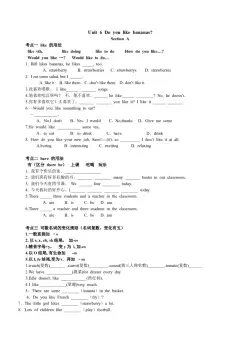
Unit 6 Do you like bananas?
词句精讲精练
                                责编: 郭素清
词汇精讲
1. eat&have
eat 与have 都可以表示“吃”的意思,有时两者可互换。
例如:I eat (have) an apple every day. 我每天吃一个苹果。
They are having (eating) their lunch. 他们在吃中饭。
eat 可用作不及物动词,后面不跟宾语。但是have 没有这个用法。
例如:We eat well at noon. 我们午饭吃的很好。
注意:“吃药”习惯说“have(take) medicine”,不说“eat medicine”。
2. well&good
两者都可以表示“好”的意思。well 是副词,用于修饰动词。
例如:Tom speaks Chinese well. 汤姆的汉语说得好。
He sings well. 他唱得好。
good 是形容词,用作定语或表语。
例如:She is a good doctor. 她是个好医生。
His pronunciation is very good. 他的发音很好。
well 作形容词时,指的是健康状况良好。
例如:He is quite well. 他身体好。
I hope you will be well soon. 我希望你很快好起来。
3. no&not
no 表示“不”,修饰可数名词单数时no=not a; 修饰可数名词复数或者不可数名词时
no=not any。
例如:I have no book.=I don’t have a book.
        I have no books. = I don’t have any books.
        There is no water in the cup.=There isn’t any water in the cup.
no 常用来做否定回答,与yes 相对应,not 不可以。
例如:Do you like bananas? No, I don’t. 不可以说Not, I don’t.
not 用于否定句,放在助动词或者be 动词后面表示否定,no 不可以。
例如:我们可以说I don’t like tea. 不可以说I do no like tea.
4. food
food 泛指“食物”,“食品”,通常用做不可数名词。
例如:I like Chinese food. 我喜欢中国食品。
We should eat healthy food every day. 我们每天应该吃健康食品。
food 指食物的种类时是可数名词。
例如:Milk is a good food. 牛奶是一种好食品。
Too many sweet foods, like cakes and pastry, may make you fat. 太多的甜食,像蛋糕和点心,
可能会使你发胖。
5. breakfast
breakfast 的意思是“早饭”。三餐饭前不加冠词,但是可以用所有格修饰。当breakfast
(早饭)/lunch(午饭)/dinner/ supper(晚饭)前有形容词修饰时, 可加不定冠词。表示
“一顿……的早/午/晚餐”。
例如:I eat my breakfast at seven o’clock. 我七点吃早餐。
                                   让更多的孩子得到更好的教育
地址:北京市西城区新德街20 号4 层 电话:010-82025511 传真:010-82079687  第2页 共7页
      They had a big dinner. 他们吃了一顿丰盛的晚餐。
6. chicken
chicken 名词,当“小鸡”讲时是可数名词,其复数为chickens。当“鸡肉”讲时是不可
数名词,不可以变为复数。
例如:There are some chickens on the farm. 农场上有一些小鸡。
      I don’t like chicken at all. 我一点也不喜欢鸡肉。
7. star
star 名词,可以指“星星”;也可以指“明星”。
例如:There are many stars in the sky at night. 晚上天上有很多星星。
      She is my favorite movie star. 她是我最喜欢的电影明星。
8. fruit
fruit 名词,“水果”。当表示水果的总称时,是不可数名词;当强调不同种类的水果时,
是可数名词。
例如:Do you like fruit? 你喜欢水果吗?(指各种水果,不可数名词)
        Which kind of fruit do you like? 你喜欢哪一种水果。(指水果的种类,可数名词)
9. for
  for 介词,意为“就……而言,对于”。后接名词或者代词的宾格形式。此外,介词for
还可以用来表示用途或者目的。
  例如:What do you like for breakfast? 你早餐喜欢吃什么?
        Let’s go out for a walk! 让我们出去散步吧!
10. so
  so 可以用作连词,表示“那么,因此,所以”。当“因此,所以”讲时,不能和because
连用。
  例如:So what do you like for breakfast?
        那么你早餐喜欢吃什么?
        I got up late, so I was late for school. 我起床晚了,所以迟到了。
  so 还可以作副词,意为“如此,这么”。
  例如:She is so beautiful. 她是如此的漂亮。
词汇精练
Ⅰ. 英汉互译。
1. 吃晚饭 _____________              2. 每天 ______________
3. 如此漂亮 ____________             4. volleyball star ___________
5. healthy  ____________
Ⅱ. 单词拼写。
1. I have__________(一些)cousins.
2. Let's __________(踢)soccer.
3. Baseball is a very __________(困难)sport.
4. He is a running __________(明星)in our school.
5. Let's have some __________(西红柿).
6. My brother Tony __________(喜欢)chicken.
7. Mr. Green __________(看)TV in the evening.
8. We have __________(午餐)at school.
9. Broccoli is a kind(种)of __________(蔬菜)。
10. I like eggs __________(当)breakfast.
                                   让更多的孩子得到更好的教育
地址:北京市西城区新德街20 号4 层 电话:010-82025511 传真:010-82079687  第3页 共7页
III. 根据首字母提示和句意填空。
1. I have hamburgers for b___________.
2. Here are some tomatoes. Do you like t _________?
3. I like c _________.
4. I have an ice c_________.
5. Children should (应当) eat lots of v___________.
6. What do you have for d__________?
7. Zhou Jielun is a singing s________.
8. She eats h________ food every day.
9. How m________ apples do you have?
10. I’m going on a picnic with my f_________.
Ⅳ. 用括号中所给词的正确形式填空。
  1.There are some ________(tomato)in the basket.
  2.Do you like French ________(fry)?
  3.She ________(have)ice cream for dessert.
  4.________(health)food is important.
  5.She ________(do not)like playing sports.
  6.________ your mother ________(watch)TV every day?
  7.The little girl likes ________(strawberry)a lot.
  8.Lots of children like ________(play)football.
  9.Chicken ________(be)very delicious.
10.My daughter ________(go)to school from Monday to Friday.
V.听力链接。
(2014 重庆南岸区期末)
9. A. Yes, it is
    B. No, it isn’t .
C. That’s OK.
10. A. Tom.
B. Tom's sister.
C. Tom's mother.
11. A. Fruit.
B. Vegetables.
C. Salad.
12. A. Saturday.
            B. Friday.
            C. Sunday.
参考答案
Ⅰ. 英汉互译。
1.have/eat dinner/supper  2. every day   3. so beautiful  4. 排球明星  5. 健康的
Ⅱ. 单词拼写。
1. some   2. play  3. difficult  4. star  5. tomatoes
6. likes  7. watches  8. lunch  9. vegetables  10. for
III. 根据首字母提示和句意填空。
1—5:breakfast, tomatoes, chicken, cream, vegetables
6—10:dinner, star, healthy, many, friends
Ⅳ. 用括号中所给词的正确形式填空。
1. tomatoes  2. fries  3. has  4. Healthy  5. doesn’t
6. Does,watch  7. strawberries  8. playing  9. is  10. Goes
V.听力链接。
答案及听力材料
9-12 ACBB
9. M: Excuse me, Mary. Is this your eraser?
                                   让更多的孩子得到更好的教育
地址:北京市西城区新德街20 号4 层 电话:010-82025511 传真:010-82079687  第4页 共7页
W: Yes. Thank you.
     Q: Is this Mary’s eraser?
10. W: Is that your sister, Tom?
      M: No. She’s my mother.
      Q: Who's that?
11. W: Hi, John! Do you like salad?
     M: No, I don’t. But I like vegetables.
     Q: What does John like?
12. W: What’s your favorite day?
      M: Friday.
      W: Why?
      M: Because the next day is Saturday.
      Q: What’s the boy’s favorite day?
句式精讲
1. -Do you like bananas?
-Yes, I do./No, I don’t.
1)本句中的like 是动词,它的意思是“喜欢”,和本单元学习的play,have,watch 一
样都是有实际意义的动词。当句子的谓语是实义动词时,在一般现在时中,它的一般疑
问句是用助动词来构成,当句子的主语是第一人称第二人称单复数,或者第三人称复数
时,用助动词do 放在句子的开头,并且要大写。它的回答是:Yes, 主语+do. / No, 主
语+don’t.
 例如:-Do you like apples? 你们喜欢苹果吗?
-Yes, we do. 是的, 我们喜欢。
  No, we don’t. 不,我们不喜欢。
2)当句子的主语是第三人称单数时,用助动词does 放在句子的开头并且大写,此时,句
中的谓语动词的三单形式要还原为原形。它的回答是:Yes, 主语+does./ No, 主语
+doesn’t.
  例如:-Does your mother like going shopping? 你妈妈喜欢买东西吗?
        -Yes, she does. 是的,她喜欢。
        -No, she doesn’t. 不,她不喜欢。
2. For breakfast, I like eggs, oranges and bananas,but I don’t like milk.
1)“for+某餐,sb.+like(likes)+食品”是固定句型,表示“某人某餐喜欢(吃)……”,for
短语也可以放在句末,此时for 前不加逗号。因此此句可改为: I like eggs, oranges and
bananas for breakfast,but I don’t like milk.
例如:—What do you like for lunch? 午餐你喜欢什么?
—I like hamburgers and salad for lunch. 午餐我喜欢汉堡包和沙拉。
I usually have a little for supper. 我晚餐吃的很少。
  2)句式“What+do/does+主语+like+for+breakfast/lunch/dinner?”意为“某人喜欢吃
什么?”,可以用来对上面的句式提问。
   例如:-What do you like for breakfast? 你早饭喜欢吃什么?
        -I like milk and bread for breakfast. 我早餐喜欢吃牛奶和面包。
3. I like / don’t like….
      这是一个用来表达喜好的句式。因为习惯和爱好是一般不会改变的,因此句子使用
一般现在时态。句式为“主语+like(don’t like)+sth.”。当主语是第三人称单数时,谓语动
                                   让更多的孩子得到更好的教育
地址:北京市西城区新德街20 号4 层 电话:010-82025511 传真:010-82079687  第5页 共7页
词要用三单的形式。
例如:She likes oranges,but she doesn’t like apples. 她喜欢桔子,但是不喜欢苹果。
      I like fruit, but I don't like vegetables.  我喜欢水果,但我不喜欢蔬菜。
4. How (What) about…?
“What about…?=How about …?”,是一个用来提建议或者征求别人意见的句式,
有时也可以用来询问某人的身体状况或者近况。其中的about 是介词,因此后面要跟名
词,代词或者动名词来做宾语。
  例如:How (What) about the fruit? 那水果呢?
        How (What) about going swimming? 去游泳怎么样?
        How (What) about your holiday? 你的假期怎么样?
        How (What) about your mother? 你妈妈怎么样?
5. What food/sports/ colors do you like and dislike?
   这是用来询问是否喜欢某一种具体事物的句型,它的构成是“What+询问的具体事物的
名称+do/does+主语+ like/dislike?”。回答时,要具体内容,不用“Yes/No”。
   例如:-What color do you like? 你喜欢什么颜色?
         -I like red. 我喜欢红色。
         -What sport do you like? 你喜欢什么运动?
         -Basketball. 篮球。
   当主语是第三人称单数时,谓语要变成三单的形式。
   例如:-What food does your brother like?
         -He likes milk. 他喜欢牛奶。
         -What color does your sister dislike? 你姐姐(妹妹)不喜欢什么颜色?
         -Green. 绿色。
句式精练
Ⅰ. 从所给单词中选出恰当的填入空白处。
like, likes, don’t, doesn’t
Sandy: What do you like to eat, Mei?
Mei: Well, I   1   salad, but I   2   like tomatoes.
Sandy: And your friend? What does he like to eat?
Mei: He   3   oranges and bananas. He  4  like hamburgers.
Bobby: And I really   5    ice cream.
Ⅱ. 按要求完成句子。
1. Mr. Scott likes carrots.(改为一般疑问句,并作肯定、否定回答)
__________ Mr. Scott __________ carrots?
Yes, he __________. No, he __________.
2. Helen has some Chinese textbooks.(改为否定句)
Helen __________ __________ __________Chinese textbooks.
3. like, they, broccoli, and, salad (连词成句)
_________________________________
4. let's, watch, eat, and, TV, ice cream (连词成句)
____________________________________
5. They like salad. (改为一般疑问句)
_________ they _________ salad?
6. Does she like ice cream? (作否定回答)
                                   让更多的孩子得到更好的教育
地址:北京市西城区新德街20 号4 层 电话:010-82025511 传真:010-82079687  第6页 共7页
_________, she _________.
7. We have chicken for dinner. (对划线部分提问)
_________ do you _________ for dinner?
8. I don’t like carrots for lunch. (用Sandra 代替I 改写句子)
 Sandra_________ _________ carrots for lunch.
9. Tim likes pears.(改为否定句)
Tim _________ _________ pears.
10.
Linda and Tom like French fries. (改成否定句)
They _______ _______French fries.
III. 根据汉语意思完成英语句子。
1.姚明和乔丹是篮球明星。
Yao Ming and Jordan are _________ _________.
2.我们早饭吃鸡蛋和汉堡包。
We have eggs and hamburgers _________ _________.
3. 那午餐呢?
_______ ______ lunch?
4. 我妹妹喜欢橙子、苹果和梨。
My sister _________ oranges, _________ and pears.
5. 水果和蔬菜都很健康。
_________ and _________ are very healthy.
6.他不喜欢吃蔬菜,但他有点喜欢吃胡萝卜。
He __________ like vegetables, but he __________ carrots a little.
7.李明不喜欢薯条。
Li Ming doesn't like __________ __________.
8.他们喜欢吃香蕉。
They __________ __________.
9.这是沙拉和冰淇淋。
These __________ __________and ice cream.
10. 你喜欢哪一种水果?
What ______ do you ______?
IV.根据对话内容,填写所缺单词,每空一词。
A: Who is the letter from, Ben ?
B: It’s from my pen pal , David.
A:

 1

 he speak Chinese?
B: No, he doesn’t. He

 2

 English. But he knows a lot about China.
A: Does he live

 3

 China?
B: Yes, he does.
A:

 4

 does he say in the letter?
B: He says he wants to visit the Great Wall.
A: Oh, he can help you with your English.
B:Yes, you’re

 5

 .
参考答案
Ⅰ. 从所给单词中选出恰当的填入空白处。
1.like  2.don't  3.likes  4.doesn't  5.like
                                   让更多的孩子得到更好的教育
地址:北京市西城区新德街20 号4 层 电话:010-82025511 传真:010-82079687  第7页 共7页
Ⅱ. 按要求完成句子。
1. Does, like, does, doesn't
2. doesn't, have, any
3. They like broccoli and salad.
4. Let's watch TV and eat ice cream.
5. Do, like  6. No, doesn’t  7. What, have
8. doesn’t eat  9. doesn’t like  10. don’t, like
III. 根据汉语意思完成英语句子。
1. basketball,stars  2. for,breakfast  3. What / How,about
4. likes, apples  5. Fruit, vegetables  6. doesn't, likes
7. French, fries   8. Like, bananas   9. are, salad
10. fruit, like
IV.根据对话内容,填写所缺单词,每空一词。
1. Does    2.speaks     3.in    4. What     5.right