让更多的孩子得到更好的教育
Review of Units 7-12
                                 责编:郭素清
词汇精讲
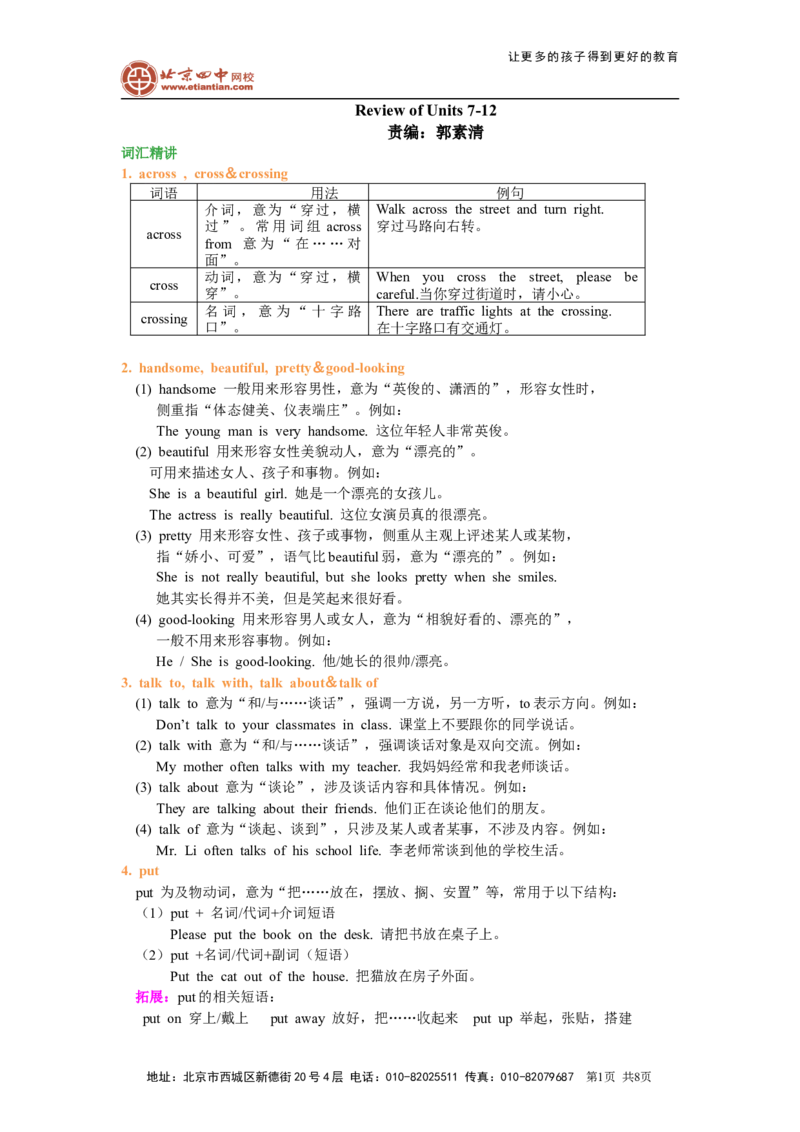
1. across , cross&crossing
词语
用法
例句
across
介词,意为“穿过,横
过” 。常用词组across
from 意为“ 在… … 对
面”。
Walk across the street and turn right.
穿过马路向右转。
cross
动词,意为“穿过,横
穿”。
When you cross the street, please be
careful.当你穿过街道时,请小心。
crossing
名词,意为“ 十字路
口”。
There are traffic lights at the crossing.
在十字路口有交通灯。
2. handsome, beautiful, pretty&good-looking
  (1) handsome 一般用来形容男性,意为“英俊的、潇洒的”,形容女性时,
侧重指“体态健美、仪表端庄”。例如:
The young man is very handsome. 这位年轻人非常英俊。
  (2) beautiful 用来形容女性美貌动人,意为“漂亮的”。
可用来描述女人、孩子和事物。例如:
She is a beautiful girl. 她是一个漂亮的女孩儿。
    The actress is really beautiful. 这位女演员真的很漂亮。
  (3) pretty 用来形容女性、孩子或事物,侧重从主观上评述某人或某物,
指“娇小、可爱”,语气比beautiful 弱,意为“漂亮的”。例如:
She is not really beautiful, but she looks pretty when she smiles.
她其实长得并不美,但是笑起来很好看。
  (4) good-looking 用来形容男人或女人,意为“相貌好看的、漂亮的”,
一般不用来形容事物。例如:
He / She is good-looking. 他/她长的很帅/漂亮。
3. talk to, talk with, talk about&talk of
  (1) talk to 意为“和/与……谈话”,强调一方说,另一方听,to 表示方向。例如:
     Don’t talk to your classmates in class. 课堂上不要跟你的同学说话。
  (2) talk with 意为“和/与……谈话”,强调谈话对象是双向交流。例如:
My mother often talks with my teacher. 我妈妈经常和我老师谈话。
  (3) talk about 意为“谈论”,涉及谈话内容和具体情况。例如:
     They are talking about their friends. 他们正在谈论他们的朋友。
  (4) talk of 意为“谈起、谈到”,只涉及某人或者某事,不涉及内容。例如:
     Mr. Li often talks of his school life. 李老师常谈到他的学校生活。
4. put
  put 为及物动词,意为“把……放在,摆放、搁、安置”等,常用于以下结构:
  (1)put + 名词/代词+介词短语
       Please put the book on the desk. 请把书放在桌子上。
  (2)put +名词/代词+副词(短语)
       Put the cat out of the house. 把猫放在房子外面。
  拓展:put 的相关短语:
   put on 穿上/戴上   put away 放好,把……收起来  put up 举起,张贴,搭建
地址:北京市西城区新德街20 号4 层 电话:010-82025511 传真:010-82079687  第1页 共8页
                                   让更多的孩子得到更好的教育
   put down 放下,写下
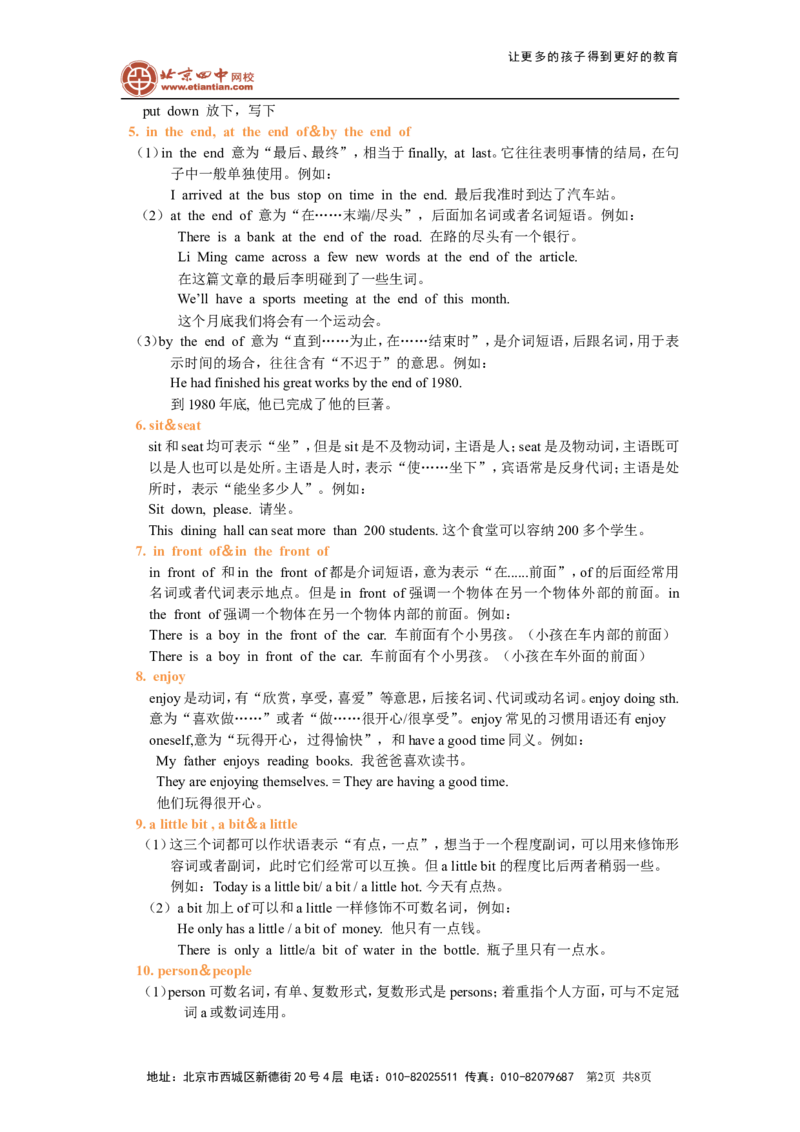
5. in the end, at the end of&by the end of
 (1)in the end 意为“最后、最终”,相当于finally, at last。它往往表明事情的结局,在句
子中一般单独使用。例如:
      I arrived at the bus stop on time in the end. 最后我准时到达了汽车站。
 (2)at the end of 意为“在……末端/尽头”,后面加名词或者名词短语。例如:
       There is a bank at the end of the road. 在路的尽头有一个银行。
       Li Ming came across a few new words at the end of the article.
在这篇文章的最后李明碰到了一些生词。
We’ll have a sports meeting at the end of this month.
这个月底我们将会有一个运动会。
  (3)by the end of 意为“直到……为止,在……结束时”,是介词短语,后跟名词,用于表
示时间的场合,往往含有“不迟于”的意思。例如:
       He had finished his great works by the end of 1980.
到1980 年底, 他已完成了他的巨著。
  6. sit&seat
sit 和seat 均可表示“坐”,但是sit 是不及物动词,主语是人;seat 是及物动词,主语既可
以是人也可以是处所。主语是人时,表示“使……坐下”,宾语常是反身代词;主语是处
所时,表示“能坐多少人”。例如:
Sit down, please. 请坐。
This dining hall can seat more than 200 students. 这个食堂可以容纳200 多个学生。
7. in front of&in the front of
in front of 和in the front of 都是介词短语,意为表示“在......前面”,of 的后面经常用
名词或者代词表示地点。但是in front of 强调一个物体在另一个物体外部的前面。in
the front of 强调一个物体在另一个物体内部的前面。例如:
There is a boy in the front of the car. 车前面有个小男孩。(小孩在车内部的前面)
There is a boy in front of the car. 车前面有个小男孩。(小孩在车外面的前面)
  8. enjoy
enjoy 是动词,有“欣赏,享受,喜爱”等意思,后接名词、代词或动名词。enjoy doing sth.
意为“喜欢做……”或者“做……很开心/很享受”。enjoy 常见的习惯用语还有enjoy
oneself,意为“玩得开心,过得愉快”,和have a good time 同义。例如:
 My father enjoys reading books. 我爸爸喜欢读书。
 They are enjoying themselves. = They are having a good time.
     他们玩得很开心。
 9. a little bit , a bit&a little
(1)这三个词都可以作状语表示“有点,一点”,想当于一个程度副词,可以用来修饰形
容词或者副词,此时它们经常可以互换。但a little bit 的程度比后两者稍弱一些。
例如:Today is a little bit/ a bit / a little hot. 今天有点热。
(2)a bit 加上of 可以和a little 一样修饰不可数名词,例如:
He only has a little / a bit of money. 他只有一点钱。
        There is only a little/a bit of water in the bottle. 瓶子里只有一点水。
         10. person&people
          (1)person 可数名词,有单、复数形式,复数形式是persons;着重指个人方面,可与不定冠
词a 或数词连用。
地址:北京市西城区新德街20 号4 层 电话:010-82025511 传真:010-82079687  第2页 共8页
                                   让更多的孩子得到更好的教育
例如:He is a person to be shunned. 他是一个谁见着谁就躲避的人。
(2)people 是一个集合名词,着重指全体方面。只用来表示复数概念,不能与不定冠词
a/an 或数词one 连用。例如:
Were there many people at the meeting? 参加会议的人多吗?
   11. fish
(1)fish 既可作可数名词,也可以作不可数名词。用作可数名词指鱼的条数时,单复数相
同;强调鱼的种类时复数是fishes。用作不可数名词时意为“鱼肉”。例如:
I bought two fish in the market. 我在市场买了两条鱼。
There are all kinds of fishes in the sea. 海里有各种各样的鱼。
I don’t like fish at all. 我根本不喜欢鱼肉。
(2)fish 还可以作动词,意为“钓鱼”。
Let’s go fishing tomorrow. 让我们明天去钓鱼吧。
         I like fishing. 我喜欢钓鱼。
   12. exciting&excited
exciting 和 excited 都是形容词,exciting 意为“令人兴奋的”,一般用来说明事物的特
征。excited 意为“感到兴奋的”,一般用来说明人的感受。
例如:The exciting news makes us excited. 这个令人兴奋的消息让我们很兴奋。
                He is very excited at the news. 因为那个消息他很兴奋。
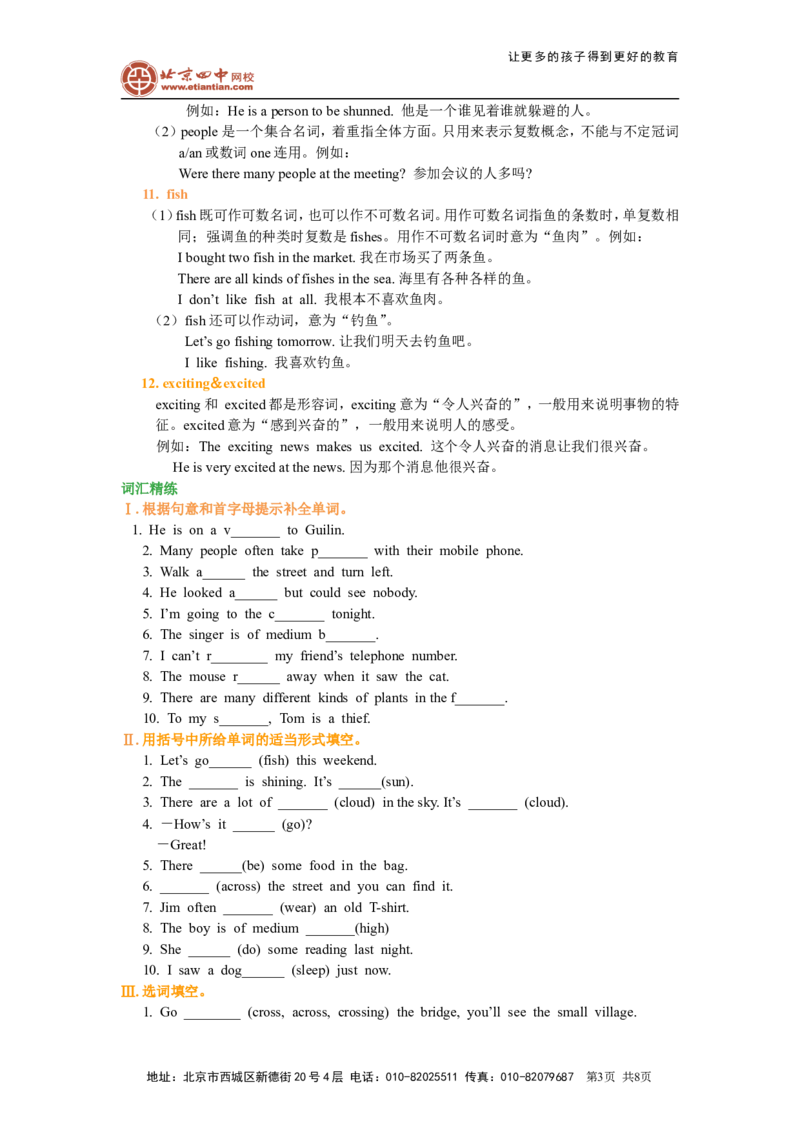
词汇精练
Ⅰ. 根据句意和首字母提示补全单词。
   1. He is on a v_______ to Guilin.
   2. Many people often take p_______ with their mobile phone.
   3. Walk a______ the street and turn left.
   4. He looked a______ but could see nobody.
   5. I’m going to the c_______ tonight.
   6. The singer is of medium b_______.
   7. I can’t r________ my friend’s telephone number.
   8. The mouse r______ away when it saw the cat.
   9. There are many different kinds of plants in the f_______.
   10. To my s_______, Tom is a thief.
Ⅱ. 用括号中所给单词的适当形式填空。
   1. Let’s go______ (fish) this weekend.
   2. The _______ is shining. It’s ______(sun).
   3. There are a lot of _______ (cloud) in the sky. It’s _______ (cloud).
   4. -How’s it ______ (go)?
     -Great!
   5. There ______(be) some food in the bag.
   6. _______ (across) the street and you can find it.
   7. Jim often _______ (wear) an old T-shirt.
   8. The boy is of medium _______(high)
   9. She ______ (do) some reading last night.
   10. I saw a dog______ (sleep) just now.
Ⅲ. 选词填空。
   1. Go ________ (cross, across, crossing) the bridge, you’ll see the small village.
地址:北京市西城区新德街20 号4 层 电话:010-82025511 传真:010-82079687  第3页 共8页
                                   让更多的孩子得到更好的教育
   2. There is a tree ________ (in the front of, in front of) the house.
   3. Please_______ (sit, seat) and have a cup of tea.
   4. How _______ (beautiful, pretty, handsome) your brother is!
   5. How many_______ (person, people) are there in your family?
   6. My sister was very _______ (exciting, excited) when she heard the _______
(exciting, excited) news.
   7. ________(in the end, at the end of, by the end of) the road, you can find a
bookshop.
   8. The students are talking ________ (to, with, about) the football match.
   9. There is only ________(a few, a little, a bit) meat in the fridge.
   10. I enjoy________ (listen, listened, listening, to listen) to the music.
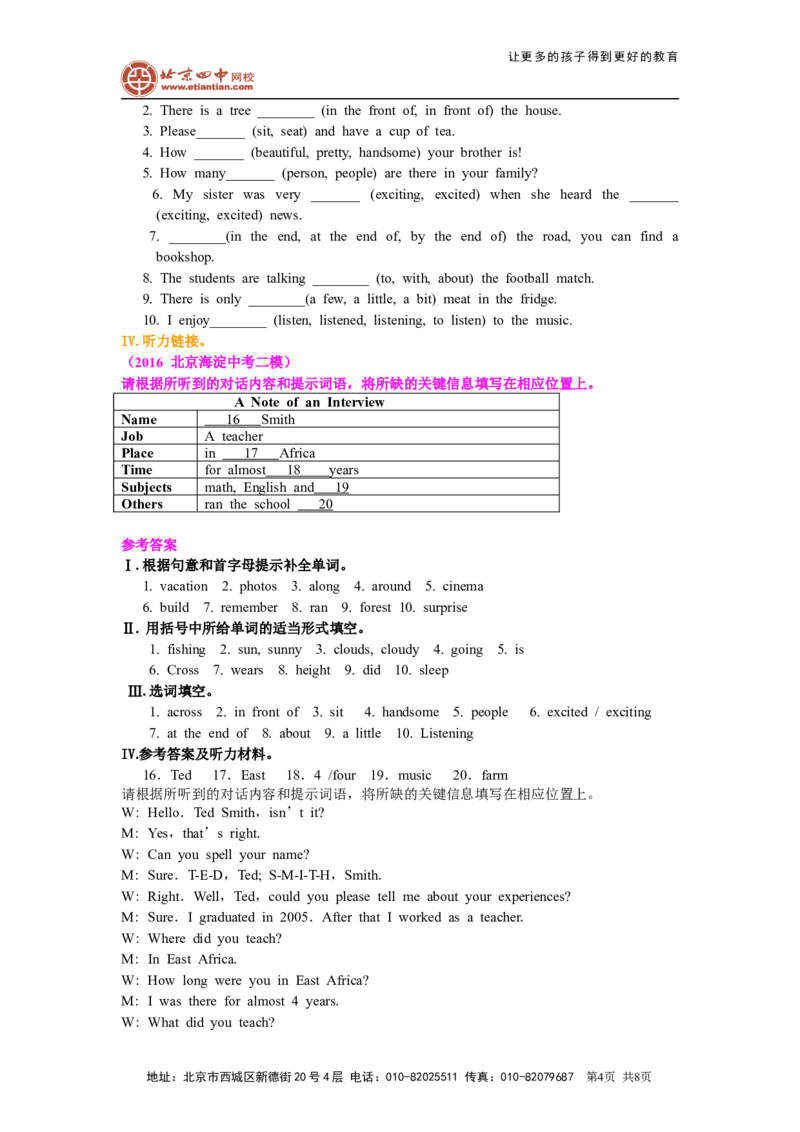
IV. 听力链接。
(2016 北京海淀中考二模)
请根据所听到的对话内容和提示词语,将所缺的关键信息填写在相应位置上。
A Note of an Interview
Name

  16

  Smith
Job
A teacher
Place
in
  17

  Africa
Time
for almost
  18


 years
Subjects
math, English and
  19

Others
ran the school
  20

参考答案
Ⅰ. 根据句意和首字母提示补全单词。
   1. vacation  2. photos  3. along  4. around  5. cinema
   6. build  7. remember  8. ran  9. forest 10. surprise
Ⅱ. 用括号中所给单词的适当形式填空。
    1. fishing  2. sun, sunny  3. clouds, cloudy  4. going  5. is
    6. Cross  7. wears  8. height  9. did  10. sleep
Ⅲ. 选词填空。
    1. across  2. in front of  3. sit   4. handsome  5. people   6. excited / exciting
    7. at the end of  8. about  9. a little  10. Listening
IV.参考答案及听力材料。
16.Ted   17.East   18.4 /four  19.music   20.farm
请根据所听到的对话内容和提示词语,将所缺的关键信息填写在相应位置上。
W: Hello.Ted Smith,isn’t it?
M: Yes,that’s right.
W: Can you spell your name?
M: Sure.T-E-D,Ted; S-M-I-T-H,Smith.
W: Right.Well,Ted,could you please tell me about your experiences?
M: Sure.I graduated in 2005.After that I worked as a teacher.
W: Where did you teach?
M: In East Africa.
W: How long were you in East Africa?
M: I was there for almost 4 years.
W: What did you teach?
地址:北京市西城区新德街20 号4 层 电话:010-82025511 传真:010-82079687  第4页 共8页
                                   让更多的孩子得到更好的教育
M: Many things,math,English and music.I enjoyed teaching there.
W: Great.What else did you do there?
M: A lot of things.I also ran the school farm.
W: How interesting! How did you feel about working in Africa?
M: Unforgettable.Helping children there really made me happy.
W: Well… you certainly have had some interesting work experiences.Let’s move on to
the next part.
句式精讲
1. How’s the weather in Shanghai?
这是一个用来询问天气的句型,How’s 是How is 的缩写形式。询问天气的句子还可以用
What’s the weather like? / What do you think of the weather? 来表示。在句末可以加上“介
词+地点/时间/季节”短语。例如:
  -What’s the weather like in Guangzhou? 广州的天气怎么样?
   -It’s very hot. 很热。
   -How’s the weather here in winter? 这儿的冬天天气怎么样?
   -It’s cold. 很冷。
2. Where is the post office?
 “Where is/are …?”是用来询问某人或某物在哪里的常用句型,其结构为:
  Where + be+人/物/地点名词?如果表示礼貌,可以用“Excuse me. ”开头。例如:
 Where is the library? 图书馆在哪里?
   拓展:有关问路的习惯用语:
    How can I get to…? 我怎样才能到达……?
    Could / Can you tell/show me the way to…? 你告诉我去……的路吗?
    Could / Can you tell me how to get to …? 你能告诉我怎样到……吗?
    Which is the way to…? 哪一条是去……的路?
    Is there a …near here? 这儿附近有……吗?
  3. 询问外貌和描述外貌的常用句型
(1)询问外貌常用的句型:
What+do/does+主语+look like?这个句型是用来询问某人的外貌特征,它的意思
是“某人看上去怎么样?”,对这个句子的回答经常用“主语+be+形容词”或者
“主语+have/has+名词”两种方式来回答。例如:
        -What does our new teacher look like? 我们的新老师长什么样?
      -She is tall and thin. 她又高又瘦。
    注意:What’s sb. like? 用来询问人的品质;What’s sth. like?用来询问事物的性质,特
别是用来谈论天气状况。例如:
What’s your new teacher like? 你们的新老师是怎样的一个人?
        What’s the weather like today? 今天天气怎么样?
(2)描述外貌常用的句型有:
       1)主语+be+形容词
          例如:She is beautiful. 她很漂亮。
       2)主语+have/has +形容词+头发/五官
          例如:She has long black hair. 她留着黑色的长发。
       3)主语+be of+形容词+build/height
          例如:She is of medium build. 她中等身材。
地址:北京市西城区新德街20 号4 层 电话:010-82025511 传真:010-82079687  第5页 共8页
                                   让更多的孩子得到更好的教育
4. Would you like a large bowl?
“Would you like…?”是日常生活中的常用句型,用于向对方有礼貌的提出建议或邀
请。其后可以跟名词、代词、动词不定式等。“Would you like sth.?”意为“你想要……
吗?” 其肯定回答是“Yes, please.”; 否定回答是“No, thanks.”。“Would you like
to do sth?”意为“你愿意……吗?”;其肯定回答常用“Yes, I’d love/like to.”;否
定回答常用“No, thanks.”或者“Sorry + 拒绝的理由. / I’d love to, but…等”。例
如:
   -Would you like a cup of tea? 你想喝杯茶吗?
   -Yes, please. / No, thanks. 好的。/ 不,谢谢。
   -Would you like to go to the cinema? 你想去看电影吗?
   -Yes, I’d love / like to. 是的,我非常愿意。
5. How was your trip yesterday?
 (1)本句为询问某事情况的常用句型,其中was 是be 动词的过去式,如果询问当前的情况
则be 动词用is。其答语常用:It was great! (好极了) / It was OK.(还可以)/ It wasn’t
good.(不好。)/ All right.(很好。)/ It was not bad.(还不错。)等。How + be+…?相当于
What + be +… + like? 例如:
-How was her holiday?她的假期过得怎么样?
-It was not bad. 还不错。
 (2)How 是疑问副词,意为“如何,怎样”,常用来引导特殊疑问句来询问方式、程度、状
况等。常用于以下交际用语中:
     1)How is/are +sb. ? 用来询问人的身体、工作、学习或生活等的状况。例如:
         -How is your father? 你爸爸好吗?
         -He is fine, thank you. 他很好,谢谢。

     2)How is/are +sth.?用来询问某物或者某事的状况如何。例如:
        How is your summer holiday? 你的暑假怎么样?
     3)How do you do? 并不表示疑问,是第一次见面时的问候语,回答仍用此句。例如:
        How do you do? 你好!
        How do you do? 你好!
     4)How is it going?/ How is everything going? 用来询问事情进展如何。例如:
        How is it going? 情况/进展如何?
        Very well./ Not too bad./just so so.
        很好。/还不坏。/一般吧。
   6. But I was so tired that I went to sleep early.
      这句话的意思是“我是如此的累,以至于我很早就睡了。”;so… that…的意思是“如
此……以至于……”,它引导结果状语从句。在口语中,so…that…的that 常被省去。例
如:
She was so tired that she couldn’t walk any more.
她是如此的累以至于她再也走不动了。
      He was so angry that he could say nothing. 他是如此的愤怒以至于什么都说不出
来。
      注意:so…that…的否定句可以和too…to…(太……而不能……)互换。
      例如:She is so young that she couldn’t go to school.
           = She is too young to go to school.
           她是如此的小,以至于她不能去上学。
地址:北京市西城区新德街20 号4 层 电话:010-82025511 传真:010-82079687  第6页 共8页
                                   让更多的孩子得到更好的教育
句式精练
Ⅰ. 阅读下面对话,从方框内七个选项中选择五个恰当的句子完成此对话。

A.When will the concert begin?
B.Sounds good!
C.When and where shall we meet?
D.I’ll see a movie.
E.Could you please get there earlier?
F.Yes.What’s up?
G.Would you like to go with me?
A: Hello.Is that Wu Bing speaking?
B: Yes,Who’s that?
A: This is Tian Hong.Are you free this Saturday evening?
B:   1
A: I’ve got two tickets to Jay Chou’s concert.
  2

B: Certainly.I’d love to.He’s my favorite singer.Thanks for your invitation.
  3

A: Let’s meet at the gate of the park at four o’clock.
B:   4   I want to buy him a gift.
A: OK,I’ll get there at three.Shall we go to the shopping center to buy the gift?
B:   5   See you then.
A: See you.
1._______  2._______  3._______  4._______  5._______
Ⅱ. 句型转换,每空一词。
    1. We are visiting our grandparents now. (改为一般疑问句)
      _______ you _______ your grandparents now?
    2. It’s snowy in Beijing. (改为同义句)
      _______ ________ in Beijing is ________.
    3. I am on a visit to Shanghai with my family. (改为同义句)
      My family and I _______ ________ Shanghai.
    4. The post office is on
    Long

   Street

 . (对划线部分提问)
      ________ ________ the post office?
    5. There is a pay phone near the bank.(改为一般疑问句)
      _______ _______ a pay phone near the bank?
    6. Grace is on Tony’s left and Dale’s right. (改为同义句)
      Grace is _______ Tony ______ Dale.
    7. Maybe I am a little late. (改为同义句)
      I ______ ______ a little late.
    8. Mr. Black is tall
   and
   heavy

 . (对划线部分提问)
      _______ ________ Mrs. Dean look like?
    9. He’d like mutton noodles. (改为一般疑问句)
      _______ _______ _______mutton noodles?
    10. I cleaned

   my
    room

  last weekend. (对划线部分提问)
       ______ ______ you ______ last weekend?
Ⅲ. 根据汉语意思,完成句子,每空一词。
   1. 今天天气怎么样?
地址:北京市西城区新德街20 号4 层 电话:010-82025511 传真:010-82079687  第7页 共8页
                                   让更多的孩子得到更好的教育
     _______ the ______ today?
   2. 那里的天气不适合滑冰。
     The weather _______ isn’t right for_______.
   3. 请尽快给我回信。
     Please write _______ me _______.
   4. 她的朋友长得怎么样?
      What ______ her friend______ ______?
   5. 这个人是中等身材。
      The person is _______ _______ _______.
   6. 我想吃羊肉和土豆面条。
      I’d like _______ and ______ noodles.
   7. 不要切碎苹果。
      Don’t _______ _______ apples.
   8. 多么可爱的一个男孩啊!
      What ______ ______ ______ he is!
   9. 你周末过的怎么样?
      ______ ______ your weekend?
   10. 我那么累以至于想早点睡觉。
      I’m _______ ________ ________ I want to go to bed early.
IV.阅读短文,然后用短文括号中所给词的适当形式填空。
(2015 沈阳中考)
Today I took part in a quiz show at a TV studio. When I arrived at     1       (eighth) o’clock, a
woman put make-up on my face, and brushed my hair.
Then the director came. He told me to stay     2
  (relax) and not to worry. It was really kind
of him to do that. The hot lights shone down upon    3      (we). One of the contestants passed out
before the show started, so the director    4      (choose) another girl. The girl was called Angela. She
knew a lot of    5      (thing). She beat me and another contestant and finally won the prize. Everyone
was happy for Angela.
I was sorry I didn’t win, but I’ll do    6      (well) next time.
 参考答案
Ⅰ. 阅读下面对话,从方框内七个选项中选择五个恰当的句子完成此对话。
    1.F  2.G  3.C  4.E  5.B
Ⅱ. 句型转换,每空一词。
    1. Are, visiting  2. the weather, snowy 3. are visiting  4. Where is  5. Is there
    6. between, and  7. may be  8. What does  9. Would he like 10. What did, do
Ⅲ. 根据汉语意思,完成句子,每空一词。
    1. How’s, weather  2. there, skating  3. to soon  4. does, look like  5. of medium
height
6. mutton, potato  7. cut up  8. a lovely boy  9. How was  10. so tired that
IV.阅读短文,然后用短文括号中所给词的适当形式填空。
1. eight     2. relaxed     3. us      4. chose      5. things    6. better
地址:北京市西城区新德街20 号4 层 电话:010-82025511 传真:010-82079687  第8页 共8页