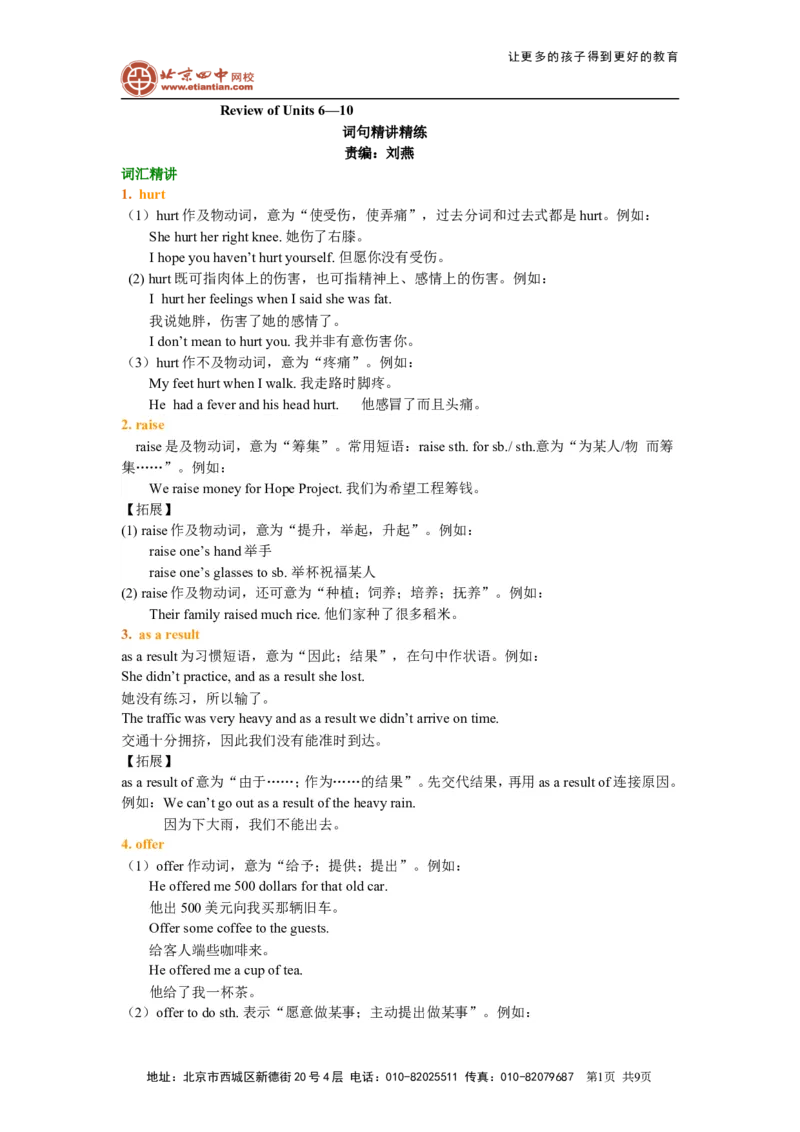
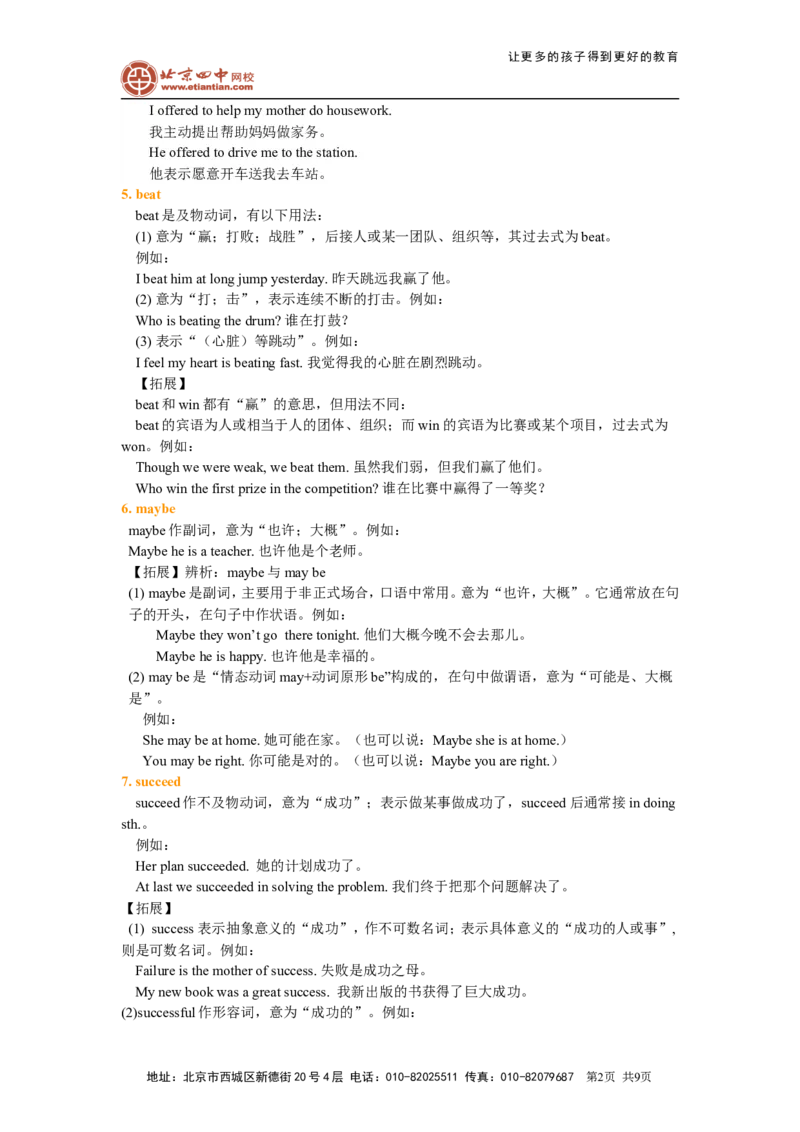
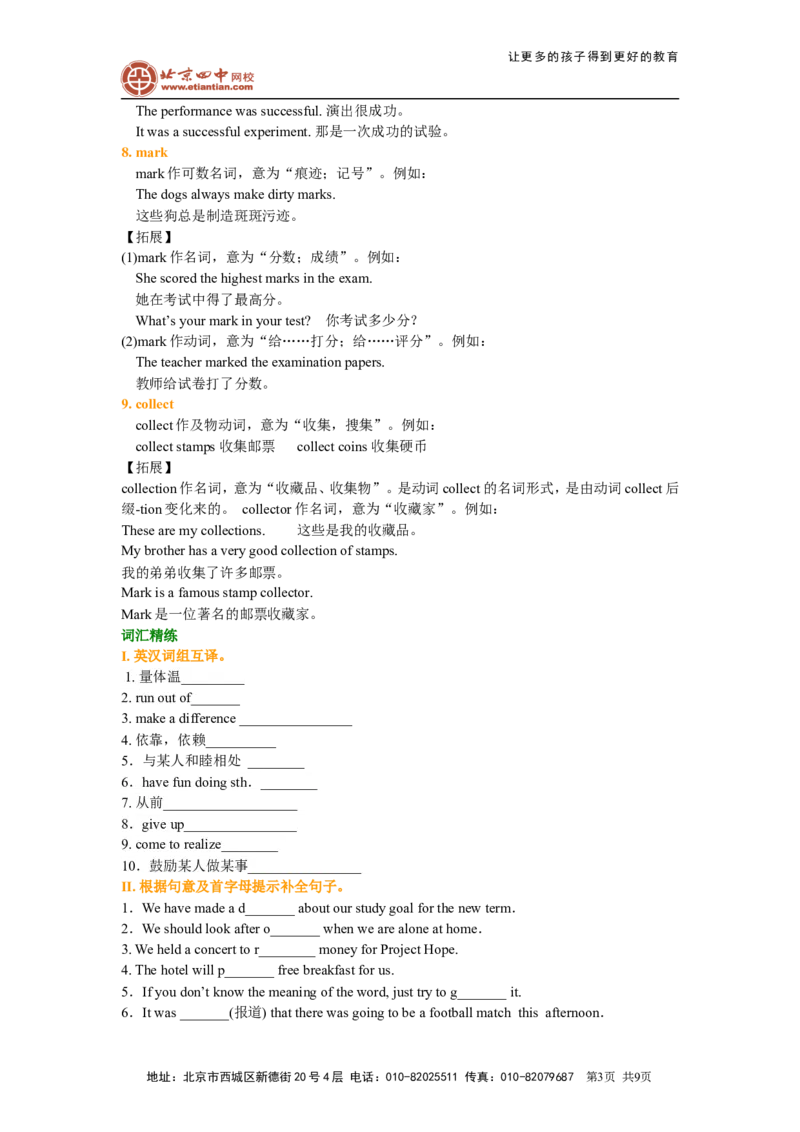
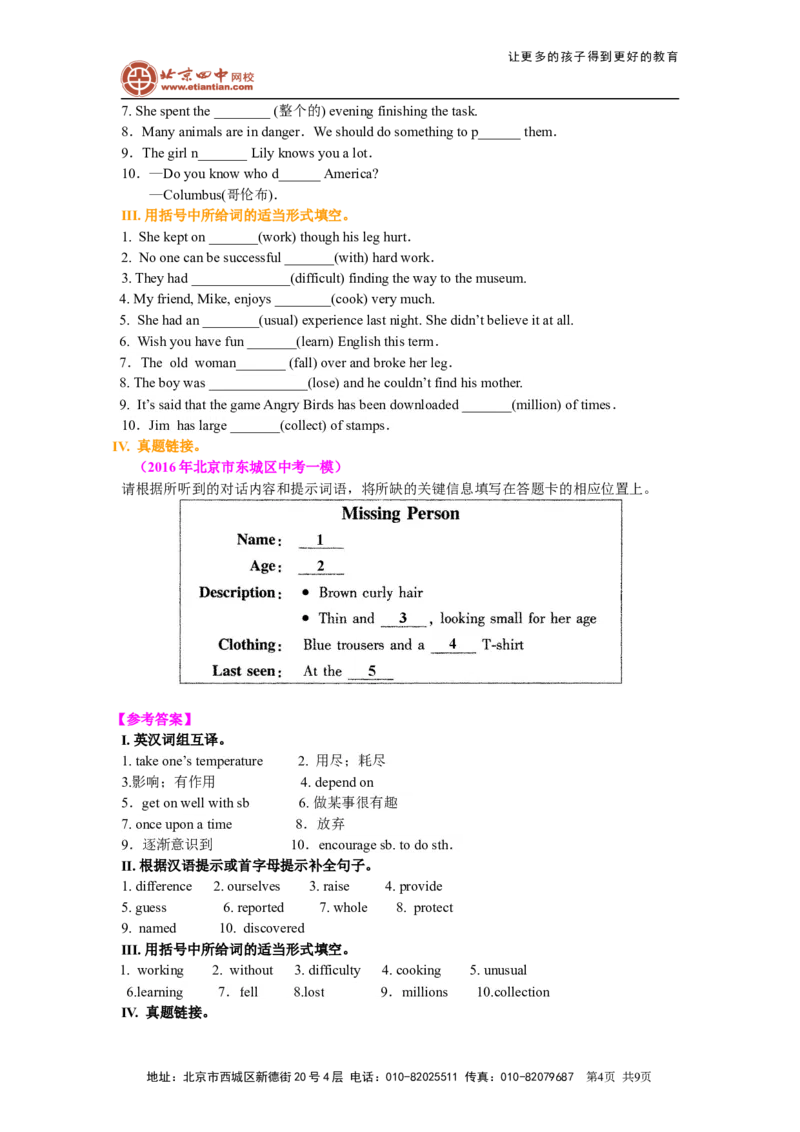
文档文本内容
                                   让更多的孩子得到更好的教育
                            Review of Units 6—10
词句精讲精练
责编:刘燕
词汇精讲
1.  hurt
(1)hurt 作及物动词,意为“使受伤,使弄痛”,过去分词和过去式都是hurt。例如:
  She hurt her right knee. 她伤了右膝。
  I hope you haven’t hurt yourself. 但愿你没有受伤。
 (2) hurt 既可指肉体上的伤害,也可指精神上、感情上的伤害。例如:
  I hurt her feelings when I said she was fat.
  我说她胖,伤害了她的感情了。
  I don’t mean to hurt you. 我并非有意伤害你。
(3)hurt 作不及物动词,意为“疼痛”。例如:
  My feet hurt when I walk. 我走路时脚疼。
  He had a fever and his head hurt.  他感冒了而且头痛。
2. raise
raise 是及物动词,意为“筹集”。常用短语:raise sth. for sb./ sth.意为“为某人/物 而筹
集……”。例如:
  We raise money for Hope Project. 我们为希望工程筹钱。
【拓展】
(1) raise 作及物动词,意为“提升,举起,升起”。例如:
  raise one’s hand 举手
  raise one’s glasses to sb. 举杯祝福某人
(2) raise 作及物动词,还可意为“种植;饲养;培养;抚养”。例如:
  Their family raised much rice. 他们家种了很多稻米。
3.  as a result
as a result 为习惯短语,意为“因此;结果”,在句中作状语。例如:
She didn’t practice, and as a result she lost.
她没有练习,所以输了。
The traffic was very heavy and as a result we didn’t arrive on time.
交通十分拥挤,因此我们没有能准时到达。
【拓展】
as a result of 意为“由于……;作为……的结果”。先交代结果,再用as a result of 连接原因。
例如:We can’t go out as a result of the heavy rain.
因为下大雨,我们不能出去。
4. offer
(1)offer 作动词,意为“给予;提供;提出”。例如:
  He offered me 500 dollars for that old car.
  他出500 美元向我买那辆旧车。
  Offer some coffee to the guests.
  给客人端些咖啡来。
  He offered me a cup of tea.
  他给了我一杯茶。
(2)offer to do sth. 表示“愿意做某事;主动提出做某事”。例如:
地址:北京市西城区新德街20 号4 层 电话:010-82025511 传真:010-82079687  第1页 共9页
                                   让更多的孩子得到更好的教育
  I offered to help my mother do housework.
  我主动提出帮助妈妈做家务。
  He offered to drive me to the station.
  他表示愿意开车送我去车站。
5. beat
 beat 是及物动词,有以下用法:
 (1) 意为“赢;打败;战胜”,后接人或某一团队、组织等,其过去式为beat。
 例如:
 I beat him at long jump yesterday. 昨天跳远我赢了他。
 (2) 意为“打;击”,表示连续不断的打击。例如:
 Who is beating the drum? 谁在打鼓?
 (3) 表示“(心脏)等跳动”。例如:
 I feel my heart is beating fast. 我觉得我的心脏在剧烈跳动。
 【拓展】
 beat 和win 都有“赢”的意思,但用法不同:
 beat 的宾语为人或相当于人的团体、组织;而win 的宾语为比赛或某个项目,过去式为
won。例如:
 Though we were weak, we beat them. 虽然我们弱,但我们赢了他们。
 Who win the first prize in the competition? 谁在比赛中赢得了一等奖?
6. maybe
maybe 作副词,意为“也许;大概”。例如:
Maybe he is a teacher. 也许他是个老师。
【拓展】辨析:maybe 与may be
(1) maybe 是副词,主要用于非正式场合,口语中常用。意为“也许,大概”。它通常放在句
子的开头,在句子中作状语。例如:
  Maybe they won’t go there tonight. 他们大概今晚不会去那儿。
  Maybe he is happy. 也许他是幸福的。
(2) may be 是“情态动词may+动词原形be”构成的,在句中做谓语,意为“可能是、大概
是”。
 例如:
 She may be at home. 她可能在家。(也可以说:Maybe she is at home.)
 You may be right. 你可能是对的。(也可以说:Maybe you are right.)
7. succeed
 succeed 作不及物动词,意为“成功”;表示做某事做成功了,succeed 后通常接in doing
sth.。
 例如:
 Her plan succeeded. 她的计划成功了。
 At last we succeeded in solving the problem. 我们终于把那个问题解决了。
【拓展】
 (1) success 表示抽象意义的“成功”,作不可数名词;表示具体意义的“成功的人或事”,
则是可数名词。例如:
 Failure is the mother of success. 失败是成功之母。
 My new book was a great success. 我新出版的书获得了巨大成功。
(2)successful 作形容词,意为“成功的”。例如:
地址:北京市西城区新德街20 号4 层 电话:010-82025511 传真:010-82079687  第2页 共9页
                                   让更多的孩子得到更好的教育
 The performance was successful. 演出很成功。
 It was a successful experiment. 那是一次成功的试验。
8. mark
 mark 作可数名词,意为“痕迹;记号”。例如:
 The dogs always make dirty marks.
 这些狗总是制造斑斑污迹。
【拓展】
(1)mark 作名词,意为“分数;成绩”。例如:
 She scored the highest marks in the exam.
 她在考试中得了最高分。
 What’s your mark in your test?  你考试多少分?
(2)mark 作动词,意为“给……打分;给……评分”。例如:
 The teacher marked the examination papers.
 教师给试卷打了分数。
9. collect
 collect 作及物动词,意为“收集,搜集”。例如:
 collect stamps 收集邮票  collect coins 收集硬币
【拓展】
collection 作名词,意为“收藏品、收集物”。是动词collect 的名词形式,是由动词collect 后
缀-tion 变化来的。 collector 作名词,意为“收藏家”。例如:
These are my collections.     这些是我的收藏品。
My brother has a very good collection of stamps.
我的弟弟收集了许多邮票。
Mark is a famous stamp collector.
Mark 是一位著名的邮票收藏家。
词汇精练
I. 英汉词组互译。
 1. 量体温_________
2. run out of_______
3. make a difference ________________
4. 依靠,依赖__________
5.与某人和睦相处 ________
6.have fun doing sth.________
7. 从前___________________
8.give up________________
9. come to realize________
10.鼓励某人做某事________________
II. 根据句意及首字母提示补全句子。
1.We have made a d_______ about our study goal for the new term.
2.We should look after o_______ when we are alone at home.
3. We held a concert to r________ money for Project Hope.
4. The hotel will p_______ free breakfast for us.
5.If you don’t know the meaning of the word, just try to g_______ it.
6.It was _______(报道) that there was going to be a football match this afternoon.
地址:北京市西城区新德街20 号4 层 电话:010-82025511 传真:010-82079687  第3页 共9页
                                   让更多的孩子得到更好的教育
7. She spent the ________ (整个的) evening finishing the task.
8.Many animals are in danger.We should do something to p______ them.
9.The girl n_______ Lily knows you a lot.
10.—Do you know who d______ America?
  —Columbus(哥伦布).
III. 用括号中所给词的适当形式填空。
1. She kept on _______(work) though his leg hurt.
2. No one can be successful _______(with) hard work.
3. They had ______________(difficult) finding the way to the museum.
4. My friend, Mike, enjoys ________(cook) very much.
5. She had an ________(usual) experience last night. She didn’t believe it at all.
6. Wish you have fun _______(learn) English this term.
7.The old woman_______ (fall) over and broke her leg.
8. The boy was ______________(lose) and he couldn’t find his mother.
9. It’s said that the game Angry Birds has been downloaded _______(million) of times.
10.Jim has large _______(collect) of stamps.
IV. 真题链接。
   (2016 年北京市东城区中考一模)
请根据所听到的对话内容和提示词语,将所缺的关键信息填写在答题卡的相应位置上。

【参考答案】
I. 英汉词组互译。
1. take one’s temperature    2. 用尽;耗尽
3.影响;有作用            4. depend on
5.get on well with sb      6. 做某事很有趣
7. once upon a time         8.放弃
9.逐渐意识到           10.encourage sb. to do sth.
II. 根据汉语提示或首字母提示补全句子。
1. difference    2. ourselves     3. raise    4. provide
5. guess       6. reported     7. whole   8. protect
9. named      10. discovered
III. 用括号中所给词的适当形式填空。
1. working    2. without   3. difficulty    4. cooking   5. unusual
6.learning     7.fell     8.lost        9.millions    10.collection
IV. 真题链接。
地址:北京市西城区新德街20 号4 层 电话:010-82025511 传真:010-82079687  第4页 共9页
                                   让更多的孩子得到更好的教育
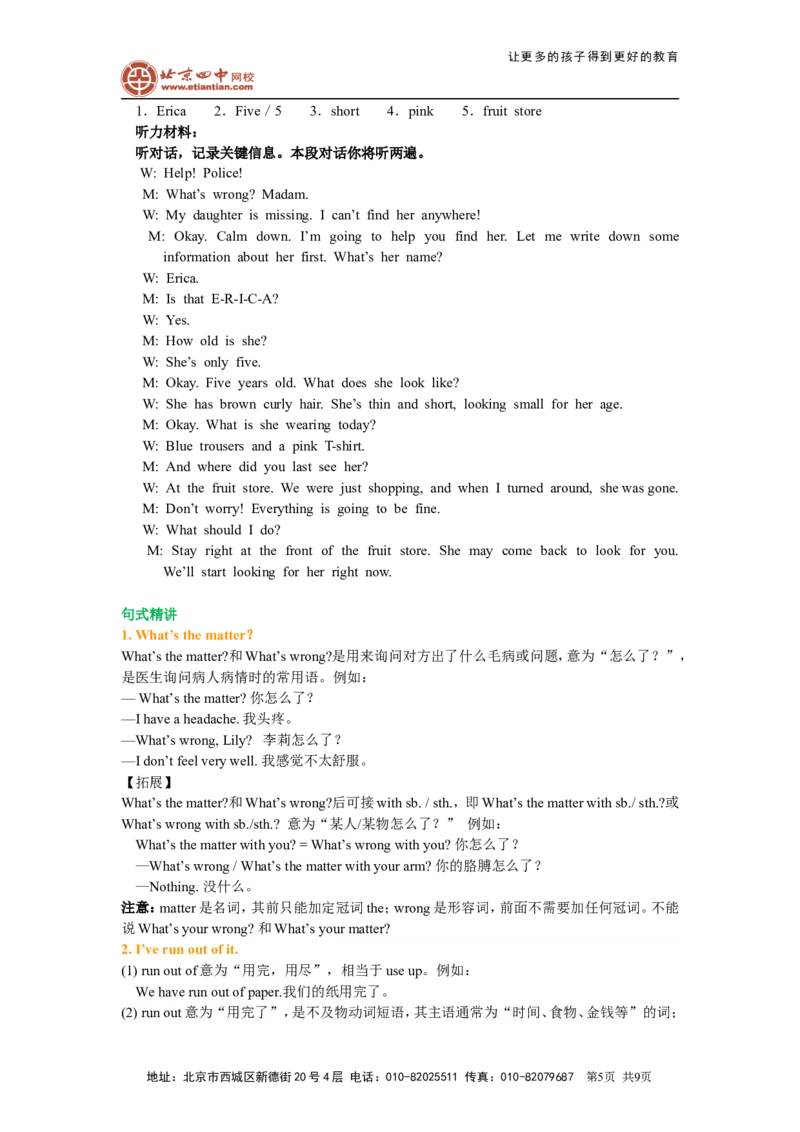
1.Erica    2.Five/5    3.short    4.pink    5.fruit store
听力材料:
听对话,记录关键信息。本段对话你将听两遍。
W: Help! Police!
   M: What’s wrong? Madam.
   W: My daughter is missing. I can’t find her anywhere!
   M: Okay. Calm down. I’m going to help you find her. Let me write down some
information about her first. What’s her name?
   W: Erica.
   M: Is that E-R-I-C-A?
   W: Yes.
   M: How old is she?
   W: She’s only five.
   M: Okay. Five years old. What does she look like?
   W: She has brown curly hair. She’s thin and short, looking small for her age.
   M: Okay. What is she wearing today?
   W: Blue trousers and a pink T-shirt.
   M: And where did you last see her?
   W: At the fruit store. We were just shopping, and when I turned around, she was gone.
   M: Don’t worry! Everything is going to be fine.
   W: What should I do?
   M: Stay right at the front of the fruit store. She may come back to look for you.
We’ll start looking for her right now.
句式精讲
1. What’s the matter?
What’s the matter?和What’s wrong?是用来询问对方出了什么毛病或问题,意为“怎么了?”,
是医生询问病人病情时的常用语。例如:
— What’s the matter? 你怎么了?
—I have a headache. 我头疼。
—What’s wrong, Lily?  李莉怎么了?
—I don’t feel very well. 我感觉不太舒服。
【拓展】
What’s the matter?和What’s wrong?后可接with sb. / sth.,即What’s the matter with sb./ sth.?或
What’s wrong with sb./sth.? 意为“某人/某物怎么了?” 例如:
 What’s the matter with you? = What’s wrong with you? 你怎么了?
 —What’s wrong / What’s the matter with your arm? 你的胳膊怎么了?
 —Nothing. 没什么。
注意:matter 是名词,其前只能加定冠词the;wrong 是形容词,前面不需要加任何冠词。不能
说What’s your wrong? 和What’s your matter?
2. I’ve run out of it.
(1) run out of 意为“用完,用尽”,相当于use up。例如:
 We have run out of paper.我们的纸用完了。
(2) run out 意为“用完了”,是不及物动词短语,其主语通常为“时间、食物、金钱等”的词;
地址:北京市西城区新德街20 号4 层 电话:010-82025511 传真:010-82079687  第5页 共9页
                                   让更多的孩子得到更好的教育
而run out of 意为“用完了”,是及物动词短语,表示主动含义,主语一般是人。例如:
 You’d better go home before your money runs out.
你最好别等钱花光再回家。
 They ran out of coal, and had to burn wood.
他们的煤用光了,只好烧柴。
3. And she won't be happy if she sees this mess.
if 后面的部分是这个句子中的条件状语从句。在以when,after,as soon as 等引导的时间状
语从句和以if,unless 等引导的条件状语从句中,如果主句是一般将来时,从句则用一般现在
时表示将来的意义。例如:
 I’ll tell him the good news when he comes back.
 当他回来的时候,我将把这个好消息告诉他。
 If it doesn’t rain, we will come here on time.
  如果不下雨,我们会按时来这儿的。
 常见的“主将从现”有以下三种情况:
 (1)条件状语从句的主句是一般将来时,那么从句常常用一般现在时。例如:
  When I grow up, I’ll be a teacher.  我长大后要当一名教师。
 (2)如果主句是祈使句,那么从句通常要用一般现在时。例如:
  Don’t laugh at others when they make mistakes.
当别人犯错误的时候,不要嘲笑他们。
 (3)如果主句是含有情态动词的一般现在时,根据需要从句多用一般现在时。
  例如:
  You should be quiet when you are in the reading room. 在阅览室时应保持安静。
4. Why don’t you talk to your parents?
  “Why don’t you + 动词原形 + 其他?”相当于“Why not + 动词原形 + 其他?”表示
“为什么不……?”,是作建议和询问。例如:
 Why don’t you go to the zoo with us? = Why not go to the zoo with us?
为什么不同我们一起去动物园呢?
 Why don’t you go swimming? = Why not go swimming? 为什么不去游泳呢?
  【拓展】
  why not 用在口语中表示赞同,意为“当然,好啊”。例如:
  — Let’s go to the movies. 我们看电影吧。
  — Why not? 好啊!
5. It doesn’t seem very possible to move a mountain.
seem 此处作连系动词,意为“似乎;好像”,后跟形容词作表语。可以和seem to be 相互转换。
例如:
  She seems very angry. = She seems to be very angry. 她好像非常生气。
【拓展】
(1) “主语 + seem + (to be) +表语”,表语多为名词或形容词,以说明主语的特征或状态。
 例如:
 He seems (to be) a very clever boy.  他看上去是一个非常聪明的男孩。
  Mr. Black seemed to be quite happy.   Black 先生好像十分快乐。
  (2) “主语 + seem + 不定式”,此句型中,seem 与不定式一起构成复合谓语。
  例如:
地址:北京市西城区新德街20 号4 层 电话:010-82025511 传真:010-82079687  第6页 共9页
                                   让更多的孩子得到更好的教育
  Mrs. Green doesn’t seem to like the picture. 格林夫人似乎不太喜欢这张画。
  The children seemed to be eating something in the room.
孩子们好像正在房间里吃东西呢。
  (3) “It seems + that 从句”,其中it 是形式主语,that 引导主语从句。例如:
  It seems that no one knows what has happened there.
似乎没有人知道在那儿发生了什么事。
  It seems to me that Mr. Brown will not come again. 在我看来布朗先生不会再来了。
6. Have you decided yet which book to write about for English class?
which book to write about 是“特殊疑问词+动词不定式”结构,在句子中作动词decide 的
宾语。相当于特殊疑问词引导的宾语从句。例如:
  I don’t know where to go.=I don’t know where I can go. 我不知道我去哪儿。
【拓展】
  疑问词what,which,how,where,when 等可以和动词不定式连用,构成不定式短语。
“疑问词+动词不定式”,可以作主语、宾语、表语等。
  When to start off hasn’t been decided yet. 什么时候出发还没决定。(作主语)
  The question is which bus to take. 问题是乘哪辆公共汽车。(作表语)
  “疑问词+动词不定式”可以由名词从句简化而来。
  I don’t know what I should do. → I don’t know what to do.
  我不知道做什么。
句式精练
I. 同义句变换。
1. They made a decision to travel abroad.
They ________ ________ travel abroad.
2. I arrived at the theatre early so that I could get good seat.
I arrived at the theatre early ________ _______ ________ get a good seat.
3. We don’t go shopping. We watch TV at home instead.
We watch TV at home _________ _________ _________ shopping.
4. The panda is kind of cute.
The panda is _______ ________ ________cute.
5. The teacher seemed angry.
__________ __________ _________ the teacher was angry.
6.He borrowed the book two weeks ago.
He ______ ______ the book since two weeks ago.
7.Mary hasn’t been to Beijing.I haven’t been to Beijing,either.
_______ Mary _______ I ______ been to Dalian.
8. Please tell me how I can use the phone. (改为同义句)
Please tell me ________ ________ _________the phone.
II.根据汉语提示完成下列句子。
1. 那位老师对我的生活产生了影响。
 The teacher________ _________ _________ to my life.
2. 我们得尽力使她振作起来。
 We had to try to _________ _________ _________.
3.你今天晚上为什么不看电视呢?
  ________ ________ ________ watch TV this evening?
地址:北京市西城区新德街20 号4 层 电话:010-82025511 传真:010-82079687  第7页 共9页
                                   让更多的孩子得到更好的教育
4.她的室友的闹钟总是在午夜响起。
 Her roommate’s alarm clock always ______ _______ at mid-night.
5. 我喜欢这些照片,它们能使我想起城市的生活。
 I like these photos and they can __________ me ____________the life in the city.
6. 他是中国最有名的音乐家之一。
 He is ______ ______ ______ ______ ______ ______in China.
7.我迫不及待坐飞机去旅行。
 I _____ ______ ______ travel around by air.
8.我常看见他在家弹钢琴。
 I often ______ ______ _______the piano at home.
III. 补全对话。
(2015 年吉林长春市中考模拟)
根据对话内容及方框中所给的句子补全对话。选项中有一项是多余的。
A. There’s a concert in Central Park this Saturday.
B. We want to go somewhere on Saturday.
C. The water park doesn’t cost much.
D. Do you two want to go?
E. Come to listen to local jazz group Blue Wind!
F. Why not go to the beach?
Emma: What are you talking about?
Jack: 1. ______
Pam: Jack wants to go to the water park. But I want to go to the beach.
Jack: The water park is more exciting.
Emma: This Saturday? Oh! I want to tell you.2. ______ You two should come with me!
Pam: What kind of concert?
Emma: Look at the notice.
(Sunday, June 26 at 6:00 p.m. 3. ______ The concert is free. Everyone is welcome!)
Jack: Wow! Free jazz music in the park!
Emma: 4. ______ The concert will be great, and it’s free!
Pam: The beach is free too! But the water park isn’t.
Jack: Hey, 5. ______.
Pam: But it’s not free!
【参考答案】
I. 同义句变换。
1. decided to    2. in order to     3. instead of going   4. a little bit
5. It seemed that  6.has kept  7.Neither;nor;have    8. how to use
II.根据汉语提示完成下列句子。
1. made a difference   2. cheer her up    3. Why don’t you
4. goes off           5. remind; of   6.one of the most famous musicians
7. can’t wait to       8.see him play
III. 补全对话。
  1. B   2. A   3. E    4. D   5. C
地址:北京市西城区新德街20 号4 层 电话:010-82025511 传真:010-82079687  第8页 共9页
                                   让更多的孩子得到更好的教育
地址:北京市西城区新德街20 号4 层 电话:010-82025511 传真:010-82079687  第9页 共9页