Unit 6 I’m going to study computer science.
Section A1 (1a-2d)
一、教学目标:
1. 语言知识目标:
1) 能掌握以下单词:grow up, computer programmer, cook, doctor, engineer,
violinist, driver, pilot, pianist, scientist, be sure about, make sure
能掌握以下句型:
─What do you want to be when you grow up?
①
─I want to be a basketball player.
─How are you going to do that?
②
─I’m going to practice basketball every day.
Where are you going to work?
③
When are you going to start?
④
I’m not sure about that.
⑤
2) 能了解以下语法:
掌握一般将来时态的构成形式;
3) 用一般将来时态表达将要做的事情。
2. 情感态度价值观目标:
每个人都有自己的梦想和对未来的打算,对于将来想要从事的职业也充满了
憧憬。 人们以常谈论他们的设想,因此,应通过学习这单元的内容来激发学生
们的学习主动性和学习兴趣,使他们更加有理想,并为实现自己的理想而不断
努力。
二、教学重难点
1. 教学重点:
1) 学习一般将来时态的构成方式。
2) 学习本课时出现的重点句型,通过在不同情景下运用来熟练运用一般将
来时态。
2. 教学难点:
用一般将来时态表达自己未来的打算。
三、教学过程
Ⅰ. Lead-in
1. 介绍自己小时候想要从事的职业,由此归纳出以前所学过的一些职业的英语
表达方式:
teacher, nurse, doctor, basketball player, runner, actor, actress…
2. 询问学生们想要从事的职业,从而引出句型:
─ What do you want to be when you grow up?
─ I want to be a basketball player.
3. 学生们看幻灯片,引导学生们进行问答自己将来所喜欢的职业。
Ⅱ. Presentation
1. 播放幻灯片,展示一些职业的图片,来引导学生们学习一些新的职业名词:
computer programmer, cook, engineer, violinist, pianist, pilot, scientist,…
2. 让学生们看大屏幕来学习记忆这些生词。
3. Tell Ss to rank them [1-12]. 1 is most interesting, 12 is least interesting.
2. Try to remember the new words.
Ⅲ. Game
1. Show some pictures in the big screen.
2. Let Ss guess what he/she does.
3. Let Ss try their best to guess the job. See which group is the best.
Ⅳ. Listening
1. T: Tell Ss to read the words of jobs in the chart. Make sure they know the meaning
of the words and sentences.
2. Play the recording for the Ss to listen and fill in the blanks.
3. Play the recording again. Check the answers with the Ss.
4. Play the recording again. Ss listen and match the jobs with activities.
5. Show the answers on the big screen.
Ⅴ. Pair work
1. Let Ss read the model with a partner.
2. Use the information in the chart of 1b. Ask and answer with a partner.
3. Let some pairs ask and answer about the chart.
Ⅵ. Listening
Work on 2a:
1. Let Ss look at the pictures below. Explain the activities in the pictures if necessary.
2. Play the recording for the Ss to listen and check (√) the correct boxes in the
picture.
3. Play the recording again to check the answers.
Work on 2b:
1. Let Ss read the chart below. Tell Ss that they’ll listen to Cheng Han’s plan for the
future. They should answer the questions:
“What” means “What is Cheng Han want to be?”
“Where” means “where is Cheng Han going to work?”
“How” means “How is he going to do it? ”
“When” means “when is he going to start?”
2. Play the recording for the Ss to write the correct answers in the chart.
3. Play the recording again to check the answers.
Ⅶ. Pair work
1. Tell Ss to ask and answer about Cheng Han’s plans using the information in 2b.
2. Give a model to the Ss.
3. Ss work in pairs. Try to ask and answer about Cheng Han’s plans.
4. Ask some pairs to act out their conversations.
Ⅷ. Role-play
1. Read the conversations and answer the two questions:
①What does Ken want to be? __________________________________
How is he going to do that? __________________________________
②
What does Andy want to be? ____________________________________
③
2. Explain main points in the conversation.
The Old Man and the Sea by Hemingway. 海明威的《老人与海》。 此处
介词by 为“由……所著”之意。再如:a short story by Lu Xun (鲁迅的
一部短篇小说),the music by Mozart(莫扎特写的音乐),paintings by Van
Gogh(梵高的绘画)等。
Then you can be anything you want! 那么你就能当上你想做的人了。
此句的基本意思是you can be anything,不定代词anything 指代未来所
从事的某一职业,you want 用来修饰anything。
3. Let Ss read the conversation after the teacher.
4. Practice the conversation with their partner. Then let some pairs to act out the
conversation.
Homework:
1. Recite the conversation in 2d after school.
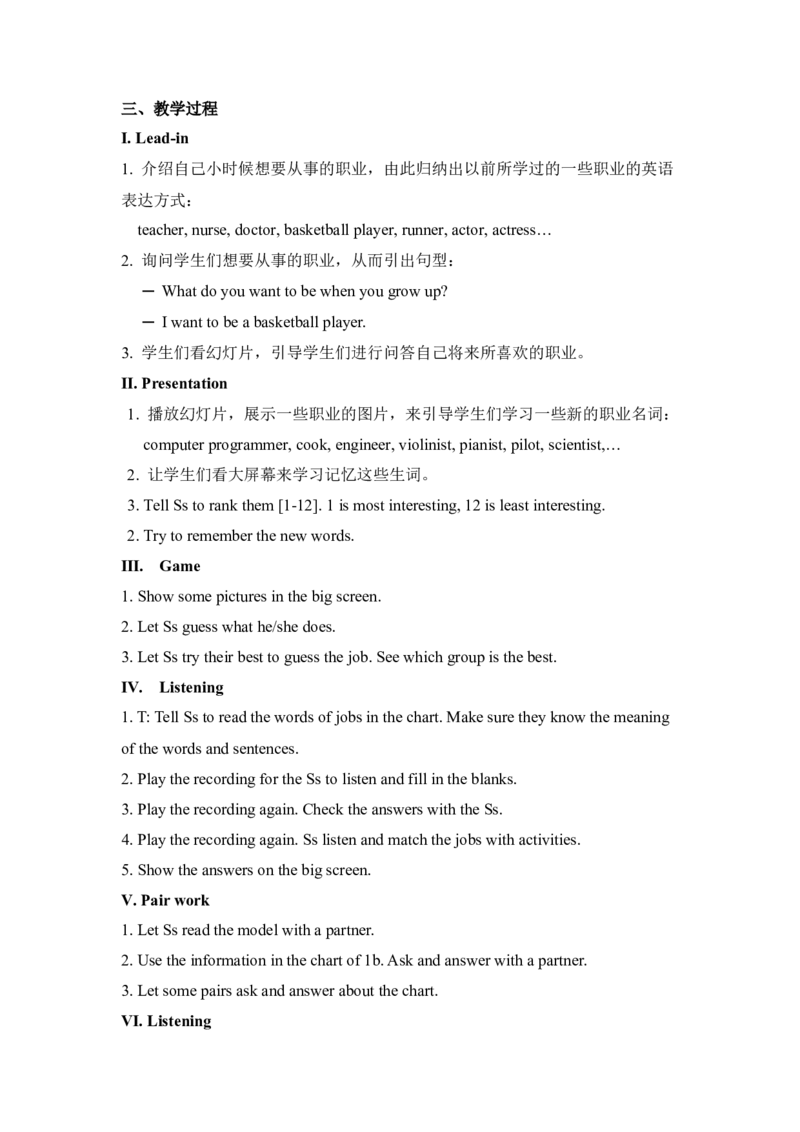
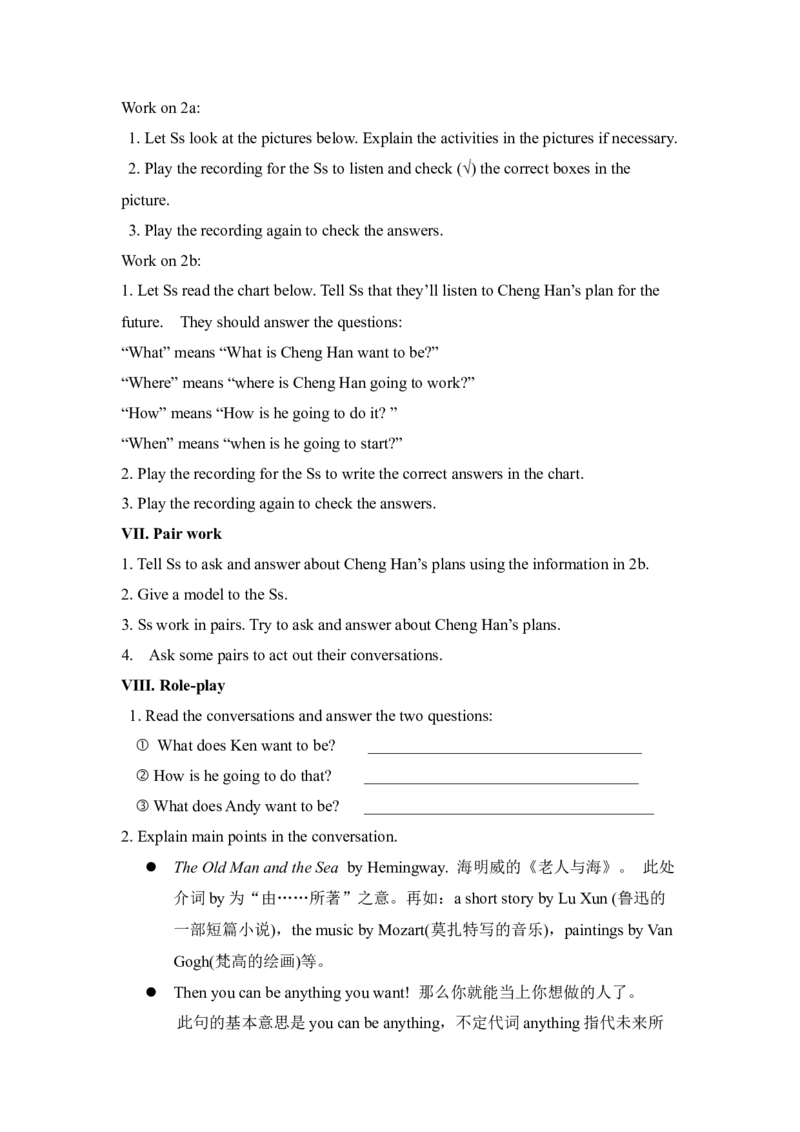
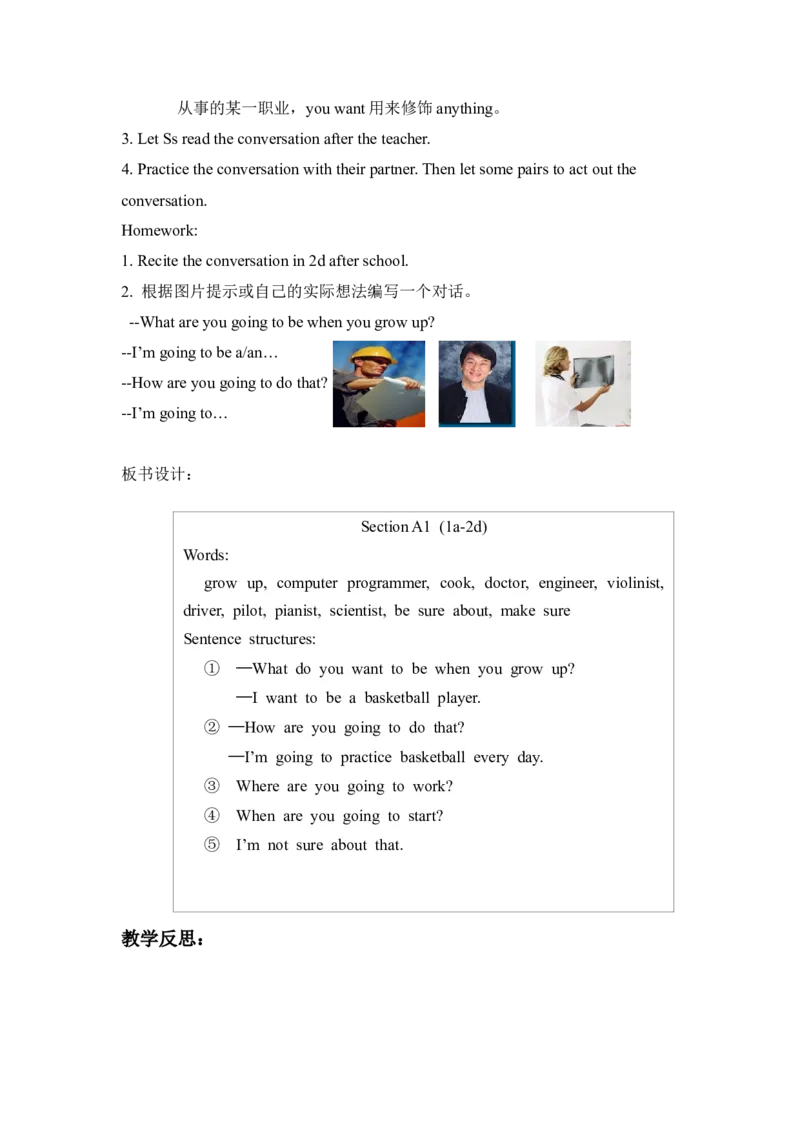
2. 根据图片提示或自己的实际想法编写一个对话。
--What are you going to be when you grow up?
--I’m going to be a/an…
--How are you going to do that?
--I’m going to…
板书设计:
教学反思:
Section A1 (1a-2d)
Words:
grow up, computer programmer, cook, doctor, engineer, violinist,
driver, pilot, pianist, scientist, be sure about, make sure
Sentence structures:
① ─What do you want to be when you grow up?
─I want to be a basketball player.
② ─How are you going to do that?
─I’m going to practice basketball every day.
③ Where are you going to work?
④ When are you going to start?
⑤ I’m not sure about that.
Section A2 (Grammar focus-3c)
一、教学目标:
1. 语言知识目标:
1) 学习掌握下列词汇:college, education, medicine, university, London, article,
send
2)进行下一步复习巩固学习Section A 部分所学的生词和词组。
3)总结一般将来时态的句子结构,并掌握其在不同句式中的句子结构。
4) 能够熟练运用一般将来时态的句子来表达自己未来的打算和做法等情况。
2. 情感态度价值观目标:
每个人都有自己的梦想和对未来的打算,对于将来想要从事的职业也充满了
憧憬。 人们以常谈论他们的设想,因此,应通过学习这单元的内容来激发学生
们的学习主动性和学习兴趣,使他们更加有理想,并为实现自己的理想而不断
努力。
二、教学重难点
1. 教学重点:
1) 复习巩固Section A 部分所学的生词和词组,达到熟练运用的目标。
2) 能够熟练运用一般将来时态的句子来表达自己未来的打算和做法等情况。
2. 教学难点:
1) 掌握一般将来时态的句子结构,并掌握其在不同句式中的句子结构。
2) 能够熟练运用一般将来时态的句子来表达自己未来的打算和做法等情况。
三、教学过程
Ⅰ. Warming- up and revision
1. Have a dictation of the new words learned in the last class.
2. Game: Give some riddles on jobs to the Ss. Ss try to guess the job.
3. Ask and answer what they want to be and how they’re going to do that.
4. Role-play the conversation in 2d.
Ⅱ. Grammar Focus.
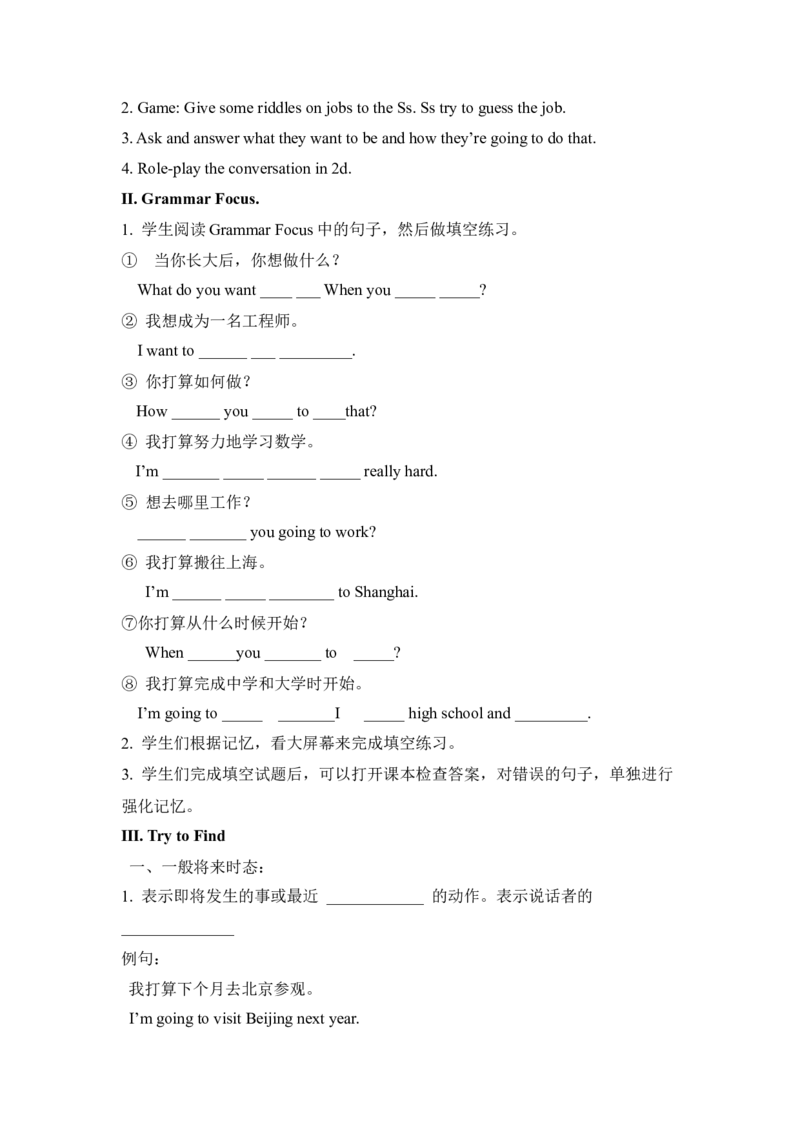
1. 学生阅读Grammar Focus 中的句子,然后做填空练习。
① 当你长大后,你想做什么?
What do you want ____ ___ When you _____ _____?
② 我想成为一名工程师。
I want to ______ ___ _________.
③ 你打算如何做?
How ______ you _____ to ____that?
④ 我打算努力地学习数学。
I’m _______ _____ ______ _____ really hard.
⑤ 想去哪里工作?
______ _______ you going to work?
⑥ 我打算搬往上海。
I’m ______ _____ ________ to Shanghai.
⑦你打算从什么时候开始?
When ______you _______ to _____?
⑧ 我打算完成中学和大学时开始。
I’m going to _____ _______I _____ high school and _________.
2. 学生们根据记忆,看大屏幕来完成填空练习。
3. 学生们完成填空试题后,可以打开课本检查答案,对错误的句子,单独进行
强化记忆。
Ⅲ. Try to Find
一、一般将来时态:
1. 表示即将发生的事或最近 ____________ 的动作。表示说话者的
______________
例句:
我打算下个月去北京参观。
I’m going to visit Beijing next year.
她打算长大后,搬往上海。
She’s going to move to Shanghai when I grow up.
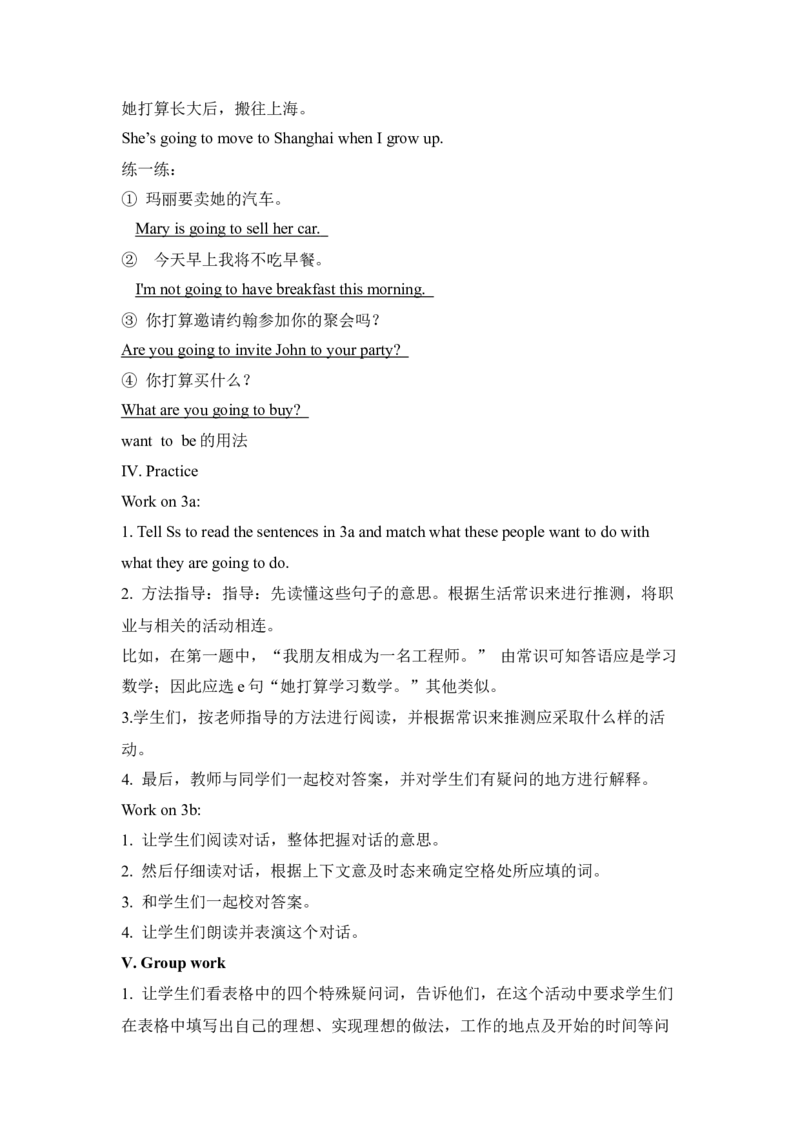
练一练:
① 玛丽要卖她的汽车。
Mary is going to sell her car.
② 今天早上我将不吃早餐。
I'm not going to have breakfast this morning.
③ 你打算邀请约翰参加你的聚会吗?
Are you going to invite John to your party?
④ 你打算买什么?
What are you going to buy?
want to be 的用法
Ⅳ. Practice
Work on 3a:
1. Tell Ss to read the sentences in 3a and match what these people want to do with
what they are going to do.
2. 方法指导:指导:先读懂这些句子的意思。根据生活常识来进行推测,将职
业与相关的活动相连。
比如,在第一题中,“我朋友相成为一名工程师。” 由常识可知答语应是学习
数学;因此应选e 句“她打算学习数学。”其他类似。
3.学生们,按老师指导的方法进行阅读,并根据常识来推测应采取什么样的活
动。
4. 最后,教师与同学们一起校对答案,并对学生们有疑问的地方进行解释。
Work on 3b:
1. 让学生们阅读对话,整体把握对话的意思。
2. 然后仔细读对话,根据上下文意及时态来确定空格处所应填的词。
3. 和学生们一起校对答案。
4. 让学生们朗读并表演这个对话。
Ⅴ. Group work
1. 让学生们看表格中的四个特殊疑问词,告诉他们,在这个活动中要求学生们
在表格中填写出自己的理想、实现理想的做法,工作的地点及开始的时间等问
题。
2. 学生们与自己的小组成员一起来讨论自己理想、实现理想的做法,工作的地
点及开始的时间等问题,同学们根据自己的实际情况,在表格先填写出自己打
算成为什么职业的人;打算在哪里工作;打算如何做;打算什么时候开始。
3. 就上述问题,根据表格的提示,用英语进行讨论。
4. 让几个小组的同学来用英语问题上述四个问题。
(最后,可以经学生们评议来推举最有能力的小组)
Ⅵ. Exercises
If time is enough, do some more exercises on big screen.
重排下列句子,成为一段完整的对话。
A. Are you going to move to Hollywood?
B. Well, I’m going to take acting lessons.
C. What are you going to be when you grow up?
D. I’m going to finish high school and college first.
E. When are you going to start?
F. I’m going to be an actor.
G. And how are you going to become an actor?
H. No, I’m going to move to New York.
___, ___, ____, ____, ___, ___, ___, ____
Homework
1. 复习Grammar focus 中的内容。
2. 用正确的形式填空。
1) We are ____________________ (play) basketball tomorrow.
2)They __________________ (visit) their aunt next week.
3)_____Lucy______________(watch)movie with Lily tomorrow? No, _____
______.
4)There ___________________________ (be) a football match tomorrow.
5)They ___________________ (not practice guitar) next week.
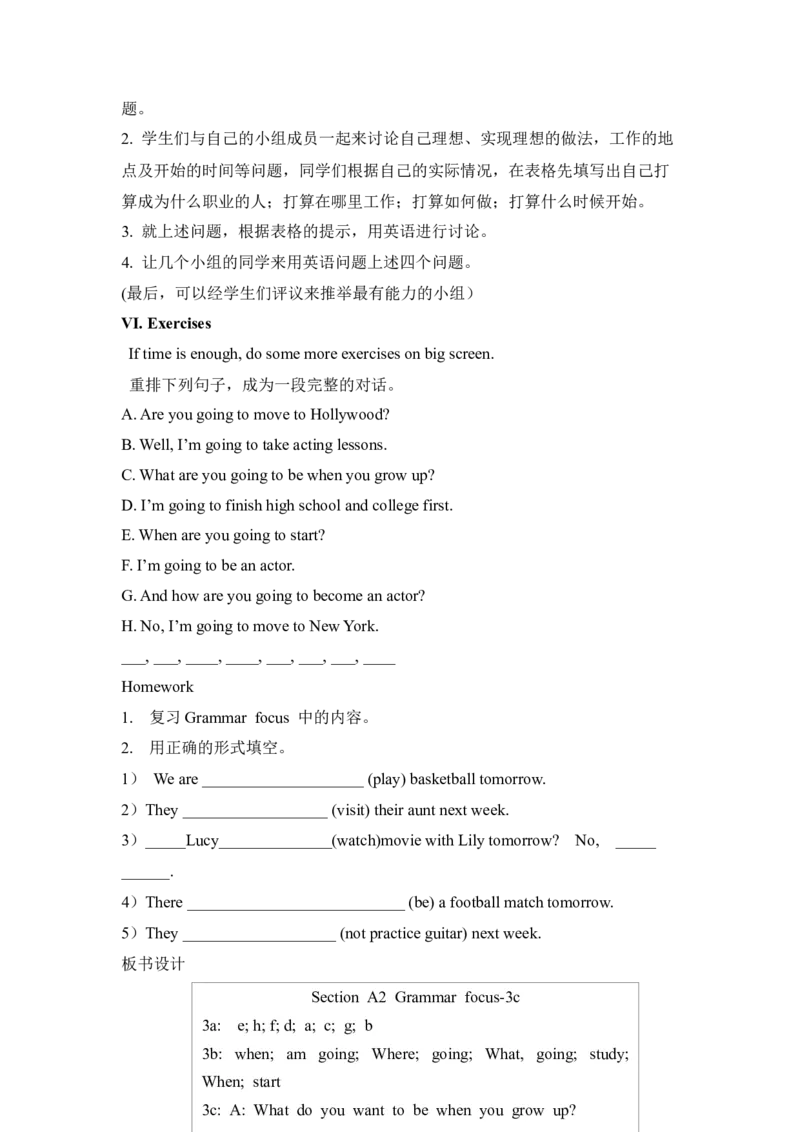
板书设计
Section A2 Grammar focus-3c
3a: e; h; f; d; a; c; g; b
3b: when; am going; Where; going; What, going; study;
When; start
3c: A: What do you want to be when you grow up?
教学反思:
Section B1 1a-2e
一、教学目标:
1. 语言知识目标:
1) 能掌握以下单词:resolution, team, foreign, able, be able to, question,
meaning, discuss, promise, beginning, write down, physical, themselves, have to do
with; self-improvement, take up, hobby, weekly, schoolwork
2) 能掌握以下句式结构:
─What are you going to do next year?
①
─I’m going to take guitar lessons.
Many resolutions have to do with self-improvement.
②
They’re going to take up a hobby like painting.
③
Sometimes the resolutions may be too difficult to keep.
④
2. 情感态度价值观目标:
每个人都有自己的梦想和对未来的打算,对于将来想要从事的职业也充满
了憧憬。 人们以常谈论他们的设想,因此,应通过学习这单元的内容来激发学
生们的学习主动性和学习兴趣,使他们更加有理想,并为实现自己的理想而不
断努力。
二、教学重难点
1. 教学重点:
1) 掌握本课时出现的生词及表达方式。
2) 进行听力训练,提高综合听说能力。
3) 阅读短文,获得相关信息,提高学生们的综合阅读能力。
2. 教学难点
1. 听力训练
2. 阅读2b 部分的短文并完成相关要求。
三、教学过程
Ⅰ. Warming- up and revision
1. Daily greeting. Check the homework.
2. 头脑风暴: 说出表示的职业名词
teacher, nurse, doctor, actor, actress, runner, basketball player, pilot, waiter,
computer programmer, pianist, scientist, violinist…
学生们可以小组为单位进行比赛,看谁写出来的最多。(在五分钟内)
3. 说理想,谈打算。
I want to be an engineer. I’m going to study math.
让学生们依次说出他们的理想及打算如何去做。(可以用大屏幕提示职业或
用学生们自己刚才写的职业)
Ⅱ. Presentation
1. T: Do you have any New Year’s Resolutions?
Let some Ss answer your questions.
2. Present some other New Year’s Resolutions on the big screen.
e.g. learn to play the piano; make the soccer team; get good grades; eat healthier food;
get lots of exercise
3. Let Ss try remember these resolutions and think of other resolutions.
Ⅲ. Talking
1. Tell your partners your New Year’s Resolutions.
2. S1: I’m going to get lots of exercise. I’m going to make a basketball team.
S2: I’m going to learn another foreign language. I’m going to learn French.
S3: …
3. Let Ss say as many resolutions as they can.
Ⅳ. Listening
Work on 1c:
1. Tell Ss to read the resolutions in 1a. Tell Ss to listen and circle the resolutions they
hear.
3. Play the recording for the Ss to listen and circle.
4. Check the answers:
Work on 1d:
1. T: Now please look at the chart in 1d. Tell Ss Lucy, Kim and Mike are talking
about their New Year’s Resolutions. How are they going to do it? Listen and try to fill
in the blanks.
听力指导:本题要求同学们听清他们打算如何做来实现他们各的理想;因此,
同学们在听的时候应将注意力放在“如何做”上;第一遍仅听,努力记住要做
的事情;第二遍的时候再写出来。
2. Ss listen to the recording carefully and try to fill in the blanks.
3. Play the recording again and check the answers with the class.
Ⅴ. Group work
1. Work in groups. Make a list of resolutions and how you are going to make them
work. Then discuss with your group.
2. Ask some pairs to act out the conversations.
3. Ask Ss the two questions:
Did you make any resolutions last year?
Were you able to keep them? Why or why not?
Ⅵ. Reading
1. T: This passage is about resolutions. Now read the passage quickly and match
each paragraph with its main purpose.
2. Let Ss read the sentences in the box first. Let some Ss say the meanings.
3. Ss read the passage quickly and match each paragraph with its main purpose.
4. Let Ss underline the words and phrases that helped them decide.
Ⅶ. Reading
1. T: Now let’s work on 2c. First, let’s read the sentences and make sure we know the
meanings of all the sentences. Then read the passage again and chose which
paragraph in the passage each sentence goes in.
2. 方法指导:首先,应读懂五个句子的意思;然后,带着这五个句子再次认真
阅读短文的内容,特别是认真阅读空格前后句子的意思,以便根据上下文意及
整个段落的意思来确定空格处应填的句子。 综合段落的主旨大意及空格上下文
的意思,确定最贴切的答案。
3. Ss read carefully and try to find the answers to the questions.
4. Check the answers with the class.
Ⅷ. Reading
1. T: Read the passage again. Then answer the questions with short sentences.
2. 方法指导:首先,读懂这五个问题的意思;然后,带着问题再次阅读短文,
为相关问题找到恰当的答语;如果没有直接的答案,还应根据自己对课文的理
解并结合自己的生活经验来给出一个恰当的答案。如:第4 和第5 小题都应是
回答自己的想法。
3. Ss try to answer the questions. Then discuss the answers with your partners.
Explanation
1. Some resolutions have to do with better planning, … 有些决定与合理的时间规
划相关,……
1) 此句中的planning 为名词,表示“计划;规划”等意思,如:city planning
(城市规划)等。英语中better planning 类似汉语中的“合理规划”,指通过制
定计划来更加充分的利用时间、空间、精力等。
2) have to do with 这个结构表示“与……相关;与……有关联或有关系”。例如:
What does this problem have to do with what we’re learning today?
这道题跟我们今天所学的内容有什么关系?
2. Sometimes the resolutions may be too difficult to keep.
有时这些决定可能会太难而无法实现。
此处情态动词may 表示推测,相当于汉语的“可能;或许;大概”之意。又如:
You may be right this time, but I’m not sure. 这一次你或许是对的,但我无法确定。
2) 英语中too…to…是一种固定结构,表示“太……而不能够……”。又如:
The kid is too young to play this game.
这孩子太小,不能玩这个游戏。
3) 本句中的动词keep 意为“履行(诺言等);遵守(惯例等)”,这是keep
的常见用法之一。类似的句子还有:
People hardly ever keep them!
人们很少履行它们(指计划)。
在这一语义下,常见的表示还有keep a promise(信守诺言),keep one’s word(遵
守承诺;说话算数)等。如:
We always keep our word.
我们说话是算数的。
Homework
1. 课后阅读短文,试着复述课文,总结课文出现的重难点词组及表达方式。
2. 完成2e 的任务;用这些词组来造句。
教学反思:
Section B2 3a-Self check
一、教学目标:
1. 语言知识目标:
1) 复习一般将来时态的构成。掌握生词own, personal, relationship
2) 能够综合运用一般将来时态及所给的提示词来完成阅读填空的任务。
3) 能够综合运用所学的知识来学习写作自己的新年决心。
4)通过完成Self check 的中练习题来全面复习一般将来时态的用法。
2. 情感态度价值观目标:
每个人都有自己的梦想和对未来的打算,对于将来想要从事的职业也充满了憧
憬。 人们以常谈论他们的设想,因此,应通过学习这单元的内容来激发学生们
的学习主动性和学习兴趣,使他们更加有理想,并为实现自己的理想而不断努
力。
二、教学重难点
1. 教学重点:
1) 能够综合运用一般将来时态及所给的提示词来完成阅读填空的任务。
2)能够综合运用所学的知识来学习写作自己的新年决心。
2. 教学难点:
能够综合运用所学的知识来学习写作自己的新年决心。
三、教学过程
Ⅰ. Warming- up and revision
1. Have a dictation of the new words and expressions.
2. Fill in the blanks of the main idea of the passage in 2b: (On the big screen)
1. A resolution is a kind of p ________. We usually make resolutions at the
b_______ of the year. We hope to i_______ our lives.
2. Some resolutions are about p_______ health. Many resolutions have to do with
self-improvement. Some resolutions have to do with better planning, like making a
w_______ plan for s___________.
3. Review the phrases. And make a sentence with it.
1) 在……的开端_________________
2) 写下;记录下 _________________
3) 关于;与有关系 _________________
4) 学着做;开始 做___________________
5) 有相同之处 ________________
6) 太……而不能 ________________
7) 向某人许诺 _____________
8) 提高某人的生活___________
Ⅱ. Lead-in
1. Ask Ss about their New Year’s Resolutions:
e.g.
T: What’s your New Year’s Resolutions, Mary?
Mary: I want to take up volleyball next term.
T: Great! What about you, Jack?
Jack:I’m going to make a soccer team. And we’re going to practice soccer every
weekend.
…
2. Present some new words on the big screen. Explain them to the Ss. Ss try to
remember them.
own, personal, relationship
Ⅲ. Reading
1. Tell Ss to work on 3b. Complete the first two paragraphs about resolutions with the
words in the box.
2. 写作指导:
首先,阅读方框中的词汇,掌握其意思,然后阅读短文,整体把握短文大意。
其次,分析有空格的每个句子,根据上下文意及句子结构确定空格处应填哪一
个词。
最后,将单词填在空格上,并完整的读一遍短文,看是否通顺。
3. Ss try to read the article and try to fill in the blanks.
4. Check the answers with the Ss.
Ⅳ. Writing
Work on 3b:
1. Read the headings below. Think about your own resolutions.
2. Write your own resolutions under the following heading.
(If you don’t have any ideas, you may go through the passage in 2b. )
3. Ss try to think about their own resolutions and try to write them down.
4. Check the answers with your partners.
Work on 3c:
1. Tell Ss to use the notes in 3b and write three more paragraphs about their
resolutions.
In each paragraph, write what they are going to do and why.
2. 写作指导:
本文为写自己决心、及做法,并说明原因。
因此,时态应用一般将来时态;
应先根据3b 的想法,说明自己的决心;然后,具体说一下自己打算怎
样去实现这个理由;最后,再简单地说一些做此事的原因。
应注意一般将来时态的结构(be going to),不要丢掉be 动词am。这
是同学们最易出现的错误。
3. 学生们根据写作提示,及上面表格中的提示来写作这篇文章。
4. Let some Ss read their passage to the class.
Ⅴ. Discussing
1. Discuss the environment in your city. Are the street and the park clean? Is the air
clean? Is it quiet or noisy?
2. Tell Ss: It’s everyone’s duty to keep our city clean and tidy. Can you think of a plan
to make it cleaner and greener?
3. Give Ss some examples:
We’re going to make the subway better. Then people don’t have to drive to
work.
We’re going to plant more trees and flowers in the park and street.
…
4. Ss try to write about their own plans on a piece of paper.
5. Let some Ss read out their plans. See who has a best one.
Ⅵ. Self check
Work on Self check 1:
1. Match the jobs with the school subjects.
2. Check the answers. Then let some Ss make some sentences with them. e.g.
I want to be a computer programmer. I’m going to study computer science.
3. 指导: 复习运用句型结构:I want to be…, I’m going to …
4. 学生自主写句子,然后相互检查答案。
Work on Self check 2
1. Tell Ss to read the conversation and fill in the blanks with the right words.
2. Ss work by themselves.
3. Check the answers and explain some main points. e.g.
第三行:How; going; 分析句子结构,主、谓、宾语都有,可知应缺少状语成分;
句意:你打算如何做?
3. 学生们分角色表演这个对话。
Work on Self check 3
1. Tell Ss to make their own plans using the phrases below.
2. Ss work with their partners. Write down their own plans.
3. Let some Ss read their plans. Correct any mistakes.
Homework
1. Review Section B.
2. Interview five of your friends. Ask them what they’re going to do next weekend.
Then write a report.
板书设计:
Section B2 3a-Self check
3a: are; help; make; take; is; learn; listen
3c: one possible version:
The second resolution is about improving my physical health. I’m going to
get more exercise and eat more vegetables. (Because my parents say I’m
kind of thin.) The third resolution is about improving my relationships with
my family and friends. I’m going to help mom cook meal and do the dishes.
I’m going to play games with my friends. (Because we can understand each
other well through games. )
Self check 2: want; to be; How, going; going; Where; going; going; to
be; going